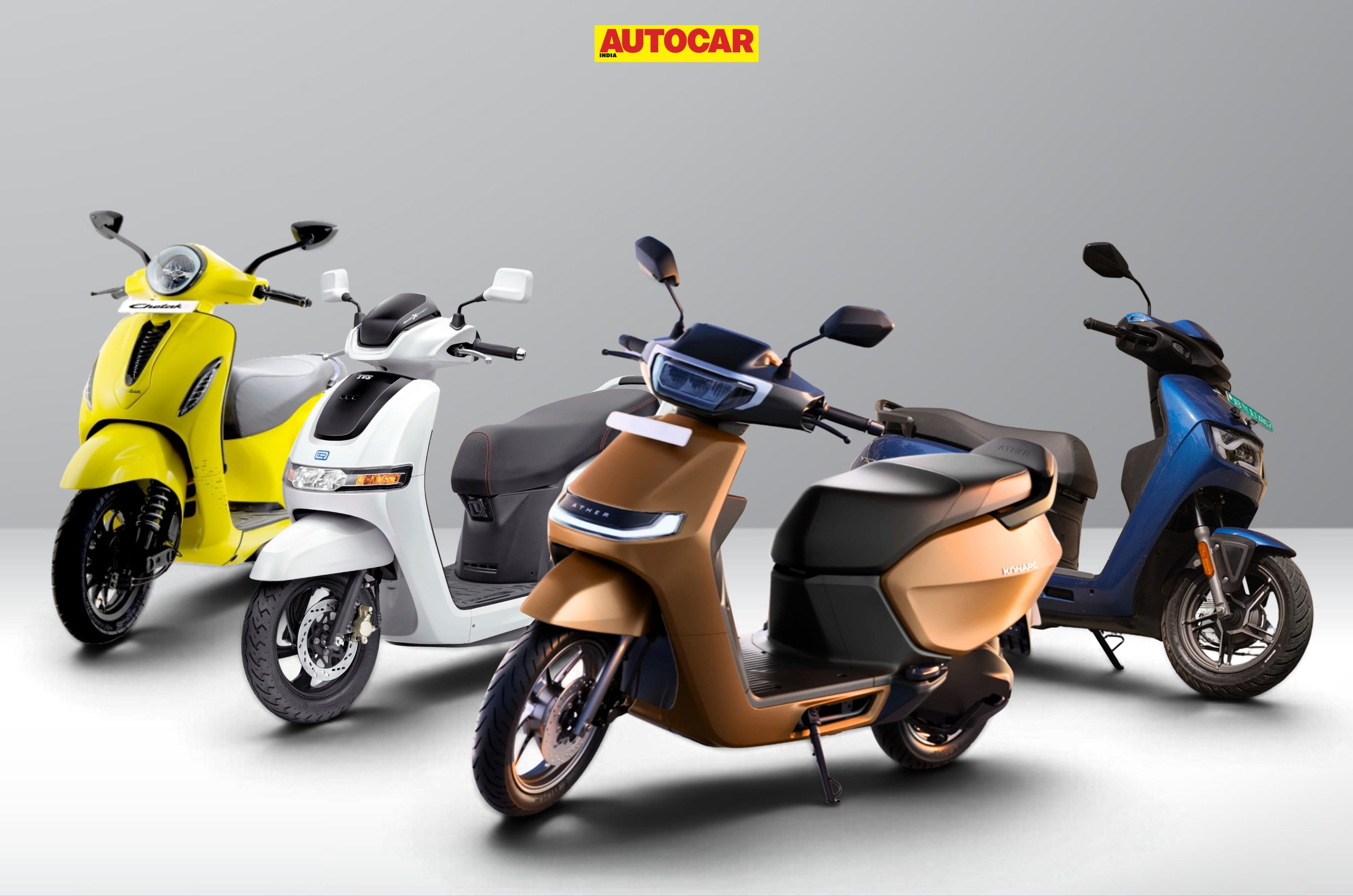
Ather Konarc S 125 vs TVS Orbiter V2: Price and specifications compared

Ather Konarc S 125 vs TVS Orbiter V2: Price and specifications compared
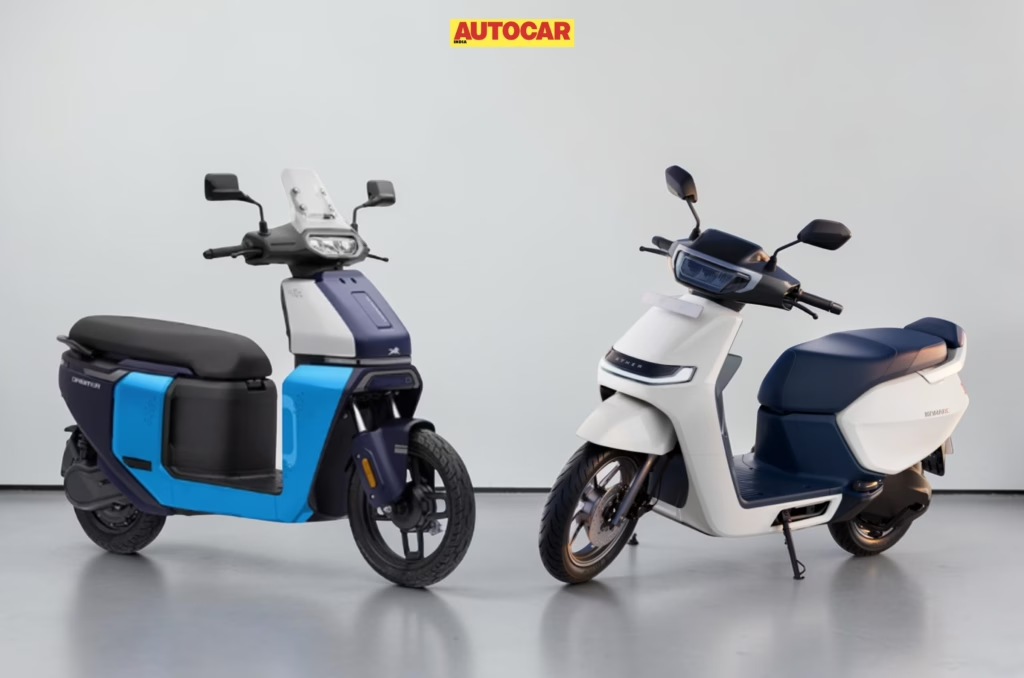
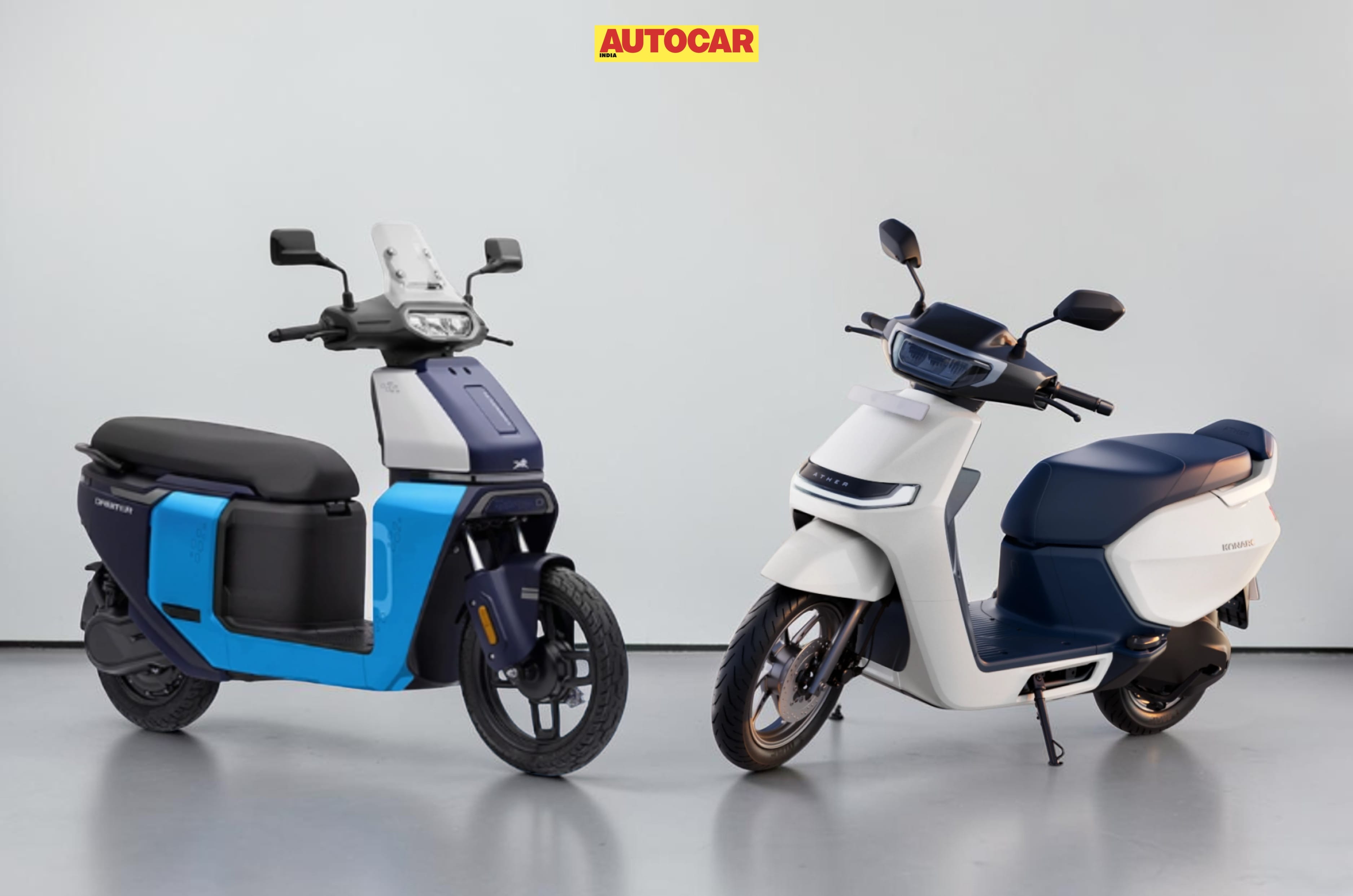
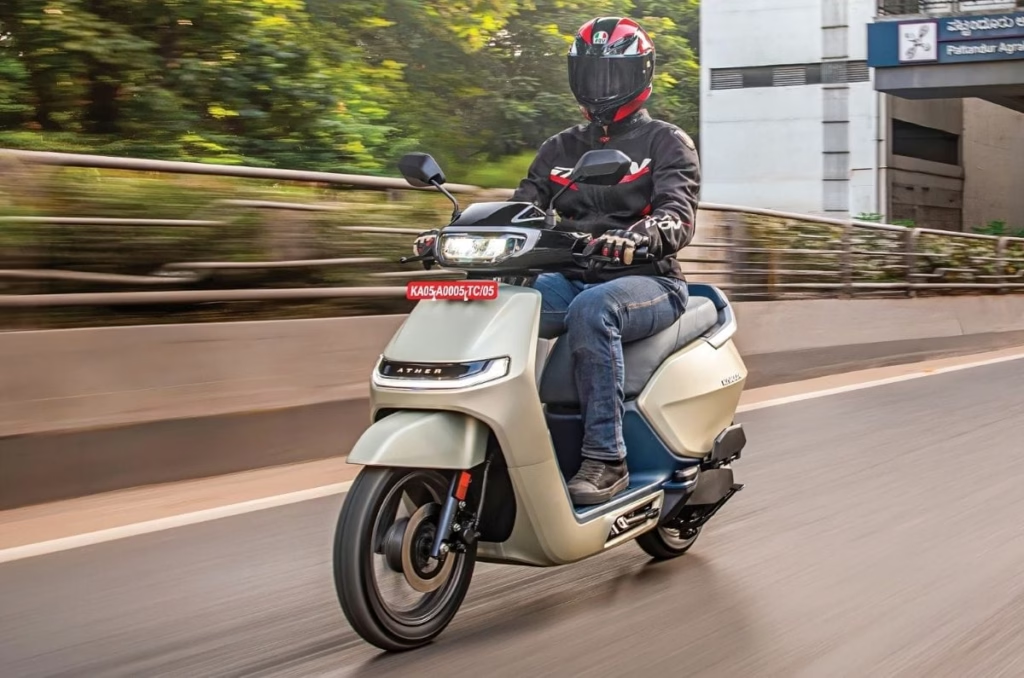
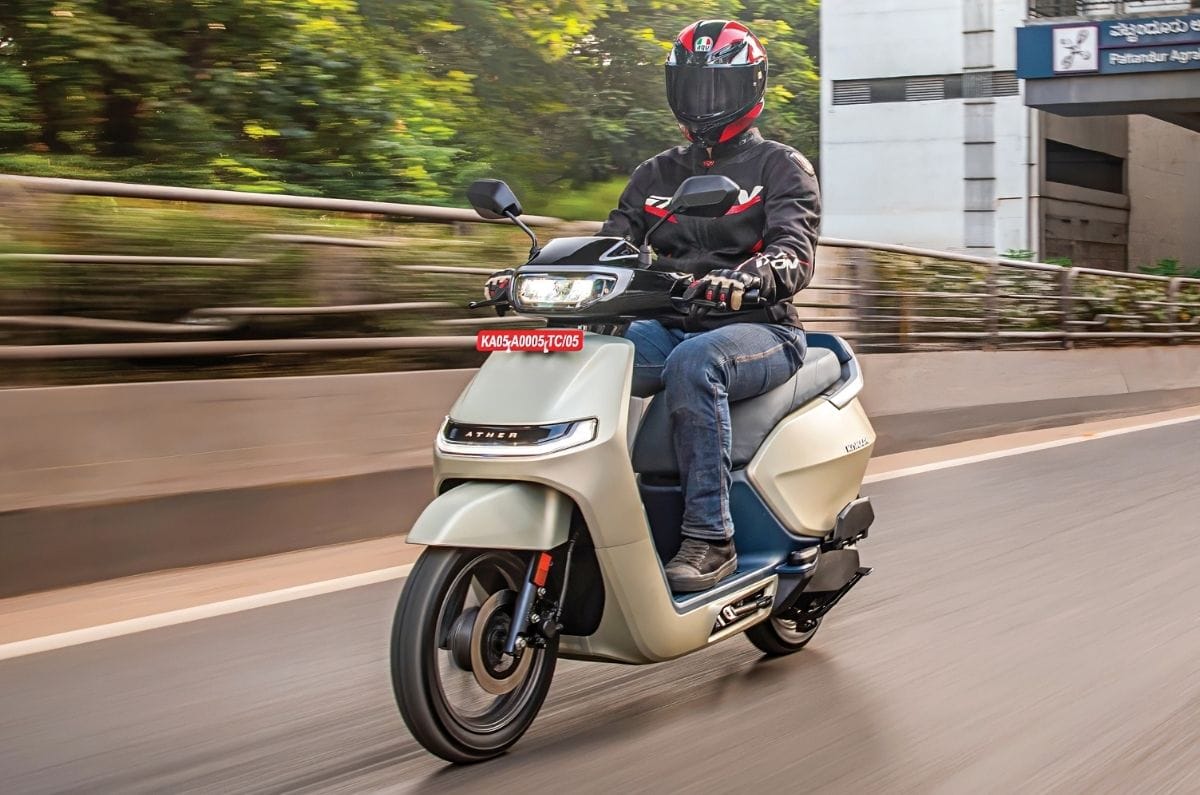
A render showing the Ather Konarc S 125 and TVS Orbiter V2

Ather has launched the Konarc with a brand-new EL platform at prices starting as low as Rs 99,999. This makes the scooter an obvious rival to the TVS Orbiter, which was revealed last year to target the urban scooter market. Since the Ather Konarc’s entry-level variant isn’t due for release until late next year, let’s see how the Konarc S 125, available later this month, compares to the TVS Orbiter V2.

Ather Konarc S 125 vs TVS Orbiter V2: Motor, battery and charging

Orbiter has more battery capacity and range


Ather Konarc S 125

TVS Orbiter V2

Peak motor power

4kW

2.9kW

Rated torque

16Nm

NA

Claimed top speed

70kph

69kph

Battery capacity

2.7kWh

3.1kWh

Claimed charge time (0-80 percent)

4h30m

4h10m

IDC range

125km

158km

Starting with the motor, the TVS Orbiter falls short of the Ather in terms of peak power. TVS has not mentioned a peak torque output for the Orbiter. However, the Orbiter bounces back with a higher battery capacity and range, as well as a quicker 0-80 charge time with a faster 650W bundled charger.

That said, both scooters offer optional hardware to speed up charging times. The Ather Konarc comes with a built-in 450W charger as standard, and it can be bundled with an external 450W charger for a faster 900W total charging speed, cutting the time down to 2 hours and 25 minutes. The Orbiter also offers a faster 950W charger as an add-on accessory, but it takes a longer 2 hours and 38 minutes to get to 80 percent from nil.

Ather Konarc S 125 vs TVS Orbiter V2: Dimensions and underpinnings

Orbiter is more accessible


Ather Konarc S 125

TVS Orbiter V2 

Wheelbase

1,352mm

NA

Seat height

770mm

760mm

Ground clearance

NA

165mm

Kerb weight

126.5kg

112kg

The Orbiter starts strong with an advantage in two important areas for a practical scooter: seat height and ground clearance. The Konarc is also the heavier scooter, with a 14.5kg higher kerb weight than the Orbiter. TVS hasn’t shared the wheelbase figure for the Orbiter.

Ather Konarc S 125 vs TVS Orbiter V2: Brakes, tyres and suspension

Konarc has the better ride package


Ather Konarc S 125

TVS Orbiter V2

Brakes (F, R)

220mm disc, 130mm drum

Drum, drum

Tyres (F, R)

90/90-14, 100/90-12

90/80-14, 90/90-12

Suspension (F, R)

Telescopic, monoshock

Telescopic, twin shock

The hardware package is where the Konarc gains significant ground. It gets a front disc brake compared to the Orbiter’s drum brake, along with wider front and rear tyres. Suspension setups are more evenly matched between the two, although the real-world experience could tip the scales towards one.

Ather Konarc S 125 vs TVS Orbiter V2: Features

TVS remains in (surprising) lockstep

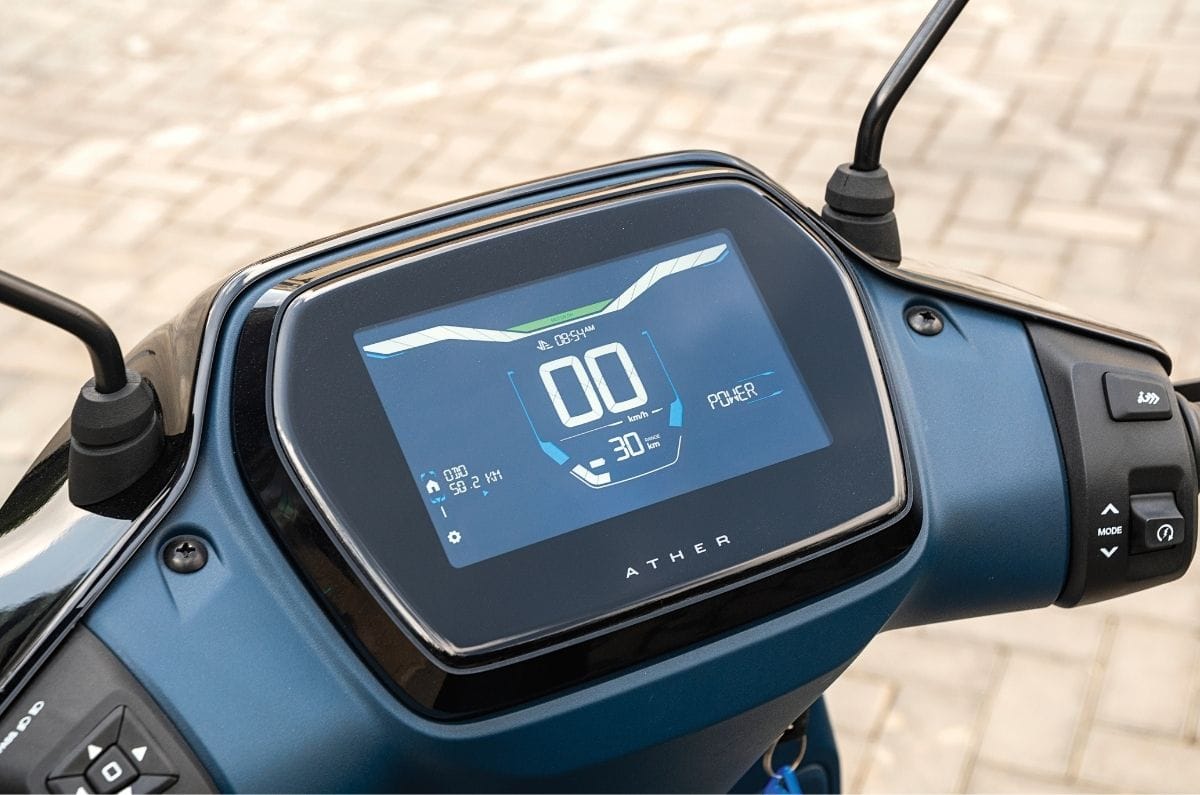
Ather has reserved most of the headlining new features, such as the TFT instrument cluster, auto (boot) pop, smart key, and so on, for the Z line. The Konarc S gets a DeepView LCD instrument cluster and comes with AirWalk, which takes the motor’s assistance to make manually moving the scooter easier. Considering Ather’s tech-savviness, this is unsurprising. Some other tech-powered features include turn-by-turn navigation, AutoHold (hill hold), Vehicle FallSafe, TrueRange, and Find my Scooter, among others. The catch, however, is that all of them require you to pay for Ather StackPro, a one-time Rs 16,000 add-on to the Konarc S 125’s ex-showroom price.

The Orbiter, on the other hand, has a much smaller LCD cluster but matches almost all of Konarc’s features, such as turn-by-turn navigation, hill-hold, smartphone connectivity, theft and tow alerts, crash and fall alerts and motor cut-off on fall. TVS also offers cruise control, which is currently only on the Ather 450 series of scooters. Right now, you get access to all the features mentioned above at no extra cost on the Orbiter, but it remains to be seen if that will change, as the TVS iQube charges an annual subscription of Rs 999 for some advanced features.

Ather Konarc S 125 vs TVS Orbiter V2: Price

Konarc starts higher, and it only gets more expensive


Ather Konarc S 125

TVS Orbiter V2

Price (ex-showroom, Bengaluru)

Rs 1.23 lakh

Rs 1.15 lakh

The two variants in comparison here make the Ather about Rs 8,000 more expensive than the Orbiter. If you prefer access to all the smart features offered by Ather StackPro, that will increase the gap even further. Even though the two e-scooters are aimed at bringing in more mainstream users to the brands, both have been designed with different demographics in mind. If you happen to be in the common demographic, though, you should definitely take a test ride before picking one over the other because the on-paper specs don’t tell the whole story.

Ather aims for a larger market presence with the Konarc

Ather aims for a larger market presence with the Konarc
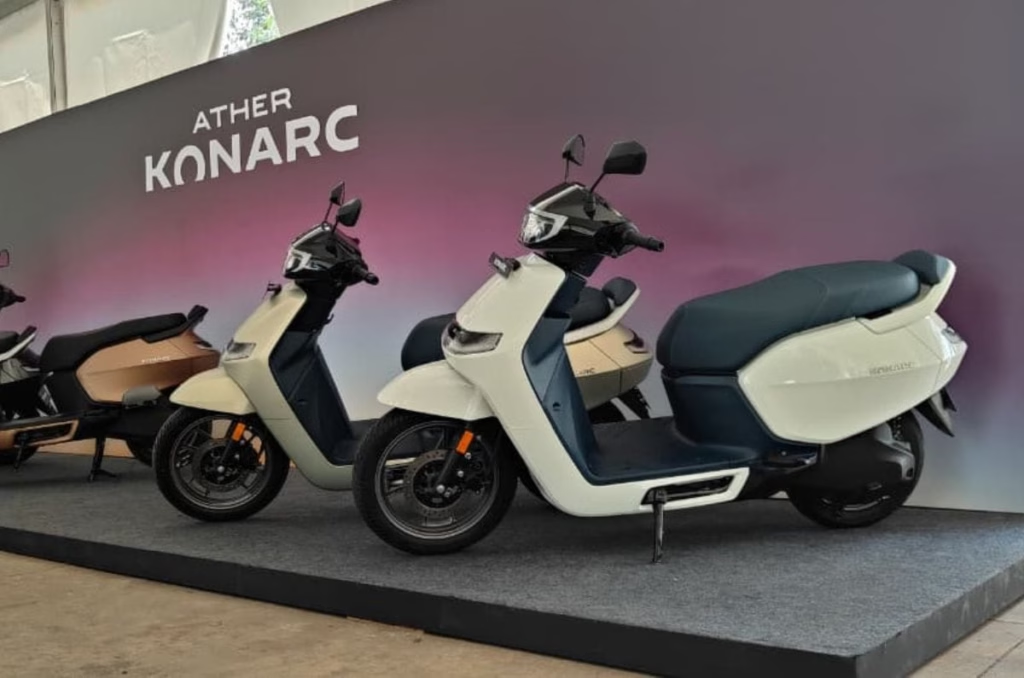
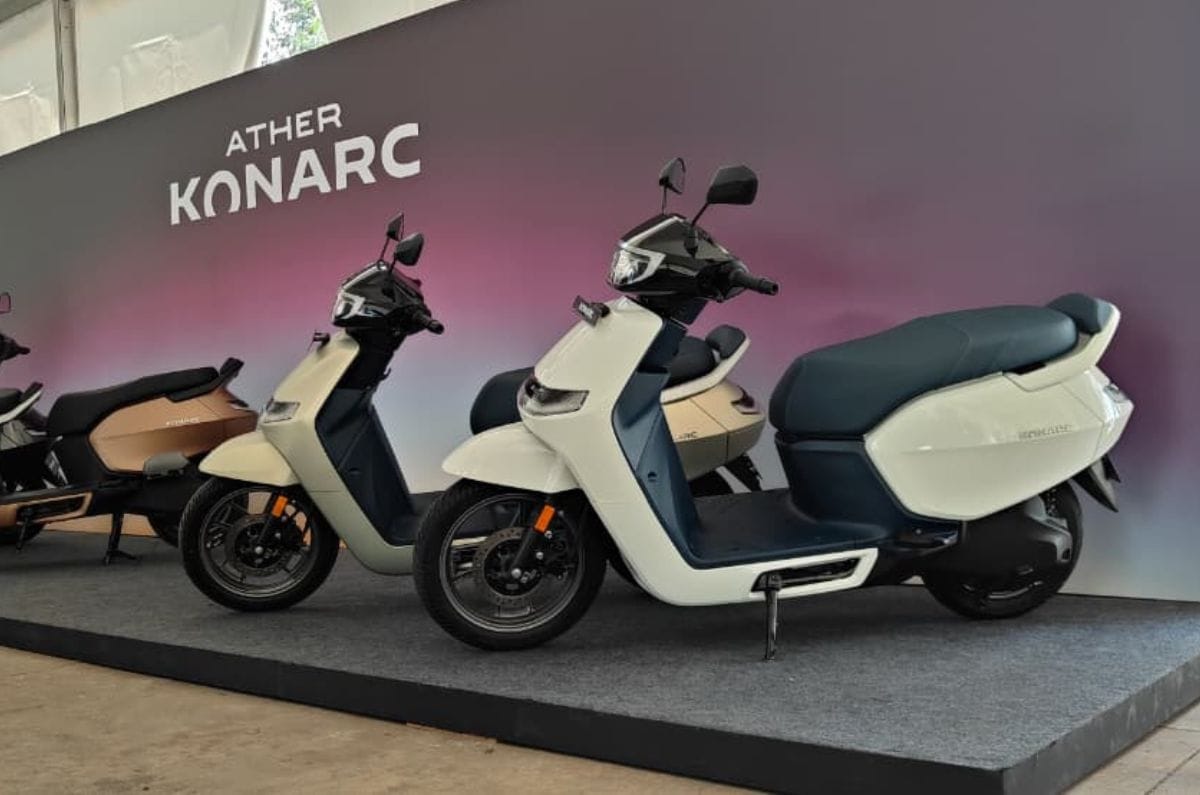
An outside image showing the Ather Konarc after the launch

Ather‘s new scooter Konarc is a broader bet for the electric two-wheeler maker to move beyond the relatively narrow customer base it has built around its technology-led products and compete for a larger share of India’s mainstream electric scooter market. Konarc is the first product on Ather’s new EL platform, which the company says was developed with safety, serviceability and scale in mind.

  1. Six different Konarcs with two available starting September
  2. Konarc doubles the service interval compared to a typical scooter
  3. AtherNode and True Health to help with charging and resale, respectively

Konarc is built to be serviced faster and less frequent

Ather says EV priorities have changed with times

The Konarc will be offered across S and Z lines. The 100km Konarc S is priced at Rs 99,999, while the 125km and 161km versions cost Rs 1.22 lakh and Rs 1.45 lakh respectively. Prices for the 200km S and the two Z variants have not been announced. The rollout will start with the S 125 and S 161 variants from September 21, followed by the 100km version in the first quarter of 2027. The Z line is scheduled for the second quarter of 2027, and the 200km S will follow in the third quarter. Once all Konarc variants are rolled out over the next year, Ather expects to have an option for 80-90 percent of the scooter market.

Ather’s own assessment is that the questions surrounding EVs have changed. Ather co-founder and CEO Tarun Mehta said that when the company started, customers asked whether an electric scooter was powerful enough, reliable enough, or even practical. As adoption has grown, the questions have become more conventional: where to charge, how safe is the battery, how long it will last, how the vehicle will be serviced and what happens when it has to be eventually sold. The company wants to solve for the three main concerns: service, charging, and resale value for its EV scooters.

Serviceability is one of the areas where Ather says the EL platform is intended to deliver an advantage. The Konarc’s service interval is 10,000 km (vs 5,000 km for most other scooters), while the number of service checkpoints has also been reduced. In a demonstration during the launch, the motor and transmission assembly was removed in 38 seconds and put back in 1 minute 33 seconds. Mehta acknowledged that service centres would not necessarily replicate these times, but said the architecture was designed to make servicing simpler.

Charging network has also been improved

Ather is solving for public and residential charging

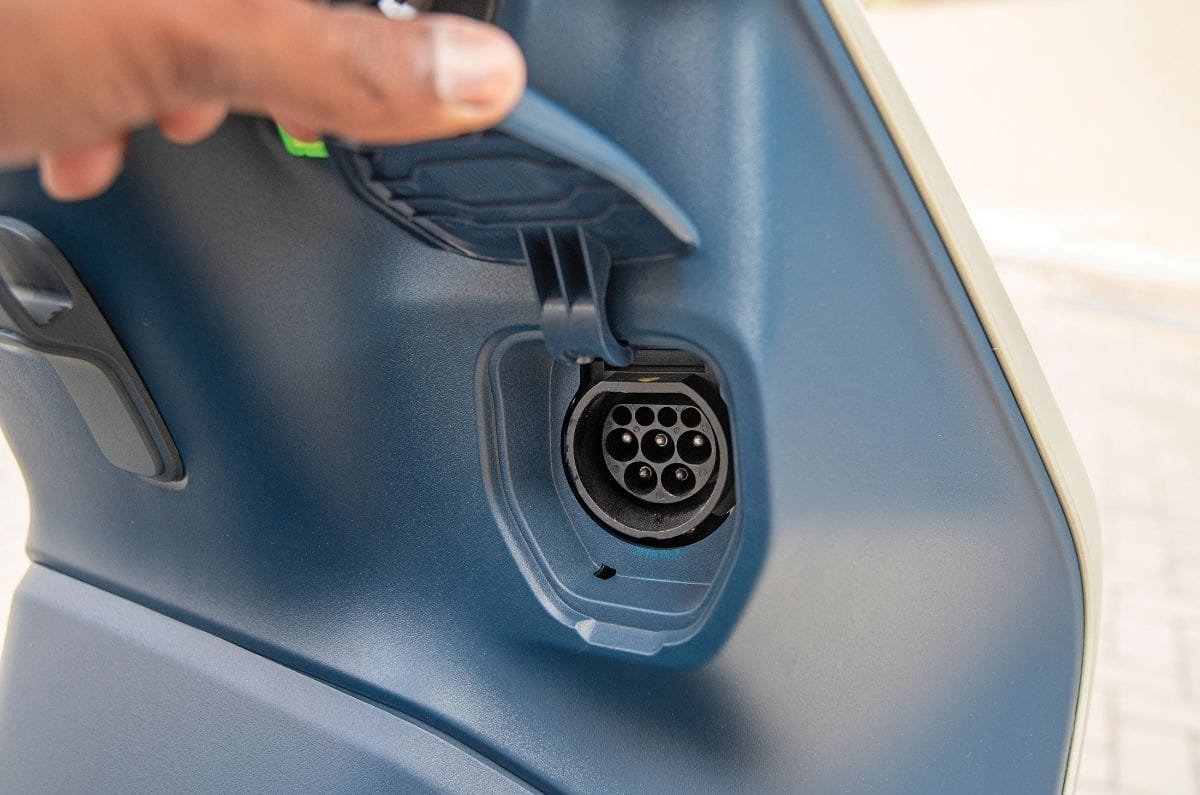
Konarc owners will of course have access to Ather’s existing network of about 6,000 public fast chargers known as Ather Grid. The company, however, sees apartment complexes as the next charging bottleneck. To solve that, it has built AtherNode, a new residential charging system, which uses a building’s common electricity supply to serve individual parking spaces. It manages the available load, queues vehicles, and generates separate bills for residents. This could allow housing societies to add more charging points without immediately upgrading their transformers. Ather plans to introduce the system in six cities from December, beginning with Bengaluru. The Konarc itself gets a 450W onboard charger and supports combined charging; which means that it can be paired with an external 450W charger to refill the battery at 900W.

Ather True Health to help with resale value

The company remains committed to its software first approach

With the Konarc, Ather has attempted to put more conventional attributes of a mass-market scooter alongside the technology it has developed over several years. The company is wanting to solve not only the product problem, but also some of the ownership concerns that could prevent customers from switching from petrol scooters. As the third prong on that front, Ather has introduced True Health on its app, a digital report covering the battery, motor, charger, dashboard, service history and wear components for eligible scooters more than three years old. Owners can view the condition of major components, the battery’s state of health and an estimated resale value. Such a company-verified report could give buyers and sellers a better basis for arriving at a price.

Finally, the company expects software adoption to remain strong even as it moves into a more mainstream segment. For example, in Madhya Pradesh, the adoption rate for AtherStack Pro initially stood at about 40 percent, but eventually crossed 88 percent with the number of stores increasing. The Konarc is Ather’s aim at a much broader part of the market, but that means competing not only with other electric scooter makers, but also with established petrol scooter brands. It remains to be seen whether the company’s push to improve serviceability, charging, and resale value will ease that challenge.

With inputs from Nayan Jain and Stephen Raj Antony.
 

Ather plans to expand to 2000 stores by 2028

Ather plans to expand to 2000 stores by 2028
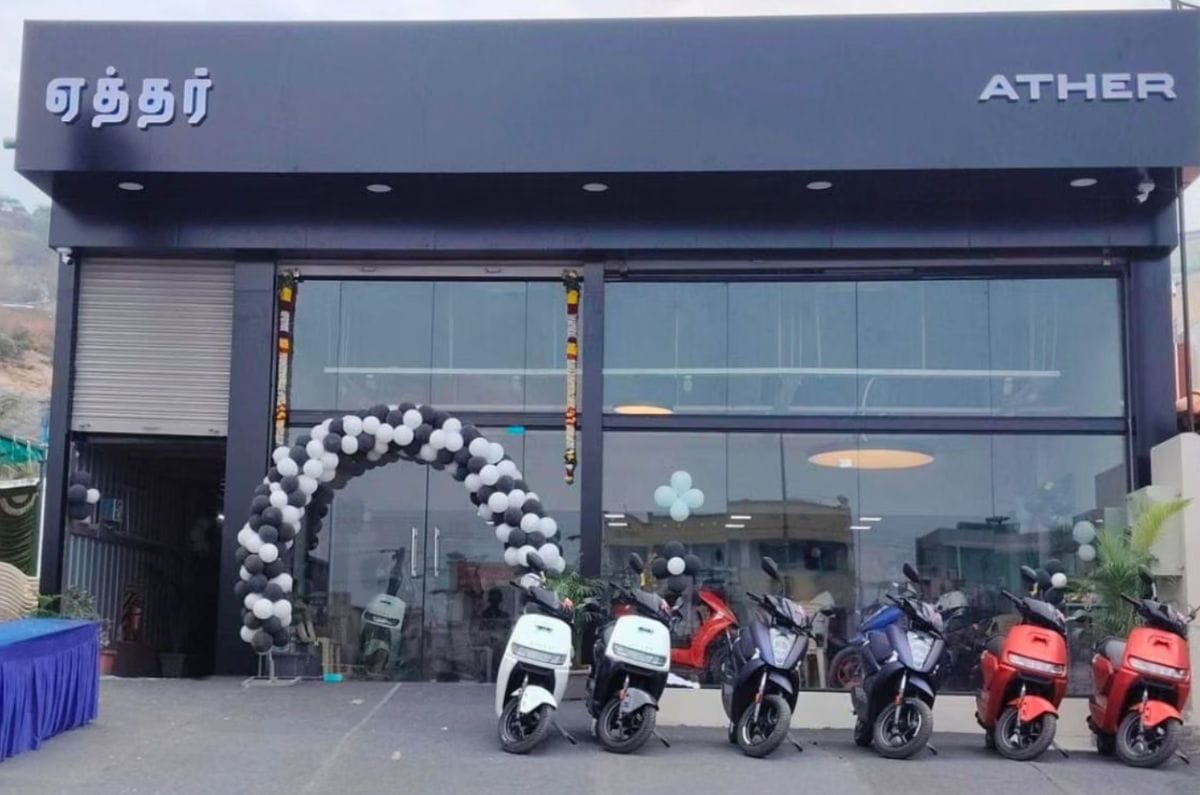
An outside image of an Ather showroom

Ather is targeting to more than double its retail footprint to between 1,800 and 2,000 stores over the next two years as the EV maker rolls out its new family scooter Konarc and expands production capacity, according to a senior company official. The company currently sells the 450X and Rizta electric scooters, which are positioned in the premium and mass premium segments of the market across some 750 stores. The company plans to use its new EL platform to broaden its product range into the more affordable segment.

  1. More scooters of different battery sizes expected from the EL platform
  2. Ather EV motorcycle at least two years away
  3. Production capacity to increase with the Aurangabad plant becoming operational

Number of retail stores and production to increase

More products expected from the Konarc’s EL platform

The newly unveiled Konarc will be available in two variants and six battery options at a starting ex-showroom price of Rs 99,999. The delivery of the first two battery options (S 125 and S 161) is set to commence in September 2026. “We are targeting 1,800 to 2,000 stores in the next 24 months,” Ather Energy’s Chief Business Officer Ravneet Phokela said. Phokela said the company expects the domestic market to remain its main focus for now, with exports only becoming important after a few years.

The EL platform, on which the Konarc is based, can produce different types of scooters, and it can also accommodate different battery sizes, wheel dimensions and dashboard designs. The company boasts that the platform helps launch more products while also reducing costs through changes like lower use of aluminium and simpler engineering. Ather has said it plans to launch multiple scooter products based on the platform first; and added that an Ather electric motorcycle is more than two years away.

Ather’s push into a wider range of scooters comes as the company looks to increase production capacity. Ather currently manufactures electric scooters at its Hosur plant, which has an annual production capacity of 4.20 lakh units. Its upcoming Aurangabad facility is expected to add another 5 lakh units of annual capacity when its first phase becomes operational later this year. The company said that it’s also considering whether to accelerate the second phase of the Aurangabad facility if demand continues to grow at its current pace.

With inputs from Stephen Raj Antony.
 

Simple Wave Launched from Rs 1.10 lakh

Simple Wave Launched from Rs 1.10 lakh
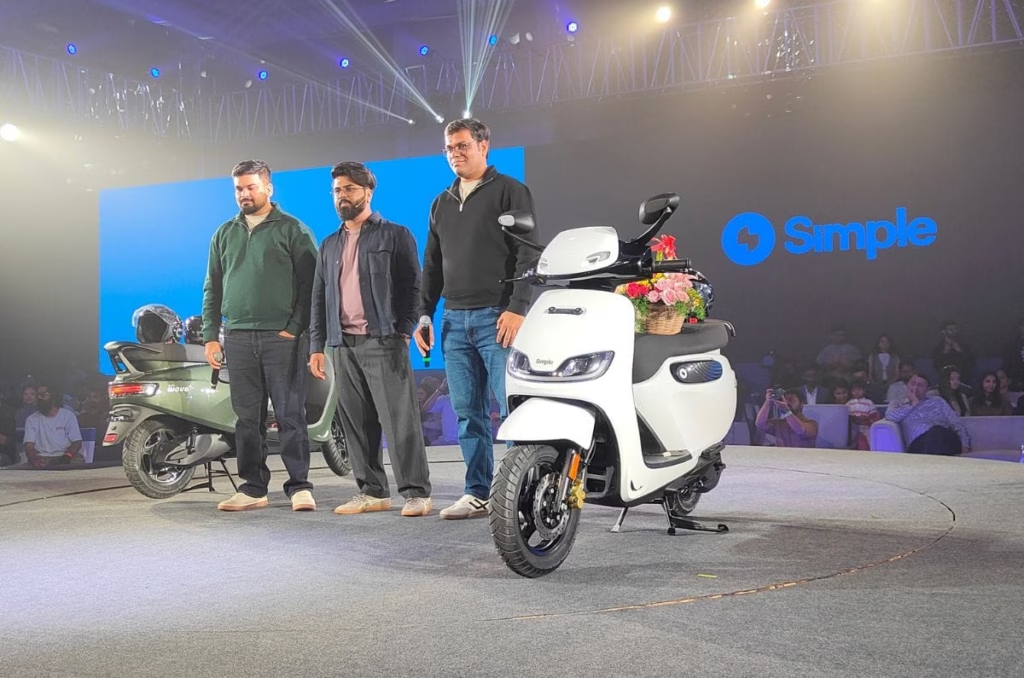
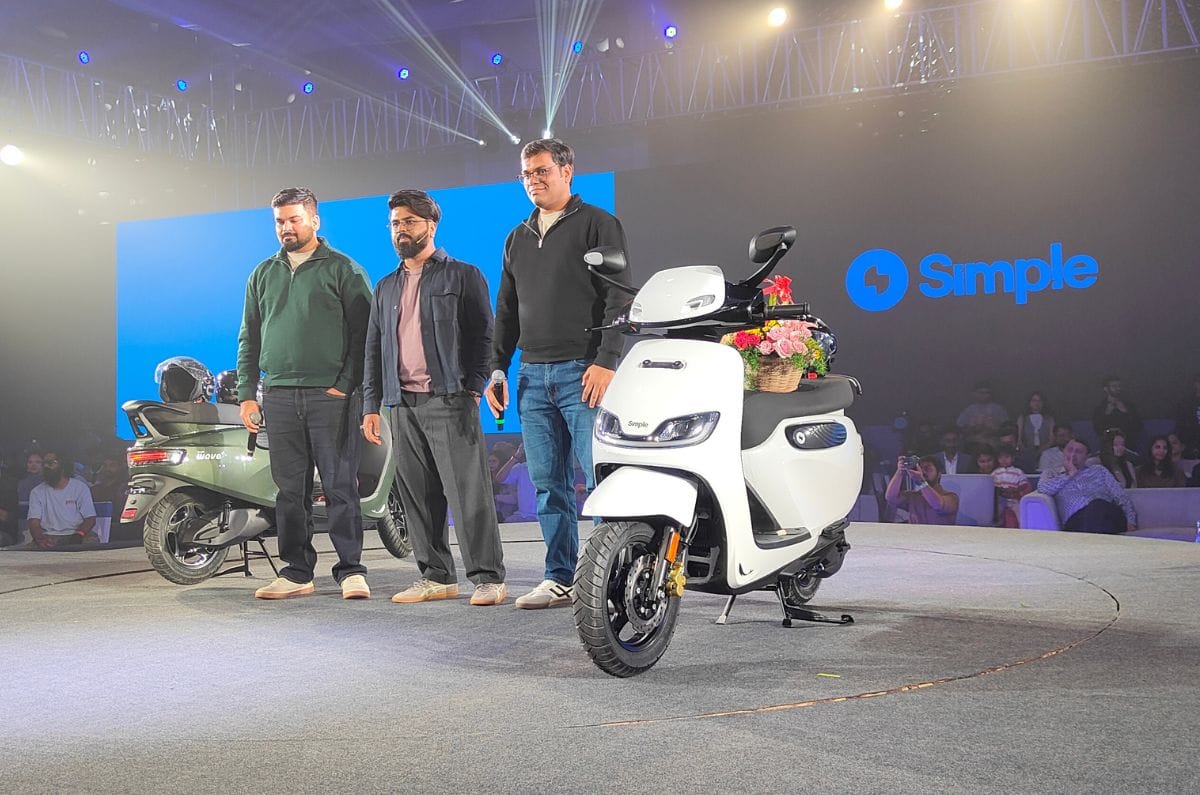
An indoor shot showing the new Wave scooter with the founders of Simple Energy on stage

Simple, the Bengaluru based EV startup, has finally launched their family scooter Wave today. The scooter was first spotted testing back in March this year and was earlier referred to as Arrive during development. Simple is looking to position this as a mass market scooter compared to their sharp, performance focussed One and One S.

  1. Simple Wave has four variants; six, if you count instrument cluster options
  2. Lowest variant has a 2.2kWh battery, top variant has a 5kWh battery
  3. Delivery starts from 25 September 2026

Simple Wave: What you should know

New and improved motor, battery, and design

The Wave is based on an updated platform of the brand’s One scooter range. The first update is to the suspension, with the Wave using a twin shock rear suspension (compared to the One’s monoshock) and a much longer seat. Speaking of which, the Wave has a whopping 920mm long seat, claimed to be the longest scooter seat in the country. The other headline is the 70L storage in the Wave. Of which, 63 litres come from the under seat compartment, three litres on the front apron cubby, and four litres from a quick access pocket on the left side of the rider’s seat (called Pill Storage). An identical pocket for the right side is offered as an accessory.

The Wave has four variants by battery capacity. The base WaveS is offered in two battery capacities, 2.2kWh and 2.7kWh with 110km and 132km of IDC range, respectively. The middle variant, Wave, has a 3.7kWh battery and 171km of IDC range, and the top Wave+ variant has a 5kWh battery and 243km of IDC range. Wave+ currently has the highest range in its segment. Compared to the One range, the powertrain has seen updates all over. The 6.4kW motor has been updated to third generation and so has the Battery Management System, with the overall size of the motor reduced by 15 percent.

For context, the One uses a 5kWh battery and an 8.8kW motor; the One S has a 3.7kWh battery and a 6.4kW motor. They offer up to 265km and 190km of claimed range, respectively. Do note that there’s also a One Ultra with a 6.5kWh battery and a motor with 8.8kW of power with a claimed 400km range, but the delivery dates for that have not been announced so far. The One Ultra is currently the most expensive scooter from Simple, priced at Rs 2.35 lakh (ex-showroom, Bengaluru).

The scooter’s design has also shifted to a sleeker silhouette, letting go of the One’s sharp and aggressive lines. Simple claims it’s inspired by water, as opposed to air for the One range. However, the Wave retains the 7-inch TFT instrument cluster. The Wave+ gets it as standard, whereas the lower variants offer an option between the TFT or an InfinityBlack LCD cluster. The WaveS variants get three ride modes (EcoX, Eco, and Ride) with a claimed top speed of 75kph. Wave and Wave+ variants add an additional Sports mode and increases the top speed to 90kph. The 2.2kWh variant is available in two colours, 2.7kWh variants in four, and the 3.7kWh and 5kWh variants in six colours.

First spotted on the test mule, the Wave swaps the rear disc from the One range for a more cost-effective rear drum brake but retains the Combined Braking System (CBS) across all four variants. However, the One scooters offer traction control as standard rider aid, with the Wave limiting it to — called GripSense now — on the higher variants. Dimensions-wise, compared to the One range, seat height has been lowered by 5mm to 775mm and ground clearance has been increased by 3mm to 175mm.

The Simple Wave has been priced starting at Rs 1.10 lakh (ex-showroom, Bengaluru). Simple has announced that deliveries commence from September 25. Prices for the higher variants hasn’t been revealed, and Simple hasn’t clarified if the delivery date applies to all the variants. With its pricing, the Simple Wave directly rivals other EV scooters like the new Ather Konarc, Bajaj Chetak, Hero Vida, and TVS iQube, with range as its biggest trump card over all of them.
 

Ather Konarc S 161 review: The next big thing?

Ather Konarc S 161 review: The next big thing?

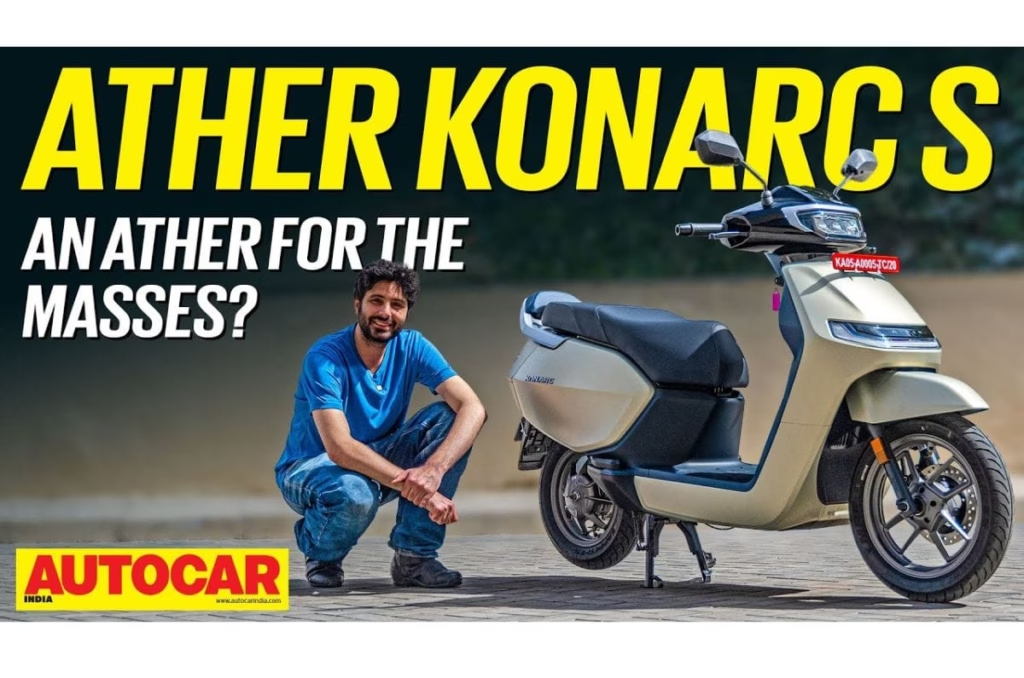
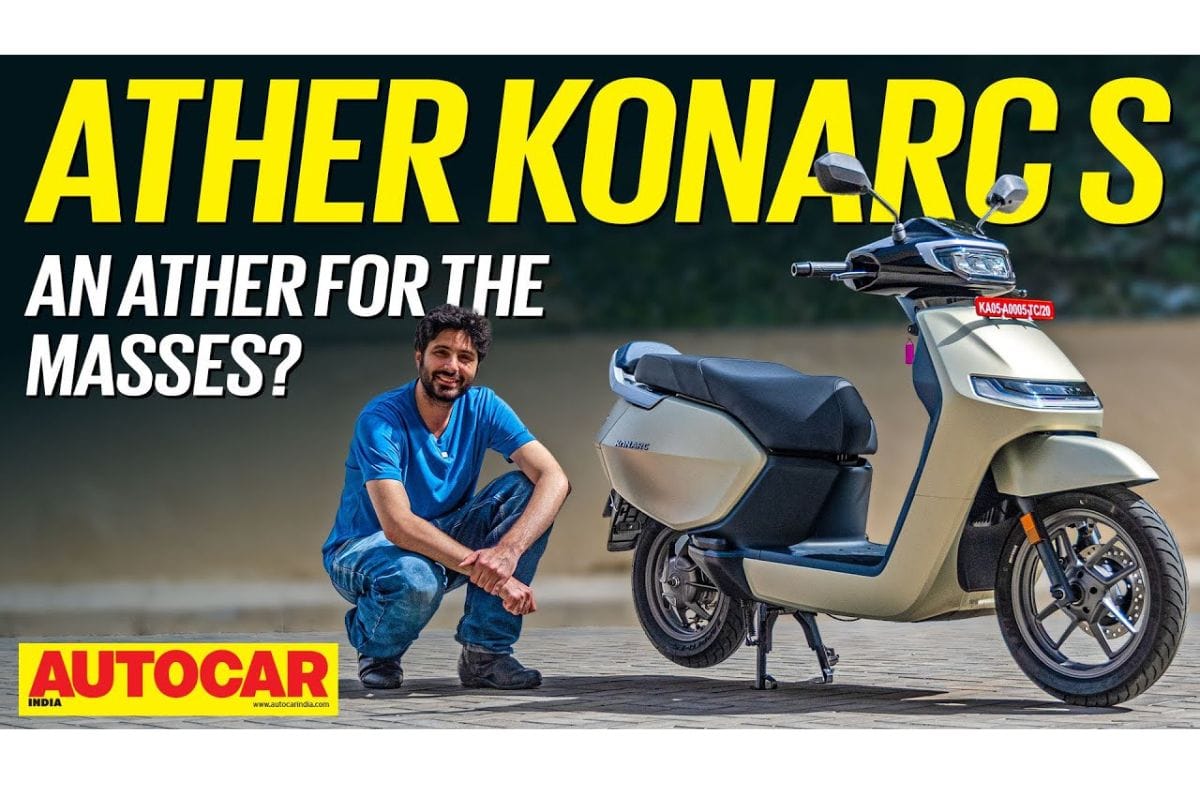
It’s not a stretch to say that the Konarc is the most important product from Ather yet, because the company hopes this new EV will help it unlock segments and markets hitherto untouched by it. The question then is, will the Konarc live up to the lofty expectations placed on its shoulders?

Konarc Design and Quality – 9/10

Straightforward design with high quality finish

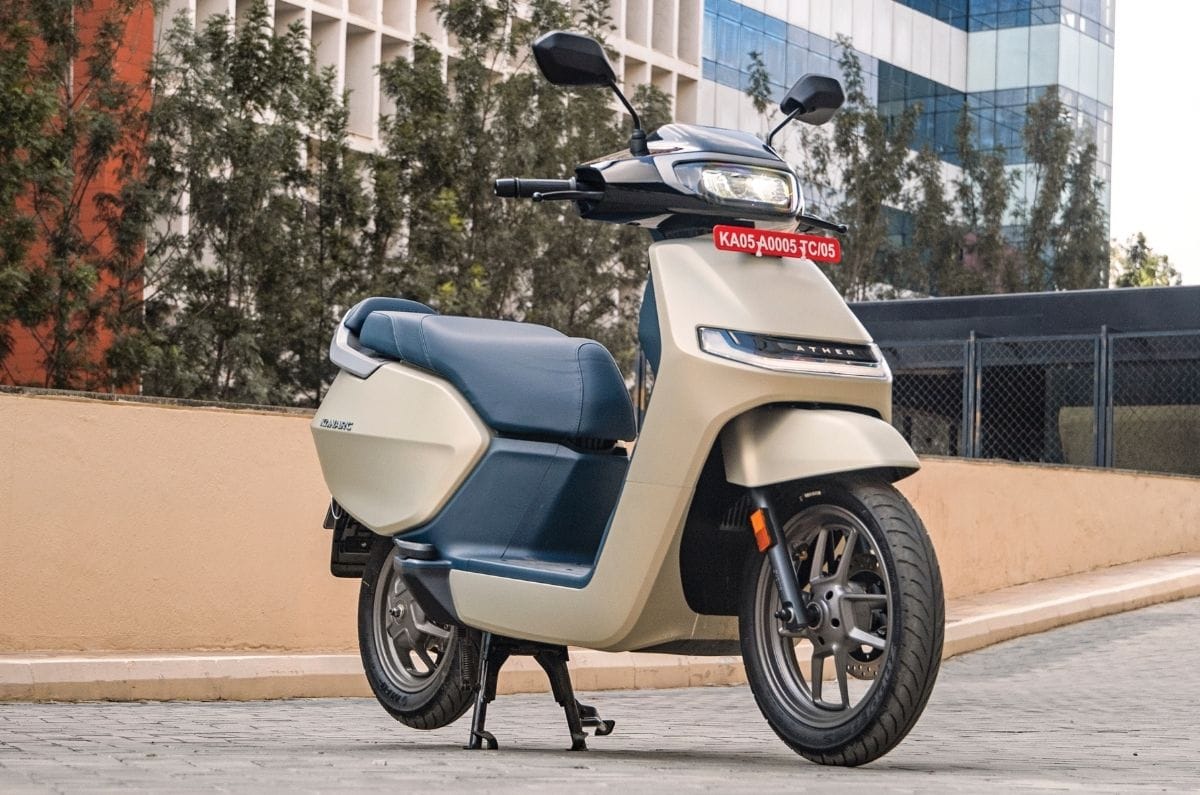
The Konarc S is offered in four classy yet inoffensive colours

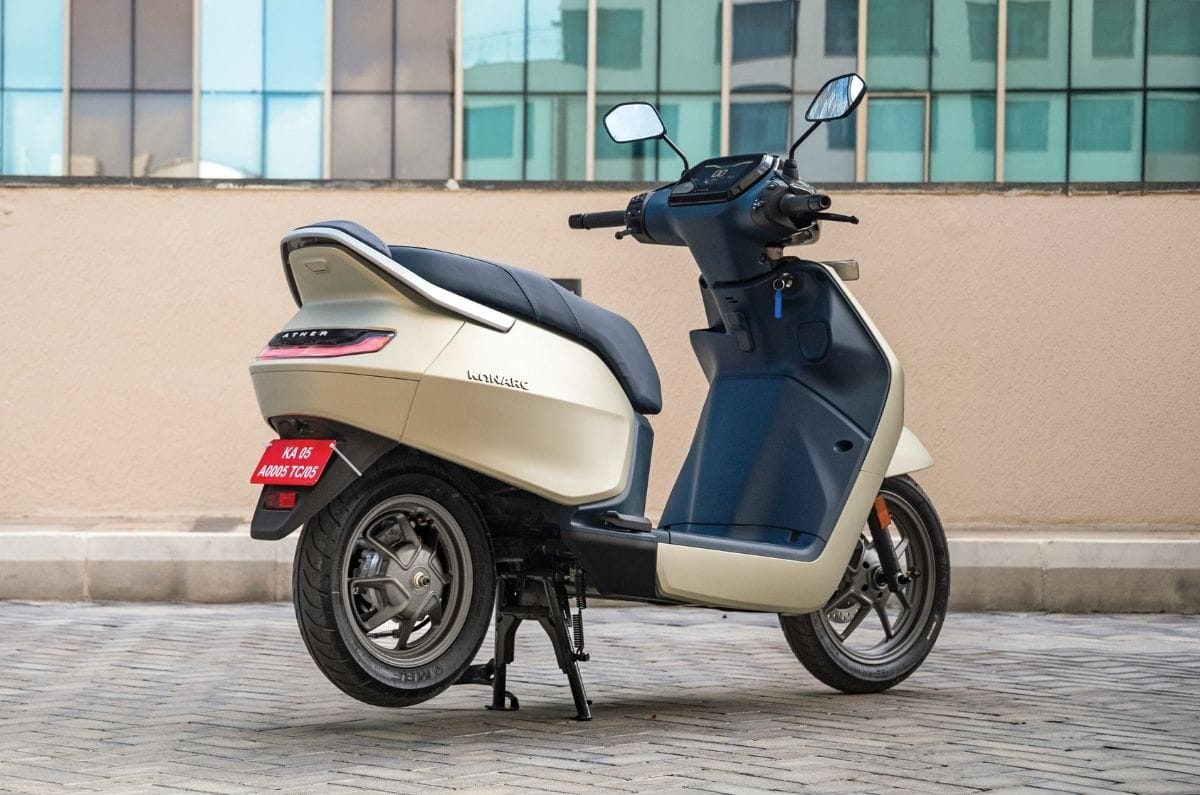
Striking looks aren’t a trait family scooters are known for and Ather wanted to play it very safe with the Konarc to bring in buyers that typically shop for ‘decent-looking’ scooters. While it does look a bit plain, it will still not completely meld into the ocean of humdrum two-wheelers on the road. Further reinforcing its family scooter aspirations are a quartet of very classy, yet inoffensive colours. 

Another aspect that the Konarc’s prospective customers will appreciate is its excellent finish and quality levels all across – a typical Ather trait. 

Konarc Ride and Handling – 9/10

Excellent ride and seating comfort, planted and surefooted handler

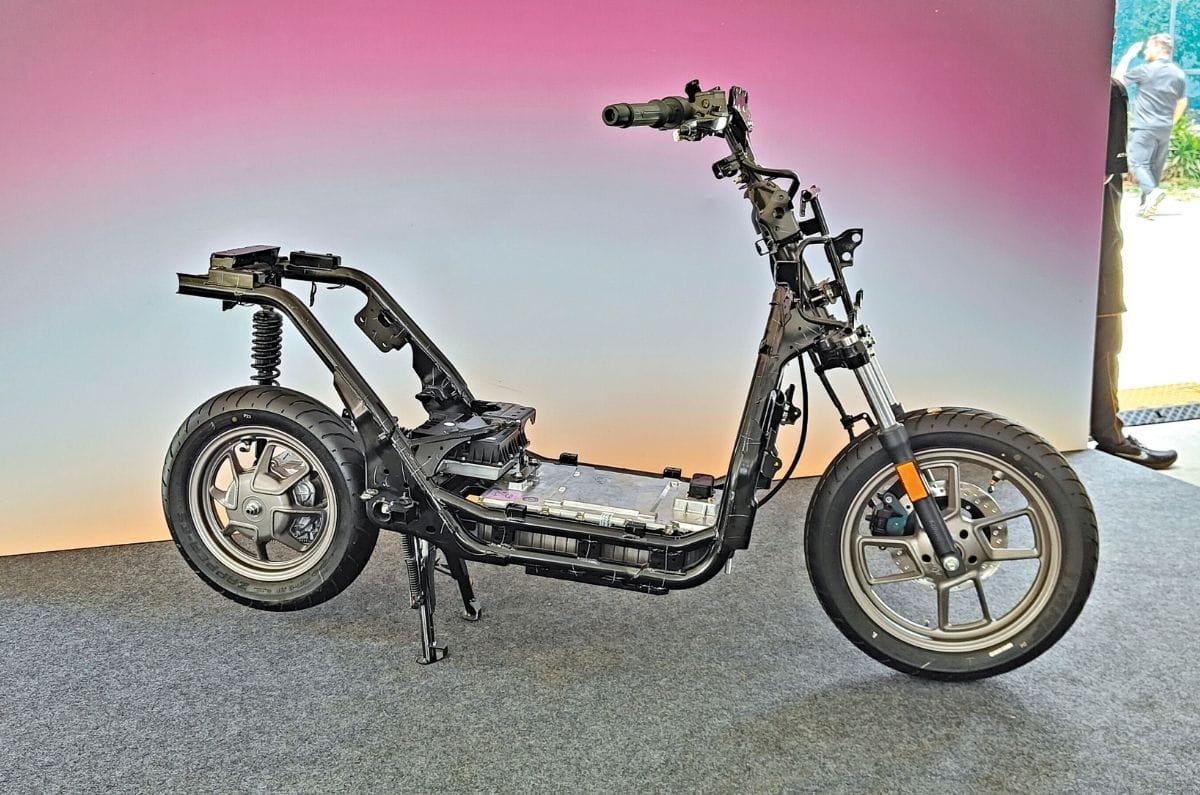
One big reason Ather moved to the new EL platform is that its earlier platform was never built for outright comfort and practicality. In this application, the main focus was to maximise comfort for both rider and pillion. The use of a 14-in front wheel and suspension with 90mm/100mm (F/R) of travel are two key factors in providing lovely ride comfort here. 

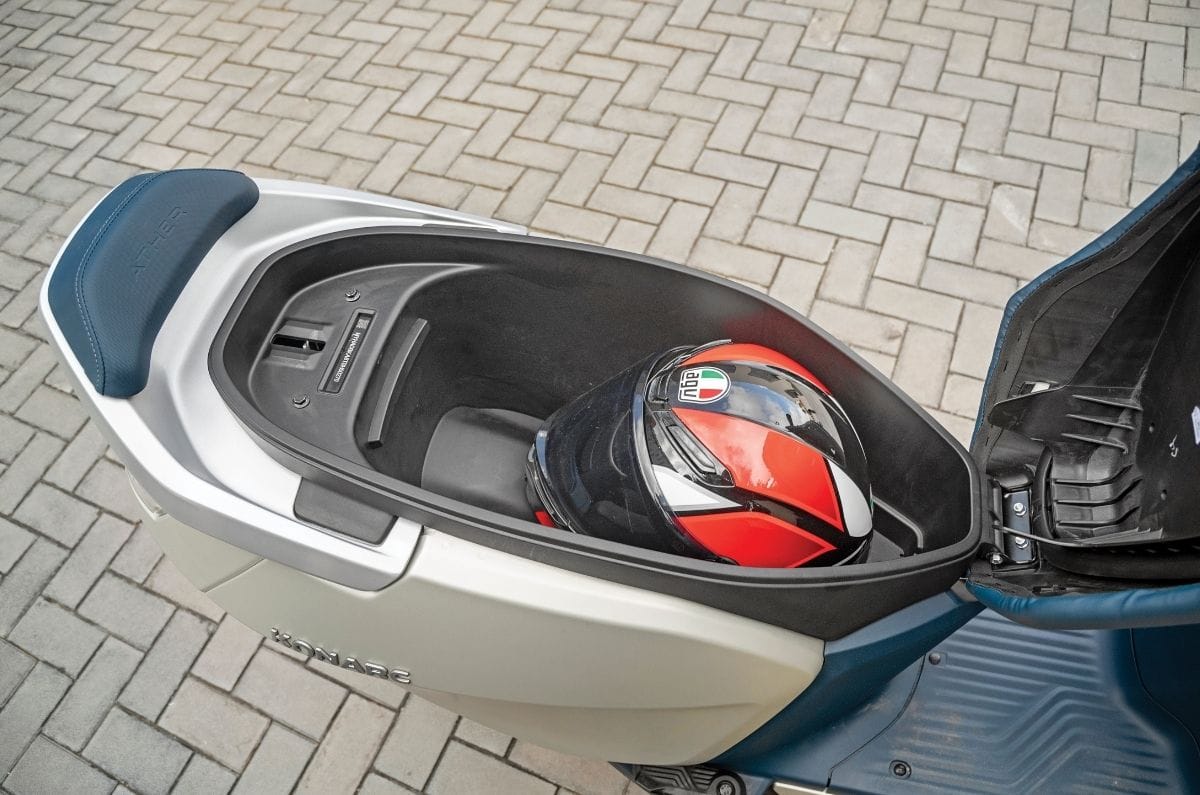
31L boot is deep enough to fit a premium helmet

Point the Konarc towards most bumps and it will round them off without getting unsettled while isolating you from the shock to a great extent. In the scooter space, this is one of the most comfortable options available. Ofcourse, this is still a scooter and really big bumps will filter through – don’t expect motorcycle-like comfort. 

SpecificationsValues
Wheelbase1352 mm
Kerb Weight126.5 kg
Chassis typeMonocoque Full – Steel Body Construction

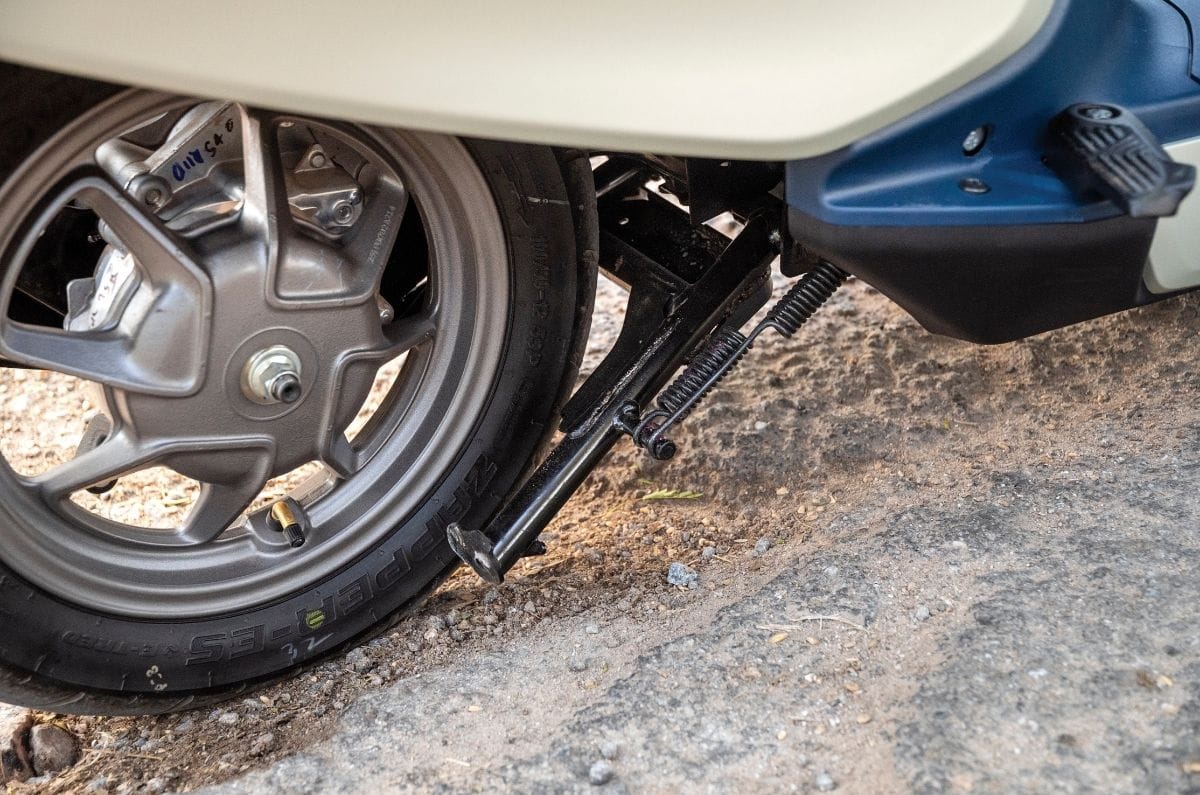
Something that a typical family scooter buyer values is a centre stand and the Konarc becomes the first Ather to offer it. Like other family scooters, the Konarc’s chassis is geared towards stability and ease of use. Despite the larger 14-in wheel and long 1352mm wheelbase, it felt very straightforward to ride. Its low 770mm seat height will help shorter folks get their feet down comfortably although its wide floorboard will have an impact here. 

Main stand can touch down in deep ruts

A spacious seat with a padded backrest means two full-size riders will fit comfortably on the Konarc. Another nice feature is that the front end doesn’t get flighty even with a heavy pillion onboard, despite no preload adjustability on the monoshock. The only ergonomic miss is that riders taller than 5’10 will find their knees touching the handlebar during full-lock turns.

SpecificationsValues
Wheel SizeFront – 14 inch, Rear – 12 inch
Front Tyre Size90/90-14
Rear Tyre Size100/90-12
Brake typeFront – Disc, Rear – Drum
Front Brake Size220 mm
Rear Brake Size130 mm
Front Suspension TypeTelescopic Fork, 90mm travel
Rear Suspension TypeDual Hydraulic Coil Spring, 100mm travel

Konarc Performance – 8/10

Has enough performance, new motor has very silent running 

Not only is the Konarc a big leap ahead in terms of comfort, its riding experience is also well-suited to city commuting. A big part of that is down to the comfort but its new swingarm-mounted motor also contributes here. Unlike the Rizta and 450 which used a rather noisy and relatively more maintenance intensive belt final drive, this motor is whisper quiet. It also directly powers the rear wheel without a chain or belt, reducing the number of components in the powertrain. 

SpecificationsValues
Fuel Type/ PropulsionElectric
Motor TypePMSM
Max Motor Power4.7 kW
Max Motor Torque16 Nm
EV Battery Capacity2.7 kWh

With 4.7kW and 16Nm of torque on tap, the Konarc’s performance is best described as sufficient, but only in the top Power mode. Here, the scooter is capable of negotiating its way through big city traffic reasonably quickly. Switching to Eco / SmartEco dulls acceleration significantly and unless you’re running out of juice or you live in a small town, this level of performance will feel out of place. 

450W onboard charger integrated into motor controller means you only need to carry a small cable around

Except for the bottom 2.1, all S variants come with a front disc brake, a rear drum and CBS. This setup is capable of bringing the Konarc to a halt quickly and safely with almost no hiccups. The one concern with the combined braking system was that the front could lock up when braking on sandy, gravelly loose surfaces using the rear brake lever exclusively. Only the Z variants launching next year come with Ather’s AeBS (Advanced Electronic Braking System) which uses the regen system to shorten braking distances. 

Konarc Features – 8/10

S variants are decently equipped but Z gets all the feel-good ones

And that is a good segue into the way Ather has distributed features across the S and Z. The keyless ignition system, automatic seat opening, AeBS, Magic Twist regen braking, traction control, the colour TFT display and all the smart functions enabled by it are reserved only for the Z. Common to all Konarcs is the 31L underseat storage area, which can easily swallow an imported full-face helmet with room to spare. 

7-inch dash informative and legible but not full colour

What three S variants (except the most affordable one) get is the 7-in simple TFT dash with Bluetooth connectivity, hill hold assist, reverse, several app-based functions, a 450W onboard charger and Airwalk. Airwalk is basically the Konarc’s motor sending a tiny amount of power to the rear wheel when you’re pushing it around to help make your life easier – this is truly effective and makes the 129kg Konarc feel far lighter than it is when moving it around. While the S has a good number of features, when you bring pricing into the equation, it stings a little. 

Same charging port for both onboard & portable chargers

Konarc Price and Verdict – 8/10

Not a cutthroat price but this is still a polished and competitive scooter

The two S variants which are on sale right now, S 125 and S 161, are priced at Rs 1.22 lakh and Rs 1.45 lakh, respectively – near identical pricing to the Rizta S. Like the Rizta, you have to pay extra for the Ather StackPro which unlocks many of the smart electronic features. 

The base S 2.1 (Rs 99,999) misses out on niceties like the disc brake and backrest and comes with rudimentary tech and a basic 4.2-in display. In that sense, the Konarc isn’t really pushing the envelope when it comes to an alluring price. 

VariantPrice (ex-showroom)
Konarc S 100Rs 1 lakh
Konarc S 125Rs 1.22 lakh
Konarc S 161Rs 1.45 lakh

However, as a scooter, the Konarc is a well-thought out product that nails comfort, promises enough performance, predictable range and lower maintenance costs. Ather claims a 10,000km / 1 year service interval and lower service charges owing to fewer parts and quicker turnaround times. 

It may not have made as stellar an impression as it could have with more aggressive pricing, but nonetheless the Konarc definitely has what it takes to elevate Ather to a higher echelon in the market.

Ather Konarc S 125 vs rivals: Price and specifications compared

Ather Konarc S 125 vs rivals: Price and specifications compared
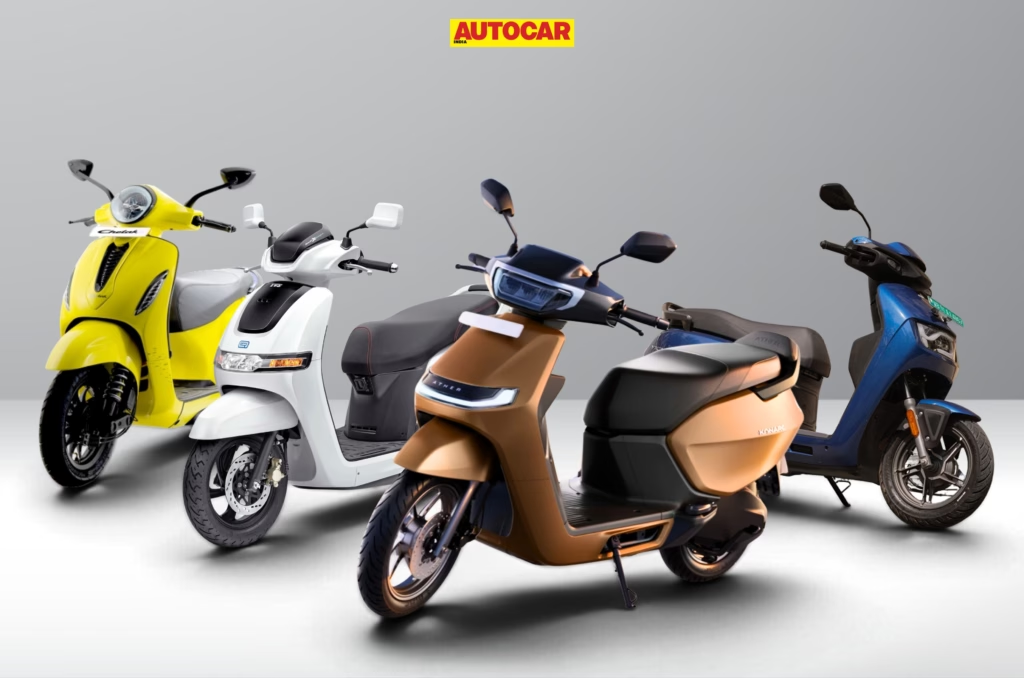
A studio shot showing the Ather Konarc, Chetak C3001, TVS iQube, and Vida VX2 Go.

Ather recently launched its first scooter on the completely new EL platform. Called the Konarc, it is currently available in six variants, starting at Rs 99,999 and going up to Rs 1.45 lakh at the moment. However, it appears that Ather is looking to make sure that there’s a Konarc at every price range. The most affordable Konarc S with 100km range isn’t going to be available until early next year, which makes the Konarc S 125km range variant the entry-level Konarc. So, how does it compare to the offerings from legacy manufacturers? Let’s find out.

Ather Konarc S 125 vs rivals: Motor, battery and charging

Chetak offers the most range


Ather Konarc S 125

TVS iQube 3.1 kWh

Chetak C3001

Vida VX2 Go 3.1

Peak motor power

4kW

4.4kW

3.1kW

6kW

Rated torque

16Nm

33Nm

20Nm

25Nm

Claimed top speed

70kph

82kph

80kph

70kph

Battery capacity

2.7kWh

3.1kWh

3kWh

3.1kWh

Claimed charge time (0-80 percent)

4h30m

4h03m

2h55m

4h45m

IDC range

125km

123km

131km

127km

These scooters rarely compare 1:1 in specifications, but if we take range as the most important factor, these are Ather Konarc’s closest rivals. As such, the Vida VX2 Go is the most powerful here, while the iQube develops the most torque. However, the Chetak quotes the highest range of the lot, and it sweetens the deal further by offering the fastest bundled charger (750W) and the shortest 0-80 charging time.

Ather Konarc S 125 vs rivals: Dimensions and underpinnings

iQube is the lightest and has the lowest seat height


Ather Konarc S 125

TVS iQube 3.1kWh

Chetak C3001

Vida VX2 Go 3.1

Wheelbase

1,352mm

1,301mm

1,355mm

1,301mm

Seat height

770mm

770mm

775mm

777mm

Ground clearance

NA

157mm

NA

155mm

Kerb weight

126.5kg

116.8kg

125kg

118kg

The C3001 and the Konarc have the longest and second-longest wheelbase, respectively, and they’re on the heavier side as well; the latter is explained by their metal body panels. Seat height is more or less on par, but if you care about the minutest of numbers, the Vida VX2’s is the tallest of the bunch. However, we wouldn’t expect that to deter buyers from choosing the Vida.

Ather Konarc S 125 vs rivals: Brakes, tyres and suspension

Konarc is the only one with a 14” wheel


Ather Konarc S 125

TVS iQube 3.1kWh

Chetak C3001

Vida VX2 Go 3.1

Brakes (F,R)

220mm disc, 130mm drum

220mm disc, 130mm drum

130mm drum, 130mm drum

190mm disc, 130mm drum

Tyres (F,R)

90/90-14, 100/90-12

90/90-12, 90/90-12

NA

90/90-12, 100/80-12

Suspension (F,R)

Telescopic, monoshock

Telescopic, twin shock

Leading-link, monoshock

Telescopic, monoshock

Ather’s biggest advantage over the others is its 14-inch front wheel, something none of the other scooters has. It also has the widest rear tyre, even though they all use 12-inch wheels. As for brakes, Chetak is the only one here without a disc brake. It is also the only one to feature a leading-link front suspension, paying homage to the design used on the original petrol-powered Chetak of yesteryear, whereas the others get a more modern telescopic fork.

Ather Konarc S 125 vs rivals: Features

Basics sorted, with more features requiring subscriptions

Ather has reserved the top-shelf feature set for the Konarc Z line, which is slated to release late next year. As standard, the Konarc gets the largest-in-size 7-inch LCD cluster. It also has AirWalk, a feature that will make manually moving the scooter easier. No other scooter in this comparison can match that. The iQube gets a 5-inch TFT instrument cluster, the C3001 gets a monochrome LCD cluster, and the VX2 Go 3.1 gets a 4.2-inch LCD. They all also offer ride modes and basic smartphone connectivity as standard.

However, most of Ather’s tech features require Ather StackPro, which costs Rs 16,000 for the Konarc S 125km variant. This is a big add-on to the overall price of the scooter, but it is a one-time purchase. If you spring for it, you do get a lot of features such as TrueRange, AutoHold and Vehicle FallSafe. Ather also promises yearly software upgrades and new features, a claim no other manufacturer on this list can meet or beat.

The other scooters also require a paid subscription to access the full feature suite. However, Ather’s is the most expensive and has the highest number of features. Chetak offers a lifetime subscription to its TecPac for Rs 3,000. Vida and TVS charge Rs 999 and Rs 900 per year, respectively, for theirs.

Ather Konarc S 125 vs rivals: Price

TVS is the most expensive, while Vida is the most affordable


Ather Konarc S 125

TVS iQube 3.1kWh

Chetak C3001

Vida VX2 Go 3.1

Price

Rs 1.22 lakh

Rs 1.29 lakh

Rs 1.14 lakh

Rs 1.12 lakh

Of this lot, the Konarc S is the second most expensive scooter to buy, behind only the TVS iQube. If you prefer to keep things simpler, both price-wise and features-wise, the Chetak and the Vida offer that: a lean feature set with promising range for the price. However, remember that real-world experience, such as comfort, can change this equation, and we can only comment on that after riding them.

The prices listed are ex-showroom, Bengaluru.

एथर एनर्जी ने टेस्ला और BYD को पीछे छोड़ा, इस साल शेयर 130% उछला; आगे और तेजी की उम्मीद

Ather Energy Share Price: इलेक्ट्रिक टू-व्हीलर कंपनी Ather Energy ने इस साल शेयर बाजार में Tesla, BYD और Xiaomi जैसी दिग्गज कंपनियों को भी पीछे छोड़ दिया है। कंपनी के शेयर 2026 में अब तक करीब 130% चढ़ चुके हैं। विश्लेषकों को बढ़ते मार्केट शेयर की वजह से स्टॉक में आगे भी तेजी की उम्मीद है।

Ather के शेयर में तेजी ने ग्लोबल निवेशकों का भी ध्यान खींचा है। सोमवार को BlackRock Global Funds ने ओपन मार्केट से कंपनी में 1% से कम हिस्सेदारी खरीदी है।

इसके उलट EV कंपनियों से जुड़े 104 शेयरों को ट्रैक करने वाला ब्लूमबर्ग इंडेक्स इस साल करीब 1% गिरा है। Tesla, BYD और Xiaomi जैसी बड़ी कंपनियों के कमजोर प्रदर्शन का असर इस इंडेक्स पर पड़ा है।

पिछले महीने शेयर 36% से ज्यादा चढ़ा

Hero MotoCorp की हिस्सेदारी वाली Ather Energy इलेक्ट्रिक टू-व्हीलर की डिजाइनिंग, मैन्युफैक्चरिंग और सर्विसिंग करती है। कंपनी का अपना चार्जिंग नेटवर्क भी है। भारत में EV की बढ़ती मांग का कंपनी को फायदा मिल रहा है।

बेंगलुरु की कंपनी का शेयर पिछले महीने 36% से ज्यादा चढ़ा। मई 2025 में लिस्टिंग के बाद यह किसी एक महीने में कंपनी की सबसे बड़ी तेजी है। बाजार में कंपनी की ग्रोथ को लेकर भरोसा बढ़ा है।

FY28 तक 26% मार्केट शेयर का अनुमान

Emkay Global Financial Services का अनुमान है कि FY28 तक Ather Energy का मार्केट शेयर बढ़कर 26% हो सकता है। मार्च के अंत में कंपनी का मार्केट शेयर करीब 17% था।

ब्रोकरेज का मानना है कि नए प्रोडक्ट लॉन्च और कंपनी की इन-हाउस टेक्नोलॉजी से Ather को फायदा मिल सकता है। इससे कंपनी घरेलू प्रतिद्वंद्वी Ola Electric को कड़ी टक्कर दे सकती है। पिछले हफ्ते Ather ने Konarc इलेक्ट्रिक स्कूटर लॉन्च किया था। इसे कंपनी की अपनी EV आर्किटेक्चर पर बनाया गया है। यह मास मार्केट सेगमेंट के लिए तैयार किया गया है।

Konarc से दोगुना हो सकता है बाजार

Nomura Holdings के एनालिस्ट्स का कहना है कि Konarc की वजह से Ather का एड्रेसेबल मार्केट दोगुना हो सकता है। यानी कंपनी के पास पहले के मुकाबले ज्यादा ग्राहकों तक पहुंचने का मौका होगा।

एनालिस्ट्स का कहना है कि भारत में इलेक्ट्रिक टू-व्हीलर का बाजार अब अहम मोड़ पर पहुंच रहा है। इस सेगमेंट में लंबी अवधि के लिए Ather को सबसे मजबूत विकल्पों में शामिल माना जा रहा है।

लिस्टिंग के बाद 440% चढ़ा शेयर

लिस्टिंग के बाद से Ather Energy का शेयर करीब 440% चढ़ चुका है। पिछले पांच साल में ₹2,500 करोड़ या उससे ज्यादा का IPO लाने वाली भारतीय कंपनियों में Ather Energy का प्रदर्शन सबसे बेहतर रहा है।

तेजी के बावजूद एनालिस्ट्स अभी भी स्टॉक को लेकर बुलिश हैं। ब्लूमबर्ग के मुताबिक, कंपनी को कवर करने वाले सभी 14 एनालिस्ट्स शेयर पर खरीदारी की सलाह दे रहे हैं।

Axis Capital ने Ather Energy का टारगेट प्राइस ₹2,100 रखा है। सोमवार के क्लोजिंग प्राइस के मुकाबले इसमें करीब 22% की तेजी की संभावना बताई गई है।

अगले 3-4 साल में शेयर दोगुना हो सकता है

Emkay के एनालिस्ट चिराग जैन का मानना है कि अगले तीन से चार साल में मौजूदा स्तर से भी Ather Energy का शेयर दोगुना हो सकता है।

उनका कहना है कि Ather सिर्फ फीचर्स हटाकर कीमत कम करने के पक्ष में नहीं है। कंपनी लागत कम करके कीमत घटाने की रणनीति पर काम कर रही है, ताकि ब्रांड और प्रोडक्ट क्वालिटी पर असर न पड़े।

एथर एनर्जी का शेयर मंगलवार को 1.07% की तेजी के साथ 1,736 रुपये पर बंद हुआ।

गोदरेज ग्रुप का स्टॉक 55% उछल सकता है, कोटक ने ₹1010 का टारगेट दिया

Disclaimer: मनीकंट्रोल.कॉम पर दिए गए सलाह या विचार एक्सपर्ट/ब्रोकरेज फर्म के अपने निजी विचार होते हैं। वेबसाइट या मैनेजमेंट इसके लिए उत्तरदायी नहीं है। यूजर्स को मनीकंट्रोल की सलाह है कि कोई भी निवेश निर्णय लेने से पहले हमेशा सर्टिफाइड एक्सपर्ट की सलाह लें।

भारत के रईस पेट्रोल-डीजल गाड़ियों को छोड़ खरीद रहे ये महंगी EV, समझिए अमीरों में तेजी से क्यों बढ़ा लग्जरी EVs का क्रेज

भारत में महंगी कार खरीदने वाले अमीर ग्राहकों के बीच इलेक्ट्रिक कारों का चलन बाकी कार बाजार के मुकाबले काफी तेजी से बढ़ रहा है। 2026 के पहले छह महीनों में भारत में बिकने वाली हर चार BMW कारों में से एक इलेक्ट्रिक कार थी। इससे BMW की इलेक्ट्रिक कारों की बिक्री करीब 25% रही, जो पूरे पैसेंजर व्हीकल बाजार के मुकाबले लगभग तीन गुना है। इस दौरान देश में कुल कार बिक्री में इलेक्ट्रिक कारों की हिस्सेदारी करीब 8-9% रही।

यह बदलाव Mercedes-Benz में भी साफ तौर पर दिख रहा है, खासकर इसके सबसे अमीर ग्राहकों के बीच। इन्हीं छह महीनों के दौरान, कंपनी ने अपने ‘टॉप-एंड’ सेगमेंट – जिसमें 1.4 करोड़ रुपये से ज्यादा कीमत वाले मॉडल शामिल हैं – से लगभग हर तीन घंटे में एक बैटरी इलेक्ट्रिक गाड़ी (BEV) बेची। इसकी CLA BEV, जिसकी शुरुआती कीमत 57 लाख रुपये है, का 2026 का कोटा पहले ही खत्म हो चुका है, जिससे नए खरीदारों को डिलीवरी के लिए अगले साल तक इंतजार करना पड़ेगा

आम भारतीय कार खरीदारों को इलेक्ट्रिक कार खरीदने से जो दिक्कतें होती हैं, जैसे चार्जिंग की सुविधा, कार की रेंज को लेकर चिंता और ज्यादा कीमत, अमीर परिवारों के लिए ये समस्याएं काफी कम हो जाती हैं।

LVP फोरकास्टिंग मोबिलिटी ग्लोबल के एसोसिएट डायरेक्टर गौरव वंगाल ने कहा, “लग्जरी सेगमेंट में EV को अपनाने की दर ज्यादा है क्योंकि इसके रास्ते में कोई रुकावट नहीं है। इन खरीदारों के पास घर पर चार्जर के साथ कवर्ड पार्किंग होती है, इसलिए चार्जिंग कभी कोई समस्या नहीं बनती।”

उन्होंने आगे कहा, “EV शायद ही कभी उनकी एकमात्र कार होती है, इसलिए रेंज की चिंता कभी नहीं होती। और पेट्रोल या डीजल वाली लग्जरी कार की तुलना में इलेक्ट्रिक कार पर टैक्स बहुत कम लगता है, इसलिए कीमत का वह अंतर जो ज्यादातर खरीदारों को रोकता है, यहां मौजूद ही नहीं है।”

मालिक होने की स्थितियों में यह अंतर बिक्री के आंकड़ों में साफ तौर पर दिख रहा है। जहां पारंपरिक लग्जरी कारों की बिक्री में बढ़ोतरी धीमी हुई है, वहीं EV से BMW और मर्सिडीज-बेंज को तेजी से बढ़ते ग्राहक मिल रहे हैं।

2026 के पहले छह महीनों में, BEV को छोड़कर Mercedes-Benz की बिक्री में सिर्फ 2.3% की बढ़ोतरी हुई, जबकि BMW की नॉन-BEV बिक्री में 5% की बढ़ोतरी हुई। जब इलेक्ट्रिक कारों को भी शामिल किया जाता है, तो Mercedes की कुल बढ़ोतरी 9% और BMW की 17% हो जाती है।

इसलिए, इलेक्ट्रिक गाड़ियां अब लग्जरी मार्केट में सिर्फ एक अतिरिक्त पावरट्रेन नहीं रह गई हैं। वे अतिरिक्त बढ़ोतरी का एक अहम जरिया बन रही हैं।

BMW ग्रुप इंडिया के प्रेसिडेंट और CEO, हरदीप सिंह बरार ने कहा कि इसकी अपील सिर्फ पर्यावरण से जुड़ी बातों से कहीं ज्यादा है।

बरार ने कहा, “EVs न सिर्फ जीरो-एमिशन वाली गाड़ियां हैं, बल्कि ये परफॉर्मेंस से कोई समझौता किए बिना सस्टेनेबल मोबिलिटी भी देती हैं, और साथ ही इनकी रनिंग, मेंटेनेंस और टैक्स की लागत भी काफी कम होती है।”

यह बात उन कीमतों पर भी असरदार साबित हो रही है जहां ईंधन की बचत शायद ही यह तय करती हो कि कोई ग्राहक कार खरीदेगा या नहीं।

मर्सिडीज़-बेंज़ के टॉप-एंड इलेक्ट्रिक पोर्टफ़ोलियो – जिसमें लगभग 1.4 करोड़ रुपये की EQS SUV, 2.4 करोड़ रुपये की EQS मेबैक SUV और 3.1 करोड़ रुपये की G580 शामिल हैं – ने जून 2026 को खत्म हुए छह महीनों में साल-दर-साल 27 प्रतिशत की ग्रोथ दर्ज की।

लक्ज़री मार्केट के ज़्यादा किफायती सेगमेंट में, मर्सिडीज़ ने CLA BEV का अपना 2026 का पूरा कोटा पहले ही बेच दिया है।

Mercedes-Benz इंडिया के मैनेजिंग डायरेक्टर और CEO, संतोष अय्यर ने कहा, “CLA BEV का पूरी तरह बिक जाना, खासकर 61 लाख रुपये वाले टॉप-एंड 250+ वेरिएंट्स का, लक्जरी EV ग्राहकों की बढ़ती समझ को दिखाता है। ये ग्राहक अब सिर्फ कीमत नहीं, बल्कि टेक्नोलॉजी और वैल्यू-बेस्ड लक्जरी मोबिलिटी को ज्यादा पसंद कर रहे हैं।”

रुकावटें दूर हो रही हैं

लग्जरी कार खरीदने वालों की प्रोफाइल से यह समझने में मदद मिलती है कि EV को अपनाने की रफ्तार आम बाजार के मुकाबले इतनी तेज क्यों है।

जो परिवार अपनी इकलौती कार खरीद रहा है, उसके लिए इलेक्ट्रिक कार अपनाने में कई समझौते करने पड़ सकते हैं। अपार्टमेंट में रहने वाले खरीदार के पास शायद अपना पर्सनल चार्जर न हो, और लंबी यात्राओं के लिए चार्जिंग इंफ्रास्ट्रक्चर को ध्यान में रखकर योजना बनानी पड़ती है। EV की शुरुआती ज्यादा कीमत की तुलना कई सालों में होने वाली ईंधन की बचत से भी करनी पड़ती है।

कई अमीर परिवारों के लिए, ये हिसाब-किताब काफी अलग होते हैं।

इन परिवारों के पास आमतौर पर अपनी पार्किंग की जगह होती है, इसलिए घर पर चार्जर लगाना आसान होता है। वे रातभर अपनी कार चार्ज कर सकते हैं और उन्हें पब्लिक चार्जिंग स्टेशन पर ज्यादा निर्भर नहीं रहना पड़ता।

सबसे बड़ी बात यह है कि अमीर परिवारों में EV अक्सर इकलौती कार नहीं होती। उनके पास एक से ज्यादा गाड़ियां होती हैं।

इसका मतलब है कि EV को परिवार की हर तरह की यात्रा की जरूरत पूरी करने की जरूरत नहीं होती। इलेक्ट्रिक कार रोजाना शहर में आने-जाने के काम आ सकती है, जबकि लंबी दूरी की यात्रा के लिए परिवार के पास पेट्रोल या डीजल कार का विकल्प मौजूद रहता है।

भारत का टैक्स सिस्टम इस बात को और मज़बूत करता है।

इलेक्ट्रिक कारों पर 5% GST लगता है, जबकि बड़ी पेट्रोल और डीजल कारों पर 28% GST और साथ में कंपनसेशन सेस भी लगता है। लग्जरी कारों की कीमतों के मामले में, यह अंतर बैटरी टेक्नोलॉजी की ज्यादा लागत को काफी हद तक कम कर सकता है और इलेक्ट्रिक व इंटरनल-कंबशन मॉडल के बीच कीमत के अंतर को घटा सकता है।

EVs में अब ऐसी खूबियां भी तेज़ी से आ रही हैं जो लग्ज़री ड्राइविंग के लिए एकदम सही हैं। इलेक्ट्रिक मोटर तुरंत टॉर्क देती है, जिससे कार तेजी से पिकअप लेती है। वहीं, पेट्रोल या डीजल इंजन नहीं होने के कारण EV काफी शांत और स्मूद ड्राइविंग अनुभव देती है। प्रीमियम कार कंपनियां भी अपनी लग्जरी कारों में इसी तरह की शांति और आराम देने के लिए काफी पैसा खर्च करती हैं।

इसलिए, हाई-एंड मार्केट के खरीदारों के लिए, इलेक्ट्रिक गाड़ियां कम टैक्स और कम रनिंग कॉस्ट के साथ-साथ परफॉर्मेंस, टेक्नोलॉजी और नई खूबियों का बेहतरीन कॉम्बिनेशन हो सकती हैं।

विकल्प तेजी से बढ़ रहे हैं

एक और बड़ा बदलाव यह है कि अमीर भारतीय अब कई तरह की इलेक्ट्रिक कारें खरीद सकते हैं।

FY25 से, भारत के लग्जरी सेगमेंट में 13 नई BEV लॉन्च हुई हैं, जिनमें Porsche, Volvo, Rolls-Royce, Ferrari और Lexus के मॉडल शामिल हैं। इनकी सबसे ज्यादा कीमत लगभग 5 करोड़ रुपये तक है।

इस विस्तार से EV अपनाने में आने वाली एक और रुकावट धीरे-धीरे दूर हो रही है: विकल्पों की कमी।

शुरुआत में लग्जरी EV खरीदने वालों के पास इलेक्ट्रिक मॉडल्स के कुछ ही विकल्प होते थे, जबकि पेट्रोल और डीजल मार्केट में कई तरह की सेडान, SUV और परफॉर्मेंस कारें उपलब्ध थीं। अब ग्राहक अपनी पसंद की बॉडी स्टाइल, परफॉर्मेंस कैटेगरी या लग्जरी ब्रांड को छोड़े बिना आसानी से पावरट्रेन बदल सकते हैं।

इसका असर इंडस्ट्री के आंकड़ों में साफ दिखता है।

FY26 में भारत में बिकने वाली कुल पैसेंजर व्हीकल्स में लग्जरी कारों की हिस्सेदारी सिर्फ 1.1-1.2% रही। लेकिन देश में बिकने वाली कुल इलेक्ट्रिक कारों (BEV) में लग्जरी कारों की हिस्सेदारी करीब 2.5-2.7% रही। यानी पूरे पैसेंजर व्हीकल बाजार में लग्जरी कारों की हिस्सेदारी के मुकाबले इलेक्ट्रिक कारों की बिक्री में इनकी हिस्सेदारी दोगुने से भी ज्यादा है।

इस बदलाव का सबसे साफ उदाहरण BMW है। कंपनी ने जून 2026 को खत्म हुए छह महीनों में 2,359 EV बेचीं, जिससे भारत में उसकी कुल बिक्री में इलेक्ट्रिक गाड़ियों का हिस्सा लगभग एक-चौथाई हो गया। इसी दौरान Mercedes-Benz ने 859 BEV बेचीं।

फिर भी, Tesla का अनुभव बताता है कि इस तेजी का फायदा हर प्रीमियम EV बनाने वाली कंपनी को बिक्री के तौर पर नहीं मिलता।

इलेक्ट्रिक मोबिलिटी के क्षेत्र में ग्लोबल पहचान होने के बावजूद, भारत में अपने पहले साल (जो जून 2026 में खत्म हुआ) में Tesla ने सिर्फ 450 के आस-पास कारें बेचीं।

इसकी सीमित प्रोडक्ट रेंज एक रुकावट है। टेस्ला अभी भारत में सिर्फ ‘मॉडल Y’ बेचती है, जिससे यह कई ऐसे सेगमेंट में मौजूद नहीं है जहां पहले से मौजूद लग्जरी कार बनाने वाली कंपनियां ग्राहकों को सेडान, SUV और परफॉर्मेंस-ओरिएंटेड मॉडल ऑफर कर सकती हैं।

इसकी एक और चुनौती कीमत भी रही है। टेस्ला ने बेस ‘मॉडल Y’ को 59.89 लाख रुपये (एक्स-शोरूम) में लॉन्च किया था, और बाद में मई 2026 में इसकी कीमत घटाकर 50.89 लाख रुपये कर दी। कीमत कम करने के बाद भी, पूरी तरह से इम्पोर्ट किया गया यह मॉडल उन कंपनियों से मुकाबला करता है जिनके पास ज्यादा बड़े पोर्टफोलियो और पहले से स्थापित सेल्स और सर्विस नेटवर्क हैं। यह अंतर दिखाता है कि भारत का लग्जरी EV मार्केट किस तरह बदल रहा है।

आम कार खरीदारों के लिए EV खरीदने पर अभी भी चार्जिंग, ड्राइविंग रेंज, ज्यादा शुरुआती कीमत और सिर्फ एक कार पर निर्भर रहने जैसी कई परेशानियां हो सकती हैं। लेकिन अमीर परिवारों के लिए इनमें से कई दिक्कतों को आसानी से दूर किया जा सकता है। वे घर पर चार्जर लगवा सकते हैं, लंबी दूरी की यात्रा के लिए दूसरी कार का इस्तेमाल कर सकते हैं और EV पर कम टैक्स लगने से इलेक्ट्रिक कार खरीदना उनके लिए अपेक्षाकृत सस्ता पड़ता है।

इन वजहों से अमीर भारतीय परिवारों में इलेक्ट्रिक लग्जरी कार अब सिर्फ महंगा प्रयोग नहीं रह गई है। यह धीरे-धीरे उनकी गैराज में एक आम और पसंदीदा विकल्प बनती जा रही है।

BMW और Mercedes-Benz के लिए यह बदलाव एक कदम और आगे बढ़ चुका है। भारत में EV अब सिर्फ उनके भविष्य के प्रोडक्ट प्लान का हिस्सा नहीं हैं, बल्कि आज ही उनकी बिक्री और ग्रोथ को बढ़ाने में अहम भूमिका निभा रही हैं।

यह भी पढ़ें: ₹99,999 में लॉन्च Ather का नया स्कूटर, Konark की मार्केट में इनसे होगी भिड़ंत

Dividend Stock: हर शेयर पर ₹50 का डिविडेंड देगी ऑटोमोबाइल कंपनी, रिकॉर्ड डेट 9 सितंबर; 2 साल में पैसे हुए डबल

ऑटोमोबाइल कंपनी फोर्स मोटर्स के शेयरहोल्डर्स को वित्त वर्ष 2025-26 के लिए 50 रुपये प्रति शेयर का फाइनल डिविडेंड मिलने वाला है। रिकॉर्ड डेट 9 सितंबर है। इस तारीख तक जिन लोगों के नाम शेयरों के लाभार्थी मालिकों के तौर पर रजिस्टर ऑफ मेंबर्स ऑफ द कंपनी या डिपॉजिटरीज के रिकॉर्ड्स में दर्ज होंगे, वे डिविडेंड के हकदार होंगे। इस डिविडेंड की घोषणा अप्रैल महीने में की गई थी।

16 सितंबर को कंपनी की सालाना आम बैठक में फाइनल डिविडेंड पर शेयरहोल्डर्स की मंजूरी ली जाएगी। इसके बाद 30 दिनों के अंदर इसका पेमेंट किया जाएगा। फोर्स मोटर्स ने वित्त वर्ष 2025 के लिए 40 रुपये प्रति शेयर का फाइनल डिविडेंड दिया था। कंपनी के शेयर की फेस वैल्यू 10 रुपये है।

फोर्स मोटर्स का शेयर 31 अगस्त को BSE पर 17550 रुपये पर बंद हुआ। कंपनी का मार्केट कैप 22800 करोड़ रुपये से ज्यादा है। शेयर BSE 500 इंडेक्स का हिस्सा है। BSE पर 52 सप्ताह का एडजस्टेड हाई 26,485.95 रुपये और एडजस्टेड लो 14,911.45 रुपये है।

Force Motors का शेयर 5 साल में 1100 प्रतिशत चढ़ा

फोर्स मोटर्स का शेयर 2 साल में निवेशकों का पैसा डबल कर चुका है। 3 साल में कीमत 411 प्रतिशत मजबूत हुई है। 5 साल में शेयर 1100 प्रतिशत से ज्यादा की तेजी देख चुका है। वहीं 6 महीनों में 28 प्रतिशत की गिरावट दर्ज कर चुका है। कंपनी में जून 2026 के आखिर तक प्रमोटर्स के पास 61.63 प्रतिशत हिस्सेदारी थी।

Ather Energy Share Price: ‘कोणार्क’ के दम पर एथर ने भरा फर्राटा, शेयर 6% तक भागा; ब्रोकरेज बुलिश

कंपनी की वित्तीय सेहत

फोर्स मोटर्स का अप्रैल-जून 2026 तिमाही में स्टैंडअलोन बेसिस पर रेवेन्यू 2,439.89 करोड़ रुपये रहा। शुद्ध मुनाफा 212 करोड़ रुपये और प्रति शेयर अर्निंग 160.95 करोड़ रुपये रही। पूरे वित्त वर्ष 2026 के दौरान कंपनी का स्टैंडअलोन बेसिस पर रेवेन्यू 9,056.54 करोड़ रुपये, शुद्ध मुनाफा 1,211.26 करोड़ रुपये और प्रति शेयर अर्निंग 919.28 करोड़ रुपये दर्ज की गई।

Disclaimer: यहां मुहैया जानकारी सिर्फ सूचना के लिए दी जा रही है। यहां बताना जरूरी है कि मार्केट में निवेश बाजार जोखिमों के अधीन है। निवेशक के तौर पर पैसा लगाने से पहले हमेशा एक्सपर्ट से सलाह लें। मनीकंट्रोल की तरफ से किसी को भी पैसा लगाने की यहां कभी भी सलाह नहीं दी जाती है।