What Brazil’s 50-year ethanol experiment tells us

What Brazil’s 50-year ethanol experiment tells us
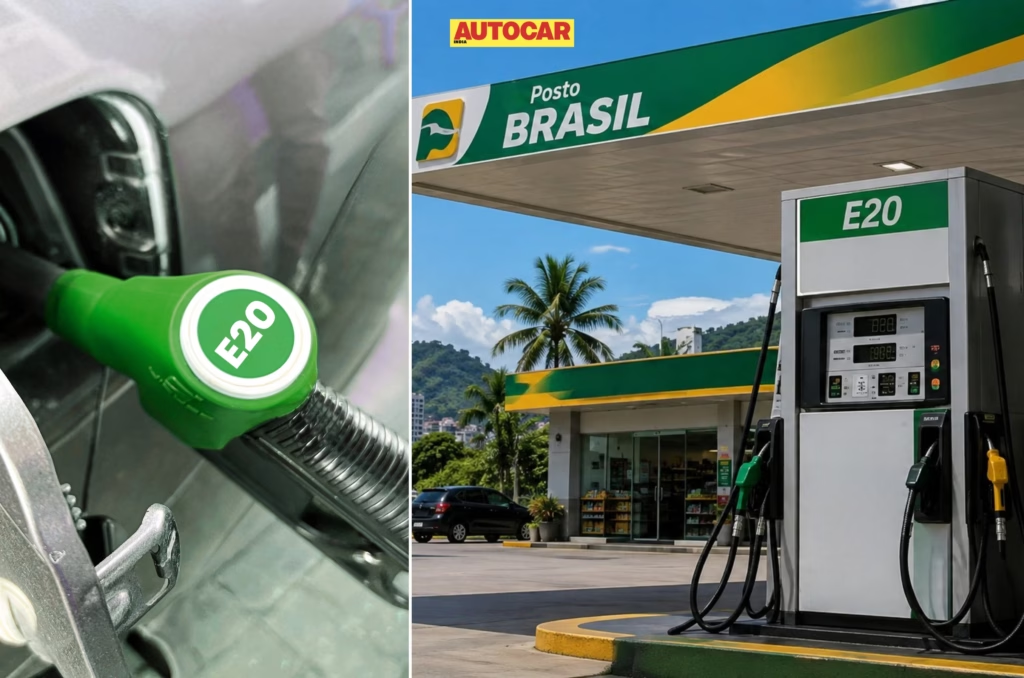
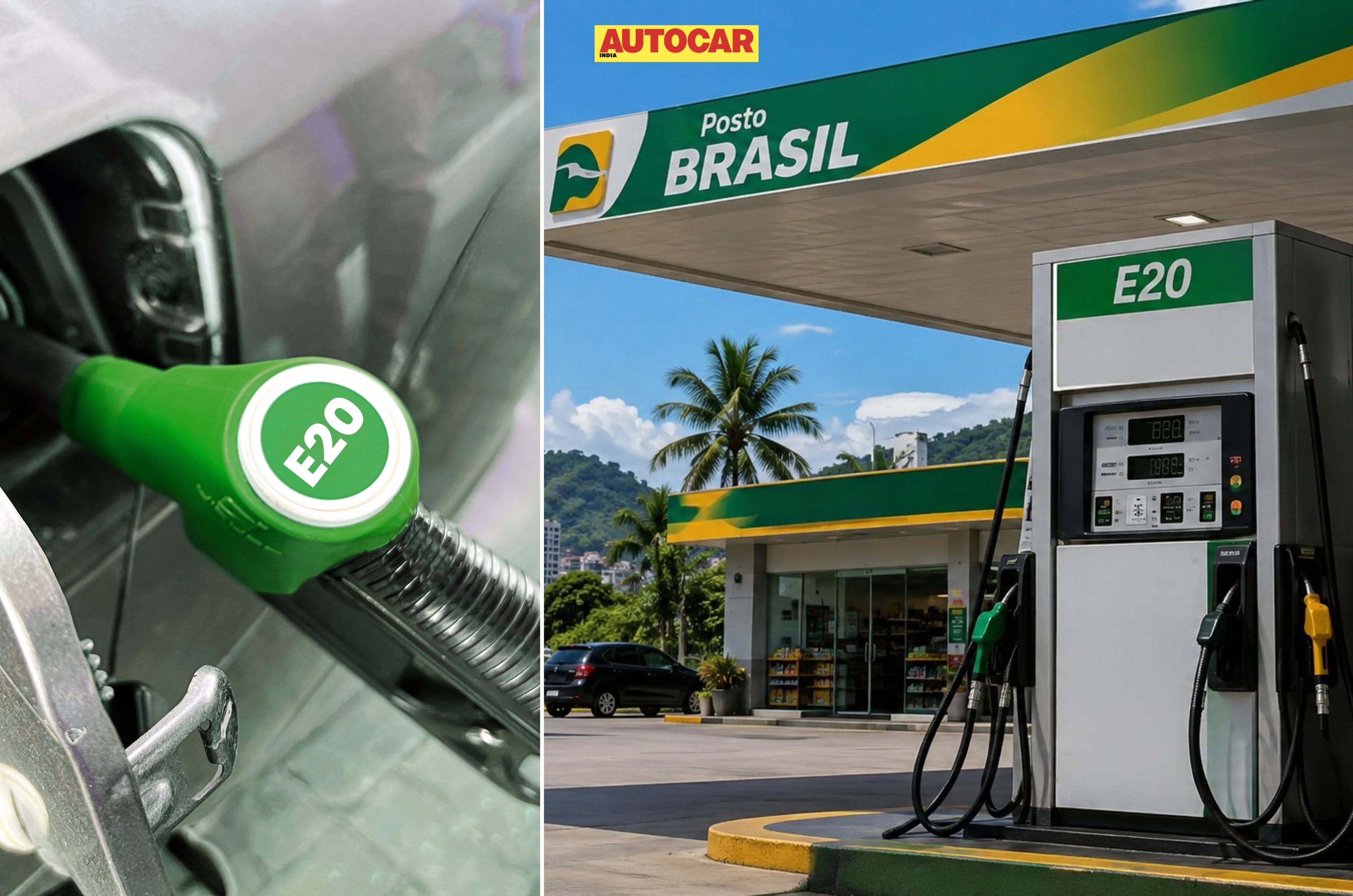
E20 fuel in Brazil

The forced introduction of E20 has set social media ablaze, with outraged car and bike owners complaining bitterly of damage to their vehicles and a drop in fuel efficiency. The anger isn’t irrational. The efficiency drop is real and, going by Autocar India’s own tests, larger than the figures the government itself has acknowledged. 

But while there’s no debate over the mileage penalty, the bigger fear is long-term damage to the vast majority of cars on our roads that are not E20-compliant. It’s a worry fanned by social media and by the way the government has handled the concern. Field trials conducted by the Automotive Research Association of India (ARAI) before the rollout reportedly found no major compatibility issues even in legacy vehicles. 

However, that report has never been made public, which has only deepened suspicion among car and bike owners. Most damaging of all was the Society of Indian Automobile Manufacturers (SIAM) formally flagging alarming levels of contamination in a letter it was later forced to publicly withdraw. Crucially, SIAM’s concern was contaminated fuel carrying worrying levels of chlorine, not the blend itself. That distinction has been lost in the noise, and it sits at the heart of the confusion, even panic, among customers fearing the worst.

So, is E20 the menace it is being made out to be, or is fuel contamination the bigger issue? The fact is, there is no workshop epidemic yet, though sceptics will argue it’s only a matter of time before engines start giving trouble. What social media is amplifying right now is the theoretical damage of a higher blend. That doesn’t make the concerns baseless, since long-term effects take years to show, but the truth is that panic and outrage are currently running well ahead of the evidence. Which makes it worth studying the one country that actually has the evidence, gathered over 50 years: Brazil.

The Brazil experience

If you think India’s leap from E10 to E20 was abrupt, consider what happened there. In November 1975, squeezed by the oil crisis and desperate to protect its foreign currency reserves, the Brazilian government launched Proalcool and shoved its motorists in at the deep end. “The blends with gasoline started at 20 percent. It went very soon up to 30 percent, and it was imposed by the government,” says Peter Gilbert, head of Operational Marketing and Customer Tech Services at Infineum Brazil, a fuel and lubricant additive specialist company whose business, it should be said, depends on ethanol-blended fuels working well. 

The documented history broadly bears him out, with one point worth noting: there was a brief low-blend ramp-up with E10, but that lasted roughly two to three years against the five decades of E20 and above since. Compare that with India, which took nearly two decades from its 2003 blending programme to reach E10. And like India, Brazil never kept an escape hatch. “There was no E0 when E20 was introduced,” says Gilbert, and there is none today: the mandated blend has since climbed through 25, 27 and 30 percent, and since August this year, all pumps in Brazil, including the super-premium ones, dispense E32.

But what is telling is the kind of cars running around on E20 in the late 1970s. Back then, cars were mainly carburetted with no fuel injection, no closed-loop control and no lambda sensors – machinery far cruder than even the oldest E10-era car on Indian roads today. So what broke?

According to Gilbert, remarkably little that could be pinned on E20 itself. “There weren’t any major issues reported,” he says. “There were issues related to the materials of the fuel system, the gaskets and the rubbers used at that time, but that has changed.”

His colleague Leandro Benvenutti, Infineum’s product manager for Latin America, says the trouble in 1970s and 1980s Brazil came almost entirely from dedicated alcohol cars running pure hydrous ethanol (E100), not from petrol cars on E20. “Everything we can remember from that time is related to these alcohol vehicles, not to the gasoline vehicles using E20,” he says. Carburettor corrosion, clogged jets, perished hoses and O-rings: all of it, in their experience, traced back to E100. “If there were problems in the other [non-flex fuel] vehicles, they were really not important at all.”

A caveat both experts volunteer: 1970s Brazil is not 2020s India, and the comparison is not like-for-like. “It’s difficult to correlate to vehicles today,” Gilbert admits. What the Brazilian record offers is not proof that nothing will go wrong here, but a large, long-running natural experiment in which the E20-specific damage everyone feared did not show up.

So what about India’s E10 cars?

Asked what he’d tell a worried Indian owner running an E10-era car on E20, Benvenutti replies, “There is no reason for panic. We don’t expect any immediate impact.” Note the word immediate. The honest answer regarding the long term is unknown, and to their credit, neither of Infineum’s experts pretends otherwise. Over years, rubber components in cars whose materials weren’t specified for E20 may embrittle sooner, and Benvenutti concedes older cars and motorcycles “may see issues with time”. But complicating the issue is attribution – what is due to ethanol and what is not. Rubber parts perish with pure petrol, too. 

Benvenutti recalls his father’s flex-fuel car whose fuel hose dried out and leaked after years of use. “Was that really caused by the ethanol, or was that something going to happen anyway after five or ten years?” If there is a cost to owners, in other words, it is most likely a shortened life for cheap parts such as hoses, gaskets and O-rings rather than failures of expensive ones. “The risk for the metal components, the hard components like valves, injectors and pumps, is much lower if you maintain this product within spec,” explains Gilbert. That last clause matters, and we’ll revisit it.

On material margins, Benvenutti is careful not to overclaim. He believes manufacturers build in buffers. “If I am developing an engine, I would prefer to keep some buffer,” he remarks but adds that he is not a materials specialist and that the buffer may mean a component lasting eight years instead of 10. Whether every manufacturer selling in India engineered that headroom is a question only the manufacturers can answer.

Calibration is key

The more concrete near-term issue isn’t corrosion. It’s calibration. E20 carries less energy per litre, so the engine management system must inject more fuel to keep the mixture correct. Most closed-loop systems that have been around since the move to BS-II fuel-injection in 2000 should easily adapt, but if an older car’s injectors or fuel-trim maps run out of adjustment range, the mixture runs lean. The tell-tale? “Probably the most impactful result will be a light on your cluster. You will see the malfunction indication light on,” says Benvenutti. If your check engine light comes on after the switch to E20, that’s your car telling you it can’t fully compensate. Whether yours will is a manufacturer-by-manufacturer, even model-by-model chance.

Then there is Brazil’s import experience, which is genuinely striking and even reassuring. European and Japanese cars homologated for E10 markets are sold in Brazil and run on E30, now E32, every day. “I haven’t seen any report on issues with those engines,” says Gilbert. And there is no exemption at the top of the market. With no E0 sold anywhere in the country, every Ferrari, Lamborghini and Porsche in Brazil fills up on E32; even the super-premium pumps dispense it. Ask whether a supercar owner can escape the blend, and the answer is emphatic. “No way,” says Benvenutti. 

Low volumes are no excuse to offer a special blend, unlike in India, where supercars have the safety net of a high-priced E0 premium fuel. Benvenutti points out that even a manufacturer bringing in a handful of sports cars must ensure the car is fit for the market’s fuel. “I would not imagine any OEM bringing one unit and selling it if that’s not prepared for that market.” The one genuine weak spot he flags concerns independent, grey-market imports, which arrive exactly as built for the European or Japanese market with no local adaptation. Much of ethanol’s impact is based on anecdotal data rather than any controlled study, but it is decades of anecdotes across millions of cars, from hatchbacks to hypercars.

How much evidence of ethanol impact is there?

Enough of it to take seriously. Start with a fact that rarely features in the Indian debate: Brazil is not a country of new cars. Punishing taxes on new vehicles and tight credit mean Brazilians hold on to their cars for a long time, and the tax system actively rewards them for doing so. Most states have long exempted the oldest cars from the annual IPVA vehicle tax, and a constitutional amendment now makes that exemption national for anything 20 years or older. The result, as per the Brazilian auto components association Sindipeças, is a fleet averaging over 11 years old, with 7.3 million vehicles past 16 years and some 220,000 past 25. Every one of them fills up on E27-to-E32 petrol because nothing else is sold. No doubt, much of this ageing fleet is flex-fuel, engineered from birth to drink anything up to E100, so their survival may seem overplayed, but only up to a point. 

Flex-fuel technology arrived in Brazil only in 2003 with the Volkswagen Golf, which means the country’s first two and a half decades on E20-and-higher blends were served entirely by ordinary petrol cars, and the earliest of those were designed for no ethanol whatsoever; the blend was simply imposed on them, which is exactly what’s happening in India today. The cars that predate the flex era and the imported non-flex cars still running on E32 haven’t seen a trend of ethanol casualties. There is no scrapyard full of ethanol victims; the old cars are still on the road.

Then there’s the formal testing. Before Brazil raised its mandate from E27 to E30 in August 2025, a working group under the country’s Ministry of Mines and Energy ran durability tests on vehicles representative of the national fleet. ANFAVEA, Brazil’s association of vehicle manufacturers (the counterpart to our SIAM), reported that the tests showed no adverse effects on engine durability or performance, with one telling condition attached: provided fuel quality standards are met. Independently, a year-long University of Nebraska-Lincoln study ran E30 in ordinary non-flex-fuel state government vehicles in the US and found no adverse effects either. None of this is a guarantee for every ageing car in India, but it is consistent, multi-source evidence that corroborates Infineum’s findings.

The dangerous C word 

So is the all-clear justified? Only conditionally, and the condition is the same one ANFAVEA attached: clean fuel made and blended to specification. And this is where India’s real problem appears to lie. If genuine damage is occurring in Indian fuel systems, the evidence points not to the ethanol blend but to what’s riding along with it: chloride contamination picked up during the production process and from storage tanks. SIAM’s now-withdrawn letter reported chloride levels of up to 500 ppm in samples from vehicle tanks and 350 ppm at retail outlets, figures the petroleum ministry has vehemently contested. Ministry officials say their own testing found high chlorine levels at just two pumps and that plastic sample containers had corrupted some tests and thrown up false readings. Yet, even a fraction of SIAM’s figures would dwarf the 3 ppm the ministry itself treats as the acceptable ceiling. 

Also, 3 ppm is only a guideline. India has yet to mandate BIS limits for chloride in fuel ethanol – something Brazil has enforced by law at 1 ppm for years. Chlorides corrode fuel pumps, injectors and valves regardless of whether a car was designed for E10 or E20, which is precisely why blaming the blend misdiagnoses the disease. The Brazilian experience, in short, largely acquits ethanol. It says nothing to acquit the fuel quality actually coming out of Indian pumps, and fixing that is a question of standards and enforcement, not of retreating to E10. 

The E20 debate, now thoroughly political, will no doubt rage on: the government and its agencies on one side, and on the other, opposition parties and a swarm of influencers and social media experts riding the outrage for popularity and views, but few of them have bothered to put an independent expert on record. The good thing is that science and first-hand experience – Brazil’s, in this case – take no sides. And that’s the side we are on.
iQOO ने लॉन्च किया धांसू Neo 11 Ultra! 9,100mAh बैटरी और 100W चार्जिंग ने खींचा ध्यान, जानें कीमत और फीचर्स

iQOO Neo 11 Ultra: iQOO Neo 11 Ultra को मंगलवार को चीन में लॉन्च कर दिया गया है। Neo सीरीज का यह नया स्मार्टफोन तीन कलर ऑप्शन में उपलब्ध है। इसके अलावा, फोन में 9,100mAh की बड़ी बैटरी, ऑक्टा-कोर MediaTek Dimensity 9500M चिपसेट, डुअल रियर कैमरा सेटअप और IP68 और IP69 रेटिंग दी गई है। अब चलिए फोन के स्पेसिफिकेशन्स और कीमत के बारे में जानते हैं।

iQOO Neo 11 Ultra की कीमत

iQOO Neo 11 Ultra के बेस मॉडल (12GB RAM और 256GB स्टोरेज) की कीमत CNY 3,699 (लगभग 52,000 रुपये) है। जबकि 16GB + 256GB स्टोरेज वाले वेरिएंट की कीमत CNY 4,099 (लगभग 58,000 रुपये), 12GB + 512GB स्टोरेज वाले वेरिएंट की कीमत CNY 4,299 (लगभग 61,000 रुपये) और 16GB + 512GB RAM वाले वेरिएंट की कीमत CNY 4,699 (लगभग 66,000 रुपये) है।

iQOO Neo 11 Ultra फिलहाल चीन में Chi Guangbai, Riding the Wind और Shadow Black कलर में उपलब्ध है।

iQOO Neo 11 Ultra: स्पेसिफिकेशन्स

iQOO Neo 11 Ultra डुअल-सिम (नैनो) सपोर्ट करता है और Android 16 पर आधारित OriginOS 6 पर चलता है। फोन में 6.83 इंच का 2K AMOLED डिस्प्ले दिया गया है, जिसका रेजॉल्यूशन 1,440×3,200 पिक्सल, आस्पेक्ट रेशियो 20:9, रिफ्रेश रेट 144Hz  और स्क्रीन-टू-बॉडी रेशियो 94.88% है।

परफॉर्मेंस के लिए फोन में ऑक्टा-कोर MediaTek Dimensity 9500M प्रोसेसर दिया गया है, जिसे 3nm प्रोसेस पर बनाया गया है। इसमें एक कोर 4.21GHz तक, तीन कोर 3.5GHz तक और चार कोर 2.7GHz तक की स्पीड पर काम करते हैं। ग्राफिक्स के लिए ARM G1-Ultra GPU दिया गया है। फोन में 16GB तक LPDDR5X Ultra RAM और 512GB तक UFS 4.1 स्टोरेज मिलती है।

फोटोग्राफी के लिए iQOO Neo 11 Ultra में डुअल रियर कैमरा सेटअप है। इसमें OIS सपोर्ट के साथ 50MP का Sony LYT700V मेन कैमरा दिया गया है, जिसका अपर्चर f/1.88 है और यह 20x तक ऑप्टिकल जूम सपोर्ट करता है। इसके साथ 8MP का अल्ट्रा-वाइड एंगल कैमरा मिलता है, जिसका अपर्चर f/2.2 है। सेल्फी और वीडियो कॉल के लिए फोन में 16MP का फ्रंट कैमरा दिया गया है, जिसका अपर्चर f/2.45 है।

फोन को IP68 और IP69 रेटिंग मिली है, जिससे यह धूल और पानी से बचाव के मामले में काफी मजबूत बन जाता है।

iQOO Neo 11 Ultra के फीचर्स और बैटरी

iQOO Neo 11 Ultra में कई सेंसर दिए गए हैं। इनमें एक्सेलेरोमीटर, एम्बिएंट लाइट सेंसर, प्रॉक्सिमिटी सेंसर, फिजिकल जायरोस्कोप, इलेक्ट्रॉनिक कंपास, कलर-टेम्परेचर सेंसर, फ्लैशलाइट सेंसर और इंफ्रारेड रिमोट-कंट्रोल सेंसर शामिल हैं। फोन में X-axis लीनियर मोटर भी दी गई है।

बायोमेट्रिक सिक्योरिटी के लिए फोन में 3D फिंगरप्रिंट सेंसर मिलता है। इसके अलावा, यह Face Wake फेस रिकग्निशन को भी सपोर्ट करता है। कनेक्टिविटी के लिए इसमें Wi-Fi 7, Bluetooth 5.4, NFC और USB Type-C पोर्ट दिया गया है। फोन में OTG, GPS, BeiDou, GLONASS, Galileo, QZSS, NavIC और A-GPS का सपोर्ट भी मिलता है।

iQOO Neo 11 Ultra में 9,100mAh की बड़ी बैटरी दी गई है, जो 100W वायर्ड फास्ट चार्जिंग सपोर्ट करती है। इसमें OTG रिवर्स चार्जिंग का फीचर भी मिलता है। कंपनी का दावा है कि फोन सिंगल 4G SIM पर 36.5 दिनों तक स्टैंडबाय टाइम दे सकता है। वहीं, 4G VoLTE पर इससे 33.5 घंटे तक कॉलिंग की जा सकती है।

फोन का साइज करीब 163.42×75.88×8.60mm है और इसका वजन 225 ग्राम है।

यह भी पढ़ें: Samsung Galaxy S26 Ultra पर बंपर ऑफर, मिल रहा ₹37,000 से ज्यादा का डिस्काउंट, जानें कीमत

Samsung Galaxy S26 Ultra पर बंपर ऑफर, मिल रहा ₹37,000 से ज्यादा का डिस्काउंट, जानें कीमत

Samsung Galaxy S26 Ultra: Samsung Galaxy S26 Ultra को Amazon पर ₹87,400 की प्रभावी कीमत में खरीदा जा सकता है। इसमें फोन की कीमत के साथ एक्सचेंज वैल्यू और अधिकतम मिलने वाला कैशबैक शामिल है। फिलहाल Galaxy S26 Ultra Amazon पर ₹1,24,999 में लिस्टेड है, जबकि इसकी लिस्टेड MRP ₹1,69,999 है।

हालांकि, ₹87,400 की प्रभावी कीमत तभी आपको मिल पाएगी, जब आपको एक्सचेंज पर बताई गई पूरी वैल्यू मिले और आप अधिकतम कैशबैक ऑफर के लिए पात्र हों।

Samsung Galaxy S26 Ultra: एक्सचेंज ऑफर

Amazon पर Samsung Galaxy S26 Ultra खरीदते समय Apple iPhone 16 (8GB+128GB) को एक्सचेंज करने पर ₹31,350 तक की एक्सचेंज वैल्यू मिल रही है। यह वैल्यू Amazon के एक्सचेंज पेज पर दिखाई गई खास कंडीशन और कॉन्फिगरेशन वाले फोन के लिए है।

हालांकि, यह एक्सचेंज वैल्यू तभी मिलेगी जब पुराना फोन बताई गई कंडीशन में हो। डिलीवरी के समय फोन की जांच और वेरिफिकेशन किया जाएगा, जिसके बाद एक्सचेंज की फाइनल वैल्यू तय होगी।

चुने गए एक्सचेंज ऑफर के लिए गणना इस प्रकार है:

ऑफररकम
Galaxy S26 Ultra की कीमत₹1,24,999
iPhone 16 की एक्सचेंज वैल्यू₹31,350
एक्सचेंज के बाद कीमत₹93,649
अधिकतम कैशबैक₹6,249 तक
प्रभावी कीमत₹87,400

Amazon यह भी बताता है कि अगर डिलीवरी के समय पुराना फोन बताई गई कंडीशन के मुताबिक नहीं मिलता है, तो भी कुछ मामलों में ग्राहक आंशिक एक्सचेंज डिस्काउंट का फायदा ले सकते हैं। इसके लिए उन्हें बची हुई रकम डिलीवरी एजेंट को देनी होगी।

वहीं, अगर पुराना फोन वेरिफिकेशन में पूरी तरह फेल हो जाता है, तो तय शर्तों के तहत ग्राहक कैश या कार्ड से एक्सचेंज डिस्काउंट की रकम चुकाकर नया फोन अपने पास रख सकते हैं।

6,249 रुपये तक का कैशबैक

Galaxy S26 Ultra की लिस्टिंग पर ₹6,249 तक का कैशबैक भी दिया जा रहा है। यह कैशबैक Amazon Pay Balance के रूप में मिलेगा और इसके लिए चुनिंदा क्रेडिट कार्ड से पेमेंट करना होगा। हालांकि, आपको मिलने वाला कैशबैक कितना होगा, यह आपके कार्ड और ऑफर की लागू शर्तों पर निर्भर करेगा।

प्रोडक्ट पेज पर नो-कॉस्ट EMI और बैंक डिस्काउंट जैसे कुछ अन्य ऑफर्स भी दिखाई दे रहे हैं। हालांकि, इन ऑफर्स को ₹87,400 की प्रभावी कीमत में अपने आप शामिल नहीं किया जा सकता, क्योंकि इनका लाभ तभी मिलेगा जब आपका पेमेंट संबंधित ऑफर की शर्तों के तहत योग्य होगा।

Samsung Galaxy S26 Ultra: स्पेसिफिकेशन्स

यह ऑफर Galaxy S26 Ultra के 12GB RAM और 256GB स्टोरेज वाले वेरिएंट के लिए है। इस फोन में 200MP कैमरा, 5,000mAh की बैटरी और Snapdragon 8 Elite Gen 5 Galaxy प्रोसेसर दिया गया है।

Samsung ने इसमें बिल्ट-इन प्राइवेसी डिस्प्ले, Androi 16, One UI 8.5 और AI-पावर्ड फीचर्स जैसे नाउ Now Nudge, Finder, Photo Assist और Creative Studio भी शामिल किए हैं।

यह फोन 60W तक की चार्जिंग और 25W तक की वायरलेस चार्जिंग को सपोर्ट करता है।

क्या-क्या Galaxy S26 Ultra की यह डील खरीदने लायक है?

₹1,24,999 की कीमत पर Galaxy S26 Ultra अभी भी एक प्रीमियम स्मार्टफोन है। हालांकि, अगर आपके पास पहले से iPhone 16 है, तो एक्सचेंज ऑफर आपकी शुरुआती लागत को काफी कम कर सकता है। अगर iPhone 16 पर ₹31,350 की पूरी एक्सचेंज वैल्यू और ₹6,249 का अधिकतम कैशबैक मिलता है, तो Galaxy S26 Ultra की प्रभावी कीमत ₹87,400 रह जाती है।

हालांकि, अंतिम बचत एक्सचेंज किए गए फोन की स्थिति और वेरिफिकेशन के साथ-साथ कैशबैक ऑफर की पात्रता पर निर्भर करेगी।

यह भी पढ़ें: Flipkart दे रहा iPhone 17 Pro पर ₹39,000 का डिस्काउंट! जानें कैसे पाएं ये धांसू डील

Skoda India to bring EVs as limited imports next year

Skoda India to bring EVs as limited imports next year
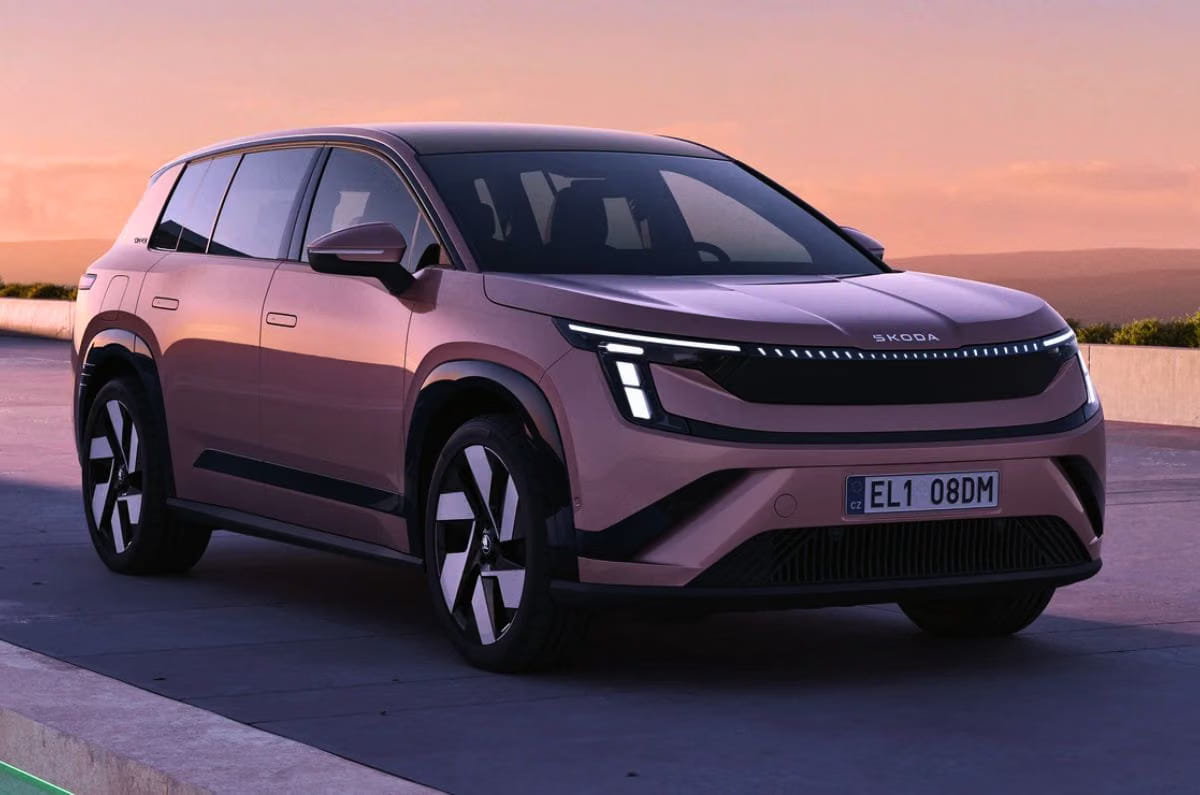
Skoda Peaq front quarter static

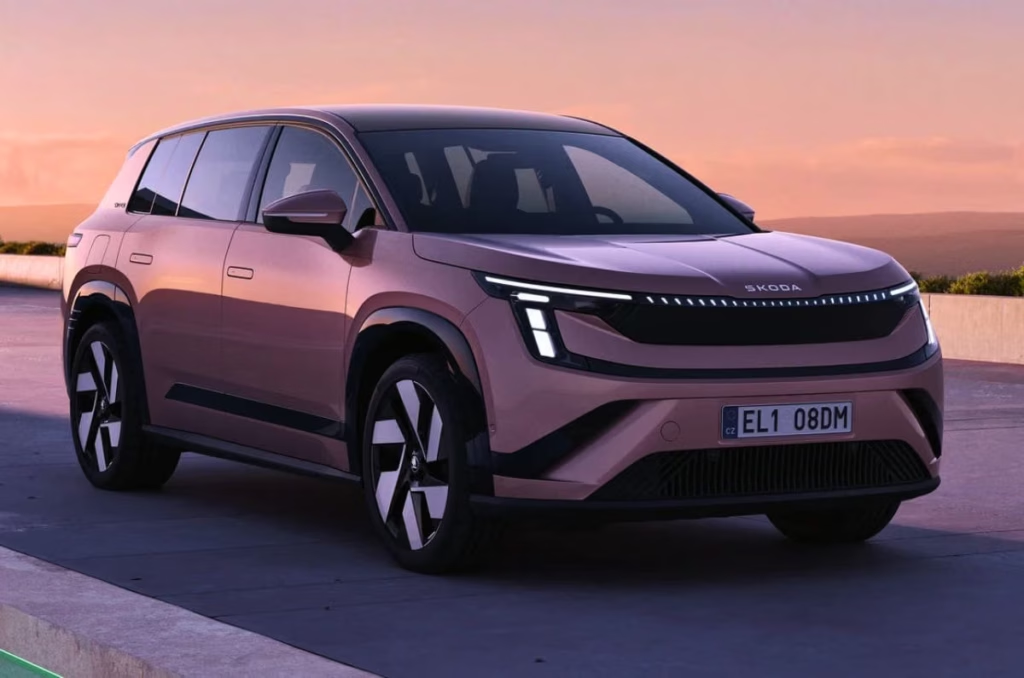
Skoda Auto India plans to bring electric vehicles from its global portfolio to India in limited volumes next year as the Czech automaker looks to establish its presence in the EV market. According to Ashish Gupta, Brand Director, Skoda Auto India, the company needs an electric vehicle in its portfolio not only to meet future regulatory requirements but also to remain relevant as EV adoption gathers pace in India.

Skoda India to bring EVs: Additional details 

“A lot of things are under discussion. So, for meeting the CAFÉ norms, there are a lot of opportunities available along with electrification, which has to be the cornerstone of meeting all compliance regulations. So that is something which we are aggressively working on,” Gupta told our sister publication, Autocar Professional.

Gupta added that the company needs an electric car in its portfolio since adoption has grown in the last 3 months owing to increasing fuel prices. While Skoda has yet to announce a specific locally manufactured EV for India, Gupta confirmed that the company plans to introduce EVs from its global line-up next year.

“It may not be a local EV, but yes, we just had two blockbuster launches globally of the Epiq and the Peaq. The Elroq is the best-selling EV in Europe. So these are opportunities available to us in limited batches,” he said. He added that in the current duty structure, it will not be possible to bring them at price points that will get volumes. “But definitely we need to urgently showcase our EV credentials and the proof point to India,” he added. 

This will allow Skoda to establish a presence in the EV market without immediately committing to the significant investment required to localise an electric model. With imported EVs still facing a challenging cost structure, Gupta said the initial objective would be to demonstrate the brand’s technology and capabilities rather than chase mass-market volumes. 

Skoda India’s hybrid ambitions take a slow gear 

Skoda’s approach to hybrids, meanwhile, appears less certain. Gupta said the company had previously viewed hybrids as a potentially stronger opportunity than EVs in India, but market data over the past two years has changed his assessment.

“Two years ago, I would have said I would take a bet on hybrid more than EV. But the tax structure has not helped anybody. In the last year, pure hybrids have stayed at 2% of the market. They have not gone beyond that. So, I am not sure whether hybrid is the right way to go. And what the last 6 months have also shown us is that people are more than willing to go for EVs now,” he said. 

The current trade and taxation structure also influences the company’s hesitation. Gupta said the India-EU Free Trade Agreement, while potentially creating opportunities for imported petrol and diesel models, does not provide similar benefits for EVs and hybrid electric vehicles. “I think from a global portfolio point of view, and if I want to bring the cars from the global portfolio with the contours of the FTA as they are, petrol and diesel will definitely be an opportunity. The diesel opportunity opens up; HEVs and electrics do not have any benefit, unfortunately,” he said. 

Gupta said the brand’s positioning in India is a bit above mass and below luxury. “That’s our natural positioning; that’s why customers buy us as well, and if we try to sell to cheap customers, they don’t buy us. If we try to sell to expensive customers, they don’t buy from us. So we have to stay true to our positioning and how customers see us,” he said. The immediate priority, Gupta adds, is to get EVs into the country as the company continues to assess which powertrains can deliver the right combination of regulatory compliance, customer demand and commercial viability.

With inputs from Ketan Thakkar

Porsche reveals a one-off 911 Slantnose

Porsche reveals a one-off 911 Slantnose
Porsche 911 Slantnose revealed

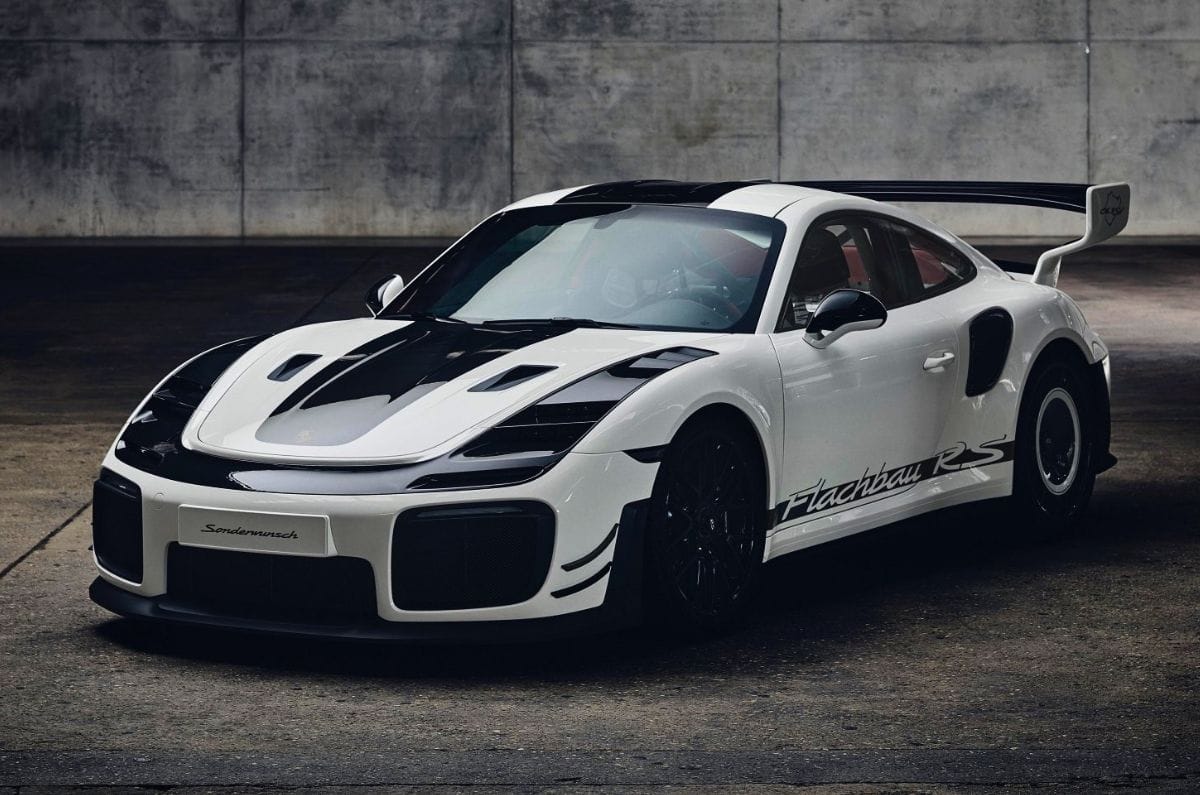
Porsche revealed a one-off 911 Slantnose, also known as the Flachbau, at the 2026 Monterey Car Week. It’s mechanically based on a 991.2-generation 911 GT2 RS with the Weissach Package from 2018, while the design has been inspired by the 1978 Porsche 935 Le Mans race car called ‘Moby Dick’. The brand claims teams from Weissach and Manthey, alongside its own in-house design studio, motorsport division and the Sonderwunsch (‘special request’ in German) department, took three years to complete this project.

  • Gets staggered headlamps, a custom rear wing and unique detailing
  • Loses rear seats, infotainment & audio systems and sound-deadening
  • Weighs 31.6kg less due to aggressive weight-saving measures
  • Claimed top speed is 340kph

Porsche 911 Slantnose exterior

Features a custom Manthey Kit and some elements inspired by the 911 GT3 R rennsport

Porsche 911 Slantnose front fascia

The silhouette of this Porsche 911 GT2 RS is understandably different due to its Slantnose conversion. The front fascia sports new, staggered LED headlamps that look sleek– the low-beam, high-beam and DRL elements are stacked above one another. These are integrated into the black U-shaped portion around the bonnet, which extends to right above the lowered front fenders. The latter has specially designed vents to prevent the build-up of air pressure in the wheel arches, claims Porsche.

Porsche 911 Slantnose front quarter

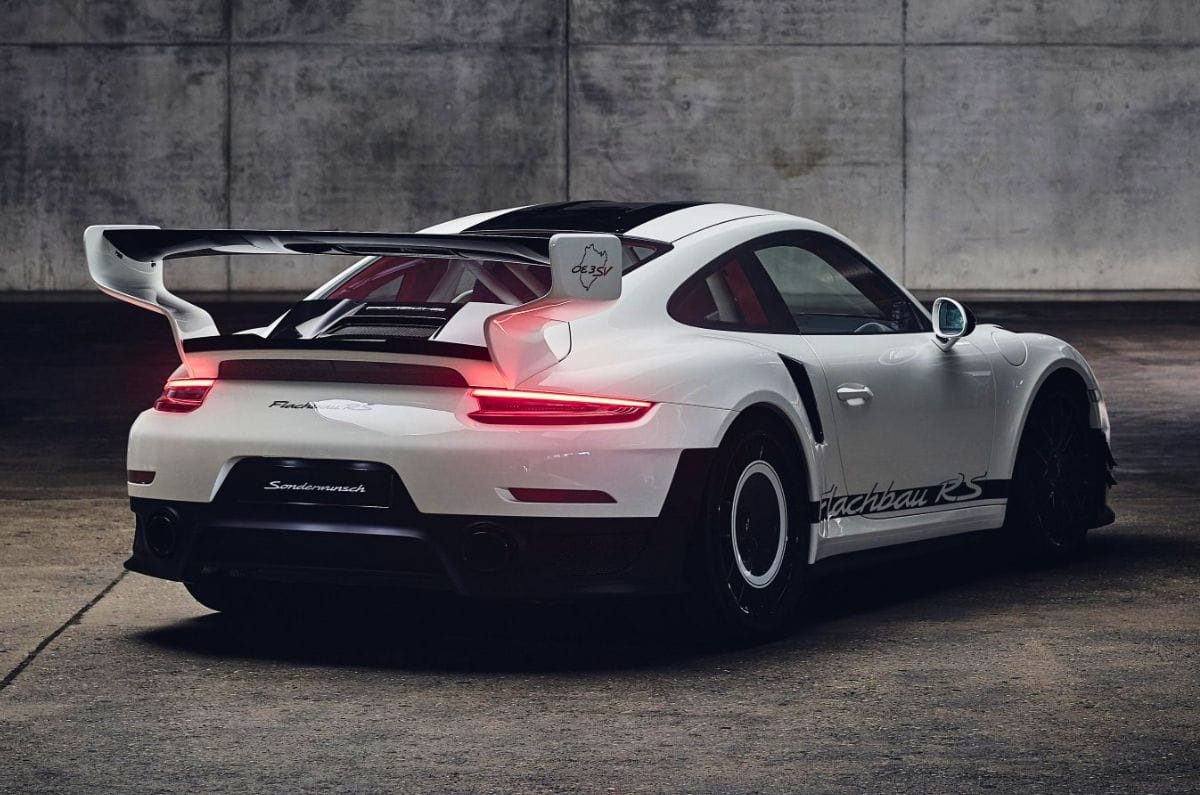
The custom Manthey Kit brings along a redesigned front bumper with small canards on the sides, a new underbody structure, plus a different front splitter and rear diffuser. While the front alloy wheels are of a conventional design, the carbon-fibre aero discs used for the rear units help reduce drag, according to Porsche. The Slantnose gets a large rear wing with S-shaped mounts inspired by the 911 GT3 R rennsport, allowing three manually adjustable positions. At the car’s top speed, Porsche claims that this wing generates 554kg of downforce.

Porsche 911 Slantnose rear quarter

The one-off Slantnose is painted in the brand’s Grand Prix White colour, but gets contrasting black accents and a black finish on the bonnet and roof. Adding more contrast are the black brake callipers and exposed carbon-fibre trim. There are ‘Flachbau RS’ lettering and decals, too, while the Nordschleife is depicted on the rear wing. Since the shape of the front fenders had been altered, the fuel-filler flap and its underlying mechanism also has to be modified, says Porsche. “Our aim was to reinterpret the iconic look of the 935 without compromising on safety, technology or road legality”, Alexander Fabig, Vice President Product Offering & Individualisation at Porsche, said.

Porsche 911 Slantnose interior

The brand has stripped this interior bare of most of its convenience features

Porsche 911 Slantnose door sill

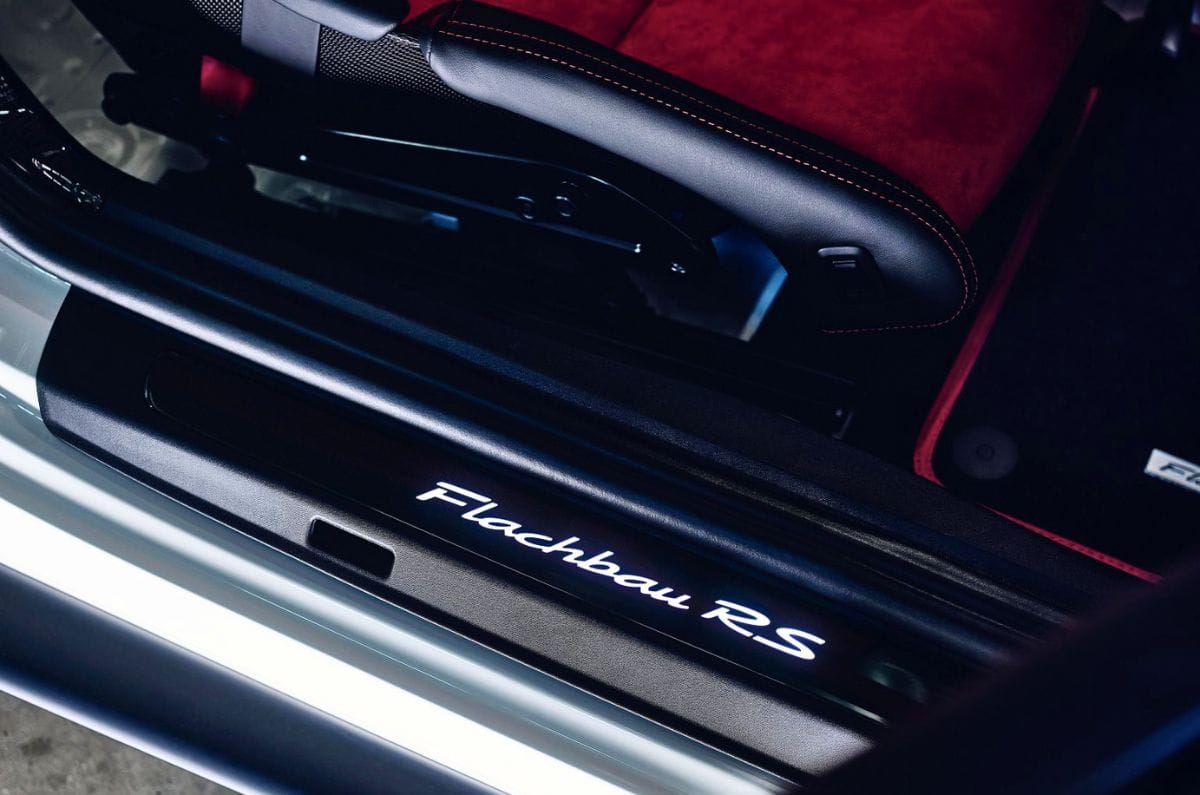
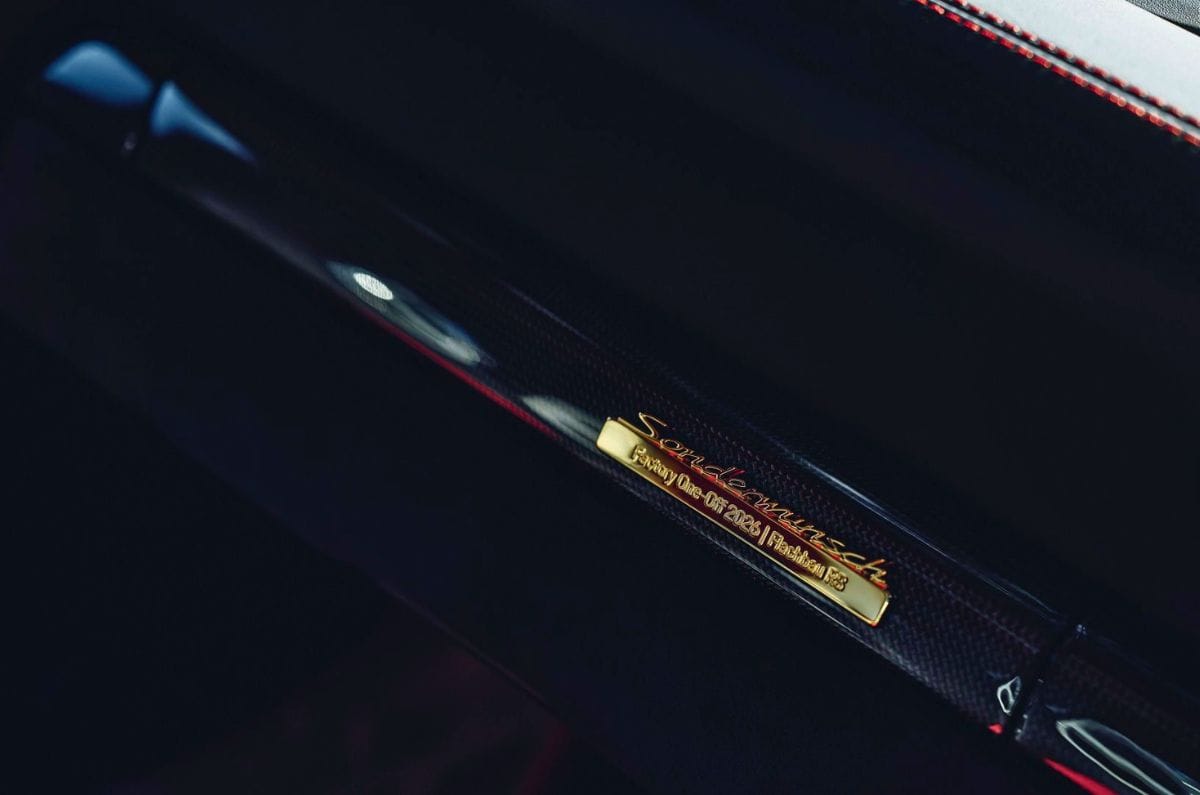
Opening the doors will reveal ‘Flachbau RS’ branding on the sills and seat headrests. There’s an outline of the Nordschleife drawn behind the front seats, along with a small gold-coloured plaque mentioning ‘Sonderwunsch’ and ‘Factory One-Off 2026 | Flachbau RS’ on the dashboard. Meanwhile, the interior continues to use the red Alcantara, black leather and exposed carbon-fibre trim originally available in the customer’s 911 GT2 RS.

Saving weight has been another important goal with this one-off Slantnose. To that effect, Porsche says it has removed the rear seats and individual wires, instead opting for simpler protective sheaths to cover newly laid wiring. Generous use of carbon fibre aside, the brand has removed the donor car’s infotainment system, replacing it with a leather-trimmed storage compartment.

Porsche 911 Slantnose dashboard

Other features to have been deleted include the audio system, floor coverings in the cabin and luggage space, and sound-deadening materials throughout the car. The end result of all these weight-saving measures means that this Slantnose is 31.6kg lighter than the donor vehicle it’s based on.

Porsche 911 Slantnose powertrain and other details

This one-off model retains the donor vehicle’s powertrain setup

Powering this one-off Slantnose is the same 3.8-litre twin-turbocharged six-cylinder engine found in the 991.2-generation 911 GT2 RS. This unit churns out 700hp and 750Nm of torque, and it drives the rear wheels via a 7-speed dual-clutch transmission. The claimed top speed of this one-off 911 is 340kph.

Porsche 911 Slantnose front

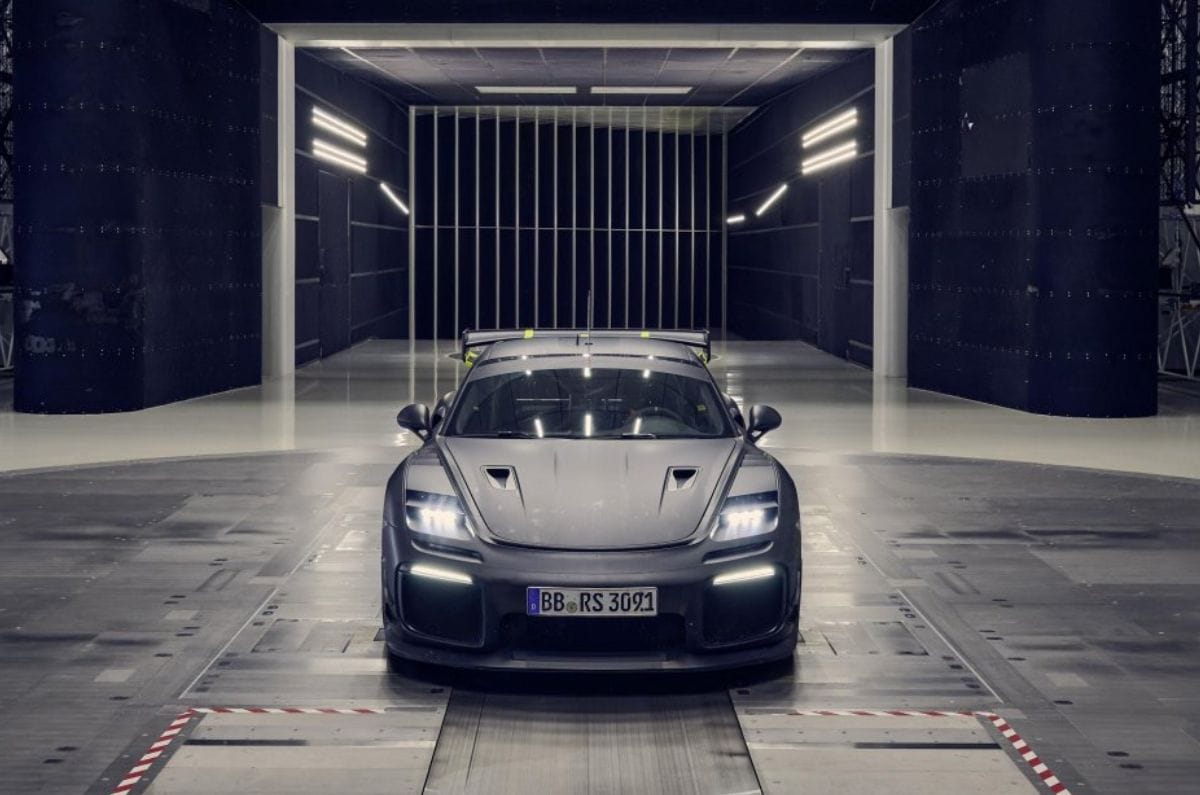
Porsche says that it built three test vehicles for validating data, while aerodynamic calculations being carried out using Computational Fluid Dynamics (CFD) to further optimise the overall design. These prototypes were subjected to multiple wind-tunnel tests, real-world road tests, and 50 laps on the Nurburgring-Nordschleife.

Also read

Ferrari Luce ‘Chassis 0’ sells for record USD 40 million at auction

GMA S1 reinterprets iconic McLaren F1 for the modern era

EMS Stocks: ECMS के पांचवें चरण को सरकार से मिली मंजूरी, सिर्मा SGS टेक्नोलॉजी और PCBL केमिकल में आई तेजी

EMS Stocks :  इलेक्ट्रॉनिक कंपोनेंट मैन्युफैक्चरिंग स्कीम (ECMS)के 5वें चरण को सरकार से मंजूरी मिल गई है। इस स्कीम के तहत 31 निवेश प्रस्तावों को मंजूरी मिली है। इस खबर के चलते Syrma और PCBL जैसी कंपनियां फोकस में हैं। ECMS स्कीम के पांचवें चरण के तहत सरकार से 7,877 करोड़ रुपए के 31 निवेश प्रस्तावों को मंजूरी मिली है। Syrma SGS और PCBL समेत 31 कंपनियों को मंजूरी मिली है। इस स्कीम के तहत 82,243 करोड़ रुपए के इलेक्ट्रॉनिक प्रोडक्ट्स का उत्पादन होगा।

पहले 4 चरणों में अब तक 75 कंपनियों के प्रस्तावों को मंजूरी मिली है। इसके तहत 23 उत्पादों के भारत में उत्पादन को मंजूरी मिली है। इसमें PCB,इलेक्ट्रॉनिक कंपोनेंट्स,कैमरा मॉड्यूल और ट्रांजिस्टर शामिल हैं। इनके लिए 61,671 करोड़ के निवेश प्रस्तावों को मंजूरी मिल चुकी है। बता दें कि ECMS इन्वेस्टमेंट और प्रोडक्शन टारगेट पहले ही पार कर चुका है। ECMS ने इन्वेस्टमेंट में 59,350 करोड़ रुपए और प्रोडक्शन में 4.56 लाख करोड़ का टारगेट रखा गया है।

विप्रो ग्लोबल इंजीनियरिंग (Wipro Global Engineering) को 1,401 करोड़ रुपए के निवेश की मंजूरी मिली है। वहीं, माइक्रोमैक्स प्रिसिजन मोल्डिंग (Micromax Precision Molding) को 565 करोड़ रुपए के निवेश की मंजूरी मिली है। पीसीबीएल केमिकल (PCBL Chemical) को 329 करोड़ रुपए के निवेश की मंजूरी मिली है। वहीं, मिंडा इंस्ट्रूमेंट (Minda Instrument) को 270 करोड़ रुपए के निवेश की मंजूरी मिली है। जबकि, सेंटम इलेक्ट्रॉनिक्स (Centum Electronics) को 106 करोड़ रुपए के 2 निवेश प्रस्तावों की मंजूरी मिली है। VVDN टेक्नोलॉजीज़ (VVDN Technologies) को 100 करोड़ रुपए के निवेश की मंज़ूरी मिली है। वहीं, मित्सुबिशी इलेक्ट्रिक (Mitsubishi Electric) को 99 करोड़ रुपए के निवेश की मंज़ूरी मिली है।

कंपनियों को मंजूरी का प्रमाण पत्र देने के बाद केंद्रीय इलेक्ट्रॉनिक्स एवं आईटी मंत्री अश्विनी वैष्णव ने कहा कि इस योजना ने निजी निवेश को आकर्षित किया है,जो मूल रूप से निर्धारित लक्ष्यों से अधिक हो गया है।

यह मंजूरी ऐसे समय में मिली है जब भारत घरेलू सप्लाई चेन को मजबूत करके,महत्वपूर्ण कलपुर्जों के आयात पर निर्भरता कम करने और एडवांस मैन्यूफैक्चरिंग क्षमता को तैयार करके इलेक्ट्रॉनिक्स में घरेलू वैल्यूएडिशन को मजबूत करना चाहता है।

EMS शेयरों में जोश

इस खबर के चलते सिर्मा SGS टेक्नोलॉजी (Syrma SGS Technology) के शेयर में अच्छी तेजी देखने को मिली है। फिलहाल यह शेयर 30.50 रुपए यानी 2.08 फीसदी की तेजी के साथ 1498 रुपए के आसपास दिख रहा है। आज का इसका दिन का हाई 1,521 रुपए और दिन का लो 1,488.90 रुपए है। स्टॉक का 52 वीक हाई 1,543 रुपए है।

पीसीबीएल केमिकल (PCBL Chemical) में भी तेजी देखने को मिल रही है। फिलहाल यह शेयर 3.25 रुपए यानी 1.03 फीसदी की बढ़त के साथ 319 रुपए पर नजर आ रहा है। आज का इसका दिन का हाई 325.85 रुपए है। स्टॉक का 52 वीक हाई 425.95 रुपए और 52 वीक लो 226.50 रुपए है।


Colgate Palmolive Share Price : बाजार को पसंद नहीं आई मैनेजमेंट की कमेंट्री, 3% टूट कर वायदा का टॉप लूजर बना शेयर

Redmi Note 17 सीरीज की ग्लोबल लॉन्च डेट कन्फर्म, 10,000mAh बैटरी समेत इन फीचर्स का हुआ खुलासा

Xiaomi के सब-ब्रांड Redmi ने ऐलान किया है कि Redmi Note 17 सीरीज जल्द ही ग्लोबल मार्केट में दस्तक देने वाली है। कंपनी ने सोमवार को इसकी लॉन्च डेट की जानकारी दी। बता दें कि इस सीरीज के फोन जुलाई में चीन में लॉन्च किए गए थे, और ब्रांड ने Redmi Note 17 के 5G और 4G वेरिएंट भी ग्लोबल लेवल पर पेश किए थे। उम्मीद है कि ग्लोबल लाइनअप में तीन मॉडल होंगे — Redmi Note 17, Note 17 Pro और एक नया Note 17 Pro Max। इनमें से आखिरी वाले (Pro Max) के कई स्पेसिफिकेशन भी अब सामने आ गए हैं।

Redmi Note 17 सीरीज की लॉन्च डेट

Xiaomi ने X पर एक पोस्ट में घोषणा की कि Redmi Note 17 सीरीज को 27 अगस्त को ग्लोबल लेवल पर लॉन्च किया जाएगा। Xiaomi की ग्लोबल वेबसाइट पर एक नई माइक्रोसाइट से Redmi Note 17 Pro Max नाम के एक नए मॉडल के जल्द लॉन्च होने की पुष्टि होती है। डिजाइन की बात करें तो, इस लाइनअप में फोटोक्रोमिक टेक्नोलॉजी होगी। Redmi का कहना है कि इसमें एक नया ‘क्लाउड ब्लश’ एलिमेंट है जो सूरज की रोशनी के साथ रिएक्ट कर सकता है।

आने वाली Redmi Note 17 सीरीज में 6.83 इंच का CrystalRes AMOLED डिस्प्ले मिलेगा, जो 1.5K रेजोल्यूशन के साथ आएगा। फोन में Snapdragon 6 Gen 5 चिपसेट दिया जाएगा। इसके साथ 24GB तक रैम मिलेगी, जिसमें वर्चुअल रैम का सपोर्ट भी शामिल होगा। Redmi का दावा है कि फोन 72 महीने तक स्मूद परफॉर्मेंस बनाए रखेगा।

माइक्रोसाइट से धूल और पानी से बचाव के लिए IP66 + IP68 + IP69 + IP69K रेटिंग्स का भी पता चलता है। Xiaomi के सब-ब्रांड का कहना है कि उनके फोन SGS और TÜV SÜD दोनों से सर्टिफाइड हैं।

कैमरे की बात करें तो अभी इसके बारे में पूरी जानकारी सामने नहीं आई है, लेकिन कंपनी ने कन्फर्म किया है कि Note 17 सीरीज में AI-पावर्ड पोर्ट्रेट एन्हांसमेंट फीचर होगा। ब्रांड द्वारा शेयर किए गए कैमरा सैंपल में f/1.5 अपर्चर, 26mm फोकल लेंथ, 1/60-सेकंड शटर स्पीड और ISO 125 की जानकारी मिलती है।

हालांकि, सबसे खास बात इसकी बैटरी क्षमता है, जो 10,000mAh की है। जानकारी से पता चलता है कि यह Redmi 17 Pro Max के लिए है, जो 100W फास्ट चार्जिंग को सपोर्ट करेगा, हालांकि Xiaomi ने कन्फर्म किया है कि वे बॉक्स में पावर एडॉप्टर नहीं देंगे। Redmi Note 17 सीरीज खरीदने पर ग्राहकों को बिना किसी अतिरिक्त खर्च के 2 महीने का YouTube Premium, तीन महीने का Spotify Premium, छह महीने का Google One प्लान, 24 महीने के अंदर एक बार फ्री स्क्रीन रिप्लेसमेंट और 36 महीने के अंदर एक बार फ्री बैटरी सर्विस मिलेगी।

पिछली रिपोर्ट्स के अनुसार, Redmi Note 17 सीरीज भारत में 18 या 20 सितंबर को लॉन्च हो सकती है। लीक से यह भी पता चलता है कि Redmi Note 17 Pro Max में 50MP (f/1.8) का प्राइमरी रियर कैमरा हो सकता है, साथ ही 8MP का अल्ट्रा-वाइड-एंगल लेंस और सेल्फी व वीडियो कॉल के लिए 32MP का फ्रंट कैमरा भी हो सकता है। हालांकि, पहले सामने आई जानकारी में फोन में 9,210mAh बैटरी होने की बात कही गई थी।

लेकिन अब ग्लोबल लॉन्च डेट कन्फर्म होने के बाद, हम उम्मीद कर सकते हैं कि Redmi Note 17 सीरीज के लॉन्च से पहले के दिनों में और भी जानकारी सामने आएगी।

यह भी पढ़ें: बिजली गई तो भी 10 घंटे तक देता रहेगा ठंडी हवा! ओरिएंट ने लॉन्च किया इन-बिल्ट बैटरी वाला BLDC पंखा, जानिए इसकी कीमत

Viral Video: मुरथल में इंसान नहीं रोबोट परोस रहे पराठे, सोशल मीडिया पर वायरल हुआ वीडियो

मुरथल अपने पराठों और ढाबों के लिए जाना जाता है। वहीं हाल ही में मुरथल का एक वीडियो सोशल मीडिया पर काफी वायरल हो रहा है। लेकिन इस बार अपने पराठों की वजह से नहीं बल्कि रोबोट वेटर की वजह से। मुरथल के रेशम ढाबा में रोबोट वेटर ग्राहकों की टेबल तक खाना पहुंचा रहा है। रोबोट को खाना सर्व करते देखकर लोग काफी एक्साईटेड हैं और उसका वीडियो भी बना रहे हैं। इस नई पहल ने पारंपरिक ढाबे के माहौल में आधुनिक तकनीक का नया रंग जोड़ दिया है।

कैसे करता है सर्व

रेस्टोरेंट में रोबोट वेटर लोगों के बीच आकर्षण का केंद्र बना हुआ है। जैसे ही रोबोट खाना लेकर टेबल तक पहुंचता है, कस्टमर उसका वीडियो बनाने लगते हैं और सेल्फी भी लेते हैं। बच्चों को ये रोबोट खास तौर पर पसंद आ रहा है। अब यहां लोगों को स्वादिष्ट खाना खाने के साथ रोबोट को देखना भी एक नया और मजेदार अनुभव मिल रहा है। रेस्टोरेंट में रोबोट के जरिए खाना पहुंचाने की प्रक्रिया भी काफी सरल है। ऑर्डर तैयार होने के बाद कर्मचारी खाने की ट्रे रोबोट पर रख देते हैं।

इसके बाद रोबोट अपने सिस्टम की मदद से सही रास्ते से ग्राहक की टेबल तक पहुंच जाता है। इसे सॉफ्टवेयर के साथ रिमोट से भी कन्ट्रोल किया जा सकता है, इसलिए जरूरत पड़ने पर रेस्टोरेंट का स्टाफ तुरंत इसकी मदद कर सकता है।

एक बार चार्ज पर दो घंटे चलता है रोबोट

रेस्टोरेंट में इस्तेमाल हो रहा यह रोबोट देखने में काफी आधुनिक है। इसका शरीर फाइबर से तैयार किया गया है और इसमें एलईडी लाइट्स लगी हैं, जो इसे अलग लुक देती हैं। इसकी आंखों में लगी लाल रोशनी लोगों का ध्यान खास तौर पर खींचती है। रेस्टोरेंट के अनुसार, एक बार पूरी तरह चार्ज होने के बाद रोबोट करीब दो घंटे तक काम कर सकता है। खास बात यह है कि ग्राहकों से रोबोट के जरिए खाना पहुंचाने के लिए कोई अतिरिक्त शुल्क नहीं लिया जाता।

मैनेजर ने क्या कहा

रेशम ढाबा के मैनेजर संजय के मुताबिक, रेस्टोरेंट ग्राहकों को खाने के साथ कुछ नया और मनोरंजक अनुभव देना चाहता था। उन्होंने IANS से कहा, “यह एक ऐसा कॉन्सेप्ट है, जिसमें रोबोट और ट्रेन दोनों शामिल हैं और मुरथल में यह अपने आप में नया है। यहां सभी ढाबे अच्छा खाना परोसने की कोशिश करते हैं, इसलिए हमने सोचा कि ग्राहकों के लिए कुछ अलग किया जाए। इसी सोच के साथ हमने खाने के साथ मनोरंजन जोड़ने के लिए रोबोट और ट्रेन का कॉन्सेप्ट शुरू किया।” सोशल मीडिया पर ये काफी वायरल हो रहा है।

Samsung Galaxy S24 Ultra की कीमत हुई कम! Exchange और Cashback से ₹25,849 की बचत

Samsung Galaxy S24 Ultra को खरीदने का प्लान बना रहे हैं, तो Amazon पर इस फोन पर फिलहाल अच्छी डील मिल रही है। फोन की कीमत अभी ₹99,999 है, जबकि इसकी लिस्टेड MRP ₹1,34,999 है। खास बात यह है कि एक्सचेंज ऑफर और कैशबैक का फायदा उठाकर इसकी प्रभावी कीमत ₹74,150 तक आ सकती है।

Amazon की लिस्टिंग में एक एलिजिबल पुराने स्मार्टफोन के लिए ₹20,850 तक की एक्सचेंज वैल्यू दिखाई गई है। एक्सचेंज स्क्रीन पर अभी 128GB स्टोरेज और बिना किसी डैमेज वाले Apple iPhone 13 को चुनने पर ₹20,850 तक की एक्सचेंज वैल्यू दिख रही है। हालांकि, असल वैल्यू फोन के मॉडल, स्टोरेज क्षमता और कंडीशन के आधार पर अलग-अलग हो सकती है।

डील का हिसाब देखें तो ₹99,999 की कीमत में से अधिकतम ₹20,850 का एक्सचेंज बेनिफिट घटाने पर फोन की प्रभावी कीमत ₹79,149 रह जाती है। इसके बाद अगर आपको उपलब्ध ऑफर के तहत ₹4,999 तक का कैशबैक मिलता है, तो इसकी प्रभावी कीमत घटकर ₹74,150 हो सकती है।

एक्सचेंज ऑफर का इस्तेमाल कैसे करें

Amazon के एक्सचेंज प्रोसेस में खरीदार को अपने पुराने फोन का ब्रांड, मॉडल, स्टोरेज क्षमता और उसकी हालत बतानी होती है। दिखाए गए उदाहरण में, चुना गया डिवाइस Apple iPhone 13 है जिसमें 128GB स्टोरेज है और यह “बिना किसी डैमेज” वाली कैटेगरी में है।

Amazon का कहना है कि अगर पुराना फोन चालू हालत में नहीं है, उसकी RAM, स्टोरेज या IMEI की जानकारी मेल नहीं खाती है, एक्सचेंज ऐप से वेरिफिकेशन फेल हो जाता है, या स्क्रीन लॉक या iCloud लॉक नहीं हटाया गया है, तो पिकअप के समय फोन को रिजेक्ट किया जा सकता है।

अगर फोन की हालत बताई गई जानकारी से मेल नहीं खाती है, तो भी Amazon के अनुसार खरीदार डिलीवरी एजेंट को अंतर की रकम देकर कुछ डिस्काउंट पा सकता है। वहीं, अगर पिकअप के समय पुराना फोन वेरिफिकेशन में फोल हो जाता है, तो भी एक्सचेंज की रकम चुकाकर एक्सचेंज डिस्काउंट का फायदा उठाया जा सकता है।

Galaxy S24 Ultra के स्पेसिफिकेशन्स

Amazon पर लिस्टेड Samsung Galaxy S24 Ultra में 6.8 इंच का डिस्प्ले दिया गया और यह Snapdragon 8 Gen 3 प्रोसेसर पर चलता है। इस मॉडल में 12GB RAM और 256GB स्टोरेज दी गई है।

कैमरे की बात करें तो Galaxy S24 Ultra में 200MP का मेन कैमरा मिलता है। फोन में 5,000mAh की बैटरी दी गई है। इसके अलावा, यह स्मार्टफोन Galaxy AI फीचर्स को भी सपोर्ट करता है और इसके साथ 1 साल की वारंटी मिलती है।

Amazon पर फोन के साथ 10 दिन की सर्विस सेंटर रिप्लेसमेंट, फ्री डिलीवरी और पे-ऑन-डिलीवरी जैसे फायदे भी दिए गए हैं।

बता दें कि ₹99,999 की कीमत वाले Galaxy S24 Ultra पर पहले से ही डिस्काउंट मिल रहा है, और एक्सचेंज व कैशबैक ऑफर के साथ इसकी असल कीमत ₹74,150 तक कम हो सकती है। हालांकि, ₹74,150 की कीमत पूरी ₹20,850 की एक्सचेंज वैल्यू और ज्यादा से ज्यादा ₹4,999 का कैशबैक मिलने पर ही लागू होगी, इसलिए खरीदारों को चेकआउट के समय फाइनल ऑफर जरूर देख लेना चाहिए।

यह भी पढ़ें: Flipkart दे रहा iPhone 17 पर बंपर डील! ₹35 हजार से ज्यादा का मिलेगा फायदा, जानें कीमत और ऑफर्स

Aston Martin Valen revealed at the Monterey Car Week

Aston Martin Valen revealed at the Monterey Car Week
Aston Martin Valen front quarter static

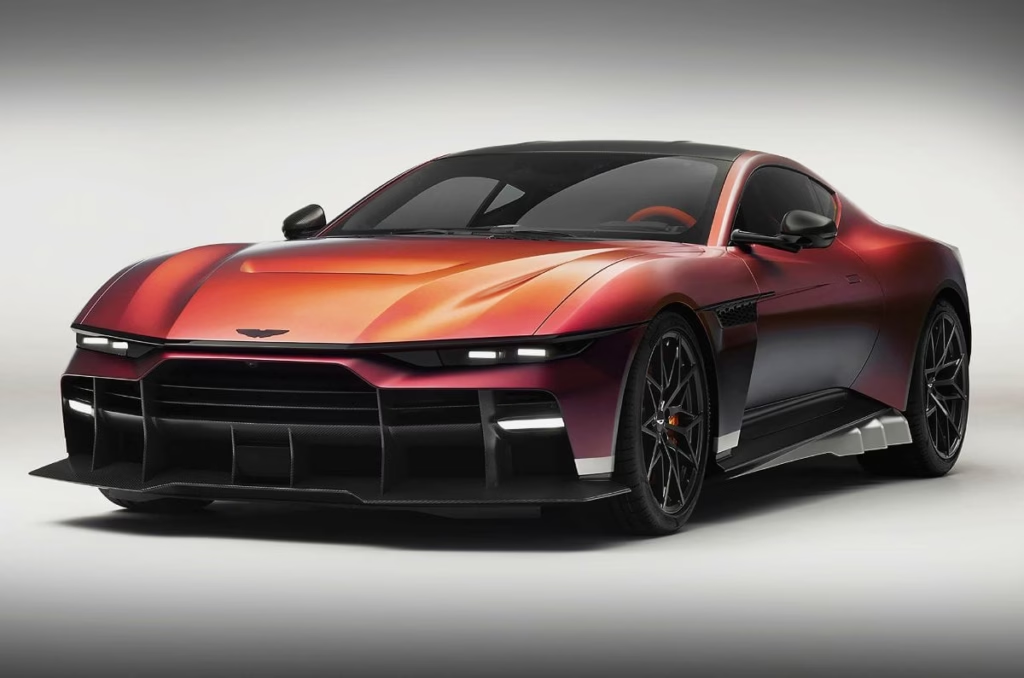
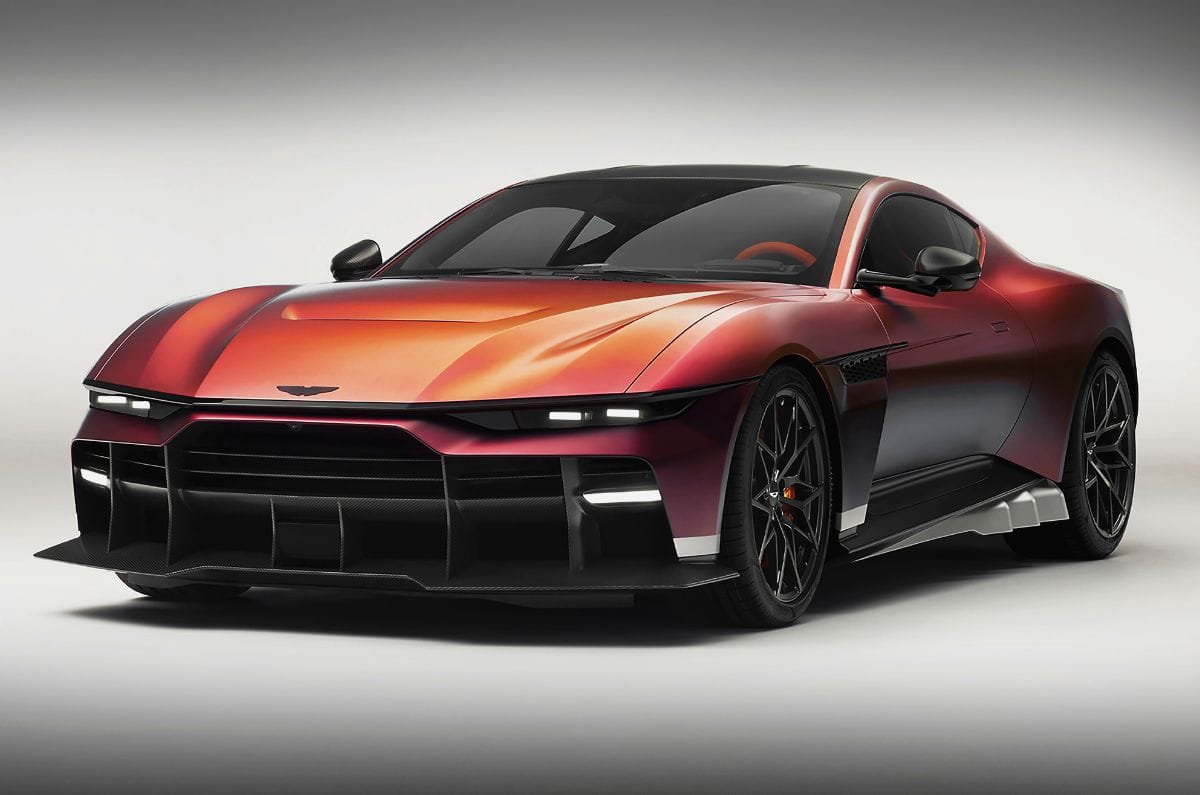
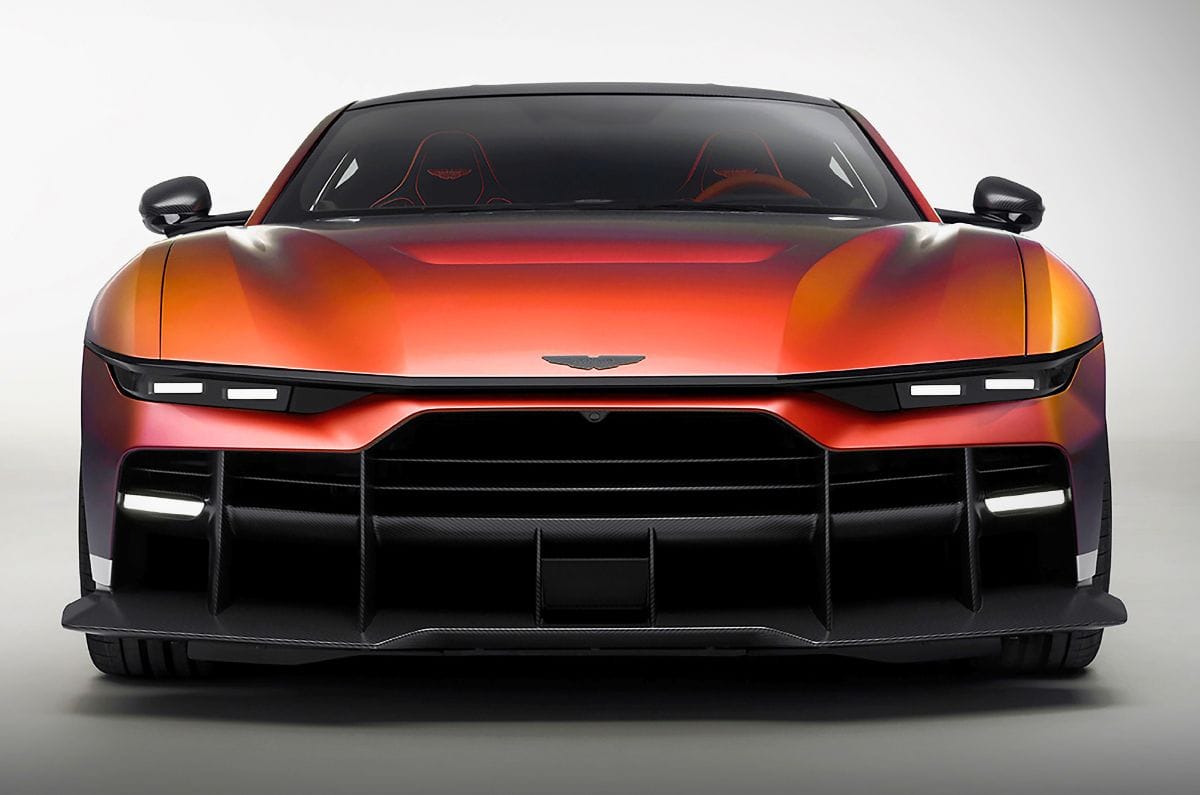
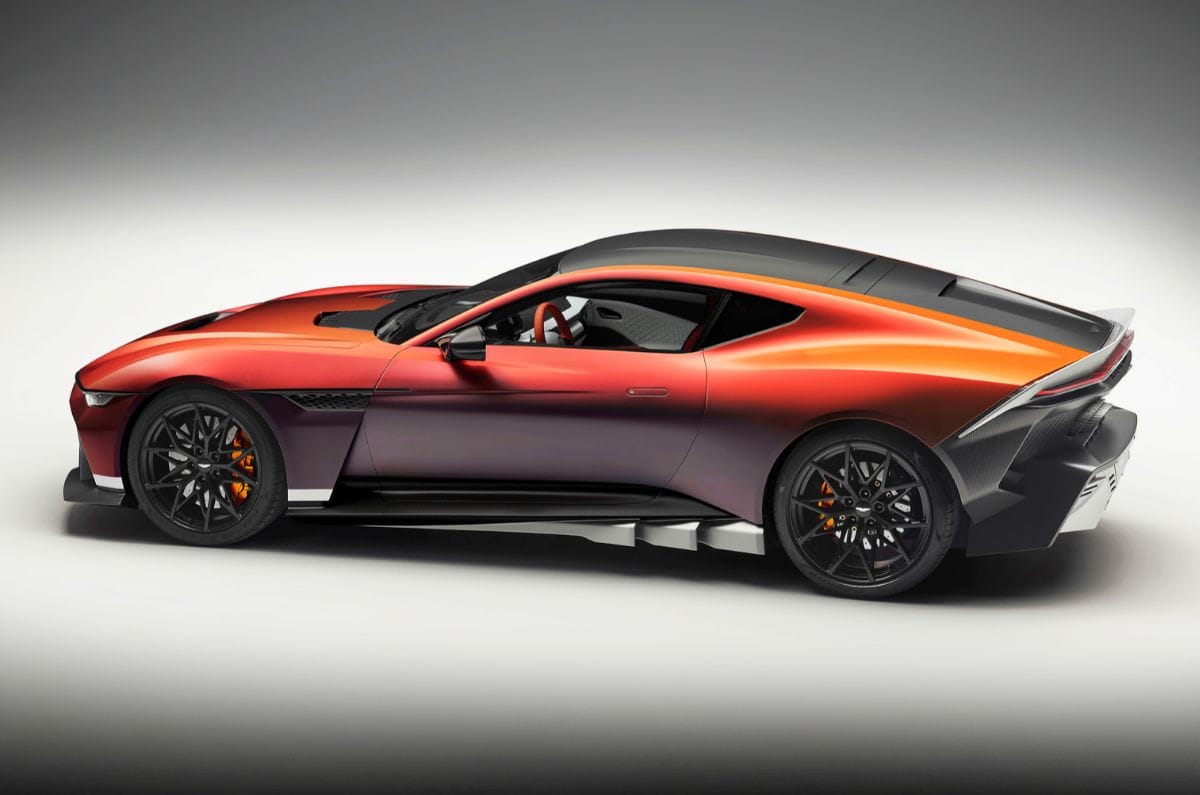
Aston Martin has revealed the Valen as its most powerful front-engined production car at the 2026 Monterey Car Week. An 850hp, 5.2-litre twin-turbo V12 engine, derived from the Vanquish, powers this GT car. Only 150 units of the Valen are being built by the manufacturer’s ‘Q’ personalisation department, with deliveries commencing in the second quarter of 2027.

  1. Claimed 0-100kph time is 3.1 seconds and top speed is 345kph
  2. Uses carbon fibre, aluminium, titanium, and magnesium elements in plenty
  3. Weighs 110kg less than the Aston Martin Vanquish

Aston Martin Valen powertrain details

Produces 15hp more than the Vanquish and is 0.2s faster in a 0-100kph sprint

The Aston Martin Valen is powered by the same 5.2-litre twin-turbo V12 engine as the Vanquish GT, but with more performance. It produces 850hp (15hp more) and 1,000Nm (same as the Vanquish) and is mated to an 8-speed automatic transmission that sends power to the rear wheels (RWD). The gearbox software has, however, been remapped with the Vantage GT4 racecar’s software for “more engaging shifts in all drive modes”. With the Valen, Aston Martin claims a 0-100kph time of 3.1 seconds (0.2s faster than the Vanquish) and an electronically limited top speed of 345kph.

The Valen is 110kg lighter than the Vanquish due to the use of lightweight motorsport-inspired materials, including carbon fibre, aluminium, titanium and magnesium. Aston Martin has also made “significant hardware changes and targeted software calibration” to the ESP, throttle, braking and steering systems. The suspension system uses stiffer springs for reduced roll and pitch motions to driver inputs for increased agility. 

Aston Martin Valen exterior design

Looks sportier and brutish than the other Aston Martin models

The Valen looks sportier than the gentlemanly designs Aston Martin is generally known for and, as per chief creative officer Marek Reichman, “the Valen is a significant departure from what has gone before”. At the front, the Valen sports a new snout with an aggressive bonnet featuring a functional top vent to draw more air to the engine. The signature Aston Martin grille motif extends to the ends of the fascia. The LED DRLs and LED headlights are slim horizontal bars that make the Valen look menacing. It also gets an “acutely angled” front splitter to channel the air into the GT’s internals. 

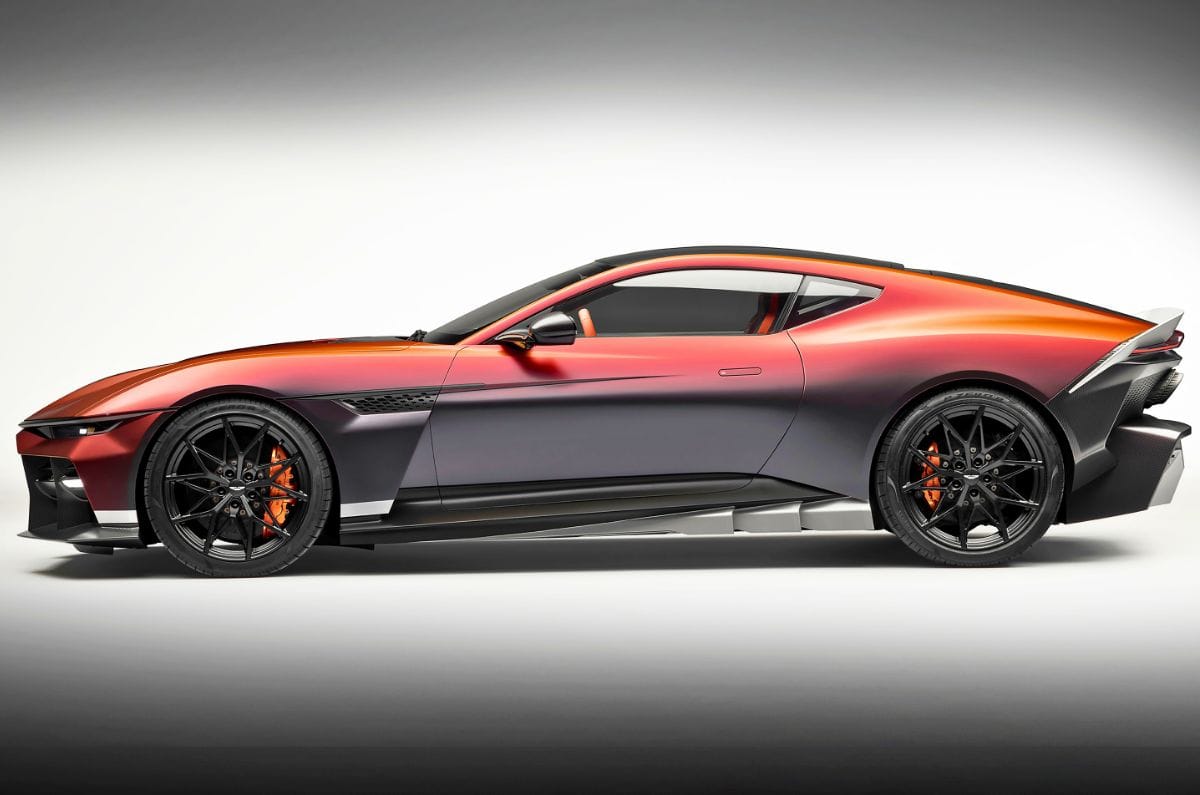
In profile, it sports lightweight magnesium wheels shod with Pirelli P Zero R tyres (275/35 ZR21 front, 325/30 ZR21 rear), specifically developed for the Valen. The GT also gets Pirelli’s latest Cyber Tyre technology, allowing real-time tyre data sharing with the vehicle’s dynamic control systems. The traditional side strakes incorporate large functional vents that extract air from the wheel arch, guiding it towards the rear for improved downforce.

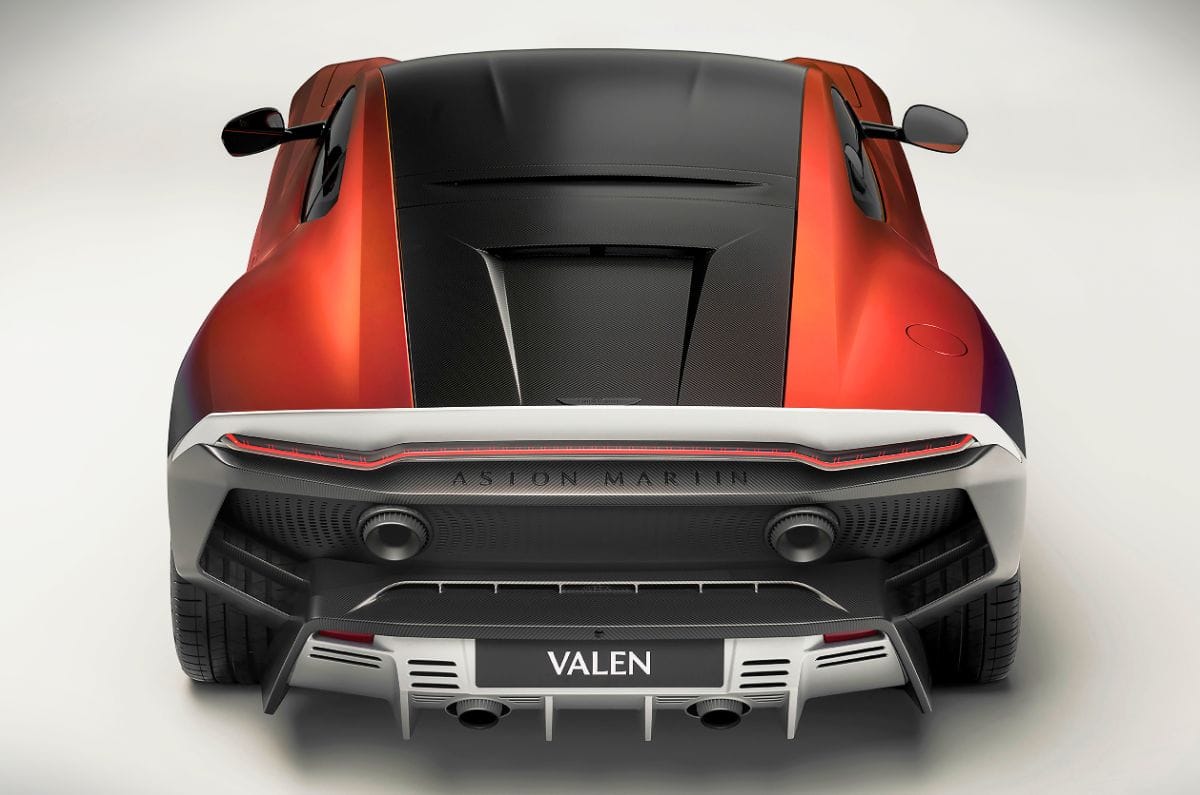
The rear design is bold as well, replacing a traditional fixed rear windscreen with a solid tailgate that opens to reveal 170 litres of boot space. The tailgate features an aerodynamic wing that acts as a Gurney flap that “generates downforce with minimal drag and negates the need for a conventional rear wing”. Beneath this wing is a slim LED taillight bar and 3D-printed quad titanium exhausts stacked in a 2-up, 2-down arrangement. The upper exhaust outlets are always open, while the lower ones open in the raciest drive modes.

The Valen is available with an optional fully exposed carbon fibre exterior that can be tinted in both satin- and gloss-finished hues by the ‘Q’ customisation department. 

Aston Martin Valen interior design

Features a minimalistic dashboard and a well-loaded cabin

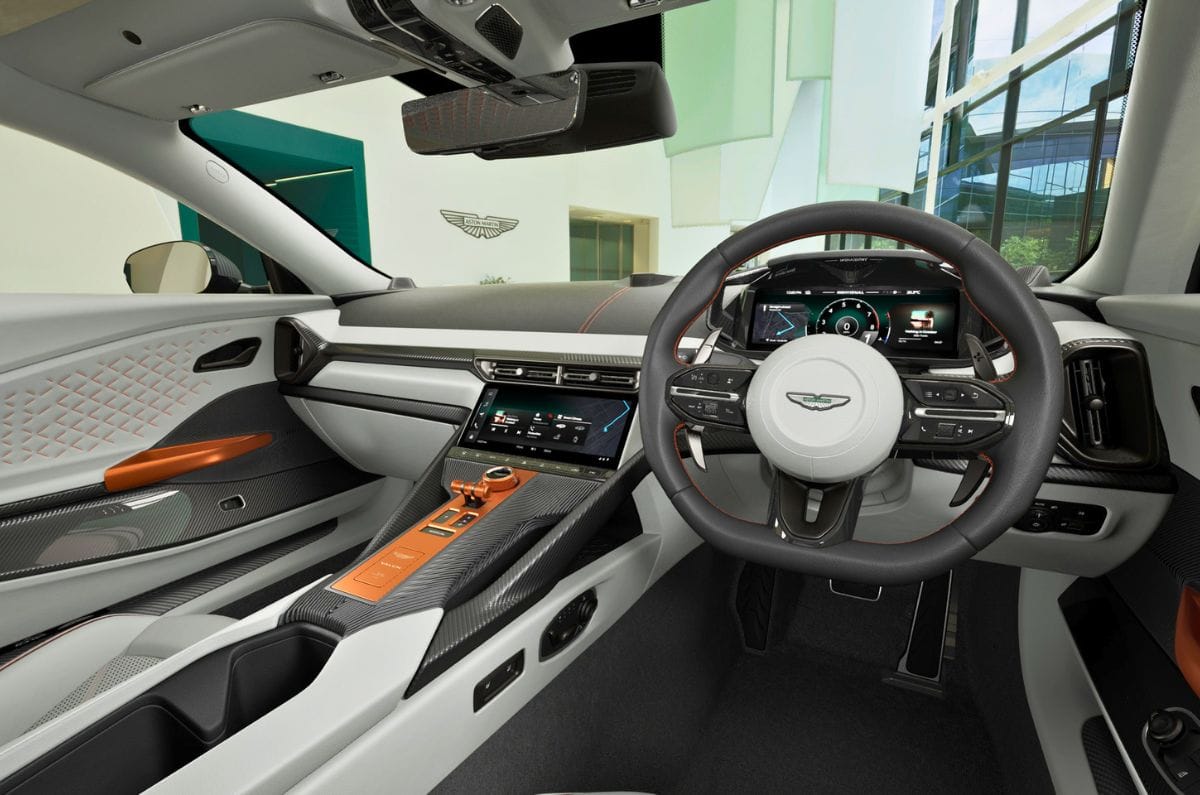
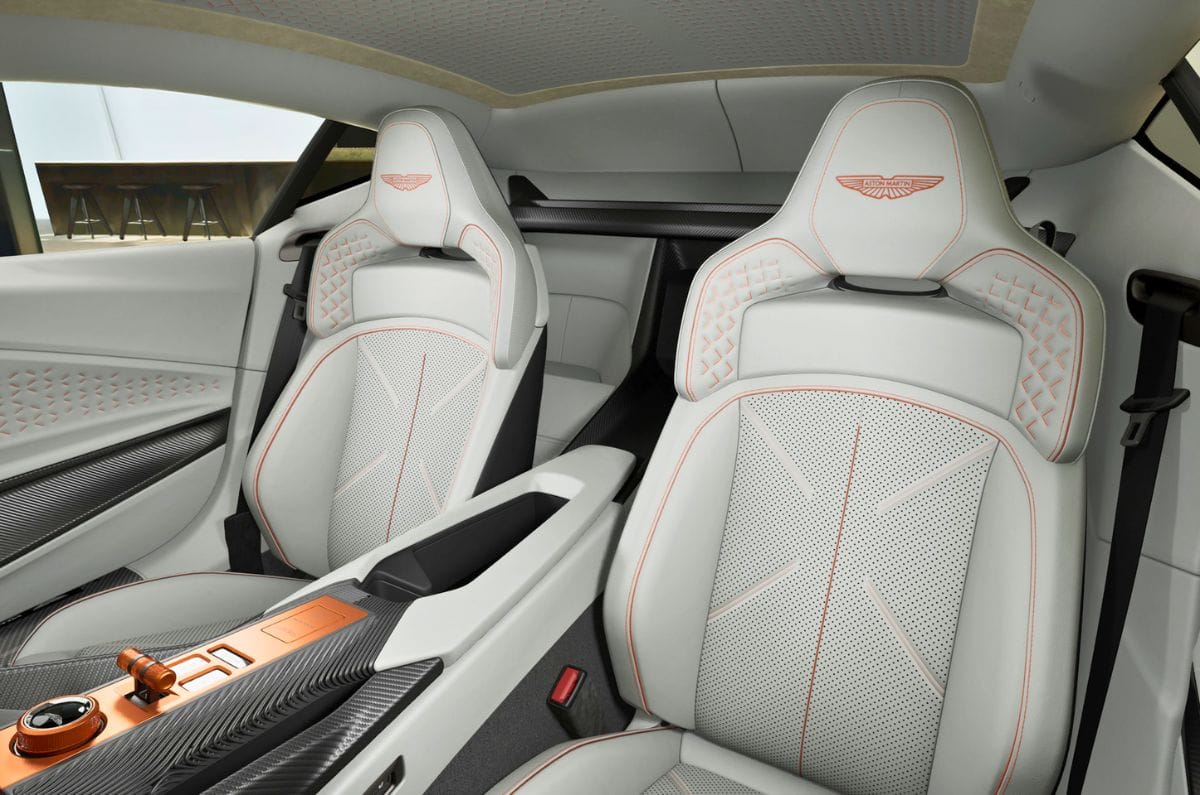
The Valen’s interior is heavily influenced by the Vanquish and hence offers a minimalistic dashboard with a 10.25-inch-inch digital driver’s display, a 3-spoke steering wheel and a 10.25-inch touchscreen infotainment system. What’s different from the Vanquish is that the centre console has been 3D-printed for “greater precision to the surfaces you regularly interact with”. This console has a carbon fibre finish and features a push-button start-stop and an aircraft-style drive mode selector.

The Aston Martin Valen offers an option between ‘Sport Plus’ seats that “combine support with long-distance comfort” or carbon-fibre ‘Performance’ seats that offer “a more focused driving experience”. Features include a 15-speaker Bowers & Wilkins sound system, a 360-degree camera system, a digital inside rearview mirror (IRVM), a powered steering column and a wireless phone charger. 

Reichman says, “Valen gave us the opportunity to explore and express more extreme emotions through a new form language and surface treatment.” Reflecting this bold design approach, Aston Martin has priced the Valen at 1.5 million pound (approximately Rs 19.46 crore), before buyers choose from the extensive catalogue of optional extras.