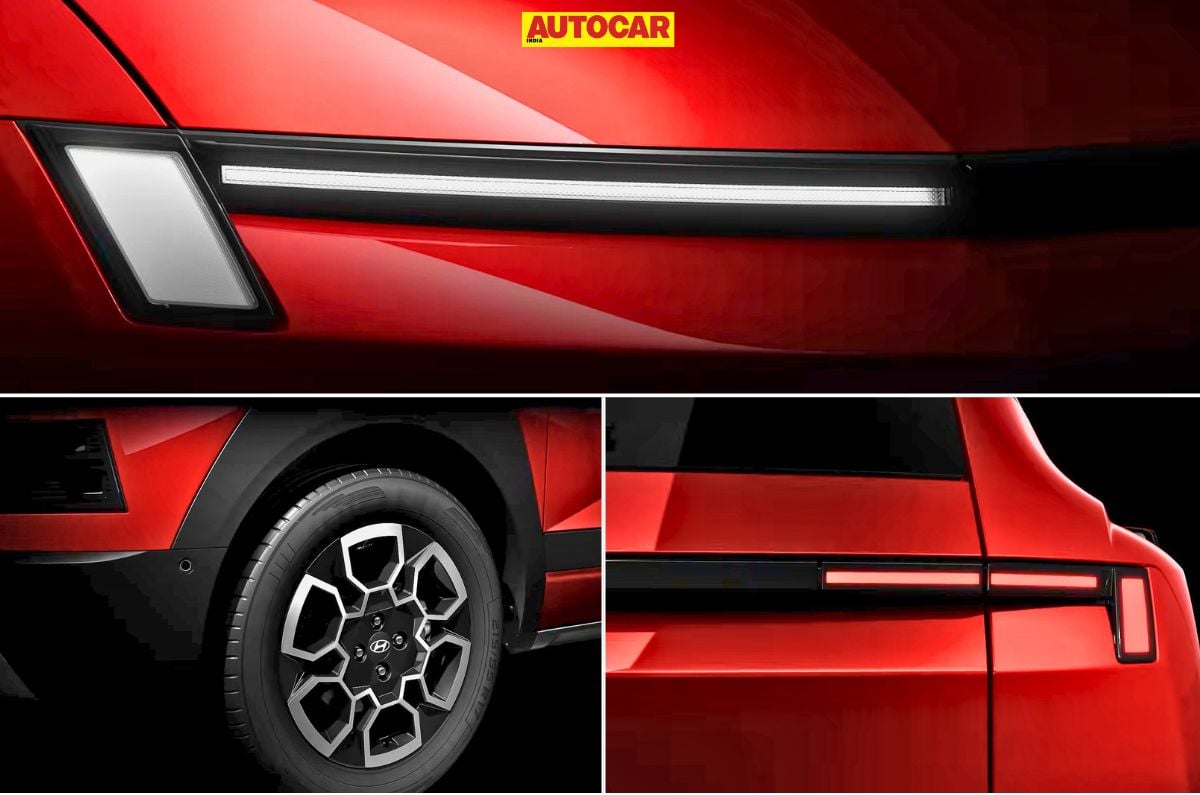
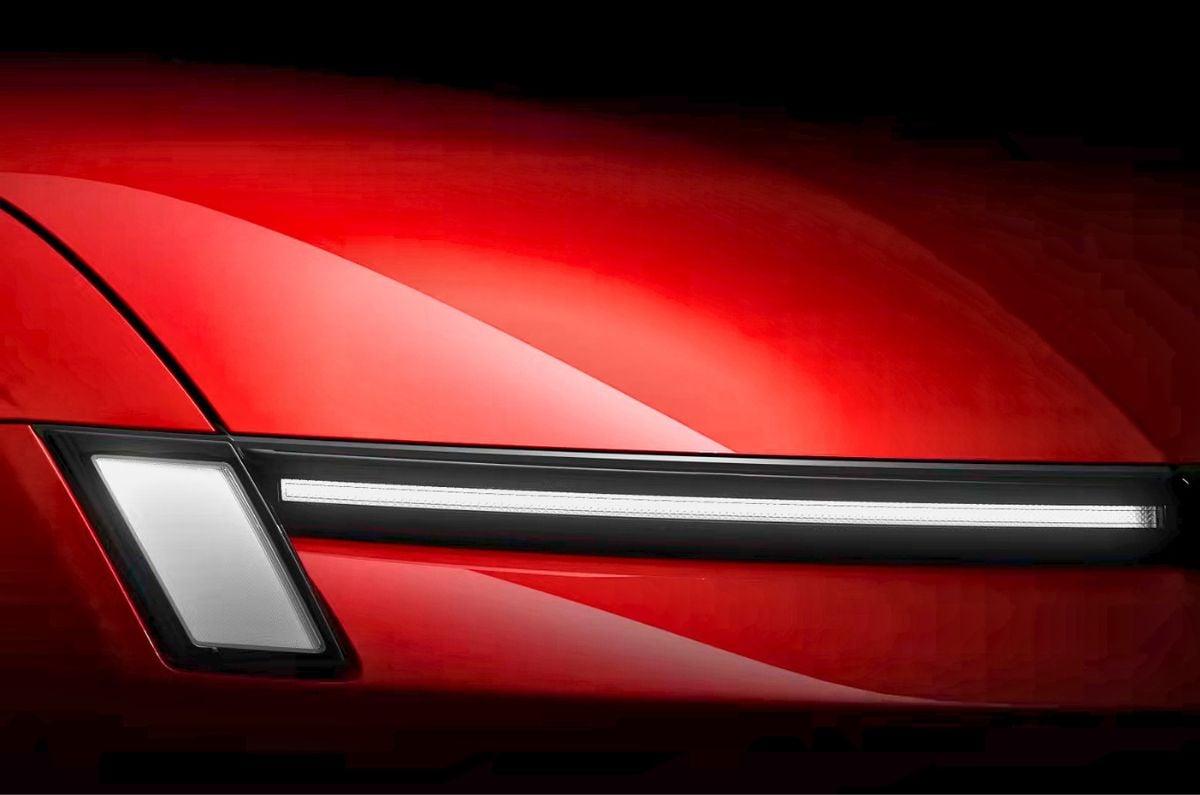
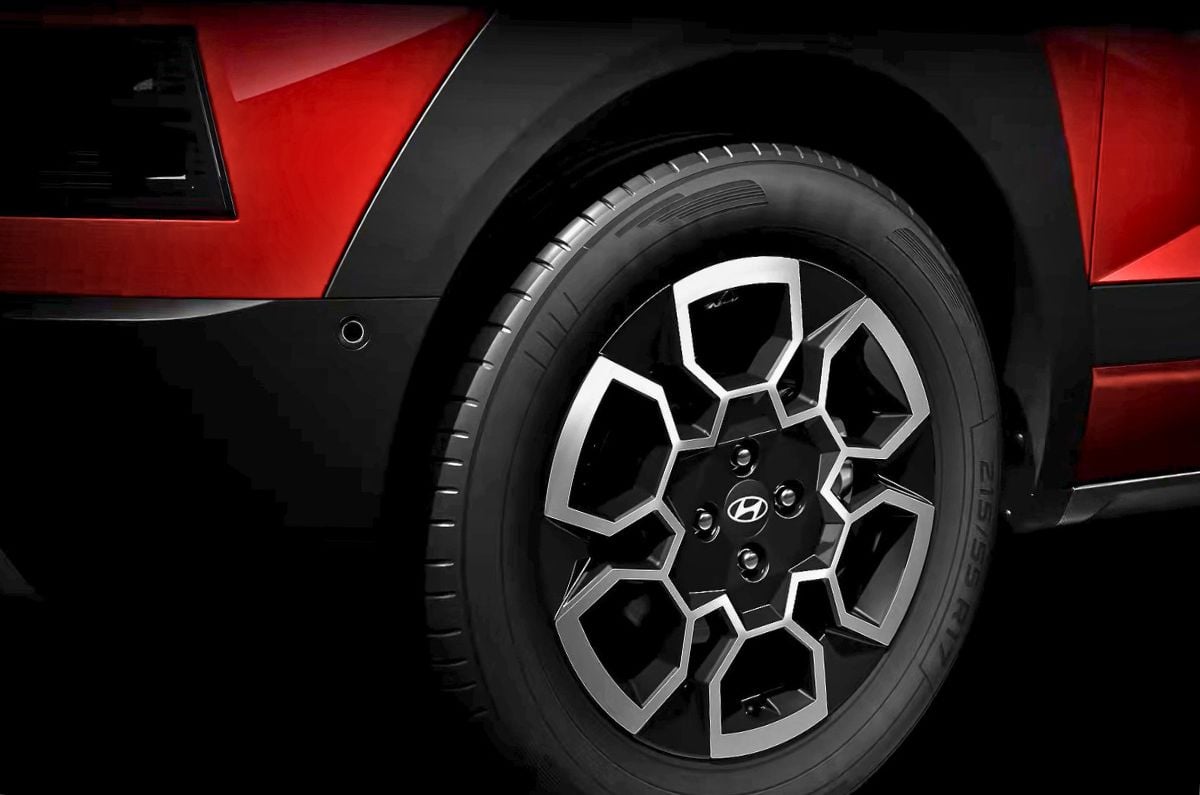
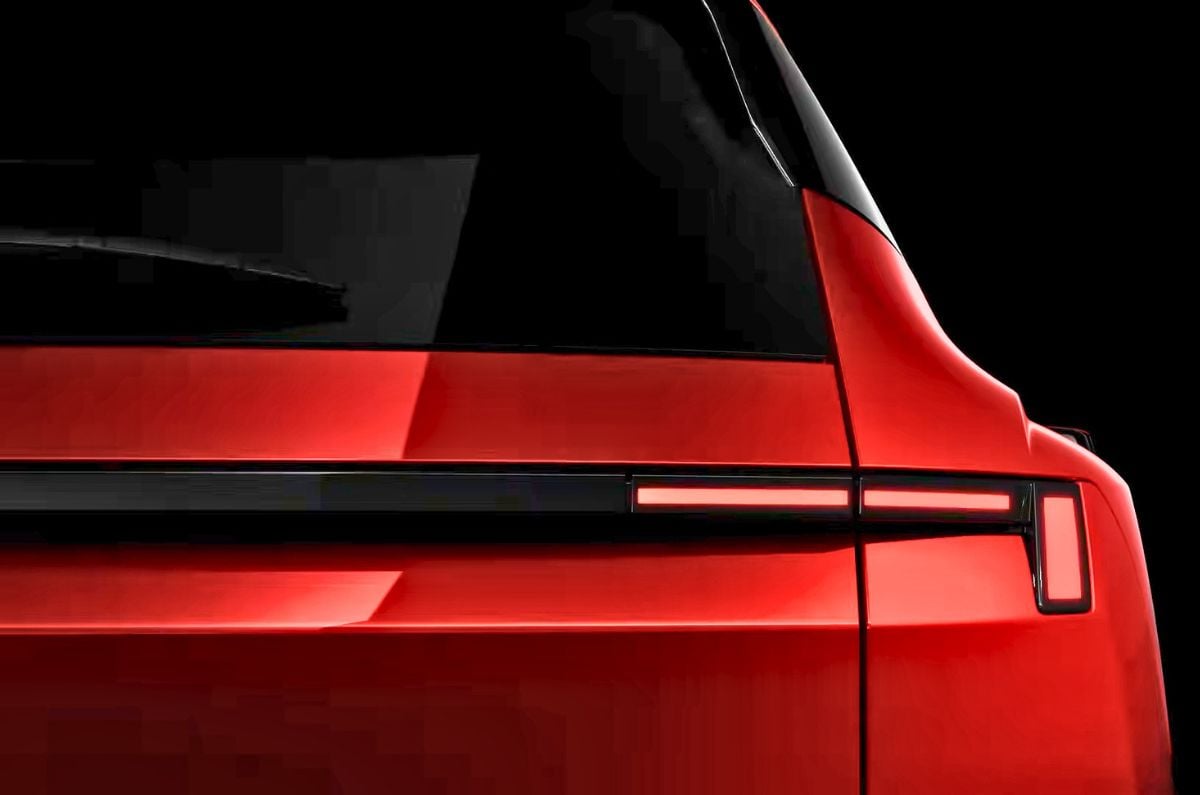
Hyundai has teased the exterior design of the upcoming Bayon, just days after releasing design sketches of the new midsize SUV. The latest teasers reveal the SUV’s sharp-looking LED DRLs and taillights, along with its alloy wheel design. The Bayon is expected to sit between the Venue and Creta in Hyundai’s India lineup, and will debut in the country during the festive season.
Hyundai Bayon teased: What could be spotted?
Teasers show sleek LED DRLs, LED taillights and alloy wheels
The teasers reveal several exterior design elements of the Bayon. Up front, it features a split-type headlight setup, with sleek, inverted L-shaped LED DRLs positioned at the top and the main headlights mounted lower on the bumper, with a design reminiscent of the Verna’s headlights.
In profile, the 17-inch dual-tone alloy wheels were teased, along with thick black cladding around the wheel arches. Keen-eyed viewers can also spot front parking sensors. Although not clearly visible in the teasers, the doors appear to feature sharp lines.
At the rear, the Bayon sports slim, wraparound inverted L-shaped LED taillights mounted on a thick black strip that appears to connect both units. Other visible elements include a rear wiper and a partially blacked-out C-pillar.
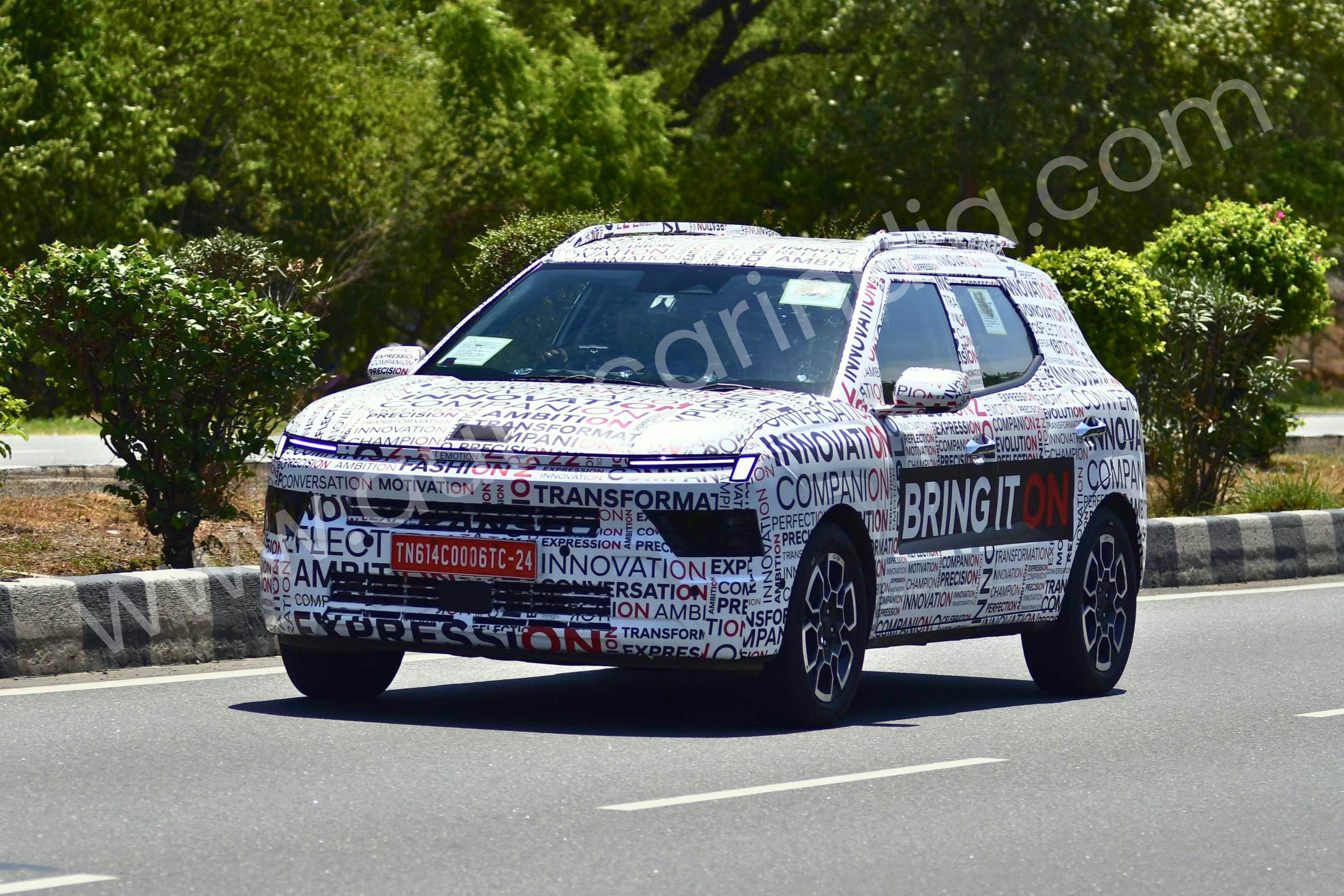
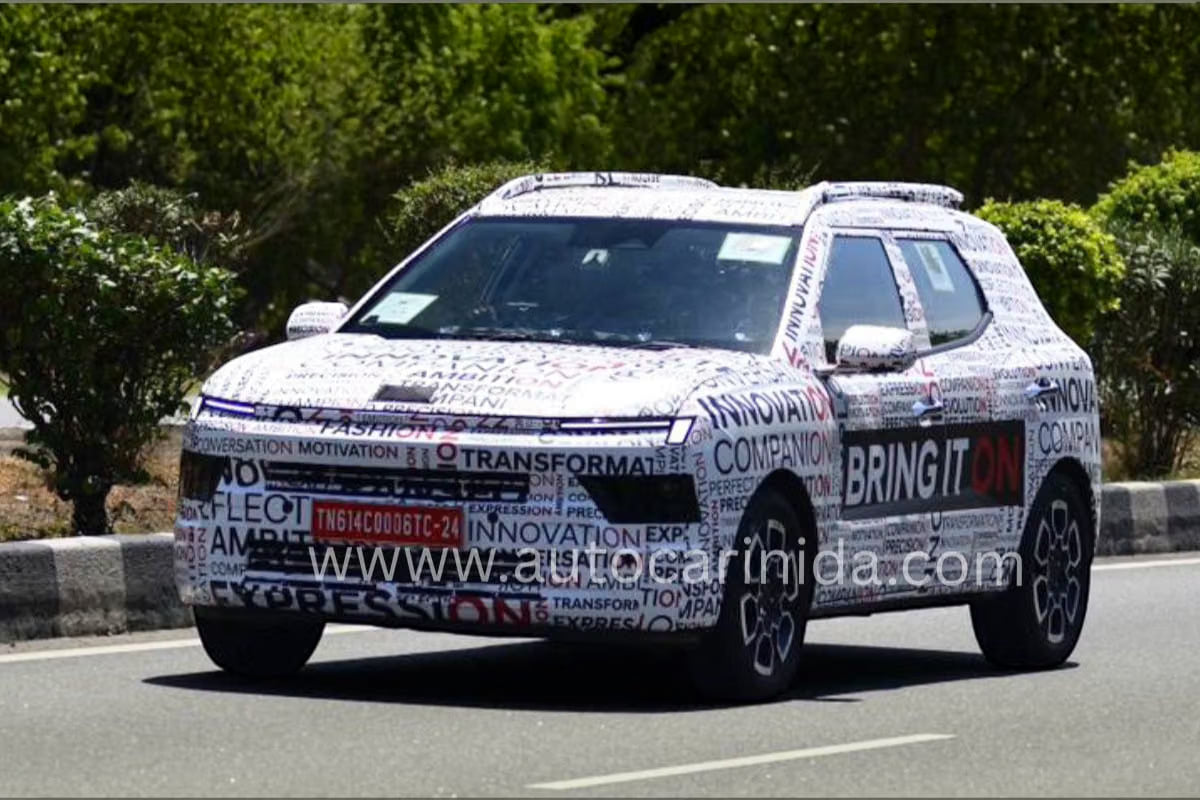
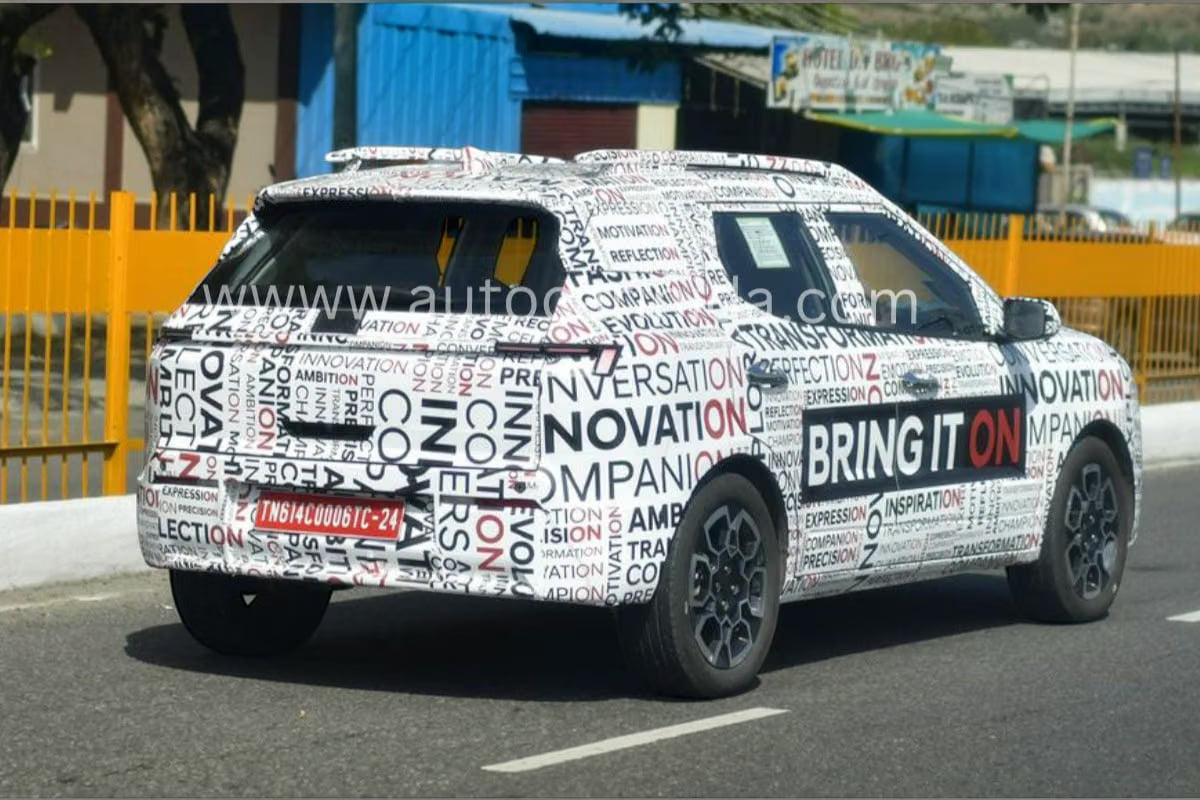
Camouflaged spy shots have also revealed that the Bayon will have a crossover-like design rather than a more upright, boxy appearance. It will feature regular pull-type door handles, functional roof rails, and prominently flared wheel arches.
Hyundai is slated to launch the Bayon mid-size SUV during the festive season. It will be one of two new nameplate additions for Hyundai India in FY27. The Bayon will compete in the popular mid-size SUV space but with a completely different positioning from the Creta. Ahead of its launch, here’s everything you need to know about the Hyundai Bayon.
Why is Hyundai launching the Bayon if it already has the Creta in the mid-size SUV space?
Hyundai’s strategy is to offer two models in the mid-size SUV space. This two-pronged approach will allow Hyundai to occupy the lower and higher rungs of the segment with the Bayon and Creta, respectively. The former will have fuel-efficient powertrains like CNG, while the latter will offer wider powertrain choices, including a hybrid version in its next generation that’s due in 2027.
Where will the Bayon sit in Hyundai’s India portfolio?
In Hyundai’s India portfolio, the Bayon will slot right between the Venue compact SUV and the Creta.
Is the Bayon sold in India similar to the Bayon sold abroad?
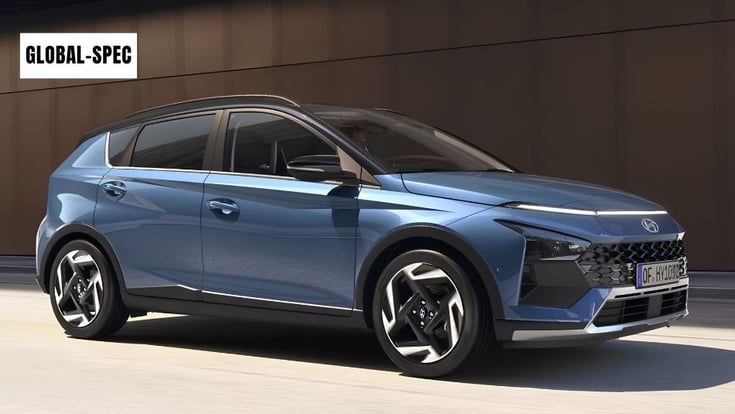
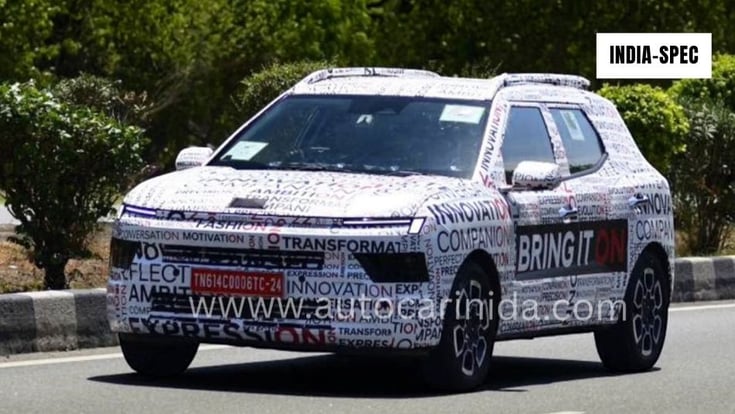
Apart from an identical nameplate, the India-spec Bayon is quite different from the global-spec model. In comparison to the latter, the former will get a completely different top hat and interior.
What powertrains will the Hyundai Bayon come with?
The Bayon will likely be powered by the Creta’s 1.5-litre naturally aspirated petrol engine with manual and CVT gearbox options. It will also be the first Hyundai model over 4 metres to offer CNG power, likely utilising the same 1.5-litre mill with an underbody-mounted tank.
What will the Hyundai Bayon look like?
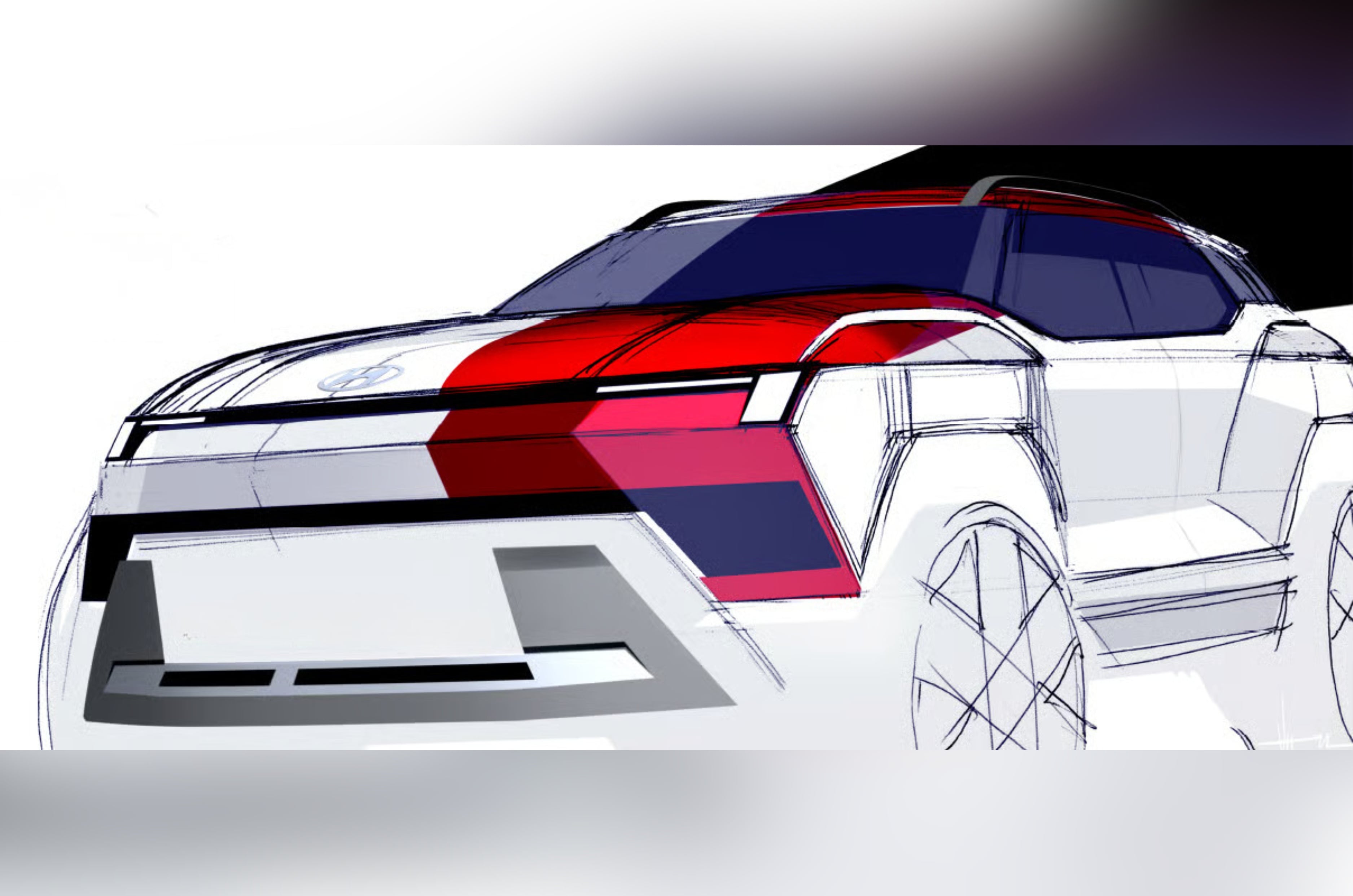
We’ve had a glimpse of what the Bayon would look like through various spy shots and, more recently, with Hyundai’s design sketches. As opposed to the boxy stance of regular SUVs, the Bayon sports a crossover-esque design. The fascia will have a split-headlamp setup with a half-split H-shaped signature for the DRLs and a scuff plate for the bumper. In profile, the Bayon gets a window line with an upward kink, pull-type door handles, flared wheel arches, and dual-tone alloy wheels. The rear is characterised by a roof-mounted spoiler, LED tail-lamps with similar signatures to the DRLs, and a smooth finish for the bumper.
What will the Hyundai Bayon’s interior look like, and what features will it get?
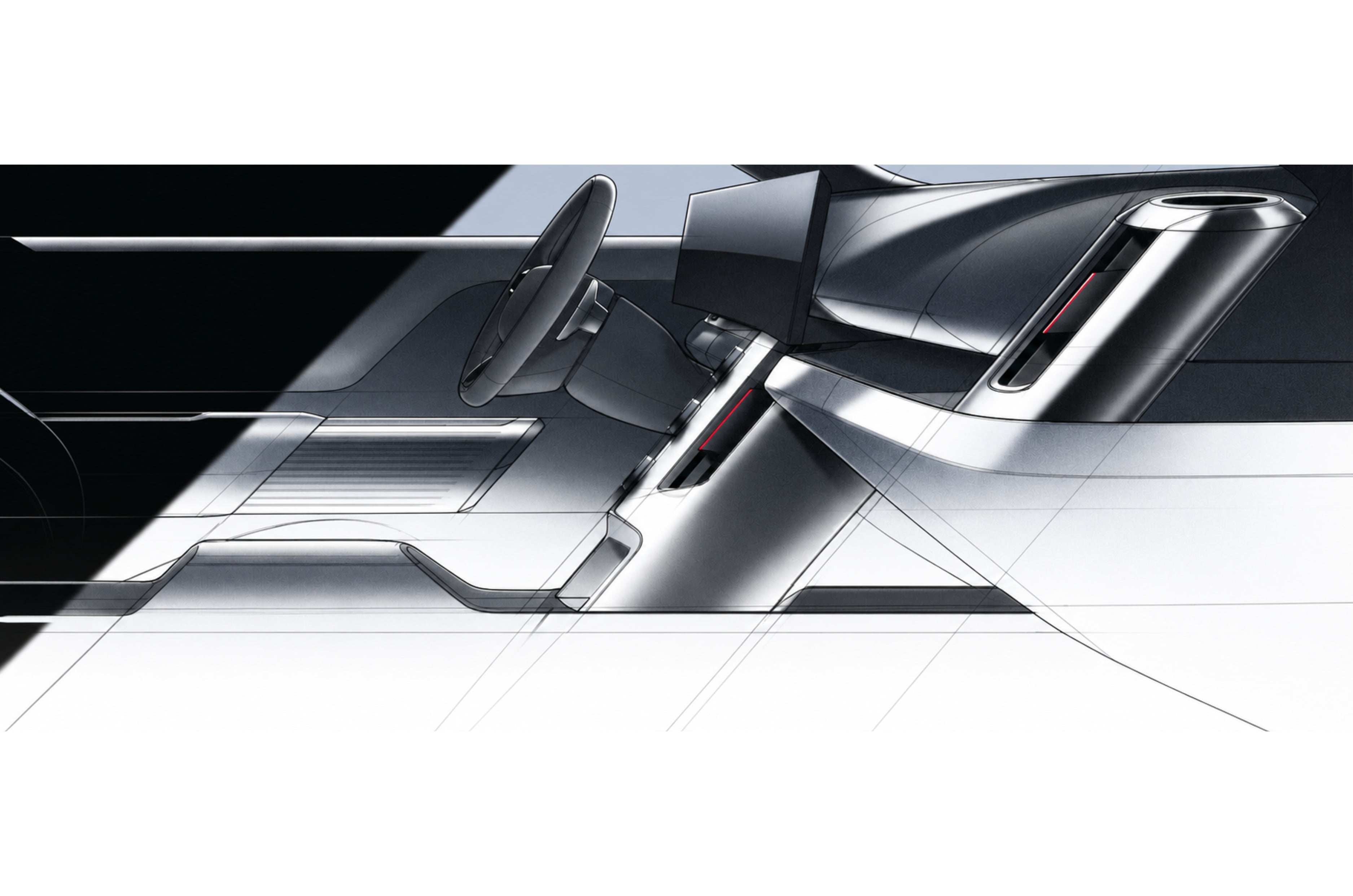
Hyundai’s design sketches of the Bayon’s interior reveal a layout that looks similar to the Brazil-spec fourth-gen i20. The dashboard gets a Venue-like curved dual-screen setup and a vertically oriented centre console with physical knobs. A black-and-white theme is expected, and spy images of the Bayon’s interior show a three-spoke steering wheel with a four-dot motif signifying ‘H’ in Morse code. In typical Hyundai fashion, the Bayon is expected to come with a lengthy feature list, including a sunroof, ventilated front seats, a wireless phone charger, a 360-degree camera, and a level 2 ADAS suite.
What is the expected price of the Hyundai Bayon?
Since the Bayon will be positioned below the Creta, it will be priced more affordably with an expected price ranging between Rs 9 lakh and Rs 14 lakh. It will lock horns with the Maruti Victoris, MG Astor, Volkswagen Taigun, Honda Elevate and Skoda Kushaq
Hyundai is slated to launch the Bayon midsize SUV during the festive season. It will be one of two new nameplate additions for Hyundai India in FY27. The Bayon will compete in the popular midsize SUV space but with a completely different positioning from the Creta. Ahead of its launch, here’s everything you need to know about the Hyundai Bayon.
Why is Hyundai launching the Bayon if it already has the Creta in the mid-size SUV space?
Hyundai’s strategy is to offer two models in the mid-size SUV space. This two-pronged approach will allow Hyundai to occupy the lower and higher rungs of the segment with the Bayon and Creta, respectively. The former will have fuel-efficient powertrains like CNG, while the latter will offer wider powertrain choices, including a hybrid version in its next generation that’s due in 2027.
Where will the Bayon sit in Hyundai’s India portfolio?
In Hyundai’s India portfolio, the Bayon will slot right between the Venue compact SUV and the Creta.
Is the Bayon sold in India similar to the Bayon sold abroad?
Apart from an identical nameplate, the India-spec Bayon is quite different from the global-spec model. In comparison to the latter, the former will get a completely different top hat and interior.
What powertrains will the Hyundai Bayon come with?
The Bayon will likely be powered by the Creta’s 1.5-litre naturally aspirated petrol engine with manual and CVT gearbox options. It will also be the first Hyundai model over 4 metres to offer CNG power, likely utilising the same 1.5-litre mill with an underbody-mounted tank.
What will the Hyundai Bayon look like?
We’ve had a glimpse of what the Bayon would look like through various spy shots and, more recently, with Hyundai’s design sketches. As opposed to the boxy stance of regular SUVs, the Bayon sports a crossover-esque design. The fascia will have a split-headlamp setup with a half-split H-shaped signature for the DRLs and a scuff plate for the bumper. In profile, the Bayon gets a window line with an upward kink, pull-type door handles, flared wheel arches, and dual-tone alloy wheels. The rear is characterised by a roof-mounted spoiler, LED tail-lamps with similar signatures to the DRLs, and a smooth finish for the bumper.
What will the Hyundai Bayon’s interior look like, and what features will it get?
Hyundai’s design sketches of the Bayon’s interior reveal a layout that looks similar to the Brazil-spec fourth-gen i20. The dashboard gets a Venue-like curved dual-screen setup and a vertically oriented centre console with physical knobs. A black-and-white theme is expected, and spy images of the Bayon’s interior show a three-spoke steering wheel with a four-dot motif signifying ‘H’ in Morse code. In typical Hyundai fashion, the Bayon is expected to come with a lengthy feature list, including a sunroof, ventilated front seats, a wireless phone charger, a 360-degree camera, and a level 2 ADAS suite.
What is the expected price of the Hyundai Bayon?
Since the Bayon will be positioned below the Creta, it will be priced more affordably with an expected price ranging between Rs 9 lakh and Rs 14 lakh. It will lock horns with the Maruti Victoris, MG Astor, Volkswagen Taigun, Honda Elevate and Skoda Kushaq
This G82-gen BMW M4 that you see has been on sale internationally since 2020, it came to India in 2022, and it even received a facelift (LCI or Life Cycle Impulse in BMW speak) a few years back. Yet, somehow, we never got a chance to drive it on Indian tarmac all these years. Now, however, we’ve finally spent some meaningful time with the BMW M4 Competition on home turf to see what it’s like.
BMW M4 Competition exterior design and engineering – 8/10
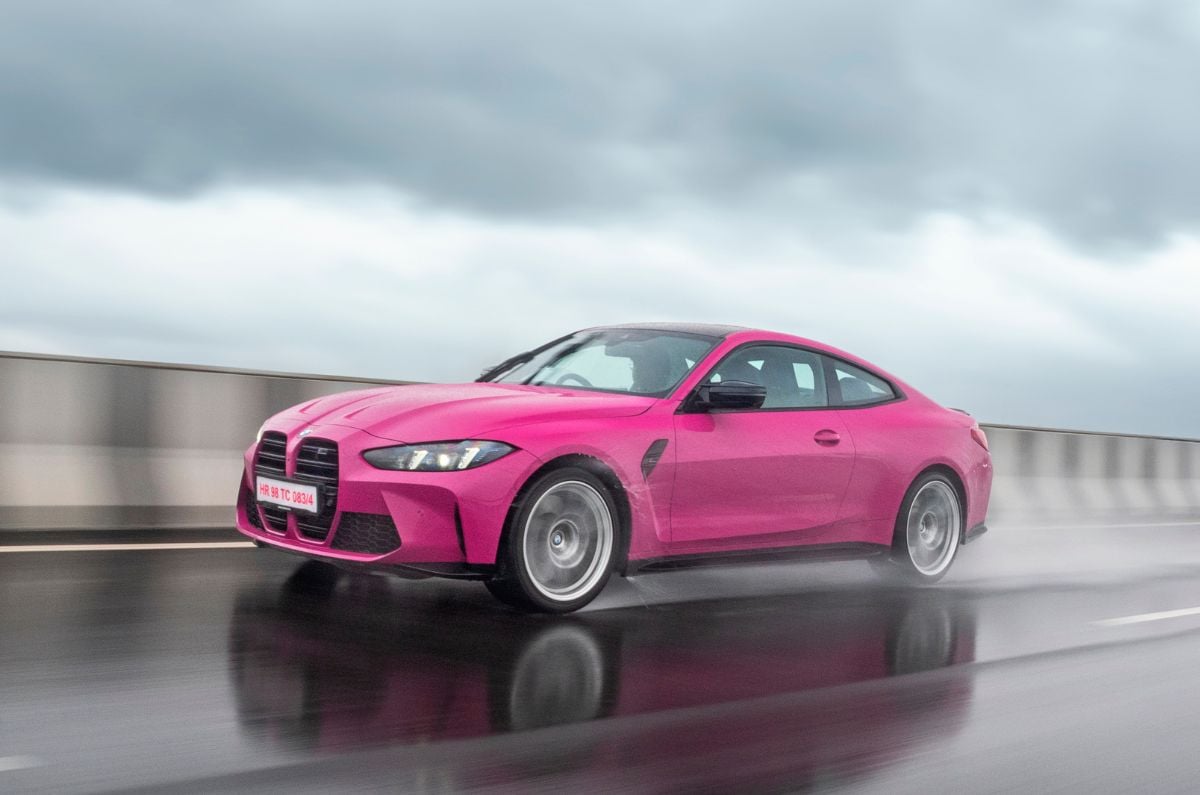
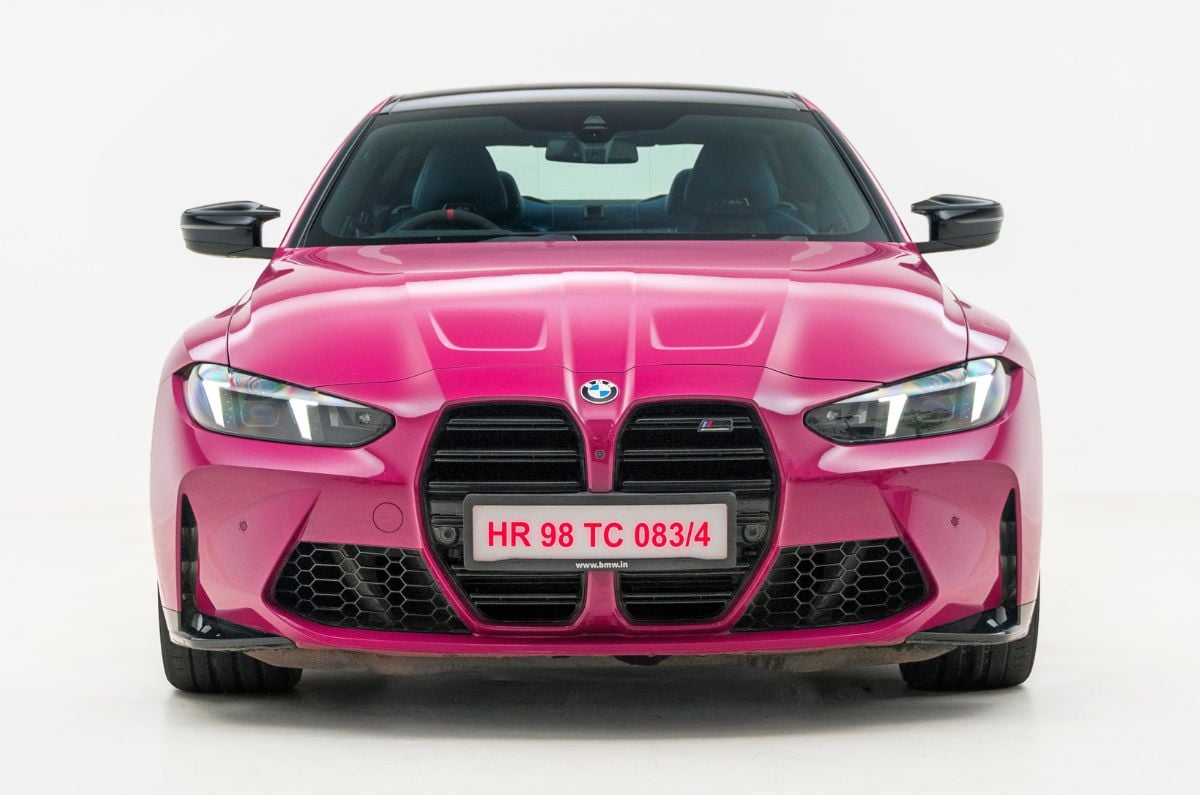
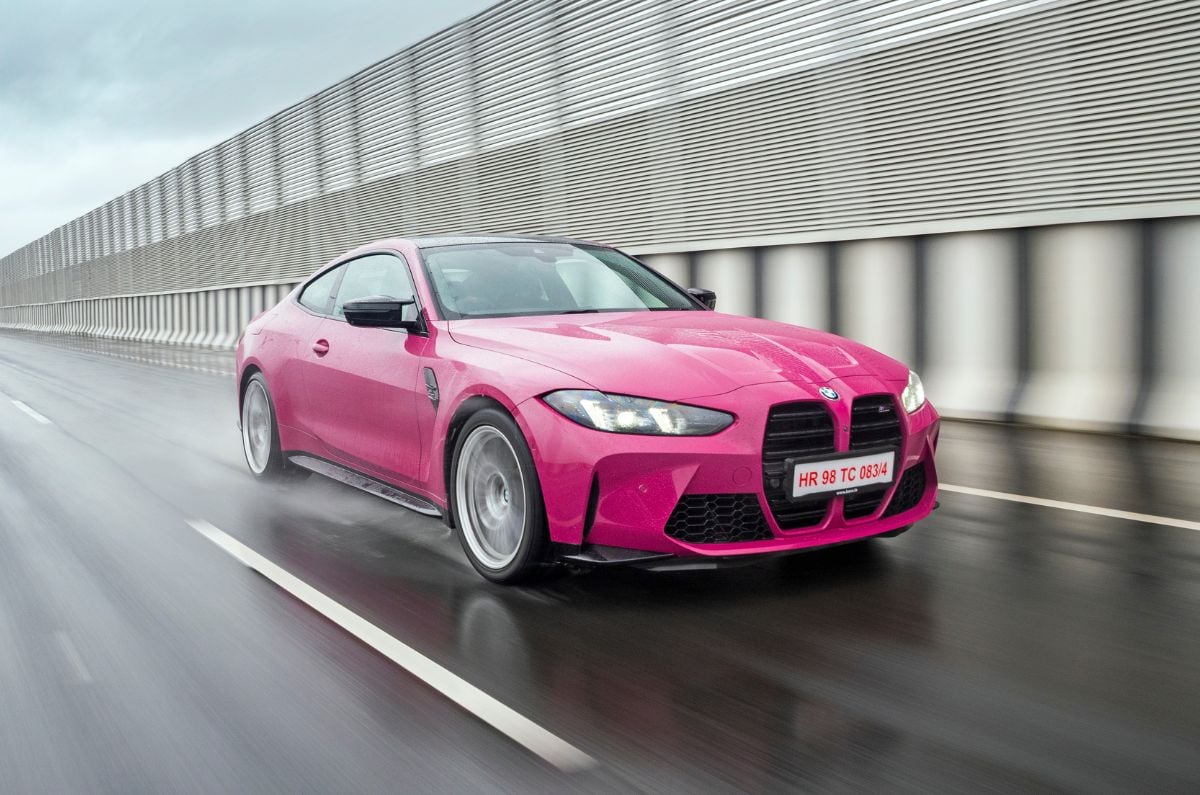
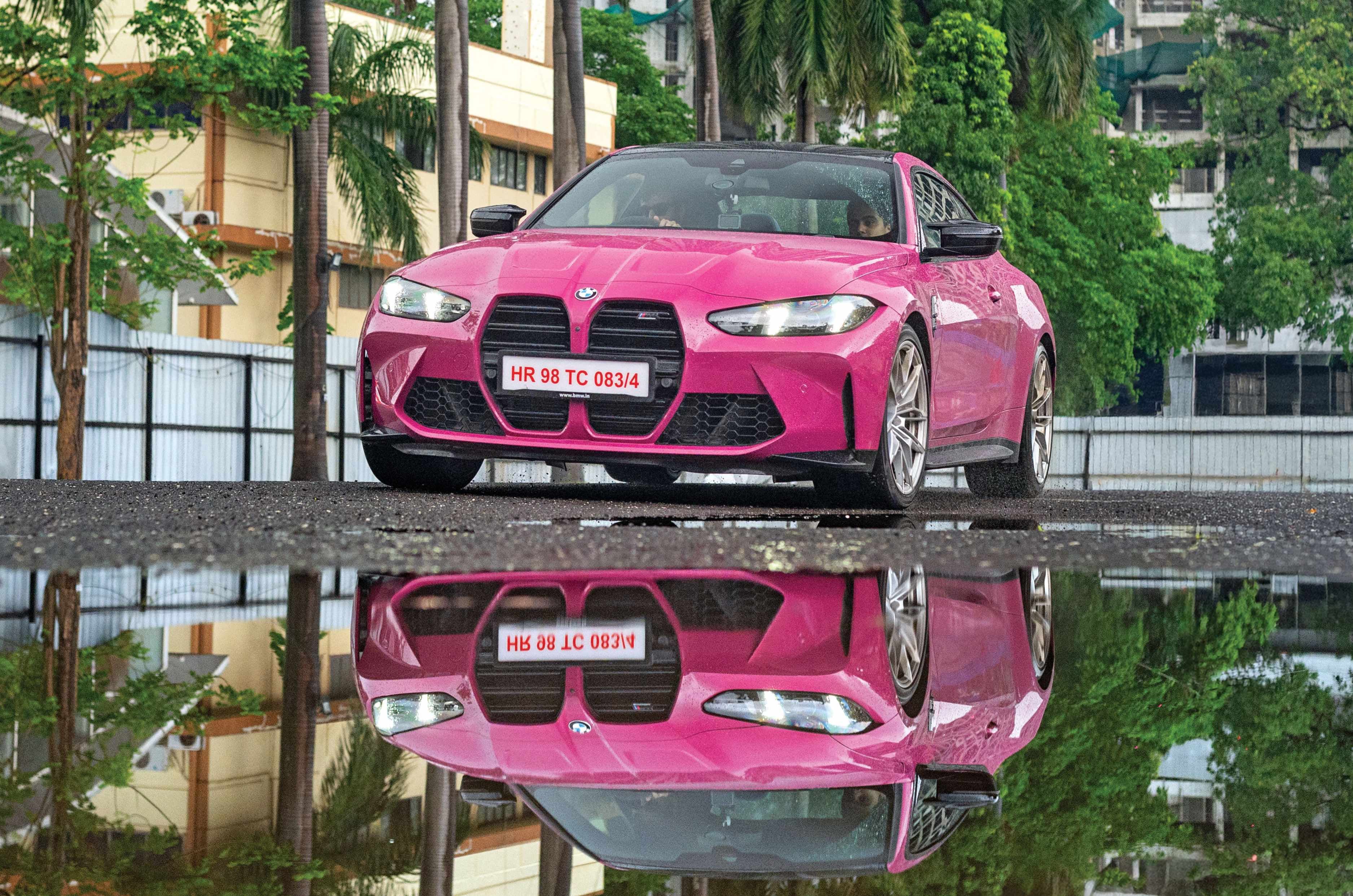
Whether you like it or not, the huge kidney grille gives it an imposing road presence.
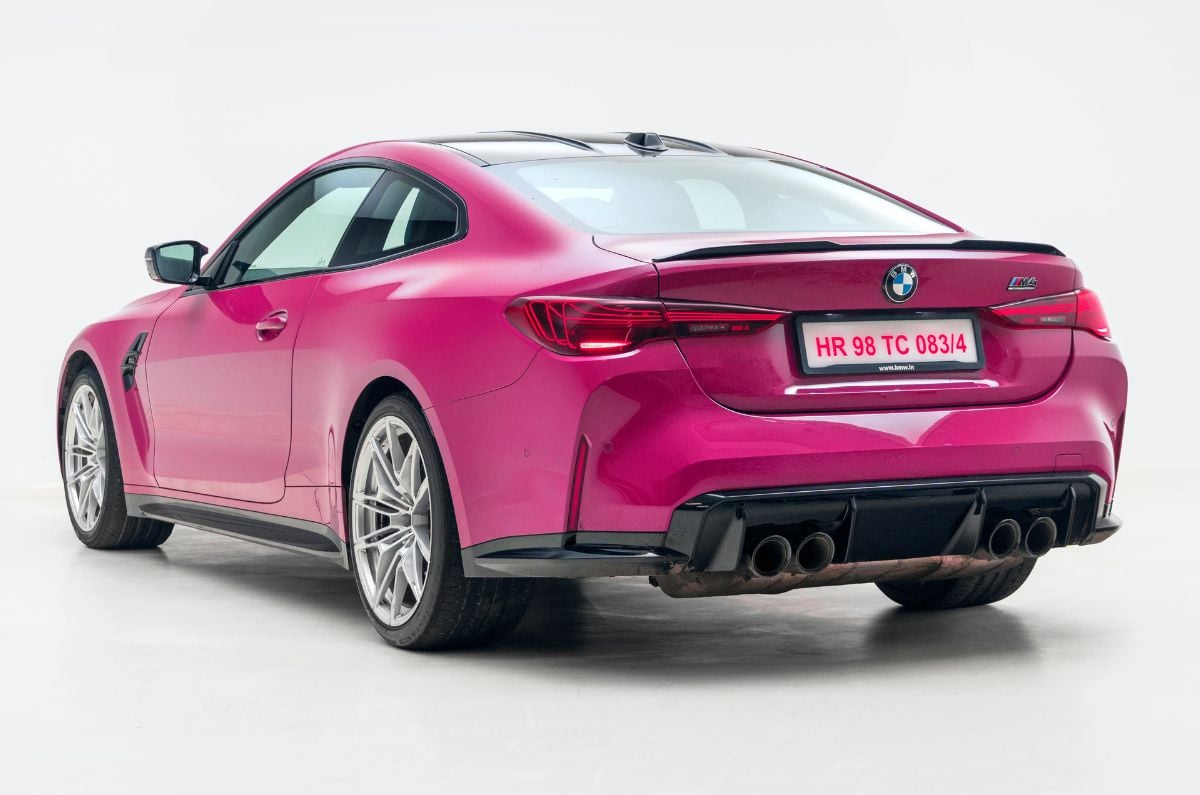
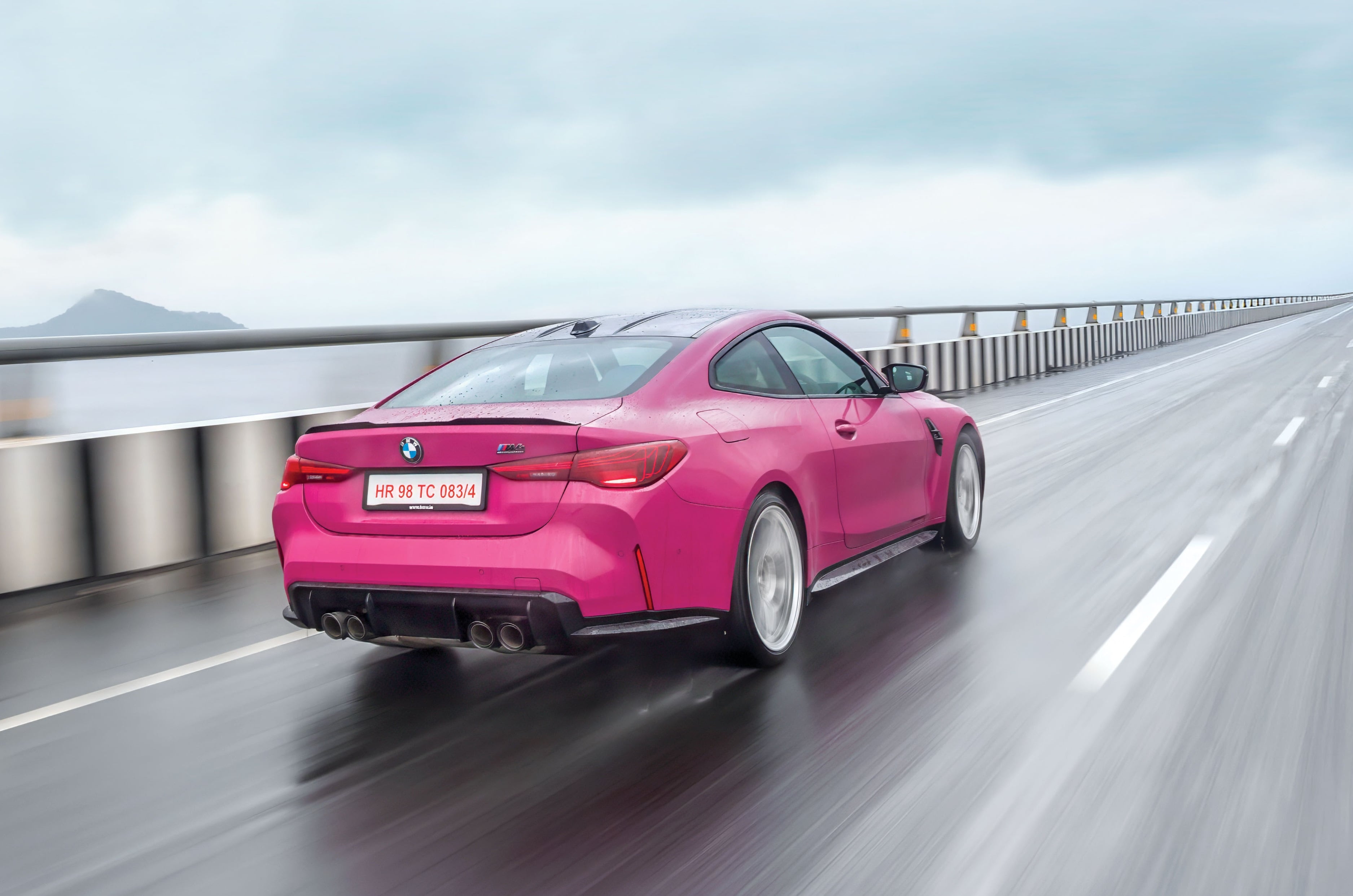
The BMW M4 Competition remains one of those cars that gets people talking before they’ve even heard it start. The enormous kidney grille is still the defining feature, and whether you like it or not, it gives the M4 a face that is impossible to mistake for anything else. The rest of the design is far more cohesive, with a long bonnet, heavily sculpted surfaces, flared wheel arches and a low, wide stance. At the rear, the quad exhausts, bootlip spoiler and prominent diffuser just add more drama to the design.
There’s serious engineering behind the visual drama, too. The M4 gets M-specific suspension hardware and aluminium suspension components, while the near-50:50 weight distribution helps give it the balance expected of an M car. And unlike all previous M3s and M4s, this one gets BMW’s M xDrive all-wheel-drive system, and it rides on staggered 19-inch front and 20-inch rear wheels.
Quad exhausts is an M signature and this LCI also gets beautifully detailed Laser LED taillights.
At 4,801mm long and 1,887mm wide, it’s a substantial car, and at 1,850kg, it’s certainly not light. But BMW has worked hard to keep the mass low and central, like with the use of a carbon-fibre roof, for example.
BMW M4 Competition interior space and comfort – 8/10
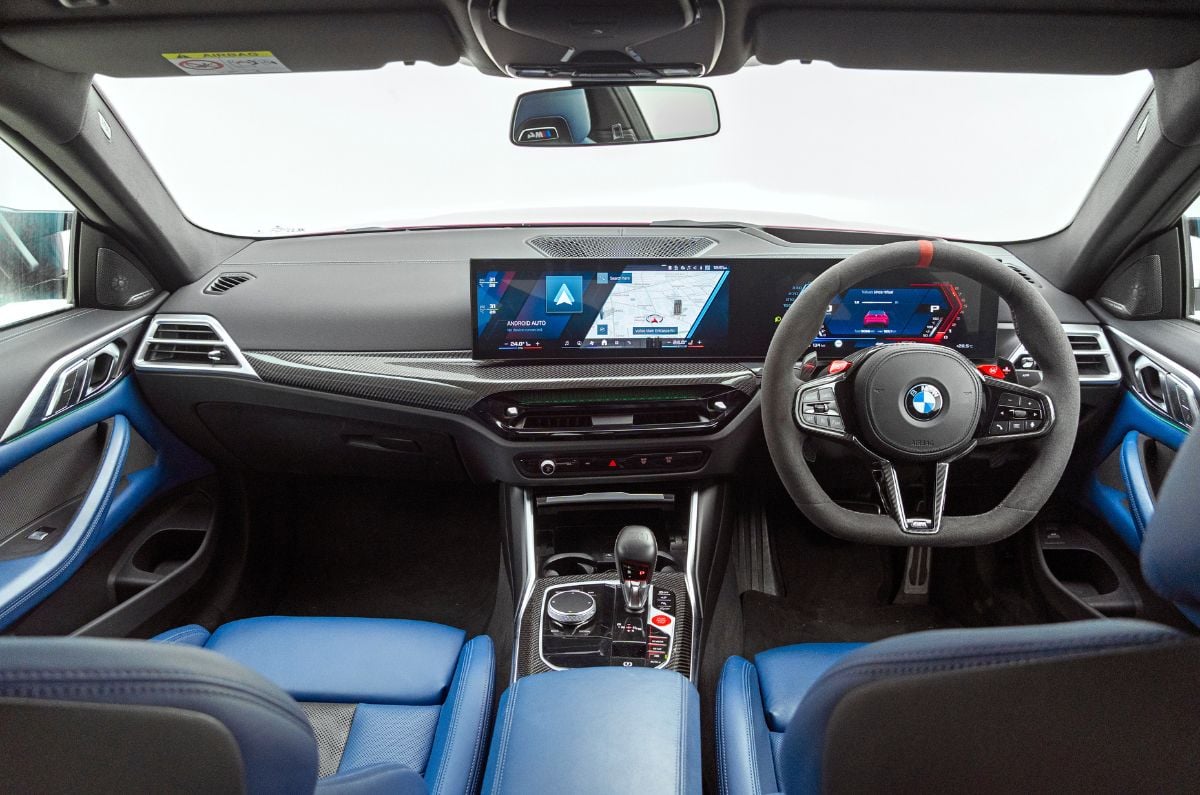
High-quality, driver-focused cabin is a mix of leather, carbon fibre and Alcantara.
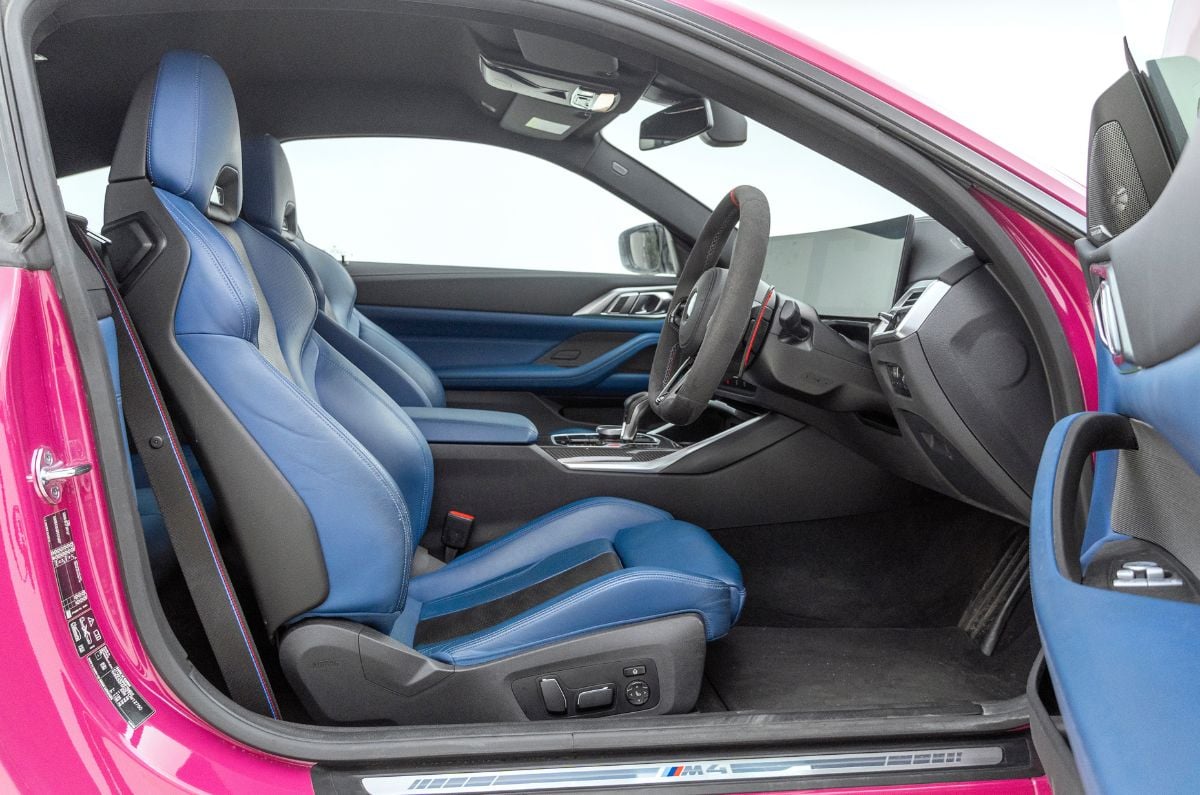
The M4’s cabin is a good example of how far modern M cars have moved from being purely performance machines. There’s plenty of everyday usability here, but the driving position still feels special. You sit low, the steering wheel is perfectly positioned, and the large front seats are supportive and comfortable, and hold you securely when you start driving enthusiastically.
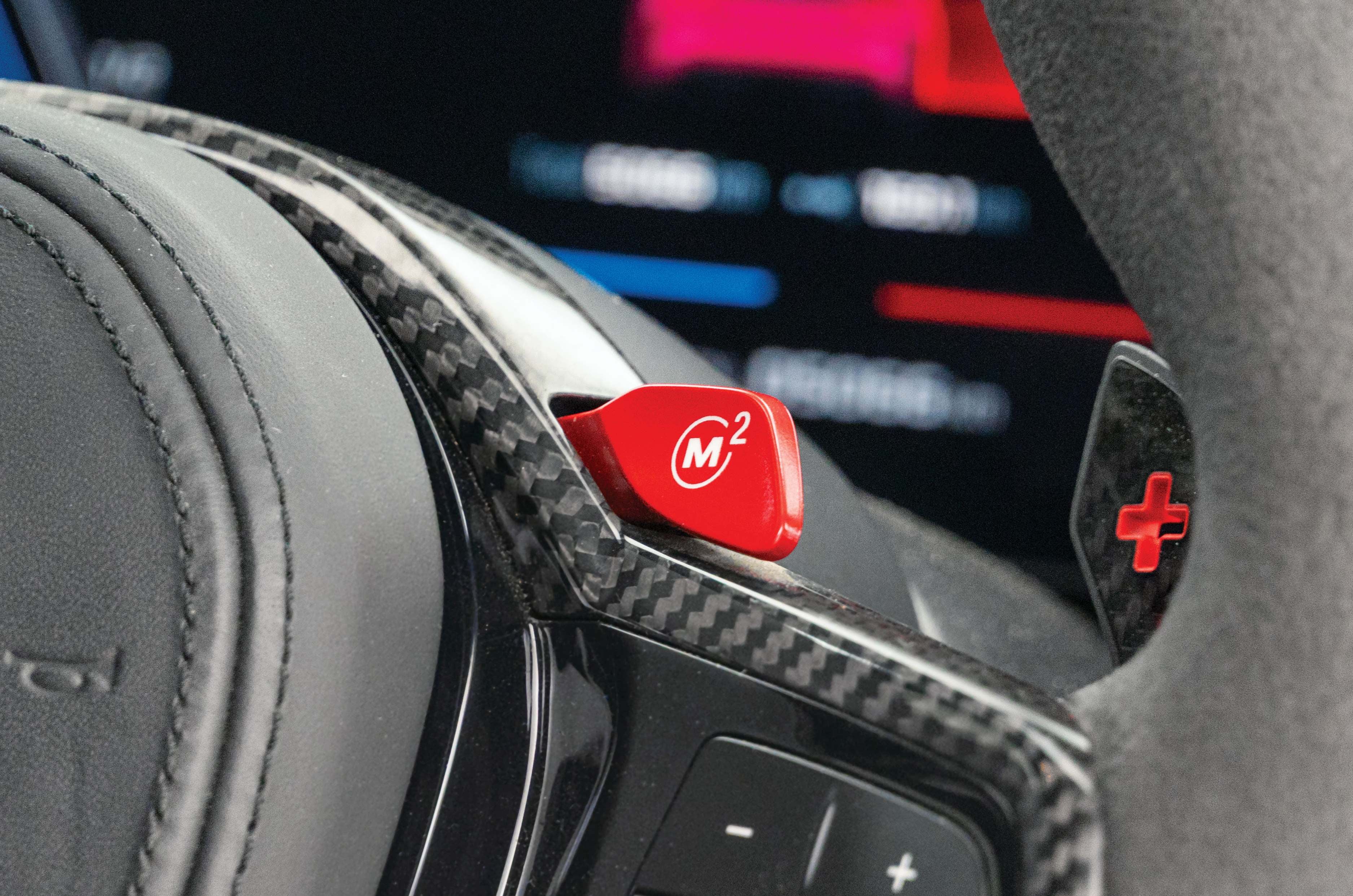
The dashboard follows BMW’s familiar layout, dominated by the curved display, while M-specific details like carbon-fibre trim throughout, M colours on the seatbelts and the red M1 and M2 buttons give the cabin enough visual distinction.
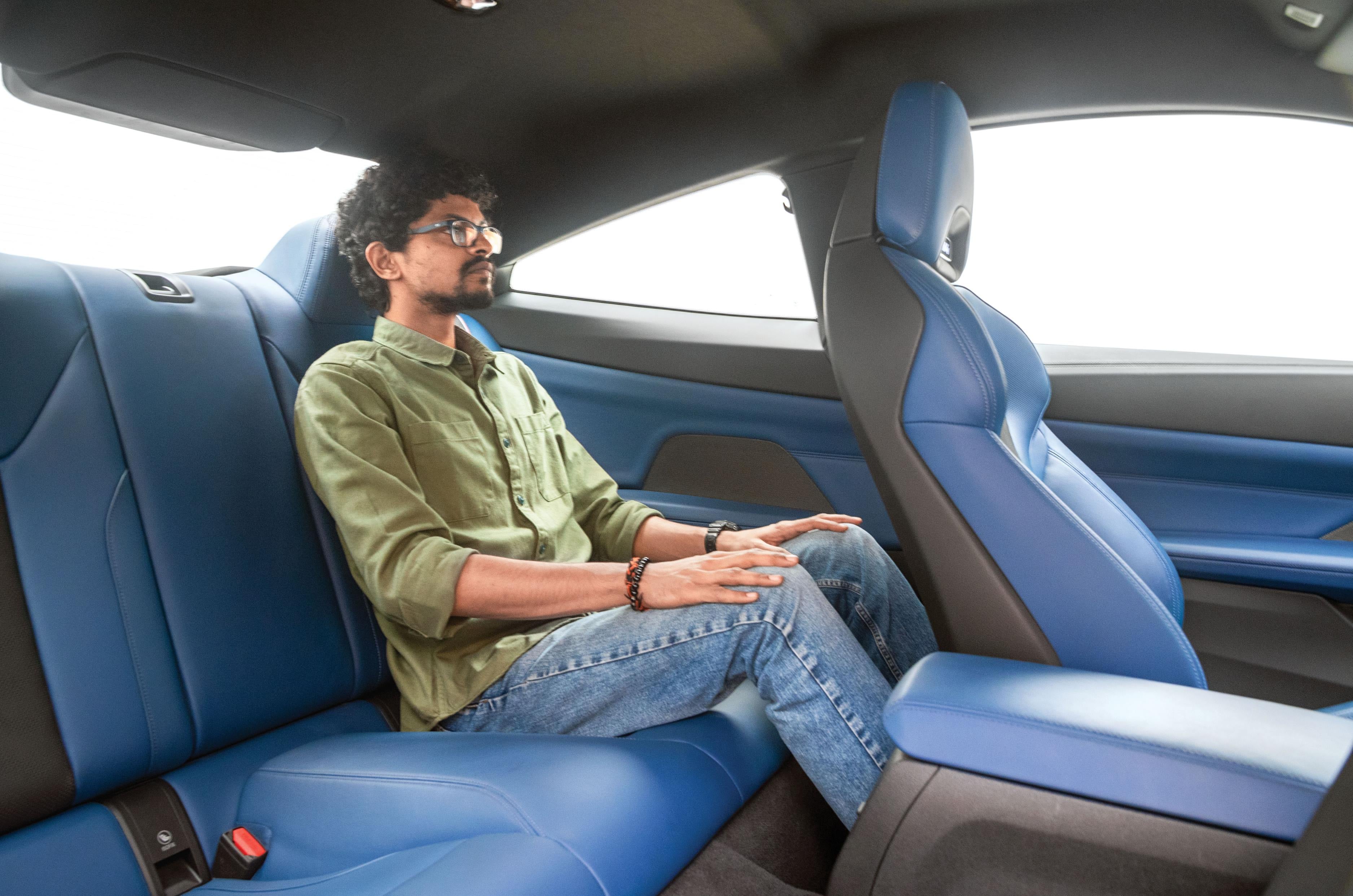
Access to the rear is tricky, though it’s a reasonably spacious place to be.
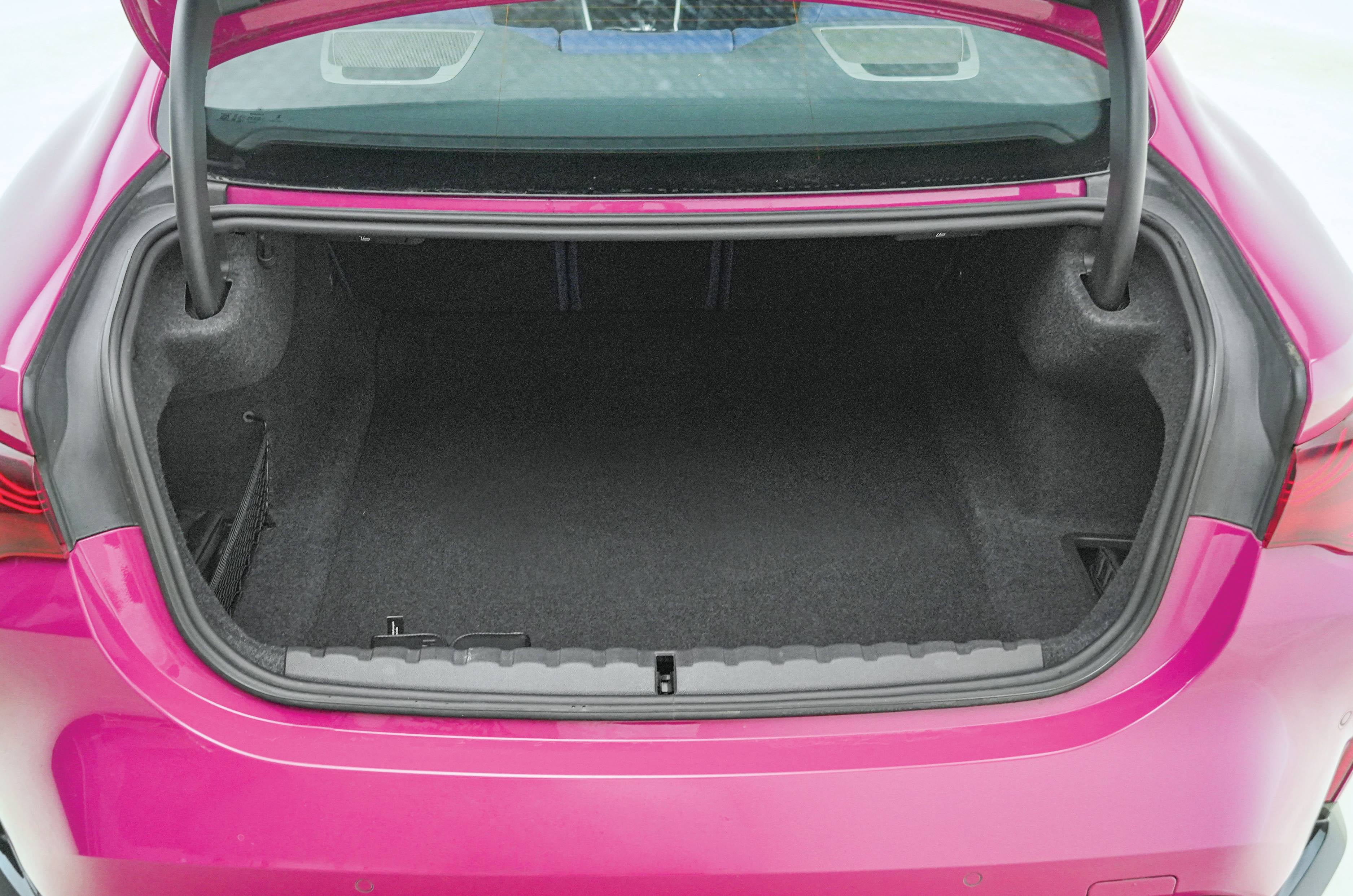
The coupe body does limit rear-seat access and space, but the back seats are still surprisingly usable, and not merely for show. There’s also a 440-litre boot, which means the M4 can manage luggage for a weekend away without too much hassle. That combination of usable cabin room and decent boot space is one of the car’s biggest strengths; very few cars with this level of performance are this practical.
440-litre boot can easily swallow up your luggage for the weekend.
It’s also relatively easy to live with in everyday conditions. The visibility is manageable, the controls are familiar and, at low speeds, the M4 is far more relaxed than its appearance suggests.
BMW M4 Competition features and safety – 8/10
The M4 Competition gets the technology expected of a modern BMW, but the really interesting equipment is the hardware and software designed to make its performance accessible.
M1 and M2 buttons are shortcuts for your preferred, pre-selected drive settings.
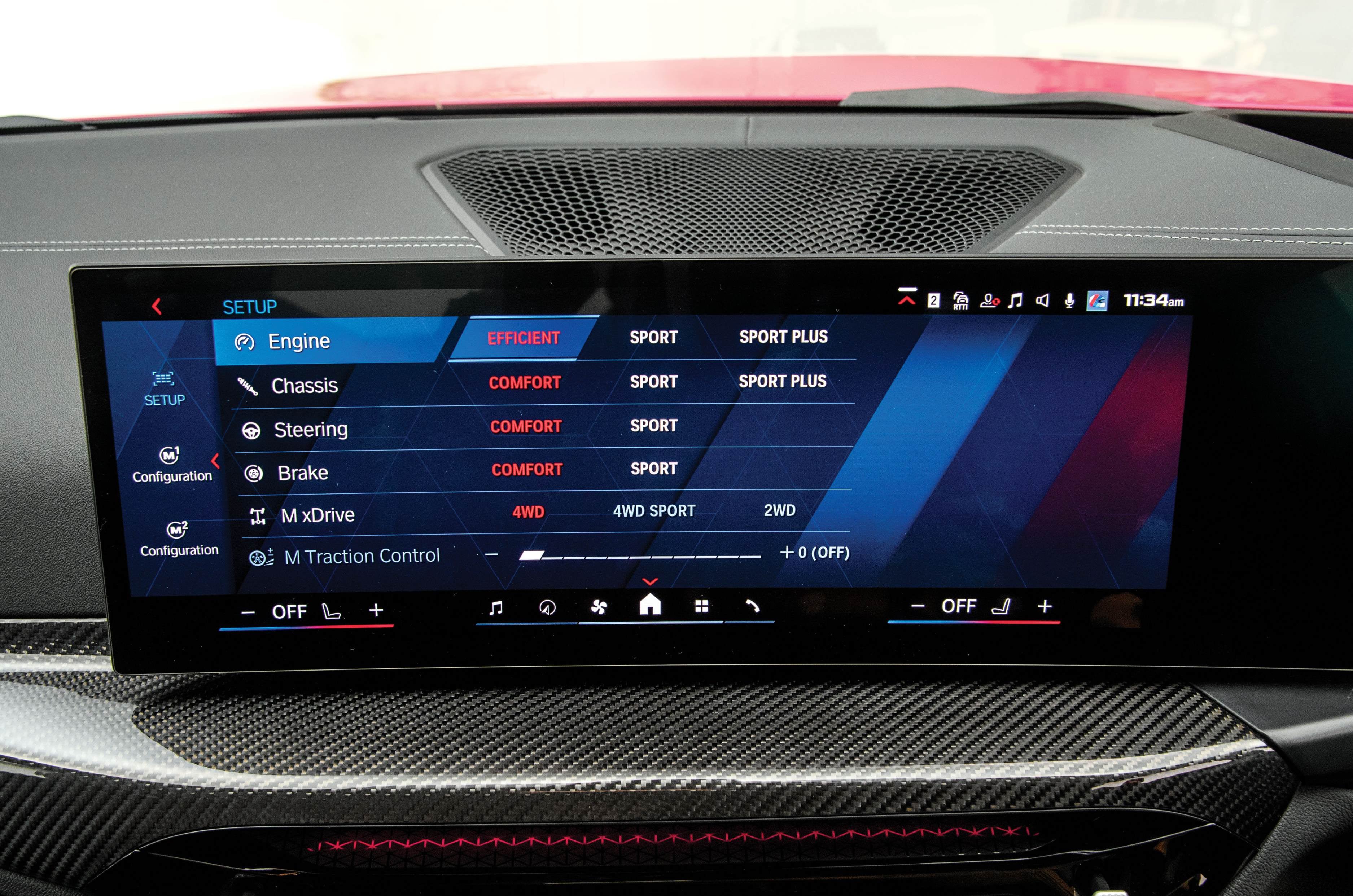
The adaptive M suspension can be adjusted through Comfort, Sport and Sport Plus settings, allowing the car to switch between everyday usability and sharper responses. M Drive lets you save preferred combinations of chassis, steering, engine and transmission settings, and these preferred settings can be designated to the M1 and M2 buttons on the chunky steering wheel.
Then there’s the more serious performance tech. The M4 gets a selectable rear-wheel-drive mode, which essentially allows you to turn the all-wheel-drive M4 into a rear-driven machine, while the M Drift Analyser adds another layer of entertainment for those inclined to explore the car’s limits in a controlled environment. While it’s nice to have this level of customisation, some may find configuring it a bit too confusing and overwhelming.
The screen is crisp, but navigating through the sub-menus gets confusing.
And that’s the case with the touchscreen as well. It’s super-crisp, slick to the touch and has M-coloured themes, which look quite cool, but the myriad apps and sub-menus are confusing to operate, to say the least. And that problem is amplified when you’re trying to make adjustments on the move.
Front seats are large, supportive and feature ventilation too.
There’s a three-zone climate control, powered and ventilated front seats, a HUD, a Harman/Kardon sound system, wireless smartphone integration, a wireless charger, a curved display, and so much more. So, the M4 isn’t lacking in the areas that matter for everyday use.
As for safety, there are multiple airbags, ADAS tech, stability and braking systems and electronic assistance systems working in the background, although in a car like this, it’s the multiple drive modes and traction systems that are arguably the more important features.
BMW M4 Competition powertrain and performance – 9/10
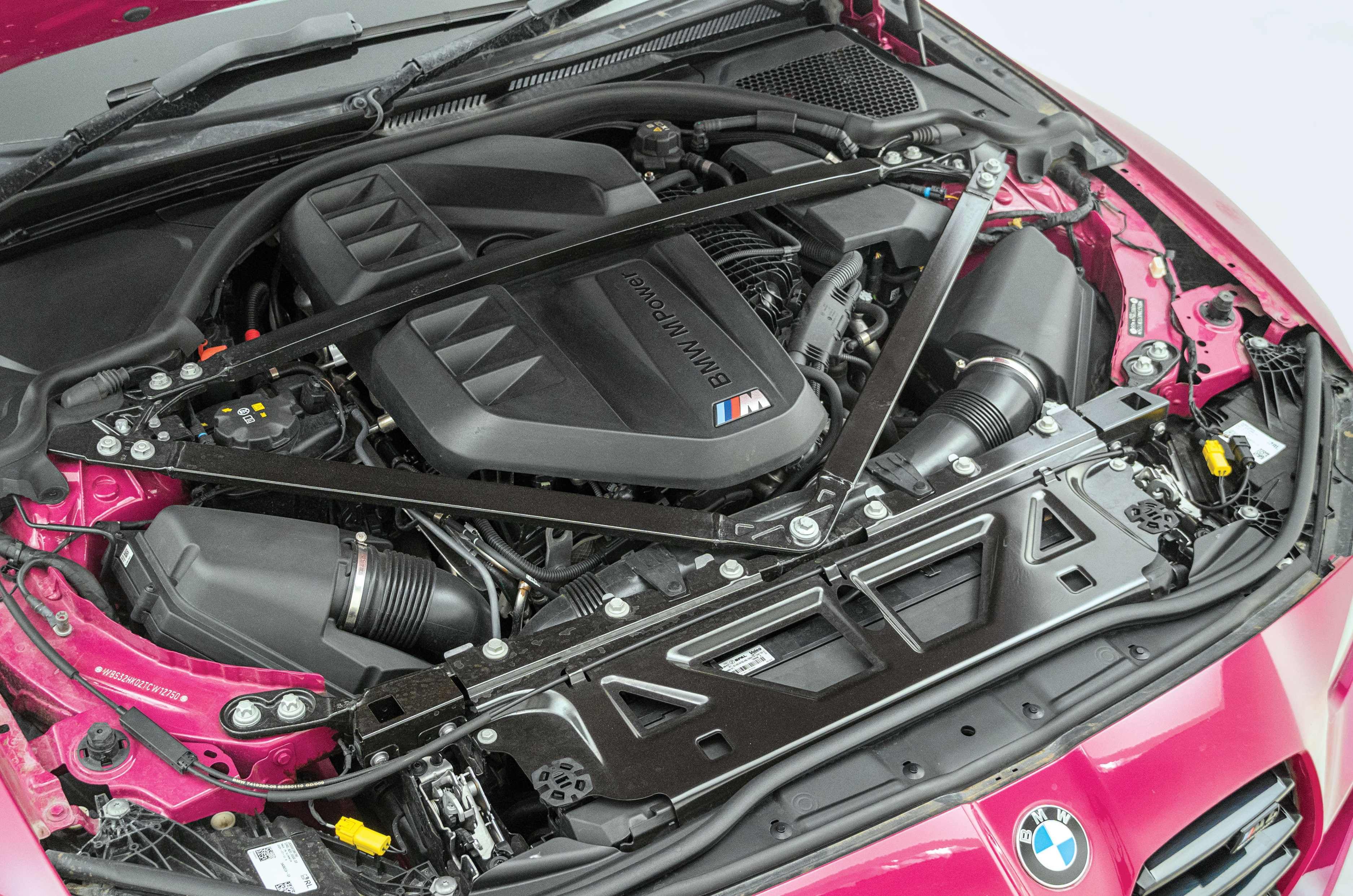
530hp, twin-turbo, straight-six pulls relentlessly and sounds good too.
The M4 Competition’s 3.0-litre twin-turbocharged S58 straight-six is the real star of the show, however. In this form, it develops 530hp and 650Nm and sends power through an 8-speed torque converter automatic to all four wheels, and BMW claims 0-100kph in 3.5sec.
What makes the engine so impressive isn’t just the numbers, but the way it delivers them. There’s almost none of the old-fashioned turbo lag here. Instead, power builds in an almost naturally aspirated fashion, with the engine pulling strongly through the rev range. It’s linear, responsive and keeps pulling hard all the way till the redline.
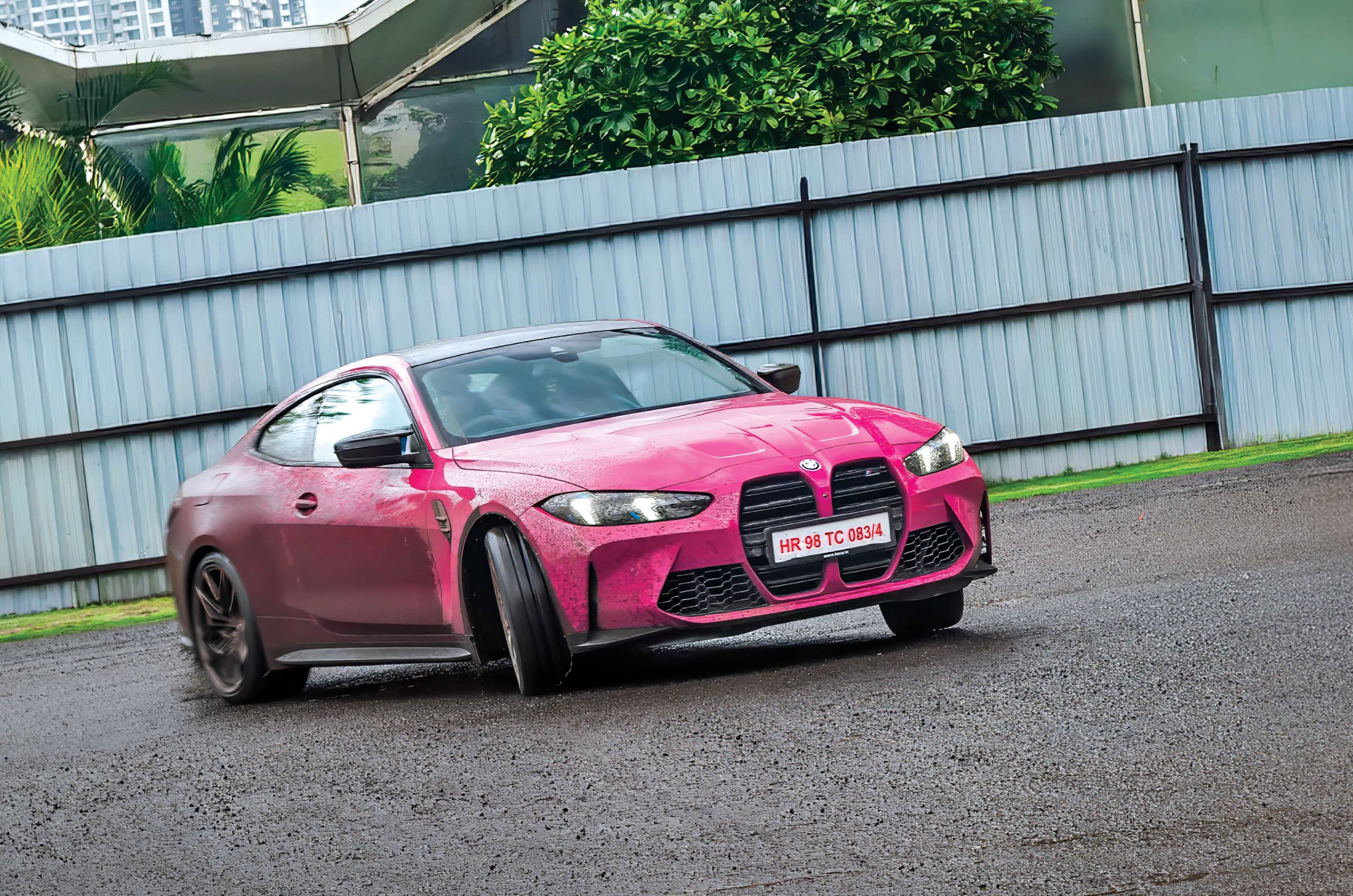
Be it drifting or touring, the M4 is up for both.
The gearbox is smooth when left to its own devices and can be calibrated to shift much more aggressively when you start driving harder. It can occasionally feel less urgent than you might expect, especially in comparison to the last-gen M4’s DCT, but the sheer performance of the engine means there’s never any shortage of pulling power.
The all-wheel-drive setup also makes it devastatingly effective when you have the space to exploit it, and it doesn’t scare you like the older rear-wheel-drive M4. The best part is that it doesn’t feel like a car that needs to be driven at ten-tenths to be entertaining. More importantly, the M4 doesn’t compromise everyday usability simply because it is so performance-focused. Driven gently, the drivetrain can be remarkably civilised.
The ride is compliant enough to make long distance travel feasible.
There’s also a pleasing authenticity to the engine note. It may not have the theatrical soundtrack of some older M cars, but the straight-six’s sound is sufficiently characterful without relying heavily on artificial enhancement.
BMW M4 Competition fuel efficiency – 6/10
Fuel economy, expectedly, isn’t the M4’s strongest suit, but the 59-litre fuel tank gives it enough range to be usable as a long-distance car, although enthusiastic driving will inevitably bring that figure down considerably.
BMW M4 Competition ride comfort and handling – 8/10
At city speeds, the M4 can be surprisingly subdued. The steering is light, and there’s little indication of the aggression that lies underneath. The ride, though, even with the adaptive dampers set to Comfort, is firm, and sharp bumps do filter through to the cabin.
What’s impressive is how effectively BMW disguises the M4’s 1,850kg mass. It is a heavy car, but it rarely feels unwieldy when you’re attacking a sequence of corners. There is a bit of understeer, but there’s virtually no body roll, making it feel agile. The M4’s grip is immense, and the xDrive system allows you to put down its considerable power remarkably effectively. Yet, it isn’t simply a point-and-shoot machine. The adjustable traction control and rear-wheel-drive mode (or even the semi-lenient ‘AWD Sport’ mode) allow considerably more freedom, revealing the car’s playful side that isn’t immediately apparent in normal driving.
Rear wheel drive mode and adjustable traction settings allow for some proper tail out fun.
The electric power steering isn’t as feelsome as the hydraulic-steering M cars of old, but the accuracy is excellent. The M4 goes precisely where you point it, and the chassis remains composed even when you begin to carry serious speed. It’s decently capable at dealing with speed breakers too, as long as you take them slow and the large ones at an angle. Road noise, however, does become apparent at higher speeds over concrete surfaces.
The M4 really has a dual personality. Around town, it can be relaxed and relatively easy to live with; on an open road, it becomes seriously fast and agile. The ride is not plush or comfy, but it is compliant enough to make long-distance driving feasible.
BMW M4 Competition value for money and verdict – 8/10
As far as fast, versatile coupes go, there’s few better than the M4 Competition.
At Rs 1.60 crore (ex-showroom, before options), the M4 Competition is a difficult car to categorise, with no real direct rivals, and that is precisely why it works so well. It has the performance to keep up with exotic sports cars, yet it retains usable rear seats, a decent boot, and it is easy enough to be driven every day.
The polarising styling remains subjective, the ride quality is stiff and the infotainment interface is unintuitive. But once you find an open road, those shortcomings simply melt away. What you’re left with is a very capable all-rounder. The 530hp straight-six provides devastating performance without being difficult to manage, the all-wheel-drive system provides great traction and a useful safety net, and it has enough adjustability to keep even the most experienced driver entertained. Fast, practical, hugely capable and remarkably usable, that versatility is ultimately what makes the M4 Competition such a compelling performance car.
When the first Bajaj Pulsar 150 broke onto the scene in 2001, it shattered the mould of what was expected of an accessible yet sporty commuter motorcycle. This recipe saw such widespread success that nothing Bajaj brought out since has been able to replace it. Therefore, the company went back to the drawing board and has now brought out a new generation of Classic Pulsars, spearheaded by the 125 and 150. In this review, we’ll share what the larger one was like to ride.
Bajaj Pulsar 150: What’s changed compared to before?
From the mechanicals to the tech, it is all-new
To start with, gone are the double-cradle frame and twin shock absorbers, replaced by a lighter and stiffer diamond frame and monoshock, respectively. Complementing the new chassis is a brand new motor. This engine started life as an engine from a similar displacement N model, but Bajaj has made certain changes to suit this application. The state of tune, various internals and the exhaust system are all different over here.
The Pulsar 150, understandably, has the sprightlier performance of the two.
Unlike before, the motor is now used as a stressed member of the chassis, and Bajaj has also peppered in the learnings it has made from the N range. For starters, the gearbox now has shorter, more tractable ratios, and there’s also a low rpm assist function, which raises engine rpm slightly to reduce stalling when you’re crawling at a higher gear at low speeds. Furthermore, higher variants of the 150 also come equipped with an Integrated Starter Generator (ISG), which brings in silent start and a reasonably quick start/stop system.
Pulsar 150 design and quality – 8/10
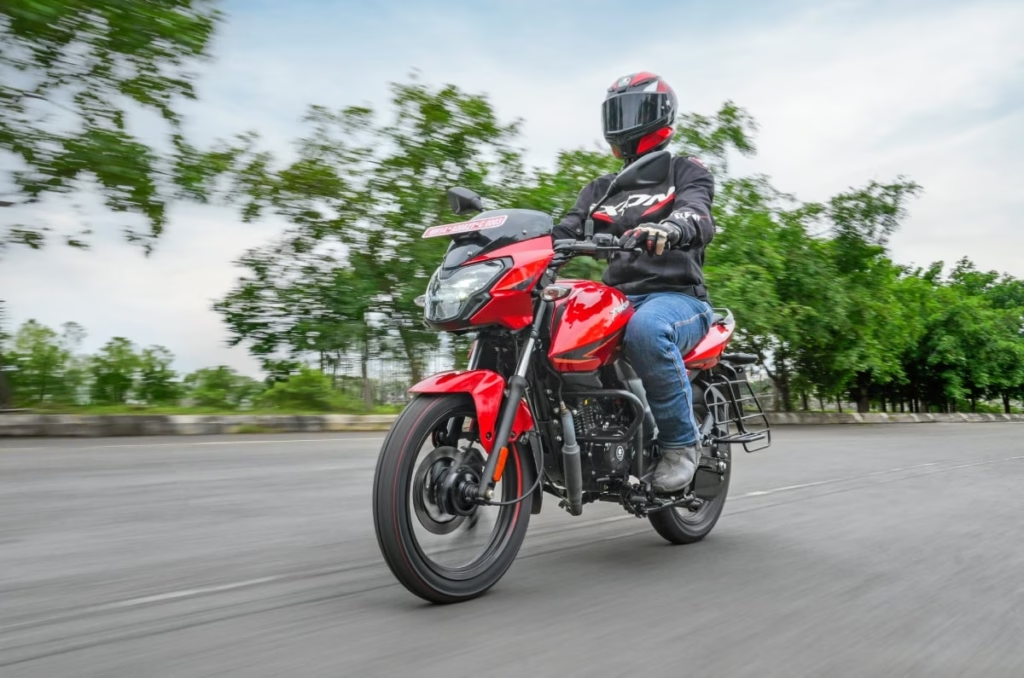
Looks uncannily similar to the older bike; feels very similar to sit on, too
Considering how much has changed underneath, it’s especially commendable that the Pulsar 150 looks this similar to before. Bajaj’s design team has deliberately gone to great lengths to package everything neatly and retain the bike’s instantly recognisable silhouette. Pulsar hallmarks that people appreciate, like a ‘wolf eye’ headlight, a chunky tank, sharp tank extensions and a pointy tail, all continue, and you won’t be mistaking it for anything other than a classic Pulsar. There are no complaints when it comes to quality, and it’s as well-finished as you’d expect from a commuter bike today.
Top variants come with a split seat.
Just like the near-unchanged design, the Pulsar 150’s ergonomics are almost the same as before – but that’s a good thing. You’re sat very neutrally, and the riding position is that of a textbook commuter with only slightly rearward pegs for the sporty touch that a Pulsar is known for. With a perch that’s just 795mm off the ground, the 150 strikes a nice chord by being friendly and approachable for both shorter folks and 6’1 Rishaad. To cater to the wants of different riders, Bajaj will sell you a Pulsar equipped with either a single piece seat or split seats. Both options are spacious – the single piece seat understandably more so – and decently padded, capable of accommodating two full-size people without them getting acquainted with each other too intimately.
Pulsar 150 performance – 8/10
Has enough pep for city and highway duties, engine stalls a little too easily, though
City traffic is where most Pulsar riders spend most of their time, so we did the same and found that the bike behaves exactly as you’d expect from a commuter. The motor has good low- and mid-range torque, and paired with the super light clutch, wading through the drudgery of traffic doesn’t feel too taxing.
The new engine is also super smooth, and should you choose to venture out onto the highway, the Pulsar can do that as well. The upper limit of the 150’s comfortable cruising speed is 90-95kph in its top 5th gear, which is par for the course in this class.
Engine
149.5cc, single-cylinder, air-oil cooled
Power
14hp at 8,000rpm
Torque
14.1Nm at 6,500rpm
Gearbox
5-speed
However, for all its strengths, the engine in the Pulsar 150 unit we were allotted displayed a tendency to stall a little too easily, and this happened on multiple occasions to both myself and Rishaad, who rode the bike.
Pulsar 150 ride and handling – 8/10
Behaves predictably and handles all situations well
While the chassis is largely the same between the 125 and 150, one noteworthy difference is that the bigger one uses a fatter 33mm fork, compared to the 31mm unit on the smaller bike. Also, unlike the 125, the Pulsar 150 comes with the government-mandated safety net of single-channel ABS. All variants come with a 260mm disc brake at the front, paired with either a 230mm drum brake on the lowest variant or a 230mm disc on the higher two variants.
Pulsar 150 behaves neutrally and predictably when subjected to a variety of riding conditions.
The best way to describe the new Pulsar 150’s handling is neutral and predictable. Neither does it feel as vague as the previous-gen model, nor does it feel as responsive as the N / NS models. The Classic Pulsar 150 retains its surefootedness in a straight line while introducing a newfound taut feeling when taking a corner. Its demeanour is predictable at all times, which is sure to inspire confidence in the varied sort of riders it will cater to. The brakes work well and bring the Pulsar to a stop in a quick fashion without much drama, although overenthusiastic usage will result in the rear locking up.
Fuel tank
14 litres
Seat height
785mm
Ground clearance
165mm
Kerb weight
141kg
Wheelbase
1,320mm
However, for all its strengths, the Pulsar 150 is not perfect, and there are some areas of improvement. The rear suspension feels slightly underdamped and springy, throwing you off the seat over larger road imperfections. The gearshifts, too, felt a little rubbery and vague, lacking a snick feel.
Pulsar 150 features and safety – 8/10
Comes with a lot of tech-y features on the top two variants
Following today’s market trends, even a humble commuter like this one now packs a dollop of tech. This includes a USB-C charging port, 4 riding modes (Sport, Tour, Road and Rain), Bluetooth connectivity for the dash via Bajaj’s app, which brings in a host of functions, and you can even cast your phone’s screen onto the TFT display, although some of these functions are still not available yet and will be rolled out at a later date.
Top variants also come with a colour TFT display and riding modes
To control the TFT display’s functions and switch between the riding modes on the top variants, you also have more comprehensive switchgear whereas the colour LCD dash on the lower variants is paired with a simpler switch cluster. Both displays are informative and well laid-out and bring an air of premiumness from the rider’s POV. Admittedly, most of these features aren’t going to add much value for most everyday riders but for the few that want their motorcycle to double up as a gadget, they’re there.
Pulsar 150 price and verdict – 8/10
It suits its intended purpose quite well
Aside from a few small misses, the new Pulsar 150 is a lovely commuter, which comes in at a price point that is more or less in line with the competition today. Prices start at Rs 1.15 lakh and go up to Rs 1.23 lakh (ex-showroom, Delhi). Compared to the last-gen 150, this latest-gen Pulsar’s prices have gone up by Rs 4,000-Rs 6,000, which is a digestible amount considering the sheer scale of new components in use here.
Given the huge demand for a bike that looks like a Classic Pulsar and the fact that this new-gen model is such a quantum leap ahead compared to the old ones while costing just a few thousand rupees more, Bajaj seems to have a winner on its hands.
The classic Pulsar 125 has always been the most affordable way into Bajaj Pulsar ownership and while the 2026 model might look largely the same as before, underneath, it is actually all new.
Bajaj Pulsar 125 what’s changed under the skin?
Everything from stem to stern is all-new
To start with, gone are the double-cradle frame and twin shock absorbers, replaced by a lighter and stiffer diamond frame and monoshock, respectively. Complementing the new chassis is a brand-new motor. This engine started life as an engine from an N model of a similar displacement, but Bajaj has made certain changes to suit this application. For instance, the new 124.58cc engine on the smaller Pulsar has the lightest crank inertia among its peers– claims Bajaj– and the company has saved 1.2kg here alone, compared to before. Speaking of weight, the 125 weighs 131kg with its 11 litre fuel tank brimmed.
Despite all under-the-skin changes, the Pulsars retain their traditional styling to cater to market demand.
The new engine is also used as a stressed member of the chassis, and Bajaj has also peppered in the learnings it has made from the N range over here. For starters, the gearbox now has shorter, more tractable ratios and there’s also a low-rpm assist function, which raises engine rpm slightly to reduce stalling when you’re crawling at a higher gear at low speeds. Furthermore, the Pulsar 125’s higher variants also come equipped with an Integrated Starter Generator (ISG) which brings in silent start and a reasonably quick start/stop system.
Bajaj Pulsar 125 Design and seating comfort – 8/10
Looks uncannily similar to the older bike; feels very similar to sit on too
Considering how much has changed underneath, it’s especially commendable that the Pulsars look so similar to before. Bajaj’s design team has deliberately gone to great lengths to package everything neatly and retain the bikes’ instantly recognizable silhouette.
Pulsar hallmarks like a ‘wolf eye’ headlight, chunky tank, sharp tank extensions and a pointy tail, all continue and you won’t be mistaking them for anything other than a classic Pulsar. Overall quality is quite nice for the price that the Pulsar 125 commands.
Lower variants come with a single-piece seat.
The seating position also echoes the near-unchanged design and you’re sat very neutrally with the riding position best described as that of a textbook commuter.The only difference is that the pegs are set slightly rearward for the sporty touch that Pulsars are known for. With a perch that’s just 795mm off the ground, the Pulsar 125 feels friendly and approachable for shorter folks as well as 5’11 me.
Engine
124.6cc, single-cylinder, air-cooled
Power
12.1hp at 8,500rpm
Torque
11.4Nm at 6,500rpm
Gearbox
5-speed
To cater to the needs of different riders, Bajaj will sell you a bike equipped with either a single-piece seat or split seats, depending on the variant you buy. Both options are spacious and decently padded, capable of accommodating two full-size people without them getting acquainted with each other too intimately.
Bajaj Pulsar 125 Performance – 8/10
Engine is smooth and responsive; gearshifts can feel a little vague though
City traffic is where a majority of Pulsar riders spend their time, so we did the same and found that the bike behaves exactly as you’d expect from a commuter. The new engine is smooth with good low- and mid-range torque and paired with the super-light clutch, wading through the drudgery of traffic demands very little effort from the rider.
The Pulsar 125 behaves neutrally and predictably when subjected to a variety of riding conditions.
Even at highway speeds, the engine retains its smooth characteristics, and should you choose to venture out onto the highway, the Pulsar 125 is up for it. The upper limit of the 125’s comfortable cruising speed is 80-85kph in its top 5th gear, which is quite respectable considering the displacement.
The monoshock feels a little springy and underdamped; it can kick you off the seat over sharper and larger bumps.
Bajaj Pulsar 125 ride and handling – 8/10
Feels trustworthy and neutral
Coming to how the Pulsar behaves on the side of the tyre, the best way to describe it is neutral and predictable. Neither does it feel as flaccid as the previous-gen model, nor does it feel as agile as the N / NS models. The bike has a good sense of surefootedness, both around a corner as well as in a straight line, which is sure to inspire confidence in the varied sort of riders it will cater to.
Two full-size adults will fit comfortably.
The lowest variant of the 125 comes with a 130mm drum front brake whereas higher variants come with a 260mm disc brake, although there’s no ABS on offer here. All variants of the 125 come with a 130mm rear drum brake. The braking power is more than sufficient for the power on tap and the drum brake also works predictably.
Tyres (F/R)
80/100-17 / 100/90-17
Brakes (F/R)
260mm disc / 130mm drum
Suspension (F/R)
Telescopic fork / monoshock
However, for all its strengths, the Pulsar 125 is not perfect and there are some areas of improvement. The rear suspension feels slightly underdamped and springy, throwing you off the seat over larger road imperfections, and the gearshifts, too, felt a little rubbery and vague, lacking a snick feel.
With this generation change, the Pulsar 125 is now a substantial 15 kilos lighter than before.
Bajaj Pulsar 125 Features – 8/10
Higher variants have a lot of tech
Following today’s market trends, humble commuters like these now also pack a dollop of tech. This includes a USB-C charging port, 4 riding modes (Sport, Tour, Road and Rain), Bluetooth connectivity for the dash via Bajaj’s app, which brings in a host of functions, and you can even cast your phone’s screen onto the TFT display, although some of these functions are still not available yet, and will be rolled out at a later date.
Lower variants feature a negative colour LCD display.
To control the TFT display on the top variants, you also have more comprehensive switchgear, whereas the colour LCD dash on the lower variants is paired to a simpler switch cluster. Both displays are informative and well-laid-out and bring an air of premiumness to the rider’s POV. Admittedly, most of these features aren’t going to add much value for most everyday riders, but for the few that want their motorcycle to double up as a gadget, they’re there.
Bajaj Pulsar 125 Price and verdict – 8/10
It’s an accomplished commuter with very few misses
Aside from a few foibles, the new Pulsar 125 is a good commuter which comes in at a price point that is more or less in line with the competition today. Prices start at Rs 92,990 and top out at Rs 1.04 lakh (ex-showroom, Delhi). Compared to the bargain basement Pulsar 125 Neon, the 2026 bike’s price has risen quite significantly, but if you were to compare the actual Pulsar 125 base model, the increment is much smaller.
Given the huge demand for a bike that looks like a Classic Pulsar, and the fact that this new-gen model is such a quantum leap ahead compared to the old ones while costing just a few thousand rupees more, Bajaj seems to have a winner on its hands.
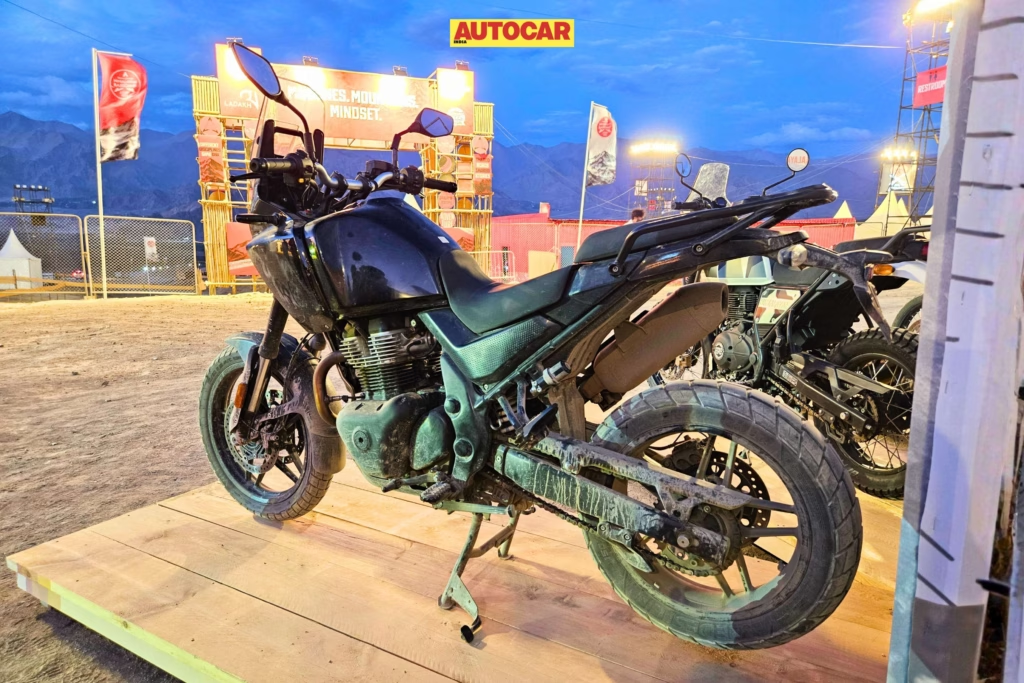
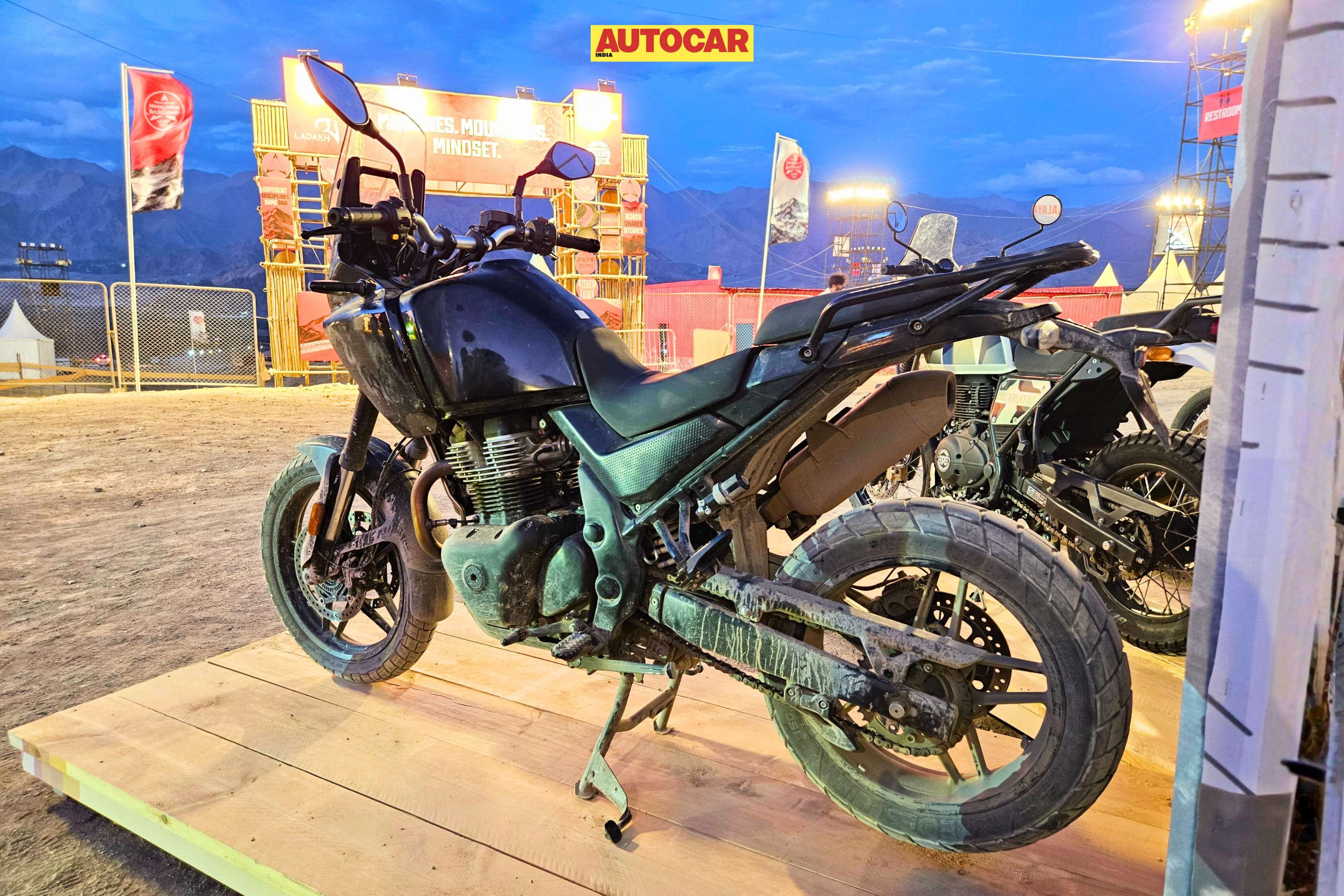
The Himalayan 750 is in the works, as we’ve known for several months now. It was first showcased at EICMA 2025 and has since been spotted being tested multiple times. During the Himalayan 440 event in Leh, we had the opportunity to get closer than ever before to Royal Enfield’s upcoming ADV, and we’ve got some interesting details for you to look forward to. And the biggest one might just be that it doesn’t aspire to be an off-roader.
Appears to swap the 21-inch front wheel on the 450 for a 19-inch unit
Gets cruise control and traction control, both a first for Royal Enfield
Preload-adjustable front and rear suspension could be limited to higher variants
Royal Enfield Himalayan 750: Power and performance
New, close to 750cc twin-cylinder engine
Perhaps the only thing we know regarding the engine is that it will displace close to 750cc and that the twin-cylinder unit shares its basic architecture with the existing 650cc parallel-twin mill. Exact power and torque details and characteristics are under wraps for now, but we’d expect it to be a marked improvement over the 650cc’s 47.4hp and 56.5Nm of torque in its most powerful form on the Bear 650. The new images give us a closer look at the exhaust routing, which, interestingly, looks similar to the Bear 650’s 2-in-1 setup, swapping the recognisable twin exhaust system used in all the other Royal Enfield 650s.
Royal Enfield Himalayan 750: Features
So many firsts for the brand
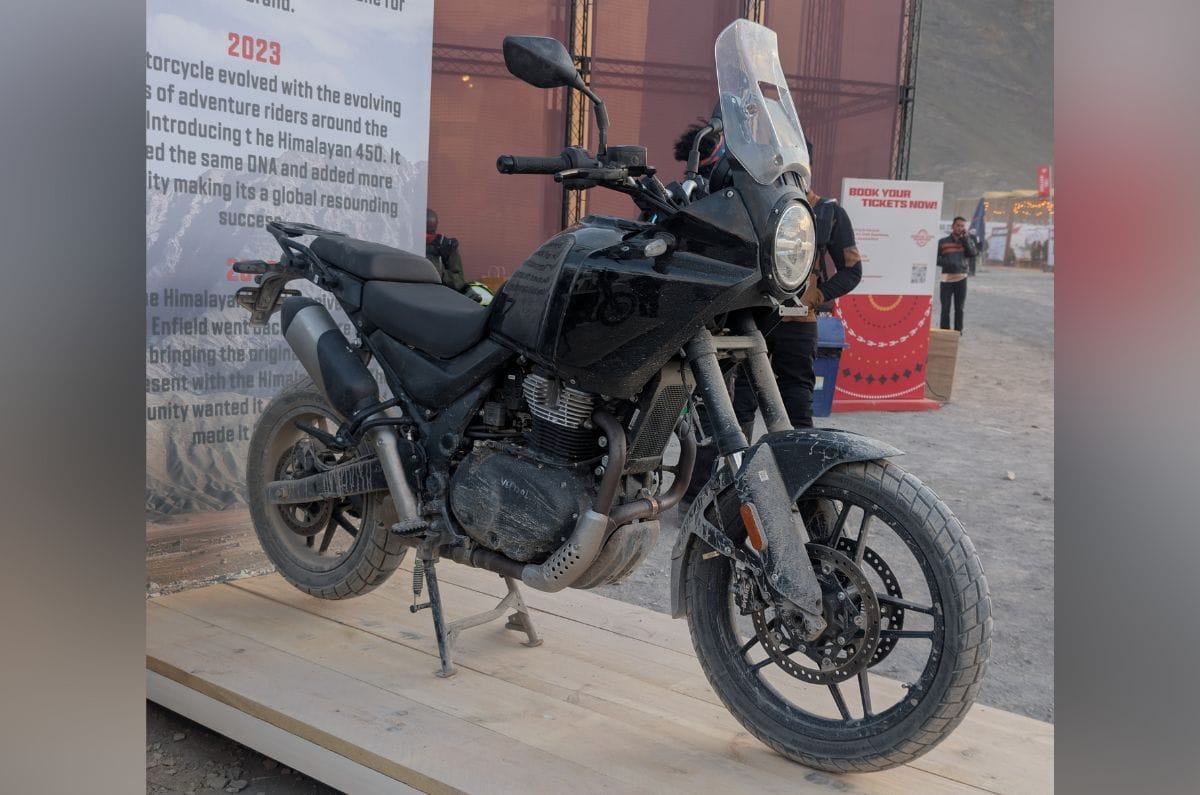
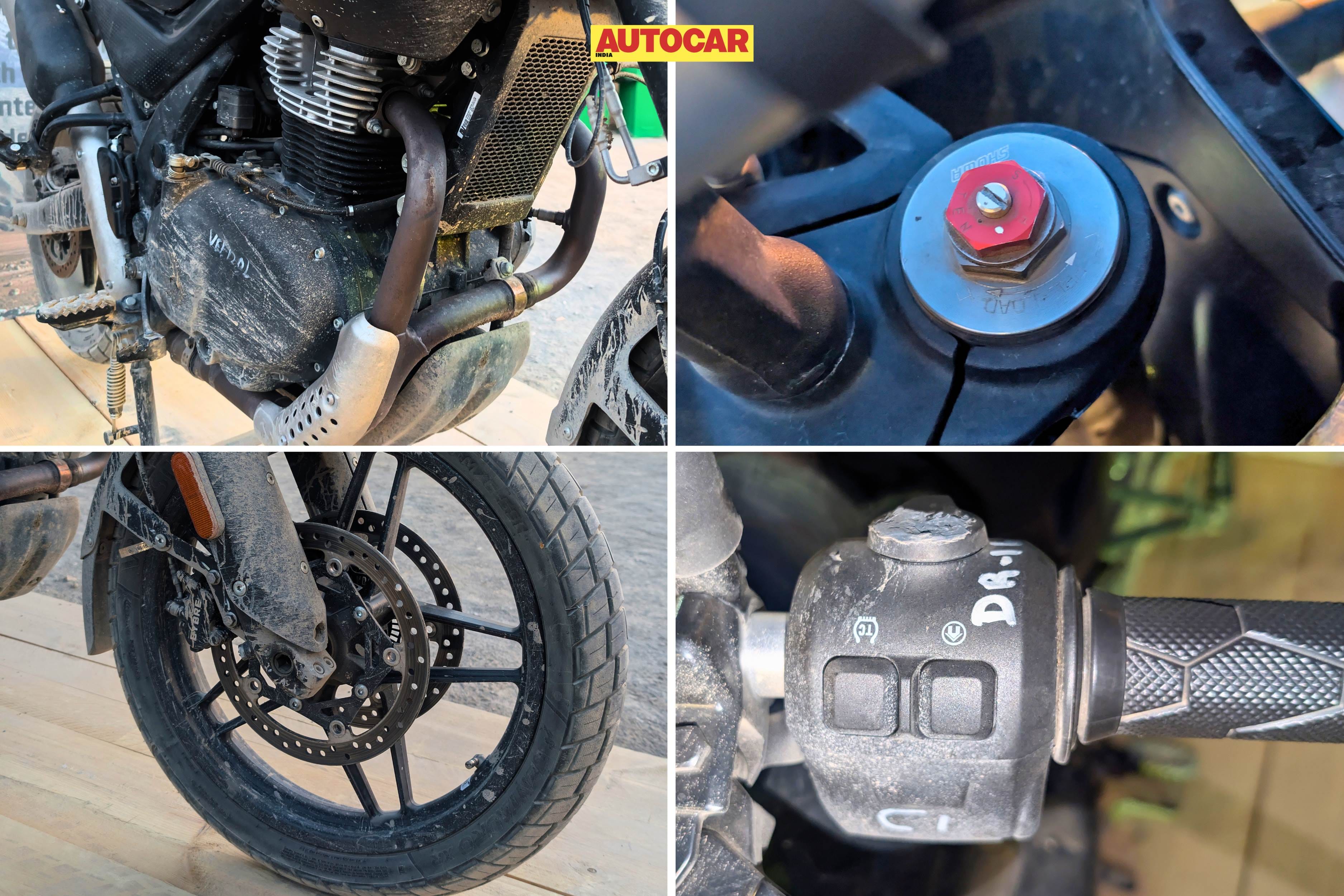
This is perhaps the biggest way the Himalayan 750 stands out from the other Royal Enfield models currently on sale. The prototype appears to have many features that have never been seen before on a production Royal Enfield. Starting alphabetically, we have adjustable front and rear suspension units. The front USD fork is a Showa-branded unit, and both legs have adjustable preload. The rear monoshock once again appears to be a linkage unit, but adjusting the preload on it seems far easier with a handy rotary knob on the left side. It’s worth noting that we’ll have to wait until the bike is officially launched to see whether this suspension setup makes it to production and whether adjustability will vary based on the variant.
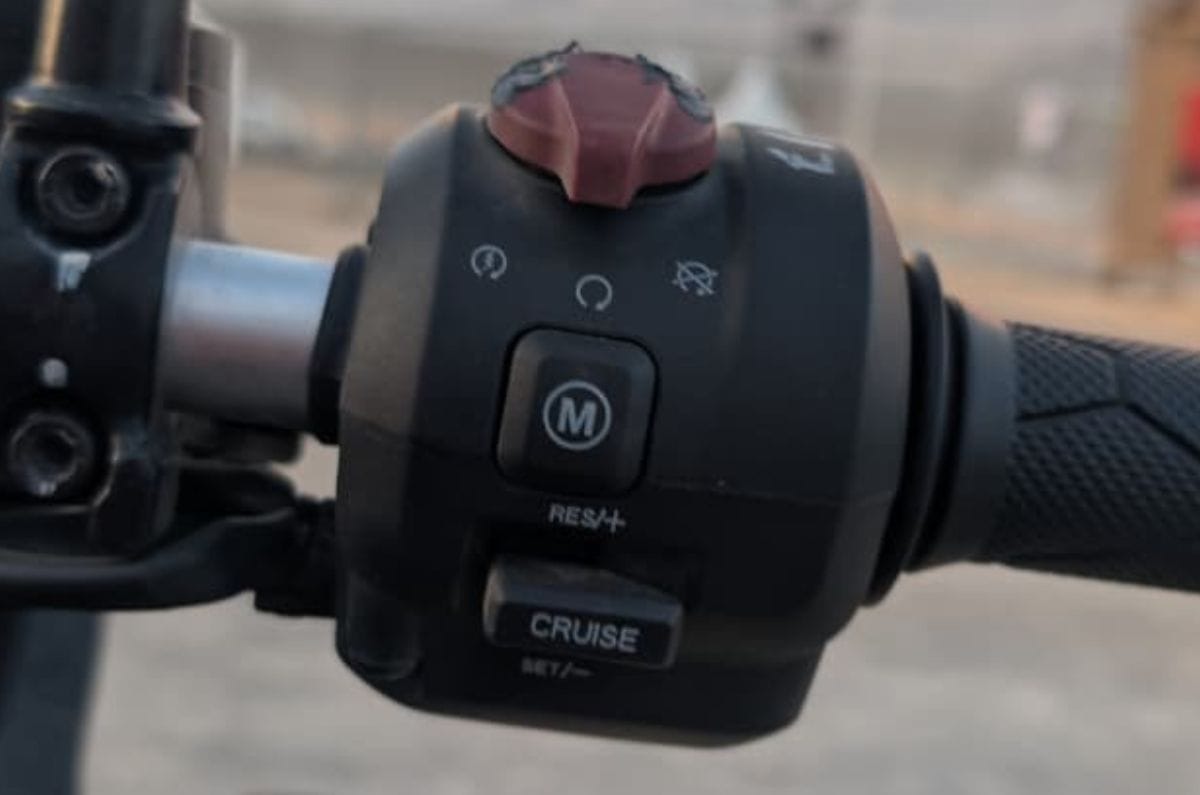
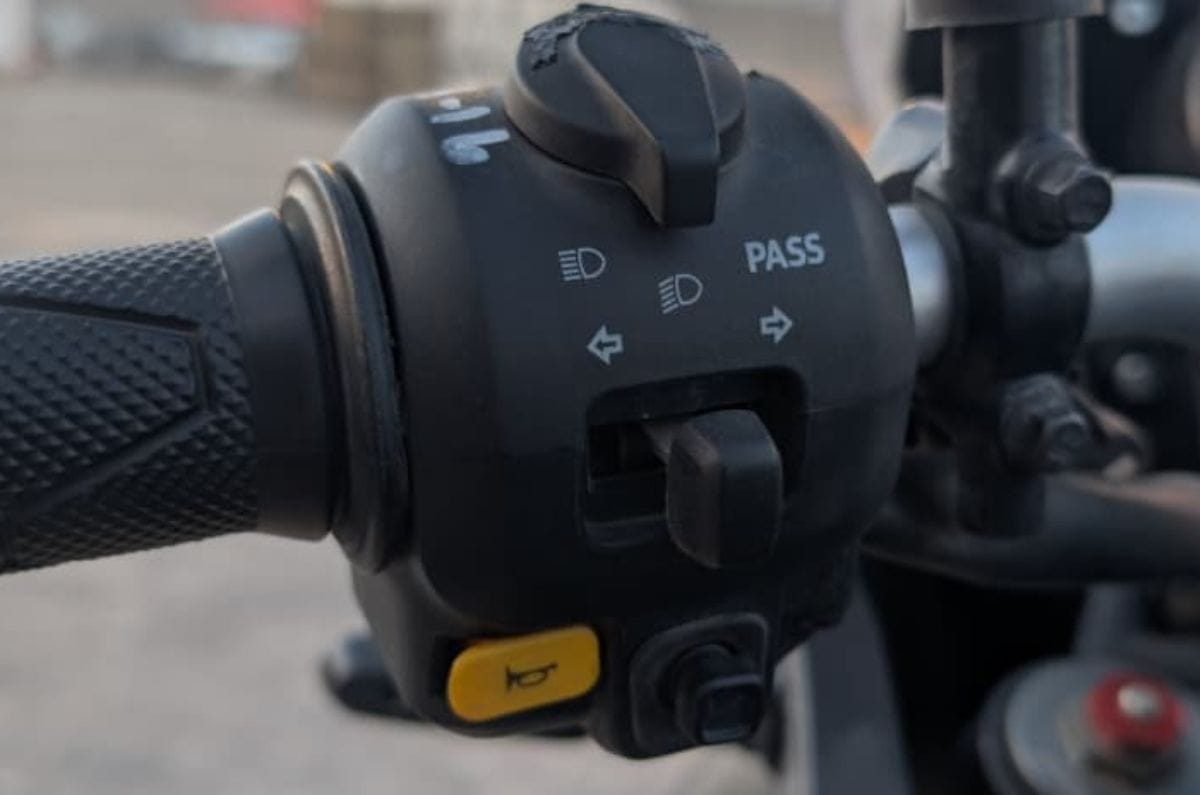
Next up we have features that signal the motorcycle’s intended purpose: long-distance touring. Cruise control, sorely missed on the Himalayan 450, is present on the bigger brother, with controls on the rear right switch cube. It’s likely similar to the ones available on the KTM 390 Adventure and the TVS RTX 300, and not an adaptive one like on higher-end motorcycles. And then we have traction control, present on the diametrically opposite side, front left of the switch cube. The presence of a dedicated button signals that the system might offer some adjustability or the option to turn it off altogether.
The list of features is longer still. We see front dual-disc brakes, once again a first for Royal Enfield, with ByBre calipers. The rear brake calipers are also from ByBre, with the swingarm appearing to share the design with the 450. One additional detail that we’ve spotted is the new Centauro XR tyres by Vredestein. The tread pattern appears to reflect some of the popular dual-use tyres, such as the CEAT GRIPP and Apollo Tramplr XR. Currently, the Centauro XR tyres aren’t listed on Apollo/Vredestein’s Indian websites, so further details are still unknown.
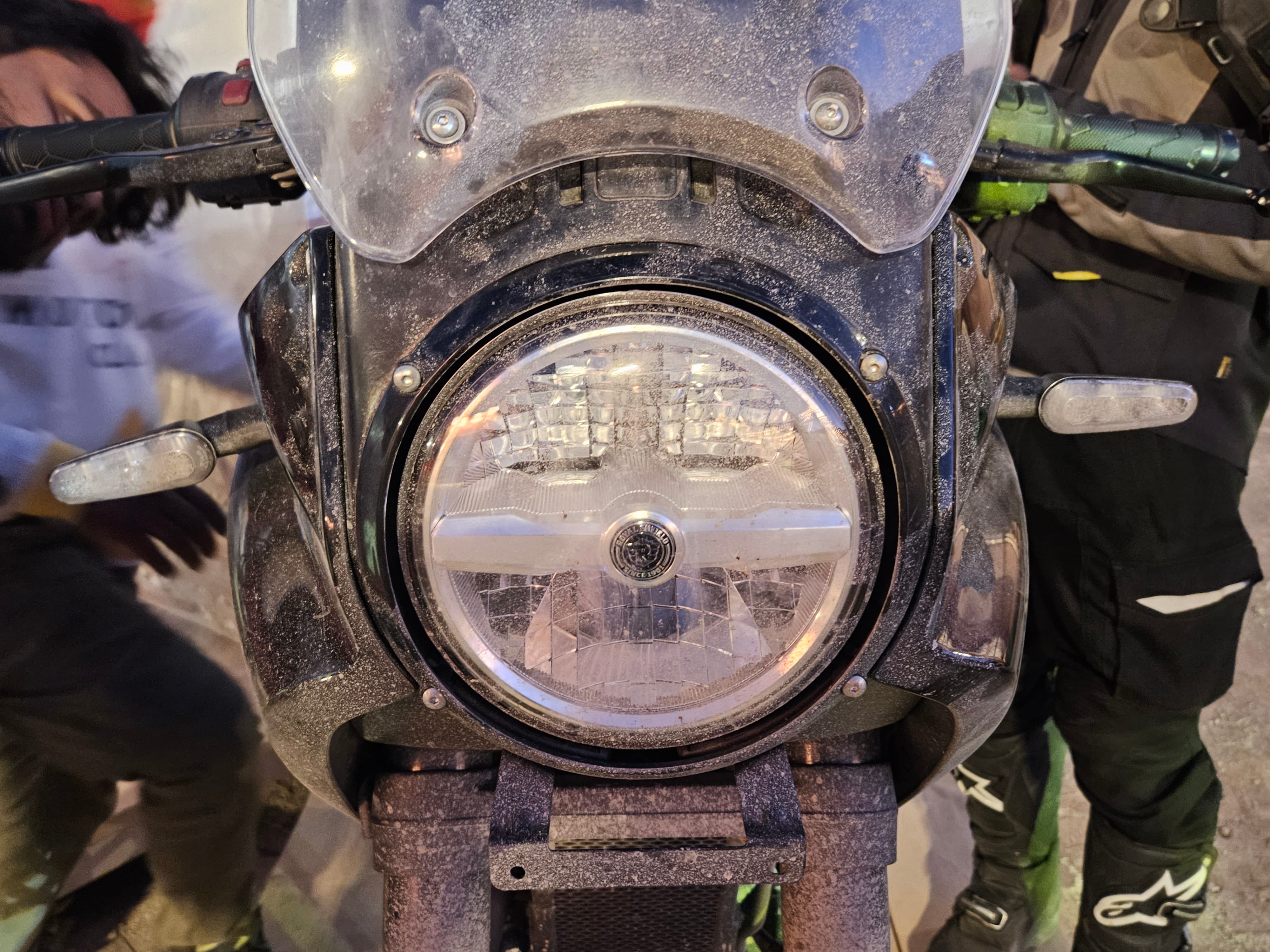
Speaking of shedding light, up front we have a new LED headlight unit – or one that appears to be – based on the assembly. Considering the headlights are one of the weakest parts, if not the weakest, of most current Royal Enfields, we hope that this is indeed a new one and that it’s a better unit, making night runs seem less daunting. Behind the headlight stands the TFT instrument cluster that was (unfortunately) turned off for this exhibition. At first glance, it looks similar to the ones on the Himalayan 450/Guerrilla 450 and Bear 650. However, it’s likely there will be upgrades to it considering the new array of features expected. That said, we can still expect the overall experience to be better, thanks to the redesigned joystick controller on the left switch cube.
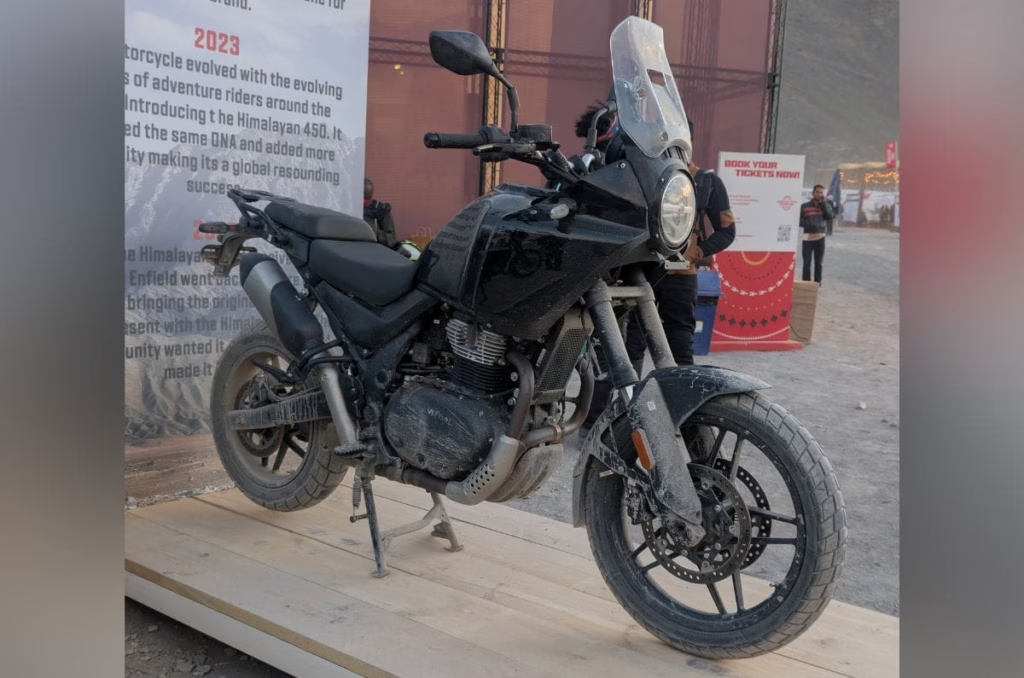
Royal Enfield appears to be positioning the Himalayan 750 as a road-biased tourer with some off-road capabilities, and there couldn’t be a more obvious clue than the wheels. One, the front wheel is a 19-inch unit, unlike the 21-inch wheel we’re used to on the current Himalayans. Two, the prototype sports alloy rims, not spoked, also expected on a motorcycle aimed at off-roading. However, the model shown off at last year’s EICMA had cross-spoked rims, so it’s entirely possible that Royal Enfield might offer a higher variant with off-road-centric wheels and tyres; we’ll just have to wait and see. One minor detail that we’ve spotted is that both the gear shifter and the rear brake lever are hinged, meaning they can turn 90 degrees to the sides, ensuring they don’t bend or break away after a fall.
Royal Enfield Himalayan 750: Price
Expected to sit at the top of the range
Pricing details are once again under wraps, similar to the body panels on the motorcycle. However, considering that the Super Meteor 650 – the most expensive 650 – tops out at Rs 4.40 lakh (ex-showroom, Chennai), it’s reasonable to expect the Himalayan 750 to be priced closer to that range, if not over it. And there we go; those are the details we noticed from getting all up close and personal with the Himalayan 750 during the Himalayan Basecamp event. We should learn more about it during the global unveil, expected during EICMA 2026.
The Himalayan 750 is in the works, as we’ve known for several months now. It was first showcased at EICMA 2025 and has since been spotted being tested multiple times. During the Himalayan 440 event in Leh, we had the opportunity to get closer than ever before to Royal Enfield’s upcoming ADV and we’ve got some interesting details for you to look forward to. And the biggest one might just be that it doesn’t aspire to want to be an off-roader.
Appears to swap the 21-inch front wheel on the 450 for a 19-inch unit
Gets cruise control and traction control, both a first for Royal Enfield
Preload adjustable front and rear suspension could be limited to higher variants
Royal Enfield Himalayan 750: Power and performance
New, close to 750cc twin-cylinder engine
Perhaps the only thing we know regarding the engine is that it will displace close to 750cc, and that the twin-cylinder engine shares the basic architecture with the existing 650cc parallel-twin engine. Exact power and torque details and characteristics are under the wraps for now, but we’d expect it to be a marked improvement over the 650cc’s 47.4hp and 56.5Nm of torque in its most powerful form on the Bear 650. The new images give us a closer look at the exhaust routing; which interestingly looks similar to the Bear 650’s 2-in-1 setup, swapping the recognizable twin exhaust system used in all the other Royal Enfield 650s.
Royal Enfield Himalayan 750: Features
So many firsts for the brand
This is perhaps the biggest way the Himalayan 750 stands out from the other Royal Enfield models currently on sale. The prototype appears to have many features that have never been seen before on a production Royal Enfield. Starting alphabetically, we have adjustable front and rear suspension units. The front USD fork is a Showa branded unit and both legs have adjustable preload. The rear monoshock once again appears to be a linkage unit, but adjusting the preload on which seems far easier with a handy rotator knob on the left side.It’s worth noting that we’ll have to wait until the bike is officially launched to see whether this suspension setup makes it to production, and if adjustability will vary based on the variant.
Next up we have features that signal the motorcycle’s intended purpose: long distance touring. Cruise Control, missed sorely on the Himalayan 450, is present on the bigger brother with controls present on the rear right switch cube. It’s likely similar to the ones available on the KTM 390 Adventure and the TVS RTX 300, and not an adaptive one like on higher end motorcycles. And then we have traction control, present on the diametric opposite side, front left of the switch cube. The presence of a dedicated button signals that the system might offer some adjustability, or the option to turn it off altogether.
The list of features is longer still. We see front dual-disc brakes, once again a first for Royal Enfield, with ByBre calipers. The rear brake calipers are also from ByBre, with the swingarm appearing to share the design with the 450. One additional detail that we’ve spotted are the new Centauro XR tyres by Vredestein. The tread pattern appears to reflect some of the popular dual-use tyres, such as the CEAT GRIPP and Apollo Tramplr XR, etc., Currently, the Centauro XR tyres aren’t listed on Apollo/Vredestein’s Indian websites, so further details are still unknown.
Speaking of shedding light, up front we have a new LED headlight unit, or one that appears to be, based on the assembly. Considering the headlights are one of the—if not the—weakest part of most current Royal Enfields, we hope that this is indeed a new one and that it’s a better unit, making night runs seem less daunting. Behind the headlight stands the TFT instrument cluster that was (unfortunately) turned off for this exhibition. At first glance, it looks similar to the ones on the Himalayan 450/Guerrilla 450, and the Bear 650. However, it’s likely that there will be upgrades to it, considering the new swathe of features expected. That said, we can still expect the overall experience will be better, thanks to the redesigned joystick controller on the left switch cube.
Royal Enfield appears to be positioning the Himalayan 750 as a road-biased tourer with some off-road capabilities and there couldn’t be a more obvious clue than on the wheels. One, the front wheel is a 19-inch unit, unlike the 21-inch wheel we’re used to on the current Himalayans. Two, the prototype sports alloy rims, not spoked, also expected on a motorcycle aimed towards off-roading. However, the model shown off at last year’s EICMA had cross-spoked rims, so it’s entirely possible that Royal Enfield might offer a higher variant with off-road centric wheels and tyres; we’ll just have to wait and see. One minor detail that we’ve spotted is that both the gear shifter and the rear brake lever are hinged, meaning they can turn 90 degrees to the sides, ensuring they don’t bend or break away after a fall.
Royal Enfield Himalayan 750: Price
Expected to sit at the top of the range
Pricing details are once again kept under the wraps, similar to the body panels on the motorcycle. However, considering the Super Meteor 650—the most expensive 650—tops out at Rs 4.40 lakh (ex-showroom, Chennai), it’s reasonable to expect the Himalayan 750 to be priced closer to that range, if not over it. And there we go, those are the details we noticed from getting all up close and personal with the Himalayan 750 during the Himalayan Basecamp event. We should learn more about it during the global unveil, expected to happen during EICMA 2026.
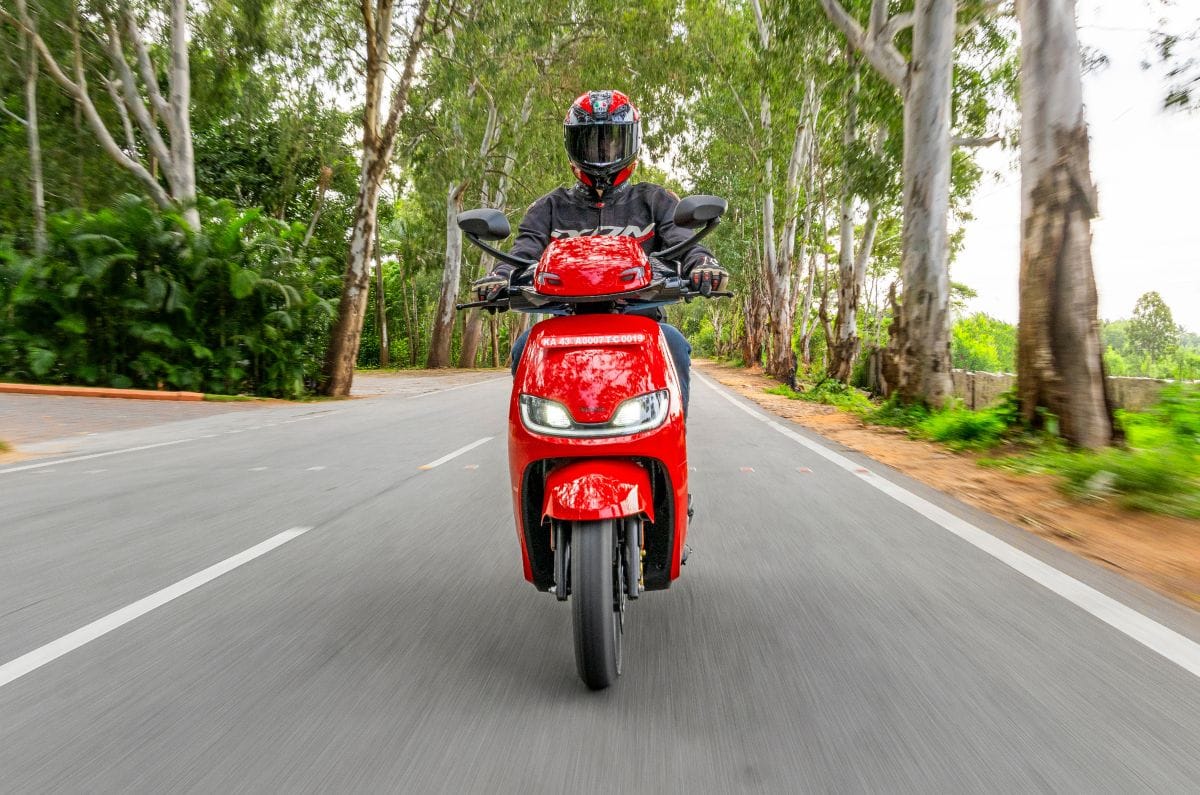
The Simple Wave is an interesting proposition in the increasingly crowded electric scooter space. Its rounded, smooth looks certainly grab attention and, as we found out, it is comfortable, spacious and offers brisk performance. There’s plenty to like here, so let’s dive right in.
Simple Wave Design and quality – 8/10
Looks unique and features many chassis changes over the One
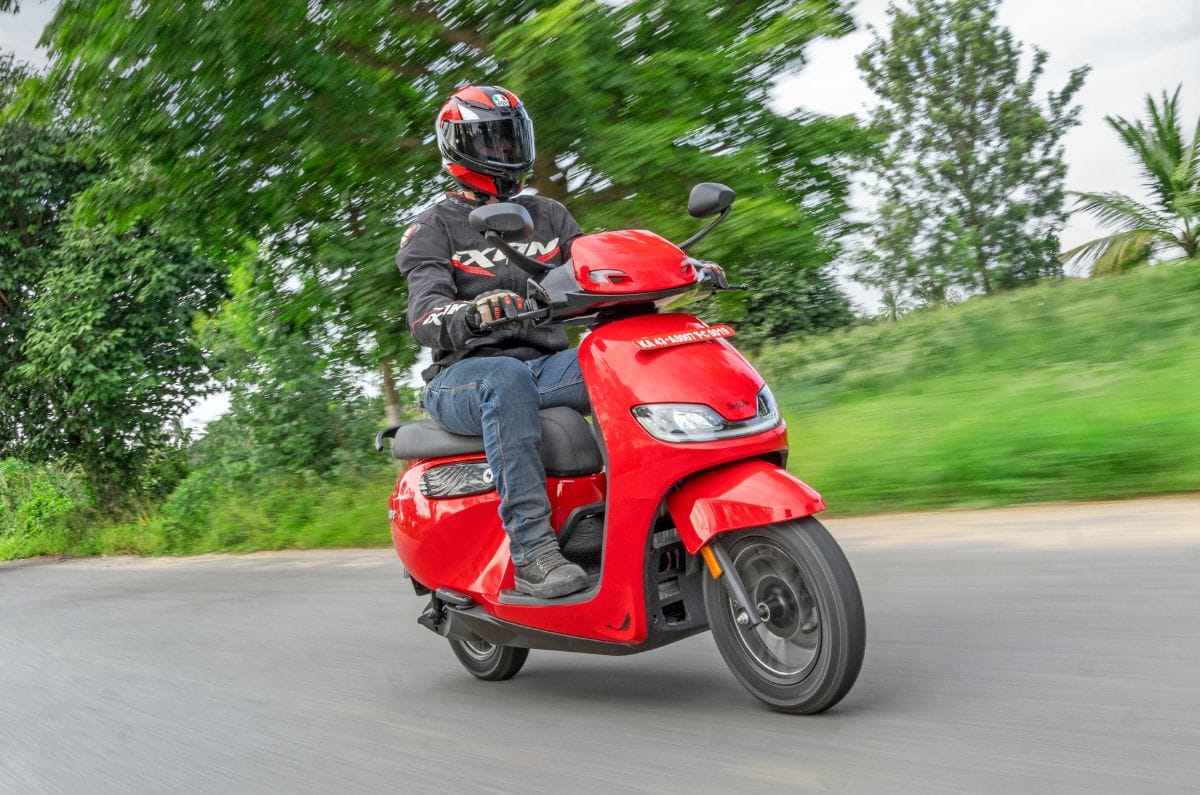
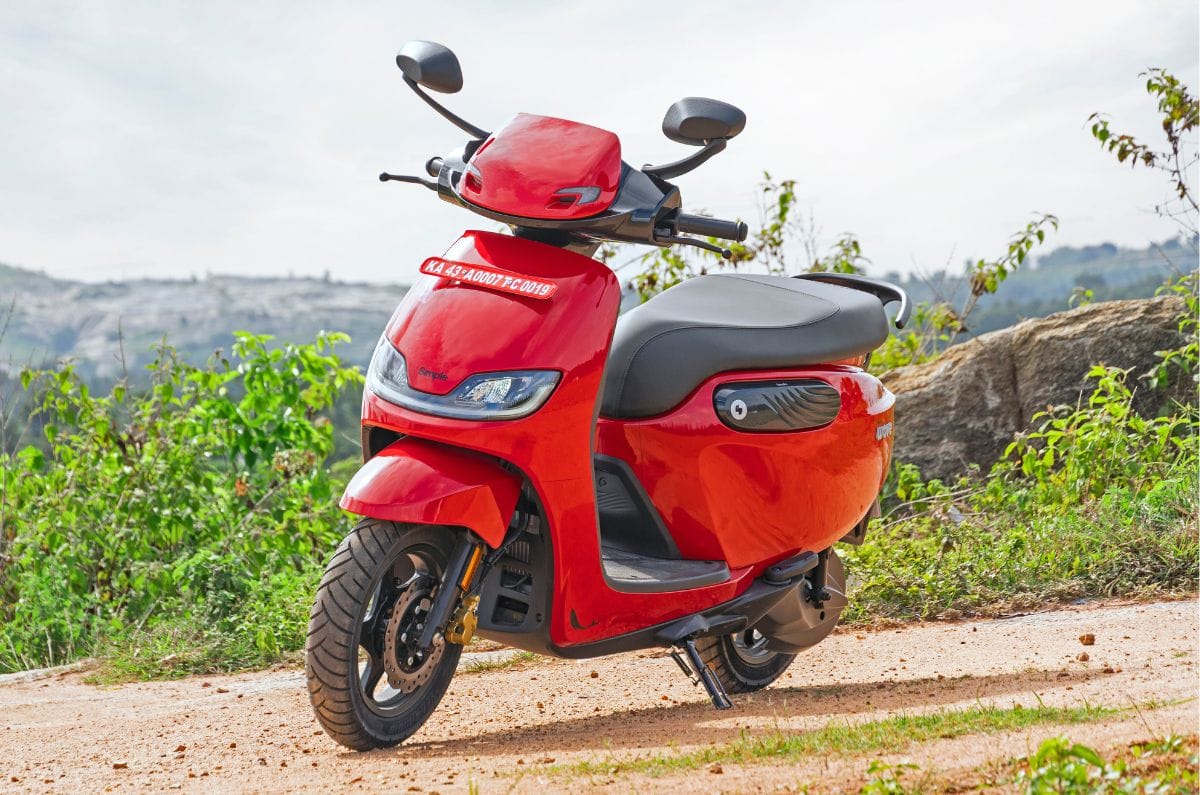
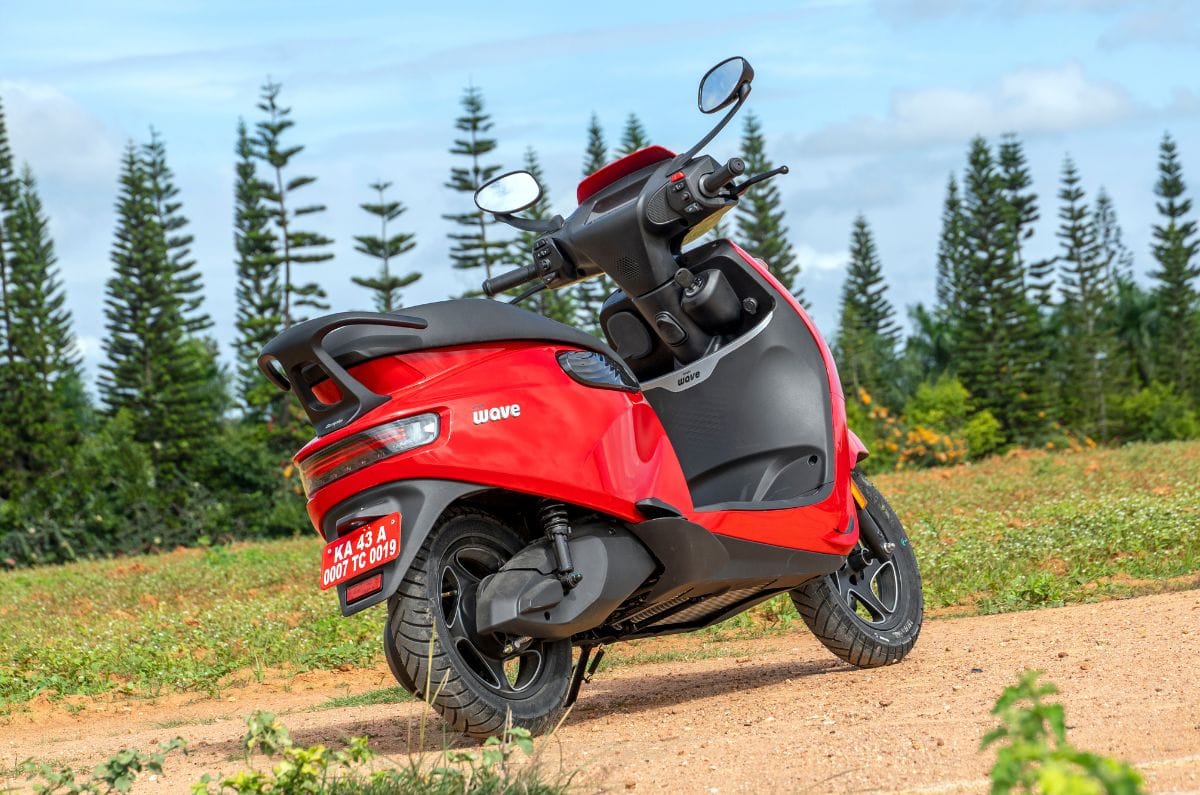
Design is subjective, of course, but the Wave looks good to my eyes with its smooth, rounded edges and distinctive silhouette. It’s got a good level of finish too, and the brighter colour options – red and blue – help it stand out. Simple has designed the Wave as a more accessible, family-oriented scooter, without making it look or feel built down to a cost.
It has a quirky design and surely stands out, especially in the brighter colour options.
Compared to the sporty Simple One, the Wave’s chassis is quite different. The rear subframe has been reworked to accommodate the bigger boot and twin shocks (which replace the One’s monoshock). The Wave also uses a simpler, more cost-effective tubular swingarm instead of the cast unit on the One.
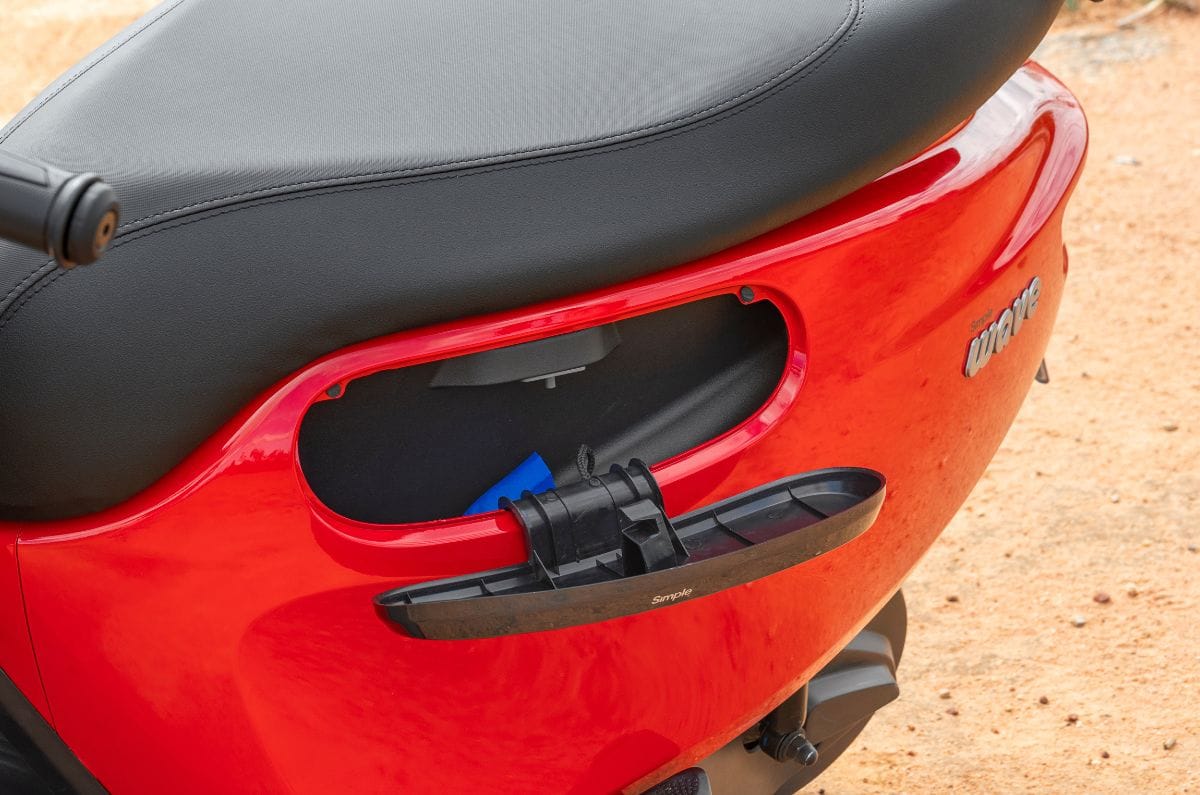
Lockable and weatherproof 4L“Pill” storage cubbies are a thoughtful touch, RH cubby is an accessory.
Simple Wave Ergonomics and comfort – 9/10
Offers a supple ride and ample space for two people
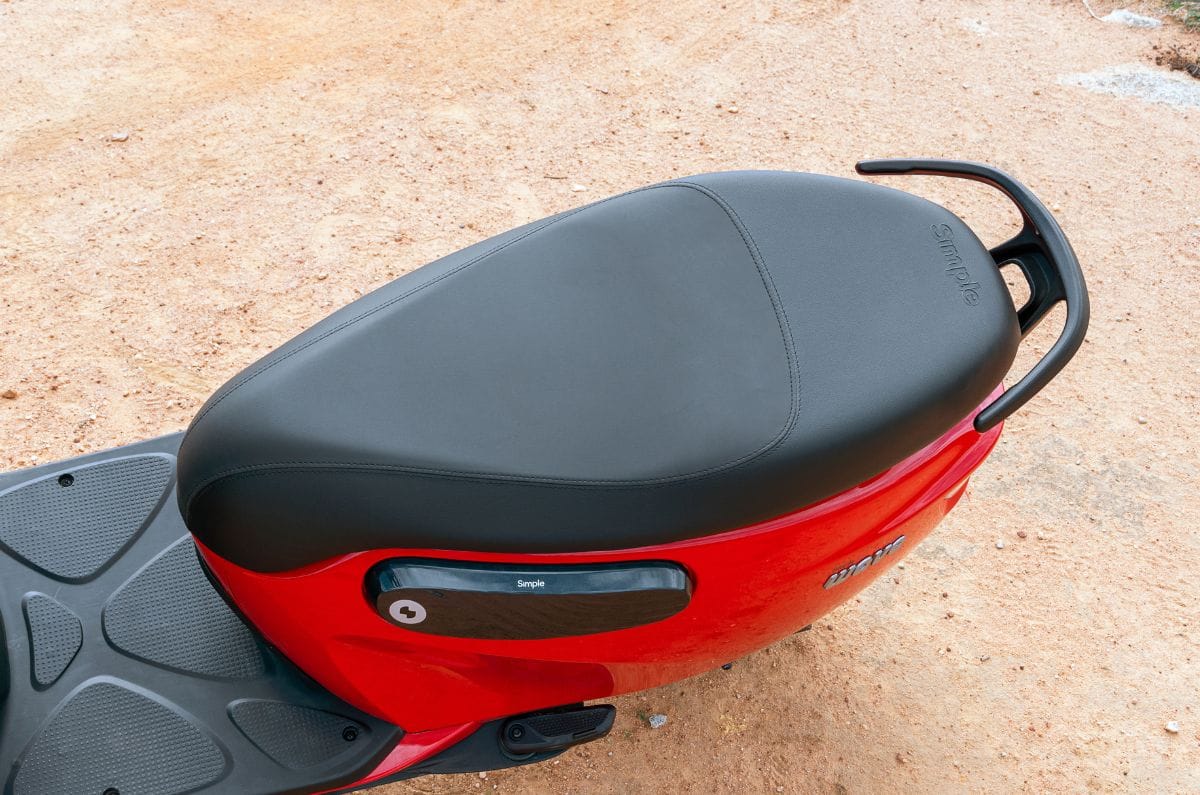
The differences only get more pronounced once you sit on the Wave. Its seat is long, wide and will easily accommodate two full-size adults, while its relatively low 775mm seat height makes it friendly for shorter riders.
That low seat height is no accident either; Simple took feedback from customers who had the One and incorporated it into the Wave. This is why the Wave also has a lower handlebar to make it more approachable for shorter and female riders. This has a trade-off, however. Taller riders will find the handlebar fouls their knees during tight, lock-to-lock U-turns.
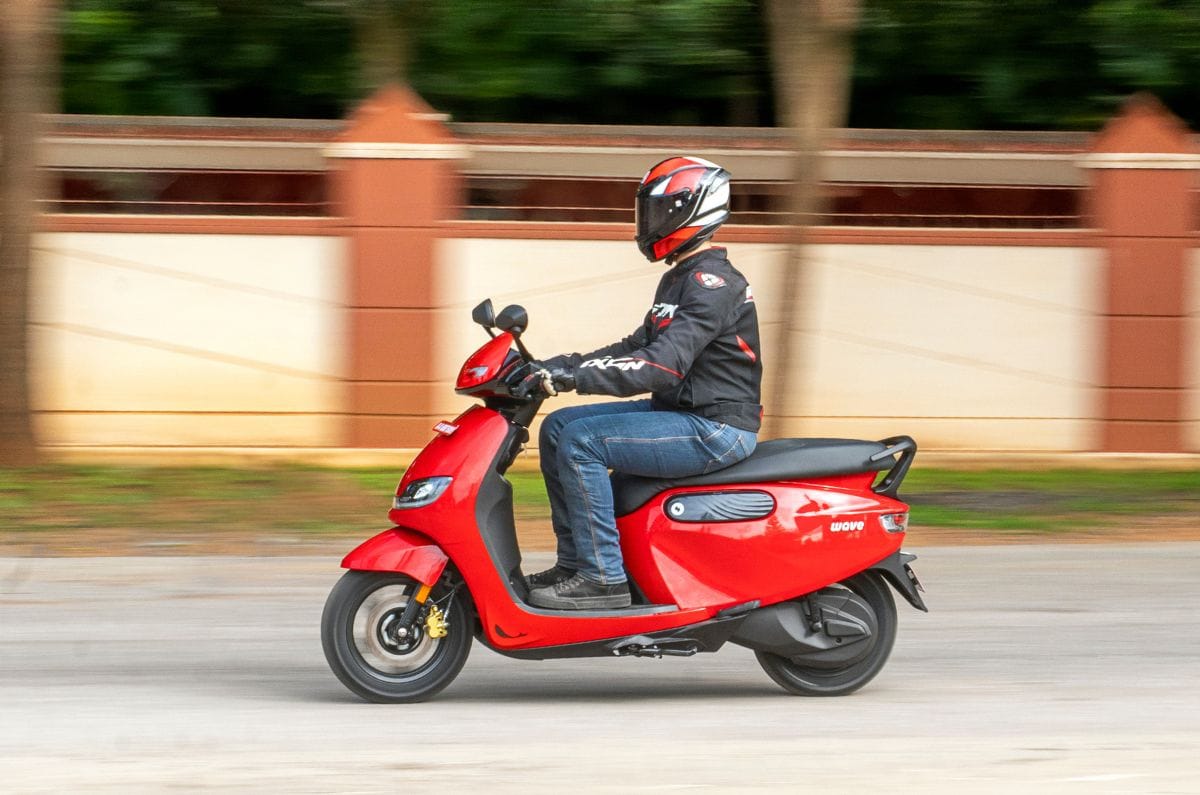
Riding position is spot-on and ride comfort too is excellent.
Other than that, the Wave is rather sorted ergonomically. Ride comfort is excellent for a scooter, and that isn’t a surprise given that the Simple One itself was quite comfortable. The Wave builds on that with a composed and plush ride that suits its intended role.
Depending on the variant, the Wave weighs between 121-128kg with the 3.7kWh TFT variant provided to us sitting roughly in the middle of that range (124.5kg). We found the Wave handled predictably, without any unwelcome surprises, feeling stable and sure-footed without compromising agility expected of a scooter.
Spacious, well-paded seat can comfortably seat 2 full-size adults.
Simple Wave Performance and range – 9/10
Performance is more than sufficient, Eco mode truly usable
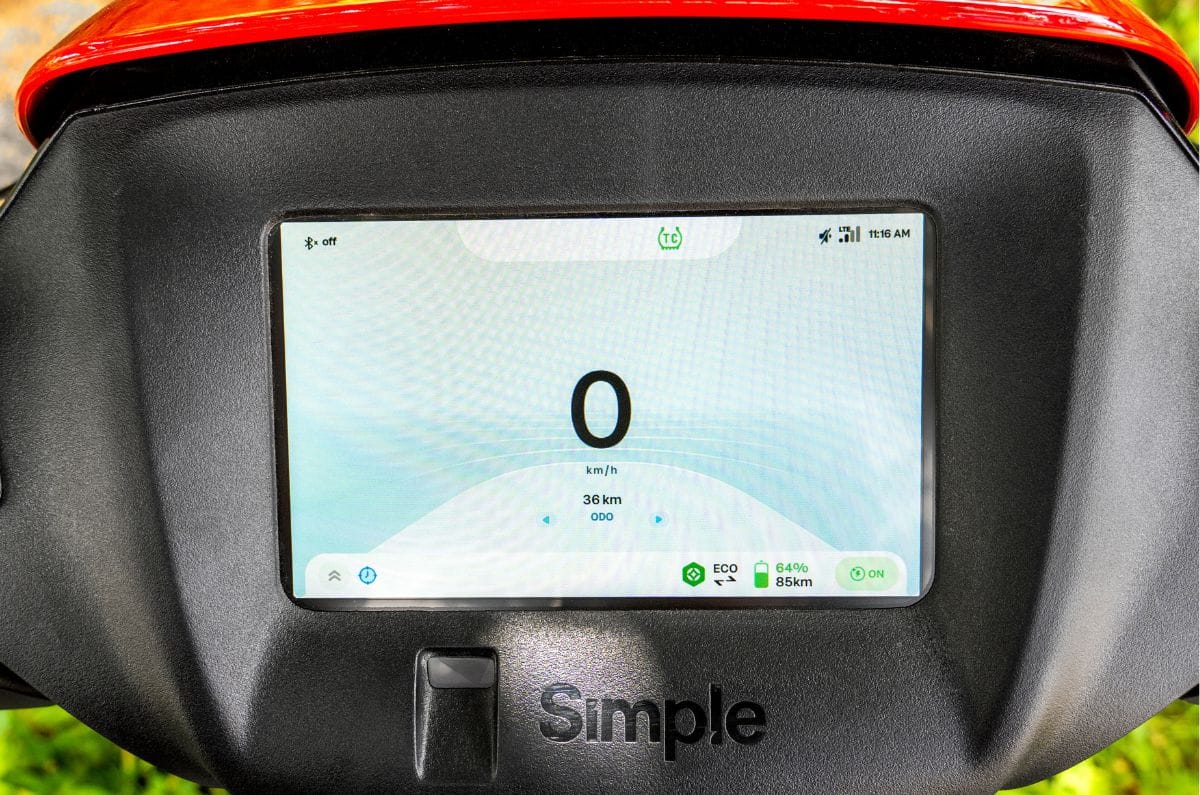
Like the One, the Wave offers really brisk performance, but still feels approachable enough for everyday use. The 3.7 version gets three riding modes – Eco, Ride and Sport – and both Ride and Sport offer more than enough performance for everyday use, which isn’t really a surprise. In Ride the top speed is 75kph, whereas Sport takes it up to 90kph (speedo-indicated, not actual).
The real surprise, however, is Eco mode. Yes, it feels duller than the other two modes, but it isn’t crippled in the way Eco modes on other EVs. The Wave can still get up to around 50-55kph quite respectably and overtake traffic, making Eco genuinely usable even on faster roads or in a big city.
It handles predictably and surefootedly in all scenarios.
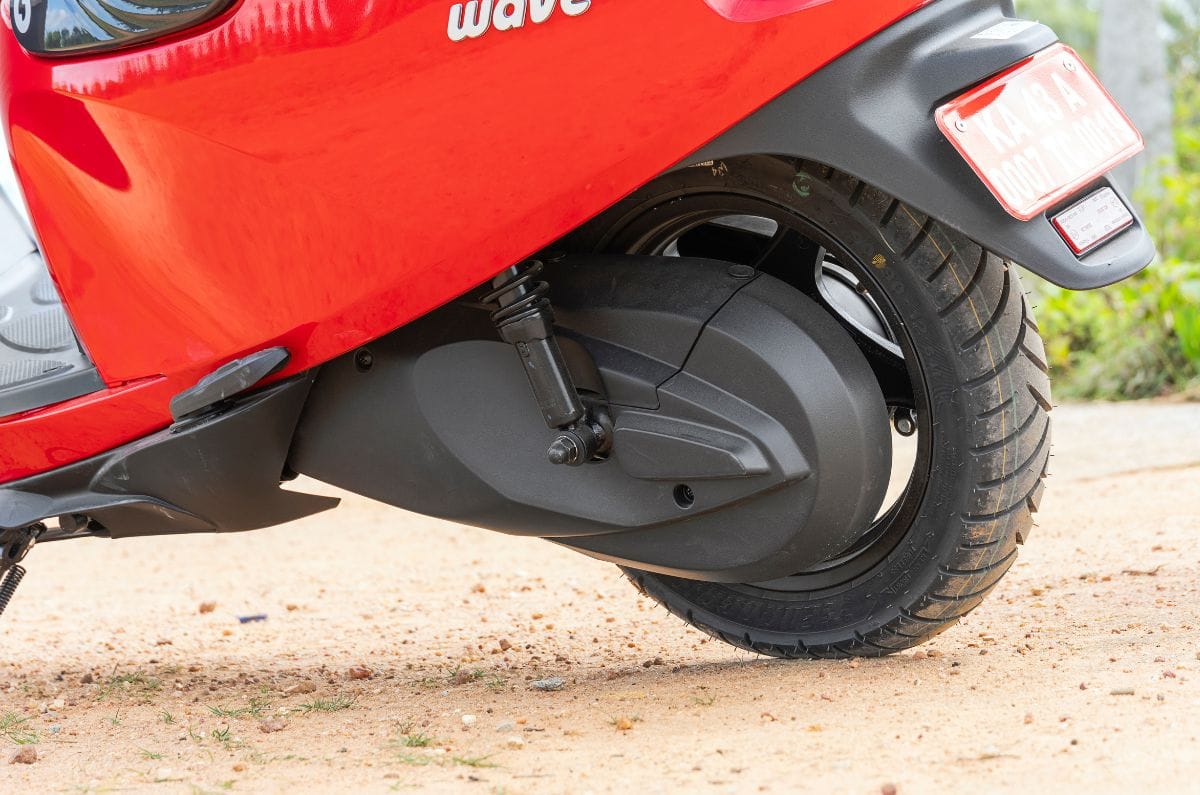
Given that the Wave uses the same motor as the OneS making 6.4kW and 52Nm, this performance is no surprise. However, on the Wave, the motor drives the rear wheel via a chain drive, not a belt as seen on the One models.. While a chain will be more maintenance-intensive than a belt, replacing it should be more affordable. Simple has worked to reduce powertrain noise with measures such as a rubber-damped sprocket, but there is still some motor noise. However, it’s much quieter than an Ather Rizta or 450, although far from dead silent like an Ather Konarc or TVS iQube.
Another welcome change to the One is the throttle response. Unlike the older One models we tested, where the scooter could continue accelerating briefly after the throttle was closed, the Wave’s accelerator behaves much more intuitively. It also gets traction control, although the throttle calibration is so smooth, you’re unlikely to need it in dry conditions but it will be a useful safety net in the wet.
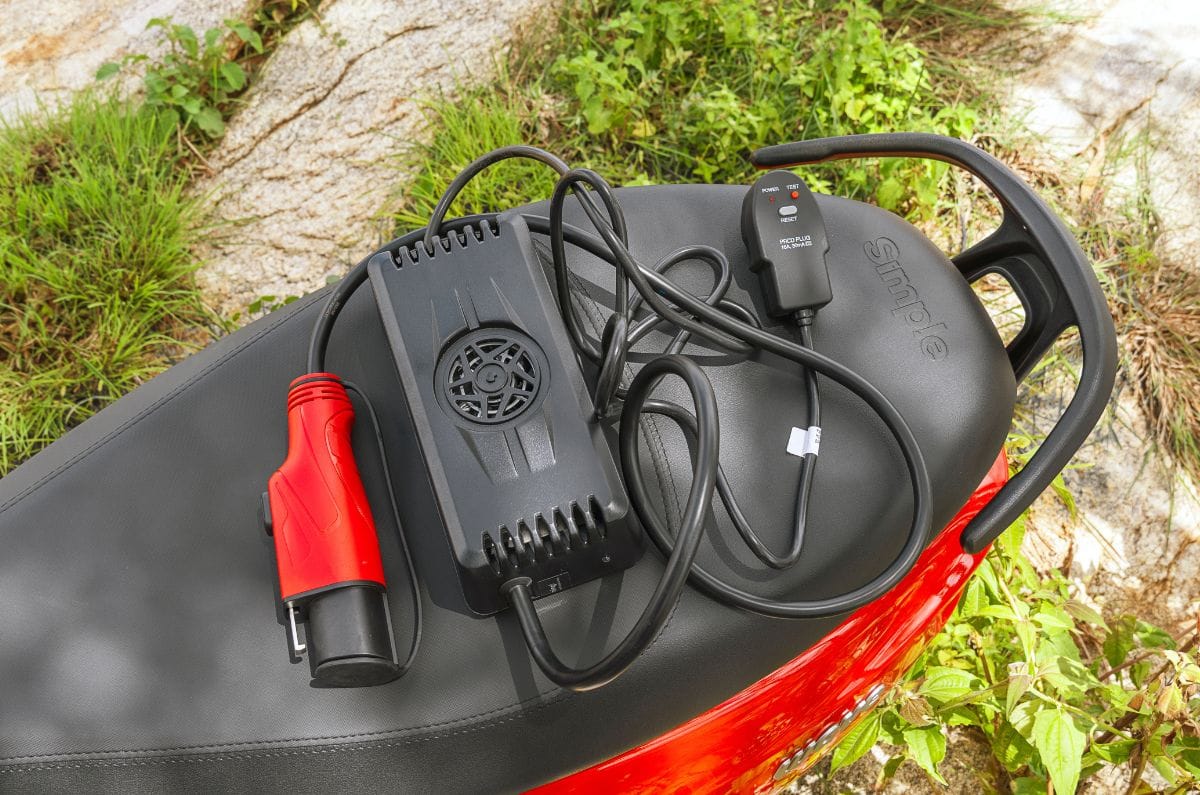
Fast 750W charger is standard on all variants.
Powering the Wave are four battery packs, depending on the variant you choose: 2.2kWh, 2.7kWh, 3.7kWh and 5kWh. The IDC ranges Simple claims are 110km, 132km, 171km and 243km, respectively. The first two use LFP (Lithium Ferrous Phosphate) chemistry, while the larger batteries use NCA (Nickel Cobalt Aluminium) cells.
The range indicator also appears to be quite trustworthy although we’ll reserve final judgement on real-world range until we can conduct a full test back in Mumbai. What is also nice is that all variants of the Wave come with a fast 750W charger which enables a pretty quick 0-80 percent claimed charging time of 3hr30min on the 3.7kWh version we were riding.
The standard warranty on the Wave is three years/30,000km, with five years/50,000km and 15 years/2 lakh km extended options also available. The price of these optional longer warranties has not been shared with us.
The Wave’s motor feeds power to the rear wheel via a chain, not a belt like on the One.
Simple Wave Features – 9/10
Massive 63L boot and Pill storage cubbies are very useful
While range without sacrificing usable performance is surely valuable on an EV, practicality is an important consideration as well. Storage is one of the Wave’s big strengths. There’s a useful front cubby, while the two “Pill” storage boxes on either side of the body panels are particularly nifty allowing you quick access to essentials you may need to reach for without having to get off the scooter. Each offers 4 litres of lockable weatherproof storage; the left one is standard, while the right is an accessory.
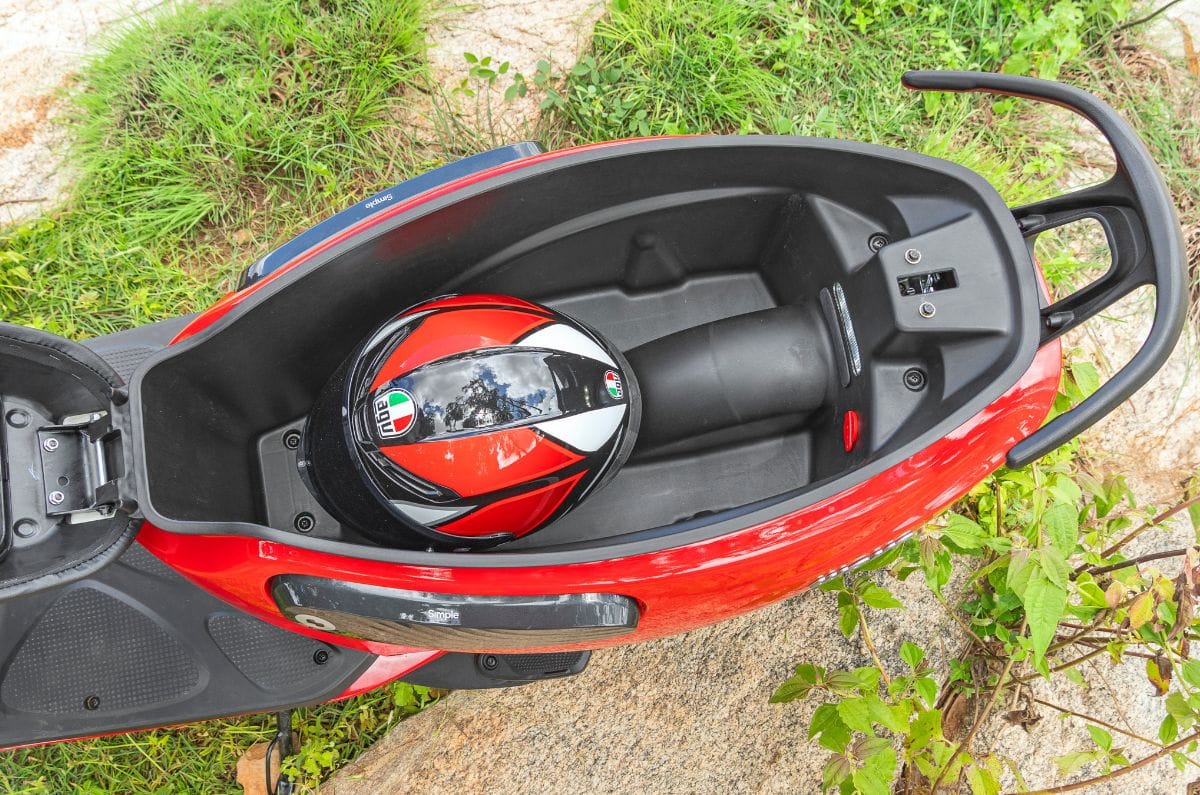
An undoubtedly big USP on the Wave is its cavernous 63L boot, the largest on any Indian scooter to date.
What is also an undoubtedly big USP on the Wave is its cavernous 63 litre boot, which is the largest on any Indian scooter to date. This should prove to be more than enough for everyone in the family! That being said, 63 litres is an enormous number and while this boot is undoubtedly big, I’m do find myself struggling to comprehend how it is nearly 50 percent bigger than the already cavernous 43 litre boot in the River Indie.
There’s plenty of technology too, including hill hold, drop-safe functionality, theft alerts and Bluetooth connectivity to your phone via the app. The TFT-equipped versions bring even more tech, while the brake-lock clasp is a small but useful touch.
TFT display is well laid-out and has a lot of tech but misses touch functionality.
Simple Wave Price and verdict – 8/10
Scooter has a lot of strengths but is pricey; company yet to prove itself
There isn’t a lot to dislike about the Wave as a scooter. It’s comfortable, spacious, well finished and quick enough to serve its intended purpose very well. However, for all its accomplishments, the Wave doesn’t come cheap. Sure, the Rs 1.10 lakh starting price is tempting, but as you climb the variants ladder, the Wave gets seriously expensive, topping out at Rs 1.90 lakh (ex-showroom, Bengaluru). That said, Simple is one of the few brands offering the option of a 5kWh battery in the family e-scooter space, which is commendable.
However, more than pricing, the bigger issue is that the company is yet to properly scale up its dealer network and establish an aftersales network that delivers the premium experience a buyer will expect after shelling out the money Simple is asking for. The Wave is a good product, but customers paying a premium for an electric scooter will expect not just a solid product but also dependable after-sales support.
The Wave has a lot of strengths but Simple is yet to prove itself in the market.
Ultimately, the Wave’s biggest challenge is that it comes from a start-up that has made plenty of big promises and statements over the past five years but still has a lot to prove. Its dealer network remains minuscule compared with the big players, and long-term reliability still remains unknown.
There’s a lot for Simple to do, but the good news is that the Wave is a genuinely likeable product. If the company can iron out the business side of things, the Wave has the potential to catapult Simple from just another niche start up to a much bigger player. Of course, doing so is a huge challenge and not an overnight process. Simple has a long road ahead of it, but the good news is that it finally has a convincing product to aid in that journey.
Pappu Yadav Viral Video: निर्दलीय सांसद पप्पू यादव ने शनिवार को CJP एक्टिविस्ट निशु आजाद से जुड़े मामले पर खुलकर बात की। हालांकि, उनके बयान से ज्यादा लोगों का ध्यान उनके बदले हुए लुक पर गया।
बता दें कि सोशल मीडिया पर उनके घटे हुए वजन को लेकर काफी चर्चा हो रही है। X पर कई यूजर्स ने कहा कि शुरू में तो उन्हें सांसद को पहचानने में भी मुश्किल हुई।
#WATCH | Patna, Bihar: On the case related to CJP activist Nishu Azad, Independent MP Pappu Yadav says, “Now, as long as Rahul Gandhi is not sitting at the police station for a protest, the daughter will never get justice. Today, we had to sit at the police station for three… pic.twitter.com/jUUJkBFXFw
कई यूजर्स ने उनके शारीरिक बदलाव पर भी ध्यान दिया और उनके वजन में आई भारी कमी चर्चा का विषय बन गई। एक यूजर ने मजाक में कहा, “पप्पू यादव का बाकी हिस्सा कहां है?”
#WATCH | Patna, Bihar: On the case related to CJP activist Nishu Azad, Independent MP Pappu Yadav says, “Now, as long as Rahul Gandhi is not sitting at the police station for a protest, the daughter will never get justice. Today, we had to sit at the police station for three… pic.twitter.com/jUUJkBFXFw
एक और यूजर ने कहा, “फेक न्यूज फैलाना बंद करो? इसमें पप्पू यादव कहां से आ गए??”
कई यूजर्स ने तो यह भी कहा कि इस जबरदस्त बदलाव के पीछे ‘ओजेम्पिक’ (Ozempic) दवा का हाथ है। यह दवा मुख्य रूप से टाइप-2 डायबिटीज के लिए दी जाती है और कभी-कभी डॉक्टर की देखरेख में वजन कम करने के लिए भी इस्तेमाल की जाती है।
एक यूजर ने कहा, ‘ Ozempic एक चमत्कार है’।
#WATCH | Patna, Bihar: On the case related to CJP activist Nishu Azad, Independent MP Pappu Yadav says, “Now, as long as Rahul Gandhi is not sitting at the police station for a protest, the daughter will never get justice. Today, we had to sit at the police station for three… pic.twitter.com/jUUJkBFXFw