Exploring Utah in a Ford Expedition: Utah by the book

Exploring Utah in a Ford Expedition: Utah by the book
UTAH BY THE BOOK

In the analogue age, I planned road trips with paper maps, fluorescent highlighters and dog-eared guidebooks. Lately, however, Uncle Claude and Aunty Gemini have lured me into the world of artificial intelligence. When I asked them to suggest an adventurous drive through south Utah, they both recommended similar itineraries. It was like asking the chef at a dhaba to surprise me with something unusual and being served butter chicken instead. Zion, Bryce Canyon and Arches. Three magnificent National Parks connected by smooth highways and comfortable hotels.
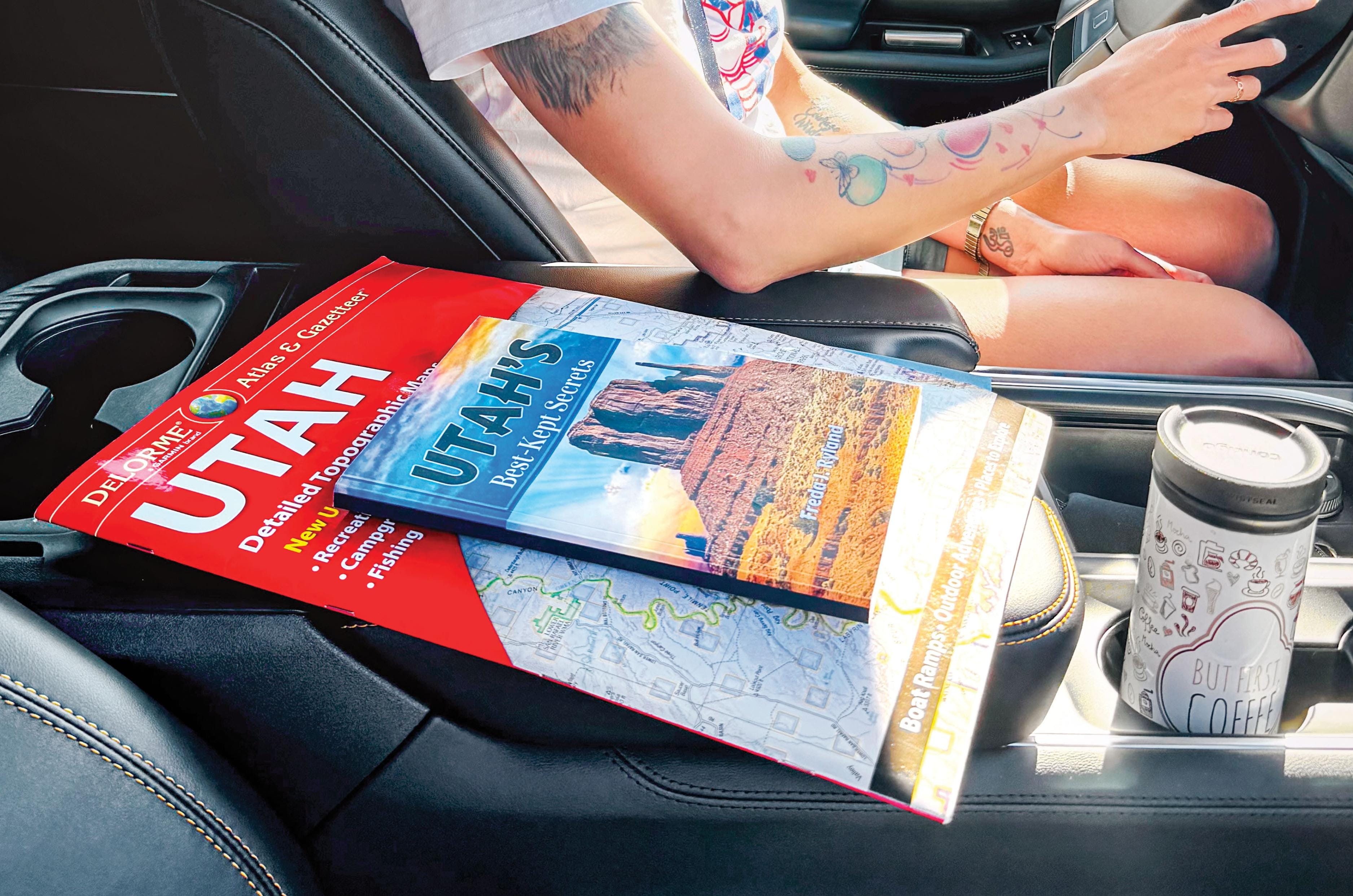
Our search engine for Utah beyond the tourist trail. No signal required.

This route hits Utah’s greatest highlights, featuring soaring cliffs, towering hoodoos and delicate sandstone arches. However, the parks are often so busy that sedans circle overflowing car parks, rather like sharks patiently circling a lifeboat. I wanted roads that filtered out sedans and coaches, demanded preparation and delivered adventure, where the SUV became part of the journey rather than mere transport.

So, I turned my back on the algorithm and went analogue. While ordering the DeLorme Utah Atlas, Amazon suggested Freda J. Ryland’s Utah’s Best Kept Secrets, promising another Utah of mesas, switchbacks, unspoiled canyons, lonely dirt roads beyond the cellular umbrella and skies dark enough to make galaxies glow.

Her book was fuel for wanderlust; an invitation into a hidden Utah for those willing to stray off the tarmac. Though its typesetting suggested a clandestine hand-operated press during the Quit India movement, its content was pure gold. Paired with the DeLorme atlas and offline Gaia GPS, the trio was as dependable as egg, bacon and toast. Freda chose the destination, the atlas found the route, and Gaia confirmed where we were. What followed often felt like driving into a fairy tale.
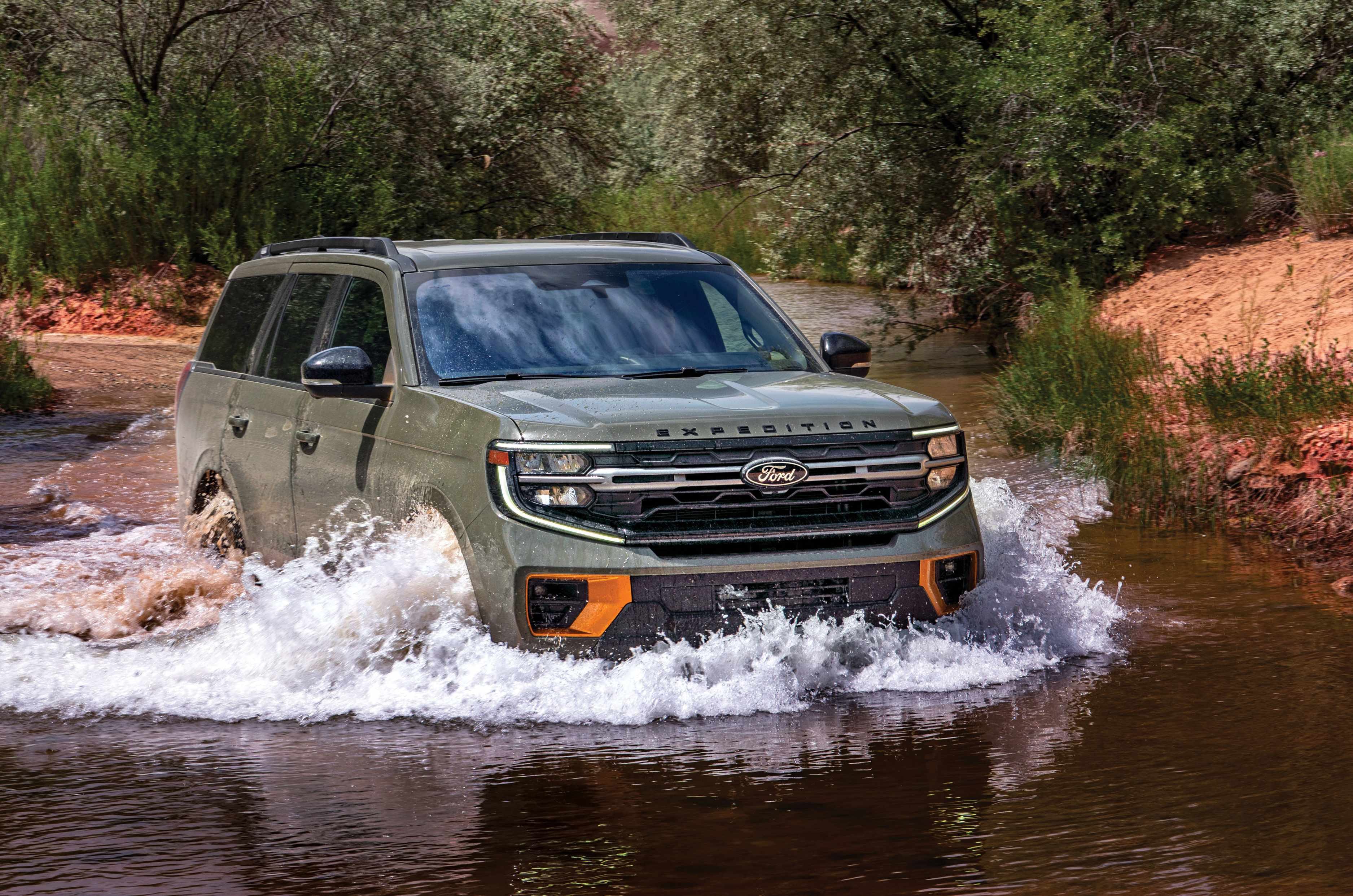
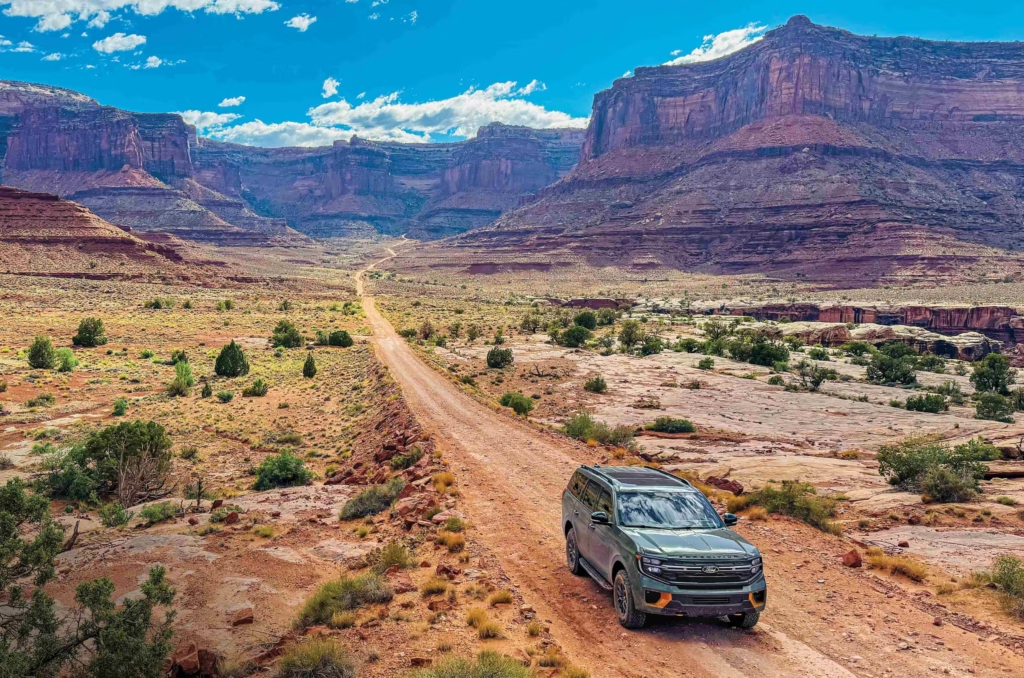
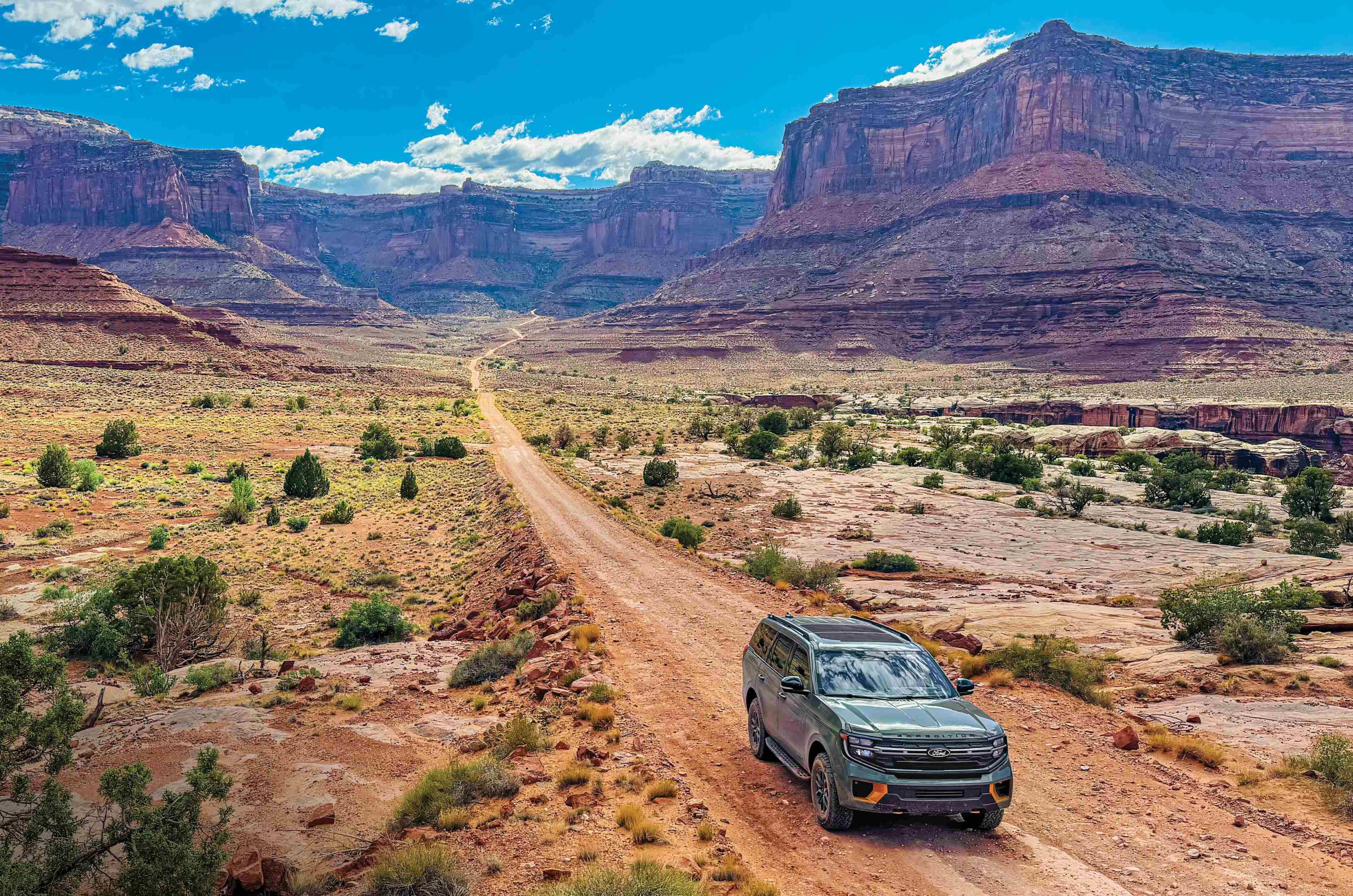
Off-grid Utah demands a dependable 4×4. The Tremor waded rivers, shrugged off loose gravel, tenacious clay and steep gradients, and kept going long after the tarmac lost interest.

None of it would have happened without the Ford Expedition Tremor, our fairy godmother. A tad tubby at over two tonnes, it came with a locking rear differential instead of a magic wand. The twin-turbocharged 3.5-litre EcoBoost V6 dispatched highway miles effortlessly. Once the tarmac disappeared, the Tremor earned its keep, shrugging off clay, loose rock, river crossings and deeply rutted tracks with nonchalant competence.
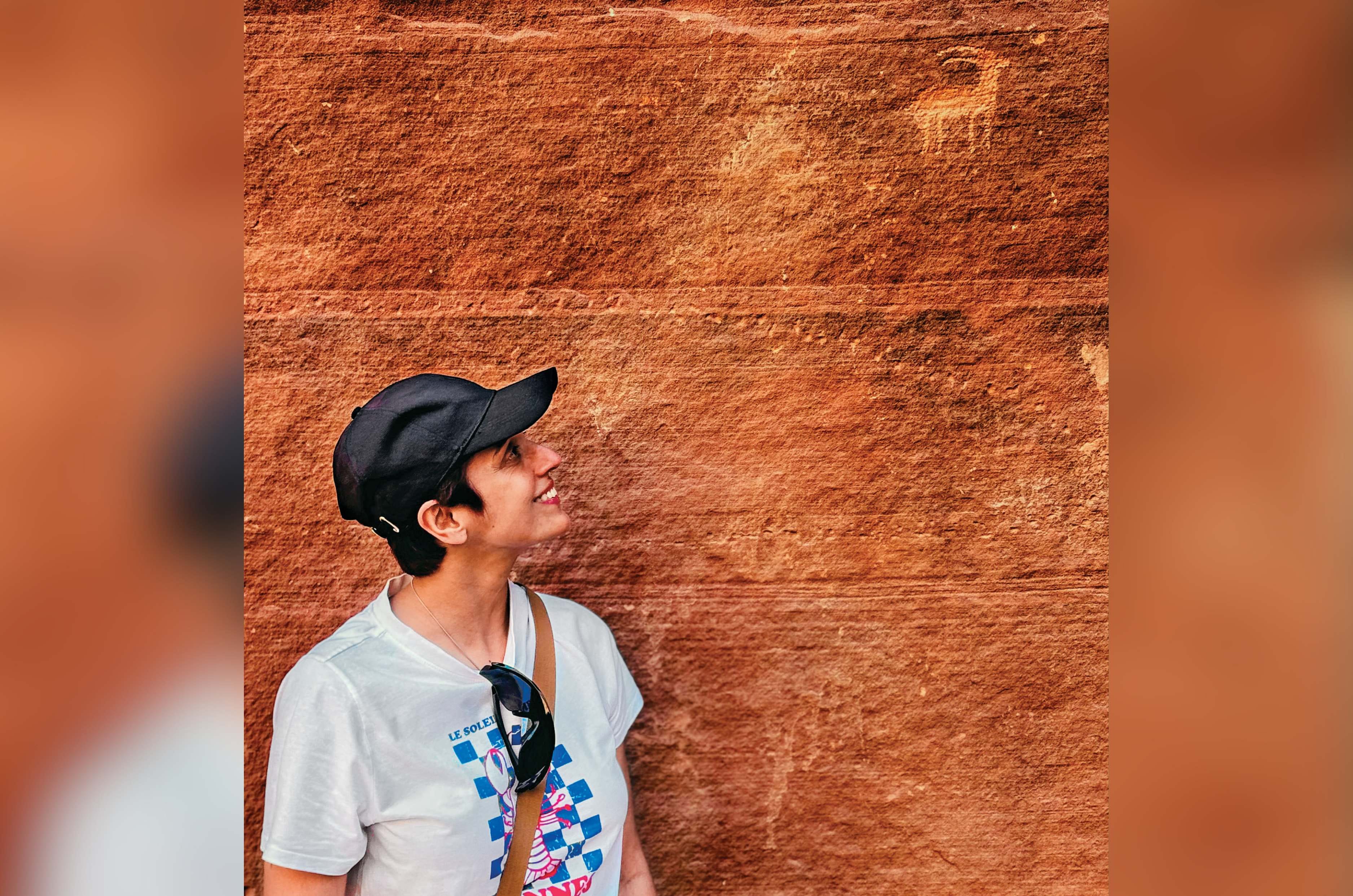
Follow her gaze. A long-gone artist still finds an audience a thousand years on. Utah is peppered with petroglyphs.

We forayed deeper into Utah’s wild, unadulterated beauty, beyond the tourist grid. To secret trails and solitude, to dinosaur tracks in ancient rock and to petroglyphs spanning two millennia, many still a mystery. I couldn’t help wondering if some ancient scribbling was simply the 2 BC equivalent of ‘Vinod loves Veronica’.

The first road to justify Freda’s confidence was Utah Scenic Byway 12, climbing out of Escalante towards Boulder through the folded canyons of Grand Staircase-Escalante National Monument, among the last regions in the contiguous US to be properly surveyed. Past Calf Creek, the road narrowed onto a hogback, a ribbon of blacktop along a ridge, with the ground dropping hundreds of feet on both sides. Red rock canyons fell open left and right, and for a few minutes it felt like driving along the spine of the Earth.
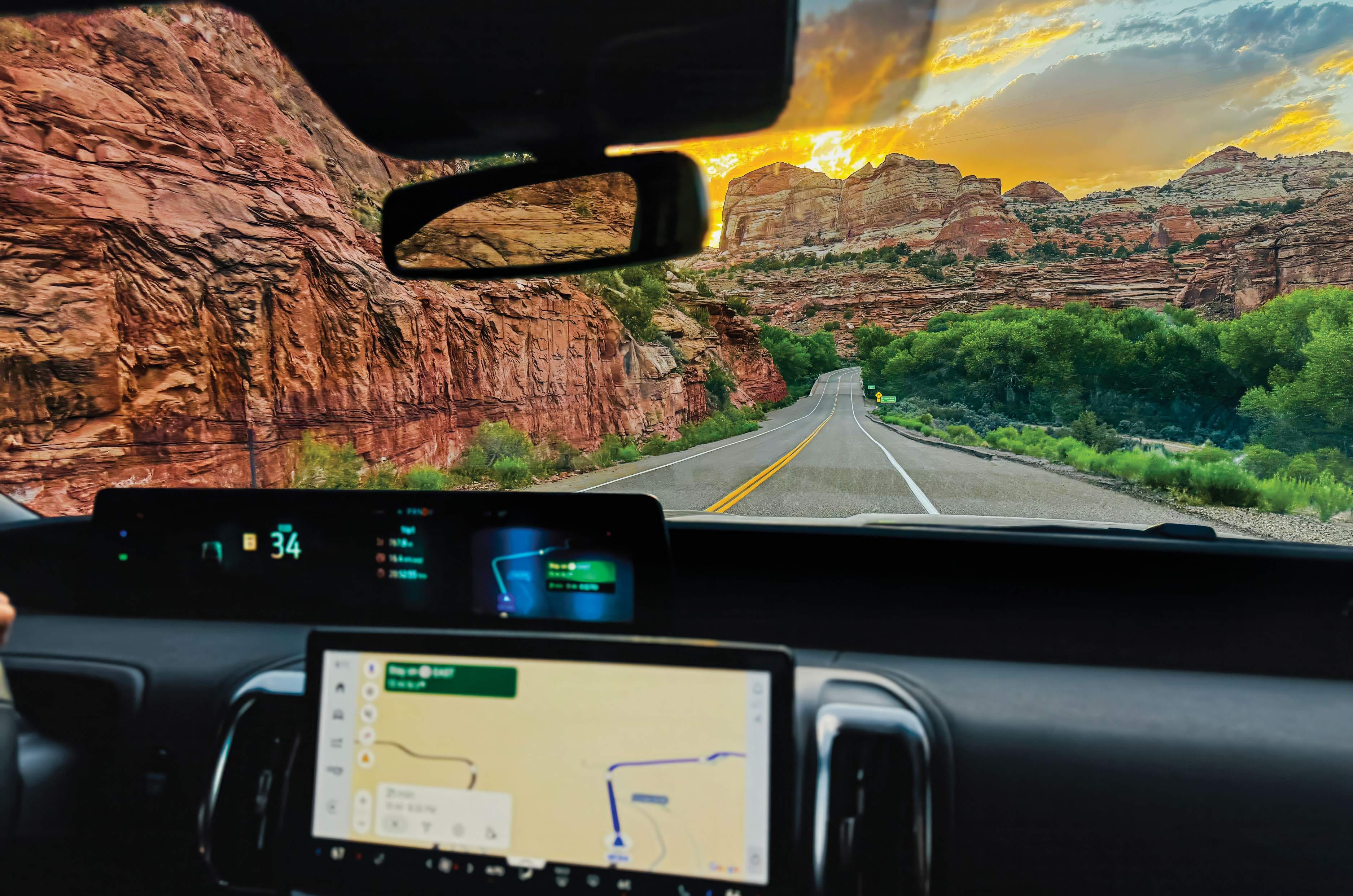
The windscreen became Utah’s widescreen, live streaming breathtaking views with hardly a break. This is Scenic Byway 12 between Escalante and Boulder.

At Boulder, we turned onto the Burr Trail, first beaten into the landscape by cattleman John Burr in the mid 1800s. Soon the road slipped past Long Canyon, colloquially called Singing Canyon because its towering, tapering walls possess the sort of acoustics that could make a bathroom baritone believe he had missed his calling. I sang a few notes and was astonished when the sandstone tuned my discordant tone to the smoothness of Sinatra.

Then the scenery became rather more serious. In 1948, the Atomic Energy Commission arrived looking for uranium, widening the trail and blasting switchbacks that tumble nearly 800 feet in less than a mile into the Waterpocket Fold, a colossal wrinkle in the earth running nearly a hundred miles across southern Utah, its tilted rock exposed in great bands of colour. We descended towards Ticaboo as the Fold surrendered to open desert.
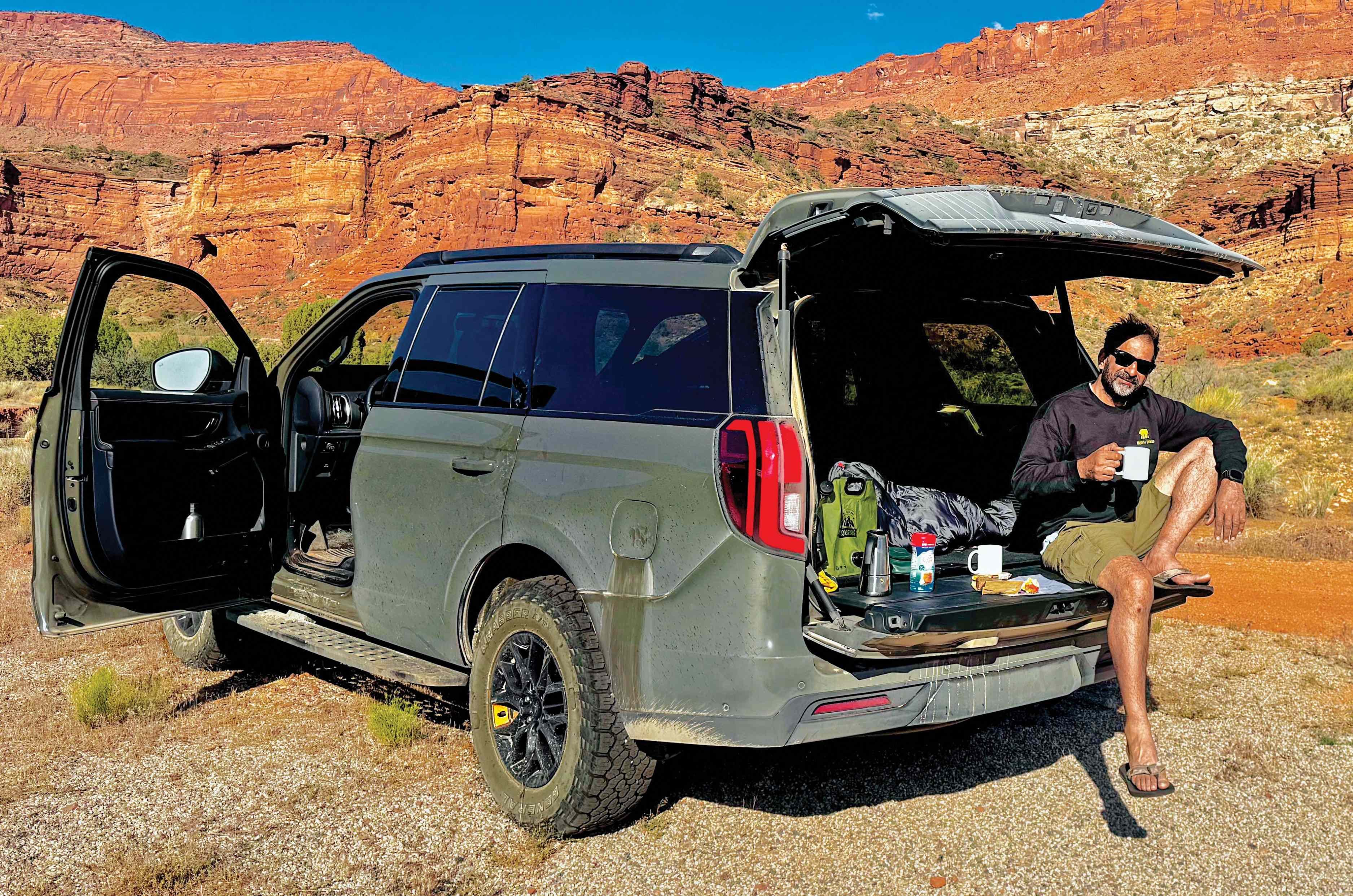
Morning coffee on the tailgate. The Expedition’s roomy interiors meant we could pull up and spend the night wherever we fancied.

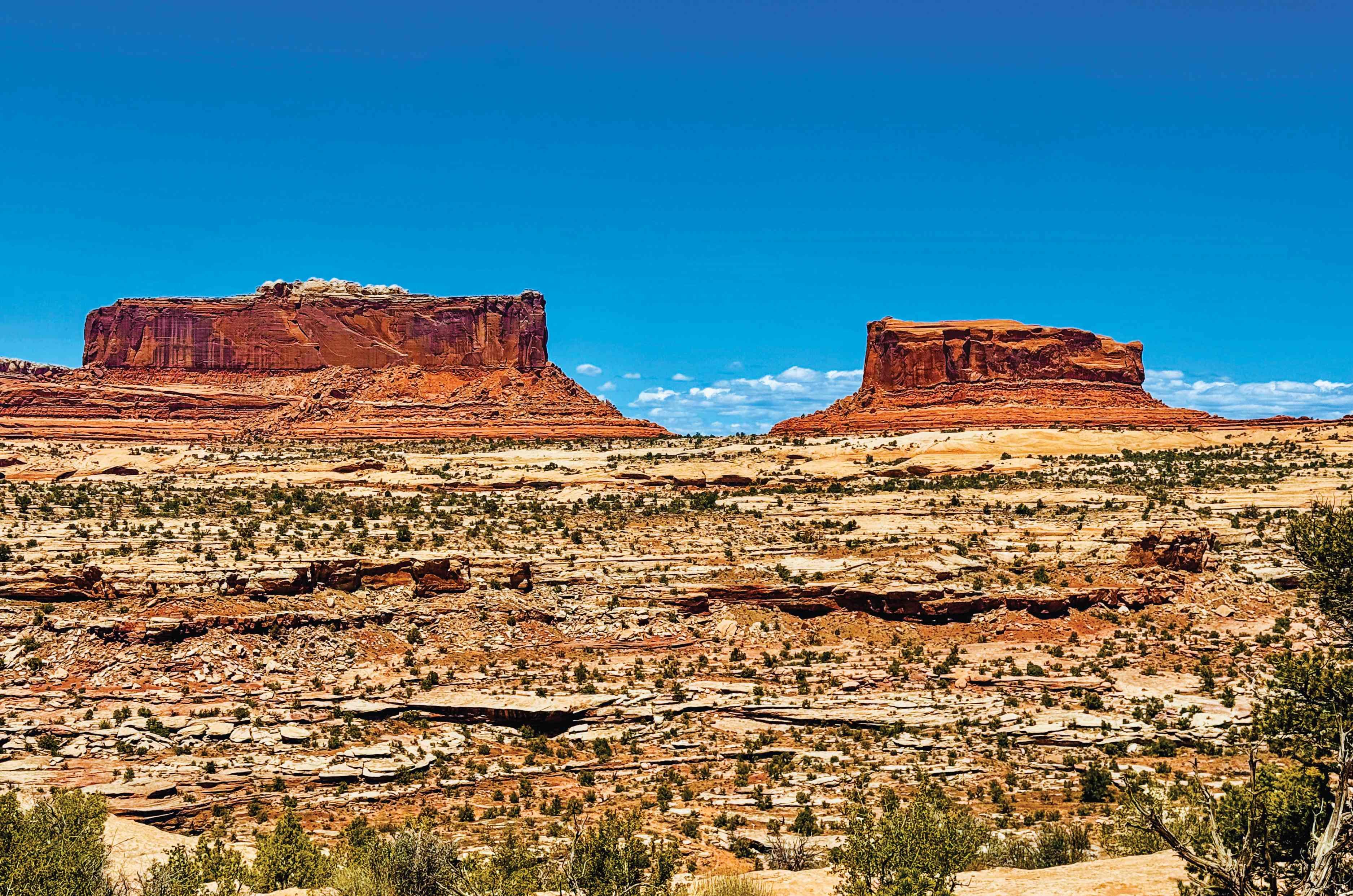
We were hoping to camp at Muley Point, but we hadn’t accounted for Utah waylaying us with stupendous scenery, another slot canyon or lonely butte persuading us to stop every few miles. Around sunset, Muley Point was still hours away, so we turned into a secluded canyon and spent the night there, one of the trip’s happiest failures. We dropped the two rear seat rows into a flatbed, laid out a mattress, and slept under a sunroof full of stars and the Milky Way. We had camped at the base of the Henry Mountains, so remote that surveyors called them the Unknown Mountains until 1869.

The next morning, we pushed on to Muley Point through Bears Ears National Monument, named for a pair of buttes that really do resemble a bear’s ears poking above the treeline. An unmarked turn led to Muley Point, where the land simply stops a thousand feet above the San Juan River’s looping canyons, with views stretching to Monument Valley.
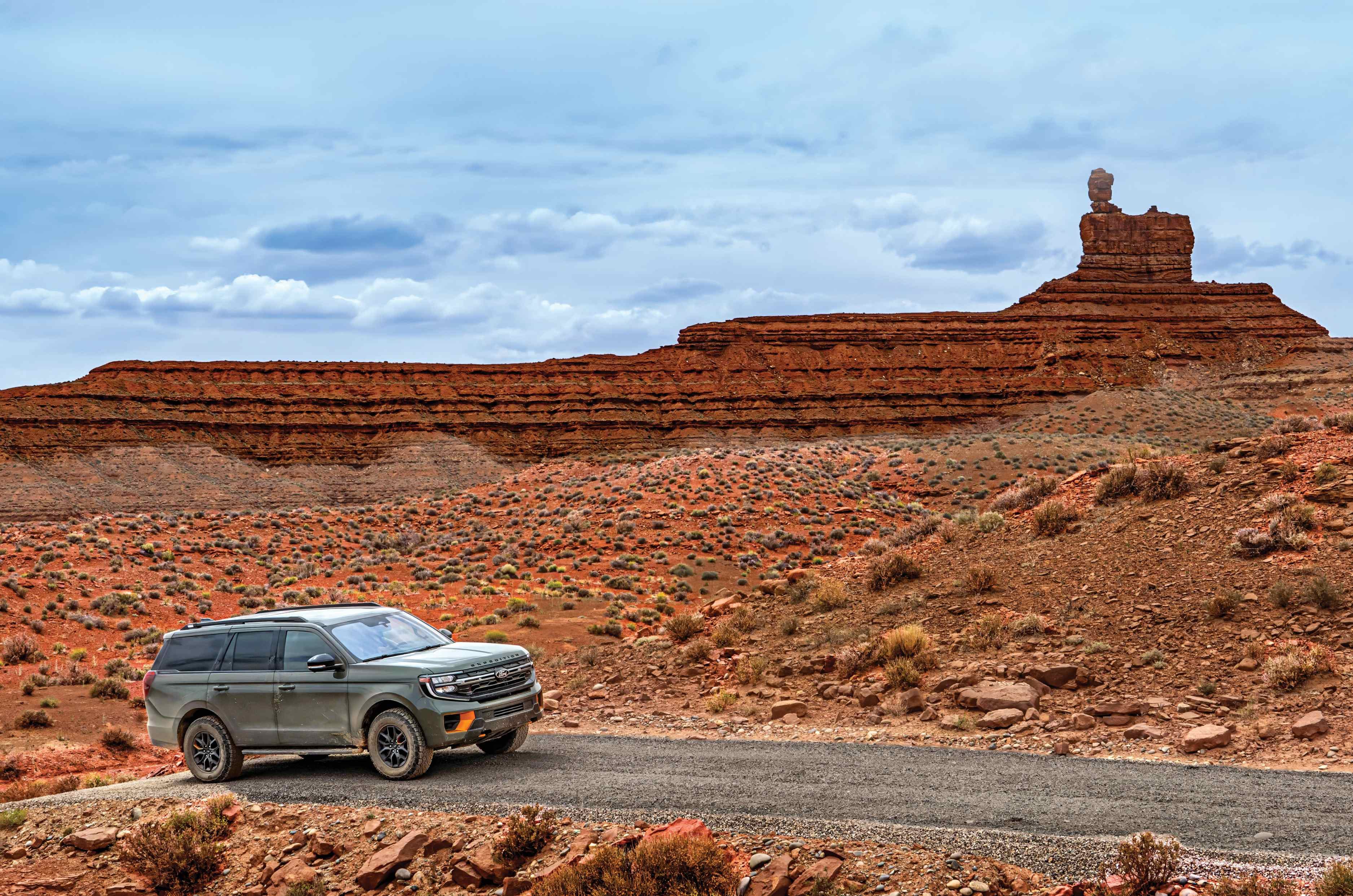
Look at the rocks above the Expedition. See anything? Someone did, and named it Lady in the Bathtub. Now try unseeing it. Welcome to the Valley of the Gods, where mesas and buttes come with wonderfully imaginative names.

Our next destination was the Valley of the Gods, the guidebook’s hidden Monument Valley twin. But first came the Moki Dugway, three miles of unpaved switchbacks blasted into Cedar Mesa in 1958 for trucks hauling uranium ore, dropping 1,100 feet at an 11 percent grade. The Tremor accepted the challenge with the calm assurance of a seasoned mountain guide.

At the bottom, a short detour brought us to Goosenecks State Park, where the San Juan River travels almost six miles in meanders to advance barely a mile and a half as the crow flies. From there, we turned into the Valley of the Gods, a dirt road meandering between sandstone monuments, nature’s own sculptures, with eccentric names. One was the Lady in the Bathtub. Had I not known the name, I might have seen only a rock. But once told, there she was, sitting bolt upright at one end of an enormous bath, her hair piled high and her back rather primly straight.
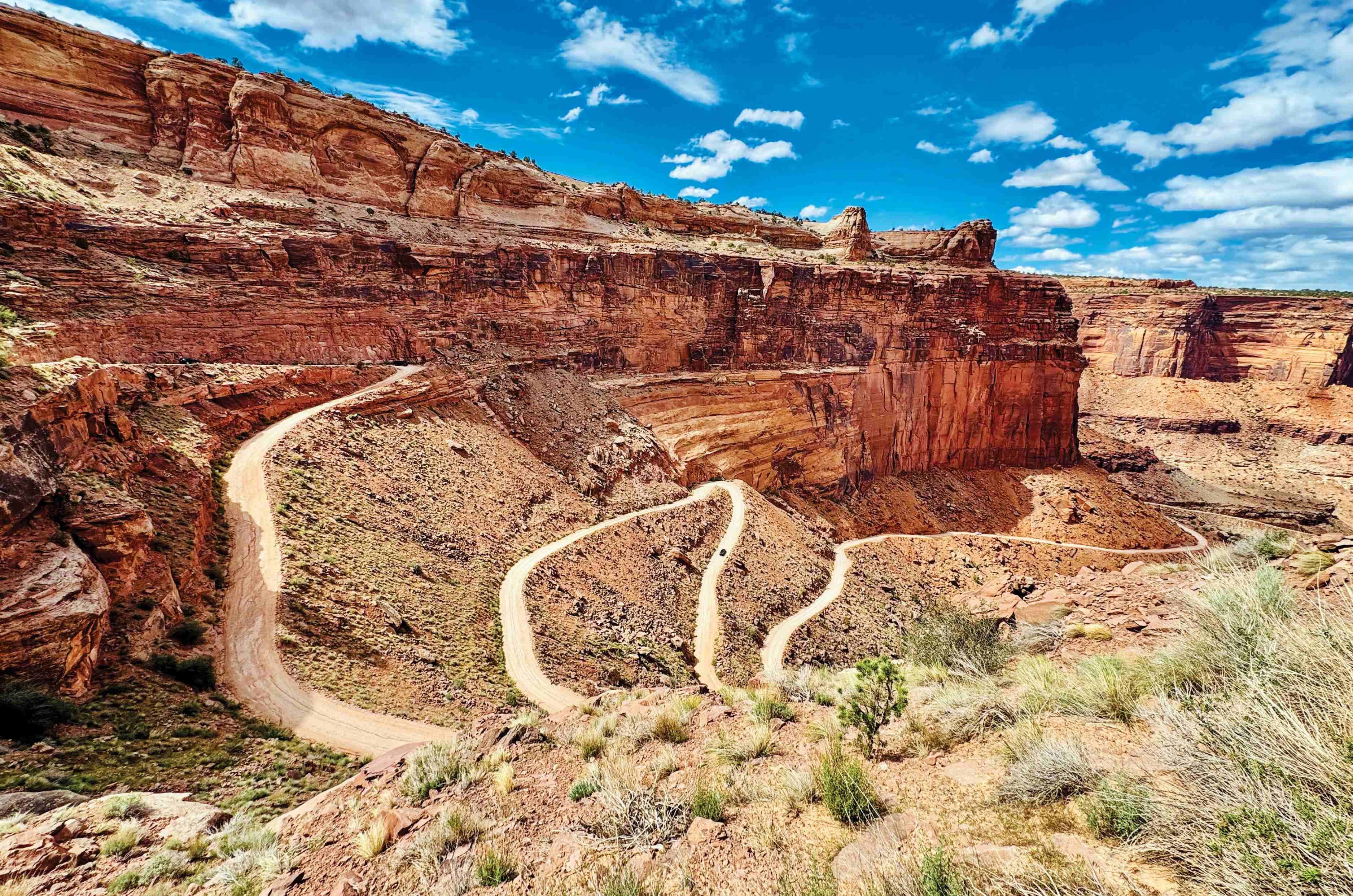
The Shafer Trail looked less like a road and more like a cartographer’s casual squiggle joining the top and bottom of a sandstone cliff. Then we drove it.

We slept another night in the car at the base of Rooster Butte, then rolled into urban Moab, our base for exploring the Needles and Island in the Sky districts of Canyonlands National Park, including the strange geological puzzle of Upheaval Dome. The highlight, though, was driving the Shafer Trail.

From the top, it was hard to believe vehicles drove down what looked like a pencil sketch etched onto a sandstone cliff.
The trail began as a foot route, widened for cattle by rancher John “Sog” Shafer, then again in the 1950s for the uranium trucks that shaped the Burr Trail and Moki Dugway.
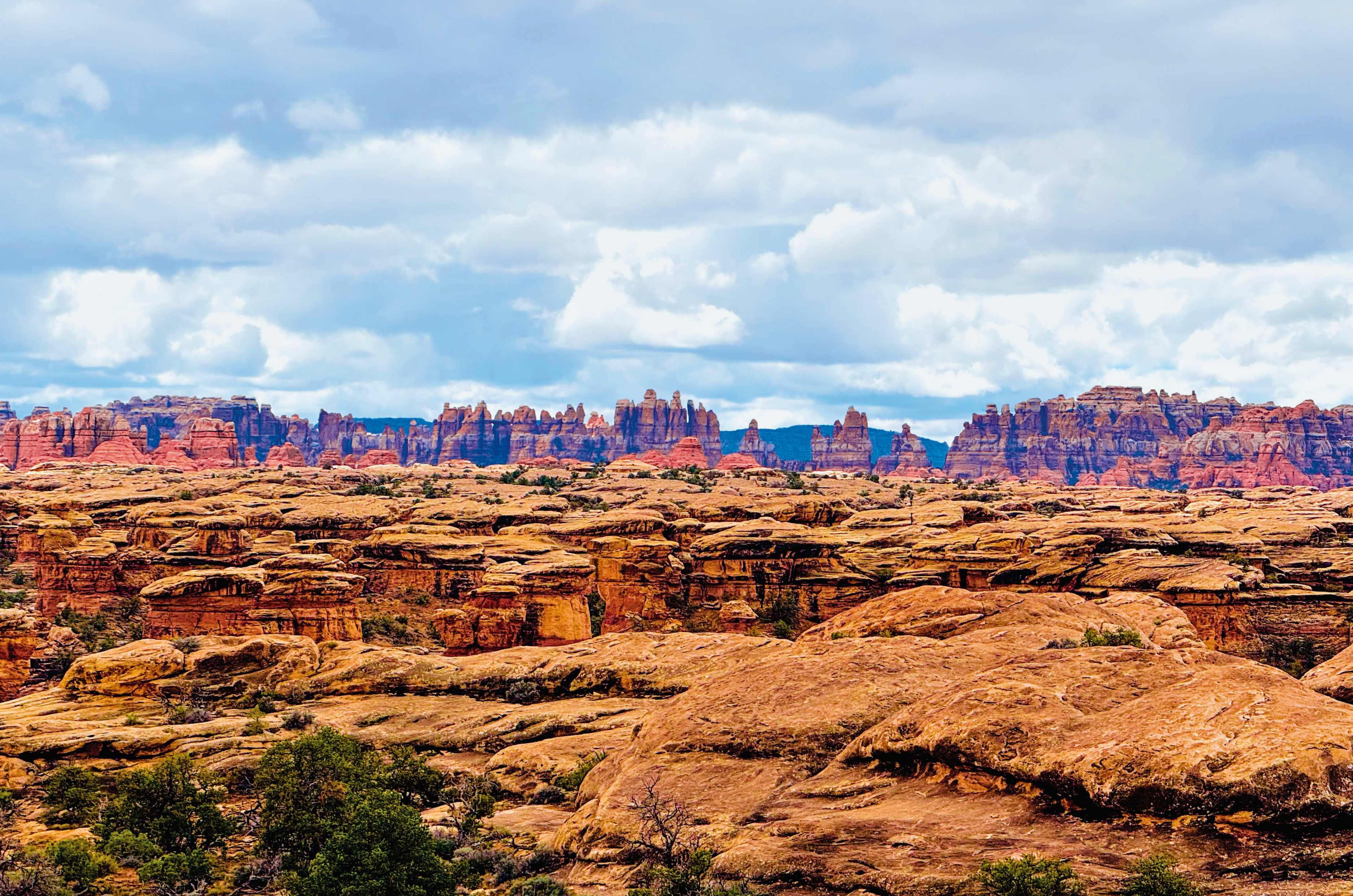
The Needles, Canyonlands – a forest of red and white banded sandstone spires, stained by iron and carved improbably thin by water patiently working through every crack.

The Expedition tipped over the edge, and we were committed. The Tremor crept down in low range, engine barely above idle, brakes doing quiet, constant work as gravel skittered from under the tyres. Every switchback flung the door mirror out over open air, nothing but red rock and sky where the road should have been, and my stomach dropped a beat before the front wheels found the turn. The cabin stayed eerily composed, no lurch, no scrabble for grip, while everything outside the glass insisted we should be afraid. At the bottom, the Colorado River came into view, and I exhaled properly for the first time in twenty minutes.
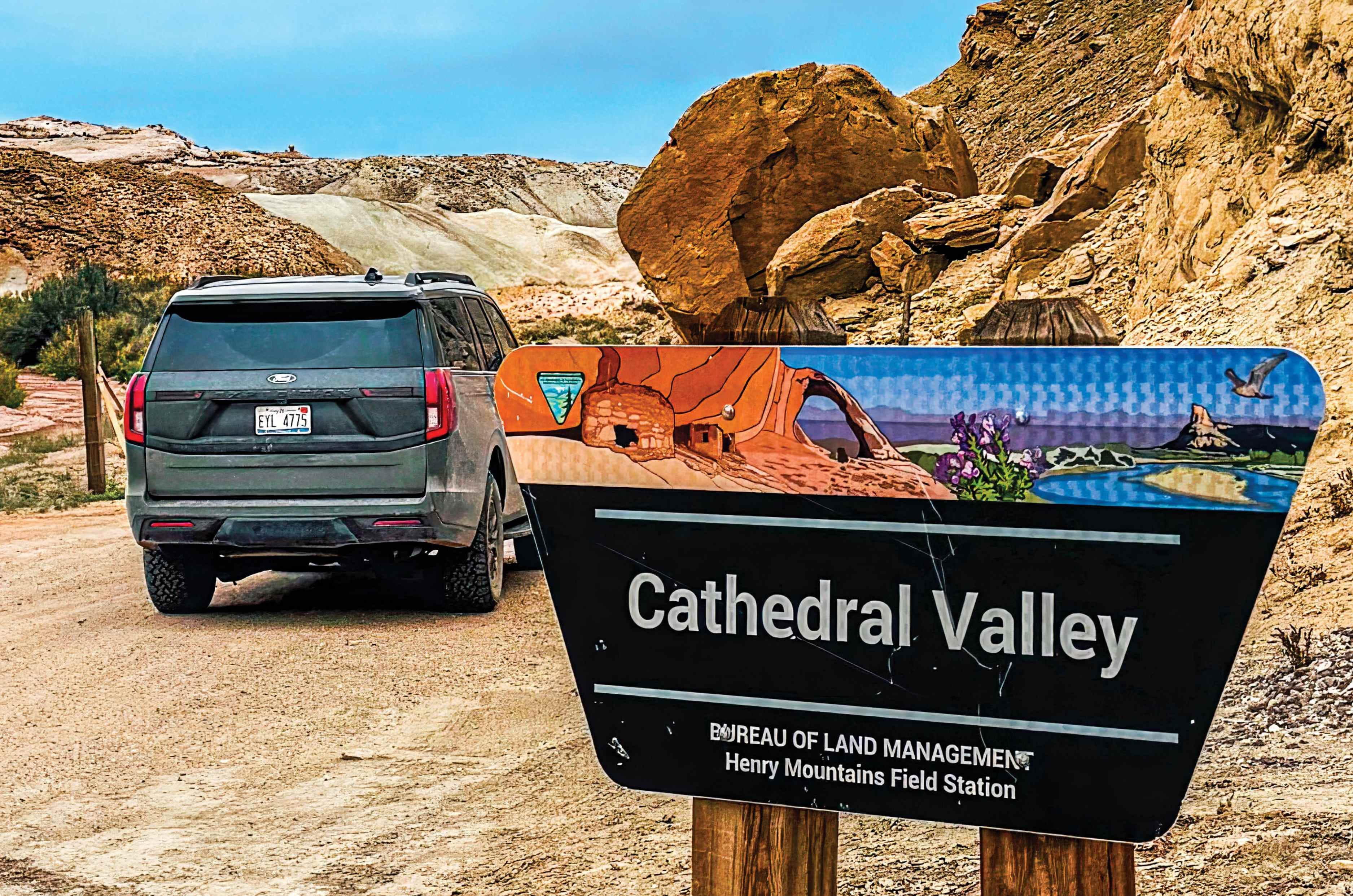
The warning isn’t for broken roads, but for deep clay bogs that require the torque and traction of a 4×4 to escape.

The final road I want to tell you about is the 80-mile loop through Cathedral Valley. According to Ms Ryland, this was Capitol Reef at its most remote – towering monoliths, strange badlands and perfect seclusion. At the entrance, a sign minced no words: ‘Road Impassable for Most Vehicles. Travel at Your Own Risk’.

The dirt road climbs through the Bentonite Hills, bands of grey, purple and blue-green clay laid down eighty million years ago in an ancient inland sea, eroded into slopes that look lunar. Beyond them, the land opens onto a high bench where the Temples of the Sun and Moon stand, solitary honey-coloured monoliths like remnants of cathedrals of a long-lost civilisation.

What struck me most, standing before the Temple of the Sun, was how closely its silhouette echoed the thirteenth-century Temple of the Sun I knew well – still standing tall in Konark, Orissa. That was shaped by human hands wielding hammers and chisels, whereas this one by wind and water.
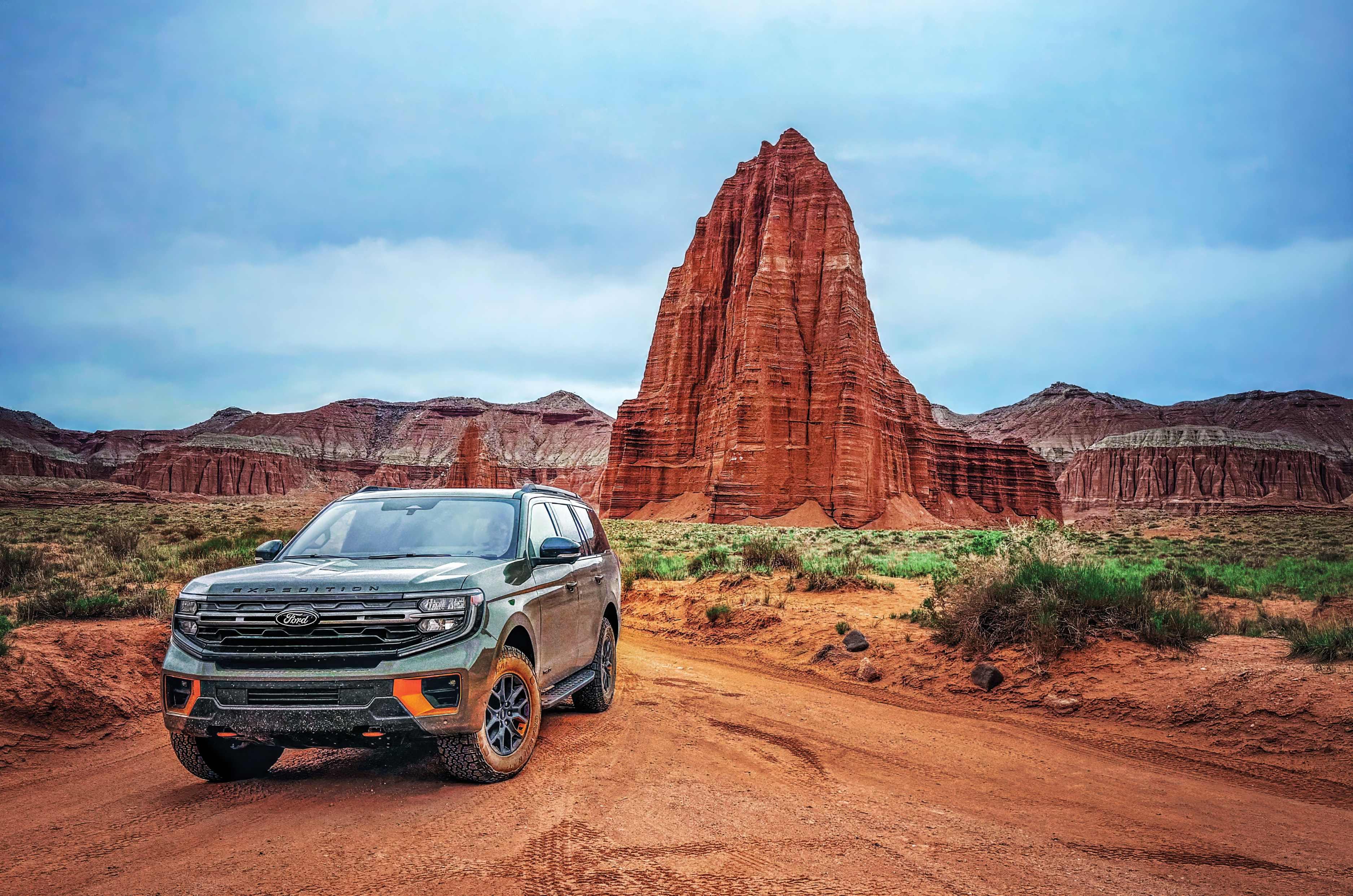
In the Cathedral Valley at The Temple of the Sun. Eighty million years in the making; no chisel required.

Most visitors run the Cathedral Valley Loop clockwise, meeting the Fremont River crossing at the start. We’d gone the other way, so it arrived at the very end, just short of Highway 24. Torrid brown water gushed across our path. Not crossing would mean backtracking 80 miles.

I waded in first to check for stone underfoot rather than clay, reading whether the current had strong opinions about being crossed. Satisfied, I waved the Tremor forward, and my partner drove it straight through, water climbing the doors. Then crossed again to pick me up, and once more just for fun, proof this was a vehicle built to encourage this kind of tomfoolery.

After Cathedral Valley, the long drive back to ordinary life began, the odometer past 1,300 miles. Looking back on those twelve days, I’m glad I chose the path not well trodden, as Robert Frost once suggested, in a digital age where it’s easiest to let the machines pick the route.

A badly printed, albeit meticulously researched book, an atlas, and a Ford that never once flinched had taken us somewhere far better than any algorithm would have dared suggest. Rather than a destination ticked off, Utah became one truly experienced, and that made all the difference.

The essentials
Self-sufficiency matters: A little preparation separates adventure from discomfort.

Water: Carry more than you think you need. We kept 20 litres in the Expedition.

Provisions: Stock up on energy bars, trail mix, fruit, chocolate, canned food, instant noodles, jerky and coffee. A camping stove is invaluable for hot meals in the middle of nowhere.

Fuel: Fill up whenever you can. Distances are vast and stations scarce.

Navigation: Download offline maps and carry a paper atlas. The DeLorme Utah Atlas and Gaia GPS worked well.

Clothing: Hot days, cold nights. Pack a warm layer and a sleeping bag.

Footwear: Sturdy hiking shoes.

Sun protection: A wide-brimmed hat, sunglasses, sunscreen and lip balm.

Vehicle: A high-clearance 4WD.

In-car essentials: First-aid kit, head torch, tyre gauge, air compressor and puncture repair kit.

Allow extra time. Utah ambushes you with one view after another, and the best memories happen at unplanned stops.


Opinion: Freak accidents are almost always human negligence

Opinion: Freak accidents are almost always human negligence

Going by the amount of social media chatter around any NCAP test, you’d think India is one safety-obsessed nation. Awareness is rising, but safety is far from ingrained in our ethos like it is in, say, Japan. We all know the current state of road safety is appalling, but I’m not talking about driving manners or vehicle collisions or crash ratings. Of late, there’s another aspect of road safety that’s really been bothering me; the road itself and everything around it. 

During the rains in Mumbai last month, two girls were electrocuted in a water-logged street. Luckily, timely intervention from a passer-by and medical treatment at a hospital saved them. Last year, an auto-rickshaw driver had his head 

pierced by a falling iron rod from metro construction; thankfully emergency neurosurgery saved him too. Not everyone is so lucky though, if you can even call these accidents lucky. A concrete slab from an under-construction girder bridge fell onto a moving auto-rickshaw and car and resulted in one death and multiple injuries.

You would have read the horrific news of a 25-year-old biker in Delhi who died after his motorcycle plunged into an unbarricaded, 14-foot-deep construction pit dug up and left open. And it’s not just bikes; people have fallen into open manholes, flooded over with water, and lost their lives, and recently a 20-year-old student died after his car plunged into an open drain. Two years ago, a massive illegal billboard blew over and killed 17 people and injured over 75 others during heavy winds in Mumbai. This monsoon season, a tree collapsed onto a school bus and took the life of an 11-year-old child. 

This is the aspect of road safety that has been bothering me recently, not because car crashes and other accidents do not, but because these are all too often termed ‘freak accidents’ or ‘random happenings’. Nonsense! These are not freak incidents, but accidents caused by negligence and unaccountability. So many folks say, ‘oh, his/her time had come’. Again, nonsense. Would you say all those poor kids who died in Africa due to starvation died because their time had come? No. They died because of human action, or inaction. 

So, really, I write this column only to highlight this fact; to remind us all that it isn’t random. As the saying goes, ‘everything happens for a reason’. Here it’s callousness, from those in charge and from us. So, the next time you express outrage over a non-5-star NCAP-rated car, spare some words of outrage for these incidents too.

Skoda Kushaq 1.0L AT real world fuel economy tested

Skoda Kushaq 1.0L AT real world fuel economy tested
Skoda Kushaq 1.0 AT real-world mileage

In March 2026, Skoda launched the updated Kushaq and one of the biggest updates was the introduction of a new 8-speed torque converter (automatic) with the smaller 1.0-litre turbo petrol engine, replacing the older 6-speed automatic. We’ve put the 2026 Kushaq 1.0L 8AT through our real-world fuel efficiency tests to see how it fares.

  • Gets an aggressive auto stop-start system
  • Weighs 1300kg
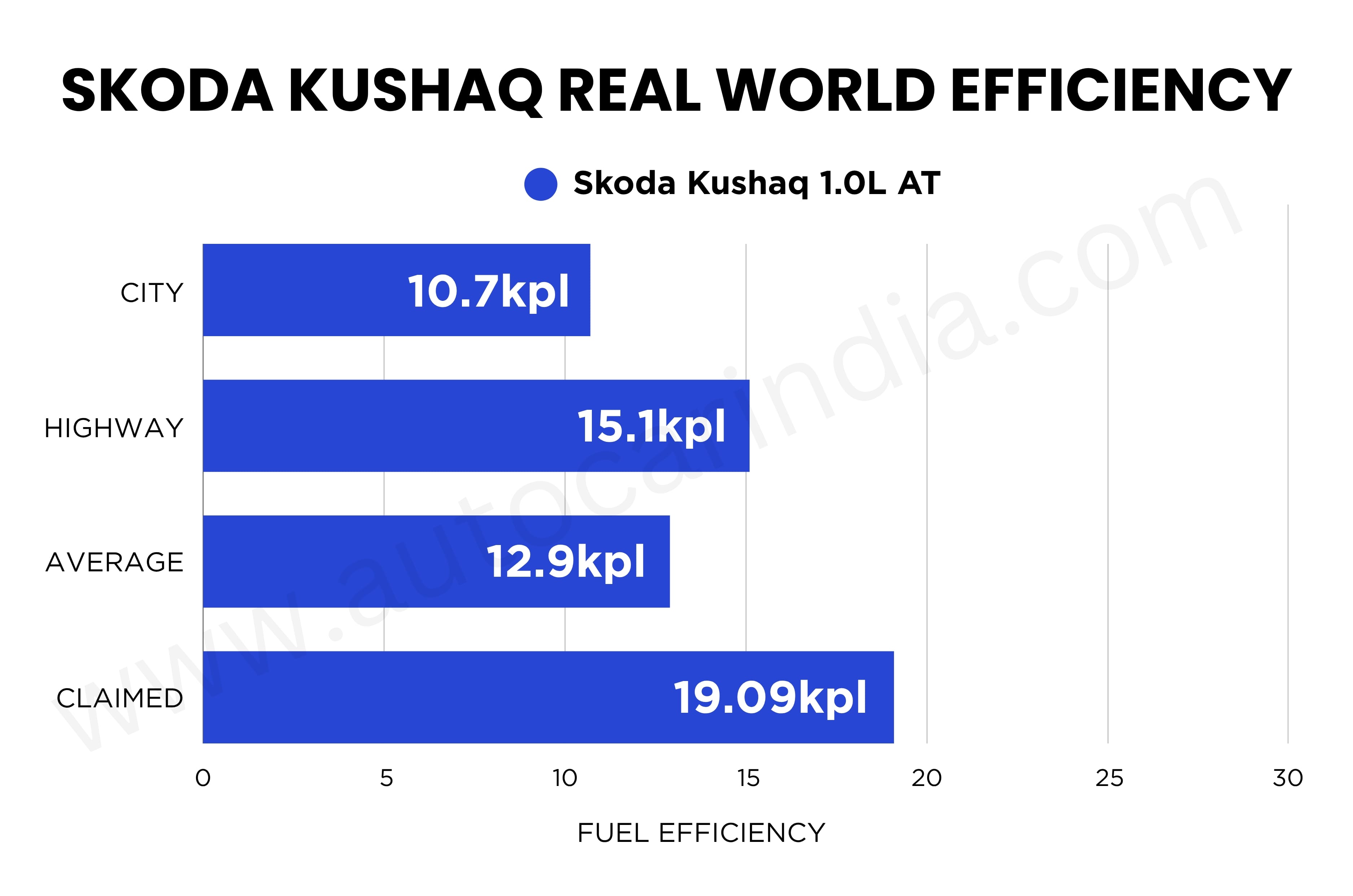
  • Claimed efficiency is 19.09kpl, 1kpl more than 1.0 6AT

Skoda Kushaq 1.0L automatic mileage explained

Powering the Kushaq is the same 1.0-litre three cylinder direct injection turbo-petrol engine that produces 115hp and 178Nm. With the addition of a new 8-speed automatic gearbox, the claimed efficiency has gone up by 1kpl, to 19.09kpl.

Skoda Kushaq 1.0L AT real world mileage graph

In our real world tests, the Kushaq returned 10.7kpl in the city and 15.1kpl on the highway, bringing its overall average efficiency to 12.9kpl. Interestingly, the updated Kushaq is 1.8kpl and 2.7kpl, more efficient than the older Kushaq with the 6-speed automatic gearbox, in the city and highway respectively, despite being 14kg heavier.

Notably, like the outgoing version, the Kushaq 1.0 8AT doesn’t get drive modes, but it continues to get an automatic engine stop-start feature. The latter is quite aggressive, and often tends to cut the engine while decelerating, even before the car has come to a complete stop. Also, while the creep function is less aggressive than the 6-speed auto version, it still feels quite eager off- the-line.

Autocar India’s fuel efficiency testing

Before our real-world fuel efficiency tests, we fill our test cars’ tanks to the brim and maintain tyre pressures based on the manufacturer’s recommendation. These cars are driven in fixed city and highway loops in and around Navi Mumbai, and we maintain certain average speeds. Throughout the tests, there is only one person in each car, running the aircon at 22deg C in full-auto mode, and other electricals, such as the audio system, indicators and wipers, when required, just like a regular user would. Periodic driver swaps further neutralise variations in driver patterns. At the end of each cycle, we calculate efficiency by filling the tanks to full again.

Aprilia Tuono 457 vs Tuono 457 Special Edition: Price and differences explained

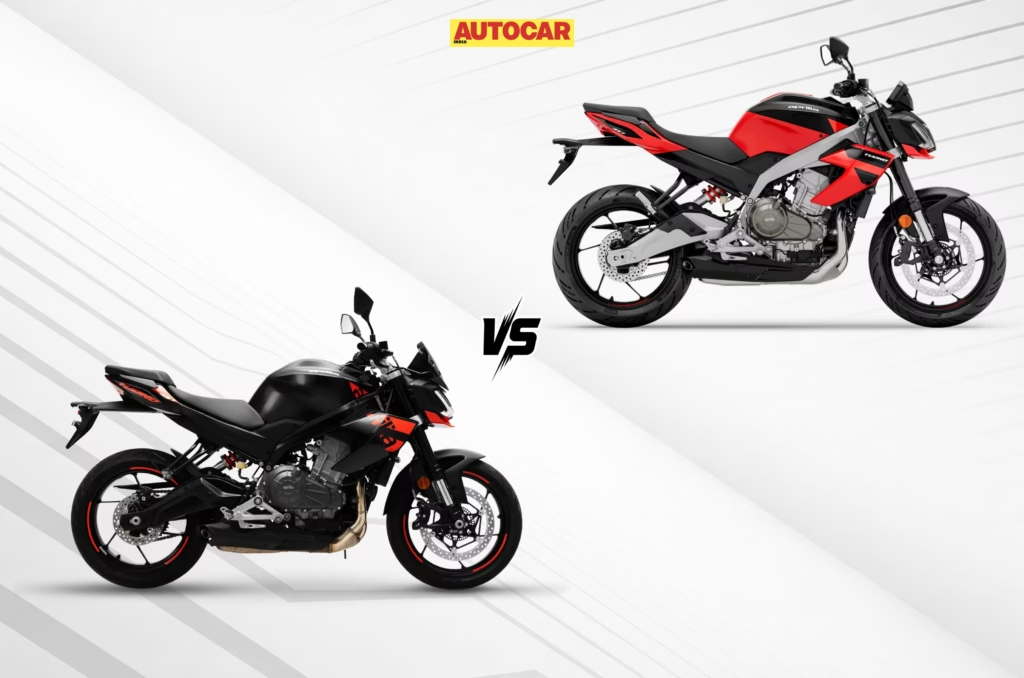
Aprilia Tuono 457 vs Tuono 457 Special Edition: Price and differences explained

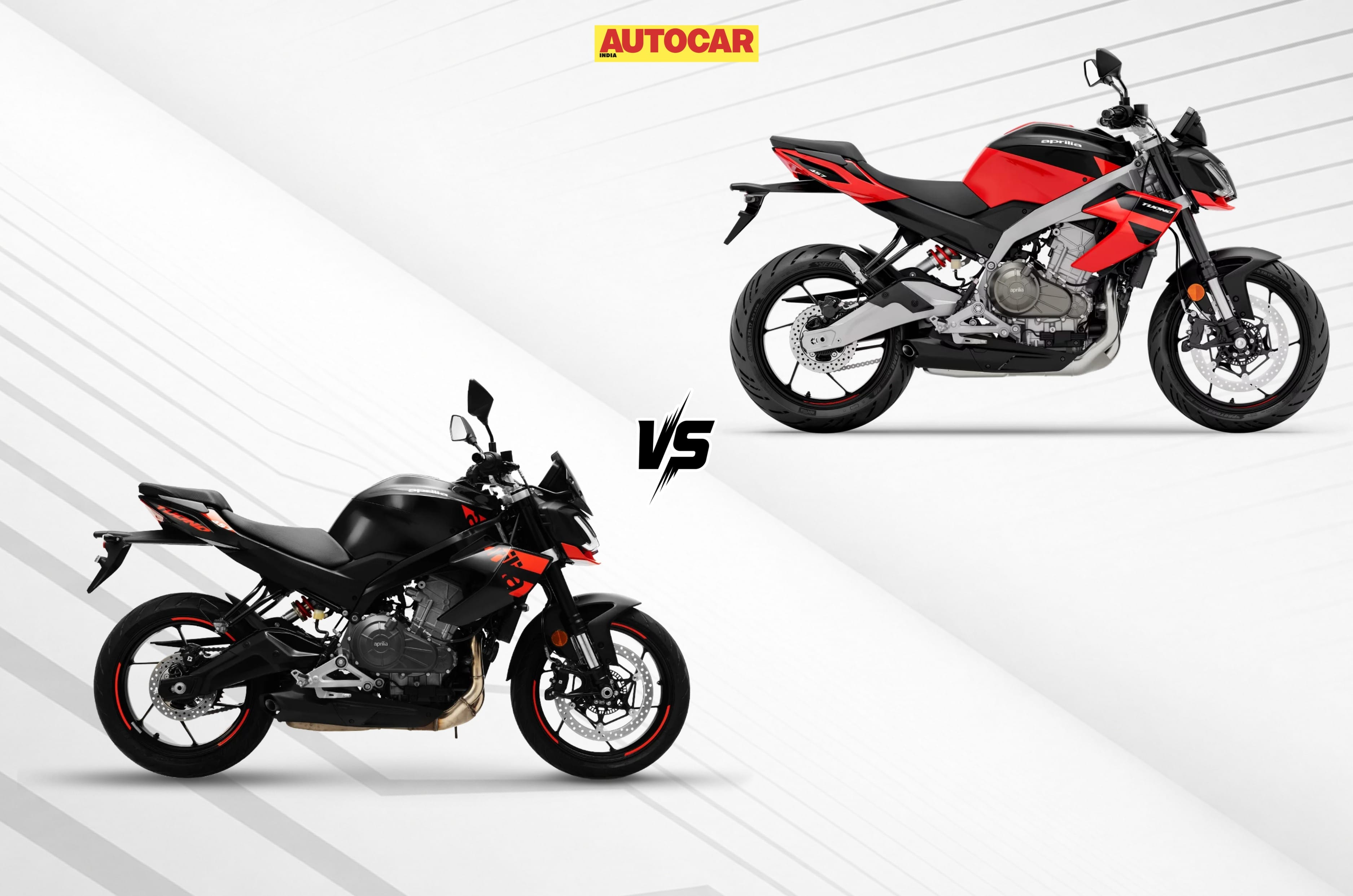
With the Special Edition, Aprilia has addressed almost all the major complaints with the Tuono 457 but what exactly are the changes? At first glance, both motorcycles look the same and they largely are the same as well. This is a case of small changes adding up to a markedly different (and better) final product.

Aprilia Tuono 457 vs Tuono 457 Special Edition: Design

Slightly different, with a new colour

The most obvious change is the updated decals and the brand-new Mamba Black colour. The new colourway, which is exclusive to the Special Edition at the moment, gets a blacked out chassis and swingarm which wasn’t the case earlier. Even on the Puma Gray colour (carried over from earlier), Aprilia has updated the decals so the India-specific Special Edition does look different compared to the international version of the Tuono 457.

Aprilia Tuono 457 vs Tuono 457 Special Edition: Comfort

Seat, handlebar, and suspension all see upgrades

Starting off with changes that are visible, Aprilia has updated the Tuono 457’s seat to be slightly different now from the RS 457. Although the main difference is the extra padding, the seat profile has been slightly changed too to make sure longer stints are more comfortable. It results in the Special Edition having a 10mm taller seat height at 810mm, but we don’t expect anyone to complain about that. The next change is to the handlebar that now gets a 10mm taller riser even though the bar itself is unchanged. Lastly, there’s a standard flyscreen above the headlight, but we’d chalk that as strictly an aesthetical improvement. Finally, the brake lever is now adjustable though the clutch lever remains non-adjustable.

The changes that won’t be visible are to the suspension. At launch, the Tuono appeared to share the exact same suspension setup as the RS 457, which was jostling to most, literally and figuratively. On the Special Edition, Aprilia has made the front suspension softer on both damping and spring preload. While the rear has a softer compression damping and spring preload; rebound damping remains where it was earlier.

Aprilia Tuono 457 vs Tuono 457 Special Edition: Price

Costs Rs 2,000 extra now

With all the upgrades, Aprilia has priced the Tuono 457 Special Edition at Rs 3.99 lakh (ex-showroom), a Rs 2,000 increase from before. Despite the name, this is the only Tuono you can buy in India now so if you were a fan of the earlier Tuono, tough luck.

Aprilia Tuono 457 vs Tuono 457 Special Edition: What did not change

Engine, chassis, and most features

The Tuono 457’s engine immediately became a favourite at launch so Aprilia has not changed that in any way. The Special Edition retains the 457cc twin-cylinder, liquid-cooled engine with a parallel twin configuration. No changes to the performance figures either with the power (47.6hp) and (43.5Nm) torque remaining exactly the same.

Like we mentioned at the beginning, the list of upgrades on the Tuono 457 Special Edition isn’t long. However, most of them make a meaningful difference to how the motorcycle is to ride which is what Aprilia seems to have wanted. It remains to be seen whether these changes will help make the Tuono any more popular than before.

15 साल बाद भारतीय महिला युगल ने जीता विश्व चैंपियनशिप में ब्रॉंज

Treesa Jolly Gayatri Gopichand

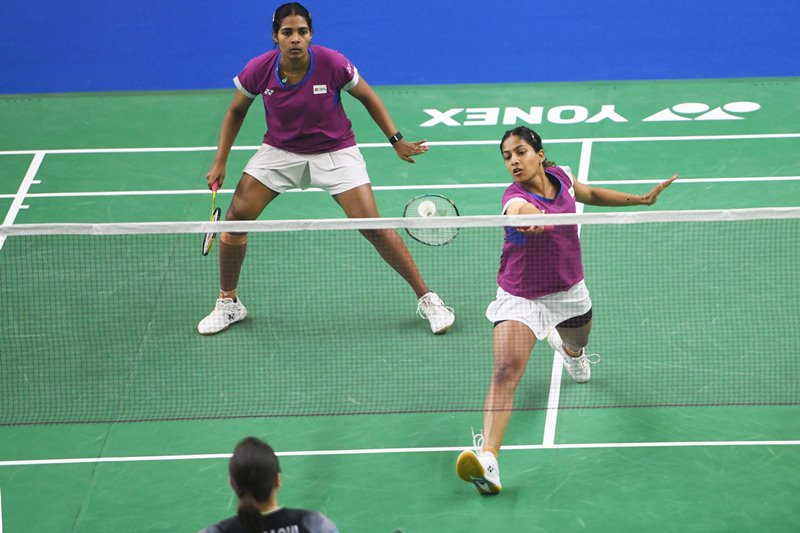
भारतीय बैडमिंटन फ़ैन्स का दिल जीतने वाले एक ऐतिहासिक सफ़र में, बिना सीडिंग वाली ट्रीसा जॉली और गायत्री गोपीचंद की जोड़ी ने 2026 बीडब्ल्यूएफ वर्ल्ड चैंपियनशिप में ब्रॉन्ज़ मेडल के साथ अपना शानदार सफ़र खत्म किया। शनिवार को नई दिल्ली के इंदिरा गांधी एरिना में खेले गए सेमीफ़ाइनल में उन्हें चीन की वर्ल्ड नंबर 1 और टॉप सीडेड जोड़ी लियू शेंग शू और टैन निंग से हार का सामना करना पड़ा।

भारतीय जोड़ी ने ज़बरदस्त टक्कर दी और पहला गेम 21-18 से जीता, लेकिन चीन की टॉप सीडेड जोड़ी ने वापसी करते हुए अगले दो गेम 21-13, 21-8 से जीत लिए। हार के बावजूद, ट्रीसा और गायत्री ने वर्ल्ड चैंपियनशिप में महिला डबल्स मेडल के लिए भारत के 15 साल के इंतज़ार को खत्म किया; इससे पहले 2011 में ज्वाला गुट्टा और अश्विनी पोनप्पा ने ब्रॉन्ज़ मेडल जीता था।

इस ऐतिहासिक सफ़र की शुरुआत क्वार्टरफ़ाइनल में एक शानदार जीत के साथ हुई, जहाँ भारतीय जोड़ी ने चीन की चौथी सीडेड जोड़ी जिया यी फ़ान और झांग शू शियान को तीन गेम के रोमांचक मुक़ाबले में हराकर मेडल पक्का किया। भारतीय जोड़ी पहला गेम 16-21 से हार गई थी, लेकिन फिर ज़बरदस्त वापसी करते हुए दूसरा गेम 21-15 से जीता। उन्होंने इसी लय को निर्णायक गेम में भी बनाए रखा और 21-13 की शानदार जीत के साथ मैच अपने नाम किया।

भारतीय जोड़ी ने अपने सफ़र की शुरुआत राउंड ऑफ़ 64 में स्पेन की पाउला लोपेज़ और लूसिया रोड्रिग्ज़ पर 21-9, 21-13 से शानदार जीत के साथ की थी। इसके बाद उन्होंने राउंड ऑफ़ 32 में अमेरिका की 16वीं सीड वाली जोड़ी लॉरेन लैम और एलिसन ली को 21-15, 21-12 से हराकर शानदार जीत हासिल की। राउंड ऑफ़ 16 में, उन्होंने जापान की सातवीं सीड वाली जोड़ी रिन इवानागा और की नाकानिशी को 21-16, 21-12 से हराकर चौंका दिया और 2015 के बाद वर्ल्ड चैंपियनशिप के क्वार्टर फ़ाइनल में पहुँचने वाली पहली भारतीय महिला डबल्स जोड़ी बन गईं।

इससे पहले शुक्रवार को भारत की मेडल संख्या और बढ़ सकती थी, लेकिन सात्विकसाईराज रंकीरेड्डी और चिराग शेट्टी की पुरुष डबल्स जोड़ी भी चीन की तीसरी सीड वाली जोड़ी लियांग वेइकेन्ग और वांग चांग के ख़िलाफ़ क्वार्टर फ़ाइनल मुक़ाबला हार गई, जिससे उनका सफ़र बिना किसी मेडल के ख़त्म हो गया। इस हार का मतलब था कि इस साल की वर्ल्ड चैंपियनशिप में डबल्स इवेंट्स से भारत के लिए सिर्फ़ ट्रीसा और गायत्री का ब्रॉन्ज़ मेडल ही हासिल हुआ, जबकि सिंगल्स स्टार पीवी सिंधु, लक्ष्य सेन, उन्नति हुड्डा और आयुष शेट्टी भी टूर्नामेंट में पहले ही बाहर हो चुके थे।

India-EU FTA is a big opportunity to bring niche models: VW CEO Thomas Schafer

India-EU FTA is a big opportunity to bring niche models: VW CEO Thomas Schafer
VW CEO Thomas Schafer

Volkswagen is preparing for a much bigger push in India, with the company reviewing its broader product, powertrain and investment plans. While a locally produced compact SUV has already been confirmed for launch next year and is expected to drive volumes, the brand is also looking at the India-EU free trade agreement (FTA) as an opportunity to bring select niche models from its global portfolio here.

“FTA has been announced in Europe. It is a huge opportunity to bring a certain sort of niche models to widen the portfolio for the consumer to offer some exciting models every now and then, which is great,” Member of the Board of Management of Volkswagen AG and CEO of Volkswagen Brand Thomas Schafer told us. He did not reveal which models could be on the cards, but said the company is taking a long-term view and will study market conditions over the next few months before making a decision.

VW’s renewed focus for India

Schafer’s India visit comes as Volkswagen reviews its global business strategy amid geopolitical tensions, changing trade policies and a growing move towards regional manufacturing. “So, globally, we see almost like a decoupling. You have a geopolitical situation and the old business model where everything’s focused on Europe, and then you export to other markets is long gone. At the same time, you have a very different dynamic in China than in the US, which is putting import duties on Europe under certain attacks. So, in that game, you have to change your business model; you have to adapt it. And that’s what we’re busy doing,” he added.

This shift could benefit India. Along with the growing domestic market, Volkswagen sees India as an important hub for engineering, IT and R&D. “We will focus a lot on India going forward. Not only because the market is exciting and growing and creating more opportunity for the future, but also the sort of knowledge base that you have here in India,” he said.

Volkswagen also sees exports as an important way to build scale out of India. The company already exports vehicles made in the country to more than 40 markets, with Mexico being one of the major markets that imports vehicles from India. “So, exports are an important part of our business, and we will always strengthen that going forward,” he said. For the upcoming compact SUV, export potential could also help boost volumes and strengthen the business case.

More powertrains can be offered at the right time

Volkswagen’s current portfolio comprises cars powered by turbo-petrol engines, even as CNG and diesel remain in demand and EVs are gaining momentum. “So, what is clear is, in the long run, there will be strong electrification, especially also in India…You see it accelerating, probably driven by the conflict in the Middle East and the oil situation,” he said.

At the same time, he clarified that be it flex-fuel, CNG, diesel or EV, the brand has the technology already on sale in certain parts of the world. “We have flex-fuel, super strong in South America for years; we have CNG, diesel and EVs, it’s all there…When it’s the right time to localise it, we will localise it,” Schafer said.

The challenge, he said, is deciding when and how to use each powertrain technology. “The dynamics in India and the market shift have been quite significant even in the last couple of months. So, to be honest, we haven’t concluded our planning on that, but the good thing is that we have it and we can deploy it if and when it is the right situation,” he stated. Volkswagen is also evaluating its next-generation models and newer platforms, but these plans are still under consideration.

Cost remains a major hurdle for VW in India

Cost has been one of Volkswagen’s biggest challenges in India. Schafer said the company has spent the past few years working on two key areas: ensuring that its products retain the core characteristics of the Volkswagen brand while simultaneously reducing the cost base. “We worked over the last four years very focused on the cars that we bring to the market now are through and through Volkswagen in terms of quality, brand fit. And, yes, our cost base is traditionally high because we are very much focused on Europe and especially Germany,” he added.

India, he said, will play an important role in Volkswagen’s efforts to reduce costs, especially through more cost-effective development and manufacturing. “Part of the programs that’s been in the media over the last, especially two years, has been reducing our cost base, developing more in more cost-efficient places like in India very much, but also shifting production from high-cost locations into lower-cost locations,” he said.

Volkswagen is now working on its next set of products, investment plans and powertrain options for India. With India becoming an increasingly important part of its global strategy, there is plenty to look forward to from the brand in the coming years.

दुबई में पानीपुरी का ऐसा क्रेज, राजस्थानी शख्स के पास रोज पहुंचते हैं 500 से 1000 ग्राहक

भारत से बड़ी संख्या में लोग बेहतर नौकरी, कमाई और भविष्य की तलाश में विदेश का रुख करते हैं। लेकिन कुछ लोगों की कहानी सिर्फ नौकरी तक सीमित नहीं रहती। वे नए देश में अपनी मेहनत और हुनर के दम पर ऐसा काम शुरू कर देते हैं, जिसमें उनकी जड़ों की झलक भी दिखाई देती है। दुबई में रहने वाले राजस्थान के एक शख्स की कहानी भी कुछ ऐसी ही है। उसने विदेश में अपना कारोबार शुरू किया, लेकिन इसके लिए किसी विदेशी खाने को नहीं चुना, बल्कि भारत की मशहूर स्ट्रीट फूड पानीपुरी को अपना जरिया बनाया।

जिस पानीपुरी को भारत में लोग सड़क किनारे ठेलों और दुकानों पर बड़े चाव से खाते हैं, वही अब दुबई में इस शख्स की पहचान बन गई है। खास बात यह है कि उसके यहां रोजाना बड़ी संख्या में ग्राहक पहुंचते हैं। उसकी कहानी सोशल मीडिया पर सामने आने के बाद लोग उसकी मेहनत और परिवार के लिए किए जा रहे प्रयासों की तारीफ कर रहे हैं।

रोज 500 से 1000 लोग पहुंचते हैं

इस शख्स की कहानी का एक वीडियो इंस्टाग्राम पर @emirateslovesindia ने शेयर किया है। वीडियो में उसने बताया कि वह पिछले करीब दो साल से दुबई में रह रहा है और वहां पानीपुरी का कारोबार कर रहा है। जब उससे ग्राहकों की संख्या के बारे में पूछा गया तो उसने बताया कि रोजाना करीब 500 से 600 ग्राहक आते हैं और कई बार यह आंकड़ा 1,000 तक पहुंच जाता है। हालांकि, वीडियो में कारोबार की सटीक जगह और उसकी कमाई का खुलासा नहीं किया गया।

एक नहीं, कई फ्लेवर की पानीपुरी

दुबई में ग्राहकों को सिर्फ आम पानीपुरी का स्वाद नहीं मिलता। शख्स ने बताया कि उनके यहां कई अलग-अलग फ्लेवर उपलब्ध हैं। इनमें जीरा, लहसुन, खट्टा-मीठा, हाजमोला, नींबू और सामान्य फ्लेवर शामिल हैं। यानी देसी पानीपुरी को दुबई में थोड़ा अलग अंदाज देकर लोगों के सामने पेश किया जा रहा है।

कमाई का आधा हिस्सा भेजता है घर

इस शख्स की कहानी का सबसे दिलचस्प हिस्सा उसकी कमाई को लेकर है। उसने बताया कि वह अपनी कमाई का 50 फीसदी हिस्सा घर भेजता है, जबकि बाकी 50 फीसदी रकम दुबई में अपने खर्चों के लिए रखता है। उसकी यह बात सोशल मीडिया यूजर्स को खास तौर पर पसंद आई, क्योंकि विदेश में रहते हुए भी वह अपने परिवार की आर्थिक मदद करना जारी रख रहा है।

दुबई की जिंदगी भी है पसंद

सिर्फ कारोबार ही नहीं, शख्स ने दुबई में अपनी जिंदगी के बारे में भी बात की। उसने बताया कि उसे वहां का खाना, रहन-सहन और घूमना काफी पसंद है। उसके मुताबिक, दुबई की अच्छी सड़कें और बेहतर सेवाएं भी उसे पसंद आती हैं। यानी राजस्थान से हजारों किलोमीटर दूर रहने के बावजूद उसने वहां अपनी मेहनत से कमाई का रास्ता बना लिया है।

सोशल मीडिया पर लोगों ने की तारीफ

वीडियो सामने आने के बाद सोशल मीडिया यूजर्स ने शख्स की मेहनत और उसके कारोबार की तारीफ की। कई लोगों को यह बात खास लगी कि वह विदेश में रहकर भी भारतीय स्ट्रीट फूड को लोगों तक पहुंचा रहा है और अपनी कमाई का एक हिस्सा परिवार को भेजता है।

हरिद्वार कांवड़ मेले में भिखारी बनकर बैठा यूट्यूबर, 8 घंटे में कमाए 4,000 रुपये

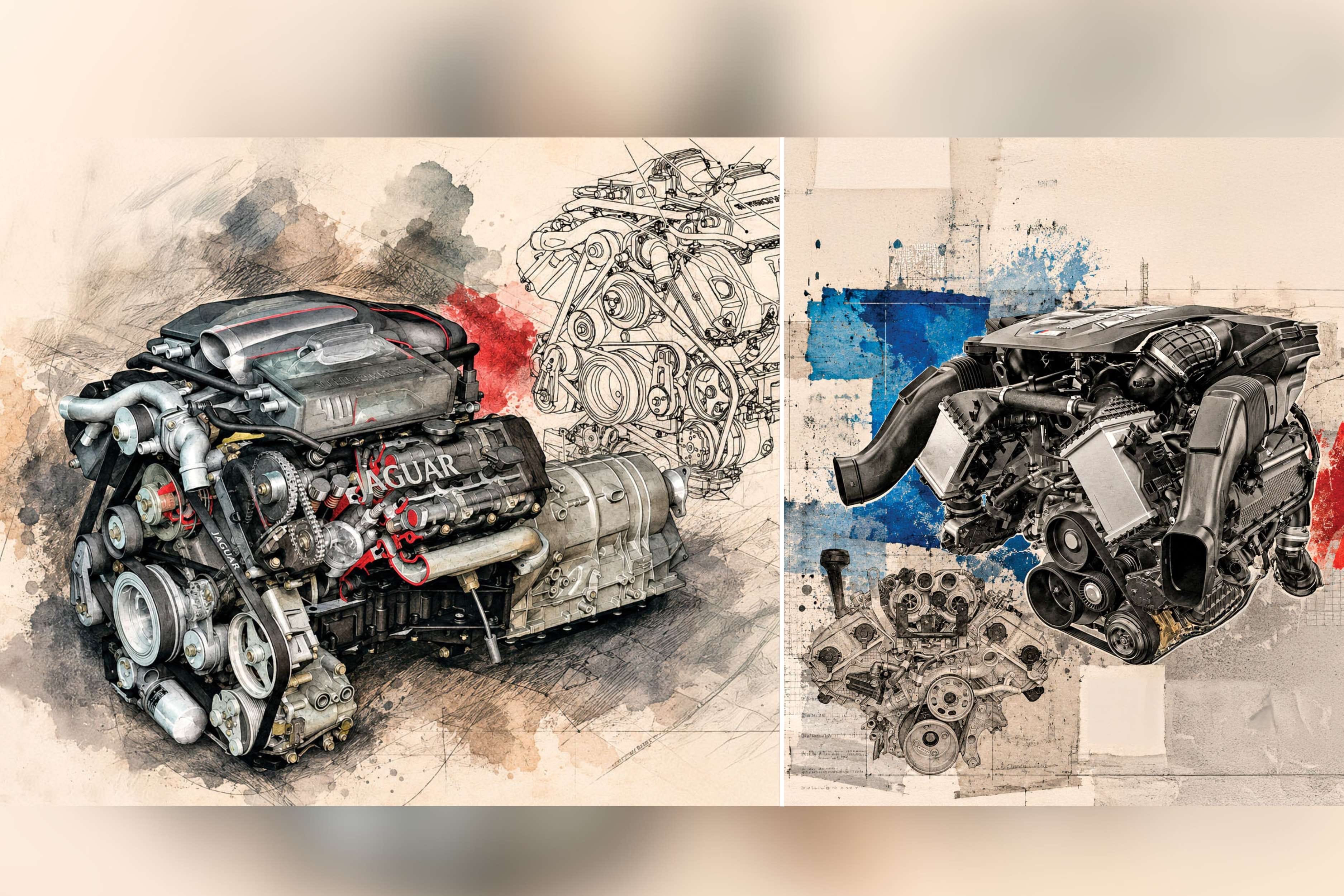
Defender: A tale of two V8s

Defender: A tale of two V8s
land rover defender V8 comparison

SUVs powered by V8 engines are becoming rarer by the day. Downsizing, electrification, ever‑tightening emissions regulations – the V8 is fading. Yet here we are in 2026, with Land Rover offering not one but two V8s. On the same model! Calls for a mini celebration, doesn’t it? And something of a journey of discovery. So how, and why, does the Defender come powered by two distinctly different V8s? Are they different enough to co-exist? Do their specifications tell a story? And are they fundamentally different from behind the wheel? Answers to these and more in this fascinating tale of two V8s.

Individual identity

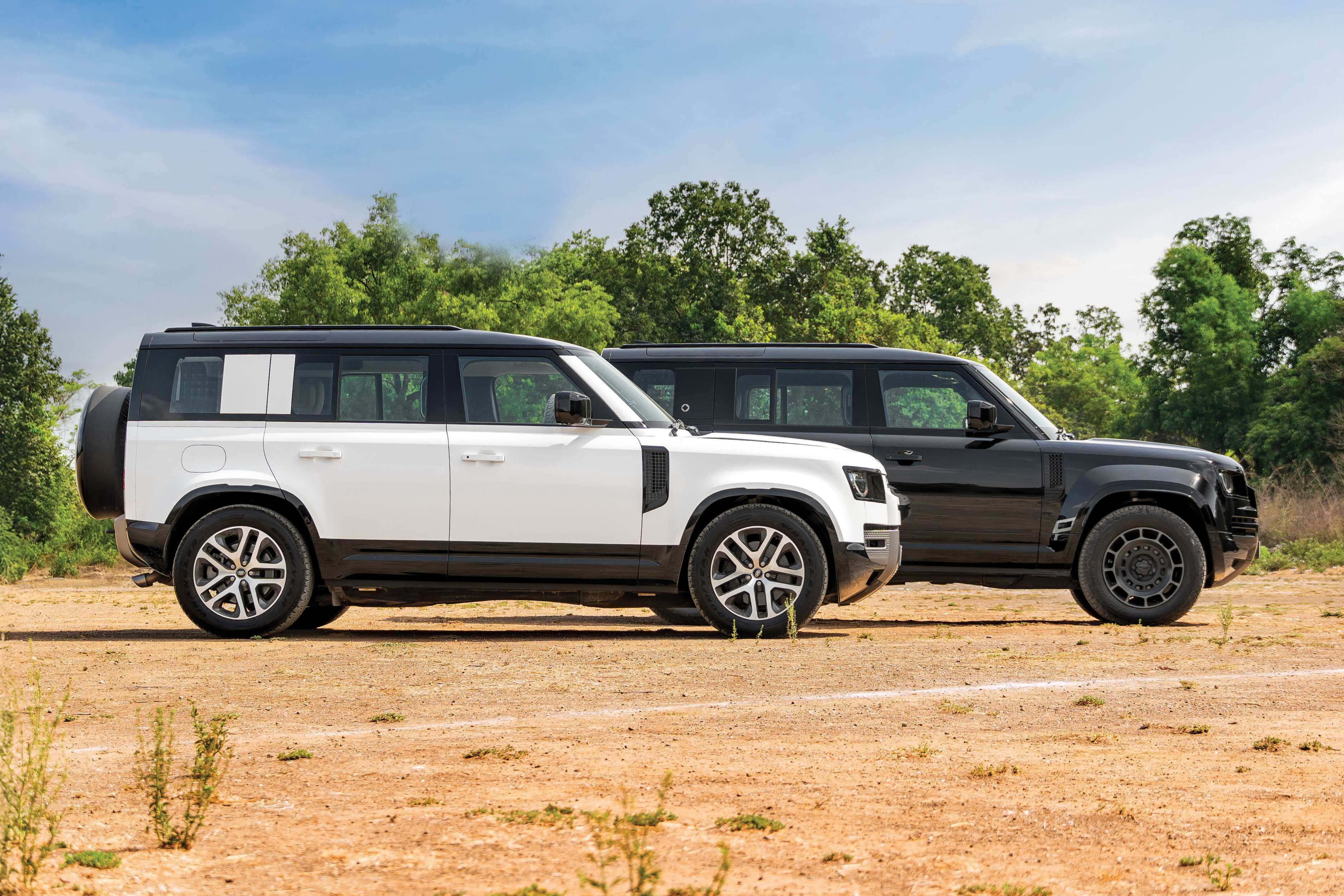
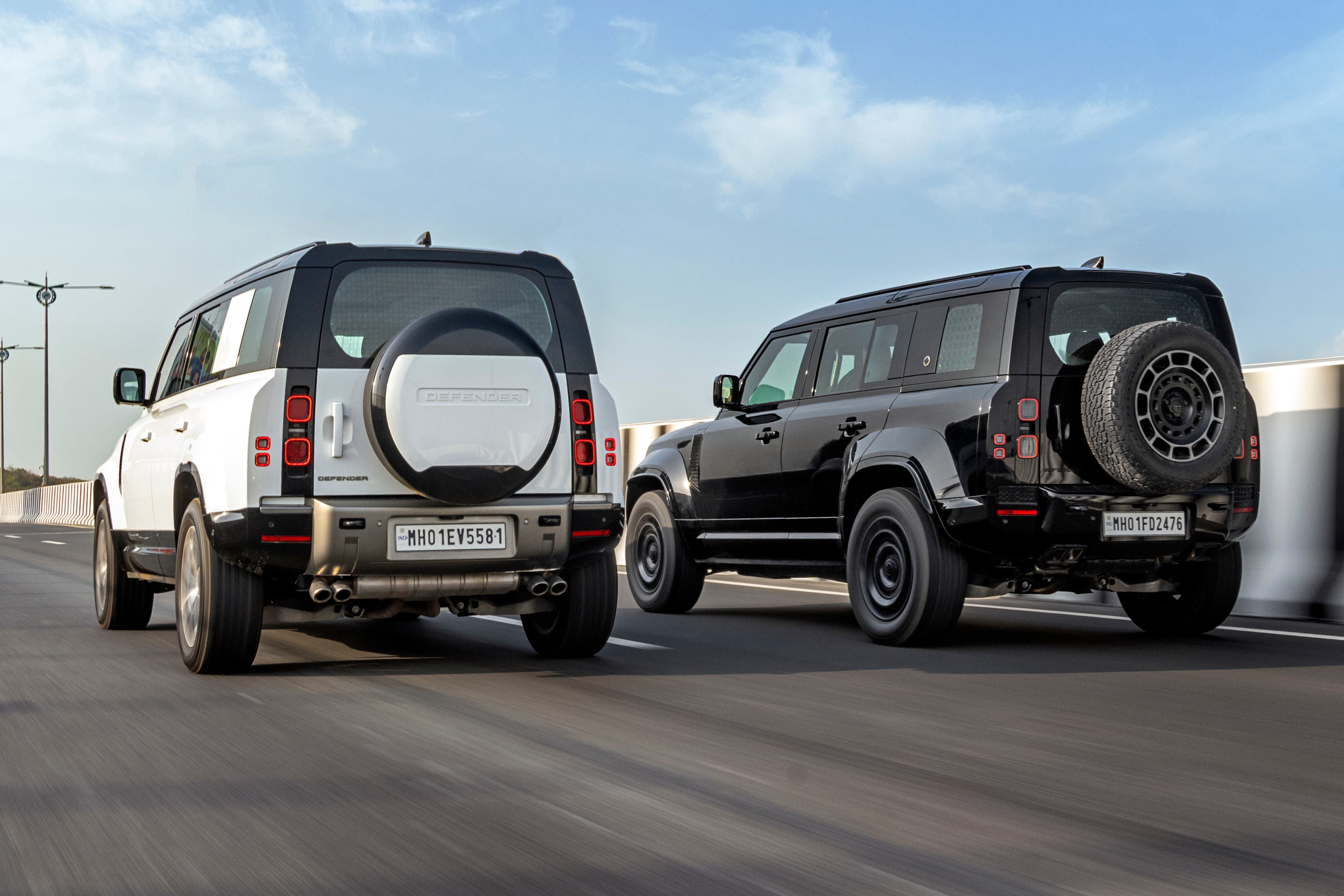
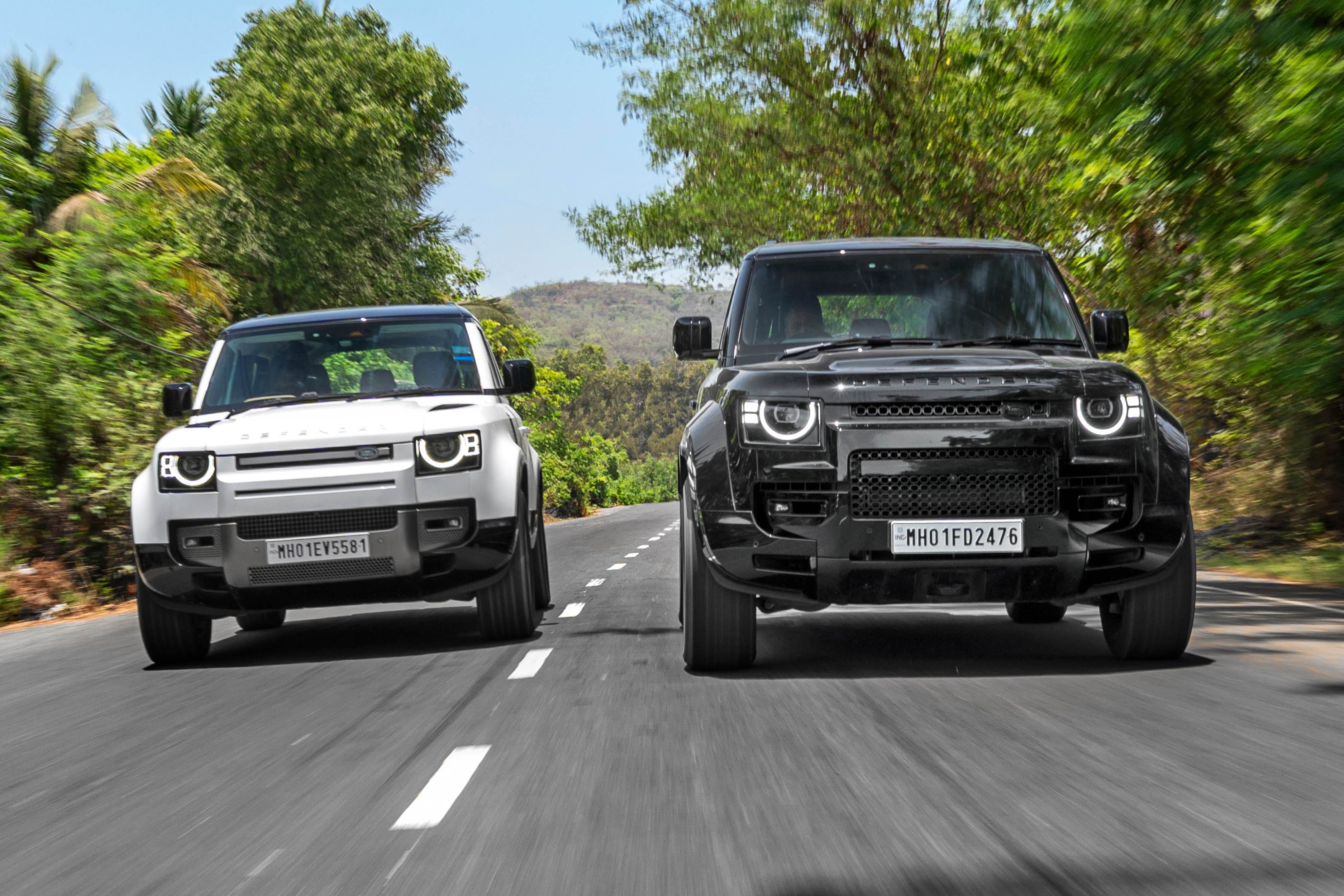
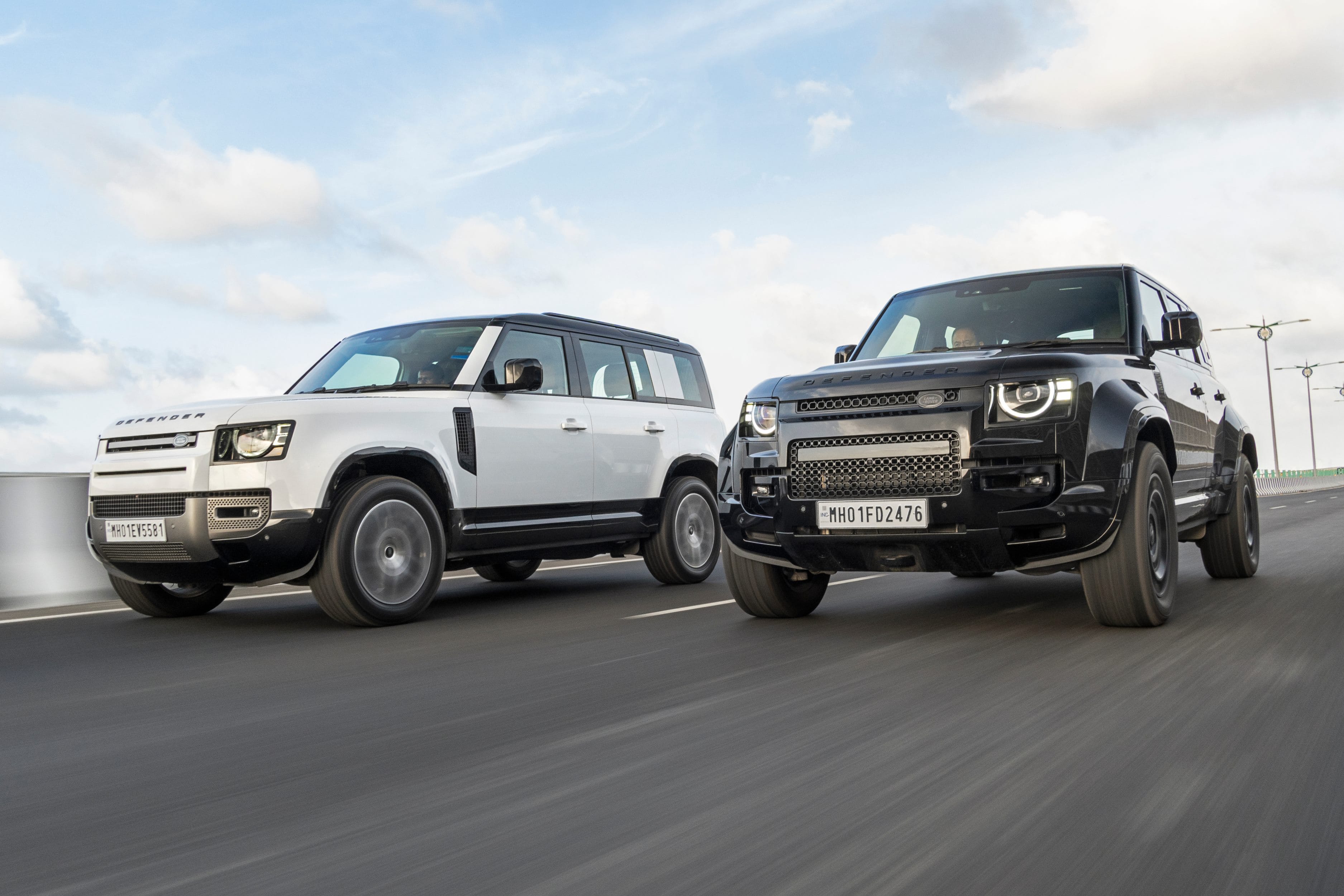
The Octa looks much more menacing than the regular Defender.

Job number one: telling them apart. Which is relatively easy when you have the two sitting cheek by jowl. But out on their own, with no reference and no back-and-forth visual comparison, it’s more difficult.

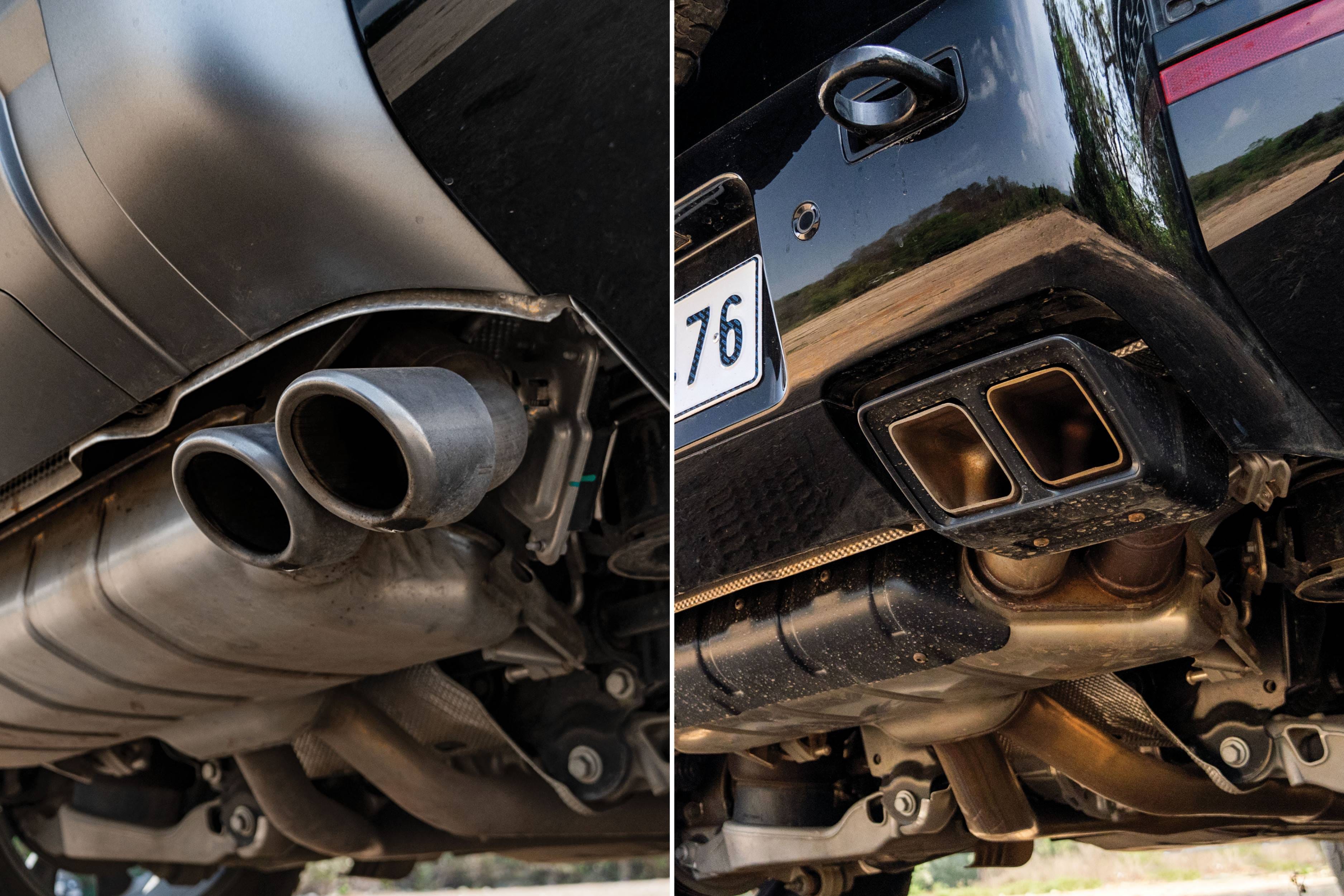
Now, most of us – at least those of us who admire the Defender – know the Octa. A bold move from Land Rover, it comes with BMW’s 4.4‑litre twin‑turbo S68 under the louvered bonnet. That, and its linked suspension, which make the Octa super stable over rough ground. Not only does it get the V8 from BMW’s sledgehammer M5, the Octa, like all good performance cars, wears its intent on the outside. A wider stance, flared wheel arches, square exhaust tips and a stance that screams ‘Defender on steroids’. Most of the visual enhancements are also functional, but it also looks wide-shouldered and bulked up without going over the top… a job well done. And then, of course, there is the Octa badge, both on the grille and behind the ‘C’ pillar.

L: The Defender V8 gets more traditional rounded exhausts; R: The Octa’s quad rectangular exhaust tips stand out.

The Defender V8, which gets Jaguar’s AJ133 engine, is much stealthier and less in your face. From the outside, it looks like a regular Defender. No V8 badge, no identifying features, nothing. In fact, look at it from the front or the side, and it’s almost impossible to tell. You can, however, tell from the rear. The horizontally placed quad round exhausts stick out at the rear and clearly tell you this is something special. Otherwise, this is a regular Defender – attractive and full of visual appeal, but not something that stands out as something special. Could this be the Defender’s best‑kept secret?

Supercharged slayer

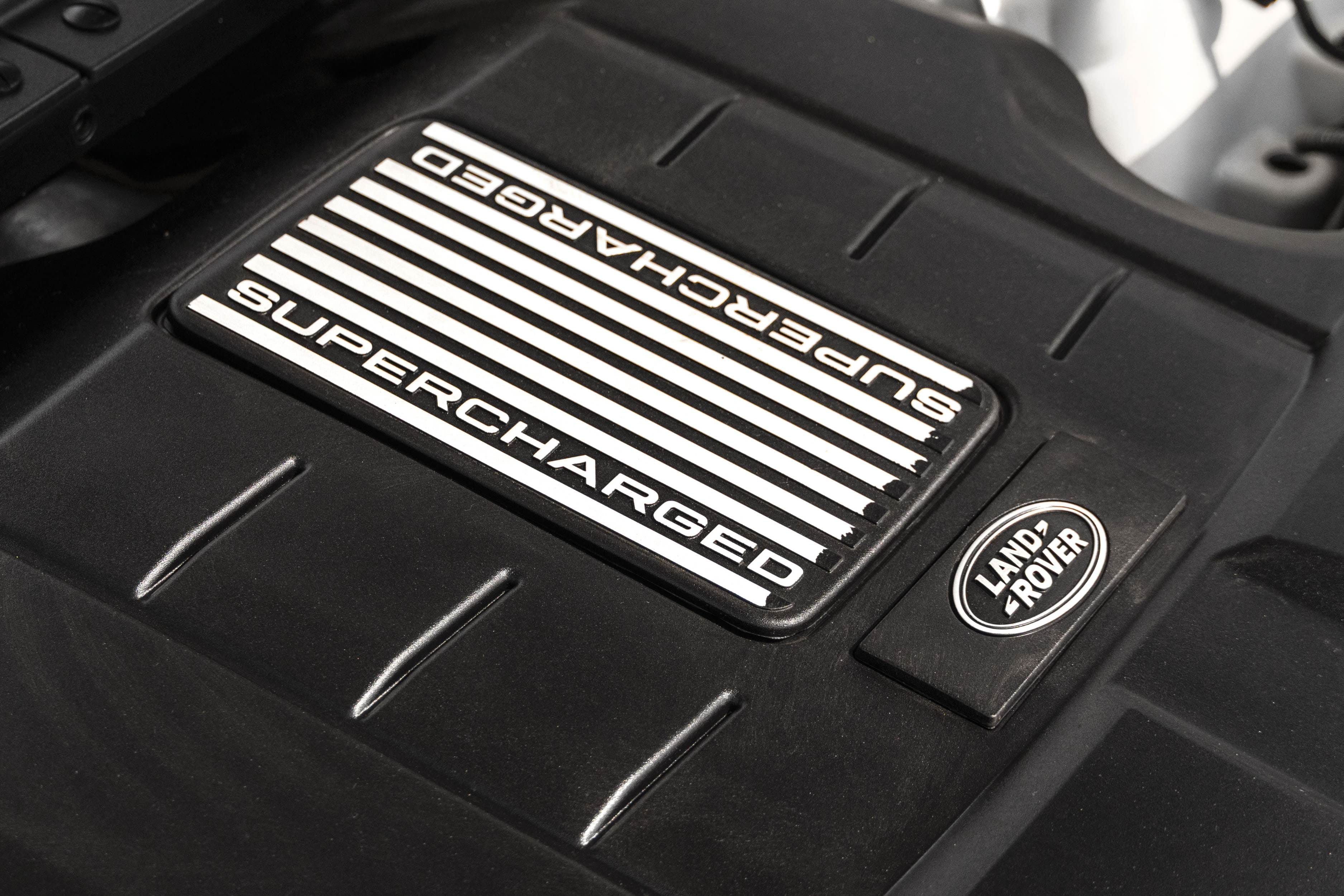
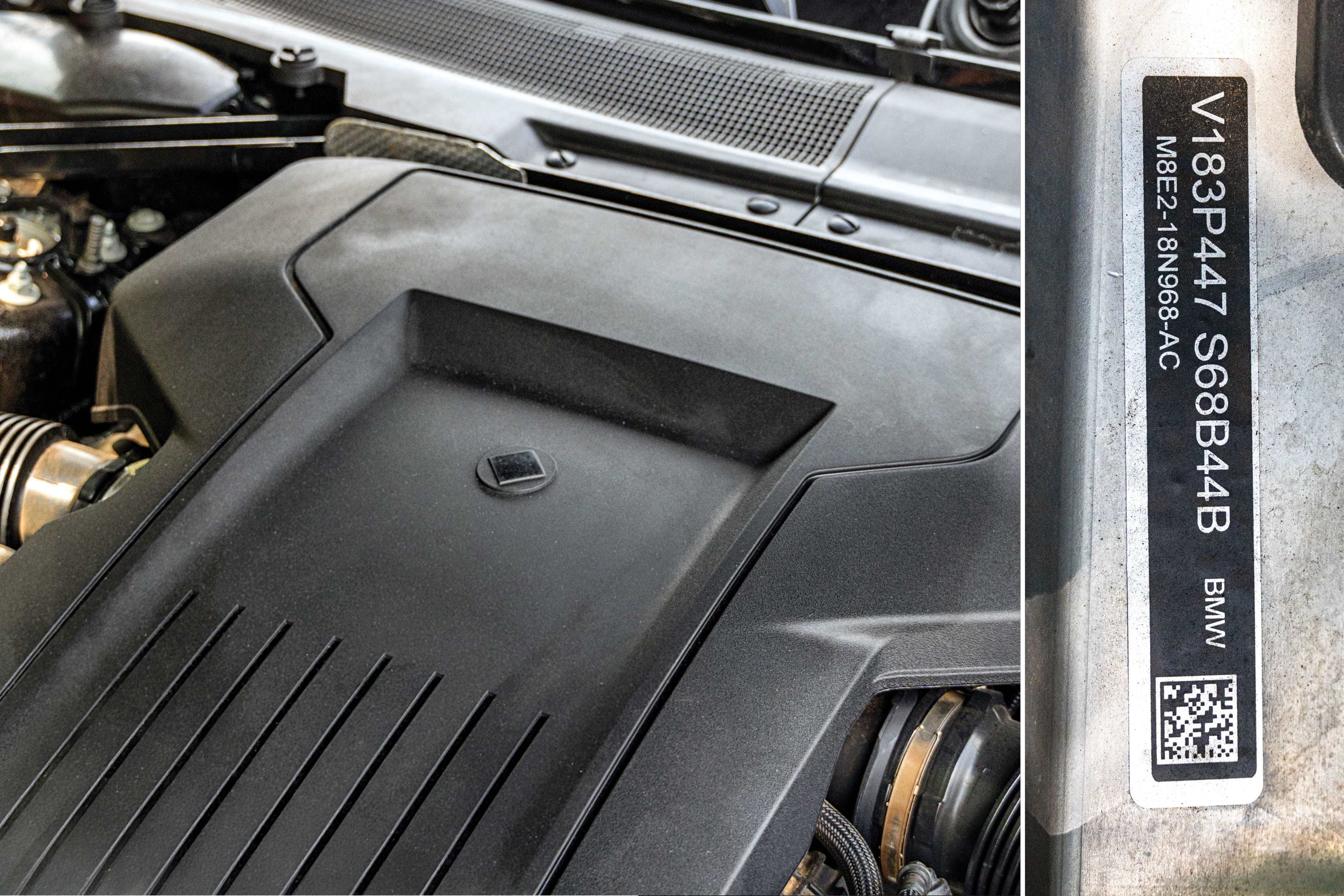
Defender V8 gets ‘supercharged’ written on the cover.

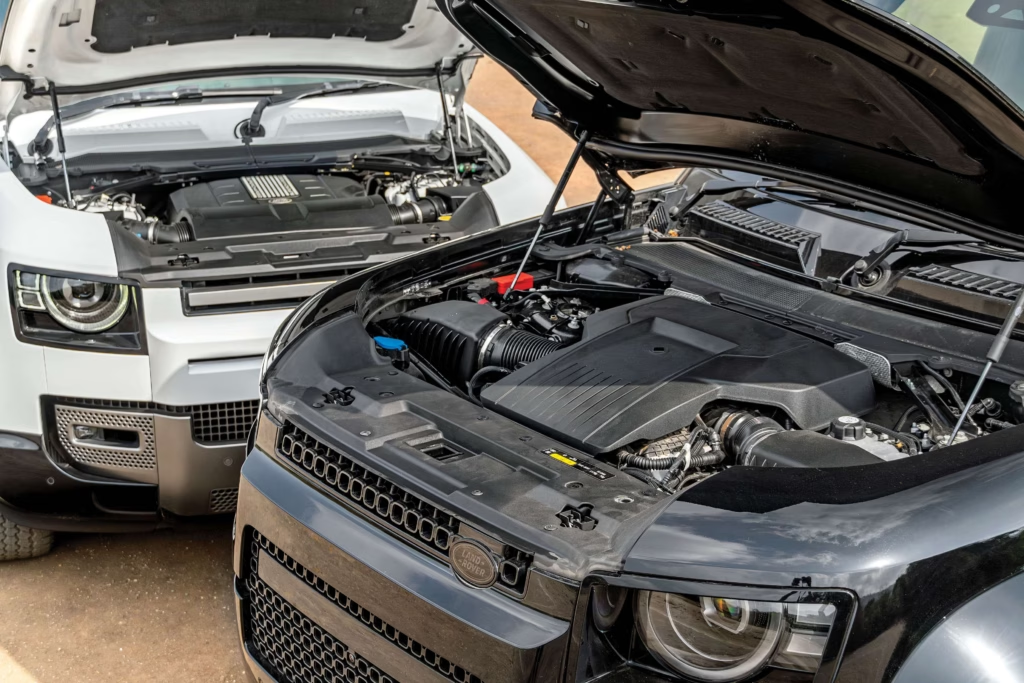
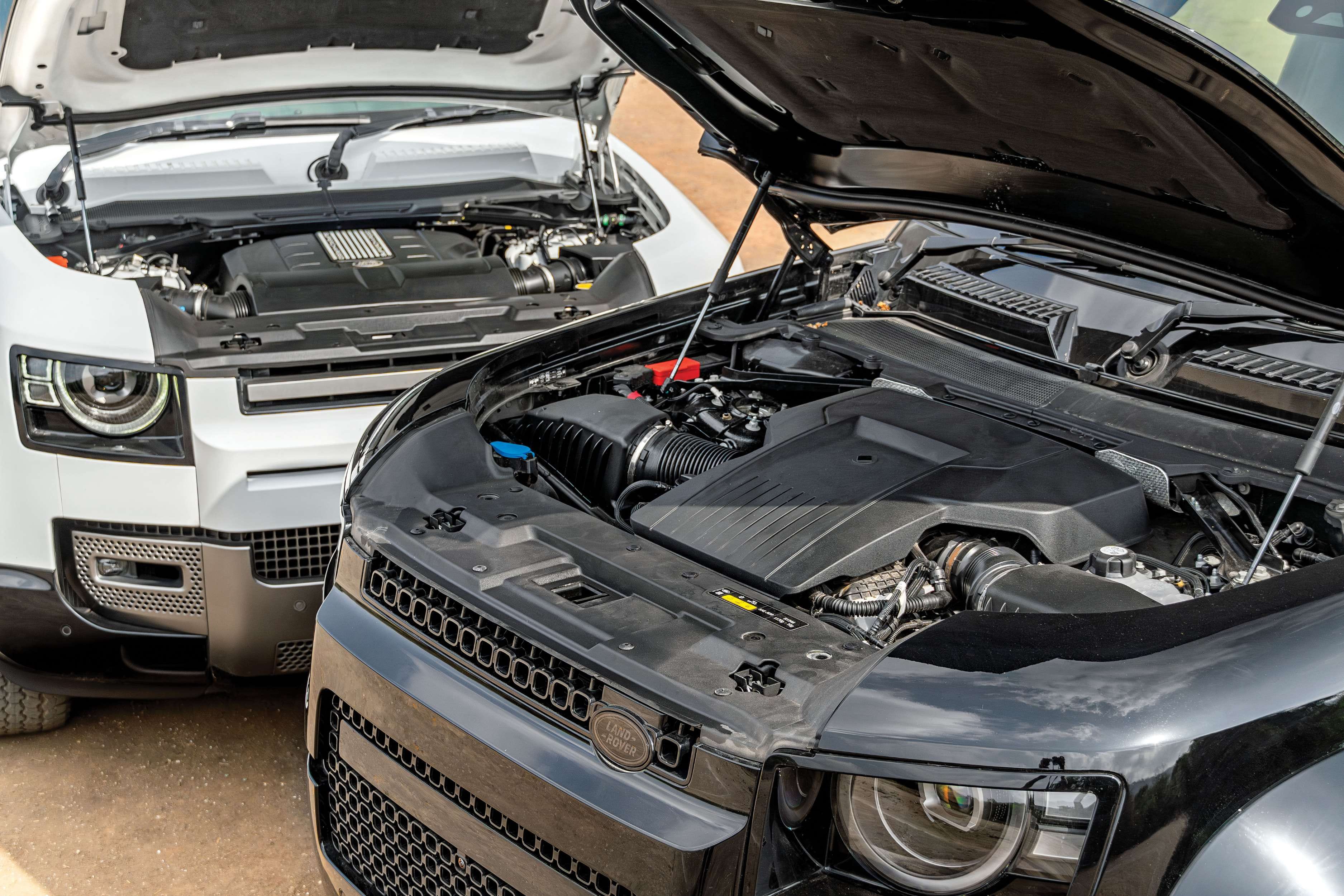
From behind the wheel, the differences are stark. The AJ133 engine is a familiar friend, earlier seen in many a Jaguar and Range Rover. In this Defender, it produces 425hp, with a large Roots-type supercharger adding some refined whine to the exhaust note. The sound that dominates, however, is a silky-smooth but unmistakable V8 ‘woofle’. Rev the engine even slightly, and a meaty growl emerges with crisp burbles on the overrun. It’s not AMG loud, nowhere near, or as raucous either, but the sound of the honey-smooth V8 is pure theatre and just gets me grinning. Why does it sound so clear and clean? There’s no turbo muffling the exhaust note, of course, and no turbo lag either. Which also explains the immediacy of the throttle responses.

In fact, tap the pedal even from idle, and the Defender V8 shoots forward, the crankshaft-driven supercharger pumping air into the engine instantly. This makes the Defender V8 feel light on its feet, and what’s even more charming is that it pulls cleanly in the mid-range, the engine spinning freely and enthusiastically towards the top. This is addictive, and long pulls to the redline are just so much fun. If you value thoroughbred engine characteristics over everything else, this engine will delight you.

Supercharger makes for instant low-end response from the AJ V8.

Now, putting so much performance into a dedicated off-roader may seem futile. But what Land Rover has done is make the Defender fundamentally sound. It’s not a ladder frame, for one, so when you drive around corners, it manages to do it in a neat and tidy manner. And that’s despite the additional weighty hardware like bulky differentials, stout driveshafts, and a robust transfer case, all needed for serious off-roading and not just slippery conditions.

So it comes as something of a surprise that the Defender V8, with its light steering and neat and tidy driving manners, can handle the performance without any fuss. It speaks volumes about how well Land Rover has engineered this platform and given it both loads of on-road capability as well as bona fide off-road chops.

The AJ-V8-powered Defender is not as effective a performance machine as the Octa.

Try and use all the performance all the time, and that feeling of composure slowly fades. You start feeling the bulk, you want more stability and confidence from the brakes, and the gearbox feels slow and laid back. And what’s this, no paddle shifters? Huh?

All pumped up

The Defender Octa amps it up to another level. Bold, brash and devastatingly effective when its full potential is unleashed, it is an all new type of animal. Initial impressions, however, immediately tell you the V8 is turbocharged. Squeeze the throttle, and the responses are initially laid back. This is especially true in comparison to the supercharged V8.

Both engines are brilliant, but both are also very distinct in the manner in which they make power.

Once past the initial softness in the throttle, however, it surges forward with relentless force, a flood of torque unleashed from the turbos spooling up. And that’s even if you haven’t pinned the throttle. A few more purposeful prods of the throttle, and the massive gulf in performance between the two Defenders is soon apparent. It’s not the 0-100kph or even the 0-150kph times, it’s just the massive surge you feel in raw thrust when you feed in the throttle.

The BMW‑sourced 4.4‑litre twin‑turbo V8 is a technological powerhouse and one of the most technically complex engines around. With 635hp and up to 800Nm in launch mode, it transforms the Defender into something approaching a super off-roader. And where the Jaguar engine is all about response, this BMW one, in contrast, is all about mid‑range and top-end muscle. In fact, knock back a few gears on the quick gearbox, plant your foot, and the Defender Octa charges forward with such ferocity that you’ll question the need for anything faster.

Where the BMW engine also differs is in the soundtrack. At low revs, the turbos and cross-bank exhaust system muffle and mute the V8’s natural exuberance and growl. But while the engine sounds are muffled at low revs, they soon build into a deep, muscular roar as the revs climb. Clearly not as sweet or as sonorous as the Jaguar V8, but well in line with the heady performance the Octa delivers.  

Octa badge (and BMW part number) tell the BMW V8-powered Defender apart.

The Octa also sits higher off the ground, thanks to its Tenneco‑Monroe 6D suspension system. This clever setup links all four dampers, acting like a virtual anti‑roll bar. The result is uncanny composure as the Octa just smothers broken roads. Drive over a poorly paved surface, and you initially feel there’s something not right. The layer of insulation between the road and you is so thick, you feel almost nothing. No big movements, no being tossed around, no big thuds. And then, what really is a game changer is that the Octa stays relatively flat when you hurl it into a corner, the tall SUV staying composed and relaxed while off-road-centric tyres howl away in protest. And it isn’t just well composed in corners, there’s very little pitching either, so you fly down poorly paved and broken sections like you are riding a hovercraft-like stable platform.

This technical marvel allows the two‑and‑a‑half‑tonne off‑roader to feel agile and secure, furthering the impression that the Octa is a Defender on steroids. Also of note, this genuinely feels like two SUVs in one – a real off-roader and the other a bona fide performance SUV that can carry real speed and put power down even on gravel, dirt tracks and unpaved sections.

Defenders of the faith

So why two V8s? The answer lies in the regulations. The AJ V8 cannot meet upcoming Euro 7 norms, but India doesn’t yet enforce equivalent standards. And that allows JLR to continue offering it here. The BMW V8 future‑proofs the Defender and has created an all-new type of performance off-roader with the Octa.

These performance off-roaders are so accomplished on road, they genuinely are multi-role SUVs.

It’s also a clever product strategy. The AJ V8-powered Defender starts at Rs 1.40 crore, offering V8 thrills at a much more affordable price. The more capable Defender Octa, on the other hand, starts at a much loftier Rs 2.62 crore. One has the traditional feel of a V8, smooth, refined and powerful; the other is a bona fide performance icon, with brutal power delivery and a massive ability to carry speed over just about any surface.  

Two distinct flavours, two distinct price points, one model line.

The Defender’s dual‑V8 strategy is nothing short of remarkable. In a world where eight‑cylinders are disappearing, Land Rover offers buyers a choice between a supercharged and a turbocharged V8. Together, they make the Defender unique. And that makes this one of the most fascinating chapters in the Defender story. Take a bow, Land Rover.  

Bits, bolts, and burbles

BMW’s S68 is an ‘M’ engine that displaces 4.4 litres. It uses an aluminium block and heads, and a cross-plane crankshaft. The bore and stroke dimensions (89mm × 88.3mm) are typically BMW – square. The engine revs to 7,200rpm, and the DOHC valvetrain gets an electrically actuated VANOS system for faster, more precise camshaft phasing. The hot vee twin-turbo layout is designed to reduce turbo lag, and the cross-bank exhaust manifold merges pulses to optimise turbine efficiency. This sacrifices some of the traditional V8 burble but sharpens response. To handle the extra loads, a high-capacity oil pump with an external oil cooler ensures consistent pressure under high lateral loads, while a multi-stage cooling circuit stabilises temperatures during track use. The S68 also integrates a 48V mild-hybrid system that provides a 9kW and 200Nm of torque fill.

Defender V8 fact file

 110 P425*Octa
PriceRs 1.40 croreRs 2.62 crore
Kerb weight2,434kg2,585kg
Engine5,000cc supercharged V84,395cc twin-turbo V8
Bore and stroke92.5mm x 93.0mm89mm x 88.3mm
Compression ratio9.510.5
Power425hp at 6600rpm635hp at 7000rpm
Torque550Nm from 1800-5000rpm750Nm from 1800-5855rpm
Claimed 0-100kph time5.8sec4.0sec
Maximum speed191kph250kph

*The supercharged-V8 Defender variants are temporarily unavailable for purchase in India, but they’re expected to return soon.

The Jaguar AJ V8 is a family of aluminium V8s produced from 1996 onwards. Offered in naturally aspirated and supercharged forms, it was Jaguar’s flagship petrol engine, engineered to combine refinement with strong performance. Evolving through three generations, the aluminium block and heads kept weight down to around 205-215kg, and it used chain driven camshafts, later evolving to double roller chains for greater durability. Supercharged “R” variants like the one in the Defender pushed outputs to 450hp, giving cars like the XJR and XKR formidable pace at the time. By 2009, the Gen III AJ V8 expanded to 5.0 litres (94 × 92mm bore and stroke), introduced direct fuel injection, and raised compression to 11.5:1. Power on the supercharged versions could exceed 500hp, and this 450hp version, with a bit of digital massaging, could also be made to increase in power.

All prices are ex-showroom, India.

4 reasons to buy the BMW X1 LWB and 3 reasons to avoid it

4 reasons to buy the BMW X1 LWB and 3 reasons to avoid it
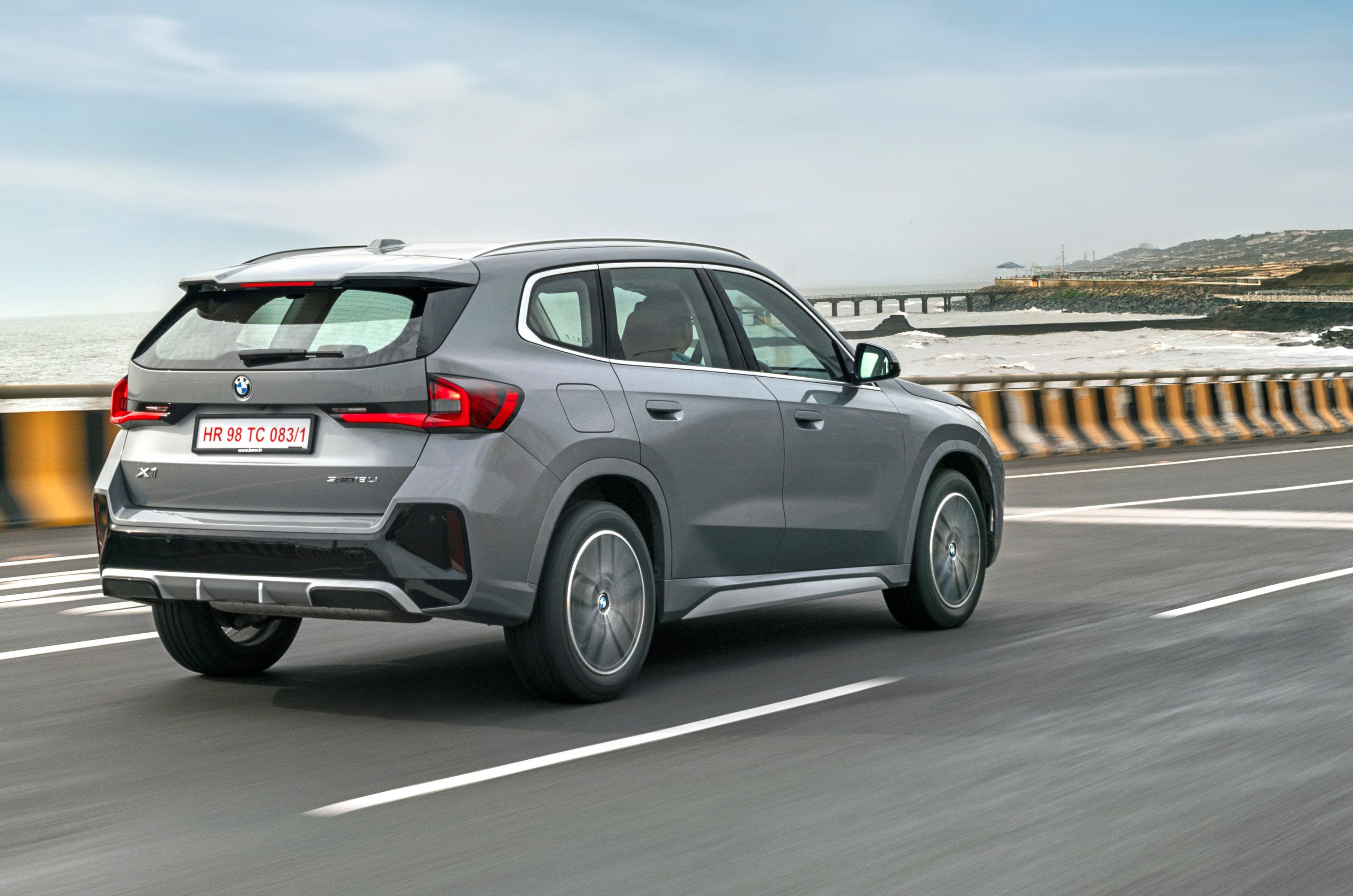
BMW X1 LWB side

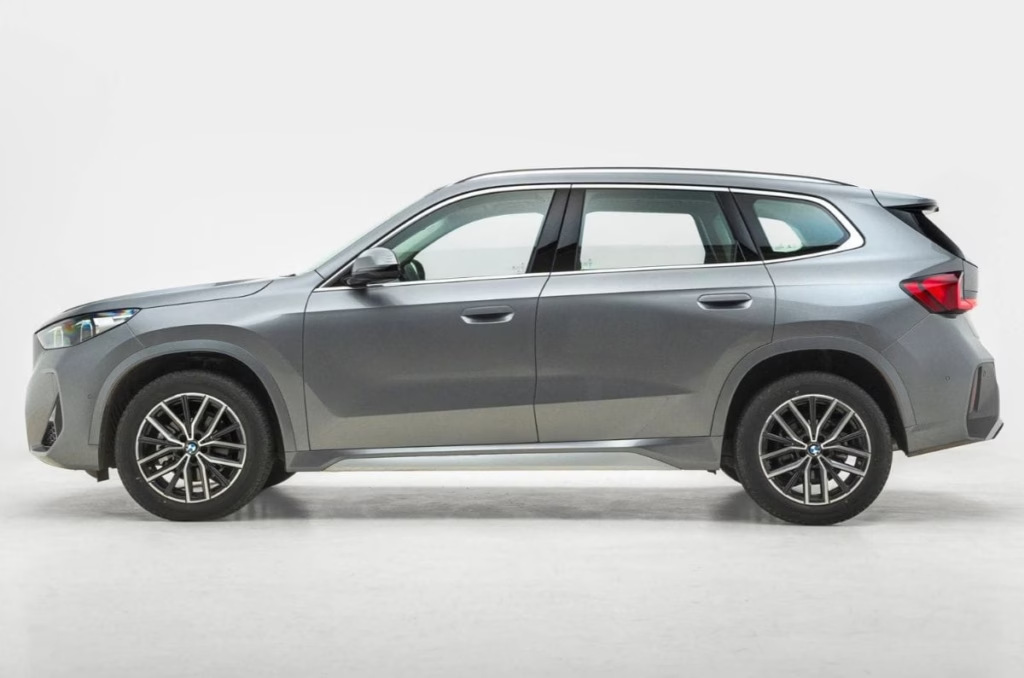
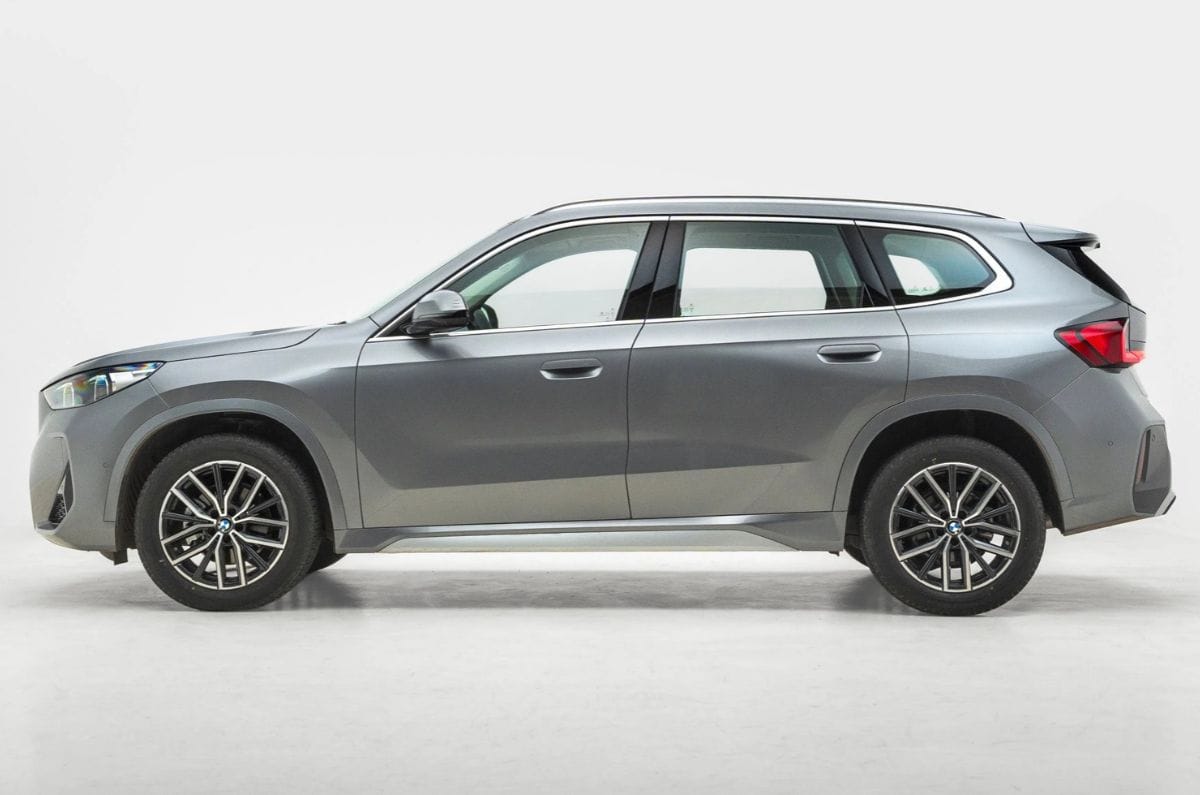
Unlike the standard X1, the Long Wheelbase (LWB) version primarily targets buyers for whom rear-seat space is the top priority. The BMW X1 LWB competes with the likes of the Audi Q3 and Mercedes-Benz GLA in India and is the only one to be offered in a long-wheelbase guise. All that said, here are some pointers to keep in mind before signing on the dotted line.

Reasons to buy the BMW X1 LWB

Space is aplenty

The Long Wheelbase version’s rear seats and boot are easily better than rivals’

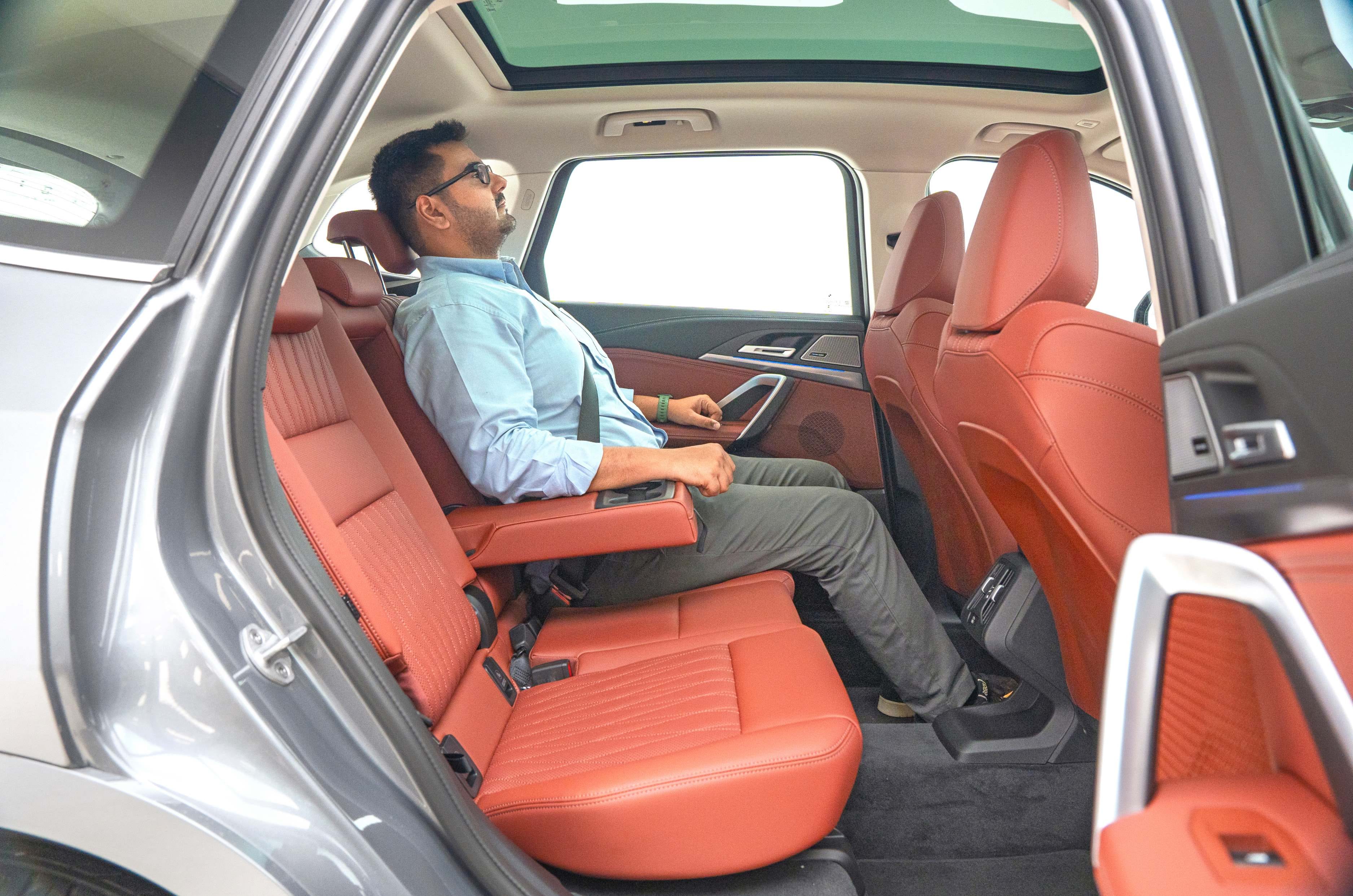
A wheelbase that’s grown by 108mm over the standard X1 means that the LWB benefits from a roomy cabin. This is noticeable upon stepping into the rear of the X1 LWB, where there’s plenty of space even for six-footers to stretch out. A centre armrest with cup holders, dedicated rear AC vents and USB Type-C charging ports aside, BMW has redesigned the rear seats.

BMW X1 LWB rear seats

Catering to the occupants in the outer units are better cushioning plus a 15mm longer seat base for added under-thigh support. Not only is the general seating position good, but the reclining backrests further elevate comfort. The expansive glasshouse, including the fixed panoramic sunroof, makes for a light and airy cabin. Furthermore, the 540-litre boot is bigger than those of the GLA and Q3.

Convincingly pliant

BMW has revised the suspension for a more comfortable ride

BMW X1 LWB rear quarter tracking

Compared to the standard-wheelbase model, the X1 LWB offers a more pliant ride that errs towards comfort rather than corner-carving sportiness. It works quietly in the background and absorbs bad patches well. Under most driving scenarios, the underlying firmness of this suspension setup will go unnoticed. The steering wheel provides a good sense of connection to the road, and the X1 LWB changes direction confidently and swiftly.

Useful parking aids

Quality assistance tech means parking the X1 LWB is a surprisingly convenient affair

The BMW X1 LWB is equipped with a 360-degree camera system, whose quality is really good. This will help one park the luxury SUV without major issues. Should you find yourself in a tricky situation or be confused about getting out of a dead end, the Reversing Assistant is a feature that could be a great help. This system is designed to automatically back up the car by retracing the path taken to reach its current spot and can work up to a distance of 50 metres.

Competitive pricing

The X1 LWB is priced rather well

At Rs 49.90 lakh (ex-showroom), the BMW X1 LWB costs Rs 1 lakh less than the standard-wheelbase model. When compared to its Mercedes-Benz GLA rival, the X1 LWB is up to Rs 5.1 lakh more affordable.

Reasons not to buy the BMW X1 LWB

Missing equipment

The long-wheelbase version has fewer features than the regular X1

For reasons known only to BMW, the X1 LWB doesn’t come with adjustable rear sunshades, ventilated or massaging seats, and even the USB slots up front aren’t backlit. This makes finding them in the dark a chore. The LWB version also lacks a dedicated climate-control zone for the rear passengers, while the advanced driver assistance systems (ADAS) package doesn’t include adaptive cruise control.

Uninspiring performance

This three-cylinder engine isn’t a punchy enough unit 

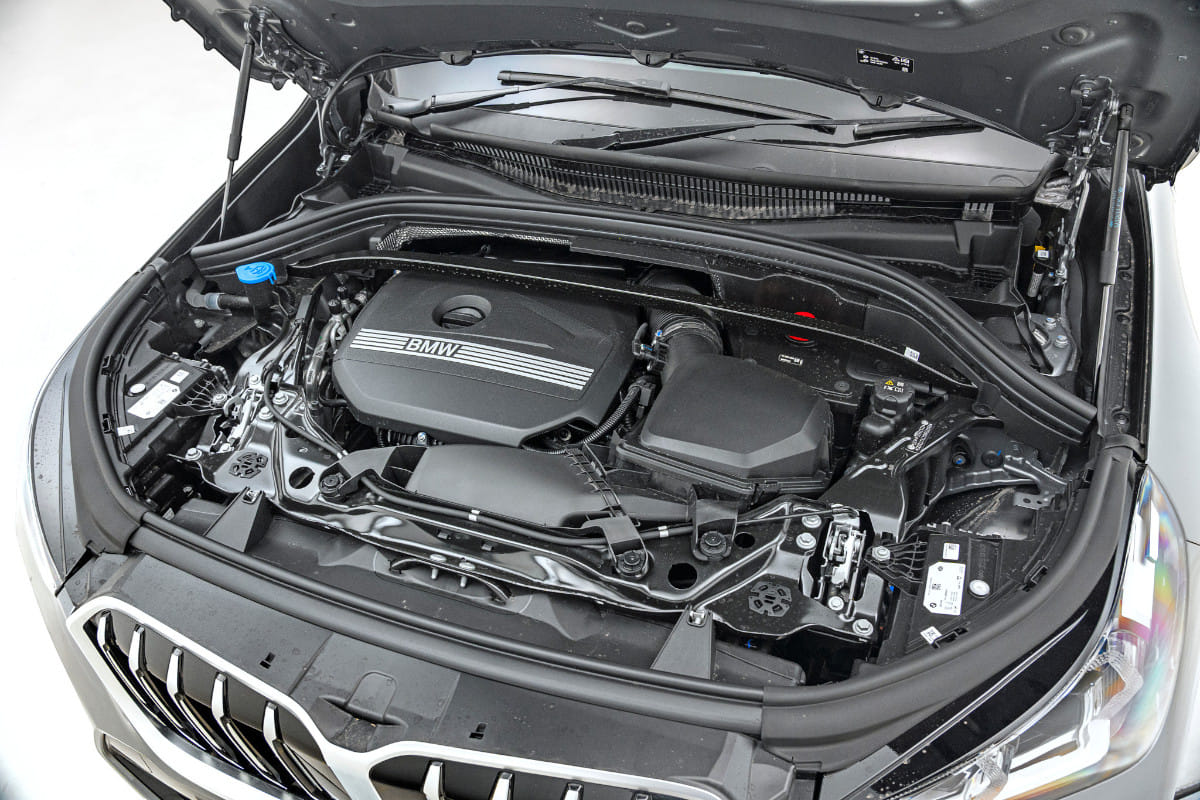
The 1.5-litre three-cylinder turbo-petrol fuel-injected engine produces 156hp and 230Nm of torque, which is 20hp more than the unit powering the standard-wheelbase X1. This E25-compliant engine comes mated to a 7-speed dual-clutch transmission (DCT) and feels more than sufficient when driving in the city.

BMW X1 LWB engine

However, when you want to overtake in a hurry or bury the accelerator pedal, there’s some delay before the X1 LWB builds speed. Push it hard, and this three-cylinder mill will make itself heard, and it isn’t a particularly sporty note either. Even in Sport mode, 0-100kph took 9.58 seconds when we tested this SUV’s acceleration.

Complicated infotainment

The system is modern but can be confusing for users

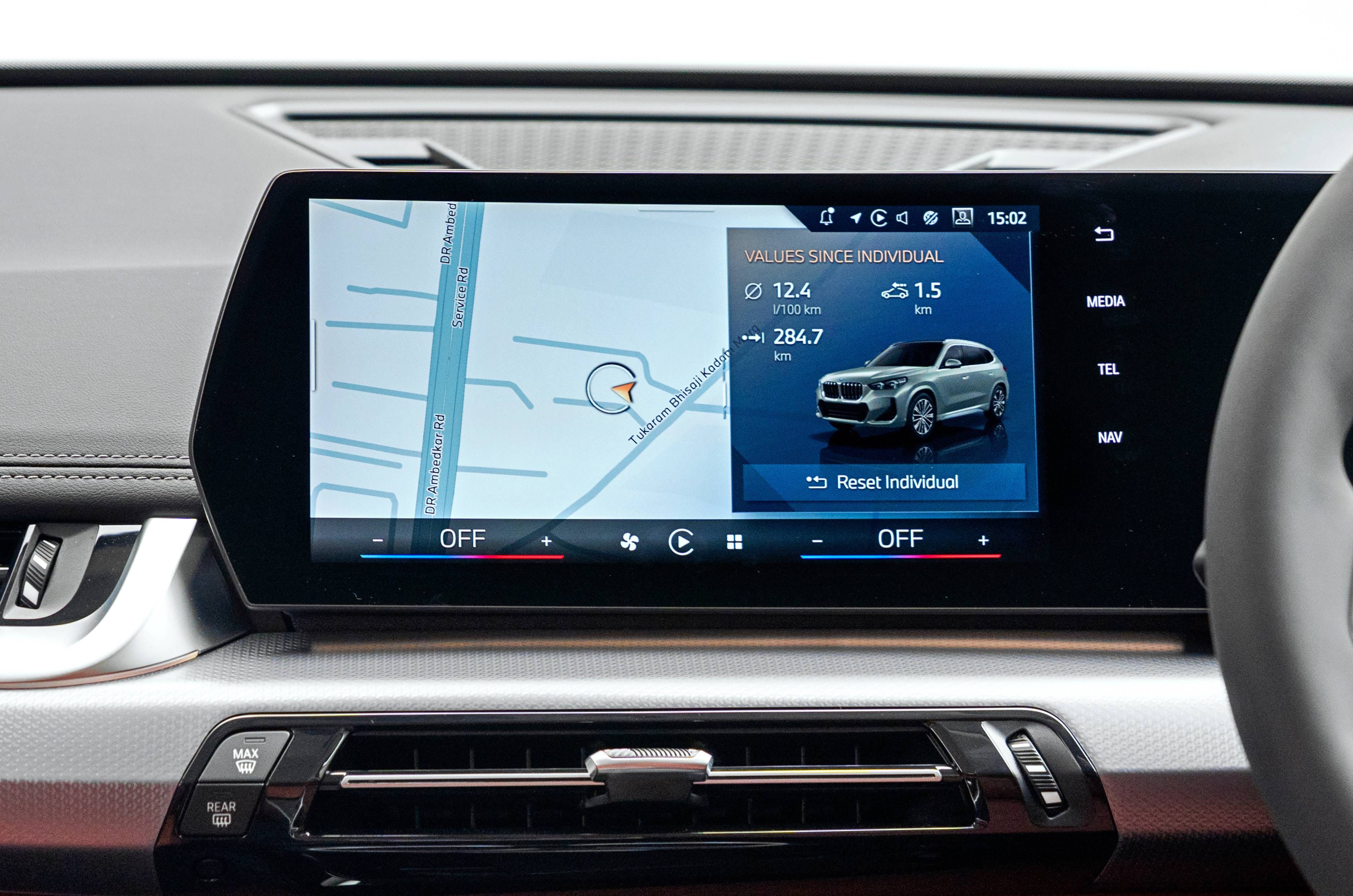
BMW X1 LWB infotainment touchscreen

The 10.7-inch touchscreen of the BMW X1 LWB looks crisp and is very responsive to inputs as well. However, its information-dense design means users will find themselves facing a plethora of menus, and finding what you need will require some patience. Even the climate-control system is managed via the touchscreen, meaning eyes off the road. All of it feels more challenging than it needs to be.

Also read

3 reasons to buy the Honda Amaze and 3 reasons to avoid it

3 reasons to buy the 2026 Mini Countryman C and 2 reasons not to

88.05 मीटर का थ्रो भी नीरज को नहीं दिला पाया गोल्ड, फिर श्रीलंकाई से हारे (Video)

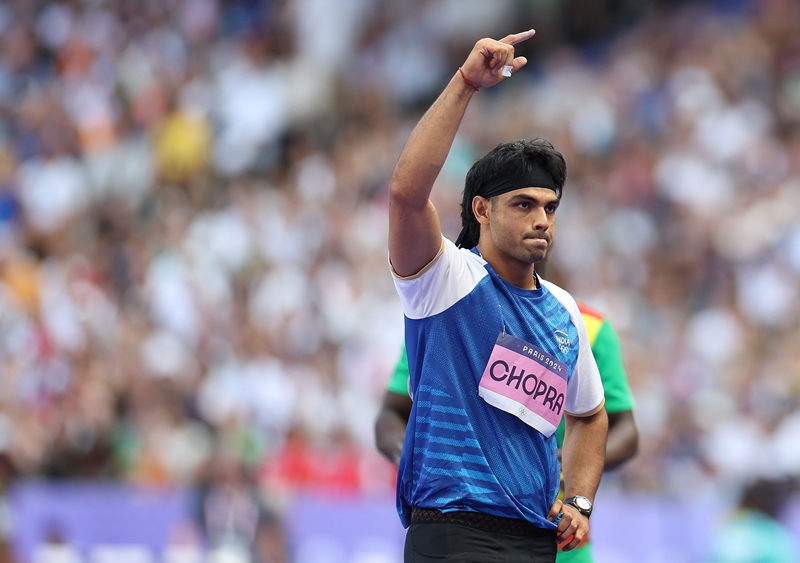
Neeraj Chopra

भारतीय भाला फेंक के दिग्गज खिलाड़ी नीरज चोपड़ा ने एक साल से अधिक समय में अपना सर्वश्रेष्ठ प्रदर्शन किया, लेकिन शुक्रवार को लुसाने डायमंड लीग में श्रीलंका के उभरते सितारे रमेश पथिरागे ने सिर्फ नौ सेंटीमीटर के अंतर से उन्हें स्वर्ण पदक से वंचित कर दिया।

चोपड़ा ने अपने दूसरे प्रयास में 88.05 मीटर का थ्रो किया, जो उनका सर्वश्रेष्ठ प्रदर्शन था। इससे यह 28 वर्षीय भारतीय खिलाड़ी नौ खिलाड़ियों के मुकाबले में दूसरे स्थान पर रहा। चोपड़ा का यह पिछले साल जून के बाद सर्वश्रेष्ठ प्रदर्शन था। उन्होंने जून 2025 में पेरिस डायमंड लीग जीतने के दौरान 88.16 मीटर का थ्रो किया था। यह इस सत्र का उनका सर्वश्रेष्ठ थ्रो भी था।

लेकिन 23 वर्षीय पथिरागे ने इस सत्र में अपना दबदबा बरकरार रखते हुए अपने तीसरे प्रयास में 88.14 मीटर के थ्रो के साथ चोपड़ा को पीछे छोड़ दिया।ग्रेनाडा के एंडरसन पीटर्स ने अपने छठे और अंतिम प्रयास में 86.69 मीटर की दूरी तय करके तीसरा स्थान हासिल किया।त्रिनिदाद और टोबैगो के मौजूदा विश्व चैंपियन केशोर्न वालकॉट 83.71 मीटर के सर्वश्रेष्ठ थ्रो के साथ चौथे स्थान पर रहे।