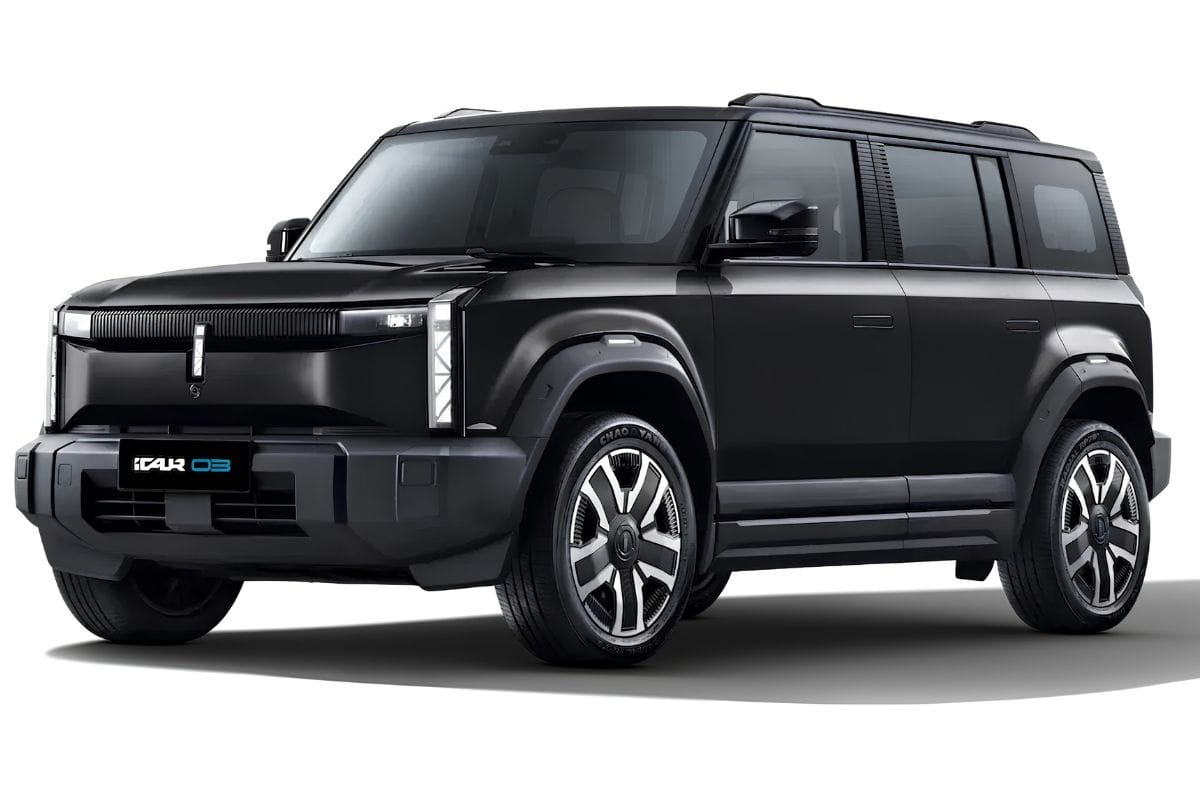
The iCAUR 03, a 5-seat electric SUV from Chinese carmaker Chery, was recently spotted in India. This model is likely to be launched under the JSW Motors nameplate, but unlike other expected JSW models that have been spied testing in India with heavy camouflage, the iCAUR 03 was uncamouflaged and being transported on a flatbed truck.
Chery iCAUR 03: What is it?
China-spec Chery iCAUR 03 used for representation
The 03 is an electric SUV sold under Chery’s iCAUR sub-brand alongside the V23. It’s 4,406mm long, 1,910mm wide, 1,715mm tall, has a 2,715mm wheelbase, and a ground clearance of 195mm. China-spec versions are powered by a 69.8kWh battery pack that utilises LFP (Lithium-ion Phosphate) chemistry. Power comes from a dual- motor setup with a combined output of 279hp and 385Nm, and it gets an AWD configuration. On the NEDC cycle, it can go up to 418km on a single charge, and the battery supports DC charging speeds of up to 80kW.
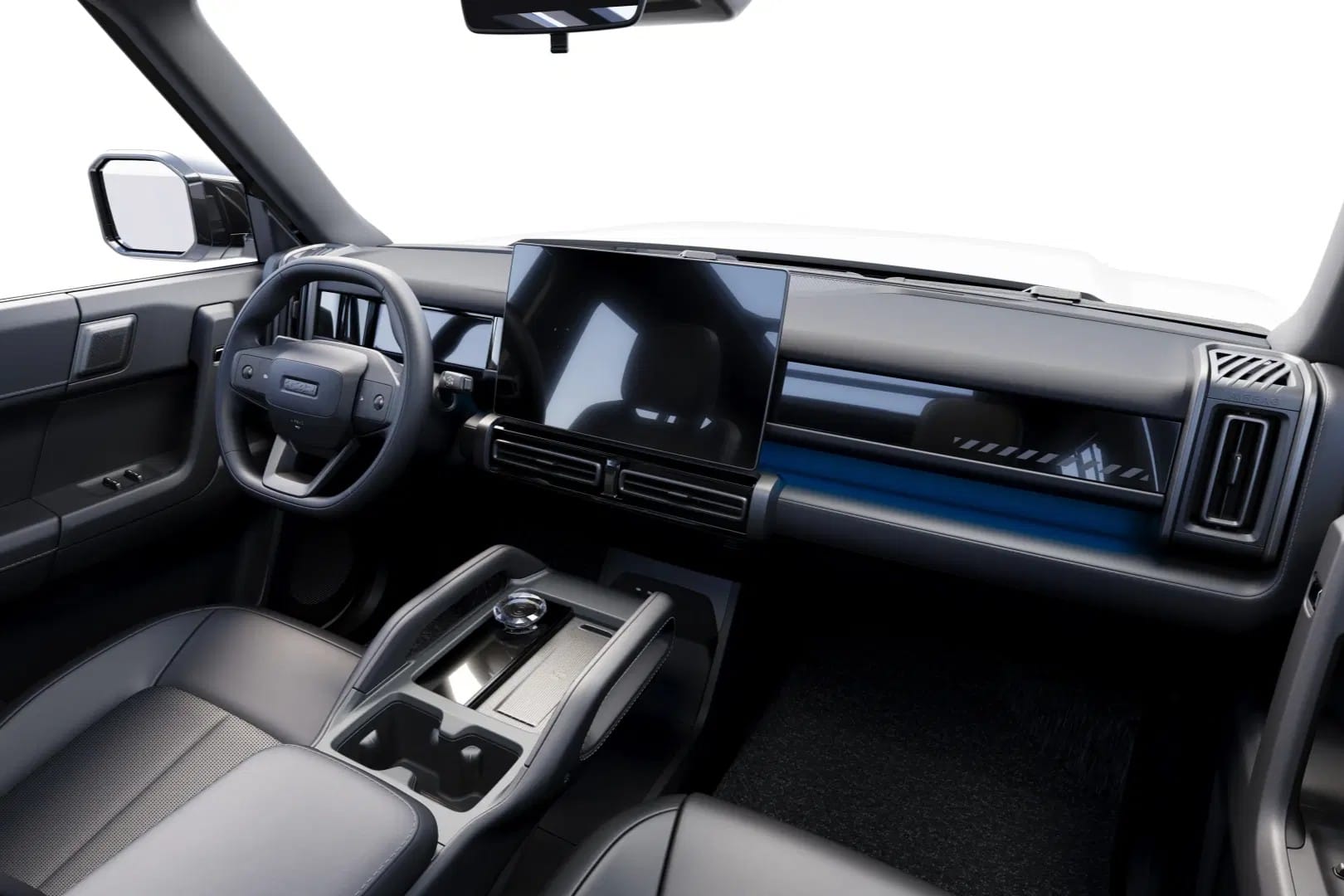
China-spec Chery iCAUR 03 interior used for representation
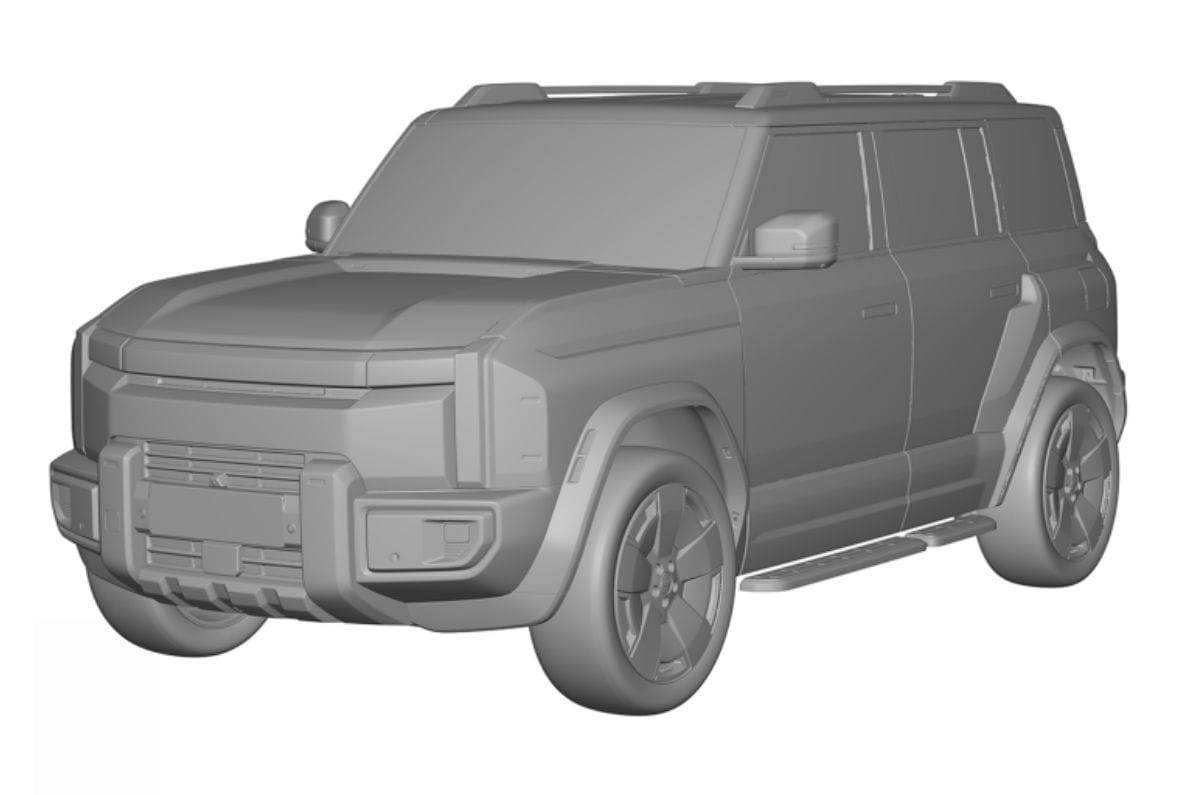
The exterior of the vehicle spotted in India had a boxy silhouette with a black finish for the front bumper and cladding on the wheel arches and door sills. Dual-tone design for the alloys, flush door handles, and LED headlamps were seen too. Interestingly, Chery has already filed a design patent for this SUV in India, as it has with its other products. However, the patented model has much beefier body cladding and rugged-looking bumpers than the model spotted on our roads. The interior of the China-spec 03 looks tough yet modern with niceties like a 15.6-inch infotainment system, 9.2-inch digital driver’s display, powered front seats, ventilated front and rear seats, level 2 ADAS, and a 360-degree camera.
Chery iCAUR 03: Another JSW Motors model?
If the iCAUR 03 does make it to our market, it is likely to be sold under the JSW Motors nameplate. Dimensions and specs considered, it could potentially compete in the mid-size electric SUV category, rivalling the likes of the Tata Harrier EV. Meanwhile, JSW Motors has been testing several other Chery-made products on our roads, including the Jetour T2, Chery iCar V23, and the Jaecoo J5. Out of these, the Jetour T2 is expected to be the first to arrive by the end of this year. It will be followed by the Jaecoo J5 and the iCar V23 at a later date.
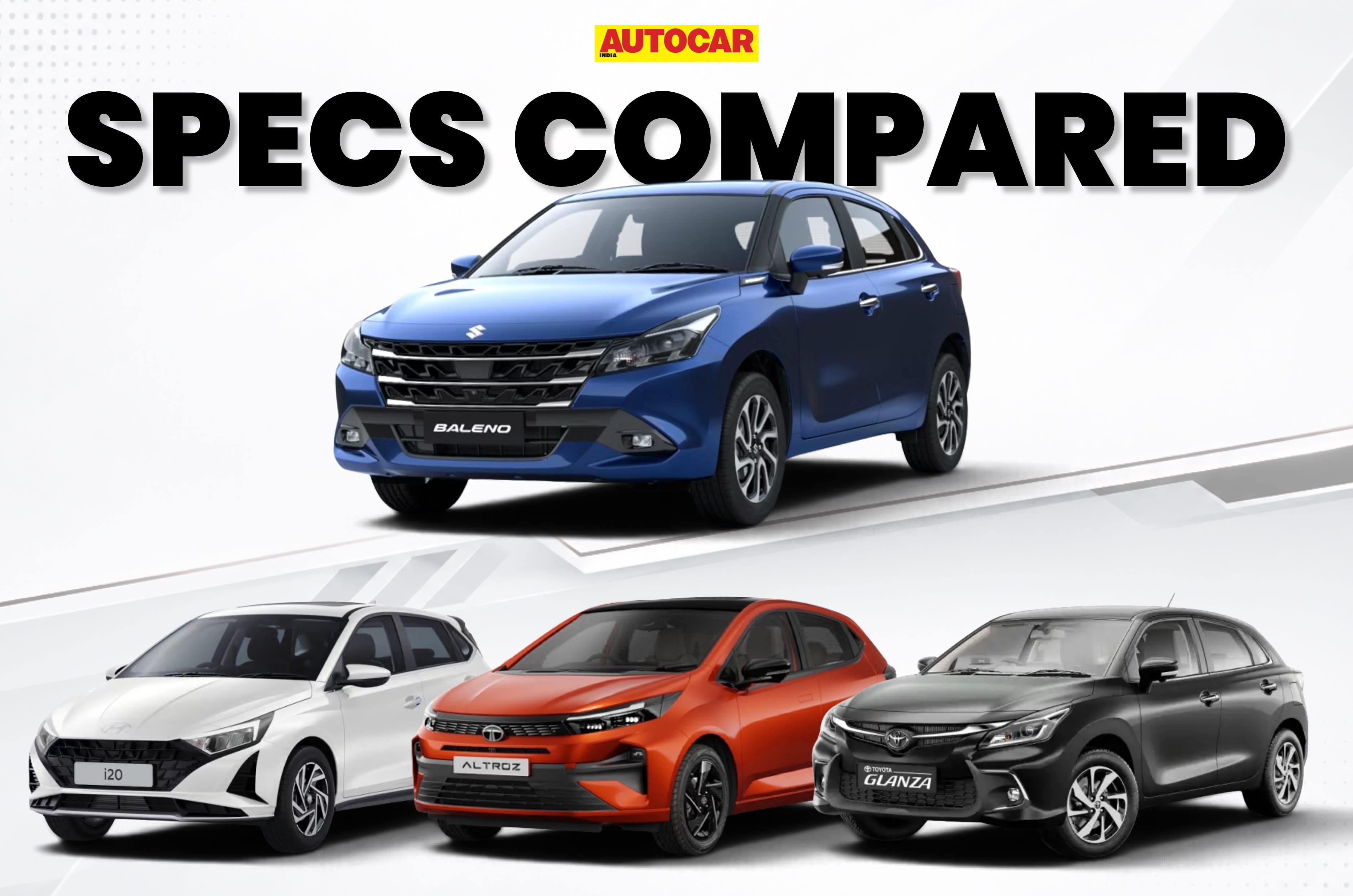
Maruti Suzuki has updated the Baleno for 2026, with changes to its powertrain, styling and equipment. It continues to compete with the Hyundai i20, Tata Altroz and Toyota Glanza in the premium hatchback segment. Here’s how the four compare on dimensions, specifications, features and prices.
2026 Maruti Baleno vs rivals: Dimensions
i20 has the longest wheelbase; Altroz has the biggest boot
Dimensions
Maruti Baleno
Hyundai i20
Tata Altroz
Toyota Glanza
Length
3,990mm
3,995mm
3,990mm
3,990mm
Width
1,745mm
1,775mm
1,755mm
1,745mm
Height
1,530mm
1,505mm
1,523mm
1,500mm
Wheelbase
2,520mm
2,580mm
2,501mm
2,520mm
Boot space
318 litres
311 litres
345 litres
318 litres
The i20 is the longest and widest of the four and also has the longest wheelbase, while the Altroz has the largest boot at 345 litres, although with CNG it falls to 210 litres. The Baleno and Glanza being badge-engineered siblings share identical length, width and wheelbase figures, although the new Baleno is 30mm taller. The Baleno also has a larger boot than the i20, despite being slightly shorter overall.
2026 Maruti Baleno vs rivals: Engine specifications
Altroz offers the widest choice of powertrains
Engine specifications
Maruti Baleno
Hyundai i20
Tata Altroz
Toyota Glanza
Engine*
1.2P | 1.2C
1.2P
1.2P | 1.2C | 1.5D
1.2P | 1.2C
No. of cylinders
3 | 3
4
3 | 3 | 4
4 | 4
Power (hp)
83 | 70
83 (MT), 88 (IVT)
88 | 74 | 90
90 | 77
Torque (Nm)
112 | 102
114.7
115 | 103 | 200
113 | 98.5
Transmission
5MT, 5AMT | 5MT
5MT, IVT
5MT, 5AMT, 6DCT | 5MT, 5AMT | 5MT
5MT, 5AMT | 5MT
*P = Naturally aspirated petrol, C = CNG, D = Diesel
The Altroz offers the widest choice of powertrains, with petrol, CNG and diesel options, while the Baleno and Glanza also get CNG variants and the i20 is petrol-only. It is also the only hatchback in India to offer a diesel engine. The Baleno and Altroz use three-cylinder petrol engines, whereas the i20 and Glanza use four-cylinder units.
The Glanza’s petrol and Altroz’s diesel engines makes the most power at 90hp, while the Altroz diesel has the highest torque at 200Nm. For automatics, the Baleno and Glanza get AMTs, the i20 gets an IVT, and the Altroz offers both AMT and dual-clutch automatic options.
2026 Maruti Baleno vs rivals: Features
Baleno is the only in the segment to offer ventilated front seats
Features
Maruti Baleno
Hyundai i20
Tata Altroz
Toyota Glanza
Head-up display
Yes
No
No
Yes
Ventilated front seats
Yes
No
No
No
360-degree camera
Yes
No
Yes
Yes
Wireless charger
Yes, cooled
Yes
Yes
No
Sunroof
No
Yes
Yes
No
Touchscreen
9-inch
10.25-inch
10.25-inch
9-inch
Instrument cluster
Analog + MID display
TFT display
10.25-inch digital
Analog + MID display
Android Auto/Apple CarPlay
Wireless
Wireless
Wireless
Wireless
Automatic climate control
Yes
Yes
Yes
Yes
Rear AC vents
Yes
Yes
Yes
Yes
Cruise control
Yes, adaptive
Yes
Yes
Yes
Connected car technology
Yes
Yes
Yes
Yes
Auto-folding ORVMs
Yes
—
Yes
Yes
Push-button start/stop
Yes
Yes
Yes
Yes
Rear USB charging
Yes
Yes
Yes
Yes
Premium audio system
Clarion, 4-speakers
Bose, 7-speaker
AudioWorX
No
The four hatchbacks offer a broadly similar level of equipment, but there are some notable differences. Both the Baleno and Glanza get a head-up display, while the Baleno stands out with ventilated front seats. The i20 and Altroz get larger 10.25-inch infotainment screens, compared with the 9-inch units in the Baleno and Glanza. All four get automatic climate control, rear AC vents, cruise control and wireless Android Auto and Apple CarPlay.
The Baleno also gets a cooled wireless charger and a 360-degree camera, while the i20 and Altroz offer sunroofs. Both the Altroz and i20 get 10.25-inch digital instrument displays, although the Altroz uses an LED display and the i20 gets a TFT unit. The Baleno and Glanza, meanwhile, use analogue dials with a MID. Overall, the four offer plenty of equipment, but buyers will have to decide whether they value features such as ventilated seats and a head-up display or a larger screen and sunroof more.
2026 Maruti Baleno vs rivals: Safety
Baleno brings Level 2 ADAS to the segment
Safety features
Maruti Baleno
Hyundai i20
Tata Altroz
Toyota Glanza
Level 2 ADAS
Yes
No
No
No
Airbags
6
6
6
6
TPMS
Yes
Yes
Yes
No
Electronic stability control
Yes
Yes
Yes
Yes
Hill-hold assist
Yes
Yes
Yes
Yes
ABS with EBD
Yes
Yes
Yes
Yes
ISOFIX mounts
Yes
Yes
Yes
Yes
All four cars get six airbags, electronic stability control, hill-hold assist, ABS with EBD and ISOFIX mounts as standard, making the core safety equipment broadly similar. The Baleno, however, has a clear advantage with Level 2 ADAS, which adds features such as adaptive cruise control, lane-keep assist, lane-departure warning and automatic emergency braking. The system is offered on the top-spec Alpha (O) trim. TPMS is also available on the Baleno, i20 and Altroz, but not on the Glanza. With the addition of ADAS, the Baleno has the most advanced active-safety package of these four hatchbacks on paper.
2026 Maruti Baleno vs rivals: Price
Baleno starts between the i20 and Altroz
Price (ex-showroom), Rs lakhs
Maruti Baleno
6.10 – Not disclosed
Hyundai i20
6 – 10.63
Tata Altroz
6.30 – 10.51
Toyota Glanza
6.73 – 9.99
At Rs 6.10 lakh, the Baleno’s starting price sits between the Hyundai i20 and Tata Altroz, while it undercuts the Toyota Glanza by Rs 63,000. Maruti Suzuki has not yet revealed the prices of the Baleno’s higher variants, so a complete price comparison with its rivals is not possible yet.
It remains to be seen how competitively the Baleno is priced at the higher end of the range and how much value it offers for the additional equipment available over its rivals.
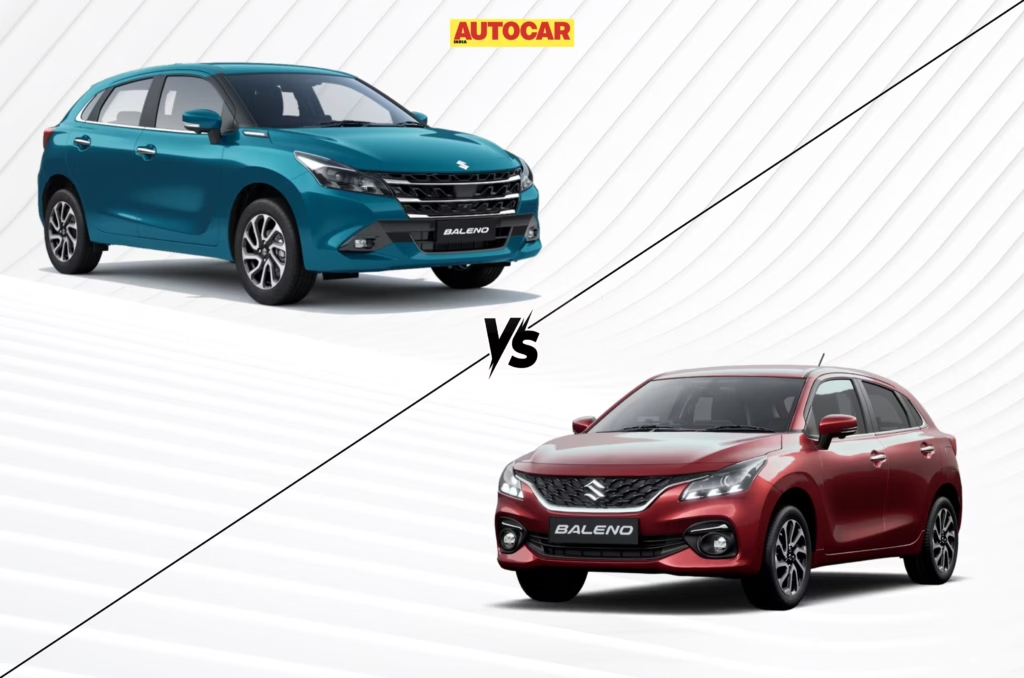
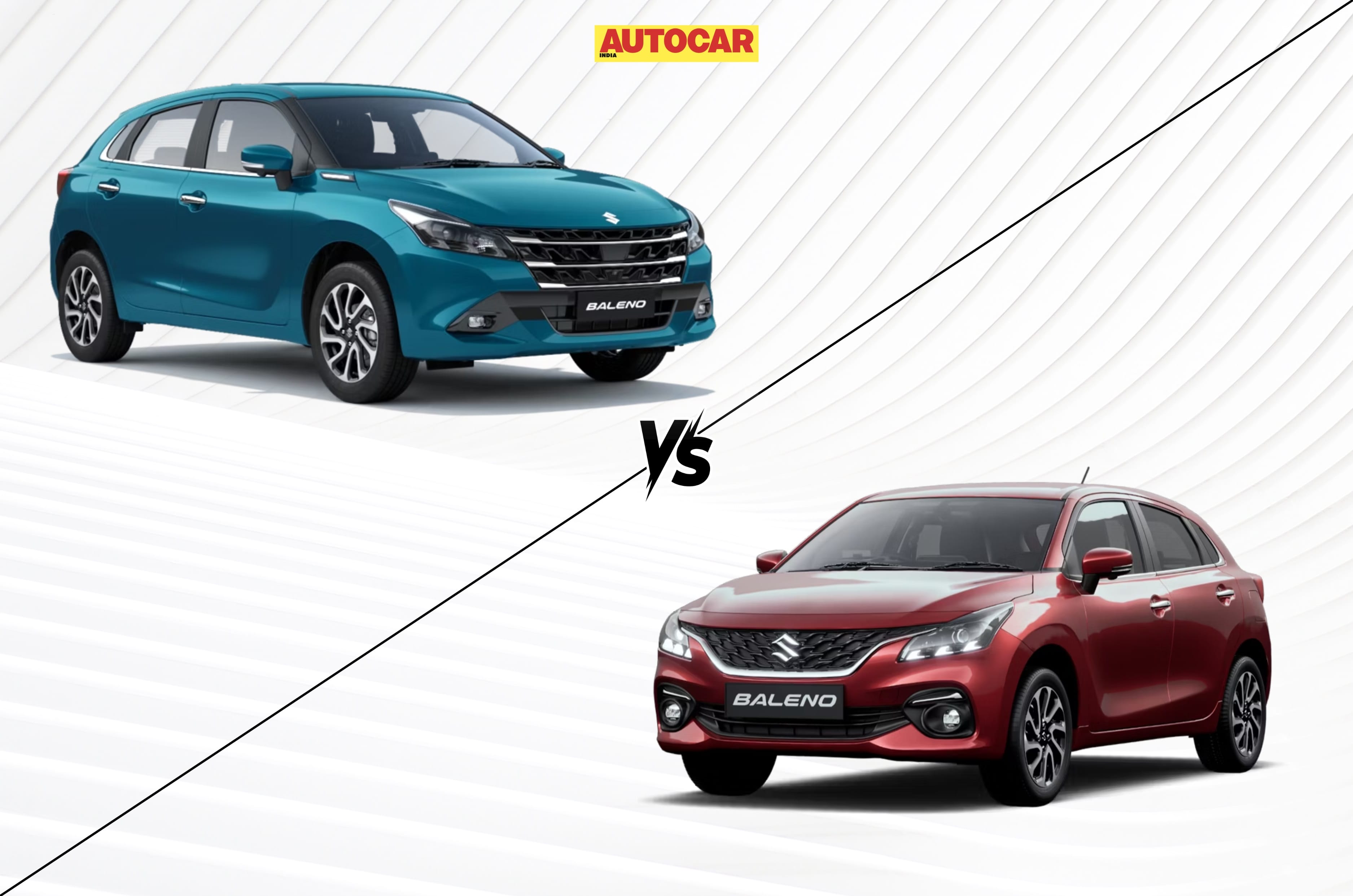
Over four years since its introduction, Maruti has given the second-generation Baleno a facelift. The premium hatchback sold via the brand’s Nexa dealerships continues to drive volumes for Maruti and consistently ranks among the top 10 best-selling cars in India every month. If you’re keen on finding out everything that’s new on the Baleno facelift, look no further, as we take a deep dive into the changes and similarities compared to its predecessor.
2026 Maruti Baleno vs old: Powertrain
New Z-Series engine low on power but high on efficiency
2026 Maruti Baleno vs old: Powertrain
2026 Baleno
Old Baleno
Powertrain
Naturally aspirated petrol | CNG
Naturally aspirated petrol | CNG
Capacity
1.2-litre
1.2-litre
No of cylinders
3
4
Power (hp)
82 | 70
90 | 78
Torque (Nm)
112 | 102
113 | 99
Gearbox
5MT / 5AMT | 5MT
5MT / 5AMT | 5MT
Claimed fuel efficiency
23.80 (MT) 24.77kpl (AMT) | 33.61km/kg
22.35 (MT) 22.94 (AMT) | 30.61km/kg
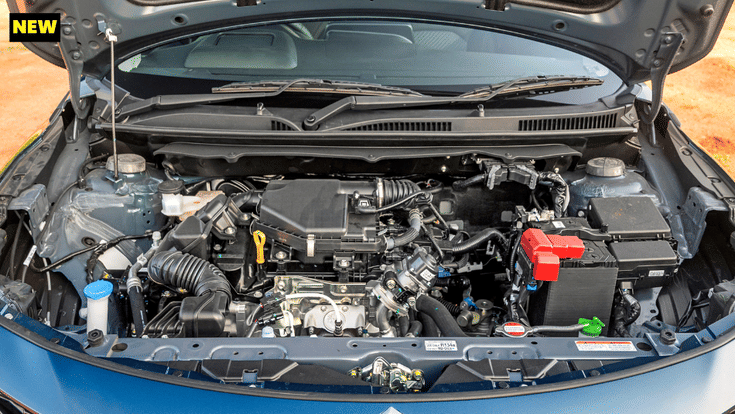
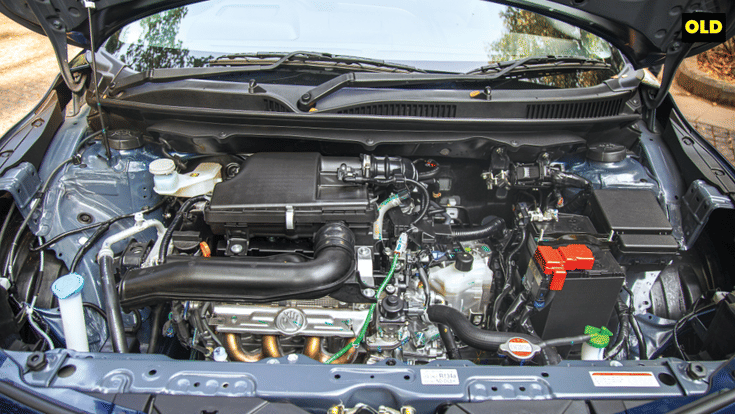
The new Baleno gets Maruti’s Z-Series engine, which is already used in the Swift and Dzire. In comparison to the pre-facelift Baleno’s K-Series engine, the Z-Series engine has the same capacity but drops a cylinder. Additionally, the latter develops lower power figures than the former in petrol guise, but the CNG version sees a slight bump in torque.
Though the new Baleno develops lower power figures, fuel efficiency, on the other hand, has increased. Company-claimed fuel efficiencies of the facelift’s petrol and CNG versions have increased by up to 1.83kpl and 3km/kg, respectively.
2026 Maruti Baleno vs old: Exterior
Revised fascia gets a bolder design
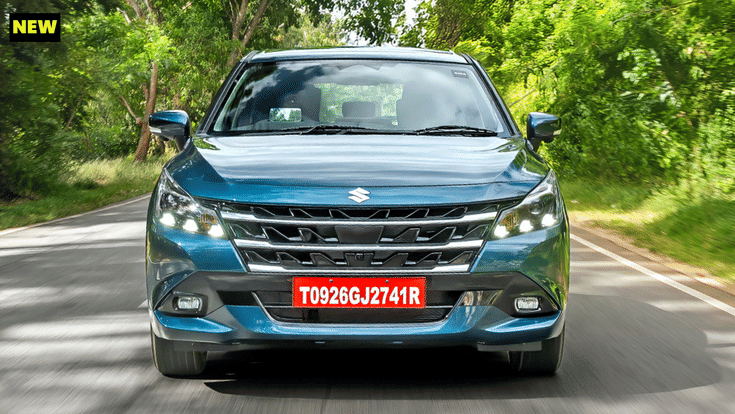
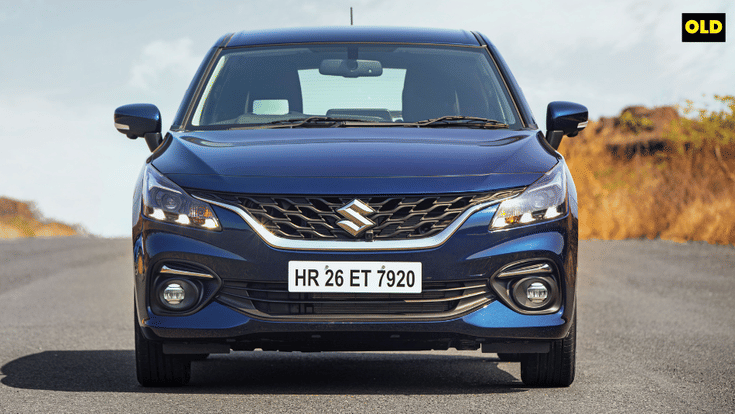
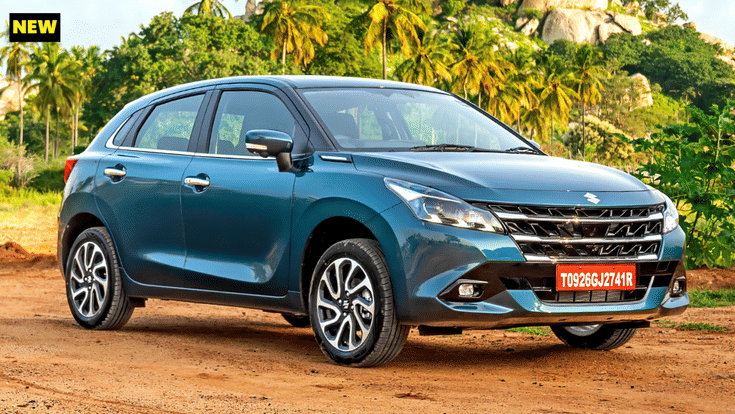
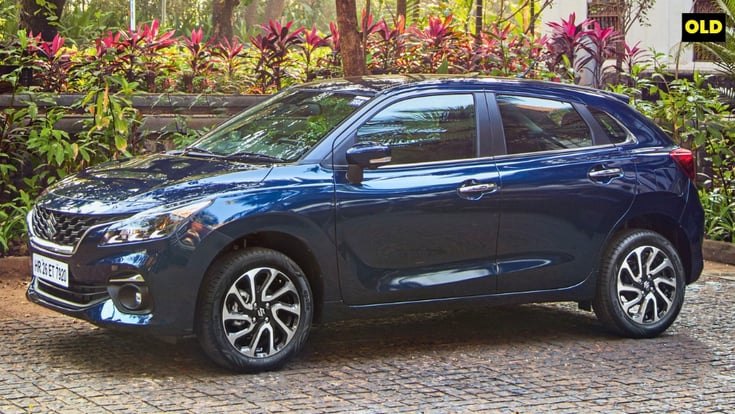
Visually, a majority of the changes to the Baleno facelift are mainly focused on the fascia. Over its predecessor, it gets a much larger grille with three chrome strips and the Suzuki badge repositioned above it. The bumper is restyled with a width-long black trim, giving it a dual-tone look, and it encases rectangular LED fog lamps. Other exterior updates include a shark fin antenna and a chrome garnish on the front fenders.
Apart from these updates, pretty much everything else remains the same. The overall silhouette is retained, and you continue to get the same alloy wheel design, chrome door handles, chrome window beltline, and subtle body moulding on the sides. Place the rear ends of both versions side by side, and it won’t take long to notice that both look identical in this regard.
2026 Maruti Baleno vs old: Features and safety
Baleno facelift gets an improved feature suite and safety kit
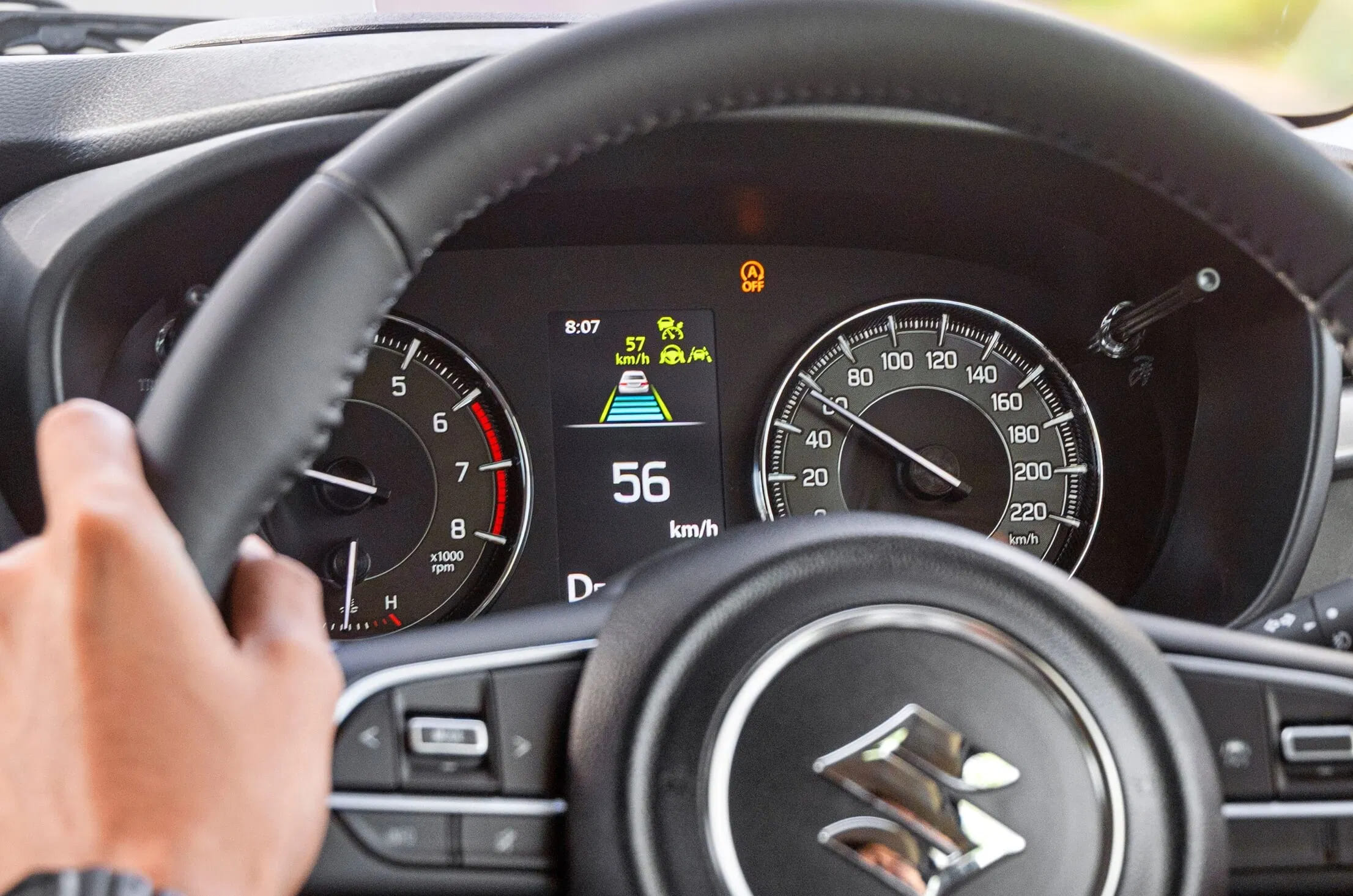
L2 ADAS in the 2026 Maruti Baleno
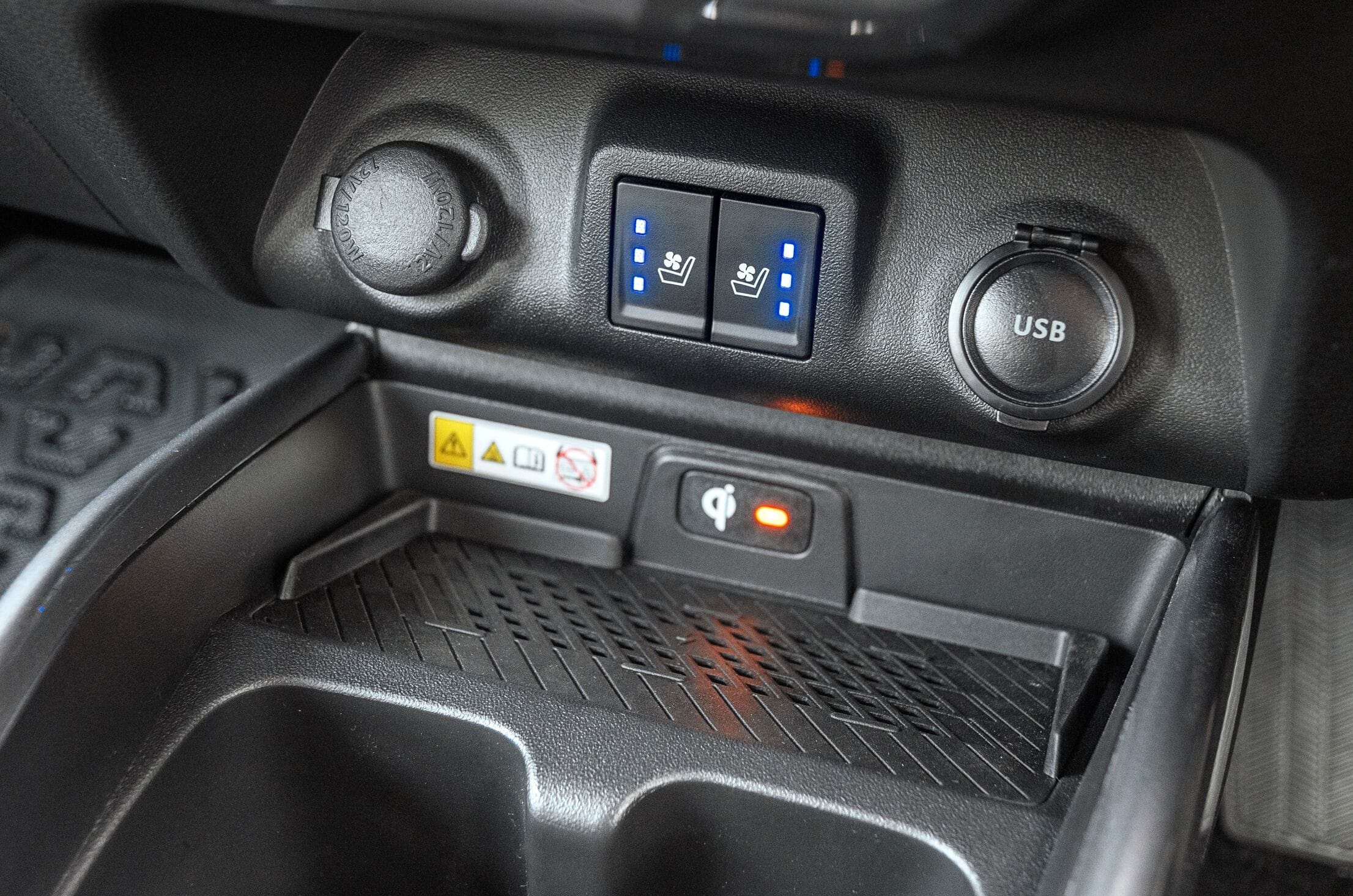
Maruti has heavily bolstered the features and safety kit on the Baleno facelift over its predecessor. New goodies are a wireless phone charger with active cooling, a Clarion sound system, and front-seat ventilation, a segment-only feature. On the safety front, Maruti has made much-needed improvements. These include six airbags fitted as standard across the lineup, a dedicated head restraint and a three-point seatbelt for the central rear passenger, and a tyre pressure monitoring system. Additionally, the Baleno facelift also gets a Level 2 ADAS suite, which is another segment-only feature. The inclusion of ADAS in the Baleno makes it Maruti’s only compact model and the only mainstream hatchback in India to have this tech.
2026 Maruti Baleno vs old: Interior
The facelift retains much of the predecessor’s cabin layout
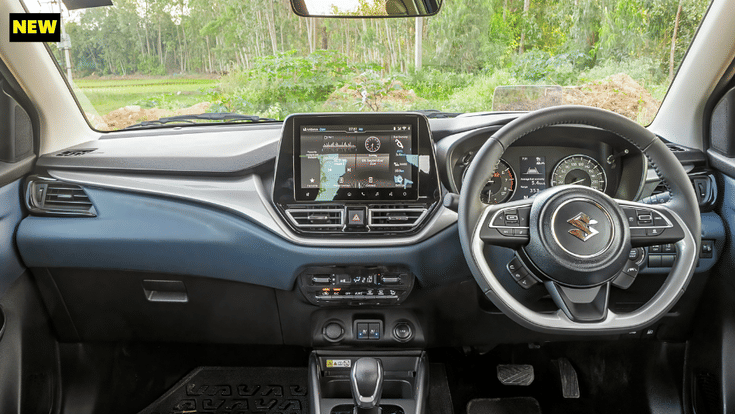
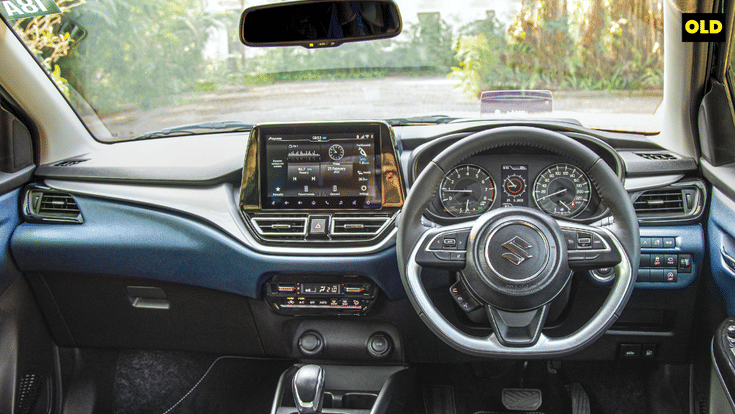
Changes to the interior of the Maruti Baleno facelift are minimal. It retains the black and blue theme and the multi-layered dashboard design from the pre-facelift model. However, the central lower section of the dashboard sees revisions to accommodate the new wireless phone charger and seat ventilation controls. Additionally, the fabric seats from the pre-facelift have been upgraded to semi-leatherette upholstery in the facelift.
2026 Maruti Baleno vs old: Price
Updates make the facelift pricier than the older model
At Rs 6.10 lakh, the Baleno facelift is pricier than the pre-facelift’s starting price of Rs 5.99 lakh. Though a variant-wise price list is awaited, the former is expected to come at a premium over the latter, especially considering the powertrain and feature additions. While the Sigma, Delta, Zeta, and Alpha trims continue to be part of the Baleno lineup, the facelift sees the addition of a new Alpha(O) trim. It sits above the Alpha trim and gets the Level 2 ADAS suite.
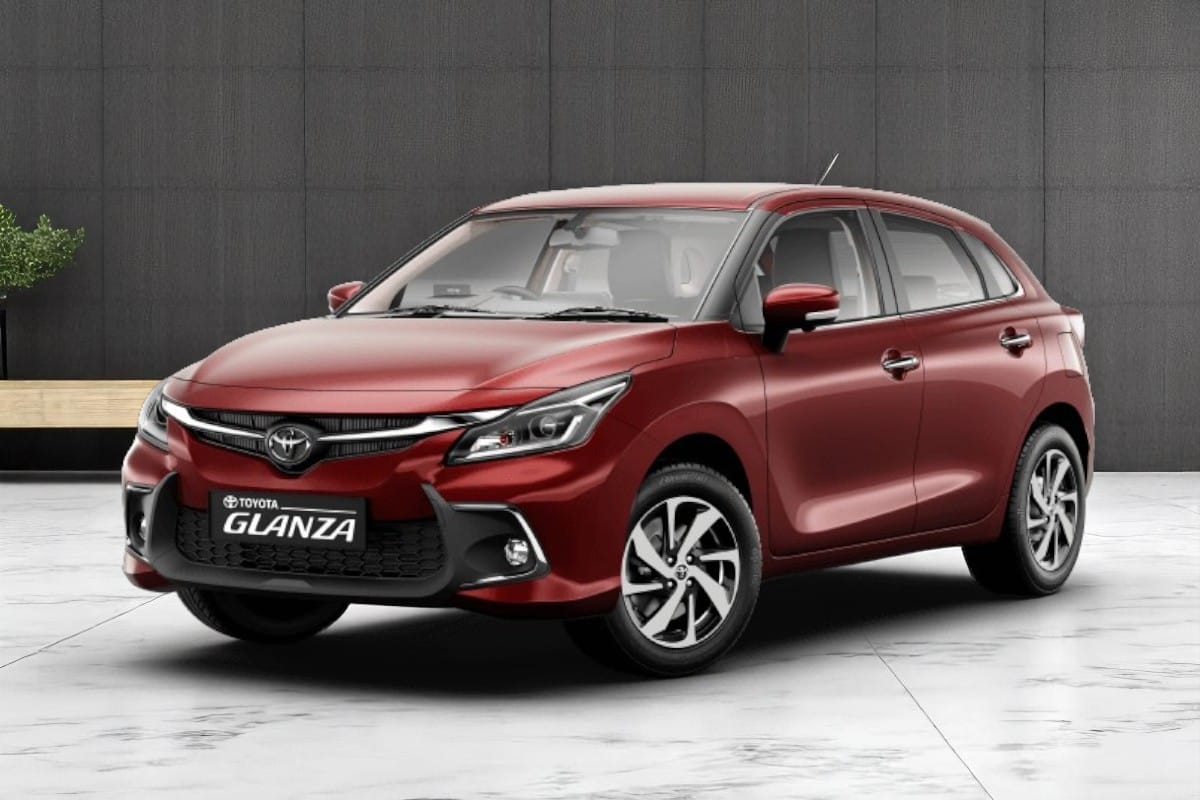
Our dealer sources suggest the Toyota Glanza facelift will debut on October 14, about a month after its Maruti sibling, the Baleno facelift, launched. Changes on board the facelifted Glanza are expected to mirror those of the Baleno facelift, including the new 1.2-litre 3-cylinder petrol engine, a new grille, and added features.
Exterior changes may include a redesigned grille and a new front bumper
New features may include ADAS, ventilated front seats, and a wireless phone charger
Toyota Glanza facelift: Expected changes
Expected to get the Baleno’s new 3-cylinder petrol engine
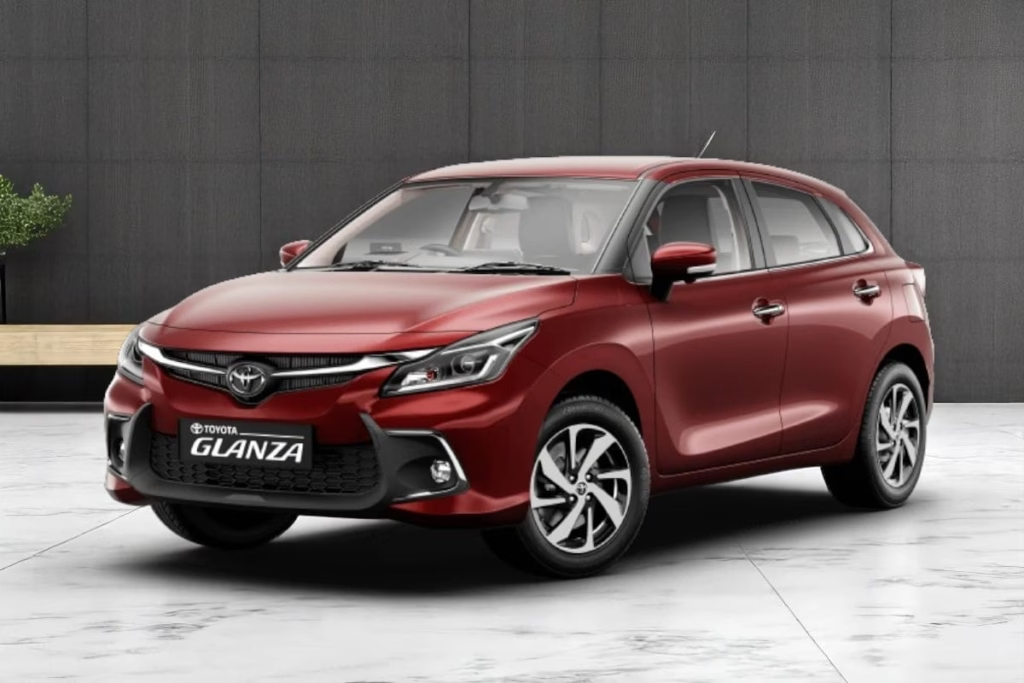
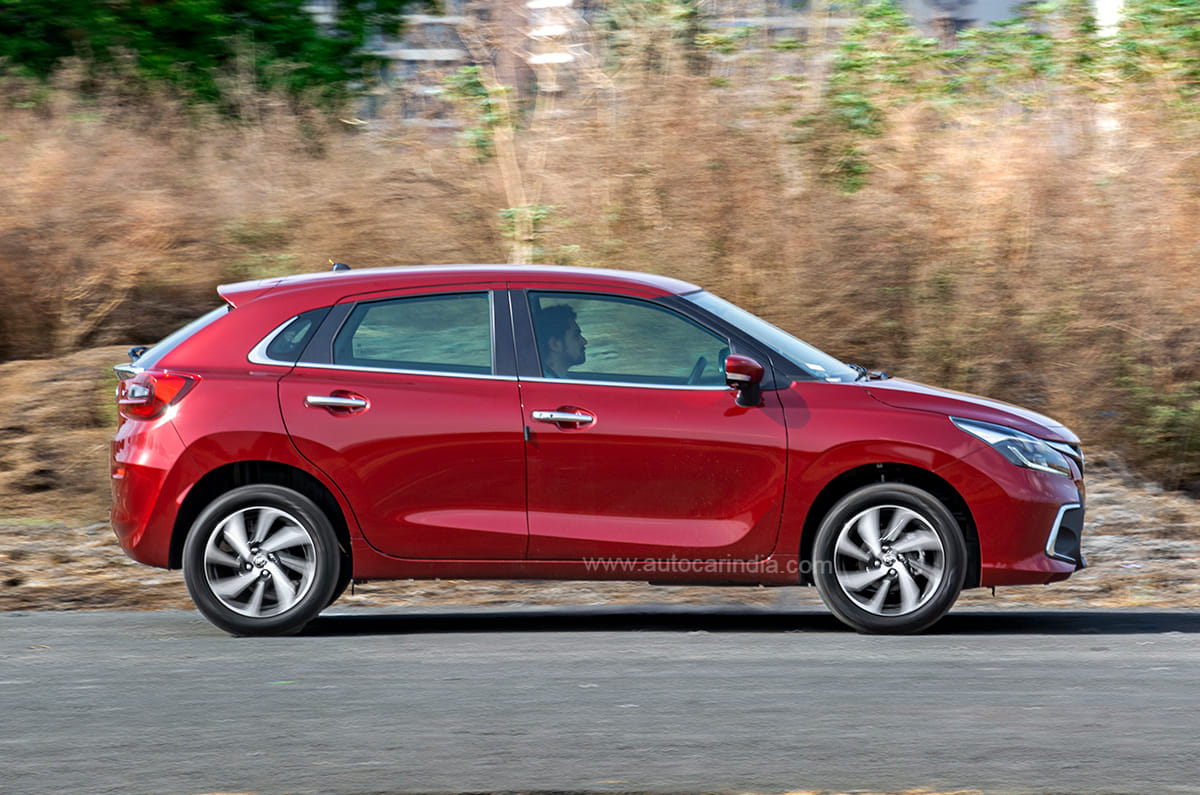
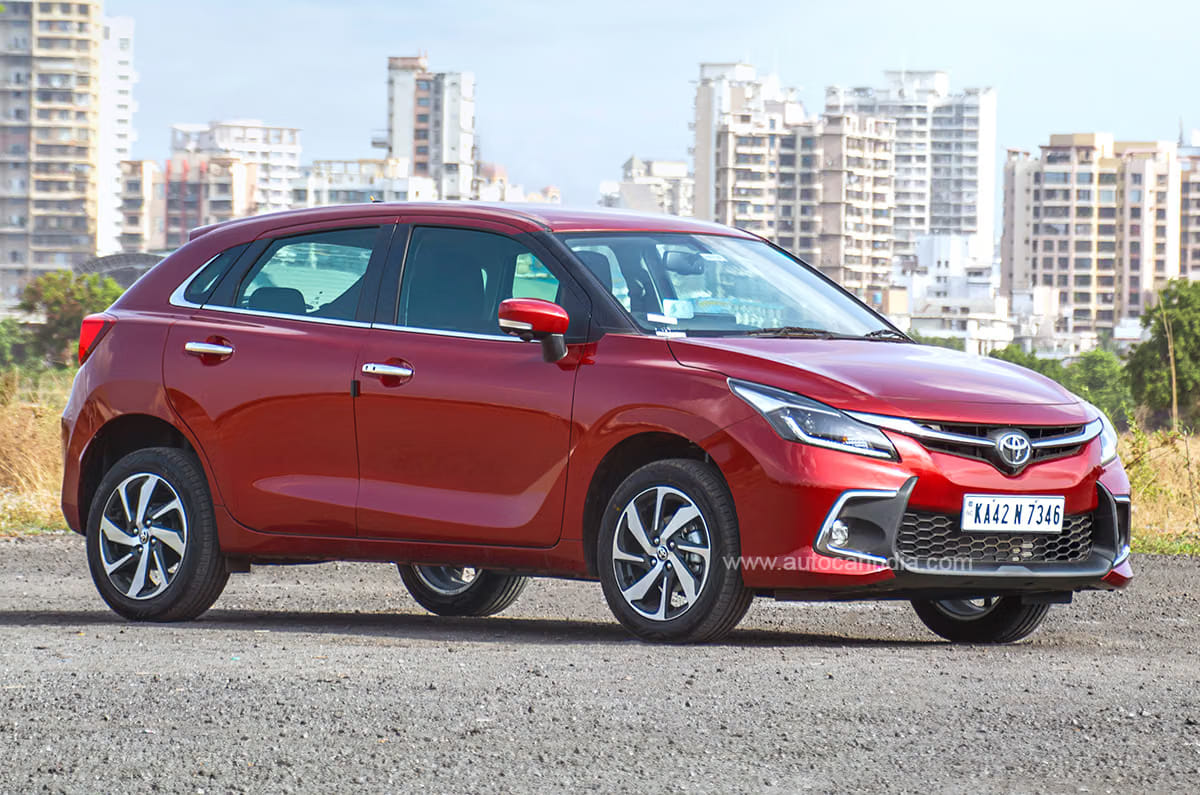
Current-spec Glanza’s image is used for representative purposes only.
With the facelift, Toyota is expected to replace the Glanza’s K12N 1.2-litre 4-cylinder petrol engine with the facelifted Baleno’s new Z12E 1.2-litre 3-cylinder naturally aspirated petrol engine, which produces 83hp and 112Nm. On the Baleno, this engine is offered with a 5-speed manual gearbox and an automated manual transmission (AMT), which is expected on the Glanza facelift too. A 70hp CNG option is also expected with a manual transmission option.
Exterior design changes could be minimal
Current-spec Glanza’s image is used for representative purposes only.
The current Glanza shares most of its design with the pre-facelift Baleno, except the fascia. This distinction is expected to continue with the facelifted Glanza, which could get a redesigned grille and a different front bumper. Other than this, the lighting elements, alloy wheels, and rear bumper could be the same as the current Glanza.
Expected to be offered with new convenience and safety tech
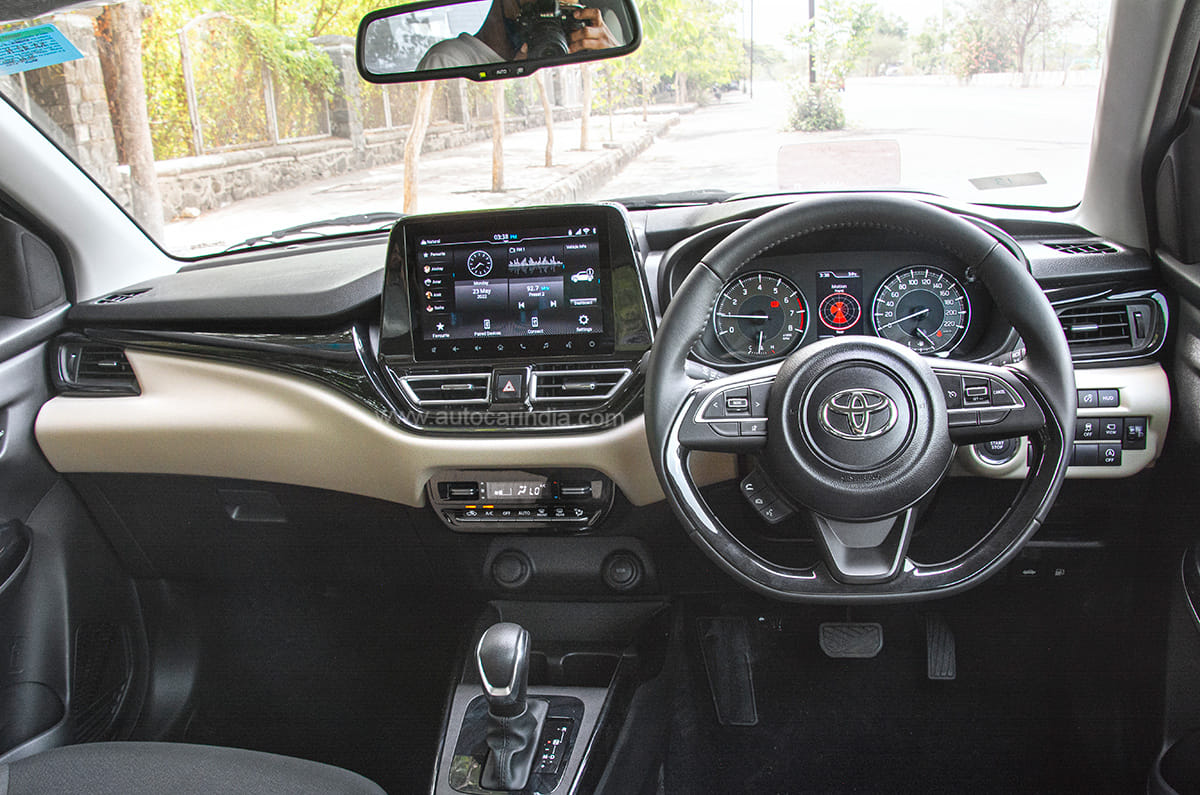
Current-spec Glanza’s dashboard image is used for representative purposes only.
The cabin design is expected to be the same. Some new features introduced on the Baleno facelift could be added to the facelifted Glanza. These include a Level 2 advanced driver assistance system (ADAS), ventilated front seats, a wireless phone charger with ventilation, and a tyre pressure monitoring system (TPMS). A sunroof or a digital driver’s display, however, will be off the cards.
With the facelift, Toyota is expected to price the Glanza at a slight premium over the current model’s Rs 6.73 lakh to Rs 9.99 lakh range (ex-showroom). It will continue to lock horns with premium hatchbacks like the Maruti Suzuki Baleno, Toyota Altroz and Hyundai i20.
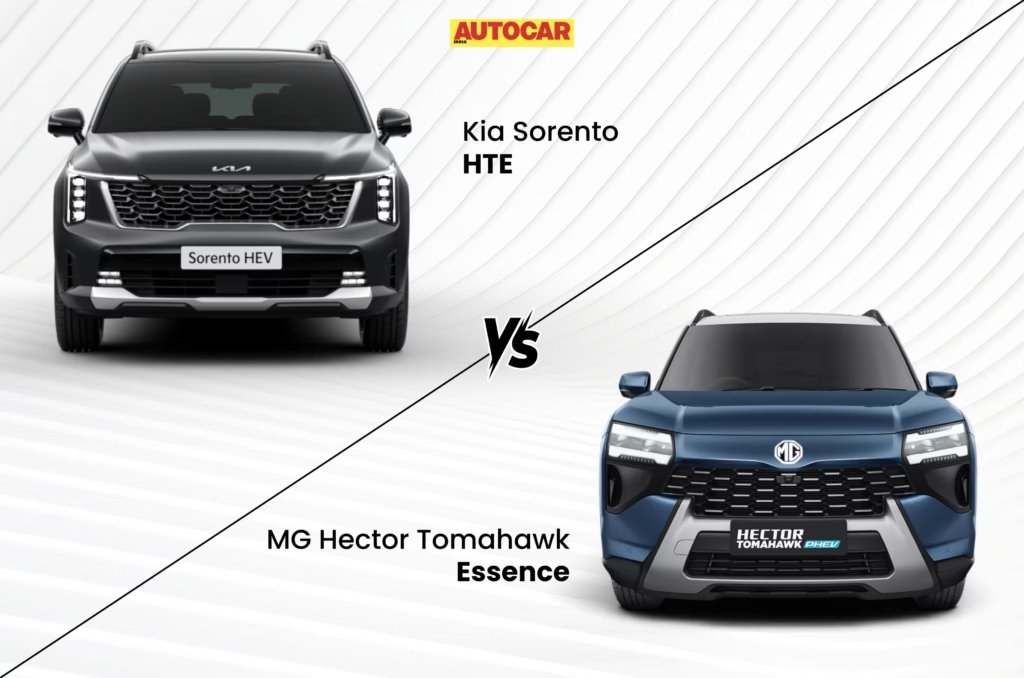
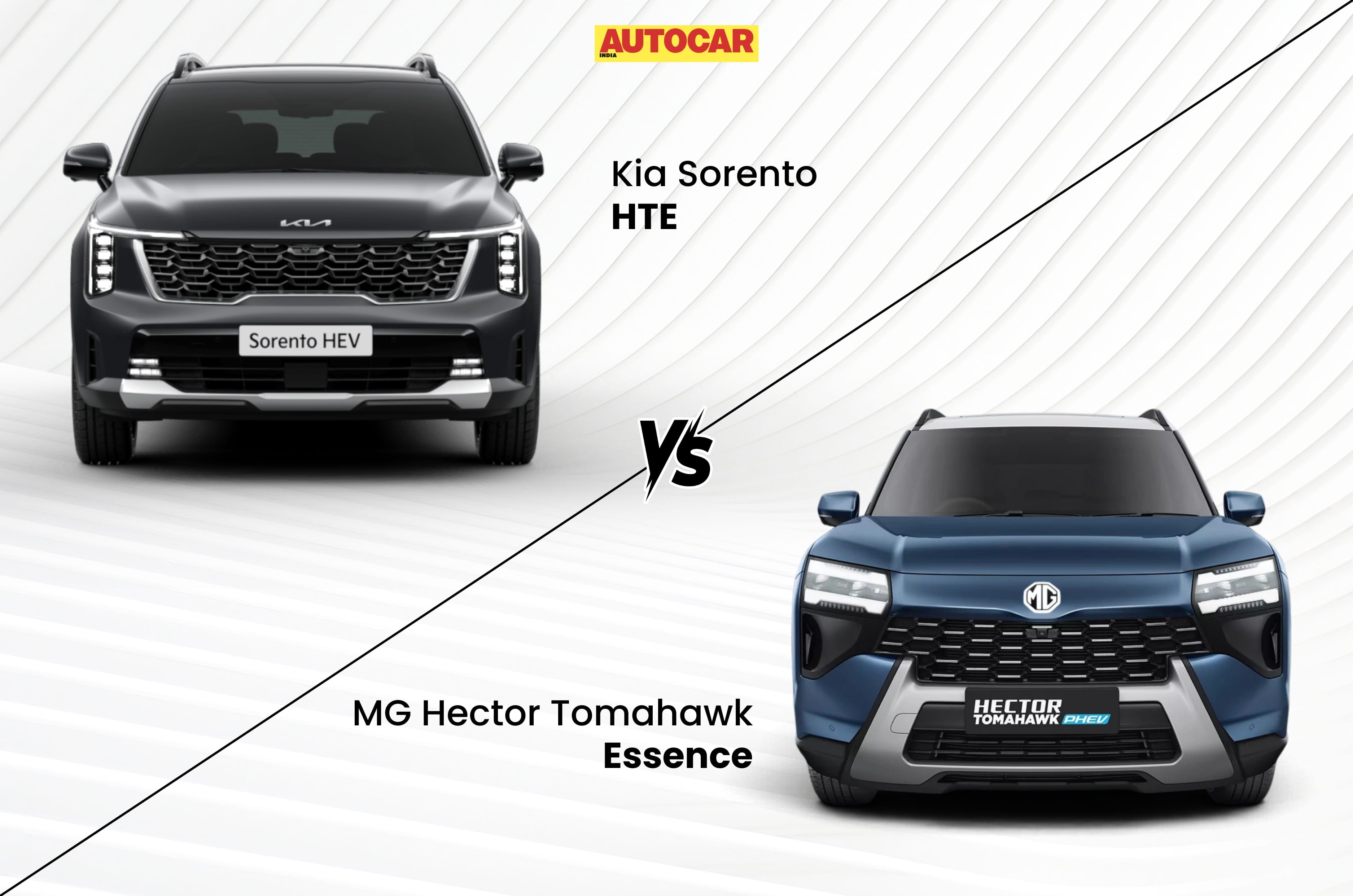
The Sorento is Kia’s first hybrid car to hit the Indian market. A few weeks prior, MG Motor India also launched its first hybrid car, the Hector Tomahawk PHEV. The Sorento is a strong hybrid, meaning it has a relatively small battery pack and isn’t designed for extended periods of pure-electric driving. On the other hand, the Hector Tomahawk PHEV is a plug-in hybrid, which means it gets a much larger battery that delivers a usable all-electric range.
If you’re looking to purchase a 7-seater hybrid SUV under the Rs 30 lakh price point (ex-showroom), the Sorento hybrid’s base variant (HTE) and the Hector Tomahawk PHEV’s top-spec variant are both within your reach. We examined their spec sheets closely to find out which of them is more value-for-money.
Kia Sorento hybrid base-spec vs MG Hector Tomahawk PHEV top-spec: Dimensions
Sorento is larger overall, while Hector Tomahawk PHEV has a bigger boot
Sorento Hybrid HTE
Hector Tomahawk PHEV Essence
Length (mm)
4,815
4,745
Width (mm)
1,900
1,850
Height (mm)
1,785
1,770
Wheelbase (mm)
2,815
2,810
Boot space*
179
192
Wheel size (inches)
18
18
*Measured with third row up.
While the Sorento is a good 70mm longer than the Hector Tomahawk PHEV, the difference between their wheelbases is just 5mm. The Kia SUV is 50mm wider and 15mm taller too, but the Hector Tomahawk PHEV has a slightly larger boot.
Kia Sorento hybrid base-spec vs MG Hector Tomahawk PHEV top-spec: Powertrains
Sorento has more powerful engine, while Hector Tomahawk PHEV offers more electric range
Sorento Hybrid HTE
Hector Tomahawk PHEV Essence
Engine
1.6-litre turbo-petrol
1.5-litre petrol
Cylinder count
4
4
Engine power (hp)
180
102
Engine torque (Nm)
265
125
Motor power (hp)
65
201
Motor torque (Nm)
264
237
Combined power (hp)
–
198
Combined torque (Nm)
–
230
Gearbox
6-speed AT
DHT
Battery capacity (kWh)
–
20.5
Claimed electric range (km)
–
115
Fuel tank capacity
67
52
3.3kW AC charging time
–
7.5 hrs (10-100%)
25kW DC charging time
–
35 mins (30-80%)
The Sorento is the first car in India to offer a turbo-petrol strong hybrid powertrain, while the Hector Tomahawk PHEV is the first plug-in hybrid to be available in the mass-market segment. In terms of pure combustion power, the Sorento’s direct-injection turbo-petrol engine is much stronger than the Hector Tomahawk PHEV’s naturally aspirated mill. The MG’s electric motor makes over three times more power than that of the Sorento, but less torque.
Kia has not yet disclosed the combined output of the India-spec Sorento hybrid, so it’s difficult to compare it with the Hector Tomahawk PHEV in this regard. The Hector Tomahawk PHEV gets a substantial 20.5kWh battery pack, which can supply a claimed all-electric range of 115km (overall driving range is rated at over 1,100km) and can be charged via AC or DC wallboxes. On the other hand, the Sorento’s self-charging hybrid system means the engine solely charges the battery. The increased dependence on the engine means the Sorento’s fuel tank is larger too.
Kia Sorento hybrid base-spec vs MG Hector Tomahawk PHEV top-spec: Exterior features
Hector Tomahawk PHEV offers LED tail-lamps, rear fog lamps, and powered tailgate
Sorento Hybrid HTE
Hector Tomahawk PHEV Essence
LED headlamps
Yes
Yes
Rear fog lamps
No
Yes
LED tail-lamps
No
Yes
Illuminated logo
No
Yes
Roof rails
Yes
Yes
Powered ORVMs
Yes
Yes
Powered tailgate
No
Yes
Rear spoiler
Yes
Yes
Colour options
7, monotone
8, monotone+dual-tone
The Hector Tomahawk PHEV easily takes the win here, offering equipment like LED tail-lamps, rear fog lamps, a powered tailgate, and an illuminated logo over the Sorento. The MG SUV also offers dual-tone exterior finishes, while the Sorento comes in monotone colours only.
Kia Sorento hybrid base-spec vs MG Hector Tomahawk PHEV top-spec: Interior features
Hector Tomahawk PHEV is packed with several more goodies than the Sorento
Sorento Hybrid HTE
Hector Tomahawk PHEV Essence
Infotainment screen
12.3-inch
15.6-inch
Instrument cluster
Analogue w/ MID
8.8-inch
Sunroof
No
Panoramic
Wireless charger
Yes
Yes
Powered front seats
Driver only
Yes
Ventilated front seats
No
Yes
Dual-zone climate control
Yes
No
Ambient lighting
No
Yes
Sound system
6-speaker
10-speaker Infinity
Apple CarPlay and Android Auto
Wireless
Wireless
Cabin air purifier
No
Yes
Connected car tech
No
Yes
Rear window sunshade
No
Yes
Rear centre armrest
Yes
Yes
Sliding, reclining rear seats
Yes
Yes
Expectedly, the Hector Tomahawk PHEV edges ahead of the Sorento on this front too. The MG has a larger screen, a digital driver’s display, ventilated and powered front seats, a panoramic sunroof, a superior sound system, ambient lighting, cabin air purifier, and more. The Sorento’s only point against the Hector Tomahawk PHEV is the inclusion of a dual-zone climate control system.
Kia Sorento hybrid base-spec vs MG Hector Tomahawk PHEV top-spec: Driving features
Sorento gets virtual engine sounds, while Hector Tomahawk PHEV offers adaptive cruise control
Sorento Hybrid HTE
Hector Tomahawk PHEV Essence
Drive modes
4
4
Virtual engine sounds
Yes
No
Paddle shifters
Yes
Yes
Cruise control
Yes
Adaptive
The Sorento holds its own in this department, matching the Hector Tomahawk PHEV in most aspects and even additionally offering virtual engine sounds. However, the Hector Tomahawk PHEV gets adaptive cruise control, which can automatically adjust the speed based on proximity to the vehicle in front, whereas the Sorento gets conventional cruise control with manual speed limit adjustment.
Kia Sorento hybrid base-spec vs MG Hector Tomahawk PHEV top-spec: Safety features
Sorento has 7 airbags, but Hector Tomahawk PHEV gets ADAS, 360-deg camera, and more
Sorento Hybrid HTE
Hector Tomahawk PHEV Essence
Level 2 ADAS
No
Yes
Airbags
7
6
ABS w/ EBD
Yes
Yes
ESC
Yes
Yes
Hill hold control
Yes
Yes
TPMS
Yes
Yes
Camera setup
Rear
360-degree
Parking sensors
Front, rear
Front, rear
Electronic parking brake
Yes
Yes
Rain-sensing wipers
Yes
Yes
Isofix child-seat anchors
Yes
Yes
Disc brakes
Front, rear
Front, rear
Both SUVs are pretty well-matched when it comes to safety features, but yet again, the Hector Tomahawk PHEV pulls ahead by way of offering Level 2 ADAS and a 360-degree camera. The Sorento, on the other hand, comes with an additional airbag.
Kia Sorento hybrid base-spec vs MG Hector Tomahawk PHEV top-spec: Prices
Hector Tomahawk PHEV is more affordable by Rs 1.69 lakh
Sorento Hybrid HTE
Hector Tomahawk PHEV Essence
Price (in Rs, lakh)
29.49
27.80
If all the extra bells and whistles weren’t enough, the top-spec Hector Tomahawk PHEV turns out to be the more affordable option too, undercutting the base Sorento hybrid by Rs 1.69 lakh. Therefore, if you want a sedate, refined SUV that offers EV efficiency for city commutes and ICE dependability during highway trips, the Hector Tomahawk PHEV is our pick. On the other hand, if you can forgo a lot of the Hector Tomahawk PHEV’s features in the pursuit of better performance, the Sorento hybrid is worth a look.
Maruti Suzuki recently updated the Baleno with new features, cosmetic changes and, most significantly, a new 1.2-litre three-cylinder petrol engine. It is available with petrol and CNG powertrains, with manual and AMT gearbox options on offer, and is priced from Rs 6.10 lakh onwards. But does it have what it takes to be the right premium hatchback for you? Here are three reasons to consider the Baleno and two reasons why you may want to look elsewhere.
Pros
1. Spacious and well-equipped cabin
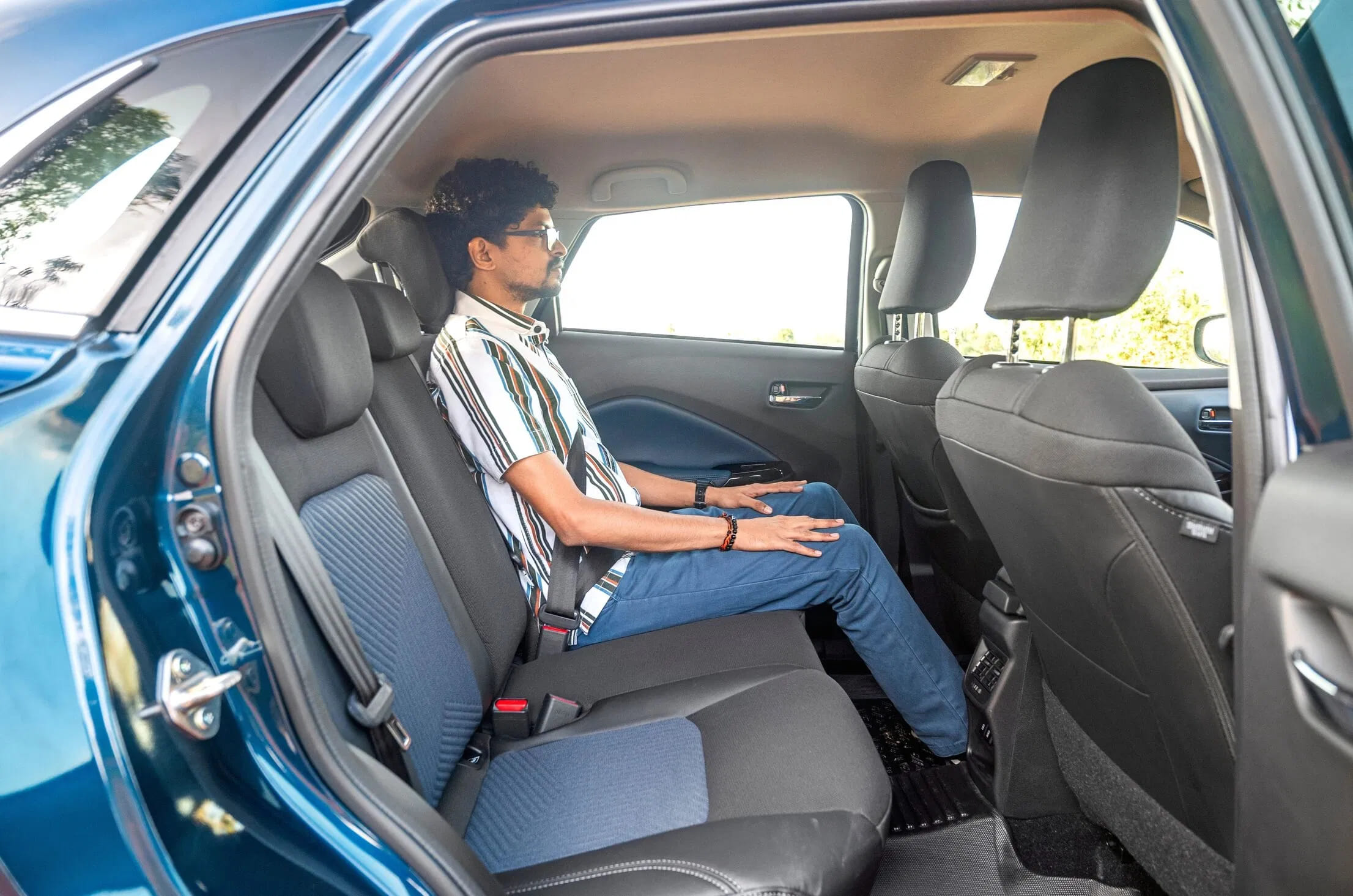
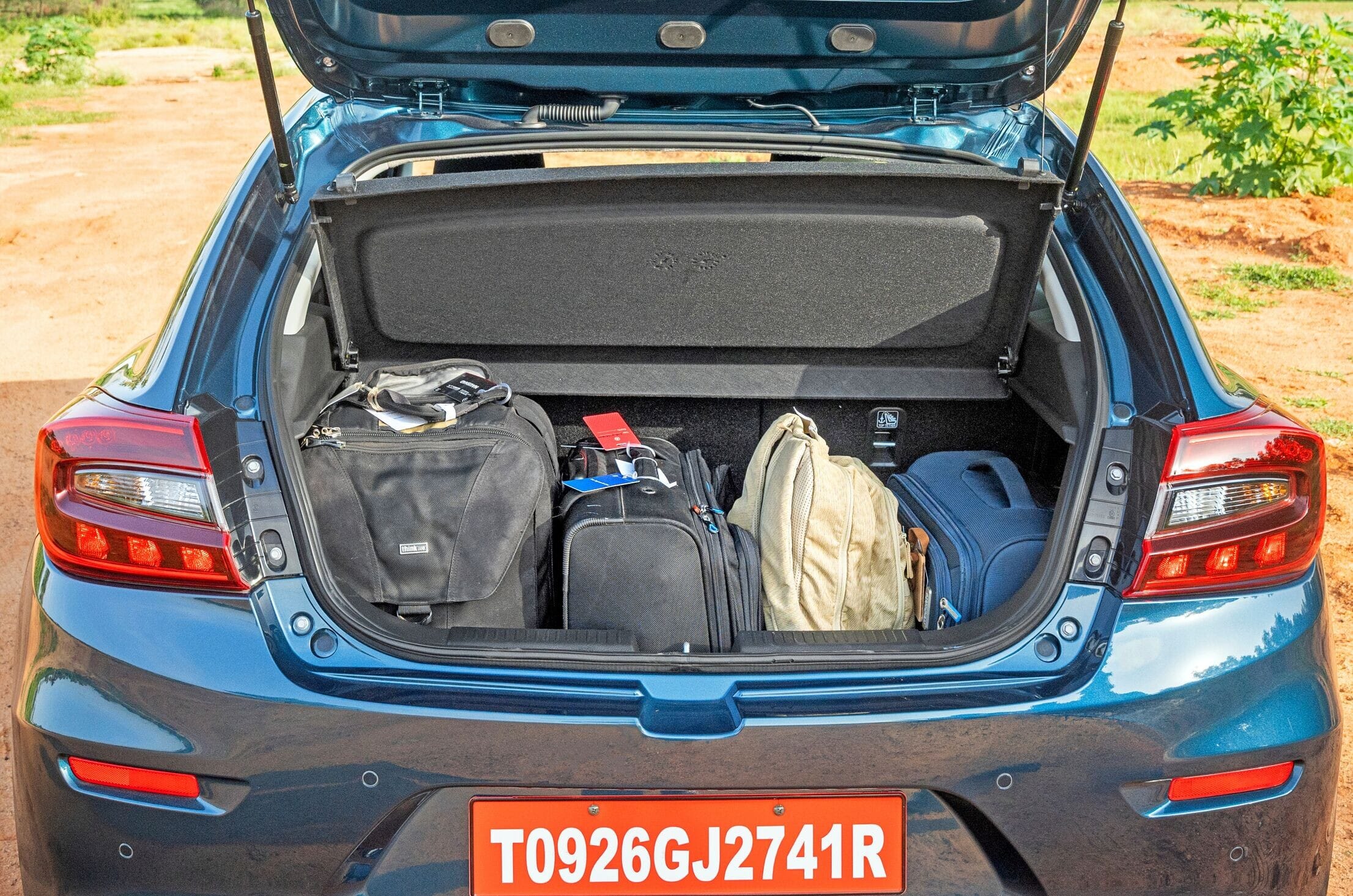
The Baleno has a spacious cabin, particularly at the rear, with ample headroom and legroom for tall passengers. The seats offer good cushioning and under-thigh support, while rear passengers get dedicated AC vents and USB charging ports. The 318-litre boot is useful for everyday needs, although the loading lip is high.
The equipment list is also a highlight, with the Baleno being the only in its segment to offer Level 2 ADAS and ventilated front seats. A head-up display is another useful addition, while the top-spec Alpha (O) also gets a 9-inch touchscreen with wireless smartphone integration, automatic climate control, a cooled wireless charger and connected-car features. Six airbags and traction control are standard.
2. Refined engine with strong claimed fuel efficiency
The 1.2-litre three-cylinder Z-series petrol engine produces 83hp and 112Nm and is one of the more refined three-cylinder engines. It has good low-end response, smooth power delivery and is well suited to everyday city driving. Fuel efficiency is another strong point. The petrol-manual has a claimed 23.80kpl, while the AMT claims 24.77kpl. The CNG version is rated at 33.61km/kg, although these are claimed figures and real-world efficiency will be lower.
3. Comfortable ride and good high-speed composure
The Baleno’s soft suspension delivers an excellent low-speed ride, absorbing most road imperfections with ease. Only sharp bumps and large potholes tend to unsettle it, making the car particularly comfortable around town.
It also remains composed at higher speeds, with well-contained body movements. The steering is light at low speeds for easy manoeuvring and gains weight as speed increases, while body control is good through corners.
Cons
1. AMT can hesitate during quick overtakes
The five-speed AMT is reasonably smooth but has a noticeable head-nod between shifts. More importantly, it can take time to downshift when a quick overtake is required, resulting in hesitation. Manual mode helps by letting the driver select the required gear, while the five-speed manual itself is smoother and more satisfying to use, with a light clutch and short, well-defined shifts.
2. Outright performance is not its strength
The Z-series engine has good low-end response and smooth power delivery, but it lacks punch higher up the rev range. It is also less peppy than the older K-series engine, while its lower output and the new Baleno’s higher weight compared to its predecessor result in slower outright acceleration. For regular city driving, the engine is adequate and easy to use. However, buyers looking for stronger acceleration, particularly during highway overtakes, may find it lacking.
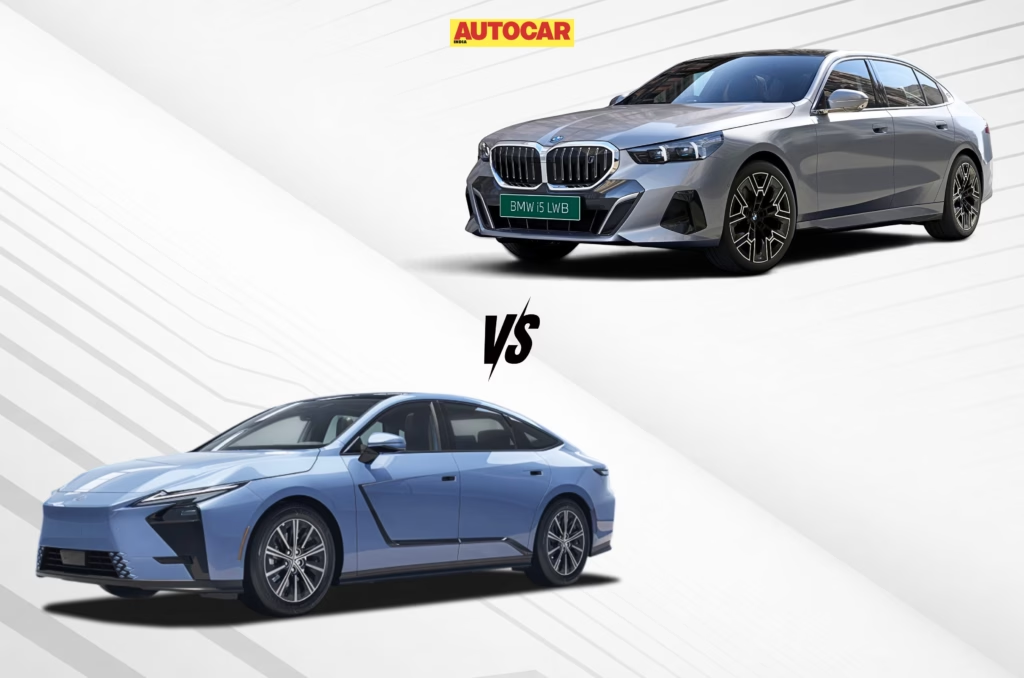
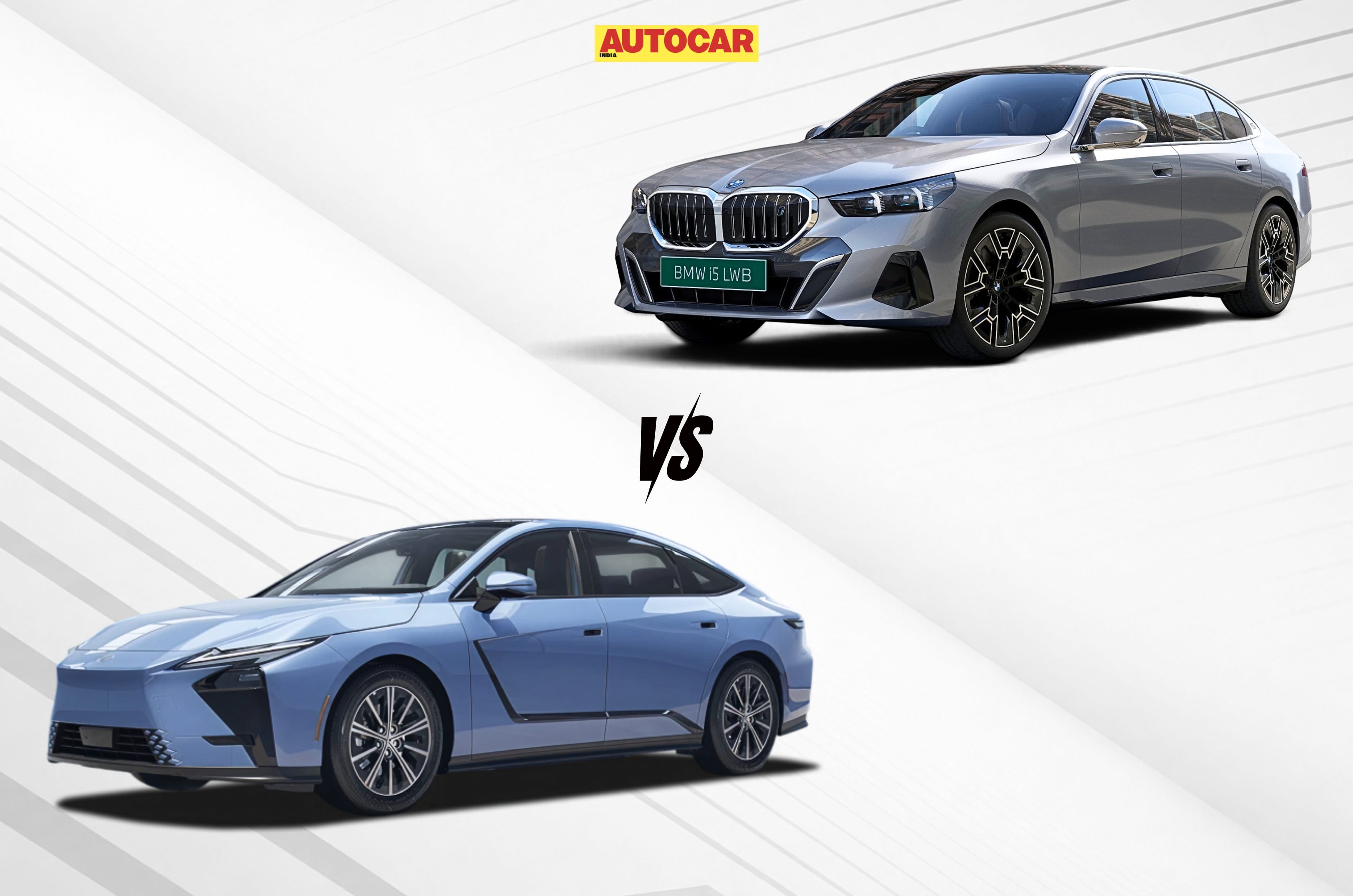
The BMW i5 LWB (long wheelbase) and Lexus ES 500e are two of the latest additions to the luxury electric sedan segment. Both pack an extensive list of features, but each has an advantage in some areas. They also get different battery pack sizes, and their peak power and torque outputs vary as well. So, how different are the two on paper? We find out.
BMW i5 LWB vs Lexus ES 500e: Dimensions
BMW i5 LWB
Lexus ES 500e
Length
5,175mm
5,145mm
Width
2,156mm
1,920mm
Height
1,520mm
1,575mm
Wheelbase
3,105mm
2,950mm
Boot space
Not disclosed
377 litres
Wheel size
20 inch
21 inch
The BMW i5 LWB is slightly longer by 30mm than the Lexus ES 500e, but the bigger difference is in width. The i5 LWB is 236mm wider than the Lexus; however, the ES 500e is 55mm taller. The BMW sedan also has a 155mm longer wheelbase. In terms of wheels, the Lexus EV rides on 21-inch units, which are 1 inch larger than the i5’s 20-inch ones. BMW has not disclosed the i5 LWB’s boot capacity at the time of writing. Meanwhile, the Es 500e has a 377 litre boot.
Another point of difference is the suspension. The i5 LWB gets rear-axle air suspension, which should offer better ride comfort in real-world conditions, while the ES 500e uses a multi-link setup.
BMW i5 LWB vs Lexus ES 500e: Powertrain specs
BMW i5 LWB
Lexus ES 500e
Battery size
81.6kWh
74.68kWh
Drive configuration
RWD
AWD
Power
268hp
343hp
Torque
410Nm
438Nm
0-100kph
6.7 seconds
5.5 seconds
Claimed range
669km (MIDC)
580km (WLTP)
AC charging (0-100 percent)
Not revealed (11kW charger)
~4 hours (22kW charger)
DC charging (10-80 percent)
33 minutes (160kW charger)
28 minutes (150kW charger)
Clearly, the dual-motor setup of the ES 500e makes much more peak outputs that the i5 LWB, which gets just a rear-mounted electric motor. Compared to the i5, the ES 500e has a 75hp and 28Nm advantage. It’s also quicker, taking 5.5 seconds to go from 0-100kph, which is 1.2 seconds quicker than the BMW. The BMW, however, gets a larger 81.6kWh battery than the Lexus’ 74.68kWh unit.
As for the claimed range figures of the two sedans, it should be noted that the i5 LWB’s 669km figure is based on the modified Indian driving cycle (MIDC), which is more relaxed than the worldwide harmonised light vehicles test procedure (WLTP). The ES 500e, meanwhile, claims a range of 580km on the stricter WLTP cycle.
When it comes to fast charging times, the ES 500e has the upper hand. On DC charging, the Lexus takes 28 minutes from 10-80 percent compared to 33 minutes for the BMW. Although the BMW supports a slightly higher maximum charging speed of 160kW compared to the Lexus’ 150kW, its longer charging time could be due to the BMW sedan’s larger battery pack.
BMW i5 LWB vs Lexus ES 500e: Exterior features
BMW i5 LWB
Lexus ES 500e
LED headlamps
Yes
Yes
LED DRLs
Yes
Yes
LED tail-lights
Yes
Yes
Fog lamps
No
Yes
Powered ORVMs
Yes
Yes
Door handles
Flap type
Flush-fitting
Shark-fin antenna
Yes
Yes
Powered tail-gate
Yes
Yes
In terms of exterior features, both sedans are similarly equipped. Both get LED headlamps, LED DRLs, LED tail-lights, powered ORVMs, shark-fin antennas and powered tail-gates. The Lexus, however, stands out here with fog lamps. The two also differ in their door-handle designs. The i5 LWB uses flap-type handles, while the ES 500e gets flush-fitting units.
BMW i5 LWB vs Lexus ES 500e: Interior features
BMW i5 LWB
Lexus ES 500e
Touchscreen
14.9 inch
14 inch
Digital driver’s display
12.3 inch
12.3 inch
Speakers
17-speaker Bowers & Wilkins
17-speaker Mark Levinson
Sunroof
Fixed, panoramic
Openable, single-pane
Ventilated front seats
Yes
Yes
Rear centre armrest
Yes
Yes
Wireless charger
Front and rear (1 each)
Front (2)
Ambient lighting
Yes
Yes
Apple CarPlay and Android Auto
Wireless
Wireless
Connected car tech
Yes
Yes
Rear sunshades
No
Yes
Soft-close doors
No
Yes
Digital IRVM
No
Yes
The two sedans get a 12.3-inch digital driver’s display, 17 speakers, ventilated front seats, rear centre armrest, ambient lighting, wireless Apple CarPlay and Android Auto, and connected car tech. While the BMW gets a Bowers & Wilkins sound system, the Lexus opts for a Mark Levinson setup.
The BMW gets a slightly larger 14.9-inch touchscreen compared to the Lexus’ 14-inch unit. The sunroof setup is different too, with the i5 LWB getting a fixed panoramic unit with integrated lights, while the ES 500e has an openable single-pane unit. The BMW also gets one wireless charger each at the front and rear, whereas the Lexus gets two at the front. The Lexus claws back some ground with rear sunshades, soft-close doors and a digital IRVM, all of which are missing on the BMW.
BMW i5 LWB vs Lexus ES 500e: Safety features
BMW i5 LWB
Lexus ES 500e
Airbags
8
8
360-degree camera
Yes
Yes
Electronic parking brake
Yes
Yes
Digital IRVM
No
Yes
ISOFIX seat anchors
Yes
Yes
Rear defogger
Yes
Yes
ADAS
Yes
Yes
Both the sedans are evenly matched on most safety features. Both get eight airbags, a 360-degree camera, electronic parking brake, ISOFIX child seat anchors, rear defogger and ADAS. The Lexus, however, offers a digital IRVM, which is not offered on the BMW.
BMW i5 LWB vs Lexus ES 500e: Verdict
BMW i5 LWB
Lexus ES 500e
Ex-showroom price (Rs lakh)
79.60
89.99
Pricing is one area where the BMW i5 LWB and Lexus ES 500e differ quite significantly, by Rs 10.39 lakh to be precise. The other difference is in outright performance. The ES 500e’s AWD setup gives it an advantage in acceleration from 0-100kph. However, for most buyers, the i5 LWB makes more sense, as it gets a relatively larger battery pack and is much more accessible in terms of price. In addition to that, you also get the BMW badge value.
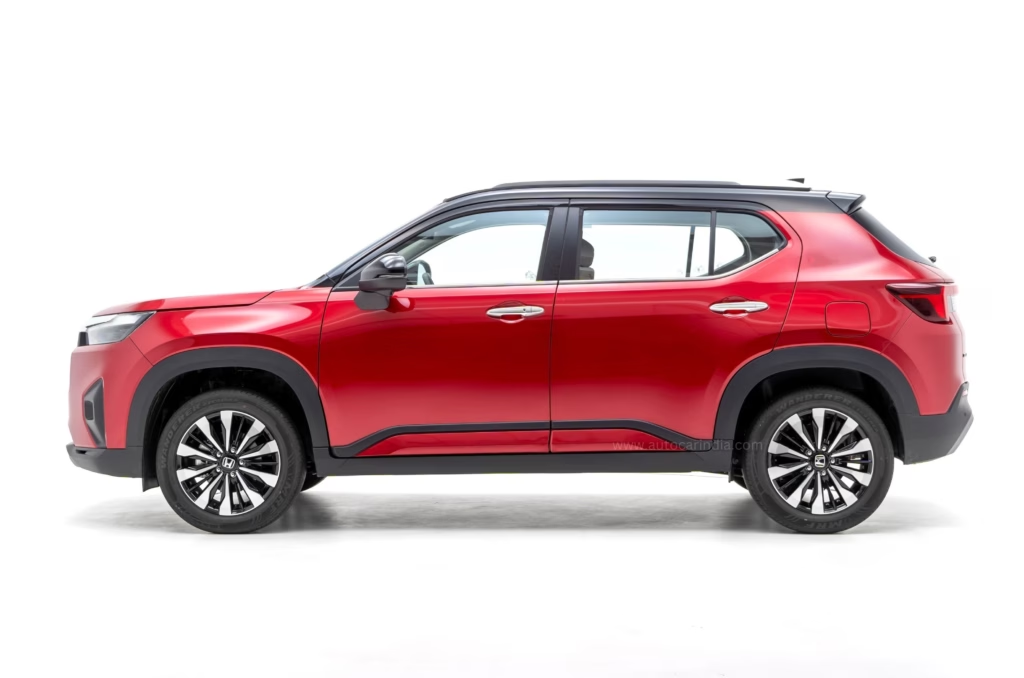
The Honda Elevate facelift will debut in India in early October 2026, our dealer sources suggest. The Elevate was introduced in June 2023, and the facelift could update its exterior and interior design while adding new features. The facelifted Elevate is, however, expected to remain mechanically unchanged.
It could have revised exterior lighting and a redesigned grille
Expected to borrow ventilated front seats from City
Honda Elevate facelift: Expected changes
Could get revised exterior lighting elements
The current Honda Elevate is shown for representative purposes only.
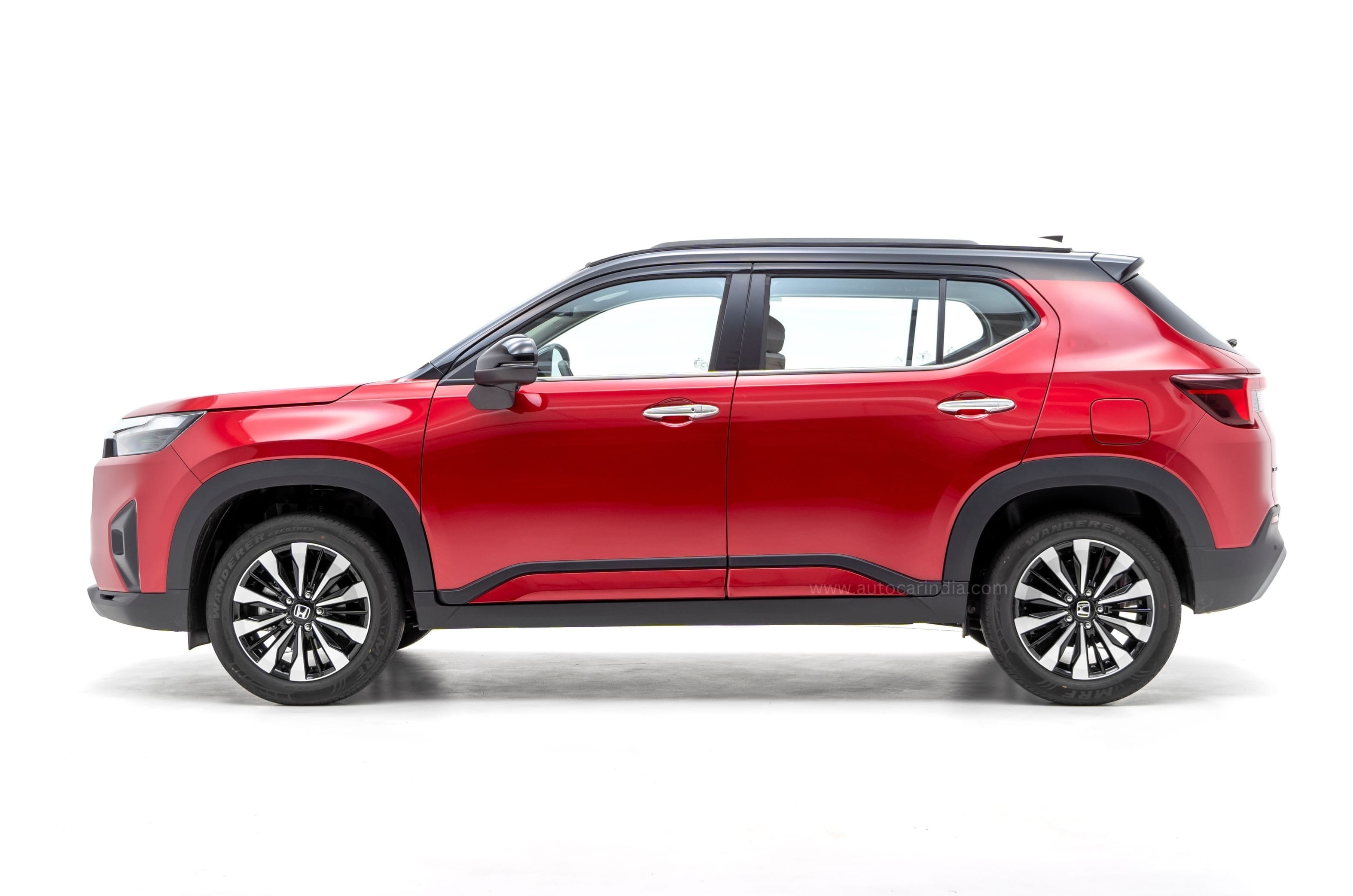
The Honda Elevate facelift, similar to the recently updated City sedan, is expected to receive some styling changes. These could include revised LED lighting elements, a redesigned grille, a new design for the 17-inch alloy wheels and revised front and rear bumpers.
More features are expected to keep the cabin more modern
The current Honda Elevate’s dashboard is shown for representative purposes only.
Inside, the Elevate facelift could get a new cabin theme and updated seat upholstery, although the overall dashboard design is expected to remain largely unchanged. However, Honda could add several new features to make the Elevate more competitive in the midsize SUV segment.
The current model misses out on features such as a panoramic sunroof, dual-zone climate control, ventilated front seats, a powered co-driver’s seat and rear sunblinds, all of which are increasingly becoming common among its rivals. Honda recently added ventilated front seats and a factory-fitted 360-degree camera to the City with its facelift, and these features are expected to make their way into the updated Elevate as well. Notably, the Elevate gets a 360-degree camera as a dealer-level accessory.
The same petrol engine is expected to continue
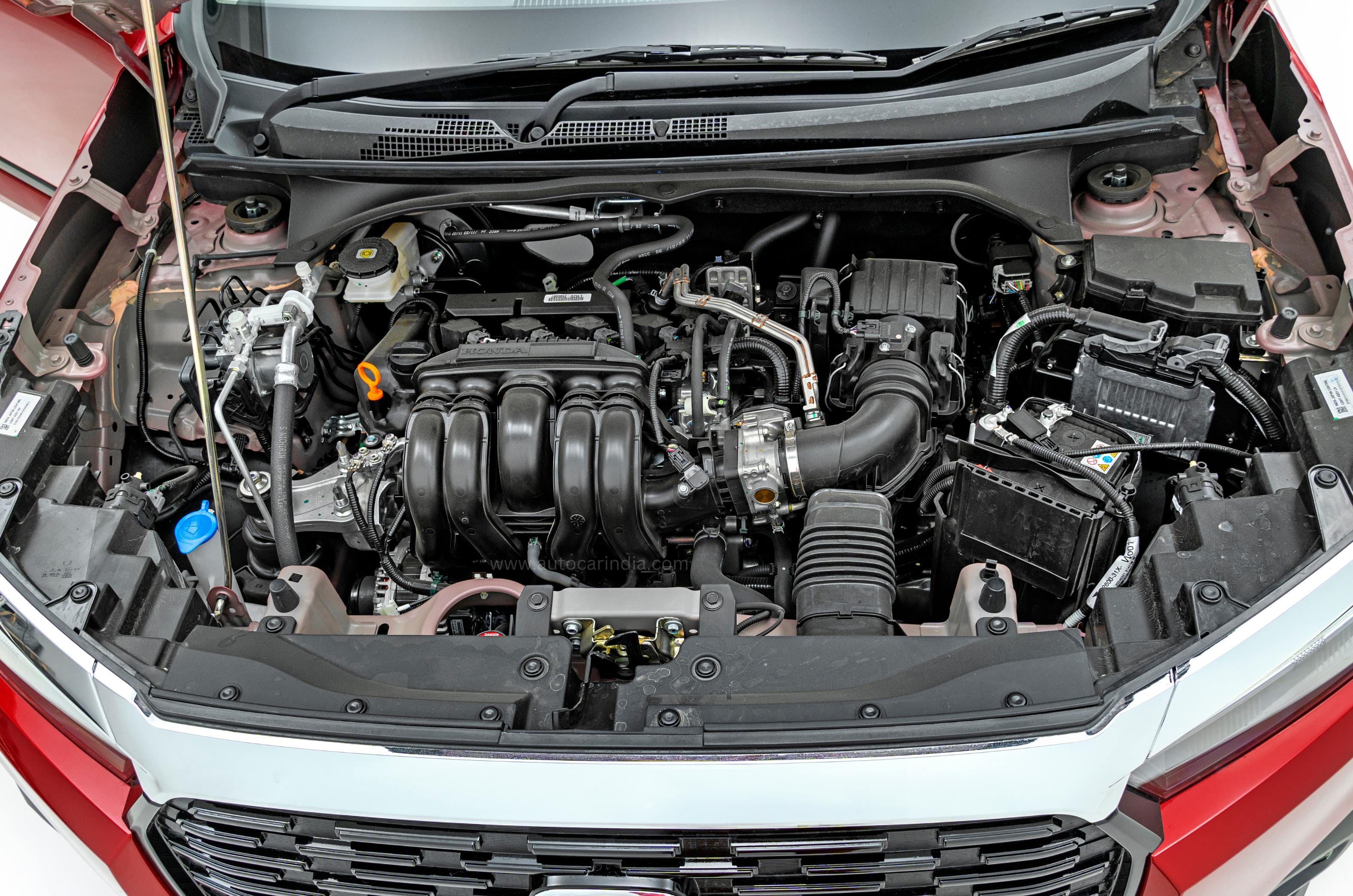
The current Honda Elevate’s engine bay is shown for representative purposes only.
The facelifted Elevate is expected to retain its existing 1.5-litre, four-cylinder naturally aspirated petrol engine. It produces 121hp and 145Nm and is available with either a 6-speed manual gearbox or a 7-step CVT automatic.
Interestingly, the City is also available with a 1.5-litre strong-hybrid petrol engine that produces a combined 126hp and 253Nm. Although the Elevate is based on the City, Honda has yet to offer this hybrid powertrain in the Elevate. With hybrid vehicles gaining popularity in India, it remains to be seen whether the facelift brings the hybrid option to Honda’s midsize SUV.
The Honda Elevate is expected to be priced at a premium over the current model, which ranges from Rs 11.81 lakh to Rs 16.36 lakh (ex-showroom). It will continue to rival other midsize SUVs like the Hyundai Creta, Kia Seltos, Tata Sierra, Maruti Victoris and Grand Vitara, and Toyota Hyryder.
The Maruti Suzuki Baleno has proven to be hugely successful, with the premium hatchback going home to 1.9 million buyers since its introduction in 2015. And in a time when compact SUVs are all the rage, the Baleno continues to buck the trend and bring in the numbers for the brand. And now in a bid to keep it fresh and relevant, Maruti Suzuki has updated it with a tweaked design, new comfort and safety features and even a new petrol engine.
Maruti Baleno Exterior Design and Engineering – 7/10
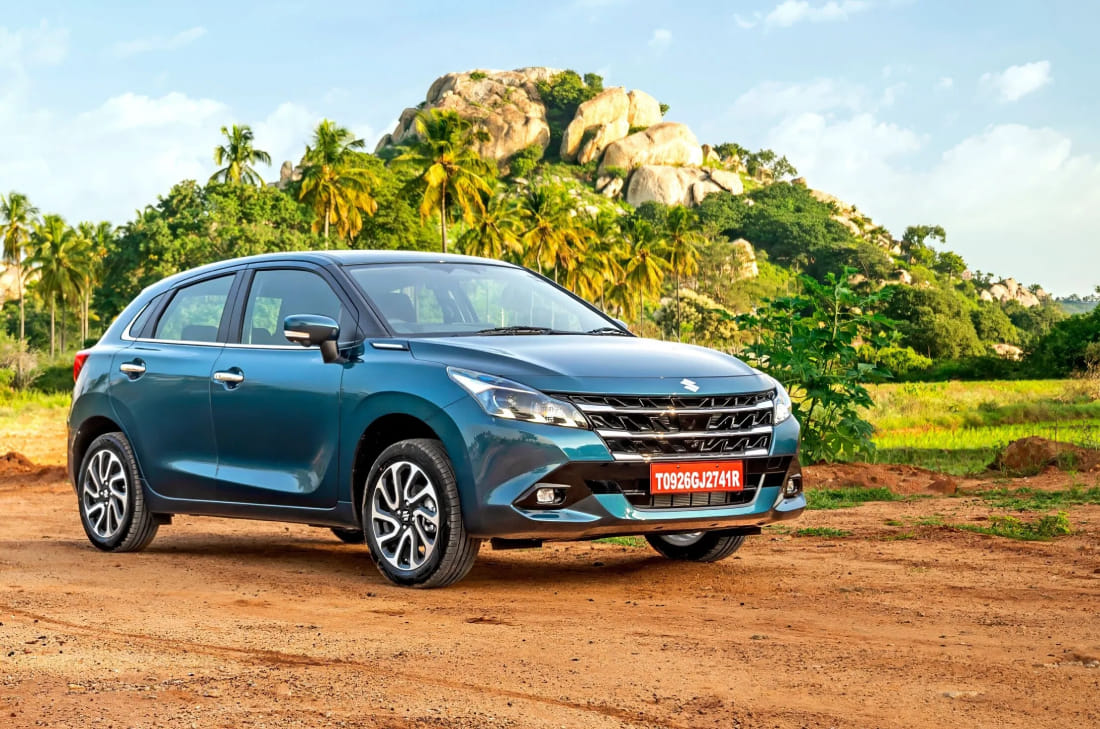
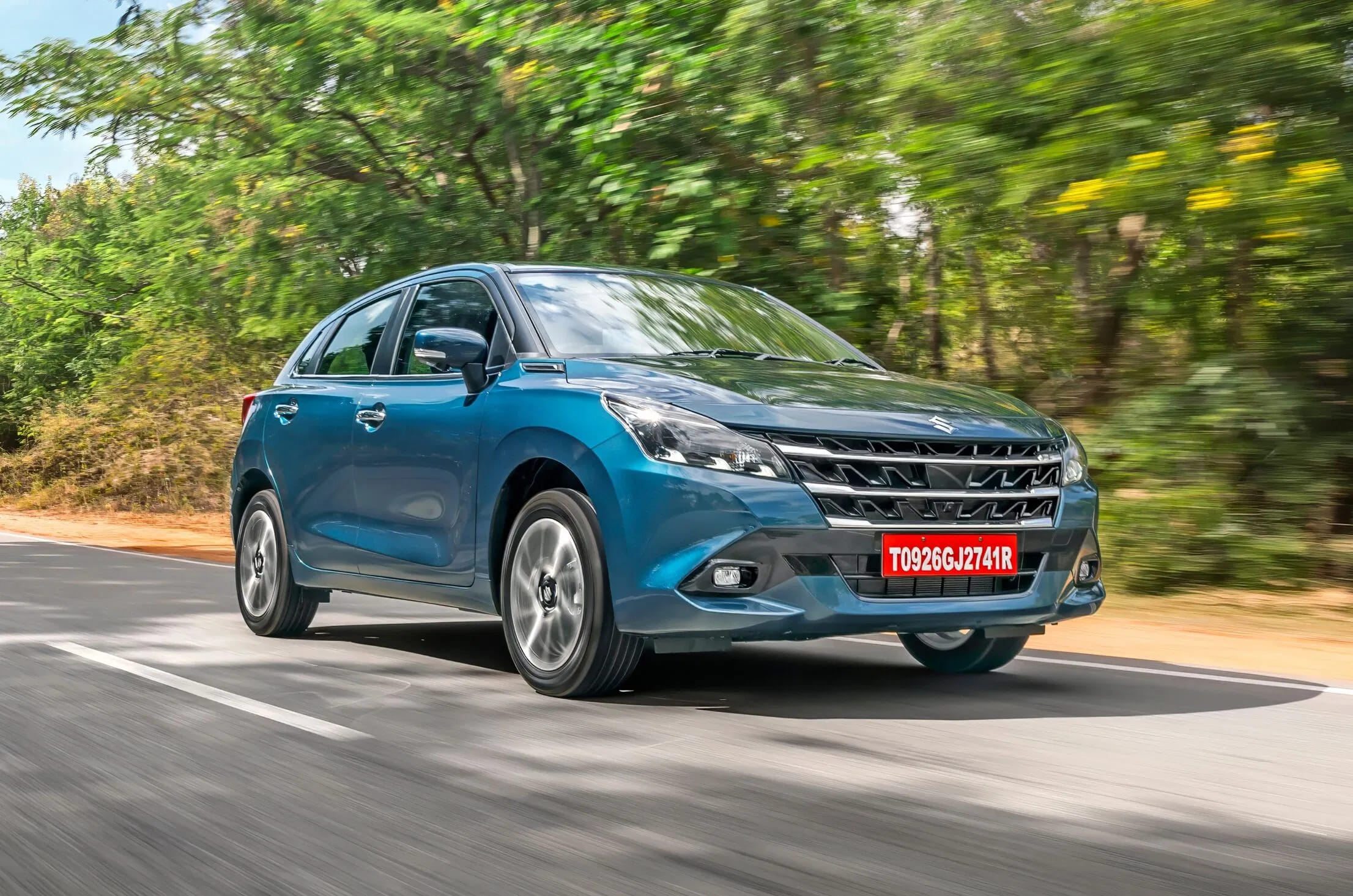
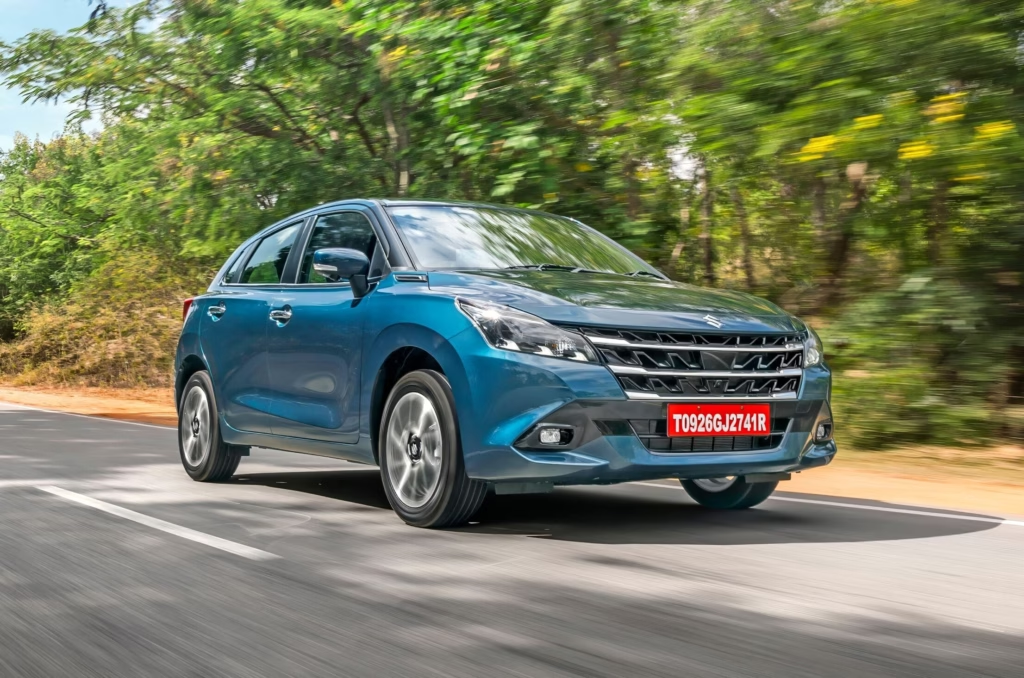
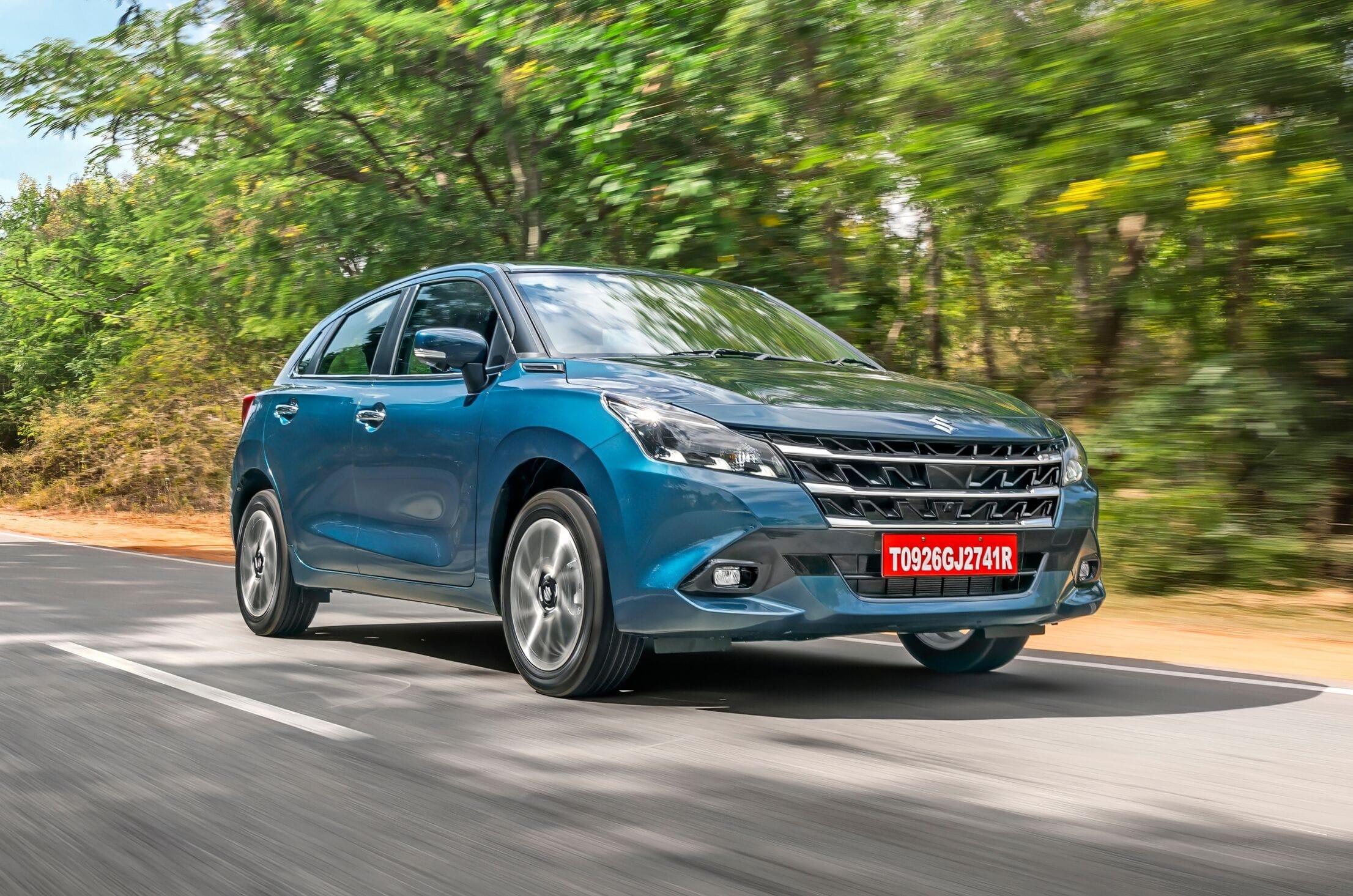
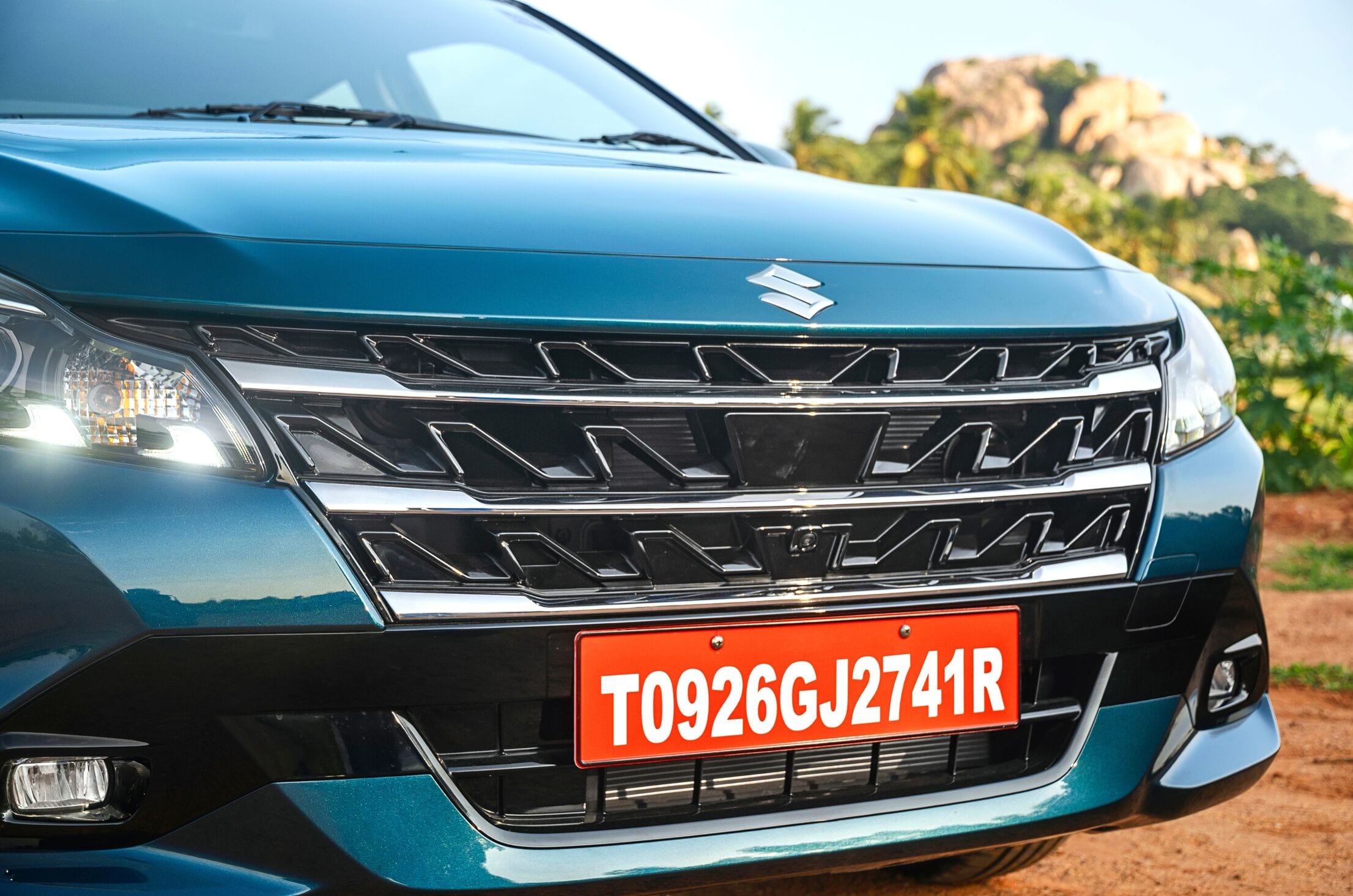
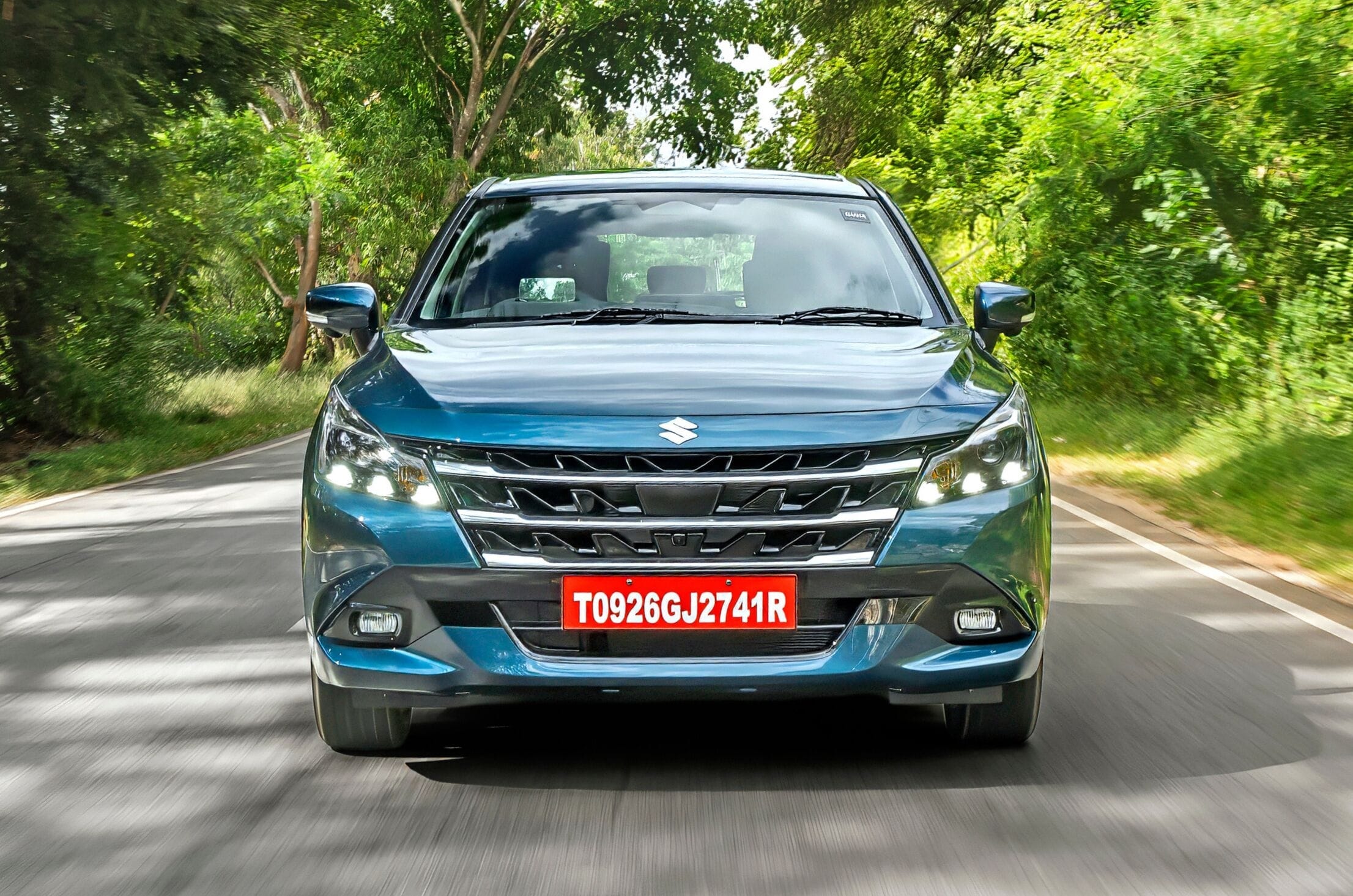
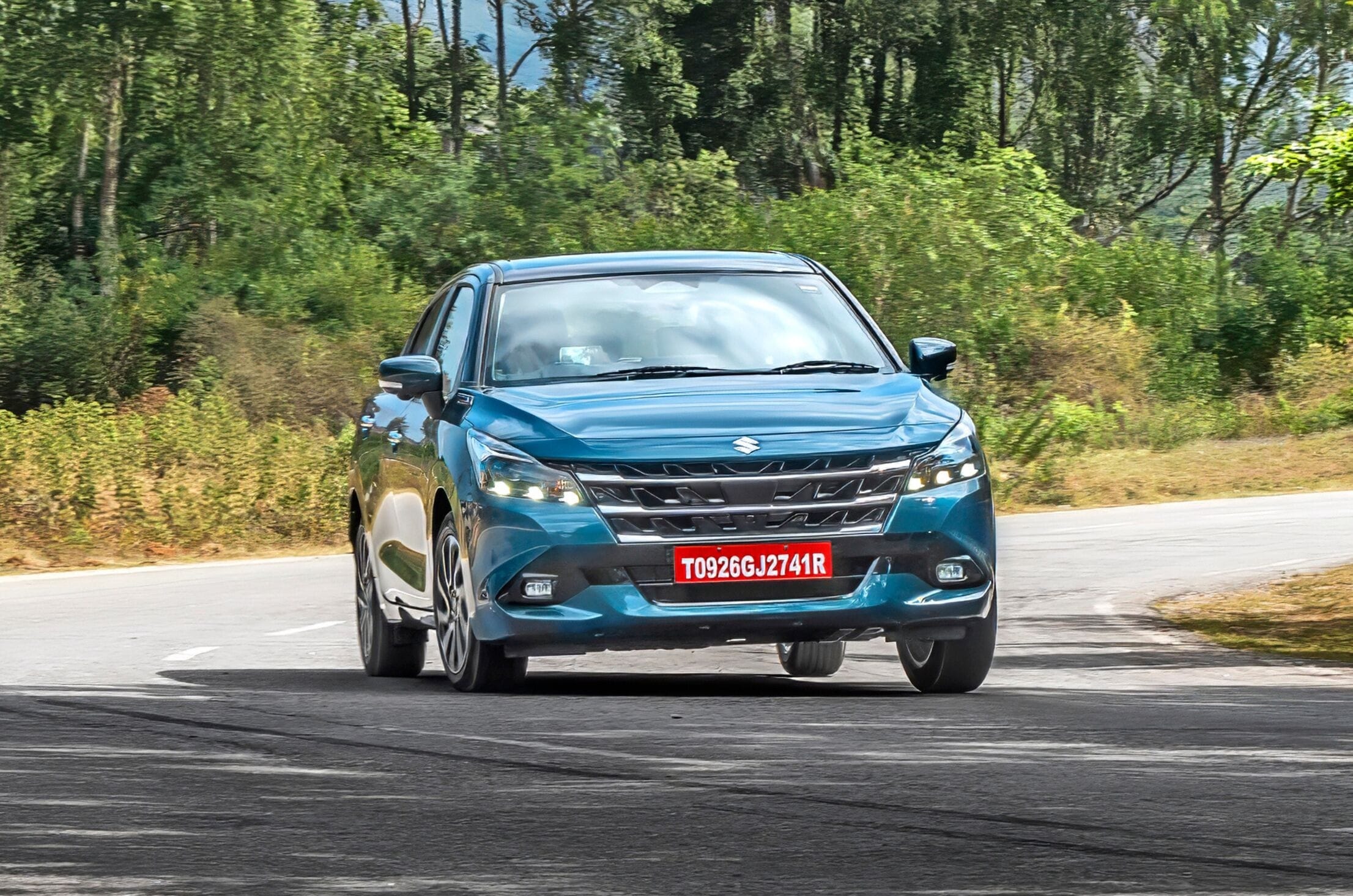
Being a mid-life-cycle update, the Baleno doesn’t get a design overhaul but rather tweaked styling with the bulk of the design changes concentrated at the front end. The grille is now much larger than before with three horizontal chrome slats and gloss black detailing, with a radar module in the centre for the new ADAS tech. The bumper is new too and features a gloss black trim that links the new LED fog lamps and the Suzuki logo has also been moved above the grille. Otherwise, the clamshell bonnet with the two character lines and the LED headlamps with the three-block DRL signature are carried over unchanged.
Gets a new larger grille with chrome slats, a new bumper and new fog lamps.
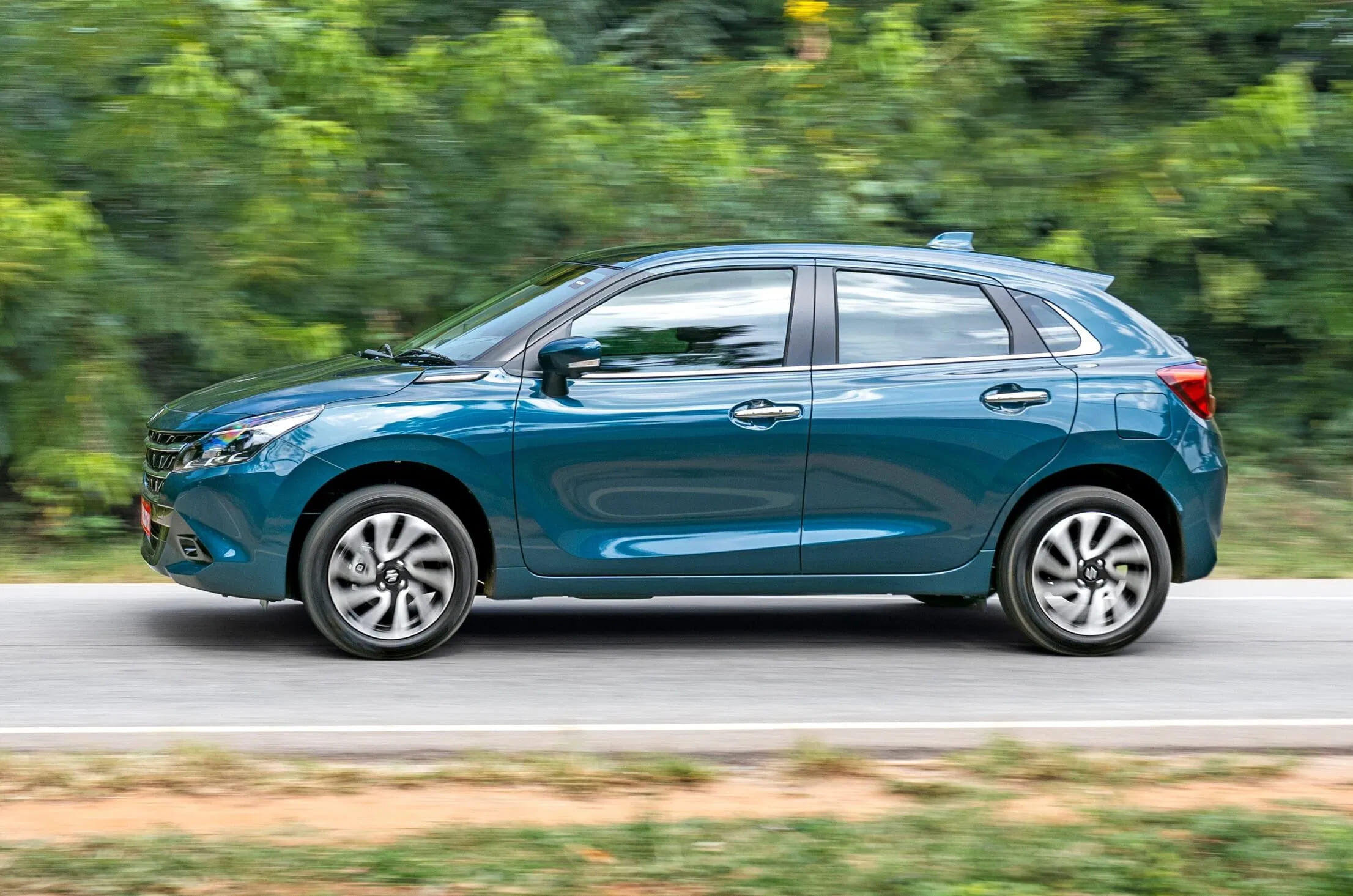
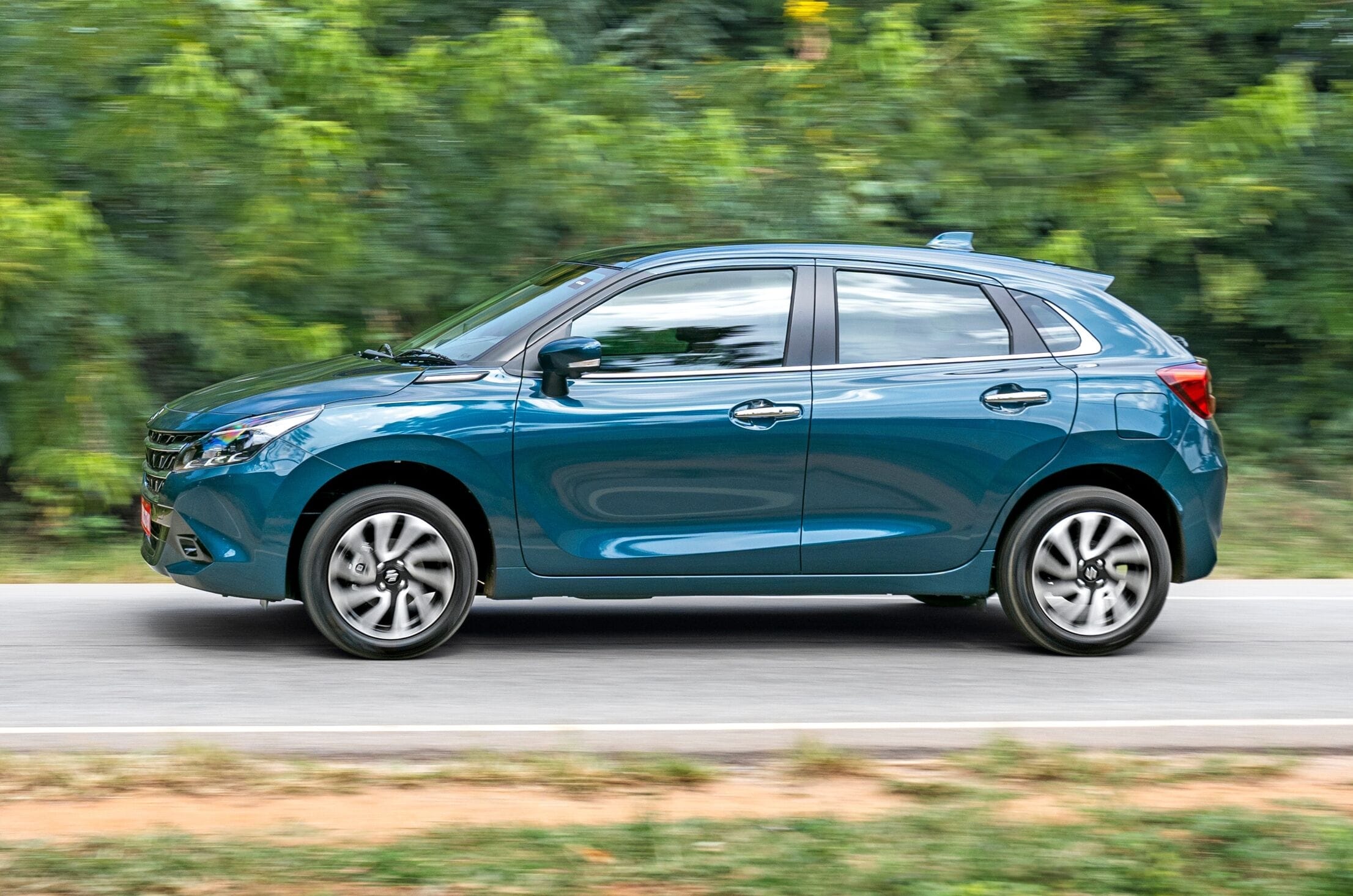
Changes along the sides are minimal, with the only distinguishing factors being a chrome garnish on the front fender and a shark fin antenna on the roof. The facelift retains the older Baleno’s chrome lining under the windows that extends up till the C-pillar, chrome door handles and the dual-tone 16-inch alloy wheels on this top-spec Alpha (O) variant.
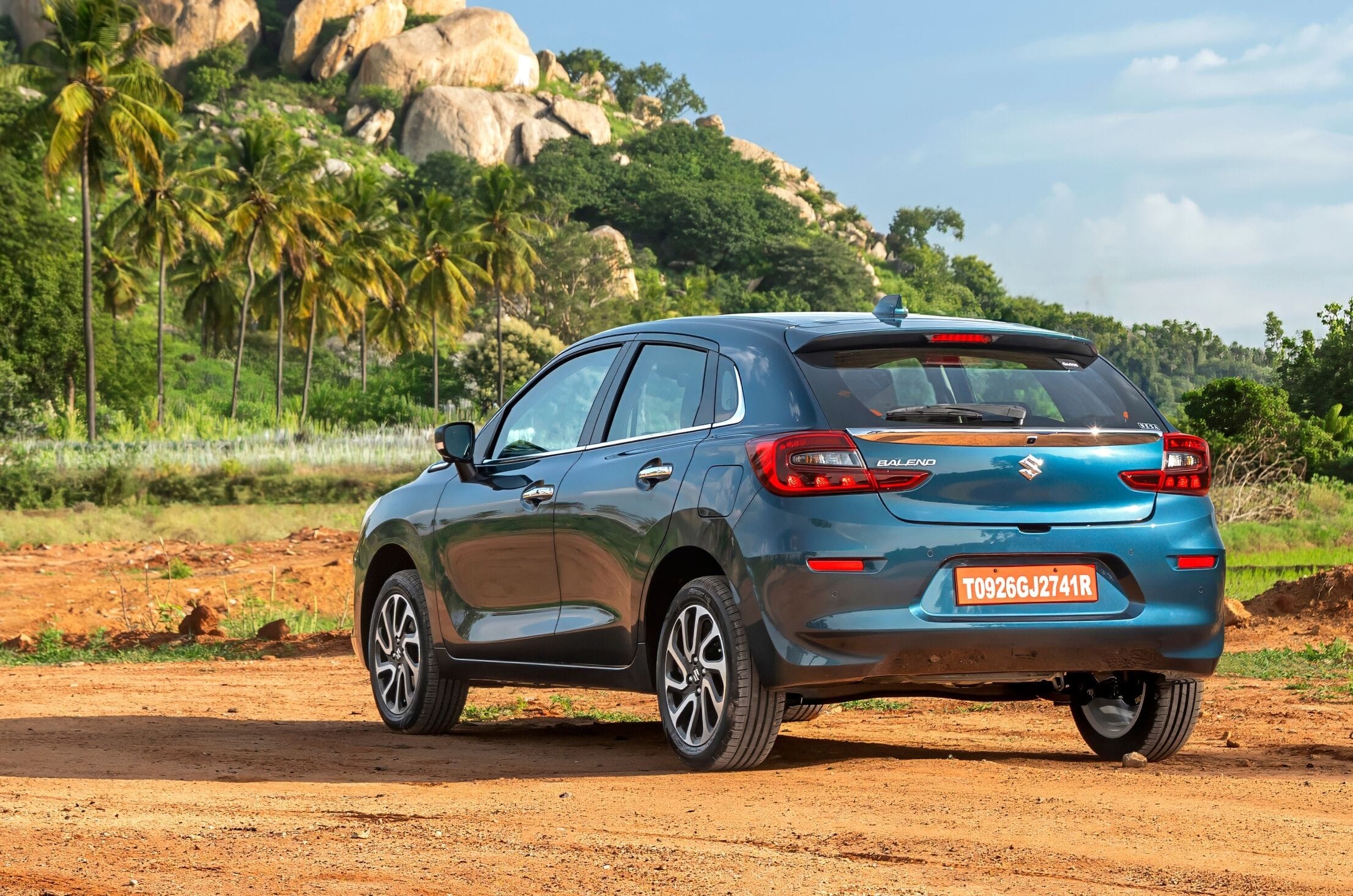
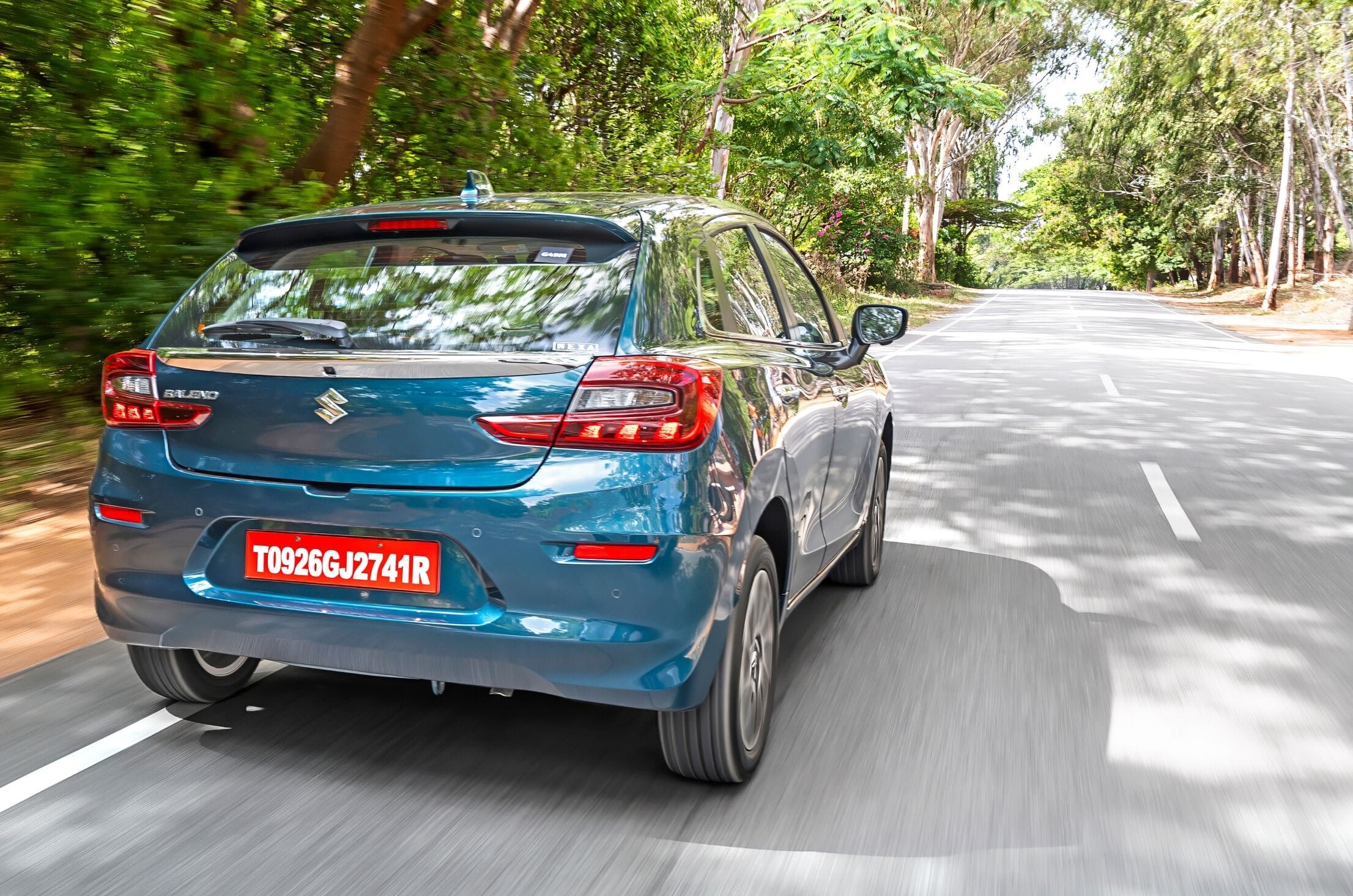
The rear however, stays identical to the pre-facelift Baleno with its C-shaped LED taillamps that also feature the three-block pattern, a chrome band running across the tailgate and a small, roof-mounted spoiler. There’s also a new Enigmatic Teal Green paint shade as seen in the pictures here. Overall, the Baleno sticks to the formula that’s made it as successful as it is with minor tweaks in order to keep it fresh. The front grille, though, splits opinion and certainly doesn’t appear as cohesive as the one on the model it replaces.
Rear stays identical to the pre-facelift model, with the same dual-tone alloys as well
Maruti Baleno Interior Space and Comfort – 8/10
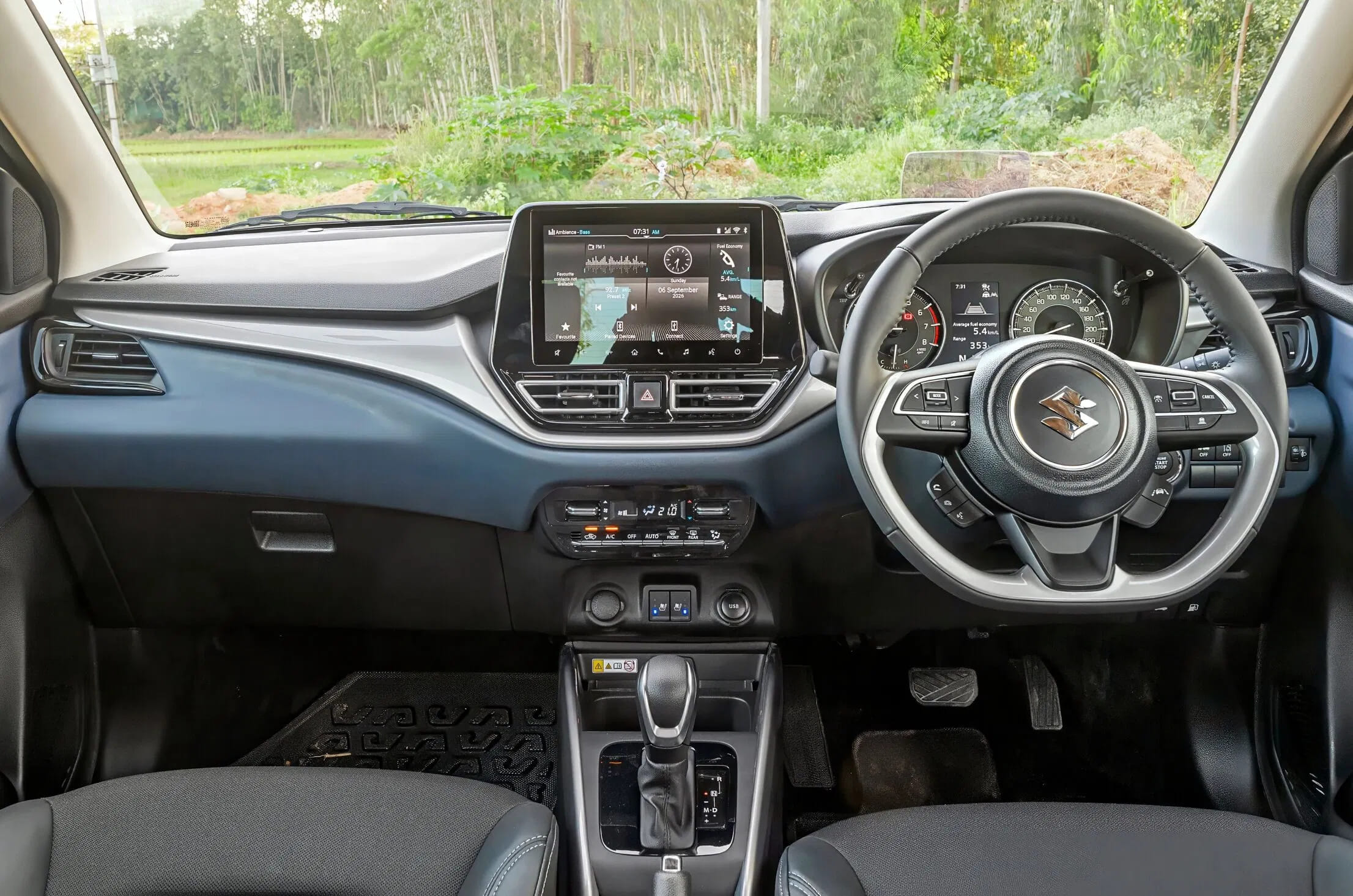
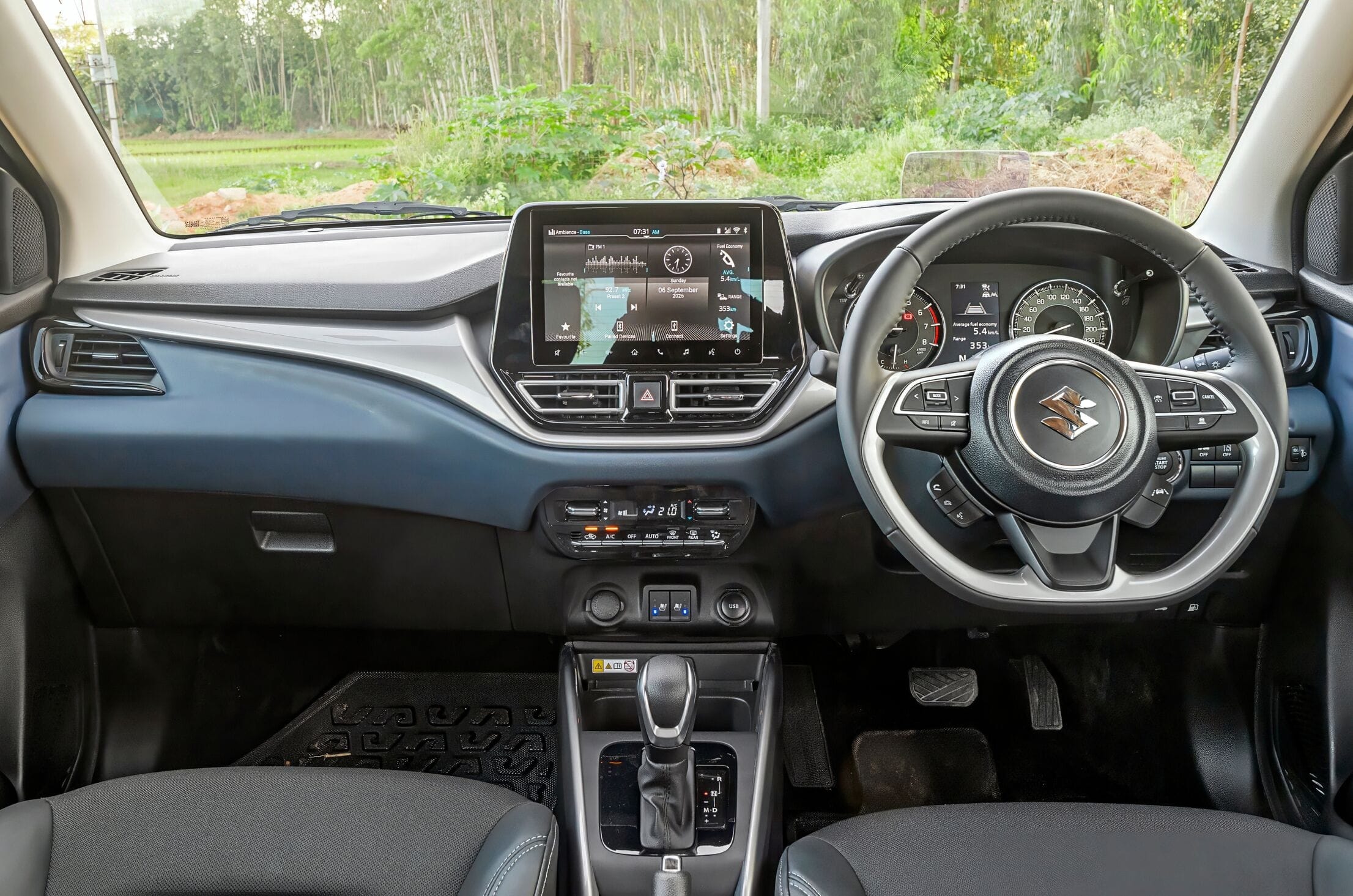
The interior of the Baleno facelift stays near-identical, with the same layered, V-shaped dashboard, flat-bottom three-spoke steering wheel and dual-tone black and blue colour scheme. There have been some tweaks however. The steering now features buttons on the right side for the adaptive cruise control and lane keep assist, there are more buttons on the right of the steering too (near the start/stop button) to turn off certain ADAS features and the seats now feature part-leatherette upholstery. The seats still majorly feature fabric upholstery but the outer edges are now finished in leatherette, which helps up the premium feel.
Layered dashboard with a dual-tone black-and-blue interior theme is carried over unchanged
Otherwise, this cabin is made up of good quality materials, particularly the soft touch leather wrapped steering and the padded elbow rests on the doorcards. The only sore points are the hard plastics and the simple woven roofliner. It’s a practical place too, with big door pockets, a decent-sized glovebox and storage in the centre console, with big cupholders and a small bin under the centre armrest.
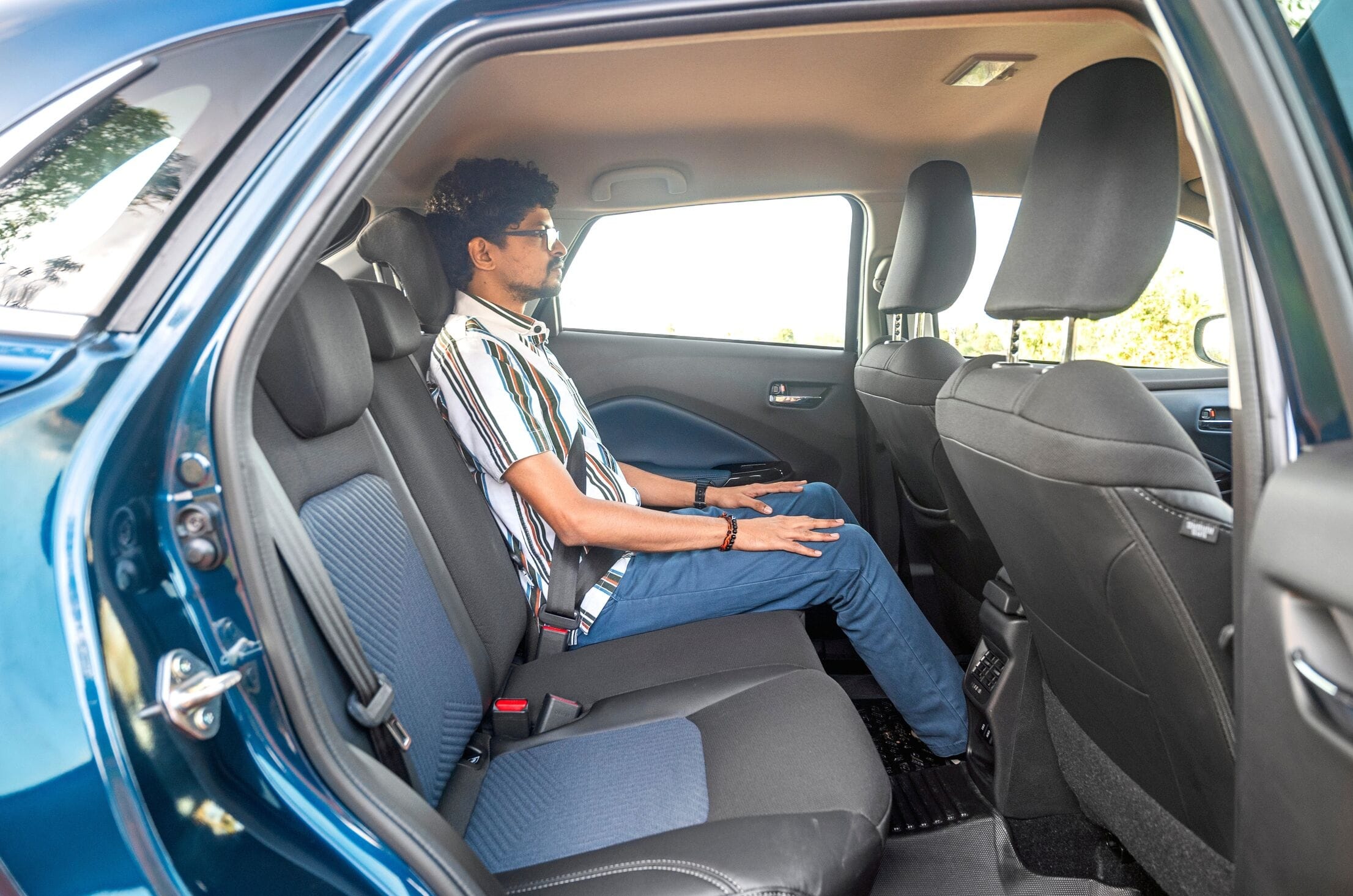
The front seats are unchanged and that’s a good thing as they are accommodating, supportive and offer nice cushioning. Thanks to the height adjustable driver’s seat and tilt/telescopic steering, finding an ideal driving position is an easy affair. Space at the rear is excellent, and even tall passengers won’t find a shortage of headroom or legroom. There’s good underthigh support, the seat cushioning is on point and on the whole, this is a comfy place to be. A welcome addition is an adjustable headrest and three-point seatbelt for the rear centre passenger. Rear passengers also get dedicated AC vents and USB charging ports.
Rear seat space is excellent and even tall passengers won’t find a shortage of headroom or legroom
What further enhances overall comfort are the UV-cut glasses, which helps keep the heat out. As for boot space, it’s a sizable 318 litres, though the loading lip is quite high. It’s also nice to see that it retains a spare tyre under the boot floor, when many modern cars are pivoting to puncture repair kits.
Boot is a sizeable 318-litres though the loading lip is quite high; continues to get a spare tyre
Maruti Baleno Features and Safety – 9/10
There have been some important additions when it comes to features, as the Baleno now gets ventilated front seats, a cooled wireless phone charger, a tyre pressure monitoring system, a Clarion sound system, and perhaps most importantly, segment-first ADAS Level 2 features.
Ventilated front seats and a cooled wireless charging pad are among the new additions
Other than that, the features list was fairly expansive as is, with this top-spec Alpha (O) also getting a 9-inch infotainment touchscreen with wireless smartphone integration, auto climate control, a heads-up display, colour MID, auto headlamps, auto-dimming IRVM, keyless entry and go, rear wiper/washer, connected car tech and more. Safety kit includes 6 airbags as standard, traction control, a 360-degree parking camera (its quite low res though) and ISOFIX child seat mounts. The outgoing Baleno had a 4-star crash safety rating from Bharat NCAP and that should be the case for this one as well.
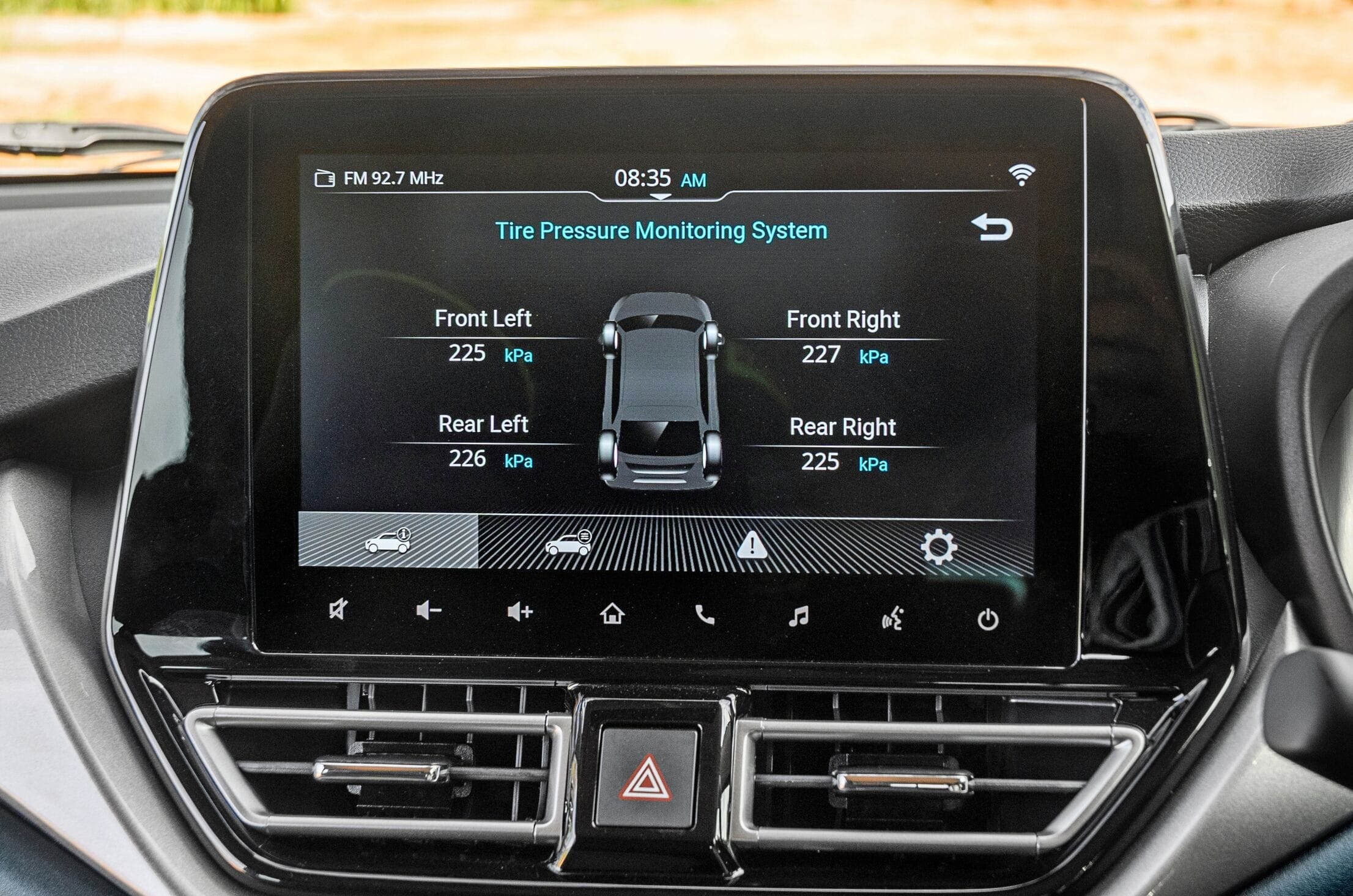
9-inch touchscreen has been retained; now features a TPMS
Of the newer features, the ventilated front seats work effectively though the blower is quite audible while the wireless charger charges your phone’s battery at a good rate without overheating it. The TPMS too worked as intended, while the Clarion audio system is better than the outgoing model’s it still falls short of what rivals offer.
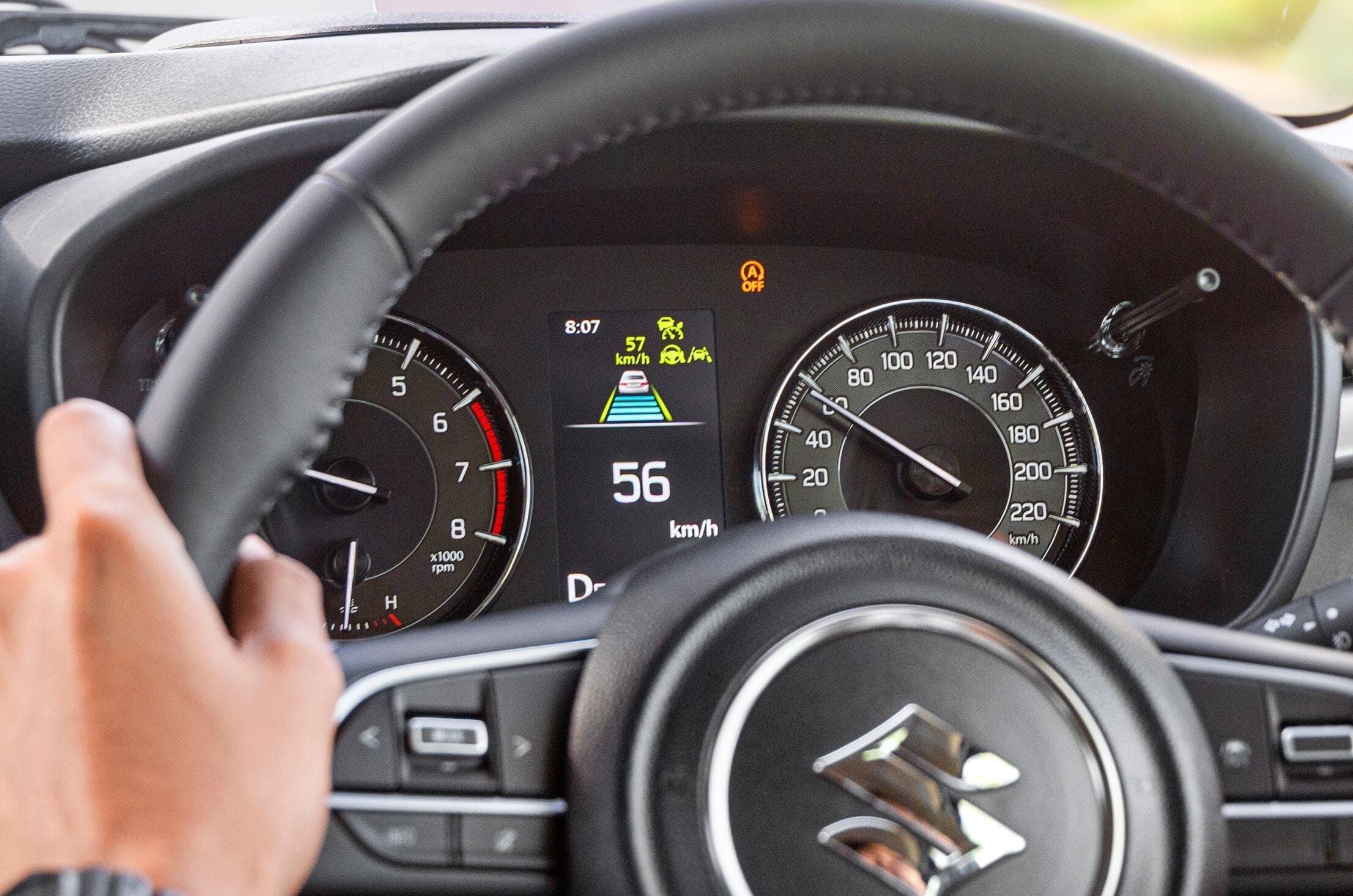
The addition of Level 2 ADAS tech however, greatly boosts the Baleno’s safety quotient. It’s a camera and radar-based system that brings in features like auto emergency braking, adaptive cruise control, lane keep assist, lane departure warning and more. On our brief test drive, the ADAS features worked as intended and seemed well calibrated as they weren’t overly intrusive. However, if you turn off the ADAS features they will automatically switch back on everytime you start the car.
Gets segment-first Level 2 ADAS features which seemed well calibrated for our conditions
As for features then, the Baleno facelift takes a step up and almost has all bases covered. Only things missing are a rear centre armrest and a sunroof, both of which its rivals offer.
Maruti Baleno Performance and Refinement – 8/10
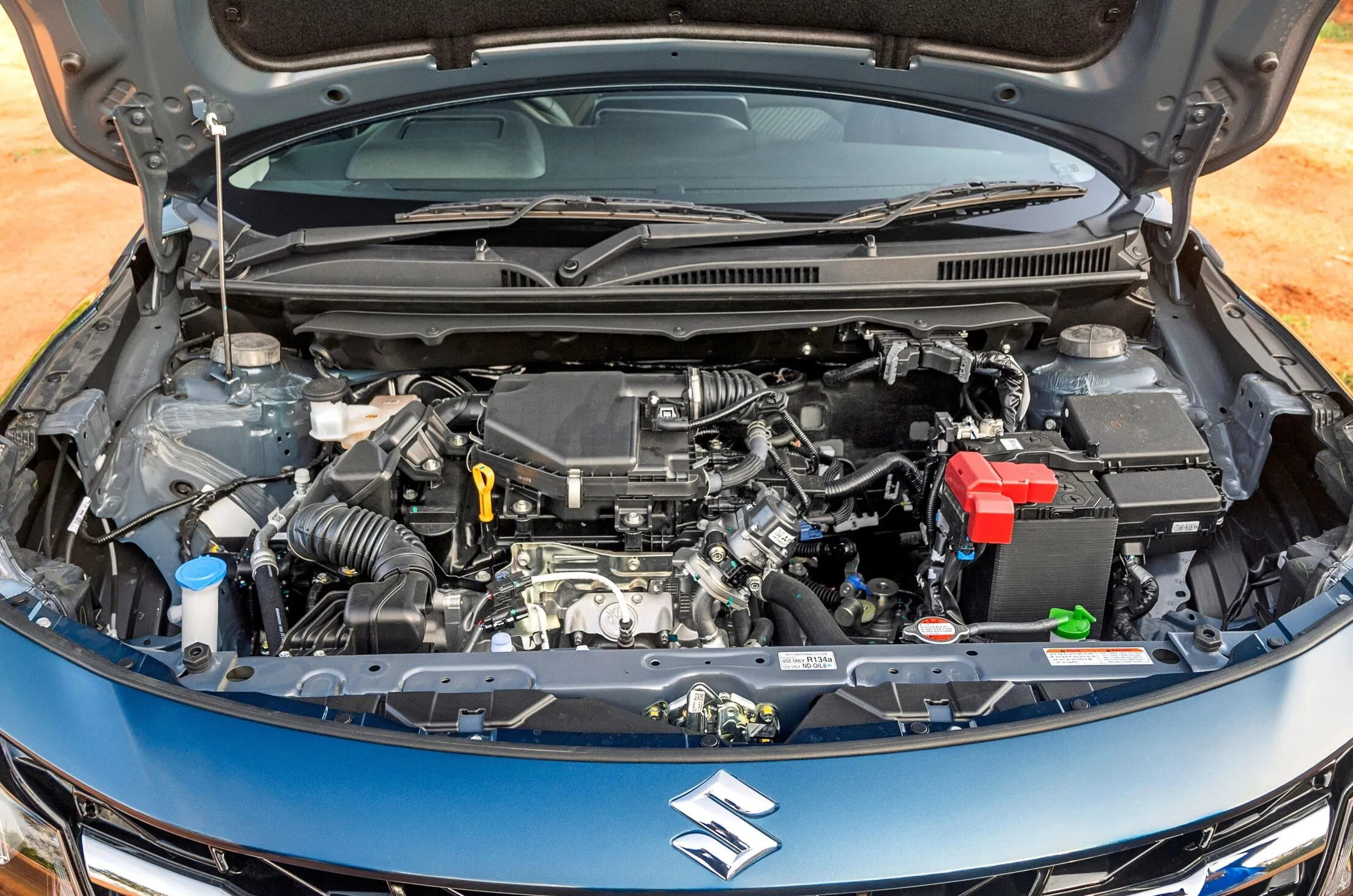
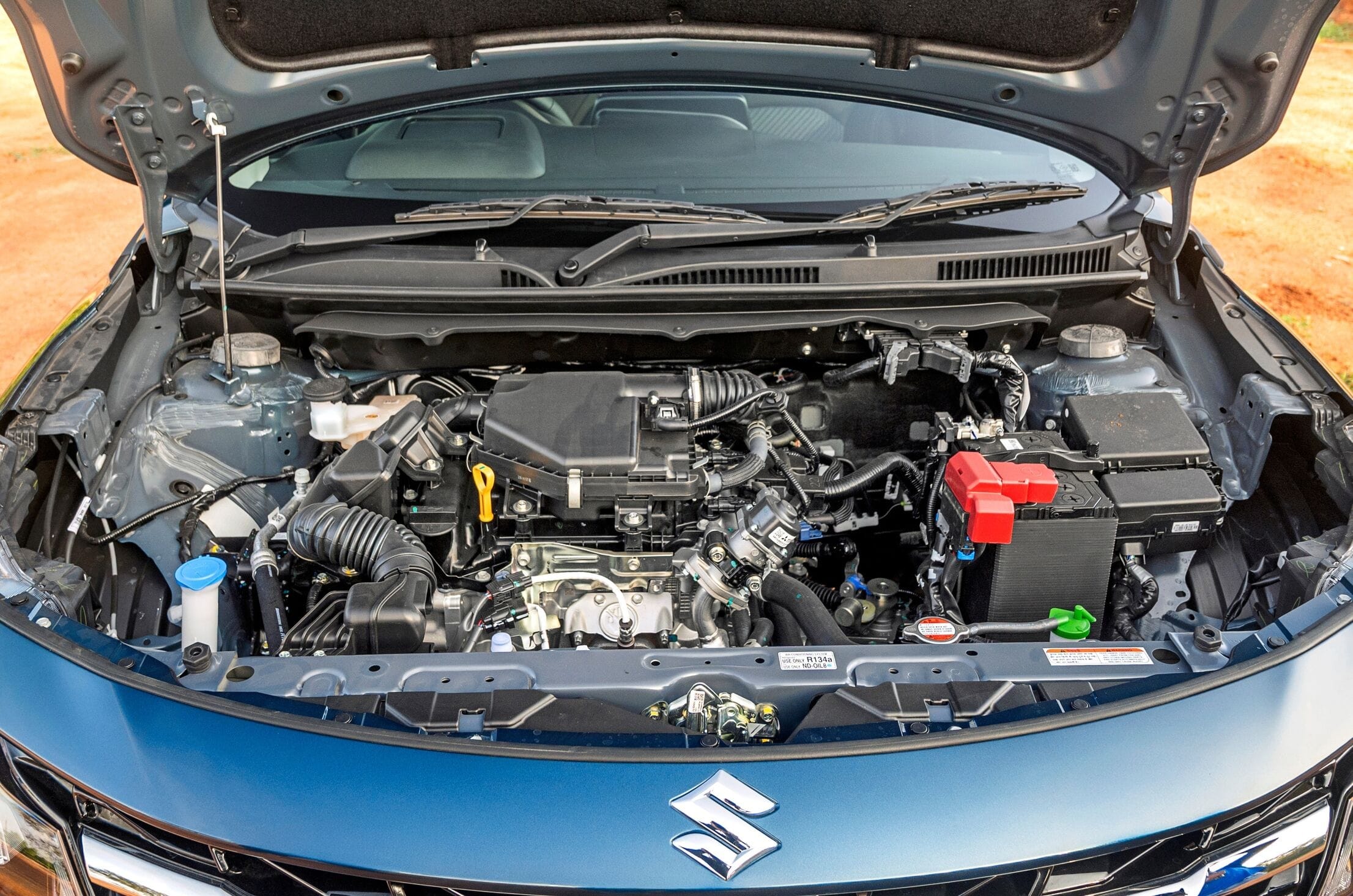
By far the biggest change with the facelift comes under the hood and it’s rare that we get to see a new engine with a facelift. Out goes the 1.2-litre, four-cylinder, K-series engine and in comes the 1.2-litre, three-cylinder, Z-series engine from the likes of the Swift and the Dzire. Yes, the Baleno is down a cylinder and as such, down on output too. The Z12E engine makes 83hp and 112Nm, which is 7hp and 1Nm lower than the older K12N engine. Maruti has moved to this engine as it is newer, is less polluting, more efficient and also opens it up to the possibility of hybridisation in the future.
New Z-series engine impresses with its drivability, low end response and promises more efficiency
This Z-series naturally aspirated engine is one of the most refined three-cylinder engines around. There is some of that typical three-cylinder thrum at idle but that smoothens out as the revs climb. It’s fairly quiet too at idle and it’s only when you’re at the top of the rev range that it becomes audible inside the cabin.
As we’ve experienced in the Swift and Dzire, this Z-series engine impresses with its low-end response and drivability. Power builds in a smooth linear manner, it moves off the line cleanly and part-throttle responses are good too. However, it doesn’t feel as peppy as the older K-series engine and doesn’t feel as strong at the top of the rev range. And considering that it’s down on power and heavier than the outgoing car, it isn’t as quick in terms of outright acceleration. But for a daily urban runabout, this engine is up to the task. For reference, we managed a 0-100kph time of 13.03sec and 15.89sec for the Swift MT and Swift AMT, respectively and you can expect the Baleno to be slightly slower than this owing to its higher kerb weight.
Power builds in a smooth linear manner and part-throttle responses are good, too.
As was the case earlier, the Baleno facelift can be had with either a 5-speed manual or a 5-speed AMT automatic. The manual gearbox is particularly impressive with its effortlessness and our pick of the two. The clutch pedal is light and easy to modulate, while the gearbox is smooth and has nice, short throws and well defined gates.
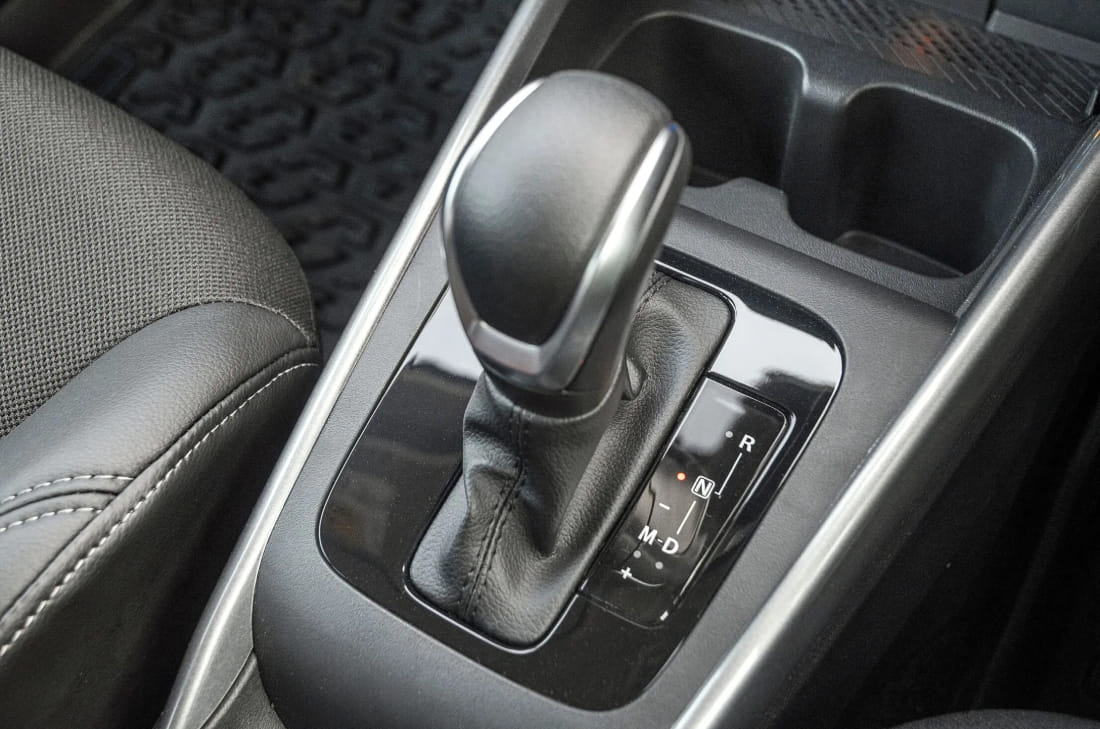
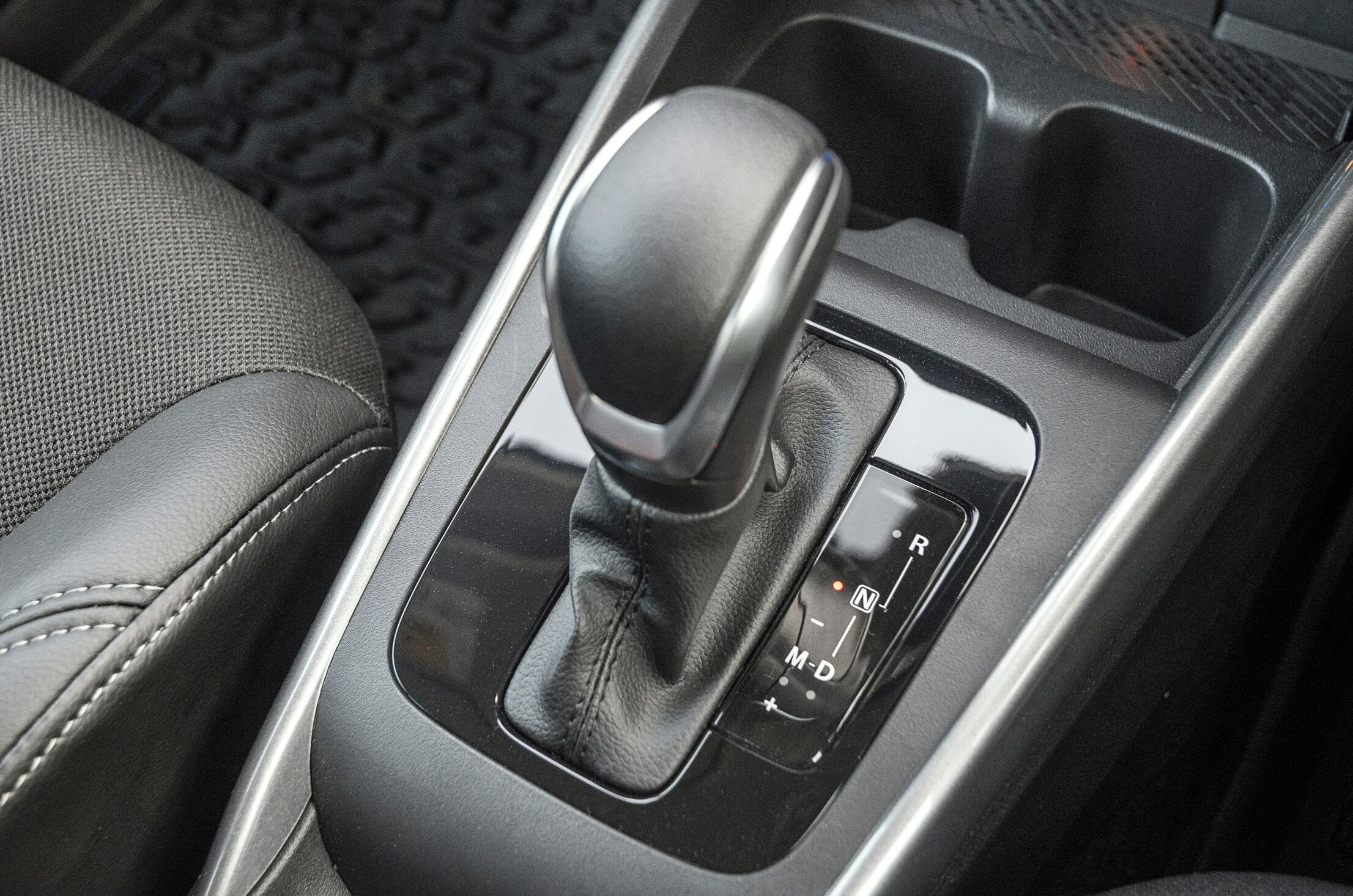
In comparison to its rivals, which offer more sophisticated automatics in the form of a CVT and a DCT, the Baleno only comes with a simpler, more cost-effective AMT. The AMT makes for a good option for those who wish for greater convenience and it’s smooth as far as AMTs go. There is still that noticeable headnod effect that you get between shifts and it is hesitant when you try to make a quick overtake, as it takes some time to downshift. That can be alleviated however, by shifting to manual mode via the gear lever and what’s nice is that it won’t auto upshift in this mode.
AMT adds a layer of convenience but feels hesitant when you try to make a quick overtake
A factory-fitted CNG option is also available with the Baleno facelift. It uses the same engine but power and torque outputs fall to 70hp and 102Nm, respectively, when run on CNG, and it can only be had with the 5-speed manual gearbox. However, we’re yet to experience the Baleno facelift CNG.
Maruti Baleno Mileage and Efficiency – 9/10
Both manual and AMT variants see an improvement in claimed efficiency with the new engine.
The biggest advantage with the move to the Z-series engine comes in the form of fuel efficiency. The Baleno petrol-manual is now claimed to return 23.80kpl (1.45kpl more), while the AMT is said to do 24.77kpl, which is a 1.83kpl improvement. The Baleno CNG meanwhile, sees an improvement of 3km/kg, with a claimed 33.61km/kg. As always, these are claimed figures tested in ideal conditions and expect real-world fuel efficiency to be lower. What’s interesting is that the Baleno has become more efficient despite becoming up to 30kg heavier than the outgoing version.
Maruti Baleno Ride Comfort and Handling – 8/10
As before, the Baleno continues to impress with its ride comfort. The suspension has a softness to it, which means low speed ride is excellent and it’s only the sharpest bumps and big potholes that manage to unsettle it. It also manages to iron out road imperfections with considerable ease and stays composed at higher speeds, with well-contained vertical and side-to-side movements.
Good body control with minimal roll and the steering weighs up nicely as you pick up the pace
Handling isn’t its strongest suit but the Baleno displays good body control with minimal roll around the corners. The steering, meanwhile, is light at low speeds, which aids city driving, but it adds some reassuring weight as you pick up the pace which is confidence-inspiring. It’s not particularly feelsome but that’s nothing to complain about, given its an urban premium hatchback. As for braking, it continues with the same discs up front and drums at the rear setup and the stopping power is more than adequate. On the whole then, the Baleno feels mature and composed on the move.
Maruti Baleno Value for Money – 8/10
The Maruti Baleno facelift is priced from Rs 6.10 lakh (ex-showroom, India), though this is a special festive price and Maruti is yet to disclose complete variant-wise pricing. It continues to get a 3 year/1,00,000km standard warranty and as before, rivals other premium hatchbacks in the Hyundai i20 and Tata Altroz, both of which are priced from Rs 6 lakh (ex-showroom, India).
The added features and the promise of greater fuel efficiency just further enhance the Baleno’s appeal
There are some drawbacks of course, like the hesitant AMT automatic and it doesn’t feel as peppy as the older K-series Baleno. But those pale in comparison to the Baleno’s inherent strengths of a spacious and comfortable cabin, an effortless drive thanks to its light controls, a refined engine and a good ride comfort and handling balance. The added comfort and safety features and the promise of greater fuel efficiency with the new engine just further enhance its appeal. As such, the Baleno is all set to retain its spot at the top of the premium hatchback chain.
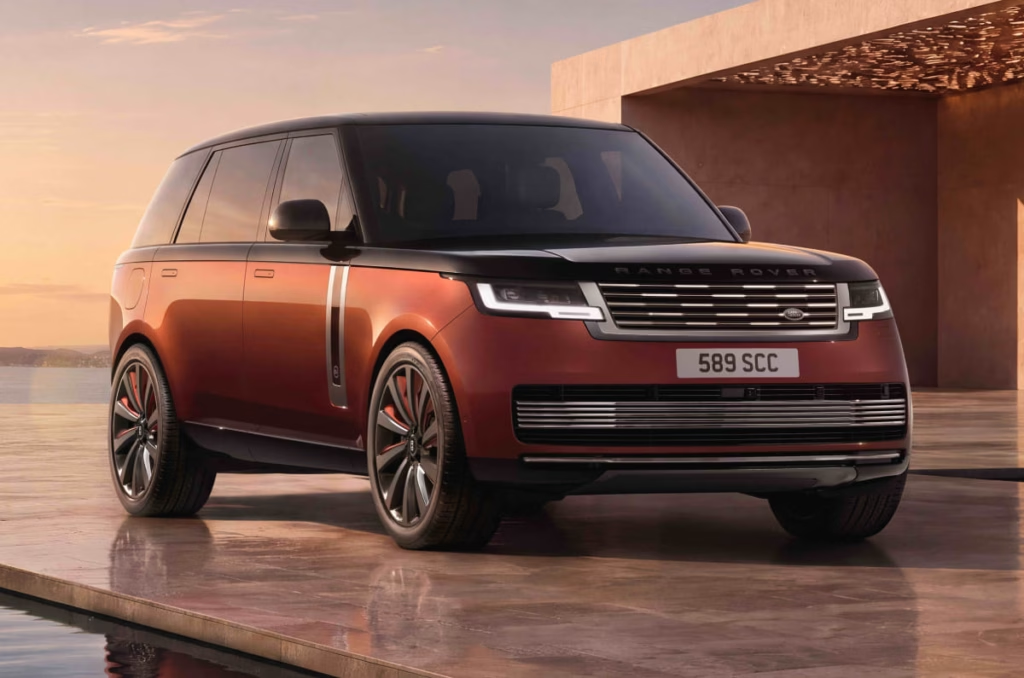
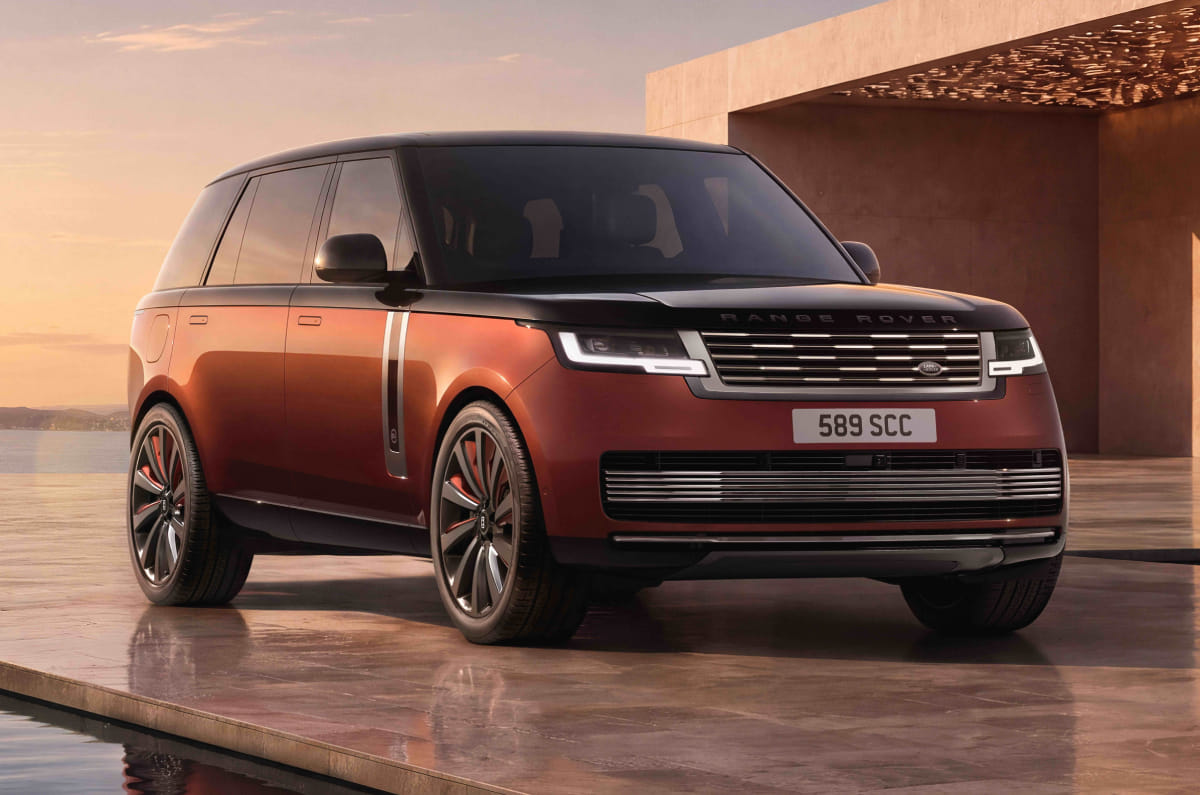
Range Rover has introduced a new Duo-Tone Fade paint finish through its Bespoke service. It uses two exterior colours that gradually blend from the roof and bonnet into the body sides and rear. The finish is available exclusively for the Range Rover SV. Range Rover has not announced a specific price for the paint option.
Range Rover SV Bespoke paint options
Four Duo-Tone Fade combinations are available: Velvet Depths, Sunstone Lustre, Ashen Amaranthine and Nacre Allure. Each is paired with a dual-tone interior.
Velvet Depths combines Obsidian with Sunrise Copper, while Sunstone Lustre pairs Obsidian with Tourmaline Brown. Ashen Amaranthine combines Obsidian with Amethyst, and Nacre Allure uses Obsidian with British Racing Green.
The finish is created using multiple layers of paint. The base colour is applied first, followed by the second colour, which is then blended into the base to create the fade. The process involves hand preparation and precision application, with the materials and colour combinations tested for compatibility.
Range Rover SV: What is it?
The Range Rover SV is the performance-focused version of the Range Rover and is available with both petrol and electric powertrains. The petrol version uses a 4.4-litre twin-turbo V8 mild-hybrid producing 537hp and 750Nm, while the electric version has a claimed range of up to 600km.
The SV gets features including a 13.1-inch infotainment touchscreen, 13.7-inch digital driver’s display, 13.1-inch rear entertainment screens, heated steering wheel, powered rear sunblinds, four-zone climate control, head-up display, ambient lighting, 360-degree camera and air purifier. All seats are electrically adjustable and get heating, ventilation, massage and memory functions.
Range Rover also offers the SV Bespoke service, which allows customers to customise the exterior and interior of their SUV.