Mercedes-Benz CLA real world range tested, explained

Mercedes-Benz CLA rear world range

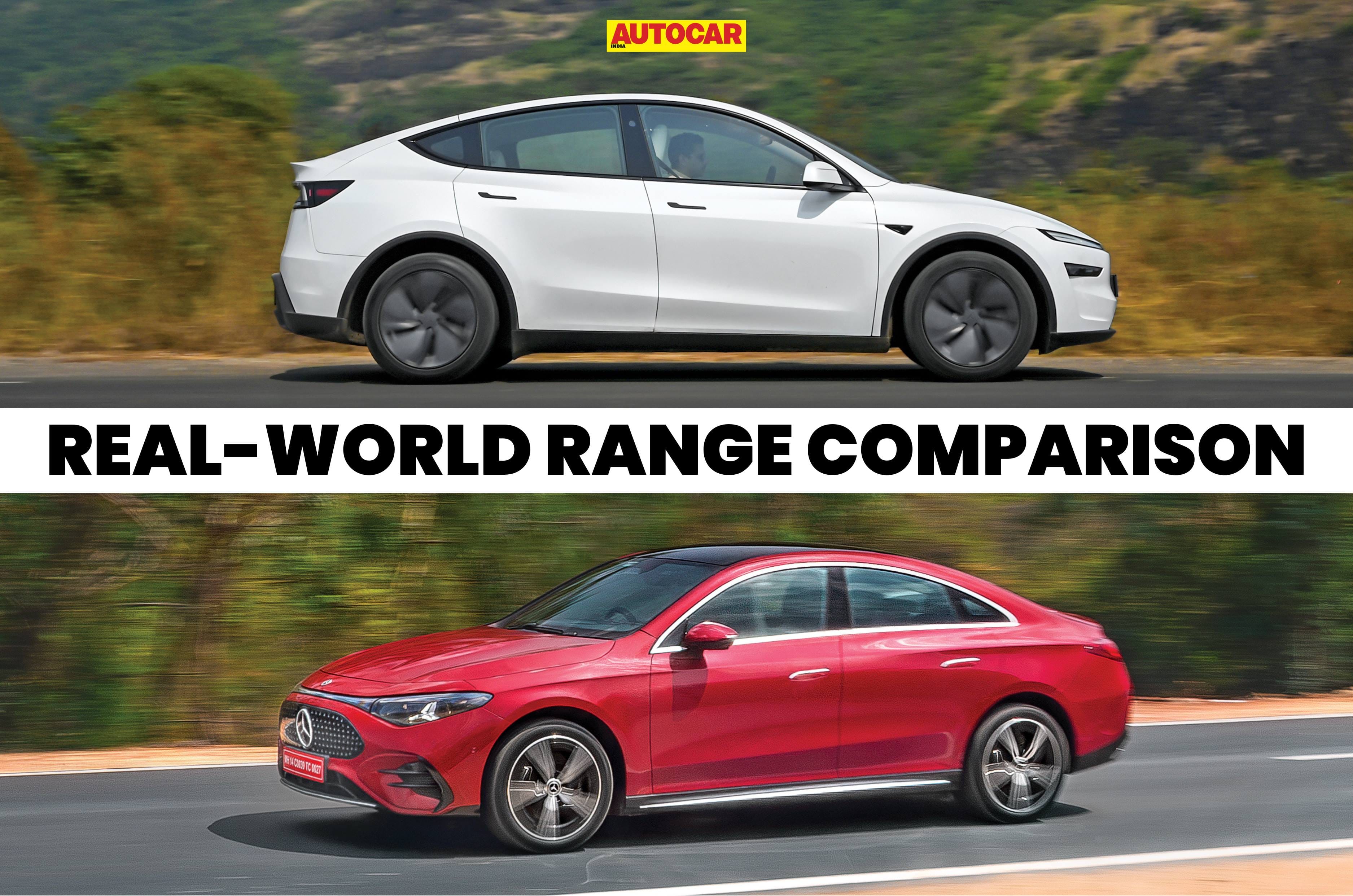
Launched in April 2026, the Mercedes-Benz CLA is currently the entry point to the manufacturer’s EV lineup in India. It is offered in two variants 200 and 250+. The CLA 200 gets a 58kWh battery with a claimed WLTP range of 542km, whereas the higher-spec CLA 250+ gets a 85kWh battery and has a WLTP claimed range of 792km. We put the CLA 250+ variant to the test to calculate its real-world efficiency.

  1. Low drag coefficient of 0.21Cd and weighs 2,055kg
  2. We used ‘ECO’ driving mode throughout the test
  3. 20-80 percent on a 150kW DC fast charger takes 35 minutes

Mercedes CLA 250+ real-world range 

The CLA 250+ makes 272hp of power and 335Nm of torque, with a RWD setup. Before starting our range test, we charged the 85kWh battery to 100 percent and switched it to the most efficient ‘Eco’ mode.

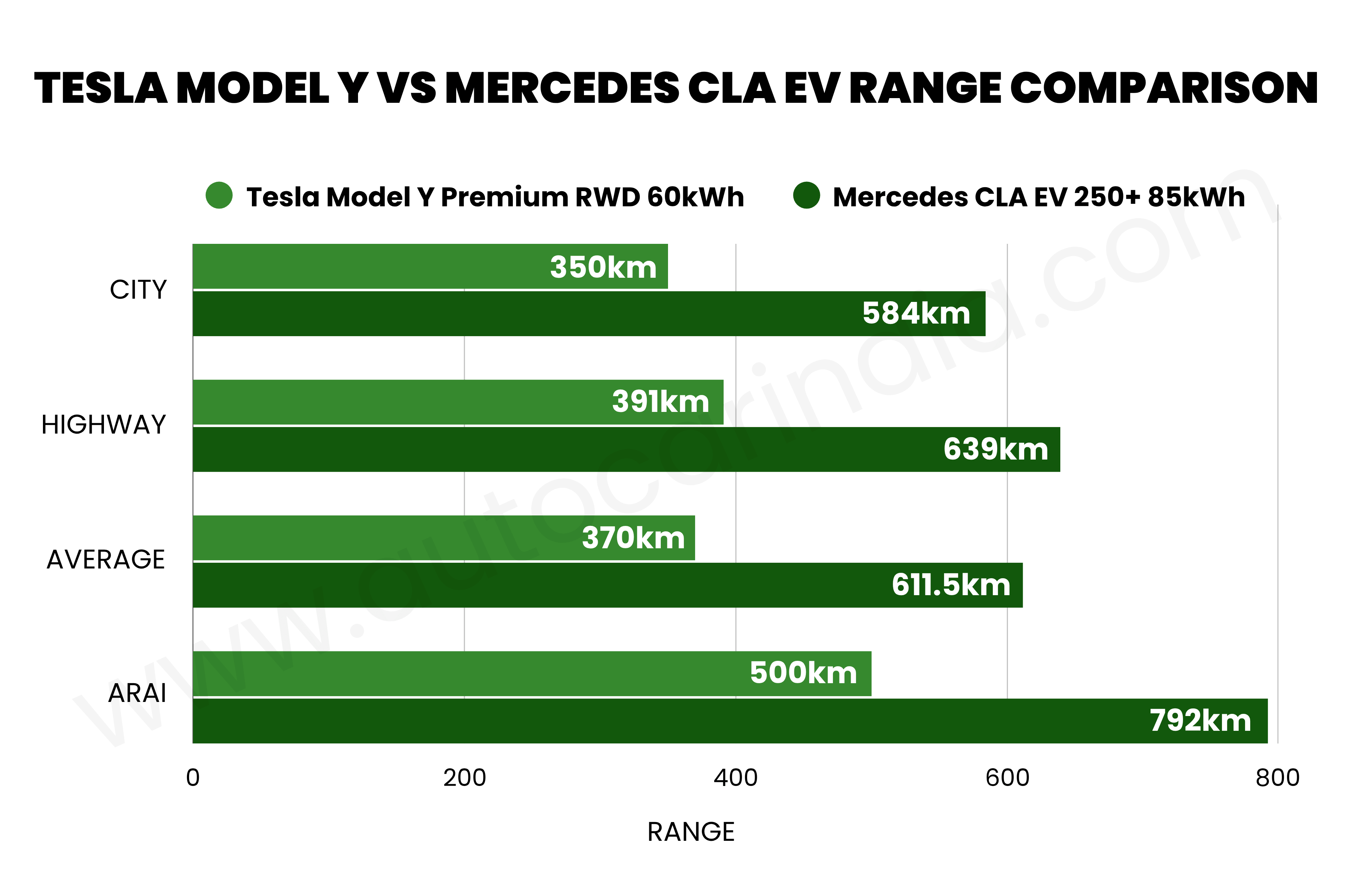
In the city, with the regen set to strongest mode, it delivered an efficiency of 6.87km/kWh that translates to a range of 584km. On the highway, with the regen set to ‘Normal’, it delivered an efficiency of 7.52km/kWh for a 640km range. With an average efficiency of 7.2km/kWh, you can expect a real-world range of 612km on a single charge, which is really good. 

In the city, the strongest regen setting enabled it to recoup energy effectively, which helped boost the efficiency. Whereas, the two-speed gearbox with a taller 5:1 ratio second gear that enables greater efficiency at higher speeds, coupled with the low drag coefficient of 0.21Cd and the normal regen mode that allows for coasting, helped it to be even more efficient on the highway which isn’t usually the case with EVs. 

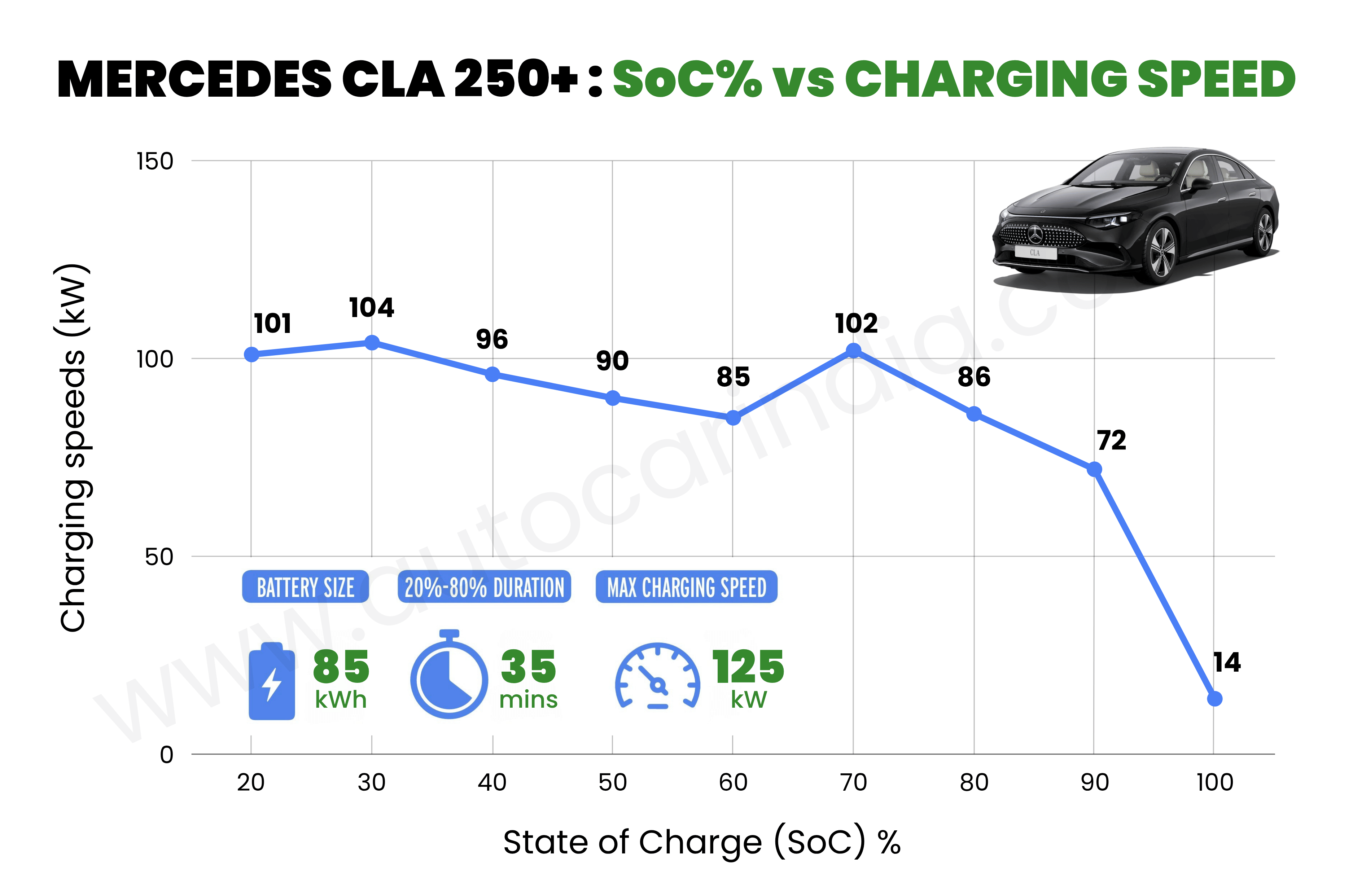
The Mercedes CLA 250+ can be charged at speeds of up to 320kW but those chargers are few and far between in our country. In our charging test using a 150kW DC fast charger, we saw an average charging speed of around 92kW with a peak charging speed of 125kW. To charge from 20-80 percent, it took 35 minutes and consumed 53.89kWh in total.

Autocar India’s range testing

Before our real-world range tests, the battery of our test car was fully charged, and we maintained tyre pressures in accordance with the manufacturer’s recommendations. The car was driven on a weekday in Mumbai city and on the adjoining state highway in a fixed loop, and we maintained the set average speeds. At the end of each cycle, we calculated the range based on the percentage charge consumed.

Throughout our tests, the climate control was set to 22deg C in a full-auto setting, and other electricals, such as the audio system, indicators and heated and massaging front seats, were used when required, just as a regular user would. We take pride in our testing data, which isn’t merely consistent but also gives users an accurate indication of what they can expect in the real world.

3 reasons to buy the Tata Sierra EV and 2 reasons not to

tata sierra ev

Seven months after the launch of the ICE-powered Tata Sierra, its all-electric derivative, the Sierra EV, is finally available for purchase. Priced from Rs 18.79 lakh to Rs 25.99 lakh (ex-showroom), the Sierra EV slots right between the Tata Curvv EV and Harrier EV, and rivals electric midsize SUVs like the Mahindra BE 6, Vinfast VF6, Hyundai Creta Electric, MG ZS EV, Maruti e Vitara, Toyota Ebella, and more.

If you’re considering bringing home a Sierra EV, here are three reasons why you should go through with it, and two reasons why you may want to think twice before signing the dotted line.

Pros

Loaded with features

Gets some additional goodies over the ICE Sierra

The Sierra EV retains the expansive equipment list of its ICE sibling, including a triple-screen layout (12.3-inch infotainment and passenger screens, 10.25-inch driver’s display), dual-zone climate control, a panoramic sunroof, Level 2 ADAS, a powered tailgate, a 360-degree camera, a wireless charging pad, a 12-speaker JBL Black sound system, ventilated front seats, a powered driver’s seat with memory and welcome functions, and more.

In typical Tata EV fashion, the Sierra EV even packs some bonus features over the ICE version, specifically a powered co-driver seat, an under-floor camera view, auto park assist, a summon mode, vehicle-to-load (V2L) and vehicle-to-vehicle (V2V) charging functions, and a heads-up display along with the triple-screen setup.

Excellent cabin space and practicality

Great for chauffeur-driven buyers

Dimensionally, the Sierra is very similar to its ICE counterpart, which means you get an incredibly roomy and lounge-like interior. Though the floor height has increased by less than an inch compared to that of the ICE Sierra, there’s nary a perceptible difference for occupants. The seats are very comfortable, there’s loads of rear legroom, and the bench even features a small amount of backrest recline.

Despite the addition of a rear motor, the Sierra EV’s boot space matches the ICE version’s 622 litres. That’s measured up to the roof, though, and using the conventional method of measurement, which is up to the parcel tray, the Sierra EV should offer roughly 450 litres of boot space. You even get a frunk, which measures 55 litres in the RWD versions and 35 litres in the AWD variant.

Smooth and potent powertrains

Only one in its segment to offer AWD

The Sierra EV can be had with 63kWh and 75kWh battery options, both of which are powered by a 315Nm rear motor (RWD) as standard. In 63kWh RWD guise, the Sierra EV develops 238hp, while the 75kWh RWD versions make 209hp. The top-spec Sierra EV Empowered A 75kWh variant additionally packs a 140hp front motor to form an AWD layout, churning out a segment-best combined output of 306hp and 504Nm.

Performance is thereby a strong suit for the AWD Sierra EV, with a claimed 0-100kph time of 5.8 seconds. As we noted in our Sierra EV review, though, the SUV doesn’t feel neck-snappingly quick off the line. Power delivery is progressive and undramatic, which is fine considering the Sierra is, after all, a family SUV. On the curated off-road course we took the Sierra EV AWD on, it proved quite capable too.

As for range, the Sierra EV 75kWh RWD claims the highest ARAI figure of the range at 665km, followed by the 75kWh AWD version at 624km and then the 63kWh RWD version at 535km. These are quite competitive range figures when compared to the Sierra EV’s rivals.

Cons

Poor interior quality and ergonomics

Umbrella holders provided, but with no drain plugs

While Tata has upped its game in terms of interior fit and finish, we could still spot hard plastics, rough edges, crooked stitching, and misaligned panels in the Sierra EV. There are some interior design oddities, too, like wasted space below the pedestal-mounted drive selector, narrow and tough-to-reach armrest storage, tiny cupholders placed at the base of the dashboard, no drain plugs for the umbrella holders in the door cards, and conspicuous gaps next to the rear window sunblinds due to the L-shaped B-pillars.

No spare tyre on offer

Removed to accommodate battery pack

In an effort to accommodate the large battery pack, the Sierra EV sacrifices the underbody-mounted spare tyre of its ICE counterpart, offering only a puncture repair kit instead.

Mercedes-AMG CLA 45 returns in 680hp all-electric form

2026 Mercedes-AMG CLA 45

The new-gen Mercedes-AMG CLA 45 4MATIC+ has been unveiled, and unlike its combustion-powered predecessor, it’s an all-electric offering. Based on the Mercedes-Benz CLA Electric that broke cover in 2025, the AMG version is available in sedan and Shooting Brake form factors.

2026 Mercedes-AMG CLA 45 powertrain and performance

Up to 680hp and 1,759Nm

The new AMG CLA is equipped with a 94kWh LFP battery powering a trio of electric motors – one mounted on the front axle and two at the rear – that use the same axial-flux tech introduced with the Mercedes-AMG GT 4-Door Coupe. Compared to conventional radial-flux motors, axial-flux units are smaller, lighter, and offer greater power density.

Combined peak output stands at 680hp – continuous output is rated at 612hp – and 1,759Nm, which is more than three times the 500Nm generated by the prior AMG CLA. During steady driving, the front motor can disconnect to improve efficiency, allowing the new AMG CLA to operate as a RWD car. The two rear motors can also operate independently, enabling torque vectoring and a dedicated Drift Mode.

Though the new AMG CLA weighs just under 2.3 tonnes, the sedan version can accelerate from 0-100kph in a claimed 3 seconds, while the Shooting Brake completes the same in 3.2 seconds. Top speed is electronically limited to 250kph, rising to 270kph with the optional AMG Dynamic Plus Package. The CLA 45 also features seven drive modes and an adaptive sports suspension.

Simulated engine note and vibrations

To enhance its aural experience, the new AMG CLA packs an AMGFORCE S+ driving mode that emulates the soundtrack of the carmaker’s ‘M139’ 2.0-litre 4-cylinder engine, along with gear shifts, artificial power interruptions, and haptics in the seats.

Coming to range, the AMG CLA sedan offers a WLTP-tested range of 670km, while the Shooting Brake is good for 640km. Up to 330kW DC fast charging is supported, allowing for a 10-80 percent charge in 22 minutes and a 270km range top-up in just 10 minutes.

2026 Mercedes-AMG CLA 45 exterior design

More menacing styling updates

Being an AMG model, the new CLA 45 sports a more aggressive body kit that includes a bespoke grille section with 10 slats (which can be optionally illuminated), redesigned bumpers with bigger air ducts, AMG-specific badging, wider fenders and side skirts, and a large rear diffuser.

The new AMG CLA rides on 19-inch alloy wheels as standard – 20-inchers are available as an optional extra – and gets larger brakes as well. The sedan also features an active deploying rear spoiler, while the Shooting Brake gets a roof-mounted spoiler.

2026 Mercedes-AMG CLA 45 interior and features

Sportier steering wheel and bucket seats

Inside, the new CLA 45 receives a similarly sporty treatment, with bucket seats up front, an AMG-spec steering wheel with dedicated drive mode selectors, all-black upholstery with contrasting accents, and more.

The dashboard is dominated by Mercedes-Benz’s ‘Hyperscreen’ triple-display setup – the digital instrument cluster even features a virtual tachometer and gear indicator, both of which work in conjunction with the AMGFORCE S+ drive mode.

Unlike the standard CLA, the AMG variant features two individual rear seats instead of a conventional bench, making for a 4-seat configuration.

BMW to launch all-wheel-drive M2 M xDrive in India

BMW to launch all-wheel-drive M2 M xDrive in India

The BMW M2 M xDrive Coupe is confirmed to launch in India. It is essentially the all-wheel-drive version of the most accessible ‘M’ model in BMW’s lineup, which debuted globally on June 3. Currently, the M2 is offered only as an RWD model in a standard and CS avatar.

  1. Rear-wheel-biased AWD system helps a 0.3s quicker 0-100kph time
  2. Powered by the same 480hp, 3.0-litre 6-cyl turbo-petrol engine
  3. No design differences compared to the standard RWD BWM M2

BMW M2 AWD: Powertrain details

Gets the same engine as the RWD M2, but clocks a 0.3s faster 0-100kph time

The BMW M2 M xDrive Coupe is powered by the same 3.0-litre straight-six turbo-petrol engine that produces 480hp and 600Nm. The engine is mated to an M Steptronic transmission, which sends power to all the wheels (AWD). The M xDrive system, BMW’s speak for the AWD setup, is rear-wheel-biased and sends power to the front wheels when the rear loses traction. It also gets an ‘Active M Differential’ that maximises traction. The M xDrive system’s behaviour is configurable via the M Setup menu, with a ‘2WD mode with DSC deactivated’ which “unlocks a driving experience of remarkable purity.”

The AWD M2, BMW claims, does a 0-100kph sprint in 3.7 seconds, 0.3 seconds quicker than the standard RWD model.
 

Tata Sierra EV on-road prices listed in top Indian cities

Tata Sierra EV front quarter static

Tata‘s second all-wheel-drive (AWD) offering in its all-electric range, the Sierra EV, was recently launched in India. It borrows most of its interior and exterior design, as well as the feature suite, from its combustion-powered Sierra, introducing new colour themes and some EV-specific features. It is offered with two battery pack options: 63kWh or 75kWh, both with a rear-axle-mounted (RWD) motor, with the larger battery also getting a dual-motor AWD option. The Sierra EV is being offered in five trims: Pure, Pure S, Adventure, Empowered, and Empowered A, priced between Rs 18.79 lakh and Rs 25.99 lakh (ex-showroom).

If you are interested, here are the Tata Sierra EV’s on-road prices across major Indian cities to help you understand how much you need to pay to get your hands on one.

Tata Sierra EV on-road price range

RWD variants are priced up to Rs 26.91 lakh, and AWD costs up to Rs 28.19 lakh

Tata Sierra EV price range in top Indian cities (in Rs, lakh)


63kWh RWD

75kWh RWD

75kWh AWD

Ex-showroom, India

18.79-22.79

22.19-24.79

25.99

Kolkata (on-road)

19.39-23.43

22.82-25.95

26.66

Chennai (on-road)

20.13-24.31

22.69-26.41

27.66

Mumbai (on-road)

20.19-24.38

23.75-26.91

28.19

Note: On-road prices may vary based on city-specific registration charges and other cost components, including insurance, FASTag and RTO fees. Please check with your nearest Tata Motors dealership for the exact figures.

As the table shows, Kolkata offers the lowest Tata Sierra prices among the listed cities, followed by Chennai and Mumbai. The top-spec 63kWh RWD (Empowered 63) is Rs 95,000 cheaper in Kolkata than in Mumbai, while the 75kWh RWD (Empowered A 75) costs Rs 96,000 less. The largest gap is for the range-topping 75kWh AWD (Empowered A 75 AWD), which is priced at Rs 1.53 lakh lower in Kolkata.

Tata Sierra EV top-spec vs Harrier EV mid-spec: Features, specs compared

Tata Sierra EV top-spec vs Harrier EV mid-spec variants compared

The recently launched Tata Sierra EV is positioned right below its larger sibling, the Harrier EV. However, there’s quite a lot of pricing overlap between the two Tata electric SUVs. To that end, we’ve compared the top-spec Sierra EV Empowered A 75 to the mid-spec Harrier EV Fearless+ 75 to find out which variant delivers better value on paper.

Explore full specs, features, and a price breakdown in our Sierra EV vs Harrier EV comparison.

Tata Sierra EV top-spec vs Harrier EV mid-spec: Dimensions

Harrier EV is longer and wider, but Sierra EV is taller and offers greater boot space

Tata Sierra EV Empowered A 75 vs Harrier EV Fearless+ 75 dimensions

 Sierra EVHarrier EV
Length (mm)4,3404,607
Width (mm)1,8411,922
Height (mm)1,7501,740
Wheelbase (mm)2,7302,741
Boot space (litres)622502
Frunk space (litres)55 (RWD) / 35 (AWD)67 (RWD) / 35 (AWD)
Wheel size (inches)1919

Expectedly, the Harrier EV is 267mm longer than the Sierra EV, but there’s only an 11mm difference between their wheelbases, suggesting that the smaller SUV doesn’t lose out on much interior space. While the Harrier EV is 81mm wider than the Sierra EV, the latter is 10mm taller. Wheel sizes are matched at 19 inches for both electric SUVs.

Interestingly, the Sierra EV offers 120 litres of additional boot space over the Harrier EV – it’s worth nothing that both SUVs’ boot capacity is measured up until the roof, as opposed to the conventional method, which is up to the parcel tray. In terms of frunk capacity, the RWD Harrier EV offers the bigger one, while their AWD versions are matched in this regard.

Tata Sierra EV top-spec vs Harrier EV mid-spec: Battery and range

Harrier EV offers more power, Sierra EV is quicker and claims higher range figures

Tata Sierra EV Empowered A 75 vs Harrier EV Fearless+ 75 powertrains

 Sierra EVHarrier EV
Battery size (kWh)7575
Motor setupSingle, rear / Dual, front and rearSingle, rear / Dual, front and rear
Power (hp)209 / 306238 / 313
Torque (Nm)315 / 504315 / 504
Drive layoutRWD / AWDRWD / AWD
Claimed 0-100kph time (seconds)5.8 (AWD)6.3 (AWD)
MIDC range (km)665 / 624627 / 622

Both the Sierra EV and Harrier EV get 75kWh battery packs, along with single-motor (RWD) and dual-motor (AWD) options. The Harrier EV edges ahead in terms of powertrain output, though the RWD versions of both SUVs feature identical torque figures. Despite the Sierra EV’s slightly lower output, its AWD variant is half a second quicker in the 0-100kph run compared to that of the Harrier EV – this is on account of the Sierra EV being smaller and lighter.

Similarly, MIDC-claimed range is a total victory for the Sierra EV as well. The Sierra EV AWD’s claimed range is 2km higher than that of the Harrier EV AWD, while the RWD version can travel 38km more on a single charge.

Tata Sierra EV top-spec vs Harrier EV mid-spec: Charging times

Both electric SUVs trade punches here

Tata Sierra EV Empowered A 75 vs Harrier EV Fearless+ 75 charging times and warranty details

 Sierra EVHarrier EV
AC charging time (10-100 percent)10.5hrs (7.2kW)10.7hrs (7.2kW)
DC charging time (20-80 percent)26mins (120kW)25mins (120kW)
Battery warrantyLifetime warranty and unlimited kilometresLifetime warranty and unlimited kilometres
Motor warranty8 years/1,60,000km (whichever is earlier)8 years/1,60,000km (whichever is earlier)
Vehicle warranty3 years/1,25,000km (whichever is earlier) 3 years/1,25,000km (whichever is earlier) 

Despite battery capacities being identical for both electric SUVs, the Harrier EV takes slightly longer to charge from 10-100 percent via a 7.2kW AC outlet. On the other hand, the Harrier EV is marginally quicker in a 20-80 percent top-up from a 120kW DC fast charger. Tata offers the same battery, motor, and vehicle warranties for the Harrier EV and Sierra EV, so buyers can rest easy on this front.

Tata Sierra EV top-spec vs Harrier EV mid-spec: Exterior features

Harrier EV additionally offers side step and charging indicator function for the front light bar

Tata Sierra EV Empowered A 75 vs Harrier EV Fearless+ 75 exterior features

 Sierra EVHarrier EV
HeadlampsAutomatic LEDAutomatic LED
Front light barLEDLED
Welcome/goodbye sequenceYesYes
Charging indicator in light barNoYes
Front fog lampsLEDLED
Cornering lampsYesYes
Tail-lampsLEDLED
Rear fog lampsYesYes
Sequential indicatorsYesYes
Side stepNoYes
Electrically adjustable ORVMs with auto-foldYesYes
Rear spoilerYesYes
Rear wiper and washerYesYes
Shark-fin antennaYesYes
Roof railsYesYes
Puddle lampsYesYes

Coming to exterior features, the Sierra EV and Harrier EV are near-identical. However, the Sierra EV does miss out on a charging indicator in the front light bar, with it instead being situated on the charging port. The Harrier EV additionally offers a side step too, which makes ingress and egress a tad easier.

Tata Sierra EV top-spec vs Harrier EV mid-spec: Interior features

Sierra EV is the only Tata electric car to offer a triple-screen setup

Tata Sierra EV Empowered A 75 vs Harrier EV Fearless+ 75 interior features

 Sierra EVHarrier EV
Touchscreen12.3 inches12.3 inches
Digital driver’s display10.25 inches10.25 inches
Passenger display12.3 inchesNo
Heads-up displayYesNo
Automatic climate controlDual-zoneDual-zone
Steering-mounted controlsYesYes
Ambient lightsYesYes
Panoramic sunroofYesYes
Powered driver seat6-way adjustment6-way adjustment
Driver seat functionsMemory and welcomeMemory and welcome
Powered co-driver seat4-way adjustment4-way adjustment
Ventilated front seatsYesYes
Boss modeYesNo
Sound system12-speaker JBL Black10-speaker JBL Black
Wireless charging padYesYes
Cabin air purifierYesYes
Powered windowsFront and rearFront and rear
Rear sunshadeYesYes
Rear AC ventsYesYes
Rear centre armrestYesYes
Connected car techYesYes
V2L, V2V functionalityYesYes

Despite its lower positioning, the Sierra EV pulls a clear lead over the Harrier EV in terms of cabin equipment. Features like a 12.3-inch passenger display, a 12-speaker JBL sound system, and a heads-up display are not offered even on the top-spec Harrier variant. In fact, the Sierra EV is the only electric Tata to come with a triple-screen setup at the moment.

Tata Sierra EV top-spec vs Harrier EV mid-spec: Driving features

Sierra EV comes with extra terrain mode and adaptive cruise control

Tata Sierra EV Empowered A 75 vs Harrier EV Fearless+ 75 driving features

 Sierra EVHarrier EV
Drive modesEco, City, SportEco, City, Sport
Battery regen modesYesYes
Terrain modesNormal, Wet, Rough, CustomNormal, Wet, Rough
Cruise controlAdaptive with stop/go functionsYes
Drift modeYesYes
Boost modeAWD onlyAWD only
Low-speed cruise controlAWD onlyAWD only
Extra terrain modes (AWD only)YesYes

Both the top-spec Sierra EV and mid-spec Harrier EV are very similar on the driving features front. However, the Sierra EV gets an additional ‘Custom’ terrain mode in the RWD version, as well as adaptive cruise control with stop and go functionality. The latter is much more convenient than the Harrier EV’s standard cruise control, as it can automatically adjust the speed based on proximity to nearby vehicles, and even come to a standstill and set off by itself. AWD versions of both SUVs get additional terrain modes too, namely Snow/Grass, Mud-Ruts, Sand, Rock Crawl, and Custom.

Tata Sierra EV top-spec vs Harrier EV mid-spec: Safety features

Harrier EV has 7 airbags and 5-star BNCAP rating, Sierra EV gets Level 2 ADAS and better camera setup

Tata Sierra EV Empowered A 75 vs Harrier EV Fearless+ 75 safety features

 Sierra EVHarrier EV
Bharat NCAP ratingYet to be tested5 stars
Airbags67
Level 2 ADASYesNo
Camera setup540-degreeRear only
Parking sensorsFront and rearFront and rear
Disc brakesFront and rearFront and rear
ABS with EBDYesYes
Electronic stability program (ESP)YesYes
TPMSYesYes
Electronic parking brake with auto-holdYesYes
Auto-dimming IRVMYesYes
Rain-sensing wipersYesYes
Rear defoggerYesYes
Driver drowsiness detectionNoYes
Acoustic vehicle alarm system (AVAS)YesYes

In the safety department, the Harrier EV holds some notable advantages, specifically a 5-star Bharat NCAP rating (the Sierra EV is yet to be tested, but will likely perform well too), 7 airbags, and driver drowsiness detection. The Sierra EV, though, trades punches with the Harrier EV thanks to safety features like Level 2 ADAS and a 540-degree camera (360-degree with underfloor view).

Tata Sierra EV top-spec vs Harrier EV mid-spec: Prices and verdict

Sierra EV is up to Rs 70,000 cheaper

Tata Sierra EV Empowered A 75 vs Harrier EV Fearless+ 75 price* (Rs, lakh)

 Sierra EVHarrier EVDifference
RWDRs 24.79 lakhRs 25.19 lakhRs 40,000
AWDRs 25.99 lakhRs 26.69 lakhRs 70,000

*Exclusive of home charger and installation, which costs Rs 49,000 extra.

The Sierra EV Empowered A 75 clearly emerges as the better option over the Harrier EV Fearless+ 75, as the smaller SUV offers considerably more comfort and convenience features, a larger boot, higher claimed range figures, similar powertrain outputs and charging speeds, and greater performance – all while being Rs 40,000-70,000 more affordable.

All prices are ex-showroom, India.

Tata Sierra EV vs Harrier EV: Whose top trim offers more value?

Tata Sierra EV vs Harrier EV: Whose top trim offers more value?

The Tata Sierra EV was recently launched as the manufacturer’s second all-electric offering with a dual-motor AWD choice. It is positioned between the Curvv EV and Harrier EV, the latter of which is also offered with an AWD option. So, between the Sierra EV and Harrier EV, whose top trim offers more features and better specifications? Let us find out.

Tata Sierra EV vs Harrier EV: Dimensions

Although smaller in size, the Sierra EV offers a larger boot and frunk

Tata Sierra EV vs Harrier EV dimensions and other specifications


Sierra EV 

Harrier EV

Difference

Length (mm)

4340

4607

-267

Width (mm)

1841

1922

-81

Height (mm)

1750

1740

+10

Wheelbase (mm)

2730

2741

-11

Ground clearance (mm)

205

Boot space (litres)

622

502

+120

Frunk space (litres)

55

35

+20

Number of seats

5

5

While the height and wheelbase of both the Sierra EV and Harrier EV are similar, the Harrier EV is longer and wider by a considerable margin. However, the Sierra EV offers a 120-litre larger boot space and a 20-litre larger frunk.

Notably, Tata has not revealed the official ground clearance figures of the Harrier EV, but it is likely to be similar to the Sierra EV’s 205mm ground clearance.

Tata Sierra EV vs Harrier EV: Powertrain

Both get similar battery packs, but the Harrier EV offers more potent electric motors

Tata Sierra EV vs Harrier EV: Powertrain specifications


Sierra EV RWD

Harrier EV RWD

Sierra EV AWD

Harrier EV AWD

Battery pack

75kWh

75kWh

75kWh

75kWh

eMotor configuration*

RWD

RWD

AWD

AWD

Power (hp)

209

238

140 (front), 209 (rear)

158 (front), 238 (rear)

Torque (Nm)

315

315

504

504

Claimed range (km)

665

627

624

622

*RWD = Rear-wheel-drive; AWD = All-wheel-drive

Top-spec trims of both the Sierra EV and the Harrier EV get identical 75kWh battery packs powering either a rear-axle-mounted (RWD) motor or dual electric motors (AWD). The Harrier EV RWD produces 29hp more than the Sierra EV RWD and has a higher claimed range.

With the AWD setup, the combined torque output of both SUVs is 504Nm, but their power outputs differ. The Harrier EV is the more powerful eSUV, its front and rear motors producing 18hp and 29 more than the Sierra EV, respectively.  The claimed range of both Tata EVs is similar too.

Notably, the Sierra EV’s lower variants are offered with a 63kWh battery with an RWD motor, and the Harrier EV is also available with a smaller 65kWh battery with an RWD setup.

Tata Sierra EV vs Harrier EV: Exterior

Both eSUVs offer identical exterior features

Tata Sierra EV vs Harrier EV: Exterior


Sierra EV Empowered A

Harrier EV Empowered

Headlights

Auto projector LED

Auto projector LED

Taillights

Connected LED

Connected LED

DRLs

Connected LED

Connected LED

Front fog lamps

LED, cornering function

LED, cornering function

Flush door handles

Yes

Yes

Wheels

19-inch alloy

19-inch alloy

Powered ORVMs

Yes

Yes

Roof rails

Yes

Yes

Sharkfin antenna

Yes

Yes

Colour

Monotone, Dual tone

Monotone, Dual tone

Exterior features on both the top-spec Sierra EV and Harrier EV are identical. These include an all-LED lighting setup, 19-inch rims, powered outside rearview mirrors (ORVMS) and roof rails.

Tata Sierra EV vs Harrier EV: Interior and features

Sierra EV offers three screens and more speakers, but misses out on boss mode

Tata Sierra EV vs Harrier EV: Interior and features


Sierra EV Empowered A

Harrier EV Empowered

Driver’s display

10.25-inch

10.25-inch

Infotainment screen

12.3-inch

14.5-inch

Passenger display

12.3-inch

Android Auto, Apple CarPlay

Yes, wireless

Yes, wireless

Audio system

12-speaker JBL

10-speaker JBL Black

On-board navigation

Yes

Yes 

Sunroof

Panoramic

Panoramic

Powered tailgate

Yes

Yes

Climate control

Dual-zone

Dual-zone

Air purifier

Yes

Yes

Seat upholstery

Leatherette

Leatherette

Steering wheel adjustment

Tilt, telescopic

Tilt, telescopic

Wireless phone charger

Yes

Yes

Driver seat adjustment

6-way powered

6-way powered

Driver’s seat features

Ventilation, memory, welcome 

Ventilation, memory, welcome 

Co-driver’s seat adjustment

4-way powered

4-way powered

Co-driver’s seat features

Ventilation

Ventilation

Rear seat features

Boss mode

Rear window sunshade

Yes

Yes

Head-up display (HUD)

Yes

No

Vehicle-to-load (V2L)

Yes

Yes

Vehicle-to-vehicle (V2V)

Yes

Yes

One of the Tata Sierra EV’s USPs is a triple-screen setup, which is not even offered on the pricier Harrier EV. Compared to the Harrier EV, the Sierra EV also gets 2 more speakers and a coloured HUD.

The flagship Harrier EV, however, offers a larger touchscreen infotainment system and powered boss mode on the co-driver’s seat, which are not available on the Sierra EV. Other features are identical to both eSUVs. 

Tata Sierra EV vs Harrier EV: Driving tech

Both electric SUVs are on par with each other in terms of driving tech

Tata Sierra EV vs Harrier EV: Driving technology


Sierra EV Empowered A

Harrier EV Empowered

Drive modes

Boost (AWD only), Eco, City, Sport

Boost (AWD only), Eco, City, Sport

RWD terrain modes

4

4

AWD terrain modes

6

6

Paddle shifters for regen

Yes

Yes

Cruise control

Adaptive

Adaptive

The Tata Sierra EV and Harrier EV share the same acti.ev+ platform, which is why they offer identical driving tech. These include 3 drive modes and up to 6 terrain modes (depending on the drivetrain).

Tata Sierra EV vs Harrier EV: Safety

Harrier EV gets an additional knee airbag and a digital IRVM

Tata Sierra EV vs Harrier EV: Safety features


Sierra EV Empowered A

Harrier EV Empowered

Airbags

6

7

ADAS

Level 2

Level 2

Camera setup

540-degree

540-degree

Parking sensors

Front and rear

Front and rear

Electronic parking brake

Yes

Yes

All-wheel disc brakes

Yes

Yes

TPMS

Yes

Yes

IRVM

Auto-dimming

Digital

Rear wiper, washer

Yes

Yes

Hill start assist

Yes

Yes

Hill descent control

Yes

Yes

ESC

Yes

Yes

Traction control

Yes

Yes

Over the Sierra EV, the top-spec Tata Harrier EV Empowered offer an additional knee airbag and a digital inside rearview mirror (IRVM). Other features, a 540-degree camera (with an under-bonnet view) and Level 2 ADAS, are identical on both EVs. 

Tata Sierra EV vs Harrier EV: Price and verdict

Sierra EV is around Rs 3 lakh more affordable than the Harrier EV

Sierra EV Empowered A vs Harrier EV Empowered ex-showroom price


Sierra EV Empowered A

Harrier EV Empowered

Difference

RWD price

Rs 24.79 lakh

Rs 27.69 lakh

– Rs 2.90 lakh

AWD price

Rs 25.99 lakh

Rs 29.19 lakh

– Rs 3.20 lakh

The top-spec Tata Harrier EV’s Empowered trim is around Rs 3 lakh pricier than the Sierra EV’s fully loaded Empowered A trim. Although the Harrier EV is larger, the Sierra EV offers more boot space and a higher claimed range with both RWD and AWD. Unlike the Harrier EV, it gets features like a dedicated screen for the co-driver and more speakers, while getting the same driving tech as the Harrier EV. Although it misses out on boss mode, an additional knee airbag and a digital IRVM, a Rs 3 lakh difference makes the Sierra EV a better value-for-money proposition.

Prices are ex-showroom, India.

Tata Sierra EV vs Mahindra BE 6: Whose top-spec trim offers better value?  

Tata Sierra EV vs Mahindra BE 6:

With the mid-size electric SUV space getting highly competitive over time, the Mahindra BE 6 comes as a popular option with its futuristic looks, large battery and powerful motor. With the Sierra EV’s arrival, Tata is aiming squarely for the BE 6. From dimensions and powertrains to features and price, we compare both eSUVs’ top-spec versions on paper to determine the better value proposition. Here, we’ve chosen the Empowered A trim of the Sierra EV and the Pack Three trim of the BE 6.

Explore full specs, features, and a price breakdown in our Sierra EV versus Mahindra BE 6 comparison.

Tata Sierra EV vs Mahindra BE 6: Dimensions

Tata Sierra EV vs Mahindra BE 6: Dimensions


Sierra EV

BE 6

Difference 

Length (mm)

4,340

4,371

-31 

Width (mm)

1,841

1,907

-66

Height (mm)

1,750

1,627

+123

Wheelbase (mm)

2,730

2,775

-45

Ground clearance (mm)

205

207

-2

Boot space (litres)

450

455

-5

Frunk space (litres)

35-55

45

+/-10

According to our mid-size eSUV specification comparison, the Sierra EV and the Mahindra BE 6 were among the largest models. While the Sierra EV is taller and has a larger frunk, the BE 6 is longer, wider, has a longer wheelbase, and slightly more ground clearance and boot. Overall, the BE 6 is larger, albeit marginally.

Tata Sierra EV vs Mahindra BE 6: Battery and range 

Tata Sierra EV vs Mahindra BE 6: Battery and range 


Sierra EV

Mahindra BE 6

Battery size (kWh)

75

79

Motor setup

RWD | AWD

RWD 

Power (hp)

209 | 140 (front) 240 (rear)

286

Torque (Nm)

315 | 504

380

ARAI range (km)

665 | 624

683

In top-specification guise, the Sierra EV and Mahindra BE 6 feature among the largest battery packs in the segment, with the latter being slightly bigger. But the Sierra more than makes up for it by being the only eSUV to have an AWD version. There’s also a single-motor RWD version offered on the Empowered A trim of the Sierra EV. While the BE 6’s single motor produces more power than the front and rear motors on the Sierra EV, the Sierra EV delivers 124Nm of additional torque in AWD guise. However, the BE 6 gets higher claimed range figures in comparison to the Sierra EV.

Tata Sierra EV vs Mahindra BE 6: Charging times 

Tata Sierra EV vs Mahindra BE 6: Charging times 


Sierra EV

Mahindra BE 6

Battery size (kWh)

75

79

AC charging output support (kW)

7.2

7.2, 11.2

DC charging output support (kW)

110, 120

180

AC charging time (hours)

8.9 | 10.5 (10-100%)

11.7, 8 (0-100%)

DC charging time (minutes)

25 | 26 (20-80%)

20 (20-80%)

As far as charging is concerned, the BE 6 supports faster AC and DC charging speeds compared to the Sierra EV. Only their DC charging speeds are comparable, with the Sierra EV’s time being up to 6 minutes slower than the BE 6’s.

Tata Sierra EV vs Mahindra BE 6: Exterior features

Tata Sierra EV vs Mahindra BE 6: Exterior features


Sierra EV

Mahindra BE 6

Headlights

Auto LED

Auto LED

Tail-lights

LED

LED

DRLs

Yes

Yes

Welcome/goodbye animation

Yes

Yes

Fog lamps

Front and rear

Front

Puddle lamps

Yes

No

Sequential indicators

Yes

Yes

Flush door handles

Yes

Yes

Rear spoiler

Yes 

Yes

Power-adjustable and folding ORVMs

Yes

Yes

Rain-sensing wipers

Yes

Yes

Rear wiper/washer

Yes

No

Shark-fin antenna

Yes

No

Colours

Monotone

Monotone

Wheels

19-inch

19-inch

On the outside, both the Sierra EV and BE 6 come with LED lighting, welcome and goodbye animations, sequential turn indicators, and the largest-in-segment 19-inch alloys. But the Sierra EV comes with rear fog lamps, puddle lamps, a rear wiper/ washer, and a shark fin antenna. However, the BE 6 gets motorised opening for the front flush door handles, while the Sierra EV’s flush door handles are manually operated.

Tata Sierra EV vs Mahindra BE 6: Interior features

Tata Sierra EV vs Mahindra BE 6: Interior features


Sierra EV

Mahindra BE 6

Infotainment screen

12.3-inch

12.3-inch

Driver’s display

10.25-inch

12.3-inch

Passenger display

12.3-inch

No

Head-up display

Yes

Yes

In-built navigation

Yes

No

Infotainment-based gaming console

Yes

No

In-car payments

Yes

No

Powered driver’s seat 

6-way

6-way

Front seat thigh support

Yes

No

Driver seat memory and welcome function

Yes

Yes

Powered front passenger seat

4-way

No

Cooled front seats

Yes

Yes

Reclining rear seats

Yes

Yes

Boss mode

Yes

No

Wireless Android Auto, Apple CarPlay

Yes

Yes

Audio system

12-speaker JBL Black

16-speaker Harman Kardon

Dolby Atmos

Yes

Yes

Sunroof

Openable panoramic

Fixed-glass panoramic

Rear AC vents

Yes

Yes

Climate control

Dual-zone

Dual-zone

Seat upholstery

Leatherette

Leatherette

Wireless phone charger

Yes

Yes

Ambient lighting

Yes

Yes

Front centre armrest

Yes

Yes

Rear centre armrest

Yes

Yes

USB ports

4x Type-C

4x Type-C

NFC-based key card

Yes

No

Powered tailgate

Yes

Yes

Air purifier

Yes

Yes

Connected car tech

Yes

Yes

Rear sunshades

Yes

No

OTA updates

Yes

Yes

While the BE 6 gets the larger digital driver’s display and more speakers than the Sierra EV, the latter, however, pips the former by offering an additional passenger display, built-in navigation, a powered front passenger seat, boss mode, and rear window sunshades. While the panoramic sunroof in the Sierra EV is openable, the BE 6 gets a fixed glass roof.

Tata Sierra EV vs Mahindra BE 6: Driving tech 

Tata Sierra EV vs Mahindra BE 6: Driving tech 


Sierra EV

BE 6

Boost mode

Yes

No

Drive modes

Normal, Eco, Sport

Default, Range, Everyday, Race

Terrain modes

Normal, Grass, Snow, Mud-ruts, Gravel, Sand, Rock Crawl, Custom

Snow

Off-road assist

Yes

No

Cruise Control

Adaptive

Adaptive

Drift mode

Yes

No

While drive modes and adaptive cruise control are present on both eSUVs, the Sierra EV’s AWD allows more adjustability to your drive. The BE 6 offers only snow mode, while the Sierra EV betters it with Normal, Grass, Snow, Mud-ruts, Gravel, Sand, Rock Crawl, and Custom terrain modes. Additionally, the Sierra EV also offers a drift mode and boost mode, with the latter surging power on demand. 

Tata Sierra EV vs Mahindra BE 6: Safety

Tata Sierra EV vs Mahindra BE 6: Safety


Sierra EV

BE 6

Airbags

6

6

ABS and EBD

Yes

Yes

ADAS

Level 2+

Level 2+

Automatic parking assist 

Yes

Yes

Camera setup

540-degree

360-degree

Parking sensors

Front and rear

Front and rear

Electric parking brake

Yes

Yes

Disc brakes

All-wheels

All-wheels

TPMS

Yes

Yes

IRVM

Auto-dimming

Auto-dimming

Hill-hold control

Yes

Yes

ESC

Yes

Yes

When it comes to safety features, the Sierra EV and BE 6 come loaded. Not only do both eSUVs cover the basics like 6 airbags, hill hold control, and ESC, but they are the segment’s only SUVs with Level 2+ ADAS and automatic parking assist. The latter feature also enables you to park/unpark your vehicle via your smartphone. But the Sierra EV nudges ahead minutely with additional cameras for the under-bonnet area on top of its 360-degree camera setup. 

Tata Sierra EV vs Mahindra BE 6: Price and verdict

Tata Sierra EV vs Mahindra BE 6: Price and verdict


Sierra EV AWD

Mahindra BE 6

Ex-showroom price (Rs lakh)

24.79 – 25.99

26.90

The Sierra EV is up to Rs 2.11 lakh cheaper than the BE 6 in top-spec guise, depending on the chosen variant. Between the two, it is the Sierra EV we recommend. While the BE 6 has larger dimensions and a higher claimed range, the Sierra EV brings more features and an AWD system, all while being more affordable at the same time, making it the better value proposition.

All electric midsize SUVs ranked as per ARAI-claimed range

Electric mid-size SUVs with the highest claimed range in India

The midsize SUV segment is not only one of the most contested among combustion-powered cars but also among electric vehicles, with 12 different EVs on sale. This form factor allows carmakers to offer large enough batteries for a usable range while also equipping them with the latest in-car tech at a competitive price. Here we have ranked all the midsize electric SUVs currently available in India as per their ARAI-claimed range. Let’s find out which model can go the farthest on a single charge.

12. MG ZS EV

Up to 461km claimed range  

MG ZS EV battery specifications and ARAI range

Specifications

MG ZS EV

Battery pack (kWh)

50.3

ARAI-claimed range (km)

461

Price (Rs lakh)

17.99-20.75

The ZS EV is the electric equivalent of the MG Astor, adapted from an ICE platform. While it is the oldest midsize electric SUV currently on sale in India, its 50kWh battery pack is on par with even the newer offerings. However, a claimed range of 461km is just fine and places it last on this list. The battery powers a front-axle-mounted (FWD) electric motor that produces 177hp and 280Nm.

11. Vinfast VF6

Up to 468km claimed range 

Vinfast VF6 battery specifications and ARAI range

Specifications

Vinfast VF6

Battery pack (kWh)

59.6

ARAI-claimed range (km)

463-468

Price (Rs lakh)

17.29-19.19

Vinfast’s most affordable EV in India, the VF6, comes with a fairly large battery pack compared to the older ZS EV, but it does not help much in the claimed range department. While the lower trims offer an ARAI-rated range of 463km, the higher ones claim a slightly better 468km. This is likely due to different tuning of the drivetrain, as the lower trims get a 177hp, 250Nm motor, while the higher-spec trims are offered with a 204hp, 310Nm unit.  

10. Tata Curvv EV

Up to 502km claimed range 

Tata Curvv EV battery specifications and ARAI range

Specifications

Tata Curvv EV

Battery pack (kWh)

55

ARAI-claimed range (km)

502

Price (Rs lakh)

16.99-19.19

In this segment, the Tata Curvv EV sets itself apart with a coupe-SUV body style. It is based on the Nexon platform that has been heavily modified for an electric powertrain. Although its 55kWh smaller than the VF6’s, it has a higher claimed range. The front-mounted motor makes 167hp and 215Nm. The Curvv is also offered in a combustion-powered avatar, with petrol and diesel powertrain options.

9. Hyundai Creta Electric

Up to 510km claimed range 

Hyundai Creta Electric battery specifications and ARAI range

Specifications

Hyundai Creta Electric

Battery pack (kWh)

42 | 51.4

ARAI-claimed range (km)

420 | 510

Price (Rs lakh)

18.02-23.67

The Creta is a bestseller in its segment by a big margin, and a fraction of its total sales are from the all-electric iteration, the Hyundai Creta Electric. It gets two battery options, 42kWh and 51.4kWh, and the smaller battery’s 420km claimed range is the lowest in the segment. The larger pack’s range improves to a respectable 510km. While power figures are 135hp and 171hp for the 42kWh and 51.4kWh batteries, respectively, the torque is 255Nm for both.

8. BYD Atto 3

Up to 521km claimed range 

BYD Atto 3 battery specifications and ARAI range

Specifications

BYD Atto 3

Battery pack (kWh)

49.92 | 60.48

ARAI-claimed range (km)

468 | 521

Price (Rs lakh)

24.99-33.99

The BYD Atto 3 is the only model here that is not locally made in India. It is brought to India via the CKD (completely knocked down kits) route, which explains its expensive price tag. At the higher end of its price range, it offers the larger battery pack with a claimed range of 521km, which is less than the Tata-Mahindra rivals that offer over 600km of range at a similar price. The Atto 3 is a born EV and therefore does not have an ICE equivalent. At 4.45 metres long, it is also a tad larger than other SUVs on this list. Like the Creta Electric, it gets two battery pack options, both mated to a 204hp, 310Nm front-axle-mounted electric motor. 

7. Vinfast VF7

Up to 532km claimed range 

Vinfast VF7 battery specifications and ARAI range

Specifications

Vinfast VF7

Battery pack (kWh)

59.6 | 70.8

ARAI-claimed range (km)

438 | 510-532

Price (Rs lakh)

21.89-26.79

The Vinfast VF7, launched alongside the VF6, is offered with two battery packs. The smaller battery comes paired with a 177hp, 250Nm front-axle-mounted electric motor, while the larger 70.8kWh unit is available in both FWD and AWD setups. The FWD version produces 204hp and 310Nm, while the AWD iteration puts out 353hp and 500Nm. Interestingly, not only is the VF7 the most affordable EV in India with an AWD setup, but it is also one of the fastest mass-market offerings with a claimed 0-100kph time of 5.8 seconds. Both its battery packs offer a claimed range on par with most other SUVs in this segment. 

6. Maruti Suzuki e Vitara

Up to 543km claimed range

Maruti Suzuki e Vitara battery specifications and ARAI range

Specifications

Maruti Suzuki e Vitara

Battery pack (kWh)

49 | 61

ARAI-claimed range (km)

440 | 543

Price (Rs lakh)

15.99-19.79

Maruti Suzuki’s first EV in India, the e Vitara, is the most affordable midsize electric SUV in India. Moreover, it is offered with a Battery-as-a-Service (BaaS) scheme, like the ZS EV, which lowers the upfront price. It is available with two battery pack options but only with a front-axle-mounted electric motor, unlike the international-spec EV that gets an AWD option too. While the 49kWh version produces 144hp, the 61kWh makes 174hp; the 193Nm torque is common for both. At a top-end price of Rs 19.79 lakh, the e Vitara’s claimed range of 543km is comparatively higher than similarly priced rivals, which mostly quote sub-500km figures. 

5. Tata Harrier EV

Up to 627km claimed range

Tata Harrier EV battery specifications and ARAI range

Specifications

Tata Harrier EV

Battery pack (kWh)

65 | 75

ARAI-claimed range (km)

538 | 622-627

Price (Rs lakh)

21.49-29.48

The Tata Harrier EV sits at the top of Tata’s EV lineup. It gets an AWD layout, but this drivetrain is offered with the higher-spec trims with the 75kWh battery pack. Lower trims feature an RWD setup that produces 175hp and 315Nm. The AWD version gets the same rear-axle motor along with a 116hp front-axle-mounted unit for a total of 504Nm. With a claimed 0-100kph sprint time of 6.3 seconds, the Harrier EV AWD is slightly slower than the Vinfast VF7 and also costs more. 

4. Mahindra XEV 9e

Up to 656km claimed range

Mahindra XEV 9e battery specifications and ARAI range

Specifications

Mahindra XEV 9e

Battery pack (kWh)

59 | 79

ARAI-claimed range (km)

522 | 656

Price (Rs lakh)

21.90-30.50

The XEV 9e is a born-electric SUV, which, incidentally, uses BYD’s proprietary Blade cell technology in its battery pack. This rear-wheel-drive model’s motor produces 231hp with the 59kWh battery and 286hp with the 79kWh unit; torque is 380Nm for both. The claimed range is over 650km for the 79kWh version. Although the XEV 9e leans towards the expensive side, its specifications help it offer great value for the price.

3. Mahindra XEV 9S

Up to 679km claimed range

Mahindra XEV 9S battery specifications and ARAI range

Specifications

Mahindra XEV 9S

Battery pack (kWh)

59 | 70 | 79

ARAI-claimed range (km)

521 | 600 | 679

Price (Rs lakh)

19.95-29.45

The Mahindra XEV 9S is the first mass-market 3-row electric SUV in India, and it is the only model on this list to get three battery pack options. All come paired with a rear-wheel-drive motor that produces 380Nm but have different power outputs – 231hp in the 59kWh version, 245hp in the 70kWh version and 286hp in the 79kWh version. Notably, even though the XEV 9S gets bigger battery packs and an additional row compared to the XEV 9e, it has a lower price tag, making it offer more value for less money. 

2. Tata Sierra EV

Up to 665km claimed range 

The Sierra EV is Tata’s latest addition to its EV range, slotting between the Cuvv EV and Harrier EV. It is powered by either a 63kWh or a 75kWh battery pack from the Harrier. The latter option also offers an AWD layout, while an RWD layout is standard. With the 63kWh battery pack, the motor produces 238hp, while it delivers 208hp in the 75kWh guise, with torque at 315Nm in both versions. Meanwhile, AWD versions add a front-mounted motor developing 140hp, while torque is bumped to 504Nm. Tata claims a 0-100kph time of 5.8 seconds for the AWD version, equaling that of the VF7’s. 

Tata Sierra EV battery specifications and ARAI range

Specifications

Tata Sierra EV

Battery pack (kWh)

63 | 75

ARAI-claimed range (km)

566 | 665, 624 (AWD)

Price (Rs lakh)

18.49-25.90

1. Mahindra BE 6

Up to 683km claimed range

Mahindra BE 6 battery specifications and ARAI range

Specifications

Mahindra BE 6

Battery pack (kWh)

59 | 79

ARAI-claimed range (km)

548 | 683

Price (Rs lakh)

18.90-26.90

The BE 6 is identical to the XEV 9e under its skin, so it carries over the same rear-wheel-drive layout and battery pack options, arguably in a more stylish package. It is also slightly smaller and lighter than the XEV 9e, which is what gives it the edge in terms of range. With 683km on a single charge with the larger 79kWh battery pack, it has the highest claimed range among all mainstream electric SUVs in India.

Prices are ex-showroom, India.

Tata Sierra EV vs Curvv EV: Which EV is better at Rs 20 lakh?

Tata Sierra EV vs Curvv EV: Which EV is better at Rs 20 lakh?

The Tata Sierra EV is the most recent all-electric offering in the manufacturer’s lineup, which is positioned between the Curvv EV and Harrier EV. The new Sierra EV is priced from Rs 18.79 lakh to Rs 25.99 lakh, while the Curvv EV’s prices range from Rs 16.99 lakh to Rs 19.19 lakh. So, if you have a budget of around Rs 20 lakh, should you go for the top-spec Curvv EV Empowered X or the similarly priced one-above-base Sierra EV Pure S variant? Let’s find out.

Tata Sierra EV Pure S vs Curvv EV Empowered X: Dimensions

Sierra EV has larger dimensions and offers additional boot space

Tata Sierra EV vs Curvv EV : Dimensions and other specifications


Sierra EV 

Curvv EV

Difference

Length (mm)

4340

4310

+30

Width (mm)

1841

1810

+31

Height (mm)

1750

1637

+113

Wheelbase (mm)

2730

2560

+170

Ground clearance (mm)

205

186

+19

Boot space (litres)

622

500

+122

Frunk space (litres)

55

11.6

+43.4

Number of seats

5

5

Both Tata EVs are offered with 5 seats, but the Sierra EV is larger than the Curvv EV in all respects. While the differences in height and width won’t matter much in the real world, the Sierra EV’s 113mm-taller height and 170mm-longer wheelbase are expected to translate into better cabin space than the Curvv EV. The Sierra EV also offers 19mm higher ground clearance, a 122-litre larger boot, and 40+ litres of additional frunk space, making it more practical than the Curvv EV. 

Tata Sierra EV Pure S vs Curvv EV Empowered X: Powertrain

Sierra EV Pure S packs a larger battery and a more potent electric motor

Tata Sierra EV Pure S vs Curvv EV Empowered X : Powertrain


Sierra EV Pure S

Curvv EV Empowered X

Battery pack

63kWh

55kWh

eMotor configuration*

RWD

FWD

Power

209hp

165hp

Torque

315Nm

215Nm

Claimed range

665km

502km

*RWD = Rear wheel drive, FWD = Front wheel drive

The Sierra EV’s Pure S variant has a slightly larger battery pack, enabling a whopping 163km higher claimed range compared to the Curvv EV’s Empowered X variant. Respective variants of both Tata EVs are offered with a single-motor setup, but with different layouts. Notably, the top-spec Sierra EV is also available with a dual-motor AWD system with a larger 75kWh battery, but at a much higher price point. The Curvv EV, however, is only offered in a FWD configuration with a 55kWh battery across its lineup.

Along with a larger battery, the Sierra EV 63kWh version is also offered with a more powerful motor, producing 44hp and 100Nm more than the Curvv EV.

Tata Sierra EV Pure S vs Curvv EV Empowered X: Exterior

Both EV variants offer similar exterior features

Tata Sierra EV Pure S vs Curvv EV Empowered X: Exterior


Sierra EV Pure S

Curvv EV Empowered X

Headlights

Auto projector LED

Auto projector LED

Tail-lights

Connected LED

Connected LED

DRLs

Connected LED

Connected LED

Front fog lamps

LED, cornering function

LED, cornering function

Flush door handles

Yes

Yes

Wheels

18-inch alloy

18-inch alloys

Powered ORVMs

Yes

Yes

Roof rails

Yes

No

Sharkfin antenna

Yes

Yes

Colour

Monotone

Monotone

Except for the missing roof rails on the Curvv EV, the exterior features on both the Tata Sierra EV Pure S and Curvv EV Empowered S are the same. Both EVs get all-LED lighting, flush-type door handles, 18-inch alloys and a shark-fin antenna.

Tata Sierra EV Pure S vs Curvv EV Empowered X: Interior, features

A powered driver’s seat and a powered tailgate are not offered with the Sierra EV Pure S 

Tata Sierra EV Pure S vs Curvv EV Empowered X: Interior and features


Sierra EV Pure S

Curvv EV Empowered X

Driver’s display

10.25-inch

10.25-inch 

Infotainment screen

12.3-inch

12.3-inch

Passenger display

No

No

Android Auto, Apple CarPlay

Yes, wireless

Yes, wireless

Audio system

8-speaker

9-speaker JBL*

On-board navigation

Yes

Yes

Sunroof

Panoramic

Panoramic

Powered tailgate

No

Yes, with gesture support

Climate control

Automatic

Automatic

Rear AC vents

Yes

Yes

Air purifier

PM2.5 filter only

Yes

Seat upholstery

Fabric

Leatherette

Steering wheel adjustment

Tilt, telescopic

Tilt

Wireless phone charger

Yes

Yes

Driver seat adjustment

Manual

6-way powered

Co-driver’s seat adjustment

Manual

Manual

Front seat features

Ventilation

Rear window sunshade

Yes

Yes

Vehicle-to-load (V2L)

Yes

Yes

Vehicle-to-vehicle (V2V)

Yes

Yes

*Curvv EV’s sound system includes JBL-sourced 8 speakers and a subwoofer

The top-spec Curvv EV Empowered X gets a few additional features over the lower-spec Sierra EV Pure S, including a powered driver’s seat with ventilation function, a powered tailgate, a subwoofer and leatherette seat upholstery. The Curvv EV also gets a full-blown air purifier, while the Sierra EV’s one-over-base Pure S trim offers only a PM2.5 air filter.

Other features like the 10.25-inch and 12.3-inch screens, a panoramic sunroof, a wireless phone charger, V2L and V2V charging support and auto climate control with rear vents are common to both EVs.

Tata Sierra EV Pure S vs Curvv EV Empowered X: Driving tech

The Curvv EV offers adaptive cruise control over the Sierra EV’s Pure S variant

Tata Sierra EV Pure S vs Curvv EV Empowered X: Driving technology


Sierra EV Pure S

Curvv EV Empowered X

Drive modes

Eco, City, Sport

Eco, City, Sport

Paddle shifters for regen

Yes

Yes

Cruise control

Yes

Adaptive

Both EV variants are offered with the same drive modes and paddle shifters to control the battery regeneration level. The difference, however, is that the top-spec Curvv EV gets adaptive cruise control, while the Sierra EV Pure S gets standard cruise control.

Tata Sierra EV Pure S vs Curvv EV Empowered X: Safety features

Curvv EV gets an ADAS suite and a 360-degree camera over Sierra EV Pure S

Tata Sierra EV Pure S vs Curvv EV Empowered X: Safety features


Sierra EV Pure S

Curvv EV Empowered X

Airbags

6

6

ADAS

No

Level 2

Camera setup

Rear

360-degree

Parking sensors

Front and rear

Front and rear

Electronic parking brake

Yes

Yes

All-wheel disc brakes

Yes

Yes

TPMS

Yes

Yes

IRVM

Manually-adjustable

Auto-dimming

Rear wiper, washer

Yes

No

Hill start assist

Yes

Yes

Hill descent control

Yes

Yes

ESC

Yes

Yes

Traction control

Yes

Yes

Safety features such as 6 airbags, front and rear parking sensors, a tyre pressure monitoring system (TPMS) and disc brakes on all wheels are common to both EVs. The top-spec Curvv EV Empowered X, however, goes a step further and offers a 360-degree camera, an auto-dimming inside rearview mirror, and a Level-2 advanced driver assistance system (ADAS). 

Tata Sierra EV Pure S vs Curvv EV Empowered X: Price, verdict

Sierra EV Pure S offers more claimed range but misses out on some premium features

Sierra EV Pure S vs Curvv EV Empowered X: ex-showroom price

Model variant

Price

Tata Sierra EV Pure S 63kWh

Rs 19.99 lakh

Tata Curvv EV Empowered X 55kWh

Rs 19.19 lakh

The lower-spec Tata Sierra EV is Rs 80,000 pricier than the top-spec Curvv EV Empowered X. However, at the higher price, the Sierra EV Pure S offers a larger battery pack with a higher claimed range. The Tata Sierra EV is also larger, which translates to better cabin space. Although it misses out on premium features like a powered driver’s seat, a powered tailgate, Level-2 ADAS and a 360-degree camera, it offers a decent feature suite. All of this makes the Sierra EV Pure S a better offering compared to the Curvv EV Empowered X. 

Prices are ex-showroom, India