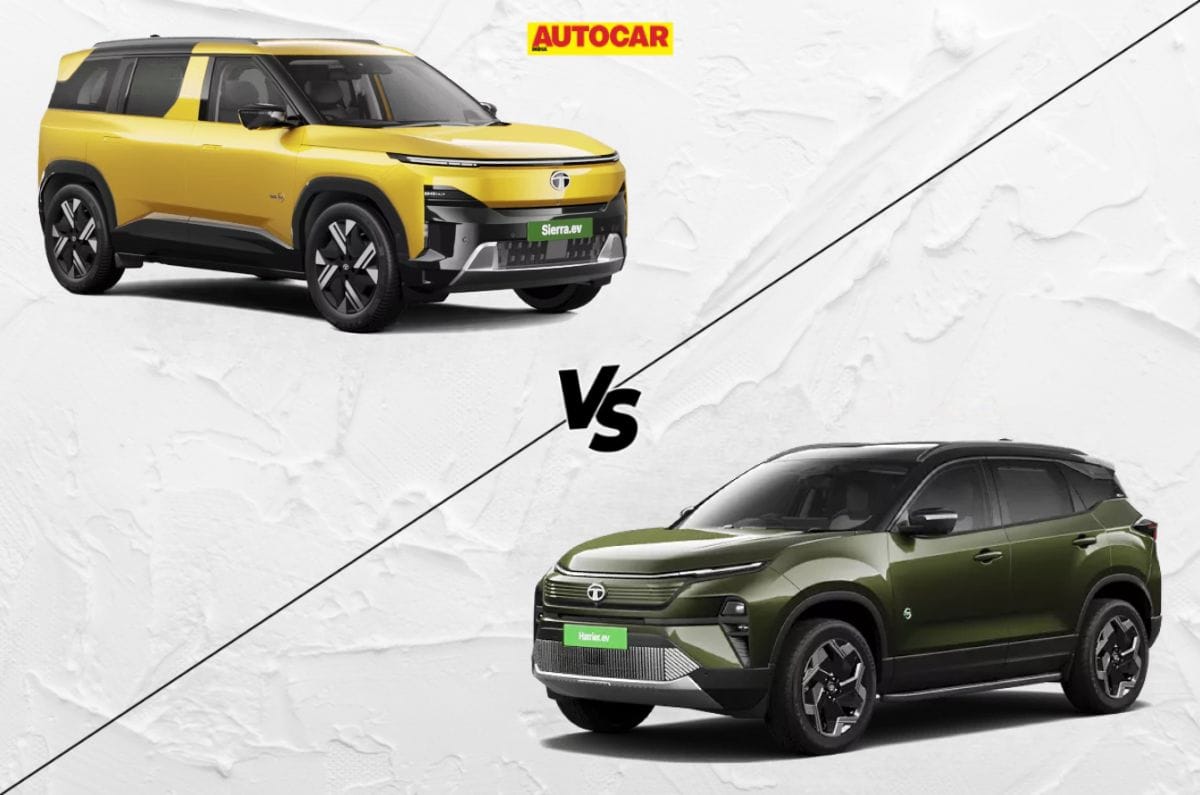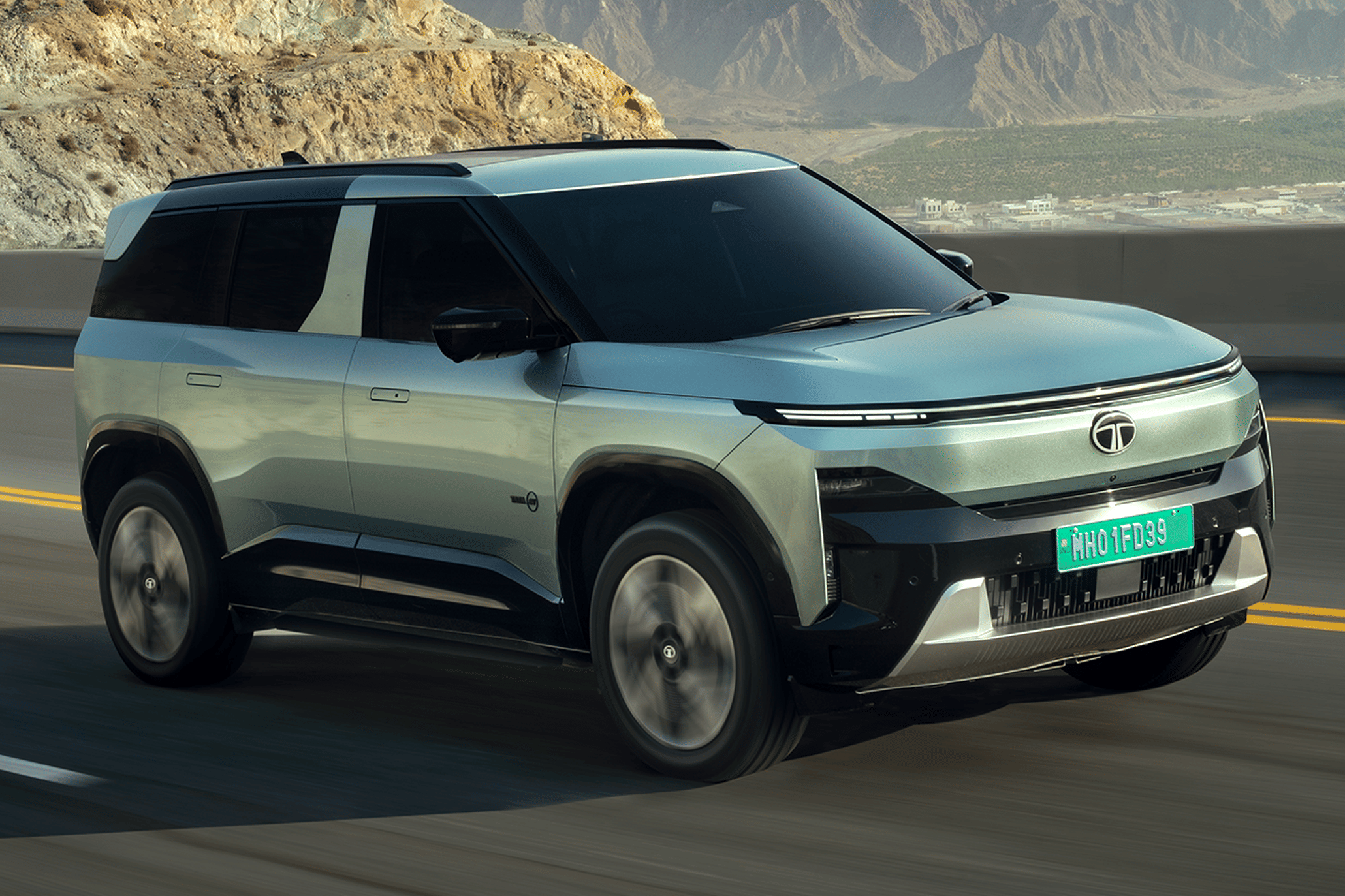
Tata Sierra EV top-spec vs Harrier EV mid-spec: Features, specs compared

Tata Sierra EV top-spec vs Harrier EV mid-spec variants compared

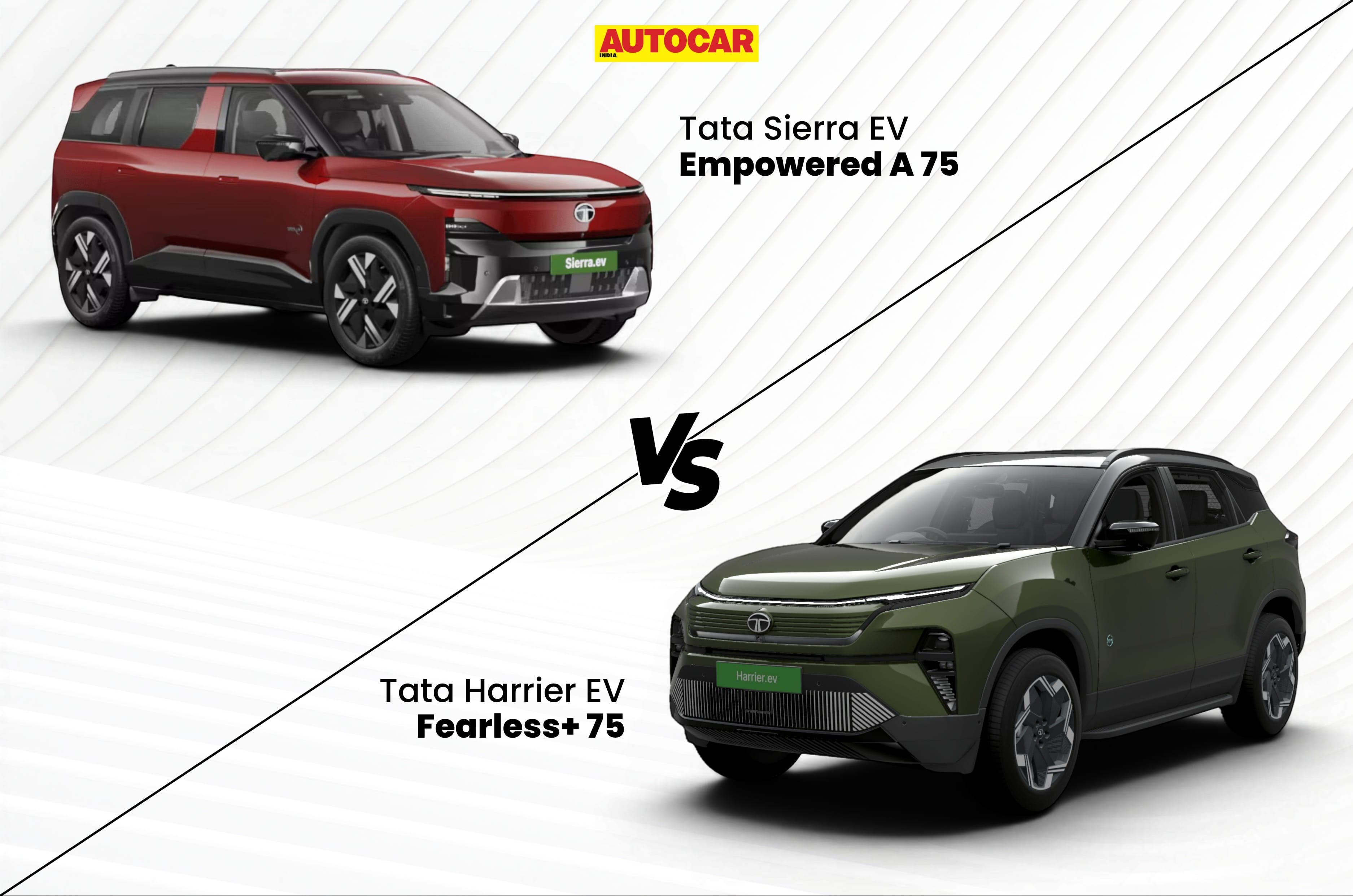
The recently launched Tata Sierra EV is positioned right below its larger sibling, the Harrier EV. However, there’s quite a lot of pricing overlap between the two Tata electric SUVs. To that end, we’ve compared the top-spec Sierra EV Empowered A 75 to the mid-spec Harrier EV Fearless+ 75 to find out which variant delivers better value on paper.

Explore full specs, features, and a price breakdown in our Sierra EV vs Harrier EV comparison.

Tata Sierra EV top-spec vs Harrier EV mid-spec: Dimensions

Harrier EV is longer and wider, but Sierra EV is taller and offers greater boot space

Tata Sierra EV Empowered A 75 vs Harrier EV Fearless+ 75 dimensions

 Sierra EVHarrier EV
Length (mm)4,3404,607
Width (mm)1,8411,922
Height (mm)1,7501,740
Wheelbase (mm)2,7302,741
Boot space (litres)622502
Frunk space (litres)55 (RWD) / 35 (AWD)67 (RWD) / 35 (AWD)
Wheel size (inches)1919

Expectedly, the Harrier EV is 267mm longer than the Sierra EV, but there’s only an 11mm difference between their wheelbases, suggesting that the smaller SUV doesn’t lose out on much interior space. While the Harrier EV is 81mm wider than the Sierra EV, the latter is 10mm taller. Wheel sizes are matched at 19 inches for both electric SUVs.

Interestingly, the Sierra EV offers 120 litres of additional boot space over the Harrier EV – it’s worth nothing that both SUVs’ boot capacity is measured up until the roof, as opposed to the conventional method, which is up to the parcel tray. In terms of frunk capacity, the RWD Harrier EV offers the bigger one, while their AWD versions are matched in this regard.

Tata Sierra EV top-spec vs Harrier EV mid-spec: Battery and range

Harrier EV offers more power, Sierra EV is quicker and claims higher range figures

Tata Sierra EV Empowered A 75 vs Harrier EV Fearless+ 75 powertrains

 Sierra EVHarrier EV
Battery size (kWh)7575
Motor setupSingle, rear / Dual, front and rearSingle, rear / Dual, front and rear
Power (hp)209 / 306238 / 313
Torque (Nm)315 / 504315 / 504
Drive layoutRWD / AWDRWD / AWD
Claimed 0-100kph time (seconds)5.8 (AWD)6.3 (AWD)
MIDC range (km)665 / 624627 / 622

Both the Sierra EV and Harrier EV get 75kWh battery packs, along with single-motor (RWD) and dual-motor (AWD) options. The Harrier EV edges ahead in terms of powertrain output, though the RWD versions of both SUVs feature identical torque figures. Despite the Sierra EV’s slightly lower output, its AWD variant is half a second quicker in the 0-100kph run compared to that of the Harrier EV – this is on account of the Sierra EV being smaller and lighter.

Similarly, MIDC-claimed range is a total victory for the Sierra EV as well. The Sierra EV AWD’s claimed range is 2km higher than that of the Harrier EV AWD, while the RWD version can travel 38km more on a single charge.

Tata Sierra EV top-spec vs Harrier EV mid-spec: Charging times

Both electric SUVs trade punches here

Tata Sierra EV Empowered A 75 vs Harrier EV Fearless+ 75 charging times and warranty details

 Sierra EVHarrier EV
AC charging time (10-100 percent)10.5hrs (7.2kW)10.7hrs (7.2kW)
DC charging time (20-80 percent)26mins (120kW)25mins (120kW)
Battery warrantyLifetime warranty and unlimited kilometresLifetime warranty and unlimited kilometres
Motor warranty8 years/1,60,000km (whichever is earlier)8 years/1,60,000km (whichever is earlier)
Vehicle warranty3 years/1,25,000km (whichever is earlier) 3 years/1,25,000km (whichever is earlier) 

Despite battery capacities being identical for both electric SUVs, the Harrier EV takes slightly longer to charge from 10-100 percent via a 7.2kW AC outlet. On the other hand, the Harrier EV is marginally quicker in a 20-80 percent top-up from a 120kW DC fast charger. Tata offers the same battery, motor, and vehicle warranties for the Harrier EV and Sierra EV, so buyers can rest easy on this front.

Tata Sierra EV top-spec vs Harrier EV mid-spec: Exterior features

Harrier EV additionally offers side step and charging indicator function for the front light bar

Tata Sierra EV Empowered A 75 vs Harrier EV Fearless+ 75 exterior features

 Sierra EVHarrier EV
HeadlampsAutomatic LEDAutomatic LED
Front light barLEDLED
Welcome/goodbye sequenceYesYes
Charging indicator in light barNoYes
Front fog lampsLEDLED
Cornering lampsYesYes
Tail-lampsLEDLED
Rear fog lampsYesYes
Sequential indicatorsYesYes
Side stepNoYes
Electrically adjustable ORVMs with auto-foldYesYes
Rear spoilerYesYes
Rear wiper and washerYesYes
Shark-fin antennaYesYes
Roof railsYesYes
Puddle lampsYesYes

Coming to exterior features, the Sierra EV and Harrier EV are near-identical. However, the Sierra EV does miss out on a charging indicator in the front light bar, with it instead being situated on the charging port. The Harrier EV additionally offers a side step too, which makes ingress and egress a tad easier.

Tata Sierra EV top-spec vs Harrier EV mid-spec: Interior features

Sierra EV is the only Tata electric car to offer a triple-screen setup

Tata Sierra EV Empowered A 75 vs Harrier EV Fearless+ 75 interior features

 Sierra EVHarrier EV
Touchscreen12.3 inches12.3 inches
Digital driver’s display10.25 inches10.25 inches
Passenger display12.3 inchesNo
Heads-up displayYesNo
Automatic climate controlDual-zoneDual-zone
Steering-mounted controlsYesYes
Ambient lightsYesYes
Panoramic sunroofYesYes
Powered driver seat6-way adjustment6-way adjustment
Driver seat functionsMemory and welcomeMemory and welcome
Powered co-driver seat4-way adjustment4-way adjustment
Ventilated front seatsYesYes
Boss modeYesNo
Sound system12-speaker JBL Black10-speaker JBL Black
Wireless charging padYesYes
Cabin air purifierYesYes
Powered windowsFront and rearFront and rear
Rear sunshadeYesYes
Rear AC ventsYesYes
Rear centre armrestYesYes
Connected car techYesYes
V2L, V2V functionalityYesYes

Despite its lower positioning, the Sierra EV pulls a clear lead over the Harrier EV in terms of cabin equipment. Features like a 12.3-inch passenger display, a 12-speaker JBL sound system, and a heads-up display are not offered even on the top-spec Harrier variant. In fact, the Sierra EV is the only electric Tata to come with a triple-screen setup at the moment.

Tata Sierra EV top-spec vs Harrier EV mid-spec: Driving features

Sierra EV comes with extra terrain mode and adaptive cruise control

Tata Sierra EV Empowered A 75 vs Harrier EV Fearless+ 75 driving features

 Sierra EVHarrier EV
Drive modesEco, City, SportEco, City, Sport
Battery regen modesYesYes
Terrain modesNormal, Wet, Rough, CustomNormal, Wet, Rough
Cruise controlAdaptive with stop/go functionsYes
Drift modeYesYes
Boost modeAWD onlyAWD only
Low-speed cruise controlAWD onlyAWD only
Extra terrain modes (AWD only)YesYes

Both the top-spec Sierra EV and mid-spec Harrier EV are very similar on the driving features front. However, the Sierra EV gets an additional ‘Custom’ terrain mode in the RWD version, as well as adaptive cruise control with stop and go functionality. The latter is much more convenient than the Harrier EV’s standard cruise control, as it can automatically adjust the speed based on proximity to nearby vehicles, and even come to a standstill and set off by itself. AWD versions of both SUVs get additional terrain modes too, namely Snow/Grass, Mud-Ruts, Sand, Rock Crawl, and Custom.

Tata Sierra EV top-spec vs Harrier EV mid-spec: Safety features

Harrier EV has 7 airbags and 5-star BNCAP rating, Sierra EV gets Level 2 ADAS and better camera setup

Tata Sierra EV Empowered A 75 vs Harrier EV Fearless+ 75 safety features

 Sierra EVHarrier EV
Bharat NCAP ratingYet to be tested5 stars
Airbags67
Level 2 ADASYesNo
Camera setup540-degreeRear only
Parking sensorsFront and rearFront and rear
Disc brakesFront and rearFront and rear
ABS with EBDYesYes
Electronic stability program (ESP)YesYes
TPMSYesYes
Electronic parking brake with auto-holdYesYes
Auto-dimming IRVMYesYes
Rain-sensing wipersYesYes
Rear defoggerYesYes
Driver drowsiness detectionNoYes
Acoustic vehicle alarm system (AVAS)YesYes

In the safety department, the Harrier EV holds some notable advantages, specifically a 5-star Bharat NCAP rating (the Sierra EV is yet to be tested, but will likely perform well too), 7 airbags, and driver drowsiness detection. The Sierra EV, though, trades punches with the Harrier EV thanks to safety features like Level 2 ADAS and a 540-degree camera (360-degree with underfloor view).

Tata Sierra EV top-spec vs Harrier EV mid-spec: Prices and verdict

Sierra EV is up to Rs 70,000 cheaper

Tata Sierra EV Empowered A 75 vs Harrier EV Fearless+ 75 price* (Rs, lakh)

 Sierra EVHarrier EVDifference
RWDRs 24.79 lakhRs 25.19 lakhRs 40,000
AWDRs 25.99 lakhRs 26.69 lakhRs 70,000

*Exclusive of home charger and installation, which costs Rs 49,000 extra.

The Sierra EV Empowered A 75 clearly emerges as the better option over the Harrier EV Fearless+ 75, as the smaller SUV offers considerably more comfort and convenience features, a larger boot, higher claimed range figures, similar powertrain outputs and charging speeds, and greater performance – all while being Rs 40,000-70,000 more affordable.

All prices are ex-showroom, India.

Tata Sierra EV vs Harrier EV: Whose top trim offers more value?

Tata Sierra EV vs Harrier EV: Whose top trim offers more value?

The Tata Sierra EV was recently launched as the manufacturer’s second all-electric offering with a dual-motor AWD choice. It is positioned between the Curvv EV and Harrier EV, the latter of which is also offered with an AWD option. So, between the Sierra EV and Harrier EV, whose top trim offers more features and better specifications? Let us find out.

Tata Sierra EV vs Harrier EV: Dimensions

Although smaller in size, the Sierra EV offers a larger boot and frunk

Tata Sierra EV vs Harrier EV dimensions and other specifications


Sierra EV 

Harrier EV

Difference

Length (mm)

4340

4607

-267

Width (mm)

1841

1922

-81

Height (mm)

1750

1740

+10

Wheelbase (mm)

2730

2741

-11

Ground clearance (mm)

205

–

–

Boot space (litres)

622

502

+120

Frunk space (litres)

55

35

+20

Number of seats

5

5

–

While the height and wheelbase of both the Sierra EV and Harrier EV are similar, the Harrier EV is longer and wider by a considerable margin. However, the Sierra EV offers a 120-litre larger boot space and a 20-litre larger frunk.

Notably, Tata has not revealed the official ground clearance figures of the Harrier EV, but it is likely to be similar to the Sierra EV’s 205mm ground clearance.

Tata Sierra EV vs Harrier EV: Powertrain

Both get similar battery packs, but the Harrier EV offers more potent electric motors

Tata Sierra EV vs Harrier EV: Powertrain specifications


Sierra EV RWD

Harrier EV RWD

Sierra EV AWD

Harrier EV AWD

Battery pack

75kWh

75kWh

75kWh

75kWh

eMotor configuration*

RWD

RWD

AWD

AWD

Power (hp)

209

238

140 (front), 209 (rear)

158 (front), 238 (rear)

Torque (Nm)

315

315

504

504

Claimed range (km)

665

627

624

622

*RWD = Rear-wheel-drive; AWD = All-wheel-drive

Top-spec trims of both the Sierra EV and the Harrier EV get identical 75kWh battery packs powering either a rear-axle-mounted (RWD) motor or dual electric motors (AWD). The Harrier EV RWD produces 29hp more than the Sierra EV RWD and has a higher claimed range.

With the AWD setup, the combined torque output of both SUVs is 504Nm, but their power outputs differ. The Harrier EV is the more powerful eSUV, its front and rear motors producing 18hp and 29 more than the Sierra EV, respectively.  The claimed range of both Tata EVs is similar too.

Notably, the Sierra EV’s lower variants are offered with a 63kWh battery with an RWD motor, and the Harrier EV is also available with a smaller 65kWh battery with an RWD setup.

Tata Sierra EV vs Harrier EV: Exterior

Both eSUVs offer identical exterior features

Tata Sierra EV vs Harrier EV: Exterior


Sierra EV Empowered A

Harrier EV Empowered

Headlights

Auto projector LED

Auto projector LED

Taillights

Connected LED

Connected LED

DRLs

Connected LED

Connected LED

Front fog lamps

LED, cornering function

LED, cornering function

Flush door handles

Yes

Yes

Wheels

19-inch alloy

19-inch alloy

Powered ORVMs

Yes

Yes

Roof rails

Yes

Yes

Sharkfin antenna

Yes

Yes

Colour

Monotone, Dual tone

Monotone, Dual tone

Exterior features on both the top-spec Sierra EV and Harrier EV are identical. These include an all-LED lighting setup, 19-inch rims, powered outside rearview mirrors (ORVMS) and roof rails.

Tata Sierra EV vs Harrier EV: Interior and features

Sierra EV offers three screens and more speakers, but misses out on boss mode

Tata Sierra EV vs Harrier EV: Interior and features


Sierra EV Empowered A

Harrier EV Empowered

Driver’s display

10.25-inch

10.25-inch

Infotainment screen

12.3-inch

14.5-inch

Passenger display

12.3-inch

–

Android Auto, Apple CarPlay

Yes, wireless

Yes, wireless

Audio system

12-speaker JBL

10-speaker JBL Black

On-board navigation

Yes

Yes 

Sunroof

Panoramic

Panoramic

Powered tailgate

Yes

Yes

Climate control

Dual-zone

Dual-zone

Air purifier

Yes

Yes

Seat upholstery

Leatherette

Leatherette

Steering wheel adjustment

Tilt, telescopic

Tilt, telescopic

Wireless phone charger

Yes

Yes

Driver seat adjustment

6-way powered

6-way powered

Driver’s seat features

Ventilation, memory, welcome 

Ventilation, memory, welcome 

Co-driver’s seat adjustment

4-way powered

4-way powered

Co-driver’s seat features

Ventilation

Ventilation

Rear seat features

–

Boss mode

Rear window sunshade

Yes

Yes

Head-up display (HUD)

Yes

No

Vehicle-to-load (V2L)

Yes

Yes

Vehicle-to-vehicle (V2V)

Yes

Yes

One of the Tata Sierra EV’s USPs is a triple-screen setup, which is not even offered on the pricier Harrier EV. Compared to the Harrier EV, the Sierra EV also gets 2 more speakers and a coloured HUD.

The flagship Harrier EV, however, offers a larger touchscreen infotainment system and powered boss mode on the co-driver’s seat, which are not available on the Sierra EV. Other features are identical to both eSUVs. 

Tata Sierra EV vs Harrier EV: Driving tech

Both electric SUVs are on par with each other in terms of driving tech

Tata Sierra EV vs Harrier EV: Driving technology


Sierra EV Empowered A

Harrier EV Empowered

Drive modes

Boost (AWD only), Eco, City, Sport

Boost (AWD only), Eco, City, Sport

RWD terrain modes

4

4

AWD terrain modes

6

6

Paddle shifters for regen

Yes

Yes

Cruise control

Adaptive

Adaptive

The Tata Sierra EV and Harrier EV share the same acti.ev+ platform, which is why they offer identical driving tech. These include 3 drive modes and up to 6 terrain modes (depending on the drivetrain).

Tata Sierra EV vs Harrier EV: Safety

Harrier EV gets an additional knee airbag and a digital IRVM

Tata Sierra EV vs Harrier EV: Safety features


Sierra EV Empowered A

Harrier EV Empowered

Airbags

6

7

ADAS

Level 2

Level 2

Camera setup

540-degree

540-degree

Parking sensors

Front and rear

Front and rear

Electronic parking brake

Yes

Yes

All-wheel disc brakes

Yes

Yes

TPMS

Yes

Yes

IRVM

Auto-dimming

Digital

Rear wiper, washer

Yes

Yes

Hill start assist

Yes

Yes

Hill descent control

Yes

Yes

ESC

Yes

Yes

Traction control

Yes

Yes

Over the Sierra EV, the top-spec Tata Harrier EV Empowered offer an additional knee airbag and a digital inside rearview mirror (IRVM). Other features, a 540-degree camera (with an under-bonnet view) and Level 2 ADAS, are identical on both EVs. 

Tata Sierra EV vs Harrier EV: Price and verdict

Sierra EV is around Rs 3 lakh more affordable than the Harrier EV

Sierra EV Empowered A vs Harrier EV Empowered ex-showroom price


Sierra EV Empowered A

Harrier EV Empowered

Difference

RWD price

Rs 24.79 lakh

Rs 27.69 lakh

– Rs 2.90 lakh

AWD price

Rs 25.99 lakh

Rs 29.19 lakh

– Rs 3.20 lakh

The top-spec Tata Harrier EV’s Empowered trim is around Rs 3 lakh pricier than the Sierra EV’s fully loaded Empowered A trim. Although the Harrier EV is larger, the Sierra EV offers more boot space and a higher claimed range with both RWD and AWD. Unlike the Harrier EV, it gets features like a dedicated screen for the co-driver and more speakers, while getting the same driving tech as the Harrier EV. Although it misses out on boss mode, an additional knee airbag and a digital IRVM, a Rs 3 lakh difference makes the Sierra EV a better value-for-money proposition.

Prices are ex-showroom, India.

Tata Sierra EV vs Mahindra BE 6: Whose top-spec trim offers better value?  

Tata Sierra EV vs Mahindra BE 6:

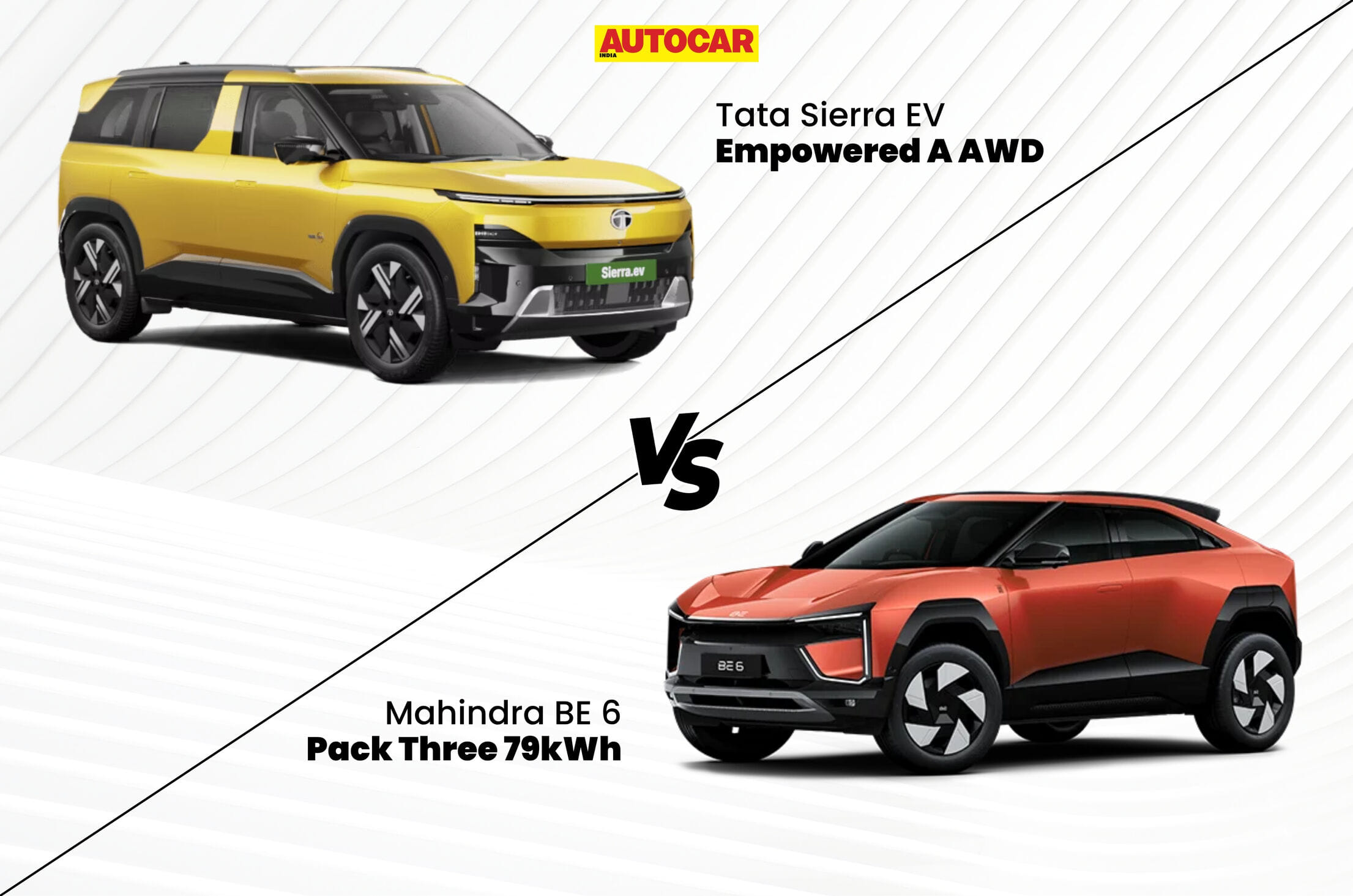
With the mid-size electric SUV space getting highly competitive over time, the Mahindra BE 6 comes as a popular option with its futuristic looks, large battery and powerful motor. With the Sierra EV’s arrival, Tata is aiming squarely for the BE 6. From dimensions and powertrains to features and price, we compare both eSUVs’ top-spec versions on paper to determine the better value proposition. Here, we’ve chosen the Empowered A trim of the Sierra EV and the Pack Three trim of the BE 6.

Explore full specs, features, and a price breakdown in our Sierra EV versus Mahindra BE 6 comparison.

Tata Sierra EV vs Mahindra BE 6: Dimensions

Tata Sierra EV vs Mahindra BE 6: Dimensions


Sierra EV

BE 6

Difference 

Length (mm)

4,340

4,371

-31 

Width (mm)

1,841

1,907

-66

Height (mm)

1,750

1,627

+123

Wheelbase (mm)

2,730

2,775

-45

Ground clearance (mm)

205

207

-2

Boot space (litres)

450

455

-5

Frunk space (litres)

35-55

45

+/-10

According to our mid-size eSUV specification comparison, the Sierra EV and the Mahindra BE 6 were among the largest models. While the Sierra EV is taller and has a larger frunk, the BE 6 is longer, wider, has a longer wheelbase, and slightly more ground clearance and boot. Overall, the BE 6 is larger, albeit marginally.

Tata Sierra EV vs Mahindra BE 6: Battery and range 

Tata Sierra EV vs Mahindra BE 6: Battery and range 


Sierra EV

Mahindra BE 6

Battery size (kWh)

75

79

Motor setup

RWD | AWD

RWD 

Power (hp)

209 | 140 (front) 240 (rear)

286

Torque (Nm)

315 | 504

380

ARAI range (km)

665 | 624

683

In top-specification guise, the Sierra EV and Mahindra BE 6 feature among the largest battery packs in the segment, with the latter being slightly bigger. But the Sierra more than makes up for it by being the only eSUV to have an AWD version. There’s also a single-motor RWD version offered on the Empowered A trim of the Sierra EV. While the BE 6’s single motor produces more power than the front and rear motors on the Sierra EV, the Sierra EV delivers 124Nm of additional torque in AWD guise. However, the BE 6 gets higher claimed range figures in comparison to the Sierra EV.

Tata Sierra EV vs Mahindra BE 6: Charging times 

Tata Sierra EV vs Mahindra BE 6: Charging times 


Sierra EV

Mahindra BE 6

Battery size (kWh)

75

79

AC charging output support (kW)

7.2

7.2, 11.2

DC charging output support (kW)

110, 120

180

AC charging time (hours)

8.9 | 10.5 (10-100%)

11.7, 8 (0-100%)

DC charging time (minutes)

25 | 26 (20-80%)

20 (20-80%)

As far as charging is concerned, the BE 6 supports faster AC and DC charging speeds compared to the Sierra EV. Only their DC charging speeds are comparable, with the Sierra EV’s time being up to 6 minutes slower than the BE 6’s.

Tata Sierra EV vs Mahindra BE 6: Exterior features

Tata Sierra EV vs Mahindra BE 6: Exterior features


Sierra EV

Mahindra BE 6

Headlights

Auto LED

Auto LED

Tail-lights

LED

LED

DRLs

Yes

Yes

Welcome/goodbye animation

Yes

Yes

Fog lamps

Front and rear

Front

Puddle lamps

Yes

No

Sequential indicators

Yes

Yes

Flush door handles

Yes

Yes

Rear spoiler

Yes 

Yes

Power-adjustable and folding ORVMs

Yes

Yes

Rain-sensing wipers

Yes

Yes

Rear wiper/washer

Yes

No

Shark-fin antenna

Yes

No

Colours

Monotone

Monotone

Wheels

19-inch

19-inch

On the outside, both the Sierra EV and BE 6 come with LED lighting, welcome and goodbye animations, sequential turn indicators, and the largest-in-segment 19-inch alloys. But the Sierra EV comes with rear fog lamps, puddle lamps, a rear wiper/ washer, and a shark fin antenna. However, the BE 6 gets motorised opening for the front flush door handles, while the Sierra EV’s flush door handles are manually operated.

Tata Sierra EV vs Mahindra BE 6: Interior features

Tata Sierra EV vs Mahindra BE 6: Interior features


Sierra EV

Mahindra BE 6

Infotainment screen

12.3-inch

12.3-inch

Driver’s display

10.25-inch

12.3-inch

Passenger display

12.3-inch

No

Head-up display

Yes

Yes

In-built navigation

Yes

No

Infotainment-based gaming console

Yes

No

In-car payments

Yes

No

Powered driver’s seat 

6-way

6-way

Front seat thigh support

Yes

No

Driver seat memory and welcome function

Yes

Yes

Powered front passenger seat

4-way

No

Cooled front seats

Yes

Yes

Reclining rear seats

Yes

Yes

Boss mode

Yes

No

Wireless Android Auto, Apple CarPlay

Yes

Yes

Audio system

12-speaker JBL Black

16-speaker Harman Kardon

Dolby Atmos

Yes

Yes

Sunroof

Openable panoramic

Fixed-glass panoramic

Rear AC vents

Yes

Yes

Climate control

Dual-zone

Dual-zone

Seat upholstery

Leatherette

Leatherette

Wireless phone charger

Yes

Yes

Ambient lighting

Yes

Yes

Front centre armrest

Yes

Yes

Rear centre armrest

Yes

Yes

USB ports

4x Type-C

4x Type-C

NFC-based key card

Yes

No

Powered tailgate

Yes

Yes

Air purifier

Yes

Yes

Connected car tech

Yes

Yes

Rear sunshades

Yes

No

OTA updates

Yes

Yes

While the BE 6 gets the larger digital driver’s display and more speakers than the Sierra EV, the latter, however, pips the former by offering an additional passenger display, built-in navigation, a powered front passenger seat, boss mode, and rear window sunshades. While the panoramic sunroof in the Sierra EV is openable, the BE 6 gets a fixed glass roof.

Tata Sierra EV vs Mahindra BE 6: Driving tech 

Tata Sierra EV vs Mahindra BE 6: Driving tech 


Sierra EV

BE 6

Boost mode

Yes

No

Drive modes

Normal, Eco, Sport

Default, Range, Everyday, Race

Terrain modes

Normal, Grass, Snow, Mud-ruts, Gravel, Sand, Rock Crawl, Custom

Snow

Off-road assist

Yes

No

Cruise Control

Adaptive

Adaptive

Drift mode

Yes

No

While drive modes and adaptive cruise control are present on both eSUVs, the Sierra EV’s AWD allows more adjustability to your drive. The BE 6 offers only snow mode, while the Sierra EV betters it with Normal, Grass, Snow, Mud-ruts, Gravel, Sand, Rock Crawl, and Custom terrain modes. Additionally, the Sierra EV also offers a drift mode and boost mode, with the latter surging power on demand. 

Tata Sierra EV vs Mahindra BE 6: Safety

Tata Sierra EV vs Mahindra BE 6: Safety


Sierra EV

BE 6

Airbags

6

6

ABS and EBD

Yes

Yes

ADAS

Level 2+

Level 2+

Automatic parking assist 

Yes

Yes

Camera setup

540-degree

360-degree

Parking sensors

Front and rear

Front and rear

Electric parking brake

Yes

Yes

Disc brakes

All-wheels

All-wheels

TPMS

Yes

Yes

IRVM

Auto-dimming

Auto-dimming

Hill-hold control

Yes

Yes

ESC

Yes

Yes

When it comes to safety features, the Sierra EV and BE 6 come loaded. Not only do both eSUVs cover the basics like 6 airbags, hill hold control, and ESC, but they are the segment’s only SUVs with Level 2+ ADAS and automatic parking assist. The latter feature also enables you to park/unpark your vehicle via your smartphone. But the Sierra EV nudges ahead minutely with additional cameras for the under-bonnet area on top of its 360-degree camera setup. 

Tata Sierra EV vs Mahindra BE 6: Price and verdict

Tata Sierra EV vs Mahindra BE 6: Price and verdict


Sierra EV AWD

Mahindra BE 6

Ex-showroom price (Rs lakh)

24.79 – 25.99

26.90

The Sierra EV is up to Rs 2.11 lakh cheaper than the BE 6 in top-spec guise, depending on the chosen variant. Between the two, it is the Sierra EV we recommend. While the BE 6 has larger dimensions and a higher claimed range, the Sierra EV brings more features and an AWD system, all while being more affordable at the same time, making it the better value proposition.

All electric midsize SUVs ranked as per ARAI-claimed range

Electric mid-size SUVs with the highest claimed range in India

The midsize SUV segment is not only one of the most contested among combustion-powered cars but also among electric vehicles, with 12 different EVs on sale. This form factor allows carmakers to offer large enough batteries for a usable range while also equipping them with the latest in-car tech at a competitive price. Here we have ranked all the midsize electric SUVs currently available in India as per their ARAI-claimed range. Let’s find out which model can go the farthest on a single charge.

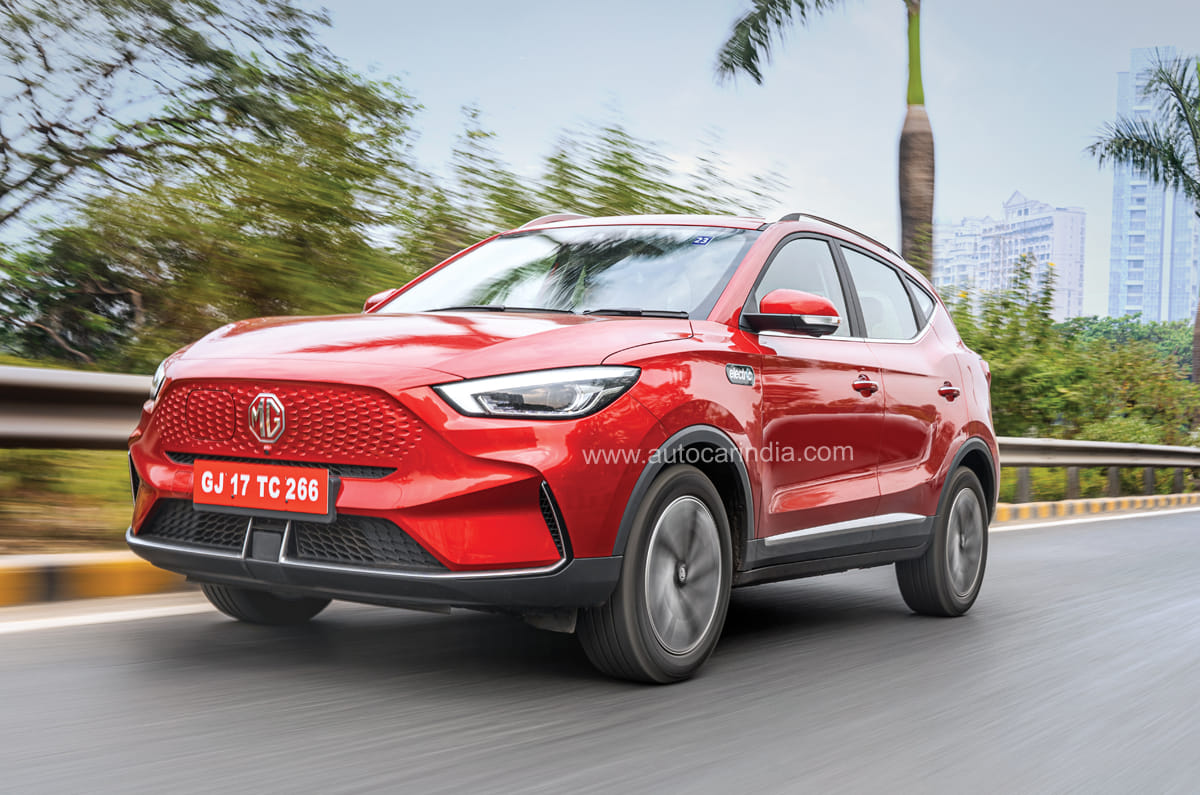
12. MG ZS EV

Up to 461km claimed range  

MG ZS EV battery specifications and ARAI range

Specifications

MG ZS EV

Battery pack (kWh)

50.3

ARAI-claimed range (km)

461

Price (Rs lakh)

17.99-20.75

The ZS EV is the electric equivalent of the MG Astor, adapted from an ICE platform. While it is the oldest midsize electric SUV currently on sale in India, its 50kWh battery pack is on par with even the newer offerings. However, a claimed range of 461km is just fine and places it last on this list. The battery powers a front-axle-mounted (FWD) electric motor that produces 177hp and 280Nm.

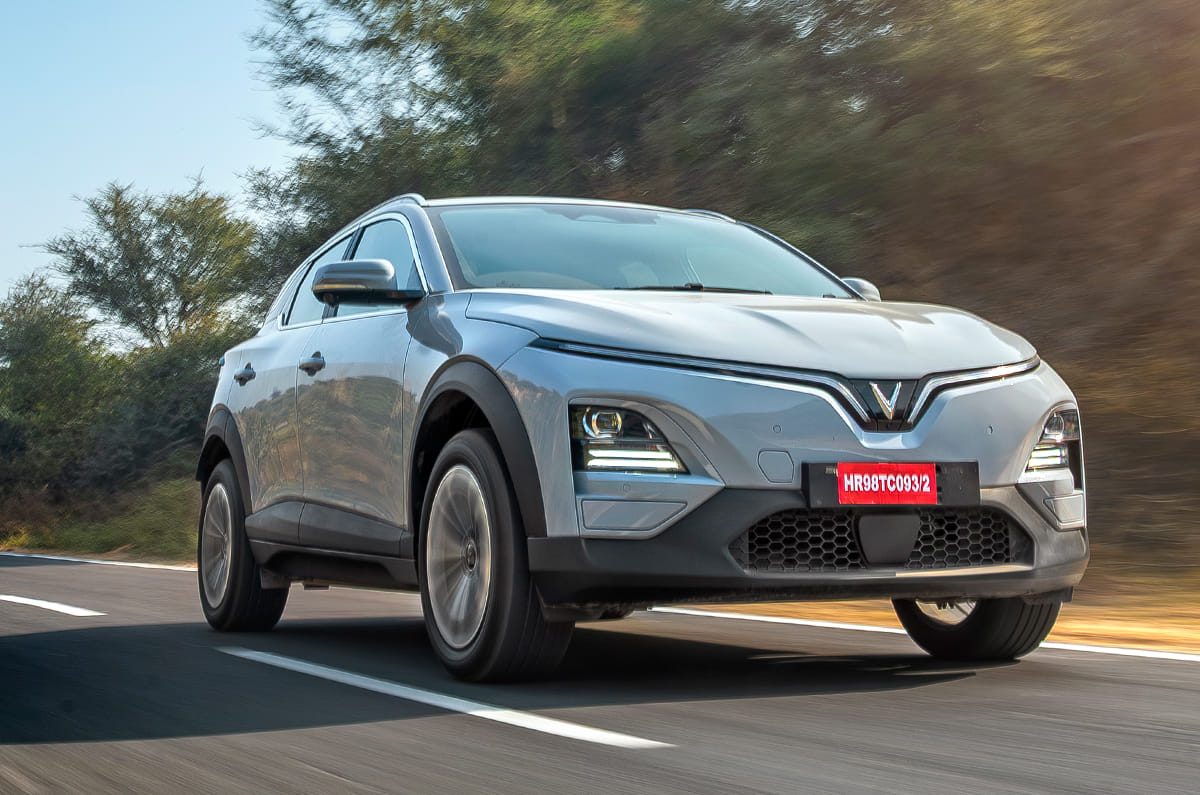
11. Vinfast VF6

Up to 468km claimed range 

Vinfast VF6 battery specifications and ARAI range

Specifications

Vinfast VF6

Battery pack (kWh)

59.6

ARAI-claimed range (km)

463-468

Price (Rs lakh)

17.29-19.19

Vinfast’s most affordable EV in India, the VF6, comes with a fairly large battery pack compared to the older ZS EV, but it does not help much in the claimed range department. While the lower trims offer an ARAI-rated range of 463km, the higher ones claim a slightly better 468km. This is likely due to different tuning of the drivetrain, as the lower trims get a 177hp, 250Nm motor, while the higher-spec trims are offered with a 204hp, 310Nm unit.  

10. Tata Curvv EV

Up to 502km claimed range 

Tata Curvv EV battery specifications and ARAI range

Specifications

Tata Curvv EV

Battery pack (kWh)

55

ARAI-claimed range (km)

502

Price (Rs lakh)

16.99-19.19

In this segment, the Tata Curvv EV sets itself apart with a coupe-SUV body style. It is based on the Nexon platform that has been heavily modified for an electric powertrain. Although its 55kWh smaller than the VF6’s, it has a higher claimed range. The front-mounted motor makes 167hp and 215Nm. The Curvv is also offered in a combustion-powered avatar, with petrol and diesel powertrain options.

9. Hyundai Creta Electric

Up to 510km claimed range 

Hyundai Creta Electric battery specifications and ARAI range

Specifications

Hyundai Creta Electric

Battery pack (kWh)

42 | 51.4

ARAI-claimed range (km)

420 | 510

Price (Rs lakh)

18.02-23.67

The Creta is a bestseller in its segment by a big margin, and a fraction of its total sales are from the all-electric iteration, the Hyundai Creta Electric. It gets two battery options, 42kWh and 51.4kWh, and the smaller battery’s 420km claimed range is the lowest in the segment. The larger pack’s range improves to a respectable 510km. While power figures are 135hp and 171hp for the 42kWh and 51.4kWh batteries, respectively, the torque is 255Nm for both.

8. BYD Atto 3

Up to 521km claimed range 

BYD Atto 3 battery specifications and ARAI range

Specifications

BYD Atto 3

Battery pack (kWh)

49.92 | 60.48

ARAI-claimed range (km)

468 | 521

Price (Rs lakh)

24.99-33.99

The BYD Atto 3 is the only model here that is not locally made in India. It is brought to India via the CKD (completely knocked down kits) route, which explains its expensive price tag. At the higher end of its price range, it offers the larger battery pack with a claimed range of 521km, which is less than the Tata-Mahindra rivals that offer over 600km of range at a similar price. The Atto 3 is a born EV and therefore does not have an ICE equivalent. At 4.45 metres long, it is also a tad larger than other SUVs on this list. Like the Creta Electric, it gets two battery pack options, both mated to a 204hp, 310Nm front-axle-mounted electric motor. 

7. Vinfast VF7

Up to 532km claimed range 

Vinfast VF7 battery specifications and ARAI range

Specifications

Vinfast VF7

Battery pack (kWh)

59.6 | 70.8

ARAI-claimed range (km)

438 | 510-532

Price (Rs lakh)

21.89-26.79

The Vinfast VF7, launched alongside the VF6, is offered with two battery packs. The smaller battery comes paired with a 177hp, 250Nm front-axle-mounted electric motor, while the larger 70.8kWh unit is available in both FWD and AWD setups. The FWD version produces 204hp and 310Nm, while the AWD iteration puts out 353hp and 500Nm. Interestingly, not only is the VF7 the most affordable EV in India with an AWD setup, but it is also one of the fastest mass-market offerings with a claimed 0-100kph time of 5.8 seconds. Both its battery packs offer a claimed range on par with most other SUVs in this segment. 

6. Maruti Suzuki e Vitara

Up to 543km claimed range

Maruti Suzuki e Vitara battery specifications and ARAI range

Specifications

Maruti Suzuki e Vitara

Battery pack (kWh)

49 | 61

ARAI-claimed range (km)

440 | 543

Price (Rs lakh)

15.99-19.79

Maruti Suzuki’s first EV in India, the e Vitara, is the most affordable midsize electric SUV in India. Moreover, it is offered with a Battery-as-a-Service (BaaS) scheme, like the ZS EV, which lowers the upfront price. It is available with two battery pack options but only with a front-axle-mounted electric motor, unlike the international-spec EV that gets an AWD option too. While the 49kWh version produces 144hp, the 61kWh makes 174hp; the 193Nm torque is common for both. At a top-end price of Rs 19.79 lakh, the e Vitara’s claimed range of 543km is comparatively higher than similarly priced rivals, which mostly quote sub-500km figures. 

5. Tata Harrier EV

Up to 627km claimed range

Tata Harrier EV battery specifications and ARAI range

Specifications

Tata Harrier EV

Battery pack (kWh)

65 | 75

ARAI-claimed range (km)

538 | 622-627

Price (Rs lakh)

21.49-29.48

The Tata Harrier EV sits at the top of Tata’s EV lineup. It gets an AWD layout, but this drivetrain is offered with the higher-spec trims with the 75kWh battery pack. Lower trims feature an RWD setup that produces 175hp and 315Nm. The AWD version gets the same rear-axle motor along with a 116hp front-axle-mounted unit for a total of 504Nm. With a claimed 0-100kph sprint time of 6.3 seconds, the Harrier EV AWD is slightly slower than the Vinfast VF7 and also costs more. 

4. Mahindra XEV 9e

Up to 656km claimed range

Mahindra XEV 9e battery specifications and ARAI range

Specifications

Mahindra XEV 9e

Battery pack (kWh)

59 | 79

ARAI-claimed range (km)

522 | 656

Price (Rs lakh)

21.90-30.50

The XEV 9e is a born-electric SUV, which, incidentally, uses BYD’s proprietary Blade cell technology in its battery pack. This rear-wheel-drive model’s motor produces 231hp with the 59kWh battery and 286hp with the 79kWh unit; torque is 380Nm for both. The claimed range is over 650km for the 79kWh version. Although the XEV 9e leans towards the expensive side, its specifications help it offer great value for the price.

3. Mahindra XEV 9S

Up to 679km claimed range

Mahindra XEV 9S battery specifications and ARAI range

Specifications

Mahindra XEV 9S

Battery pack (kWh)

59 | 70 | 79

ARAI-claimed range (km)

521 | 600 | 679

Price (Rs lakh)

19.95-29.45

The Mahindra XEV 9S is the first mass-market 3-row electric SUV in India, and it is the only model on this list to get three battery pack options. All come paired with a rear-wheel-drive motor that produces 380Nm but have different power outputs – 231hp in the 59kWh version, 245hp in the 70kWh version and 286hp in the 79kWh version. Notably, even though the XEV 9S gets bigger battery packs and an additional row compared to the XEV 9e, it has a lower price tag, making it offer more value for less money. 

2. Tata Sierra EV

Up to 665km claimed range 

The Sierra EV is Tata’s latest addition to its EV range, slotting between the Cuvv EV and Harrier EV. It is powered by either a 63kWh or a 75kWh battery pack from the Harrier. The latter option also offers an AWD layout, while an RWD layout is standard. With the 63kWh battery pack, the motor produces 238hp, while it delivers 208hp in the 75kWh guise, with torque at 315Nm in both versions. Meanwhile, AWD versions add a front-mounted motor developing 140hp, while torque is bumped to 504Nm. Tata claims a 0-100kph time of 5.8 seconds for the AWD version, equaling that of the VF7’s. 

Tata Sierra EV battery specifications and ARAI range

Specifications

Tata Sierra EV

Battery pack (kWh)

63 | 75

ARAI-claimed range (km)

566 | 665, 624 (AWD)

Price (Rs lakh)

18.49-25.90

1. Mahindra BE 6

Up to 683km claimed range

Mahindra BE 6 battery specifications and ARAI range

Specifications

Mahindra BE 6

Battery pack (kWh)

59 | 79

ARAI-claimed range (km)

548 | 683

Price (Rs lakh)

18.90-26.90

The BE 6 is identical to the XEV 9e under its skin, so it carries over the same rear-wheel-drive layout and battery pack options, arguably in a more stylish package. It is also slightly smaller and lighter than the XEV 9e, which is what gives it the edge in terms of range. With 683km on a single charge with the larger 79kWh battery pack, it has the highest claimed range among all mainstream electric SUVs in India.

Prices are ex-showroom, India.

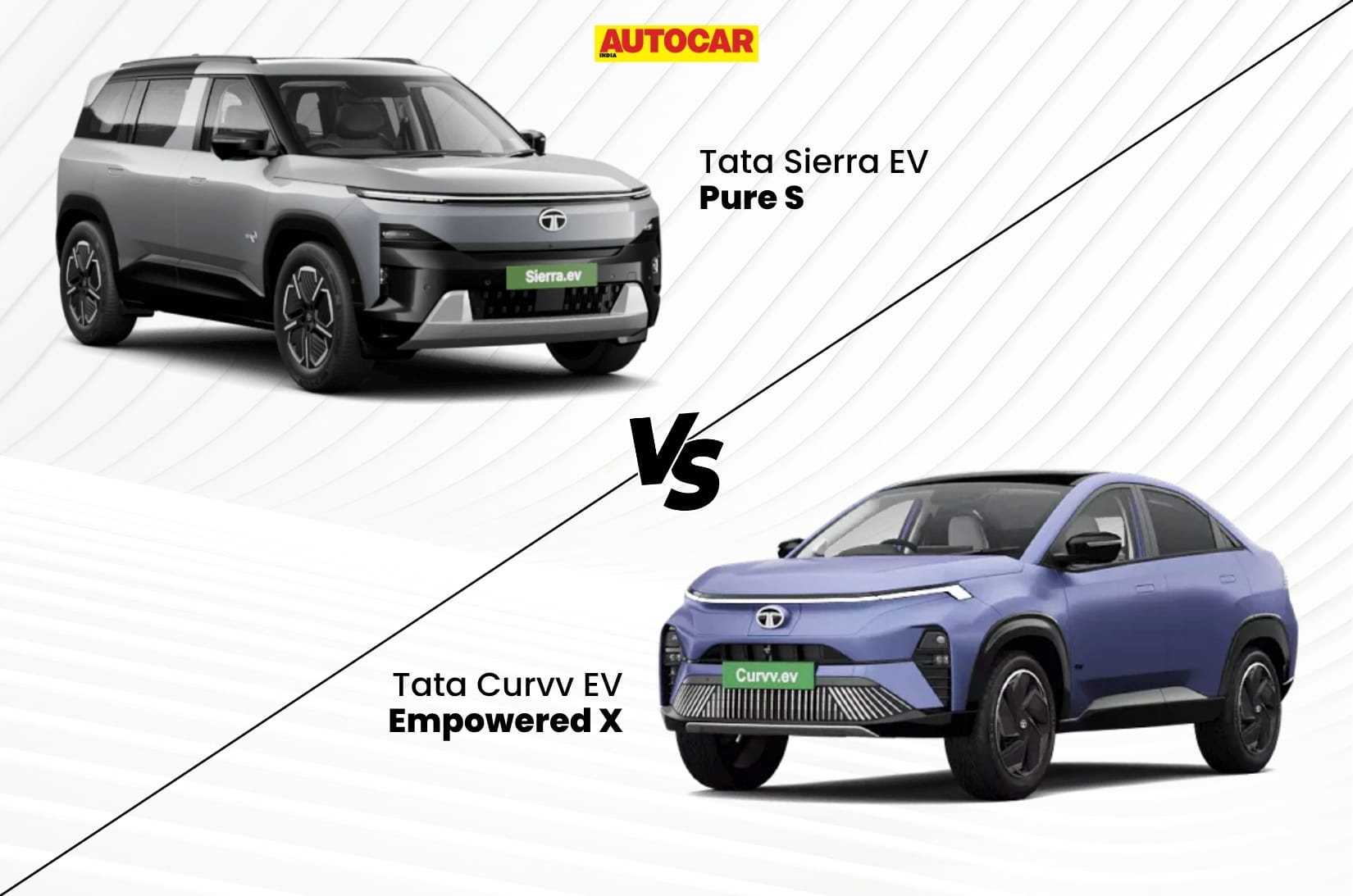
Tata Sierra EV vs Curvv EV: Which EV is better at Rs 20 lakh?

Tata Sierra EV vs Curvv EV: Which EV is better at Rs 20 lakh?

The Tata Sierra EV is the most recent all-electric offering in the manufacturer’s lineup, which is positioned between the Curvv EV and Harrier EV. The new Sierra EV is priced from Rs 18.79 lakh to Rs 25.99 lakh, while the Curvv EV’s prices range from Rs 16.99 lakh to Rs 19.19 lakh. So, if you have a budget of around Rs 20 lakh, should you go for the top-spec Curvv EV Empowered X or the similarly priced one-above-base Sierra EV Pure S variant? Let’s find out.

Tata Sierra EV Pure S vs Curvv EV Empowered X: Dimensions

Sierra EV has larger dimensions and offers additional boot space

Tata Sierra EV vs Curvv EV : Dimensions and other specifications


Sierra EV 

Curvv EV

Difference

Length (mm)

4340

4310

+30

Width (mm)

1841

1810

+31

Height (mm)

1750

1637

+113

Wheelbase (mm)

2730

2560

+170

Ground clearance (mm)

205

186

+19

Boot space (litres)

622

500

+122

Frunk space (litres)

55

11.6

+43.4

Number of seats

5

5

–

Both Tata EVs are offered with 5 seats, but the Sierra EV is larger than the Curvv EV in all respects. While the differences in height and width won’t matter much in the real world, the Sierra EV’s 113mm-taller height and 170mm-longer wheelbase are expected to translate into better cabin space than the Curvv EV. The Sierra EV also offers 19mm higher ground clearance, a 122-litre larger boot, and 40+ litres of additional frunk space, making it more practical than the Curvv EV. 

Tata Sierra EV Pure S vs Curvv EV Empowered X: Powertrain

Sierra EV Pure S packs a larger battery and a more potent electric motor

Tata Sierra EV Pure S vs Curvv EV Empowered X : Powertrain


Sierra EV Pure S

Curvv EV Empowered X

Battery pack

63kWh

55kWh

eMotor configuration*

RWD

FWD

Power

209hp

165hp

Torque

315Nm

215Nm

Claimed range

665km

502km

*RWD = Rear wheel drive, FWD = Front wheel drive

The Sierra EV’s Pure S variant has a slightly larger battery pack, enabling a whopping 163km higher claimed range compared to the Curvv EV’s Empowered X variant. Respective variants of both Tata EVs are offered with a single-motor setup, but with different layouts. Notably, the top-spec Sierra EV is also available with a dual-motor AWD system with a larger 75kWh battery, but at a much higher price point. The Curvv EV, however, is only offered in a FWD configuration with a 55kWh battery across its lineup.

Along with a larger battery, the Sierra EV 63kWh version is also offered with a more powerful motor, producing 44hp and 100Nm more than the Curvv EV.

Tata Sierra EV Pure S vs Curvv EV Empowered X: Exterior

Both EV variants offer similar exterior features

Tata Sierra EV Pure S vs Curvv EV Empowered X: Exterior


Sierra EV Pure S

Curvv EV Empowered X

Headlights

Auto projector LED

Auto projector LED

Tail-lights

Connected LED

Connected LED

DRLs

Connected LED

Connected LED

Front fog lamps

LED, cornering function

LED, cornering function

Flush door handles

Yes

Yes

Wheels

18-inch alloy

18-inch alloys

Powered ORVMs

Yes

Yes

Roof rails

Yes

No

Sharkfin antenna

Yes

Yes

Colour

Monotone

Monotone

Except for the missing roof rails on the Curvv EV, the exterior features on both the Tata Sierra EV Pure S and Curvv EV Empowered S are the same. Both EVs get all-LED lighting, flush-type door handles, 18-inch alloys and a shark-fin antenna.

Tata Sierra EV Pure S vs Curvv EV Empowered X: Interior, features

A powered driver’s seat and a powered tailgate are not offered with the Sierra EV Pure S 

Tata Sierra EV Pure S vs Curvv EV Empowered X: Interior and features


Sierra EV Pure S

Curvv EV Empowered X

Driver’s display

10.25-inch

10.25-inch 

Infotainment screen

12.3-inch

12.3-inch

Passenger display

No

No

Android Auto, Apple CarPlay

Yes, wireless

Yes, wireless

Audio system

8-speaker

9-speaker JBL*

On-board navigation

Yes

Yes

Sunroof

Panoramic

Panoramic

Powered tailgate

No

Yes, with gesture support

Climate control

Automatic

Automatic

Rear AC vents

Yes

Yes

Air purifier

PM2.5 filter only

Yes

Seat upholstery

Fabric

Leatherette

Steering wheel adjustment

Tilt, telescopic

Tilt

Wireless phone charger

Yes

Yes

Driver seat adjustment

Manual

6-way powered

Co-driver’s seat adjustment

Manual

Manual

Front seat features

–

Ventilation

Rear window sunshade

Yes

Yes

Vehicle-to-load (V2L)

Yes

Yes

Vehicle-to-vehicle (V2V)

Yes

Yes

*Curvv EV’s sound system includes JBL-sourced 8 speakers and a subwoofer

The top-spec Curvv EV Empowered X gets a few additional features over the lower-spec Sierra EV Pure S, including a powered driver’s seat with ventilation function, a powered tailgate, a subwoofer and leatherette seat upholstery. The Curvv EV also gets a full-blown air purifier, while the Sierra EV’s one-over-base Pure S trim offers only a PM2.5 air filter.

Other features like the 10.25-inch and 12.3-inch screens, a panoramic sunroof, a wireless phone charger, V2L and V2V charging support and auto climate control with rear vents are common to both EVs.

Tata Sierra EV Pure S vs Curvv EV Empowered X: Driving tech

The Curvv EV offers adaptive cruise control over the Sierra EV’s Pure S variant

Tata Sierra EV Pure S vs Curvv EV Empowered X: Driving technology


Sierra EV Pure S

Curvv EV Empowered X

Drive modes

Eco, City, Sport

Eco, City, Sport

Paddle shifters for regen

Yes

Yes

Cruise control

Yes

Adaptive

Both EV variants are offered with the same drive modes and paddle shifters to control the battery regeneration level. The difference, however, is that the top-spec Curvv EV gets adaptive cruise control, while the Sierra EV Pure S gets standard cruise control.

Tata Sierra EV Pure S vs Curvv EV Empowered X: Safety features

Curvv EV gets an ADAS suite and a 360-degree camera over Sierra EV Pure S

Tata Sierra EV Pure S vs Curvv EV Empowered X: Safety features


Sierra EV Pure S

Curvv EV Empowered X

Airbags

6

6

ADAS

No

Level 2

Camera setup

Rear

360-degree

Parking sensors

Front and rear

Front and rear

Electronic parking brake

Yes

Yes

All-wheel disc brakes

Yes

Yes

TPMS

Yes

Yes

IRVM

Manually-adjustable

Auto-dimming

Rear wiper, washer

Yes

No

Hill start assist

Yes

Yes

Hill descent control

Yes

Yes

ESC

Yes

Yes

Traction control

Yes

Yes

Safety features such as 6 airbags, front and rear parking sensors, a tyre pressure monitoring system (TPMS) and disc brakes on all wheels are common to both EVs. The top-spec Curvv EV Empowered X, however, goes a step further and offers a 360-degree camera, an auto-dimming inside rearview mirror, and a Level-2 advanced driver assistance system (ADAS). 

Tata Sierra EV Pure S vs Curvv EV Empowered X: Price, verdict

Sierra EV Pure S offers more claimed range but misses out on some premium features

Sierra EV Pure S vs Curvv EV Empowered X: ex-showroom price

Model variant

Price

Tata Sierra EV Pure S 63kWh

Rs 19.99 lakh

Tata Curvv EV Empowered X 55kWh

Rs 19.19 lakh

The lower-spec Tata Sierra EV is Rs 80,000 pricier than the top-spec Curvv EV Empowered X. However, at the higher price, the Sierra EV Pure S offers a larger battery pack with a higher claimed range. The Tata Sierra EV is also larger, which translates to better cabin space. Although it misses out on premium features like a powered driver’s seat, a powered tailgate, Level-2 ADAS and a 360-degree camera, it offers a decent feature suite. All of this makes the Sierra EV Pure S a better offering compared to the Curvv EV Empowered X. 

Prices are ex-showroom, India

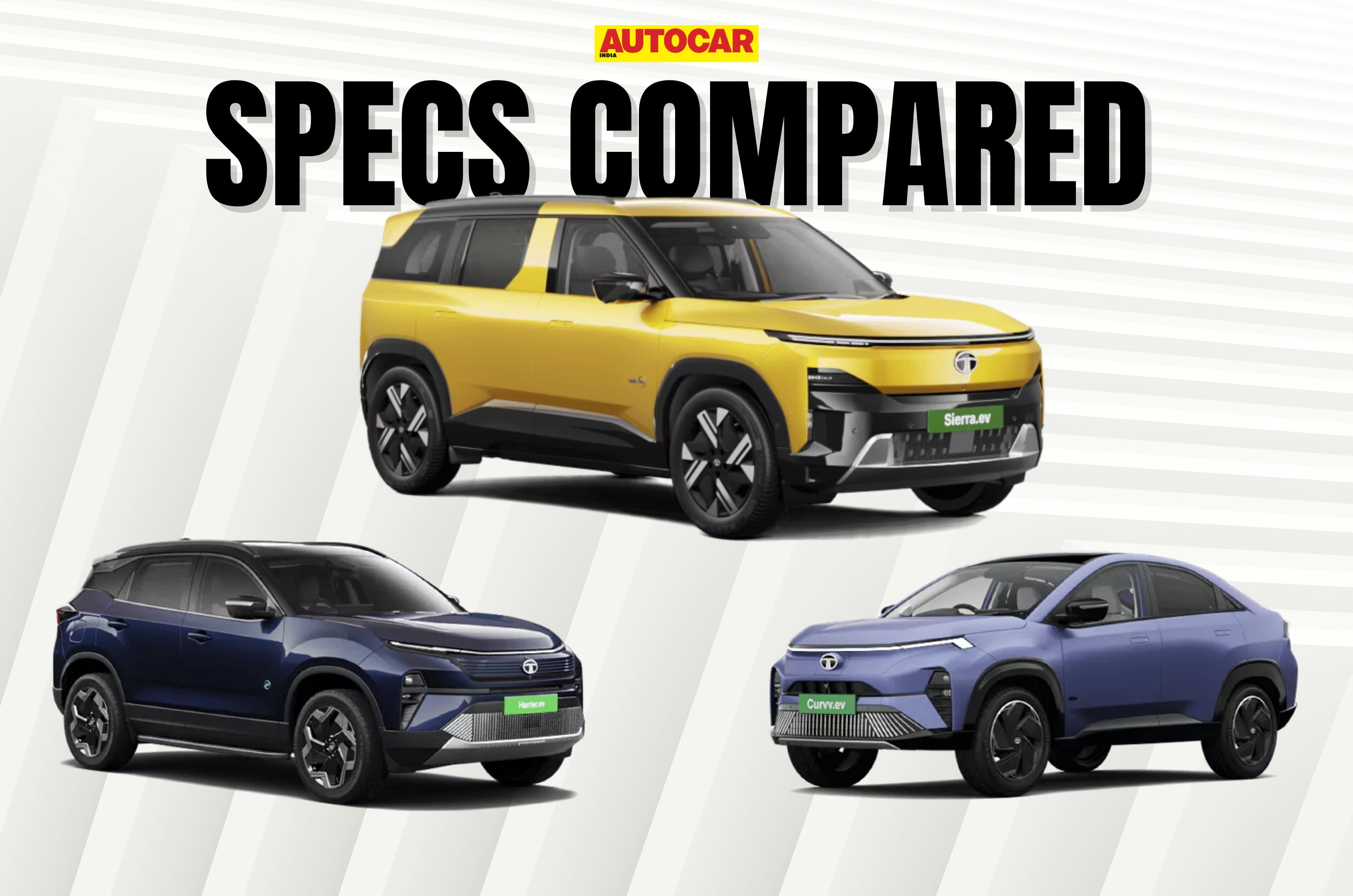
Tata Sierra EV prices and specs compared with Harrier EV, Curvv EV

Tata Sierra EV prices and specs compared with Harrier EV and Curvv EV

Tata Motors launched the fully electric version of the Sierra on June 30, 2026. Spread across three distinct variants, the Sierra EV joins the automaker’s all-electric line-up and is slotted between the Curvv EV and Harrier EV. The Harrier EV and Sierra EV are in a similar price bracket, with clear price overlaps between some trim levels, with the top-spec Curvv EV coming in close proximity to the latter. Let’s now look at how these cars compare against one another.

Tata Sierra EV dimensions vs Harrier EV, Curvv EV

The frunk and wheel sizes of the Sierra EV and Harrier EV differ based on variants

Tata Sierra EV dimensions vs Harrier EV, Curvv EV


Tata Sierra EV

Tata Harrier EV

Tata Curvv EV

Length (mm)

4,340

4,607

4,310

Width (mm)

1,841

1,922

1,810

Height (mm)

1,750

1,740

1,637

Wheelbase (mm)

2,730

2,741

2,560

Boot space (litres)

450*

502

500

Frunk (litres)

55/35

67/35

–

Wheel size (inches)

18-19

18-19

18

The Sierra EV is a significant 267mm shorter than the Harrier EV but 30mm longer than the Curvv EV. It’s not only 31mm wider than the Curvv EV but also a noticeable 113mm taller. Not just that, the Sierra EV is slightly taller than the Harrier EV, too. The Sierra EV has a wheelbase that’s 170mm longer than the Curvv’s but falls short of the Harrier’s by 11mm.

The luggage-carrying capacity of the Harrier EV is more than that of the Sierra EV, owing to its size. While we’re yet to measure it, Tata claims that the Sierra EV’s boot is similar in size to its combustion-powered namesake, where it’s 450 litres. This means that the Sierra EV’s boot is smaller than that of the Curvv EV by 50 litres. The frunk capacity of the Sierra EV and Harrier EV change based on the variant chosen, with the lower ones sporting more capacity. While the Sierra and Harrier can be had with 18- or 19-inch wheels, the Curvv EV is only offered with 18-inch rims. 

Tata Sierra EV powertrain vs Harrier EV, Curvv EV

Sierra EV shares its dual-motor configuration, battery size and torque output with the Harrier EV

Tata Sierra EV powertrain vs Harrier EV, Curvv EV

Specifications

Curvv EV 55

Sierra EV

Harrier EV

Battery variant (kWh)

55

63 / 75 / 75 QWD

65 / 75 / 75 QWD

Front electric motor (hp)

167

NA / 140

NA / 158

Rear electric motor (hp)

NA

238 / 209 / 209

238 / 238 / 238

Combined torque (Nm)

215

315 / 315 / 504

315 / 315 / 504

Drive configuration

FWD

RWD / RWD / AWD

RWD / RWD / AWD

Claimed 0-100kph (sec)

8.6

5.8*

6.3*

Claimed range (km)

502

535 / 665 / 624

538 / 627 / 622

AC charging (7.2kW)

7.9 hrs (10-100%)

8.9-10.5 hrs (10-100%)

9.3-10.7 hrs (10-100%)

DC fast charging

40 mins at 70kW (10-80%)

25-26 mins at 120kW (20-80%)

25 mins at 120kW (20-80%)

*Claimed acceleration figures of the top-spec variants.

Both the Sierra and Harrier come in single-motor rear-wheel drive (RWD) and dual-motor all-wheel drive (AWD) versions. The entry-level variant of the Sierra and Harrier have identical outputs, with the torque remaining identical between all variants of these two SUVs. However, the mid-spec and top-spec Sierra’s rear motors make less power than their Harrier counterparts. Meanwhile, the Curvv EV is only offered with one powertrain option.

Since it’s likely less heavy than the larger Harrier, the Sierra EV QWD (Tata’s parlance for AWD) manages to finish the sprint from 0-100kph half-a-second quicker. It’s also 2.8 seconds quicker to 100kph than the single-motor front-wheel drive Curvv EV. The claimed range of the base- and top-spec Sierra EV are comparable to those of the Harrier EV, but the former’s mid-spec 75kWh RWD version has a slight range advantage.

Meanwhile, the Curvv EV’s claimed range is 122km shy of the Sierra EV’s. Both the Sierra and Harrier with the 75kWh battery option can accept DC fast-charging, taking the battery from 20-80 percent in about the same time. When plugged into a 7.2kW AC charger though, the Curvv’s smaller battery can be charged from 10-100 percent in a little over 7 hours. The Sierra EV needs about 1-3 hours extra to do the same, and the Harrier EV take a similar amount of time.

Tata Sierra EV features vs Harrier EV, Curvv EV

Among the top-spec variants of all three, the Sierra EV is the most feature-packed car here

Tata Sierra EV features vs Harrier EV, Curvv EV


Tata Curvv EV 55

Tata Sierra EV 75 QWD

Tata Harrier EV 75 QWD

Infotainment touchscreen

12.3-inch

12.3-inch

14.5-inch

Digital driver’s display

10.25-inch

10.25-inch

10.25-inch

Front passenger screen

No

12.3-inch

No

Voice-assisted sunroof

Panoramic

Panoramic

Panoramic

Multiple voice assistants

Yes

Yes

Yes

Powered seats

Yes (driver only)

Yes

Yes

Driver’s seat memory, welcome functions  

No

Yes

Yes

Ventilated front seats

Yes

Yes

Yes

‘Boss’ mode

No

Yes

Yes (powered)

Wireless Apple CarPlay & Android Auto

Yes

Yes

Yes

Automatic climate control

Single-zone

Dual-zone

Dual-zone

Audio system

9-speaker JBL

12-speaker JBL Black

10-speaker JBL Black

Dolby Atmos

No

Yes

Yes

Wireless charging

Yes

Yes

Yes

Rear sunblinds

Yes

Yes

Yes

Surround-view camera

Yes (360-degree)

Yes (540-degree)

Yes (540-degree)

EV route planner

No

Yes (Android Auto)

No

Arcade.ev suite

Yes

Yes

Yes

‘AirConsole’ in-car gaming

No

Yes

No

‘DrivePay’

No

Yes

Yes

LED ambient lighting

Yes (multi-colour)

Yes (multi-colour)

Yes (multi-colour)

Connected-car features

Yes

Yes

Yes

‘Summon’ mode

No

Yes

Yes

Level 2 ADAS

Yes

Yes

Yes

Auto headlamps

Yes

Yes

Yes

Rain-sensing wipers

No

Yes

Yes

HUD

No

Yes

No

Airbags

6

6

7

SOS

Yes

Yes

Yes

Hill-hold control

Yes

Yes

Yes

Hill-descent control

No

Yes

Yes

Regen modes

4

4

4

Paddle shifters

Yes

Yes

Yes

Terrain modes

No

6

6

Drive modes

3

4

4

Powered tailgate

Gesture activated

Gesture activated

Gesture activated

V2L, V2V

Yes

Yes

Yes

The Sierra EV gets a dedicated 12.3-inch infotainment screen for the front passenger, a JBL Black audio system with the most number of speakers, and a separate route planner meant currently for Android Auto users. It also comes with a new ‘AirConsole’ gaming feature, which syncs the user’s phone with the infotainment screen for playing games. Moreover, it’s only the Sierra EV that can be had with an augmented-reality head-up display (HUD).

The ‘Summon’ mode of the Sierra EV and Harrier EV allows the car to crawl out of parking spots using a key fob, while both models support Dolby Atmos and dual-zone climate control. Features like automatic headlamps & wipers, a driver’s seat with memory & welcome functions, 540-degree cameras, and hill-descent control are found on the Sierra EV as well as the Harrier EV. They also get 6 terrain modes: Normal, Grass/Snow, Mudruts/Gravel, Sand, Rock Crawl and Custom. However, the Harrier EV has 7 airbags and a larger primary touchscreen.

All three EVs come with four levels of regenerative braking, a gesture-activated tailgate, voice-activated panoramic sunroofs, and ventilated front seats. They also get Level 2 ADAS (Advanced Driver Assistance Systems) with adaptive cruise control and auto-emergency braking, plus vehicle-to-load (V2L) and vehicle-to-vehicle (V2V) functions. The Sierra EV has the most number of features here.

Prices of Tata Sierra EV vs Harrier EV, Curvv EV

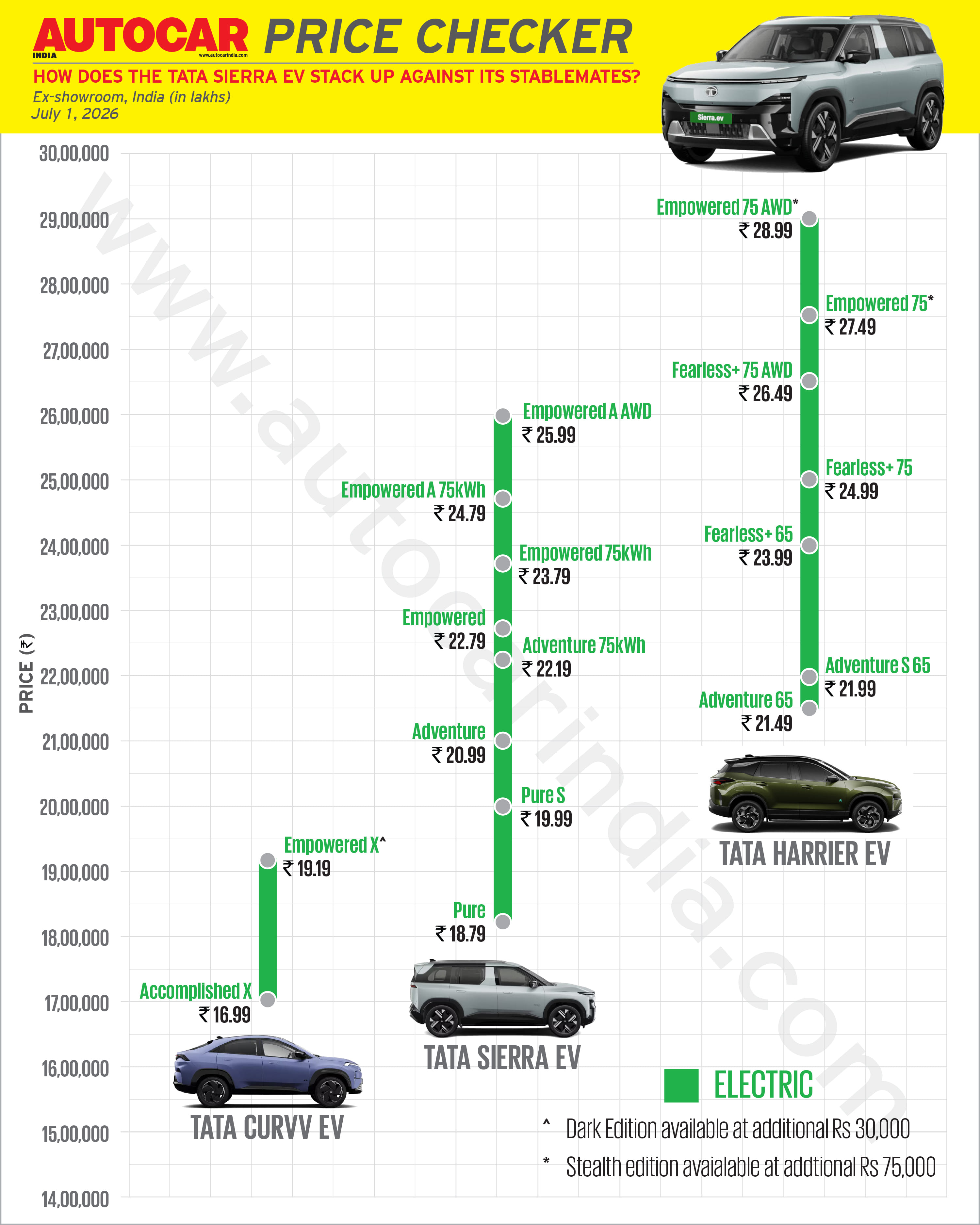
Tata Sierra EV, Harrier EV, Curvv EV price checker

While the top-spec Empowered X trim of the Curvv EV comes closest to the base-spec Sierra EV, the latter is still fairly well-loaded. Moving on to the Sierra EV and Harrier EV, their mid-spec Adventure trims are fairly matched in terms of pricing. At the top end, there’s Rs 3 lakh separating the fully loaded Tata Sierra EV from its equivalent Harrier EV counterpart. Some of the extra cash spent on the Sierra EV goes towards features that are exclusive to it – like the augmented-reality head-up display and dedicated screen for the front passenger. On the other hand, the price difference between the base Sierra EV and Curvv EV is Rs 1.8 lakh, with that gap widening to Rs 6.8 lakh at the top end.

All prices are ex-showroom, India.
Also read

Which Tata Sierra EV variant should you buy?

BMW X6 vs rivals: Specifications and prices compared

How do the Sierra EV’s price and specifications fare against rivals?

Tata Sierra EV vs rivals: Specifications and price compared

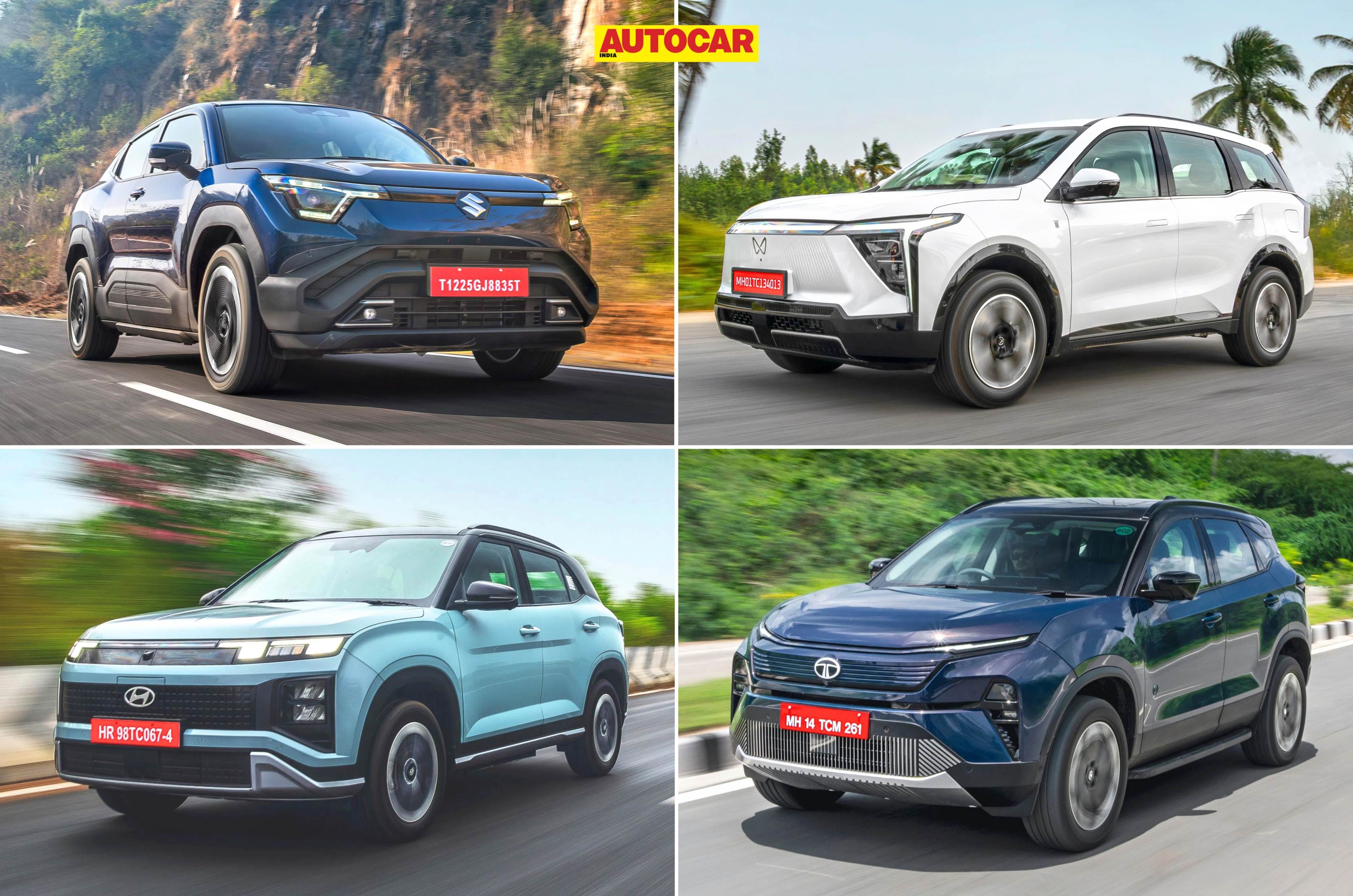
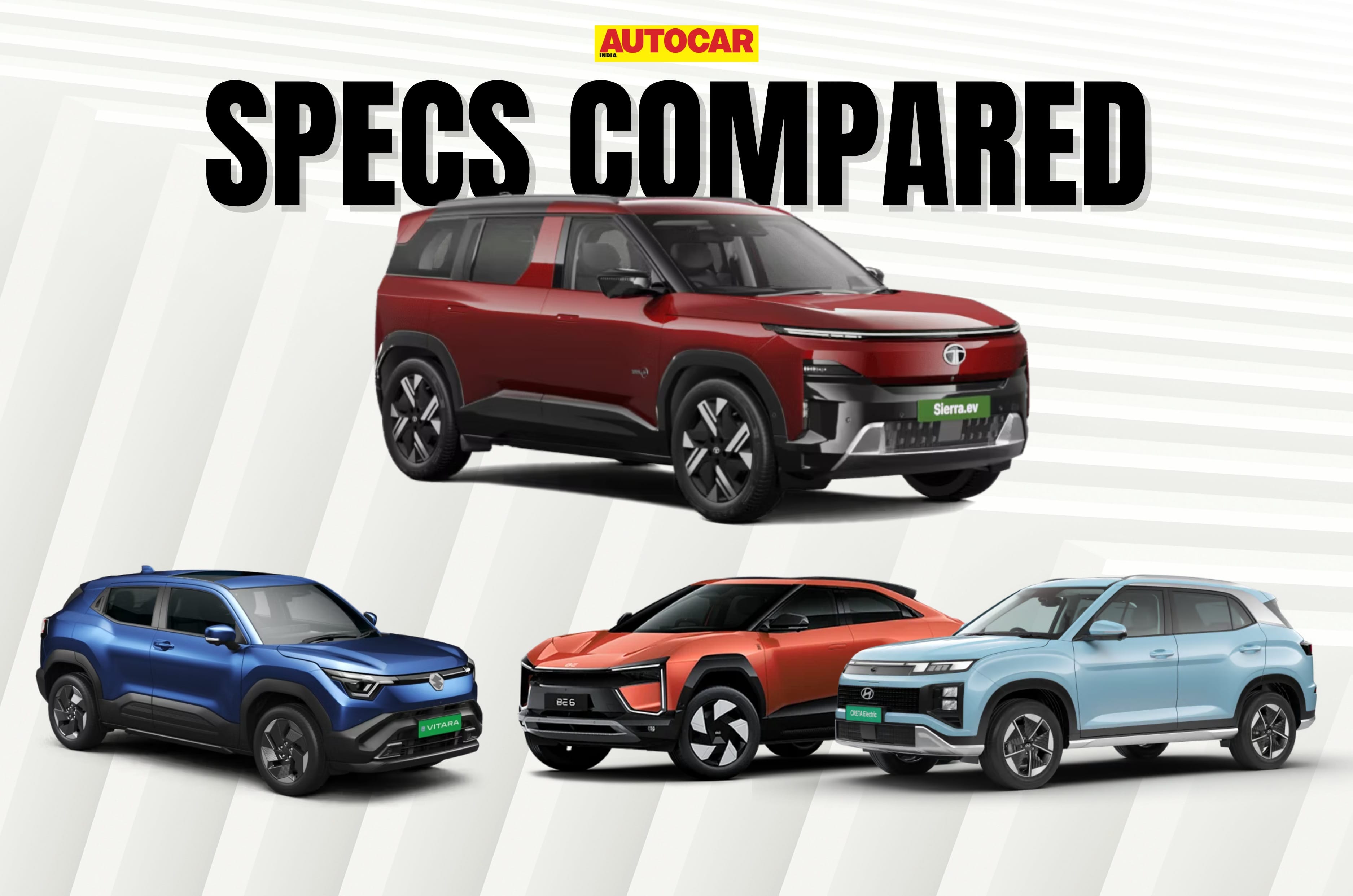
As the electric mid-size SUV space gets highly contested over time, it has witnessed a new entrant in the form of the Sierra EV. With the arrival of the Sierra EV, Tata is now the only carmaker in the segment to have two contenders. But how well do the Sierra EV’s on-paper specifications perform against its competition? We bring along the specs of the Tata Curvv EV, Maruti e Vitara, Toyota Ebella, Hyundai Creta Electric, MG ZS EV, and the Vinfast VF6 to find out.

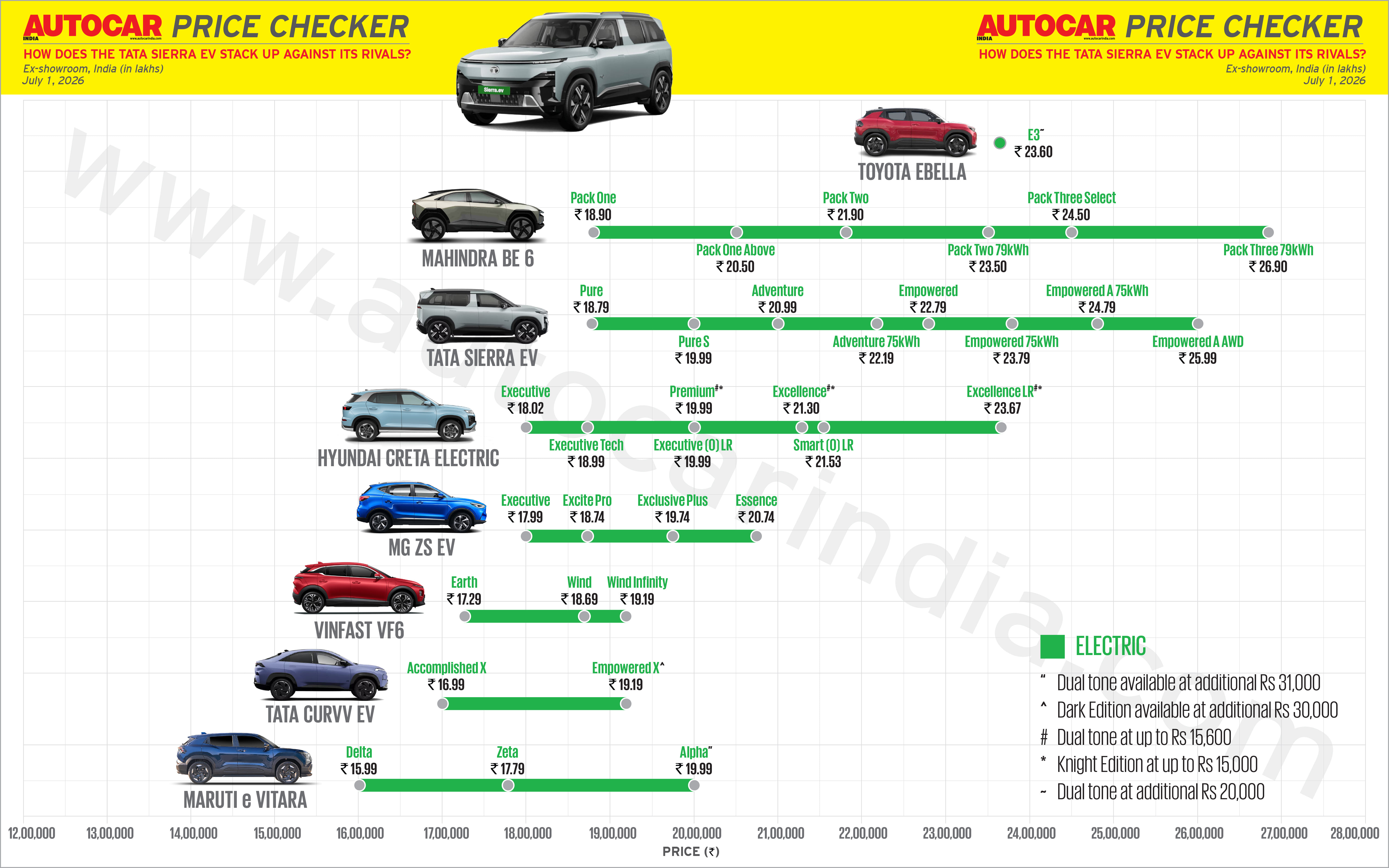
Tata Sierra EV vs rivals: Price

When it comes to the starting price, the Sierra EV is the third most expensive among rivals. In top-spec guise, it comes across as the second most expensive, undercutting the RWD BE 6 despite additionally offering AWD. The Maruti e Vitara is the most affordable model in the segment, while its badge-engineered Toyota Ebella’s sold variant has the highest starting price. At an identical Rs 19.19 lakh, the Tata Curvv EV and the Vinfast VF6 have the most accessible pricing for top-specification versions here.

Tata Sierra EV vs rivals: Dimensions 

Tata Sierra EV vs rivals: Dimensions 


Sierra EV

e Vitara

Ebella 

Creta Electric 

VF6

Curvv EV

ZS EV

BE 6

Length (mm)

4,340

4,275

4,275

4,340

4,241

4,310

4,323

4,371

Width (mm)

1,841

1,800

1,800

1,790

1,834

1,810

1,809

1,907

Height (mm)

1,750

1,640

1,640

1,655

1,615

1,637

1,649

1,627

Wheelbase (mm)

2,730

2,700

2,700

2,610

2,730

2,560

2,585

2,775

Ground clearance (mm)

205

185

185

200

190

186-190

177

207

Boot space (litres)

450

306

306

433

423

500

448

455

Frunk space (litres)

35-55

N/A

N/A

22

N/A

11.6

N/A

45

Wheel size (inches)

18-19

18

18

17

17-18

17-18

17

18-19

The Sierra EV is the tallest and has the largest frunk capacity in the segment. At the same time, it ranks second concerning length, width, wheelbase, and ground clearance after the BE 6. Despite its coupe SUV bodystyle, the Curvv EV gets the largest boot. A frunk is missing on the ZS EV, e Vitara, Ebella, and the VF6. Wheel sizes are the smallest on the Creta Electric and ZS EV, while the largest ones are on the Sierra EV and BE 6. 

Tata Sierra EV vs rivals: Battery and range

Tata Sierra EV vs rivals: Battery and range


Sierra EV

e Vitara

Ebella

Creta Electric

VF6

Curvv EV

ZS EV

BE 6

Battery size (kWh)

63 / 75

49 / 61

61

42 / 51.4

59.6

55

50.3

59 / 79

Motor setup

RWD / RWD, AWD

FWD

FWD

FWD

FWD

FWD

FWD

RWD

Power (hp)

238 / 209, 140 (front) 240 (rear)

144 / 174

174

135 / 171

177 / 204

167

177

231 / 286

Torque (Nm)

315 / 315, 504

193

193

255

250 / 310

215

280

380

ARAI range (km)

535 / 665, 624

440 / 543

543

420 / 510

468 / 463

502

461

548 / 683

The Sierra EV is the only eSUV to offer an AWD version and has a diverse powertrain lineup. Its 75kWh battery pack is second only to the Mahindra BE 6’s 79kWh unit, while the Creta Electric’s 42kWh battery is the smallest here. The Ebella, Curvv EV, ZS EV, and VF6 only offer a single battery pack option. While the BE 6 and other variants of the Sierra EV are inherently AWD, the remaining eSUVs have a FWD layout. For models with a single-motor setup, the BE 6 79kWh version develops the most power by a healthy margin, followed by the Sierra EV’s RWD 75kWh variant. However, the Sierra EV’s AWD version churns out the highest torque. As for the claimed range, the BE 6’s 79kWh and the Sierra EV’s 75kWh RWD versions grab the first and second spots, respectively. The Creta Electric’s 42kWh version develops the least power and has the lowest claimed range figure among all SUVs here.

Tata Sierra EV vs rivals: Charging times

Tata Sierra EV vs rivals: Charging times


Sierra EV

e Vitara

Ebella

Creta Electric

VF6

Curvv EV

ZS EV

BE 6

Battery size (kWh)

63 / 75

49 / 61

61

42 / 51.4

59.6

55

50.3

59 / 79

AC charging output support (kW)

7.2

7.4 

7.2

11

N/A

7.2

7.4

7.2, 11.2

DC charging output support (kW)

110 / 120

70

N/A

100

100

70

50

140 / 180

AC charging time (hours)

8.9 / 10.5

(10-100%)


6.5 / 9

(10-100%)

N/A

4 / 4.83

(10-100%)

N/A

7.9

(10-100%)

9 

(0-100%)

8.7, 6 / 11.7, 8 

(0-100%)

DC charging time (minutes)

25 / 26

(20-80%)

45

(10-80%)


N/A

39

(10-80%)

25 

(10-70%)

40 

(10-80%)


60 

(0-80%)

20

(20-80%)

Most SUVs here, including the Sierra EV, offer about 7kW AC charging speeds as standard, while the Creta Electric gets faster 11kW support. The BE 6 offers an 11.2kW charger, but at an additional cost. AC charging-wise, the larger battery packs on the Sierra lend it to the slower side of the comparison. As for DC charging, the Sierra EV supports the second-quickest charging outputs, and its charging time isn’t too far behind that of the BE 6s that support faster charging outputs. 

All prices are ex-showroom, India.

Which Tata Sierra EV variant should you buy?

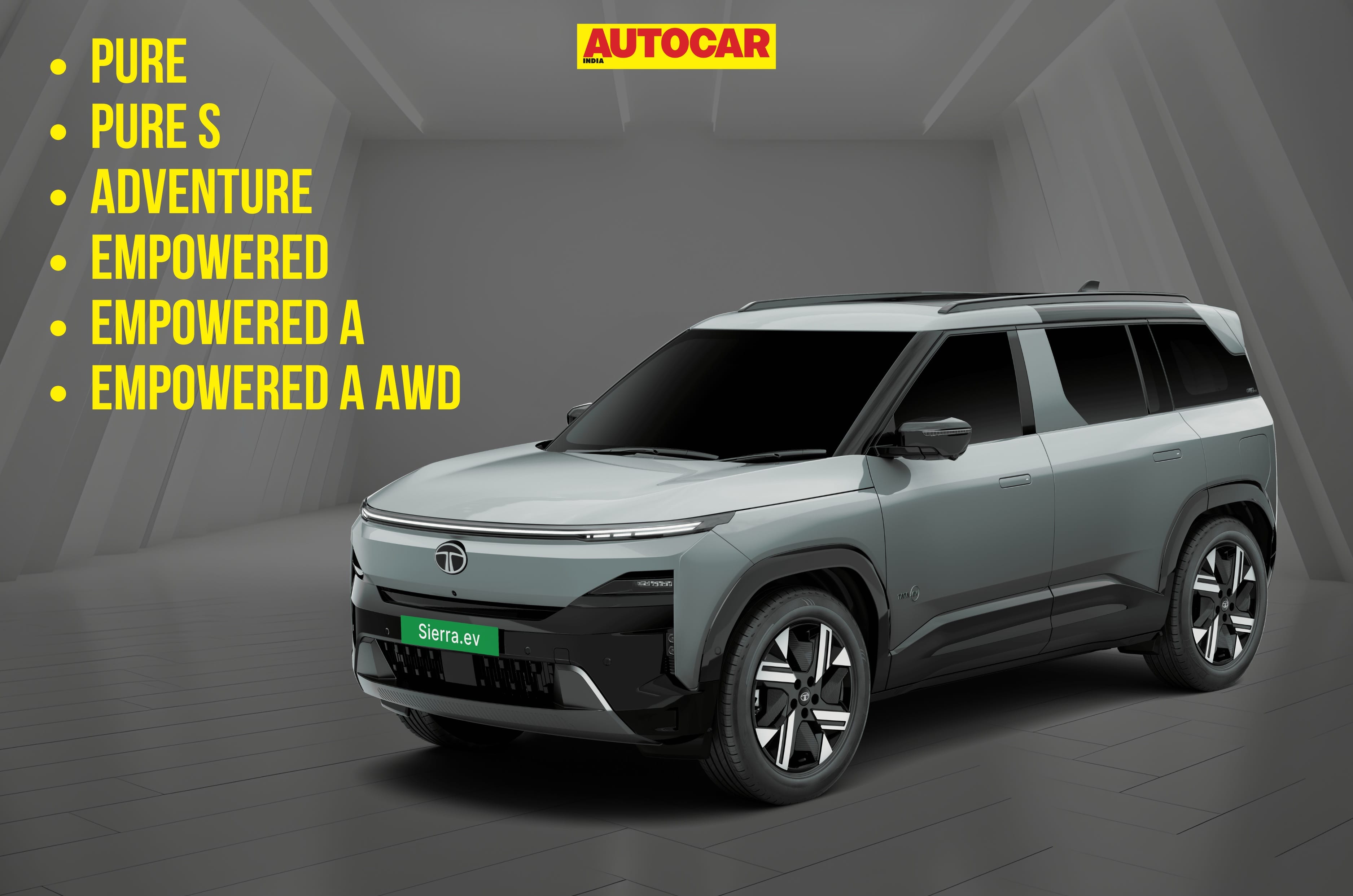
Tata Sierra EV variants

The new Tata Sierra EV is positioned right between the Curvv and Harrier electric SUVs in Tata Motors’ ever expanding EV lineup. Sharing a lot of features and even mechanical underpinnings with the Harrier EV, it is Tata’s second car to now get an optional all-wheel drive (AWD) system. In this feature, we break down what each Sierra EV variant offers and explain which one makes the most sense to buy.

Tata Sierra EV prices and powertrain specs

Tata Sierra EV variant-wise prices (Rs lakh)*

Trim63kWh75kWh
Pure18.79–
Pure S19.99–
Adventure20.9922.19
Empowered22.7923.79
Empowered A–24.79
Empowered A AWD 25.99

*7.2kW home charger and its installation cost an extra Rs 49,000.

The Sierra EV is priced towards the higher end of the midsize electric SUV segment, sitting close to the Mahindra BE 6, which is priced between Rs 18.9 lakh and Rs 26.9 lakh. The Sierra EV is available with 63kWh and 75kWh battery pack options, and both get a rear-mounted electric motor producing 315Nm. The 63kWh variants develop 238hp, while the 75kWh versions produce 209hp. The larger battery is also available with a dual-motor AWD option, which adds a 140hp front motor; combined torque output from this AWD setup is rated at 504Nm. With Boost Mode activated, the AWD version can sprint from 0-100kph in a claimed 5.8 seconds.

Tata Motors claims an MIDC-certified range of 665km for the 75kWh RWD variants, 624km for the 75kWh AWD version and 535km for the 63kWh variants. Using a 120kW DC fast charger, the battery can gain up to 263km of range in 15 minutes, while a 20-80 percent charge takes around 26 minutes. Using a 7.2kW AC charger, the 63kWh battery takes 8.9 hours to charge from 10-100 percent, while the 75kWh battery takes 10.5 hours.

Tata Sierra EV colour options

Tata Sierra EV colours

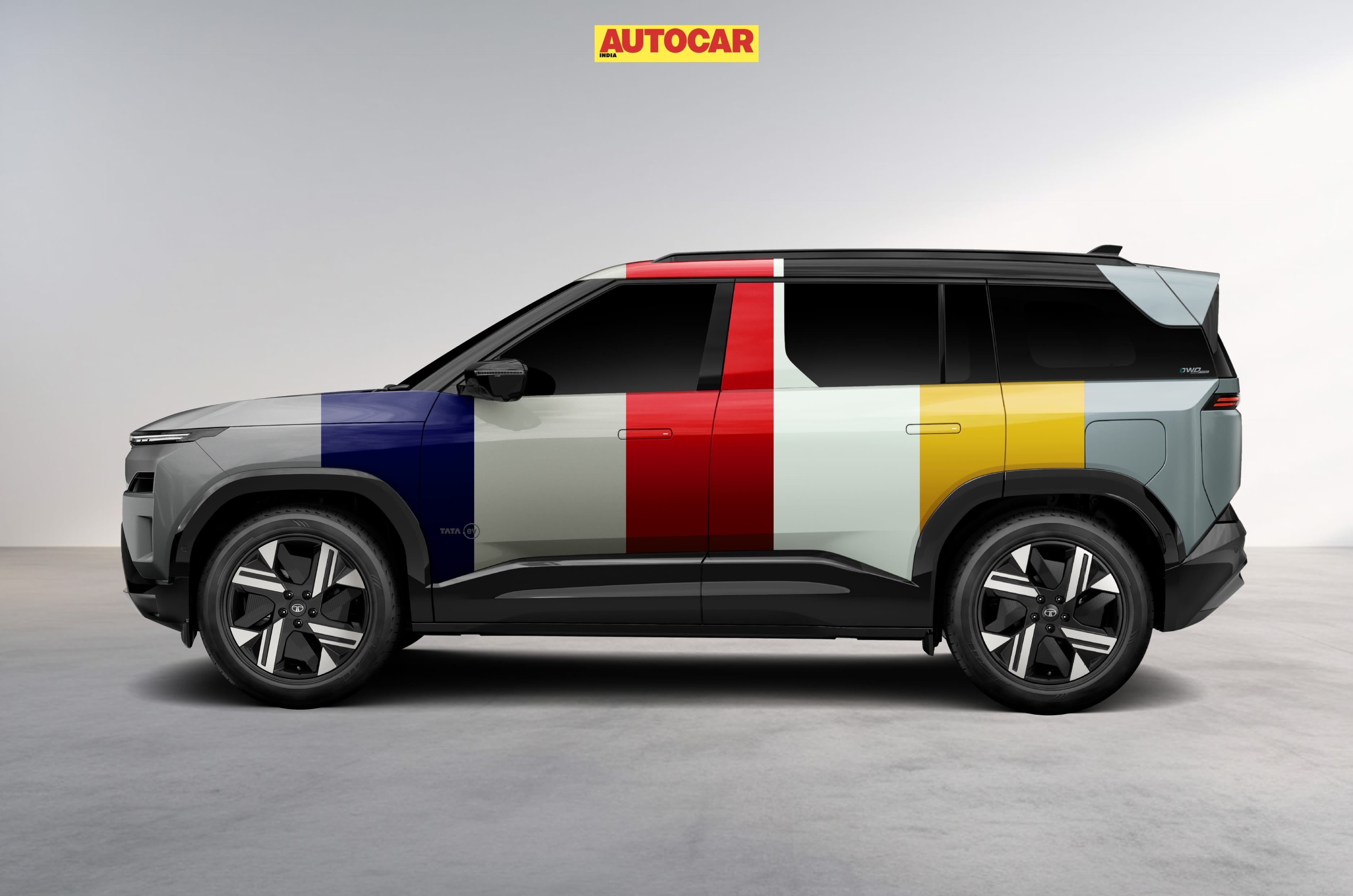
The Tata Sierra EV is offered in seven monotone colour options: Rishikesh Rapids, Nainital Nocturne, Coorg Clouds, Pure Grey, Pristine White, Andaman Adventure and Bengal Rouge. Of these, Rishikesh Rapids and Nainital Nocturne are exclusive to the Sierra EV, while the remaining colours are also available on the ICE-powered Sierra.

The entry-level Pure trim is available in Coorg Clouds, Pure Grey and Pristine White. The Adventure trim adds Andaman Adventure and Bengal Rouge, while the top-spec Empowered variant also gets Rishikesh Rapids. Nainital Nocturne is reserved exclusively for the Sierra EV AWD.

Tata Sierra EV variant-wise features

Pure

Rs 18.79 lakh

  • 6 airbags
  • All-wheel disc brakes
  • Electronic stability program (ESP)
  • Rain-sensing wipers
  • Hill hold control
  • Hill descent control
  • Traction control system (TCS)
  • Electronic parking brake with auto hold
  • Electronic brakeforce distribution (EBD)
  • Antilock braking system (ABS)
  • Central lock
  • Tyre pressure monitoring system (TPMS)
  • Tyre repair kit
  • Rear wiper and washer
  • Rear camera
  • Push button start/ stop
  • 10.25-inch driver’s display
  • 12.3-inch touchscreen
  • Wireless Android Auto and Apple CarPlay
  • 8 speakers
  • Amazon Alexa voice assistant
  • Connected car tech
  • Over the air (OTA) updates
  • 2 front USB Type-C ports (15W multimedia and 65W charging)
  • 2 rear 65W USB Type-C ports
  • Tilt and telescopic adjustment for the steering wheel
  • Steering mounted controls
  • Paddle shifters for regenerative braking
  • Cruise control
  • Manually adjustable front seats
  • Manual IRVM
  • Height-adjustable front seatbelts
  • Front armrest with storage
  • Cooled glovebox
  • Automatic AC
  • PM 2.5 air purifier
  • Drive modes: Economy, City and Sports
  • Valet mode
  • Power windows
  • EV route planner for Android Auto
  • Adjustable headrests at the front and rear
  • Rear AC vents
  • Rear window sunshade
  • Automatic LED projector headlamps
  • LED DRLs and tail lamps
  • 18-inch alloy wheels
  • Electrically adjustable ORVMs with turn indicators
  • Shark-fin type antenna with GPS

Pure S

Rs 19.99 lakh

In addition to Pure

  • Front parking sensors
  • Acoustic vehicle alerting system (AVAS)
  • Auto-folding ORVMs
  • Vehicle to load (V2L) charging
  • Vehicle to vehicle (V2V) charging
  • Voice-assisted panoramic sunroof
  • Frunk
  • Roof rails
  • Front LED fog lamps with cornering function

Adventure

Rs 20.99 lakh-22.19 lakh

In addition to Pure S

  • 360-degree camera with blind spot
  • Rear defogger
  • Wireless charger
  • AirConsole remote gaming support
  • Boss mode
  • Auto dimming IRVM
  • Ambient lights
  • Leatherette-wrapped steering wheel
  • Thigh support extender at the front
  • Front seatback pockets
  • 12 JBL Black speakers
  • Dolby Atmos
  • Arcade.ev suite
  • DrivePay
  • Terrain modes: Normal, Wet/Rain, Rough, Custom
  • Drift mode

Empowered

Rs 22.79 lakh-23.79 lakh

In addition to Adventure

  • 12.3-inch front passenger screen
  • Front ventilated seats
  • 6-way powered driver’s seat with memory function
  • Dual zone AC
  • Leatherette upholstery
  • 60:40 split rear seats with recline
  • Rear centre armrest with cup holders
  • Adjustable rear centre headrest
  • Sequential turn indicators
  • LED headlamps
  • Rear fog lamps
  • Gesture-controlled tailgate
  • NFC card entry
  • Puddle lamps

Empowered A

Rs 24.79 lakh

In addition to Empowered

  • Level 2+ ADAS
  • Auto park assist
  • 540-degree camera
  • 19-inch alloy wheels
  • Powered co-driver’s seat
  • HUD
  • Cabin ioniser

Empowered A AWD

Rs 25.99 lakh

In addition to Empowered A

  • Boost mode
  • 6 terrain modes: Normal, Grass/ Snow, Mudruts/ Gravel, Sand, Rock Crawl, Custom
  • Off-road Assist

Which Tata Sierra EV variant should you consider buying?

We recommend the Rs 19.99 lakh-Pure S trim, which packs passenger convenience features such as a panoramic sunroof, a 10.25-inch digital driver’s display, a 12.3-inch touchscreen, wireless Android Auto and Apple CarPlay, an eight-speaker audio system, automatic climate control and cruise control. It comes only with the 63kWh battery pack, which offers a real-world range of 440-460km, according to Tata’s C75 tests (represents a real-world range figure that can be expected by buyers). This should be more than sufficient for daily office commutes as well as highway trips.

However, if your budget allows, the Rs 22.19 lakh-Adventure trim with the 75kWh battery pack is worth considering. It’s the most affordable Sierra EV variant with the larger 75kWh battery pack, which increases the claimed real-world range to 510-530km, as per Tata’s C75 tests. Besides the longer range, it also adds features such as a 360-degree camera with blind-spot view, Boss mode, a wireless phone charger, a 12-speaker JBL Black audio system, Dolby Atmos, AirConsole remote gaming support and more.

Ex-showroom prices mentioned above are as of July 1, 2026.

665KM रेंज, 5.8 सेकंड में 100kmph की रफ्तार! Tata Sierra EV हुई लॉन्च, जानें कीमत, फीचर्स और बैटरी की पूरी डिटेल

टाटा मोटर्स पैसेंजर व्हीकल्स ने भारत में अपनी नई Tata Sierra EV लॉन्च कर दी है। इसकी शुरुआती एक्स-शोरूम कीमत 18.79 लाख रुपये रखी गई है। इसके साथ ही टाटा की सबसे लोकप्रिय एसयूवी में से एक सिएरा अब पूरी तरह इलेक्ट्रिक रूप में भारतीय बाजार में लौट आई है। नई Tata Sierra EV कुल पांच वेरिएंट में उपलब्ध है। इसमें दो बैटरी पैक का विकल्प मिलता है। कंपनी का दावा है कि यह एक बार चार्ज करने पर 665 किलोमीटर तक (एमआईडीसी प्रमाणित) की ड्राइविंग रेंज देती है। इसके अलावा इसमें ऑल-व्हील ड्राइव (AWD) का विकल्प और बैटरी पर लाइफटाइम वारंटी भी दी गई है।

यह टाटा मोटर्स की सातवीं इलेक्ट्रिक कार है। इससे पहले कंपनी टियागो ईवी, टिगोर ईवी, पंच ईवी, नेक्सॉन ईवी, कर्व ईवी और हैरियर ईवी को बाजार में उतार चुकी है। Tata Sierra EV की बुकिंग आज से शुरू हो गई है, जबकि इसकी डिलीवरी 15 जुलाई से शुरू होगी। ग्राहक चाहें तो 49,000 रुपये अतिरिक्त देकर 7.2 किलोवॉट एसी फास्ट चार्जर का विकल्प भी ले सकते हैं।

Tata Sierra EV: कीमत और वेरिएंट

Tata Sierra EV को कंपनी ने पांच वेरिएंट में लॉन्च किया है। इनमें प्योर, प्योर एस, एडवेंचर, एम्पावर्ड और एम्पावर्ड ए शामिल हैं। इस इलेक्ट्रिक एसयूवी की शुरुआती एक्स-शोरूम कीमत 18.79 लाख रुपये है। वहीं, इसका सबसे टॉप मॉडल एम्पावर्ड ए (QWD) 25.99 लाख रुपये (एक्स-शोरूम) में उपलब्ध है। यह वेरिएंट सबसे ज्यादा फीचर्स और बेहतर परफॉर्मेंस के साथ आता है।

Tata Sierra EV: बैटरी, रेंज और चार्जिंग

Tata Sierra EV में दो बैटरी विकल्प दिए गए हैं। पहला 63 kWh और दूसरा 75 kWh बैटरी पैक है। कंपनी के मुताबिक, 75 kWh बैटरी एक बार फुल चार्ज होने पर 665 किलोमीटर तक (एमआईडीसी प्रमाणित) चल सकती है। वहीं, 63 kWh बैटरी की रेंज 565 किलोमीटर बताई गई है।

टाटा मोटर्स का कहना है कि रोजमर्रा के इस्तेमाल में 75 kWh बैटरी वाली सिएरा ईवी करीब 510 से 530 किलोमीटर तक चल सकती है। वहीं, 63 kWh बैटरी वाला मॉडल 440 से 460 किलोमीटर तक की वास्तविक ड्राइविंग रेंज देगा। इसके अलावा 75 kWh बैटरी के साथ आने वाला क्वाड-व्हील ड्राइव (QWD) मॉडल एक बार चार्ज करने पर 500 किलोमीटर से ज्यादा की रेंज देने का दावा करता है।

चार्जिंग की बात करें तो इसमें 120 kW डीसी फास्ट चार्जिंग, 7.2 kW एसी चार्जिंग और 3.3 kW एसी चार्जिंग का विकल्प मिलता है। 120 kW डीसी फास्ट चार्जर की मदद से बैटरी को सिर्फ 26 मिनट में 20% से 80% तक चार्ज किया जा सकता है। वहीं, कंपनी का दावा है कि 15 मिनट की फास्ट चार्जिंग में यह इलेक्ट्रिक एसयूवी 250 किलोमीटर से ज्यादा की ड्राइविंग रेंज दे सकती है।

इसके अलावा Tata Sierra EV में व्हीकल-टू-व्हीकल (V2V) और व्हीकल-टू-लोड (V2L) जैसी आधुनिक सुविधाएं भी दी गई हैं। इनकी मदद से जरूरत पड़ने पर कार से दूसरे इलेक्ट्रिक वाहन या अन्य इलेक्ट्रॉनिक उपकरणों को भी बिजली दी जा सकती है।

Tata Sierra EV: पावर और परफॉर्मेंस

Tata Sierra EV को कंपनी ने दो इलेक्ट्रिक मोटर विकल्पों के साथ पेश किया है। इसके रियर-व्हील ड्राइव (RWD) मॉडल में 175 kW की इलेक्ट्रिक मोटर दी गई है, जो 340 Nm का टॉर्क पैदा करती है। वहीं, इसके टॉप वेरिएंट में 103 kW की फ्रंट मोटर भी मिलती है। दोनों मोटरों के साथ यह एसयूवी ऑल-व्हील ड्राइव (AWD) सिस्टम से लैस हो जाती है, जिससे इसकी पकड़ और प्रदर्शन बेहतर हो जाता है। टाटा मोटर्स का दावा है कि सिएरा ईवी महज 5.8 सेकंड में 0 से 100 किलोमीटर प्रति घंटे की रफ्तार पकड़ सकती है। कंपनी के अनुसार, यह अब तक भारत में लॉन्च हुई सबसे तेज इलेक्ट्रिक एसयूवी है।

Tata Sierra EV: डिजाइन और फीचर्स

Tata Sierra EV का डिजाइन काफी हद तक सिएरा के पेट्रोल-डीजल (आईसीई) मॉडल जैसा है, लेकिन इसे इलेक्ट्रिक एसयूवी का आधुनिक लुक देने के लिए कई खास बदलाव किए गए हैं। इसमें आगे की तरफ पारंपरिक ग्रिल की जगह बंद फ्रंट पैनल दिया गया है, जो आज की ज्यादातर इलेक्ट्रिक कारों की पहचान बन चुका है। इसके अलावा कार के फ्रंट बंपर को भी नया डिजाइन दिया गया है, जिससे इसका लुक और ज्यादा आकर्षक दिखाई देता है। वहीं, पीछे की तरफ कार के डिजाइन में ज्यादा बदलाव नहीं किए गए हैं। इसका रियर लुक पेट्रोल-डीजल मॉडल जैसा ही रखा गया है, जिससे सिएरा की पहचान बरकरार रहती है।