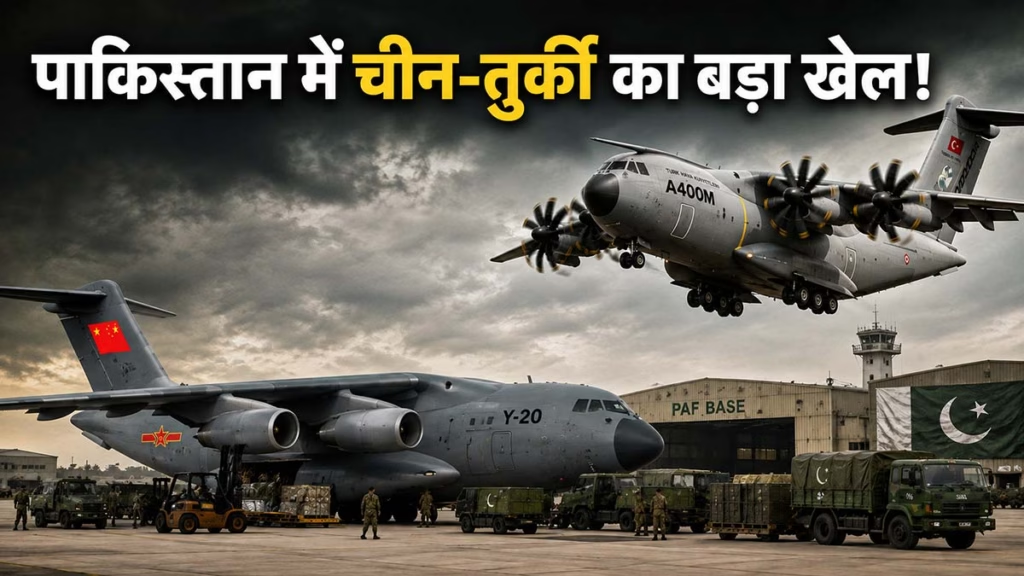
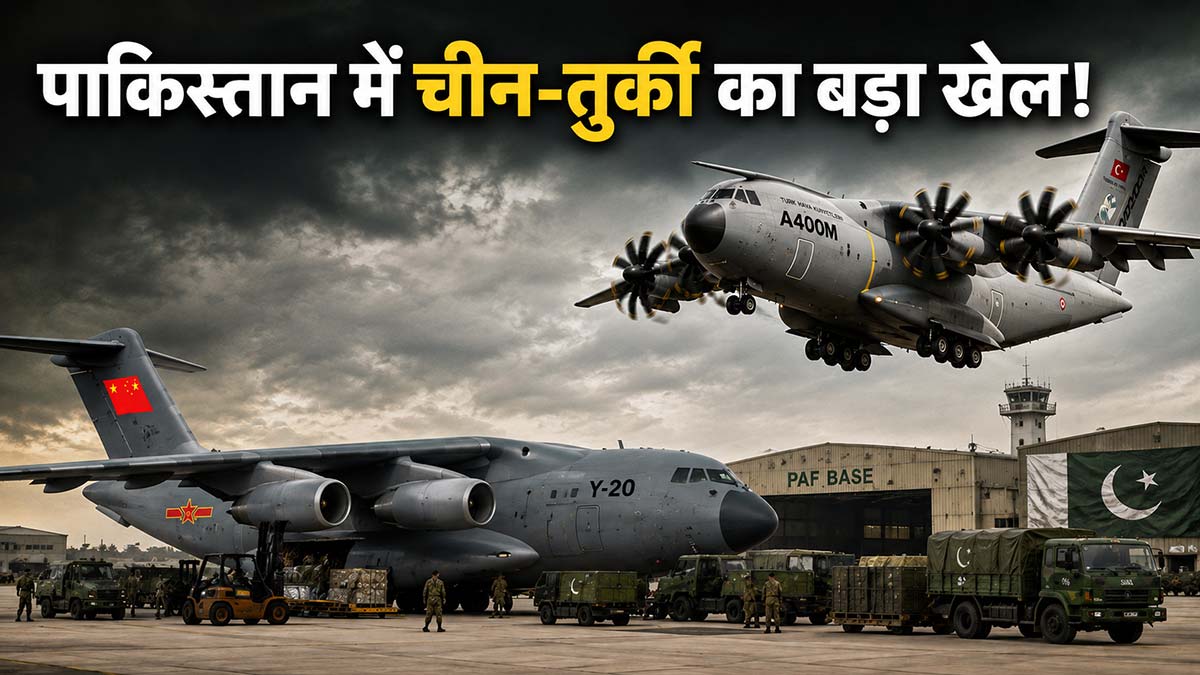
South Asia strategic defense: 18 से 20 अगस्त के बीच पाकिस्तान के हवाई क्षेत्र में देखी गई अभूतपूर्व सैन्य गतिविधियों ने दक्षिण एशियाई सामरिक संतुलन पर गहरे सवाल खड़े कर दिए हैं। खुले स्रोतों (OSINT) और भारतीय सुरक्षा एजेंसियों के इनपुट के अनुसार, चीन (Xi'an Y-20) और तुर्की (Airbus A400M) के भारी सैन्य परिवहन विमानों ने करीब 60 घंटे तक पाकिस्तान के प्रमुख एयरबेसों पर दर्जनों उड़ानें भरीं और उतरते देखे गए।
पाकिस्तान की ज़मीन पर क्या उतार रहे हैं चीन और तुर्की?
सैन्य विशेषज्ञों का अनुमान है कि यह भारी एयरलिफ्ट सिर्फ नियमित लॉजिस्टिक्स (Routine Logistics) का हिस्सा नहीं हो सकती। इस असामान्य हलचल के पीछे निम्नलिखित सैन्य आपूर्ति की संभावना जताई जा रही है। विश्लेषकों और रक्षा विशेषज्ञों का मानना है कि इस उच्च-स्तरीय लॉजिस्टिक ऑपरेशन में निम्नलिखित महत्वपूर्ण सैन्य सामग्रियों की डिलीवरी शामिल हो सकती है:
सटीक मारक हथियार और उन्नत ड्रोन (UCAVs) : तुर्की के Bayraktar Akinci/TB2 और चीन के Wing Loong III ड्रोनों की नई खेप या उनके महत्वपूर्ण स्पेयर पार्ट्स।
इलेक्ट्रॉनिक वारफेयर (EW) व राडार सिस्टम : पाकिस्तान वायु सेना (PAF) के लड़ाकू विमानों और ग्राउंड-बेस्ड राडार के लिए एडवांस्ड स्टैंड-ऑफ जैमर्स (SOJ) व सिग्नल्स इंटेलिजेंस उपकरण।
एयर-डिफेंस और मिसाइल स्पेयर-पार्ट्स : चीन से प्राप्त HQ-16 और HQ-9P मिसाइल रक्षा प्रणालियों के कलपुर्जे या त्वरित रिप्लेसमेंट हार्डवेयर।
'KAAN' 5th Gen फाइटर जेट कंपोनेंट्स : तुर्की के 5वीं पीढ़ी के लड़ाकू विमान प्रोजेक्ट 'KAAN' में पाकिस्तान की साझेदारी के तहत तकनीकी हस्तांतरण।
इलेक्ट्रॉनिक वारफेयर (EW) और राडार उपकरण : पाकिस्तान वायु सेना (PAF) के स्टैंड-ऑफ जैमर्स (SOJ) और अर्ली वार्निंग एयरक्राफ्ट (AEW&C) के लिए आधुनिक जैमिंग उपकरण।
भारतीय रक्षा एजेंसियों के लिए यह त्रिगुट (China-Pakistan-Türkiye Axis) कोई नई बात नहीं है, लेकिन इसका समय और तीव्रता चिंता का विषय है:
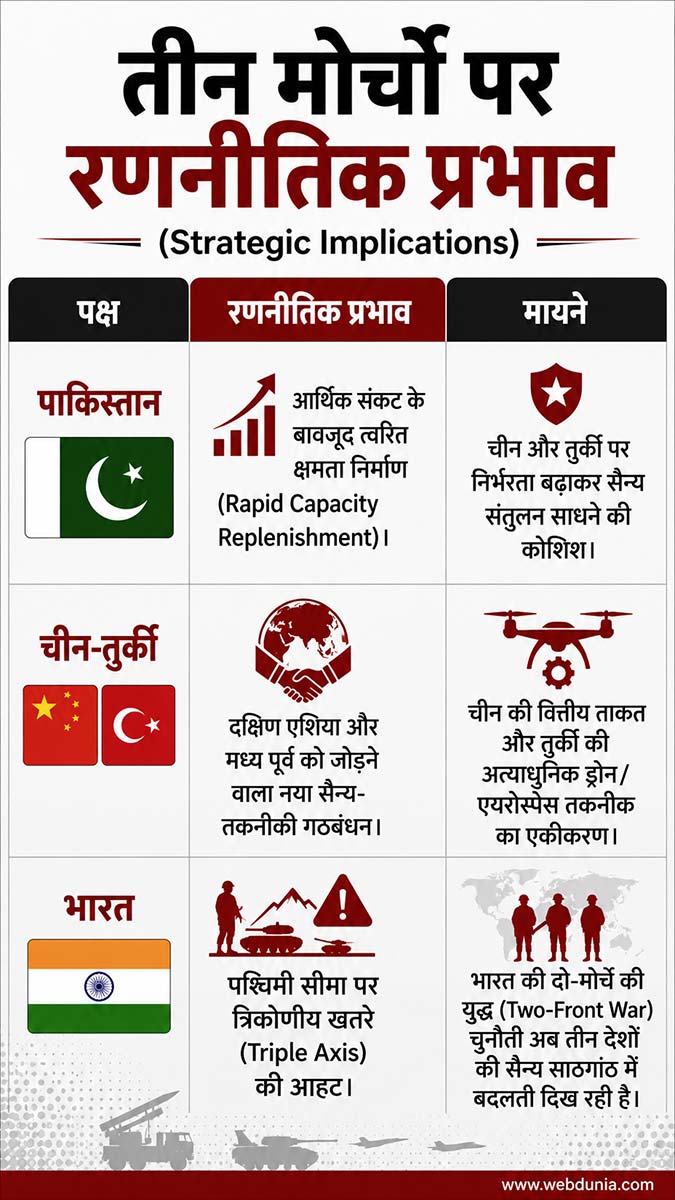
त्वरित क्षमता निर्माण (Rapid Capability Replenishment) : किसी संभावित आपात स्थिति के लिए पाकिस्तान की सैन्य तैयारियों को तेजी से मजबूत करना।
त्रिपक्षीय रक्षा गठबंधन : हाल ही में सामने आए तुर्की, पाकिस्तान और रणनीतिक सहयोगियों के बीच बढ़ते सैन्य समन्वय का यह एक व्यावहारिक प्रदर्शन हो सकता है।
'KAAN' फाइटर जेट प्रोजेक्ट : तुर्की के 5वीं पीढ़ी के लड़ाकू विमान प्रोजेक्ट में पाकिस्तान की भागीदारी के बाद तकनीकी ट्रांसफर और उपकरणों की आवाजाही।
हाल ही में पाकिस्तान, तुर्की और सऊदी अरब द्वारा हस्ताक्षरित 'मक्का संयुक्त रक्षा समझौते' के तुरंत बाद इस तरह की भारी सैन्य एयरलिफ्ट का होना संकेत देता है कि क्षेत्र में एक नया सैन्य ब्लॉक आकार ले रहा है।
चीन की तकनीकी व वित्तीय ताकत, तुर्की की आधुनिक ड्रोन टेक्नोलॉजी और पाकिस्तान का भारत विरोधी एजेंडा—यह त्रिकोण दक्षिण एशिया के सामरिक संतुलन को प्रभावित कर सकता है। भारत की खुफिया एजेंसियां इस 60 घंटे के रहस्यमयी एयरलिफ्ट ऑपरेशन्स के हर विवरण पर पैनी नजर बनाए हुए हैं।
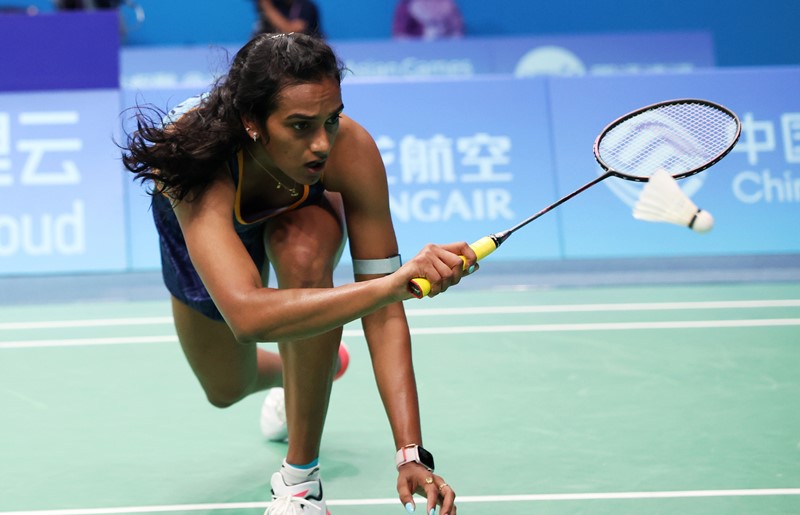
स्टार बैडमिंटन खिलाड़ी पीवी सिंधु और आयुष शेट्टी आने वाले चाइना मास्टर्स सुपर 750 से हट गए हैं, जो 1 सितंबर से शुरू हो रहा है। यह टूर्नामेंट एशियन गेम्स से पहले एकमात्र बड़ा BWFवर्ल्ड टूर इवेंट होगा। आयुष का नई दिल्ली में वर्ल्ड चैंपियनशिप में यादगार प्रदर्शन रहा, जहाँ उन्होंने पहले राउंड में दुनिया के नंबर 1 शी युकी को हराया था।
इसके बाद भारतीय खिलाड़ी इंडोनेशिया के अल्वी फरहान से हारने से पहले राउंड ऑफ़ 16 में पहुँचे थे। आयुष के हटने के बाद, लक्ष्य सेन और किदांबी श्रीकांत पुरुष सिंगल्स में भारत के रिप्रेजेंटेटिव होंगे। हालाँकि, लक्ष्य को वर्ल्ड चैंपियनशिप में दूसरे राउंड में अमेरिका के वर्ल्ड नंबर 92 गैरेट टैन से हारने के बाद जल्दी बाहर होना पड़ा।
सिंधु ने वर्ल्ड चैंपियनशिप के राउंड ऑफ़ 16 में भी हिस्सा लिया था, जहाँ वह एक करीबी मुकाबले में चीन की वर्ल्ड नंबर 3 वांग ज़ी यी से हार गईं। ऐसा लग रहा था कि भारतीय खिलाड़ी इस मुश्किल मैच का असर महसूस कर रही हैं, जिसकी वजह से उन्होंने चाइना मास्टर्स से हटने का फैसला किया होगा। मालविका बंसोड़ और आकर्षि कश्यप भी हट गई हैं, जिससे महिला सिंगल्स में उन्नति हुड्डा, देविका सिहाग और तन्वी शर्मा भारत की चुनौती संभालेंगी।
Ayush Shetty and PV Sindhu from the upcoming China masters Super 750.
Shetty recently grabbed headlines as he defeated the World No. 1, Shi Yuqi , with Ayush out of contention, the men’s singles challenge will be shouldered by Lakshya Sen and Kidambi Srikanth.
पुरुषों युगल में सात्विकसाईराज रंकीरेड्डी और चिराग शेट्टी, हरिहरन अमासुकरन और अर्जुन एमआर के साथ भारतीय टीम की कमान संभालेंगे। सात्विक और चिराग वर्ल्ड चैंपियनशिप में चोट के कारण बाहर रहने के बाद लौटे थे, लेकिन राउंड ऑफ़ 16 में चीन के लियांग वेइकेंग और वांग चांग से हार गए थे। भारत की महिला डबल्स ड्रॉ में कोई जोड़ी नहीं होगी, क्योंकि ट्रीसा जॉली और गायत्री गोपीचंद ने वर्ल्ड चैंपियनशिप में अपने ऐतिहासिक ब्रॉन्ज़ मेडल जीतने के बाद बाहर होने का फैसला किया है।
2011 में ज्वाला गुट्टा और अश्विनी पोनप्पा के ब्रॉन्ज़ मेडल के बाद, भारतीय जोड़ी वर्ल्ड चैंपियनशिप में मेडल जीतने वाली देश की दूसरी महिला डबल्स जोड़ी बन गई। मिक्स्ड डबल्स में, ध्रुव कपिला और तनिषा क्रैस्टो, रोहन कपूर और रुत्विका शिवानी के साथ, भारत को रिप्रेजेंट करेंगे। भारत ने 2011 से हर वर्ल्ड चैंपियनशिप में कम से कम एक मेडल जीतने का अपना शानदार सिलसिला जारी रखा, 2026 एडिशन रविवार को नई दिल्ली में खत्म होगा।
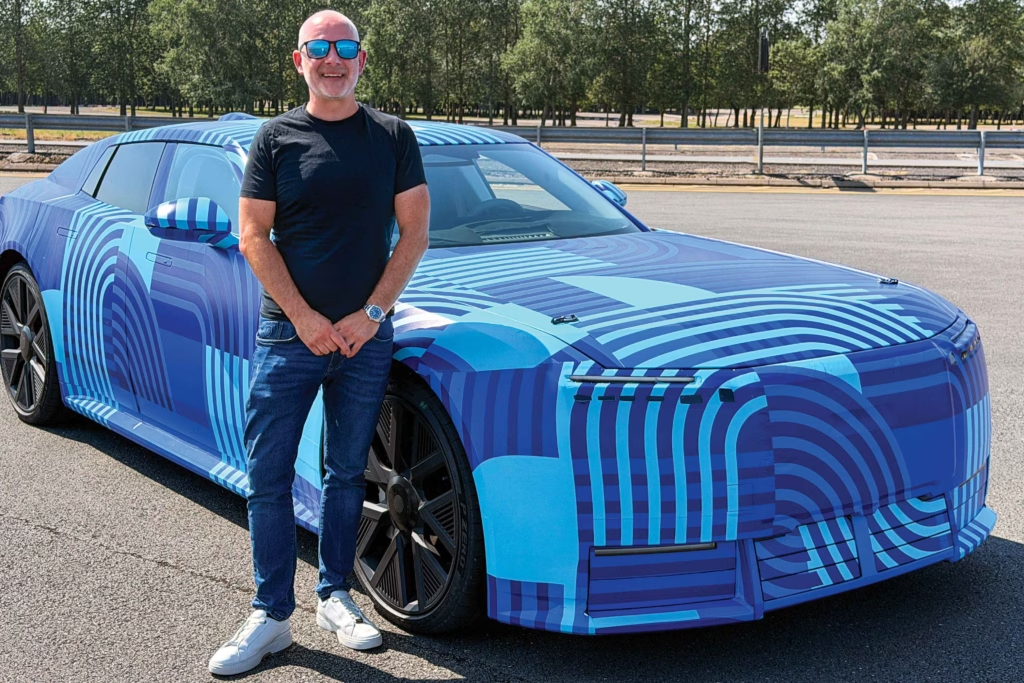
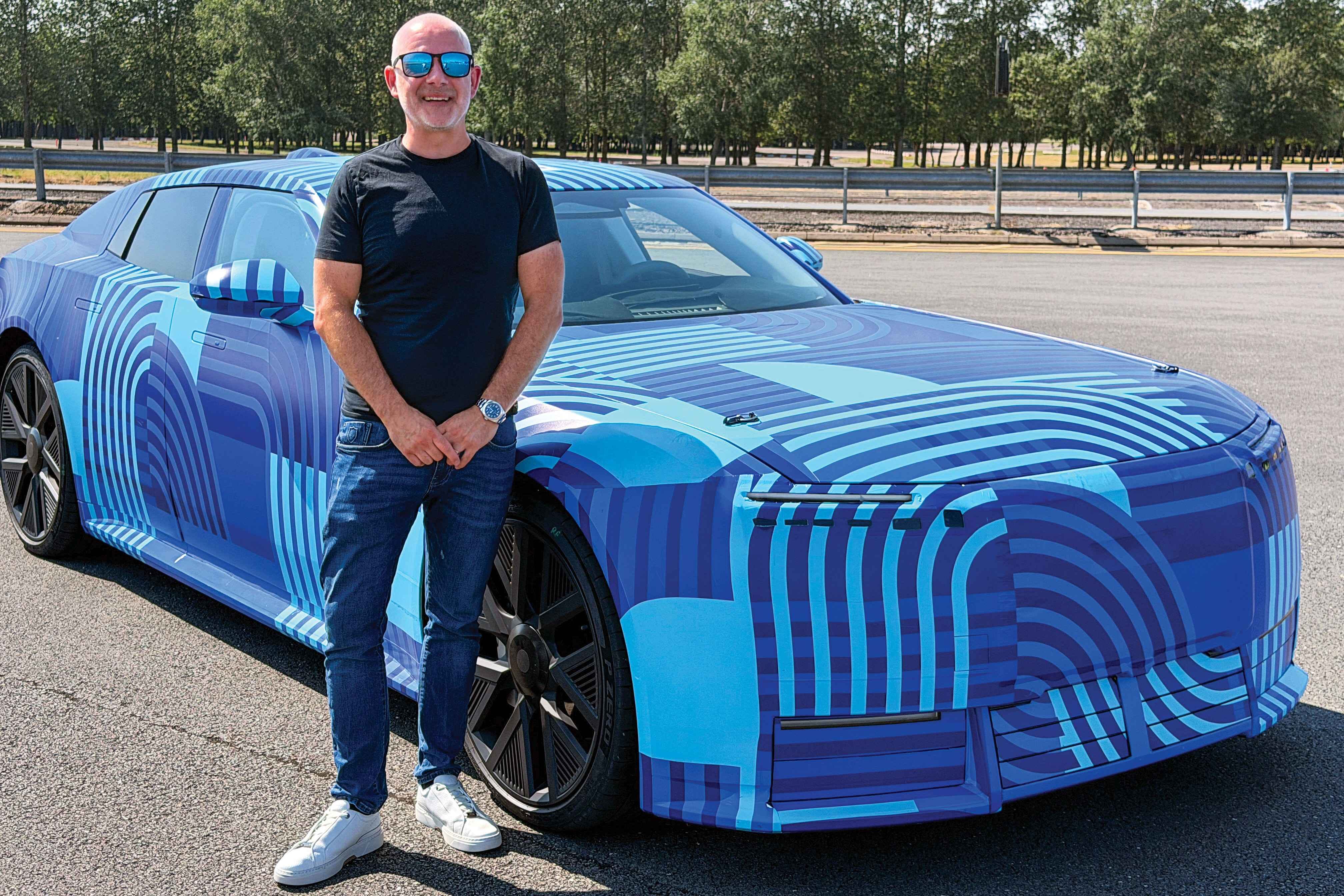
Rawdon Glover has worked with the JLR group for over thirteen years and took charge as Managing Director three years ago. From the sidelines of our first drive with the Jaguar Type 01, we speak to Glover, who tells us about Jaguar’s new direction, taking risky decisions, core markets and upcoming products.
Why the major shift in the positioning of Jaguar?
Putting Jaguar back on a firm footing for the next 90 years is the main job. And if you look at the task, it’s brand management where sometimes you need small incremental changes. But if you look at today’s technical changes, competitive context, how the brand was performing globally and a host of factors, what was called for was a big shift. That requires you to be bold and confident.
Why go for a radical and polarising design?
We’re ok with polarising. If you look at our history, it was bold evolutions, for example the XJS, the spiritual successor to the E-Type. It would have been easy to say let’s just make a modern example of the E-Type, but that’s not what we did, and if you look back at reviews, it was applauded for its dynamics and refinement, but the design was seen as polarising. Now it’s a design icon. So, I’d rather have four out of ten absolutely love the car, rather than have everyone go – yeah, it’s ok.
Isn’t going all-electric a massively risky move?
The EV landscape is evolving rapidly, many new brands are coming in, and I believe one will crack the EV glass ceiling, so why not Jaguar? So we ripped up the EV rulebook because, in the luxury space, it wasn’t working. So it’s not designed as an EV without an engine and a really cab-forward layout. But it’s about presence and performance, and to deliver the level of performance and refinement, electric is best.
Would the car sit above the XJ in terms of price? All of the vehicles coming off this platform would be between GBP 1,20,000 and GBP 1,50,000. We see a white space at the top end of the premium segment, but underneath established luxury players. That’s where we want to be, and with this vehicle what you get is the stature, the presence, the drama of those uber-luxury brands at the top end of the premium price point.
What are the core markets, and how does India figure in the plan?
We used to sell in 130 markets, but we’ll narrow this to just eight or nine, with 85 percent of the volume. North America will remain a large part, China will become important, and the UK, Germany and some Nordics, where they have really embraced EVs, will be the mainstay. Then in markets like the Middle East and India, which have been small, we think we can really break into them now. The retail would, of course, still be through the existing JLR network.
FTAs do not favour EVs, so is the 01 capable of being locally assembled?
Manufacturing this outside of the UK is not currently in the plan. All production will be built out of Solihull, so all exports to other markets will be CBUs, but that doesn’t rule out local production outside UK. As you know, the geopolitical situation is so fluid at the moment, but in time we could consider production elsewhere.
Is there a more chauffeur-driven offering from Jaguar coming?
The 01 is unashamedly driver-focussed, it has four comfortable seats, but it’s a four-door GT, not a four-door sedan designed as a luxury chauffeur-driven car. There will be other vehicles off this platform that will share the same design language, but will have a distinct personality and target different groups, and they would be accessible to a wider audience. So, yes absolutely, there will be a chauffeur-driven-focused model from Jaguar.
Would an SUV body style be part of the portfolio?
What you shouldn’t expect from us is a high-sided Jaguar that is a Range Rover competitor. We already have the best SUV on the planet, and part of the house of brand’s strategy is to differentiate the brands. All I can say, for now, is that you can expect a variety of vehicles from us, and there will be vehicles slightly higher positioned, but all will drive like a Jaguar.
How has it been working with Tata Motors?
Unwavering is the word. There is nobody more dedicated and passionate about our success than the shareholders, and that’s an incredibly privileged position to be in. It puts a little pressure, but having somebody like PB Balaji come onto our board is great. He’s been on the journey with us, he understands it inside and out, and for him, Jaguar is personal. It’s important to our chairman and even was to Ratan Tata. I was reading stories about Ratan Tata driving about in his father’s XK120, so it’s really important to Tata that Jaguar wins. In all my interactions with the board, there is never talk of tempering ambitions, it’s always, just go for it.
India-China Border Issues: भारत और चीन के बीच लंबे समय से चले आ रहे सीमा विवाद को लेकर एक बार फिर उच्चस्तरीय बातचीत होने जा रही है। राष्ट्रीय सुरक्षा सलाहकार (NSA) अजीत डोभाल सोमवार (24 अगस्त) को बीजिंग पहुंचेंगे। इस दौरान सीमा विवाद पर भारत-चीन के विशेष प्रतिनिधियों की बातचीत में चीन के विदेश मंत्री वांग यी के साथ हिस्सा लेंगे। सरकारी सूत्रों के अनुसार, डोभाल और वांग मंगलवार 25 अगस्त को विशेष प्रतिनिधि वार्ता के 25वें दौर में शामिल होंगे।
डोभाल और वांग दोनों ही सीमा वार्ता प्रक्रिया के लिए तय विशेष प्रतिनिधि हैं। यह प्रक्रिया 2003 में 3,488 किलोमीटर लंबी भारत-चीन सीमा के जटिल मुद्दे को पूरी तरह से सुलझाने के लिए शुरू की गई थी। हालांकि, सीमा विवाद को सुलझाने में इसे सफलता नहीं मिली। लेकिन दोनों तरफ के अधिकारी इस व्यवस्थित प्रक्रिया को अलग-अलग मोर्चों पर दोनों देशों के बीच बार-बार होने वाले तनाव को दूर करने के लिए एक उपयोगी साधन मानते हैं।
जानकारों का कहना है कि यह बातचीत इसलिए भी अहम है क्योंकि यह चीनी राष्ट्रपति शी जिनपिंग की भारत यात्रा से ठीक पहले हो रही है। वह 12-13 सितंबर को नई दिल्ली में होने वाले ब्रिक्स शिखर सम्मेलन में शामिल होने आ रहे हैं।
शी जिनपिंग आ सकते हैं भारत
शी जिनपिंग की यात्रा के बारे में कोई आधिकारिक पुष्टि नहीं हुई है। लेकिन दोनों तरफ के अधिकारी चीनी नेता के शामिल होने को लेकर उम्मीद लगाए हुए हैं। शिखर सम्मेलन से इतर प्रधानमंत्री नरेंद्र मोदी के साथ उनकी बैठक भी हो सकती है। इसमें द्विपक्षीय संबंधों को आगे बढ़ाने की पहलों पर चर्चा हो सकती है। दोनों नेता पिछले साल अगस्त में तियानजिन में शंघाई सहयोग संगठन शिखर सम्मेलन के दौरान मिले थे।
सीमा विवाद पर विदेश मंत्री जयशकंर ने क्या कहा?
बीजिंग में डोभाल-वांग की बातचीत से पहले, विदेश मंत्री एस. जयशंकर ने शनिवार 22 अगस्त को फिर कहा कि चीन के साथ अच्छे संबंधों के लिए सीमावर्ती इलाकों में शांति और स्थिरता जरूरी है। उनकी यह टिप्पणी हाल के हफ्तों में अरुणाचल प्रदेश के ऊपरी सुबनसिरी इलाके में चीनी सैनिकों के आक्रामक रवैये की खबरों के बीच आई है।
जयशंकर ने शनिवार को नई दिल्ली में ‘इकोनॉमिक टाइम्स वर्ल्ड लीडर्स फोरम’ में कहा, “मुझे लगता है कि हमने 2020 की गर्मियों और 2024 की शरद ऋतु के बीच एक बहुत मुश्किल दौर देखा, और यह मुख्य रूप से सीमावर्ती इलाकों की स्थिति का नतीजा था।” उन्होंने कहा, “आखिरकार, सीमावर्ती इलाकों में शांति और स्थिरता अच्छे संबंधों के लिए जरूरी है। सीमा की स्थिति ही काफी हद तक संबंधों की स्थिति तय करेगी।”
अरुणाचल प्रदेश पर चीन का बयान
अरुणाचल प्रदेश सीमा के पास चीन की बढ़ती सैन्य गतिविधियों की खबरों पर चीन के विदेश मंत्रालय के प्रवक्ता गुओ जियाकुन ने 12 अगस्त को कहा कि चीन-भारत सीमा की स्थिति फिलहाल आम तौर पर स्थिर है। गुओ ने कहा कि चीन और भारत ने चीन-भारत सीमा मामलों पर बातचीत और तालमेल के लिए कार्य प्रणाली की 36वीं बैठक की। उन्होंने कहा, “दोनों पक्ष कूटनीतिक और सैन्य चैनलों के जरिए बातचीत बनाए रखने और सीमावर्ती इलाकों में शांति एवं स्थिरता बनाए रखने के लिए सहमत हुए।”
विदेश मंत्रालय के प्रवक्ता रणधीर जायसवाल ने 11 अगस्त को कहा कि भारत चीन के साथ सीमावर्ती इलाकों से जुड़े मामलों को बहुत गंभीर मानता है। उन्होंने कहा कि वास्तविक नियंत्रण रेखा (LAC) पर शांति और स्थिरता बनाए रखना सबसे जरूरी है, क्योंकि सीमा की स्थिति ही दोनों देशों के रिश्तों की दिशा तय करेगी।
इससे पहले, नई दिल्ली ने अरुणाचल प्रदेश में 27 जगहों और भौगोलिक विशेषताओं को उनके मानक नामों से औपचारिक रूप से पहचानने के अपने फैसले पर बीजिंग की आलोचना को भी खारिज कर दिया था। भारत ने इस बात पर जोर दिया कि यह राज्य भारत का अटूट और अभिन्न हिस्सा है तथा कोई भी चीज इस निर्विवाद वास्तविकता को बदल नहीं सकती।
Rawdon Glover has worked with the JLR group for over 13 years and took charge as Managing Director 3 years ago. From the sidelines of our first drive with the Jaguar Type 01, we speak to Glover, who tells us about Jaguar’s new direction, taking risky decisions, core markets and upcoming products.
Why the major shift in the positioning of Jaguar?
Putting Jaguar back on a firm footing for the next 90 years is the main job. And if you look at the task, it’s brand management where sometimes you need small incremental changes. But if you look at today’s technical changes, competitive context, how the brand was performing globally and a host of factors, what was called for was a big shift. That requires you to be bold and confident.
Why go for a radical and polarising design?
We’re ok with polarising. If you look at our history, it was bold evolutions, for example the XJS, the spiritual successor to the E-Type. It would have been easy to say let’s just make a modern example of the E-Type, but that’s not what we did, and if you look back at reviews, it was applauded for its dynamics and refinement, but the design was seen as polarising. Now it’s a design icon. So, I’d rather have four out of ten absolutely love the car, rather than have everyone go – yeah, it’s ok.
Isn’t going all-electric a massively risky move?
The EV landscape is evolving rapidly, many new brands are coming in, and I believe one will crack the EV glass ceiling, so why not Jaguar? So we ripped up the EV rulebook because, in the luxury space, it wasn’t working. So it’s not designed as an EV without an engine and a really cab-forward layout. But it’s about presence and performance, and to deliver the level of performance and refinement, electric is best.
Would the car sit above the XJ in terms of price? All of the vehicles coming off this platform would be between GBP 1,20,000 and GBP 1,50,000. We see a white space at the top end of the premium segment, but underneath established luxury players. That’s where we want to be, and with this vehicle what you get is the stature, the presence, the drama of those uber-luxury brands at the top end of the premium price point.
What are the core markets, and how does India figure in the plan?
We used to sell in 130 markets, but we’ll narrow this to just eight or nine, with 85 percent of the volume. North America will remain a large part, China will become important, and the UK, Germany and some Nordics, where they have really embraced EVs, will be the mainstay. Then in markets like the Middle East and India, which have been small, we think we can really break into them now. The retail would, of course, still be through the existing JLR network.
FTAs do not favour EVs, so is the 01 capable of being locally assembled?
Manufacturing this outside of the UK is not currently in the plan. All production will be built out of Solihull, so all exports to other markets will be CBUs, but that doesn’t rule out local production outside UK. As you know, the geopolitical situation is so fluid at the moment, but in time we could consider production elsewhere.
Is there a more chauffeur-driven offering from Jaguar coming?
The 01 is unashamedly driver-focussed, it has four comfortable seats, but it’s a four-door GT, not a four-door sedan designed as a luxury chauffeur-driven car. There will be other vehicles off this platform that will share the same design language, but will have a distinct personality and target different groups, and they would be accessible to a wider audience. So, yes absolutely, there will be a chauffeur-driven-focused model from Jaguar.
Would an SUV body style be part of the portfolio?
What you shouldn’t expect from us is a high-sided Jaguar that is a Range Rover competitor. We already have the best SUV on the planet, and part of the house of brand’s strategy is to differentiate the brands. All I can say, for now, is that you can expect a variety of vehicles from us, and there will be vehicles slightly higher positioned, but all will drive like a Jaguar.
How has it been working with Tata Motors?
Unwavering is the word. There is nobody more dedicated and passionate about our success than the shareholders, and that’s an incredibly privileged position to be in. It puts a little pressure, but having somebody like PB Balaji come onto our board is great. He’s been on the journey with us, he understands it inside and out, and for him, Jaguar is personal. It’s important to our chairman and even was to Ratan Tata. I was reading stories about Ratan Tata driving about in his father’s XK120, so it’s really important to Tata that Jaguar wins. In all my interactions with the board, there is never talk of tempering ambitions, it’s always, just go for it.
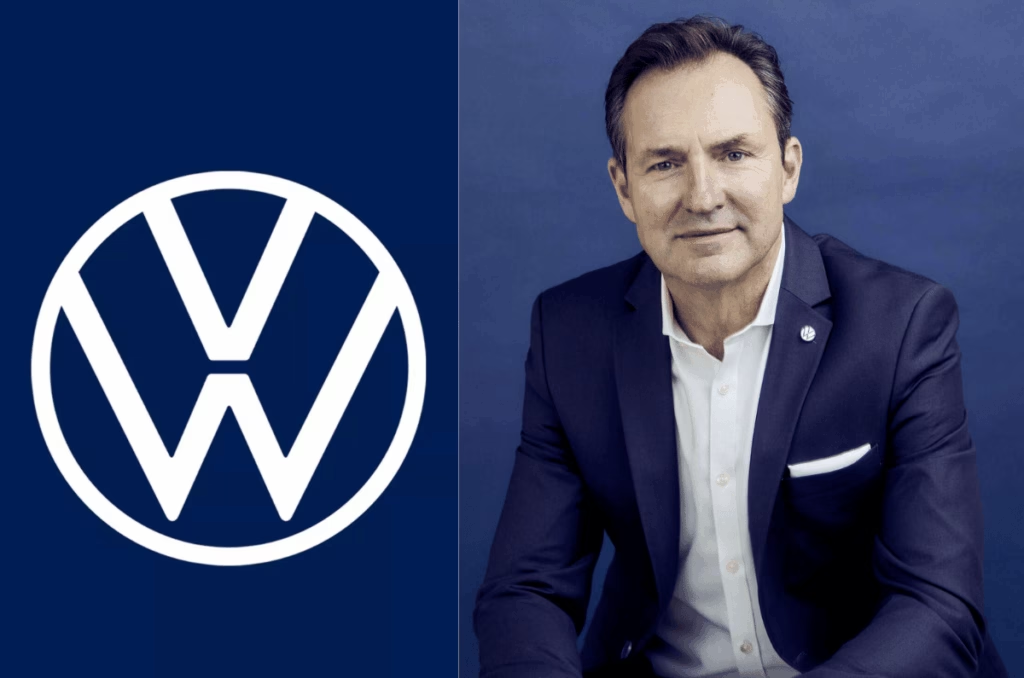
Volkswagen is preparing for a much bigger push in India, with the company reviewing its broader product, powertrain and investment plans. While a locally produced compact SUV has already been confirmed for launch next year and is expected to drive volumes, the brand is also looking at the India-EU free trade agreement (FTA) as an opportunity to bring select niche models from its global portfolio here.
“FTA has been announced in Europe. It is a huge opportunity to bring a certain sort of niche models to widen the portfolio for the consumer to offer some exciting models every now and then, which is great,” Member of the Board of Management of Volkswagen AG and CEO of Volkswagen Brand Thomas Schafer told us. He did not reveal which models could be on the cards, but said the company is taking a long-term view and will study market conditions over the next few months before making a decision.
VW’s renewed focus for India
Schafer’s India visit comes as Volkswagen reviews its global business strategy amid geopolitical tensions, changing trade policies and a growing move towards regional manufacturing. “So, globally, we see almost like a decoupling. You have a geopolitical situation and the old business model where everything’s focused on Europe, and then you export to other markets is long gone. At the same time, you have a very different dynamic in China than in the US, which is putting import duties on Europe under certain attacks. So, in that game, you have to change your business model; you have to adapt it. And that’s what we’re busy doing,” he added.
This shift could benefit India. Along with the growing domestic market, Volkswagen sees India as an important hub for engineering, IT and R&D. “We will focus a lot on India going forward. Not only because the market is exciting and growing and creating more opportunity for the future, but also the sort of knowledge base that you have here in India,” he said.
Volkswagen also sees exports as an important way to build scale out of India. The company already exports vehicles made in the country to more than 40 markets, with Mexico being one of the major markets that imports vehicles from India. “So, exports are an important part of our business, and we will always strengthen that going forward,” he said. For the upcoming compact SUV, export potential could also help boost volumes and strengthen the business case.
More powertrains can be offered at the right time
Volkswagen’s current portfolio comprises cars powered by turbo-petrol engines, even as CNG and diesel remain in demand and EVs are gaining momentum. “So, what is clear is, in the long run, there will be strong electrification, especially also in India…You see it accelerating, probably driven by the conflict in the Middle East and the oil situation,” he said.
At the same time, he clarified that be it flex-fuel, CNG, diesel or EV, the brand has the technology already on sale in certain parts of the world. “We have flex-fuel, super strong in South America for years; we have CNG, diesel and EVs, it’s all there…When it’s the right time to localise it, we will localise it,” Schafer said.
The challenge, he said, is deciding when and how to use each powertrain technology. “The dynamics in India and the market shift have been quite significant even in the last couple of months. So, to be honest, we haven’t concluded our planning on that, but the good thing is that we have it and we can deploy it if and when it is the right situation,” he stated. Volkswagen is also evaluating its next-generation models and newer platforms, but these plans are still under consideration.
Cost remains a major hurdle for VW in India
Cost has been one of Volkswagen’s biggest challenges in India. Schafer said the company has spent the past few years working on two key areas: ensuring that its products retain the core characteristics of the Volkswagen brand while simultaneously reducing the cost base. “We worked over the last four years very focused on the cars that we bring to the market now are through and through Volkswagen in terms of quality, brand fit. And, yes, our cost base is traditionally high because we are very much focused on Europe and especially Germany,” he added.
India, he said, will play an important role in Volkswagen’s efforts to reduce costs, especially through more cost-effective development and manufacturing. “Part of the programs that’s been in the media over the last, especially two years, has been reducing our cost base, developing more in more cost-efficient places like in India very much, but also shifting production from high-cost locations into lower-cost locations,” he said.
Volkswagen is now working on its next set of products, investment plans and powertrain options for India. With India becoming an increasingly important part of its global strategy, there is plenty to look forward to from the brand in the coming years.
In a rapidly evolving and diversifying market like India, Skoda’s lineup has strictly been limited to just petrol models until now, with petrol itself shrinking and currently making up less than 50 percent of the overall market. The Czech carmaker is now finally looking to diversify, having announced an aggressive CNG plan, a return to diesel with the Superb and also EVs, but in limited batches of fully imported models. However, a locally made EV is still crucially missing from the lineup. Autocar India understands that this gap is expected to finally be addressed in 2028 with a locally produced EV.
India-made Skoda EV details
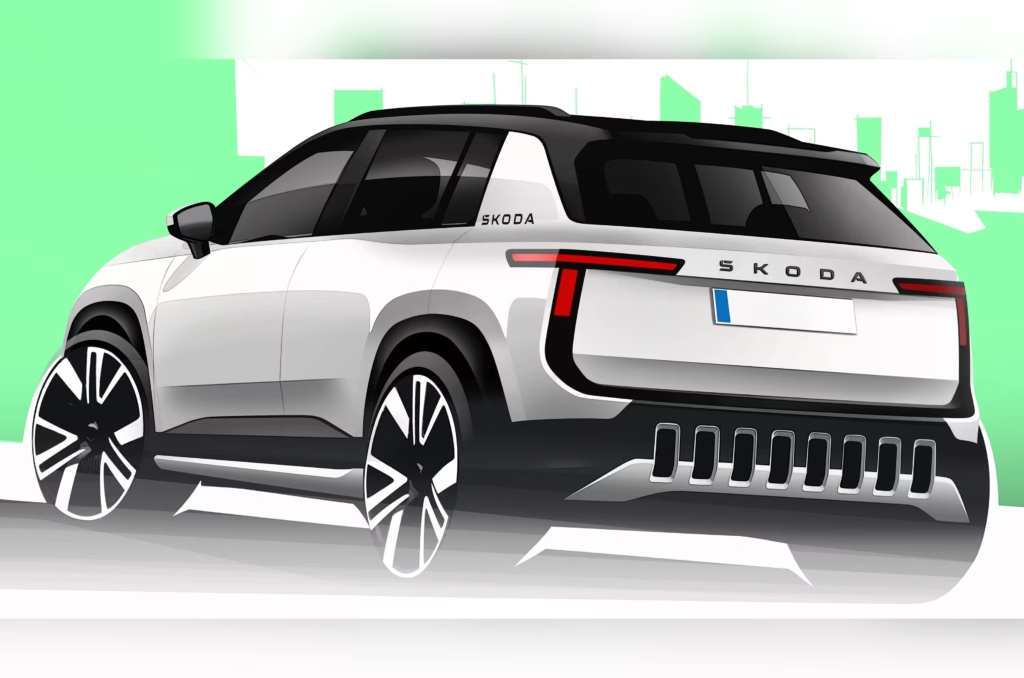
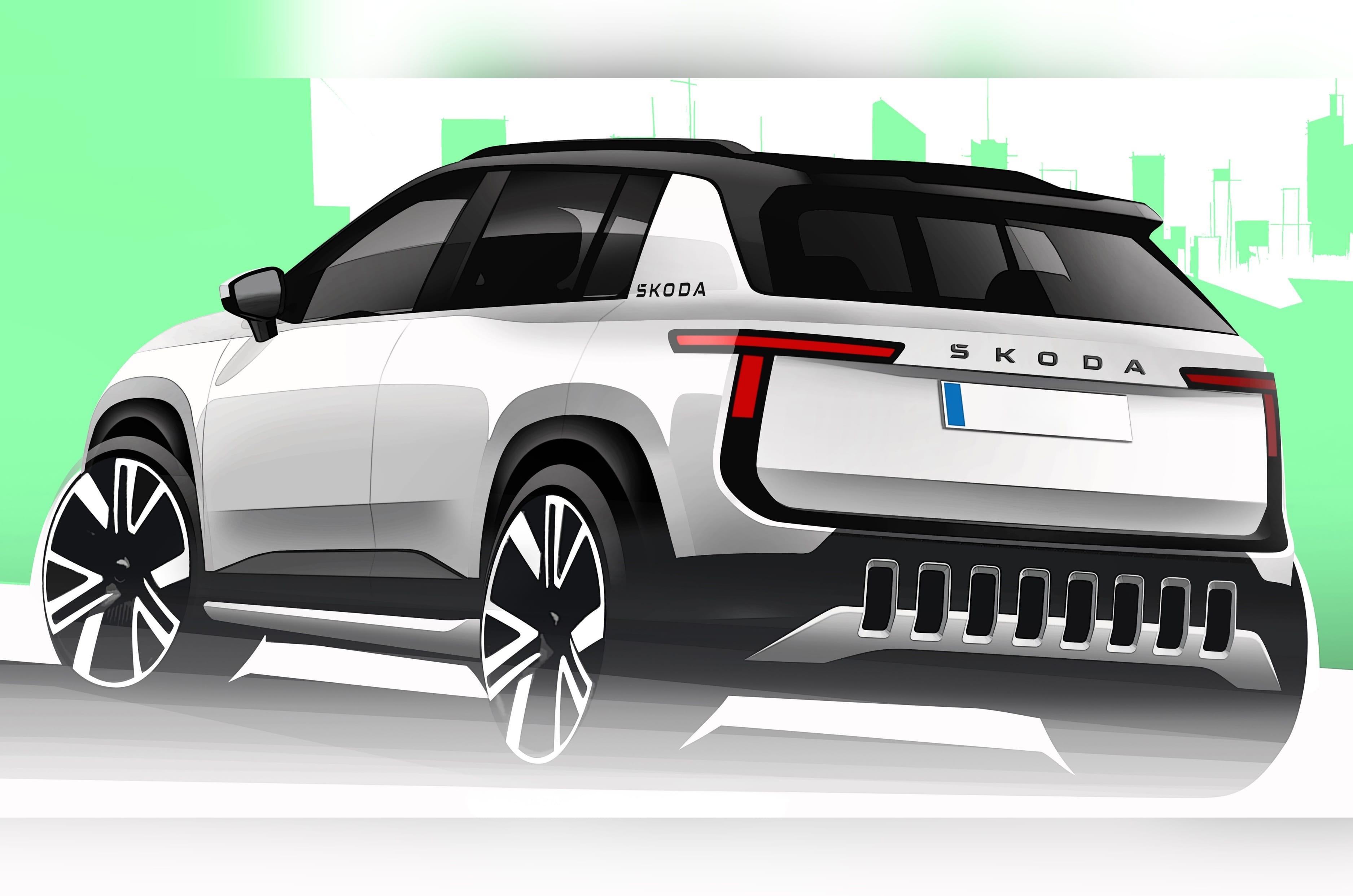
Having announced a fresh barrage of products, Skoda has now moved on to what it is internally referring to as the India 3.0 programme. The programme is expected to support a CNG-powered Kylaq in 2027 and two locally manufactured battery electric vehicles starting in 2028 – the first will be a 5-seater, followed by a 7-seater at a later stage.
“We know we have to do electric, so we are now thinking about what would be the best option for an electric car in India,” Martin Jahn, Skoda Auto board member for sales and marketing, told Autocar India on the sidelines of the updated Slavia’s launch.
While Jahn did not disclose specific details about the EVs, as we’ve reported previously, the EV programme is likely to use an adaptation of the Volkswagen Group’s China Main Platform, or CMP. The version being developed for India is referred to as the India Main Platform, or IMP, and will be tailored to local costs and market requirements.
The group intends to leverage an existing electric architecture while localising the platform, battery system and key components. A high level of localisation will be essential to price the models competitively in India’s mainstream EV market. Speaking to Autocar India, Skoda India brand director Ashish Gupta also acknowledges saying, “The volume EVs are going to come when there is localisation, and that is something which we are working on heavily.”
Where will the investment for the new EVs come from?
That’s the most important question, with new investment being key to designing, developing and engineering Skoda’s locally-made EVs. We understand the carmaker is close to finalising its next phase of investment in India. The company hasn’t officially disclosed the size or structure of the proposed investment, but sources say it could be around one billion euros.
Skoda is examining different ways to fund and execute the EV programme, including bringing in a strategic partner. As previously reported, Skoda Auto Volkswagen India is in the final stages of discussions for an alliance with the JSW Group. The proposed structure is likely to give the Indian conglomerate a majority stake and bring in the much-needed capital for the EV programme.
The discussions have yet to reach a formal conclusion, and the final structure and scope of the proposed alliance are still to be announced. Skoda Auto Volkswagen India is also examining other funding routes if the partnership does not materialise.
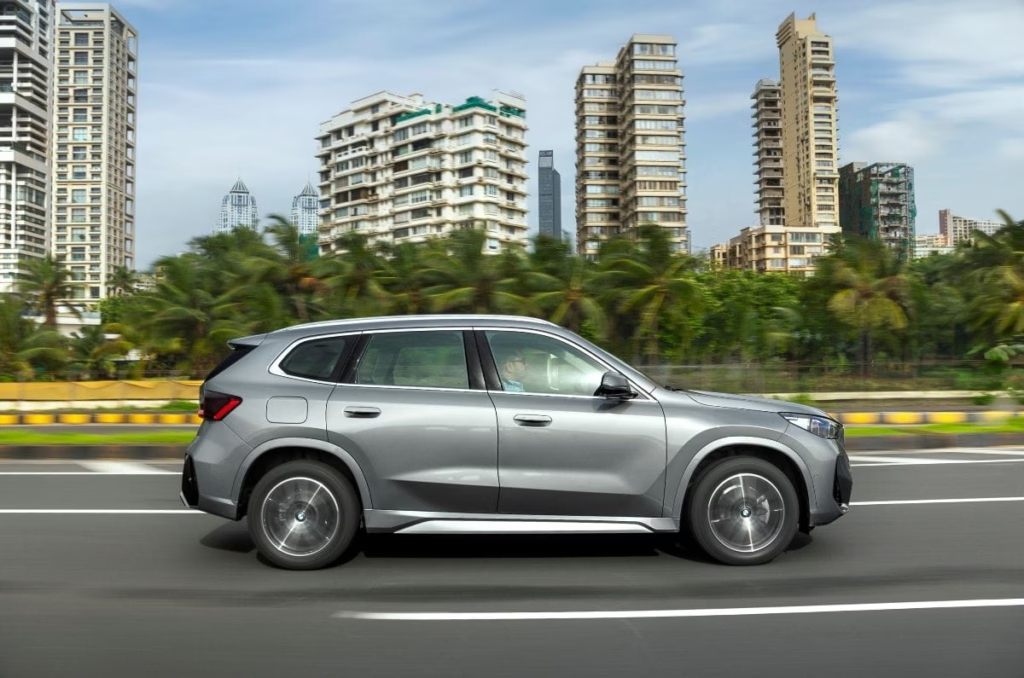
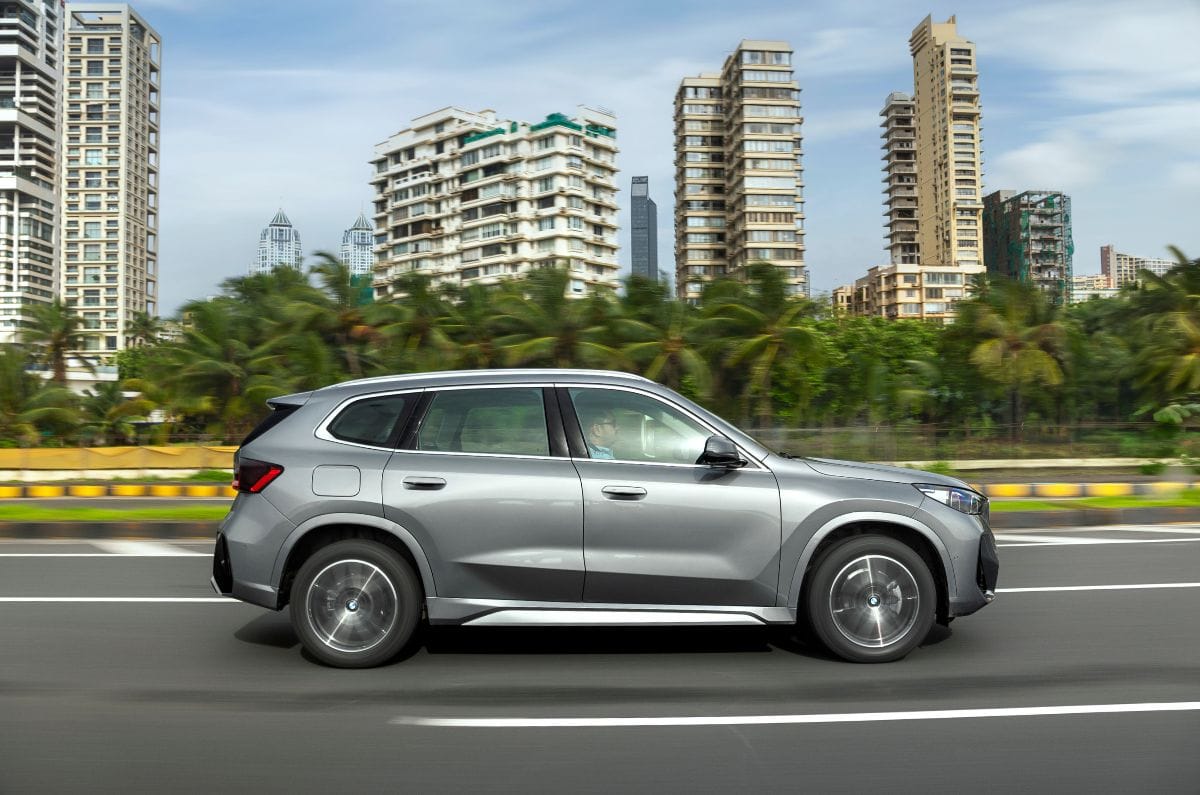
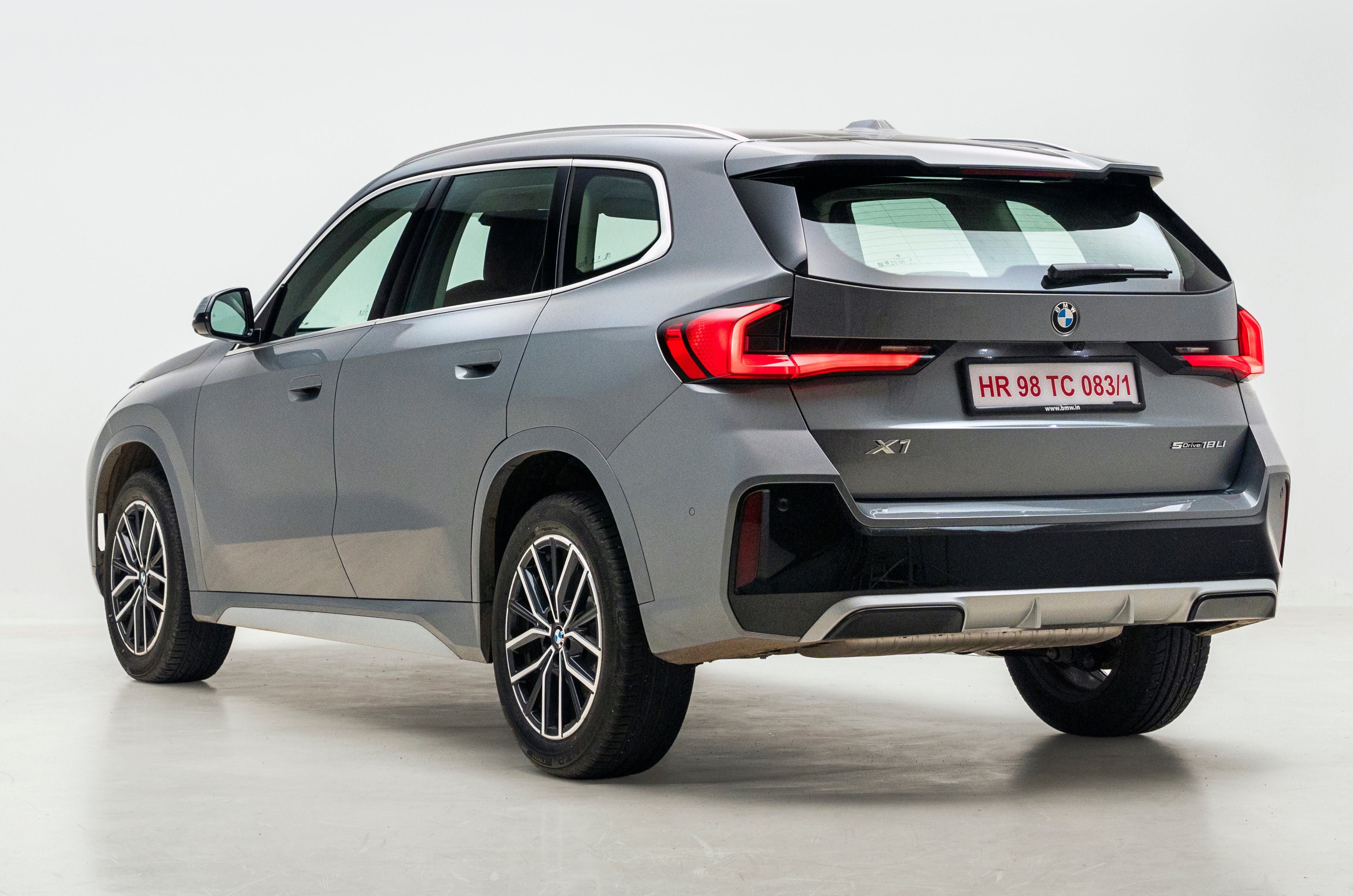
A long-wheelbase BMW X1 isn’t a new idea. China has had an extended-length X1 for years, and we got it in India last year in the form of the all-electric iX1 LWB. The X1 LWB brings the formula to the ICE X1 range. BMW says the standard-wheelbase X1 will continue to sell, though we assume the LWB will be the only X1 down the road.
BMW X1 LWB Exterior Design and Engineering – 7/10
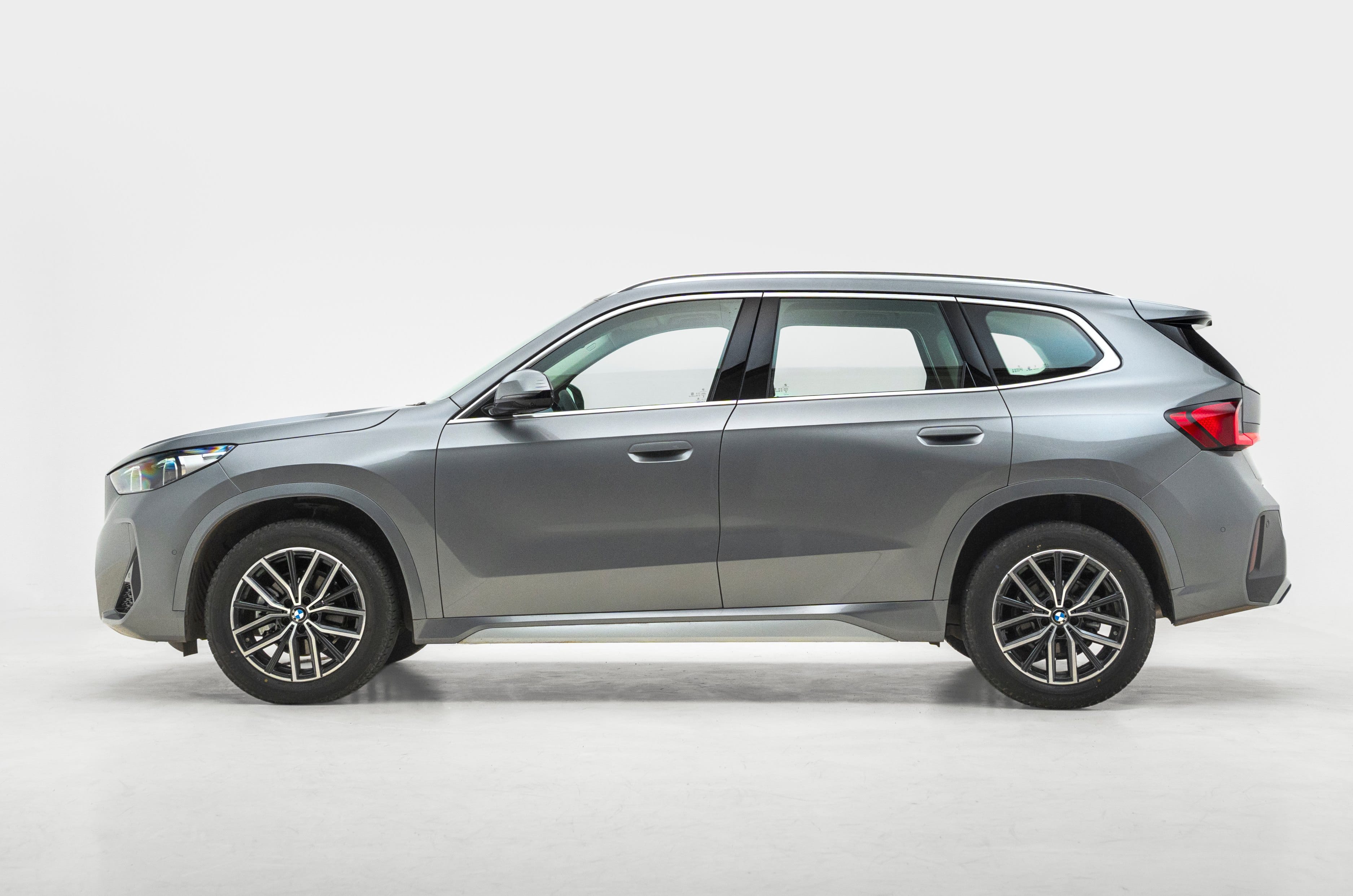
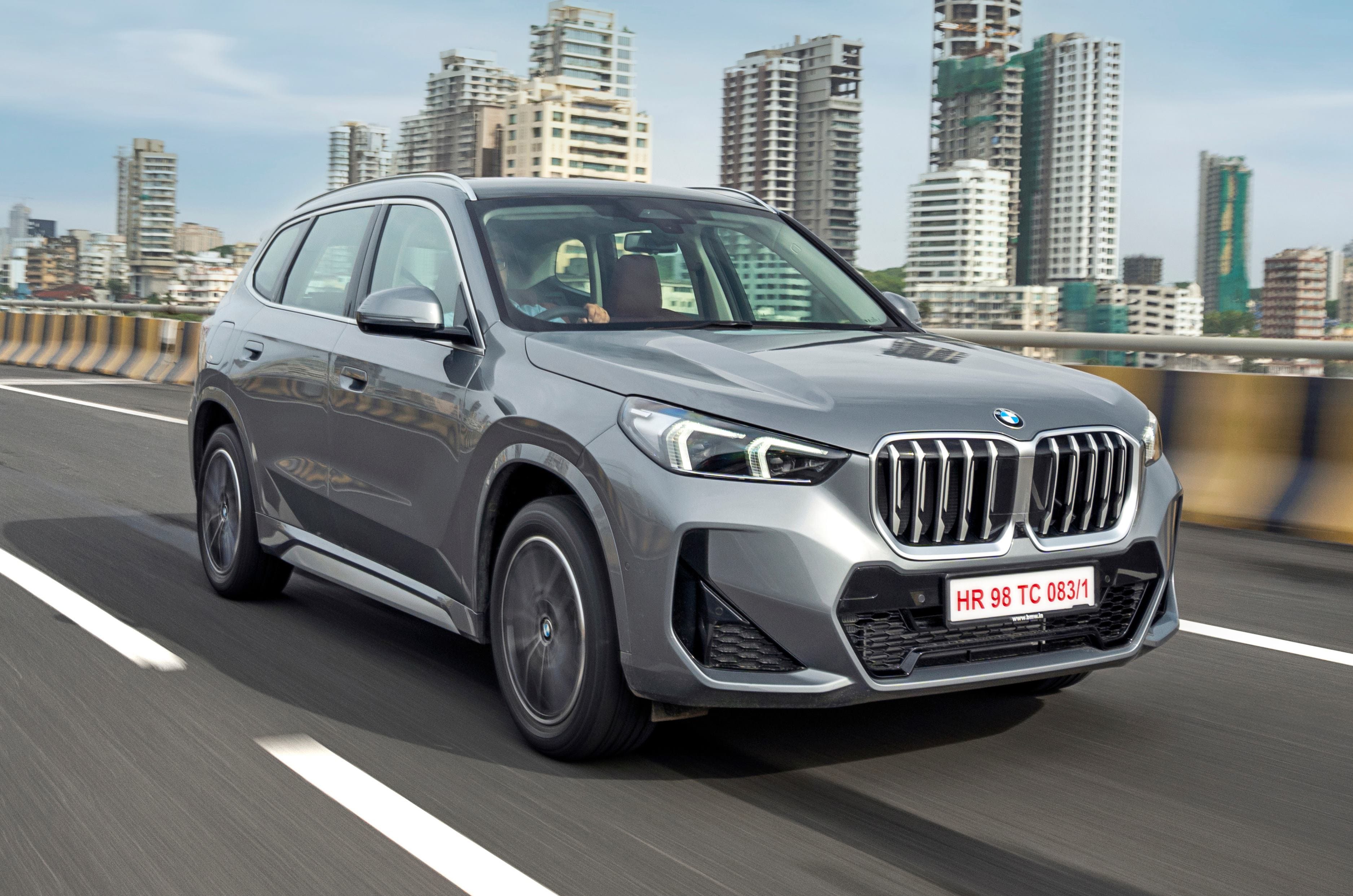
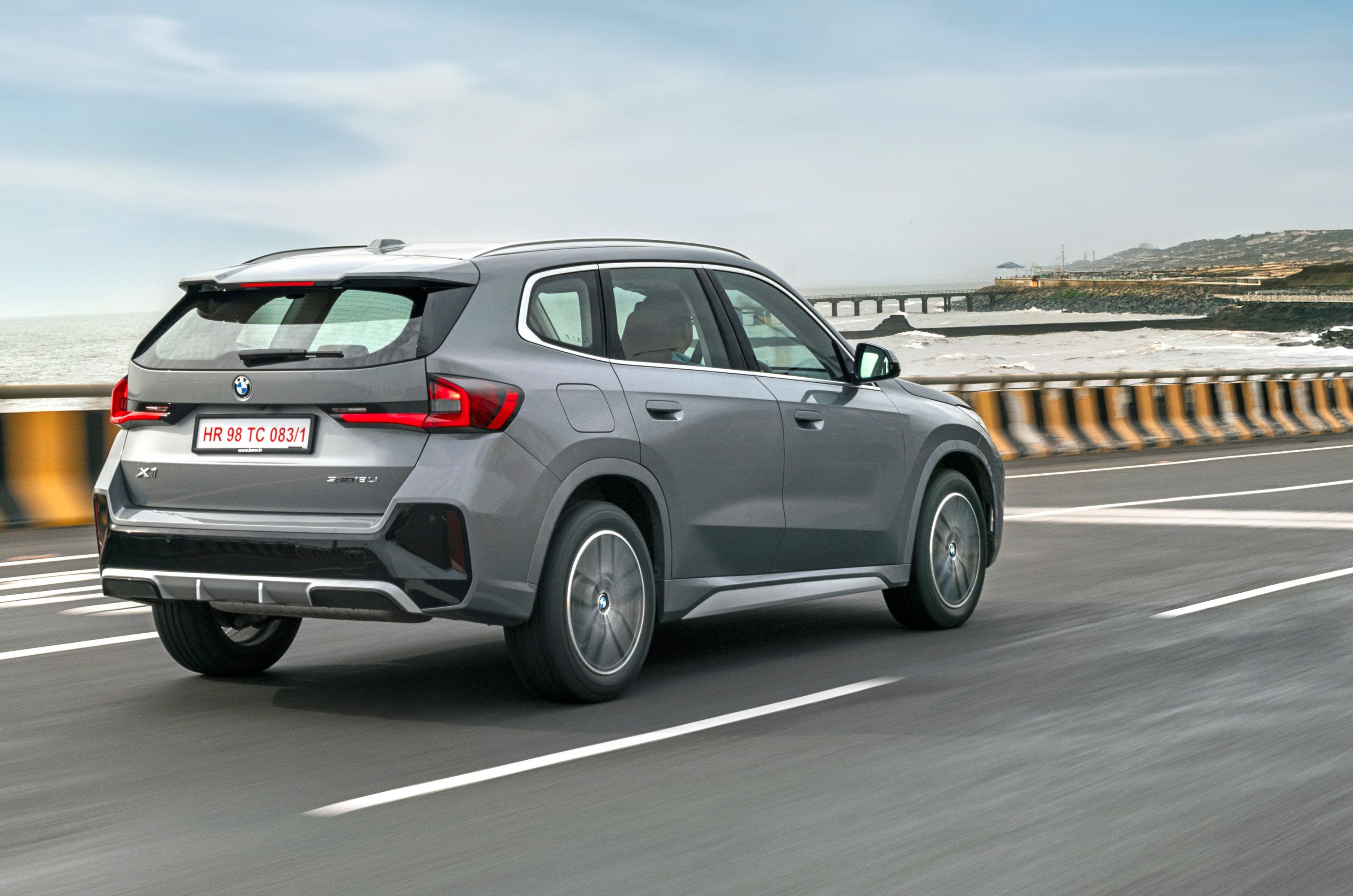
The X1 might be BMW’s smallest SUV, but it’s not particularly small anymore. It’s 116mm longer overall with 108mm of that added length at the wheelbase alone. Importantly, the longer wheelbase doesn’t look unusually long, and so the proportions work.
Lengthened body but well-proportioned design
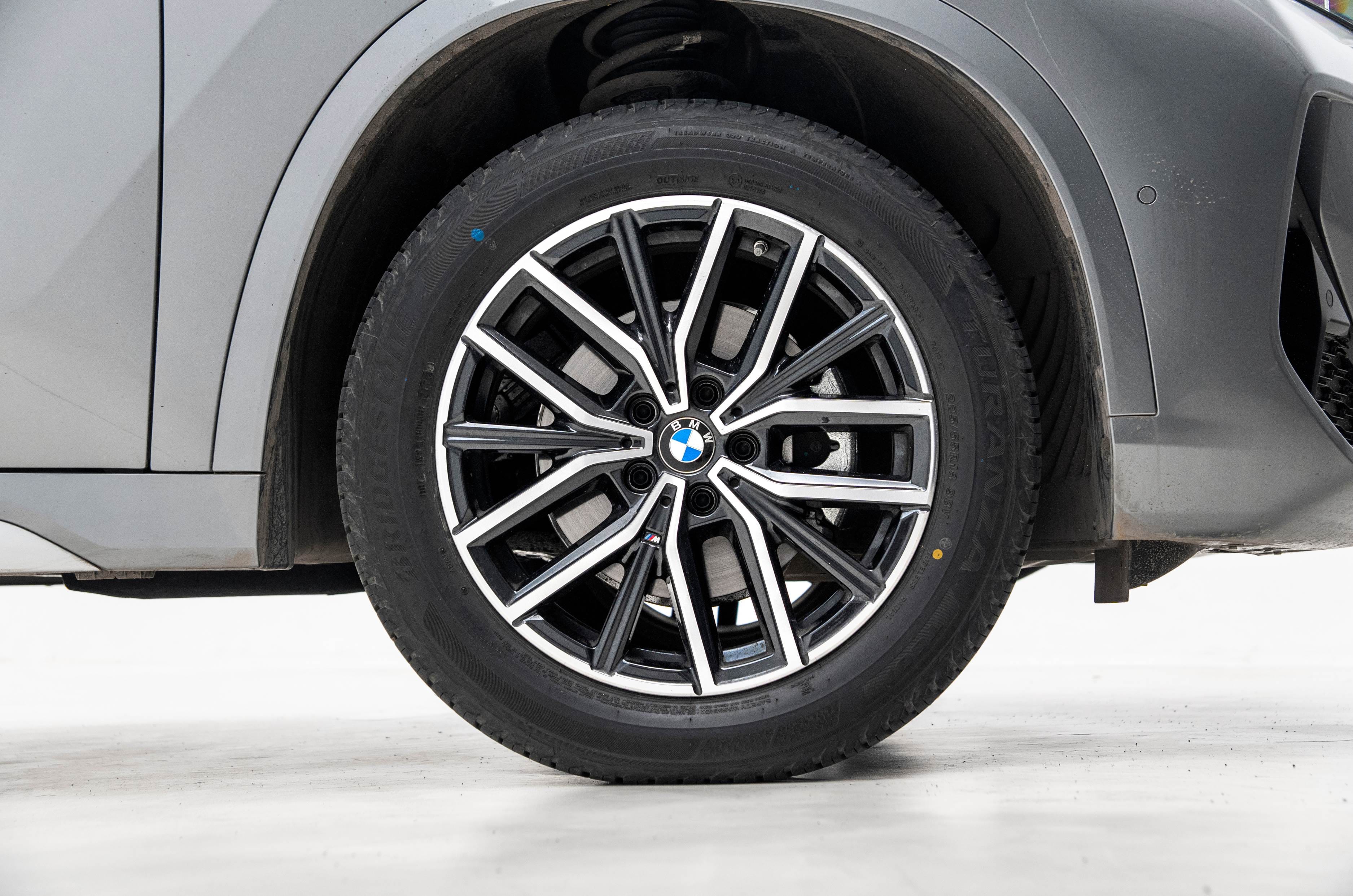
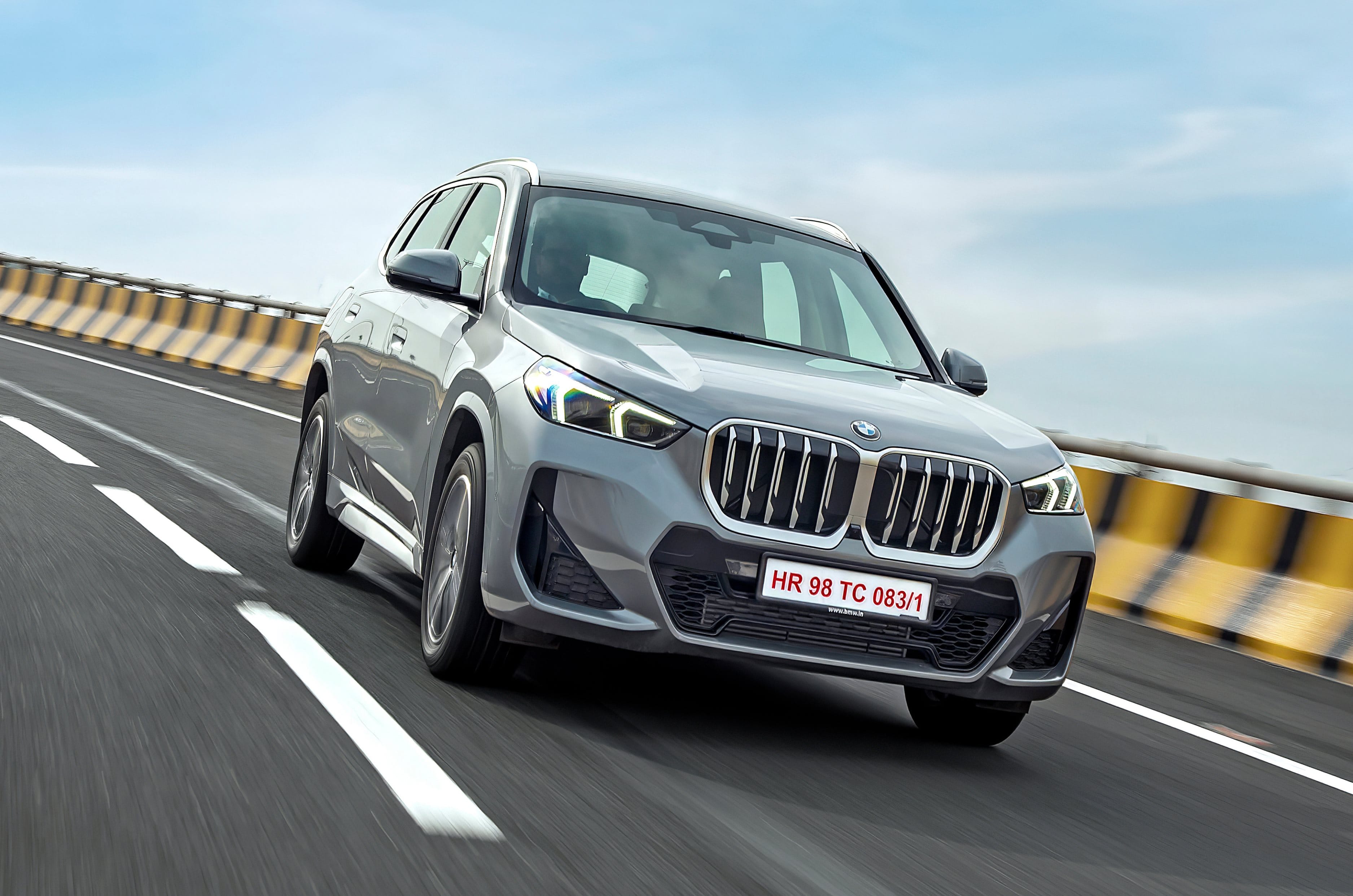
In person, the X1 LWB doesn’t look vastly different to the standard wheelbase model. It’s got the same peeled back headlamps, same M Sport styling pack and same edgy tail lights. The 18-inch rims are shared with the other X1s, but a more exciting design and or a larger size would have done much for the look. A chrome surround for the large windows is a small detail distinction to the standard X1 that uses a black effect, while the conventional grille here serves as a distinguishing element to the iX1 that sports a closed-off grille.
18-inch wheels shared with regular X1; larger wheels would have done much for the look.
BMW X1 LWB Interior Space and Comfort – 8/10
Long wheelbase opens up huge space at the back
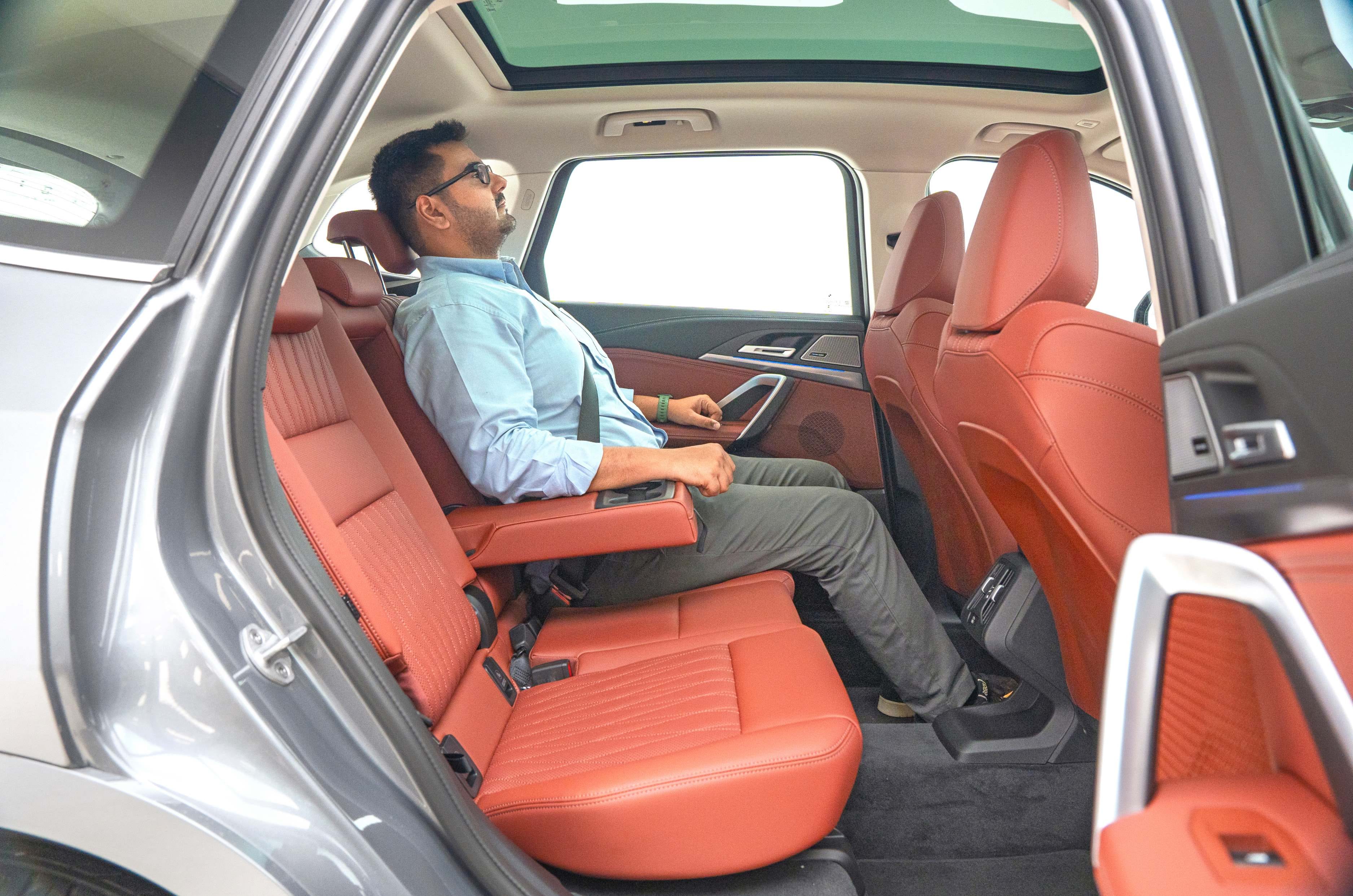
Thanks to wide opening rear doors and a large door aperture, getting into the back of the X1 LWB is very convenient. And once you’re inside, you’ll be amazed by the sense of space that you get there.
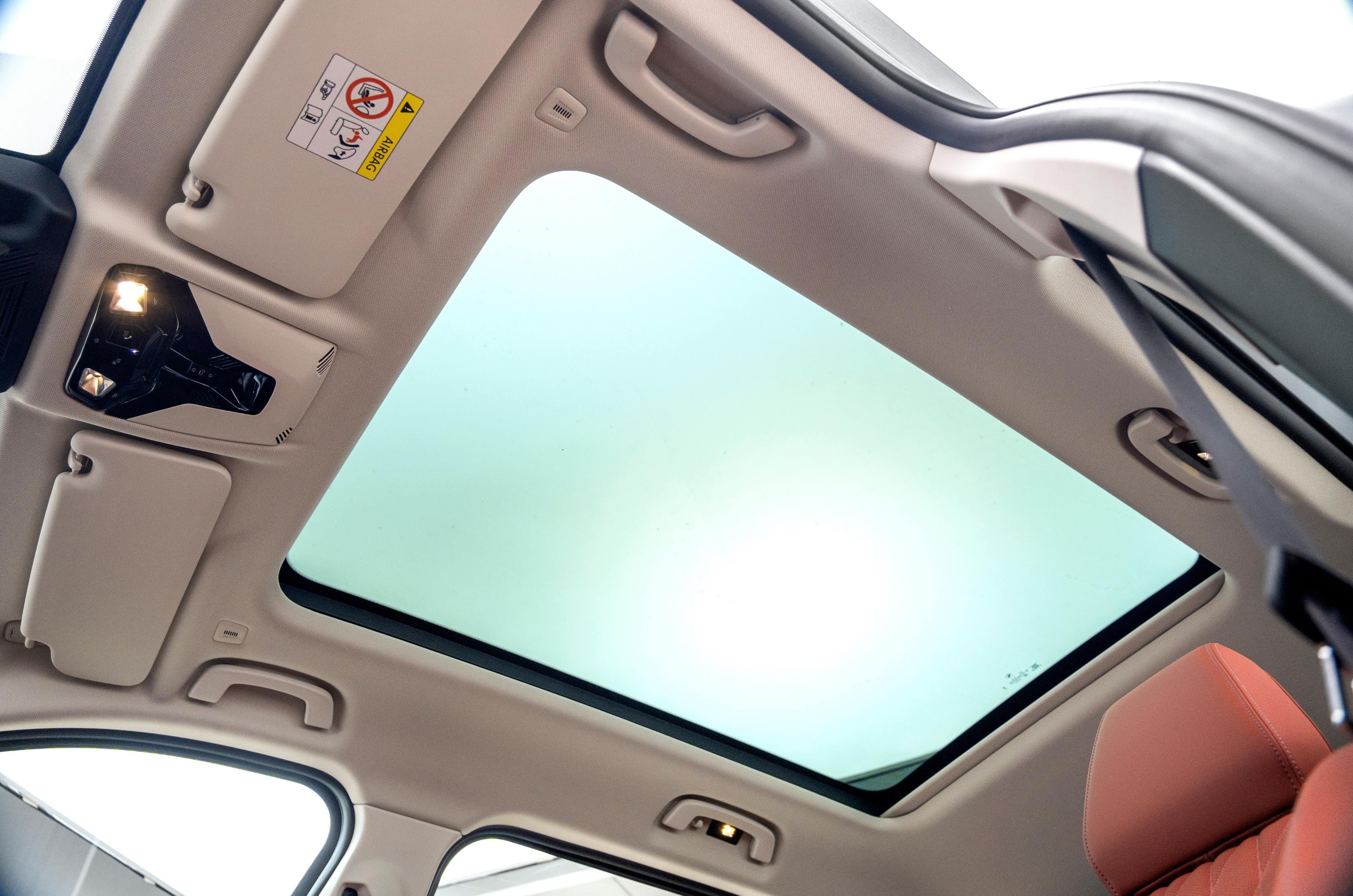
Even six footers will find legroom generous and helping the feeling of space is the large glasshouse. The panoramic glass roof (it doesn’t open) lets in lots of light and the rear windows are also large. Pity, they don’t get adjustable sunshades.
Rear seat gets a longer base and enhanced cushioning for better comfort.
Like the iX1 LWB, the X1 LWB also benefits from a redone rear seat. There’s enhanced cushioning while a 15mm longer seat base adds a bit more by way of thigh support. The seating position itself is very good, and if you want a more relaxed setting, you also have the option to recline the backrest by a couple of degrees. The extra leg room also makes the X1 LWB that little bit comfier for a middle passenger who will have more space to keep his or her feet on either side of the high centre tunnel. Still, the rear seat is best for two.
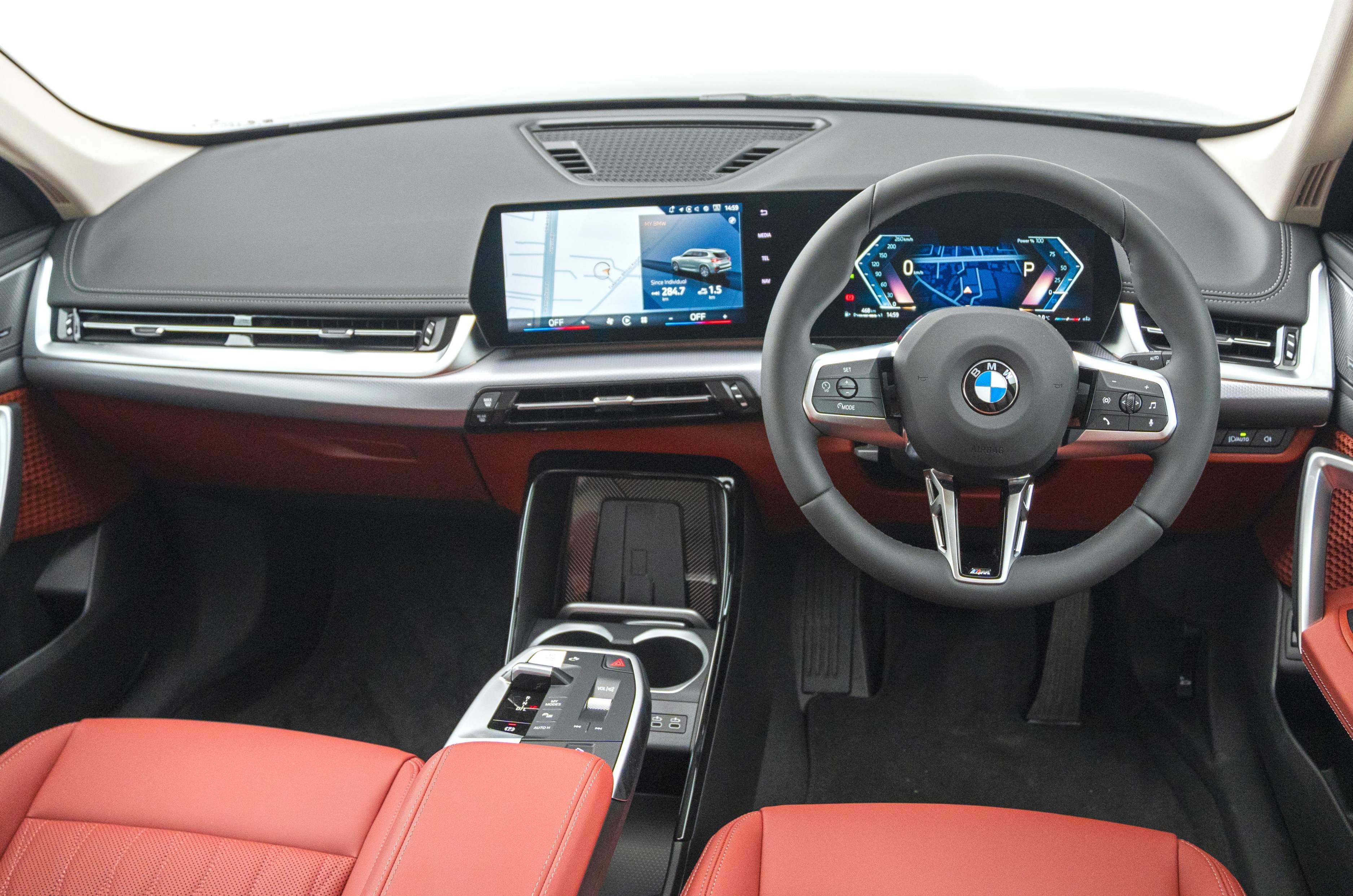
Dashboard is identical to the standard wheelbase X1.
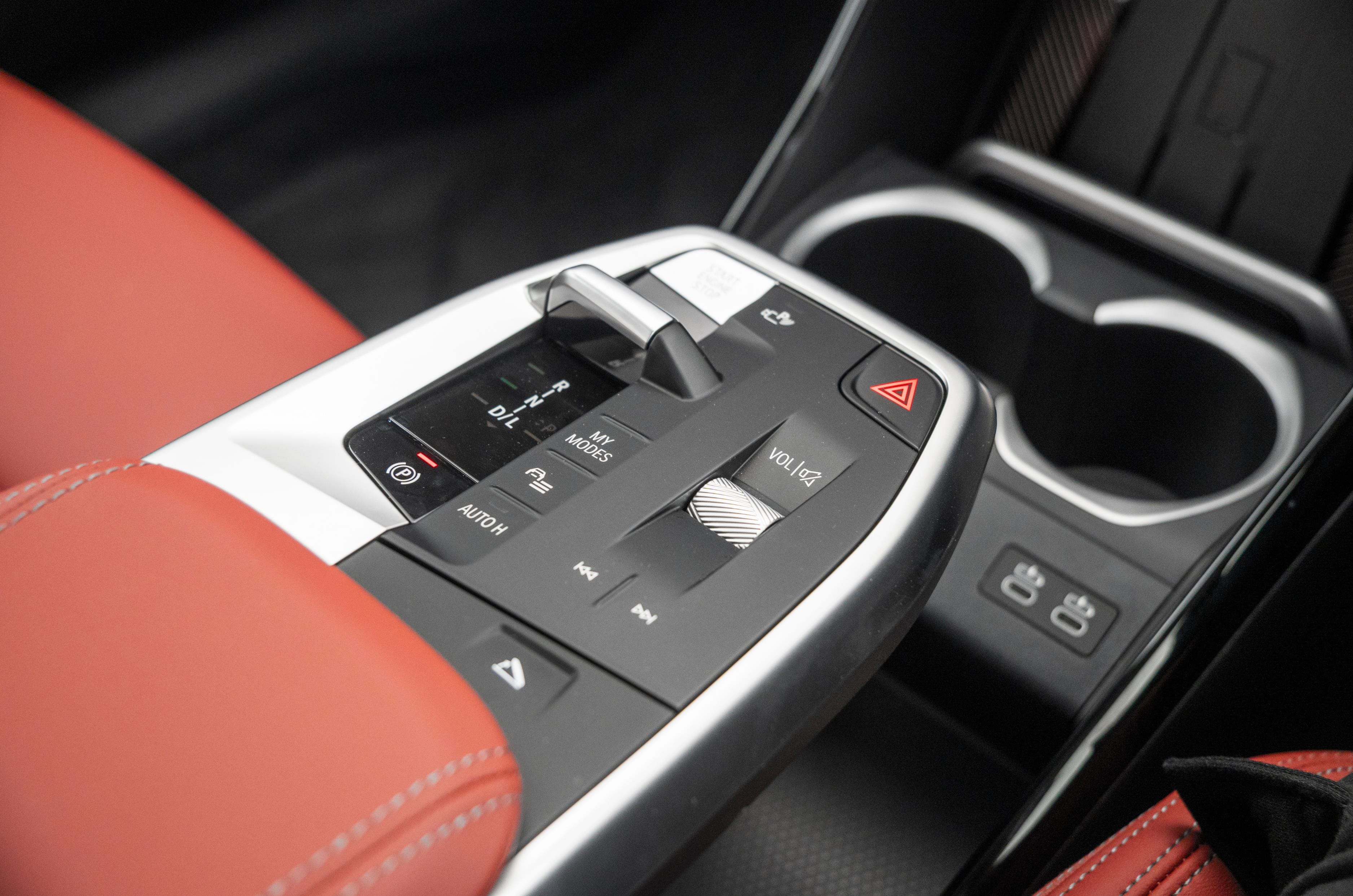
Up front, the X1 LWB is no different to the standard wheelbase X1. The dash with its asymmetric AC vents looks youthful and what also adds some flavour to the X1’s cabin is the upright wireless phone charging pad at the base of the dash. There’s also a floating centre console, which houses a few key buttons, such as for the gear selector, volume control and driving modes. There’s some storage under the front centre armrest but oddly, the lid opens towards the passenger side.
Floating centre console gets a few physical controls and some storage underneath.
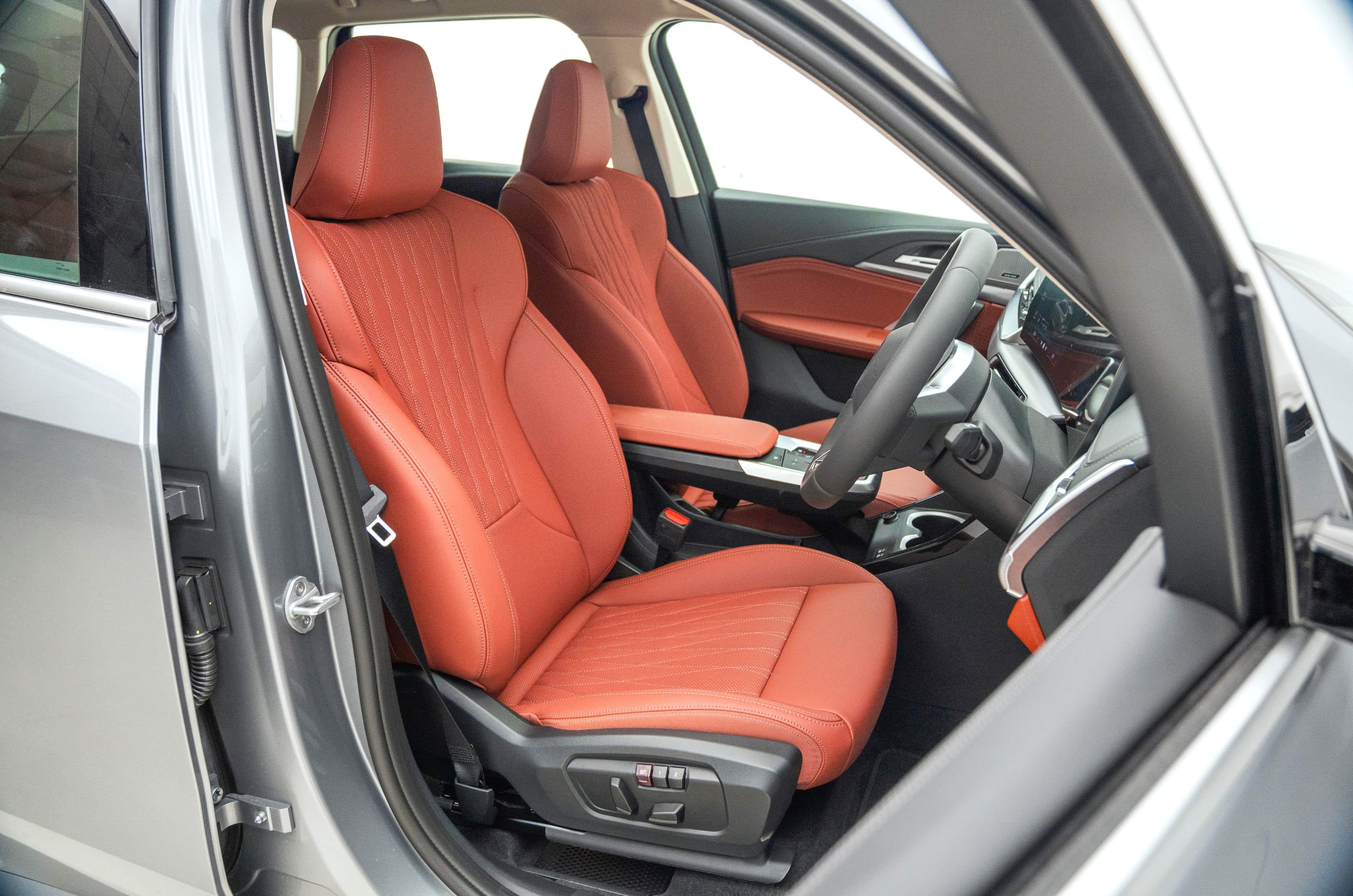
Upholstery choices include the brown you see here as well as a white on black theme which we suspect would be a pain to keep clean. The front seats themselves look sporty and also hold you really well, but unfortunately, the X1’s seat massage function has been dropped on the long wheelbase model. There’s also no seat ventilation function. An M Sport steering is standard but feels a bit too chunky in most hands, and also misses on paddleshifters.
Front seats are sporty, but they miss out on ventilation and massage functions.
In terms of quality, key touch points look and feel good. There are padded materials on the dash and the textured metal-like effect is nicely done. However, it’s not quite got the same attention to detail as pricier BMWs. The USB slots on the dash, for one, aren’t backlit, so you’ll fumble with wires in the dark. The ambient lighting, too, isn’t as vibrant as, say, in a Mercedes GLA. BMW says boot capacity stands at 540 litres and there is plenty of space for large bags. Packaged under the boot floor is a space-saver spare tyre.
BMW X1 LWB Features and Safety – 7/10
X1 LWB is available in a single M Sport trim
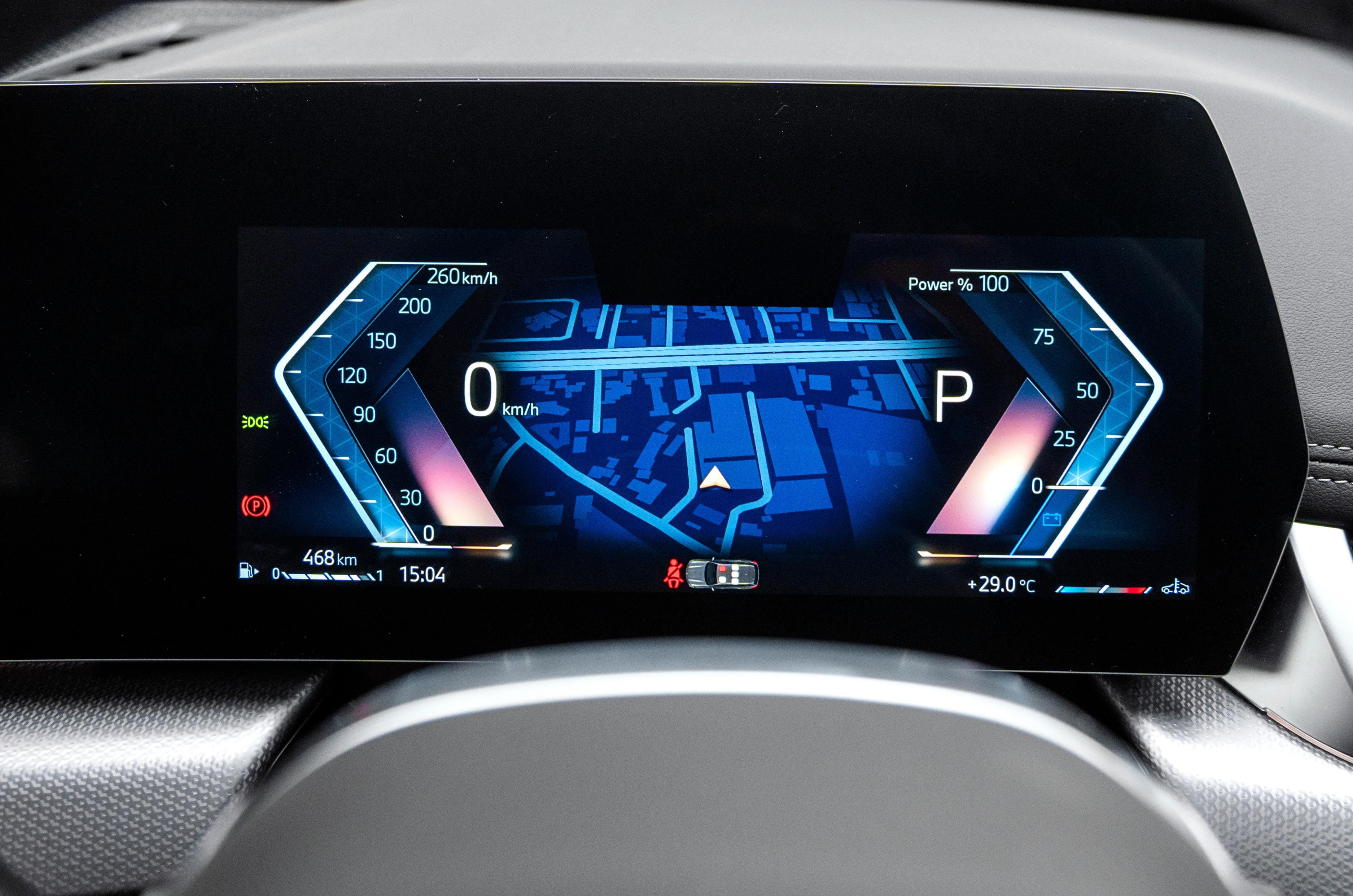
The X1 LWB sports BMW’s twin screen Curved Display. The 10.25-inch digital instrument cluster does give all the info you need, but the presentation with hexagonal themes isn’t appealing even after all these years. The 10.7-inch touchscreen has its highs and lows, too. It’s crisp and responsive, but packs in way too much, including the climate control settings. The menus, frankly, can feel overwhelming on the go. The crisp 360-degree camera does get our vote. A Reversing Assistant that retraces the path in and automatically backs out (up to 50m) is a handy function to get you out of tricky situations.
Instrument cluster offers lots of information, but the presentation with hexagonal themes isn’t appealing.
Interestingly, BMW offers a subscription service to unlock more advanced maps, customizable icons, and more screen themes and modes. Other features include a digital key, allowing you to share access with up to 18 friends and family members, while the 12-speaker Harman Kardon sound system is rather nice, too.
Headlining the list of comfort features is the panoramic glass roof, and there’s power adjust for both front seats. Rear seat passengers get dedicated rear AC vents but there’s no dedicated zone for the rear section of the cabin. A fold-down armrest and USB type C charging port are other functions at the back.
Panoramic glass roof lets in lots of light, but isn’t openable.
Safety kit includes 8 airbags, ABS, ESC and Isofix child seat mounts among other features. The X1 LWB also packs in a few ADAS functions such as auto emergency braking and lane departure warning and assist. Adaptive cruise control, however, is missed.
BMW X1 LWB Performance and Refinement – 7/10
1.5-litre, three-cylinder turbo-petrol is only engine on X1 LWB
BMW is launching the X1 LWB in S-Drive 18 Li form, which is a complicated way of saying that it’s powered by a 1.5-litre three-cylinder turbo petrol engine. Yes, you read that right. The engine is E25 compliant, but there’s no diesel option for the moment, and buzz is there won’t be one in the future either.
Performance is adequate but unexciting
The X1 LWB’s petrol engine makes 156hp and 230Nm and all the power goes to the front wheels only, via a seven-speed dual-clutch transmission. A fact to note, 156hp is the upgraded power figure. On the standard wheelbase X1, the engine makes 136 horsepower.
Unfortunately, the power bump doesn’t magically transform the X1 LWB into something sporty. In ordinary city driving, you really won’t have a problem with the performance on hand. There’s enough power for the urban grind. It’s just that when you pick up the pace, you’ll miss that reserve of power that you just expect in a luxury car.
Refinement is good but the engine thrums when extended
Sport mode does make the engine feel a bit more urgent, but it’s also in Sport mode that the engine can’t hide its three-cylinder-ness. When it’s time to overtake, for instance, and you press down on the accelerator pedal, there is a bit of a delay, then you hear the engine thrum, and that’s not a very BMW sound. Performance is also not very BMW. We managed a 0-100 kph time of 9.58 seconds.
Then again, the X1 LWB’s USP is the rear seat, and there will be buyers who rarely, if ever, take the wheel. If you’ve instructed your chauffeur to drive in an easygoing manner, you will note that engine noise is actually pretty well-contained.
BMW X1 LWB Mileage and Efficiency – 8/10
While we haven’t put the X1 LWB to the full test it should prove to be more efficient than rivals’ four-cylinder turbo-petrol units. Of course, it won’t be outright frugal because the X1 LWB is a substantial vehicle. We expect real-world fuel economy in the 7-10kpl band with the figure rising to 9-12kpl over highway drives.
BMW X1 LWB Ride Comfort and Handling – 8/10
Suspension has been tweaked for better comfort on the X1 LWB
The X1 LWB might be front-wheel drive only but there is a crispness to the way it changes direction. You will like the feel at the steering wheel and you get a good sense of connect too. Unfortunately, the handling isn’t supported by the engine. Long story short, this is not the BMW for keen drivers.
As for ride comfort, BMW has tweaked the suspension for the X1 LWB, and they’ve done a pretty good job of things. The suspension works quiet, it feels absorbent, and it’s only when you’re really paying attention that you’ll notice a distant firmness to the setup.
BMW X1 LWB price and verdict – 8/10
X1 LWB makes for a great backseat SUV
Prices for the X1 LWB will be announced on August 21. We expect BMW to keep pricing within the Rs 50-55 lakh (estimated, ex-showroom) band, which would make the X1 LWB a very enticing proposition.
Rear seat space is the highlight and immediately gives the BMW bragging rights over the Mercedes GLA and Audi Q3. Thing is, the X1 LWB’s appeal is almost too tied to the rear seat experience. The drive experience is just so-so. Performance is fine for the daily grind but the three cylinder unit does little to excite. If that’s not a deal breaker for you, the BMW X1 LWB is sure worth a long, hard look.
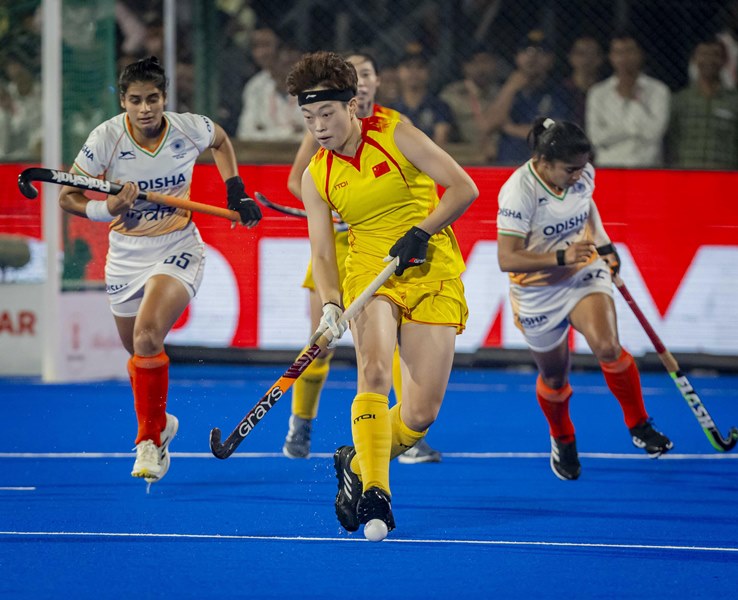
भारत ने प्रबल दावेदार चीन के साथ हॉकी महिला विश्व कप मुकाबले में रविवार को दो बार बढ़त बनाने के बाद 2-2 का ड्रा खेला।भारत इस परिणाम से कॉन्फिडेंस लेगा। चीन फेवरेट के तौर पर आया था, लेकिन दोनों टीमों में से भारत ज़्यादा खुश होगा।
उन्होंने नवनीत की आठवें मिनट में शानदार फिनिश की वजह से लीड ली और फिर दीपिका ने 25वें मिनट में पेनल्टी कॉर्नर से स्कोर 2-1 कर दिया। चीन ने दोनों गोल किए, झांग यिंग ने शिल्पी के फाउल के बाद 15वें मिनट में पेनल्टी स्ट्रोक को गोल में बदला और फिर मा निंग ने तीसरे क्वार्टर में 39वें मिनट में पेनल्टी कॉर्नर पर गोल करके स्कोर 2-2 कर दिया।
The Indian Women’s Team showed immense character, resilience and fighting spirit to secure a hard-fought 2-2 draw against Olympic silver medallists China in their opening match of the FIH Hockey… pic.twitter.com/QIYons4rEN
चीन ने आखिरी क्वार्टर में ज़ोर लगाया, भारत ने प्रेशर झेलते हुए एक पॉइंट हासिल किया।इंग्लैंड दक्षिण अफ्रीका के खिलाफ अपनी पिछली जीत के बाद ग्रुप में सबसे आगे है। चीन और भारत ने इस गेम से एक-एक पॉइंट हासिल किया।ग्रुप से दूसरे राउंड में सिर्फ़ दो टीमें ही आगे बढ़ी हैं, इसलिए चीन और भारत दोनों अपने अगले गेम में पॉइंट गंवाने का रिस्क नहीं उठा सकते।