इंडियन प्रीमियर लीग (IPL) में दिल्ली कैपिटल्स और बंगाल के लिए खेलने वाले भारतीय क्रिकेटर अभिषेक पोरेल मुश्किल में फंस गए हैं। आईपीएल में पिछले चार सीजन से दिल्ली कैपिटल्स का हिस्सा रहे पोरेल को सोमवार रात हुगली जिले की पुलिस ने गिरफ्तार किया। उन पर एक महिला ने शादी का भरोसा देकर शारीरिक संबंध बनाने का आरोप लगाया है। पुलिस ने महिला की शिकायत के आधार पर कार्रवाई करते हुए क्रिकेटर को हिरासत में लिया और मामले की जांच शुरू कर दी है। आइए जानते हैं कौन है अभिषेक पोरेल
हुगली (रूरल) के पुलिस सुपरिटेंडेंट कुनार भूषण सिंह ने बताया, “अभिषेक पोरेल के खिलाफ मामला दर्ज किया गया था और उनकी गिरफ्तारी के लिए कोर्ट से आदेश भी जारी हुआ था। उन्हें सोमवार देर रात गिरफ्तार कर लिया गया और आज उन्हें कोर्ट में पेश किया जाएगा।”
क्या है पूरा मामला
कर्नाटक की एक मेडिकल छात्रा ने 23 जून को मोगरा पुलिस थाने में अभिषेक पोरेल के खिलाफ शिकायत दर्ज कराई थी। छात्रा का आरोप है कि, दोनों करीब साढ़े तीन साल से एक-दूसरे के साथ रिश्ते में थे और शादी करने की योजना बना रहे थे। शिकायत मिलने के बाद पुलिस ने मामले की जांच शुरू की। पुलिस की टीम कई बार चंदननगर स्थित पोरेल के घर भी पहुंची, लेकिन उस समय वह घर पर नहीं मिले। पुलिस ने अभिषेक पोरेल को सोमवार देर रात मोगरा इलाके से गिरफ्तार किया। इस मामले में पुलिस ने पोरेल के खिलाफ भारतीय न्याय संहिता (BNS) की कई धाराओं के साथ-साथ सूचना प्रौद्योगिकी (IT) एक्ट के तहत भी केस दर्ज किया है। मामले में BNS की धारा 69 भी शामिल है।
कौन है अभिषेक पोरेल
आईपीएल में दिल्ली कैपिटल्स के लिए खेलने वाले अभिषेक पोरेल घरेलू क्रिकेट में बंगाल की टीम का भी हिस्सा रहे हैं। अभिषेक पोरेल बाएं हाथ से बल्लेबाजी करने वाले विकेटकीपर हैं। उन्होंने 2023 में आईपीएल में डेब्यू किया था और अब तक दिल्ली कैपिटल्स के लिए 35 मैच खेल चुके हैं। आईपीएल 2026 में उन्होंने टीम के लिए चार मुकाबले खेले और चार पारियों में कुल 108 रन बनाए। इस सीजन में दिल्ली कैपिटल्स की कप्तानी अक्षर पटेल ने की थी।
वहीं बंगाल के लिए फर्स्ट क्लास क्रिकेट में 32 मैच खेलकर 1408 रन बनाए हैं। 23 लिस्ट ए मैचों में उनके नाम 833 रन और 61 टी20 मैचों में 1590 रन हैं। पोरेल ने रणजी ट्रॉफी, विजय हजारे ट्रॉफी और सैयद मुश्ताक अली ट्रॉफी में बंगाल का प्रतिनिधित्व किया है। वह अपनी बल्लेबाजी के साथ-साथ विकेटकीपिंग के लिए भी जाने जाते हैं।
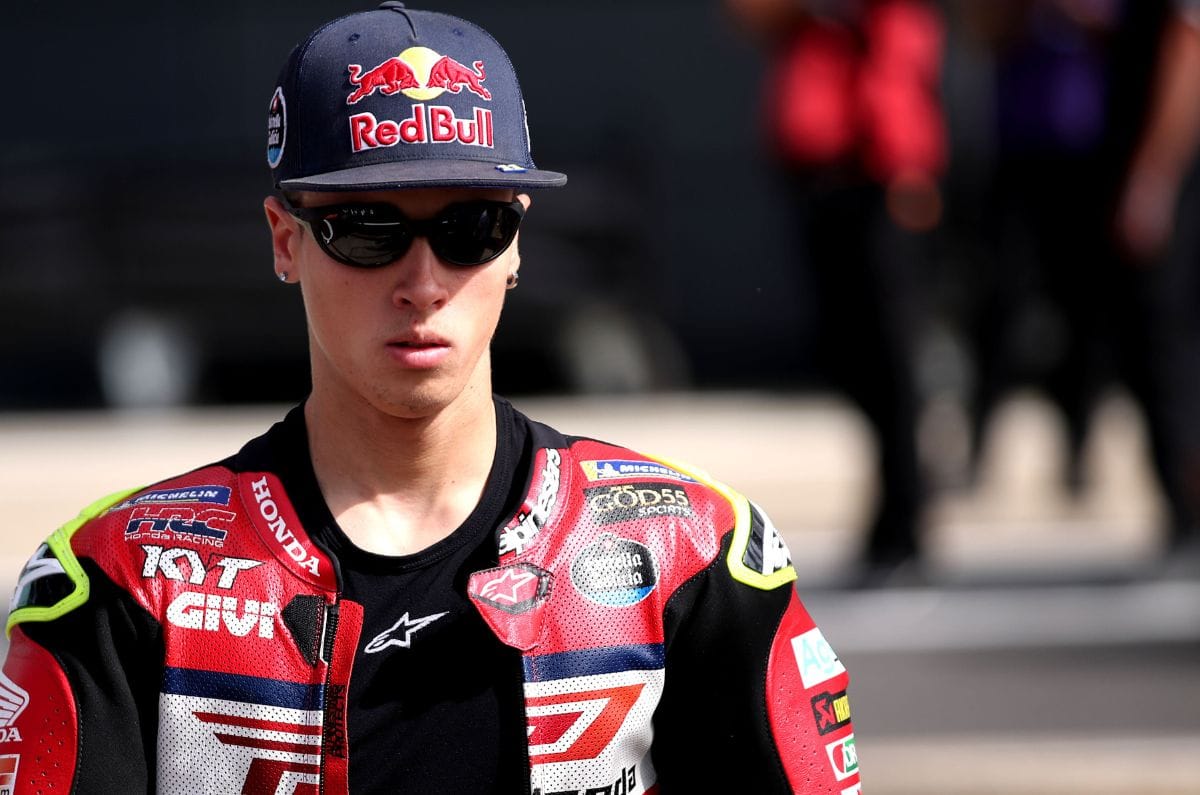
MotoGP is transitioning from 1000cc to 850cc motorcycles in 2027 and Triumph has also revealed a new engine for Moto2 next year. Speaking to Visordown, Diogo Moreira, current rookie rider for the Honda LCR MotoGP team and 2025 Moto2 world champion, said that this should make the jump between the two formats easier and that he’s optimistic about it.
Diogo Moreira’s excited for the new 850cc MotoGP bike
Says the new Moto2 engine will make transition easier for future riders
Triumph says the new engine isn’t based on the Tiger Sport/Trident 800
MotoGP to transition from 1000cc to 850cc engine in 2027
Earlier stepping up from Moto2 to MotoGP meant getting used to a bike that has about 100 more horsepower, much more sophisticated electronics, and carbon ceramic braking systems
In the past, upscaling from a Moto2 bike to a MotoGP bike hasn’t been easy for most riders. Stepping up means getting used to a bike that has about 100 more horsepower, much more sophisticated electronics, and carbon ceramic braking systems. There have been riders like Pedro Acosta who adapted to the changes quickly. On the other hand, current MotoGP riders like Raúl Fernández (2026 British GP winner) and Fabio Di Giannantonio (currently fifth in the world championship) struggled when they first came from Moto2. They got better with time, and of course, with their teams choosing to trust their potential. Moreira himself is currently struggling to stand out on the grid though it is too early to write him off.
When asked about the changes, he said, “But anyway, I think we are happy to be in this new generation because, for me, I think it will be easier to ride this bike because it’s more similar to a Moto2. It should be good.” Moreira’s comments come at an important time for Moto2 and MotoGP when both are set to change substantially next year. MotoGP is downsizing while Moto2 is upsizing which is expected to reduce the steep jump between the two formats.
At this juncture, it bears repeating Triumph’s clarification about their new 2027 engines for Moto2. Since they already have a slightly larger engine, the obvious question was asked and answered. Triumph’s Chief Product Officer Steve Sargent told Visordown in a separate interview, “it’s categorically not the Tiger Sport 800 engine. It’s a completely different set-up.” He added that in 2019, when Triumph took over as Moto2’s exclusive engine supplier from Honda, the existing 765cc triple-cylinder engine was adapted for racing. With the new engine, that process has been reversed with focus on performance as well as durability.
But, he also didn’t say that this racing-first engine will never make it to a road motorcycle. While Triumph’s plans remain shrouded at this time, we can expect to see the learnings from this new race engine being applied to their future road motorcycles, at the very least. If Triumph manages to make the transition easier for riders, not only will that help the brand, but a future Triumph motorcycle with a Moto2 based engine would also be a strong marketing tool. While the gap between Moto2 and MotoGP has narrowed, there’s absolutely no doubt that MotoGP will remain the pinnacle of motorcycle racing. So, all in all, 2027 should likely be a win-win-win for all parties involved.
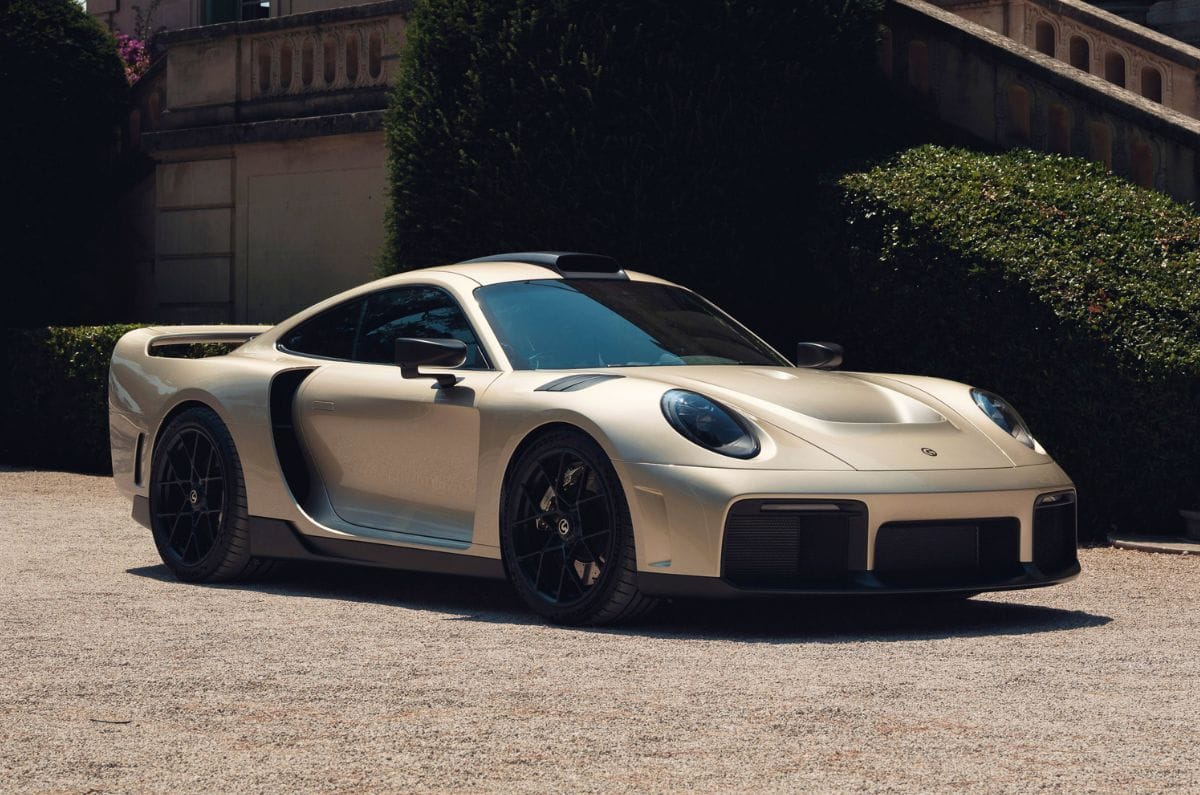
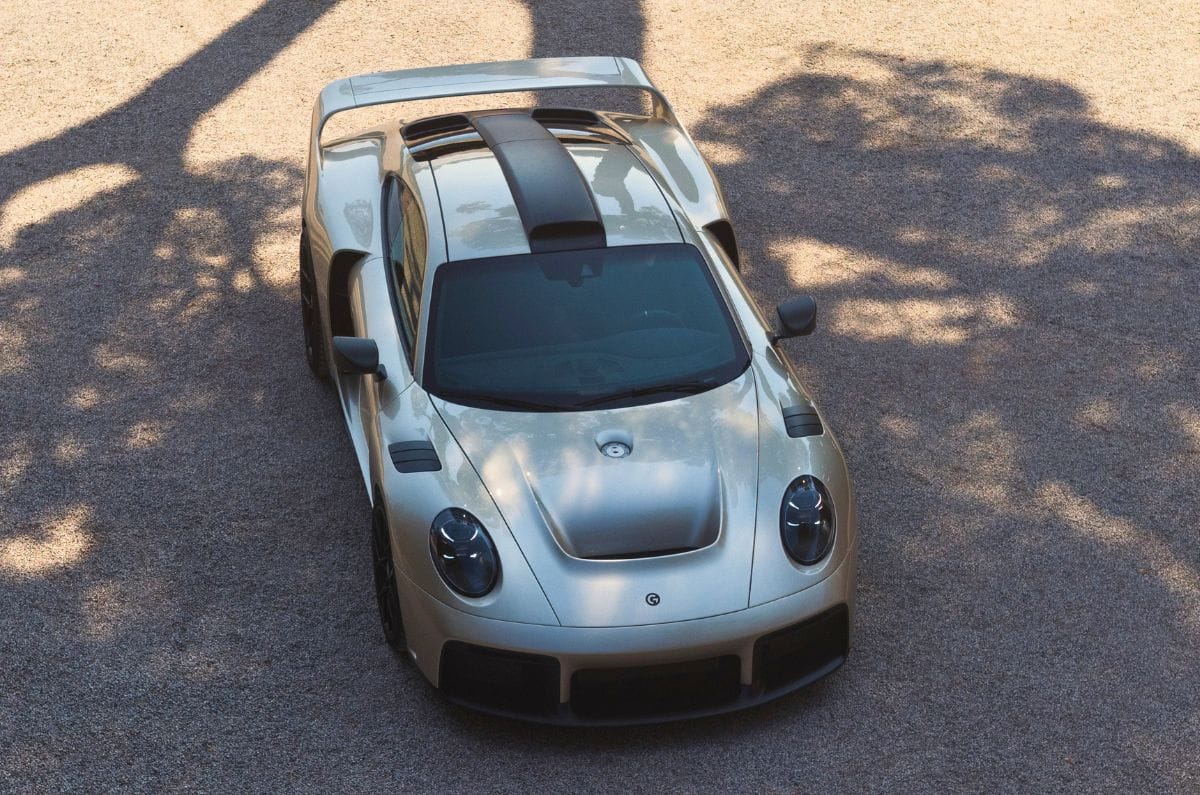
Based on the 992-series Porsche 911 Turbo S, the Marsien GT has been revealed ahead of its global premiere at the Pebble Beach Concours d’Elegance on August 13, 2026. Produced by Marc Philipp Gemballa GmbH, the Marsien GT is the company’s second limited-edition model – the first was the desert-focused Marsien of 2021. Including 40 units of the latter and another 30 examples of the grand tourer (GT), there’ll be a total of 70 Marsiens produced. The 70-unit combined production run honours the 70th anniversary of Uwe Gemballa, Marc Philipp Gemballa’s father, the marque stated.
Has a carbon-fibre exterior, active aero and custom colour options
Gets Michelin Pilot Sport Cup 2 tyres and an Akrapovic titanium exhaust system
Revised six-cylinder boxer engine outputs over 830hp and 930Nm
Marsien GT design and interior
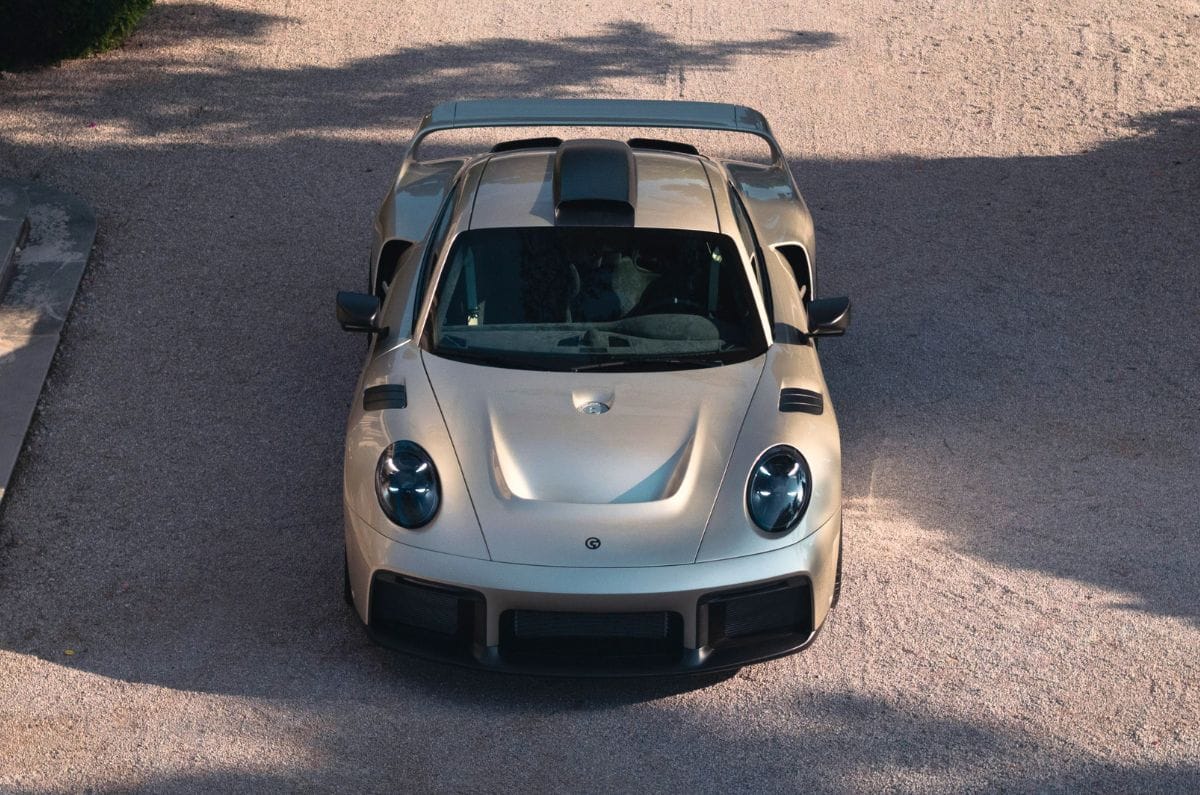
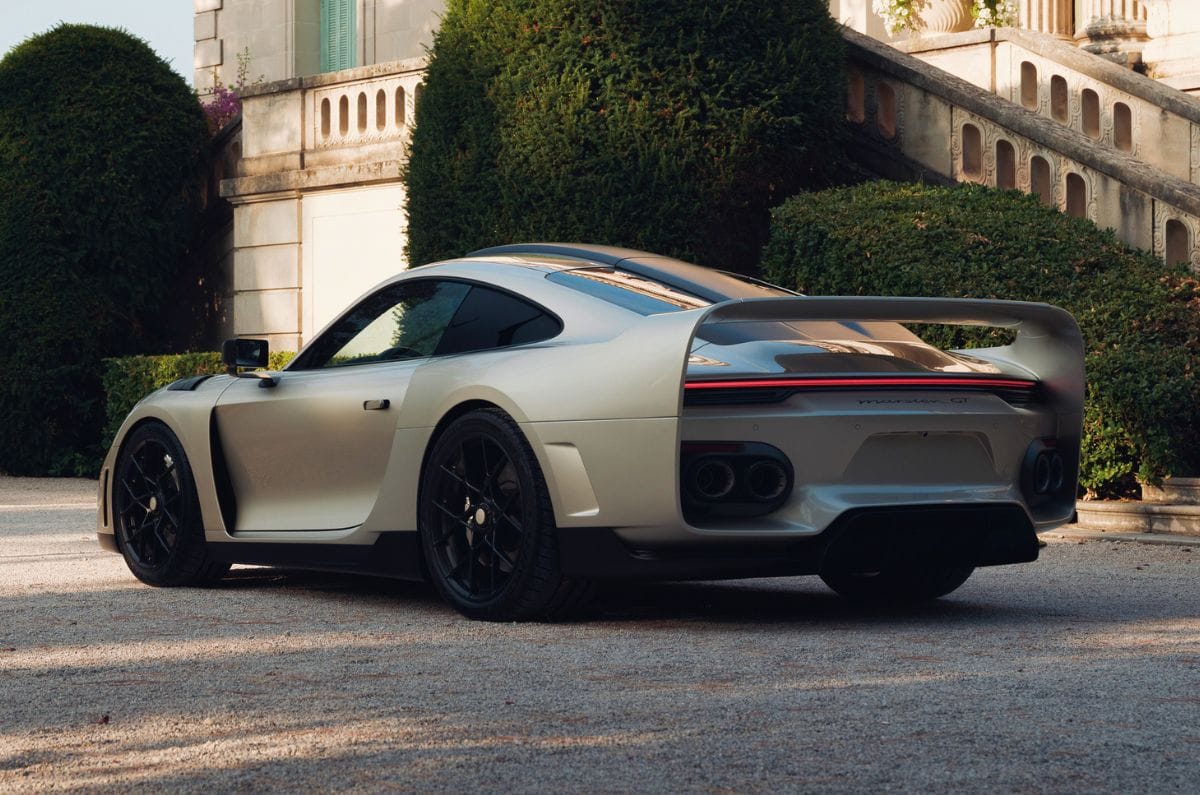
The exterior styling of the Marsien GT is the work of French automotive designer Alan Derosier. It features a one-off four-layer metallic colour called Anniversary Liquid Champagne Gold, in honour of the 70th anniversary of Uwe Gemballa. The colour is applied at a paint studio that the brand claims can “fulfil the most daring customer colour requests.” The brand also says that the Marsien GT has a full carbon-fibre exterior, consisting of over a hundred individual carbon-fibre components. The front axle-lift system has been retained from the 911 Turbo S, though.
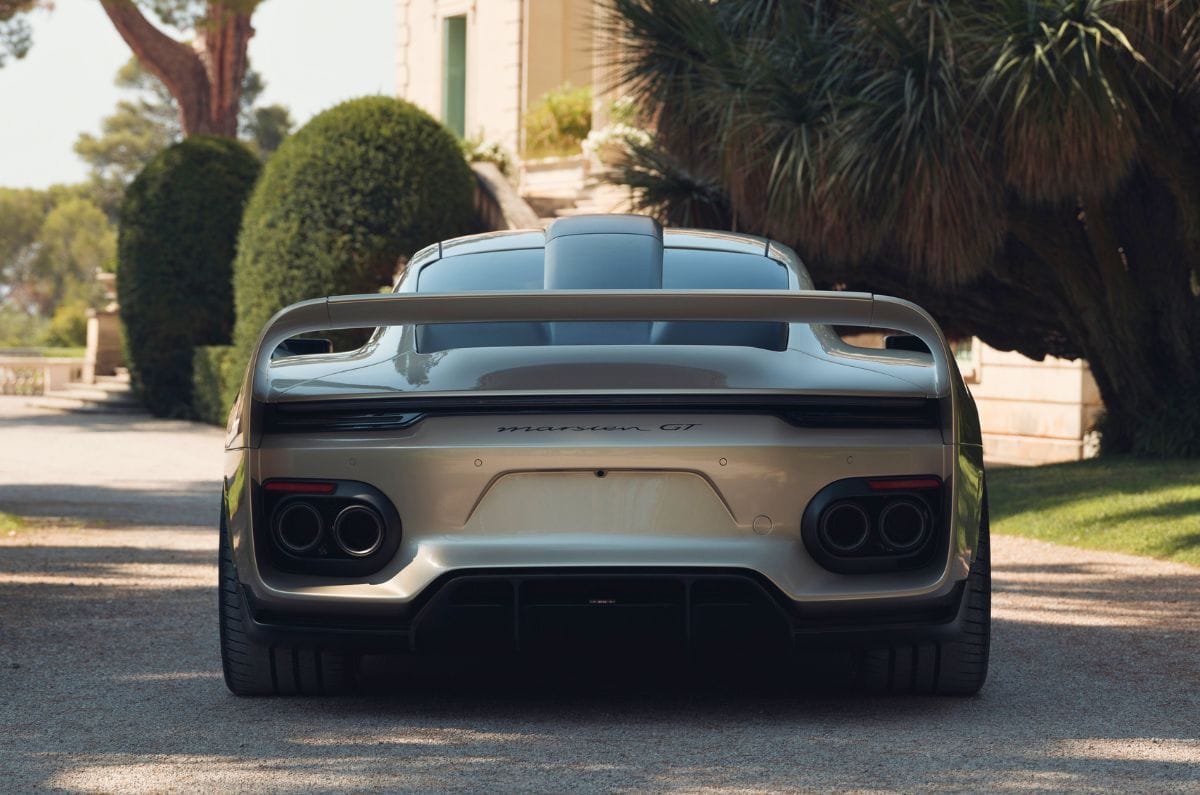
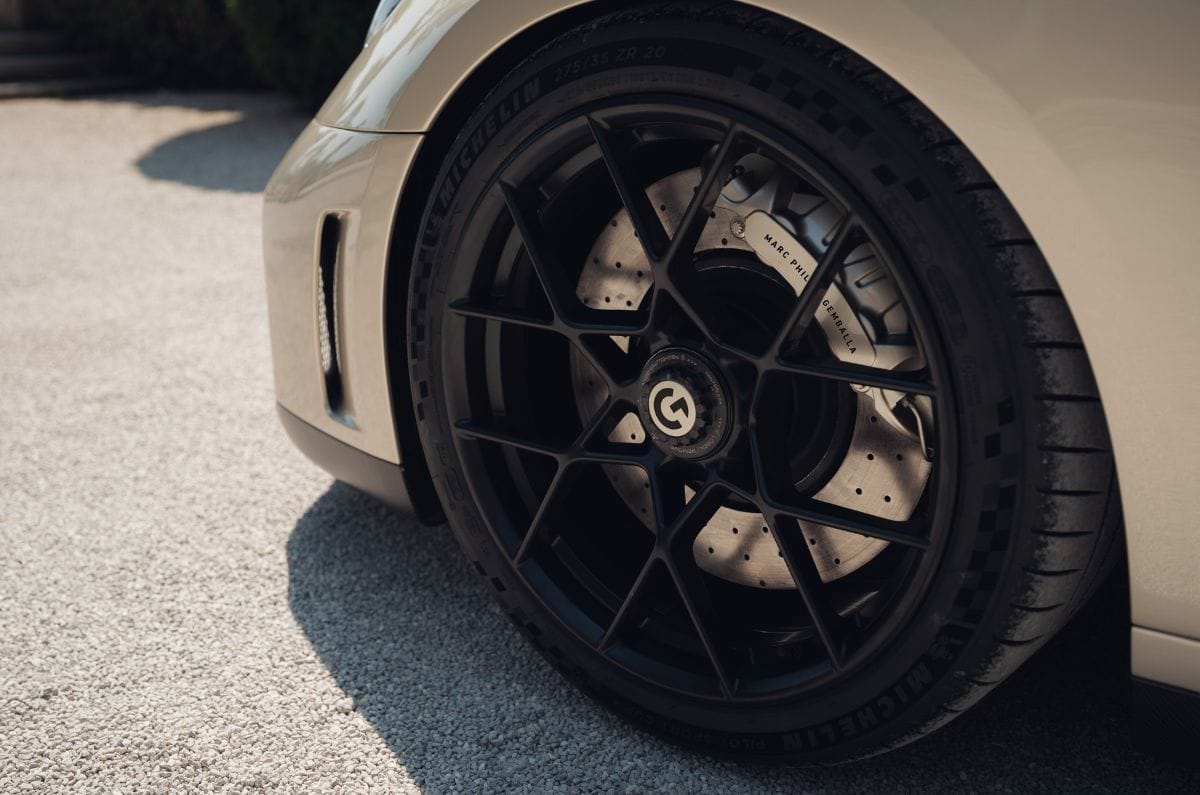
Noticeably different elements over the donor vehicle include the uniquely shaped outside rearview mirrors (ORVMs), a top-mounted scoop, active air flaps on the front fenders, ram-air intakes, side skirts with integrated air channels, and a large active rear wing whose design is reminiscent of the Porsche 959’s. Adding to these are the forged aluminium wheels wrapped in Michelin Pilot Sport Cup 2 tyres, an Akrapovic titanium exhaust system, and a carbon-fibre underfloor. All these lightweight measures ensure weight savings of 75kg over the donor vehicle, whilst the active aero features cool the brakes and reduce turbulence from the wheel arches, as per the brand.
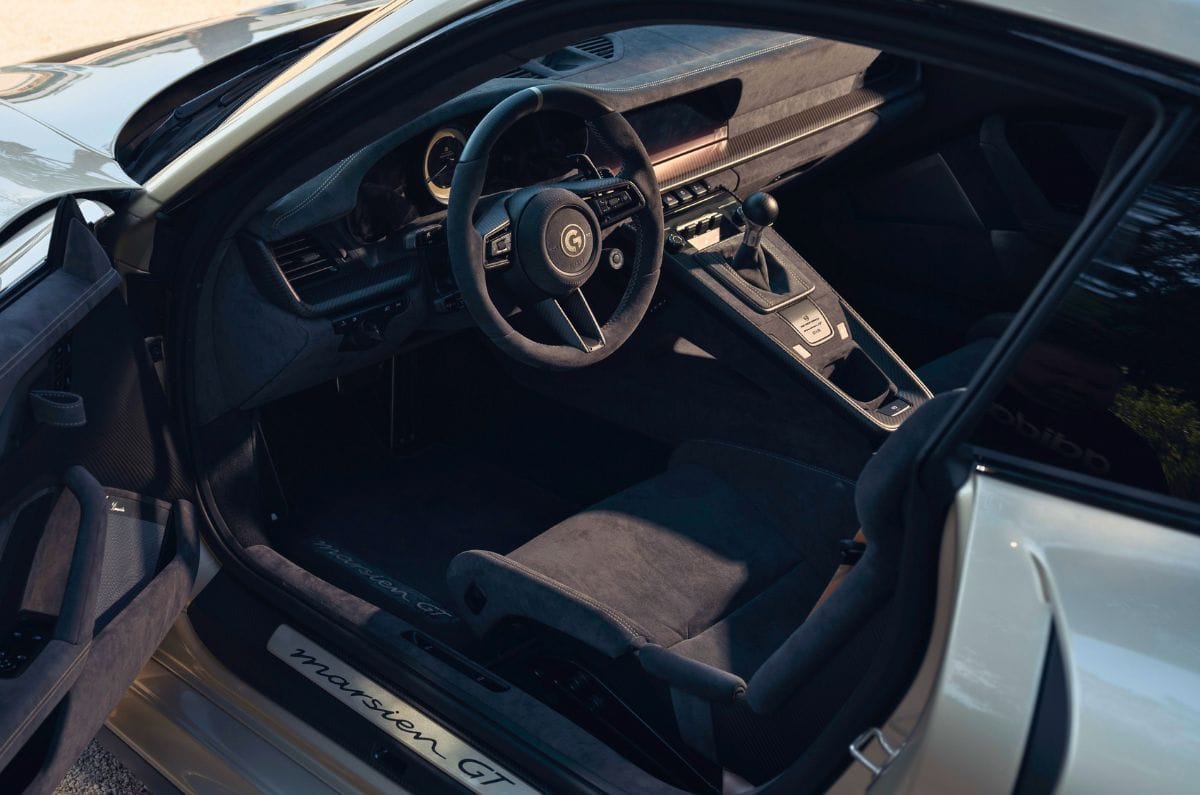
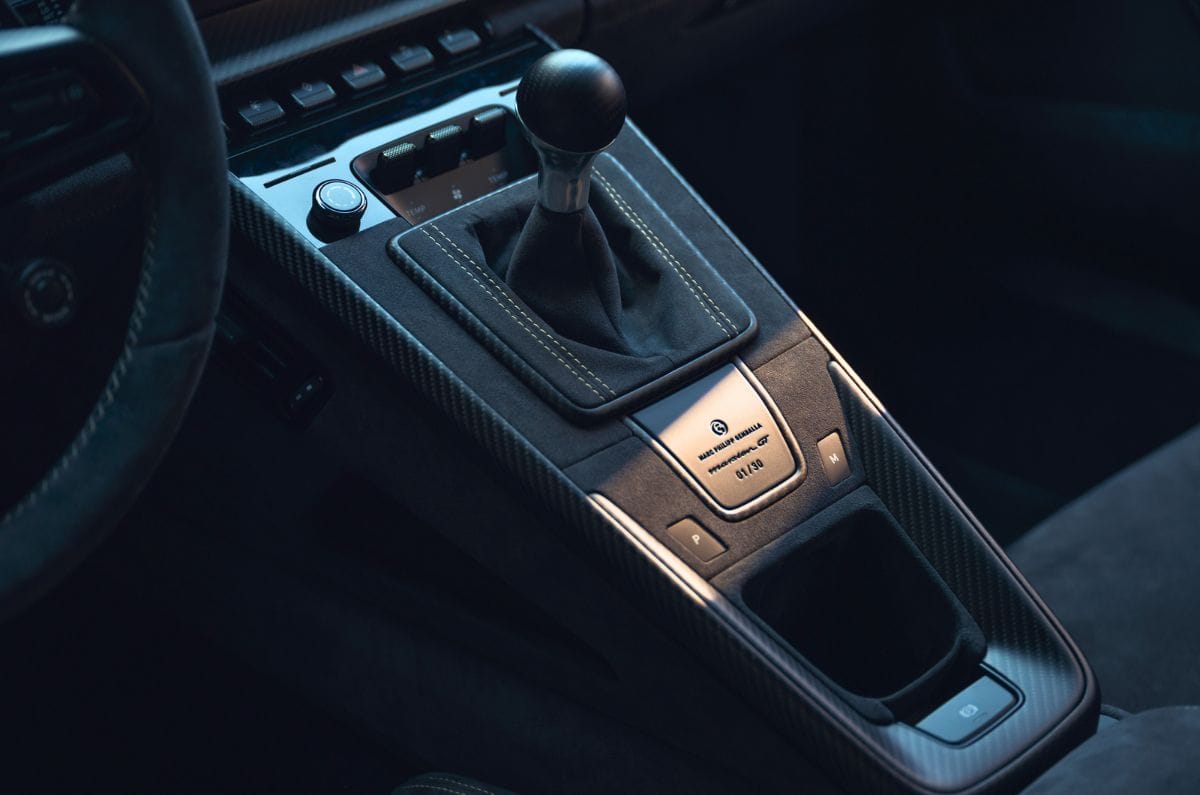
Some of the stand-out design elements inside the Marsien GT are visible along the centre console, which itself is raised over what’s seen in the standard 911 Turbo S, but there’s also an aluminium gear lever that’s inspired by the unit found in the Carrera GT. Customers can opt this gear lever to be covered in either exposed carbon or mahogany wood, instead of softer materials like leather or Alcantara. The interior also features hand-stitched brand logo on the steering wheel, headrests, armrest and floor mats.
The centre console also sports a metal badge displaying the individual production number of each vehicle. Apart from the carbon bucket seats and dark grey Alcantara, the interior of this launch-ready example features champagne accents for much of the stitching, plus on the seatbelts and within the instrument cluster. There are also matte carbon-fibre accents and an Alcantara-trimmed roll bar. According to the brand, customers can purchase a carbon-fibre interior package that adds even more exposed carbon-fibre elements.
Marsien GT powertrain and suspension
Porsche engine specialist RUF Automobile is key behind the powertrain of the Marsien GT. Uwe Gemballa and RUF Automobile have collaborated to produce powertrains for various vehicles in the 1980s, said Marc Philipp Gemballa GmbH. Compared to the 911 Turbo S, the six-cylinder boxer engine of the Marsien GT features a remapped ECU (engine control unit) and enhanced variable-geometry turbochargers – this results in a claimed output of over 830hp and 930Nm of torque. The 8-speed dual-clutch automatic transmission (DCT) has also been revised to handle the extra power and torque.
The brand is currently working on a second-stage engine upgrade option, which will take the output to over 900hp. Even in its current avatar, the Marsien GT has a claimed top speed of 330kph and a 0-97kph sprint time of 2.4 seconds. That said, the Marsien GT retains the all-wheel-drive (AWD) system of the Porsche 911 Turbo S.
However, Marc Philipp Gemballa GmbH has partnered with KW Automotive for its car’s suspension needs. It claims that the new double-wishbone front setup has been specifically developed for the Marsien GT, with its electronically controlled dampers capable of adjusting and responding to changing road conditions within just 20 milliseconds. This suspension setup ensures that the Marsien GT offers precise control without sacrificing ride comfort that’s expected of a grand tourer, according to the brand.
Marsien GT price
The Marc Philipp Gemballa Marsien GT will be making its world premiere during the upcoming 2026 Monterey Car Week at the Pebble Beach Concours d‘Elegance in California, USA. Production will begin in 2027, with first customer deliveries commencing later the same year. The starting price of the Marsien GT will be EUR 770,000, not including the cost of the donor vehicle, i.e., the 992 Porsche 911 Turbo S. For reference, the latter starts at EUR 271,000 in Germany.
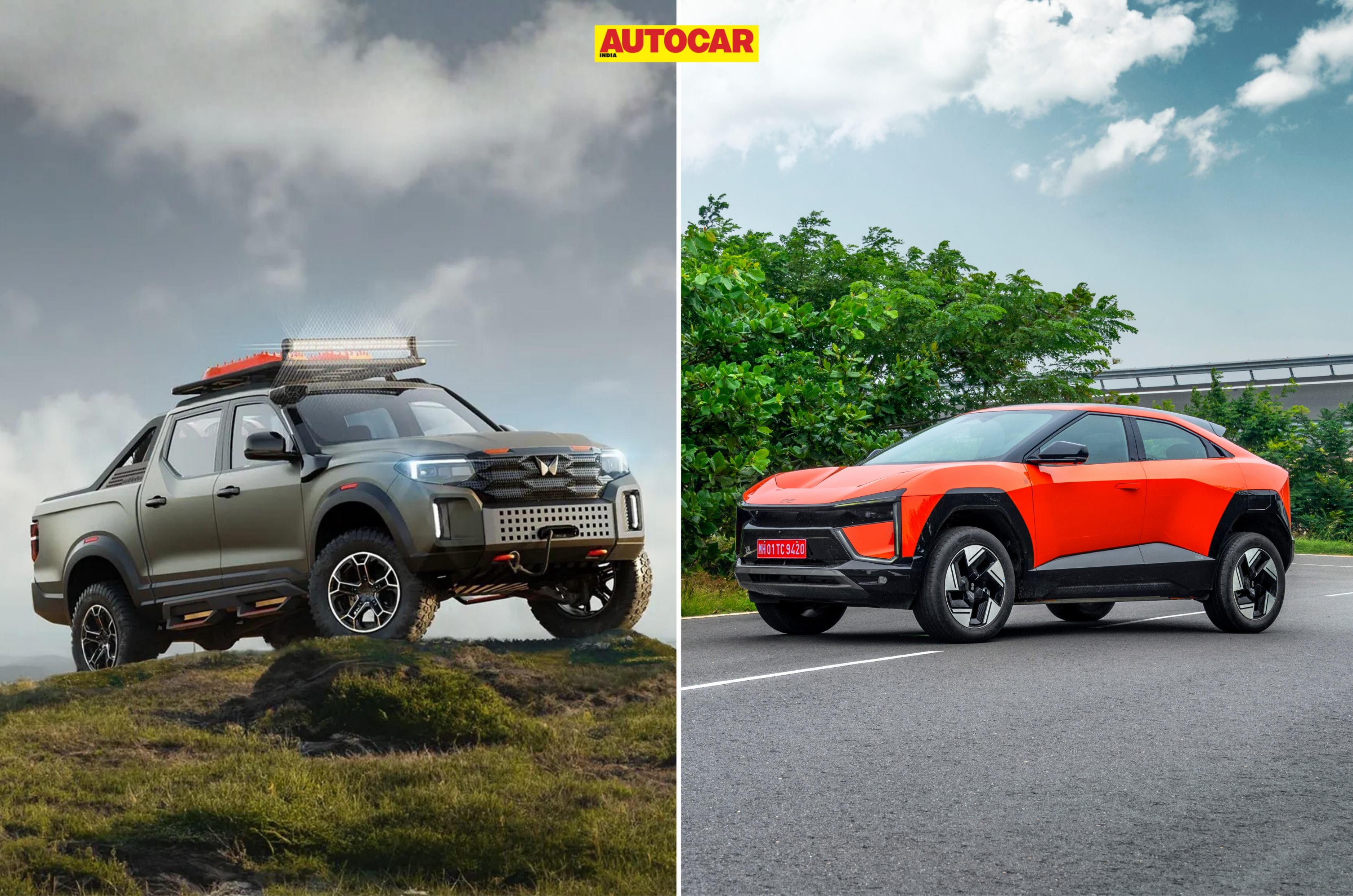
Over the past few years, Mahindra celebrated Independence Day by debuting all-new models (Thar Roxx and XUV700), concept cars that preview upcoming models (Vision S, Vision T, Thar.e, and more), or even fresh platforms and technologies (Nu_IQ and INGLO). The tradition will continue in 2026, with Mahindra set to host a blowout on August 15. Here’s what you can expect.
Closer-to-production-spec Mahindra Scorpio N pickup truck
Mahindra’s Hilux rival is likely just days away from its unveil
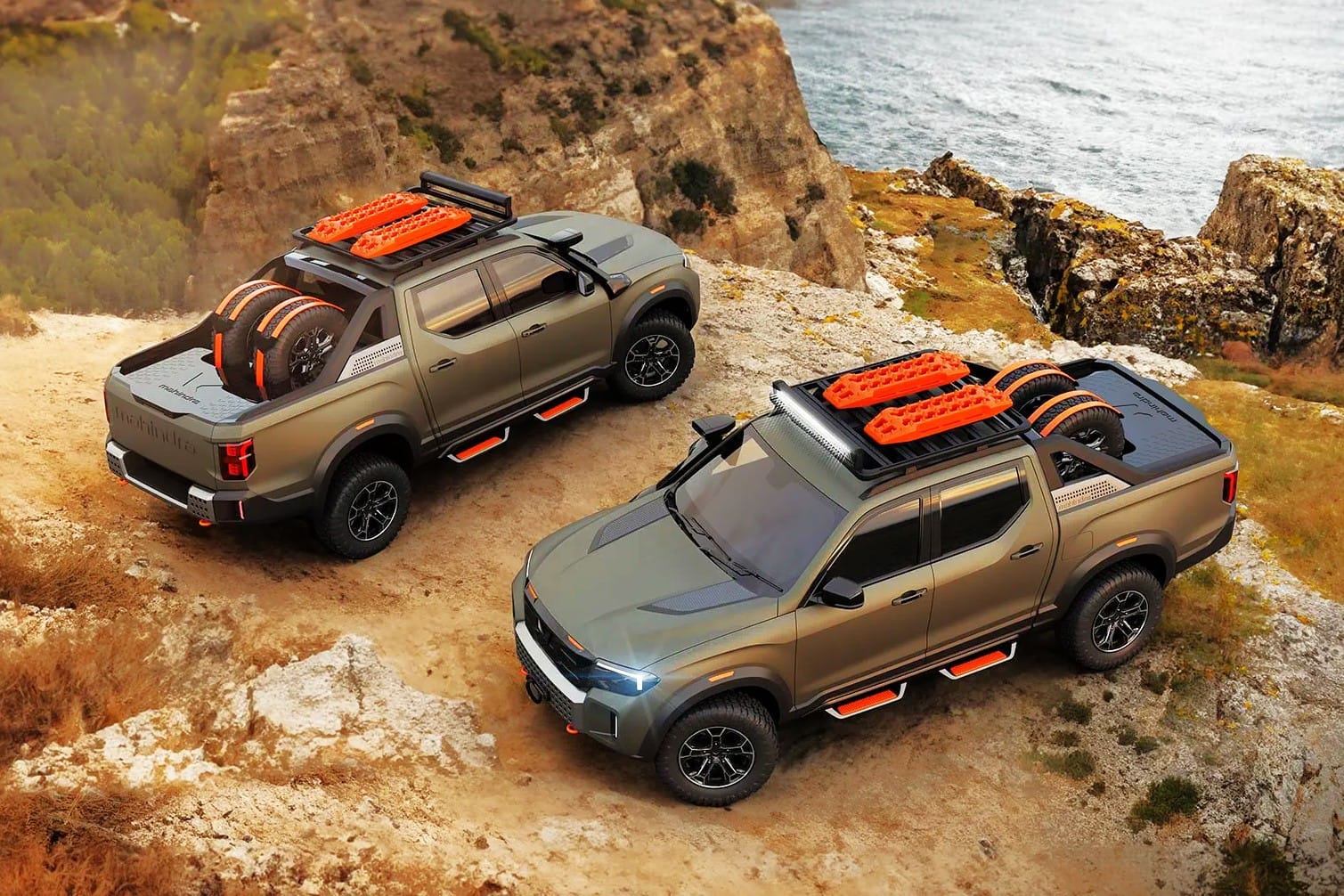
First previewed at Mahindra’s 2023 Independence Day event by way of the Global Pik Up Concept, the Scorpio N pickup truck is expected to finally break cover in a closer-to-production guise at this year’s celebration. Mahindra has been testing the Scorpio N pickup on Indian roads for quite some time, with prototypes sporting a single-cab configuration and an extended load bed. It remains to be seen if the final versions will sport a similar body style.
Credit: vashusinghyt via Instagram
Styling elements for the pickup truck are anticipated to largely mirror those of the Scorpio N SUV, possibly with more rugged cues for differentiation. Under the bonnet, we expect the Scorpio N pickup to retain the SUV’s 203hp 2.0-litre direct-injection turbo-petrol and 175hp 2.2-litre diesel engines, with 6-speed manual and 6-speed automatic gearbox options. 4WD is expected to be on offer as well.
The Scorpio N pickup is likely to rival the Toyota Hilux, which has done well to grow the popularity of the lifestyle pickup truck segment in India and make it a more lucrative space – one where Mahindra’s formula of tough, off-road-capable ladder-frame offerings fits quite well.
Mahindra BE 6 Sporteq variant
Gets triple-display setup and more conventional dashboard design
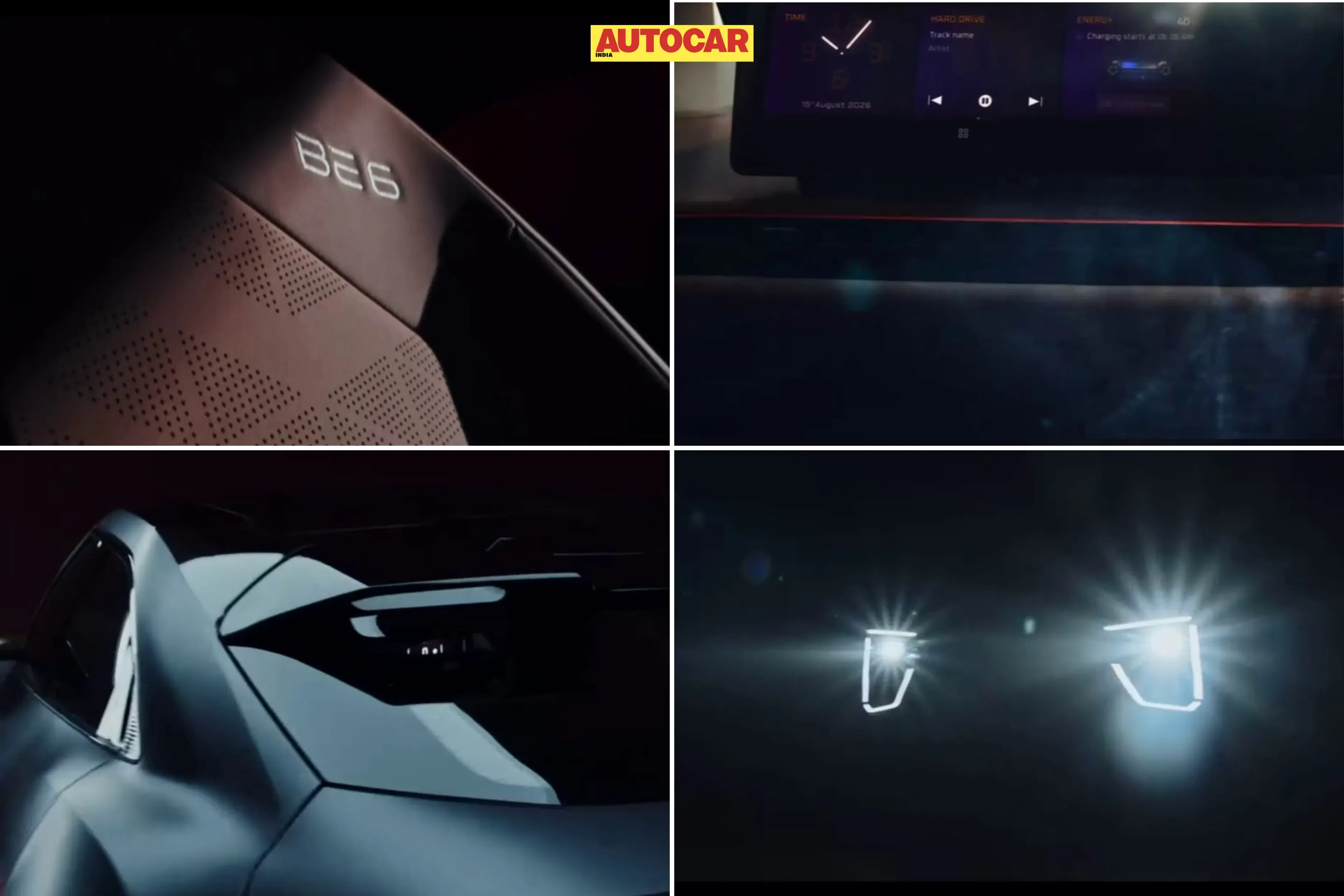
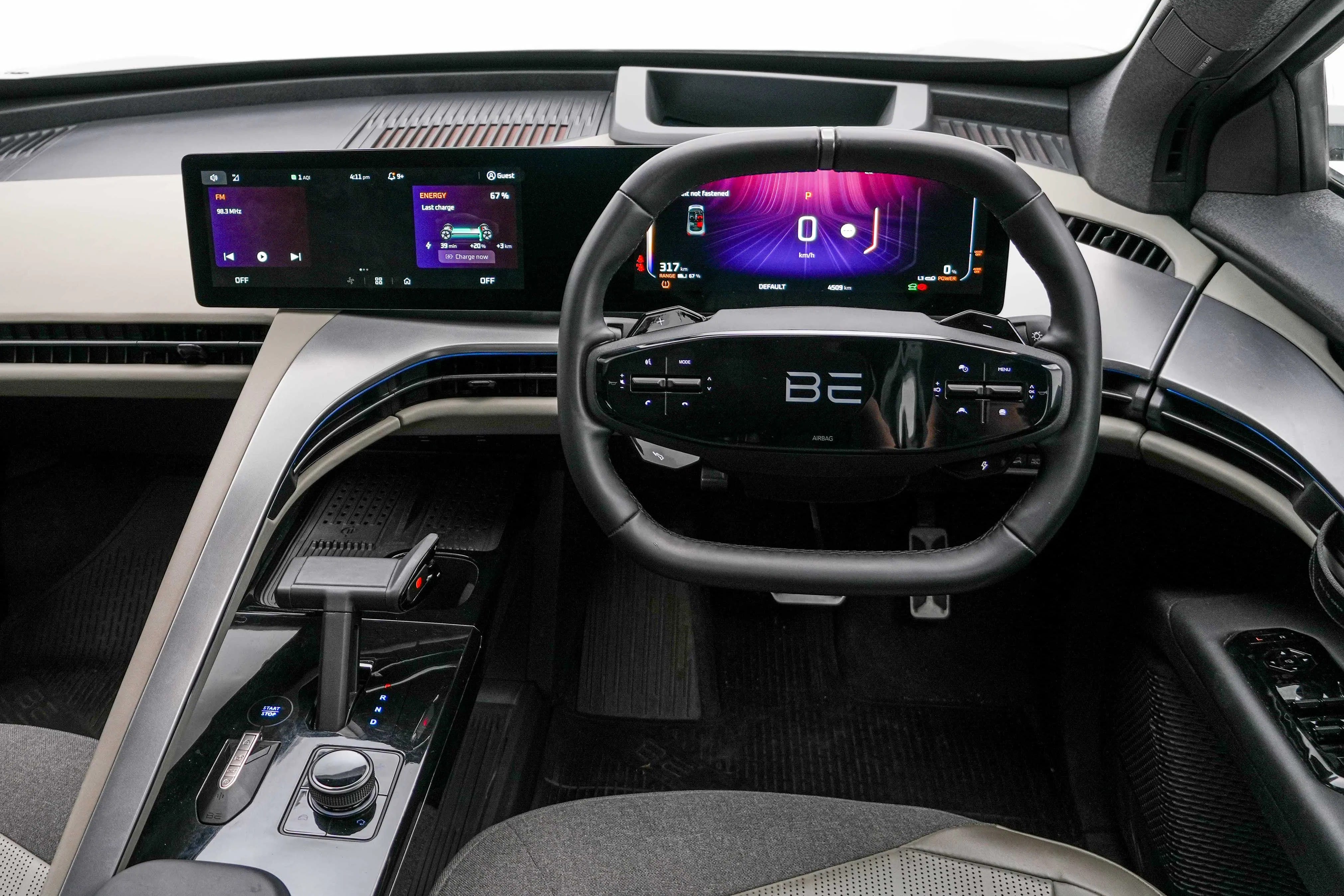
Mahindra will debut a new Sporteq variant of the BE 6 electric SUV on August 15. The BE 6 Sporteq’s key update is the addition of a passenger display on the inside, forming a triple-screen setup like those of the larger XEV 9e and XEV 9S. It will also sport a redesigned dashboard that eschews the large divider between the front seats, which was an ergonomic flaw that restricted access to the wireless charging pad and USB Type-C ports for the co-driver, and did not leave enough space for a second cupholder.
Current Mahindra BE 6 dashboard. Image used for representation only.
In addition to the aforementioned updates, the BE 6 Sporteq may offer new interior upholstery and colour options. Since the Sporteq is likely to be positioned as the new top-spec BE 6 variant, expect it to come with the 79kWh, rear-motor powertrain outputting 286hp and 380Nm, and claiming an MIDC range of 683km. As for pricing, the BE 6 Sporteq is anticipated to command a slight premium over the current top-spec Pack Three 79kWh variant, which costs Rs 26.9 lakh (ex-showroom).
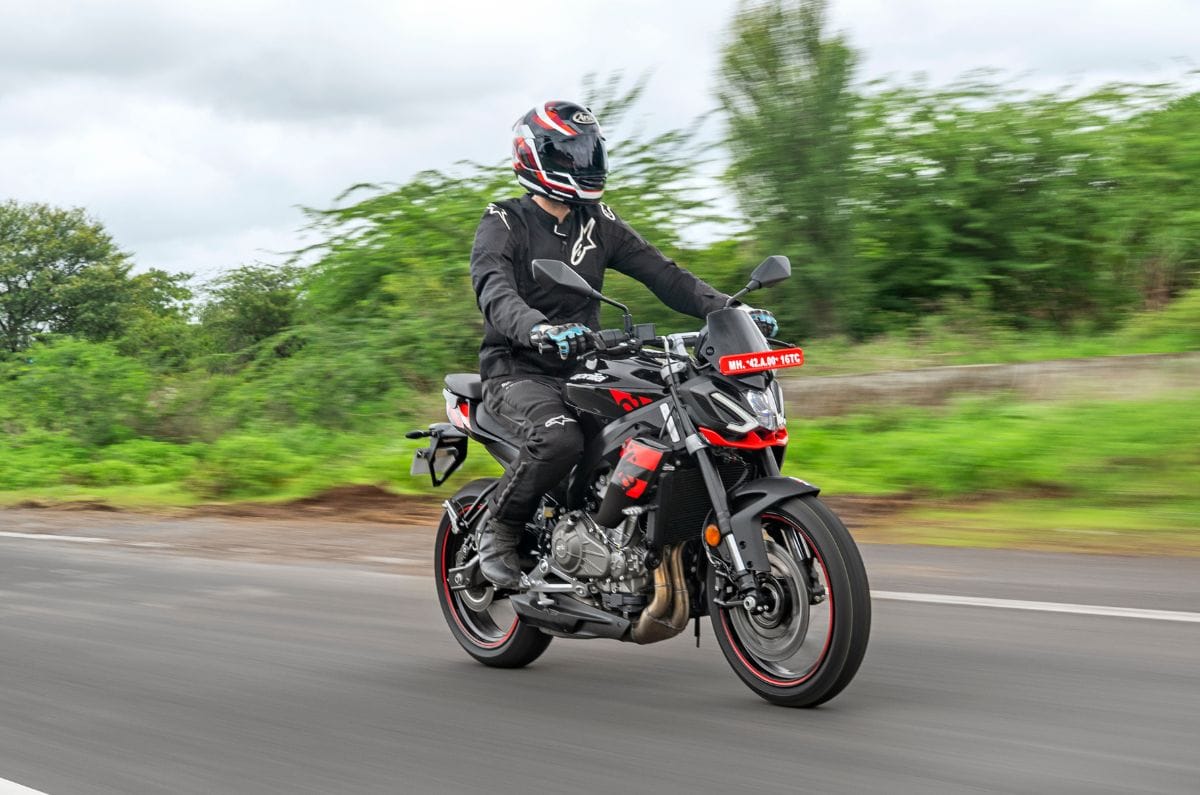
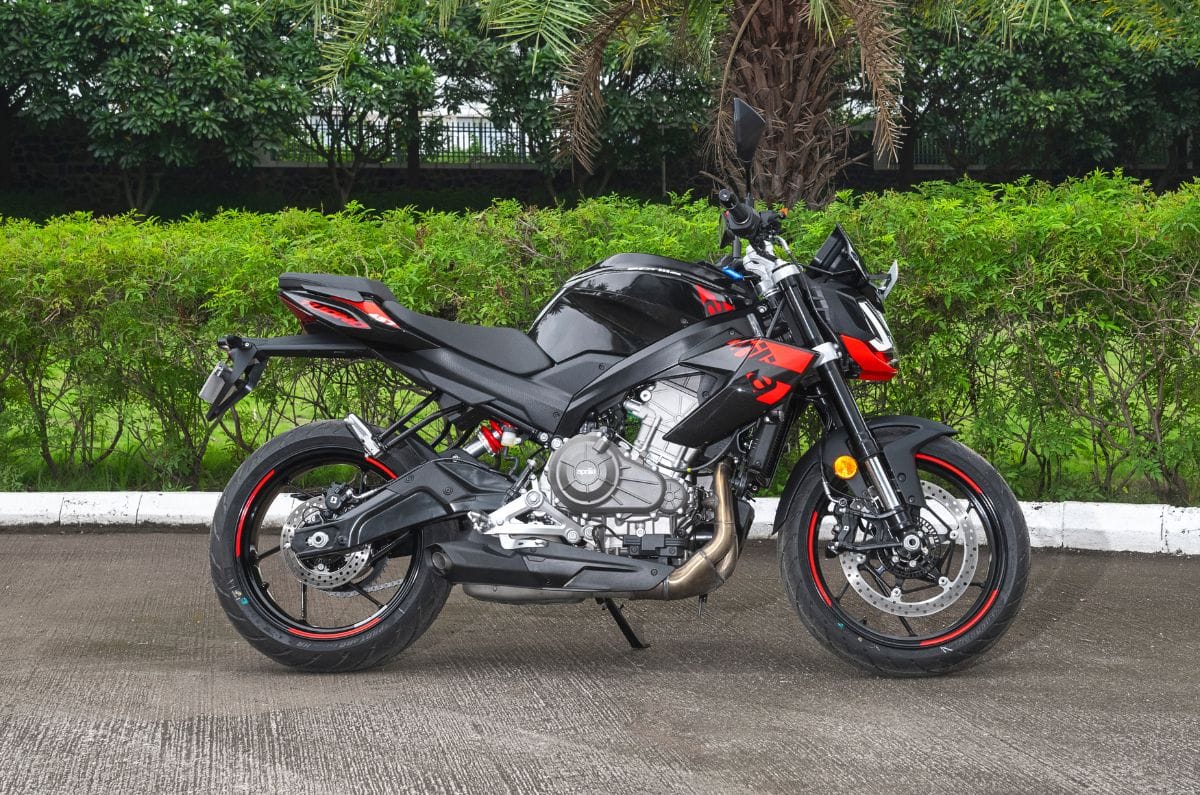
When you hear the words Special Edition, the natural assumption is that this is the special version of a normal bike. Aprilia thinks otherwise, and unlike what the name suggests, the new Special Edition is the only Tuono 457 you can buy in India today.
Tuono 457 Special Edition Comfort – 7/10
The changes are all aimed at making the Tuono a little easier to live with. When first launched, the Tuono was quite literally the naked version of the racy RS 457 with the only differences being in how it looked and the fact that it had a flat handlebar instead of clip-ons. The result was a high capable bike but one that was unforgiving in terms of comfort.
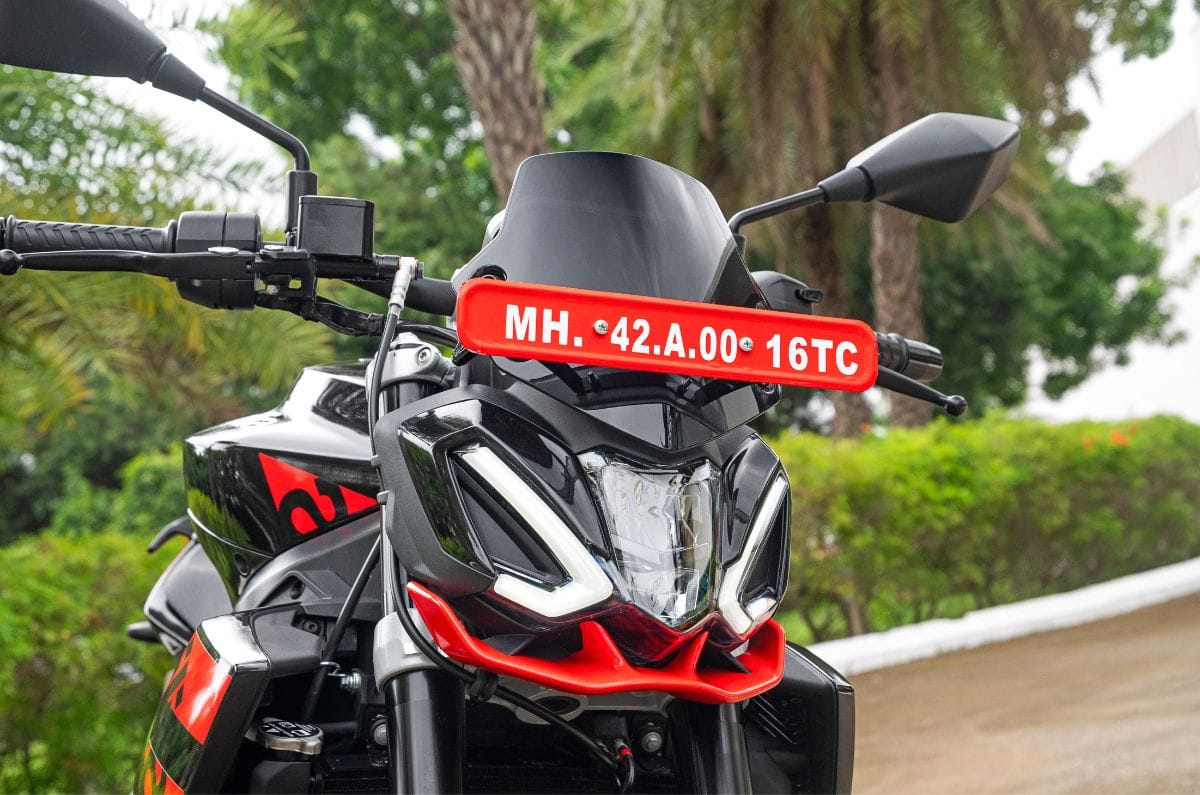
Fly screen is now standard fit
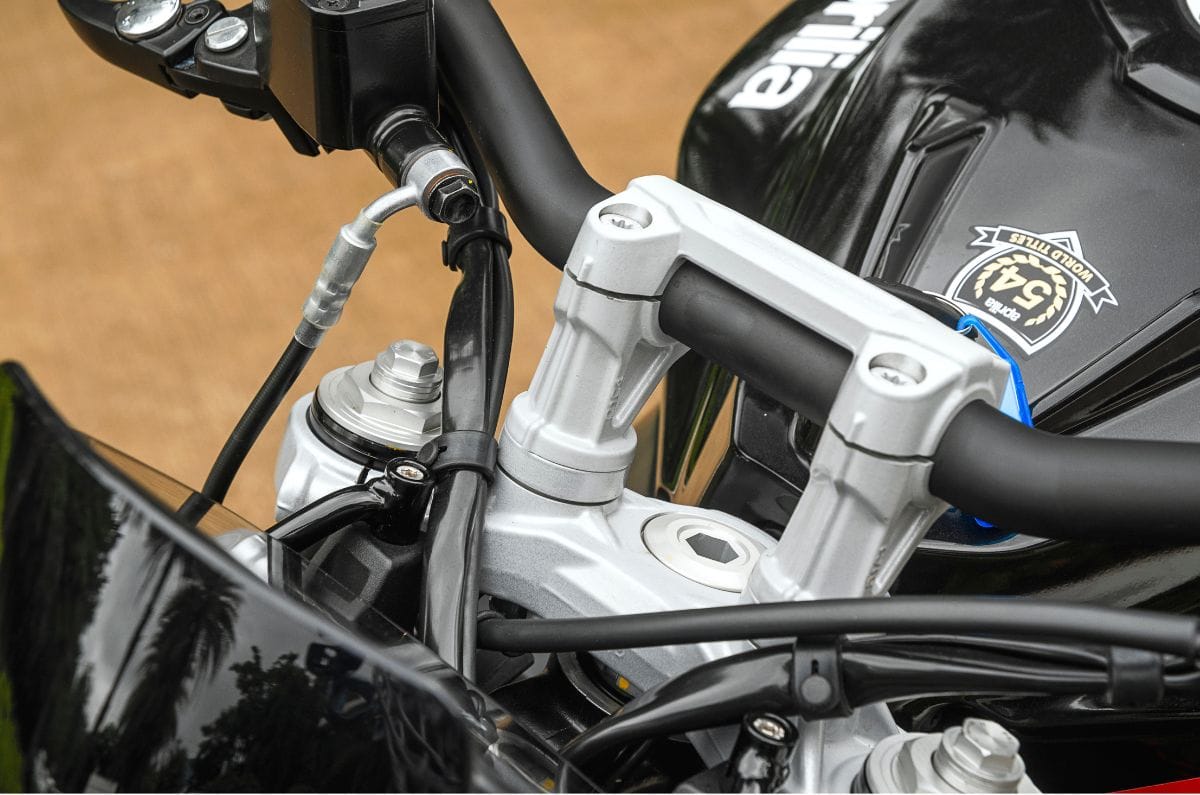
The Special Edition aims to make the Tuono more inviting with tweaks made to the riding position as well as the suspension. The handlebar is the same, but a new riser raises it by about 10mm. While the Tuono used to have the same seats as the RS 457, the rider seat now has additional padding which again raises the seat height by about 10mm.
Same handlebar as before but with taller risers
These two changes may sound marginal, but they have a noticeable effect. At 6’1”, I used to find the Tuono uncomfortably cramped, with my knees feeling locked in place by the tank and the handlebar aggressively low. The new setup improves things and while this is still a compact riding position with high-set footpegs, it’s not punishingly so – I do appreciate the difference it makes to comfort after an hour of riding.
Tuono 457 Special Edition Suspension and Handling – 9/10
Monoshock, adjustable preload, 130 mm wheel travel
Front Tyre Size
110/70 – 17
Rear Tyre Size
150/60 – 17
Brake type
Front – Disc, Rear – Disc
The other change comes in the form of retuned suspension with a focus on comfort. Wheel travel is unchanged, but the compression/rebound damping and spring rates have been reduced a little at the front while the rear gets reduced spring rates as well as a little less compression damping – rebound damping is similar to before. Aprilia stresses that while the suspension is softer, it will not bottom out under hard riding conditions.
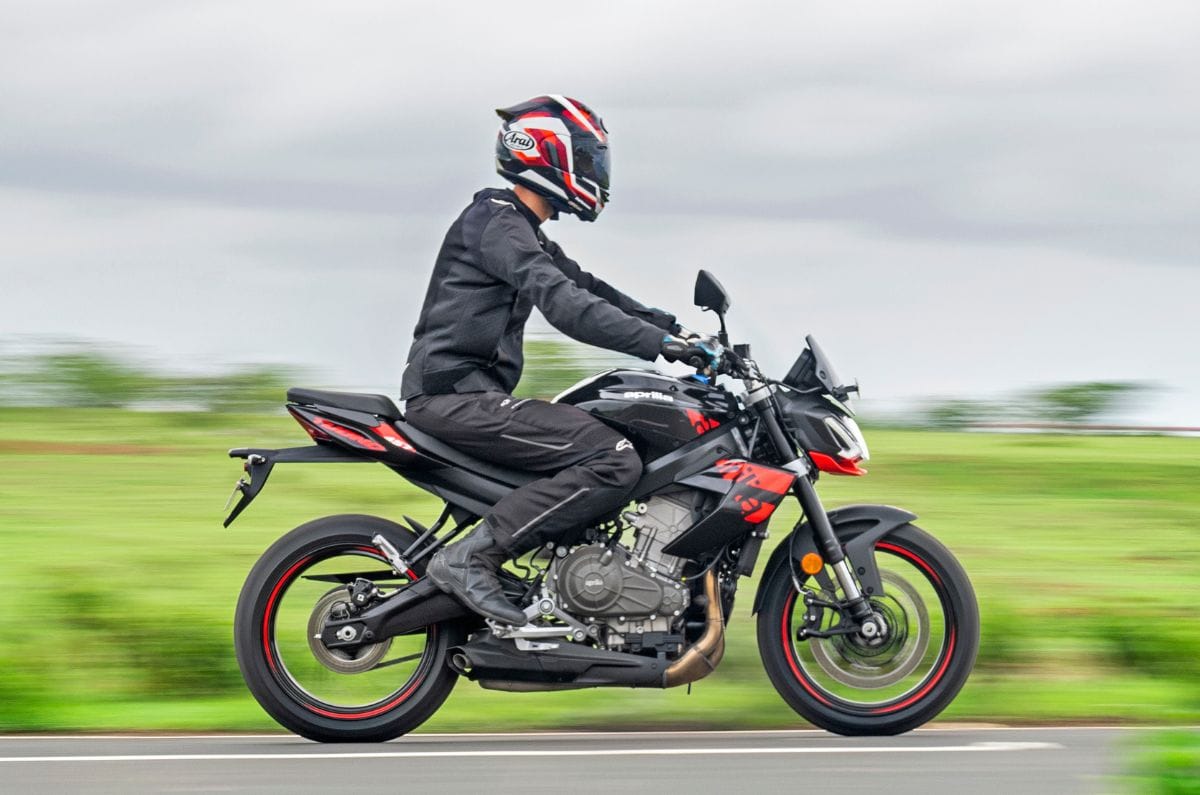
The riding position is still sporty but now noticeably more comfortable
Specifications
Values
Fuel Tank Size
12.7 L
Kerb Weight
175 kg
From what I could tell, the bike does feel a little softer and more absorptive in the initial travel, but we faced an unusual difficulty in making a clear verdict – the roads around Baramati where we were riding it were shockingly good! You could tell that this was still a very agile and reactive motorcycle with a taut feel. I’m quite confident that its superb handling skills are still intact and the only difference may be seen when being pushed to the limit at the race track – something we look forward to evaluating soon. At the same time, I don’t expect this to be a plush and comfortable bike over Mumbai’s bumpy concrete roads, but it should be a little less harsh than before.
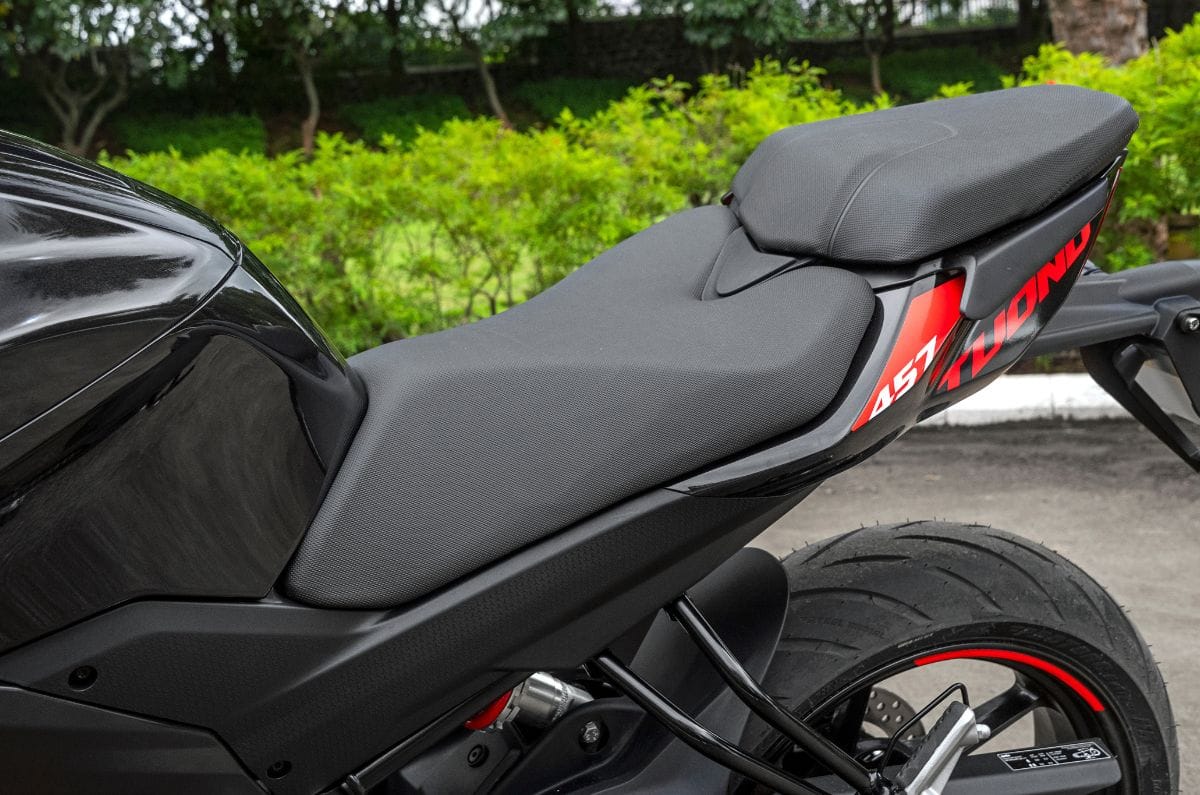
Rider seat gets more padding for better comfort
The other changes on the Tuono are largely visual. It now gets a fly screen as standard which adds to the look but doesn’t transform its wind protection capabilities in any significant way. There’s also a new adjustable brake lever and a smart shade of black that I think makes the Tuono 457 a better looking bike.
Tuono 457 Special Edition Engine and performance – 9/10
The 457cc twin cylinder engine has strong performance and makes a great sound
Specifications
Values
Engine Displacement
457 cc
Max Engine Power
47.6 hp @ 9400 rpm
Max Engine Torque
43.5 Nm @ 6700 rpm
Number of Gears
6
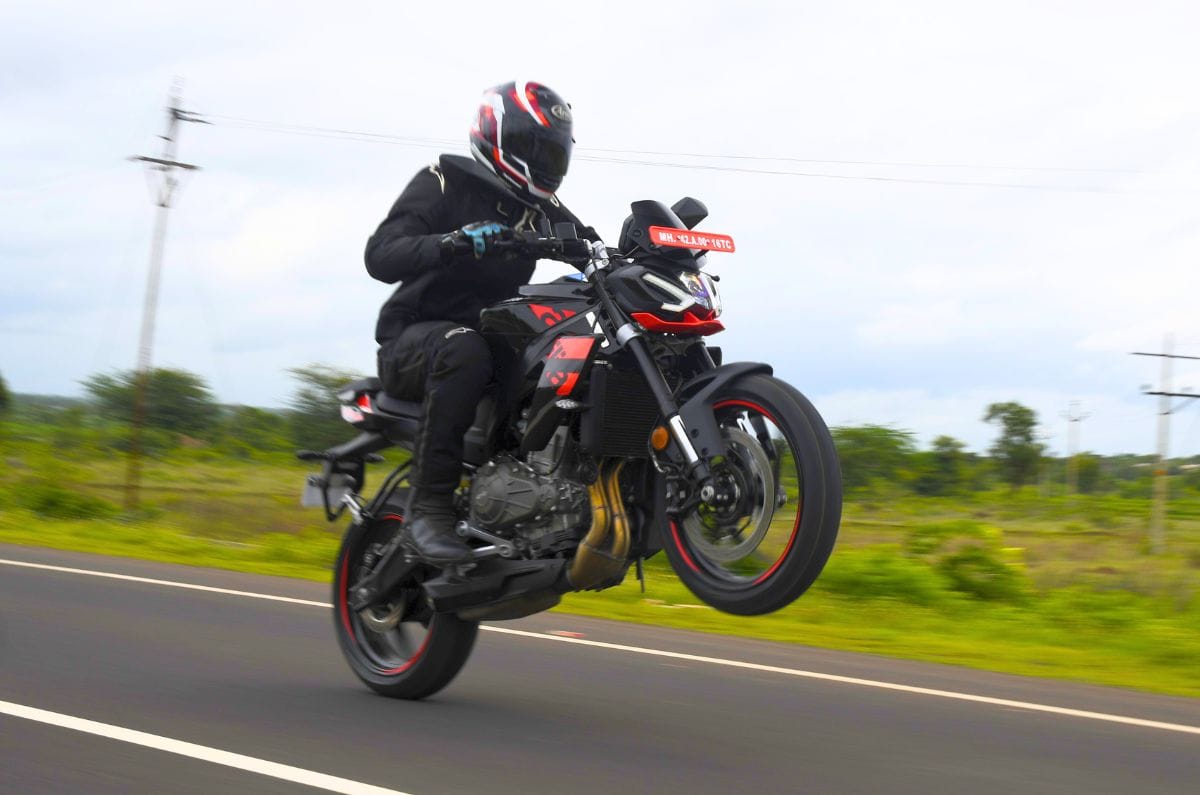
The rest remains the same, including the absolutely delectable 457cc parallel twin engine that makes a superb sound and has solid punch. The engine doesn’t have a great top end, but the mid range is strong enough to pull clutch up wheelies in second gear in a way that no other locally manufactured bike can match. Highway speeds are smooth and effortless and the bike can sit at 130 or higher without stress. This really would make for a great engine in a Tuareg 457 ADV whenever that finally becomes a reality. The company also seems to be ironing out the significant reliability concerns that plagued the first RS 457 models and the number of customer complaints has reduced.
Suspension is now a little softer while the braking set up is the same
Braking hardware is the same as well and it is good enough for road use. It’s only under repeated hard braking conditions that you will want to upgrade to better brake pads at the very least. The one missing feature is a bi-directional quickshifter which can be bought for an additional Rs 21,000.
Tuono 457 Special Edition Price and Conclusion – 8/10
The Aprilia Tuono 457’s Rs 4 lakh ex-showroom price is suddenly a lot more appealing than it used to be. That’s not because Aprilia lowered it in any way, but simply because they haven’t raised it after the GST rate hike. While its chief rival the KTM 390 Duke used to cost around Rs 1 lakh less, that difference is now just Rs 50,000 and that suddenly puts the Tuono in a new light.
It is still a more expensive bike – both to buy and run – and the dealer network is far more limited as well. However, as far as riding thrills go, no rival comes close to the ‘scaled down big bike’ feel this bike offers and with these changes, it makes for a much more appealing package at this price.
The government has ruled out blending ethanol with diesel, as it sharply lowers the fuel’s flash point (the temperature at which its vapours can ignite) and fails to meet the required safety standards. Public-sector oil marketing companies (OMCs) tested ethanol-diesel blends at their research and development centres, in association with accredited laboratories and automobile manufacturers, Minister of State for Petroleum and Natural Gas Suresh Gopi said.
This comes after the government seeks to blend ethanol with other fuels beyond petrol. Currently, E20 and E85 fuels, which contain 20 percent and 85 percent ethanol respectively, are available in the country.
Issues in ethanol-diesel blending
Speaking of flash points, ethanol has a flash point of just 12 to 13deg C, compared with the minimum 35deg C requirement for diesel. This puts the two fuels in different petroleum safety classes, making both their storage and transportation difficult. Even with proprietary binders, OEMs have generally been reluctant to go beyond a 5 percent ethanol blend before combustion issues emerged.
For years, blending ethanol with diesel has been a challenge as the chemistry refuses to cooperate. Ethanol is a two-carbon alcohol with a polar structure, meaning it doesn’t like to mix with the oily consistency of diesel. As a result, ethanol and diesel can separate when stored together unless chemical binders are used. These binders, however, can be expensive.
सोशल मीडिया पर जंगली हाथी का एक हैरान कर देने वाला वीडियो सामने आया है, जिसमें वह कीचड़ से भरे धान के खेत में लोगों के बीच अचानक आक्रामक होता नजर आ रहा है। घुटनों तक पानी और दलदल के बावजूद हाथी जिस तेजी से आगे बढ़ता है, उसे देखकर मौके पर मौजूद लोगों में अफरा-तफरी मच जाती है। वीडियो में कुछ लोग हाथी को खेत से दूर भगाने के लिए टॉर्च की रोशनी का इस्तेमाल करते दिखाई देते हैं। शुरुआत में हाथी उनके बीच से आगे बढ़ता नजर आता है, लेकिन कुछ ही देर में वह अचानक लोगों की तरफ दौड़ पड़ता है।
हाथी को अपनी ओर आता देख वहां मौजूद लोग इधर-उधर भागने लगते हैं। इस दौरान कुछ लोग गिरते हुए भी नजर आते हैं। वीडियो ने जंगली हाथियों के बेहद शक्तिशाली और तेज होने के साथ-साथ उनके करीब जाने या उन्हें डराने के खतरे को लेकर एक बार फिर चर्चा छेड़ दी है।
टॉर्च की रोशनी दिखाते ही दौड़ा हाथी
वीडियो में हाथी पानी और कीचड़ से भरे खेत में बेहद तेजी से आगे बढ़ता दिखता है। मुश्किल जमीन के बावजूद उसकी रफ्तार देखकर लोग भी हैरान रह गए। कुछ लोग लगातार टॉर्च लहराकर हाथी को डराने की कोशिश कर रहे थे। इसी दौरान हाथी अचानक लोगों की तरफ तेजी से बढ़ा। हाथी को अपनी ओर आता देखकर वहां मौजूद लोगों में अफरा-तफरी मच गई और वे जान बचाकर भागने लगे। इस भगदड़ में कुछ लोग जमीन पर गिरते हुए भी दिखाई दिए।
उत्तराखंड के अधिकारी ने बताया हाथी की रफ्तार का राज
यह वीडियो उत्तराखंड के मुख्यमंत्री के विशेष सचिव डॉ. पीएम धकाते ने X पर साझा किया। उन्होंने लोगों को आगाह करते हुए बताया कि हाथी को धीमा समझना बेहद खतरनाक हो सकता है, खासकर कीचड़ भरे इलाके में।
उन्होंने समझाया कि हाथियों के चौड़े पंजे उनका वजन बड़े क्षेत्र में बांट देते हैं। इसी वजह से वे ऐसे दलदली और कीचड़ वाले इलाकों में भी उम्मीद से कहीं अधिक तेजी से आगे बढ़ सकते हैं।
An elephant looks slow until it isn’t.
In knee-deep paddy mud where a person can barely walk, an elephant’s broad feet spread its heavy weight effortlessly. They accelerate to high speed in seconds. Safe distance is an illusion. Shouting, waving torches, or throwing… pic.twitter.com/SGyWWki5Ip
डॉ. धकाते ने चेतावनी दी कि हाथी को डराने या घेरने की कोशिश स्थिति को और खतरनाक बना सकती है। अगर हाथी खुद को खतरे में या चारों तरफ से घिरा हुआ महसूस करता है, तो वह पीछे हटने के बजाय हमला कर सकता है। उन्होंने लोगों को सलाह दी कि जंगल में हाथी दिखाई देने पर उससे पर्याप्त दूरी बनाए रखें और उसे डराने के लिए चिल्लाने, टॉर्च लहराने या पटाखे चलाने जैसी हरकतों से बचें।
‘हाथी को निकलने का रास्ता दें’
अधिकारी ने लोगों को खास तौर पर हाथी का रास्ता रोकने या उसे चारों ओर से घेरने से बचने की सलाह दी। उनके मुताबिक, जंगली हाथी को हमेशा पीछे हटने और सुरक्षित दिशा में जाने के लिए खुला रास्ता मिलना चाहिए। वीडियो को श्याम उरांव और संतोष लकड़ा के नाम से क्रेडिट किया गया है। यह घटना एक बार फिर दिखाती है कि जंगली हाथियों को करीब से भगाने या डराने की कोशिश कितनी जोखिम भरी हो सकती है। ऐसे मामलों में दूरी बनाए रखना और हाथी को शांतिपूर्वक निकलने देना ही सबसे सुरक्षित तरीका है।
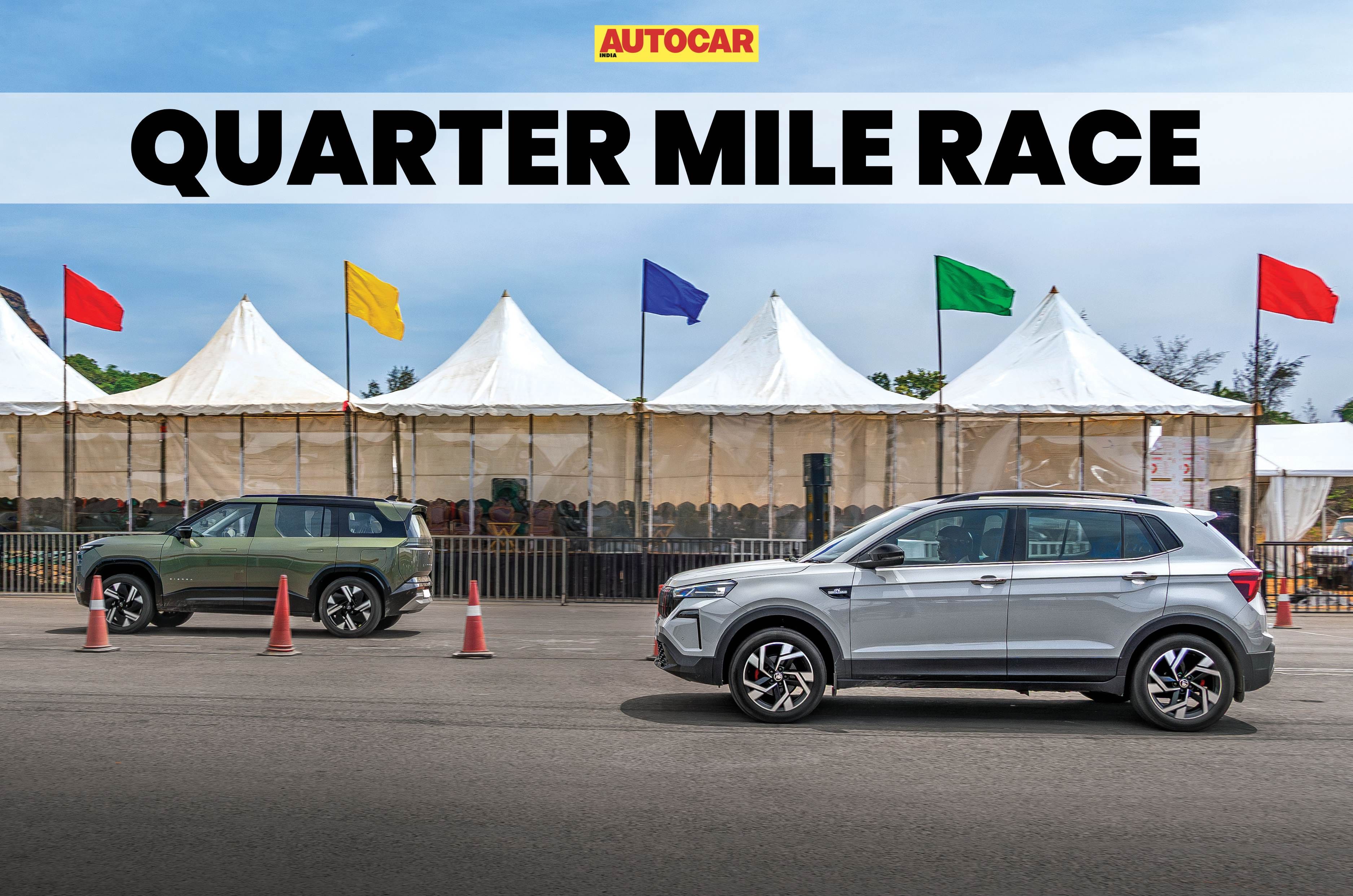
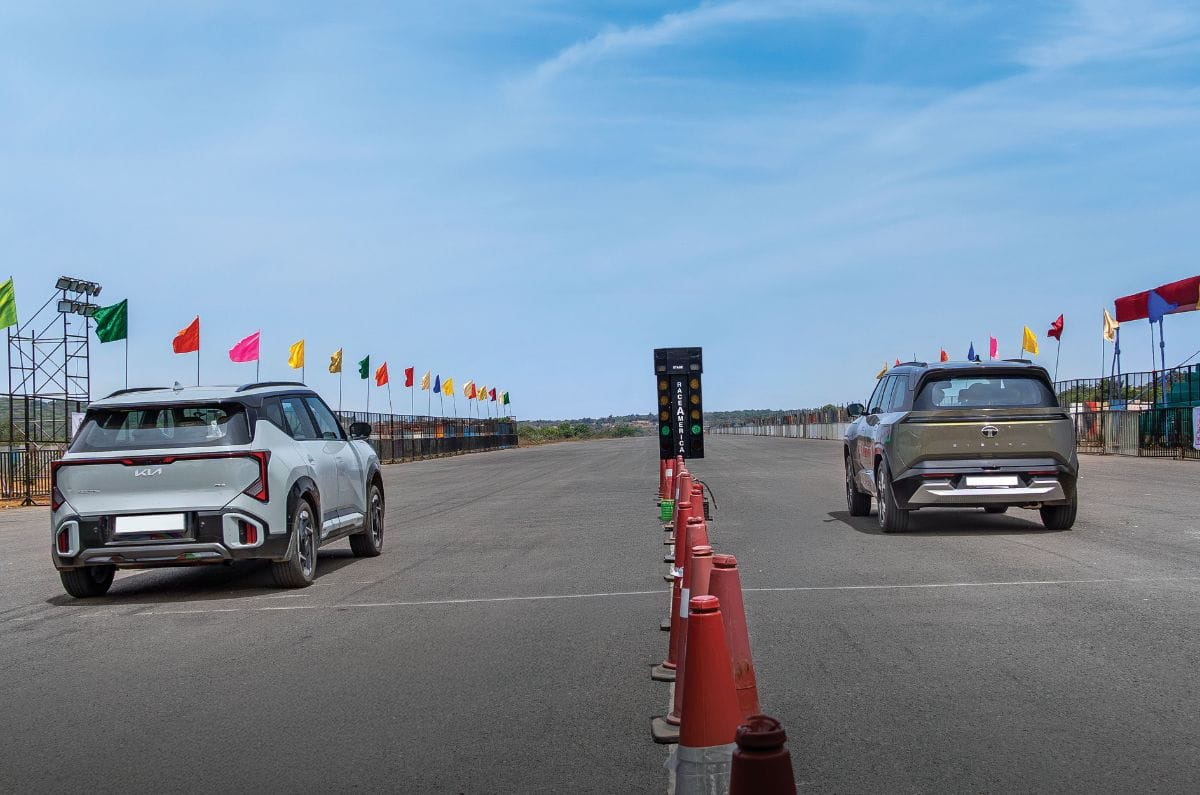
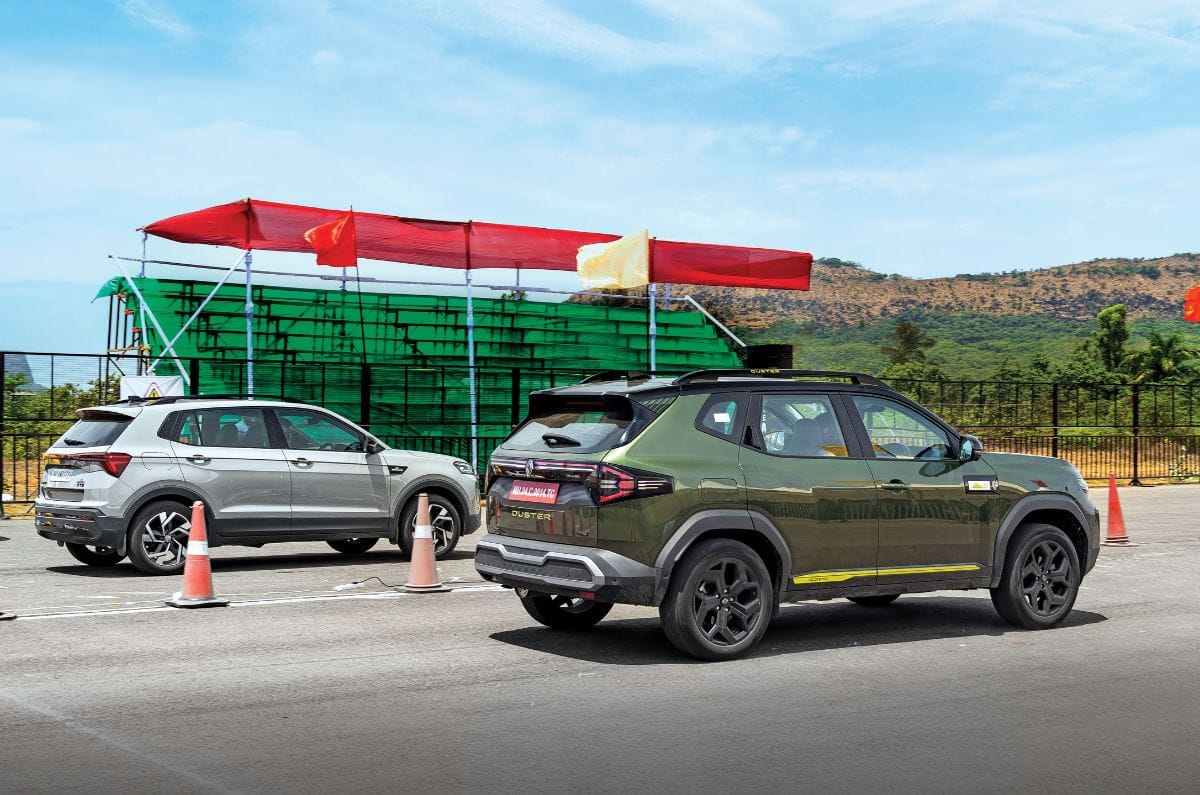
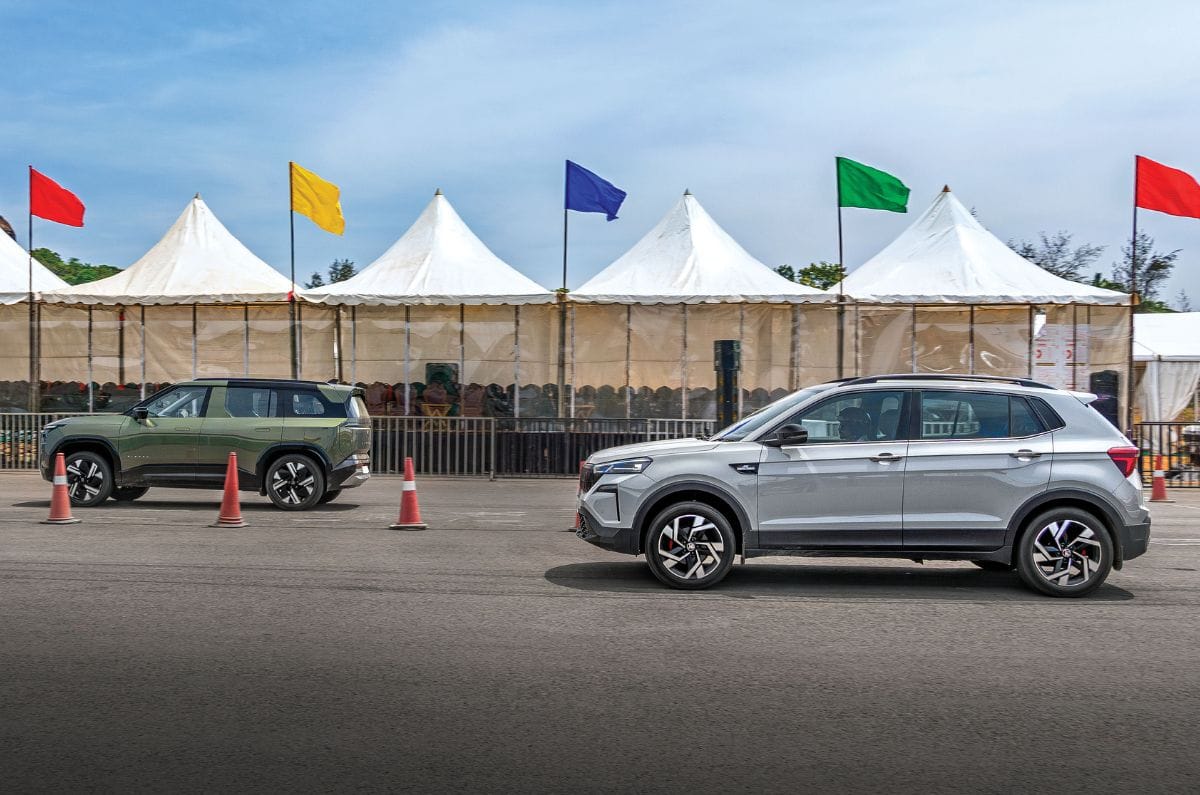
There’s no simpler way to compare one car’s performance to another than with a head-to-head quarter-mile race. In this edition of Autocar India’s quarter-mile racing series, we’ve brought together some of the newest midsize SUVs in the market, including the Tata Sierra, Kia Seltos and the Renault Duster. Let’s find out which of this new crop of midsize SUVs is the quickest down the drag strip.
Race 1: Tata Sierra vs Kia Seltos
SUV
Seltos
Sierra
Engine
1482cc, 4-cylinder
1498cc, 4-cylinder
Power
160hp at 5500rpm
160hp at 5000rpm
Torque
253Nm at 1500-3500rpm
255Nm at 1750-4000rpm
Transmission
7-speed dual-clutch
6-speed torque converter
Kerb weight
1467kg
1552kg
Our first pairing is between the Tata Sierra and the Kia Seltos, both of which are powered by 1.5-litre turbo-petrol engines, but with different gearboxes.
These two new midsize SUVs are neck-and-neck on paper, with both featuring 160hp turbo-petrol engines, similar torque outputs and similar weight. However, the torque-converter-equipped Sierra launches much stronger than the Seltos, whose dual-clutch automatic is conservative off the line. The Kia Seltos does begin to claw back lost ground, but a little too late. The Sierra manages to win by a slender margin of about two tenths of a second. Race 2 is even closer, with a gap of just over a tenth, but the result stays the same.
Sierra vs Seltos drag race times
Sierra
Seltos
Race 1
16.92 sec
17.11 sec
Race 2
17.07 sec
17.19 sec
Race 2: Skoda Kushaq vs Renault Duster
SUV
Kushaq
Duster
Engine
1498cc, 4-cylinder
1333cc, 4-cylinder
Power
150hp at 5000-6000rpm
163hp at 5,250rpm
Torque
250Nm at 1600-3500rpm
280Nm at 2,000-3,500rpm
Transmission
7-speed dual-clutch
6-speed dual-clutch
Kerb weight
1322kg
1363kg
Our next pairing is between the Skoda Kushaq and the Renault Duster. The Kushaq uses a 1.5-litre turbo-petrol engine, while the Duster uses a smaller but more powerful 1.3-litre unit. Both engines come mated to a DCT gearbox.
The Duster has the advantage on paper with more power, and it backs it up by winning Race 1 by two tenths. The Renault’s wet-clutch DCT allows a better launch than the Skoda’s dry-clutch unit, but the Skoda’s snappier shifts and stronger top end mean it is catching up. Race 2 starts off with the Skoda getting a better launch, and as such, it goes on to beat the Renault by nearly four tenths. Race 3 is closer than Race 2, but the result stays the same, with the Kushaq coming out on top yet again.
Kushaq vs Duster drag race times
Kushaq
Duster
Race 1
17.77 sec
17.65 sec
Race 2
17.05 sec
17.69 sec
Race 3
17.28 sec
17.67 sec
Race 3: Tata Sierra vs Skoda Kushaq
SUV
Sierra
Kushaq
Engine
1498cc, 4-cylinder
1498cc, 4-cylinder
Power
160hp at 5000rpm
150hp at 5000-6000rpm
Torque
255Nm at 1750-4000rpm
250Nm at 1600-3500rpm
Transmission
6-speed torque converter
7-speed dual-clutch
Kerb weight
1552kg
1322kg
Finally, we bring together the winners from the first two rounds to determine the fastest midsize SUV you can buy today.
The Sierra has the numbers on its side, but the Kushaq does tend to punch above its weight. As was the case in the earlier races, the Skoda proves tricky to launch off the line, while the Tata Sierra jumps ahead. From there on, the Kushaq does start to reel in the Sierra, but it’s just not enough. The Tata Sierra wins Race 1 by just about a tenth. Race 2 is equally close, with the gap being a minuscule 0.2 seconds, and the Sierra manages to win again.
Sierra vs Seltos drag race times
Sierra
Kushaq
Race 1
17.18 sec
17.28 sec
Race 2
17.02 sec
17.21 sec
Autocar India’s testing standards
Before we conduct our performance tests, we check and maintain tyre pressures based on the manufacturer’s recommendation and ensure the car has a full tank of fuel. The car is then tested in a controlled environment, and the data is collected via highly accurate GPS-based timing equipment.
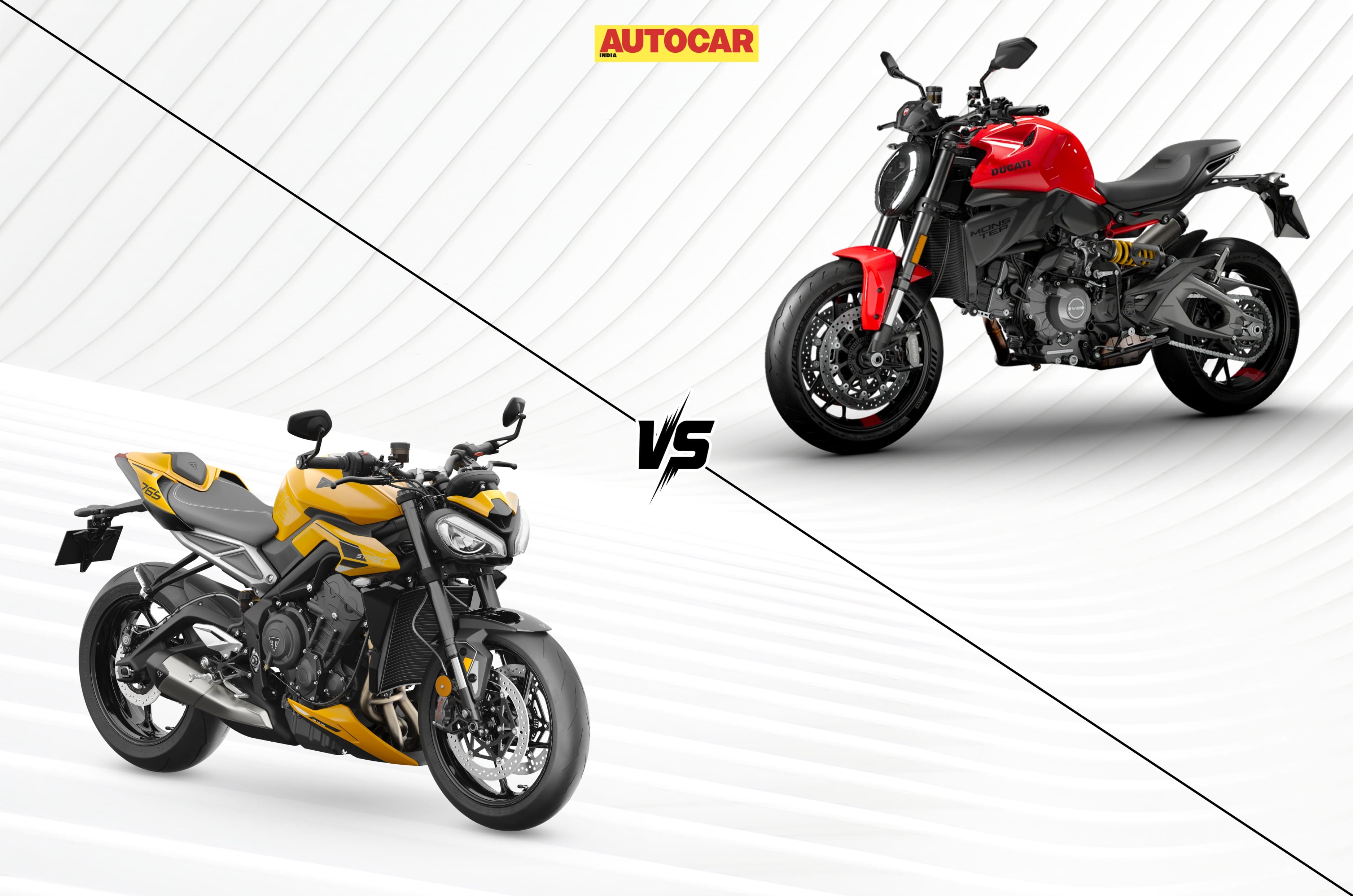
Ducati has just updated the Monster with a slew of changes. Amongst the many updates are an updated, smaller 890cc engine, a new monocoque chassis, and 4kg lesser weight with the price starting at Rs 13.99 lakh. Till now, the most popular option in this price segment has been Triumph’s Street Triple 765 RS, coming in at Rs 12.92 lakh. Let’s see how the updates have shaped up the Monster V2.
Ducati Monster V2 vs Triumph Street Triple 765 RS: Engine and output
More power for Triumph, more torque for Ducati
Ducati Monster V2
Triumph Street Triple 765 RS
Engine
890cc, V-twin-cylinder, liquid-cooled
765cc, inline three-cylinder, liquid-cooled
Power
111hp at 9,000rpm
130hp at 12,000rpm
Torque
91.1Nm at 7,250rpm
80Nm at 9500rpm
Gearbox
6-speed
6-speed
Power-to-weight ratio
634.29hp/tonne
691.49hp/tonne
The headlining change for the new Monster is the previous version’s 937cc V-twin engine being replaced with a 890cc V-twin engine, also seen in the likes of the Multistrada V2, Panigale V2, and the Streetfighter V2. Despite being smaller, this engine makes similar power and slightly lower torque (2Nm less, to be exact). Triumph, however, remains the most powerful engine in the segment with a class-leading 130hp. However, the reputed three-cylinder engine does have lesser torque than the Monster’s twin-cylinder. The Triumph also delivers both power and torque later in the rev range.
Ducati Monster V2 vs Triumph Street Triple 765 RS: Weight and dimensions
Ducati only discloses wet weight with no fuel
Ducati Monster V2
Triumph Street Triple 765 RS
Fuel tank capacity
14 litres
15 litres
Ground clearance
NA
NA
Wet weight
175kg (without fuel)
188kg
Seat height
815mm
836mm
Wheelbase
1492mm
1399mm
Ducati’s new updates to the Monster V2 includes a lower, narrower 815mm seat height (with 795mm and 775mm seats available as accessories; the latter requires a low suspension kit). Owing to various improvements throughout, it’s 4kg lighter than the outgoing model. The Triumph, by default, has a 21mm taller seat height. Although Triumph does offer lower seats as accessories, a 808mm one and a 798mm one; the latter requires a shorter rear suspension. At first glance, it might appear that the Ducati is significantly lighter than the Triumph, but do note that Ducati India only reports wet weight without fuel, whereas Triumph reports wet weight with fuel. With 90 percent fuel, the Monster should weigh closer to 185.3kg. However, neither company mentions the ground clearance numbers on their Indian website.
Ducati Monster V2 vs Triumph Street Triple 765 RS: Tyres, brakes, and suspension
The Ducati offers a larger brake rotor on both ends
Ducati Monster V2
Triumph Street Triple 765 RS
Tyres (F, R)
120/80R17, 180/55R17
120/80R17, 180/55R17
Brakes (F, R)
Dual 320mm front disc, single 245mm rear disc, cornering sensitive dual-channel ABS
Dual 310mm front disc, single 220mm rear disc, cornering sensitive dual-channel ABS
Suspension (F, R)
43mm USD fork, monoshock
41mm USD fork, monoshock
Both the motorcycles share the exact same tyre sizes. The Ducati offers a larger brake rotor on both ends, although both companies offer cornering ABS as standard. Things get a bit more interesting with the suspension. The Ducati offers the larger diameter front fork but its system isn’t quite as adjustable as the Triumph. Triumph suspension can be adjusted for preload, rebound, and compression on both ends, whereas the Ducati only offers rear preload adjustment. Point to be noted that the Street Triple RS is a track-focussed version whereas the Monster is meant for balanced usage. To that end, it is the Ducati that has the longer travel on both front (130mm vs 115mm) and rear (145mm vs 131.2mm). Differences in rake and trail are negligible for their intended purpose.
Ducati Monster V2 vs Triumph Street Triple 765 RS: Features
Par for the segment
Both the companies offer most of the features expected in this segment, but Ducati does go the extra mile by offering wheelie control and a bi-directional quickshifter as standard. As is also the norm in this segment, both motorcycles are ready for numerous accessory fitments such as cruise control and TPMS, with Ducati once again offering more electronic rider aids than Triumph.
Ducati Monster V2 vs Triumph Street Triple 765 RS: Price
Triumph is cheaper by a lakh
Model
Ducati Monster V2
Street Triple RS
Rs 13.99 lakh – Rs 14.45 lakh
Rs 12.92 lakh
Ducati has priced the new Monster at Rs 13.99 lakh (ex-showroom), a Rs 15,000 increase over the old Monster. Triumph on the other hand asks for Rs 12.92 lakh (ex-showroom). Do note that the Street Triple R—the road-focussed version—costs Rs 10.86 lakh (ex-showroom), which is significantly more affordable than the Monster. Both the motorcycles are distinctive enough with their design and equipment to make choosing one over the other simpler.
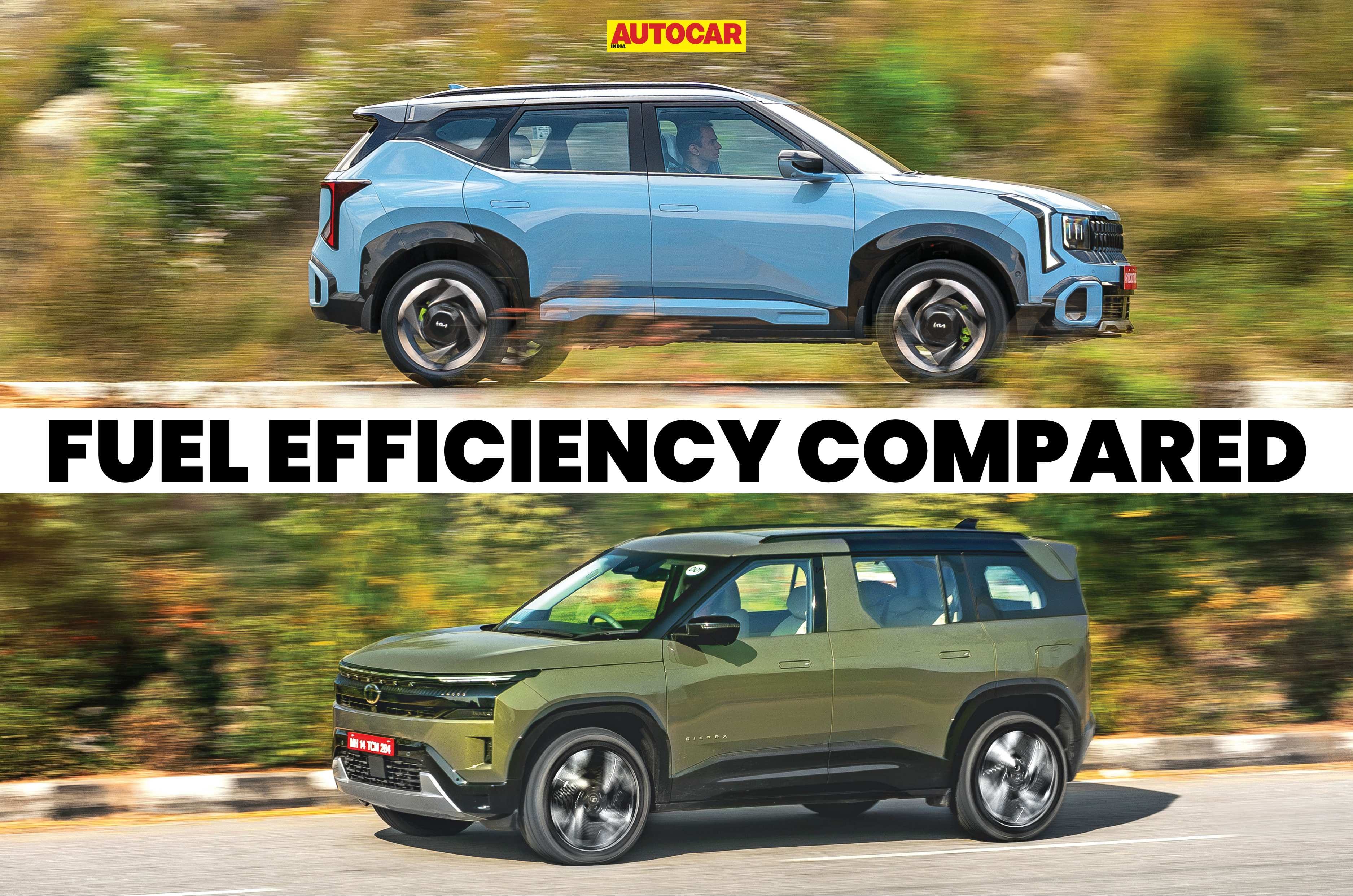
Alongside the Hyundai Creta, the only SUVs in this segment offering a diesel engine mated to a torque-converter automatic transmission (AT) are the Kia Seltos and the Tata Sierra. Where the all-new Sierra was introduced in November 2025, the second-gen Seltos entered the fray in January 2026. The Sierra diesel-AT version is limited to five trim options, but its Seltos counterpart is available in eleven. So, which one of these 5-seater midsize SUVs offers higher fuel economy?
Explore full specs, features and a price breakdown in our Seltos vs Sierra comparison.
Kia Seltos vs Tata Sierra diesel automatic: Specifications
The Sierra offers more power, but it is also heavier than the Seltos
Kia Seltos vs Tata Sierra diesel automatic: Specifications
Kia Seltos
Tata Sierra
Engine
4 cyl, diesel
4 cyl, diesel
Displacement (cc)
1493
1497
Power (hp)
116 (4,000rpm)
118 (4,000rpm)
Torque (Nm)
250 (1,500-2,750rpm)
280 (1,500-2,750rpm)
Gearbox
6-speed AT
6-speed AT
Fuel tank (litres)
47
50
Even though their turbocharged engines are of similar sizes, it’s the Tata Sierra’s unit that produces 2hp and 30Nm more. Moreover, the power and torque figures of these cars are achieved over the same engine RPM range. Compared to the Seltos, the Sierra diesel comes with a slightly larger fuel tank (by 3 litres), whilst the gearboxes on both are 6-speed torque-converter automatic units. Both cars are equipped with a variable-geometry turbocharger, thus improving power delivery and reducing turbo lag.
Kia Seltos vs Tata Sierra diesel automatic: Real-world fuel efficiency
Despite featuring an ‘Eco’ mode and weighing less, the Seltos fared slightly worse than the Sierra
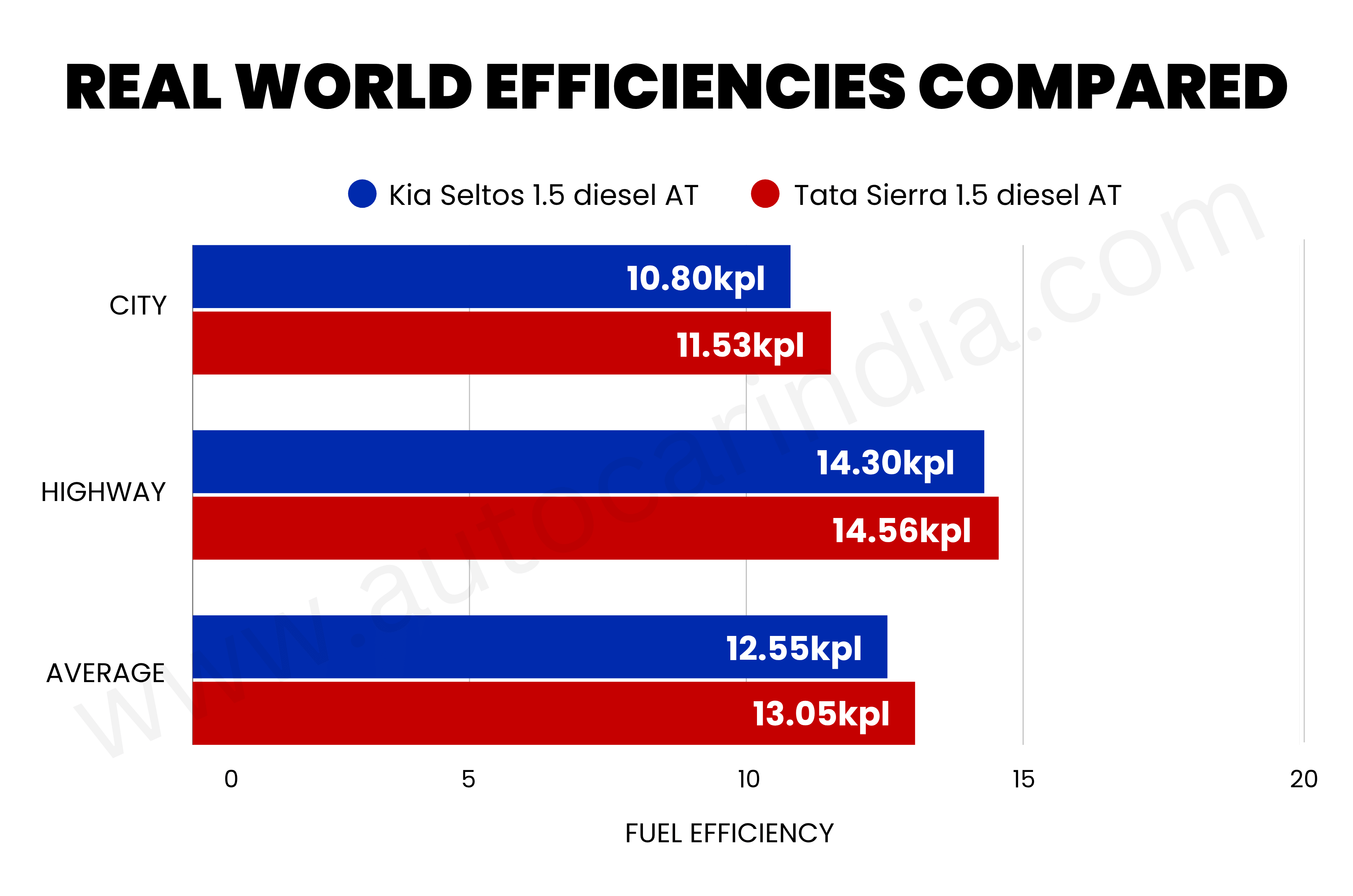
During our real-world fuel economy test, the Seltos diesel managed an average that was 0.5kpl worse than the Sierra. It was also 0.73kpl thirstier in the city, whilst consuming 0.26kpl more fuel than its Tata rival out on the highway. Despite being heavier than a comparable diesel-automatic trim of the Seltos, the relatively lower engine RPM of the Sierra when cruising at 100kph helps its efficiency. For reference, the Seltos’ diesel engine was spinning much faster at 100kph, at 2,100 RPM. Neither SUV gets an automatic engine stop-start system to reduce fuel burn further, but the Seltos does come with an Eco drive mode.
Kia Seltos vs Tata Sierra diesel automatic: Prices
Kia Seltos vs Tata Sierra diesel automatic prices
Kia Seltos
Tata Sierra
Price range (in Rs, lakh)
15.32-21.82
15.99-21.29
The most affordable trim of the Kia Seltos diesel with the torque-converter automatic gearbox costs Rs 67,000 less than its equivalent Tata Sierra. At the top-end of the spectrum, the latter has a price advantage of Rs 53,000.
Autocar India’s fuel efficiency testing
Before our real-world fuel efficiency tests, we fill our test cars’ tanks to the brim and maintain tyre pressures based on the manufacturer’s recommendations. These cars are driven in fixed city and highway loops in and around Navi Mumbai, and we maintain certain average speeds. Throughout the tests, there is only one person in each car, running the air conditioner and other electricals, such as the audio system, indicators and wipers, when required, just like a regular user would. Periodic driver swaps further neutralise variations in driver patterns. At the end of each cycle, we calculate efficiency by filling the tanks to full again.