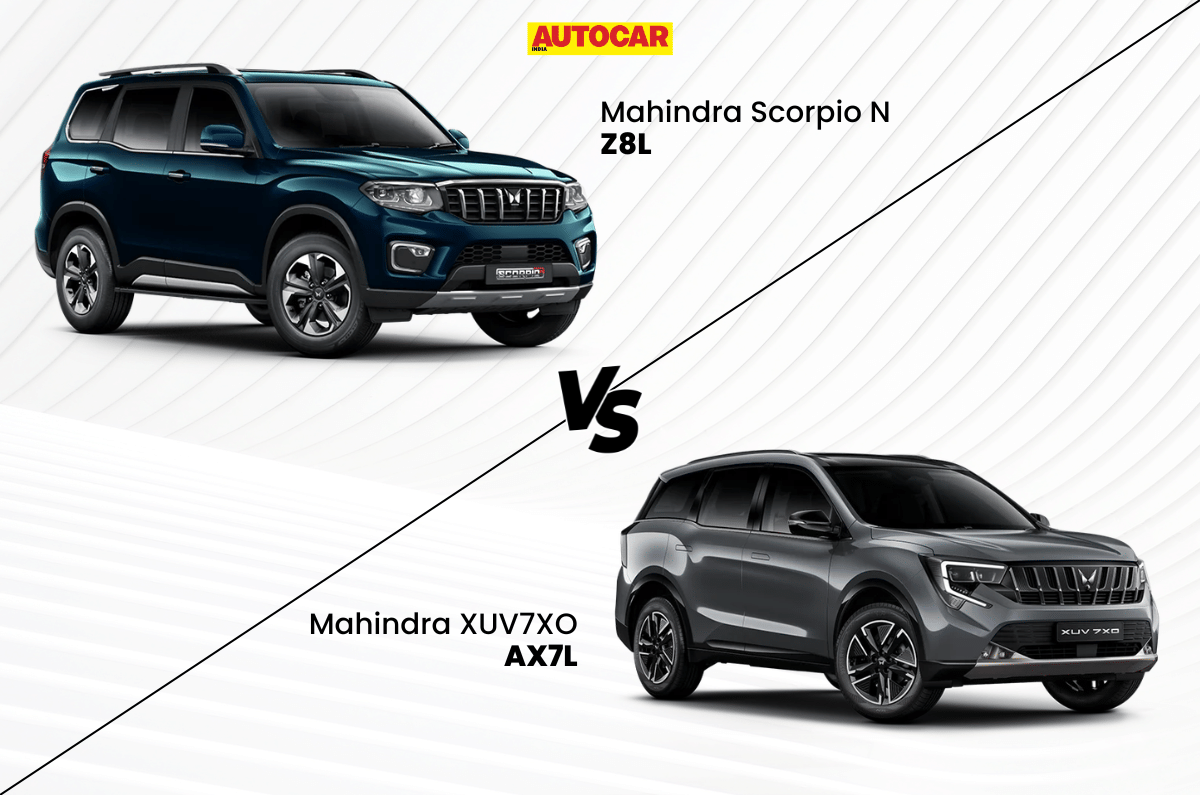
Mahindra Scorpio N Z8L vs XUV 7XO AX7L top trims compared

Mahindra Scorpio N Z8L vs XUV 7XO AX7L top trims comparison

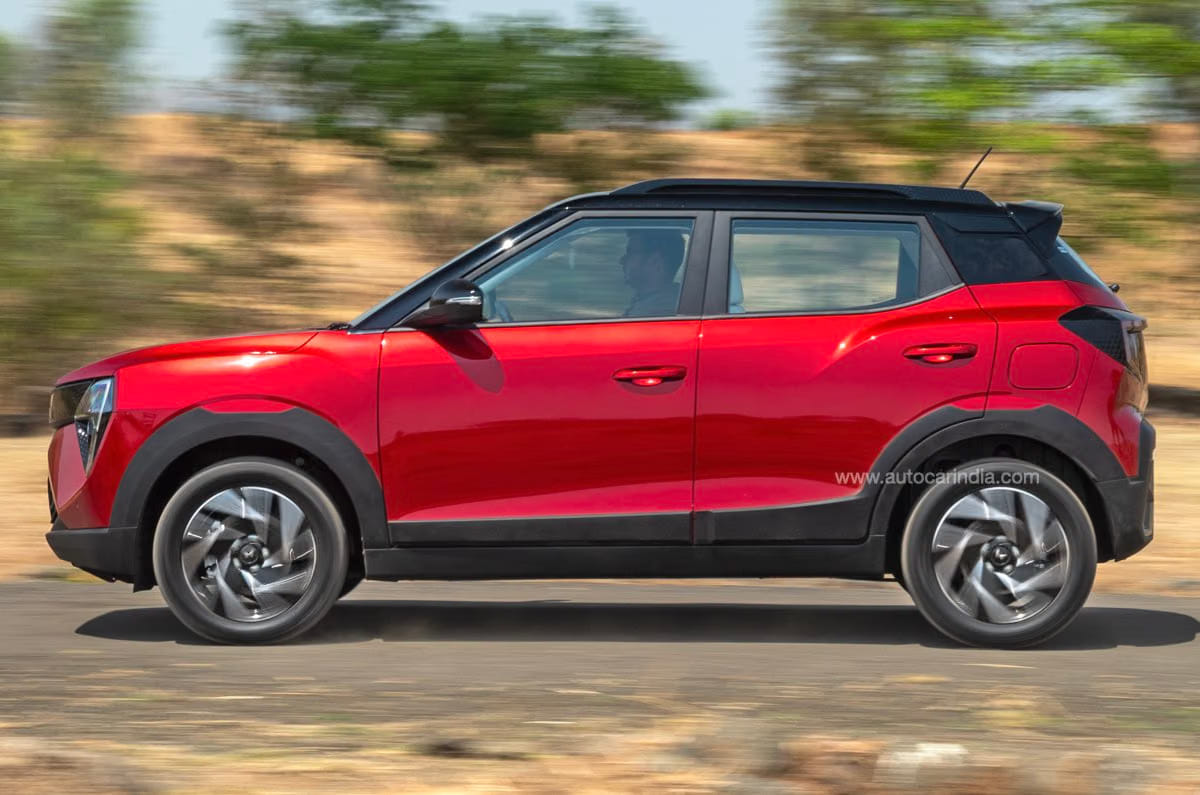
The Mahindra Scorpio N and XUV 7XO are popular three-row SUVs offered by the Indian carmaker. While the Scorpio N uses a ladder-frame chassis, the XUV 7XO is based on a monocoque construction. Both SUVs received mid-life updates in 2026 and are now well-equipped by modern standards. However, they differ in areas such as dimensions, powertrain tuning, features and pricing. To see how they compare, we have put their top trims, the Scorpio N Z8L and XUV 7XO AX7 L, head-to-head.

Mahindra Scorpio N Z8L vs XUV 7XO AX7L: Dimensions


Scorpio N

XUV 7XO

Length (mm)

4,662

4,695

Width (mm)

1,917

1,890

Height (mm)

1,857

1,755

Wheelbase (mm)

2,750

2,750

Seat layout

6/ 7

6/ 7

The two SUVs have the same 2,750mm wheelbase and offer both six- and seven-seat layouts. However, the XUV 7XO is 33mm longer than the Scorpio N, while the Scorpio N is 27mm wider and 102mm taller.

Mahindra Scorpio N Z8L vs XUV 7XO AX7L: Powertrain


Scorpio N

XUV 7XO

Engine

2-litre turbo petrol / 2.2-litre diesel2-litre turbo petrol / 2.2-litre diesel

Power (hp)

203 / 175203/ 185

Torque (Nm)

370-380 / 370-400380/ 420-450

Gearbox

6MT or 6AT6MT or 6AT
Drive layoutRWD / RWD, 4WDFWD / FWD, AWD

Both use the same 2-litre turbo-petrol and 2.2-litre diesel engines, but their outputs differ. The petrol engines make 203hp in both SUVs, while the XUV 7XO’s diesel is more powerful at 185hp versus 175hp in the Scorpio N. Depending on the gearbox, the XUV 7XO also produces more torque with its diesel engine, at 420-450Nm compared to 370-400Nm in the Scorpio N.

The Scorpio N has a proper 4WD system (with low range) and offers it with both the manual and automatic gearboxes in diesel form. The XUV 7XO, meanwhile, gets an AWD system only with the diesel automatic version. When not equipped with four-wheel drive, the Scorpio N uses a RWD layout, which gives it better traction on hilly terrains. The non-AWD XUV 7XO, meanwhile, uses a front-wheel-drive setup.

Mahindra Scorpio N Z8L vs XUV 7XO AX7L: Exterior


Scorpio N

XUV 7XO

Headlights

Auto LED

Auto LED

Taillights

LED

LED

DRLs

LED

LED

Front fog lamps

LED

LED with cornering function

Wheels

18-inch alloys

19-inch alloys
Door handlesPull typeFlush fitting
Chrome finish on door handlesYesNo

Powered ORVMs with indicators

Yes

Yes

Roof rails

Yes

Yes

Shark-fin antenna

Yes

Yes

Rear spoiler

Yes

Yes

Both SUVs get LED headlights, tail-lights and DRLs, along with powered ORVMs, roof rails, a shark-fin antenna and a rear spoiler. However, the XUV 7XO gets larger 19-inch alloy wheels compared to the Scorpio N’s 18-inch units, while its front fog lamps also add a cornering function. The Scorpio N uses conventional pull-type door handles with chrome detailing, whereas the XUV 7XO gets flush-fitting handles without chrome.

Mahindra Scorpio N Z8L vs XUV 7XO AX7L: Interior, features


Scorpio N

XUV 7XO

Driver’s display

10.25 inch

12.3 inch

Central touchscreen

12.3 inch

12.3 inch
Passenger touchscreenNA12.3 inch

Android Auto, Apple CarPlay

Wireless

Wireless
Type-C USB portsFront and rearFront and rear

Audio system

12-speaker Sony

16-speaker Harman Kardon

Push-button start/stop

Yes

Yes

Sunroof

Panoramic

Panoramic

Powered tailgate

No

No

Climate control

Dual-zone

Dual-zone

Seat upholstery

Leatherette

Leatherette

Steering wheel adjustment

Tilt

Tilt and telescopic

Wireless phone charger

Front

Front and rear

Driver’s seat adjustment

Powered

Powered

Co-driver’s seat adjustment

Manual

Powered

Ventilated front seats

Yes

Yes
Ventilated second-row seatsNoOutboard only (both 6 and 7 seater versions)
Boss modeNoYes
Bring your own device mountsNoYes

The XUV 7XO has an edge in cabin tech, with a larger 12.3-inch driver’s display and an additional 12.3-inch passenger touchscreen, which the Scorpio N does not offer. It also gets a 16-speaker Harman Kardon system versus the Scorpio N’s 12-speaker Sony setup. Both get wireless Android Auto and Apple CarPlay, panoramic sunroofs, dual-zone climate control, powered driver’s seats and ventilated front seats.

There are also a few other differences. The XUV 7XO gets a telescopic steering adjustment, powered co-driver’s seat, wireless phone charging for both front and rear passengers, and ventilated outboard second-row seats. It also offers Boss Mode and bring-your-own-device mounts, which are not available on the Scorpio N. Interestingly, neither SUV gets a powered tailgate.

Mahindra Scorpio N Z8L vs XUV 7XO AX7L: Driving tech


Scorpio N

XUV 7XO

Drive modes

Zip, Zap, Zoom (diesel only)

Zip, Zap, Zoom (diesel only)

Terrain modes

Normal, Snow, Mud and Ruts, Sand (diesel only)

No
Low range 4WDYesNo

Electronic locking differential

4WD only

No

Paddle shifters

AT only

AT only

Cruise control

Adaptive

Adaptive

Both SUVs offer the same three drive modes, namely Zip, Zap and Zoom, along with adaptive cruise control and paddle shifters with the automatic gearbox. However, the Scorpio N has a clear advantage for off-road use, with terrain modes for Normal, Snow, Mud and Ruts, and Sand. It also gets low-range 4WD system, as mentioned before, and an electronic locking differential, features that are not available on the XUV 7XO.

Mahindra Scorpio N Z8L vs XUV 7XO AX7L: Safety


Scorpio N

XUV 7XO

Airbags

6

7

ADAS

Level 2

Level 2

Camera setup

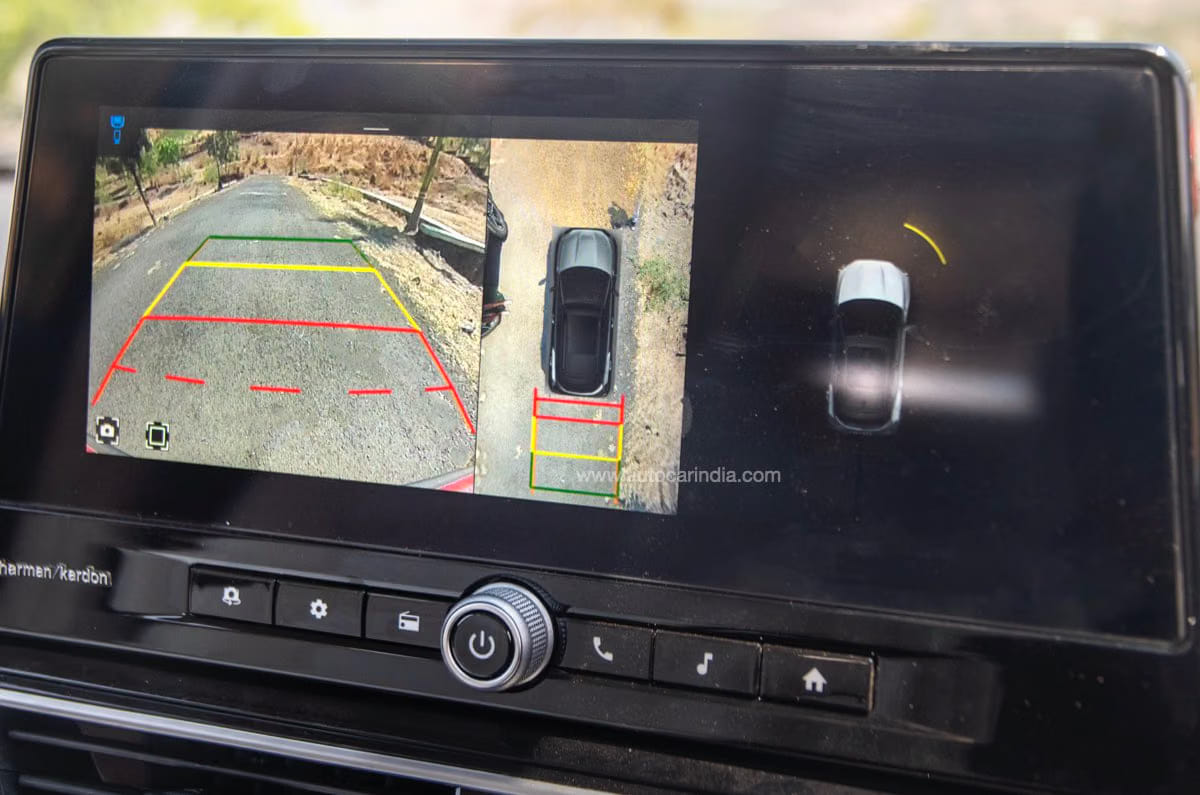
540-degree

540-degree

Parking sensors

Front and rear

Front and rear

Electronic parking brake

Yes

Yes

All-wheel disc brakes

Yes

Yes
ABSYesYes

TPMS

Yes

Yes

IRVM

Auto-dimming

Auto-dimming

Rear wiper, washer and defogger

Yes

Yes

Hill hold assist

Yes

Yes

Hill descent control

Yes

Yes

ESC

Yes

Yes

This is one area where the two SUVs aren’t that far apart, especially in their respective top trims. Both get Level 2 ADAS, 540-degree cameras, front and rear parking sensors, all-wheel disc brakes, ABS, TPMS, auto-dimming IRVMs, electronic parking brakes, hill hold assist and hill descent control. The XUV 7XO does have a small advantage with seven airbags, compared with six in the Scorpio N.

Mahindra Scorpio N Z8L vs XUV 7XO AX7L: Prices and verdict


Scorpio N

XUV 7XO

Petrol MT

21.31-21.69

Petrol AT

22.87-23.05

24.29-24.49

Diesel MT 

21.99-22.25

23.29

Diesel AT

23.49-25.49

24.79-25.79

Clearly, the Mahindra XUV 7XO AX7L is more expensive than the Scorpio N Z8L. The price gap is smallest for the petrol AT, at Rs 1.24-1.44 lakh, while the diesel AT carries a difference of Rs 1.30-1.31 lakh. For the diesel manual, the XUV 7XO is also more expensive by Rs 1.04-1.30 lakh. The Scorpio N is also the only one of the two available with a petrol manual at the top end.

Without a doubt, the two SUVs are well equipped, but their focus is quite different. The Scorpio N is better suited to buyers who want to go off-road, thanks to its ladder-frame construction and the 4WD system. The XUV 7XO, on the other hand, is better suited to those looking for a three-row SUV for city and highway use, with some mild off-road ability. Additionally, its monocoque construction and dampers with DCx piston valves are aimed at delivering a more comfortable ride. 

Overall, we recommend the XUV 7XO for its overall package, offering higher engine outputs, a more premium cabin and additional features, a relatively more usable third row and better ride and handling. It does command a slight premium over the Scorpio N, but we think the added cost is justified.
3 Reasons to buy the Mahindra XUV 3XO and 2 reasons not to

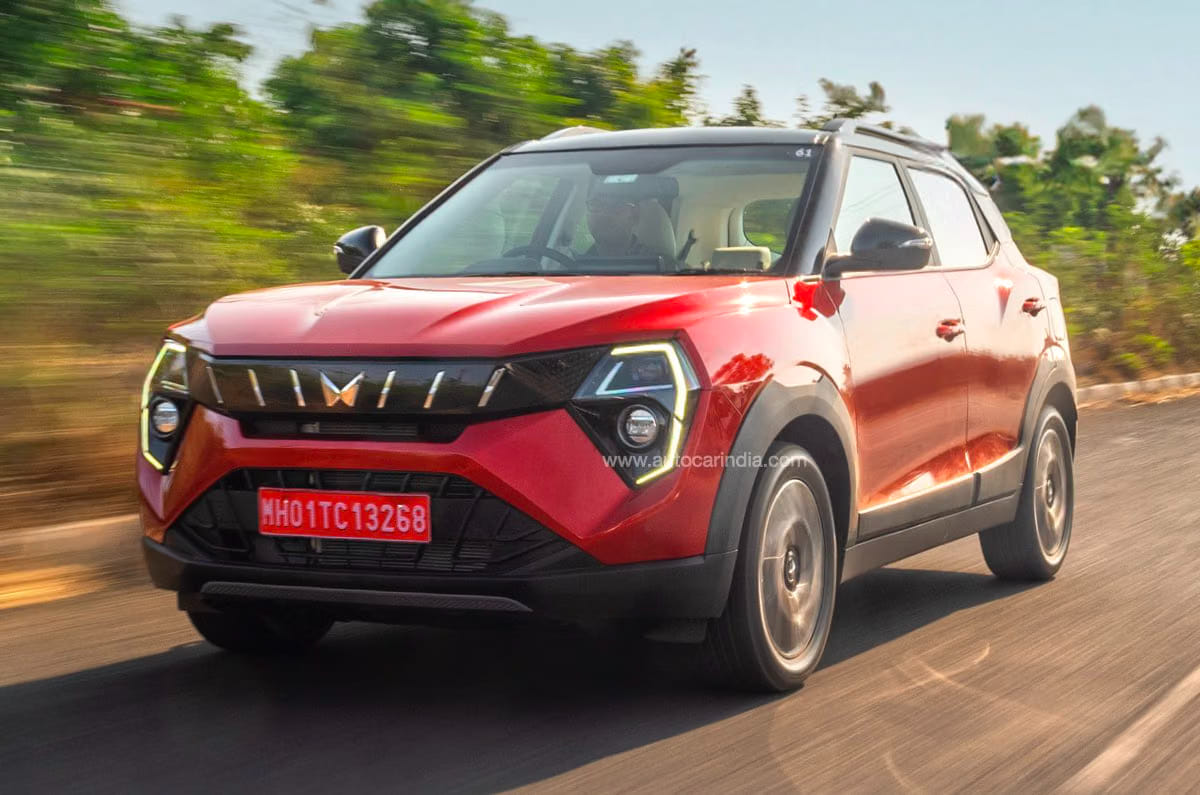
Mahindra XUV 3XO front quarter tracking

Introduced in 2024, the XUV 3XO debuted as Mahindra’s replacement for the XUV 300 in the compact SUV segment. In fact, this SUV was the first Mahindra model to have the ‘XO’ lettering in its name, a naming convention later adopted for the XUV 7XO. The XUV 3XO comes with a radical exterior, a premium interior and is powered by potent engine options. If you’re considering buying the XUV 3XO, we’ve listed reasons to go for it along with its limitations, so you can decide to look elsewhere.

Reasons to buy the Mahindra XUV 3XO

Upmarket Interior quality

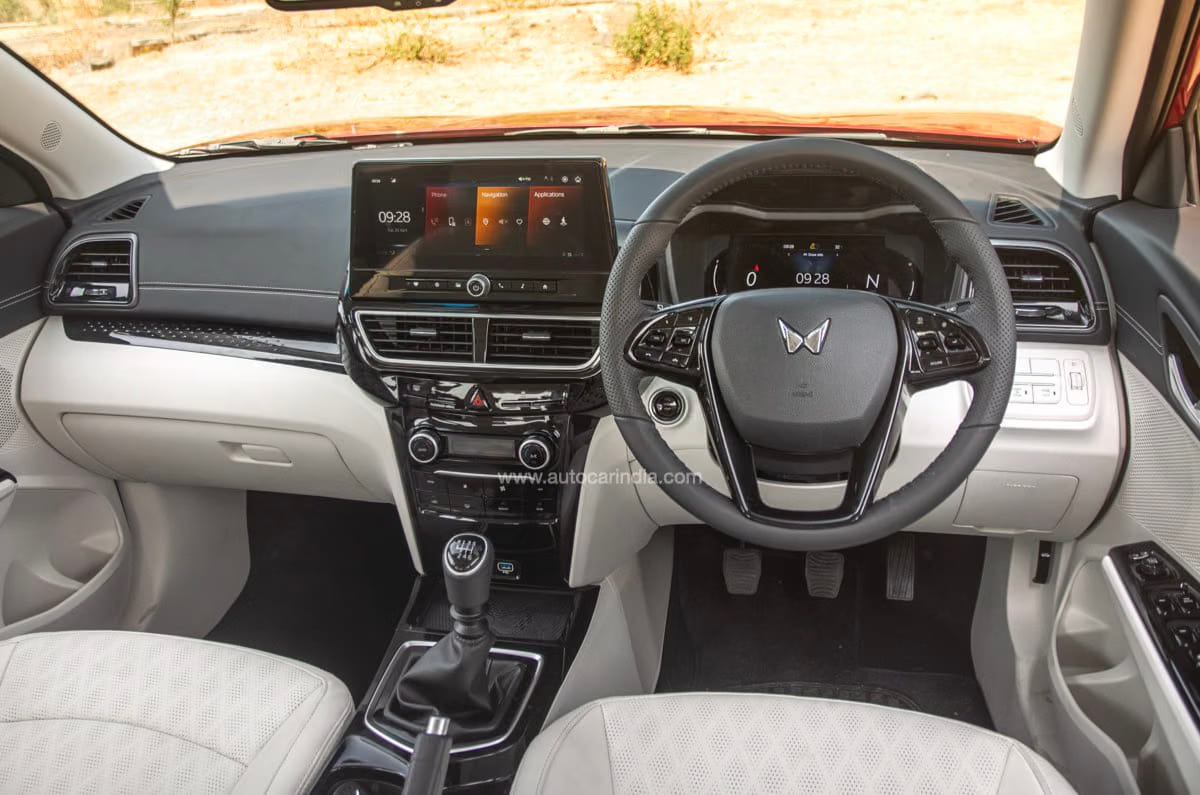
Though its interior may lack panache when compared to rivals, quality and feel, on the other hand, are up there at the top. Top-end versions come with soft-touch leatherette material on the dashboard and door trims, and the perforated leatherette seats feel quite upmarket. Even cabin bits like the leather-wrapped steering wheel, window switches, and wiper and light stalks look like they belong in a pricier car.

Strong engines

The Mahindra XUV 3XO is offered with three engine choices. There’s a 1.2-litre turbo-petrol engine producing 111hp and 200Nm, a 1.2-litre direct-injection turbo-petrol unit developing 131hp and 230Nm, and a 1.5-litre turbo-diesel churning 117hp and 300Nm. The latter two options are the most powerful in their respective segments. A six-speed manual is standard on all engines, while the turbo-petrol can also be paired to a 6-speed torque converter automatic, and the diesel can be mated with a 6-speed AMT.

The XUV 3XO feels at its best when paired with the direct-injection turbo-petrol. With 131hp on tap, power is quickly accessible, and the mid-range punch is pleasing. Its 230Nm torque figure (250Nm in overboost) is way ahead of its rivals and performance is on par with pricier SUVs. Refinement levels are remarkable for a three-cylinder engine and noise levels are kept in check. 

Like the petrol, the diesel mill is refined as well, while turbo-lag is well contained at low speeds. Performance feels effortless when getting to cruising speeds. While power isn’t instantaneous, the engine itself feels responsive throughout the power band, and the 300Nm torque comes in handy especially on the highway.

Long feature list 

High-end trims of the Mahindra XUV 3XO come equipped with features to the brim. These include dual 10.25-inch screens for the infotainment and digital driver’s display, wireless Apple CarPlay and Android Auto, a panoramic sunroof, 7-speaker Harman Kardon audio system, dual-zone climate control (segment-only), connected car tech, wireless phone charger, drive and steering modes. 

As far as safety is concerned, top-spec versions come with level 2 ADAS, a 360-degree camera, front parking sensors, an auto-dimming IRVM, an electronic parking brake with auto hold, and blind-spot detection.

Reasons to not buy the Mahindra XUV 3XO

Low boot space

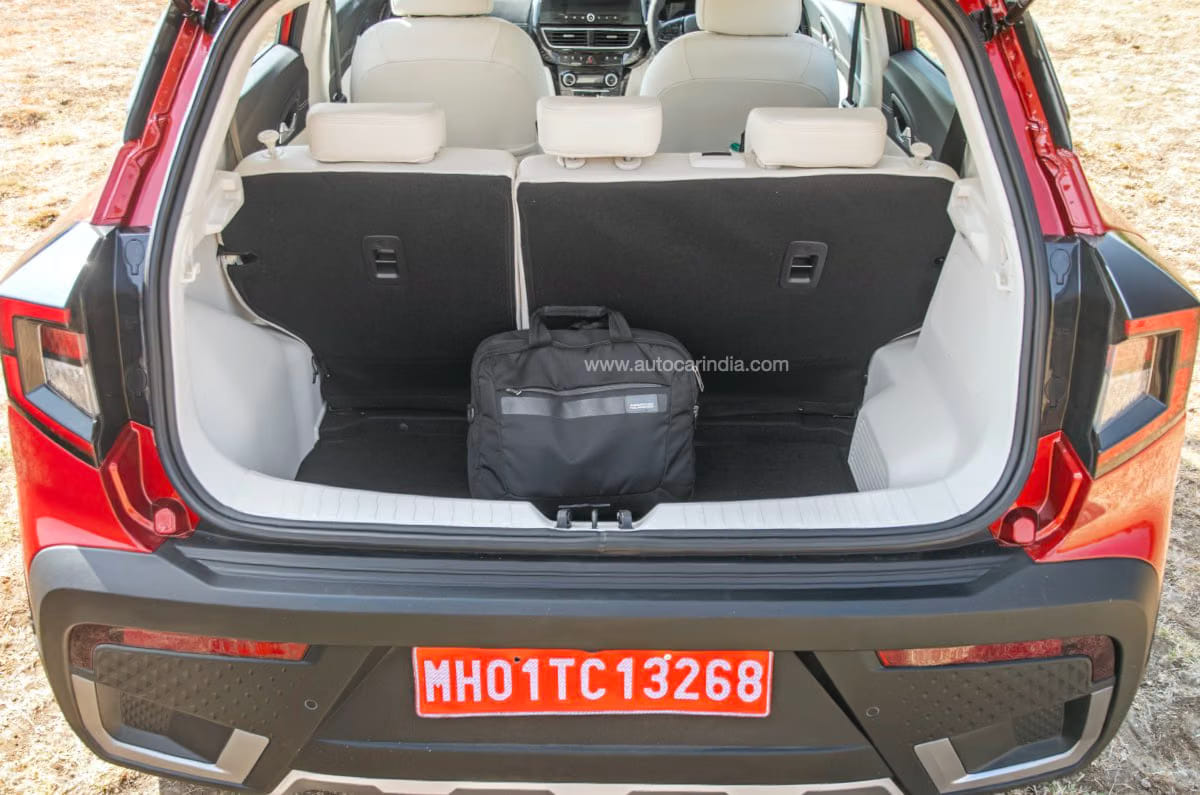
While the XUV 3XO scores well for rear space and practical in-cabin storage spaces, the same can’t be said for the boot space. With a capacity of 295 litres, it has the smallest boot among its core rivals. Additionally, the low floor and high loading lip make it difficult to put things in and out of the boot.

Expensive top-end variants

Top-end versions of the Mahindra XUV 3XO are quite pricey. With prices of the top-most AX7 L trim ranging from Rs 13.32 lakh to Rs 15.04 lakh with turbo-petrol and diesel engines, you’ve entered mid-size SUV territory. At that price point, one may find a larger, more spacious mid-size SUV in mid-spec guise.

VinFast Rasad electric maxi-scooter design patented in India

VinFast Rasad

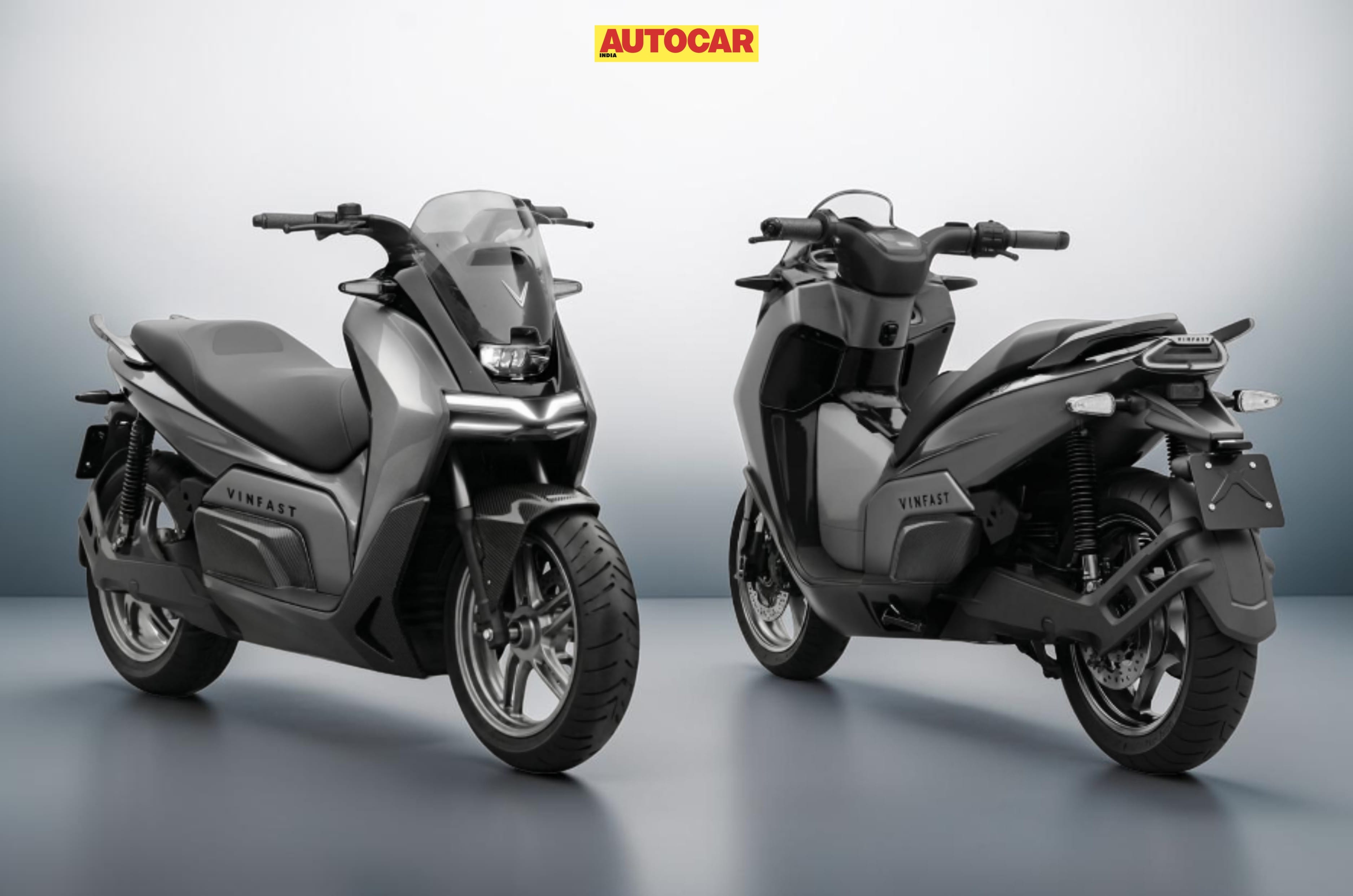
VinFast has filed a design patent in India for what appears to be the Rasad, an electric maxi-scooter concept that the Vietnamese brand unveiled in early 2026 as part of a comprehensive overhaul of its electric two-wheeler portfolio.

  1. Unveiled globally alongside the VinFast Sadie and Saxil
  2. VinFast Viper scooter and Sulad motorcycle also recently patented in India

Upcoming VinFast Rasad details

The Rasad will likely be positioned as a performance-oriented maxi-scooter

The filing comes just a few weeks after VinFast patented two other electric two-wheelers in India – the Viper scooter and an electric motorcycle believed to be based on the Sulad concept, another model the brand unveiled in January 2026 as part of its future product portfolio. The multiple patent filings suggest VinFast is actively preparing a broader product lineup for the Indian market than previously indicated.

The Rasad features a muscular, angular design with chunky tyres and an underbone chassis, similar to the Yamaha Aerox and the recently unveiled Honda ADV160. The design patent also reveals disc brakes at both ends, a spacious-looking stepped seat and a tall windscreen. Suspension duties are handled by a telescopic fork at the front and twin rear shock absorbers.

While VinFast has not officially revealed specifications, Vietnamese publications including Vietnam News have reported that the scooter will use a centrally mounted motor producing 7.1kW of peak power, enabling a claimed top speed of 100kph. The same reports also suggest that VinFast is targeting a global launch in the fourth quarter of 2026.

With regard to the Indian market, VinFast had previously stated that it planned to enter the country in 2026, initially identifying three models from its Vietnam lineup as candidates. Since then, the Viper, the Sulad and now the Rasad have all been patented in India. While patent filings don’t necessarily confirm a launch, they do suggest these models could eventually make their way to our market.

Ducati Monster V2 launched from Rs 13.99 lakh

Ducati Monster V2 launched from Rs 13.99 lakh

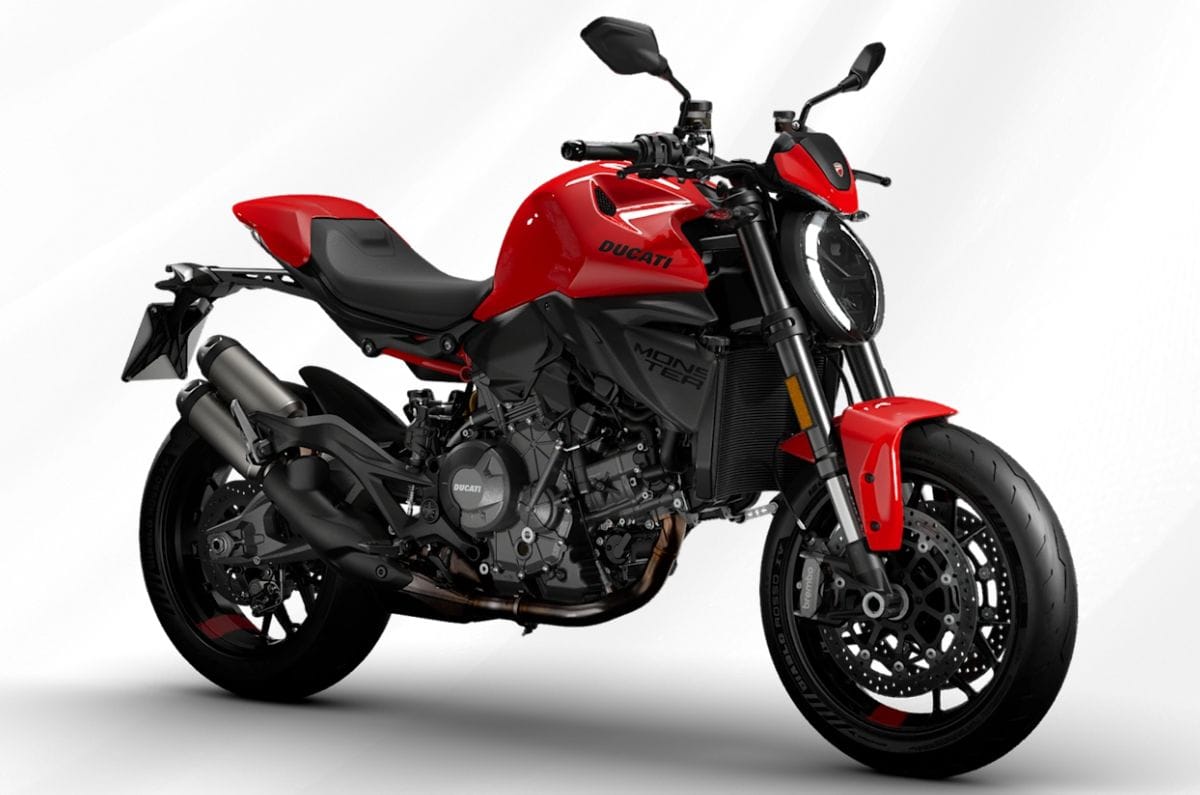
Ducati India has launched the Monster and Monster+ V2 in India. Like we’d reported a few days ago, the updated Monster gets a brand-new 890cc engine that’s shared with the Multistrada V2, Panigale V2, and Streetfighter V2. The new Monsters start at Rs 13.99 lakh (ex-showroom, India), Rs 15,000 more than the outgoing models.

  1. Gets a new 890cc V2 engine that delivers similar power
  2. Both variants are mechanically identical
  3. Ducati Protect Periodic Maintenance Contract available as an extra

Available in Monster and Monster+ guises

Both are mechanically identical, cosmetically different

Ducati has revealed the prices for both the Monster and the Monster+. Both get three colours: Ducati Red, Iceberg White, Sport Livery. The Monster in Ducati Red colour starts at Rs 13.99 lakh with the other two colours costing Rs 14.23 lakh. The Monster+ is mechanically identical to the Monster, but with the addition of a headlight cowl and a passenger seat cover. The Monster+ starts at Rs 14.34 lakh for Ducati Red and Rs 14.45 lakh for Iceberg White and Sport Livery.

New 890cc V-twin engine, shared with Multistrada V2 and Panigale V2

Power and torque figures are similar despite the smaller size

The Monster V2 gets a new 890cc V-twin engine, a brand-new monocoque chassis replacing the aluminium frame on the previous model, more muscular tank design that’s in line with the Monster’s design legacy but the capacity itself remains unchanged at 14-litres. Not only is the overall weight reduced by 5kg, thanks to IVT (Intake Variable Timing), the new 890cc engine makes the same 111hp as the previous Monster’s 937cc engine but peak power is delivered at 9,000rpm (250rpm earlier than before). Torque, on the other hand, sees a 2Nm reduction coming in at 91.1Nm and peak torque is now delivered at 7,250rpm (vs 6,500rpm earlier). However, 80 percent of this torque is now available between 4,000 and 9,000rpm.

The maintenance schedule has also become more relaxed, thanks again to IVT, with valve clearance check intervals now necessary only at 45,000km. Ducati expects the Monster to be serviced once a year, or once every 15,000km, whichever is earlier. The standard warranty is two years with unlimited mileage.

Other areas on the Monster V2 also see updates. The seat height is lower at 815mm and it’s narrower than before. For riders wanting to make it more accessible, there’s a lower 795mm seat accessory and an even lower seat with a 775mm seat height, which requires a lower suspension kit. Speaking of, the suspension is handled by the Showa 43mm USD fork and the rear monoshock suspension which are touted to balance comfort and sportiness. Brakes are from Brembo with front 320mm dual-disc brakes and a rear 245mm disc brake. The ride package is completed with the Pirelli Diablo Rosso IV tires with the front having a 120/70R17 and the rear 180/55R17.

Standard rider aids consist of ride and power modes, traction control, wheelie control, engine brake control, and cornering ABS. Other electronic features include a 5-inch TFT instrument cluster, full LED lighting, a bi-directional quickshifter, dynamic and self cancelling indicators. The new Monsters are also ready for a number of Ducati accessories like TPMS, cruise control, turn-by-turn navigation, and heated grips etc., The Monster V2 is now available for booking on Ducati India’s website.

Triumph to introduce new race engines for 2027 Moto2 World Championship

Triumph to introduce new race engines for 2027 Moto2 World Championship

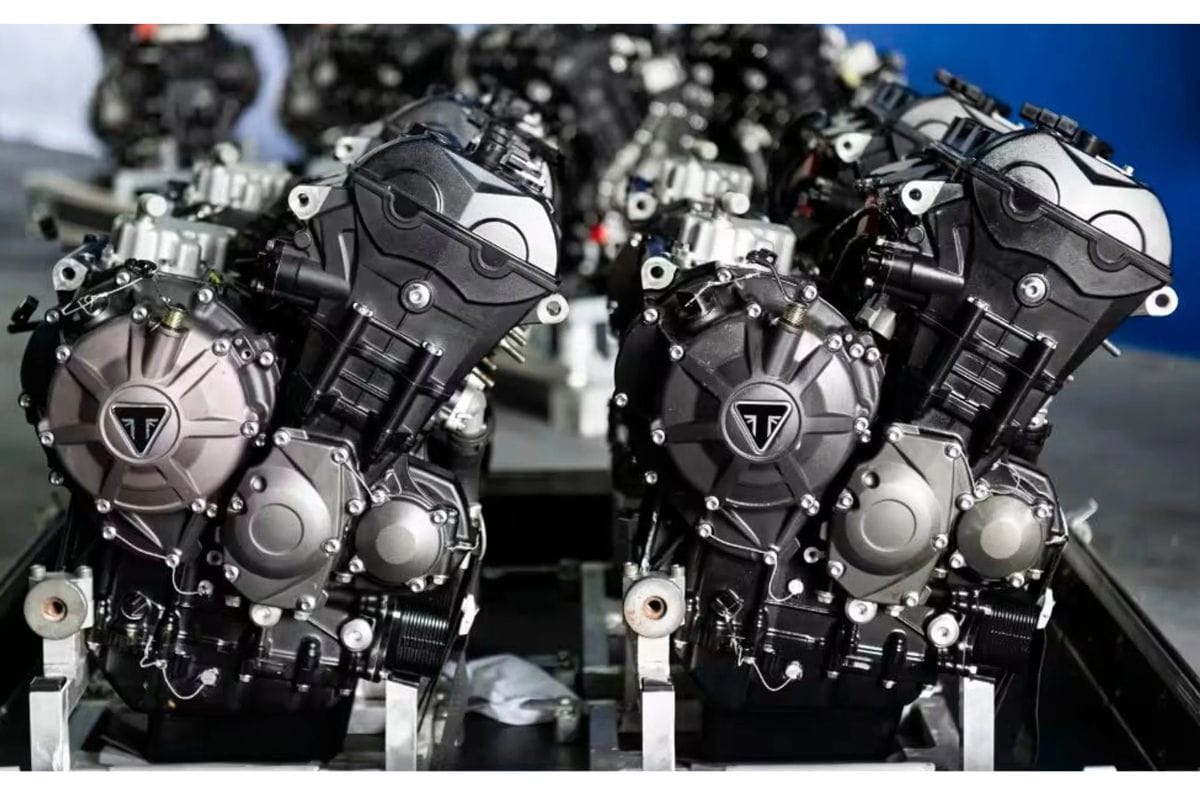
Triumph Motorcycles will introduce a new race engine for the Moto2 World Championship from 2027, with track testing scheduled to begin in the coming months. The new power unit is expected to deliver around 6 percent higher peak power than the current engine and will also bring a change in engine capacity.

  1. Triumph has been the exclusive engine supplier for Moto2 since 2019
  2. Based on data gathered from nearly two million kilometres of racing
  3. This new engine focuses on increasing airflow into the cylinders

Triumph’s new Moto2 engine

This new engine is 2kg lighter and produces 6 percent more peak output

Triumph has been the exclusive engine supplier for Moto2 since 2019, when it replaced Honda. The new engine represents the most significant performance update to the Moto2 power unit since Triumph began supplying the championship.

The development has been based on data gathered from nearly two million kilometres of racing since 2019, along with feedback from Moto2 riders. The existing 765cc three-cylinder engine, derived from the Street Triple 765 RS, has received several updates over the years, including gearbox changes aimed at improving performance.

According to Triumph, the new engine focuses on increasing airflow into the cylinders. It features a redesigned cylinder head, a lower-inertia valvetrain, higher-flow ports and a new combustion chamber. These changes are intended to enable a higher compression ratio and increase torque across the rev range.

The crankcases and internal components have also been redesigned to handle the additional power and torque. Despite the performance increase, the revised engine is around 2kg lighter than the current unit.

The engine upgrade will also require Moto2 chassis manufacturers to develop new designs for the 2027 season. Changes will be required to the air-intake positioning and engine mounting points, among other areas.

Triumph said it has been working with chassis manufacturers for the past 12 months to provide the technical information required for the new engine. The power unit will be made available to Moto2 teams ahead of private testing, with its on-track debut planned for later this year.

Since Triumph became the Moto2 engine supplier, the championship has recorded close to 100 improvements in all-time and race lap records, according to the company.

Steve Sargent, Chief Product Officer, Triumph Motorcycles, said the new engine marks a step forward in the company’s partnership with MotoGP and builds on the development work carried out since 2019.

The new engine will make its competitive debut in the Moto2 World Championship in 2027 and could go on to power the future generation of the Triumph Street Triple as well.

Mahindra BE 07 interior spied for the first time

Mahindra BE 07 interior

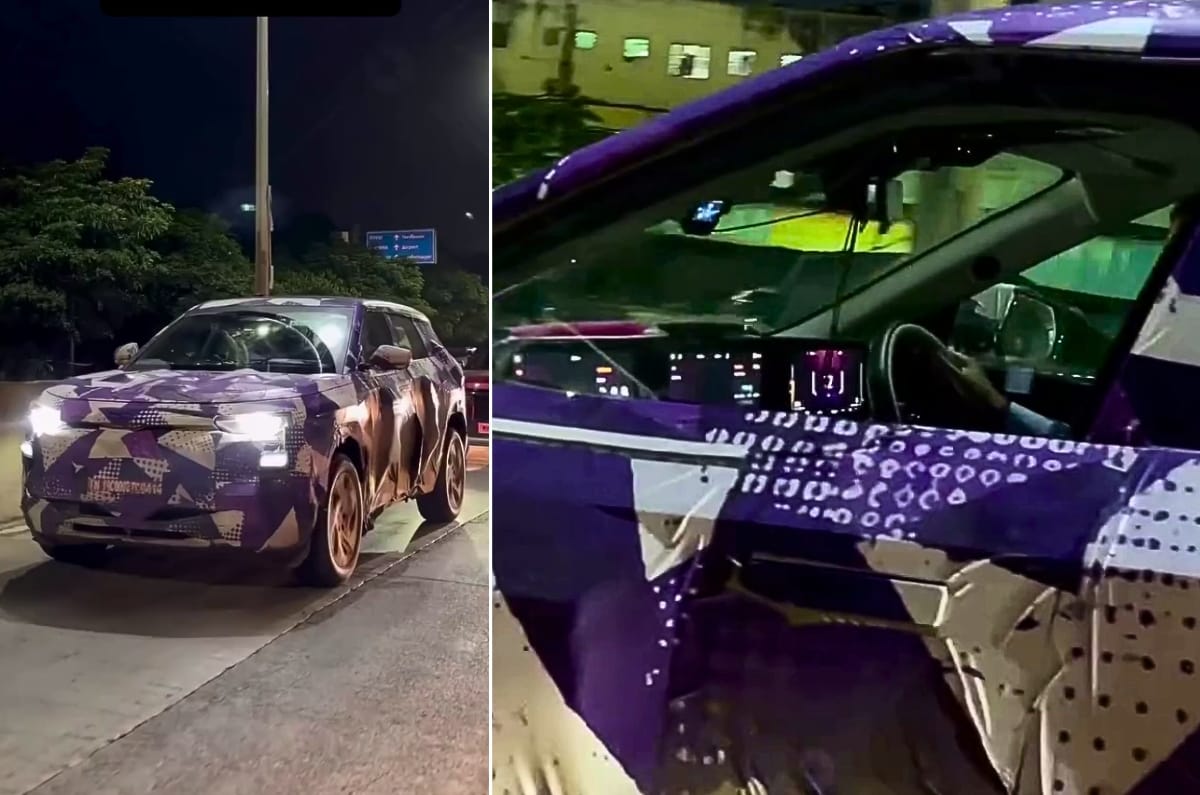
New spy shots of a Mahindra BE 07 test mule have given us the first glimpse of the upcoming electric SUV’s interior. Slated to hit the market in 2027, this SUV will be the production-spec version of the BE 07 concept, and will sit above the BE 6 as the second offering under Mahindra’s BE sub-brand.

Mahindra BE 07 interior details

Credit: CarDekho

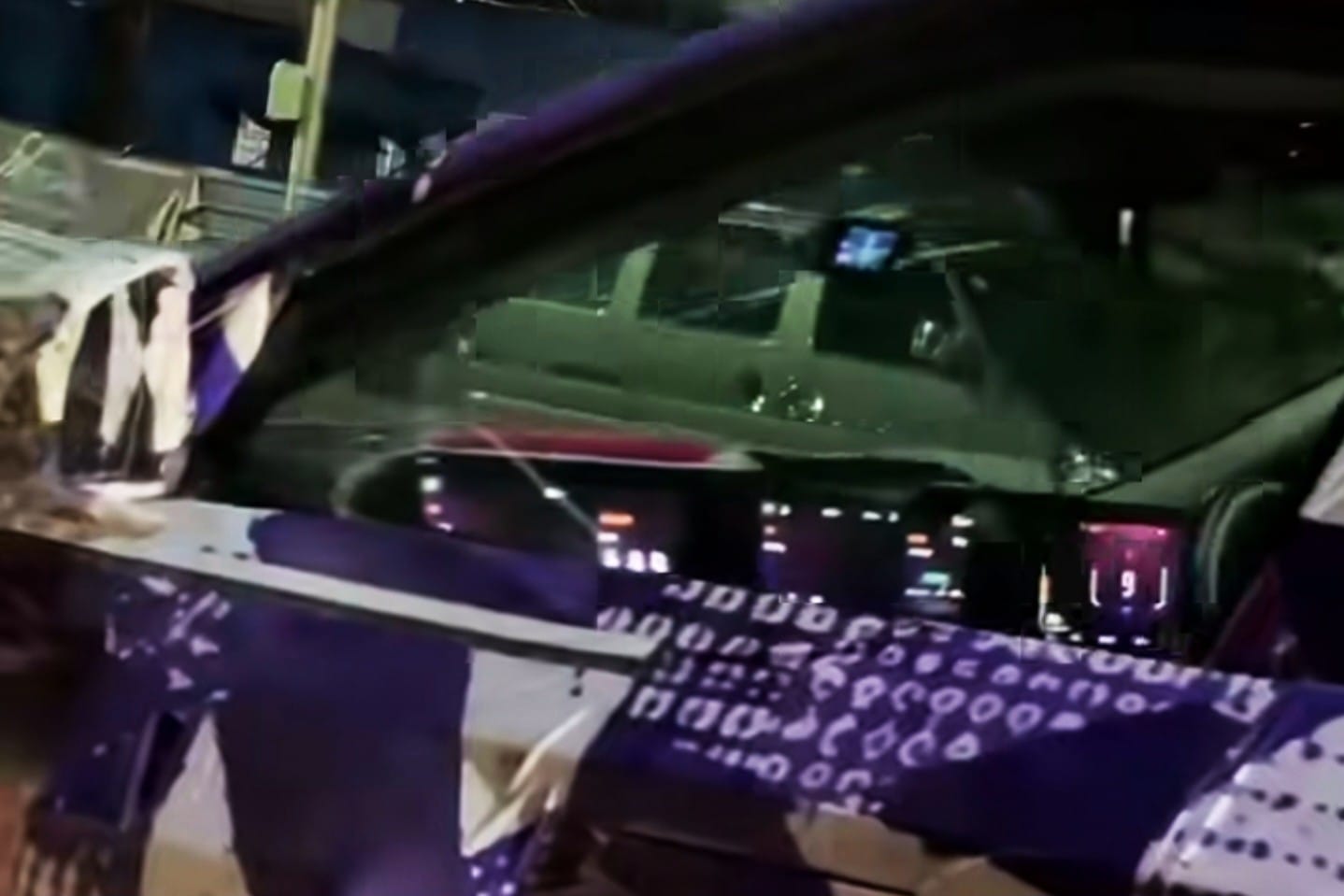
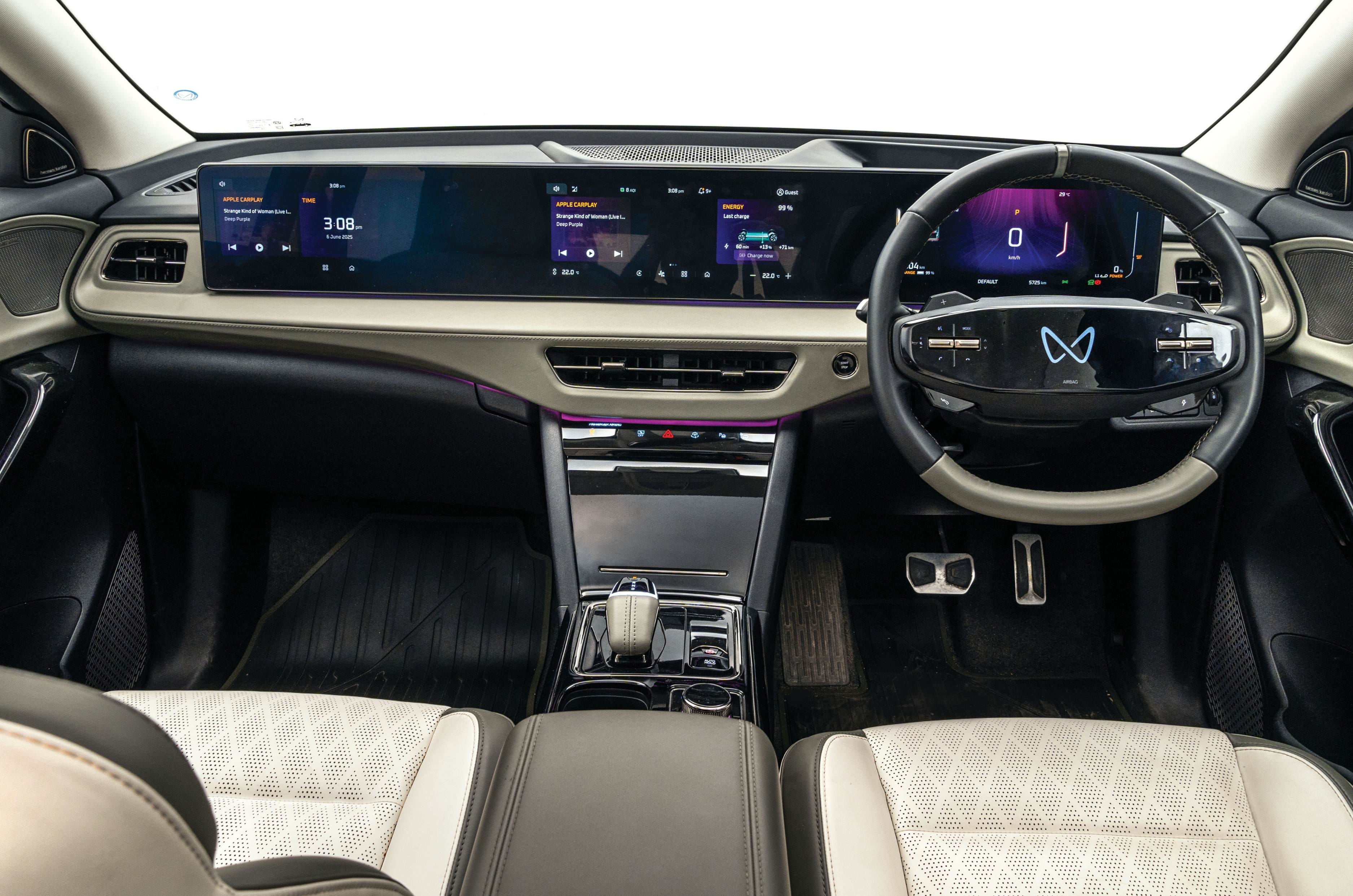
If this test mule is any indication, the production-spec BE 07 will mirror many of Mahindra’s newer models by hopping on the triple-screen bandwagon. A trio of large displays can clearly be seen in the spy shot, spanning the width of the dashboard. The Mahindra XEV 9e and XEV 9s offer similar setups, and a forthcoming updated version of the BE 6 will come with a triple-screen layout as well.

A small dashcam display is also visible on the BE 07’s windscreen, though it remains unclear whether it hints at a built-in unit or is specific to the prototype. For reference, the BE 6, XEV 9e, and XEV 9S feature a dashcam function that uses the 360-degree camera setup to record and save clips during emergency situations. However, continuous general-loop recording (like in a conventional dashcam) requires a USB storage device to be plugged in.

Mahindra XEV 9e interior. Image used for representation only.

Elsewhere, the production-spec BE 07’s cabin is likely to get a two-spoke steering wheel with the ‘butterfly’ Mahindra logo (used exclusively for the carmaker’s born-electric offerings), ambient lighting, a 5-seat configuration, and more.

Mahindra BE 07 battery and range

Credit: CarDekho

The BE 07 is expected to be underpinned by Mahindra’s INGLO platform and retain the BE 6’s 59kWh and 79kWh battery packs. Since the BE 07 will be larger than the BE 6, its range is likely to be lower than the MIDC-tested 548-683km that the latter claims. As for rivals, the BE 07 is expected to butt heads with the likes of the Tata Harrier EV, Vinfast VF7, and BYD Atto 3.

Nissan Gravite CNG real world fuel economy tested, explained

Nissan Gravite CNG

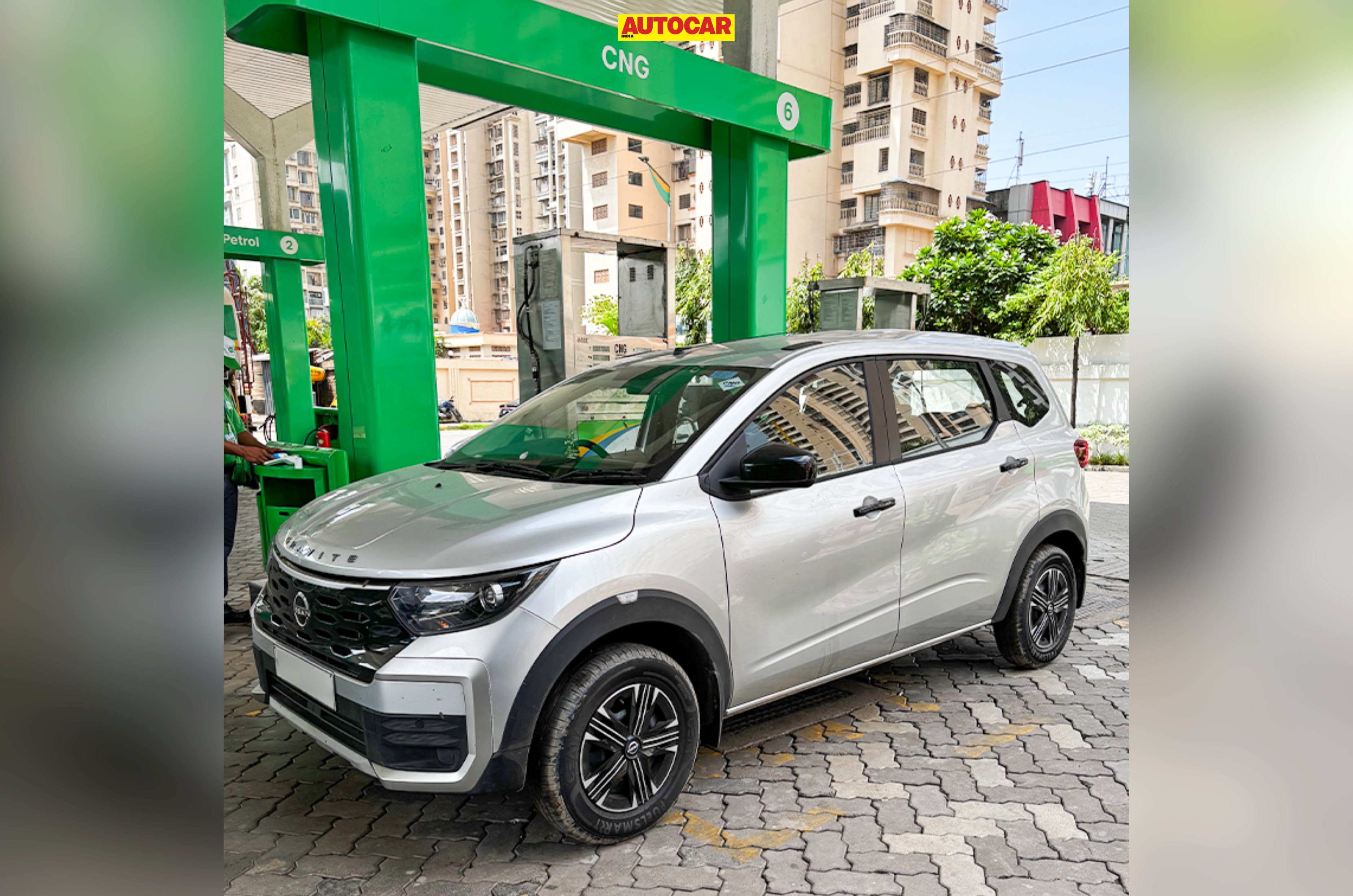
The Nissan Gravite, launched in February, 2026, is among the most affordable three-row MPVs sold in the country. In May, Nissan started offering the Gravite with a dealer-level CNG kit. Manufactured by Motozen, the kit is government and ICAT approved, and is available at an additional cost of Rs. 83,000. 

We’ve now put the Gravite CNG through our real-world fuel-efficiency tests to see how it performs.

  1. CNG kit available at an introductory price of Rs. 83,000.
  2. Spare wheel is mounted underneath the boot floor.
  3. 3-year/1,00,000km third-party warranty offered on CNG components.

It is powered by the same 1.0-litre, three-cylinder petrol engine (BR10) as seen in the Renault Triber, paired to a 5-speed gearbox. It produces 72hp and 96Nm of torque in petrol mode, however, Nissan is yet to reveal the claimed efficiency and the engine’s output when run on CNG. The twin CNG tanks are stacked vertically in the boot one above the other, each with a 25-litre capacity.

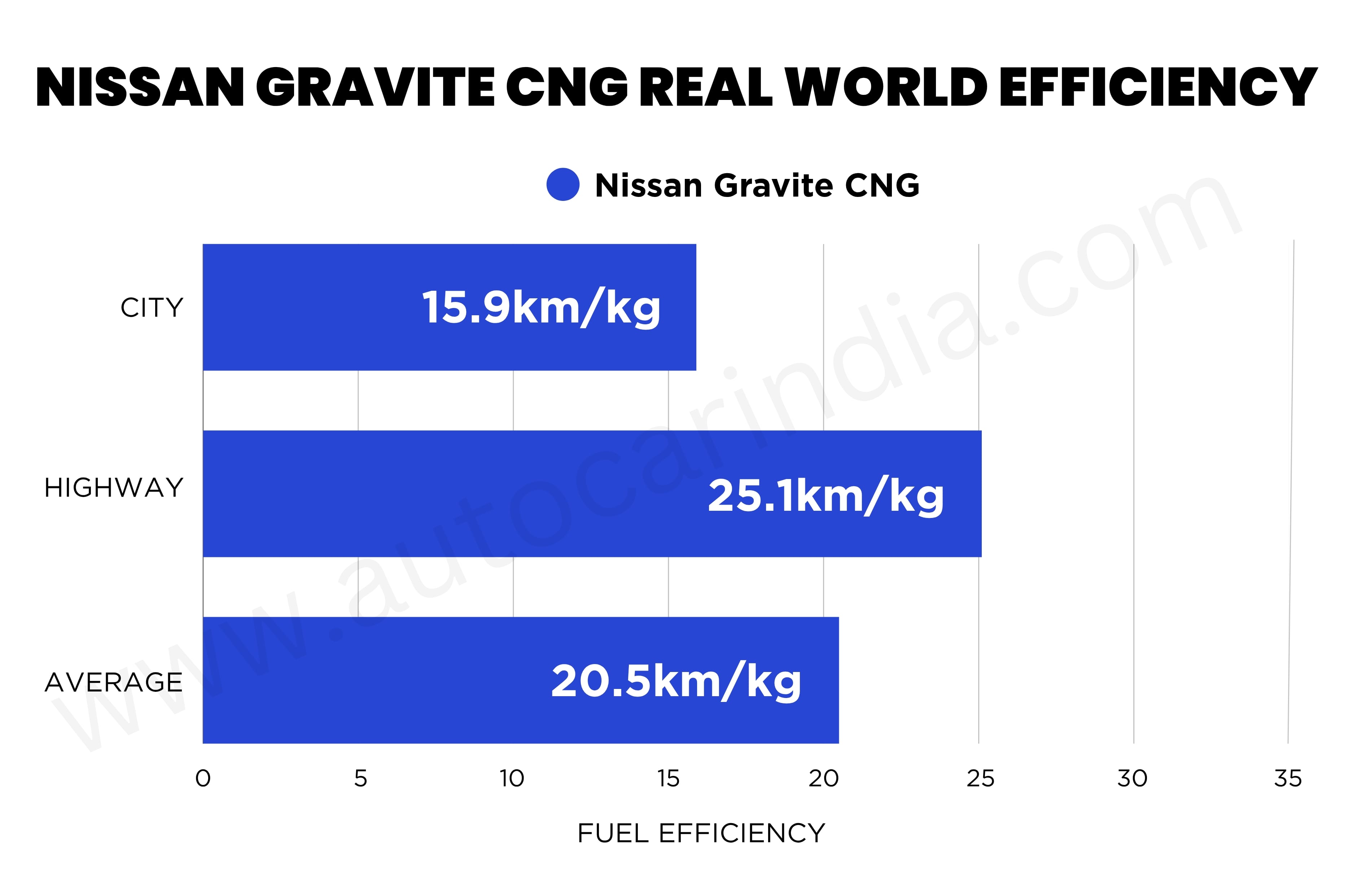
In our tests, the Gravite CNG delivered 15.9km/kg in the city and 25.1km/kg on the highway, for an overall average efficiency of 20.5km/kg.

When refilled from empty, we managed to fill  7.7kg of CNG, although this can vary depending on the pump pressure and ambient temperature. Based on our average overall efficiency of 20.5km/kg, one can expect a real-world range of 150-160km on a full tank of CNG.

Autocar India’s fuel-efficiency testing

Since CNG tanks are more difficult to fill consistently due to variables such as ambient temperature and pump pressure, we did not use our standard tankful-to-tankful methodology. Instead, for our real-world tests, we emptied the CNG tank and refilled it with 2kg of CNG. We then drove the vehicle in city conditions until the gas was exhausted. The same process was repeated for the highway run. Throughout both tests, the Gravite was driven exclusively in CNG mode.

Before our real-world fuel efficiency tests, we maintain tyre pressures based on the manufacturer’s recommendations. These cars are driven in fixed city and highway loops in and around Navi Mumbai, and we maintain certain average speeds. Throughout the tests, there is only one person in each car, and the aircon is set to fan speed 2 with temperature dialed to the lowest position. We operate other electricals, such as the audio system, indicators and wipers, just like a regular user would. Periodic driver swaps further neutralise variations in driver patterns.

Stock Market Today : बाजार पर आज इन खबरों का दिखेगा असर, कोई ट्रेड लेने से पहले इन पर डाल लें एक नजर

Market news : GIFT Nifty से मिल रहे संकेतों को देखते हुए लगता है कि 10 अगस्त को भारतीय बेंचमार्क इंडेक्स बढ़त के साथ खुल सकते हैं। GIFT Nifty शुरुआती कारोबार में बढ़त के साथ 24,660 के आसपास ट्रेड कर रहा था। यहां हम आपके लिए तमाम समाचार प्लेटफॉर्मों पर चल रही आज की ऐसी अहम खबरों की एक सूची जारी कर रहें हैं जो भारतीय और अंतर्राष्ट्रीय बाजारों को प्रभावित कर सकते हैं।

मार्केट ओवरव्यू

शुक्रवार को सेंसेक्स-निफ्टी गिरावट के साथ बंद हुए थे। ऑटो और IT शेयरों में अच्छी बढ़त के बावजूद बाजार पर फाइनेंशियल शेयरों में आई गिरावट का असर ज्यादा रहा। कारोबारी सत्र के अंत में सेंसेक्स 455.59 अंक या 0.58 प्रतिशत गिरकर 78,499.17 पर और निफ्टी 65.35 अंक या 0.27 प्रतिशत गिरकर 24,570.65 पर बंद हुआ। निफ्टी ऑटो और IT इंडेक्स में 1.84 प्रतिशत और 1.42 प्रतिशत की बढ़त हुई,जबकि प्राइवेट बैंकों के शेयरों में 1 प्रतिशत से ज्यादा की गिरावट आई।

गिफ्ट निफ्टी

सुबह 07:25 बजे के आसपास गिफ्ट निफ्टी करीब 40 अंक यानी 0.16 फीसदी की बढ़त के साथ 24,680 के आसपास कारोबार कर रहा था।

एशियाई बाजार

एशियाई शेयर बाजारों में तेजी देखने को मिल रही है। जापान के निक्केई में 2.09 फीसदी की बढ़त देखने को मिल रही है। स्ट्रेट टाइम्स में 1.04 फीसदी की तेजी दिख रही है। हैंग सेंग में 0.80 फीसदी की बढ़त के साथ कारोबार हो रहा है। ताइवानी बाजार में 1.89 फीसदी की तेजी के साथ कारोबार हो रहा है। कोस्पी में 0.69 फीसदी की मजबूती दिख रही है। शांघाई कंपोजिट में भी 0.59 फीसदी की तेजी नजर आ रही है।

अमेरिकी बाजार

शुक्रवार को अमेरिकी बाजारों में बढ़त देखने को मिली। S&P रिकॉर्ड ऊंचाई पर बंद हुआ। डाओ जोन्स इंडस्ट्रियल एवरेज 151.83 अंक या 0.28% बढ़कर 54,036.93 पर पहुंच गया। S&P 500 इंडेक्स में 47.68 अंक या 0.62% की बढ़त हुई और यह 7,757.64 पर बंद हुआ। वहीं, नैस्डैक कम्पोजिट 342.26 अंक या 1.30% बढ़कर 26,690.62 पर पहुंच गया।

डॉलर इंडेक्स

शुरुआती कारोबार में दुनिया की अधिकांश बड़ी मुद्राओं के मुकाबले डॉलर में थोड़ी बढ़त देखने को मिल रही थी। ईरान और ओमान स्ट्रेट ऑफ़ होर्मुज़ को फिर से खोलने के लिए किसी अंतिम समझौते पर नहीं पहुंच पाए हैं। जोखिम के प्रति संवेदनशील मुद्राओं का प्रदर्शन कमजोर नजर आ रहा है। डॉलर इंडेक्स 99.63 के लेवल पर दिख रहा है।

US बॉन्ड यील्ड

अमेरिका में 10 ईयर और 2 ईयर के ट्रेजरी बॉन्ड की यील्ड 4.66% और 4.20% पर ऊपर ट्रेड कर रही है।

एशियाई करेंसी

अमेरिकी डॉलर के मुकाबले एशियाई करेंसीज में मिला-जुला रुख नजर आ रहा है। इंडोनेशियाई रुपिया (+0.15%),फिलीपींस पेसो (+0.21%),थाई बाहत (+0.17%), ताइवान डॉलर (+0.16%),चीनी रेनमिनबी (+0.06%) और मलेशियाई रिंगित (+0.06%) मजबूत दिख रहे हैं। जबकि दक्षिण कोरियाई वॉन (-0.50%),जापानी येन (-0.18%)और सिंगापुर डॉलर (-0.09%) कमजोर कारोबार कर रहे हैं। दक्षिण कोरियाई वॉन में सबसे ज्यादा गिरावट नजर आ रही है।

FII और DII फंड फ्लो

7 अगस्त को विदेशी संस्थागत निवेशकों (FIIs) ने ₹480 करोड़ के शेयर खरीदे। जबकि घरेलू संस्थागत निवेशकों (DIIs)ने लगातार तीसरे दिन भी खरीदारी जारी रखते हुए ₹235 करोड़ के शेयर खरीदे।

BMW M 1000 RS in the works for 2027

R 1300 RS headlight

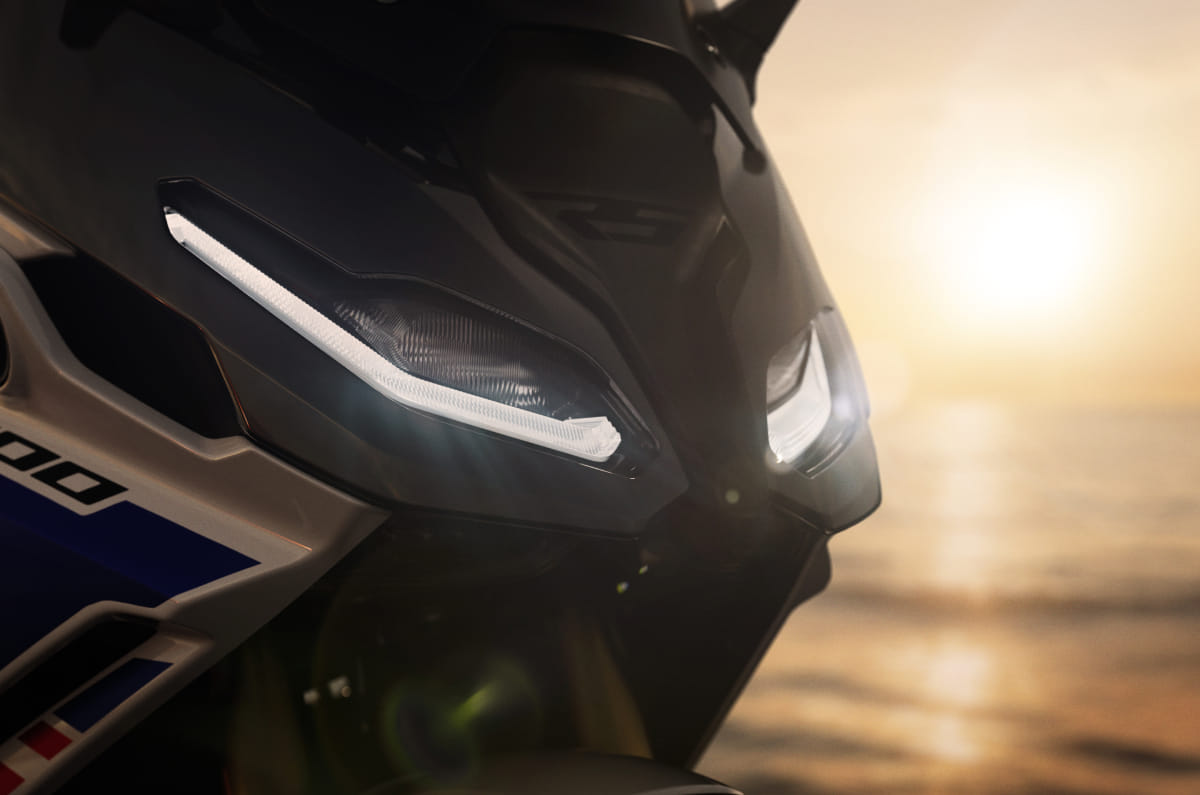
A new BMW M model appears to be in the works for 2027 with emissions filings with the US Environmental Protection Agency (EPA) and the California Air Resources Board (CARB) having independently certified a model listed as the BMW M 1000 RS. The nomenclature suggests that the upcoming model could be a sport-touring derivative of the M 1000 RR.

  1. US EPA and CARB certifications independently confirm a 2027 BMW M 1000 RS
  2. Expected to use the same 999cc inline-four as the M 1000 RR
  3. Likely to feature a sport-touring setup

What to expect from the BMW M 1000 RS

Spy images have revealed that BMW is also likely working on an M 1300 GS

In both the EPA and CARB filings, the M 1000 RS appears alongside the M 1000 RR under the same emissions certification, suggesting it will share the same 999cc inline-four engine. The CARB data for the 2027 M 1000 RR points to the same 205hp at 13,000rpm and 113Nm as the current model.

What distinguishes the RS from the RR is likely to be its intent rather than its engine. BMW has traditionally used the ‘RS’ (Reise und Sport, German for ‘Travel and Sport’) suffix on its sport-touring motorcycles, such as the R 1300 RS, which uses a 1,300cc boxer twin. An M 1000 RS would therefore represent an entirely new product, becoming the first RS model to use an inline-four platform.

Currently, BMW’s global M motorcycle lineup comprises the M 1000 RR, M 1000 XR and M 1000 R, the last of which was recently launched in India at Rs 33.50 lakh. Spy images of what appears to be an M 1300 GS have also surfaced online in recent days, suggesting the M 1000 RS may not be the only all-new M model planned for 2027. BMW is also known to be developing the next-generation S 1000 RR, and a design patent for the motorcycle was filed in India last month.

BMW seems to have several major product unveilings in the pipeline, and with the emissions certifications covering the 2027 model year, an official reveal at EICMA this November appears likely.

Source: Motorcycle.com