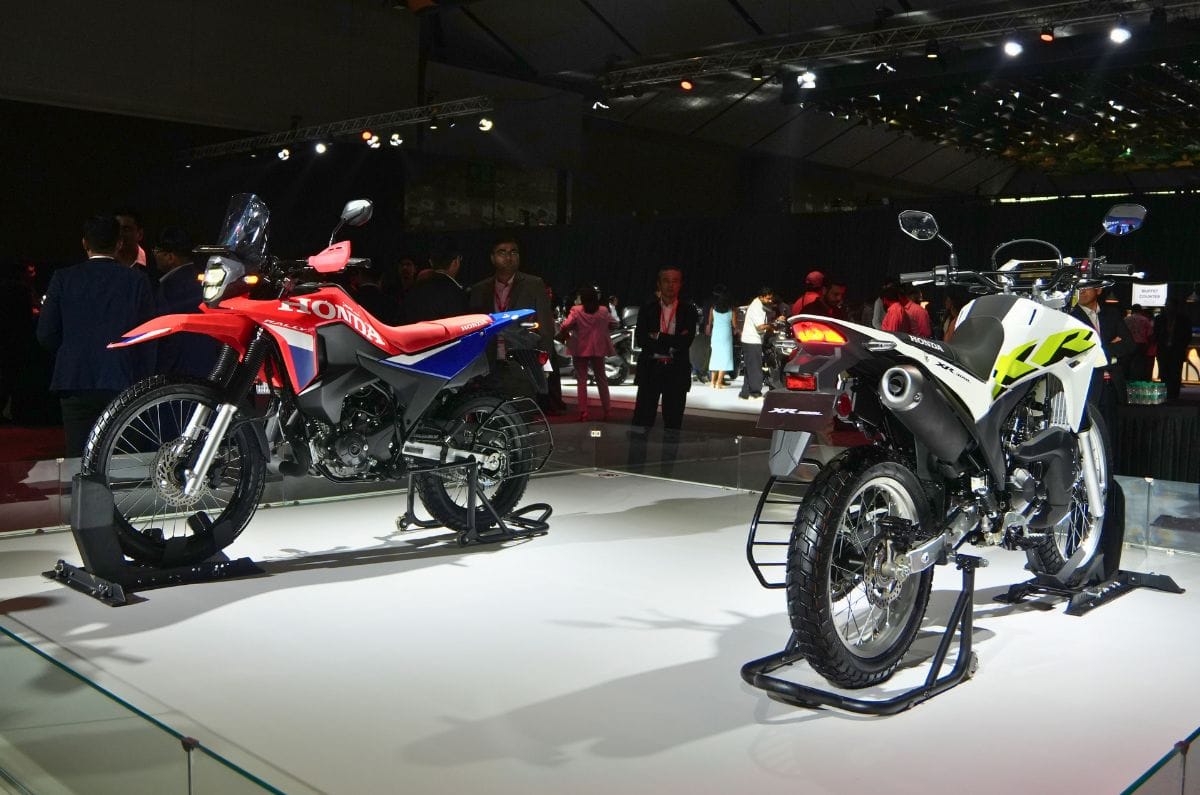
The small-capacity adventure motorcycle segment in India has never been more competitive, and understandably so, given how well these bikes suit our riding conditions. While Honda has long had capable dual-sport motorcycles in its global portfolio, it never offered one in our market. That has now changed with the announcement of the XR300L and XR300 Rally. The brand is yet to reveal full specifications, but a combination of what is visible on the bikes and Honda’s existing global lineup gives us a good idea of what to expect. Here’s everything we know so far.
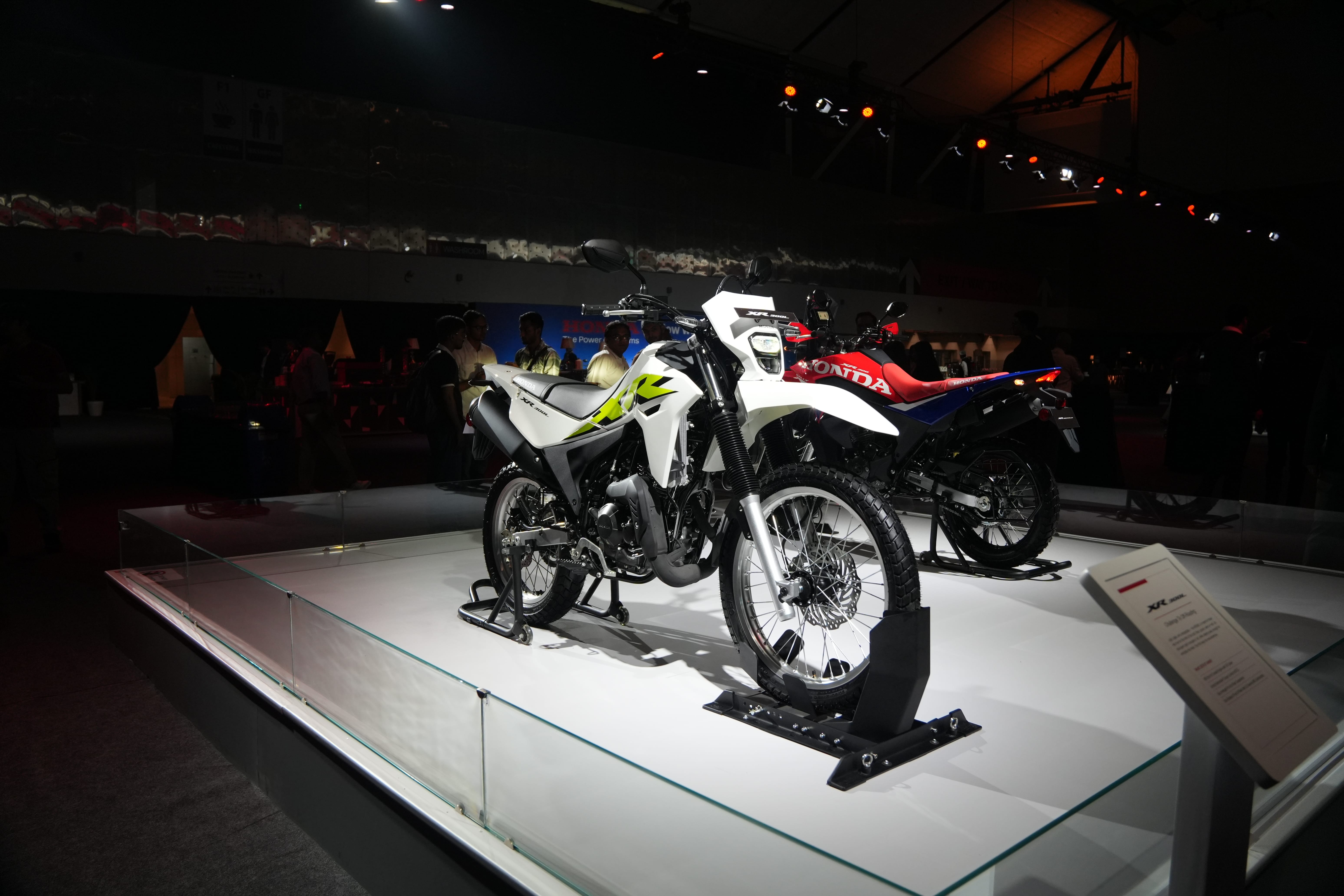
Honda XR300L
Engine is likely related to the CB300F, and Honda already sells an XR300L in South America
Visually, the engine on the India-spec XR300L appears closely related to the 293cc unit found in the CB300F. Additionally, Honda already sells an XR300L in South American markets such as Brazil and Colombia, and that motorcycle also uses a 293cc engine. If the India-spec bike uses the same motor, it is likely to produce around 24.3hp at 7,500rpm and 26.5Nm at 5,750rpm.
Interestingly, the Brazilian-spec XR300L is Flex Fuel-compatible, allowing it to run on either petrol or ethanol. While Honda has not confirmed whether the India-spec motorcycle will feature the same capability, it would make sense given the increasing focus on ethanol-blended fuels in India.
The South American XR300L is certified only to Euro 3 emissions standards, which could explain why the India-spec bike features noticeably different exhaust routing. The stricter emissions regulations here are likely to require revised exhaust architecture and engine tuning, even if the underlying engine remains the same. The bodywork also differs slightly from the South American model.
The bike sold in Brazil and Colombia uses a telescopic fork with 221mm of wheel travel and a rear monoshock with 227mm of travel. While Honda has not confirmed the India-spec motorcycle’s suspension figures, we could expect to see similarly impressive figures. The bike also rides on a 21-inch front and 18-inch rear wheel combo – a setup also seen on the India-spec bike.
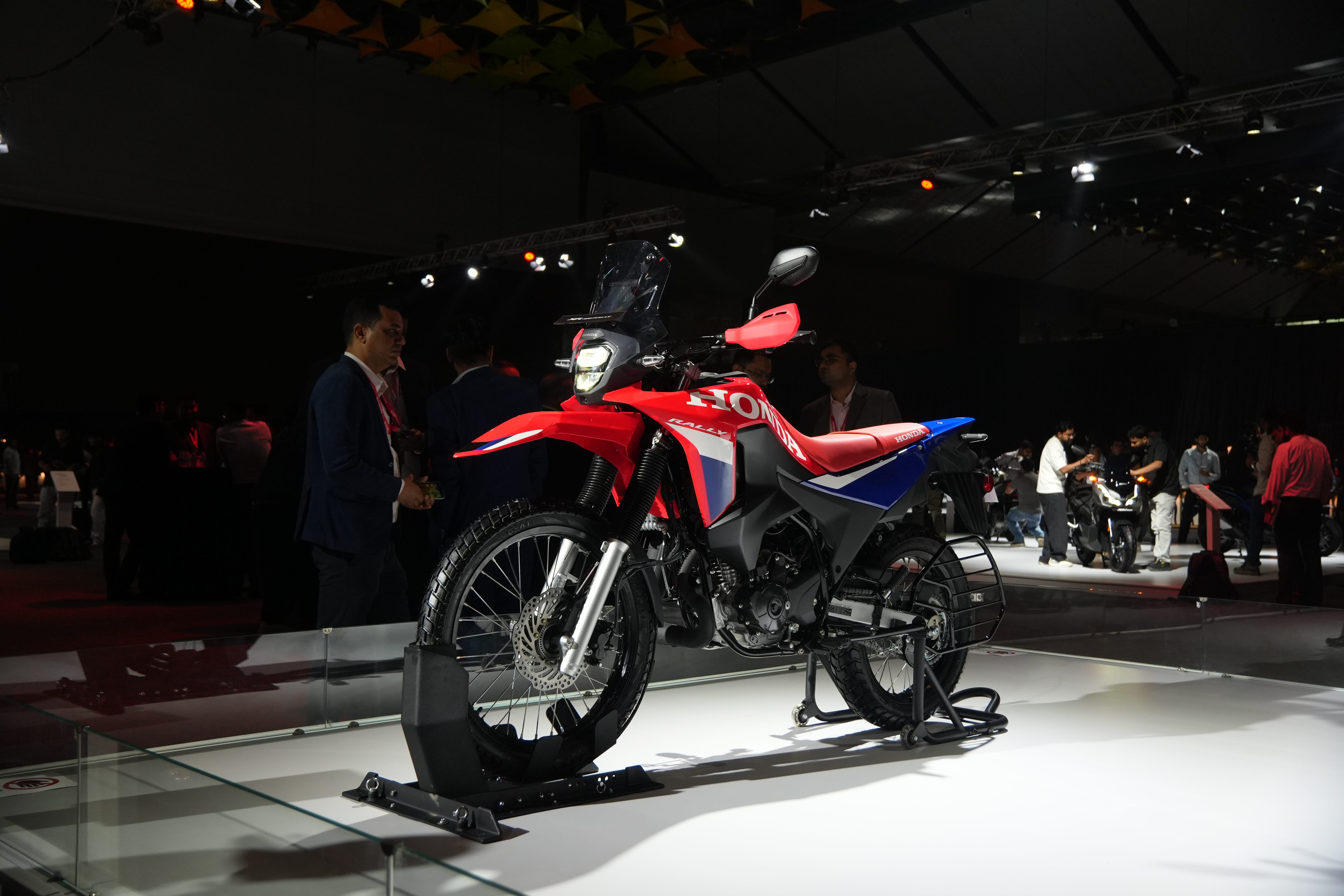
Honda XR300 Rally
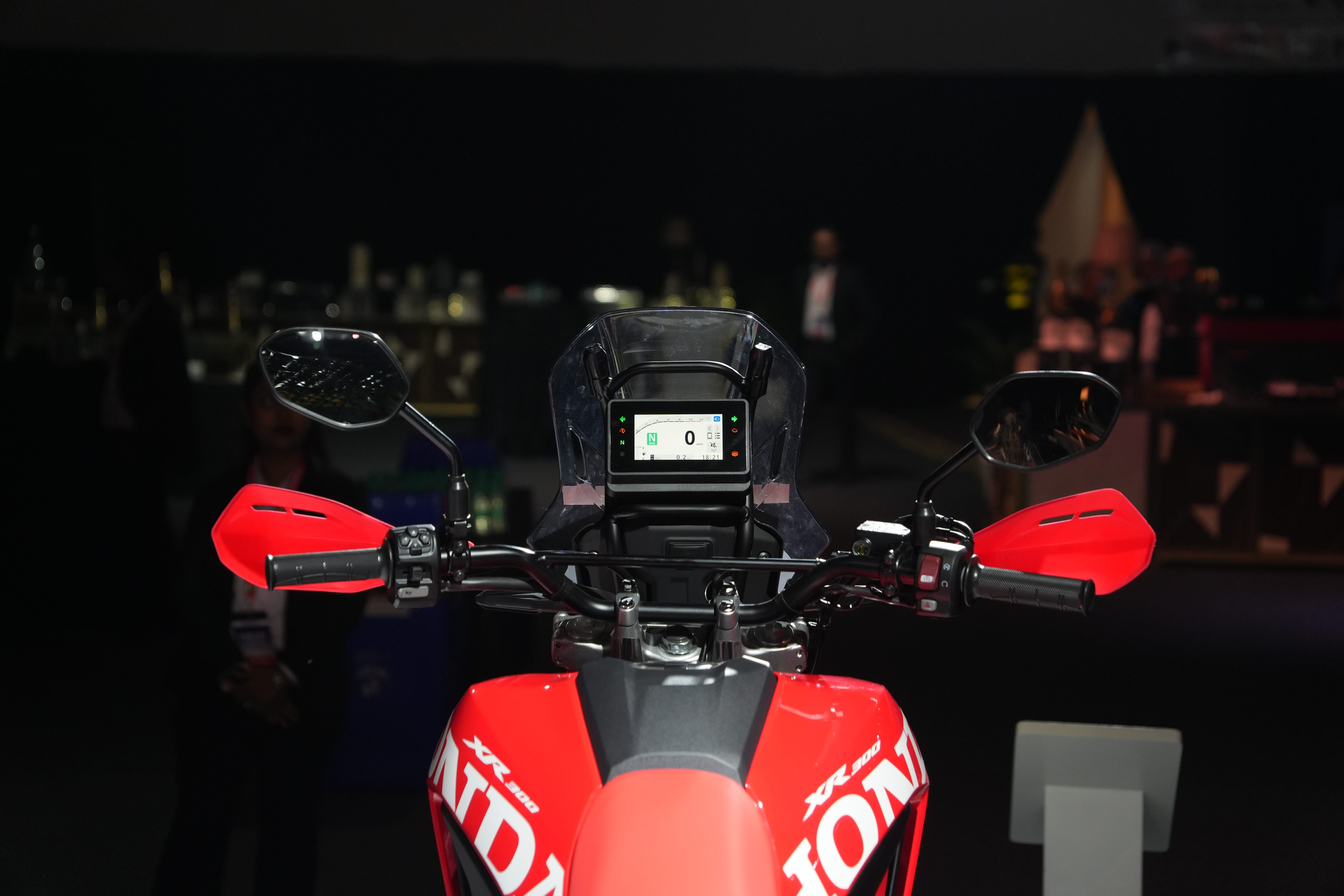
Gets a larger fuel tank, taller windscreen and TFT display over the XR300L
The XR300 Rally is expected to share its engine and core mechanical package with the XR300L, while adding equipment better suited to long-distance touring. Confirmed additions include a larger fuel tank (capacity yet to be revealed), a 5-inch TFT display that we’ve already seen on several Honda motorcycles in India, and more comprehensive switchgear to access its additional functions. A taller windscreen, knuckle guards and unique bodywork are also part of the package. The Rally also appears to use a different tyre tread pattern, although wheel and tyre sizes are expected to remain unchanged.
If the relationship between the global CRF300L and CRF300 Rally is anything to go by, the XR300 Rally is also likely to feature a slightly taller seat height, a marginal reduction in ground clearance and a small increase in kerb weight owing to its larger fuel tank.
For now, that’s all we know. Honda is yet to announce pricing or full specifications for either motorcycle, but with both bikes now officially unveiled, a launch over the coming months is imminent. Local manufacturing should also allow Honda to price them competitively. For reference, the arch rivals to these bikes, the Kawasaki KLX230 and Hero Xpulse 210 cost Rs 2.19 lakh and Rs 1.67-1.76 lakh, respectively.
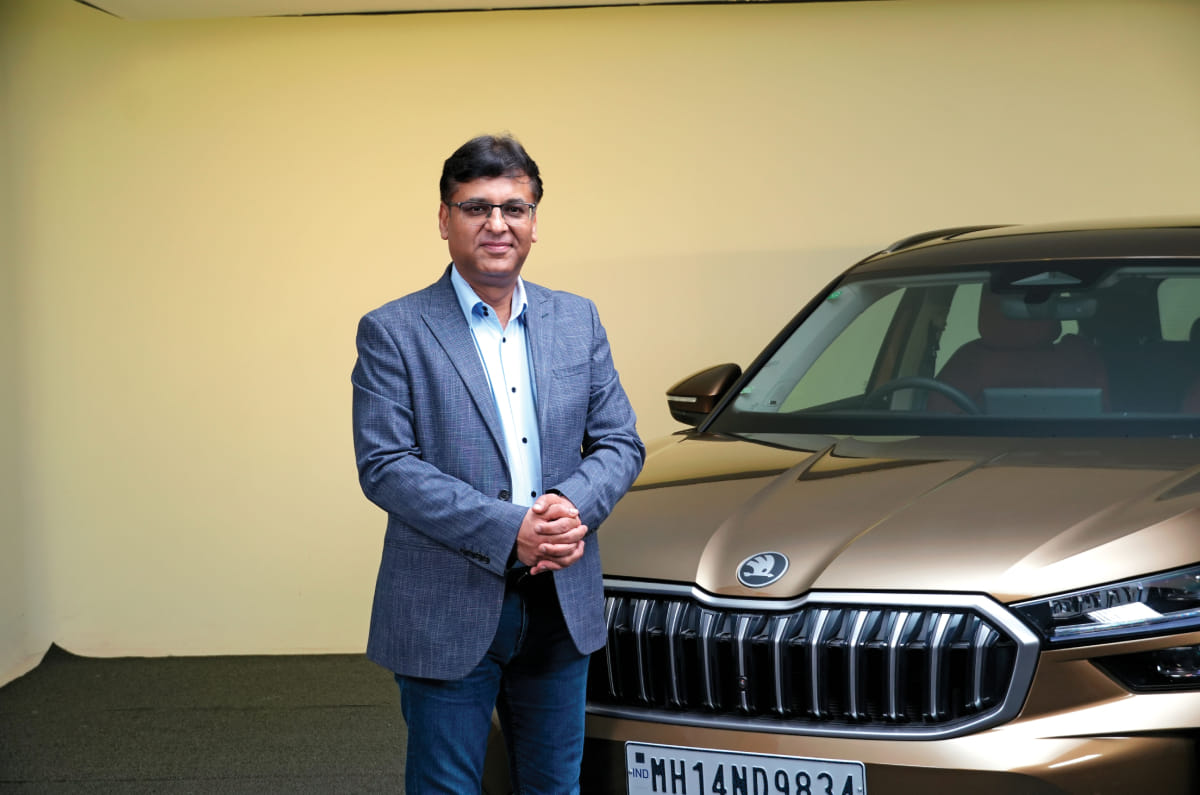
Skoda Auto India has had a busy year, with the launch of the Kylaq, the return of the Kodiaq, an expanding dealer network and plans to strengthen its presence across multiple segments. The company is also preparing for an electric future while continuing to invest in its petrol-powered portfolio. In this interview, Brand Director Ashish Gupta talks about Skoda’s sales growth, the launch of the Kodiaq RS, upcoming model updates, EV strategy and the steps being taken to improve the ownership experience in India.
On his first year at the helm of Skoda India.
Coming from Volkswagen, I’ve basically switched to the other side of the office, but I’d say it’s been challenging but exhilarating. I’m more than satisfied with the year, from the brand side, sales and also setting the foundation for the future. All our KPIs – brand image, awareness, consideration, network coverage, dealer profitability, customer satisfaction, market coverage, etc. – have improved, and we have done really well. In sales, we went from number eleven to seven, and we also became number four in the global sales ranking for Skoda, just slightly behind the UK.
On the launch of the Kodiaq RS.
The Kodiaq is our flagship. It came here in 2017, and we have it on sale again. At the same time, this year marks 125 years for Skoda in motorsport, and it’s also about 50 years since the RS badge was first born, so we thought it would be great to bring in the Kodiaq RS as the pinnacle of our engineering and motorsport heritage. It’s coming in as a fully built unit, and we have only 50 units; allocation is a challenge when it’s a bestseller abroad, but we have the option of another batch later on.
On the Kylaq driving Skoda’s sales growth.
Yes, a large portion of our sales came from the Kylaq, but that was also because we were running out the Kushaq, which was due for an update and has now been launched. So, the demand for the Kushaq was always there. Also, it’s only been two months, so it’s too early to qualify, but we have seen an uptake of about 40% in sales, and the order book is solid.
On the Slavia and the upcoming update.
The Slavia is a very special model for us. SUVs are the flavour of the season, but sedans are doing fine too, and we are among the few manufacturers in the world that still have a sedan portfolio, all of which are doing well. In India, the Slavia continues our sedan legacy of models like the Octavia, Superb and Rapid, and so, yes, it will see an update, but it’s early to specify details.
On the company’s electric vehicle plans.
If you want to be a relevant player in that space, you have to have a local play, so that’s what we are working on. EV penetration was 7% in May, up from 4.5% at the end of last year, so yes, this is a space where we will accelerate our plans, but you cannot do this suddenly, as there are factors like the supply chain to consider. But there’s an international portfolio too that we can look at.
On the possibility of the Peaq making it to India.
Bringing in a global model is very difficult as far as pricing goes, and the EU-FTA, as you know, does not give benefits to EVs for now. So, for now, we have to look at what makes sense, and yes, a larger EV is easier to manage pricing with. And yes, the Peaq is certainly on my radar. We will look at the specifications and see how we can best manage that with pricing, as you cannot have a high-priced CBU but be low on equipment. So, we are working on this. My ambition is to get the global portfolio to India.
On a petrol-only portfolio and flex-fuel cars.
If you see, year to date, the petrol market is about 46%, which used to be above 50% last year, so there is a shift, but the market is also growing by 20%. So even if the share of other fuels is rising, the absolute volume of petrol is increasing, so I’m not worried about our current portfolio. As for flex fuel, yes, ethanol is a longer-term strategy that the government wants, so we have to look at it, and we are, but there is work to manage this, as we have to look at the engine portfolio and manage our strict emission norms too.
On addressing Skoda’s dealer experience.
If you look at our customer experience scores, they have been improving. Sales have grown by almost 12 percent over the last year, and customer experience for service has improved by 18 to 20 percent. So, are we perfect? No, but the trend has improved and is only rising. Also, we are now present at about 335 touchpoints in 183 cities and are just inaugurating our 200th workshop in India, so we are getting closer to our customers. We have competitive service packs and excellent parts availability. Today, we have a parts service rate of more than 96 percent at our warehouses and dealerships, which is among the best in the industry.
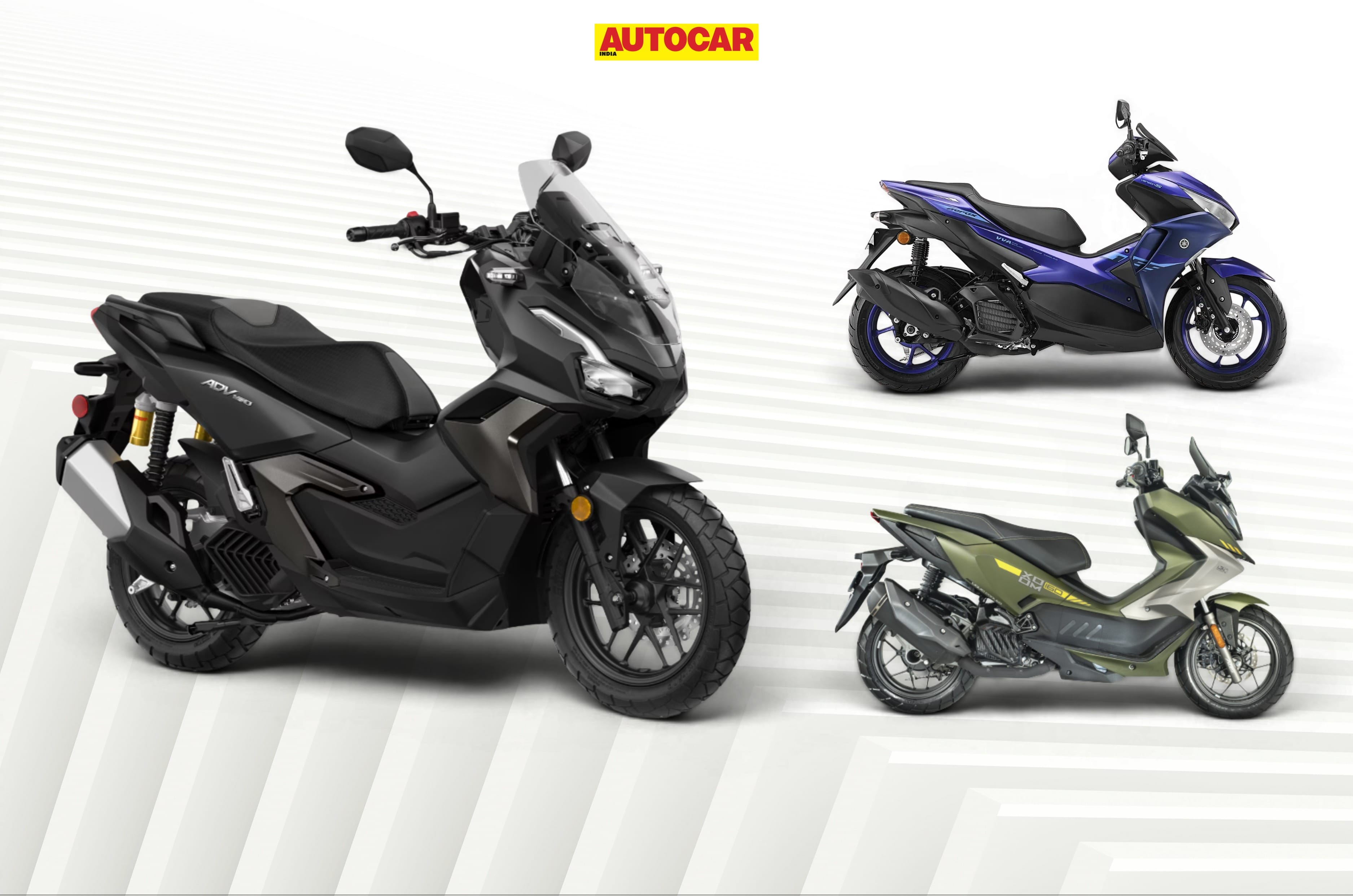
The premium maxi-scooter segment is steadily gathering momentum in India, and Honda has now committed to it with the unveiling of the much-anticipated ADV160. The adventure-styled scooter joins the HeroXoom 160 and YamahaAerox 155, giving buyers another premium 160cc, liquid-cooled option.
Honda, however, has arrived with a trick up its sleeve. The ADV160 has been showcased with an E85-compatible flex-fuel engine, making it the first flex-fuel scooter to be showcased in India. We compare its specifications with those of its closest rivals to see how the three stack up on paper.
Honda ADV160 vs rivals: Engine and output
Honda ADV160
Hero Xoom 160
Yamaha Aerox 155
Engine
157cc, single-cyl, liquid cooled
156cc, single-cyl, liquid-cooled
155cc, single-cyl, liquid-cooled
Power
16.3hp
14.9hp
15hp
Torque
14.9Nm
14Nm
13.9Nm
Power-to-weight ratio
122.6hp/tonne
104.9hp/tonne
119.0hp/tonne
The ADV160 produces the most power and torque.
Honda has the upper hand on paper here, producing the highest output while also boasting the best power-to-weight ratio of the three. Interestingly, these output figures are marginally higher than those of the ADV160 sold in several overseas markets. Honda also pulled a surprise by showcasing the ADV160 with an E85-compatible flex-fuel engine, making it the first flex-fuel scooter to be showcased in India. While ethanol’s higher octane rating can allow manufacturers to adopt more aggressive engine calibration, Honda hasn’t attributed the ADV160’s class-leading performance specifically to its flex-fuel capability. The Aerox 155 follows closely behind and, thanks to its lower kerb weight, isn’t far off the ADV160 in terms of power-to-weight ratio. The Xoom 160, meanwhile, ranks third on outright performance and also has the lowest power-to-weight ratio, owing largely to it being the heaviest scooter in this comparison.
Honda ADV160 vs rivals: Weight and dimension
Honda ADV160
Hero Xoom 160
Yamaha Aerox 155
Kerb weight
133kg
142kg
126kg
Wheelbase
1323mm
1348mm
1350mm
Ground clearance
NA
155mm
145mm
Seat height
780mm
787mm
790mm
Fuel tank capacity
8.0 litres
7.0 litres
5.5 litres
The ADV160 comes with the most fuel-carrying capacity
Honda is yet to reveal most of the ADV160’s weight and dimension specifications for the India-spec model, so the figures above have been sourced from the scooter sold in international markets and should be taken with a pinch of salt. Even so, the ADV160 appears to strike a middle ground between its two rivals, undercutting both in seat height while offering the largest underseat storage and fuel tank. The Aerox 155 remains the lightest scooter here and also has the longest wheelbase, while the Xoom 160 is the heaviest but offers a higher ground clearance than the Yamaha.
Honda ADV160 vs rivals: Tyres, brakes and suspension
Honda ADV160
Hero Xoom 160
Yamaha Aerox 155
Tyres
110/80-14 / 130/70-13
120/70 – R14 / 140/60 – R14
110/80-14 / 140/70-14
Brakes
240mm disc / 130mm drum (Single-channel ABS)
240mm disc / drum (Single-channel ABS)
230mm disc / 130mm drum (single-channel ABS)
Suspension
Telescopic fork / dual-shock absorber
Telescopic fork / dual-shock absorber
Telescopic fork / dual-shock absorber
All three scooters get single-channel ABS
There’s little to separate the three scooters when it comes to cycle parts, with telescopic front forks, twin rear shock absorbers and single-channel ABS standard across the board. The ADV160 and Xoom 160 get a larger 240mm front disc, while the Aerox uses a slightly smaller 230mm unit. Hero has equipped the Xoom with the widest front tyre, whereas the Aerox gets the widest rear tyre. The ADV160, meanwhile, is the only scooter here to combine a 14-inch front wheel with a 13-inch rear, while both the Xoom and Aerox ride on 14-inch wheels at both ends.
Honda ADV160 vs rivals: Features
The ADV160 clearly leads the way when it comes to features. It is the only scooter here to combine a TFT instrument cluster with traction control, an adjustable windscreen and an idling stop system, while also offering the largest underseat storage. The Xoom 160 and Aerox 155 both get smartphone connectivity, navigation and keyless ignition, but rely on LCD instrument clusters. Of the two, only the Aerox offers traction control, while the Xoom counters with an adventure-style design and a competitive feature list. Overall, Honda has equipped the ADV160 with the most comprehensive package on paper.
Alongside a slew of unveils, Honda has unveiled the ADV160 in India, showcasing its first maxi-scooter with adventure-inspired styling in the country that will also get E85 compliance, making it one of the first scooters showcased with flex-fuel compliance. Honda says the ADV160 will be locally-manufactured in India and even exported overseas, helping it keep costs in check. Once launched, the ADV160 will be sold via Honda’s both – Red Wing and premium Big Wing showrooms in India. It packs features such as single-channel ABS, traction control, and a TFT display with smartphone connectivity.
Honda ADV160 launch timeline to be announced soon
E85-compliant 157cc liquid-cooled engine makes 16hp and 14.7Nm
To be sold via both the RedWing and premium BigWing showrooms
Honda ADV160 unveiled: What to expect?
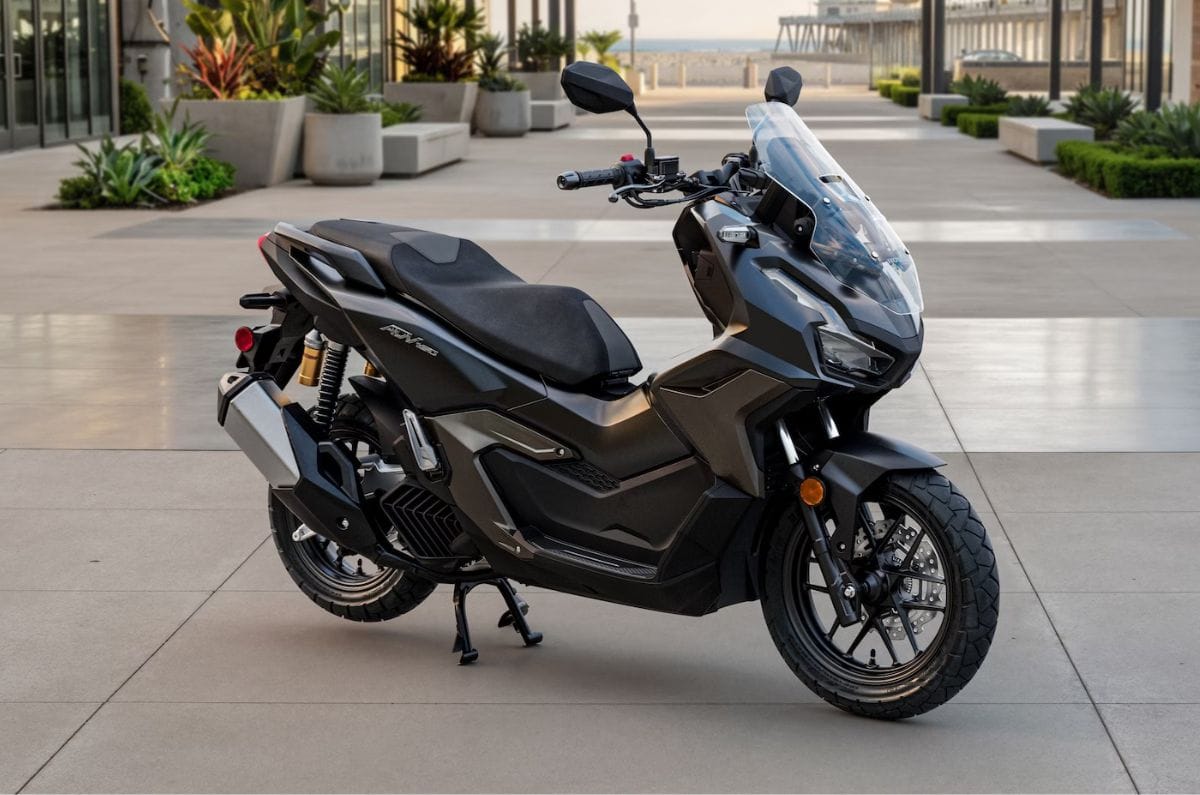
Styled like a scaled-down X-ADV, the ADV160 features a tall adjustable windscreen, twin LED headlamps, and block-pattern tyres. Honda says the ADV160 brings the ‘Adventure-scooter’ format to India through the concept of City Adventure.
Feature highlights include a TFT instrument display with Honda RoadSync smartphone connectivity, a USB charging socket, Honda Selectable Torque Control (traction control), single-channel ABS and a generous under-seat storage compartment of 27 litres.
Honda ADV160 engine details
Powering the ADV160 is a 157cc, single-cylinder, liquid-cooled engine producing 16.3hp and 14.9Nm, paired with a CVT automatic transmission. The talking point about this engine is its E85 compliance, denoting that it can run on an ethanol blend of up to 85 percent with 15 percent petrol.
The scooter rides on a telescopic fork and twin rear shock absorbers, with a 14-inch front and 13-inch rear wheel setup. It weighs 133kg, has a 780mm seat height, 165mm ground clearance and an 8.1-litre fuel tank.
Honda ADV160 launch details:
While the specifications of the ADV160 are out, the brand has only unveiled it and says that the launch timeline for the models will be announced later today and we will update this story accordingly. However, it’s safe to say that since the ADV160 will be locally manufactured here in India and exported overseas, the pricing for this maxi-scooter will be competitive.
Mercedes-Benz India has said every car it has sold in the country since January 2026 is compatible with E25 ethanol-blended petrol, making it one of the first luxury carmakers in India to prepare its portfolio ahead of any mandate for higher ethanol blends.
The announcement comes months after India completed the nationwide rollout of E20 petrol. More recently, the Bureau of Indian Standards (BIS) notified technical standards for higher ethanol blends, including E22, E25, E27 and E30, signalling the government’s efforts to prepare the regulatory framework for fuels beyond E20.
Mercedes cars in India have been E20-compatible since 2020
Announcement made at the launch of the AMG E 53 plug-in hybrid
Company to go ahead with a multi-powertrain strategy in India
Mercedes-Benz prepared line-up ahead of future ethanol norms
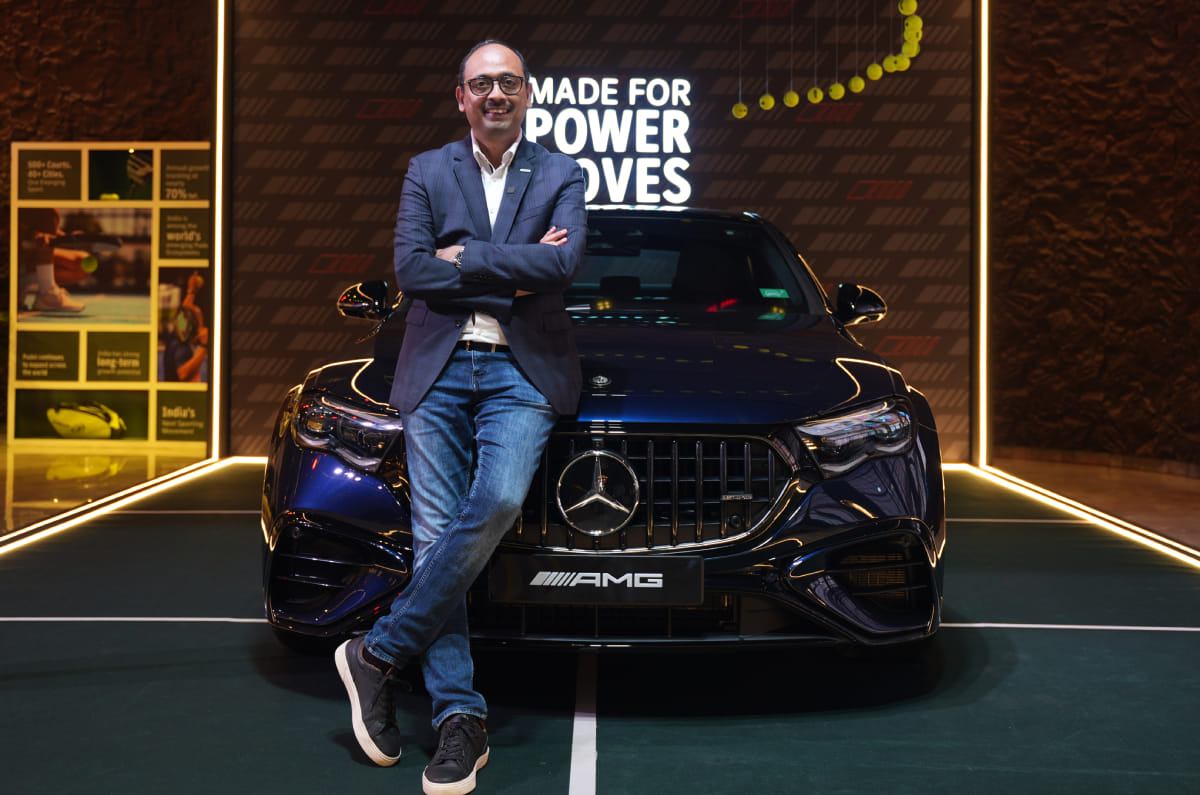
Speaking at the launch of the Mercedes-AMG E 53, Mercedes-Benz India Managing Director and CEO Santosh Iyer said the company upgraded its India portfolio in anticipation of future fuel regulations. Explaining the decision, Iyer said Mercedes-Benz wanted to prepare its products ahead of any future regulation. “The Mercedes customers expect that we will learn the legislation and upcoming trends. There are a lot of discussions on E25. It may not happen, but we want to offer cars which are compliant,” he said.
According to Iyer, Mercedes-Benz adopted E25 compatibility to future-proof its products as discussions continue around increasing ethanol blending beyond E20. He added that the company had similarly made its India line-up E20-compatible from 2020, around three years before the fuel became mandatory.
The announcement comes weeks after Mercedes-Benz highlighted concerns over fuel adulteration, rather than the E20 blend itself. The company had said inconsistent fuel quality could affect vehicle performance and called for stricter quality control as higher ethanol blends are introduced.
Mercedes-Benz to continue offering multiple powertrains
Mercedes-Benz said it will continue offering a mix of internal combustion engine, battery electric and plug-in hybrid models in India instead of focusing on a single powertrain technology. “Our job and responsibility is to offer good options across the spectrum, including gasoline with an E25,” he said.
The AMG E 53 launched alongside the announcement is the brand’s second plug-in hybrid model in India after the recently introduced S-Class Plug-in Hybrid, and the first electrified AMG E-Class in the country. Mercedes-Benz says customer demand in India continues to be spread across conventional ICE models and electrified vehicles, supporting its multi-powertrain strategy.
India completed the nationwide rollout of E20 petrol in April last year, making it the standard grade of petrol sold at fuel stations across the country. E20 contains 20 percent ethanol and 80 percent petrol, replacing the lower ethanol blends that were sold previously.
The transition has raised several questions among vehicle owners about compatibility, fuel efficiency, maintenance, warranties and long-term reliability. We separate the facts from the misconceptions and answer the key questions around E20.
1. What is E20 petrol and why has India switched to it?
E20 is fuel blended with 20 percent ethanol and 80 percent petrol. Ethanol is a biofuel produced from agricultural feedstocks such as sugarcane, maize and surplus food grains. India introduced the Ethanol Blended Petrol (EBP) Programme in 2003 with E5 petrol, and while the blended percentage kept varying for a while, it was eventually increased to E10 before completing the nationwide rollout of E20 in 2025, five years ahead of the planned implementation. According to the government, the programme aims to reduce dependence on imported crude oil, improve energy security, lower emissions and create an additional market for agricultural produce.
2. Can I use E20 fuel in my car or bike?
New petrol cars and two-wheelers sold in India today are compatible with E20 petrol. Under the government’s roadmap, vehicle manufacturers were required to make new petrol models manufactured from April 2023 compatible with E20.
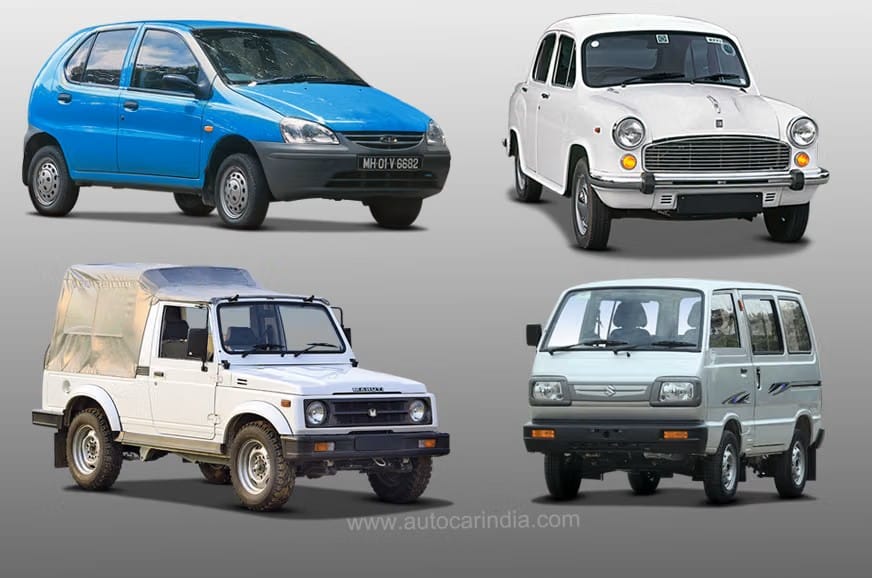
Vehicles manufactured before April 2023 were designed for lower ethanol blends, so compatibility may vary depending on the model and year of manufacturing. However, some brands state that they had E20 material compliance before 2023, for a list click here.
3. How do I know if my car is E20 compatible?
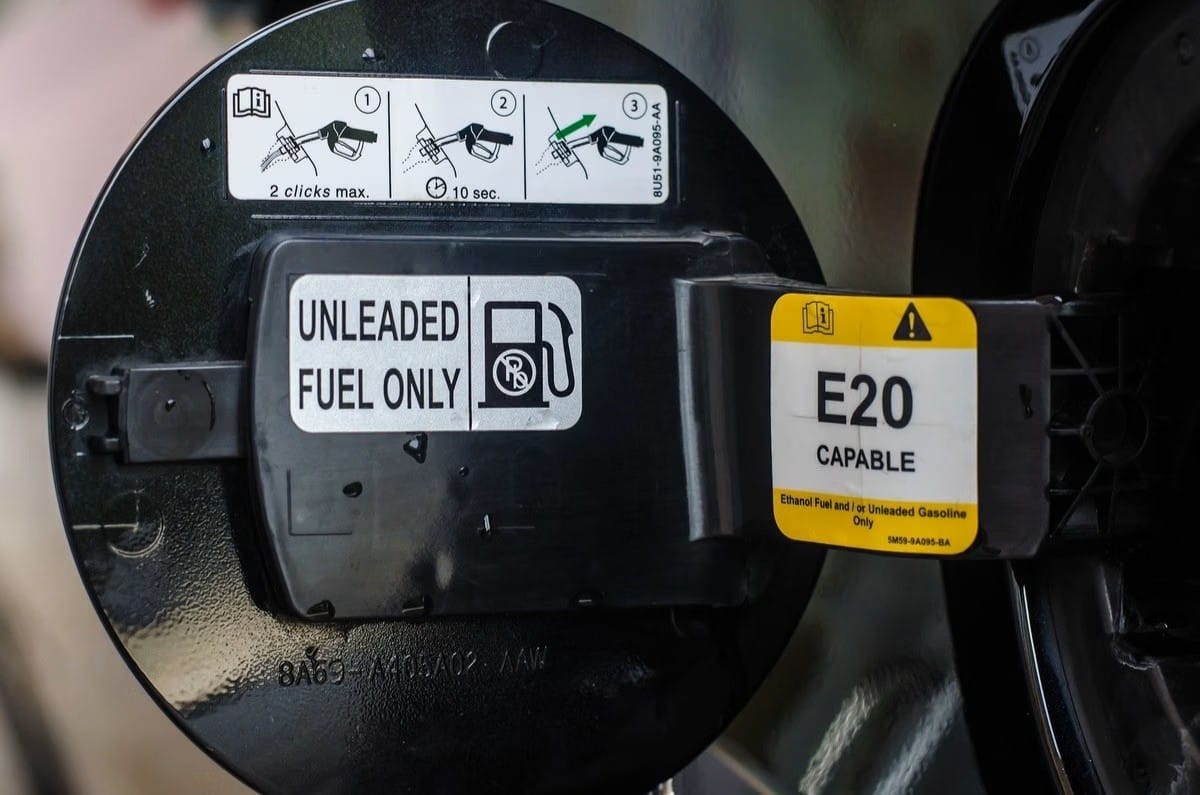
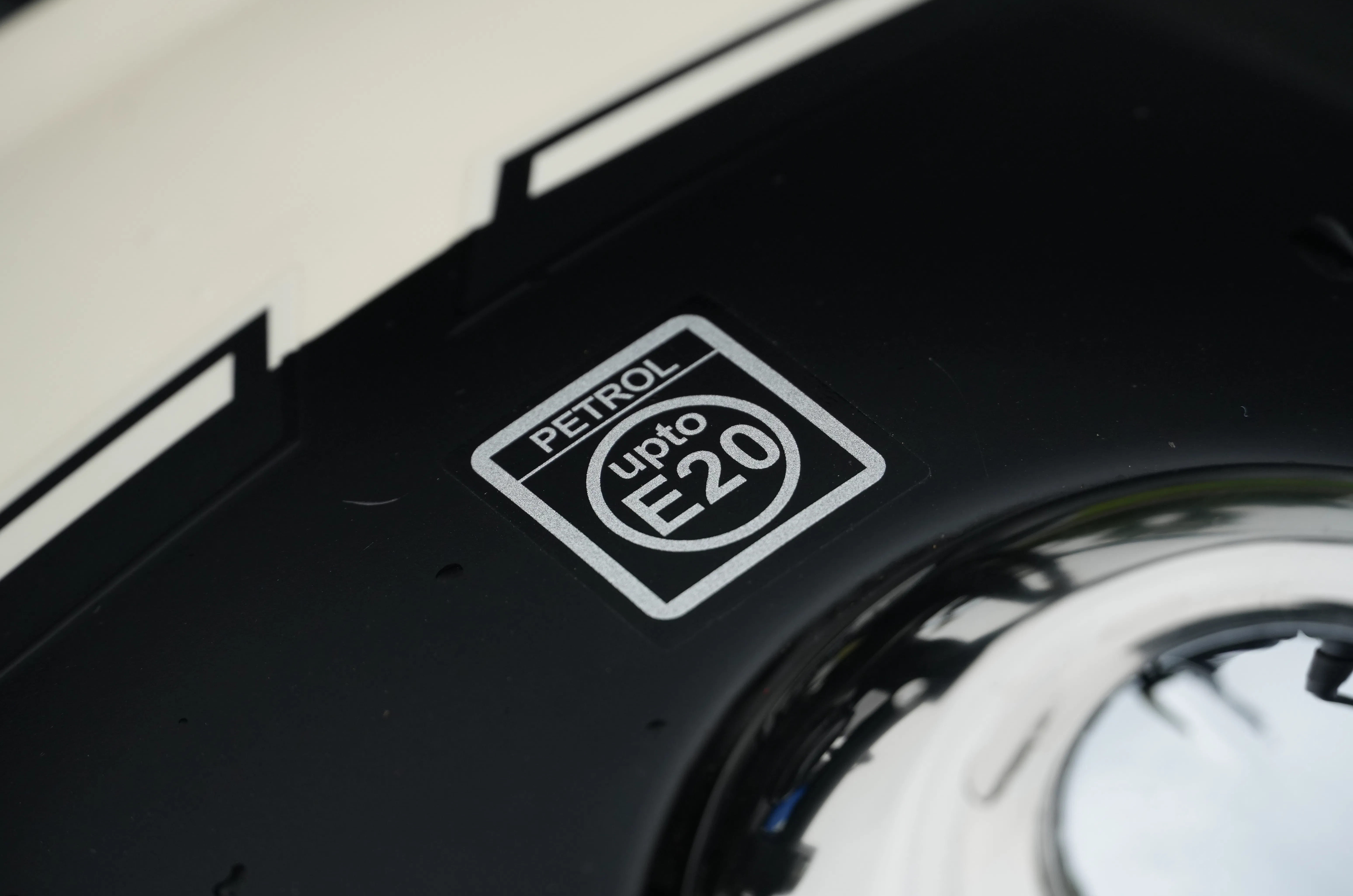
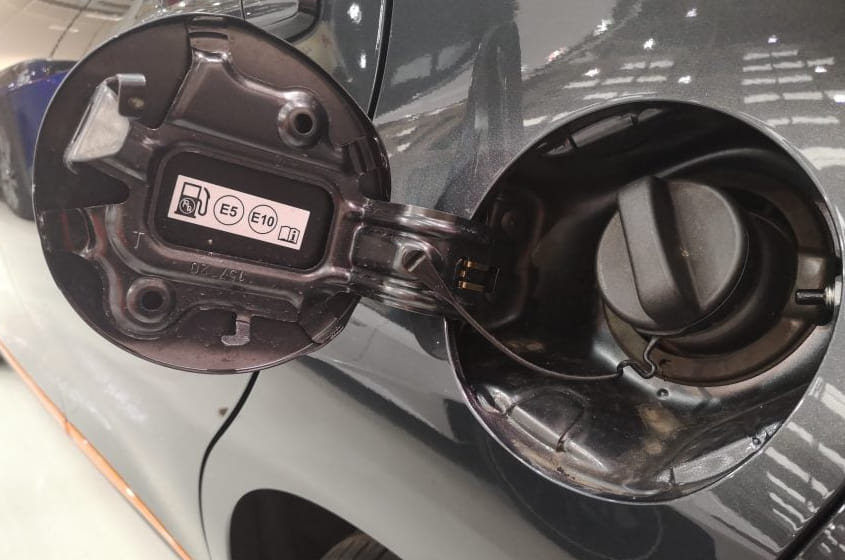
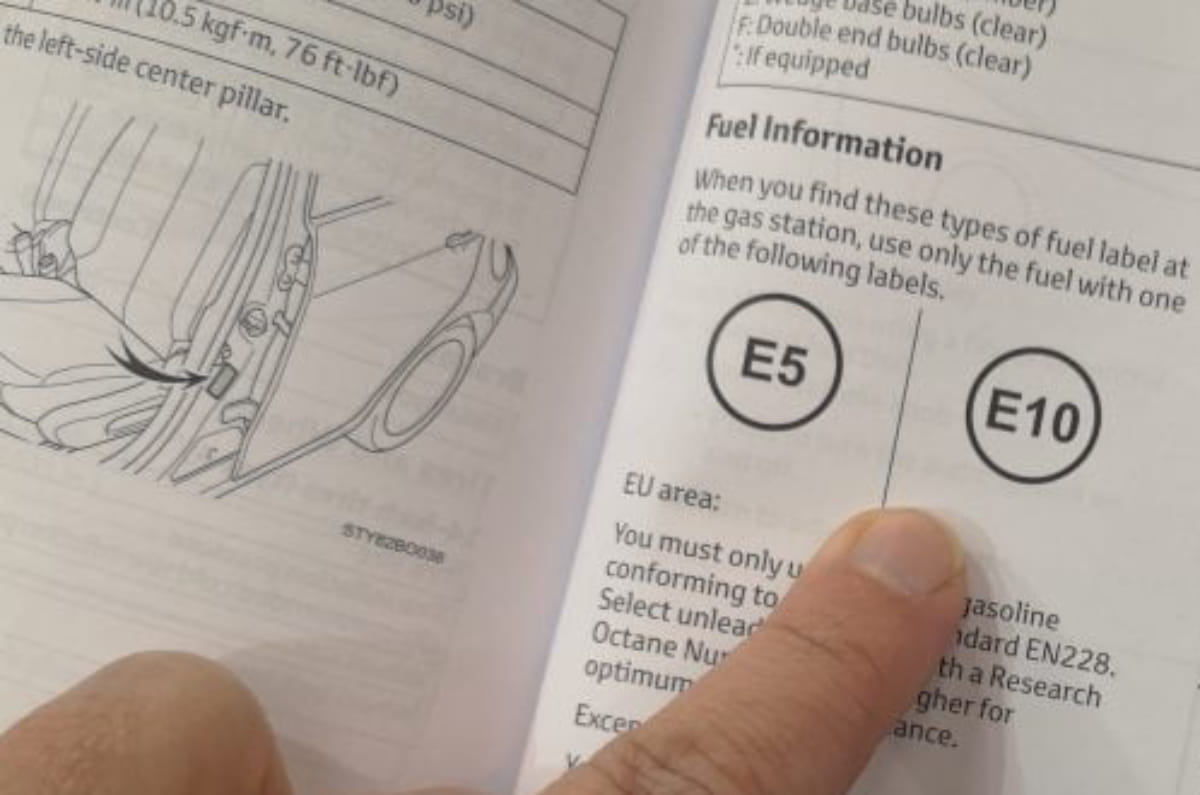
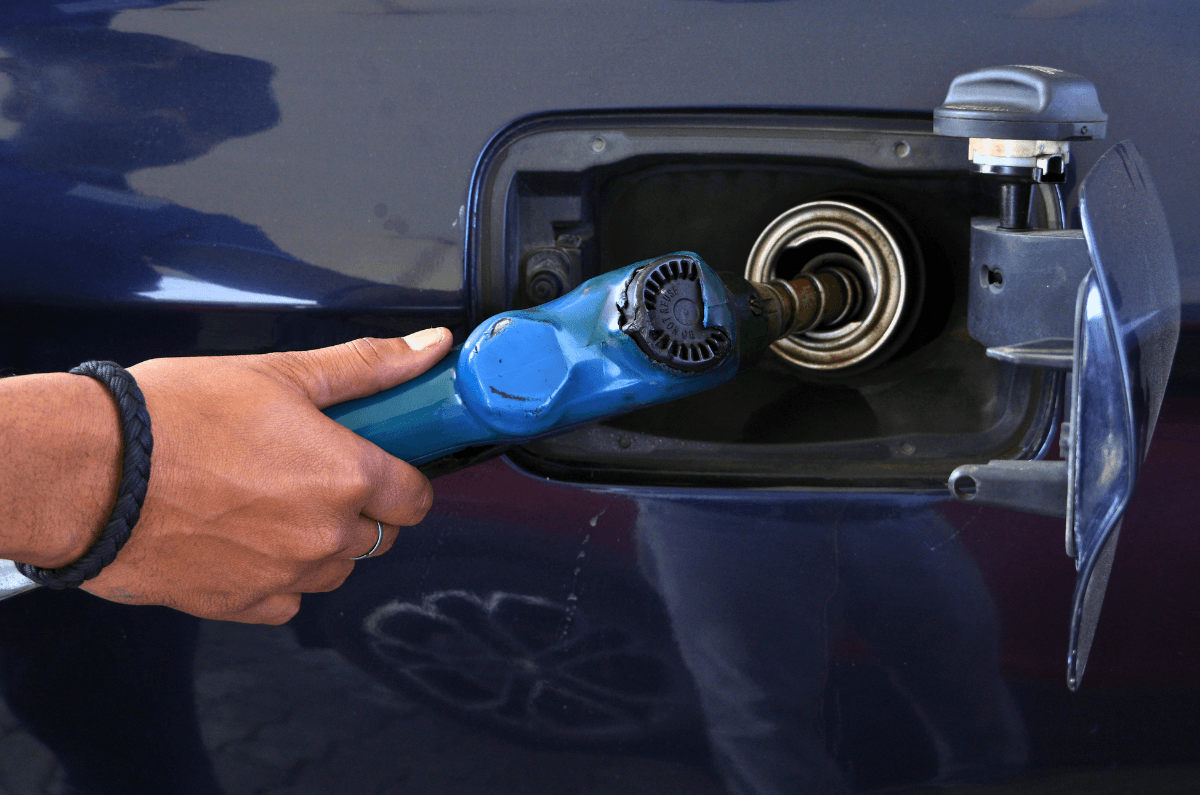
The easiest way is to check your vehicle’s fuel flap or the owner’s manual or contact the manufacturer’s authorised dealership. As part of the government’s E20 roadmap, manufacturers progressively introduced E20-compatible petrol vehicles from 2023 onwards. However, compatibility can vary depending on the model and year of manufacture, so owners should not assume that every petrol vehicle is fully E20-compatible.
4. Can E20 damage older engines or fuel-system components?
Concerns about E20 mainly relate to older vehicles that were not originally designed for higher ethanol blends. While ethanol has not been found to significantly directly affect metal fuel-system components, prolonged exposure to E20 can accelerate wear in some older rubber and plastic parts such as fuel hoses, seals, O-rings, gaskets and certain fuel pipes if they are made from materials that are not ethanol compatible.
Before approving E20, ARAI tested metals, elastomers and plastics commonly used in fuel systems. The study found no significant corrosion of metal components, but certain rubber compounds and plastics used in older vehicles showed greater deterioration than with E10 fuel. These findings prompted manufacturers to use ethanol-compatible materials in newer vehicles. Thus, owners of older vehicles should keep up with regular servicing and follow the manufacturer’s recommended maintenance schedule, increasing the inspection frequency if damage is suspected.
5. Does E20 reduce fuel efficiency?
Yes. E20 fuel generally returns lower fuel efficiency than petrol with a lower ethanol content because ethanol contains less energy than petrol. The exact reduction varies depending on the vehicle, engine and calibration.
E20 vs E10 mileage test results
Creta N Line
Dzire (BS 6)
Polo GT TSI
Dzire (BS 4)
Registration year
2024
2024
2017
2016
Average speed
17.8kph
20.25kph
18.0
19.3
Kpl on E20
10.59
14.24
9.13
9.8
Kpl on E10
12.12
14.81
9.63
11.19
Kpl variance
1.53
0.57
0.50
1.39
% variance
-12.62
-3.84
-5.19
-12.42
ARAI estimates a fuel efficiency drop of 1-6 percent with E20, while some manufacturers put it closer to 7-8 percent. In Autocar India’s real-world testing, both newer E20-compatible cars and older pre-E20 vehicles recorded a measurable drop in mileage when compared with an equivalent E10 blend. Among the newer cars, the Maruti Suzuki Dzire recorded a 3.8 percent drop, while the Hyundai Creta N Line saw a 12.6 percent decline.
Among older BS4-era cars, the Volkswagen Polo GT TSI posted a 5.2 percent drop, while the older Maruti Suzuki Dzire recorded a mileage drop of 12.4 percent.
The results also showed that there is no single figure applicable to every vehicle. Factors such as engine calibration and compression ratio all influence fuel efficiency, meaning some vehicles adapt better to E20 than others.
6. Does E20 improve performance or reduce emissions?
Octane rating test results
Fuel type
RON result
Regular E20 petrol
98.2 RON
XP95
98.8 RON
Yes, but not in a way that most motorists are likely to notice. E20 has a higher-octane rating than regular petrol, which improves resistance to engine knocking and can benefit engines designed to take advantage of higher-octane fuel.
The government says E20 aims to lower emissions by replacing a portion of petrol with domestically produced ethanol which is a renewable fuel. For most motorists, however, the most noticeable effect of switching to E20 is likely to be a small drop in mileage rather than a change in vehicle performance.
7. Is E20’s water contamination issue a real problem?
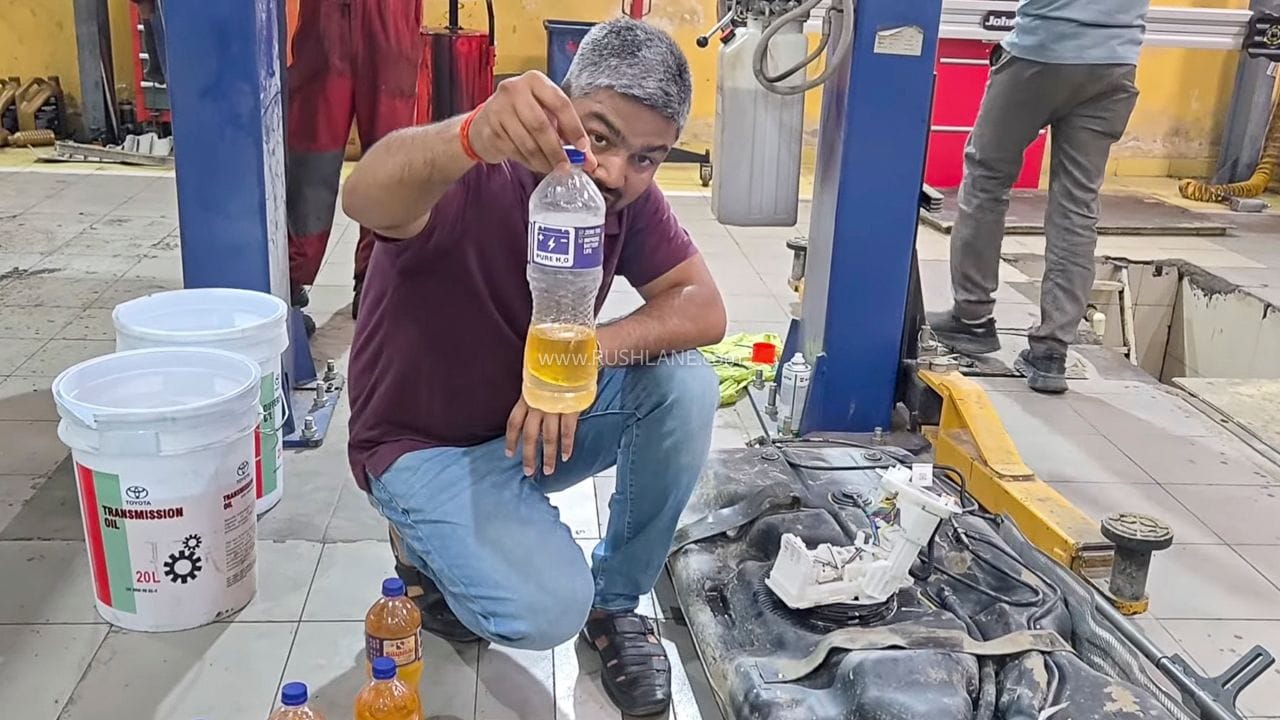
Image credit – Rushlane
Ethanol is hygroscopic, meaning it has the capability to absorb moisture. As a result, E20 is more susceptible to water contamination if excess moisture enters the fuel during storage or handling. In severe cases, this can lead to phase separation, where the ethanol and water separate from the petrol, affecting fuel quality.
Some petrol pump operators have raised concerns that existing underground storage tanks, particularly during the monsoon or in coastal areas, could be more prone to moisture ingress, increasing the risk of phase separation. However, the government and the Federation of Automobile Dealers Associations (FADA) says that there is no evidence linking E20 itself to widespread fuel contamination or vehicle failures.
8. Will using E20 affect my vehicle’s warranty?
For most owners, no. Vehicle manufacturers have said that using E20 petrol will not affect the warranty of their vehicles, and valid warranties will continue to be honoured. The government, SIAM and several manufacturers have stated that vehicles continue to be covered under their standard warranty terms when fuelled with E20, for a full list click here. SIAM has also said that OEMs will honour the warranty committed to customers for E20 usage, and that insurance claims will remain unaffected.
9. Why isn’t E20 petrol cheaper than regular petrol?
Although E20 contains 20 percent ethanol, it is not cheaper than regular petrol because ethanol currently costs more to procure and blend than petrol under prevailing market conditions. The cost of ethanol procurement, tax, transportation, blending and distribution offsets any potential saving from replacing a portion of petrol with domestically produced ethanol.
Any savings from lower crude oil imports are realised at the national level rather than by consumers through lower pump prices.
10. Why can’t I still buy E10 or pure petrol?
Because by policy E20 is now India’s standard petrol. Following the nationwide rollout of the Ethanol Blending Programme, oil companies have standardised regular petrol and premium 95-octane petrol to an E20 blend. Maintaining parallel supplies of E10 and E20 would require separate storage, transportation and dispensing infrastructure, making nationwide distribution significantly more complex.
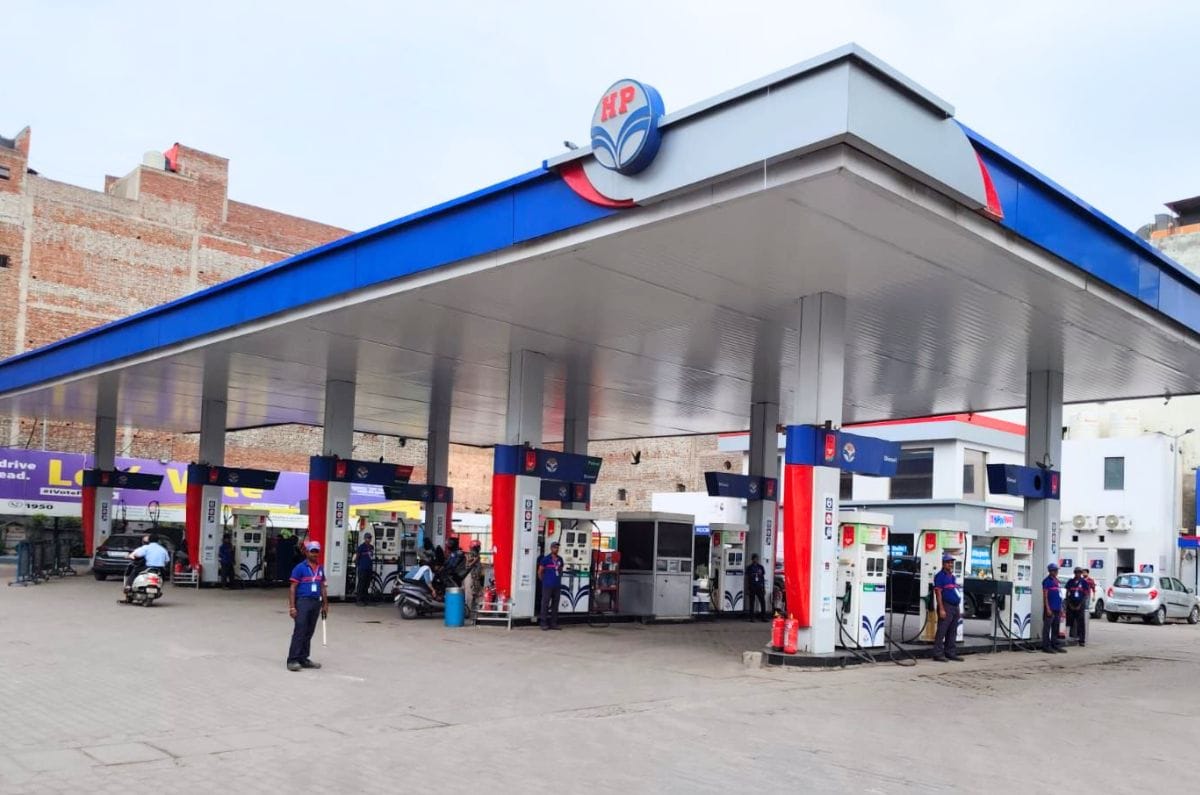
As a result, motorists can no longer choose between E10 and E20 at regular fuel stations. The only exception is 100-octane petrol, such as IndianOil XP100 and HP Power100, which remains effectively ethanol-free because it is a niche fuel sold in limited volumes. For most vehicle owners, however, E20 is now the only petrol available.
11. Is the government planning to increase ethanol blending beyond E20?
Not yet, but the groundwork has begun. While the government has said no decision has been taken to mandate petrol with more than 20 percent ethanol, it has begun preparing the regulatory framework for higher blends.
In May 2026, the Bureau of Indian Standards (BIS) notified fuel quality standards for E22, E25, E27 and E30 petrol, indicating that the government is laying the groundwork for future adoption. It has also proposed recognising E85 and E100 fuels under the Central Motor Vehicles Rules.
Separately, the government has tasked the Automotive Research Association of India (ARAI) with studying the impact of E25 petrol on existing E10- and E20-compatible vehicles, including its effect on fuel efficiency, durability, emissions and engine performance under long-term use.
However, any move beyond E20 will require extensive testing and consultation with vehicle manufacturers, fuel companies and research agencies to assess engine durability, emissions and fuel-system compatibility before it is introduced.
12. What should owners of older cars do now?
If your vehicle is not certified as E20-compatible, it does not necessarily mean it will experience immediate problems. However, owners should follow the manufacturer’s guidance, keep up with regular servicing and replace worn fuel-system components as required. It would also be prudent to increase the frequency of inspection of your vehicles fuel system to ensure there is no corrosive damage and catch it before it gets acute.
If you own a classic car, an older imported vehicle or a high-performance model designed for lower ethanol blends, using ethanol-free 100-octane petrol may be worth considering.
13. Can I convert my vehicle to run on E20 fuel?
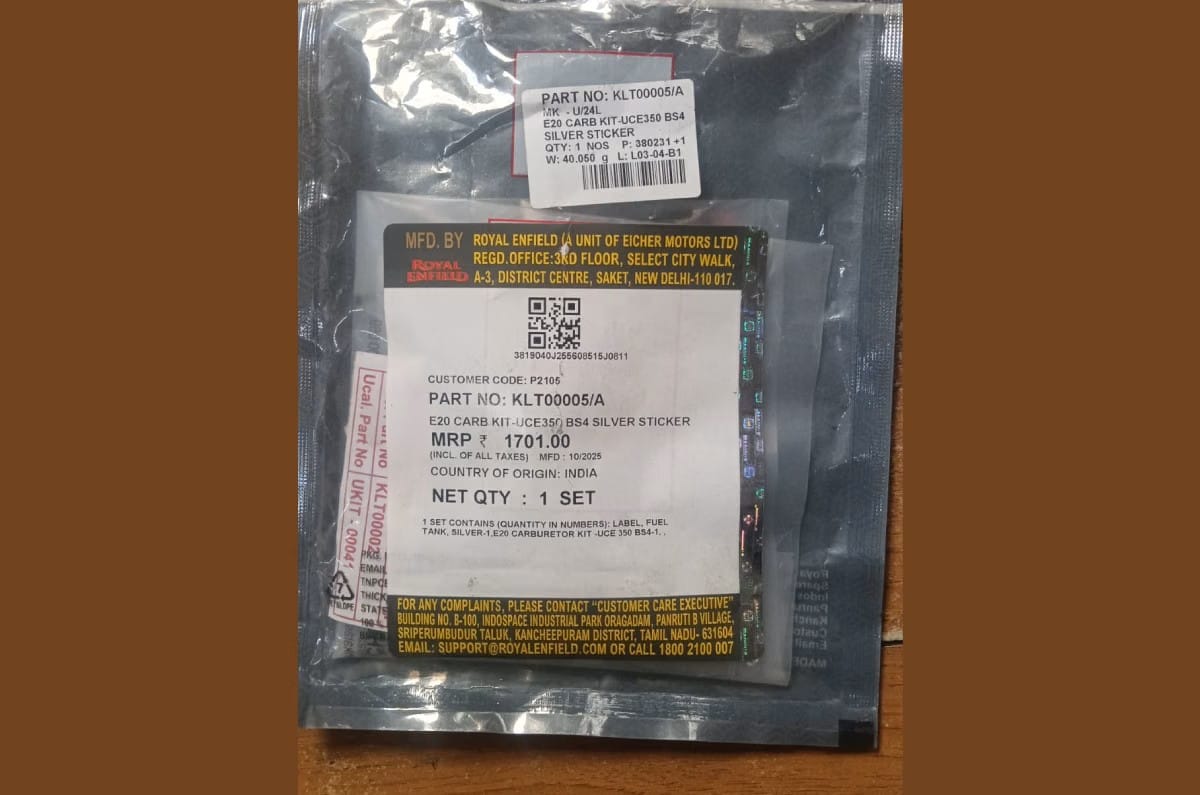
Yes, but official upgrade programmes are currently limited and while a few manufacturers, like Royal Enfield and Maruti Suzuki, had mentioned a plan for these earlier, they don’t have much to say for now. In a recent government press conference that aimed to quell the E20 backlash, Maruti stated that the kits are for R&D purpose only.
Theoretically, it’s possible to replace critical components susceptible to E20 damage with those designed to handle the fuel – especially if your vehicle is still in production – and if you feel the need to, you can go ahead and have parts like fuel lines, fuel pump and gaskets replaced but by your authorised workshops only.
So, should you be worried about E20 petrol?
Not worried, but alert. Modern petrol cars and bikes designed or updated for E20 are engineered to run on the fuel without major issues, and extensive testing by the government, research agencies and manufacturers found no evidence of widespread reliability concerns.That said, E20 is not without trade-offs. Most motorists should expect a small reduction in fuel efficiency.
For owners of older vehicles, it would be wise to pay closer attention to fuel-system maintenance.
The Indian automobile industry has asked the government to introduce a proper system to check the quality of fuel sold at pumps, according to a report by ET Auto. The request comes after many vehicle owners reported issues such as stalling and difficulty in starting their vehicles following the wider rollout of E20 fuel, it stated further.
Industry executives have clarified that E20 itself is not the problem, provided the vehicle is designed to run on it. Instead, they believe contaminated or adulterated fuel is causing these issues. Fuel pump owners have also raised concerns about contaminated fuel.
Hygroscopic nature of ethanol can cause contamination
As per the publication, investigations into customer complaints have found elevated levels of moisture and chloride in some fuel samples. One reason behind this is that ethanol has a tendency to absorb water. Since the existing underground storage tanks and fuel pipelines were originally built for regular petrol, high ethanol blends can cause issues. Water can also enter these tanks through rainwater, moisture, condensation or even fuel tankers supplying petrol.
If the water content in an underground fuel tank rises above 0.5 percent, the ethanol mixes with the water and separates from the petrol. This process, known as phase separation, leaves a layer of petrol on top and a water-ethanol mixture at the bottom. Vehicles that receive fuel from the lower part of the tank may end up with this water-rich mixture instead of E20 fuel.
The report also notes that storage tanks and pipelines made of mild steel are more likely to corrode if not upgraded for higher ethanol blends.
Industry wants an independent fuel-testing body
On condition of anonymity, a senior industry executive told the publication, “The maker cannot be the checker. At present, oil marketing companies (OMCs) check the quality of fuel being dispensed at pumps. An independent body needs to be made responsible to examine whether the fuel being retailed meets the specifications outlined by the Bureau of Indian Standards or BIS (the national body responsible for the standardisation, marking and quality certification of goods).”
According to BIS guidelines, E20 fuel should not contain added detergents, dispersants, silicone, chlorine-based additives or metallic additives.
Another industry executive explained, “The quantum of ethanol being blended in petrol has doubled to 11 billion litres in the last two years. But while the ratio of ethanol in the fuel has increased, the infrastructure remains the same. Trucks which were used in alternate applications are carrying E20 fuel; depots and fuel storage tanks at petrol pumps have not been upgraded. Therefore, the instances of fuel contamination.”
Hindustan Petroleum Corporation Limited (HPCL) said that it has completed an extensive nationwide fuel quality surveillance operation across its retail network to monitor ethanol-blended petrol compliance. It said that the inspection cycle concluded with zero reported instances of adulteration, contamination, or critical quality lapses.
HPCL conducted 2,173 unannounced inspections at fuel outlets
Inspection was to specifically verify localized ethanol blending metrics
According to operational data released by HPCL, field officers executed 2,173 unannounced surprise inspections at retail outlets between July 7 and July 13, 2026, specifically to verify localized ethanol blending metrics. These surprise checks were conducted alongside 1,385 regular field inspections scheduled throughout the network between July 3 and July 13, 2026.
The monitoring campaign also involved the company’s dedicated Quality Assurance Cell, which functions as an internal anti-adulteration division. The unit carried out 93 targeted surprise inspections, while technical teams utilized mobile laboratory facilities to test 49 individual fuel samples directly on-site.
Hero MotoCorp has identified the proposed extension of Corporate Average Fuel Economy (CAFE) norms to two-wheelers as a potential business risk, stating that a sudden rollout could significantly increase development costs and impact profitability in India’s price-sensitive motorcycle market.
Hero says sudden implementation could increase compliance costs
Company is upgrading ICE engines and expanding EV portfolio
Bharat Stage 7 norms also listed among future regulatory priorities
Hero calls for realistic implementation of proposed CAFE norms
Hero MotoCorp has identified the proposed extension of Corporate Average Fuel Economy (CAFE) norms to two-wheelers as a potential business risk, stating that a sudden rollout could significantly increase development costs and impact profitability in India’s price-sensitive motorcycle market.
In its FY2025-26 annual report, Hero said CAFE regulations, which currently apply to passenger vehicles, are proposed to be extended to two-wheelers. Unlike emission norms that regulate tailpipe pollutants, CAFE standards require manufacturers to meet fleet-wide fuel efficiency targets across the vehicles they sell.
The company acknowledged that stricter fuel efficiency standards could help reduce fuel consumption, lower running costs for customers and reduce dependence on imported oil. However, it warned that a rapid implementation could leave manufacturers with limited time to redesign products, upgrade technologies and prepare their supplier base.
Hero added that passing higher compliance costs on to customers would be difficult in India’s highly price-sensitive two-wheeler market, putting additional pressure on profitability.
To prepare for future regulations, Hero said it is improving the efficiency of its internal combustion engines, increasing the use of lightweight materials and expanding its electric vehicle portfolio to help meet future fleet-wide fuel efficiency requirements.
The company also said it is investing in multiple low-emission technologies instead of relying solely on battery electric vehicles. Alongside EVs, Hero is developing motorcycles capable of running on higher ethanol blends, reflecting its view that multiple powertrain technologies will continue to play a role in India’s mobility transition.
Hero added that its R&D investments are increasingly focused on future regulatory requirements, including cleaner powertrains, connected vehicle technologies and digital capabilities.
BS7 norms also on Hero’s radar
The annual report also lists Bharat Stage 7 emission norms for two-wheelers among the policy issues on which Hero is engaging with the Society of Indian Automobile Manufacturers (SIAM). The company said it is advocating for implementation timelines and targets that are realistic and technically feasible for the industry, although it did not disclose when either the proposed CAFE norms or BS7 regulations could come into effect.
The origin of the species. The very beginnings of the automobile. Where it all started. How it all started. What form the earliest cars took. What if you could experience all of this in one place, at the same time? Say hello to UMS Technologies, India’s smallest carmaker. Nestled in the heart of the bustling city of Coimbatore, where the manufacturing of machines is almost a religion, UMS tech not only recreates the past, it does so with exacting precision and a level of dedication that borders on obsession.
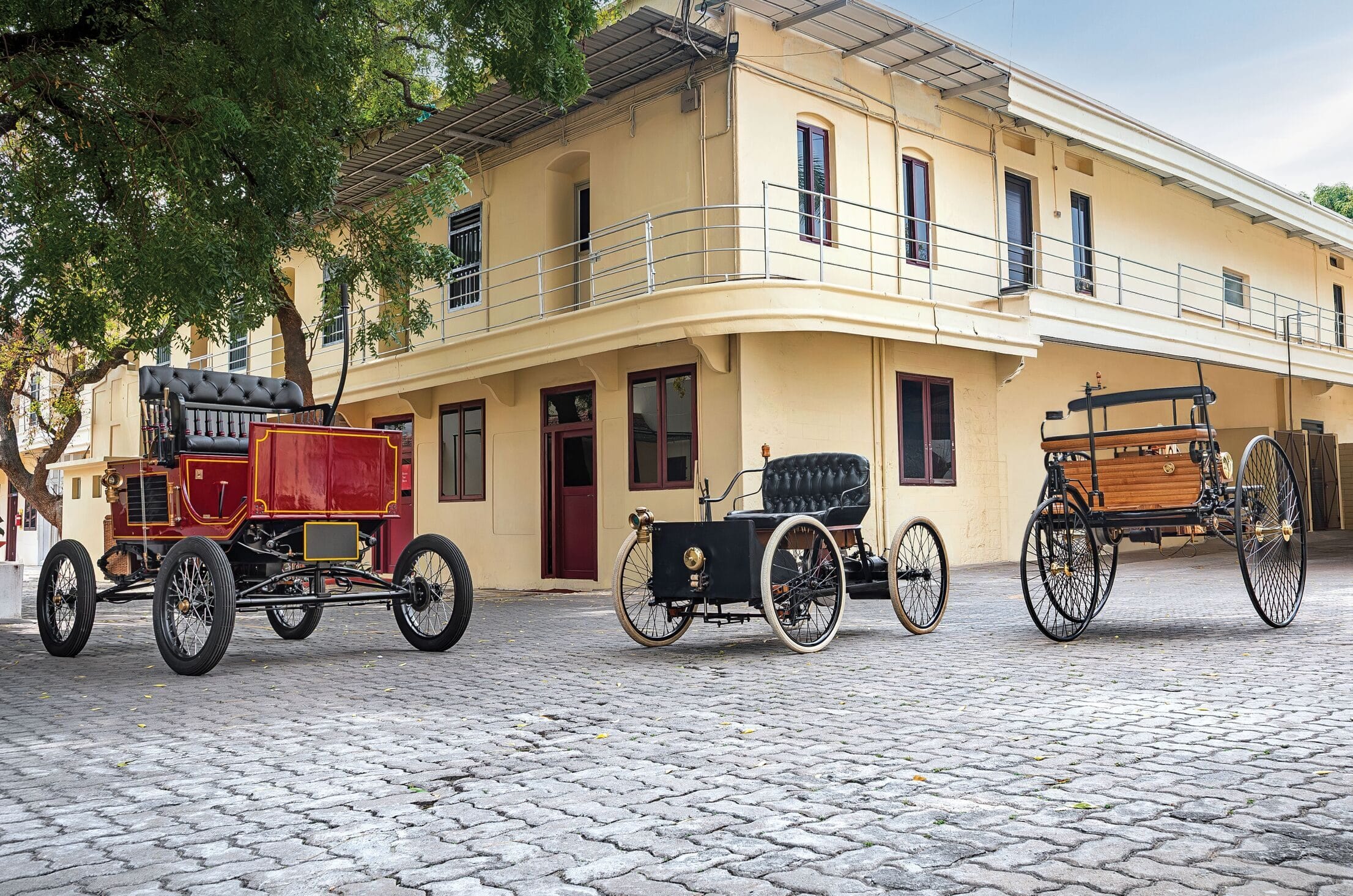
Walk onto the shop floor, just off main street Coimbatore, and you are greeted by finished versions of three icons – the 1899 Stanley Steamer, the 1896 Ford Quadricycle, and the 1886 Benz Patent-Motorwagen. Each is a faithful replica, crafted with painstaking detail, and together they tell the story of how the automobile was born. It feels like history is coming back to life.
Give me steam
The steam car is the most difficult to steer and can accelerate quickly for a prehistoric car.
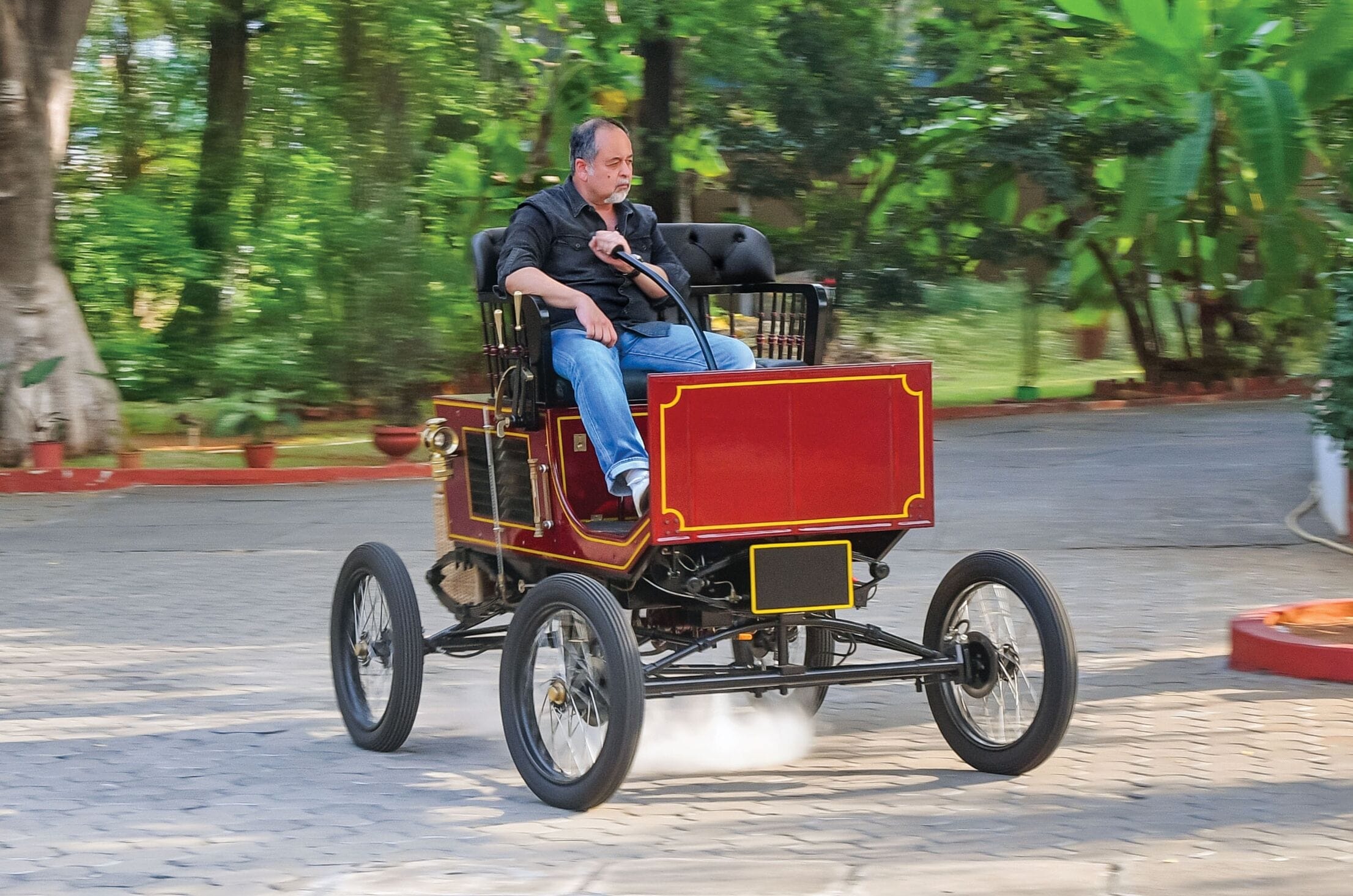
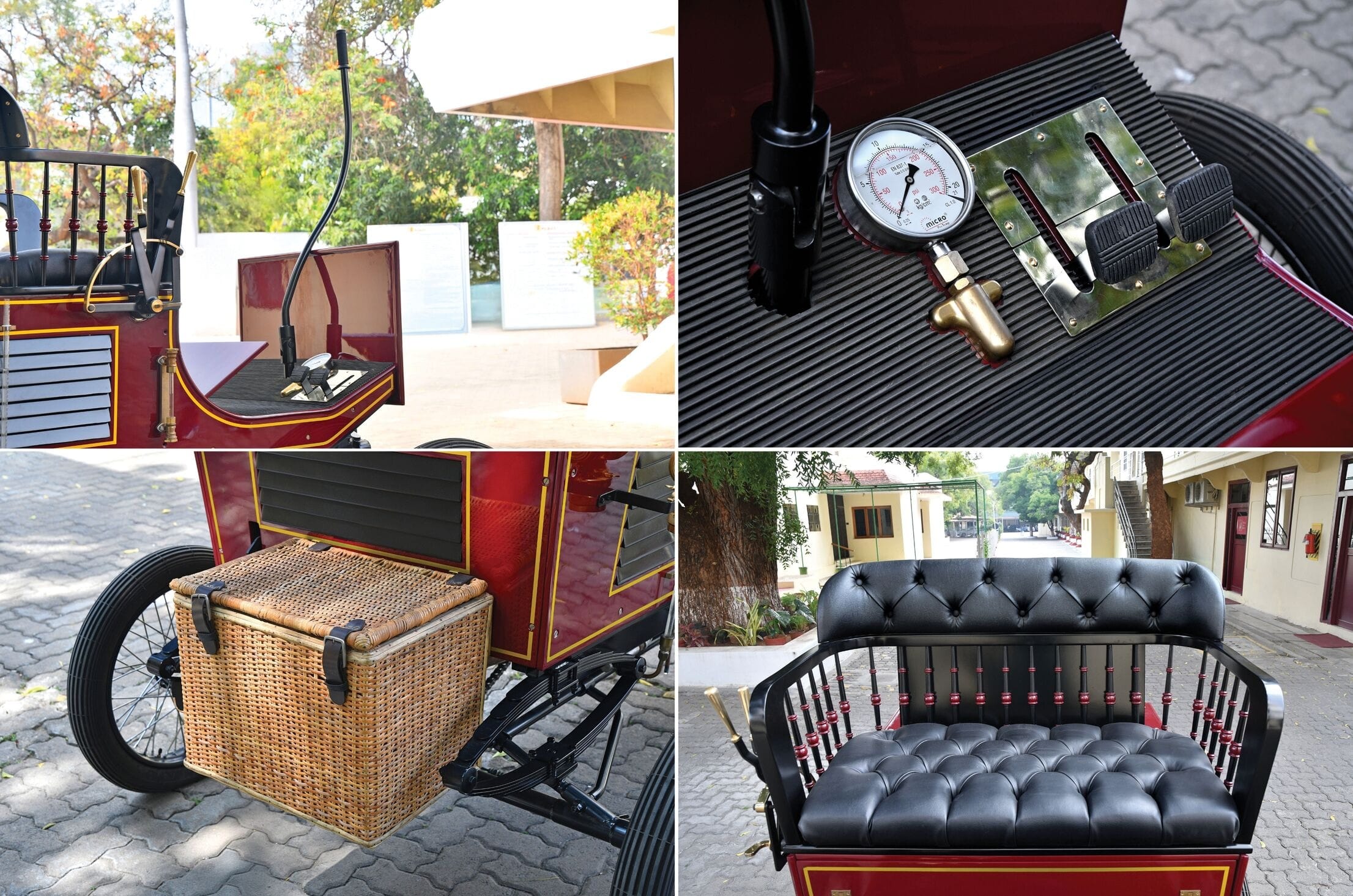
The Locomobile, or Stanley Steamer, is perhaps the most theatrical of the trio. Originally powered by naphtha and coal, it relied on steam pressure to drive its pistons. Did you know steam-powered cars predated petrol-powered cars by almost a century? The replica here, however, has been updated with a diesel burner. Pressure in the ‘boiler’ goes up to around 150-200 PSI, and a gauge on the dashboard (origin of the term) tells you when the car is ready to move. This takes a bit.
Clockwise from left: Levers select direction; Braking is via motorcycle discs; Seat feels like a comfy sofa; Diesel burner replaces coal.
Sidebar: steam-powered ships like aircraft carriers sometimes took 12-24 hours to build up a sufficient head of steam before they could start. In the car, once the needle climbs into range, a gentle push on the accelerator sends the vehicle chuffing forward with the rhythm of a steam train. The experience is surreal. Torque is abundant, acceleration is surprisingly brisk, and the soundtrack – a soft, mechanical chuffing – is delightfully addictive. Steering it, however, is a challenge. Without a wheel, only a rudimentary tiller guides the car, reminding me of why the steering rack was one of the most important innovations. Fun fact: none of the three cars here has a steering wheel. For safety, especially considering how quick it is when it builds up a head of steam, UMS Technologies has added motorcycle disc brakes.
Before the Model T
This was the car Henry Ford made before the Model T or even before the company’s formation in 1903.
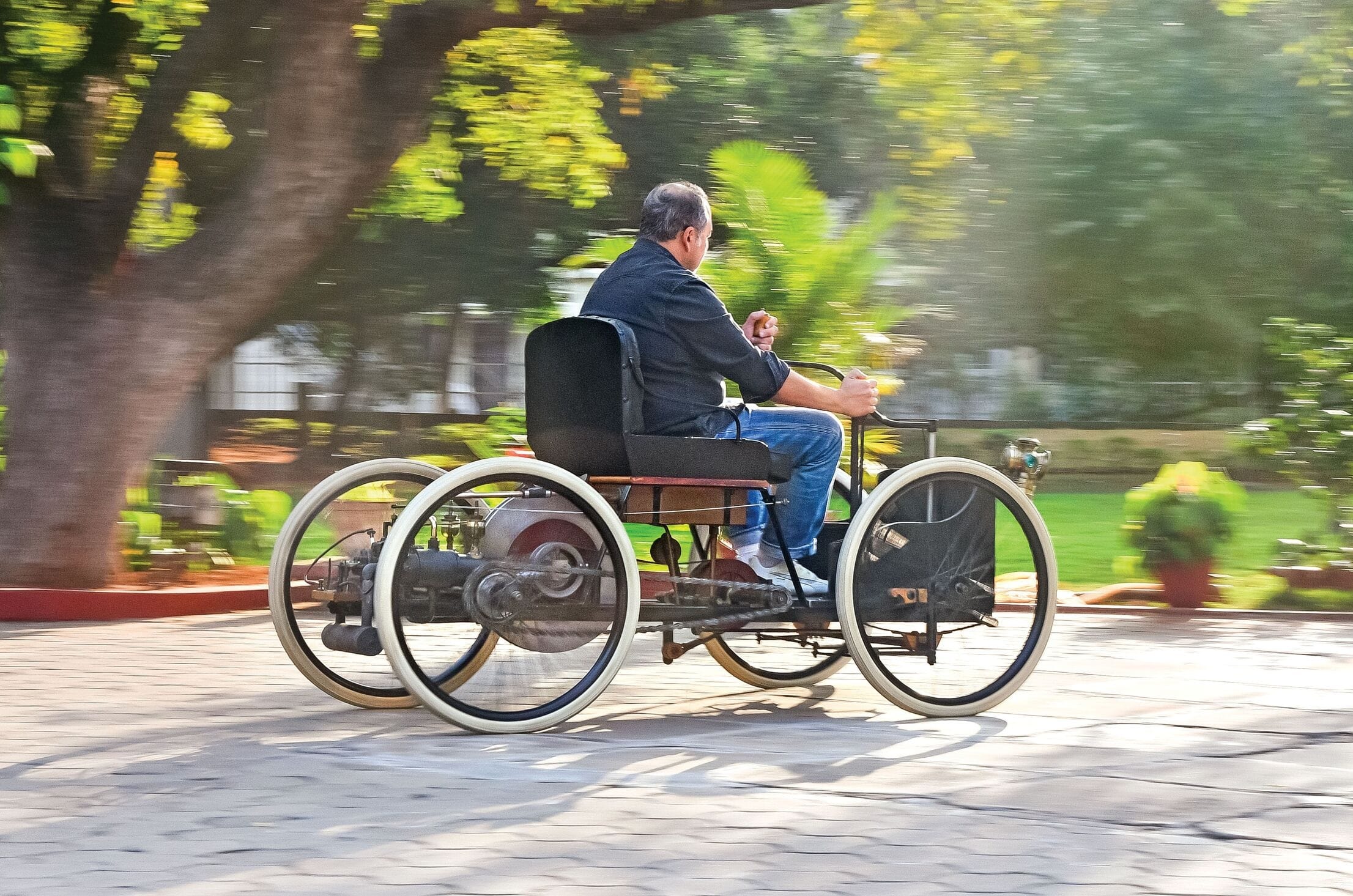
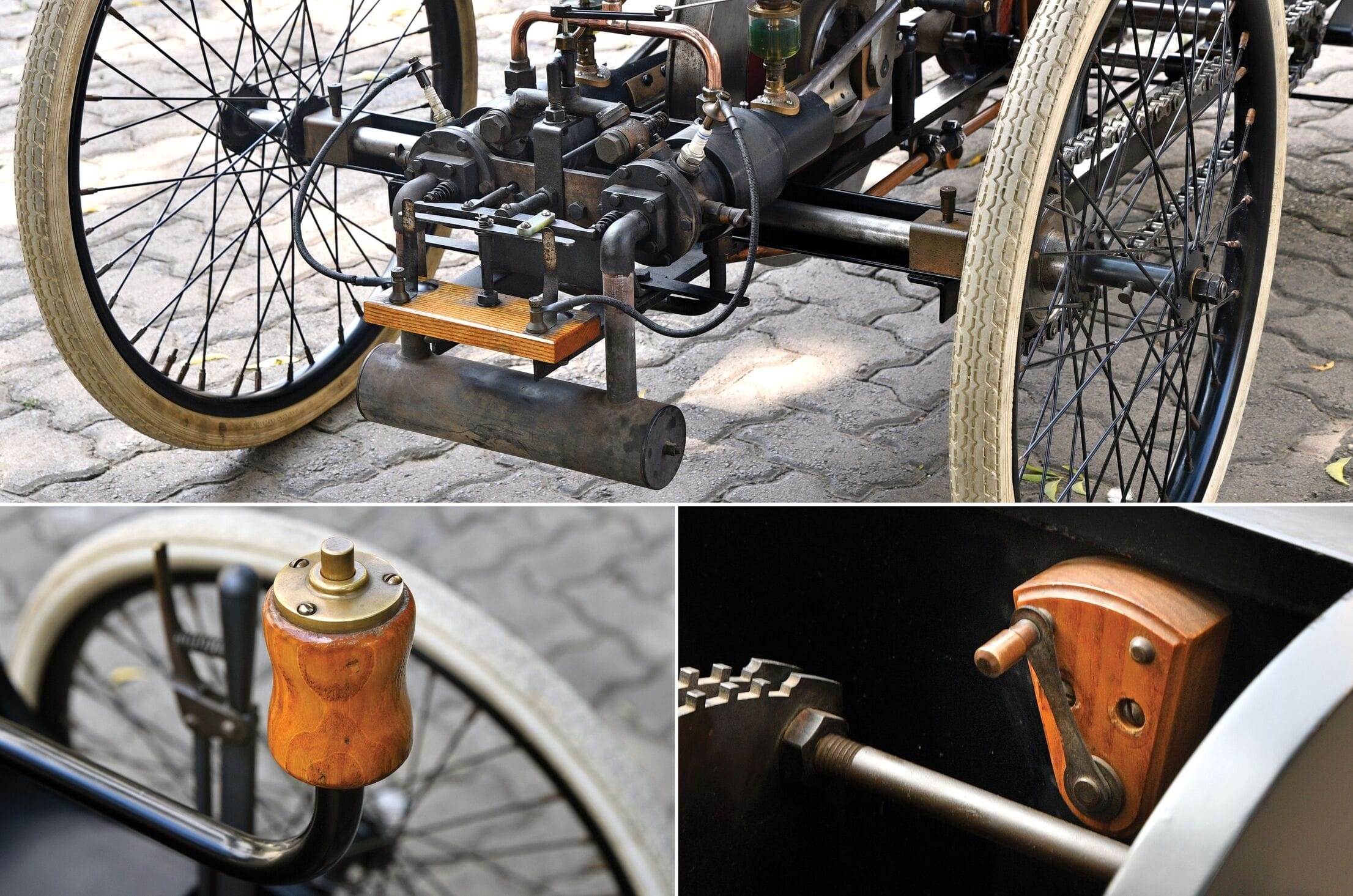
If the Stanley Steamer is theatrical, the Ford Quadricycle is a burst of youthful energy. Built in 1896, ten years after Karl Benz unveiled his Patent-Motorwagen, it was Henry Ford’s first car, created before he even founded the Ford Motor Company in 1903. The replica is faithful to the original, complete with its mid-mounted twin-cylinder engine and bulb-type rudimentary carburettors that mix the fuel and air. The pistons are exposed, with no sump for oil, so lubrication is handled by drip-feed systems. A brass tube connects the pistons to water tanks for cooling, while spark plugs, carburettor, tappets, and valves are all visible, making the engine look like a mechanical marvel, all the running bits visible and exposed.
Clockwise from top: Twin cylinders placed horizontally; Contact box switch to start the car; Steering knob has button for the bell.
Driving it is exhilarating. The twin cylinders give it a noticeable boost in speed. Steering is again by a tiller, while a lever operates the throttle, much like one on an aircraft; but in reverse. Pulling the lever back sends the car shooting forward, while pushing it forward slows it down! And yes, Ford even thought to add a horn, making this one of the first cars to have this safety feature. Something else that’s fascinating – this car runs on E100 or pure ethanol. However, there’s no blue roundel or Ford badge. This car came before the Ford Motor Company, remember.
Prime petroleum
It moves forward gingerly with a put-putting sound from the weak single-cylinder ‘engine’.
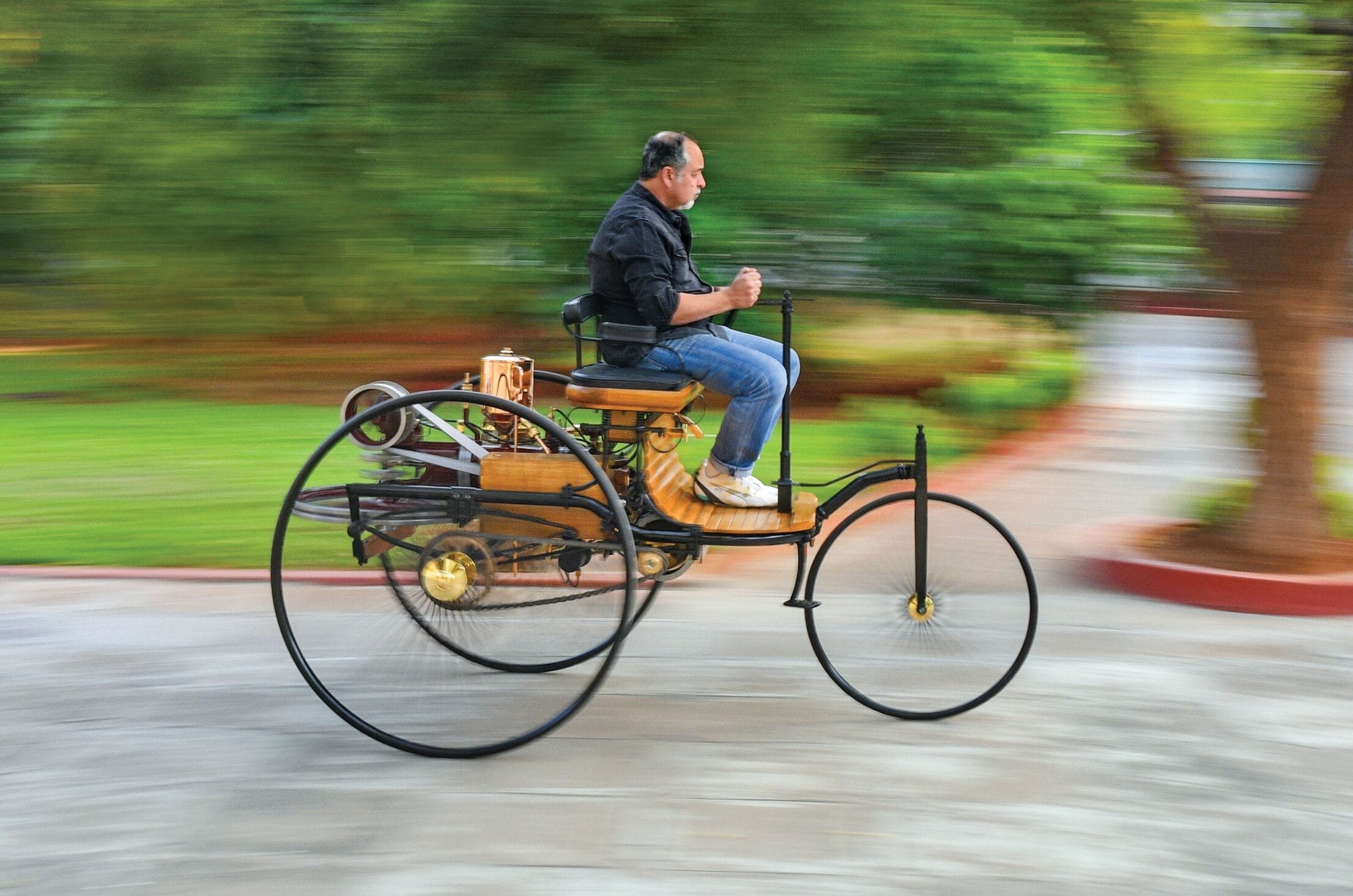
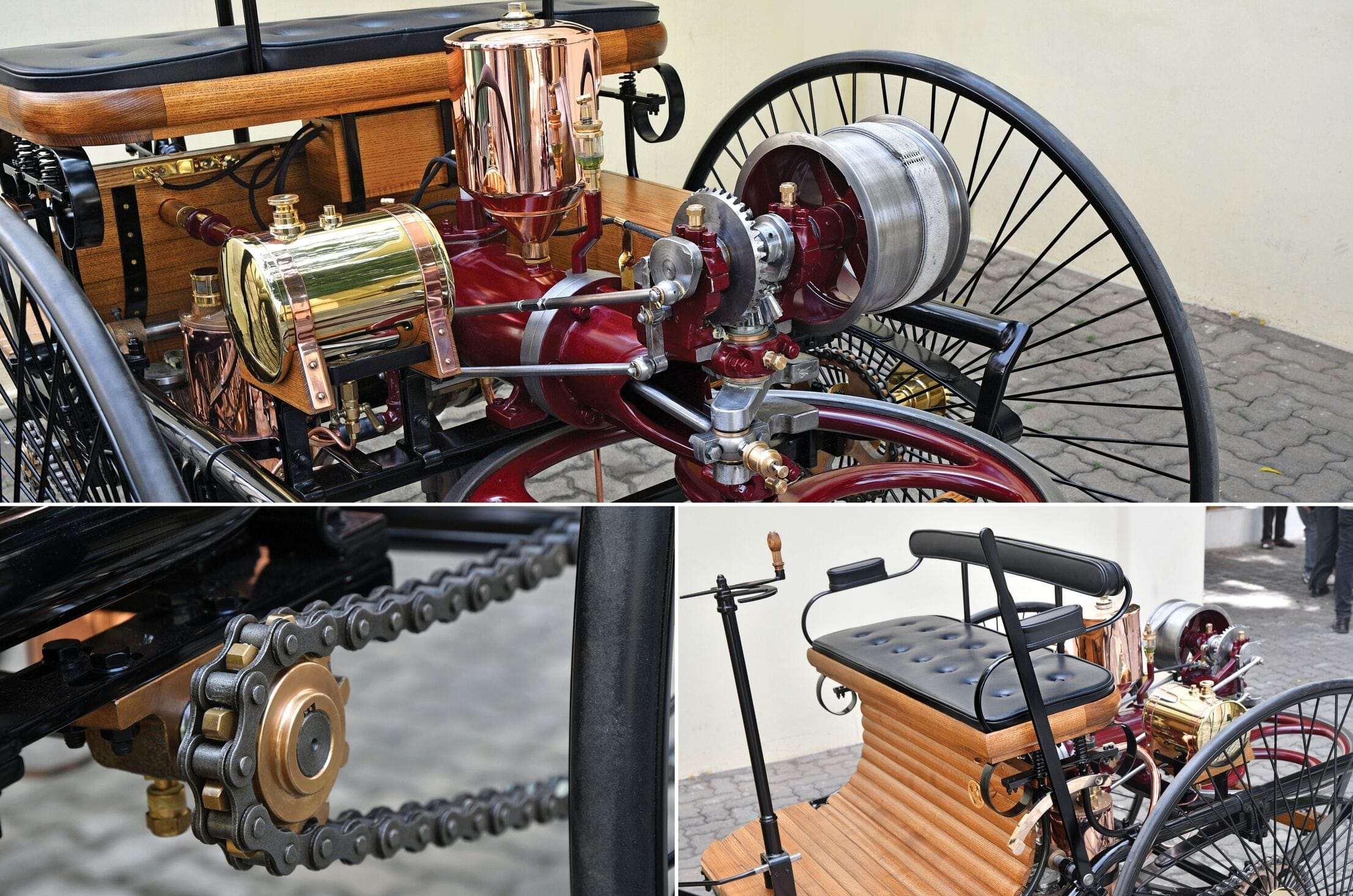
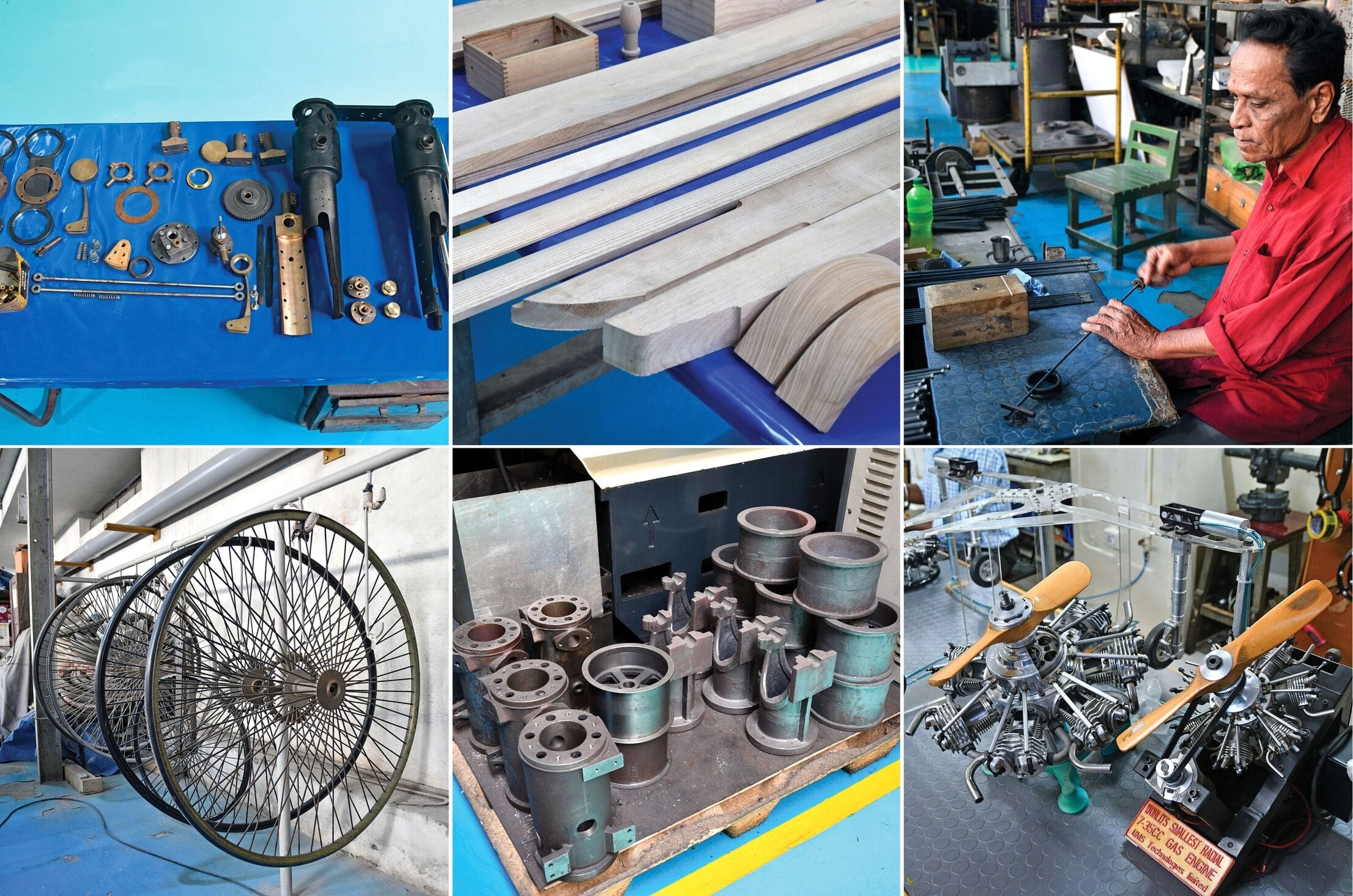
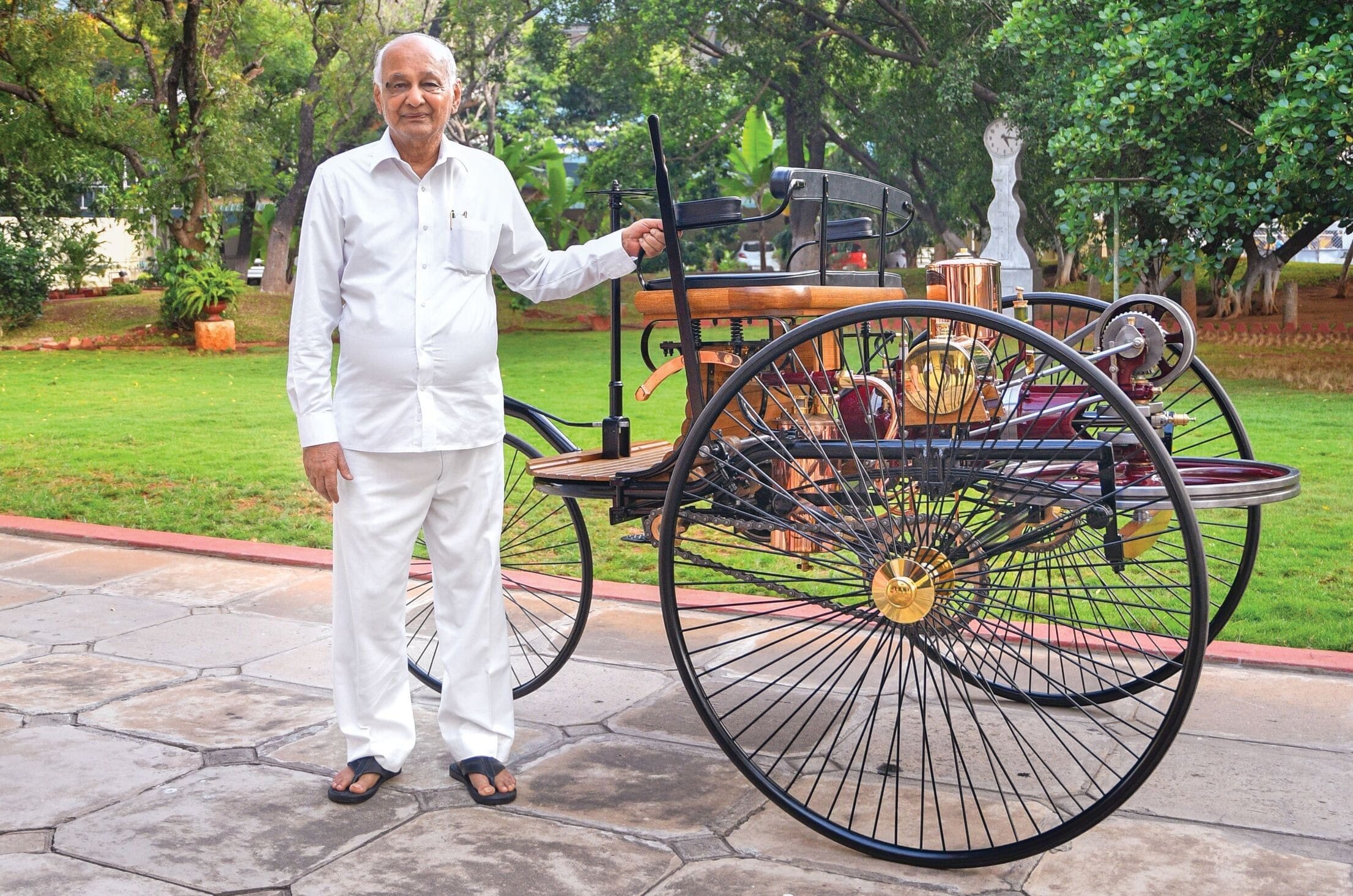
The Benz Patent-Motorwagen, however, is the granddaddy of them all. Widely regarded as the first petrol-powered car, it was unveiled in 1886 and changed the course of history. While steam vehicles had existed since the 1760s, Benz’s creation was revolutionary: a single-cylinder, horizontal piston engine mounted on a tricycle frame. The replica here is almost indistinguishable from the original. Austrian white ash has been imported for the woodwork, just as Benz used in Germany. Brass fittings, carburettors, pistons and connecting rods are all crafted in-house, from the same materials that were used on the original. Even the massive wheels with hard-rubber tyres are made at the factory in Coimbatore, cast and assembled with meticulous care, as we stand and watch.
Operating the Motorwagen is an exercise in patience. The wooden box houses the battery and electrics, while the crankshaft and piston lie horizontally. A pulley system drives the camshaft, with pushrods for intake and exhaust valves. The engine is started by spinning the horizontally placed ‘fly wheel’, and the car starts with a soft and faint put-put-put, white smoke softly escaping from the rear.
Clockwise from top: Brass canisters hold water, fuel; You steer with a tiller and use a long lever to accelerate, brake; Drive is via bicycle chain.
Sat high up, you control acceleration and braking with a single lever; push forward to accelerate or pull back to brake. On the road, it feels fragile and threatens to tip over at times. Unless you push the throttle open, even gentle slopes are a challenge. And then there’s some overrun, so you often need to pump the lever to give it a burst of power. In addition, the ride is harsh, the suspension rocks you and larger bumps simply toss you and threaten to flip the tricycle. But every chug of the piston, every few metres you cover remind you that this is where petrol motoring began.
Recreating history
What makes these replicas remarkable is not just their historical accuracy, but the fact that they are built entirely in-house. UMS Technologies casts its own parts – cylinder heads, crankshafts, flywheels, carburettors – 20km away, then assembles them here. Brass, steel, gunmetal and Austrian ash are all shaped into components that mirror the originals. The workshop even uses a Carl Zeiss measuring machine to check tolerances on the Benz cylinder head – something Karl Benz himself could never have imagined in 1886. And the company doesn’t stop at cars. It also builds engines for drones and RC planes, ranging from single-cylinder 100cc units to seven-cylinder radial engines. Precision, craftsmanship and innovation coexist in this tiny factory, proving that scale is not a prerequisite for excellence. It even makes small turbine engines, complete with flames emitted from the rear and afterburners.
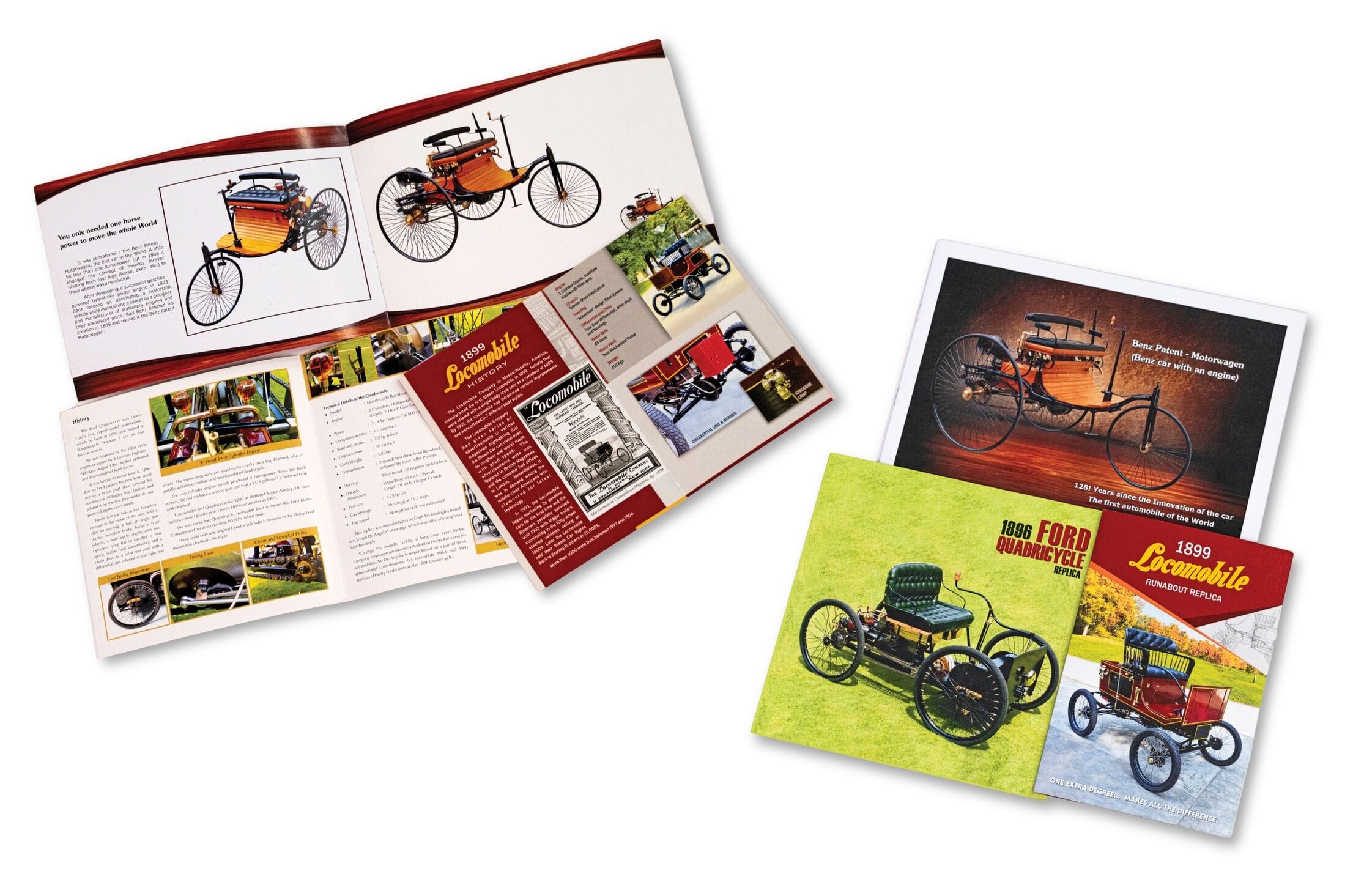
Each car gets its own brochure, as it should.
In an era dominated by SUVs, EVs and autonomous driving, why do these replicas matter? Because they remind us of where it all began. They show us the ingenuity of pioneers who built cars, they highlight the evolution of engineering, from steam to petrol, from tillers to steering wheels, from drip-feed lubrication to blade batteries.
India’s smallest carmaker has achieved something extraordinary. By recreating the Stanley Steamer, the Ford Quadricycle and the Benz Patent-Motorwagen, it has preserved the earliest DNA of the automobile and shown us what it must have been like to drive and be transported by these machines. Even better, if you want to own one of these, each of them is on sale.
Benz Motor Wagen
Stanley Steamer
Ford Quadricycle
Price*
Rs 22.10 lakh
Rs 19.50 lakh
Rs 15.60 lakh
Wheelbase
1,450mm
1,473mm
1,200mm
Power
0.68hp
3.5-5.5hp
3-4hp
Kerb weight
265kg
410kg
227kg
Top speed
16kph
40-48kph
28kph
*Domestic market discount 20-25 percent
No steering required
Driving these three, you get a sense of what the pioneering days of motoring must have been like. You sit exposed, as on a carriage, and looking at this set here, that’s what they really are – horseless carriages. In the Patent-Motorwagen, you pump the accelerator and brake repeatedly, coaxing the car up inclines and slowing it down with a wooden lever. It feels awkward at first, but soon you get the hang of it. The ride is rough, but the sense of history is overwhelming. In the Stanley Steamer, you wait five minutes for pressure to build, then glide forward with effortless torque. The chuffing soundtrack is addictive, and the acceleration surprisingly rapid. Steering with a tiller is tricky, but the experience is joyous. In the Ford Quadricycle, performance takes centre stage. The twin cylinders deliver speed, the ethanol tank nods to sustainability, and the bell-like horn adds a touch of practicality. It feels like the first step toward the modern automobile. Together, they offer a time jump into motoring’s infancy.
How these cars are made in India
All basic parts for the engines are cast or machined either in-house or by a local supplier; for the Benz, the same imported ash wood as the original is used; the spokes and big wheels are made by hand; cylinder and sleeve made to the same spec as the originals; UMS also makes cylinder radial engines for drones and model planes – a nine-cylinder radial and a turbine, among the many.
Interview with GD Gopal, UMS Technologies
Why build replicas of cars that are more than a century old?
Because they are the roots of motoring. Everyone knows the latest SUVs or EVs, but very few have seen where it all began. By recreating the Stanley Steamer, the Ford Quadricycle and the Benz Patent-Motorwagen, we’re preserving history in a way people can touch, feel and drive.
How difficult is it to manufacture these cars from scratch?
Extremely difficult. We cast our own cylinder heads, crankshafts and carburettors. Even the woodwork is done here using Austrian ash, just like the originals. Every part is measured, machined and finished by hand. It’s not about mass production; it’s about precision and authenticity.
What’s next?
We’ll keep building history. And maybe inspire the future too.