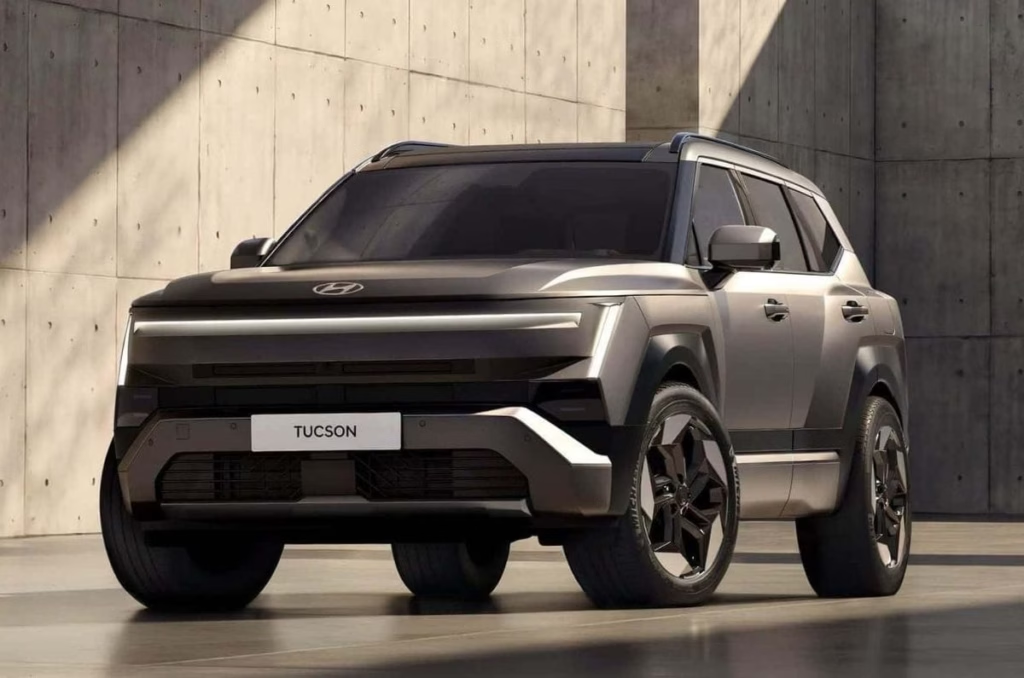
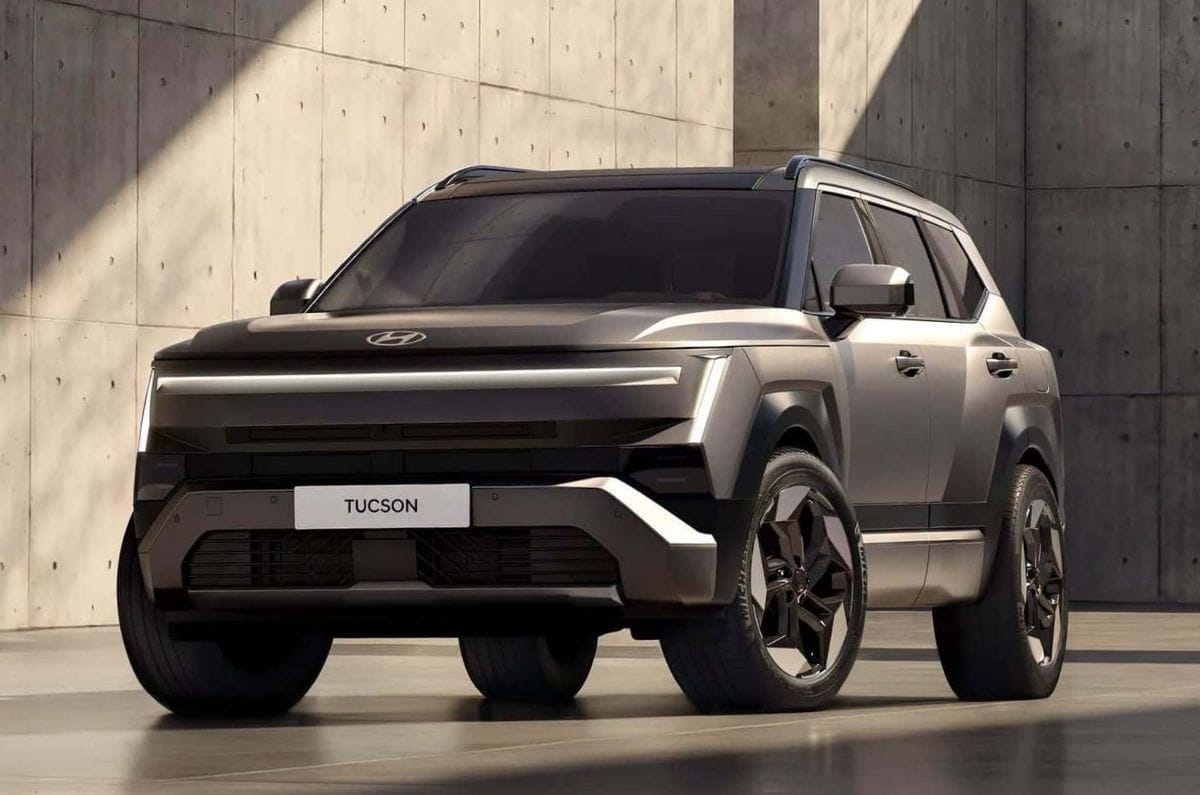
Hyundai has just previewed the next-gen Tucson, with details for the time being focused on its new design. The SUV largely appears to be in a pre-production phase for now, but the production-spec car is expected to carry forward several design features seen here. While most of its technical details are under wraps, we know that the 2027 Hyundai Tucson will be bigger than the outgoing model, which was discontinued in India in late 2025.
Squared-off and boxy exterior gets full-width LED lighting
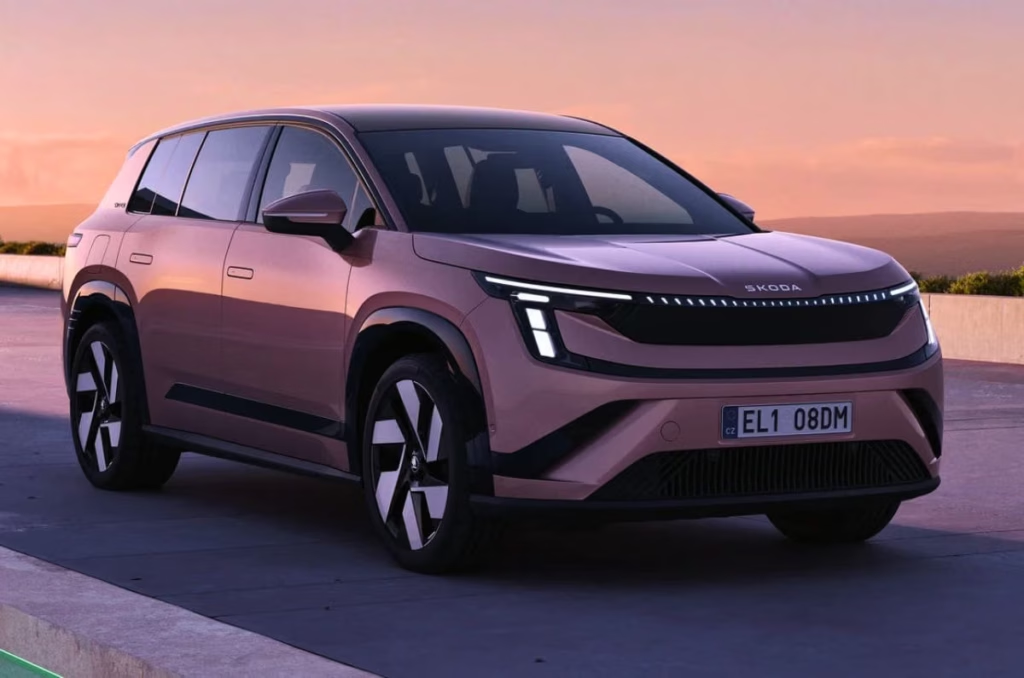
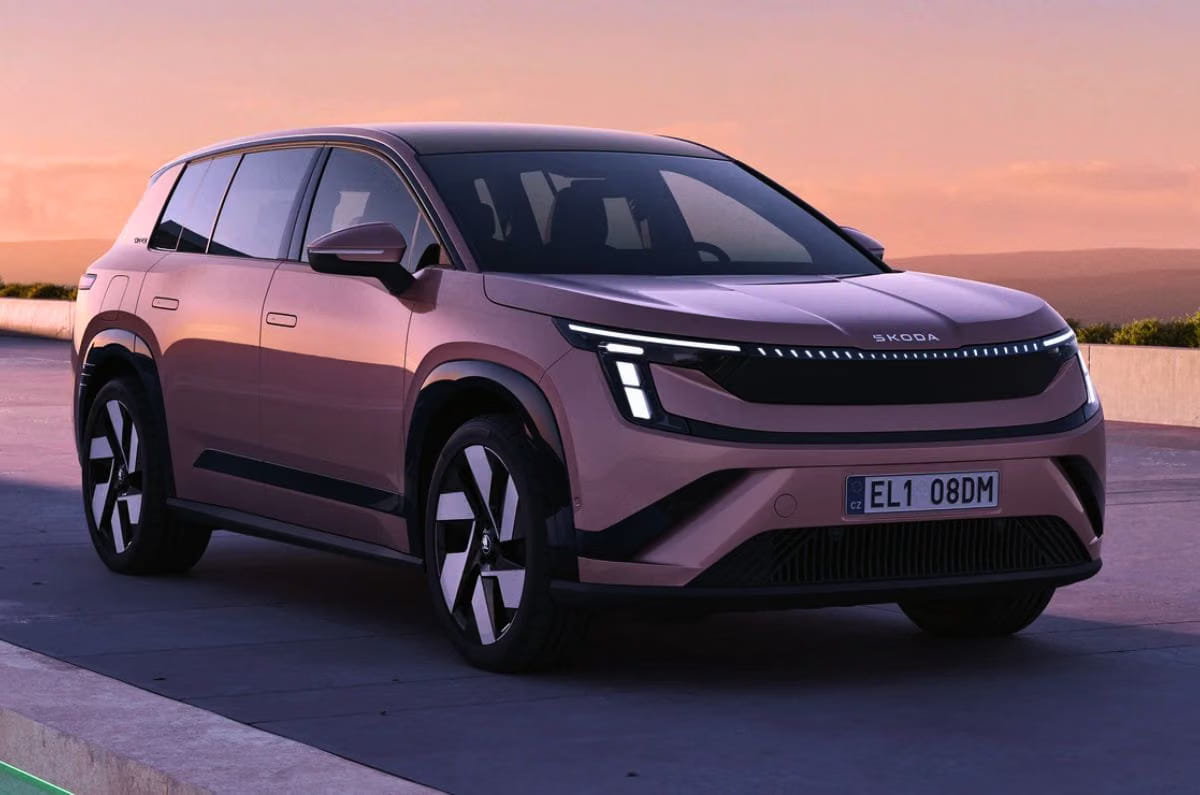
Skoda Auto India plans to bring electric vehicles from its global portfolio to India in limited volumes next year as the Czech automaker looks to establish its presence in the EV market. According to Ashish Gupta, Brand Director, Skoda Auto India, the company needs an electric vehicle in its portfolio not only to meet future regulatory requirements but also to remain relevant as EV adoption gathers pace in India.
Skoda India to bring EVs: Additional details
“A lot of things are under discussion. So, for meeting the CAFÉ norms, there are a lot of opportunities available along with electrification, which has to be the cornerstone of meeting all compliance regulations. So that is something which we are aggressively working on,” Gupta told our sister publication, Autocar Professional.
Gupta added that the company needs an electric car in its portfolio since adoption has grown in the last 3 months owing to increasing fuel prices. While Skoda has yet to announce a specific locally manufactured EV for India, Gupta confirmed that the company plans to introduce EVs from its global line-up next year.
“It may not be a local EV, but yes, we just had two blockbuster launches globally of the Epiq and the Peaq. The Elroq is the best-selling EV in Europe. So these are opportunities available to us in limited batches,” he said. He added that in the current duty structure, it will not be possible to bring them at price points that will get volumes. “But definitely we need to urgently showcase our EV credentials and the proof point to India,” he added.
This will allow Skoda to establish a presence in the EV market without immediately committing to the significant investment required to localise an electric model. With imported EVs still facing a challenging cost structure, Gupta said the initial objective would be to demonstrate the brand’s technology and capabilities rather than chase mass-market volumes.
Skoda India’s hybrid ambitions take a slow gear
Skoda’s approach to hybrids, meanwhile, appears less certain. Gupta said the company had previously viewed hybrids as a potentially stronger opportunity than EVs in India, but market data over the past two years has changed his assessment.
“Two years ago, I would have said I would take a bet on hybrid more than EV. But the tax structure has not helped anybody. In the last year, pure hybrids have stayed at 2% of the market. They have not gone beyond that. So, I am not sure whether hybrid is the right way to go. And what the last 6 months have also shown us is that people are more than willing to go for EVs now,” he said.
The current trade and taxation structure also influences the company’s hesitation. Gupta said the India-EU Free Trade Agreement, while potentially creating opportunities for imported petrol and diesel models, does not provide similar benefits for EVs and hybrid electric vehicles. “I think from a global portfolio point of view, and if I want to bring the cars from the global portfolio with the contours of the FTA as they are, petrol and diesel will definitely be an opportunity. The diesel opportunity opens up; HEVs and electrics do not have any benefit, unfortunately,” he said.
Gupta said the brand’s positioning in India is a bit above mass and below luxury. “That’s our natural positioning; that’s why customers buy us as well, and if we try to sell to cheap customers, they don’t buy us. If we try to sell to expensive customers, they don’t buy from us. So we have to stay true to our positioning and how customers see us,” he said. The immediate priority, Gupta adds, is to get EVs into the country as the company continues to assess which powertrains can deliver the right combination of regulatory compliance, customer demand and commercial viability.
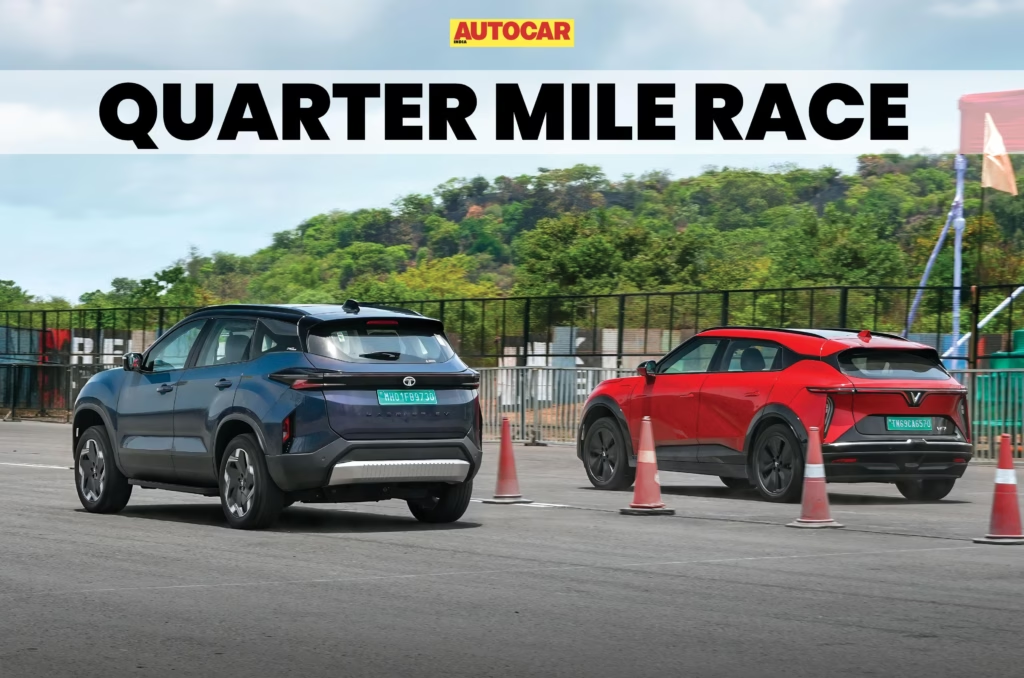
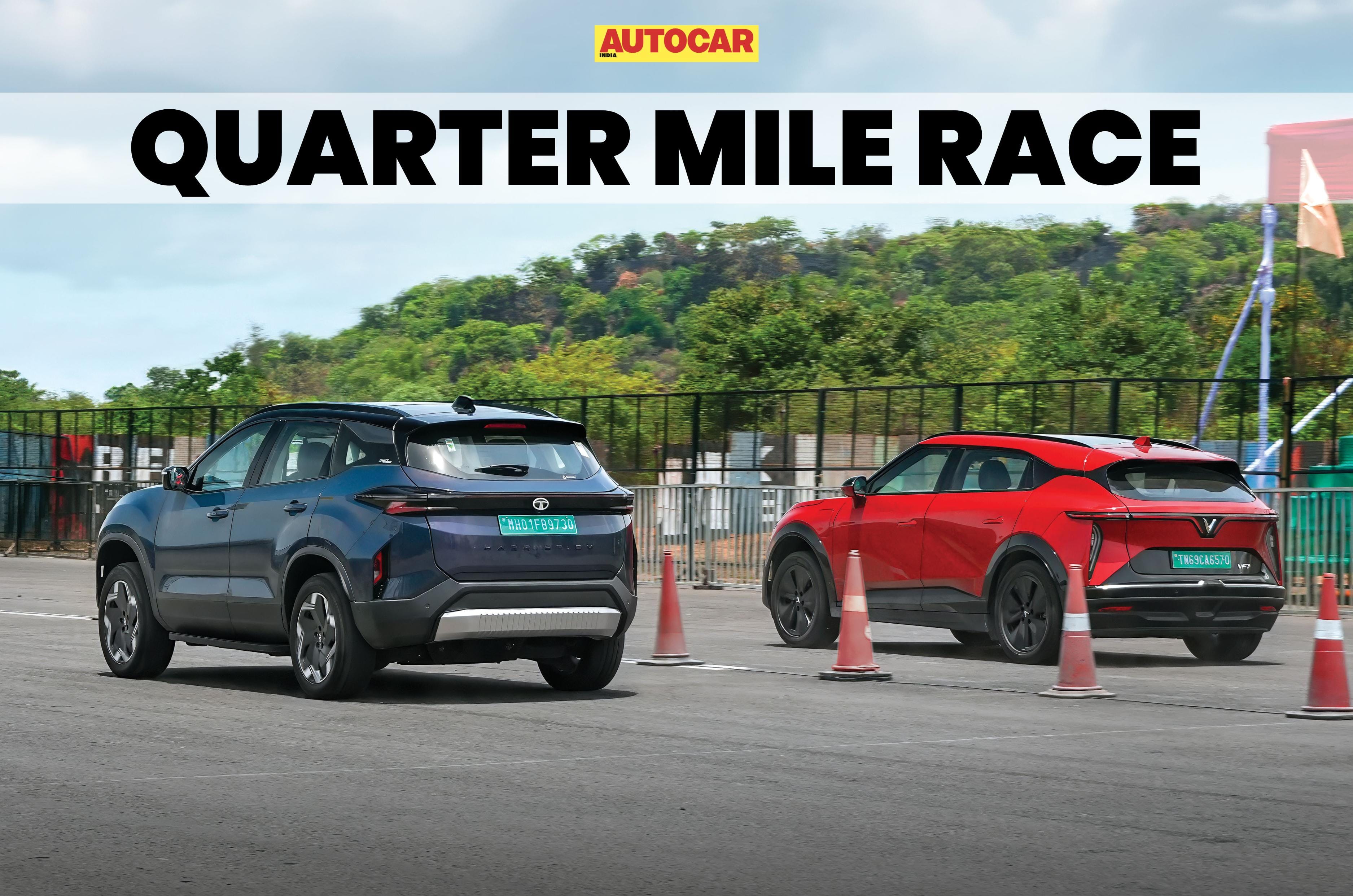
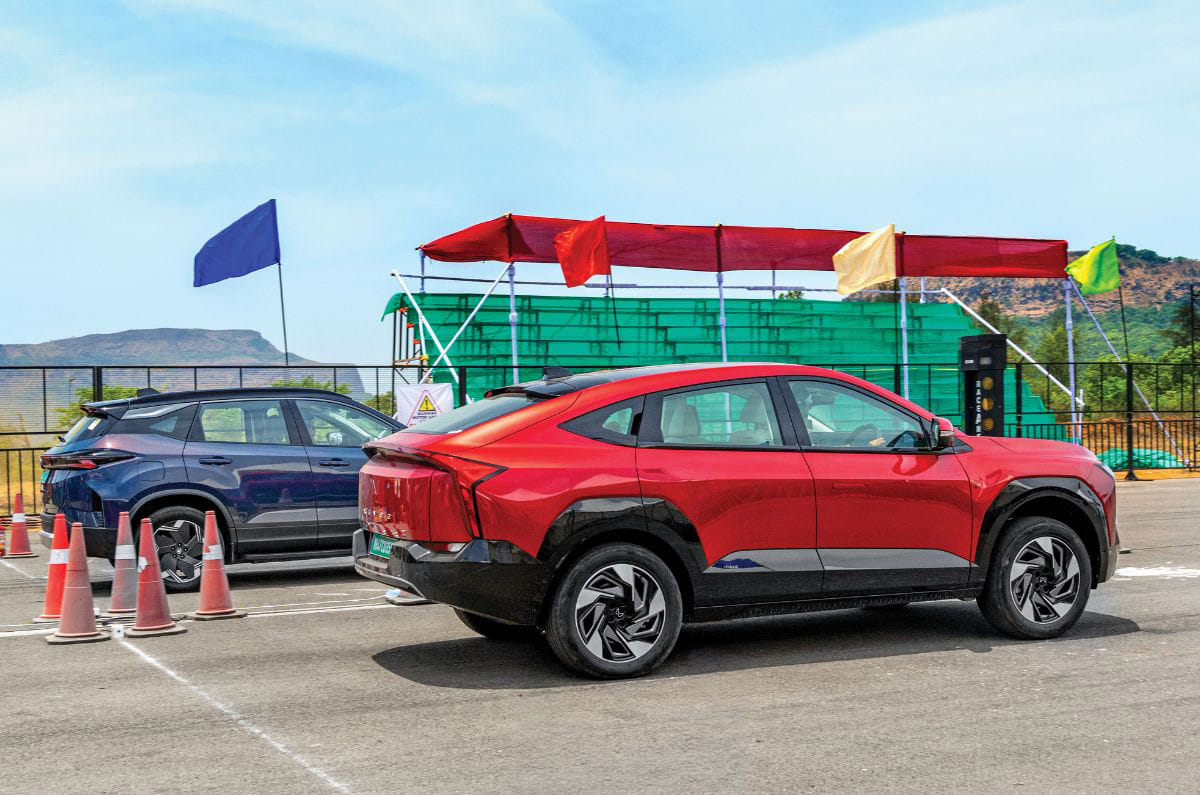
There’s no simpler way to compare one car’s performance to another than with a head-to-head quarter-mile race. Following the shootout between the newest crop of midsize SUVs, in this edition of Autocar India’s quarter-mile racing series, we’ve brought together three premium electric SUVs including the Tata Harrier EV, the Mahindra XEV 9e and the Vinfast VF7. Let’s find out which one here is the quickest down the drag strip.
Round 1: Tata Harrier EV vs Mahindra XEV 9e
Model
Tata Harrier EV
Mahindra XEV 9e
Battery
75kWh
79kWh
Electric Motor setup
Dual Motor, AWD
Single Motor, RWD
Power
313hp
286hp
Torque
504Nm
380Nm
Weight
2335kg
2201kg
Between these two homegrown EVs, the Harrier EV has an advantage for not only being more powerful, but it also has all-wheel drive as opposed to XEV 9e’s rear-wheel drive setup. Both SUVs are heavy-weights, but the Mahindra has an advantage for being 134kg lighter. On whose favour will the scales tip? Let’s find out.
The Harrier EV’s all-wheel drive system gives it a clear advantage in this race, giving it a comfortable win in Race 1 by a big margin of over seven tenths. Despite not being able to turn off traction control, the grip from the AWD system is enough for it to gap the Mahindra. Race 2 is a repeat, but the Mahindra does manage to close the gap, losing by half a second this time around.
Model
Tata Harrier EV
Mahindra XEV 9e
Race 1
14.35 sec
15.02 sec
Race 2
14.26 sec
14.92 sec
Round 2: Tata Harrier EV vs Vinfast VF 7
Model
Tata Harrier EV
Vinfast VF 7
Battery
75kWh
70kWh
Electric Motor setup
Dual Motor, AWD
Dual Motor, AWD
Power
313hp
353hp
Torque
504Nm
500Nm
Weight
2335kg
2218kg
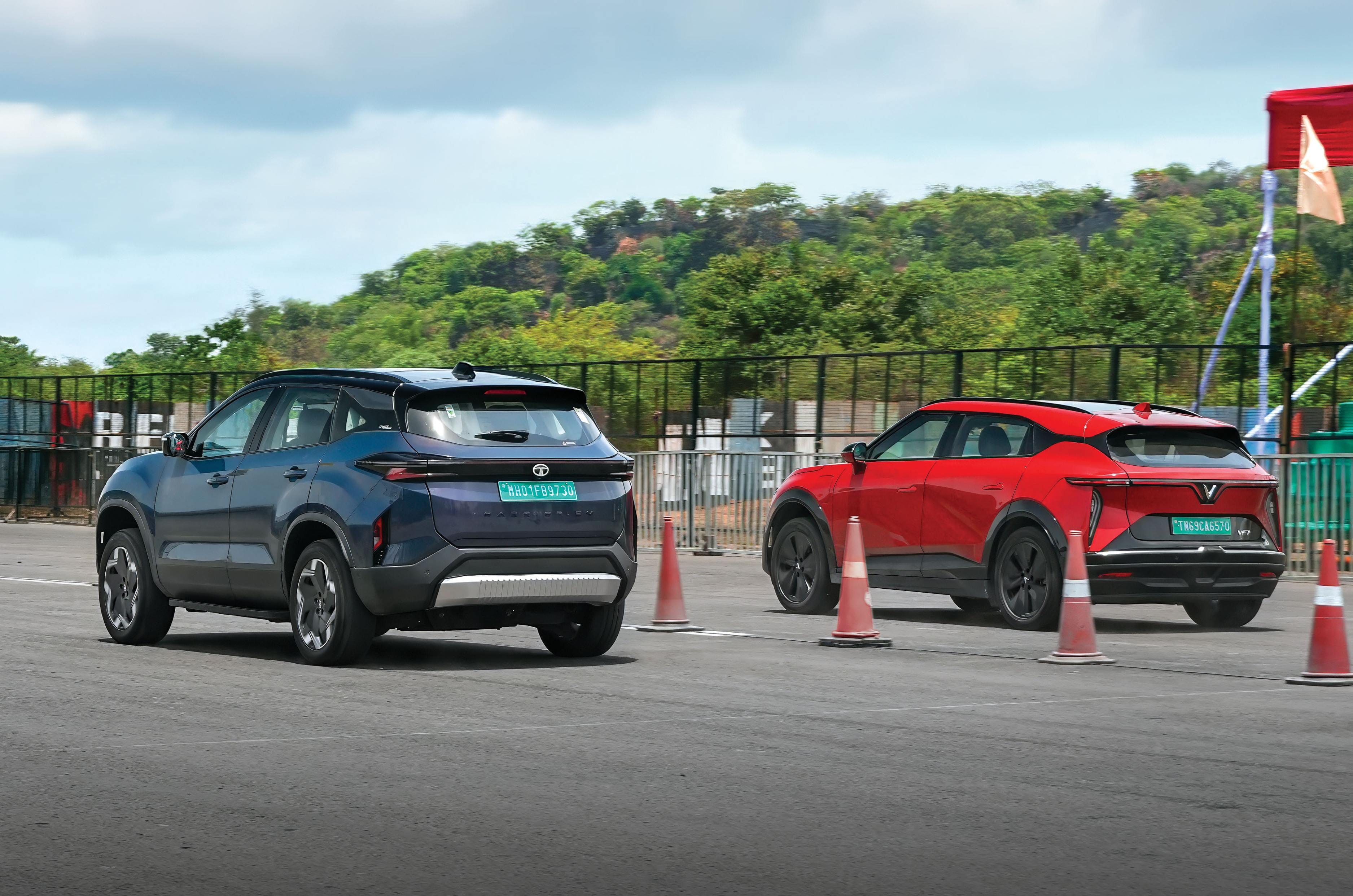
After winning the home-grown battle, the Harrier EV is lined up against another similarly powered, similarly priced and AWD-equipped EV in the form of the Vietnamese Vinfast VF7. This time, however, the Harrier EV is on the back foot – it’s less powerful, weighs more and the advantage of all-wheel drive has been wiped away.
The Vinfast does allow you to turn traction control off, which results in a much better launch than the Harrier EV. In Race 1, both SUVs are neck-and-neck off the line, but the VF7 soon builds a lead and manages to maintain it all the way till the finish, crossing the line four tenths faster than the Tata. The Harrier EV does manage to narrow the gap in Race 2, but the advantage the VF7 gains at launch is hard for the Tata to overcome, and it loses out by 0.29sec.
Model
Tata Harrier EV
Vinfast VF7
Race 1
13.85 sec
14.25 sec
Race 2
13.94 sec
14.23 sec
Autocar India’s testing standards
Before we conduct our performance tests, we check and maintain tyre pressures based on the manufacturer’s recommendation and ensure the car has a full tank of fuel. The car is then tested in a controlled environment and the data is collected via highly accurate GPS-based timing equipment.
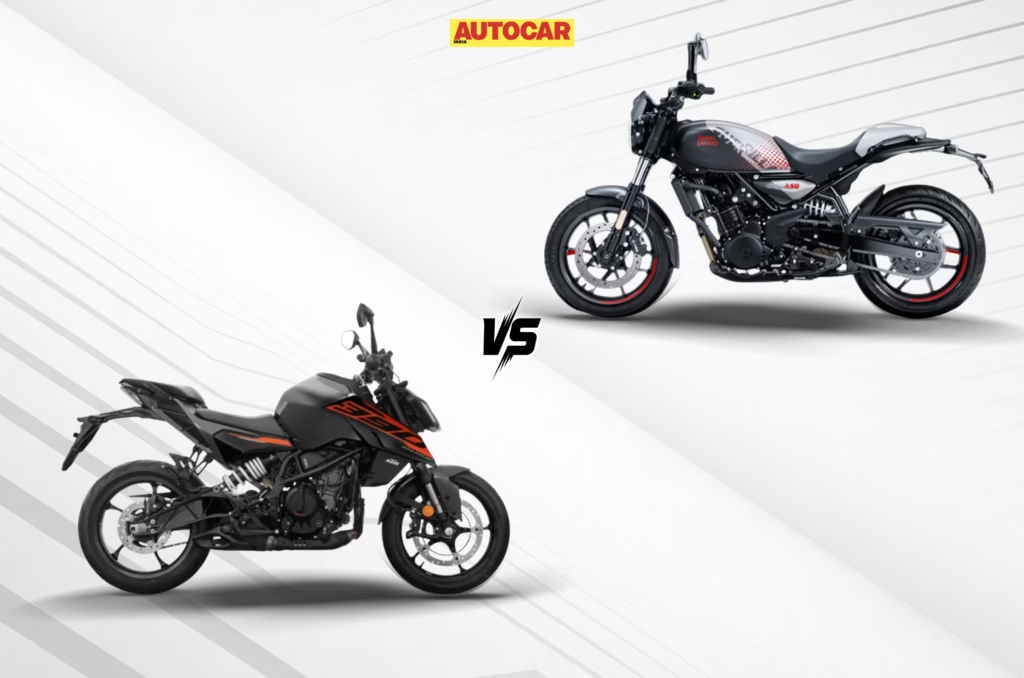
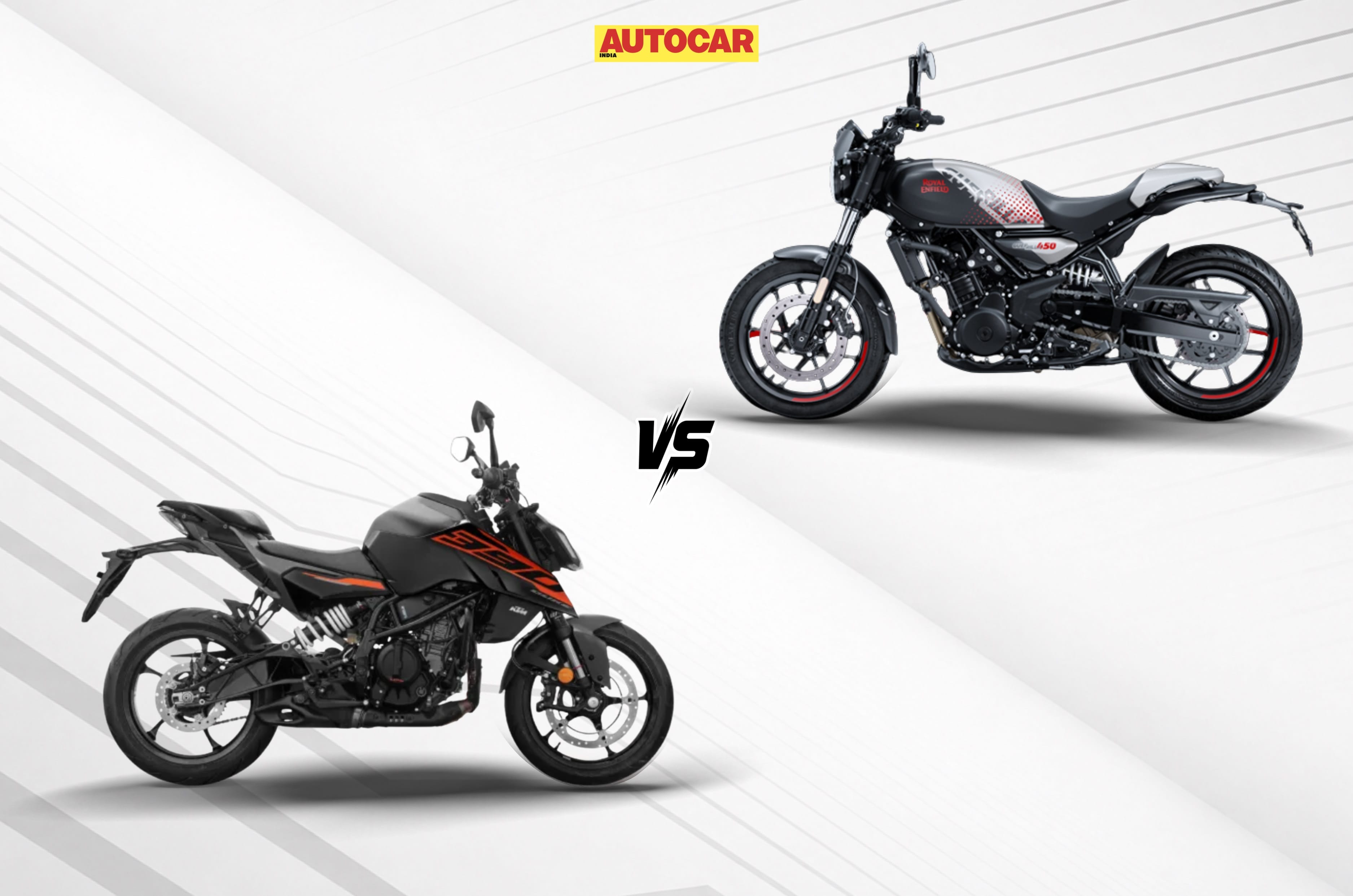
When the Guerrilla 450 first launched in 2024, comparisons to the KTM390 Duke (now known as the Duke R) were inevitable. In 2026 though, things have changed because, following the revised GST structure on motorcycles, Bajaj decided to downsize all of its 400cc manufactured bikes to fall below the 350cc threshold. So, we now have a 390 Duke with a 349cc engine and the 398cc version continues on as the 390 Duke R. Meanwhile, the Royal Enfield Guerrilla 450 is now available in a new, sportier Apex variant. Let’s see how the motorcycles compare on paper with these redrawn boundaries.
KTM 390 Duke vs Royal Enfield Guerrilla 450 Apex: Engine and output
KTM has more power, Guerrilla has more torque
KTM 390 Duke
Royal Enfield Guerrilla 450 Apex
Engine
349.32cc, single-cylinder, liquid-cooled
452cc, single-cylinder, liquid-cooled
Power
41.5hp at 8,600rpm
40.02hp at 8,000rpm
Torque
33.5Nm at 7,000rpm
40Nm at 5,500rpm
Transmission
6-speed
6-speed
Power-to-weight ratio
246.58hp/tonne
216.32hp/tonne
The biggest reason for this comparison is the KTM’s downsized 349cc engine. It now makes 41.5hp of power (vs 46hp on the Duke R) and 33.5Nm of torque (vs 39Nm on the Duke R). Both are now delivered slightly later in rev range as well. KTM achieved this with an 8mm shorter stroke length, although the bore remains unchanged. The Guerrilla 450 Apex, on the other hand, has not changed on the engine front and retains its 452cc engine with the same power and torque figures. Thus, the Guerrilla offers quite a bit more torque than the Duke and it’s delivered much earlier in the rev range too. Which means you will have to work the throttle and gearbox comparatively less on the Royal Enfield. Thus, if you spend most of your time in the city, it will be the less cumbersome bike to ride in this regard.
KTM 390 Duke vs Royal Enfield Guerrilla 450 Apex: Dimensions and weight
Duke is lighter despite a 30 percent larger fuel tank
KTM 390 Duke
Royal Enfield Guerrilla 450 Apex
Fuel tank capacity
15 litres
11 litres
Ground clearance
183mm
169mm
Kerb weight
168.3kg
185kg
Seat height
800mm
780mm
Wheelbase
1357mm
1440mm
The 390 Duke continues to be far lighter than the Guerrilla, which weighs a staggering 17kg more. Another pertinent detail is that despite the lower weight, the Duke gets a 4-litre larger fuel tank compared to the Guerrilla. The Guerrilla does get a 20mm lower seat height and its ground clearance is 14mm lesser than the Duke. However, it’s worth noting that both bikes are perfectly usable on our roads, pothole-ridden or otherwise.
KTM 390 Duke vs Royal Enfield Guerrilla 450 Apex: Tyres, brakes, and suspension
Duke has adjustable suspension and better brakes
KTM 390 Duke
Royal Enfield Guerrilla 450 Apex
Tyres (F, R)
110/70R17, 150/60R17
120/70R17, 160/60R17
Brakes (F, R)
320mm front disc, 240mm rear disc; dual-channel ABS
310mm front disc, 270mm rear disc; dual-channel ABS
Suspension (F, R)
43mm USD fork, monoshock
43mm RSU fork, linkage monoshock
Moving on to one of the most important links between the rider and the tarmac, the tyres. The Guerrilla gets slightly wider tyres than the Duke at both ends, but the disc brakes on the Guerrilla are slightly smaller at the front, and slightly larger at the rear. However, the KTM comes with a more sophisticated radial calliper at the front, whereas the Guerrilla makes do with a simpler axial unit. As for suspension, the Duke gives you an USD fork which is compression and rebound adjustable; and the rear monoshock is rebound and preload adjustable. The only adjustability the Guerrilla gets is for its rear preload.
KTM 390 Duke vs Royal Enfield Guerrilla 450 Apex: Features
KTM continues its tech-forward approach
KTM has always offered a myriad of tech features and rider aids on its motorcycles. Royal Enfield on the other hand has always been restrained on that front, prioritizing simplicity and ease of use instead. Depending on your preferences, you will gravitate towards one or the other. KTM offers you slip-and-assist clutch, ride modes, traction control, launch control, lean-sensitive ABS, bi-directional quickshifter, cruise control, turn-by-turn navigation, track screen, and a type-C charging port. Royal Enfield, to its credit, has given the Guerrilla a decent feature-set comprising a TFT instrument cluster which allows you to screencast Google Maps, two ride modes and a slip-and-assist clutch.
KTM 390 Duke vs Royal Enfield Guerrilla 450 Apex: Price
Guerrilla is more affordable with a bigger engine but has less features
KTM 390 Duke
Royal Enfield Guerrilla 450 Apex
Price
Rs 2.84 lakh (ex-showroom, Delhi)
Rs 2.51 lakh (ex-showroom, Chennai)
Last but not least, the other reason necessitating the comparison, is the price. With its downsized engine KTM was able to meet a lower GST slab and thus the 390 Duke now costs Rs 2.84 lakh (ex-showroom, Delhi). The Guerrilla 450 Apex still manages to undercut it and by a good deal, starting at Rs 2.51 lakh and going up to Rs 2.58 lakh for the Apex Green colour.
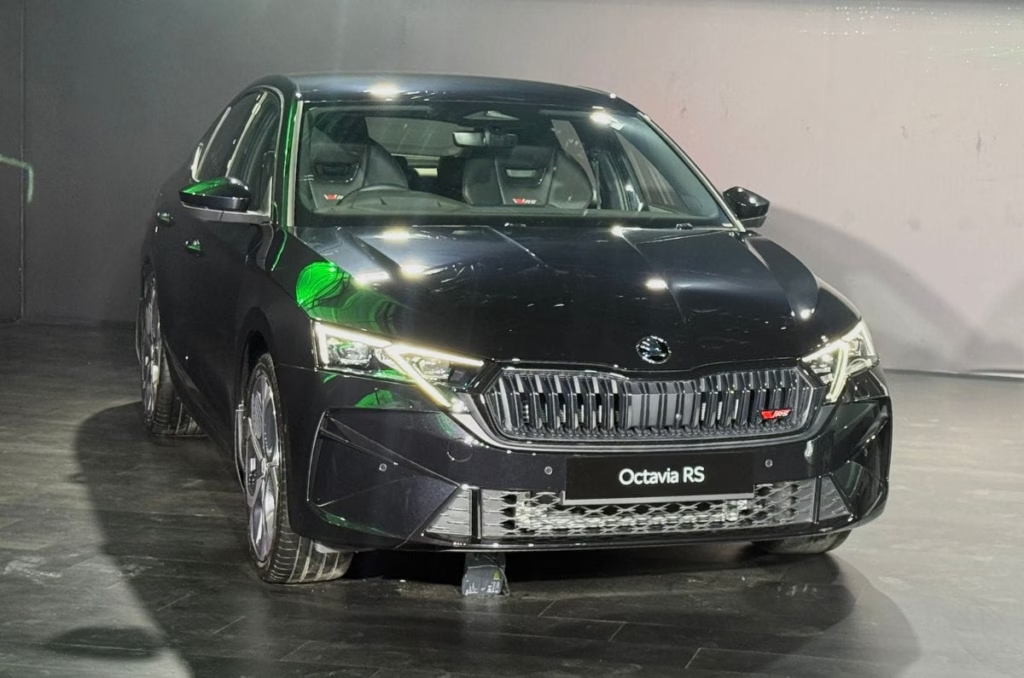
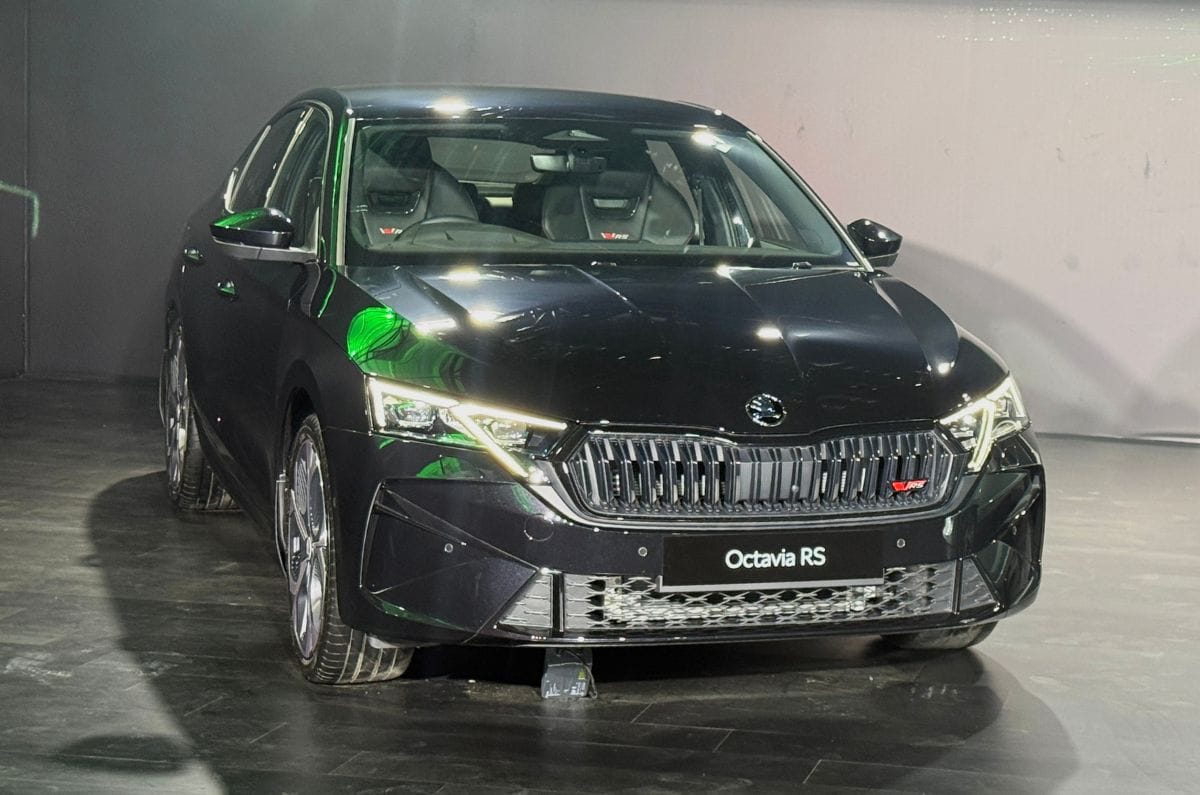
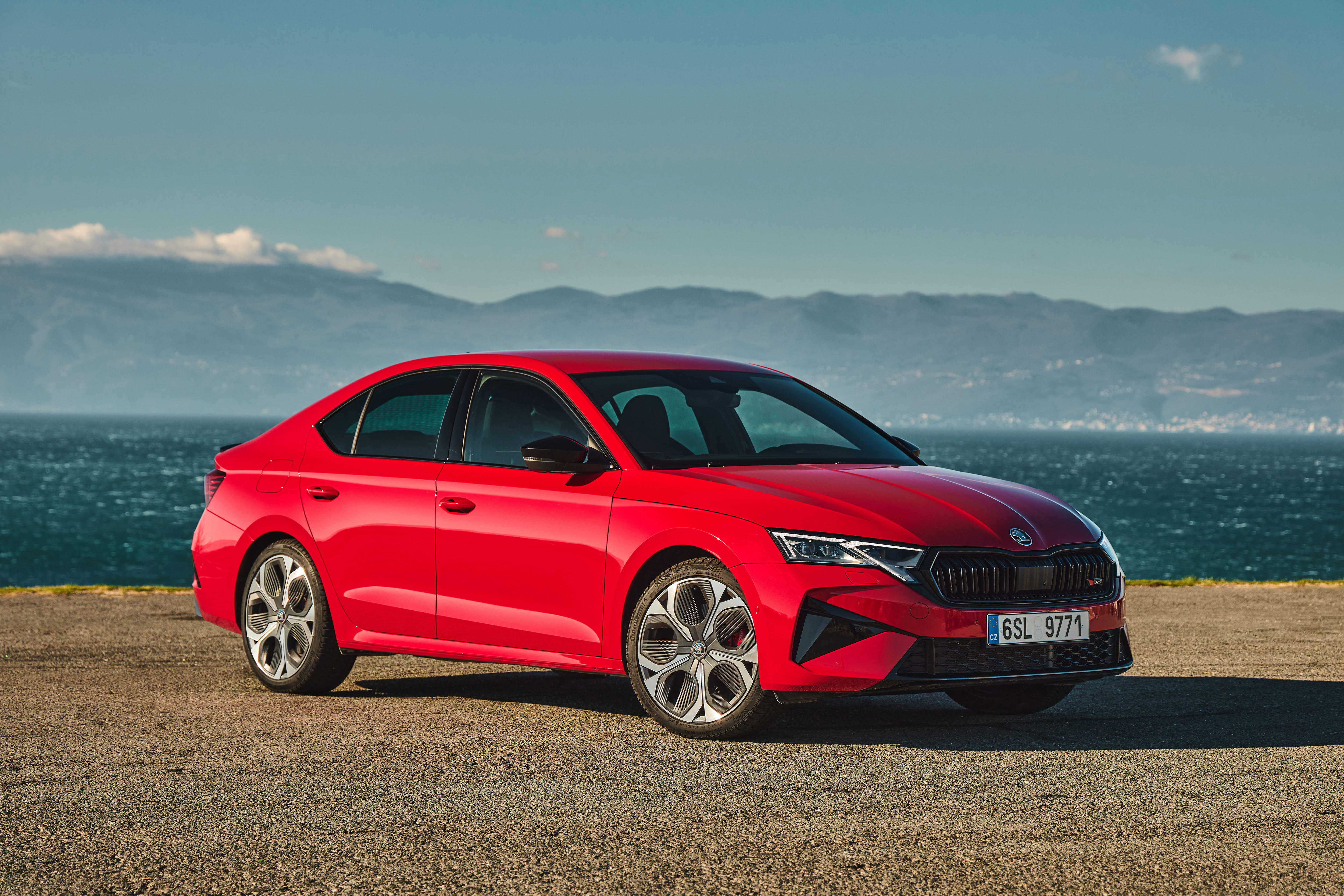
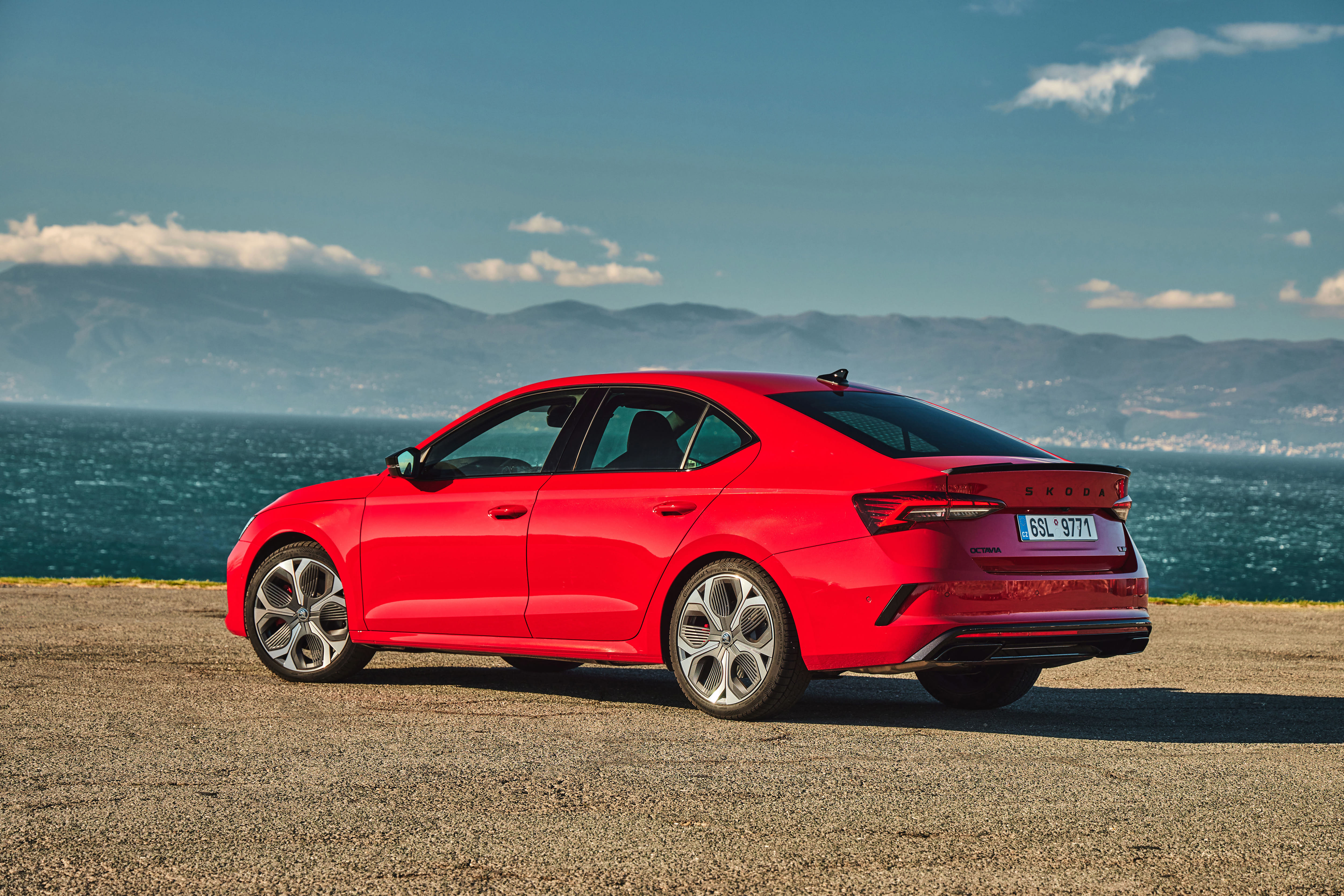
Having sold out the Octavia RS’s first batch comprising 100 units last year, Skoda has now announced a second batch for the model in India. The Octavia RS has quite a loyal fan base in our market, which means many enthusiasts were left disappointed, despite its high asking price. The Octavia RS will return this year with another allocation of 50 units, the deliveries of which are expected around the upcoming festive season. However, the car will continue to be a full import, which means prices can be expected to be quite steep.
Existing bookings from the previous year will be honoured first
Octavia RS is powered by a 265hp 2.0-litre turbo-petrol engine
The new Octavia RS batch will be available in three colour options
Skoda Octavia RS second batch details
Speaking to Autocar India last year, Ashish Gupta, brand director for Skoda India, had said, “I will definitely be working on getting more cars to India. Apart from the ones already allocated, the remaining people are on our communications list. We will be in touch with them, and our endeavour will be to get more cars early next year.”
Gupta had then said the brand had amassed nearly 350 bookings. The company will be honouring the existing bookings first before opening the order books to new customers. For reference, the first batch of the Octavia RS was launched at an ex-showroom price of Rs 49.99 lakh.
Skoda Octavia RS powertrain details
The inbound batch of the Octavia RS will continue to be powered by a 265hp, 370Nm 2.0-litre 4-cylinder turbo-petrol engine. Transmission duties are handled by a 7-speed DSG automatic gearbox, and power is sent to the front wheels. Skoda claims a 0-100kph time of 6.4 seconds and an electronically limited top speed of 250kph. The same engine is also found under the hood of the Volkswagen Golf GTI, a second batch of which is also expected to arrive here. The new Octavia RS batch will be available in three colour options: Mamba Green, Velvet Red and Magic Black.
The Octavia RS has always enjoyed a cult status in India. Even the previous-generation Octavia RS 245 launched in 2020 (limited to 200 units) was sold out in a little over a month.
This announcement comes alongside the debut of the Slavia facelift as well as the confirmation of the Superb’s return to India, importantly in diesel guise, marking the return of a diesel engine to the Volkswagen Group in India after 2020. While all other manufacturers have practically given up on sedans, Skoda will have quite an expansive sedan line-up ranging from mass-market to the premium segments.
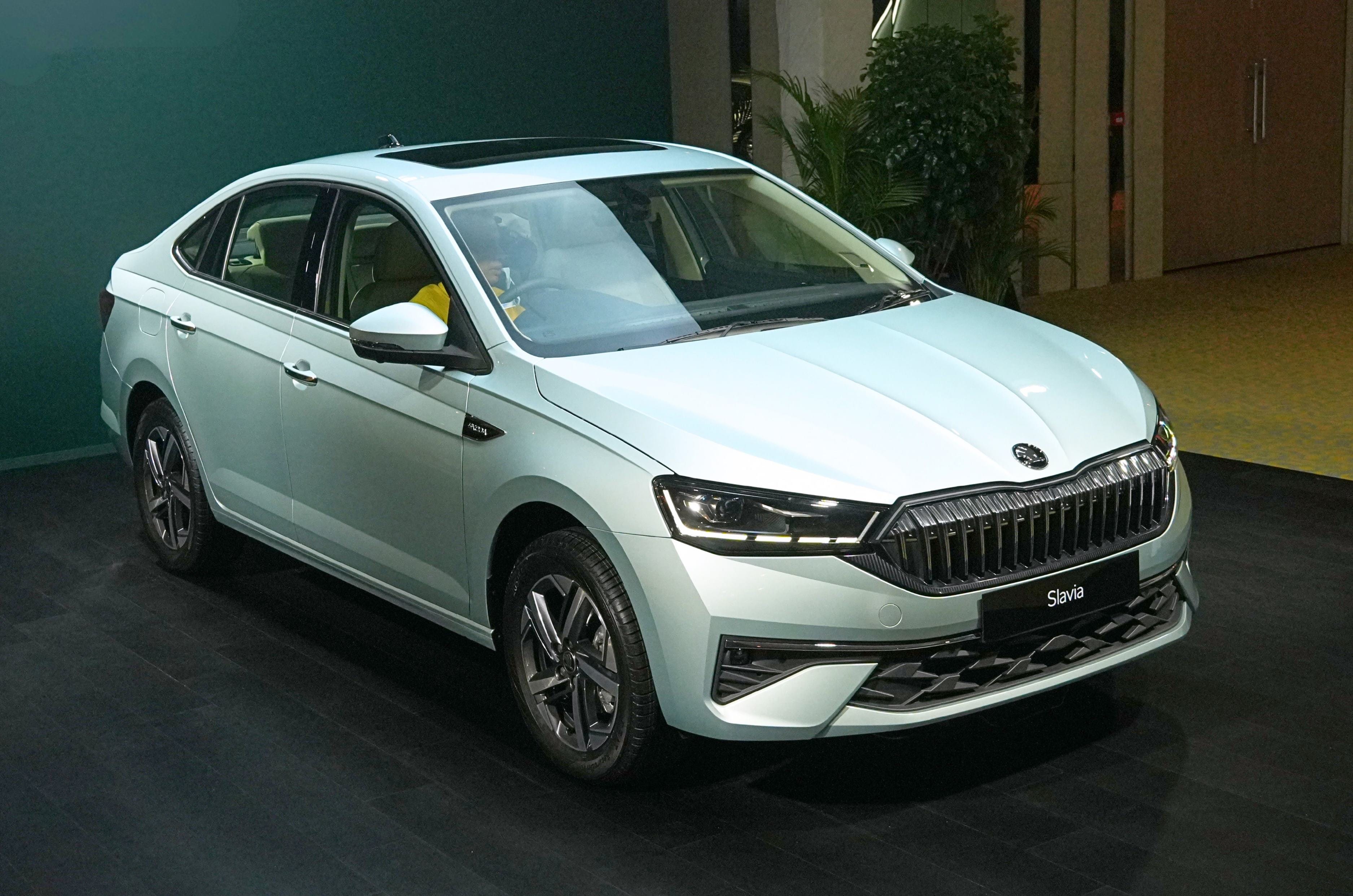
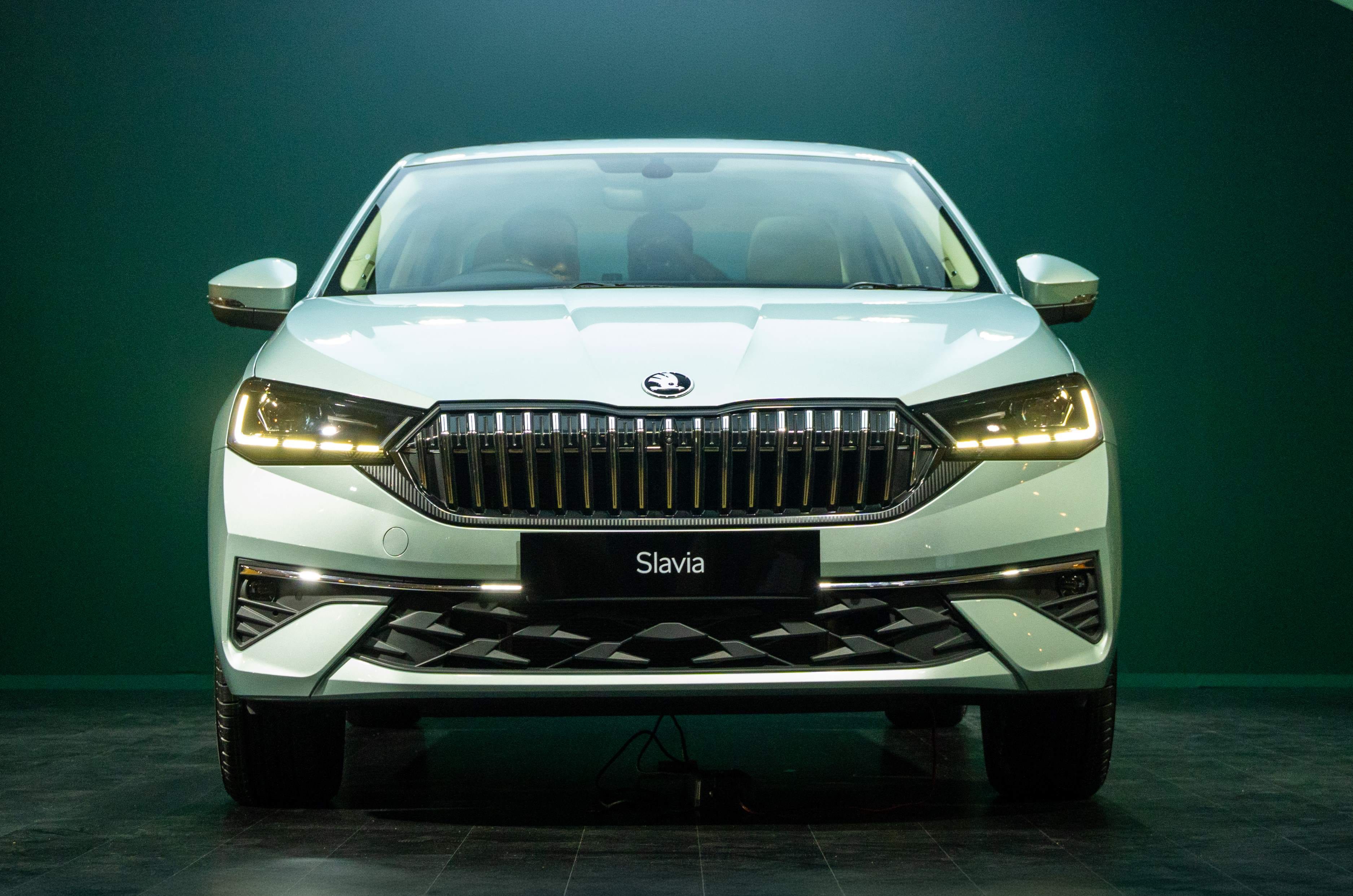
The much-awaited Skoda Slavia facelift has finally been revealed. The mid-lifecycle update brings several cosmetic changes and new features, along with an automatic gearbox upgrade for the 1.0 TSI petrol engine. The prices will be announced in the first week of October and pre-bookings for the Skoda sedan are underway. Meanwhile, deliveries will begin this festive season.
360-degree camera, LEDs integrated into the front grille have been added
Kushaq-like rear sear massaging function available as well
New 8AT option introduced for the 1.0 TSI mill instead of the 6AT unit
New Skoda Slavia exterior highlights
New LED DRL signatures and bumper grille come courtesy of the facelift.
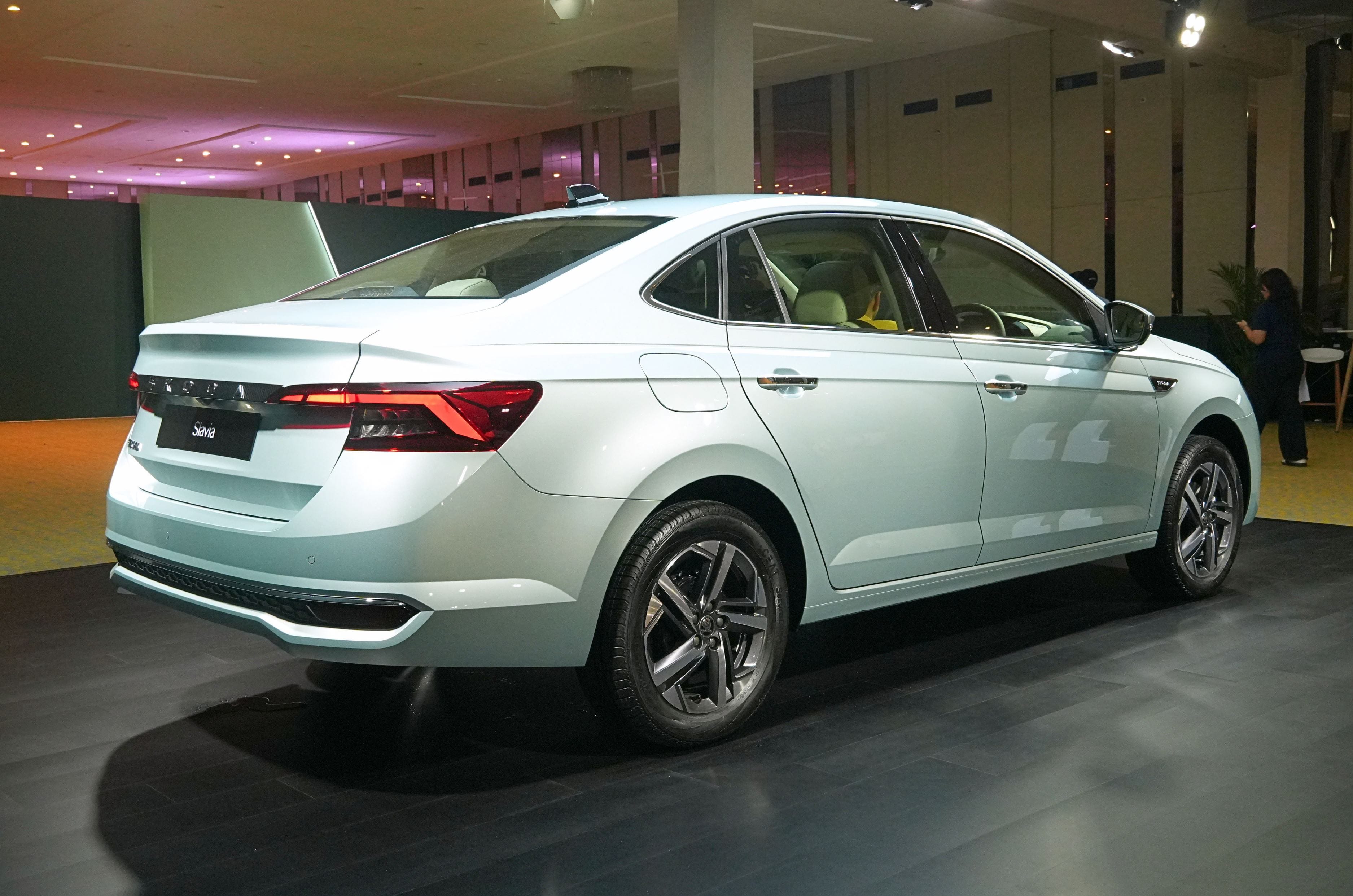
Being a facelift, the overall silhouette of the mid-size sedan has been carried over. Parts like the headlights, tail-lights, front grille and air dam, and alloy wheels have been refreshed. It also gets Skoda Kushaq-like segmented LEDs integrated into the grille and sequential turn indicators at the rear. A new trim between the tail-lights with the ‘SKODA’ lettering has also been added.
Side profile is largely unchanged.
Arctic Silver and Cappuccino Beige are among the new colours, however, deliveries for the latter will only start from December. Other colour option on offer are Shimla Green, Brilliant Silver, Candy White, Carbon Steel, Steel Grey, Lava Blue, Cherry Red and Deep Black.
New Skoda Slavia interior features
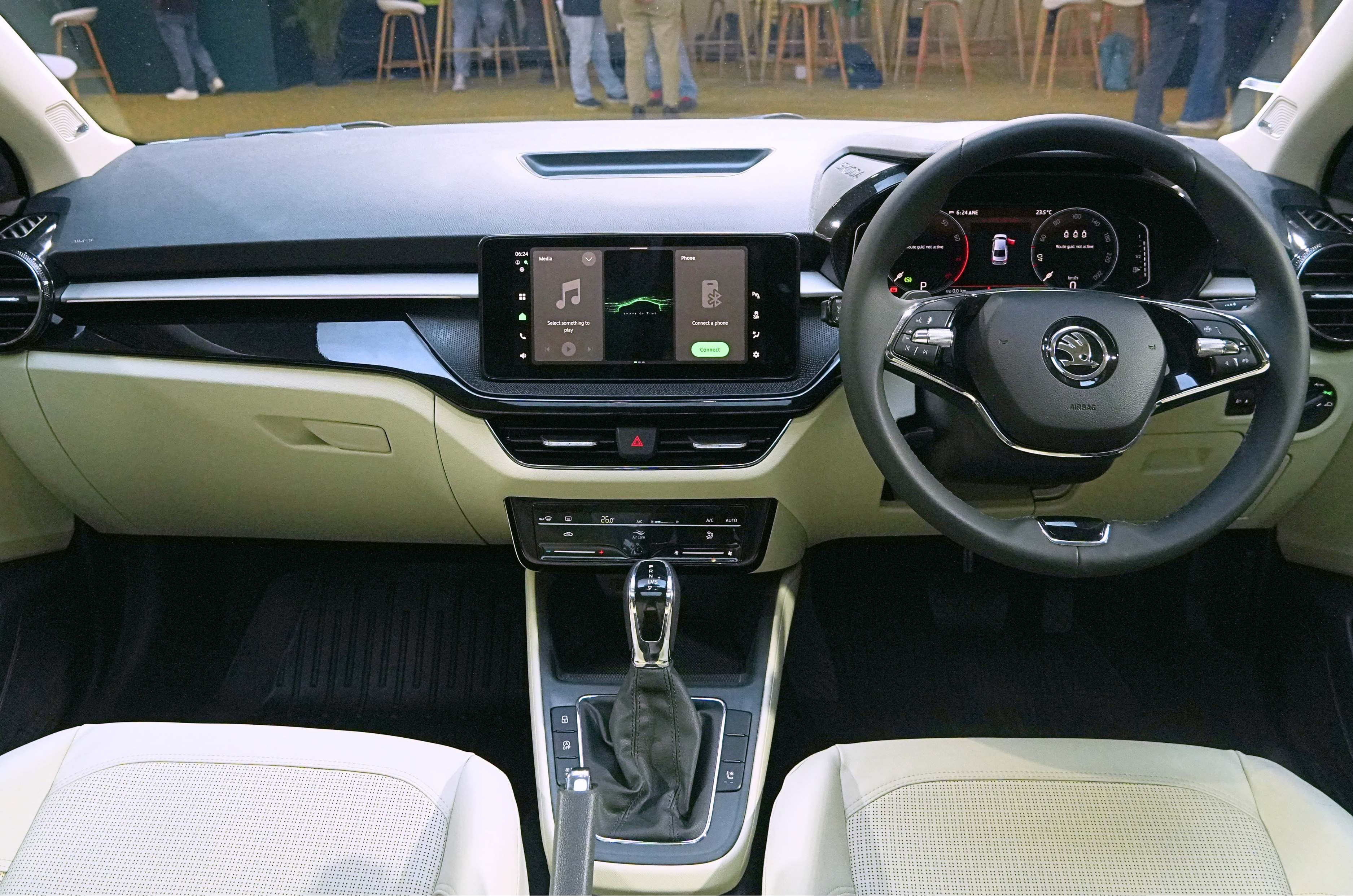
The interior layout has been carried over.
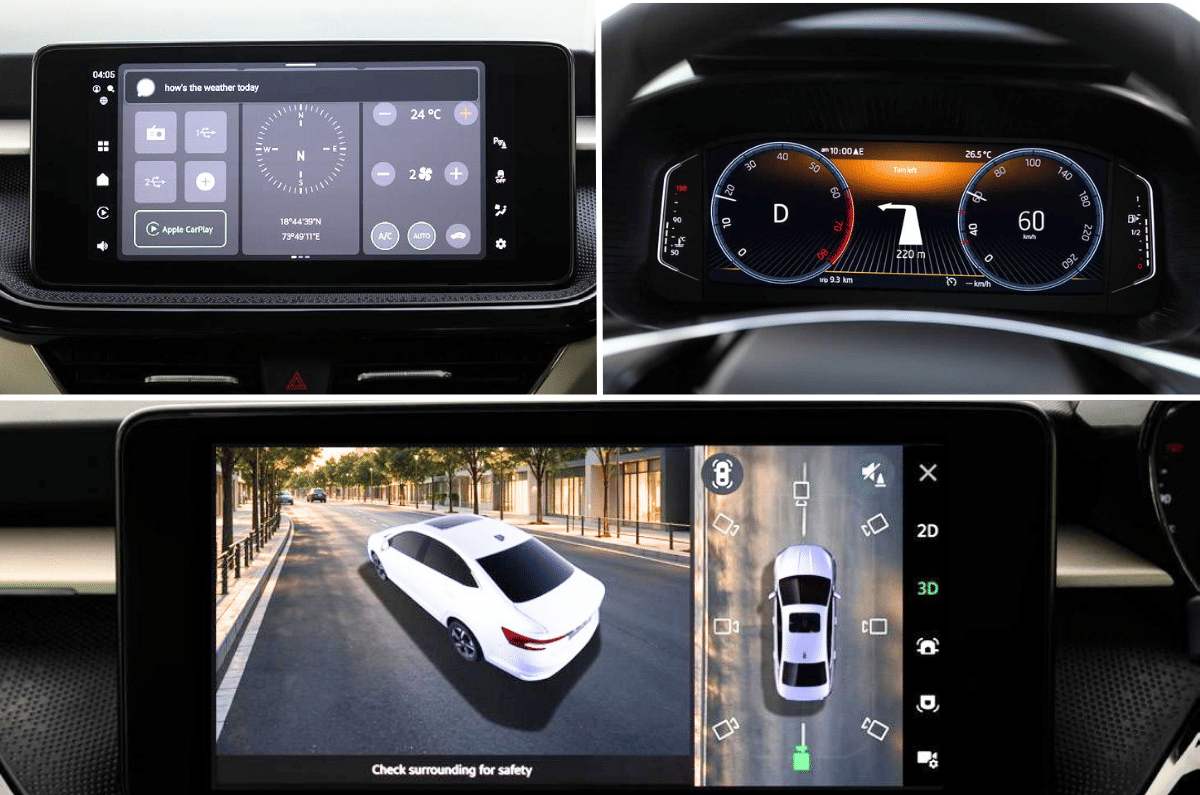
The Slavia facelift gets a segment-first rear-seat massaging function. It also gets larger screens, with a 10.1-inch touchscreen replacing the erstwhile 10-inch unit, while a 10.25-inch driver’s display has been added in place of the 8-inch unit. Both of them come with new graphics and features. A panoramic sunroof is still not part of the package, and it continues with a single-pane unit.
Top: 10.1 inch touchscreen (L), 10.25 inch driver’s display (R); bottom: 360-degree camera view.
A 360-degree camera replaces the previous rear-only unit and like the Kushaq; however, an ADAS suite remains absent.
New Skoda Slavia engine and gearbox choices
New 8-speed torque converter gearbox replaces the 6-speed unit.
The 2026 Slavia continues with the familiar set of 115hp 1.0 TSI and 150hp 1.5 TSI turbo-petrol engines. The 1.0 TSI gets a 6-speed manual, while the 1.5 TSI continues with a 7-speed dual-clutch automatic. The key change is to the 1.0 TSI automatic, which now is an 8-speed torque-converter unit instead of the earlier 6-speed gearbox.
With this update, Skoda aims to keep the Slavia competitive against the Hyundai Verna and Honda City, both of which received facelifts earlier this year. Meanwhile, the Volkswagen Virtus is likley to get an update later this year. The outgoing Slavia is priced between Rs 10 lakh and Rs 18.19 lakh, ex-showroom. With the facelift, a price hike of up to Rs 85,000 is likely.
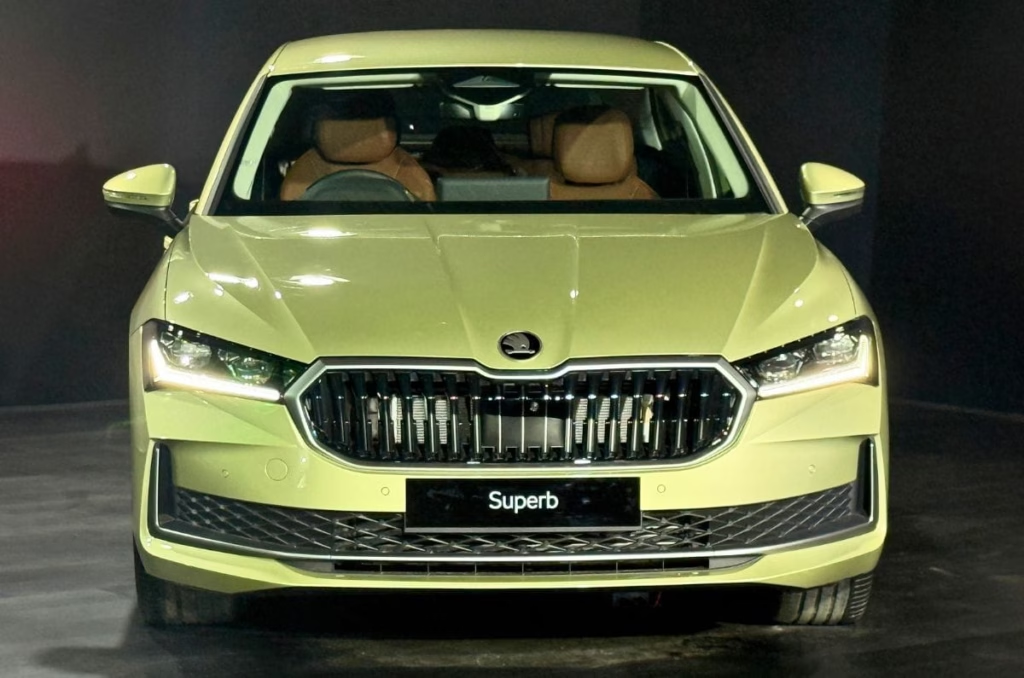
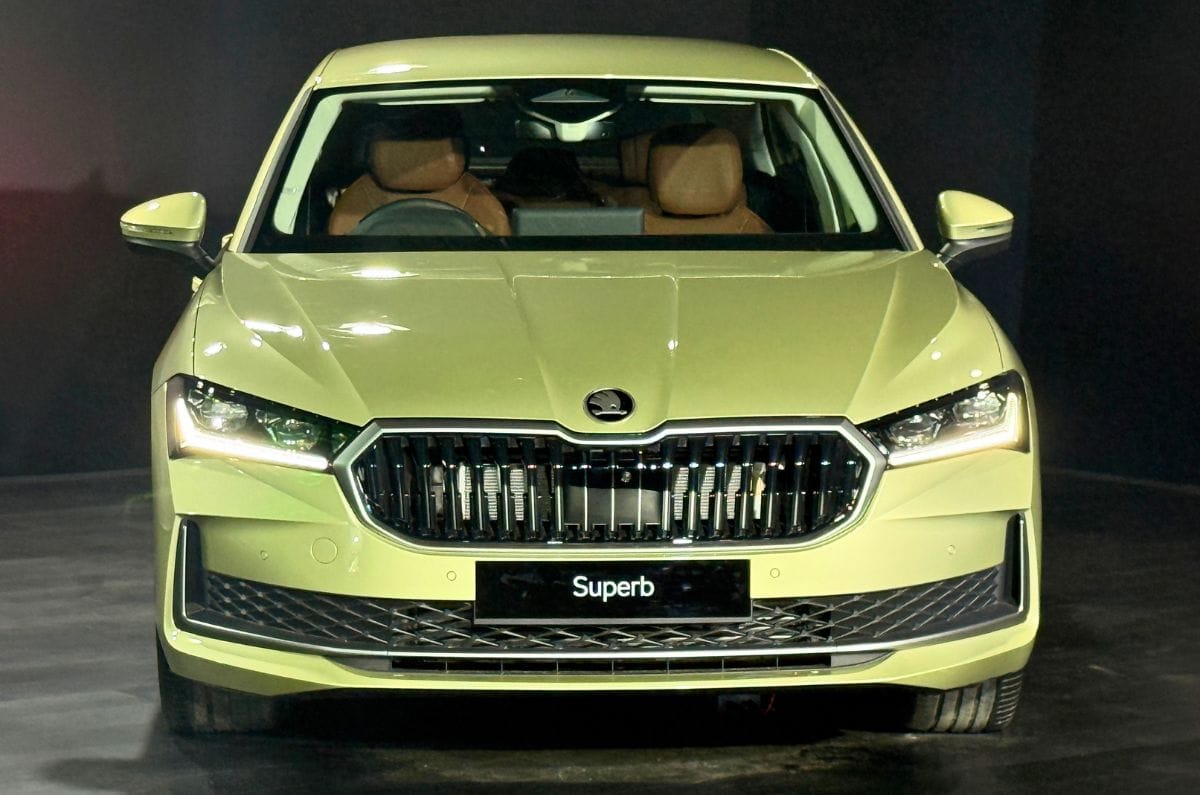
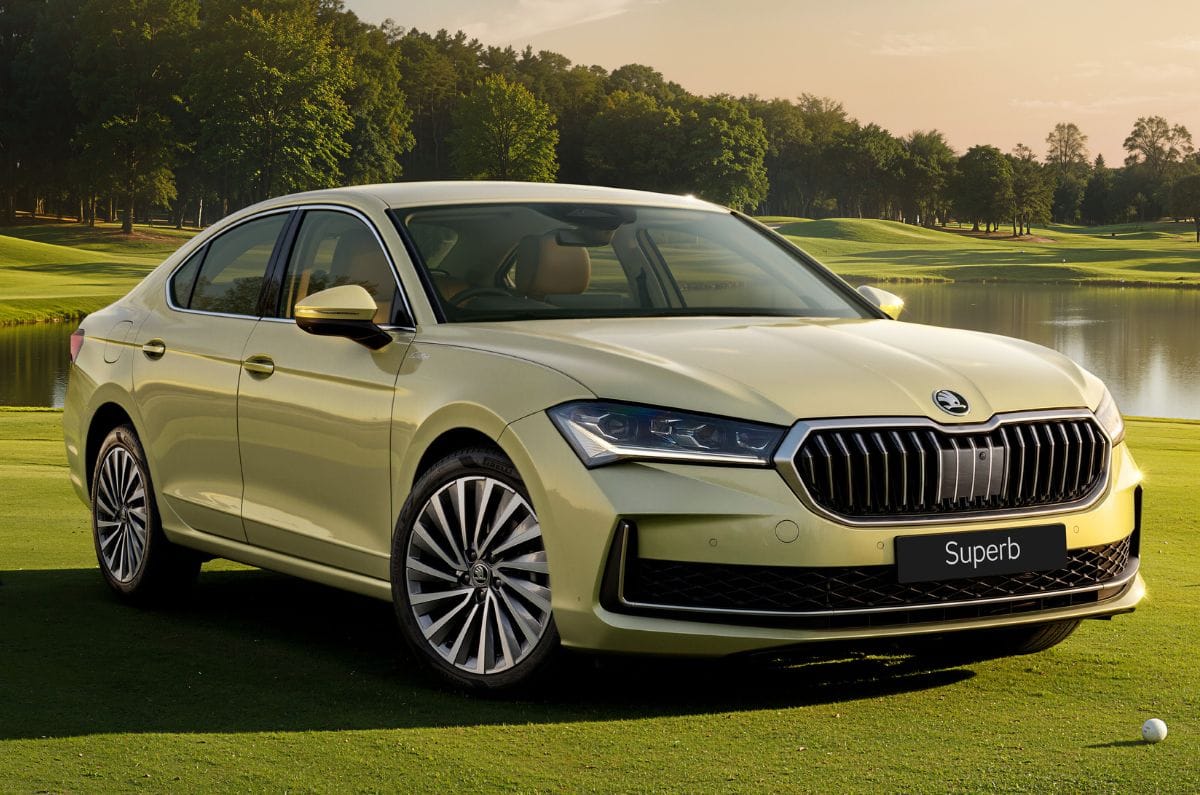
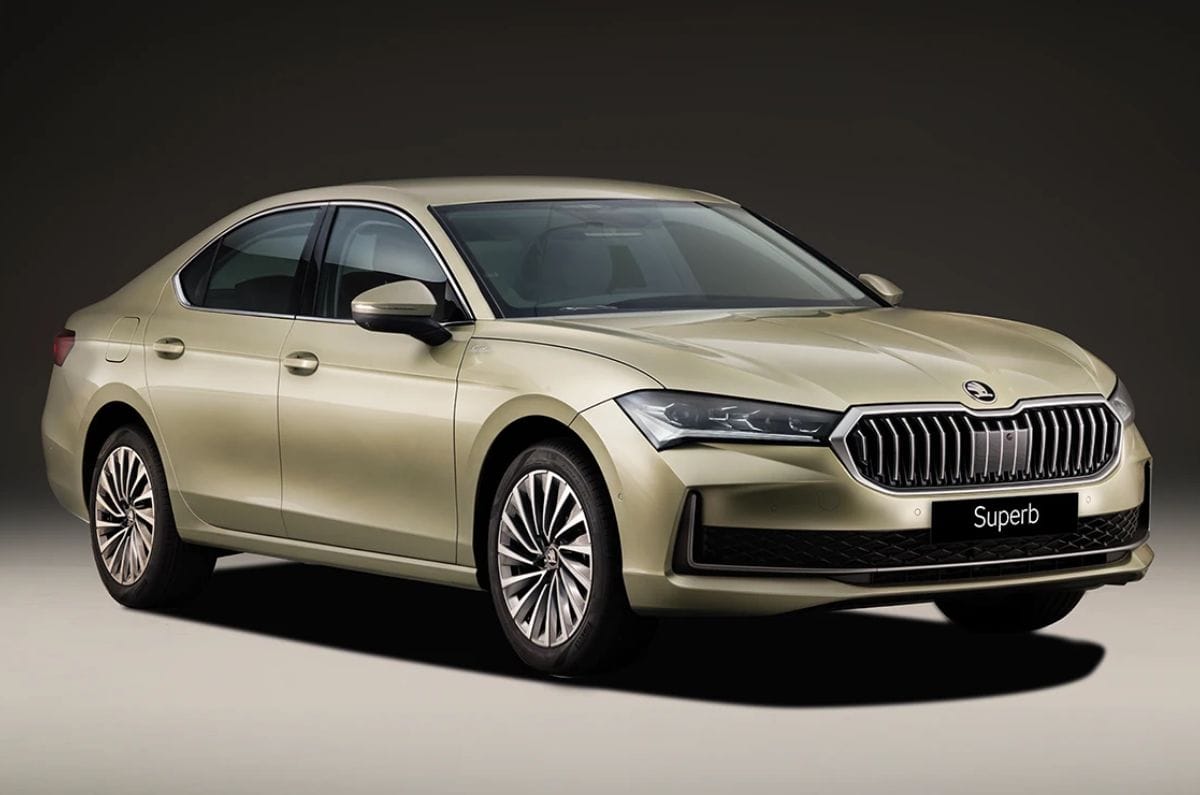
Skoda has revealed the flagship fourth-generation Superb in India ahead of the sedan’s expected launch in the first half of 2027. The Czech manufacturer will bring the Superb’s range-topping Laurin & Klement (L&K) trim to India as a completely built unit (CBU) import. Customers can now register their interest in the Skoda Superb at dealerships, with deliveries slated to commence in the second quarter of 2027.
Powered by a 150hp diesel engine, allowing a 9.2s 0-100kph claimed time
Matrix LED headlights, LED tail-lights and 18-inch alloys to be offered
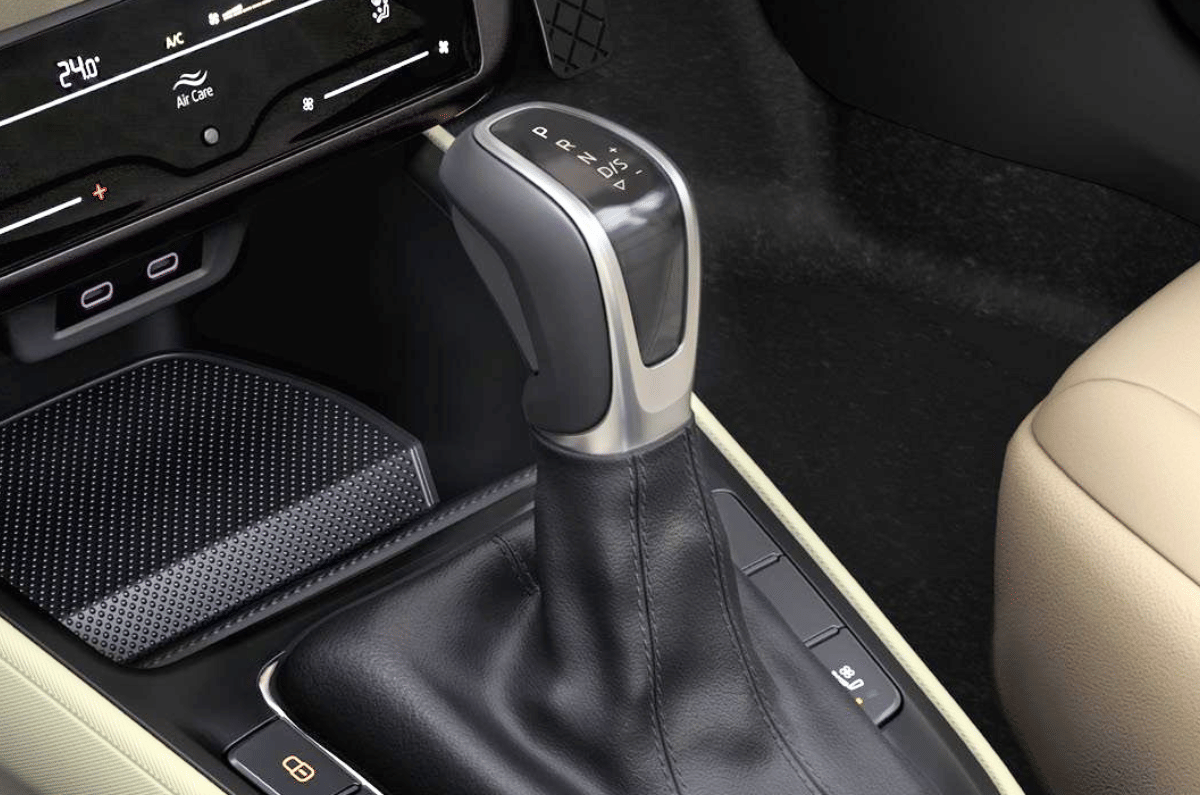
Cabin gets a 12.9-inch infotainment unit, 3-zone AC and a 14-speaker sound system
Interestingly, the Superb was previously brought to India as a CBU import in 2024. However, this will be the first time the fourth-generation model is officially offered to Indian customers. Its arrival also marks the return of a diesel engine to the wider Volkswagen Group in India after a six-year absence. Diesel engines were last offered by the group in the country in 2020, before the BS6 emission norms came into effect.
Skoda Superb powertrain details
India-spec Superb will get a 150hp 2.0-litre diesel engine with a FWD setup
The India-spec Skoda Superb will be powered by a 2.0-litre diesel engine that produces 150hp and 290Nm. It will be mated to a 7-speed dual-clutch automatic transmission (DCT) that sends power to the front wheels (FWD). With this engine in the Superb, Skoda claims a 0-100kph sprint time of 9.2 seconds and an electronically limited top speed of 225kph.
A more powerful 193hp version of this engine, paired with an all-wheel-drive (AWD) system, was showcased at the 2025 Auto Expo, but has now been ruled out for the final India-spec version.
The India-spec Superb will, however, be offered with Progressive Dynamic Steering and Dynamic Chassis Control (DCC) to automatically adjust the handling balance based on driving speed, road conditions and selected driving mode.
Skoda Superb exterior design
Matrix LED headlights, 18-inch alloy wheels and wraparound LED tail-lights
The fourth-generation Skoda Superb retains the elegant look usually associated with the model. Up front, it features the Skoda Signature grille with chrome slats and a chrome surround. The bumper has honeycomb mesh air inlets and a horizontal chrome bar in the centre. It gets Matrix LED headlights with a cornering function and LED daytime running lamps (DRLs) with welcome and goodbye animations.
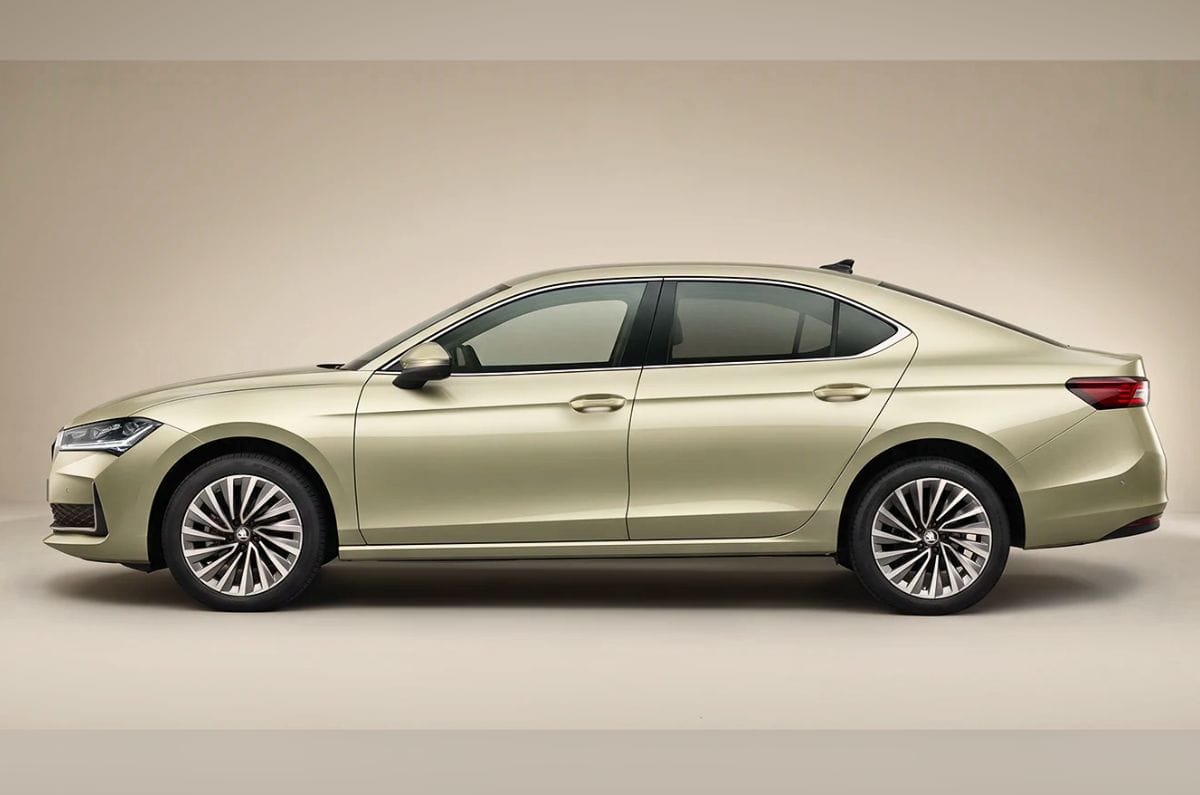
Moving on to the profile, Skoda will offer the Superb with 18-inch dual-tone alloys as standard. The window surrounds have a chrome finish, and the front fenders have the ‘Laurin & Klement’ badge. At the rear are wraparound LED tail-lights with the same welcome animations as the front DRLs and a Skoda wordmark on the tailgate.
Below are the dimensions of the Skoda Superb:
India-spec Skoda Superb dimensions and other specifications
Length
4,912mm
Width
1,849mm
Height
1,511mm
Wheelbase
2,841mm
Ground clearance
138mm (for UK-spec model)
Boot space
645 litres (for UK-spec model)
Skoda Superb interior design and features
Gets a cognac-hued cabin, two digital screens and a lot of convenience features
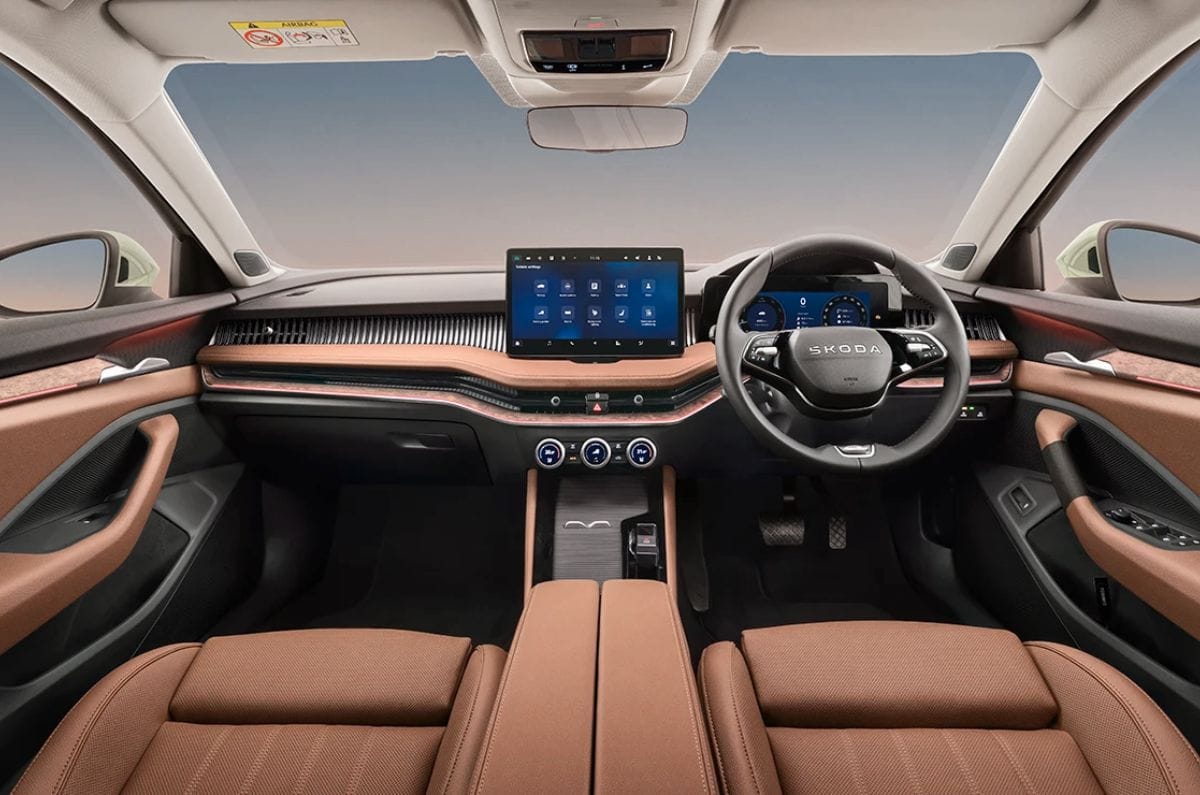
The interior, too, is as elegant as the exterior, featuring a dual-tone black-and-Cognac cabin theme and a simple dashboard with a 12.9-inch touchscreen infotainment system, a 10-inch digital driver’s display and a 3-spoke steering wheel with ‘Skoda’ wordmark. Like the Kodiaq SUV, it gets rotary dials with digital screens on the centre console to operate climate and audio controls. The seats have leatherette upholstery that matches the cabin’s colour scheme.
Other features include a 14-speaker Canton sound system, triple-zone climate control, a 25-Watt wireless phone charger, rear sunblinds and a powered tailgate with gesture support. The front seats are powered and offer features such as memory, heating, ventilation and massage. The Skoda Superb also comes with a ‘Sleep Package’ as standard, featuring adjustable headrests for the rear outboard seats and two blankets for added comfort.
Safety features include 10 airbags, a 360-degree camera, Level 2 advanced driver assistance systems (ADAS), an electronic parking brake, a tyre-pressure monitoring system (TPMS) and automatic parking assistance.
As a CBU import, the Skoda Superb is expected to have a premium positioning and be priced in the Rs 55 lakh-60 lakh range. However, with the India-EU Free Trade Agreement (FTA) set to come into force in 2027, reduced import duties could make the Superb more affordable. If Skoda manages to price it competitively, the Superb could be a fitting alternative to the Toyota Camry, currently the only other sedan in this premium segment.
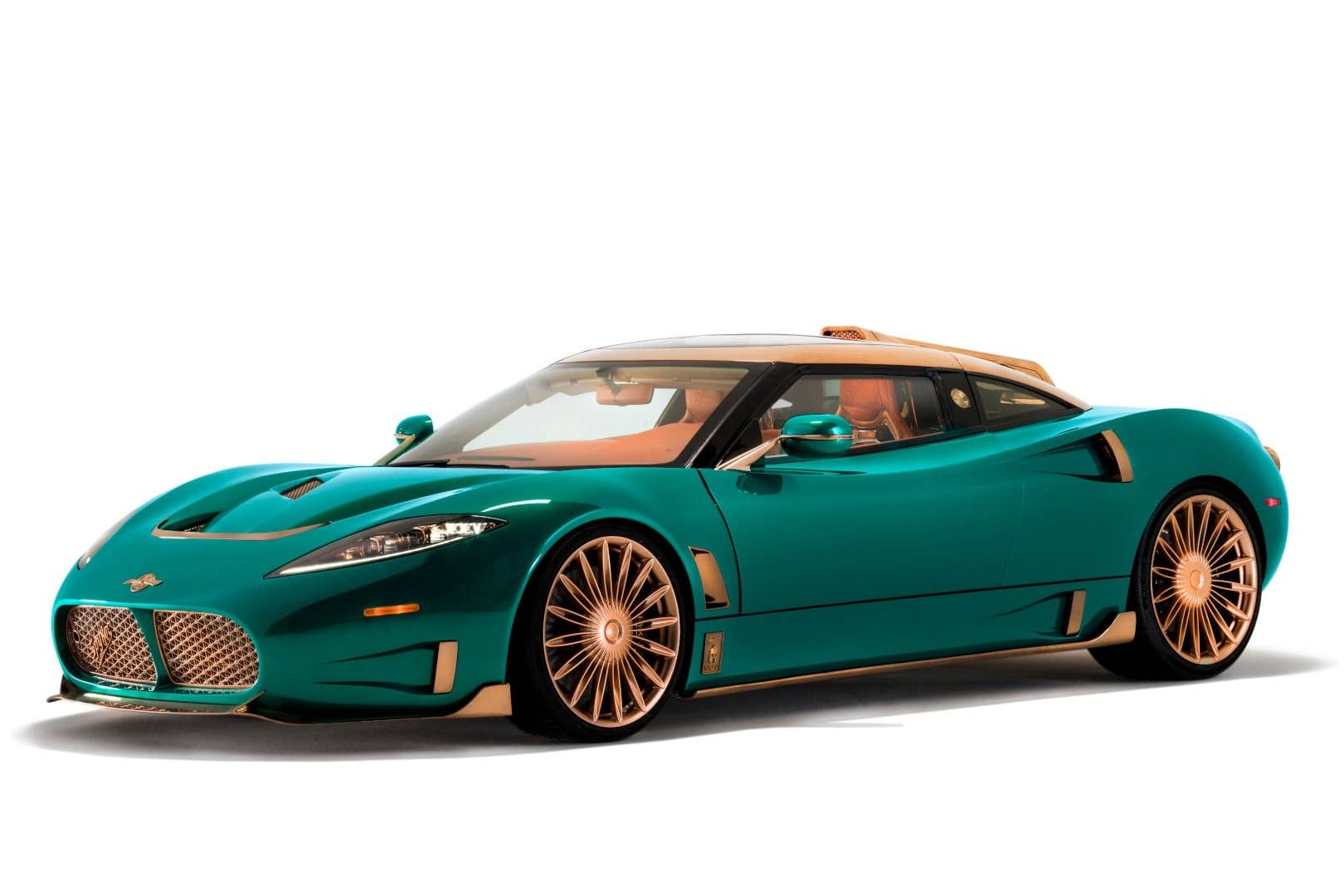
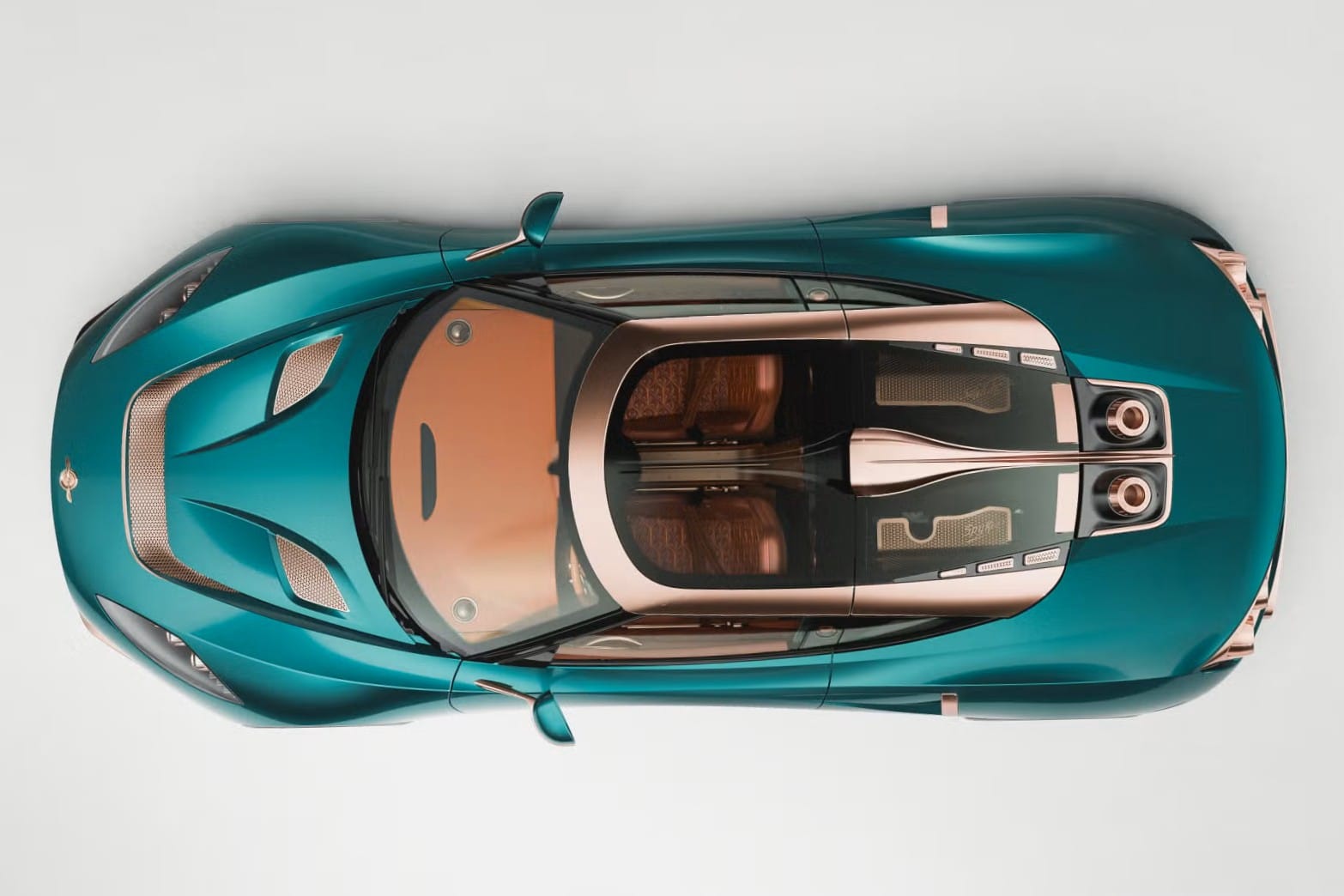
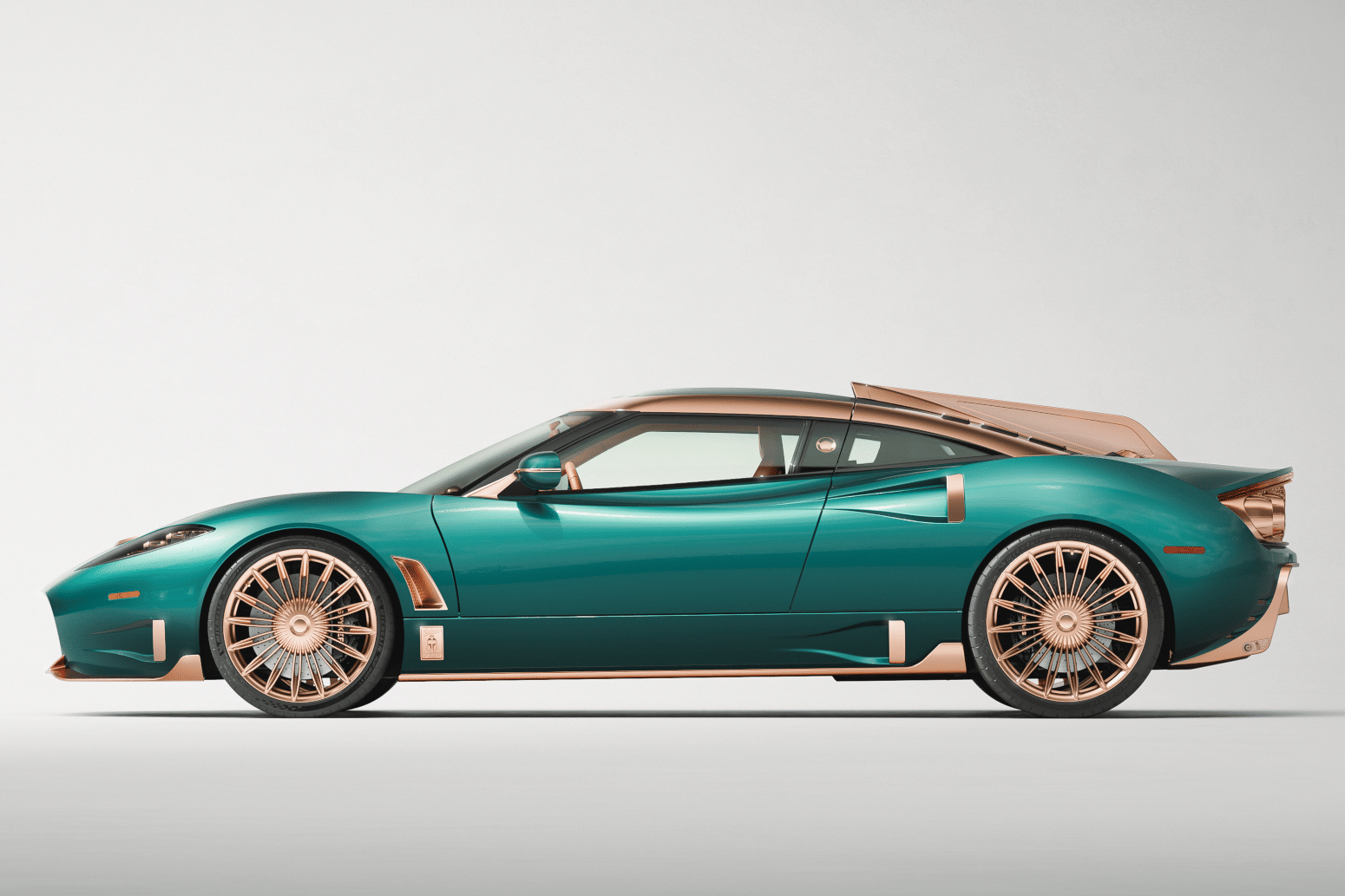
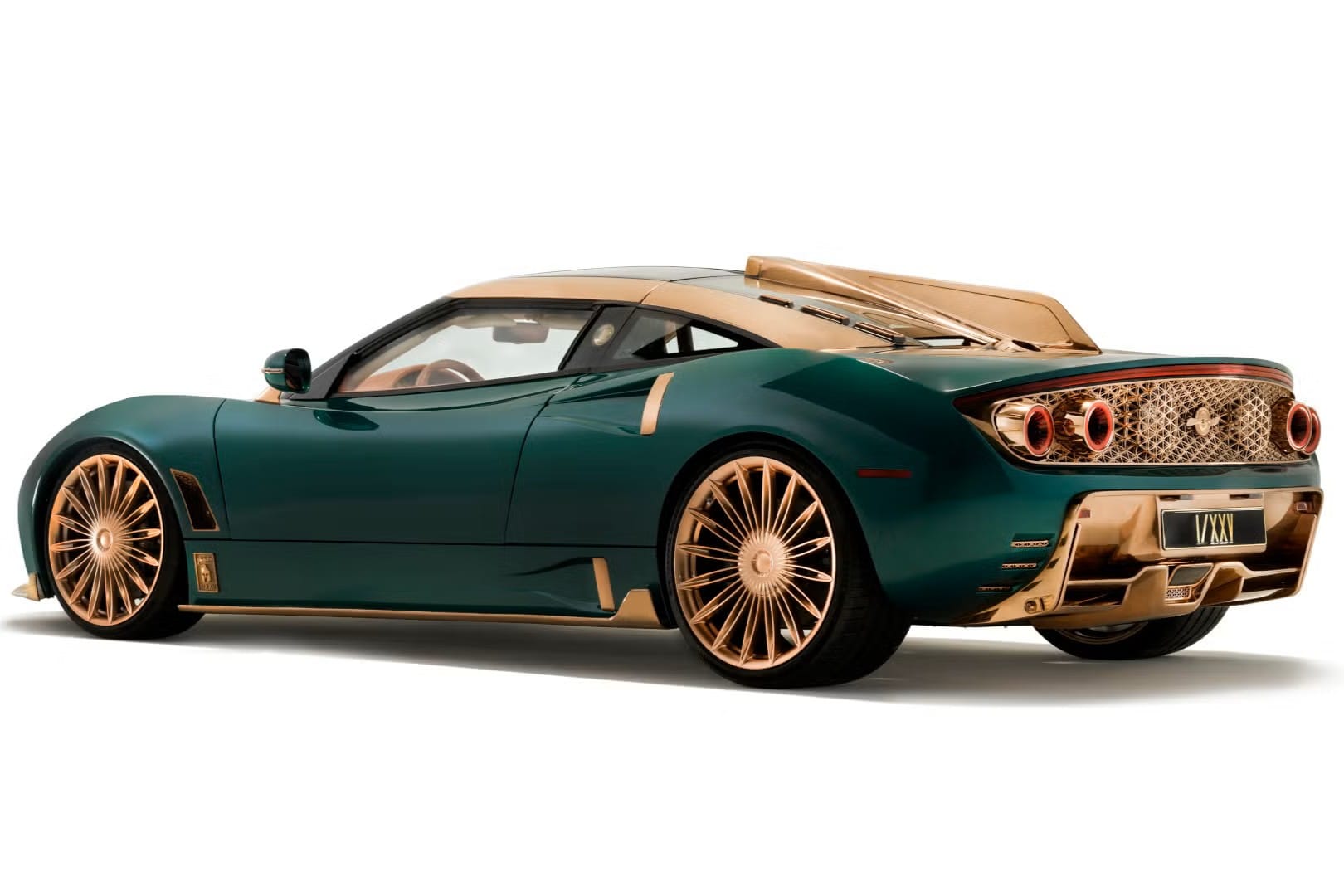
Dutch carmaker Spyker has resurfaced with the C8 Preliator XXV Coupe, a limited-run mid-engined supercar that marks the start of a new chapter for the troubled brand. Unveiled at The Quail during Monterey Car Week, the XXV is based on the C8 Preliator that debuted in 2016 and will be limited to just 25 examples. Pricing has not been disclosed for the C8 Preliator XXV.
Spyker’s return follows its 2021 bankruptcy and a subsequent years-long legal dispute over the brand. In October 2025, co-founder Victor Muller finally reacquired the rights to the Spyker name, and Ukrainian-born cryptocurrency entrepreneur Volodymyr Nosov acquired a significant stake in the company in June 2026 to facilitate its return.
Spyker C8 Preliator XXV powertrain and performance
Built on an aluminium space frame chassis with hand-formed exterior panels, the C8 Preliator XXV is powered by an Audi-sourced 4.0-litre twin-turbo petrol V8 that belts out 800hp and 1,000Nm of torque, and revs to 8,000rpm. Power is sent to the rear wheels via a 6-speed manual gearbox, 0-100kph comes up in a claimed 2.7 seconds, and the top speed is rated in excess of 349kph.
Spyker C8 Preliator XXV exterior design
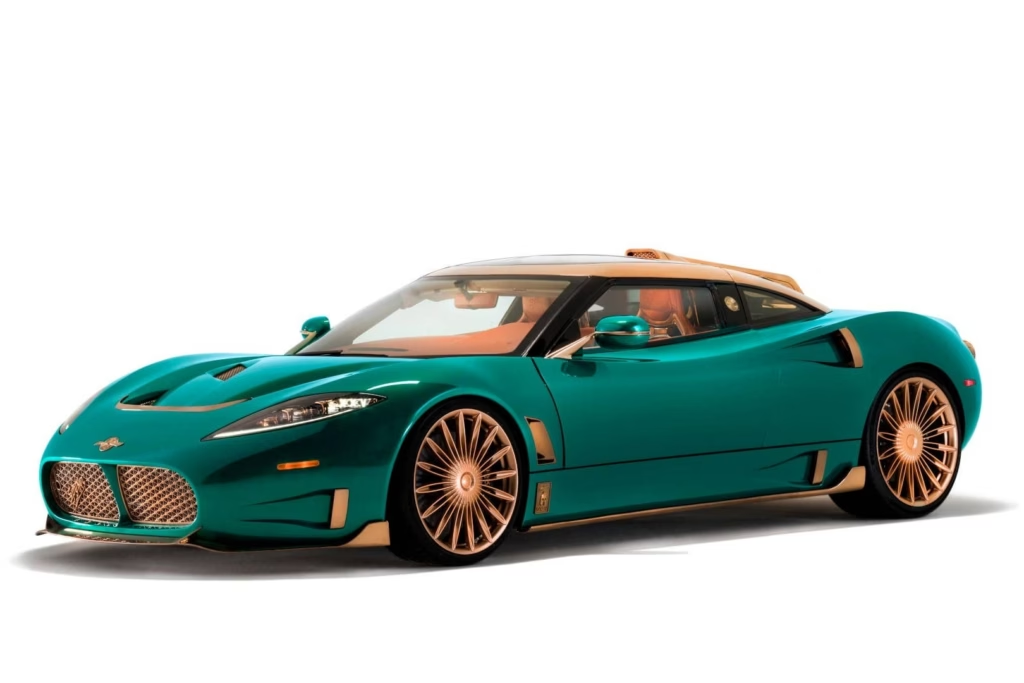
The C8 Preliator XXV’s design continues Spyker’s long-running aviation aesthetic, with propeller-inspired alloy wheels, air ducts, flowing lines, fighter-jet-esque afterburner tail-lamps, and a central roof intake. Other notable styling cues include sleek headlamps with ‘XXV’ DRL signatures, a split grille, a sizable front splitter, a panoramic glass roof, and badging behind the front wheel arches that displays the production number.
The example displayed at The Quail was finished in Quail Green with rose gold accenting on the grille, front splitter, ORVM stalks, air intakes, wheels, rear diffuser, roof, and more.
Spyker C8 Preliator XXV interior
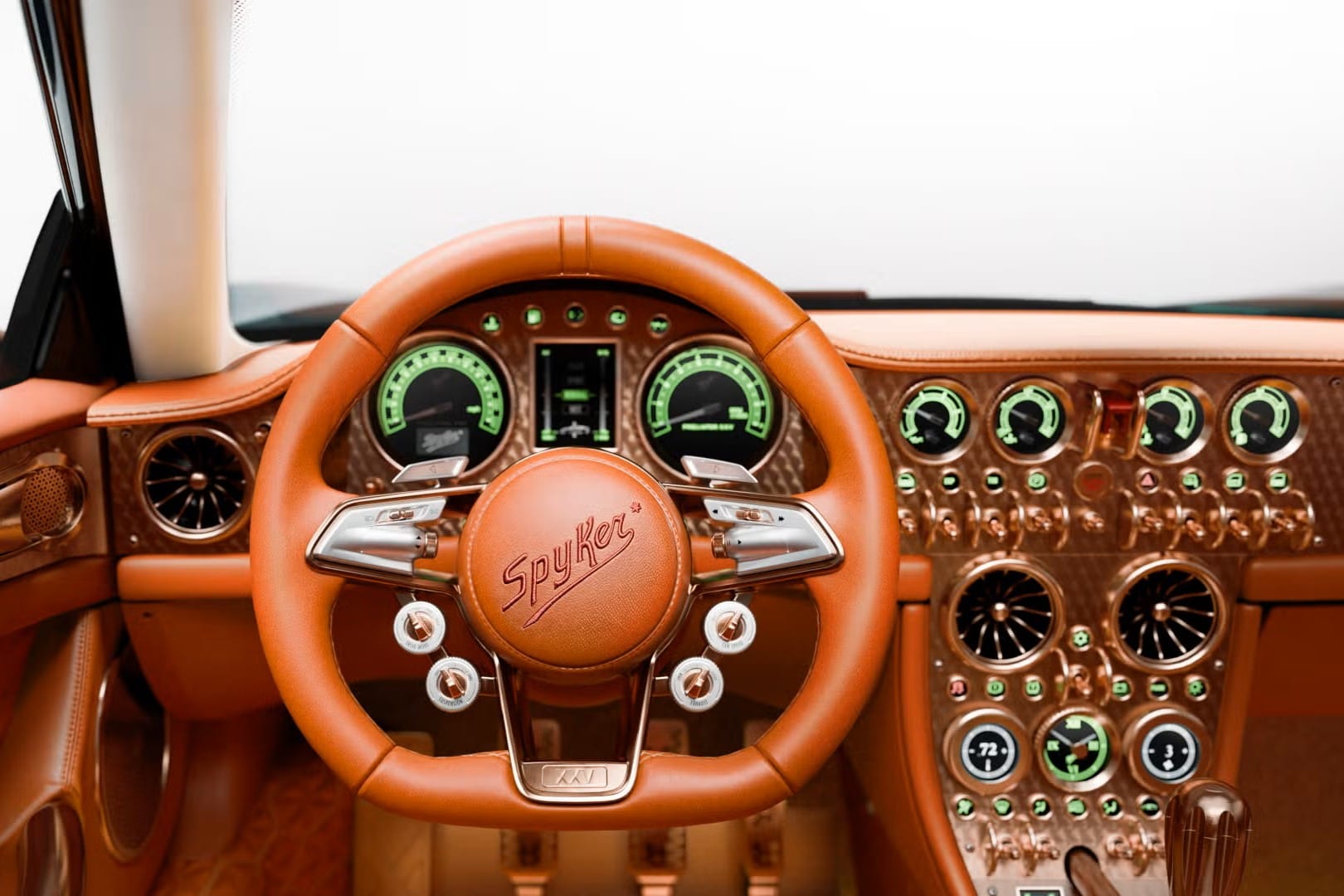
Inside, the C8 Preliator XXV features a refreshingly analogue milled dashboard beset with gauges and physical controls, instead of a barrage of screens. The turbine-like AC vents further the aviation inspiration, and the entire interior is trimmed in an orange-brown leather Spyker calls Tuscan Saddle. In fact, such is the attention to detail in the C8 Preliator XXV, that all the screw heads in the cabin are aligned by hand to face the same direction, and the chassis number is stamped into the space frame.
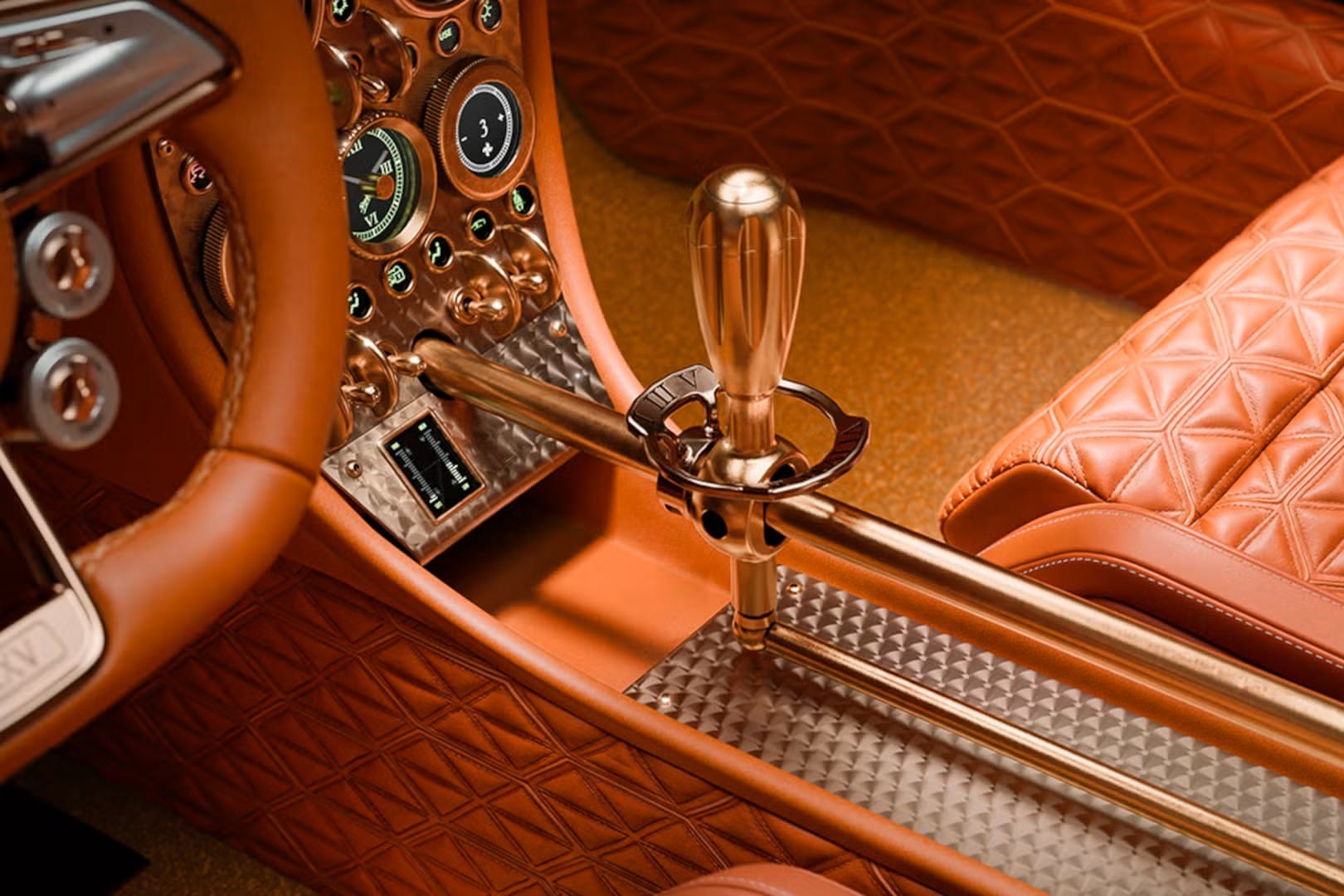
Ahead of the driver sits a three-spoke flat-bottomed steering wheel, which houses lots of dials, rocker switches, and buttons, along with individual stalks for the left and right indicators. The green-accented instrument cluster is very traditional in look too, though it’s worth noting that Spyker has included a heads-up display as the only digital interface in the C8 Preliator XXV. At the bottom of the dashboard lies a gear lever with an exposed shift linkage, which looks very cool.
What’s next for Spyker?
The revived Spyker says the C8 Preliator XXV is the first step in a larger comeback for the carmaker. Spyker is currently mulling a return to motorsport, specifically GT3-level endurance racing, and is also expected to resume the long-delayed development (owing to financial hardships) of the D8 Peking-to-Paris, a super SUV first previewed at the 2006 Geneva Motor Show.
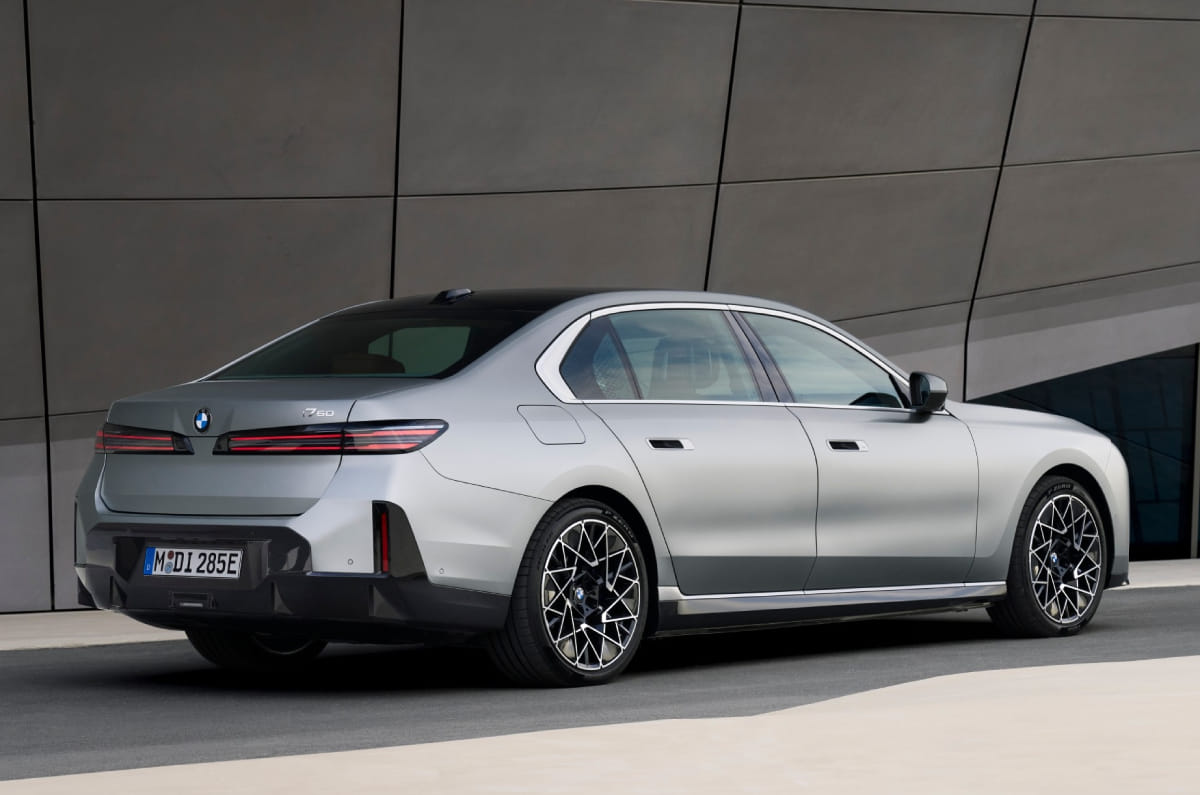
BMW will launch the facelifted 7 Series and i7 in India on September 11. The company had opened bookings for both flagship luxury sedans on August 1, shortly after their global debut earlier this year. The mid-life update brings exterior styling revisions, a heavily revised cabin with BMW’s latest Panoramic iDrive display, and updates to the petrol, diesel and electric powertrains.
Bookings for both models opened on August 1
Redesigned cabin with BMW’s new Panoramic iDrive
Updated petrol, diesel and electric powertrains
BMW 7 Series, i7 facelifts: all we know so far
BMW i7 60 xDrive
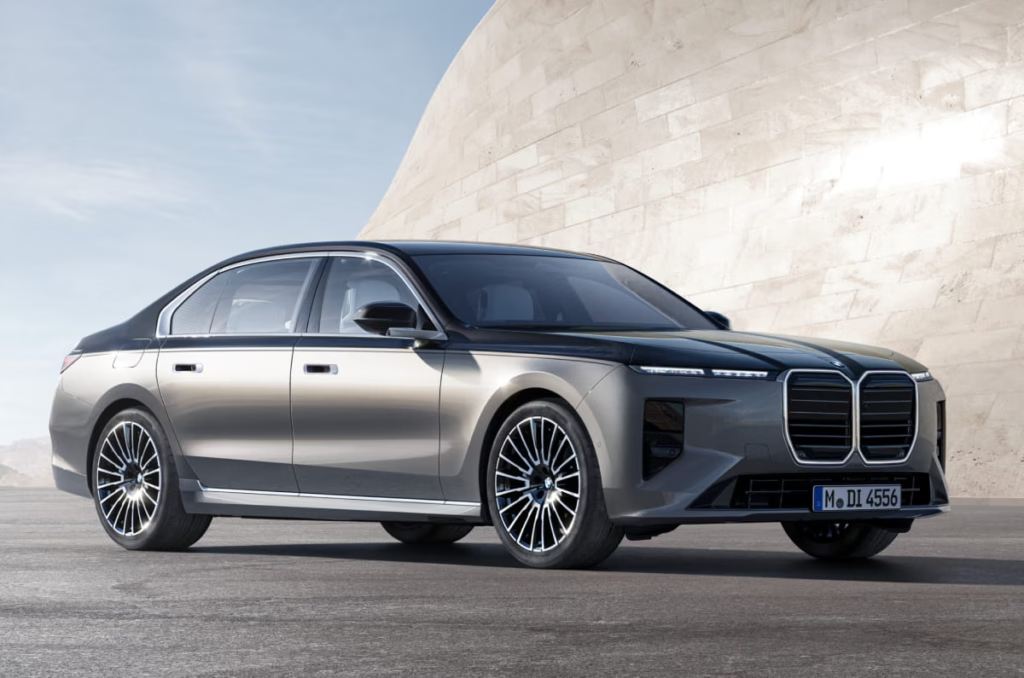
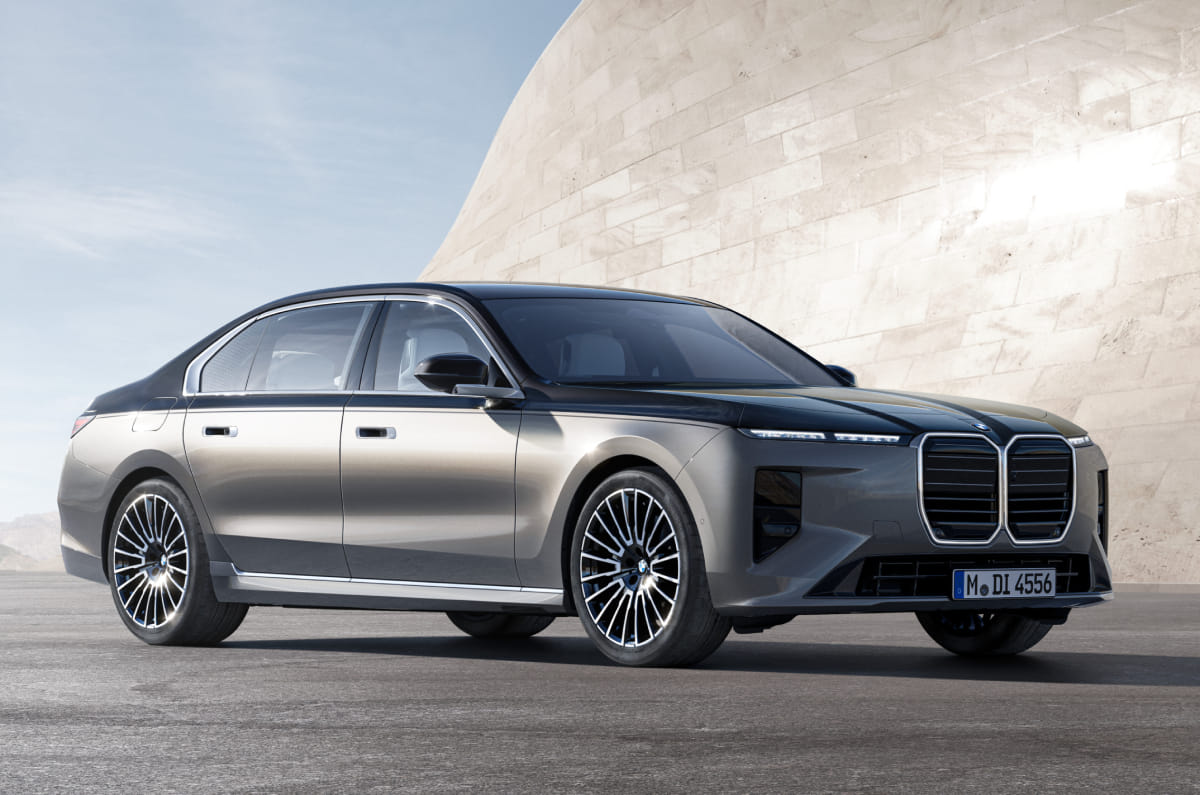
The facelifted 7 Series and i7 receive styling revisions while retaining the overall design of the outgoing models. Changes include a redesigned illuminated kidney grille, revised split LED headlamps and a new front bumper. Along the sides, BMW has introduced a new alloy wheel design while retaining the flush-fitting door handles. At the rear, both models get slimmer tail-lamps with smoked lenses and chrome detailing, along with a redesigned tailgate and bumper.
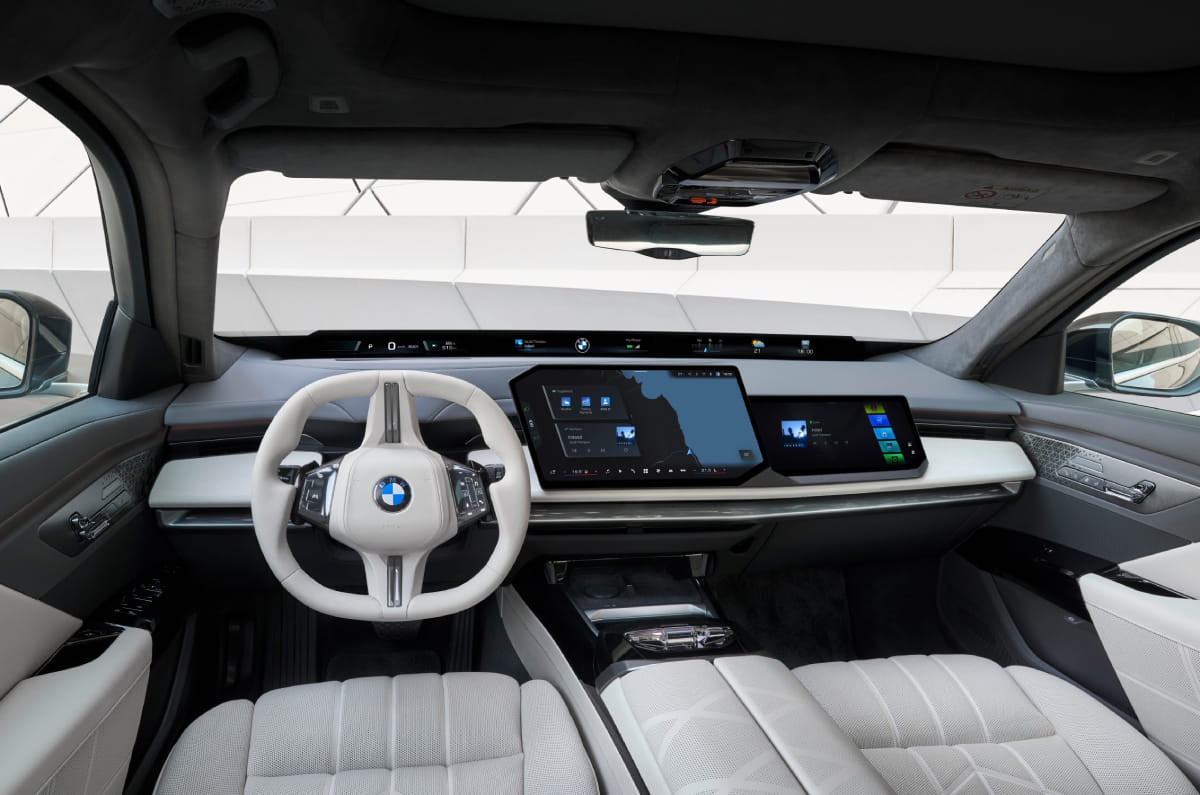
The biggest changes are inside the cabin. The facelift introduces BMW’s new Panoramic iDrive layout, replacing the conventional digital instrument cluster with a full-width projection display at the base of the windscreen. It works alongside a 17.9-inch central touchscreen and a 14.6-inch front passenger display. The infotainment system runs the latest BMW Operating System X, supports over-the-air updates, wireless Apple CarPlay and Android Auto, and features improved voice controls. BMW has also redesigned the dashboard, introduced a new four-spoke steering wheel like in BMW’s Neue Klasse models and revised the ambient lighting.
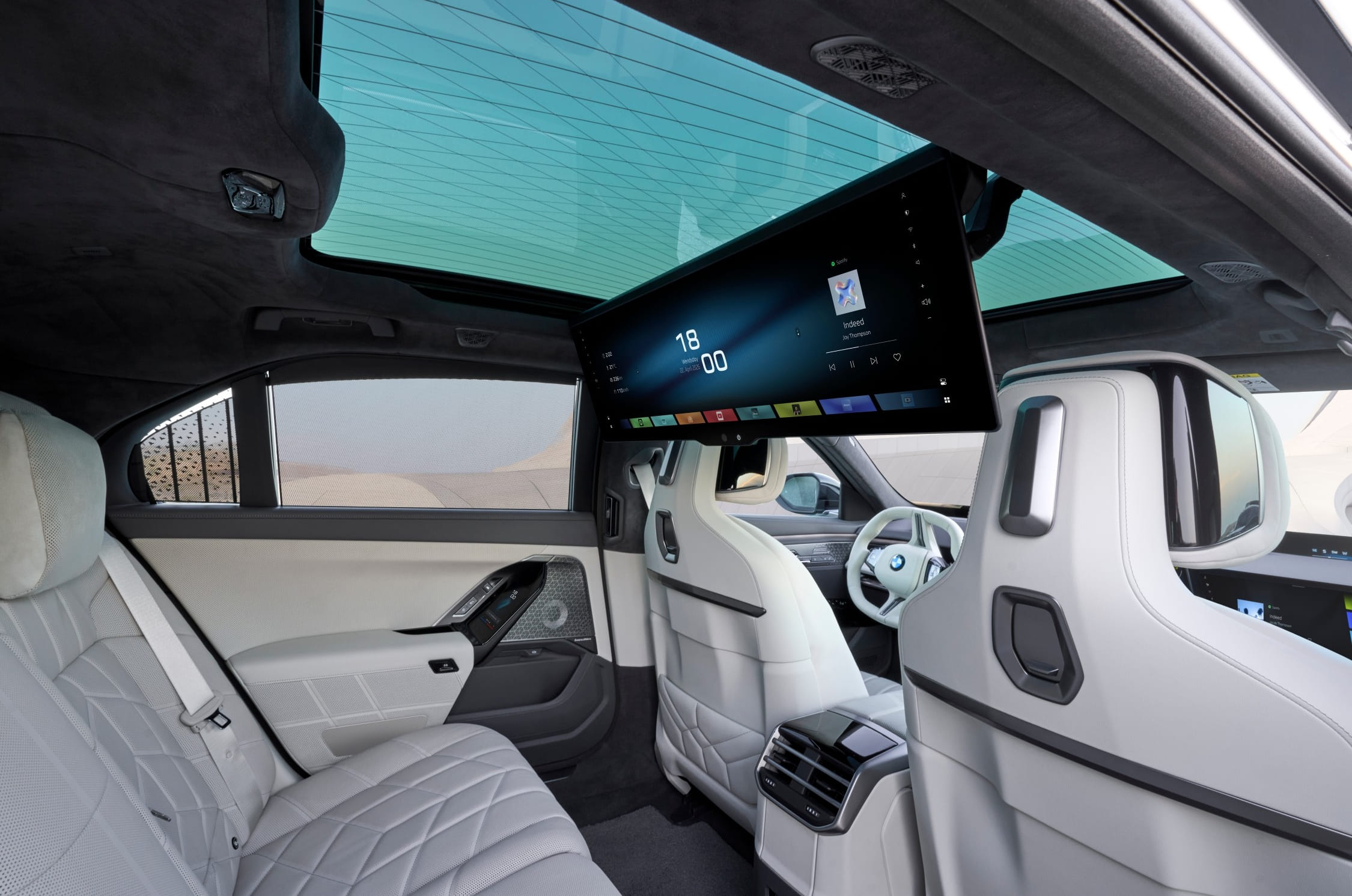
Standard equipment includes electrically adjustable seats with heating, ventilation, massage and lumbar support. The front passenger seat can also slide fully forward to create additional legroom for the passenger seated behind. Rear-seat passengers benefit from an updated 31.3-inch 8K Theatre Screen and revised rear door-mounted control panels. BMW has also revised the automatic doors with better-positioned open and close buttons. Other highlights include a Bowers & Wilkins surround sound system and additional ambient lighting elements throughout the cabin.
BMW 7 Series, i7 facelifts: Powertrain
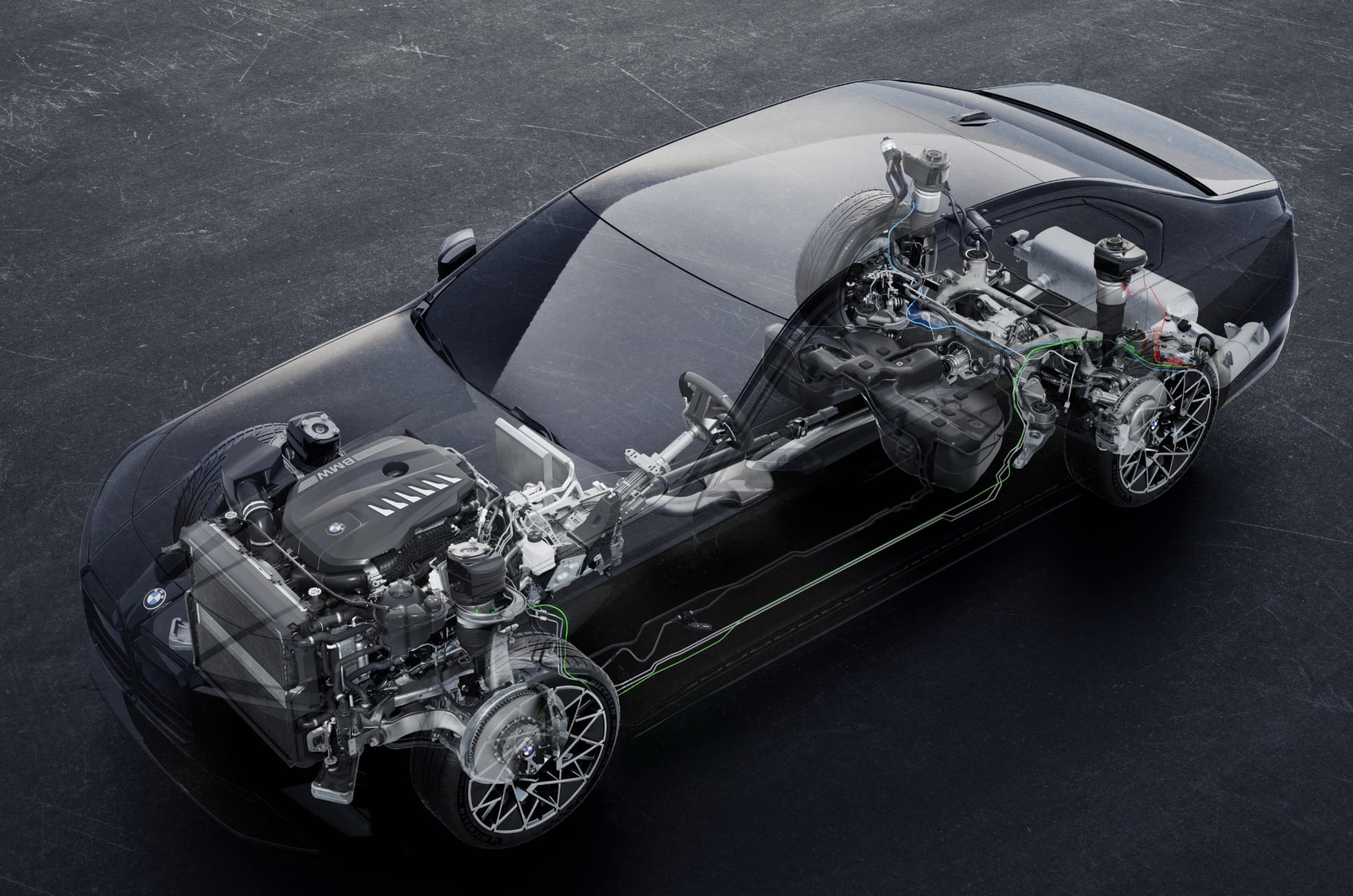
BMW has not yet confirmed the India-spec variant lineup. However, the current 7 Series is sold here in 740i petrol and 740d diesel forms, while the i7 is available in eDrive50 and M70 xDrive guises. Internationally, all four receive mechanical updates.
The facelifted 740i xDrive continues with a 3.0-litre inline-six petrol mild-hybrid engine which now produces 400hp and 580Nm, up by 19hp and 60Nm. Meanwhile the 740d xDrive now develops 313hp and 670Nm, an increase of 27hp and 20Nm over the outgoing model. Both remain paired with an eight-speed automatic transmission and all-wheel drive.
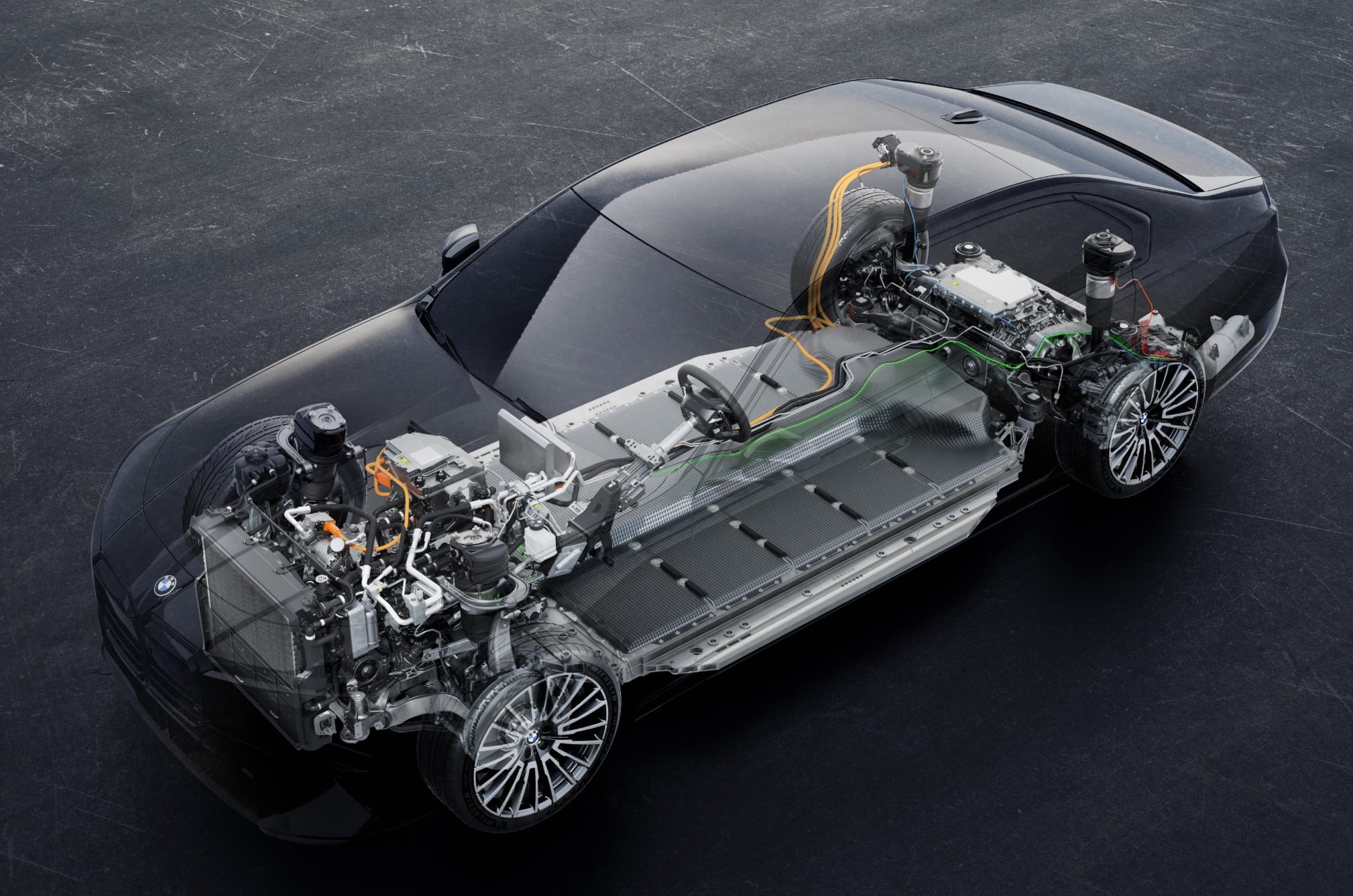
The entry-level i7 eDrive50 has been replaced by the i7 xDrive50, which now gets all-wheel drive. It also receives a larger 112.4kWh battery in place of the previous 101.7kWh unit. Output rises to 455hp and 660Nm. The i7 M70 xDrive also adopts the larger battery, with power increasing from 650hp to 680hp, while torque increases from 1,015Nm to up to 1,100Nm. It remains to be seen whether the range-topping i7 M70 xDrive is also launched in India.
International-spec BMW 7 Series shown for representative purposes only.
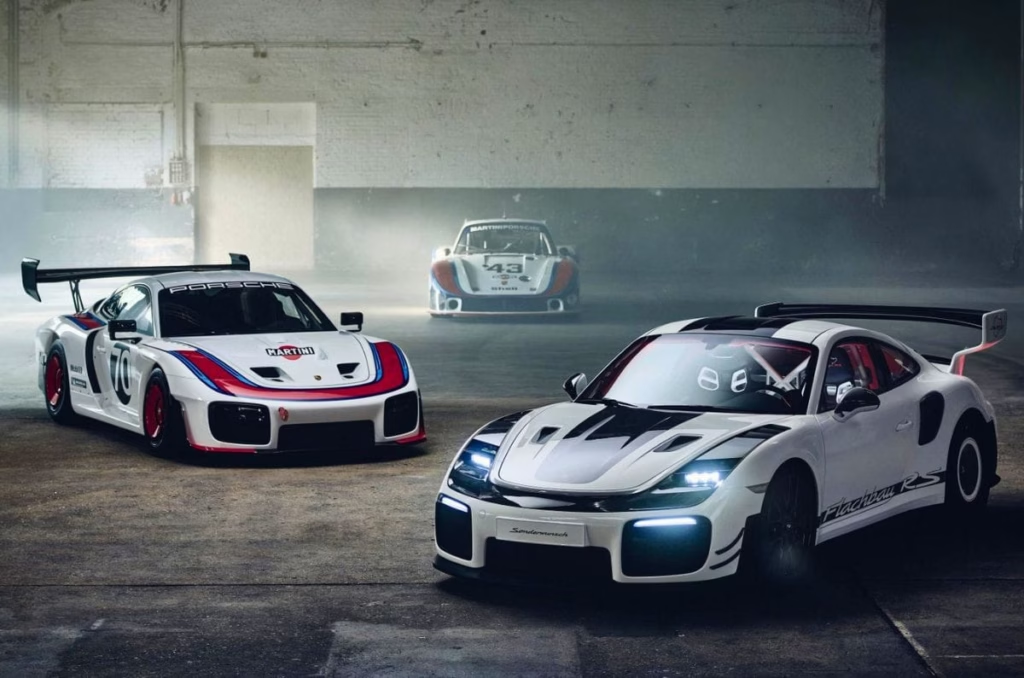
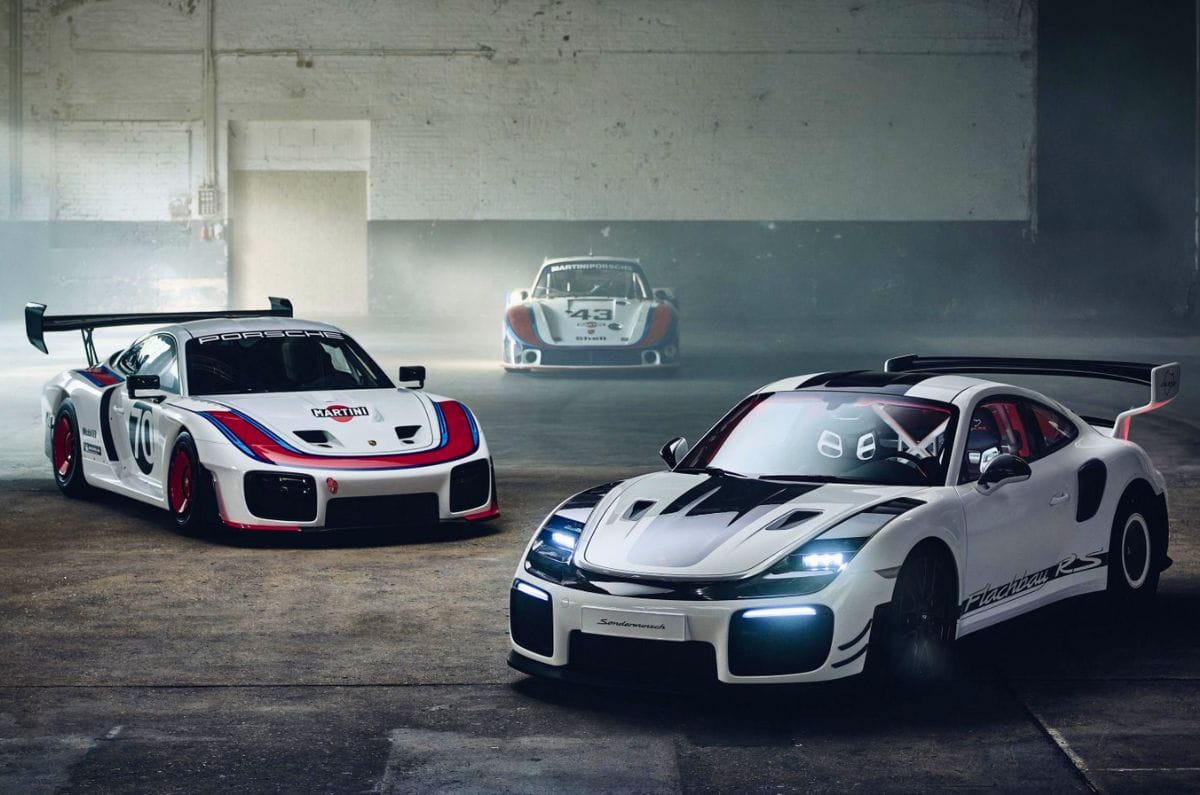
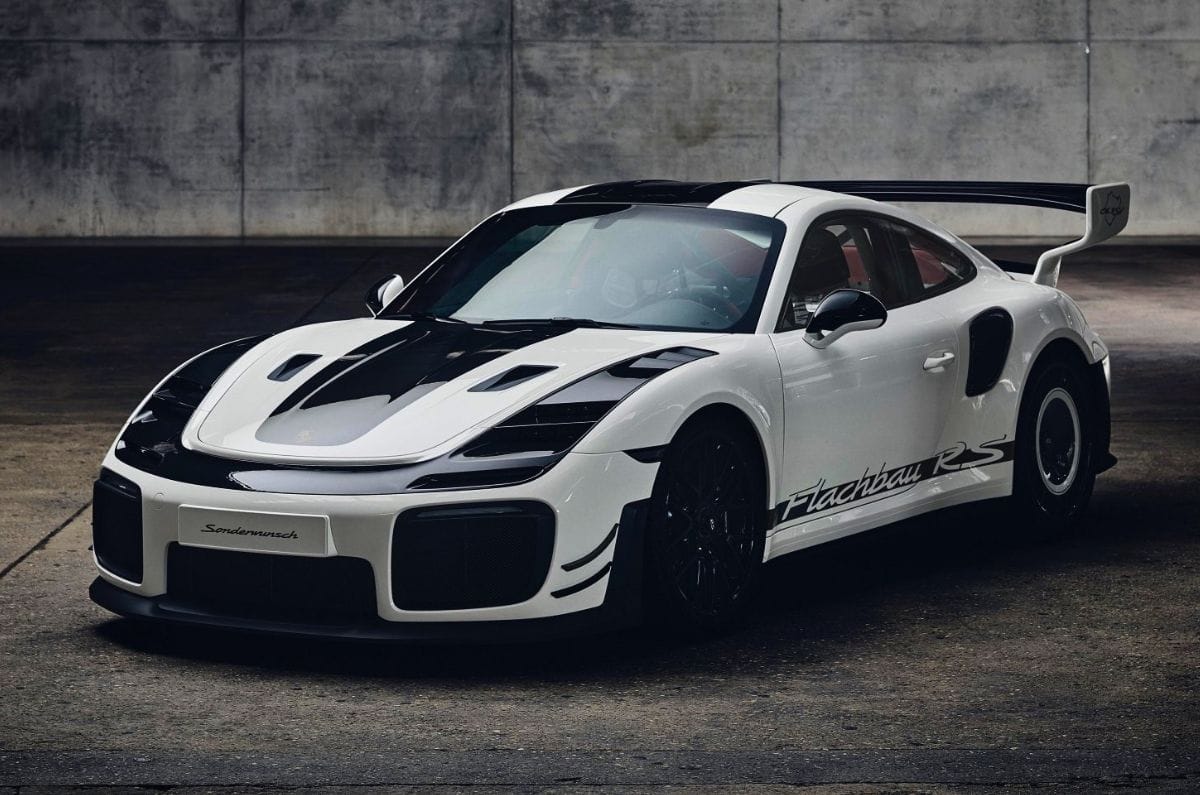
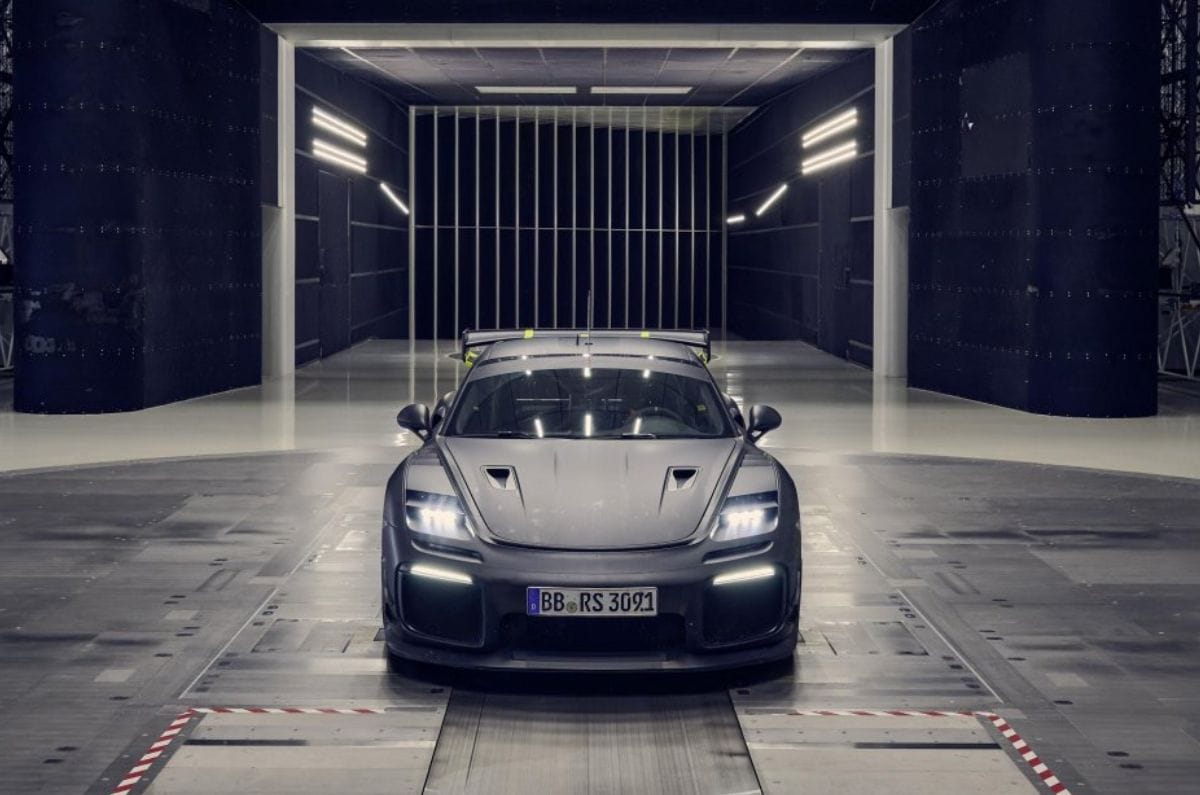
Porsche revealed a one-off 911 Slantnose, also known as the Flachbau, at the 2026 Monterey Car Week. It’s mechanically based on a 991.2-generation 911 GT2 RS with the Weissach Package from 2018, while the design has been inspired by the 1978 Porsche 935 Le Mans race car called ‘Moby Dick’. The brand claims teams from Weissach and Manthey, alongside its own in-house design studio, motorsport division and the Sonderwunsch (‘special request’ in German) department, took three years to complete this project.
Gets staggered headlamps, a custom rear wing and unique detailing
Loses rear seats, infotainment & audio systems and sound-deadening
Weighs 31.6kg less due to aggressive weight-saving measures
Claimed top speed is 340kph
Porsche 911 Slantnose exterior
Features a custom Manthey Kit and some elements inspired by the 911 GT3 R rennsport
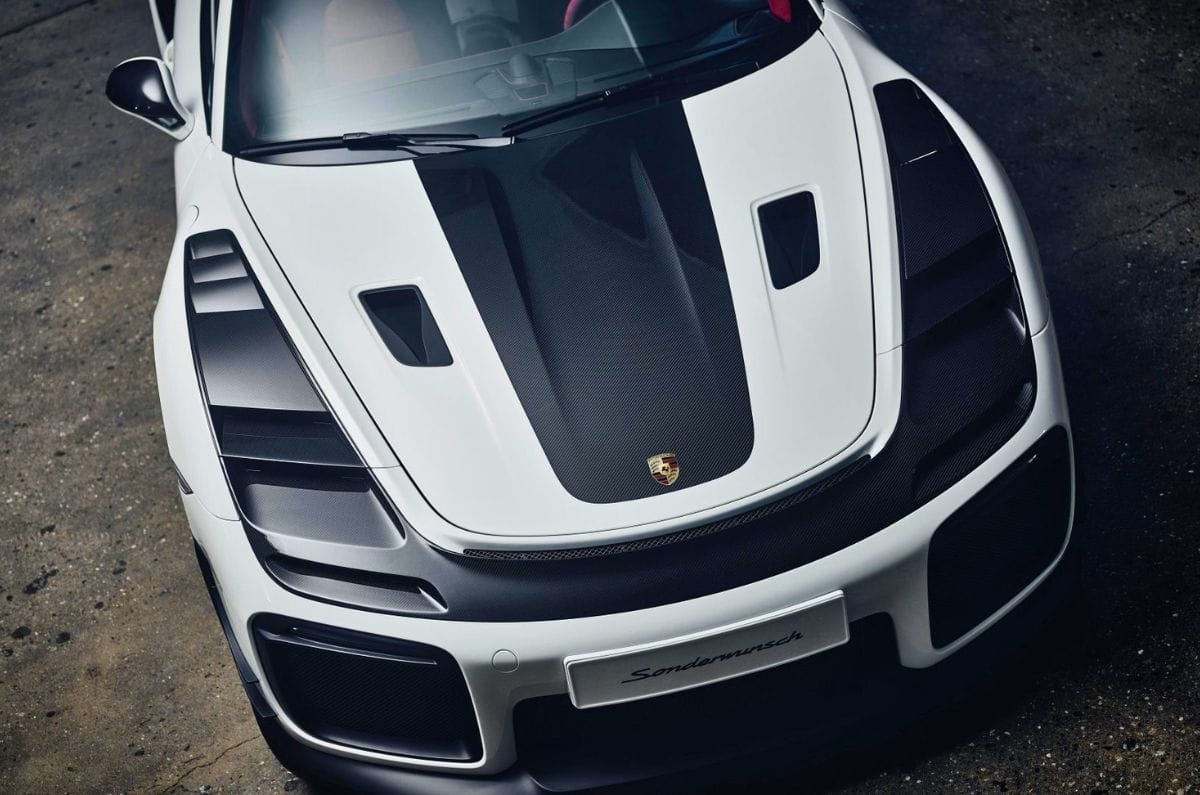
The silhouette of this Porsche 911 GT2 RS is understandably different due to its Slantnose conversion. The front fascia sports new, staggered LED headlamps that look sleek– the low-beam, high-beam and DRL elements are stacked above one another. These are integrated into the black U-shaped portion around the bonnet, which extends to right above the lowered front fenders. The latter has specially designed vents to prevent the build-up of air pressure in the wheel arches, claims Porsche.
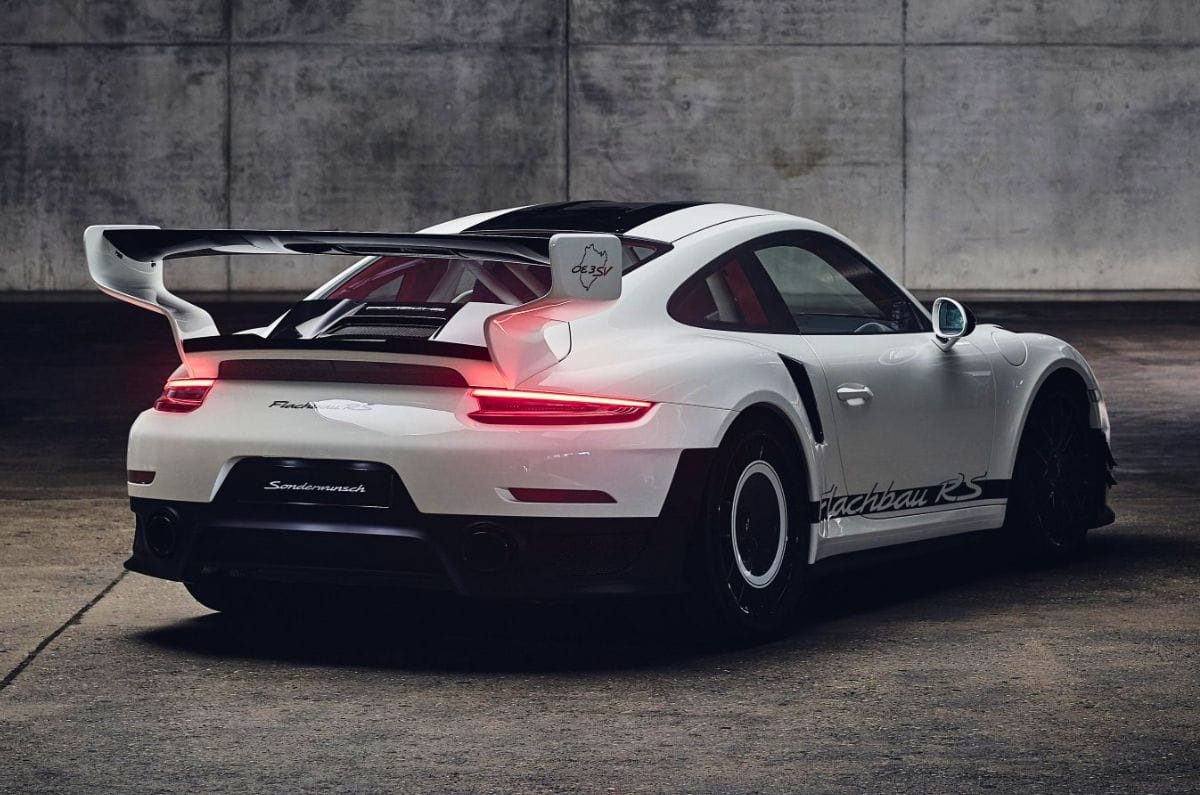
The custom Manthey Kit brings along a redesigned front bumper with small canards on the sides, a new underbody structure, plus a different front splitter and rear diffuser. While the front alloy wheels are of a conventional design, the carbon-fibre aero discs used for the rear units help reduce drag, according to Porsche. The Slantnose gets a large rear wing with S-shaped mounts inspired by the 911 GT3 R rennsport, allowing three manually adjustable positions. At the car’s top speed, Porsche claims that this wing generates 554kg of downforce.
The one-off Slantnose is painted in the brand’s Grand Prix White colour, but gets contrasting black accents and a black finish on the bonnet and roof. Adding more contrast are the black brake callipers and exposed carbon-fibre trim. There are ‘Flachbau RS’ lettering and decals, too, while the Nordschleife is depicted on the rear wing. Since the shape of the front fenders had been altered, the fuel-filler flap and its underlying mechanism also has to be modified, says Porsche. “Our aim was to reinterpret the iconic look of the 935 without compromising on safety, technology or road legality”, Alexander Fabig, Vice President Product Offering & Individualisation at Porsche, said.
Porsche 911 Slantnose interior
The brand has stripped this interior bare of most of its convenience features
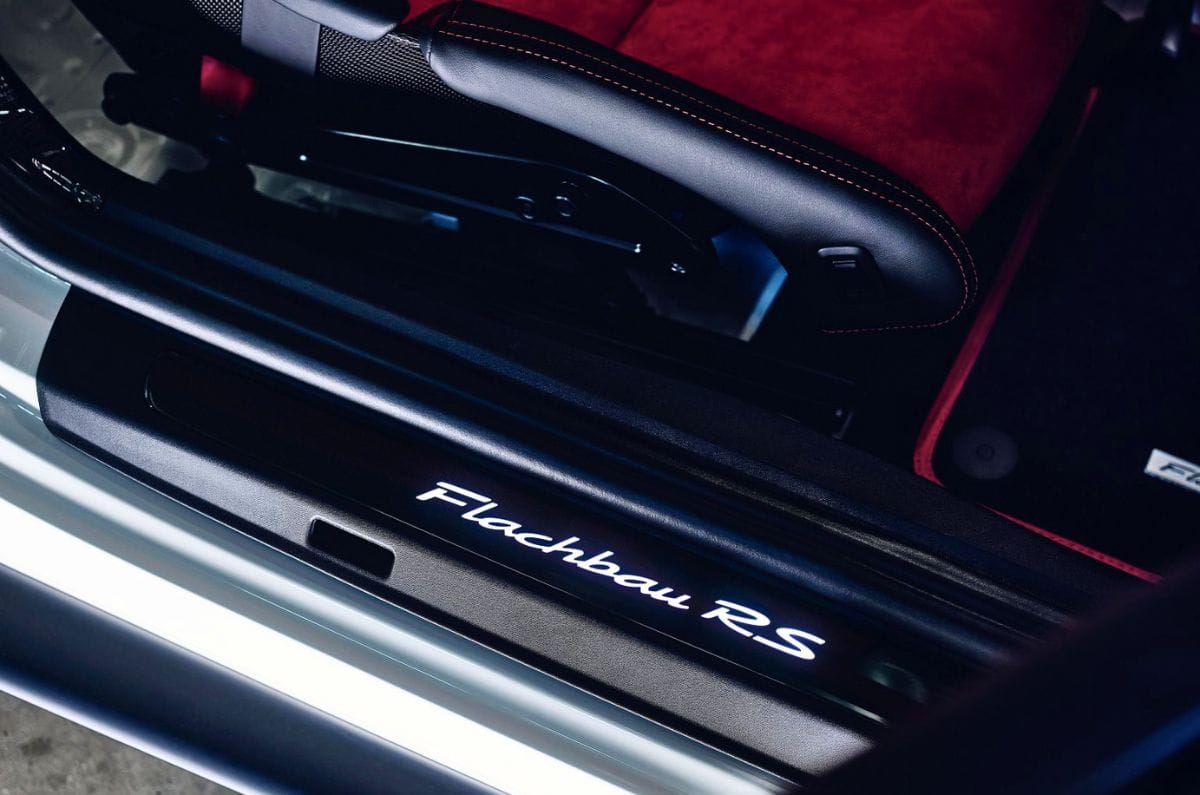
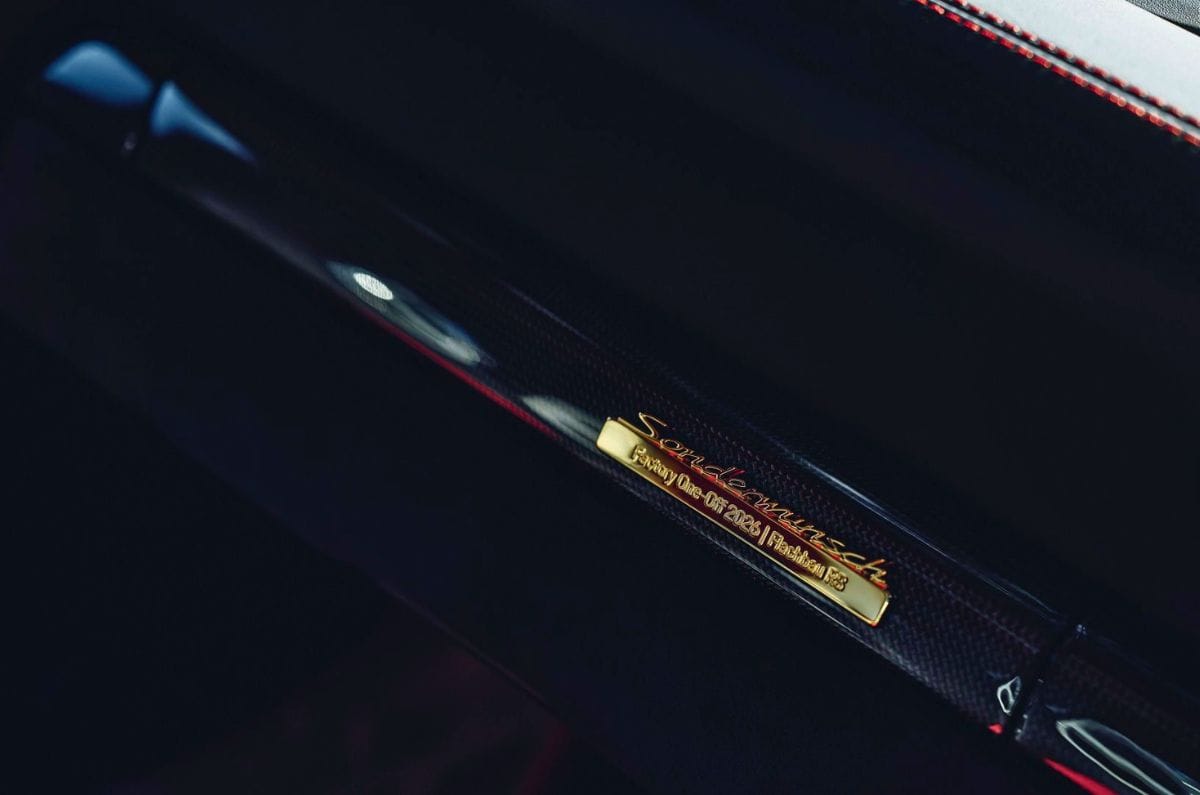
Opening the doors will reveal ‘Flachbau RS’ branding on the sills and seat headrests. There’s an outline of the Nordschleife drawn behind the front seats, along with a small gold-coloured plaque mentioning ‘Sonderwunsch’ and ‘Factory One-Off 2026 | Flachbau RS’ on the dashboard. Meanwhile, the interior continues to use the red Alcantara, black leather and exposed carbon-fibre trim originally available in the customer’s 911 GT2 RS.
Saving weight has been another important goal with this one-off Slantnose. To that effect, Porsche says it has removed the rear seats and individual wires, instead opting for simpler protective sheaths to cover newly laid wiring. Generous use of carbon fibre aside, the brand has removed the donor car’s infotainment system, replacing it with a leather-trimmed storage compartment.
Other features to have been deleted include the audio system, floor coverings in the cabin and luggage space, and sound-deadening materials throughout the car. The end result of all these weight-saving measures means that this Slantnose is 31.6kg lighter than the donor vehicle it’s based on.
Porsche 911 Slantnose powertrain and other details
This one-off model retains the donor vehicle’s powertrain setup
Powering this one-off Slantnose is the same 3.8-litre twin-turbocharged six-cylinder engine found in the 991.2-generation 911 GT2 RS. This unit churns out 700hp and 750Nm of torque, and it drives the rear wheels via a 7-speed dual-clutch transmission. The claimed top speed of this one-off 911 is 340kph.
Porsche says that it built three test vehicles for validating data, while aerodynamic calculations being carried out using Computational Fluid Dynamics (CFD) to further optimise the overall design. These prototypes were subjected to multiple wind-tunnel tests, real-world road tests, and 50 laps on the Nurburgring-Nordschleife.