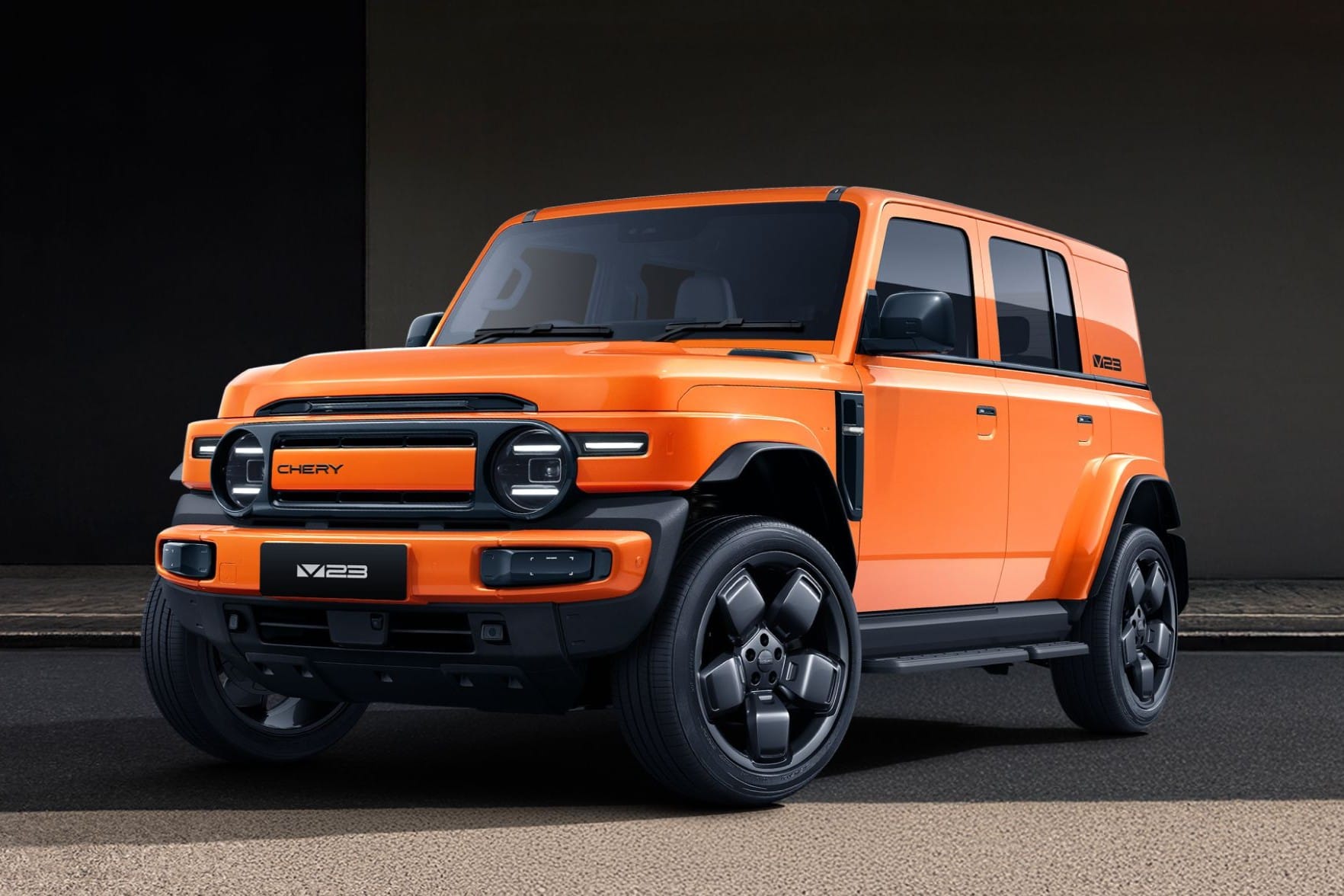
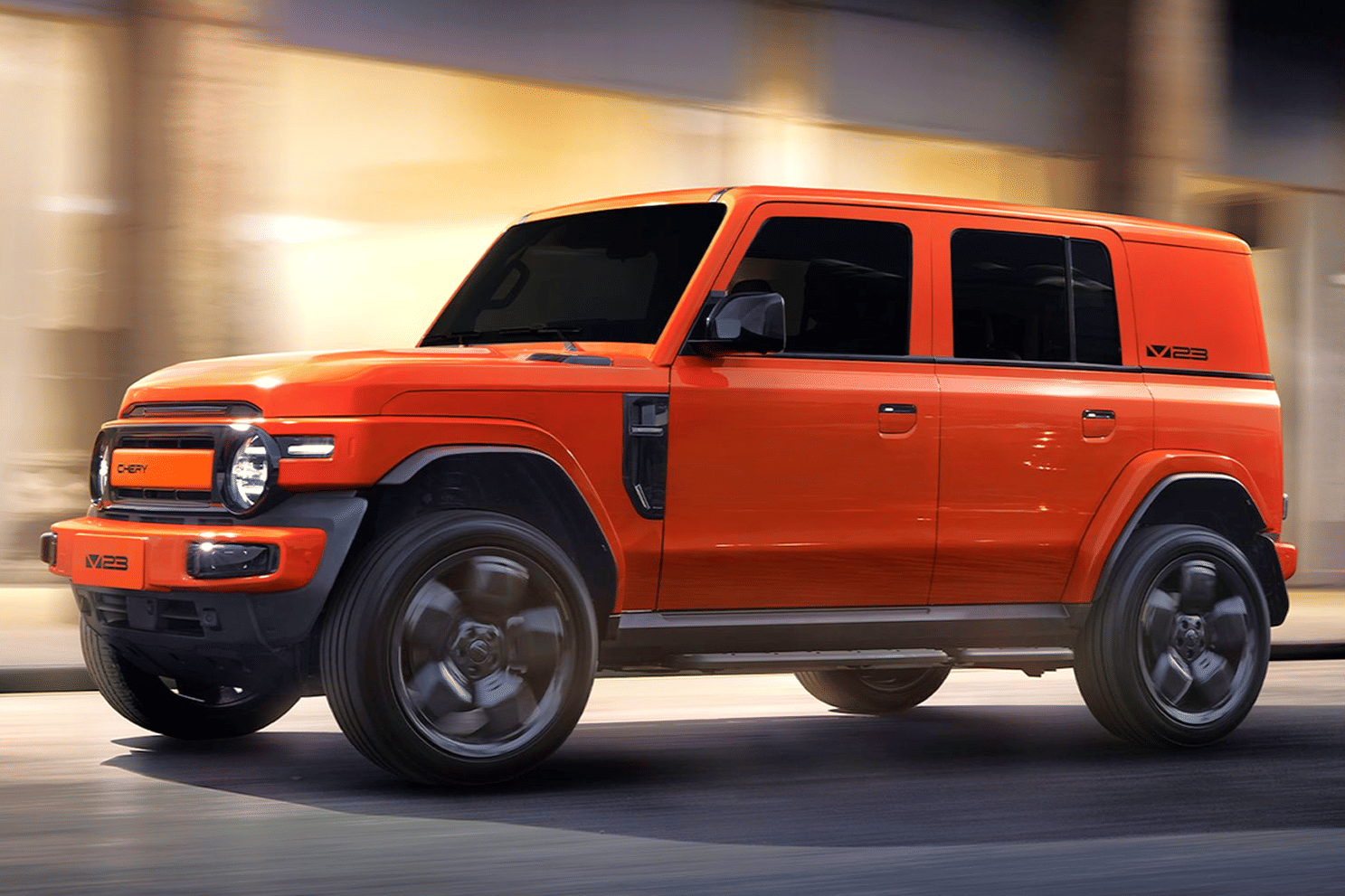
JSW Motors’ third model, an electric SUV based on the Chery iCar V23, is expected to be sold with a dual-motor all-wheel drive powertrain in India, per our sources. This EV will be the first mass-market electric off-roader in India, and its closest rival will be the Mahindra Thar Roxx, which is ICE-powered, but also a 5-door off-road-focused SUV. We even reported previously that JSW’s iCar V23-based EV may be priced under Rs 20 lakh (ex-showroom).
JSW Motors’ iCar V23-based electric SUV: Powertrain
In global markets, the dual-motor AWD version of the iCar V23 packs an 81.76kWh NMC battery pack with an NEDC-certified range of 430km. Combined output is pegged at 211hp and 292Nm, which makes for a rather brisk 0-100kph time of 7.5 seconds (claimed). Top speed is rated at 140kph. The global-spec iCar V23 also supports up to 6.6kW AC and 104kW DC charging speeds.
JSW Motors’ iCar V23-based electric SUV: Exterior and interior
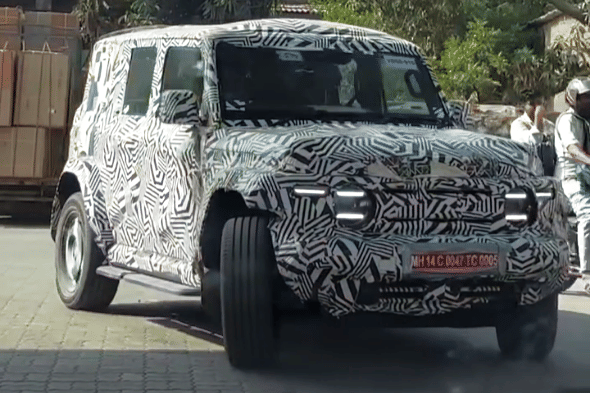
Credit: @torqueculturee via Instagram
Test mules of JSW’s iCar V23-based EV have been spotted on Indian roads on several occasions, hinting at a very similar design to that of the global model. For reference, the global-spec iCar V23 measures 4,220mm in length, 1,915mm in width, and 1,845mm in height, with a wheelbase of 2,735mm. It also has an unladen ground clearance of 210mm.
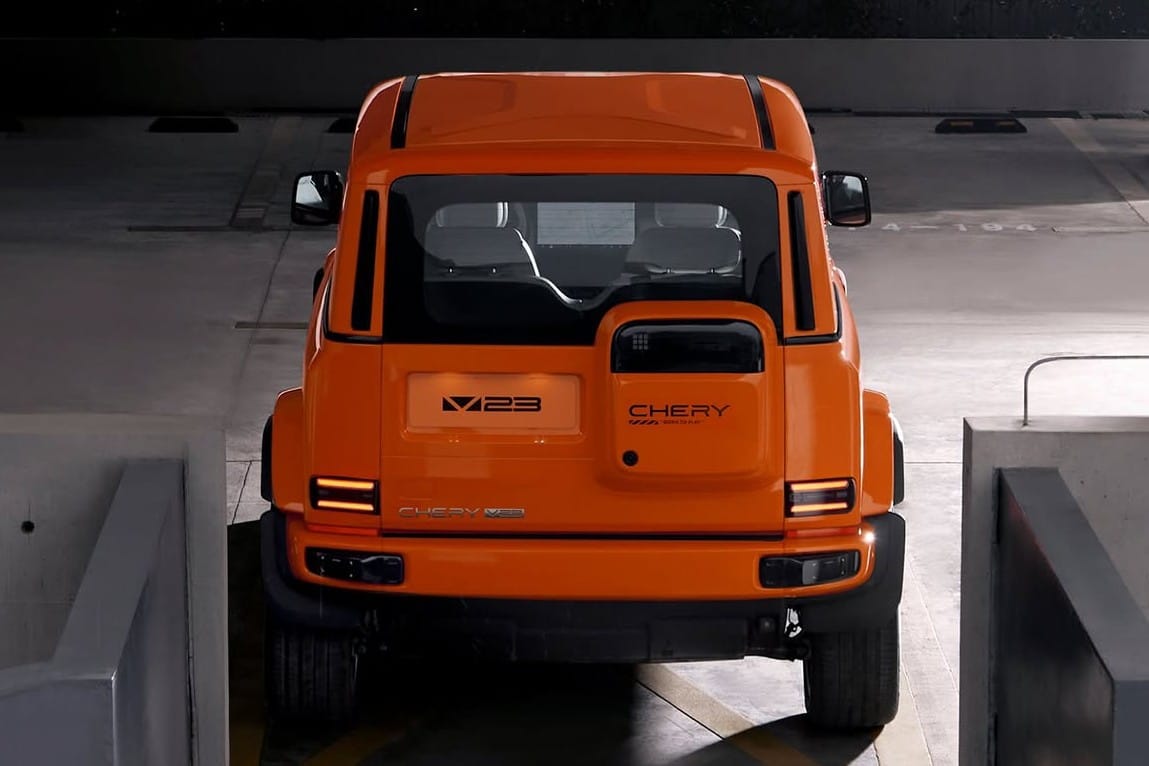
Size-wise, then, the iCar V23 slots between the Maruti Jimny and Thar Roxx. Styling highlights for the iCar V23 include butch and boxy proportions, muscular bumpers, flared and squared-off fenders, 21-inch alloy wheels, circular LED headlamps, low-set rectangular tail-lamps, and a bootlid-mounted spare wheel.
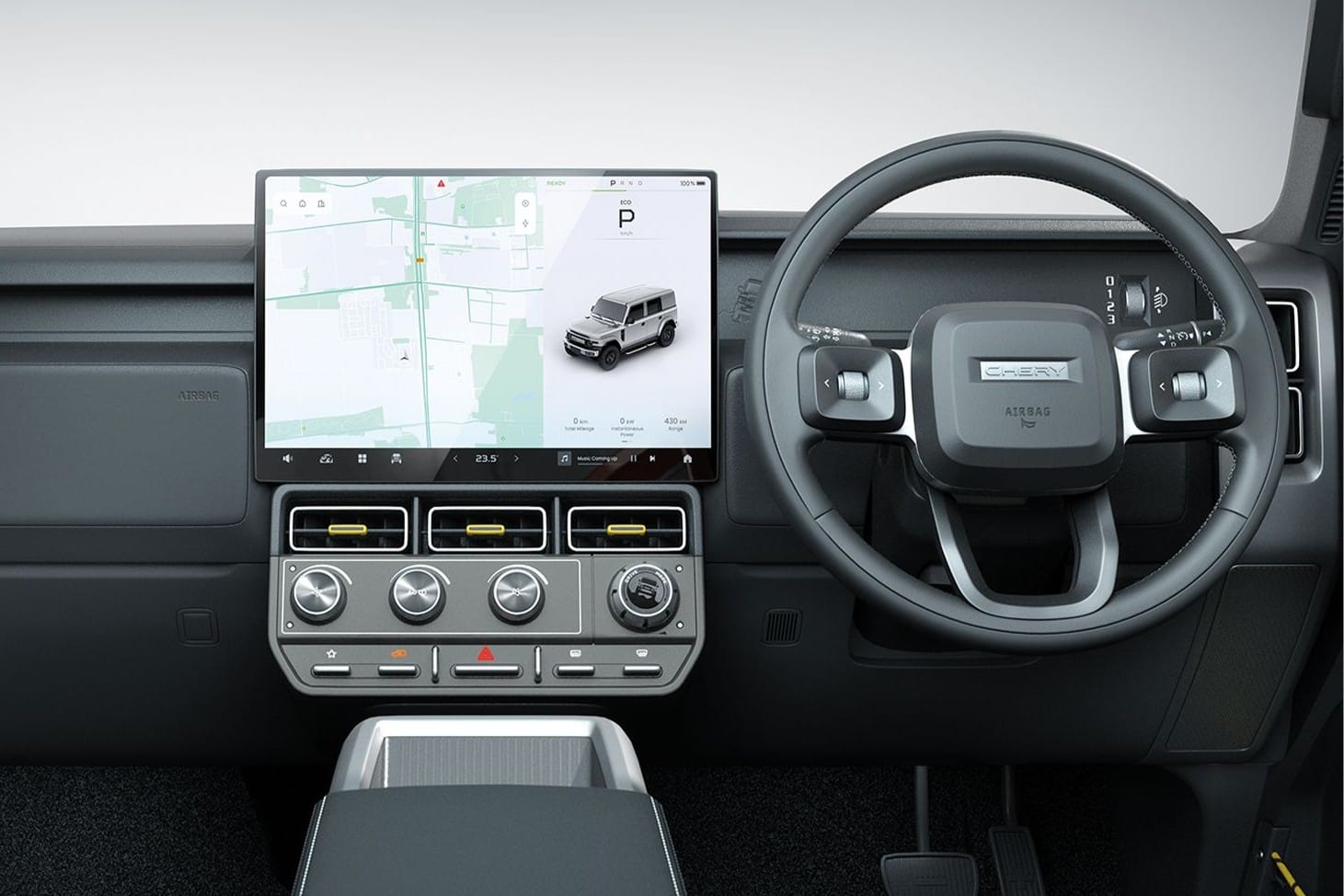
Inside, the iCar V23 sports a minimalist dashboard layout, comprising a massive 15.4-inch infotainment touchscreen, a three-spoke steering wheel, and two rows of physical controls on the centre console. As for features, the global-spec iCar V23 packs wireless Apple CarPlay and Android Auto, a 540-degree camera, six drive modes, ADAS, powered and ventilated front seats, V2L functionality, a digital key, a 7-speaker sound system, and more.
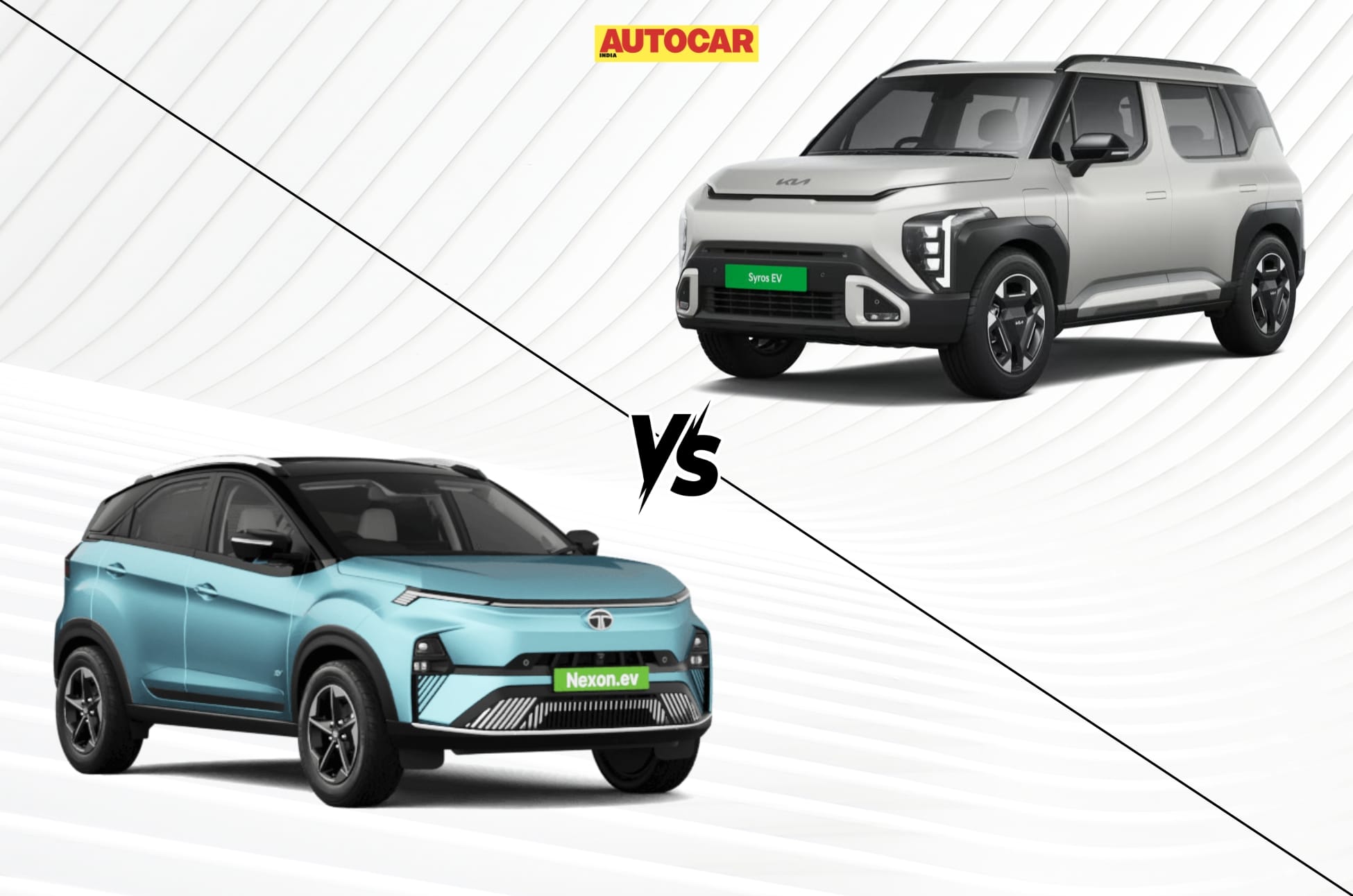
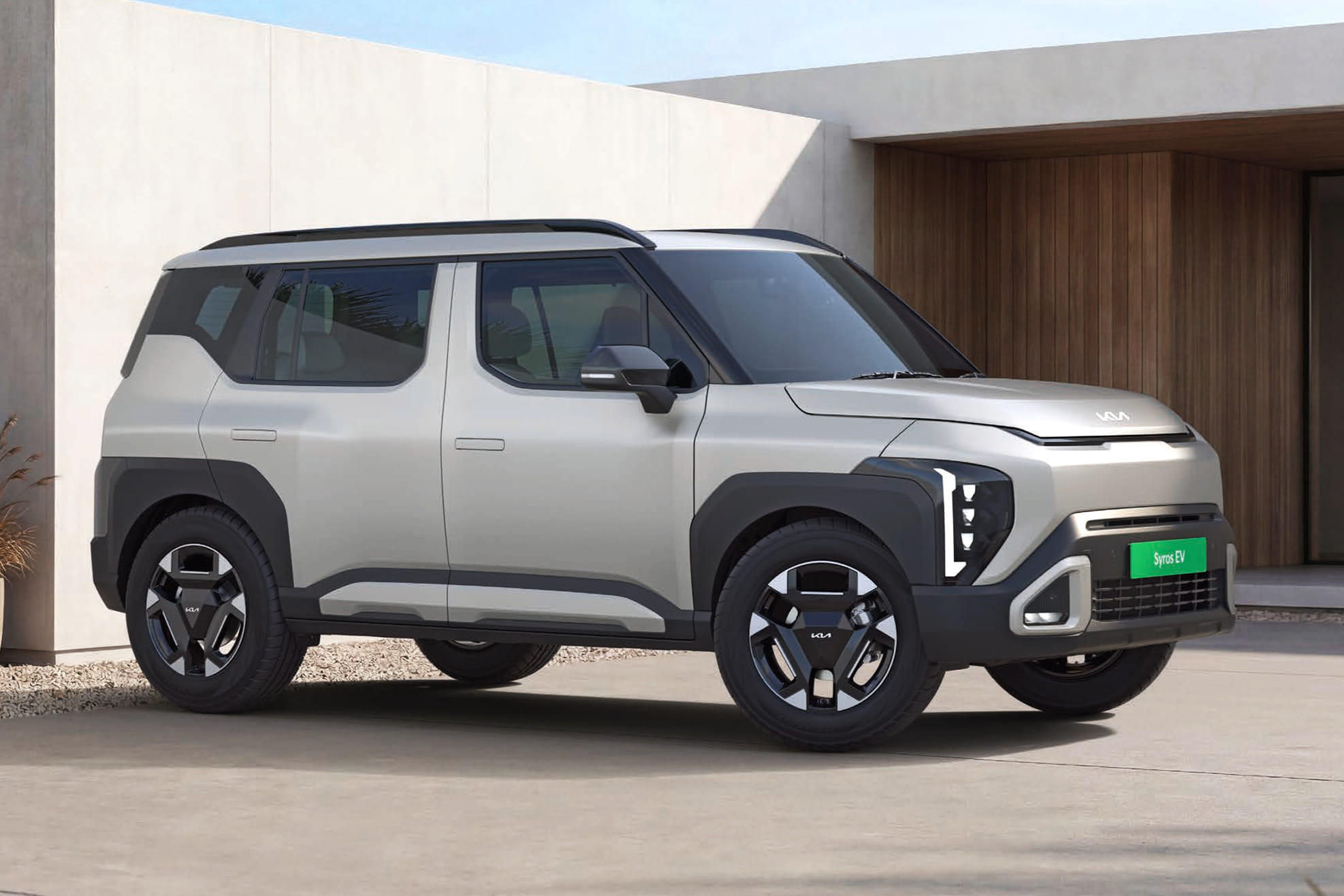
Kia has taken its first aim to crack the compact electric SUV space with the Syros EV. On the other hand, Tata has been dominating this very segment with the Nexon EV that’s been on the market for quite some time. But how do both SUVs fare when comparing specifications and features of their respective top-spec versions? For this comparison, we’ve chosen the Kia Syros EV’s X-Line variant and the Nexon EV’s Empowered+ A 45 variant.
Explore full specs, features, and a price breakdown in our Syros EV vs Nexon EV comparison.
Kia Syros EV vs Tata Nexon EV: Dimensions
Syros EV is comparatively the larger vehicle here
Kia Syros EV vs Tata Nexon EV: Dimensions
Kia Syros EV
Tata Nexon EV
Length (mm)
3,995
3,995
Width (mm)
1,805
1,802
Height (mm)
1,670
1,625
Wheelbase (mm)
2,550
2,498
Frunk (litres)
16
11.6
Boot space (litres)
390
350
Wheel size (inches)
17
16
While both SUVs have identical length, the Syros EV is 3mm wider, 45mm taller, and gets a 52mm longer wheelbase than the Nexon. Additionally, the former gets a 40-litre larger boot, a 4.4-litre larger frunk, and rides on wheels an inch bigger than the Nexon EV.
Kia Syros EV vs Tata Nexon EV: Powertrains
Syros EV gets the larger battery pack, more powerful motor, and higher claimed range figure
Kia Syros EV vs Tata Nexon EV top-spec: Powertrains
Kia Syros EV
Tata Nexon EV
Battery size (kWh)
51.4
45
Electric motor setup
Single motor
Single motor
Drive layout
FWD
FWD
Power (hp)
171
144
Torque (Nm)
255
215
Claimed 0-100kph time (seconds)
8.1
8.9
ARAI range (km)
526
489
The Syros EV features the largest battery pack in its segment with a 51.4kWh battery pack. Not only is its battery pack larger than the Nexon’s, but it also has a more powerful motor, leading to a quicker claimed 0-100kph time and a segment-best ARAI range that’s 37km higher than the Nexon’s.
Kia Syros EV vs Tata Nexon EV top-spec: Charging speeds and times
Syros EV supports faster charging speeds
Kia Syros EV vs Tata Nexon EV top-spec: Charging speeds and times
Kia Syros EV
Tata Nexon EV
Battery size (kWh)
51.4
45
7.2kW AC charging (10-100 percent)
–
6 hours 36 minutes
11kW AC charging (10-100 percent)
8.9 hrs
DC fast charging (10-80 percent)
39 minutes at 100kW
40 minutes at 60kW
The Syros EV supports higher charging output than the Nexon EV, be it at AC or DC speeds. But despite this, the Nexon EV’s smaller battery helps it juice up quicker at AC speeds, while DC fast charging times are almost similar to the Syros EV’s.
Kia Syros EV vs Tata Nexon EV: Exterior features
Syros EV top-spec limited to one colour
Kia Syros EV vs Tata Nexon EV top-spec: Exterior features
Kia Syros EV
Tata Nexon EV
LED headlamps
Automatic
Automatic
LED tail-lamps
Yes
Connected
DRLs
Yes
Connected
Front fog lamps
LED
LED
Puddle lamps w/ logo projection
Yes
No
Powered and foldable ORVMS
Yes
Yes
Flush door handles
Yes
No
Rear spoiler
Yes
Yes
Colour options
2, monotone and matte
5, dual tone
On the outside, the Syros EV gets goodies such as flush door handles with motorised opening for the front handles, and puddle lamps with logo projection, which the Nexon EV skips. But with the Syros EV in top-spec guise, you’re limited to only black exterior paint in either matte or gloss finish. On the other hand, the Nexon offers five dual tone paint choices with a black roof as standard at the top-end.
Kia Syros EV vs Tata Nexon EV: Interior features
Sliding and reclining rear seats with seat base ventilation found only on the Syros EV
Kia Syros EV vs Tata Nexon EV: Interior features
Kia Syros EV
Tata Nexon EV
Infotainment screen
12.3-inch
12.3-inch
Digital driver’s display
12.3-inch
10.25-inch
HVAC display
5-inch
No
Apple CarPlay & Android Auto
Wireless
Wireless
Connected car tech
Yes
Yes
Sunroof
Panoramic
Panoramic
Sound system
8-speaker Harmon Kardon
9-speaker JBL
Automatic climate control
Yes
Yes
Wireless charger
Yes
Yes
Driver’s seat adjustment
4-way powered
No
Ventilated front seats
Yes
Yes
Rear seat base ventilation
Yes
No
Rear sunshades
Yes
Yes
Rear centre armrest
Yes
Yes
Sliding, reclining rear seats
Yes
No
OTA updates
Yes
Yes
Ambient lighting
Yes
Yes
Air purifier
No
Yes
Rear AC vents
Yes
Yes
While Kia and Tata have packed a lot of features for their respective models, the former has the edge here. The Syros EV gets a larger digital driver’s display, powered driver seat, rear seat base ventilation, and sliding and reclining rear seats. But it misses out on an additional speaker and an air purifier, which the Nexon EV gets.
Kia Syros EV vs Tata Nexon EV: Driving features
Both models are on par with driving features
Kia Syros EV vs Tata Nexon EV: Driving features
Kia Syros EV
Tata Nexon EV
Drive modes
Eco, Normal, Sport
Eco, City, Sport
V2L function
Yes
Yes
Multi-level regen braking
Yes
Yes
Paddleshifters for regen
Yes
Yes
Cruise control
Adaptive
Adaptive
In the driving features department, the Syros EV and Nexon EV are equally equipped with drive modes, regen paddle shifters, adaptive cruise control, and V2L functionality.
Kia Syros EV vs Tata Nexon EV: Safety features
Syros EV yet to achieve BNCAP certification
Kia Syros EV vs Tata Nexon EV: Safety features
Kia Syros EV
Tata Nexon EV
Bharat NCAP rating
Yet to be tested
5 stars
Airbags
6
6
ABS with EBD
Yes
Yes
Electronic stability program
Yes
Yes
Follow-me-home headlamps
Yes
No
Hill hold control
Yes
Yes
Hill descent control
No
Yes
TPMS
Yes
Yes
360-degree camera
Yes
Yes
Parking sensors
Front, rear, side
Front and rear
Electronic parking brake
Yes (w/ auto-hold)
Yes (w/ auto-hold)
Rain-sensing wipers
No
Yes
Auto-dimming IRVM
Yes
Yes
ISOFIX child seat anchors
Yes
Yes
Rear wiper, defogger
Yes
Yes
Disc brakes
All wheel
All wheel
Level 2 ADAS
Yes
Yes
While the Tata Nexon EV has already scored a 5-star rating in BNCAP tests, the Syros EV is yet to be tested. But for the latter, a similar rating can be expected considering its ICE version has already attained a 5-star rating.
Both the Syros EV and Nexon EV come well equipped with basic and advanced safety features, including a Level 2 ADAS suite and a 360-degree camera. Here, the Kia gets follow-me-home headlamps and additional parking sensors on the side over the Tata. However, hill descent control and rain-sensing wipers are found only on the latter.
Kia Syros EV vs Tata Nexon EV: Prices and Verdict
Syros EV X-Line pricier by Rs 3.5 lakh
Kia Syros EV vs Tata Nexon EV: Price
Kia Syros EV
Tata Nexon EV
Price (Rs lakh)
20.00
17.49
In top-specification guise, the Syros EV is Rs 3.5 lakh pricier than the Nexon EV. Between the two, it’s the Nexon EV we find as the better value proposition. While the Syros EV is the larger vehicle dimensionally, has the larger battery pack, more powerful motor, and the higher claimed range, it doesn’t justify the extra premium that it commands over the Nexon EV. The Nexon EV may not have as much claimed range or features as the Syros EV, but it isn’t bad by segment standards.
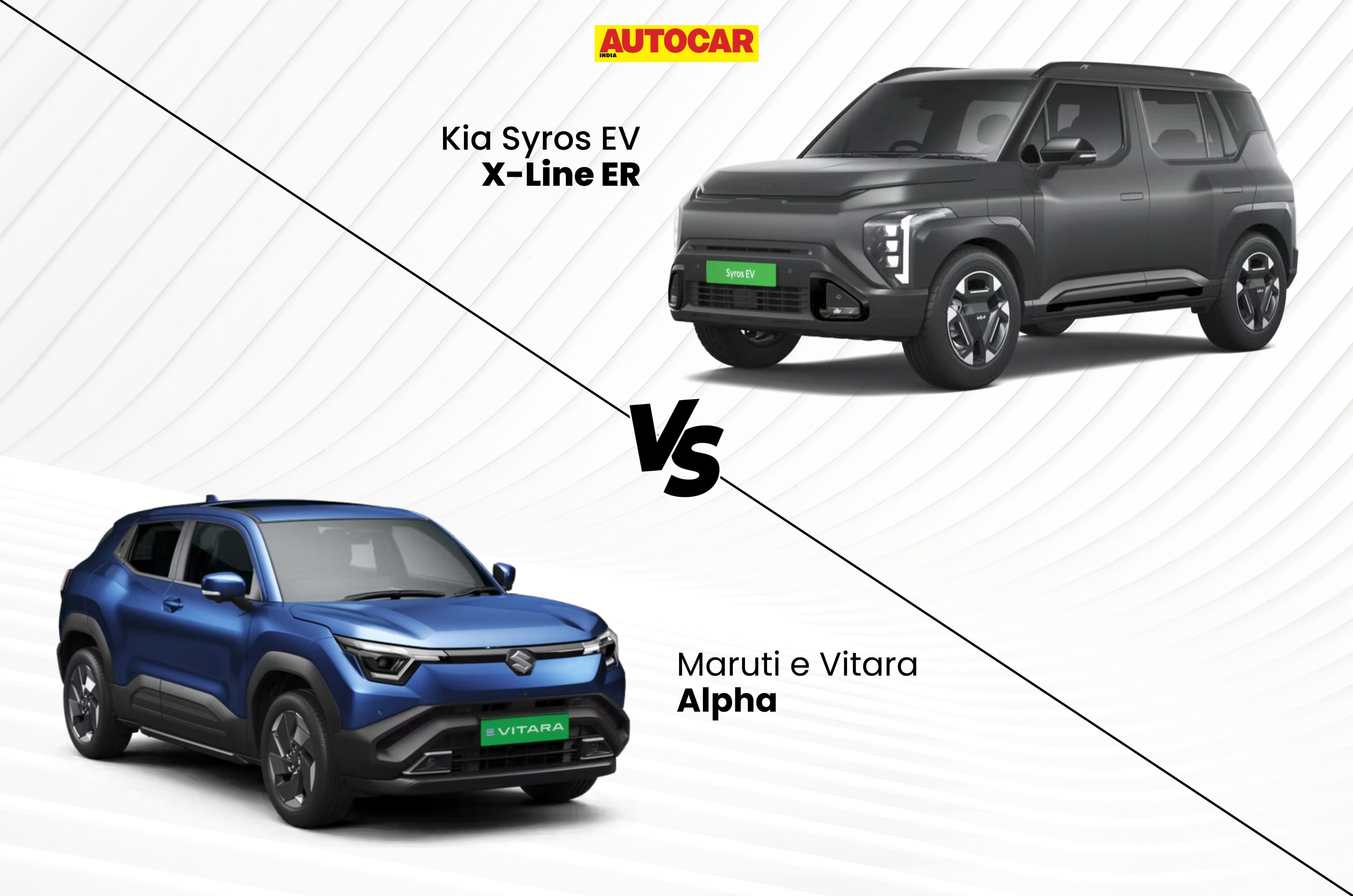
Kia India has officially launched its second mass-market electric car, the Syros EV. While the sub-4m Syros EV directly rivals the Tata Nexon EV and Mahindra XUV 3XO, the Kia’s pricing sees quite a bit of overlap with that of the Maruti Suzuki e Vitara, which is of a segment above. In fact, the top-spec trims of both electric SUVs are identically priced. Therefore, we compared the top-spec versions of the Syros EV and e Vitara on paper to determine which electric SUV offers more bang for your buck.
Kia Syros EV vs Maruti Suzuki e Vitara: Top trim dimensions
e Vitara is longer, but Syros EV is wider and taller
Kia Syros EV X-Line ER vs Maruti e Vitara Alpha dimensions
Syros EV
e Vitara
Length (mm)
3,995
4,275
Width (mm)
1,805
1,800
Height (mm)
1,670
1,640
Wheelbase (mm)
2,550
2,700
Frunk (litres)
16
–
Wheel size (inches)
17
18
Expectedly, the Syros EV is 280mm shorter overall (150mm shorter wheelbase) than the e Vitara, but interestingly, the Kia compact SUV is 5mm wider and 30mm taller. Neither Kia nor Maruti Suzuki quote precise boot space figures for their respective electric SUVs, but it’s worth noting that the Syros EV comes with a 16-litre frunk, while the e Vitara completely lacks storage space up front. However, the top-spec e Vitara does get larger alloy wheels than the equivalent Syros EV.
Kia Syros EV vs Maruti Suzuki e Vitara: Top trim powertrains
Syros EV is quicker, e Vitara claims higher range and has a bigger battery
Kia Syros EV X-Line ER vs Maruti e Vitara Alpha battery and range
Syros EV
e Vitara
Battery size (kWh)
51.4
61
Electric motor setup
Single motor, front
Single motor, front
Drive layout
FWD
FWD
Power (hp)
171
174
Torque (Nm)
255
193
Claimed 0-100kph time (seconds)
8.1
8.7
ARAI range (km)
526
543
The Syros EV’s battery pack is almost 10kWh smaller than that of the e Vitara, but the Kia is only 17km behind in terms of ARAI-claimed range. Both electric SUVs are front-wheel drive and make similar amounts of power, but the Syros EV edges ahead by a significant 62Nm in terms of torque output. This is partly why the Syros EV claims a 0.6sec quicker 0-100kph time than that of the e Vitara.
Kia Syros EV vs Maruti Suzuki e Vitara: Top trim charging speeds
Syros EV supports higher DC wattages
Kia Syros EV X-Line ER vs Maruti e Vitara Alpha charging times
Syros EV
e Vitara
Battery size (kWh)
51.4
61
7.4kW AC charging (10-100 percent)
–
9 hrs
11kW AC charging (10-100 percent)
8.9 hrs
–
DC fast charging (10-80 percent)
39 mins at 100kW
45 mins at 70kW
Kia and Maruti Suzuki quote AC charging speeds at different wattages, so the Syros EV and e Vitara can’t be directly compared on this front. However, it’s noteworthy that though the e Vitara has a larger battery than the Syros EV, the former takes roughly the same amount of time for a 10-100 percent charge at 7.4kW as the latter does at 11kW. Coming to DC charging, the Syros EV supports up to 100kW, while the e Vitara tops out at 70kW.
Kia Syros EV vs Maruti Suzuki e Vitara: Top trim exterior features
Syros EV gets puddle lamps, but e Vitara offers much greater choice in colours
Kia Syros EV X-Line ER vs Maruti e Vitara Alpha exterior features
Syros EV
e Vitara
LED projector headlamps
Yes (auto)
Yes (auto)
Front fog lamps
Yes
Yes
LED tail-lamps
Yes
Yes
Puddle lamps w/ logo projection
Yes
No
Roof rails
Yes
No
Powered ORVMs
Yes
Yes
Auto-folding ORVMs
Yes
Yes
Flush door handles
Yes
No
Body cladding
Yes
Yes
Rear spoiler
Yes
Yes
Colour options
2, monotone
10, monotone + dual-tone
Both electric SUVs are quite evenly matched in terms of exterior features, but the Syros EV takes the lead by way of roof rails and door-mounted puddle lamps that project the Kia logo. The Syros EV has flush door handles too, but some may appreciate the e Vitara’s conventional door handles more. Colours are a square win for the e Vitara, as it offers six monotone options and four dual-tone finishes. The Syros X-Line ER can be had in either Aurora Black Pearl or Matte Graphite, both of which are difficult to maintain. Buyers who want other colours have no option but to consider lower-spec Syros EV variants.
Kia Syros EV vs Maruti Suzuki e Vitara: Top trim interior features
Syros EV beats e Vitara with panoramic sunroof, cooled rear seat bases, and more
Kia Syros EV X-Line ER vs Maruti e Vitara Alpha interior features
Syros EV
e Vitara
Infotainment screen
12.3-inch
10.1-inch
Digital driver’s display
12.3-inch
10.25-inch
Climate control display
5-inch
–
Sunroof
Panoramic
Fixed single-pane
Wireless charger
Yes
Yes
Driver’s seat adjustment
4-way powered
10-way powered
Ventilated front seats
Yes
Yes
Rear seat base ventilation
Yes
No
Automatic climate control
Yes
Yes
Ambient lighting
Yes
Yes
Sound system
8-speaker Harmon Kardon
8-speaker Infinity
Apple CarPlay & Android Auto
Wireless
Wireless
Connected car tech
Yes
Yes
OTA updates
Yes
Yes
Rear sunshades
Yes
No
Rear centre armrest
Yes
Yes
Sliding, reclining rear seats
Yes
Yes
Even on the inside, the Syros EV’s feature set comes out on top. Over the e Vitara, the Syros EV packs larger infotainment and instrument displays, an additional screen for climate control settings, a panoramic sunroof, rear sunshades, and ventilation for the rear seat bases – this feature is not available even in electric SUVs a segment above the Syros EV. The e Vitara’s only advantage over the Syros EV is a greater gamut of electrical adjustment for the driver’s seat.
Kia Syros EV vs Maruti Suzuki e Vitara: Top trim driving features
Syros EV scores big on convenience by way of paddle shifters for regen modes
Kia Syros EV X-Line ER vs Maruti e Vitara Alpha driving features
Syros EV
e Vitara
Drive modes
Eco, Normal, Sport
Eco, Normal, Sport
Terrain modes
No
Snow
V2L function
Yes
No
Multi-level regen braking
Yes
Yes
Paddle shifters for regen
Yes
No
Cruise control
Adaptive
Adaptive
Both the Syros EV and e Vitara come with three drive modes and adaptive cruise control, but the Kia SUV inches forward thanks to vehicle-to-load (V2L) functionality, which lets you power external devices from the battery pack. The Syros EV also offers paddle shifters to cycle through the regenerative braking levels, while the e Vitara makes do with just a knob on the centre console. However, the e Vitara does offer a Snow terrain mode over the Syros EV.
Kia Syros EV vs Maruti Suzuki e Vitara: Top trim safety features
e Vitara wins thanks to an extra airbag, rain-sensing wipers, and 5-star BNCAP score
Kia Syros EV X-Line ER vs Maruti e Vitara Alpha safety features
Syros EV
e Vitara
Bharat NCAP rating
Yet to be tested
5 stars
Airbags
6
7
ABS with EBD
Yes
Yes
Electronic stability program
Yes
Yes
Follow-me-home headlamps
Yes
Yes
Hill hold control
Yes
Yes
TPMS
Yes
Yes
360-degree camera
Yes
Yes
Parking sensors
Front, rear, side
Front, rear
Electronic parking brake
Yes (w/ auto-hold)
Yes (w/ auto-hold)
Rain-sensing wipers
No
Yes
Auto-dimming IRVM
Yes
Yes
ISOFIX child seat anchors
Yes
Yes
Rear wiper, defogger
Yes
Yes
Disc brakes
Front, rear
Front, rear
Level 2 ADAS
Yes
Yes
Acoustic vehicle alert system
Yes
Yes
Coming to safety, the e Vitara finally scores a win. It’s the only one here to come with seven airbags and rain-sensing wipers, whereas the Syros EV sets itself apart with side parking sensors. The e Vitara also holds a 5-star crash safety rating from Bharat NCAP, while the Syros EV has not been tested yet. It’s worth noting, though, that the ICE-powered Syros was awarded 5 stars by Bharat NCAP, so a similar rating for the compact SUV’s electric derivative is very possible.
Kia Syros EV vs Maruti Suzuki e Vitara: Top trim prices
Syros EV for buyers seeking features, e Vitara for those who want a bigger car
Kia Syros EV X-Line ER vs Maruti e Vitara Alpha price comparison
Syros EV
e Vitara
Price (Rs, lakh)
20.00
19.99
As noted previously, there is next to no difference in the pricing of the Syros EV X-Line ER and e Vitara Alpha, which means the final decision comes down to your needs and preferences. If you want as many features as possible, are fine with a dark colour, and don’t mind smaller dimensions and funkier styling, the Syros EV X-Line ER is the one to go for. On the other hand, if you want the price you pay to be reflected in the size of the car, more choice in colours, more conventional looks, and are happy to forgo some features, you can consider the e Vitara.
It’s also worth noting that both the Syros EV and e Vitara can be purchased with battery-as-a-service (BaaS), which converts the cost of the battery into separate usage-based EMIs, thereby lowering the upfront cost. Kia has yet to reveal the BaaS price of the Syros EV X-Line ER, but the e Vitara Alpha costs Rs 14.49 lakh – Rs 5.5 lakh off the sticker price – with a Rs 4.39/km battery usage fee.
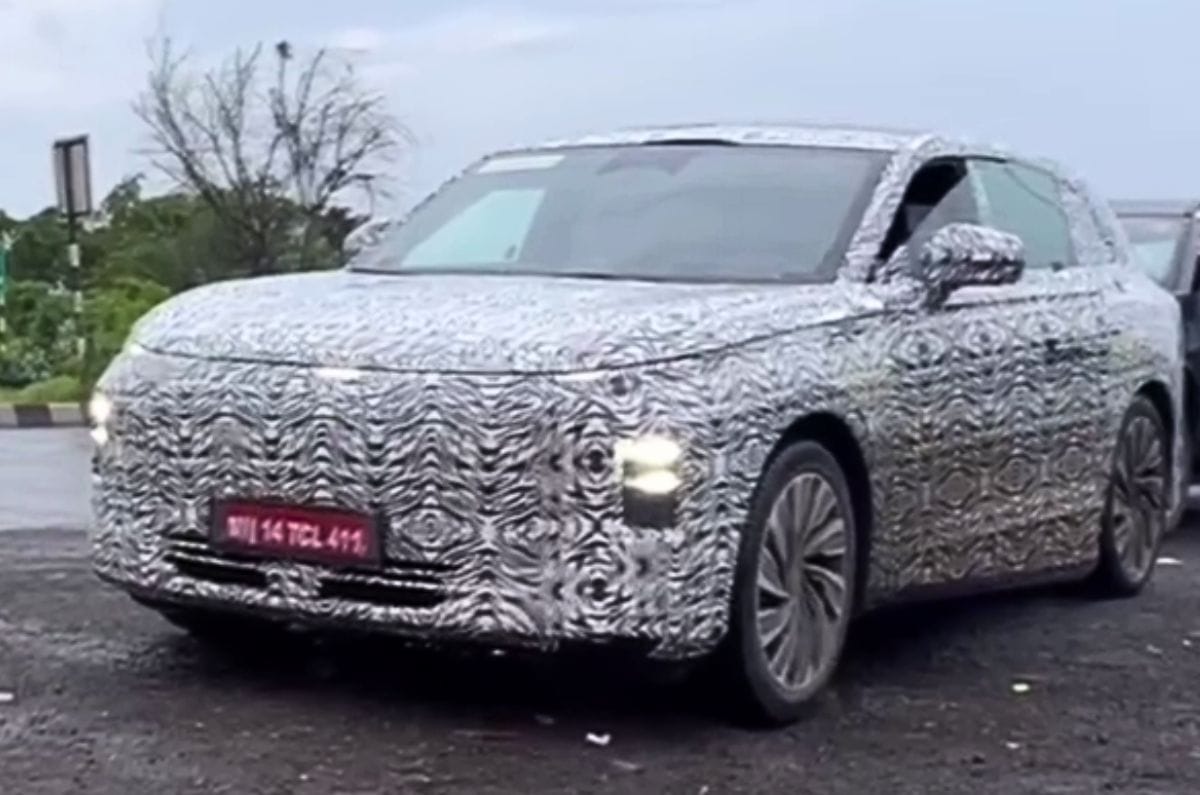
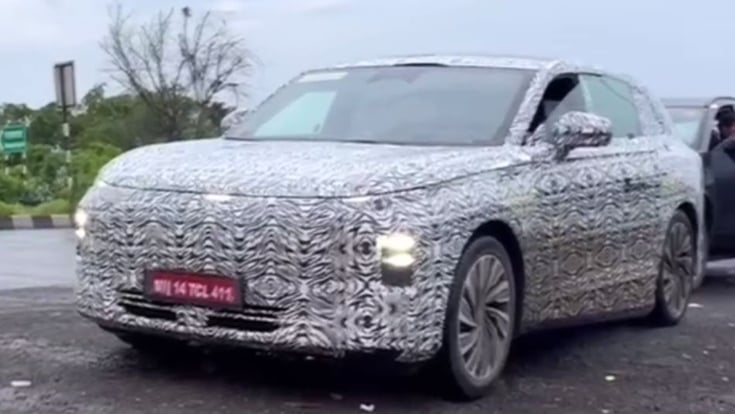
A new camouflaged prototype vehicle was recently spied testing in India, which many online reports speculated to be one of Tata’s upcoming Avinya models. Contrary to those reports, however, the spotted test mule is actually the Sterra ET, an SUV manufactured by Chinese automaker Exceed, a premium brand of Chery. Incidentally, the Exceed Sterra ET is based on the same Chery-JLR platform which Tata Motors recently announced will be underpinning its upcoming Avinya range.
Tata Avinya EVs to Chery’s E0X platform
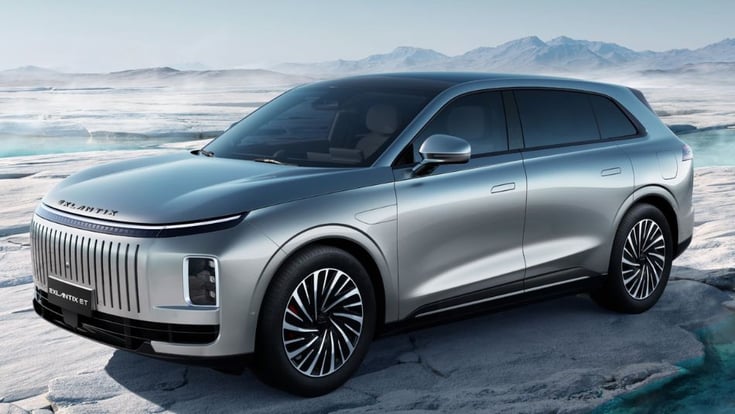
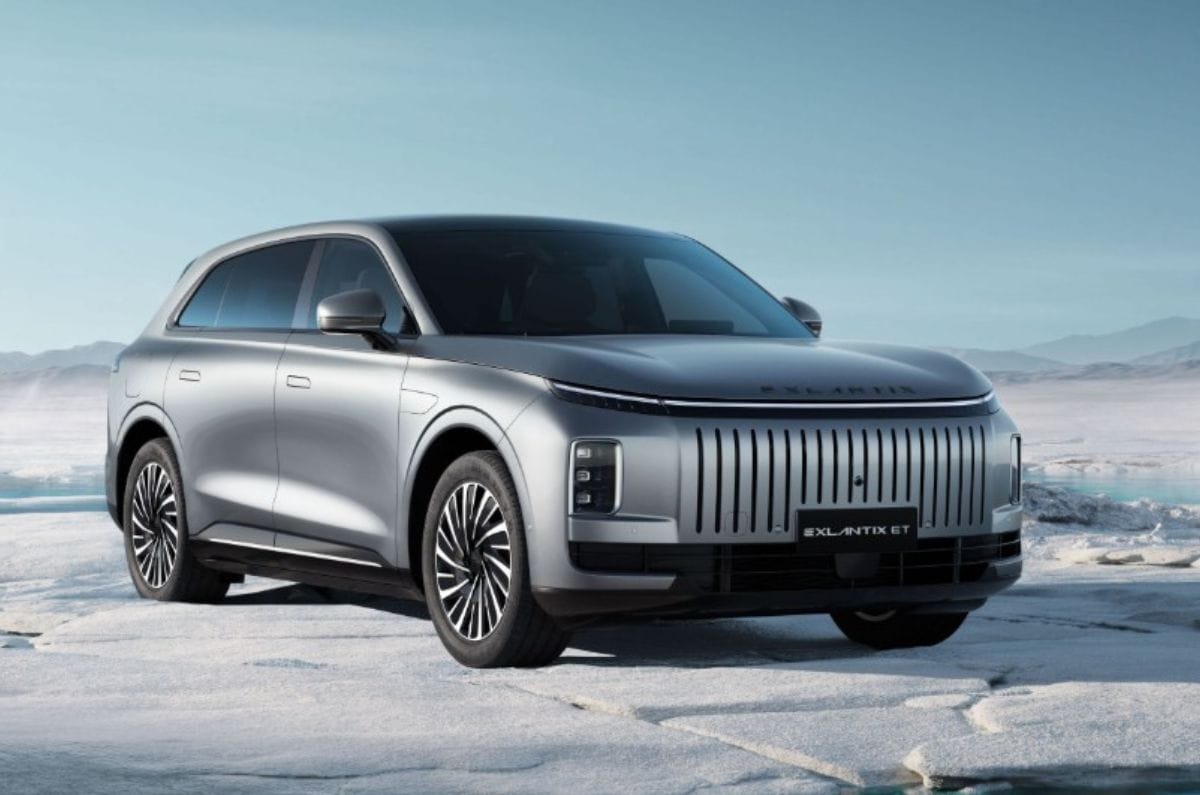
Tata Motors recently confirmed that the Avinya range of models will be underpinned by the Freelander EV platform produced by Chery-JLR in China. Known as the E0X, this platform also underpins several other models in the Chinese market like the Exceed Sterra ES and Sterra ET, the latter of which has been spied testing on our roads. It’s also known as the Exceed Exlantix ET in markets outside China.
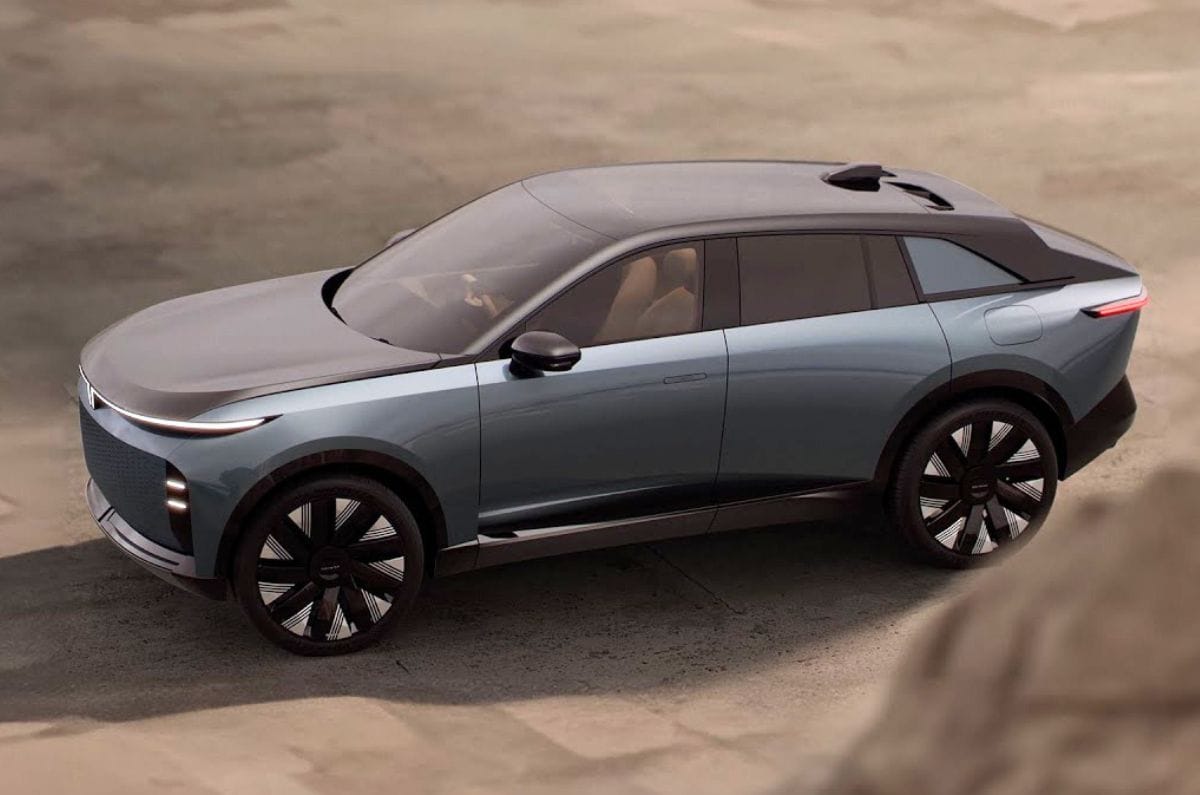
Essentially, the company is using the Exceed Sterra ET as a test bed for its upcoming Avinya EVs, but the spied test mule doesn’t preview any Avinya model in particular, even though its proportions are very similar to the Avinya X concept.
While Avinya EV’s underlying mechanical architecture is expected to be similar to other models based on the E0X platform, Tata Motors is understood to be reworking key parts of the electronics, software and vehicle systems for Indian market requirements.
Exceed Sterra ET: what is it?
The Sterra ET is a near-5-meter-long SUV that’s available with both all-electric and range-extender hybrid powertrain options. It’s Exeed’s second product in its Sterra lineup after the Sterra ES sedan.
The Sterra ET is also known as the Exlantix ET in markets outside China.
In all-electric guise, the Sterra ET gets an 800V architecture and can support batteries of up to 100kWh in size. It comes in either rear-wheel drive or all-wheel drive configurations and is claimed to return up to 760km of range in the CLTC cycle. Meanwhile, the range-extender hybrid versions use a 400V architecture and are powered by a 1.5-litre turbo-petrol engine coupled with either a 32kWh or a 41.2kWh battery packs. This, too, comes in both rear-wheel drive and all-wheel drive configurations, and is said to return a combined range of up to 1518 km on the CLTC cycle.
First production model under Avinya brand is due in 2027.
It remains to be seen which powertrain configurations Tata chooses for its Avinya range of EVs. The Sterra ET also gets Level 2 ADAS features, OTA updates and V2L capabilities.
The first production model under the Avinya brand will be the Avinya X, due for a market launch in 2027.
Kia is aiming at the growing compact electric SUV segment with the upcoming Syros EV, set to be its second mass-market electric model for India. The Syros EV utilises the same K1 platform as its ICE-powered counterpart. Bookings for the Syros EV are already open ahead of its launch, scheduled for the end of July 2026. In this article, we answer everything that you need to know about the Syros EV.
1. What battery pack options does the Kia Syros EV offer, and how much power does its motor produce?
The Kia Syros EV offers the same 42kWh and 51.4kWh battery packs that do duty in the Kia Carens Clavis EV and the Hyundai Creta Electric. Both are mated to a front-mounted motor. In the 42kWh guise, the motor delivers 135hp and 255Nm, but in the 51.4kWh guise, power is bumped to 171hp, while torque remains the same. The 51.4kWh battery pack and its 171hp motor make it the model with the largest battery pack and the most powerful motor in the class. Kia claims a 0-100kph sprint in 8.1 seconds with the 51.4kWh version.
2. What is the claimed range of the Kia Syros EV?
The ARAI-rated range is 443km for the 42kWh battery pack and 543km for the larger 51.4kWh unit. Not only does the Syros EV have a higher claimed range than the Clavis EV and the Creta Electric, but its 543km figure is also the highest in the compact electric SUV segment.
3. What charging speeds does the Kia Syros EV support, and how long does it take to charge?
The Kia Syros EV supports up to 11kW AC charging speeds, while DC charging is capped at 100kW. A 10-100 percent top-up for the 42kWh version takes 6 hours with the 7.4kW charger and 4 hours with the 11kW unit. In the 51.4kWh guise, the same takes 7 hours and 15 minutes with a 7.4kW charger and 4 hours and 50 minutes with an 11kW charger. Kia also claims that with a 100kW DC fast charger, both batteries can charge from 10 to 80 percent in 39 minutes.
4. How different is the Kia Syros EV from the ICE Syros on the outside and inside?
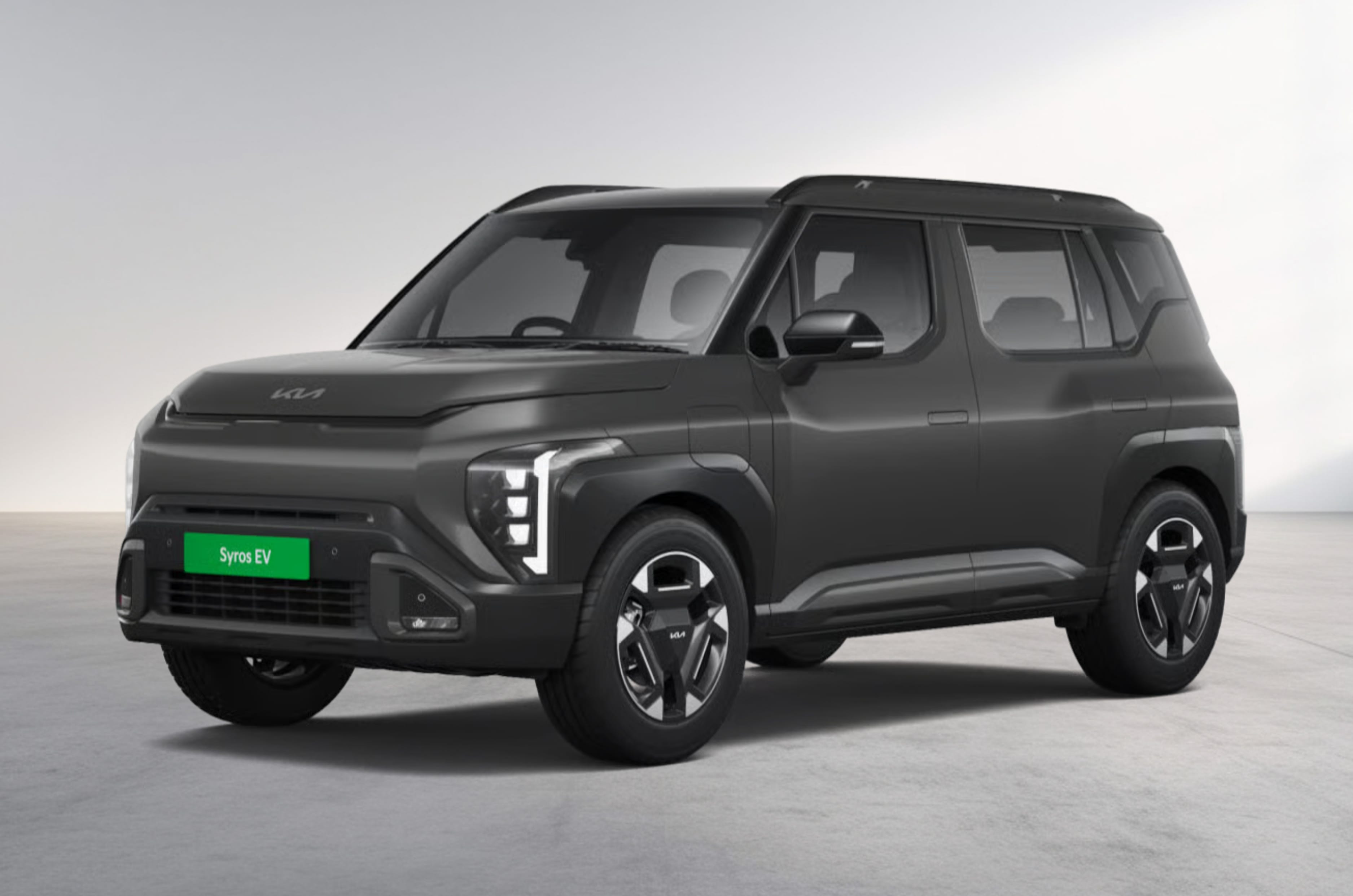
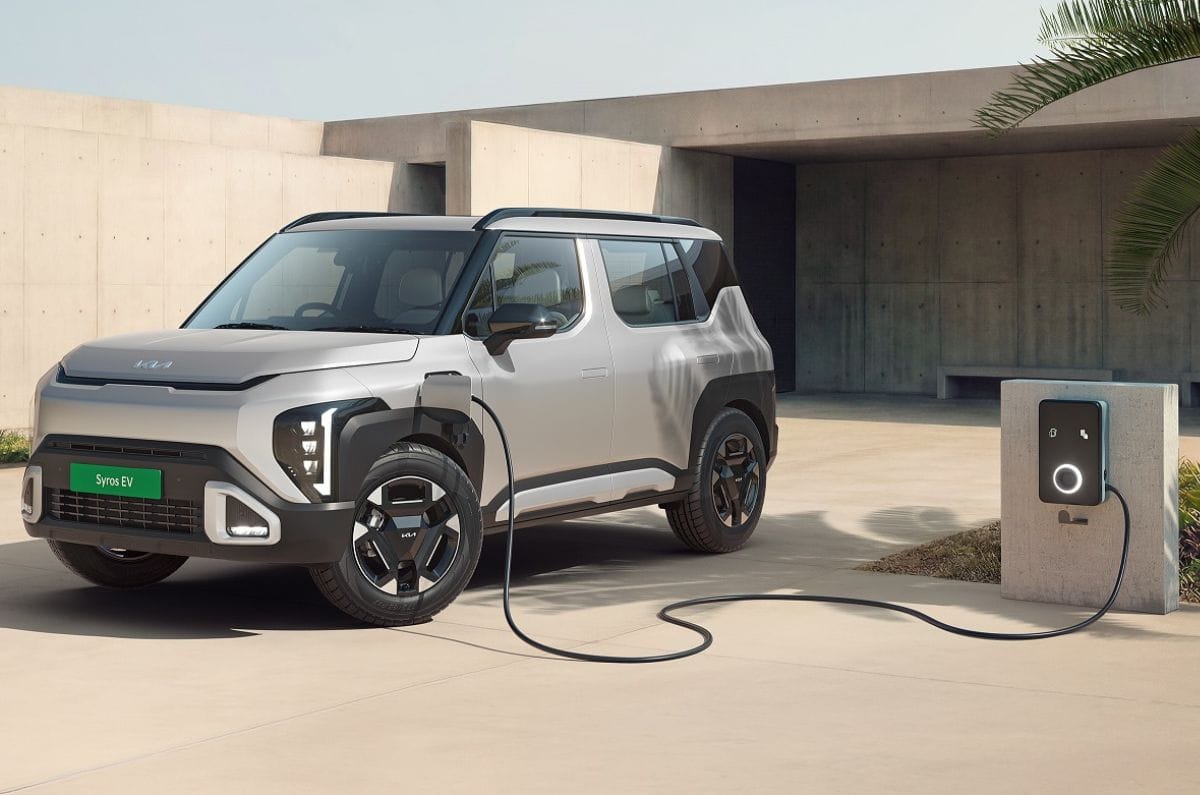
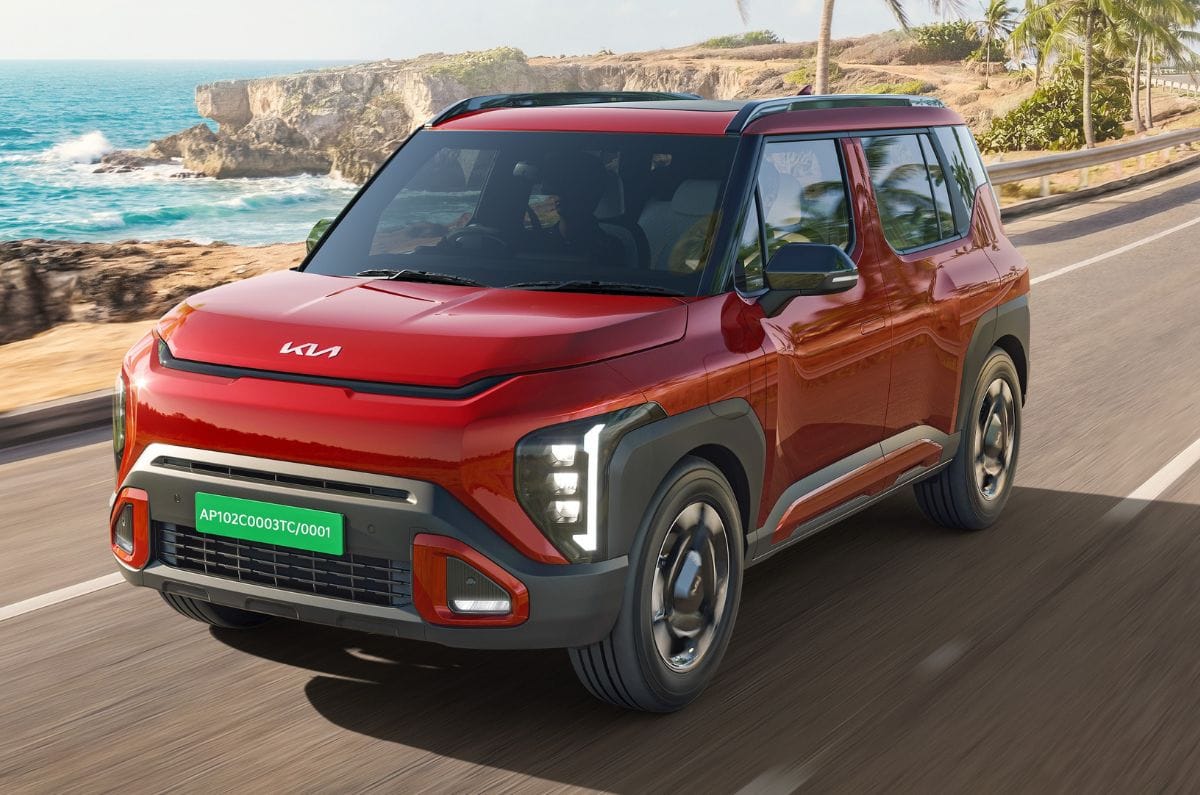
The Kia Syros EV may look largely similar to the ICE Syros, but it comes with a charging flap on the front fender, EV badging at the rear and a different set of alloy wheels that give it some distinction. Apart from these differences, it retains the overall tall-boy silhouette, front and rear bumper designs and lighting elements found on its combustion-powered counterpart.
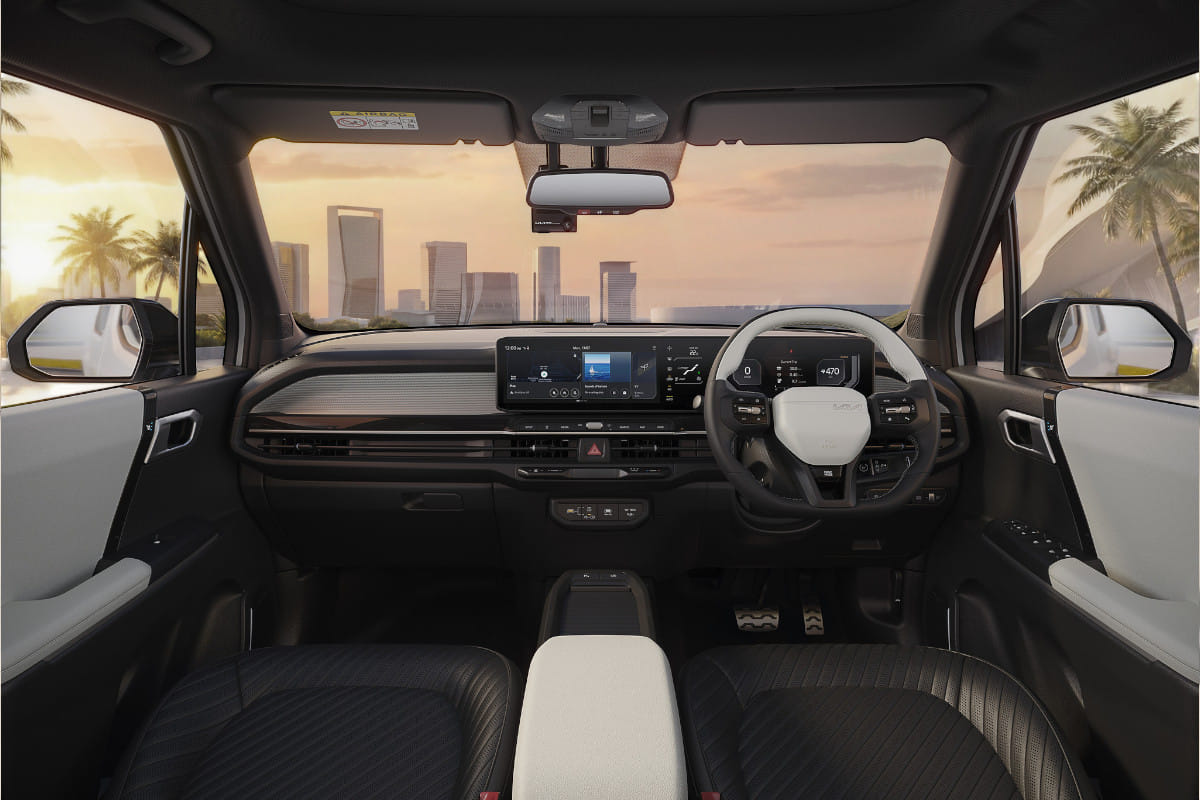
Inside, the dashboard layout remains the same as the ICE Syros, but there are some revisions to the centre console, which is high-set and features storage spaces and retractable cup holders. Also, the drive select lever has shifted to the steering wheel column.
5. What features does the Kia Syros EV come with?
For starters, the Kia Syros EV retains its ICE counterpart’s unique sliding and reclining rear seat with a ventilation function for the seat base. It also gets features such as dual 12.3-inch screens, a 5-inch HVAC control screen, wireless Apple CarPlay and Android Auto, a wireless charging pad, an 8-speaker Harman Kardon sound system, a panoramic sunroof, 64-colour ambient lighting and rear sunshades.
6. What does the Kia Syros EV offer over the ICE-powered Syros?
Apart from having EV-specific features such as a 16-litre frunk, regenerative braking, a virtual engine sound system and vehicle-to-load (V2L) functionality, it gets Level 2 ADAS, automatic flush door handles, a 360-degree camera setup, a dual-camera dashcam, a digital key, puddle lamps, multi-colour ambient lighting and metal pedals over the ICE-powered Syros.
7. What is the expected price of the Kia Syros EV?
The Kia Syros EV is expected to be priced from Rs 15 lakh to Rs 20 lakh, ex-showroom. It will take on the Mahindra XUV 3XO EV and the segment-reigning Tata Nexon EV, among others.
Ahead of its launch later this month, the Kia Syros EV has been unveiled in full. It follows a similar philosophy to the Kia Carens Clavis EV, wherein there are little to no exterior changes compared to the ICE-powered Syros. Even on the inside, the Syros EV is largely identical to its ICE counterpart, save for a three-spoke steering wheel instead of the latter’s two-spoke one, a floating centre console, and additional features like V2L functionality and virtual engine sounds. Under the skin, the Syros EV offers the same 42kWh and 51.4kWh battery options as the Carens Clavis EV and Hyundai Creta Electric.
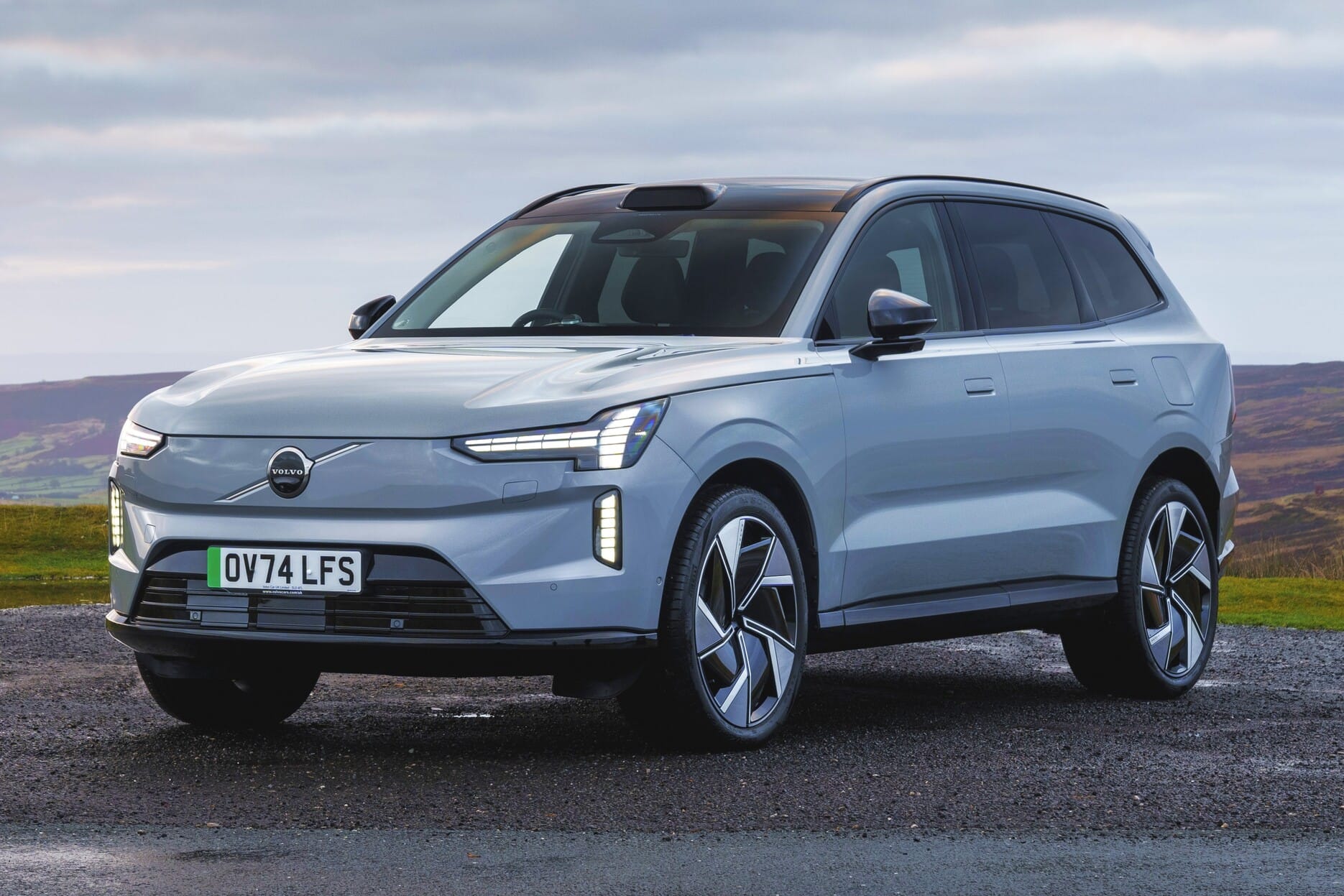
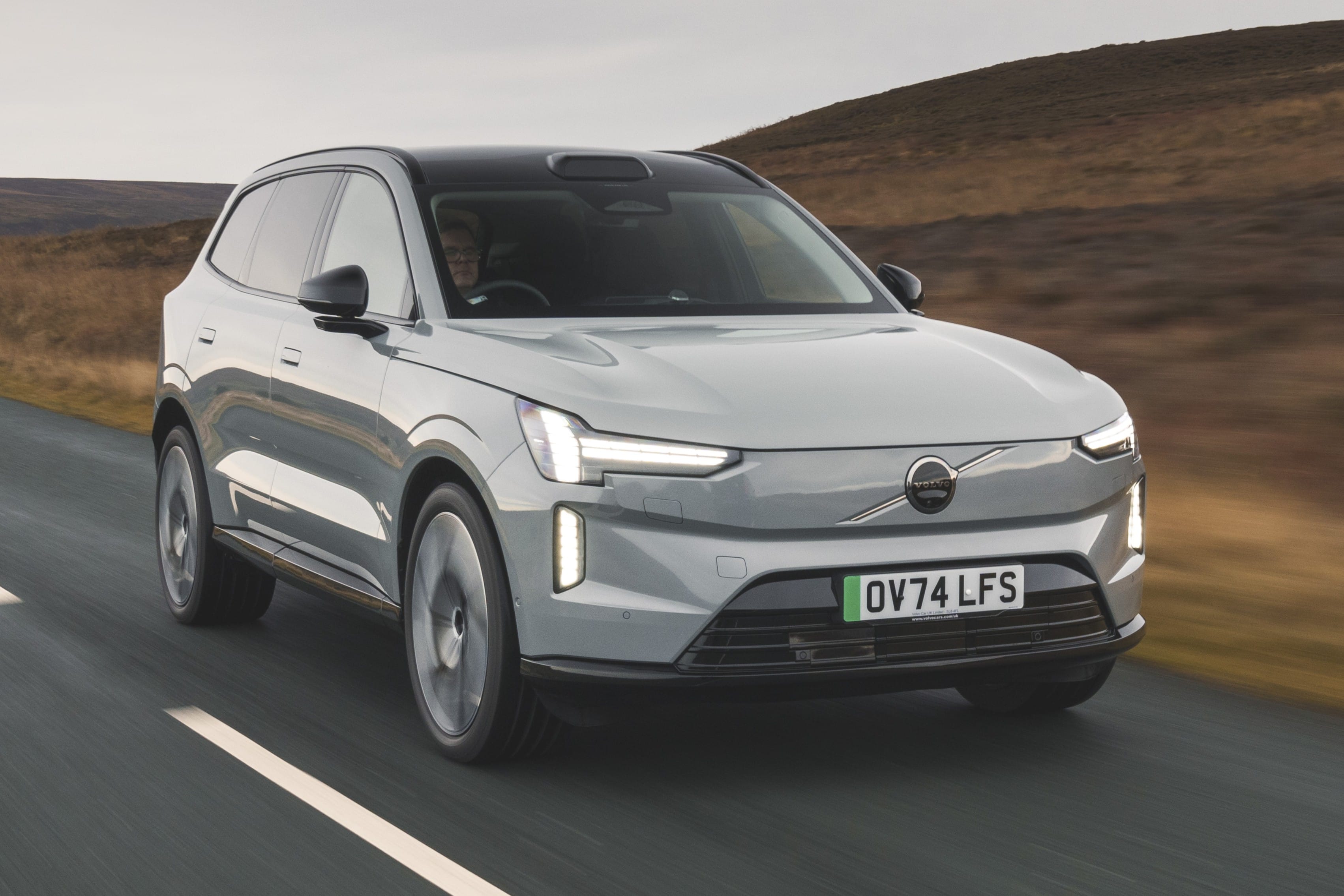
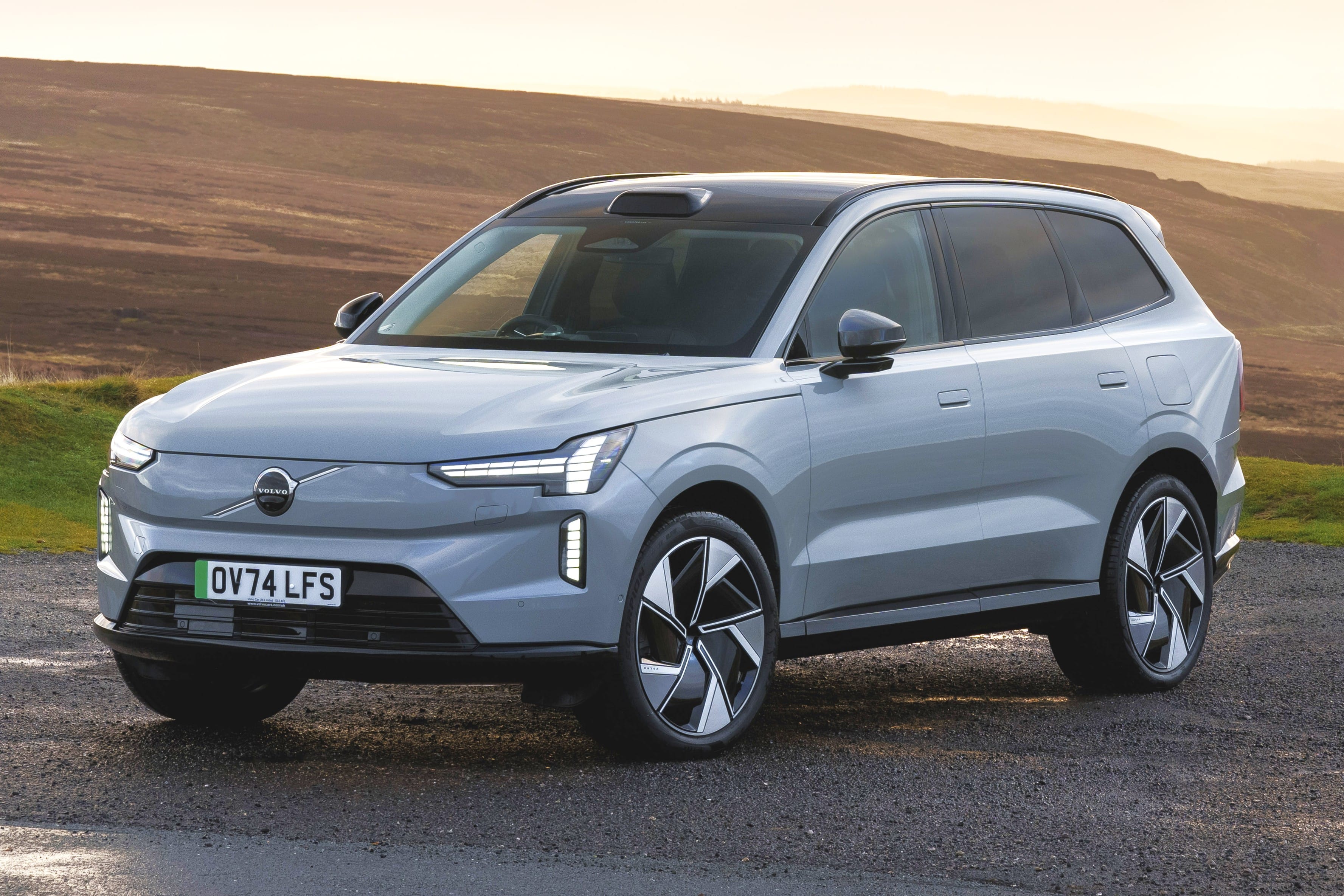
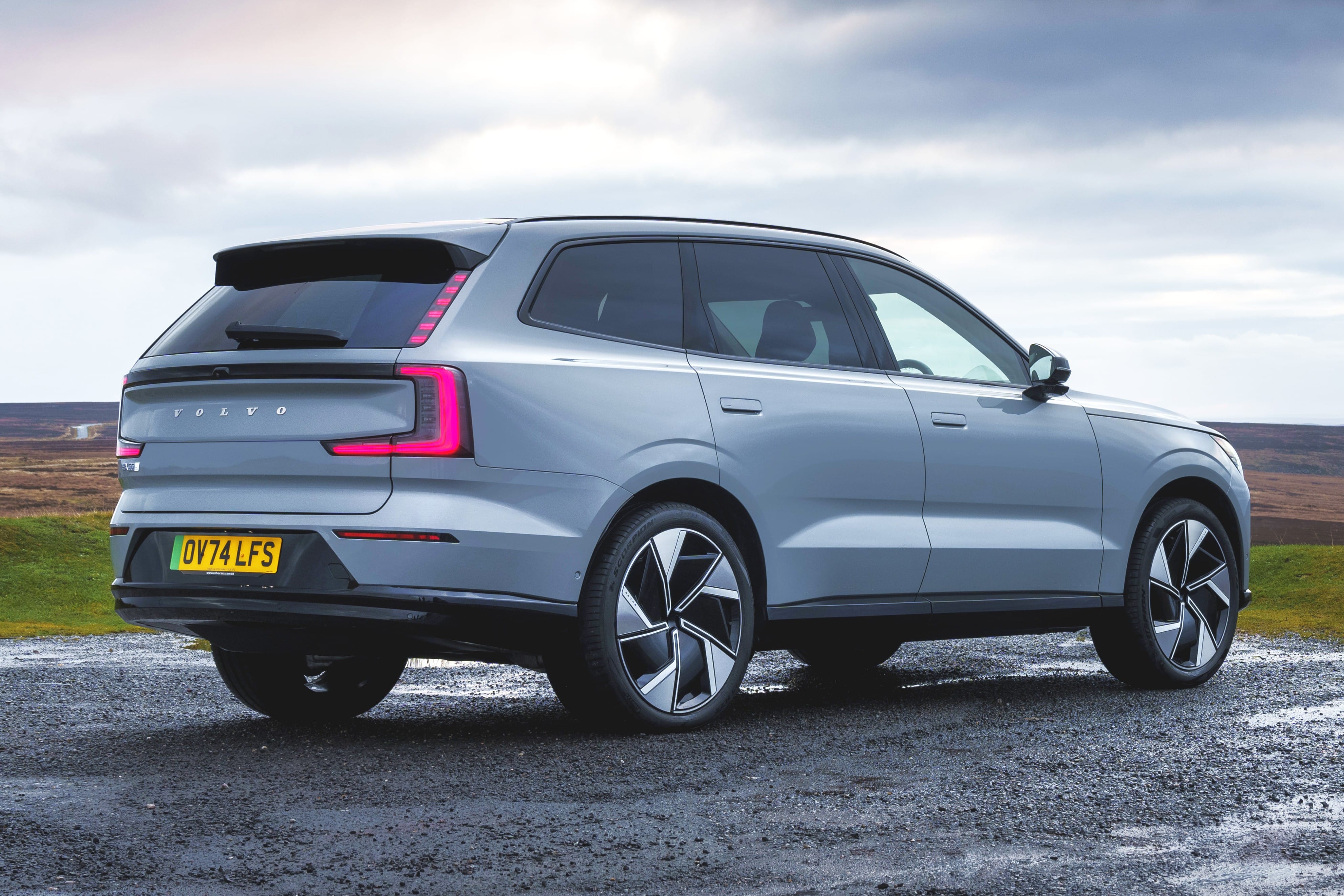
Volvo has confirmed that the India debut of the EX90 electric SUV will take place on August 19, 2026. The EX90 will be Volvo’s second EV for the Indian market, and is also the Swedish carmaker’s global flagship offering.
Volvo EX90 battery and range
92kWh RWD and 106kWh AWD powertrains
The EX90 is underpinned by an 800V architecture and offers 92kWh (Single Motor) and 106kWh (Twin Motor) battery options. In 92kWh guise, the SUV gets a single rear-mounted motor (RWD) outputting 333hp and 480Nm. 0-100kph comes up in a claimed 6.6 seconds, and the WLTP-rated range is 565km.
Meanwhile, the 106kWh EX90 features a dual-motor AWD setup that outputs 456hp and 670Nm in base spec, and 680hp and 870Nm in the range-topping Performance variant. The former version completes the 0-100kph run in a claimed 5.3 seconds, whereas the latter takes 4 seconds for the same. As for WLTP range, the lower-powered 106kWh variant boasts 608km and the Performance trim manages 602km.
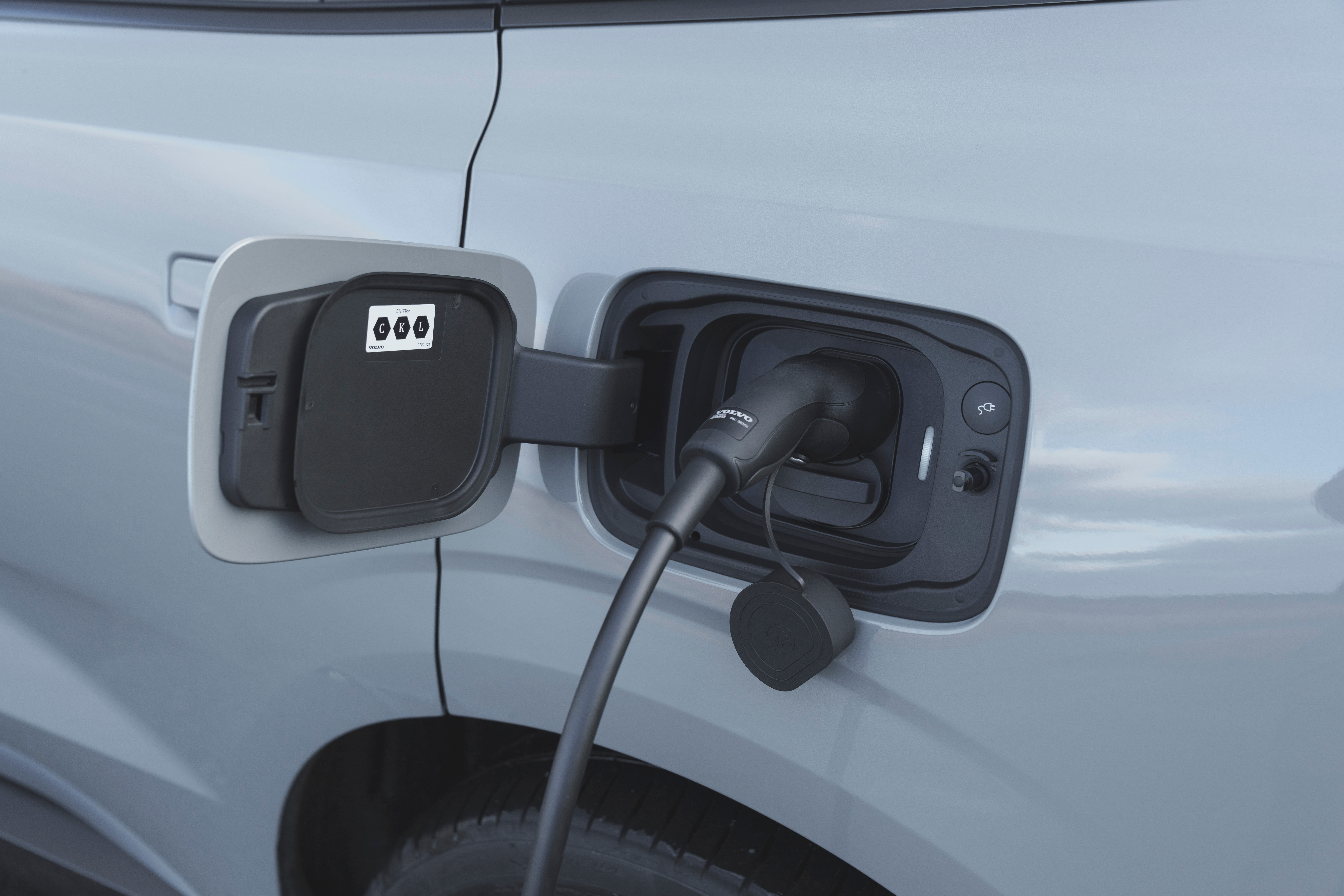
Coming to charging speeds, all three variants of the EX90 can utilise up to 350kW DC charging, and take 22 minutes for a 10-80 percent charge.
Volvo EX90 exterior design
Looks very different compared to the XC90
Measuring 5,037mm in length, 1,964mm in width, 1,744mm in height, and 2,985mm in wheelbase, the EX90 is dimensionally similar to the XC90, but sports a distinct design. Up front, the EX90 has sleeker T-shaped headlamps with pixel-like ‘Thor’s Hammer’ DRL signatures, below which sits a pair of slim vertically-arranged lights. The Volvo badge is placed front and centre on the grille-less fascia, with a discreet air dam underneath. A LiDAR sensor can also be spotted on the leading edge of the roof.
The side profile of the EX90 is cleanly-styled, with a prominent shoulder line and gently rising glass area, and there’s not much in the way of body cladding – Volvo claims a drag coefficient of 0.29Cd. 20-inch alloy wheels are fitted as standard, with 21- and 22-inchers optionally available. Over to the rear, the EX90 gets C-shaped LED tail-lamps with an additional vertical row of lights flanking the rear windscreen. Other styling elements of note include a sizable roof spoiler and a Volvo wordmark on the bootlid.
Volvo EX90 interior and features
14.5-inch infotainment touchscreen sits front and centre on the dash
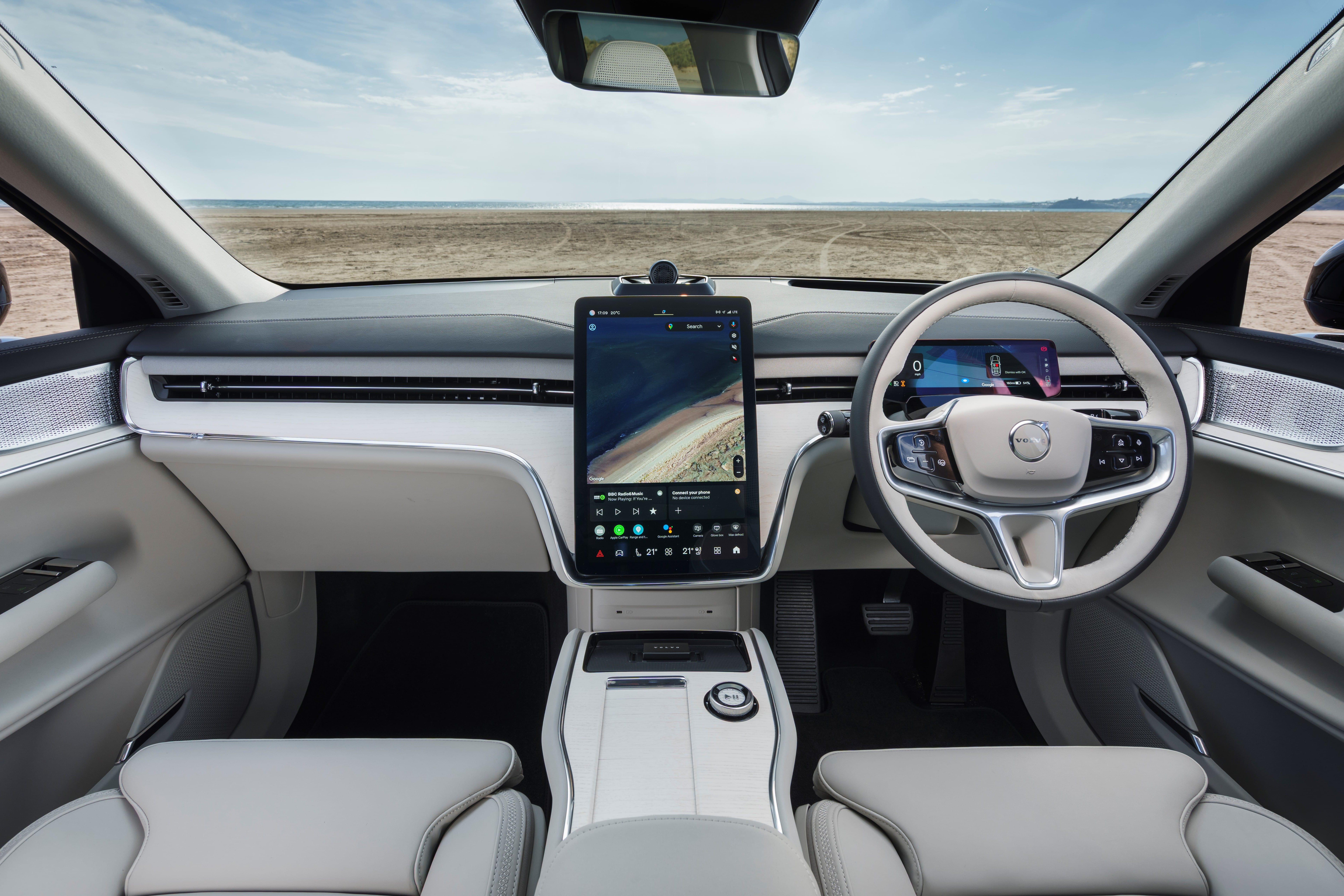
Inside, the EX90’s minimalistic dashboard is dominated by a 14.5-inch Google-based portrait touchscreen that incorporates much of the in-car functionality – physical controls are few and far between. There’s also a floating centre console, a three-spoke steering wheel with a neat layered design, a slim 9-inch digital driver’s display, and a 13.2-inch heads-up display.
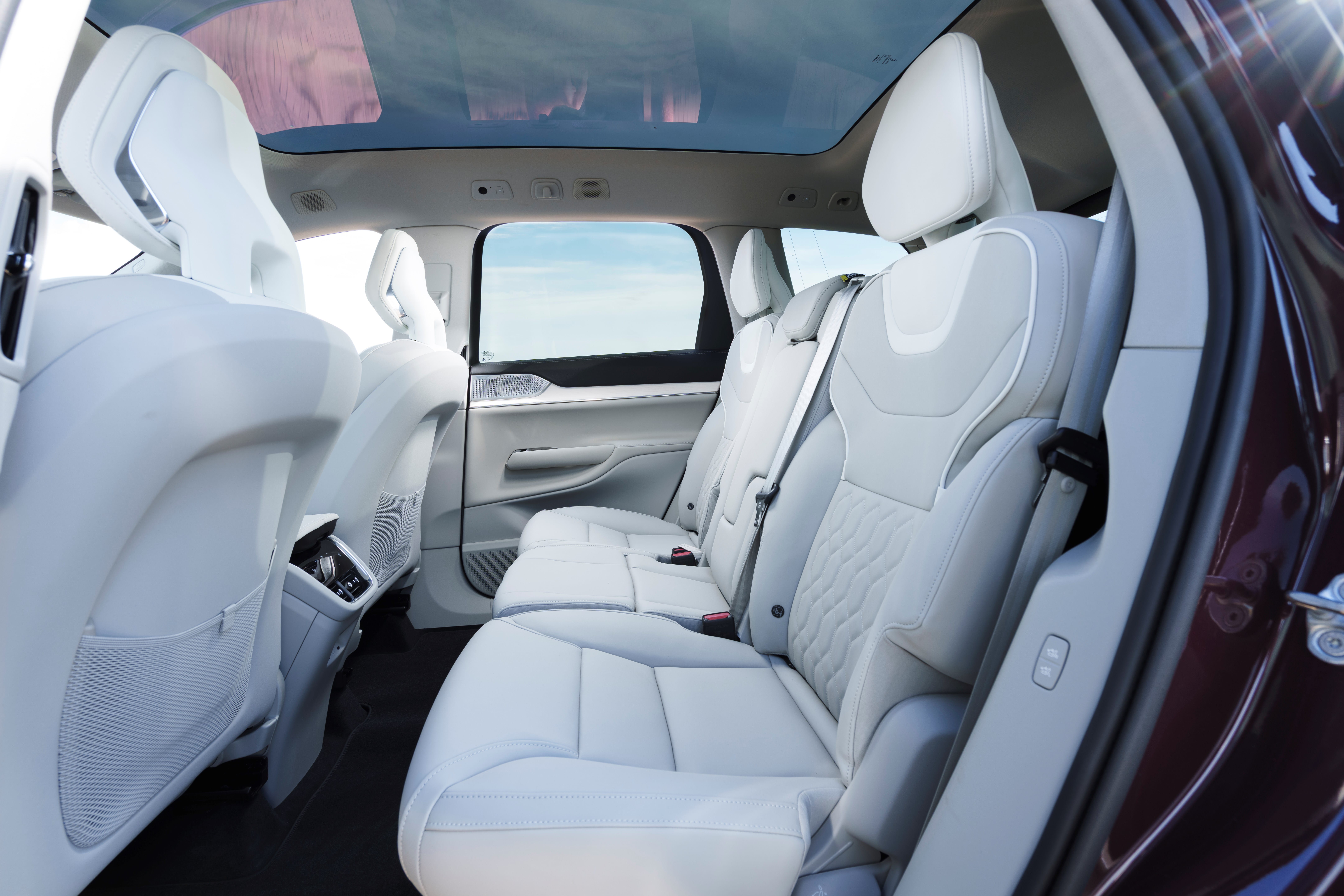
The EX90 is a 7-seater as standard, but certain variants offer a 6-seat configuration with captain’s chairs for the second row as well. In some markets, Volvo even offers a 4-seater version of the EX90 with a rear centre console that integrates a refrigerator, rivalling the likes of the Mercedes Maybach EQS SUV. Boot space is pegged at up to 384 litres with all three rows up, and there’s a 45-litre frunk too.
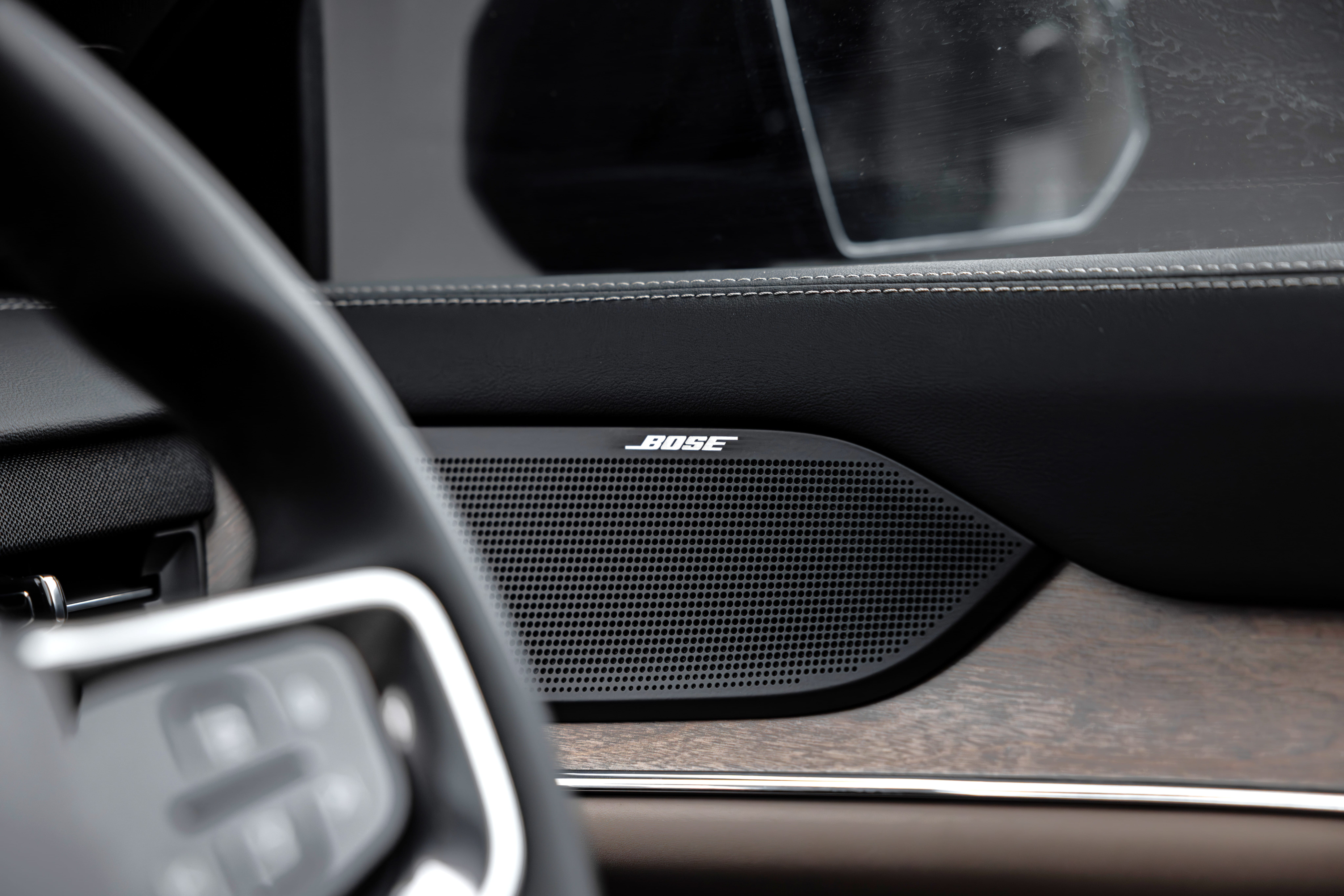
As for features, the EX90 packs a 5G connection to aid OTA updates, a digital key, ambient lighting, four-zone climate control, a cabin air purifier, a wireless charging pad, a 360-degree camera, powered front seats, a panoramic glass roof, a Bose sound system, connected car tech, auto park assist, Level 3 ADAS, V2L functionality, and more. It’s also claimed to be Volvo’s safest car to date, holding 5-star crash safety ratings from Euro NCAP and NCAP.
Kia Syros EV: तेजी से बढ़ते इलेक्ट्रिक SUV सेगमेंट में Tata Nexon EV और Mahindra XUV 3XO EV जैसे कॉम्पिटिटर्स को टक्कर देने के लिए, Kia ने Carens Clavis EV के बाद अब भारत में अपना दूसरा मास-मार्केट इलेक्ट्रिक मॉडल, Syros EV पेश किया है। इस EV के लिए कंपनी ने ₹25,000 में प्री-बुकिंग भी शुरू कर दी है। यह मॉडल बेहतर ड्राइविंग रेंज, तेज चार्जिंग, एडवांस्ड टेक्नोलॉजी और एक कॉम्प्रिहेंसिव ओनरशिप पैकेज देने का वादा करता है।
Kia Syros EV की खासियत क्या है?
इसकी सबसे बड़ी खासियत है इसकी ARAI-सर्टिफाइड ड्राइविंग रेंज है, जो बड़े 51.4 kWh बैटरी पैक के साथ 526 km तक चल सकती है। Kia के अनुसार, यह अपने सेगमेंट की पहली SUV है जो 500 km का आंकड़ा पार करती है। खरीदार 42 kWh बैटरी का विकल्प भी चुन सकते हैं, जिसकी रेंज 443 km बताई गई है। इसके अलावा, Kia Syros EV में लगी इलेक्ट्रिक मोटर 171 PS की पावर जनरेट करती है। वहीं, बड़े बैटरी पैक वाले मॉडल में यह SUV 0 से 100 किलोमीटर प्रति घंटे की रफ्तार सिर्फ 8.1 सेकंड में पकड़ सकती है।
रोजाना इस्तेमाल के लिए यह कितनी प्रैक्टिकल है?
Kia का कहना है कि Syros EV को 100 kW DC फास्ट चार्जर से 39 मिनट में 10% से 80% तक चार्ज किया जा सकता है। इसमें चार्जिंग परफॉर्मेंस को बेहतर बनाने के लिए 10.8 kW का ऑनबोर्ड AC चार्जर और बैटरी कंडीशनिंग टेक्नोलॉजी भी दी गई है। MyKia ऐप के जरिए, मालिक एक ही वॉलेट का इस्तेमाल करके 23 चार्जिंग ऑपरेटर्स के 20,300 से ज्यादा चार्जिंग पॉइंट्स का इस्तेमाल कर सकते हैं, जबकि Kia के डीलरशिप नेटवर्क में 129 से ज्यादा DC फास्ट चार्जिंग लोकेशन्स और 275 से ज्यादा EV-रेडी वर्कशॉप्स शामिल हैं।
Kia Syros EV में कौन-कौन से फीचर्स हैं?
Syros EV में 30-इंच का ट्रिनिटी पैनोरमिक डिस्प्ले है, जिसमें डिजिटल इंस्ट्रूमेंट क्लस्टर, टचस्क्रीन इंफोटेनमेंट सिस्टम और क्लाइमेट कंट्रोल शामिल हैं। इसके अन्य फीचर्स में वायरलेस Android Auto और Apple CarPlay, Harman Kardon का 8-स्पीकर साउंड सिस्टम, ओवर-द-एयर सॉफ्टवेयर अपडेट, आगे और पीछे वेंटिलेटेड सीटें, पैनोरमिक सनरूफ, V2L (व्हीकल-टू-लोड) क्षमता, डिजिटल की (Key) और 16-लीटर का फ्रंट स्टोरेज कम्पार्टमेंट शामिल हैं।
नई इलेक्ट्रिक SUV कितनी सुरक्षित है?
सुरक्षा एक और ऐसा पहलू है जिस पर Kia ध्यान दे रही है। Syros EV में लेवल 2 ADAS के साथ 16 ऑटोनॉमस ड्राइविंग असिस्टेंस फंक्शन मिलते हैं। इसके अलावा, इसमें छह एयरबैग, 360-डिग्री कैमरा, इलेक्ट्रॉनिक स्टेबिलिटी कंट्रोल, सभी पहियों पर डिस्क ब्रेक, टायर प्रेशर मॉनिटरिंग सिस्टम और कुल 25 स्टैंडर्ड सुरक्षा फीचर दिए गए हैं।
Kia ओनरशिप के क्या फायदे दे रही है?
प्रोडक्ट के अलावा, Kia EV की ओनरशिप से जुड़ी आम चिंताओं को दूर करने की कोशिश कर रही है। इसके लिए वह लाइफटाइम हाई-वोल्टेज बैटरी वारंटी (शर्तों के साथ, 15 साल तक), एक ‘एश्योर्ड बायबैक’ प्रोग्राम और शुरुआती खरीद लागत को कम करने के मकसद से ‘बैटरी-एज-अ-सर्विस’ फाइनेंसिंग ऑप्शन दे रही है।
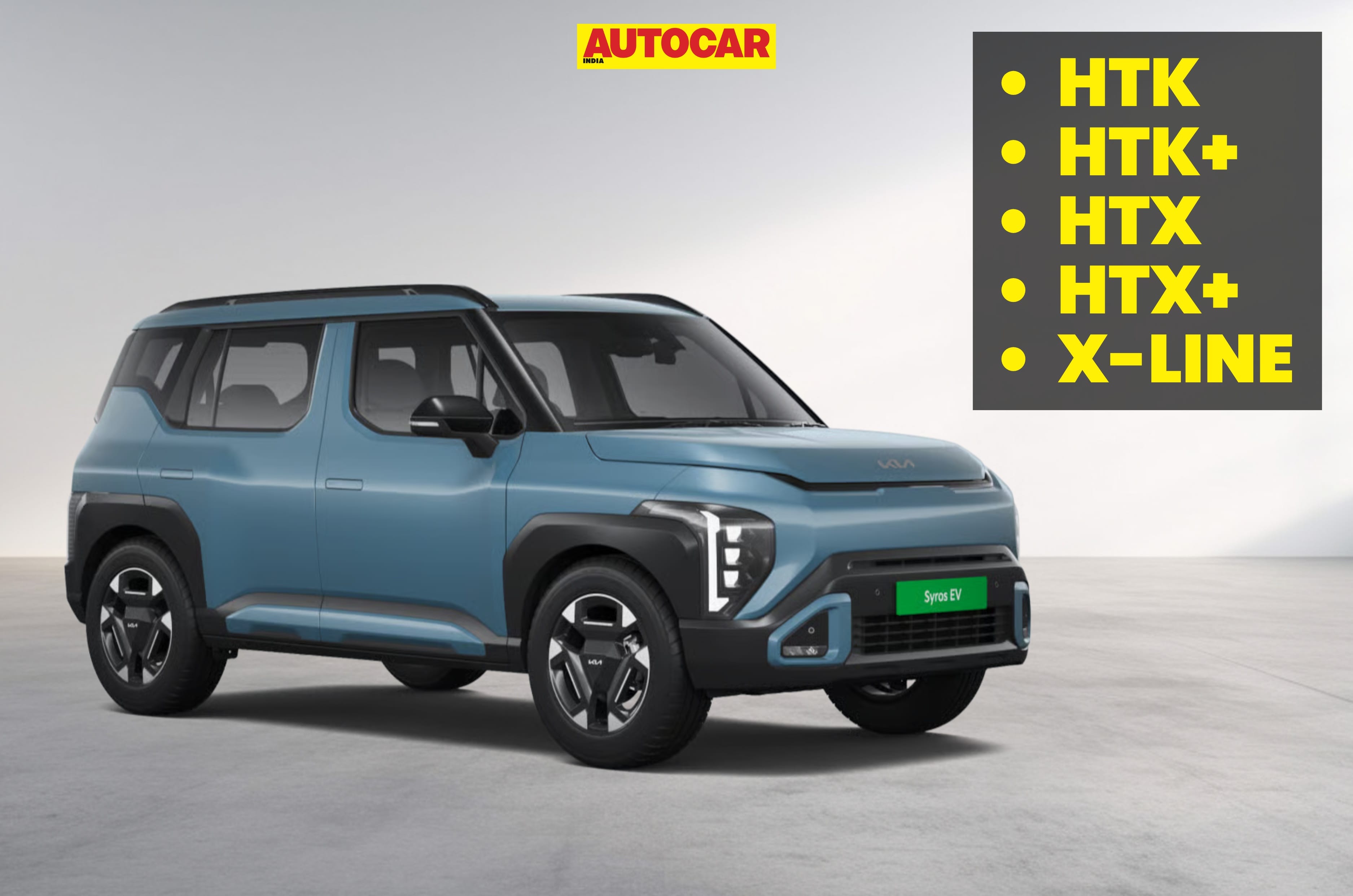
Kia has unveiled its second mass-market electric model for India in the form of the Syros EV. Though it shares its K1 platform with its ICE counterpart, it utilises the same battery packs found on the larger Carens Clavis EV. While prices are yet to be announced, they are expected to be in the Rs 15 lakh to 20 lakh range. At launch, it will take on the likes of the Tata Nexon EV, which currently dominates the segment, and the Mahindra XUV 3XO EV. In this article, we explain all the variants on offer, the colours, the standard safety kit, and the variant-wise features of the Syros EV.
Kia Syros EV variant-wise battery pack options
Offered in seven variants across five trims
Kia Syros EV variant-wise battery pack options
Trim
42kWh
51.4kWh (Extended range)
HTK
Yes
–
HTK+
Yes
Yes
HTX
Yes
Yes
HTX+
–
Yes
X-Line
–
Yes
The Kia Syros EV offers a choice of 42kWh and 51.4kWh battery packs. While the base HTK trim solely offers a 42kWh option, the mid-level HTK+ and HTX trims additionally offer the larger 51.4kWh battery pack. Meanwhile, the higher-end HTX+ and X-Line trims are available only with the 51.4kWh battery pack.
Both battery packs are paired to a front-mounted motor, which develops 135hp and 171hp in 42kWh and 51.4kWh guises, respectively. In both versions, the motor produces an identical 255Nm of torque. Kia claims a 0-100kph time of 8.1 seconds in 51.4kWh guise. While the 42kWh battery pack gets an ARAI-claimed range of 443km, the 51.4kWh version’s claimed range is 526km. Not only has Kia equipped the Syros EV with the largest battery pack in its segment (51.4kWh), but it also gets the most powerful motor and the highest claimed range figure in its class.
Both versions support up to 11 kW AC charging speeds, while DC charging support is up to 100kW. At 11kW AC speeds, a smaller 42kWh battery takes four hours to charge from 10-80 percent, while the 51.4kWh battery takes an additional 50 minutes. However, with a 100kW DC charger, both versions can charge from 10-80 percent in the same 39 minutes, claims Kia.
Kia Syros EV exterior and interior colours
Nine options for the exterior, three for the interior
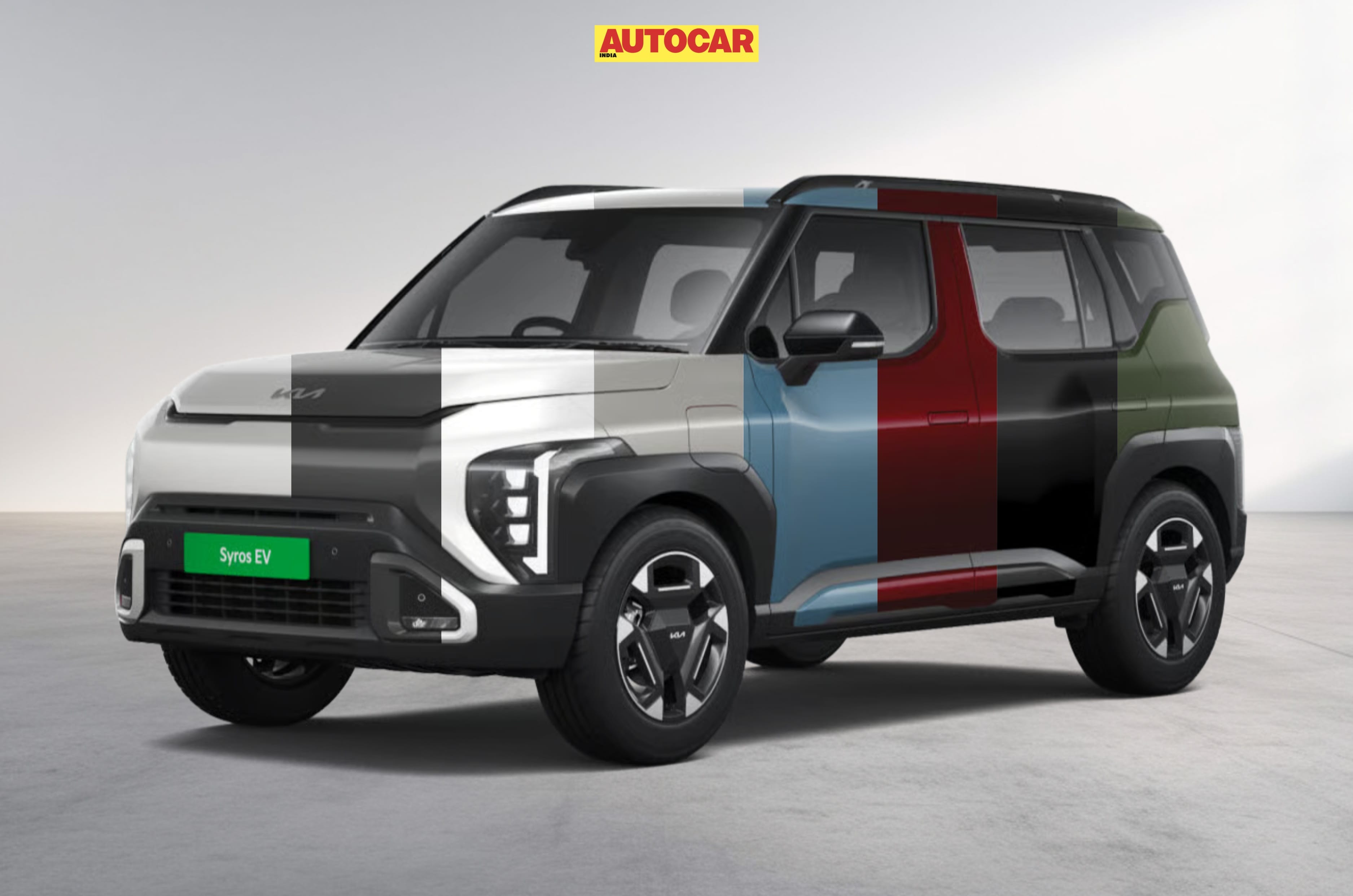
The Kia Syros EV is available only in nine monotone colour options. These include Ivory Silver Matte, Frost Blue, Gravity Grey, Pewter Olive, Magma Red, Ivory Silver Gloss, Aurora Black Pearl, Glacier White Pearl, and Xclusive Matte Graphite. Of these, the top X-Line trim is available solely in the Aurora Black Pearl and Xclusive Matte Graphite colours.
Inside, the Syros EV offers three interior and seat upholstery options depending on the chosen trim. HTK, HTK+ and HTX trims get blue and grey semi-leatherette seat upholstery and green accents throughout the interior, while the HTX+ trim gets black and white leatherette seat upholstery and white accents throughout the interior. The top X-Line trim comes with black and green leatherette seat upholstery with green accents across the interior.
Kia Syros EV standard safety kit
Gets six airbags, electronic parking brake, hill start assist, TPMS, to name a few
As standard, the Kia Syros EV is equipped with six airbags, ABS, brake assist, ESC, stability control, hill-start assist, tyre pressure monitoring system (TPMS), all-wheel disc brakes, electronic parking brake with auto hold, follow-me-home headlamps, virtual engine sound system, child lock, rear parking sensors, speed sensing door locks, impact sensing auto door unlock, 3-point seatbelts for all seats, ISOFIX anchors, rear occupant alert, front passenger airbag on/off switch, and rear occupant alert.
Kia Syros EV variant-wise features list
HTK
Battery pack options: 42kWh
LED headlamps, DRLs, foglamps, and tail-lamps
16-inch aero-optimised alloy wheels
Flush door handles
Shark fin antenna
Blue and grey fabric-leatherette seat upholstery
12.3-inch infotainment system
12.3-inch digital driver’s display
Wireless Android Auto and Apple CarPlay
4 speakers and 2 tweeters
Steering-mounted controls
Tilt-adjustable steering
Drive modes (Eco, Sport, Normal)
4x USB Type-C ports
Portable charging cable
Front centre console with retractable cup holders and storage
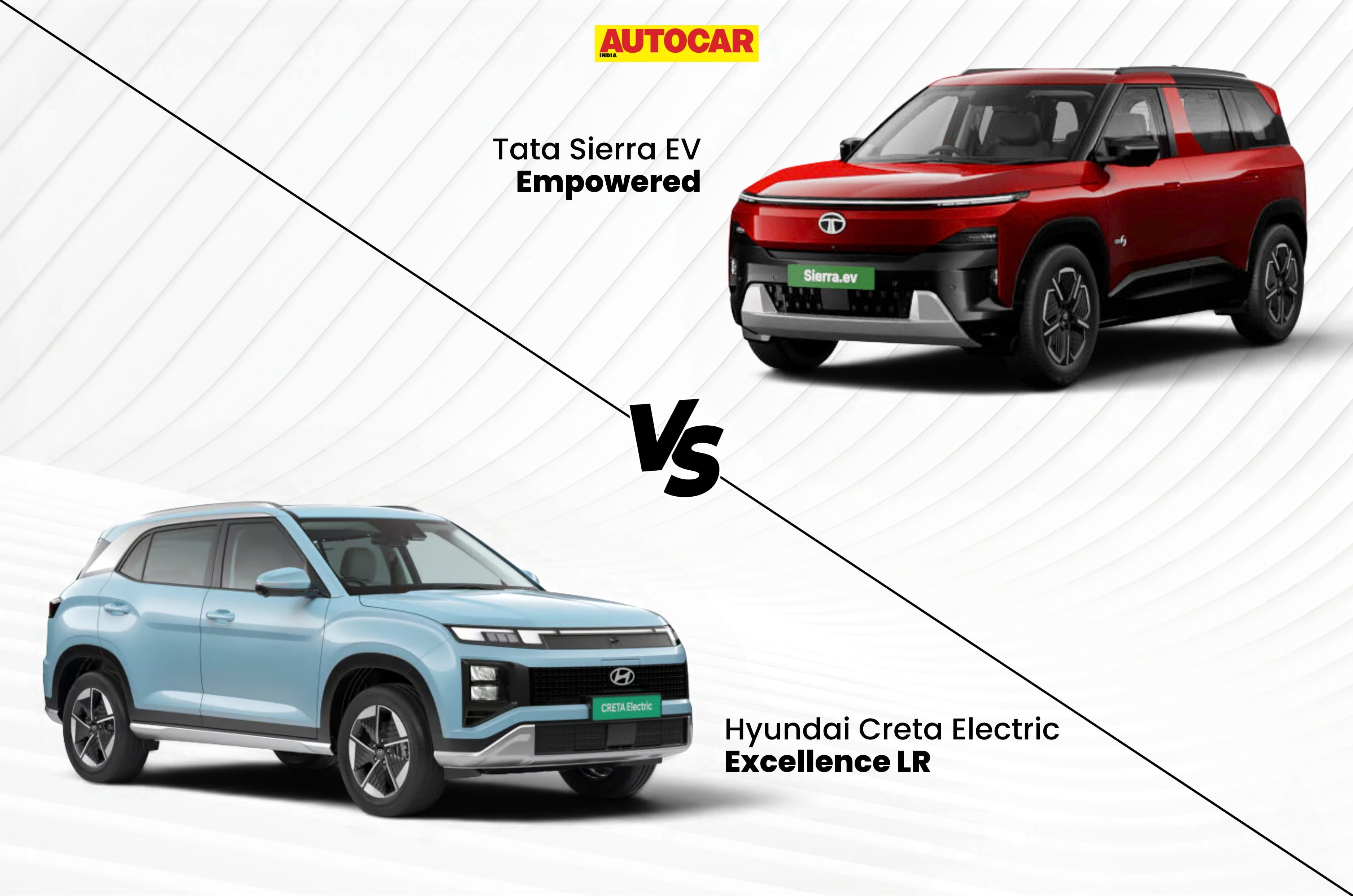
Both the Tata Sierra EV and Hyundai Creta Electric are available with two battery pack options. However, the lower variants of the Creta Electric feature a smaller 42kWh battery pack, so we’ll be looking at the 51.4kWh version here – the Creta’s top-spec Excellence LR (Long Range) variant is only offered with the larger battery pack. However, the Sierra EV’s Empowered trim offers buyers more flexibility as it’s available in 63kWh and 75kWh guises. The Sierra EV Empowered is priced from Rs 22.79 lakh to Rs 23.79 lakh, while the Creta Electric’s top-spec Excellence LR costs Rs 23.67 lakh. Let’s find out which midsize electric SUV is right for you.
Tata Sierra EV Empowered vs Hyundai Creta Electric Excellence LR: Dimensions
The Sierra is the bigger car here, but the Creta EV is just as long
Tata Sierra EV Empowered vs Hyundai Creta Electric Excellence LR dimensions
Tata Sierra EV
Hyundai Creta Electric
Length (mm)
4,340
4,340
Width (mm)
1,841
1,790
Height (mm)
1,750
1,655
Wheelbase (mm)
2,730
2,610
Boot space (litres)
450
433
Frunk (litres)
55
22
Wheel size (inches)
18
17
While the overall length of the Hyundai Creta Electric is identical to the Tata Sierra EV, the latter boasts 120mm longer wheelbase. The Sierra EV is 51mm wider and 95mm taller at the roof than its Hyundai rival. The range-topping Excellence LR variant of the Creta EV only gets 17-inch wheels, but the Empowered trim of the Tata SUV comes equipped with larger 18-inch rims. In terms of their luggage-carrying capacity as well, the Sierra EV has the bigger rear boot and frunk (front trunk).
Tata Sierra EV Empowered vs Hyundai Creta Electric Excellence LR: Powertrain
The rear-wheel drive Sierra gets two powertrain options and has the range advantage
Tata Sierra EV Empowered vs Hyundai Creta Electric Excellence LR powertrain options
Tata Sierra EV
Hyundai Creta Electric
Battery size (kWh)
63/75
51.4
Electric motor setup
Single, rear (RWD)
Single, front (FWD)
Power (hp)
238/209
171
Torque (Nm)
315
255
Claimed 0-100kph
–
7.9 seconds
Claimed range (km)
566/665
510
AC charging
Up to 10.5 hrs at 7.2kW (10-100%)
7.25 hrs at 7.4kW (10-100%)
DC fast charging
Up to 26 mins at 120kW (20-80%)
39 mins at 100kW (10-80%)
The Sierra EV in Empowered trim is offered with 63kWh and 75kWh battery packs. Even with the smaller battery option, the Sierra EV’s claimed range is 56km more than the top-spec Creta Electric’s. Bumping up to the top-spec, rear-wheel drive (RWD) 75kWh version of the Sierra EV means a claimed range of 665km – that’s 155km more than the top-spec Creta Electric.
The smaller battery size and a slightly faster AC charging speed means that the Creta Electric can be charged from 10-100 percent in 7 hours and 15 minutes, which is over 3 hours less than what the Sierra EV with the 75kWh battery pack requires. Meanwhile, the Sierra EV with the 63kWh battery takes under 9 hours to achieve the same SoC (state of charge). Both cars support DC fast charging of over 100kW, with the Sierra EV’s claimed charging time being based on 120kW DC charging.
The Sierra EV’s single electric motor powers its rear wheels, while that of the Creta Electric powers its front. While the punchier 63kWh version of the Tata SUV makes 67hp more than its Hyundai EV rival, even its lower-output 75kWh version makes more power (38hp more than the Creta Electric). The Sierra EV also has the torque advantage, developing 60Nm more than its Hyundai rival. While Tata Motors hasn’t published the claimed 0-100kph time of the mid-spec Sierra EV, it’s likely to be brisk.
Tata Sierra EV Empowered vs Hyundai Creta Electric Excellence LR: Exterior features
The Sierra EV’s Empowered trim adds more novelty features on the outside than its Hyundai rival
Tata Sierra EV Empowered vs Hyundai Creta Electric Excellence LR exterior features
Tata Sierra EV
Hyundai Creta Electric
LED projector headlamps
Yes (auto)
Yes (auto)
Connected light bar
Yes
Yes
Front fog lamps
Yes
No
Rear fog lamps
Yes
No
Cornering lights
Yes
No
Sequential turn signals
Yes
Yes
Welcome lights
Yes
Yes
Puddle lamps
Yes
Yes
Powered ORVMs
Yes (with auto-fold function)
Yes (with auto-fold function)
Flush door handles
Yes
No
Body cladding
Yes
Yes
Roof rails
Yes
Yes
Rear spoiler
Yes
Yes
Powered tailgate
Yes (gesture activated)
No
Colours
Mono-tone
Mono-tone and Dual-tone
The Empowered trim of the Sierra EV gets useful features such as a gesture-activated powered tailgate, front & rear fog lamps, and front cornering lights. While both cars gets a rear spoiler, the Sierra EV’s unit actually hides the rear wiper for a cleaner look. They also feature niceties like puddle lamps, welcome & good-bye light animations, and automatic LED headlamps. The Creta Electric sticks to conventional pull-type door handles, whilst the Tata SUV uses flush door handles. Hyundai offers dual-tone colour choices with the Creta Electric, but Tata Motors does not.
Tata Sierra EV Empowered vs Hyundai Creta Electric Excellence LR: Interior features
Both electric SUVs are fairly well-matched when it comes to interior convenience features
Tata Sierra EV Empowered vs Hyundai Creta Electric Excellence LR interior features
Tata Sierra EV
Hyundai Creta Electric
Infotainment screen
12.3-inch
10.25-inch
Digital driver’s display
10.25-inch
10.25-inch
Front passenger display
12.3-inch
No
Panoramic sunroof
Yes (voice assisted)
Yes (voice assisted)
Wireless charger
Yes
Yes
Driver’s seat adjustment
6-way powered
8-way powered
Co-driver’s seat adjustment
4-way manual
8-way powered
Thigh-support extender
Yes
No
‘Boss’ mode
Yes (manual)
Yes (powered)
Ventilated front seats
Yes
Yes
Leatherette upholstery
Yes
Yes
Rear split seats
Yes
Yes
Automatic climate control
Yes (dual-zone)
Yes (dual-zone)
Cooled glovebox
Yes
Yes
Cooled armrest storage
No
Yes (front)
Ambient lighting
Yes
Yes
Audio system
12-speaker JBL Black
8-speaker Bose
Dolby Atmos
Yes
No
Apple CarPlay & Android Auto
Yes (wireless)
Yes (wired)
USB Type-C ports
Yes (4 ports)
Yes (3 ports)
Connected car tech
Yes
Yes
Voice assistant
Yes (multiple)
Yes
OTA updates
Yes
Yes
EV route planner
Yes
No
Gaming
Yes
No
Rear sunblinds
Yes
Yes
Rear armrest
Yes (with cupholders)
Yes (with cupholders)
Rear tray tables
No
Yes
The Tata Sierra EV gets more speakers as part of its JBL Black audio system, along with Dolby Atmos and wireless Apple CarPlay & Android Auto. The Sierra offers more USB ports and Tata’s new ‘AirConsole’ gaming system with a high-definition front passenger screen. Other interior features exclusive to the Sierra EV include front thigh-support extenders for added comfort and a route planner to help minimise range anxiety.
The Hyundai Creta Electric doesn’t get a third screen and its dual digital displays are smaller than the Sierra’s. However, the Hyundai EV offers a powered ‘Boss’ function, a cooled compartment under the front armrest, tray tables with cupholders for rear passengers, and a leatherette-like eco-friendly material for the seats.
Tata Sierra EV Empowered vs Hyundai Creta Electric Excellence LR: Safety features
The fully loaded Creta EV comes with ADAS, which the Sierra EV lacks in its mid-spec trim
Tata Sierra EV Empowered vs Hyundai Creta Electric Excellence LR safety features
Tata Sierra EV
Hyundai Creta Electric
Airbags
6
6
ABS with EBD
Yes
Yes
Electronic stability program
Yes
Yes
Hill-hold assist
Yes
Yes
Hill-descent control
Yes
Yes
TPMS
Yes
Yes
Parking sensors
Yes (front & rear)
Yes (front & rear)
360-degree camera
Yes
Yes
Electronic parking brake
Yes (with auto-hold function)
Yes (with auto-hold function)
Auto-dimming IRVM
Yes
Yes
Rain-sensing wipers
Yes
Yes
Auto-dimming IRVM
Yes
Yes
ISOFIX
Yes
Yes
Rear wiper and defogger
Yes
Yes
All-wheel disc brakes
Yes
Yes
Level 2 ADAS
No
Yes
Both these cars come well-equipped with modern safety features. However, the Creta Electric adds Level 2 ADAS (Advanced Driver Assistance Systems), too. This ropes in nannies such as forward collision warning, blind-spot warning, lane-departure warning with lane-keeping assist, rear cross-traffic alert, high-beam assist, and adaptive cruise control with stop & go functionality.
Tata Sierra EV Empowered vs Hyundai Creta Electric Excellence LR: Other features
The Sierra EV is better equipped on this front too
Tata Sierra EV Empowered vs Hyundai Creta Electric Excellence LR other features
Tata Sierra EV
Hyundai Creta Electric
Drive modes
Yes (3)
Yes (3)
Terrain modes
Yes (4)
No
Single-pedal driving
No
Yes
V2V and V2L
Yes
Yes (V2L)
AVAS
Yes
Yes
Unlike the Sierra EV, the Hyundai Creta Electric gets a proper single-pedal driving mode. This makes driving it over long distances on the highway less tiresome while also helping improve range because of energy recuperation even without using the brake pedal. However, the Sierra EV supports both vehicle-to-load and vehicle-to-vehicle charging functions – the Creta Electric only supports the former. Both EVs come with an Acoustic Vehicle Alerting System (AVAS).
Conclusion
Tata Sierra EV Empowered vs Hyundai Creta Electric Excellence LR prices
Tata Sierra EV
Hyundai Creta Electric
Price range (In Rs, lakh)
22.79-23.79
23.67
If you want more cabin & luggage space, longer range & faster performance plus conveniences like a powered tailgate, wireless smartphone connectivity, multiple voice assistants, plus V2V and V2L functions, then the Tata Sierra EV will be a suitable pick. In case you don’t need the additional range offered by the 75kWh version, you can save Rs 1 lakh and go for the 63kWh version instead – it’s Rs 88,000 cheaper than the Creta Electric. However, prospective Sierra EV buyers should be aware of the inconsistencies in Tata’s service quality and vehicle fit & finish.