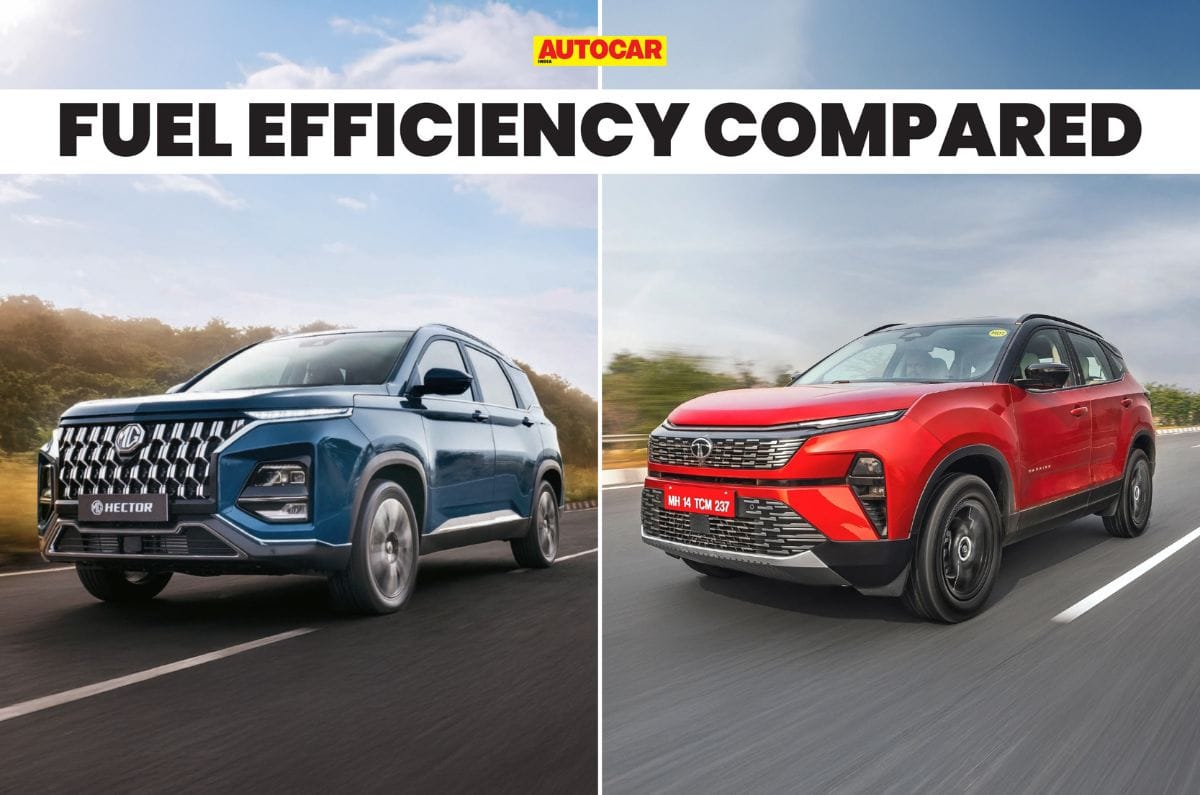
Since its introduction in 2019, the MG Hector has been available with a turbo-petrol engine with manual and CVT automatic transmissions. However, it wasn’t until January 2026 that Tata Motors equipped the Harrier with a turbo-petrol engine. Where MG offers the Hector in 7-seater configurations, the Tata Harrier petrol only offers seating for 5 occupants. That said, let’s find out which SUV delivers better fuel economy.
Explore full specs, features and a price breakdown in our Harrier vs Hector comparison.
Tata Harrier vs MG Hector turbo-petrol automatic: Specifications
The Harrier petrol has the clear power advantage over the equivalent Hector
Tata Harrier vs MG Hector turbo-petrol automatic: Specifications | ||
| Tata Harrier | MG Hector |
Engine | 4 cyl, petrol | 4 cyl, petrol |
Displacement (cc) | 1498 | 1451 |
Power (hp) | 170 (5,000rpm) | 143 (5,200rpm) |
Torque (Nm) | 280 (1,750-3,500rpm) | 250 (3,000rpm) |
Gearbox | 6-speed automatic | Continuously variable transmission |
Fuel tank (litres) | 50 | 60 |
While both SUVs are powered by 1.5-litre direct-injection turbo-petrol engines, the Harrier’s unit is ever so slightly bigger (by 47cc). It backs up this size advantage by developing 27hp and 30Nm more than the engine under the MG Hector’s bonnet. The Tata Harrier’s higher torque output is also available across a wide RPM band, with peak power coming in at 200rpm lower in the engine’s rev range when compared to the Hector.
A key differentiator here is that the Tata Harrier petrol is paired with a 6-speed torque converter automatic gearbox, while the MG Hector makes use of a CVT (continuously variable transmission). The latter also features a bigger fuel tank, holding 10 litres more petrol.
Tata Harrier vs MG Hector turbo-petrol automatic: Real-world fuel efficiency
The Hector’s more efficient in the city, but the Harrier manages a higher average economy
Tata Harrier vs MG Hector turbo-petrol automatic: Real-world mileage | ||
| Tata Harrier | MG Hector |
Tested city mileage (kpl) | 6.17 | 8.30 |
Tested highway mileage (kpl) | 12.49 | 9.60 |
Tested average mileage (kpl) | 9.33 | 8.95 |
During our time testing it in the real world, the MG Hector’s mileage figures remained in the single digits. In the city, the Hector turbo-petrol turned out to be 2.13kpl more frugal than the Tata Harrier. Out on the open highway, it was the Tata Harrier turbo-petrol that fared better by achieving a fuel economy in the double digits – it was 2.89kpl higher than the Hector.
A wider peak torque spread of the Tata SUV means that its engine is less stressed at higher speeds, one of the factors explaining its better mileage on the highway. On the other hand, if a majority of your drives are in a city environment, The Hector’s CVT gearbox helps it sip less fuel in the city, given this design’s inherent efficiency advantages at lower speeds. Unfortunately, the MG SUV’s average mileage is lower than the Harrier’s despite its lower kerb weight and the CVT. Both cars get an Eco drive mode, but neither features an automatic engine stop-start system.
Tata Harrier vs MG Hector turbo-petrol automatic: Prices
Tata Harrier vs MG Hector turbo-petrol automatic: Prices | ||
| Tata Harrier | MG Hector |
Price range (in Rs, lakh) | 17.70-24.25 | 17.00-20.00 |
There are six trim levels of the Tata Harrier petrol with the automatic gearbox, and all of them are priced higher than their MG Hector counterparts. At the bottom end, the Hector CVT is Rs 70,000 cheaper than the entry-level Harrier petrol automatic. For those wishing to get all the bells & whistles that are only available in the range-topping trims of each SUV, the top-end Hector CVT is Rs 4.25 lakh less expensive than its equivalent Tata Harrier petrol variant.
Autocar India’s fuel efficiency testing
Before our real-world fuel efficiency tests, we fill our test cars’ tanks to the brim and maintain tyre pressures based on the manufacturer’s recommendations. These cars are driven in fixed city and highway loops in and around Navi Mumbai, and we maintain certain average speeds. Throughout the tests, there is only one person in each car, running the air conditioner and other electricals, such as the audio system, indicators and wipers, when required, just like a regular user would. Periodic driver swaps further neutralise variations in driver patterns. At the end of each cycle, we calculate efficiency by filling the tanks to full again.
Prices are ex-showroom, India.
Also read
Renault Duster 1.3L turbo MT vs DCT: Performance compared
Mahindra XUV 7XO vs Tata Harrier petrol AT: Real world mileage compared