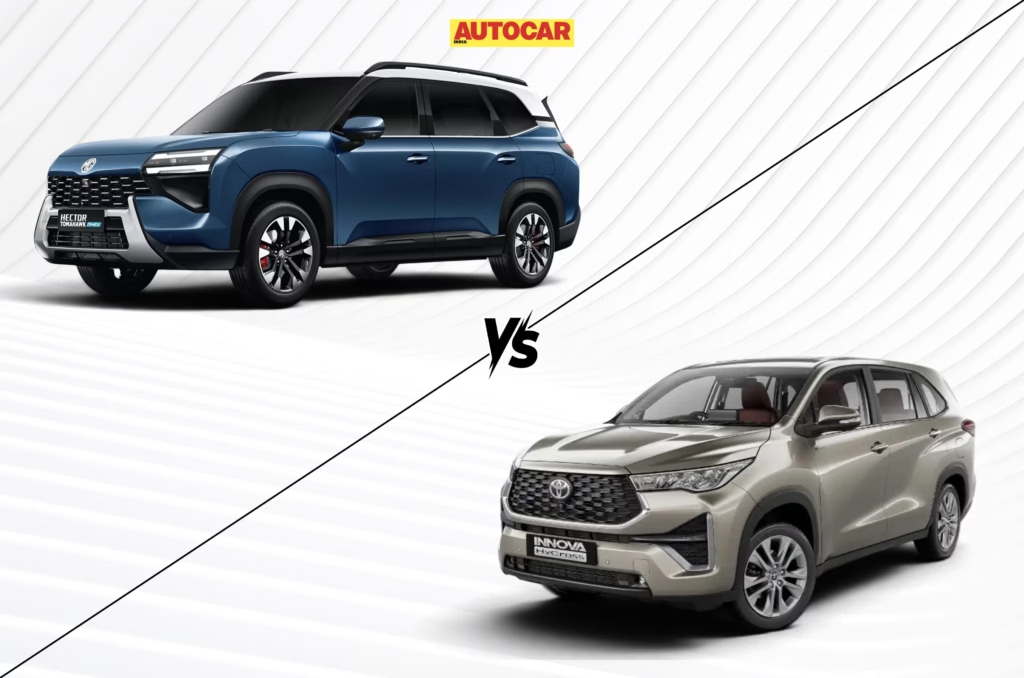
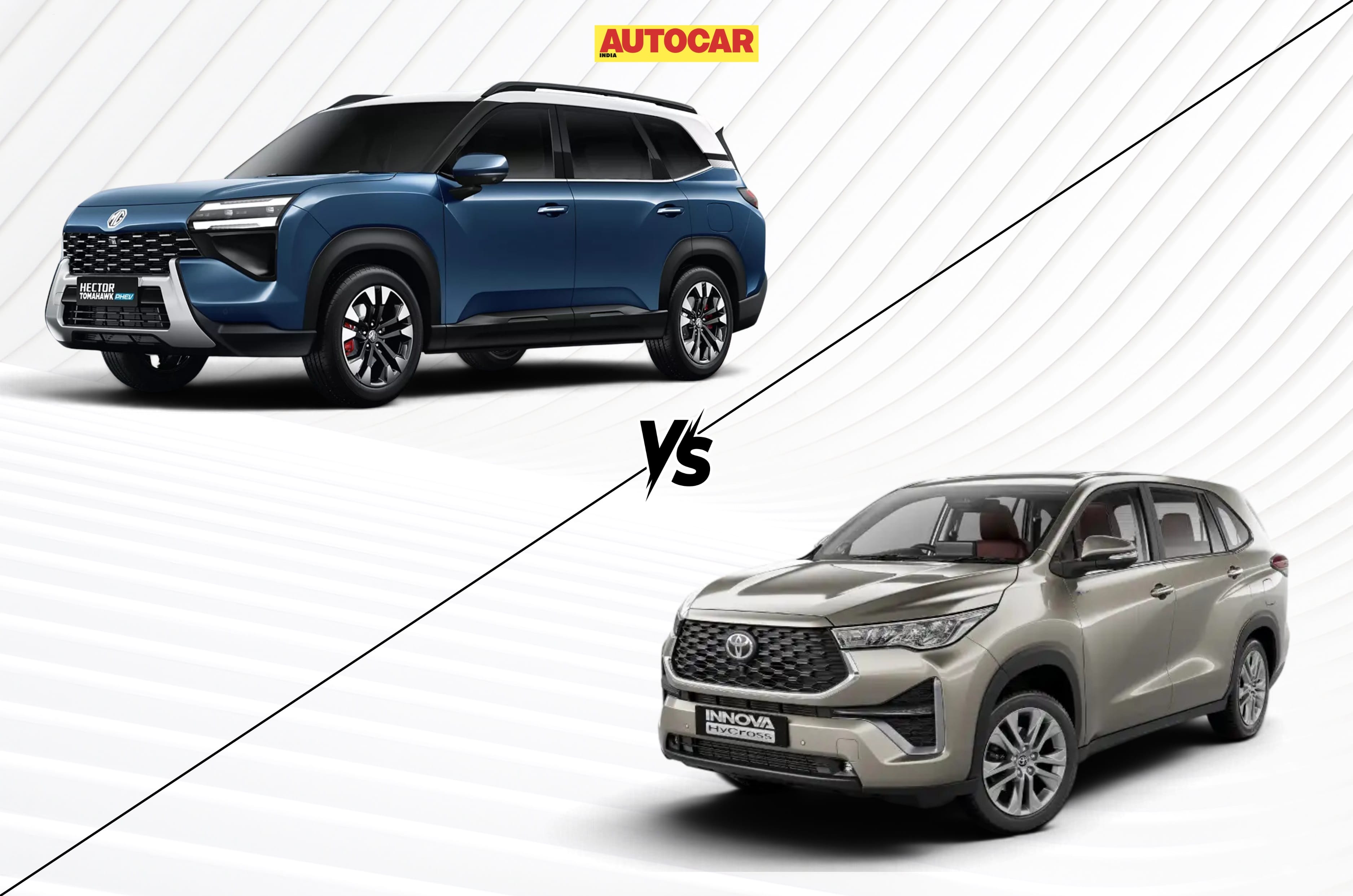
While both models here are hybrids and have 7 seats across three rows, they offer different hybrid technologies. With the ADAPT platform-based JSW MG Hector Tomahawk PHEV, India has its first-ever mass-market plug-in hybrid vehicle making its entry in the hugely popular SUV segment. On the other hand, the TNGA-C platform-based Toyota Innova Hycross is an MPV and offers a strong-hybrid powertrain. Here’s how they stack up in their fully loaded trims.
Explore full specs, features and a price breakdown in our Hector Tomahawk PHEV and Innova Hycross Hybrid comparison.
MG Hector Tomahawk PHEV Essence vs Toyota Innova Hycross Hybrid ZX (O): Dimensions
The Innova Hycross is larger and offers a slightly bigger boot with all seats in place
MG Hector Tomahawk PHEV Essence vs Toyota Innova Hycross Hybrid ZX (O) dimensions | ||
| MG Hector Tomahawk PHEV | Toyota Innova Hycross Hybrid |
Length (mm) | 4,745 | 4,755 |
Width (mm) | 1,850 | 1,850 |
Height (mm) | 1,770 | 1,790 |
Wheelbase (mm) | 2,810 | 2,850 |
Boot space (litres) | 192 | 239 |
Wheel size (inches) | 18 | 18 |
The Innova Hycross Hybrid is 10mm longer and 20mm taller than the Hector Tomahawk PHEV. The Toyota MPV also has a wheelbase that’s longer by 40mm, while both cars have identical width figures and sport 18-inch alloy wheels in their top-spec trims. The Innova Hycross Hybrid’s luggage capacity with the third row in place is greater by 47 litres. One of the factors limiting the outright cargo volume of the Hector Tomahawk PHEV is its more space-consuming plug-in hybrid tech.
MG Hector Tomahawk PHEV Essence vs Toyota Innova Hycross Hybrid ZX (O): Powertrain
The plug-in hybrid powertrain of the MG SUV is more fuel-efficient and offers more power
MG Hector Tomahawk PHEV Essence vs Toyota Innova Hycross Hybrid ZX (O) powertrain options | ||
| MG Hector Tomahawk PHEV | Toyota Innova Hycross Hybrid |
Engine | 1.5-litre naturally aspirated petrol | 2.0-litre naturally aspirated petrol |
Battery size | 20.5kWh | 1.6kWh |
Electric motor type | Permanent magnet synchronous motor | Permanent magnet synchronous motor |
Drive configuration | FWD | FWD |
Total system output | 198hp, 230Nm | 184hp, 188Nm |
Transmission | DHT | eCVT |
0-100kph | 9.0 seconds | 10.69 seconds* |
Claimed mileage | 50kpl | 22.16kpl |
Fuel tank | 52 litres | 52 litres |
AC charging | 7.5 hrs at 3.3kW (10-100%) | – |
DC fast charging | 35 mins at 25kW (30-80%) | – |
*Autocar India-tested 0-100kph time.
The strong hybrid powertrain of the Toyota Innova Hycross offers a couple of drive modes – including pure-electric and engine + electric. However, its compact nickel metal hydride (NiMH) battery means that the EV mode of the Innova Hycross Hybrid is understandably more limited than the MG Hector Tomahawk PHEV’s, requiring the 2.0-litre petrol engine to step in more often.
The claimed mileage figure of the Innova Hycross Hybrid is 27.84kpl worse than the MG plug-in hybrid SUV, and despite the same fuel tank size, the former’s combined range tops out at around 800km, as per our real-world test of the Toyota MPV. Meanwhile, the plug-in hybrid system of the MG Hector Tomahawk PHEV offers more flexibility and comes with four main drive modes. The larger 20.5kWh battery pack and 1.5-litre engine allow for a combined claimed range of over 1,100km.
The Hector Tomahawk PHEV not only offers a claimed pure-electric range of over 115km, but it can also have the engine charging the battery pack while the electric motor drives the front wheels. This is a drive mode that isn’t offered with the Toyota Innova Hycross Hybrid. To extract the highest possible efficiency from its hybrid system, the Hector Tomahawk PHEV needs to be plugged in to an AC or a DC charger in order to fully top up its battery pack.
Depending on the battery’s SoC, both cars can rely entirely on their petrol engine to drive the wheels. Compared to the Innova Hycross Hybrid’s e-CVT (electronically controlled continuously variable transmission), the Hector Tomahawk PHEV gets a DHT (Dedicated Hybrid Transmission) with an e-clutch. The combined output of the MG Hector Tomahawk PHEV is 14hp and 42Nm more than what the Toyota Innova Hycross Hybrid offers.
MG Hector Tomahawk PHEV Essence vs Toyota Innova Hycross Hybrid ZX (O): Exterior features
Different body styles aside, both cars are similarly equipped on the outside
MG Hector Tomahawk PHEV Essence vs Toyota Innova Hycross Hybrid ZX (O) exterior features | ||
| MG Hector Tomahawk PHEV | Toyota Innova Hycross Hybrid |
Auto LED headlamps | Yes | Yes |
LED DRLs | Yes | Yes |
Backlit logo | Yes | No |
Sequential turn signals | Yes | Yes |
Front fog lamps | No | Yes (LED) |
Rear fog lamps | Yes (LED) | No |
Welcome lights | No | Yes |
Powered ORVMs | Yes (with auto-fold function) | Yes (with auto-fold function) |
Body cladding | Yes | No |
Roof rails | Yes | No |
Rear spoiler | Yes | Yes |
Powered tailgate | Yes | Yes |
Radio antenna | Windscreen-integrated | Sharkfin |
Colours | Mono-tone and dual-tone | Mono-tone |
The MG Hector Tomahawk PHEV is offered in two dual-tone colour options and six mono-tone shades, including a couple of bolder choices. The Toyota Innova Hycross Hybrid is restricted to six simpler-looking colours. The SUV body style aside, the Hector Tomahawk PHEV also sports a backlit ‘MG’ logo up front plus prominent roof rails and body cladding.
Where the Innova Hycross Hybrid gets the traditional sharkfin radio antenna, the Hector Tomahawk PHEV has its antenna embedded in the windscreen. The Toyota Innova Hycross Hybrid gets front LED fog lamps, whilst the MG Hector Tomahawk PHEV features rear LED fog lamps. While the top-spec trims of both cars get automatic LED headlamps and sequential turn indicators, it’s only the Toyota that offers ‘welcome’ lights.
MG Hector Tomahawk PHEV Essence vs Toyota Innova Hycross Hybrid ZX (O): Interior features
The Hector Tomahawk PHEV offers even more modern on-board tech than the Hycross
MG Hector Tomahawk PHEV Essence vs Toyota Innova Hycross Hybrid ZX (O) interior features | ||
| MG Hector Tomahawk PHEV | Toyota Innova Hycross Hybrid |
Infotainment screen | 15.6-inch (with swipe gestures) | 10.1-inch |
Digital driver’s display | 8.8-inch | 7.0-inch MID |
Panoramic sunroof | Yes (dual-pane) | Yes (dual-pane) |
Steering adjustment | Tilt & telescopic | Tilt & telescopic |
Driver’s seat adjustment | 6-way powered | 8-way powered |
| Memory powered | Yes (with ‘retreat’ function) | Yes |
Co-driver’s seat adjustment | 4-way powered | 4-way manual |
Sliding & reclining second row | Yes | Yes (powered ottoman seats) |
Split rear seats | Yes (second & third rows) | Yes (second & third rows) |
Ventilated front seats | Yes | Yes |
Leatherette upholstery | Yes | Yes |
Rear sunblinds | Yes | Yes |
Rear armrest | Yes (with cupholders) | Yes (individual armrests) |
Wireless charger | Yes (50W) | No |
Automatic climate control | Yes (dual-zone) | Yes (single-zone) |
Ambient lighting | Yes (256 colours) | Yes (single-colour) |
Audio system | 10-speaker Infinity | 9-speaker JBL |
Wireless Apple CarPlay & Android Auto | Yes | Yes (CarPlay only) |
USB ports | Yes (5 ports) | Yes (4 ports) |
Connected car tech | Yes | Yes |
Voice assistant | Yes (AI-powered & multilingual) | Yes |
OTA updates | Yes | No |
Multi-app support | Yes | No |
The infotainment features of the top-spec MG Hector Tomahawk PHEV are more comprehensive. It comes with a larger touchscreen that supports swipe-gesture functionalities, along with an AI-powered voice assistant with six languages supported. MG’s tie-up with Jio means that there are plenty of apps offered – including gaming, streaming and more. The Hector Tomahawk PHEV also offers OTA software updates, wireless connectivity for both Apple CarPlay and Android Auto and a built-in 50-watt wireless charger.
The MG SUV’s convenience features further include a more comprehensive 256-colour ambient lighting system, a fully digital instrument panel, dual-zone AC, a powered front passenger seat, a ‘retreat’ function for the driver’s seat when the door is opened, armrest-integrated cupholders for the second row, and an additional USB port over the top-spec Toyota Innova Hycross Hybrid.
However, the latter offers individual & powered captain chairs for the second row with a fold-away ottoman function. The 7-seat capability of the Innova Hycross comes by way of a three-seat third bench. The minimalist interior of the Hector Tomahawk PHEV looks modern but the increased reliance on the touchscreen can come in the way of everyday usability, especially while on the move. The Innova Hycross Hybrid’s interior, meanwhile, offers plenty of physical switchgear that are much easier to use.
MG Hector Tomahawk PHEV Essence vs Toyota Innova Hycross Hybrid ZX (O): Safety features
Both cars are relatively well-equipped on the safety front
MG Hector Tomahawk PHEV Essence vs Toyota Innova Hycross Hybrid ZX (O) safety features | ||
| MG Hector Tomahawk PHEV | Toyota Innova Hycross Hybrid |
Airbags | 6 | 6 |
ABS with EBD | Yes | Yes |
Electronic stability program | Yes | Yes |
Traction control system | Yes | No |
Hill-hold assist | Yes | Yes |
TPMS | Yes | Yes |
Parking sensors | Yes (front & rear) | Yes (front & rear) |
360-degree camera | Yes | Yes |
Electronic parking brake | Yes (with auto-hold function) | Yes (with auto-hold function) |
Auto-dimming IRVM | Yes | Yes |
Rain-sensing wipers | Yes | No |
ISOFIX | Yes | Yes |
Rear wiper and defogger | Yes | Yes |
All-wheel disc brakes | Yes | Yes |
ADAS | Yes | Yes |
The fully loaded trims of both these cars offer all the basic passive and active safety aids that buyers at this price bracket expect. While both come with ADAS (Advanced Driver Assistance Systems), it’s the MG Hector Tomahawk PHEV that packs in more features within its ADAS suite. Its adaptive cruise control aid integrates Bend Cruise Assistance (BCA), which slows down the vehicle when approaching corners. There’s also Traffic Jam Assist, which works alongside other active lane-keeping measures.
MG Hector Tomahawk PHEV Essence vs Toyota Innova Hycross Hybrid ZX (O): Other features
The MG SUV adds a few nice-to-have features over the equivalent Innova Hycross
MG Hector Tomahawk PHEV Essence vs Toyota Innova Hycross Hybrid ZX (O) other features | ||
| MG Hector Tomahawk PHEV | Toyota Innova Hycross Hybrid |
Drive modes | Yes (4) | Yes (3) |
Paddle shifters | No | Yes |
V2V and V2L | Yes | No |
The MG Hector Tomahawk PHEV offers Eco, Normal, Sports and Custom drive modes, whereas the Toyota Innova Hycross Hybrid gets Eco, Normal and Power – one less than the MG. The latter also lacks Vehicle to Vehicle (V2V) and Vehicle to Load (V2L) functionalities that are available with the Hector Tomahawk PHEV.
Conclusion
MG Hector Tomahawk PHEV Essence vs Toyota Innova Hycross Hybrid ZX (O) prices | ||
| MG Hector Tomahawk PHEV | Toyota Innova Hycross Hybrid |
Prices (In Rs, lakh) | 27.79 | 31.84 |
While the prices of the MG Hector Tomahawk PHEV are currently introductory, the delta between the two cars here is steep. The top-spec Toyota Innova Hycross Hybrid ZX (O) is priced Rs 4.05 lakh more than fully loaded Essence trim of the MG plug-in hybrid SUV. Its affordability factor notwithstanding, the Hector Tomahawk PHEV Essence trim gets a more comprehensive & punchier hybrid powertrain that offers better mileage, along with a better-finished and more premium-looking interior. Moreover, if you prefer an SUV body style, the MG Hector Tomahawk PHEV would be worth a serious look.
Also read
MG Hector Tomahawk EV vs PHEV: Differences explained
Maruti Brezza ZXi+ vs Tata Nexon Fearless+ PS: Which should you buy?