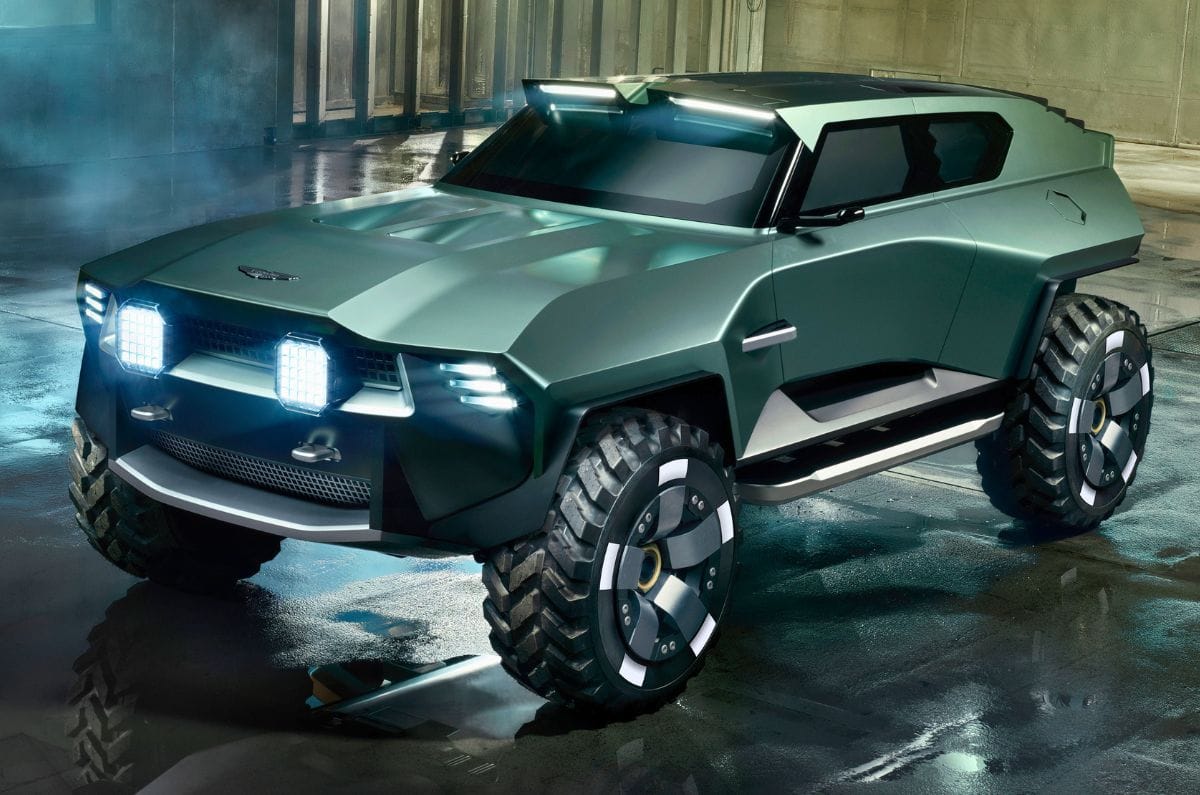
The Aston Martin Dreadnought SUV has been revealed as the British marque’s take on a 4×4 V12 SUV, but as a digital-only vehicle for the Call Of Duty: Modern Warfare 4 game. It will be available to be driven in the ‘DMZ’ and ‘Warzone’ modes when the game is launched on October 23. It has off-road-specific design elements inside and out, and its full-size model is being displayed to the public at the Fanatics Fest in New York till July 19. Aston Martin is yet to comment on whether the Aston Martin Dreadnought SUV will inspire a road-legal SUV.
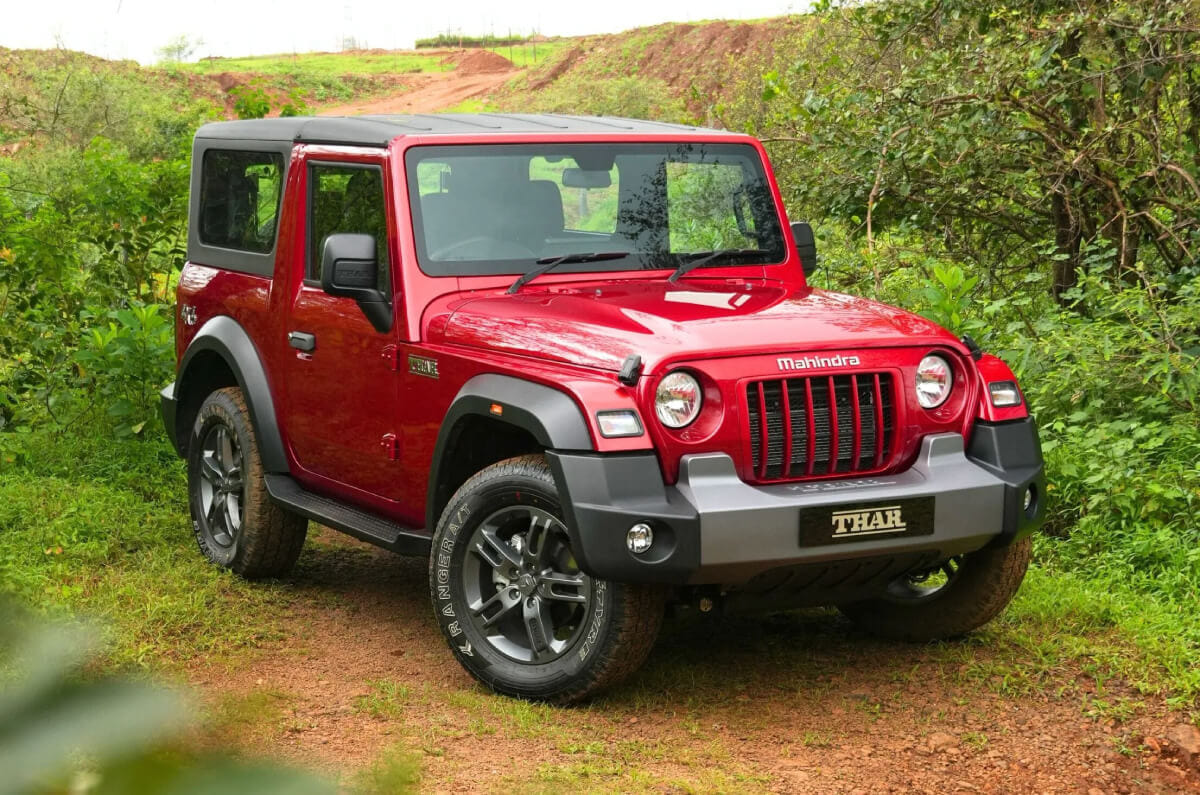
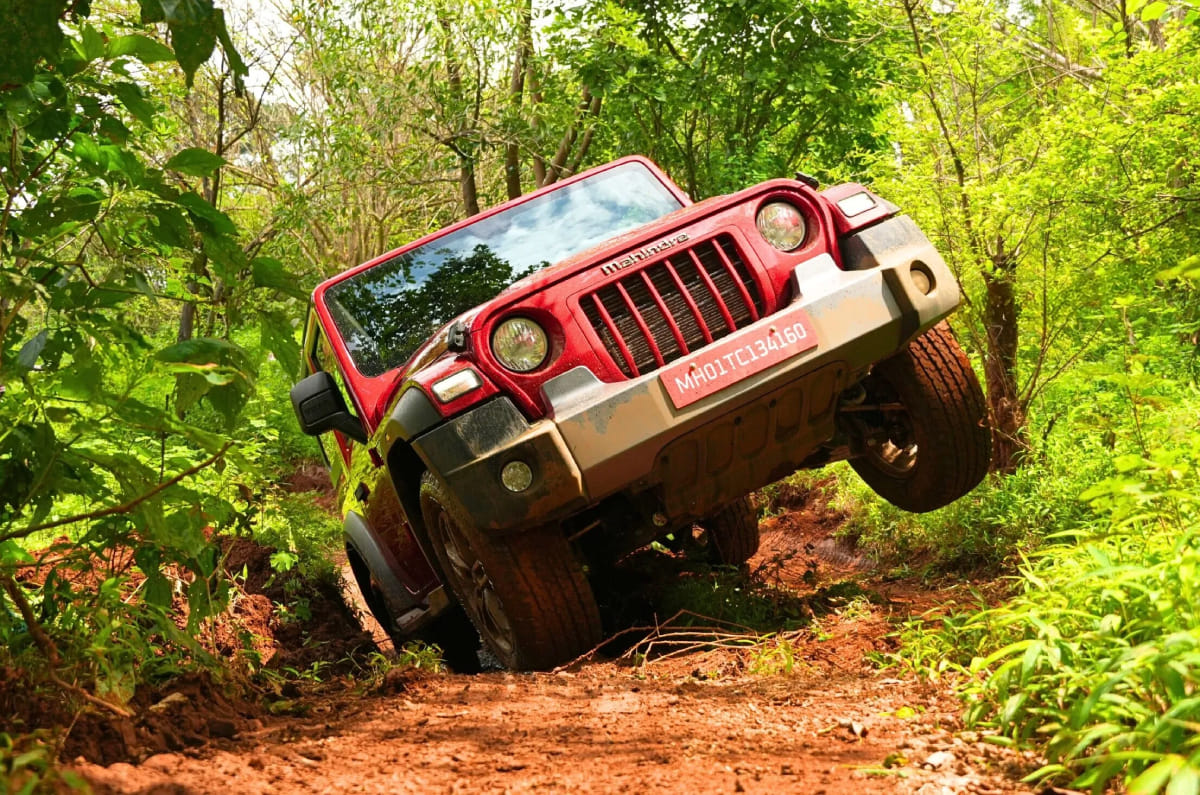
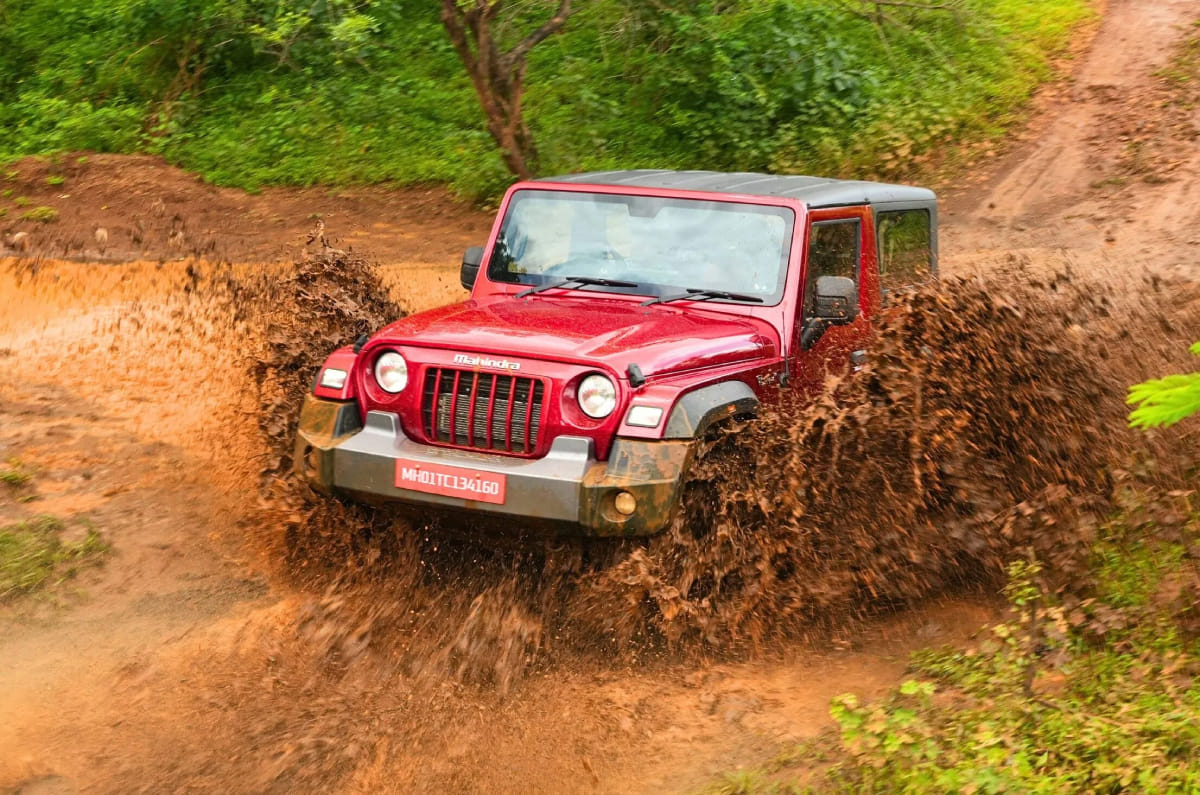
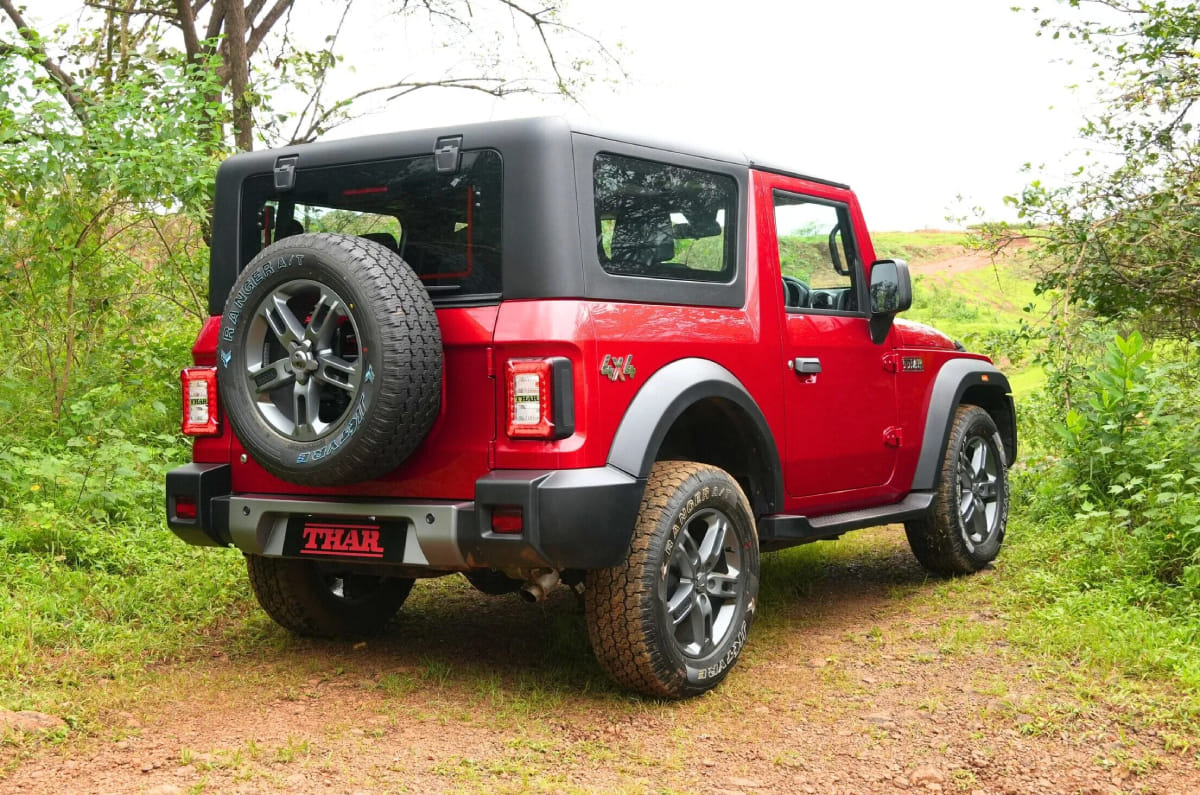
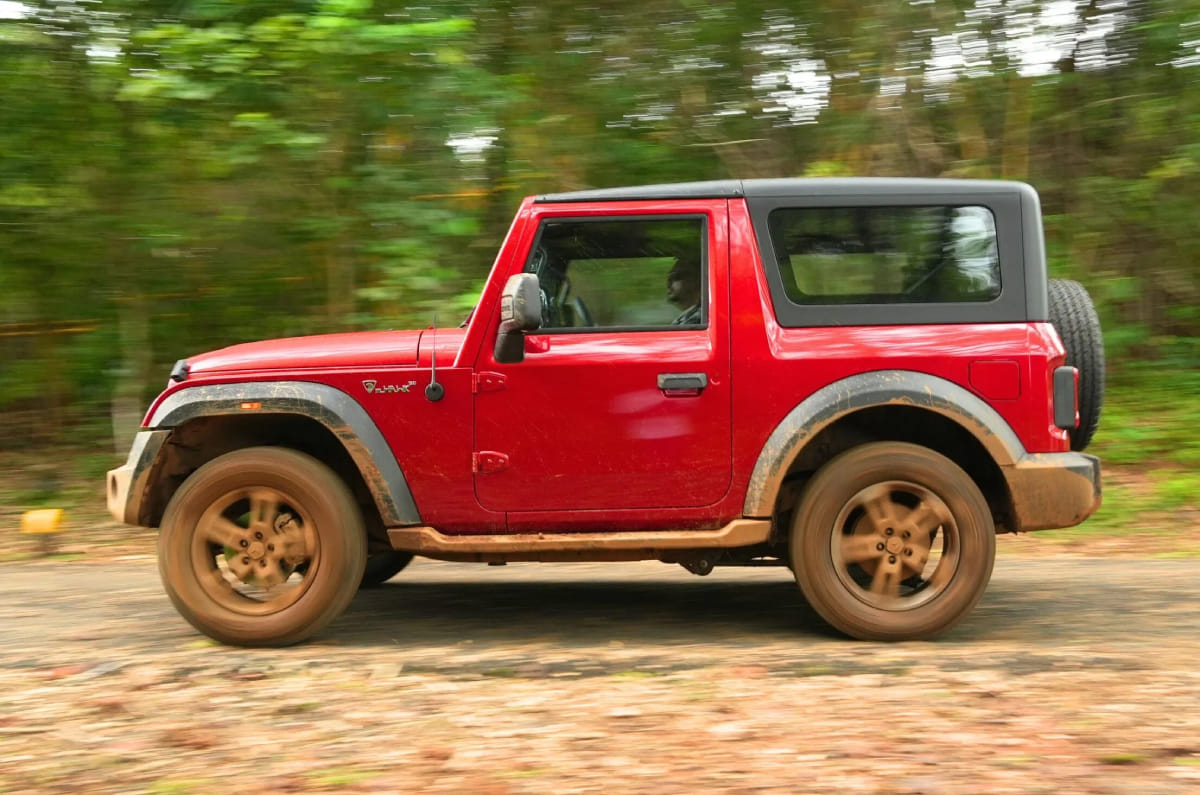
The Mahindra Thar is one of India’s most capable off-road SUVs and is available with petrol and diesel engines, rear-wheel drive and four-wheel drive options. Priced from Rs 10.32 lakh (ex-showroom), it prioritises off-road ability over outright practicality. Here are three reasons to buy the Thar and three reasons why you may want to look elsewhere.
Reasons to buy
Built for serious off-roading
Purpose-built hardware makes it exceptionally capable off road
Few SUVs at this price can match the performance of the Thar once the road ends. Its ladder-frame construction, low-range transfer case and mechanical locking differential on 4×4 variants allow it to tackle steep climbs, deep ruts and loose surfaces with confidence. Even difficult trails are handled with surprising ease, making the Thar one of the most capable off-road SUVs currently on sale.
Strong petrol and diesel engines
Both petrol and diesel engines are refined and offer strong performance
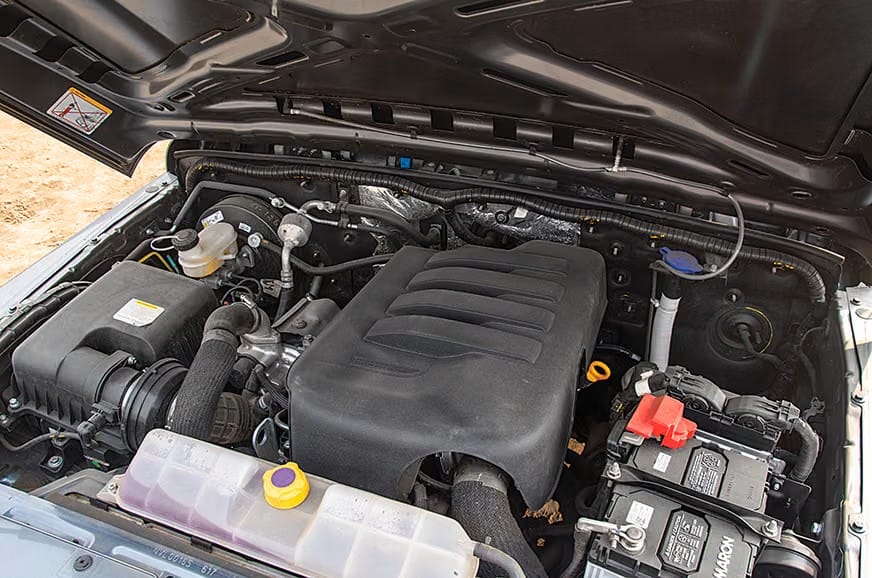
The Thar is available with three engine options. The 1.5-litre diesel (4×2 only) produces 119hp and 300Nm, while the larger 2.2-litre diesel develops 132hp and 300Nm. The 2.0-litre turbo-petrol, meanwhile, makes 152hp and 300Nm. All engines come paired with a 6-speed manual gearbox, while the 2.2-litre diesel and 2.0-litre petrol can also be had with a 6-speed torque-converter automatic.
The diesel engine stands out for its refinement and strong low-end torque, making it particularly well-suited to off-road driving. Buyers looking for stronger on-road performance, meanwhile, will appreciate the punch of the turbo-petrol engine.
Better equipped than before
Recent updates make the cabin easier to live with
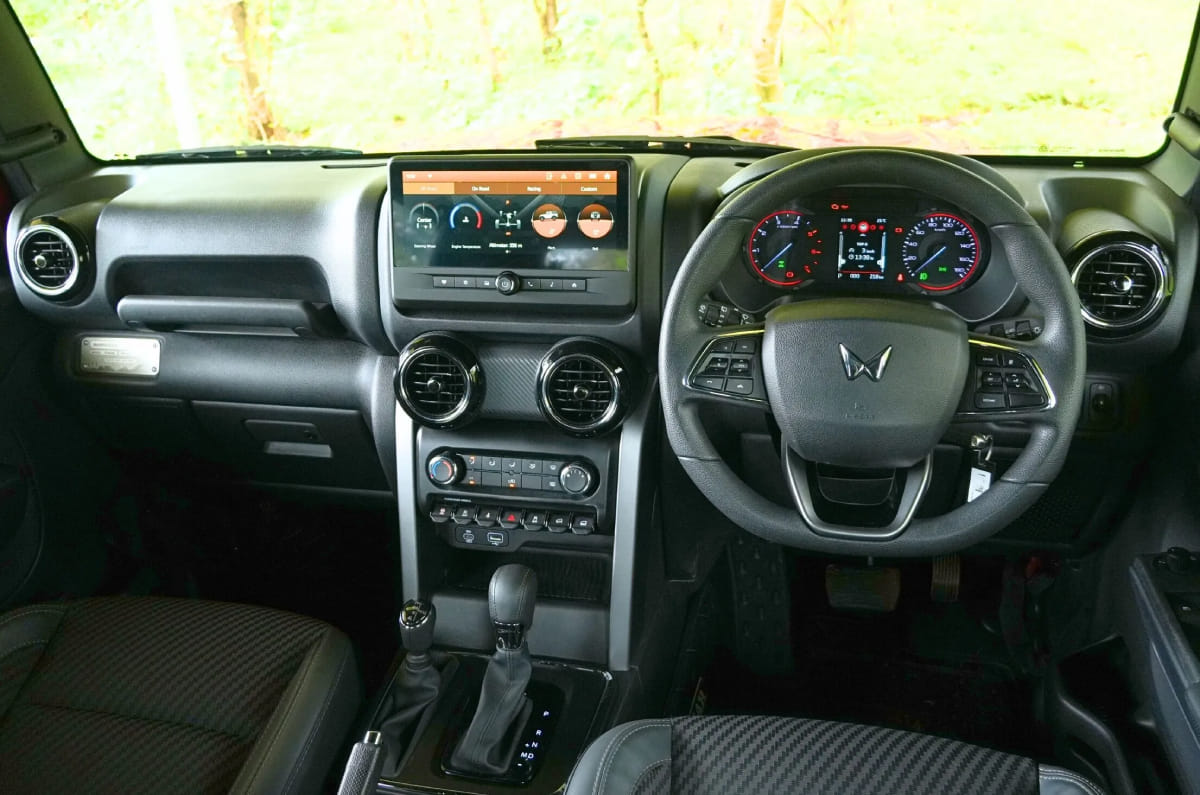
The latest updates have addressed several everyday usability issues. The Thar now gets a larger 10.25-inch touchscreen, rear-view camera, rear washer and wiper, rear AC vents, Type-C charging port, revised centre console with an adjustable armrest, grab handles on the A-pillars and relocated power window switches. While these are relatively small changes individually, together they make the Thar noticeably easier to use every day.
Reasons to skip
Rear-seat access remains inconvenient
Three-door body style limits practicality
Getting into the rear seats remains one of the Thar’s biggest compromises. The front seats need to be folded and slid forward, making access inconvenient, particularly for older passengers and those travelling with children. Boot space is also limited, leaving little room for luggage when all four seats are occupied. Buyers who frequently travel with family or need a more practical everyday SUV may find five-door alternatives better suited to their needs.
Ride comfort isn’t its forte
Suspension prioritises off-road ability over comfort
The Thar’s suspension is designed primarily for off-road use and it feels bouncy over broken roads. While Mahindra has improved the setup over the years, it isn’t as settled or comfortable as most monocoque SUVs. The hydraulically assisted steering is heavier than the electrically assisted systems used by most rivals and can kick back when driving over potholes or other sharp road imperfections.
Not particularly fuel efficient
Petrol and diesel engines aren’t efficiency focused
The Thar’s engines deliver strong performance, but fuel efficiency is not one of its strengths. In our 2021 Thar road test, the petrol automatic returned 7kpl in the city and 9.3kpl on the highway. The diesel manual performed better, managing 12kpl in the city and 12.6kpl on the highway, but it still trails many similarly priced monocoque SUVs. Buyers covering high annual running may find more economical alternatives elsewhere.
Sonam Wangchuk Wife Gitanjali J Angmo: दिल्ली के जंतर-मंतर पर भूख हड़ताल पर बैठे सोनम वांगचुक को जबरन अस्पताल शिफ्ट किए जाने के बाद यह मामला अब और गरमा गया है। वांगचुक के अनशन के 21वें दिन दिल्ली पुलिस द्वारा की गई इस कार्रवाई पर उनकी पत्नी गीतांजलि जे अंगमो ने बेहद कड़ा रुख अख्तियार किया है। वहीं CJP के कार्यकर्ताओं का आरोप है कि, दिल्ली पुलिस वांगचुक को जबरन घसीटते हुए अपने साथ ले गई है। कॉकरोच जनता पार्टी के प्रवक्ता सौरव दास ने दिल्ली पुलिस द्वारा सोनम वांगचुक को प्रदर्शन स्थल से हटाने का पूरा वीडियो शेयर किया है।
‘पुलिस ने जबरन घसीटा’… कार्यकर्ताओं का गंभीर आरोप
NEET पेपर लीक मामले को लेकर केंद्रीय शिक्षा मंत्री धर्मेंद्र प्रधान के इस्तीफे की मांग कर रही कॉकरोच जनता पार्टी (CJP) के कार्यकर्ताओं ने पुलिस पर गंभीर आरोप लगाए हैं। समाचार एजेंसी एएनआई के मुताबिक, वांगचुक को ले जाए जाने के तुरंत बाद प्रदर्शनकारियों ने जमकर नारेबाजी की और आरोप लगाया कि पुलिस वांगचुक को जबरन घसीटते हुए अपने साथ ले गई है।
‘बिना सहमति कुछ भी दिया, तो सीधे ठहराऊंगी जिम्मेदार’
सोनम वांगचुक को सफदरजंग अस्पताल के इमरजेंसी वार्ड में भर्ती कराए जाने के कुछ ही घंटों बाद उनकी पत्नी गीतांजलि जे अंगमो अस्पताल पहुंचीं और एक्स पर लिखा, ‘मैं दिल्ली के सफदरजंग अस्पताल में हूं, जहां सोनम वांगचुक को भर्ती कराया गया है। मेरी, उनके परिवार की और पिछले 20 दिनों से उनकी सेहत की निगरानी कर रहे हमारे डॉक्टरों की सहमति के बिना उन्हें मुंह से या नस के जरिए कुछ भी नहीं दिया जाना चाहिए।’
गीतांजलि ने इससे पहले मीडिया से बातचीत में यह भी साफ कर दिया था कि अगर सोनम वांगचुक की सेहत के साथ कोई भी ऊंच-नीच होती है, तो इसके लिए वे सीधे तौर पर पुलिस और प्रशासन को जवाबदेह मानेंगी।
डॉक्टरों ने बताया कैसी है वांगचुक की हालत?
सफदरजंग अस्पताल प्रशासन ने सोनम वांगचुक के हेल्थ बुलेटिन को लेकर एक आधिकारिक बयान जारी किया है। डॉक्टरों के मुताबिक, सोनम वांगचुक फिलहाल होश में हैं और उनकी स्थिति स्थिर है। लेकिन लगातार 21 दिनों तक भूखे रहने के कारण उनके शरीर में पानी की भारी कमी हो गई है, जिससे वे बेहद कमजोर हो चुके हैं।
अस्पताल का कहना है कि उनके शरीर के सभी मानकों को दोबारा सामान्य स्तर पर लाने के लिए उन्हें लगातार डॉक्टरों की निगरानी, मॉनिटरिंग और इलाज की सख्त जरूरत है।
दिल्ली हाईकोर्ट के आदेश के बाद पुलिस ने लिया एक्शन
बता दें कि दिल्ली पुलिस ने यह कदम दिल्ली हाईकोर्ट के सख्त रुख के बाद उठाया है। दो दिन पहले दिल्ली हाईकोर्ट ने वांगचुक की गिरती सेहत से जुड़ी एक याचिका पर सुनवाई करते हुए कहा था कि ‘देश के किसी भी नागरिक का जीवन बेहद कीमती होता है।’ कोर्ट ने प्रशासन को आदेश दिया था कि वांगचुक की रोजाना क्लिनिकल जांच की जाए और जरूरत पड़ने पर जरूरी मेडिकल हस्तक्षेप भी किया जाए। इसी आदेश के आधार पर शनिवार तड़के पुलिस जंतर-मंतर पहुंची थी।
वांगचुक के बाद अब अभिजीत दिपके बैठेंगे अनशन पर
सोनम वांगचुक को प्रदर्शन स्थल से हटाए जाने के बाद भी आंदोलन खत्म होने का नाम नहीं ले रहा है। कॉकरोच जनता पार्टी (CJP) के संस्थापक अभिजीत दिपके ने ऐलान कर दिया है कि सोनम सर को अस्पताल भेजने से यह आंदोलन नहीं रुकेगा। अब वे खुद शनिवार से अनिश्चितकालीन भूख हड़ताल पर बैठ रहे हैं। दिपके ने साफ किया कि मानसून सत्र के पहले दिन यानी 20 जुलाई को संसद की तरफ निकाला जाने वाला उनका विरोध मार्च अपने तय शेड्यूल के हिसाब से ही होगा।
#WATCH | Delhi: Founding President of the Cockroach Janta Party, Abhijeet Dipke, says, “I am commencing my indefinite hunger strike starting today. I appeal to everyone: do not back down; this movement will only grow larger. They have made a grave mistake… I urge everyone to… pic.twitter.com/iCoB6jSOHQ
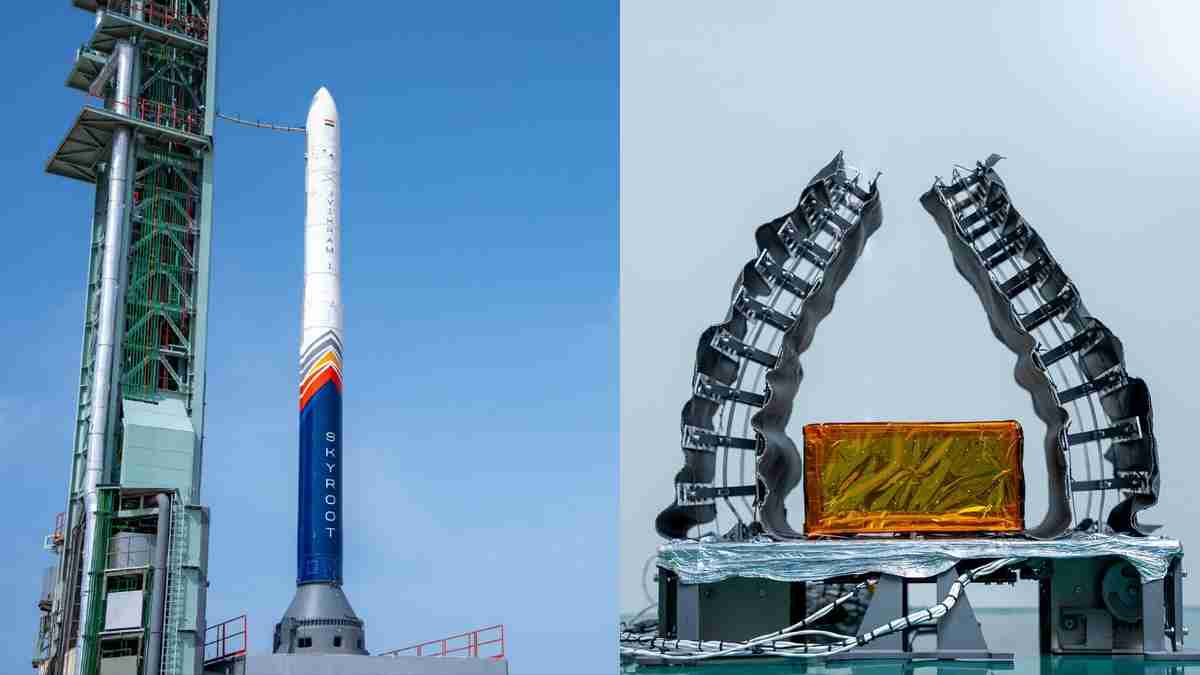
Vikram 1 Launch : प्राइवेट स्पेस स्टार्टअप स्काईरूट एयरोस्पेस 18 जुलाई को विक्रम-1 टेस्ट फ्लाइट-1 के जरिए प्रधानमंत्री नरेंद्र मोदी का 'वंदे मातरम' लिखा हाथ से लिखा पोस्टकार्ड अंतरिक्ष में भेजेगा। यह भारत के पहले निजी ऑर्बिटल-क्लास रॉकेट की टेस्ट उड़ान होगी, जिसमें कई टेक्नोलॉजी डेमोंस्ट्रेशन और विशेष पेलोड भी शामिल हैं।
सोशल मीडिया प्लेटफार्म एक्स पर एक पोस्ट में स्काईरूट एयरोस्पेस ने कहा कि इस मिशन में ले जाए जाने वाले खास पेलोड में पीएम मोदी का हाथ से लिखा संदेश भी शामिल होगा। इसके साथ ही, कंपनी की टीम, निवेशकों, नीति-निर्माताओं और दुनिया भर के शुभचिंतकों के हाथ से लिखे नोट भी इसमें शामिल होंगे।
A historic new frontier for India’s space journey!
At 11:30 AM today, Skyroot Aerospace will undertake the maiden orbital launch of Vikram-1, India’s first privately developed launch vehicle.
This four-stage rocket is designed to provide rapid and on-demand launch services.… pic.twitter.com/1qFVTwNOuZ
प्रधानमंत्री नरेंद्र मोदी ने सोशल मीडिया साइट एक्स पर अपनी पोस्ट में कहा, भारत की अंतरिक्ष यात्रा के लिए एक ऐतिहासिक नया सवेरा! आज सुबह 11:30 बजे, स्काईरूट एयरोस्पेस भारत के पहले निजी तौर पर विकसित लॉन्च व्हीकल, विक्रम-1 (Vikram-1) का पहला ऑर्बिटल लॉन्च करेगा। यह चार चरणों वाला रॉकेट त्वरित और ऑन-डिमांड लॉन्च सेवाएं प्रदान करने के लिए डिज़ाइन किया गया है।
उन्होंने कहा कि यह मिशन हमारे युवाओं की प्रतिभा, दृढ़ संकल्प और उद्यमशीलता की भावना को रेखांकित करता है। यह यह भी दर्शाता है कि कैसे हमारे अंतरिक्ष-क्षेत्र के सुधार नवाचार और उद्यम के लिए नए अवसरों के द्वार खोल रहे हैं।
सफल लॉन्च के लिए पूरी स्काईरूट एयरोस्पेस टीम को मेरी हार्दिक शुभकामनाएं। विक्रम-1 नई ऊंचाइयों को छुए, इतिहास रचे और नवप्रवर्तकों की एक पूरी पीढ़ी को प्रेरित करे।
मैं सभी भारतीयों, विशेषकर अपने युवा मित्रों से इस ऐतिहासिक मिशन को देखने और #IndiaWithVikram1 का उपयोग करके टीम स्काईरूट को सफलता की शुभकामनाएं देने का आग्रह करता हूं।
क्यों खास है विक्रम 1 का मिशन?
यादगार चीजों के अलावा, विक्रम-1 में कॉस्मोसर्व, डी-क्यूब्ड और स्काईरूट के अपने स्कोप से टेक्नोलॉजी डेमोंस्ट्रेशन पेलोड ले जाए जाएंगे। साथ ही, इसमें कॉसमॉस डायमंड्स का बनाया आर्टवर्क ‘कॉस्मिक ब्लूम’ और एक माइक्रो-आर्ट पेलोड भी होगा। विक्रम-1 स्काईरूट एयरोस्पेस का पहला ऑर्बिटल लॉन्च व्हीकल, भारत के प्राइवेट स्पेस सेक्टर के लिए एक अहम उपलब्धि साबित हो सकता है। इस मिशन का मकसद देश में बने इस लॉन्च व्हीकल की क्षमताओं को दिखाना और देश के कमर्शियल स्पेस लक्ष्यों को मज़बूत करना है।
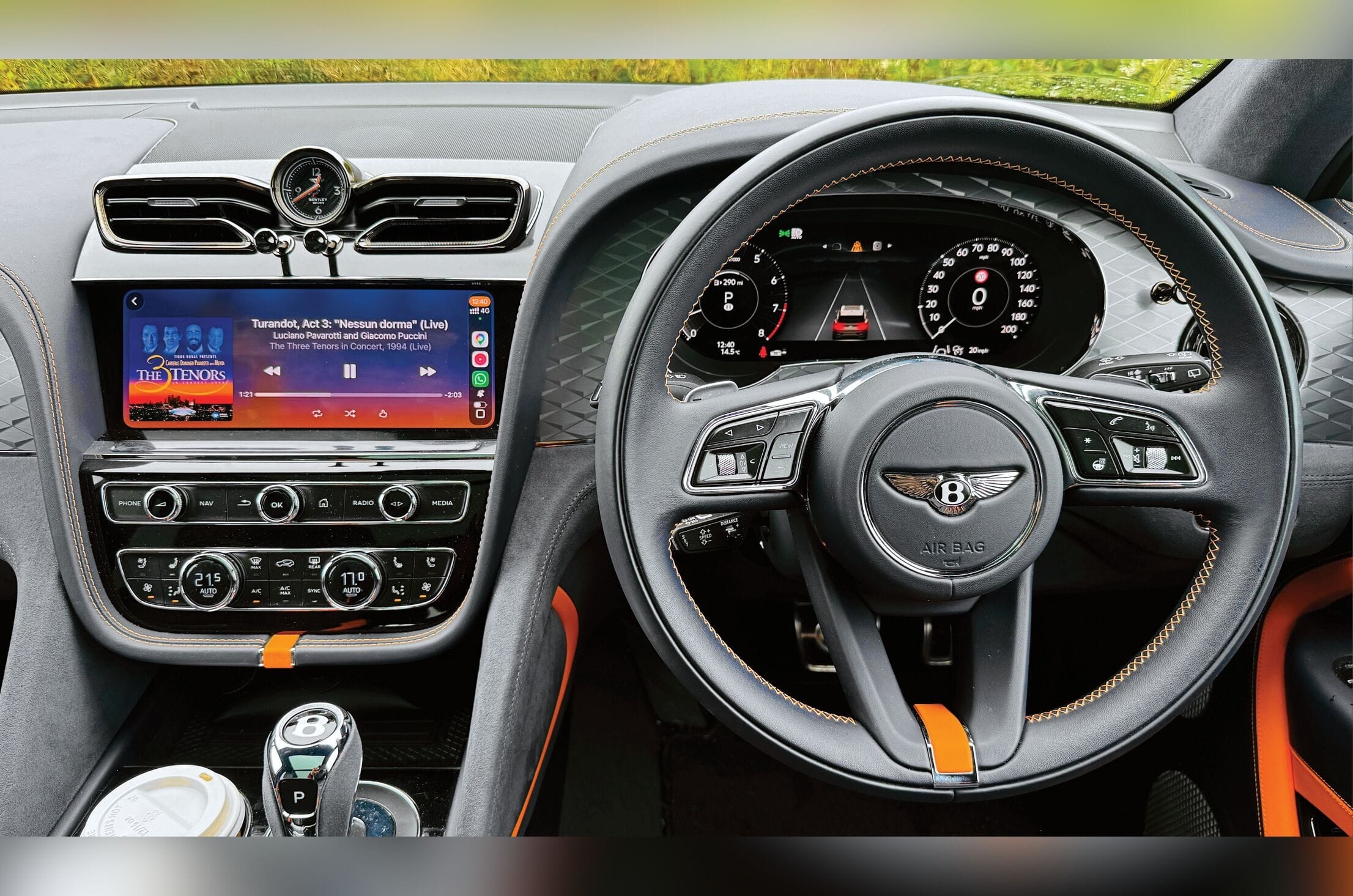
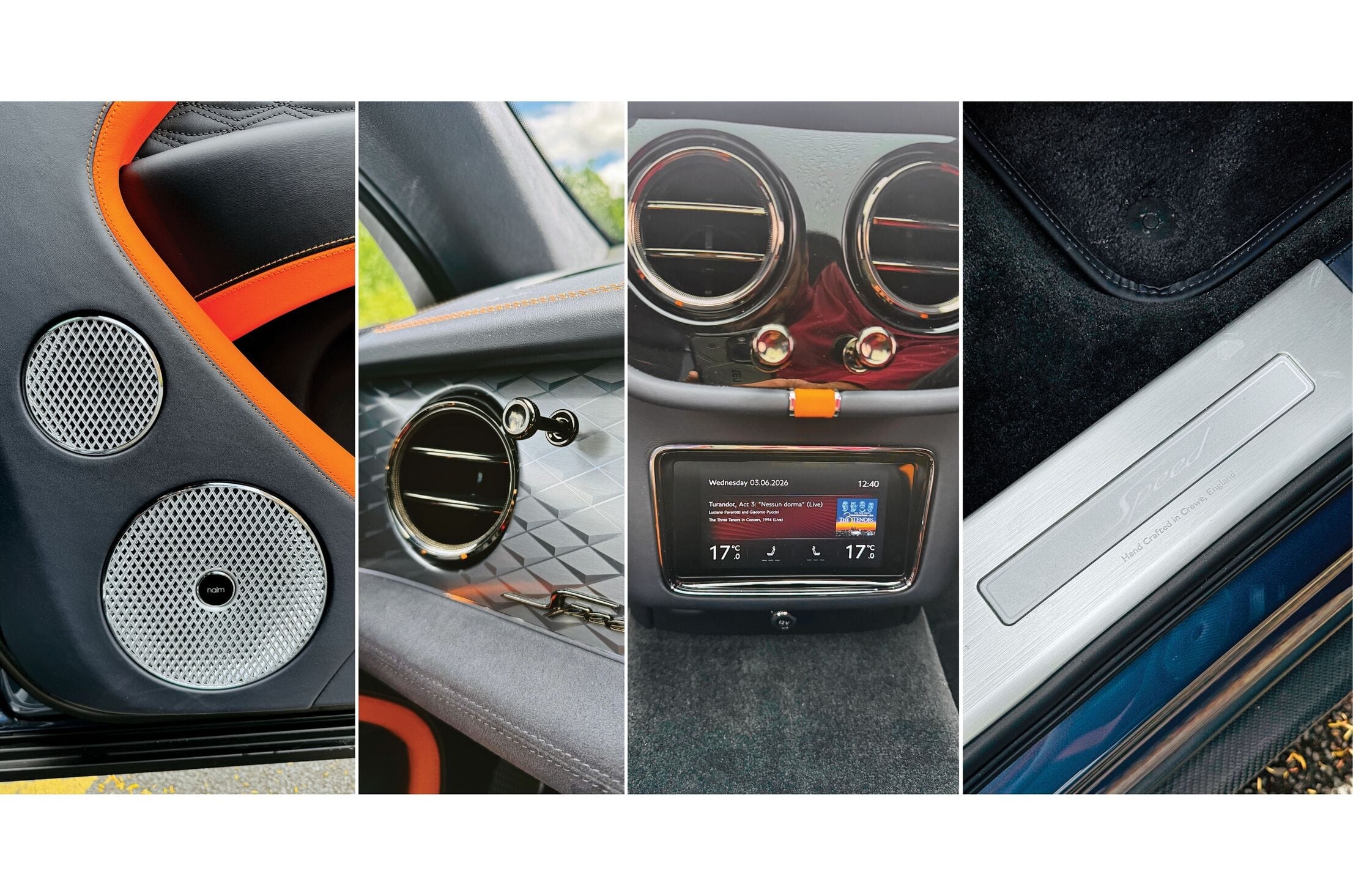
We left London at quarter past two on a Monday afternoon, and for the next four hours, the Bentley Bentayga did what most cars can only pretend to do on the M40 and M6. It made the motorway disappear. Settle into the driver’s seat of this Speed variant, and the first thing you notice is how little there is to notice – and yet how much there is to appreciate. The cabin is hushed to the point of unease, wind and road noise simply refusing to show up, leaving you enveloped in a space that celebrates analogue tactile pleasure in an increasingly digital world. Front and centre on the dashboard sits a Breitling analogue clock, anchoring the cabin with old-world authority. Below it, the knurled metal organ stop levers for the air vents operate with a satisfying mechanical resistance that no touchscreen has ever replicated.
A cabin that celebrates tactile touch in an age that has forgotten it. Leather-stitched with the patience of people who still care.
The audio system is by Naim – the Wiltshire-based hi-fi company whose amplifiers have been a byword for sonic purity since 1973 – and with Pavarotti filling the cabin at modest volume somewhere past Birmingham, it was immediately clear this was not a system installed merely to tick a specification box. Rear seat passengers, meanwhile, had their own touchscreen for climate and media control – ours showing Pavarotti mid-aria, which felt, in a Bentley, entirely correct. Neither the Bentayga nor Lancashire feel the need to tom-tom their virtues. Both simply get on with it, and trust that the right people will notice. I have driven this route north before in lesser company, and it has never once felt this short.
Every detail in the Bentayga Speed — the Naim audio system, the organ-stop vents, the diamond-quilted dash, the rear-passenger screen, the sill that quietly announces it was hand-crafted in Crewe — speaks of a car assembled by people who considered indulgence a serious responsibility.
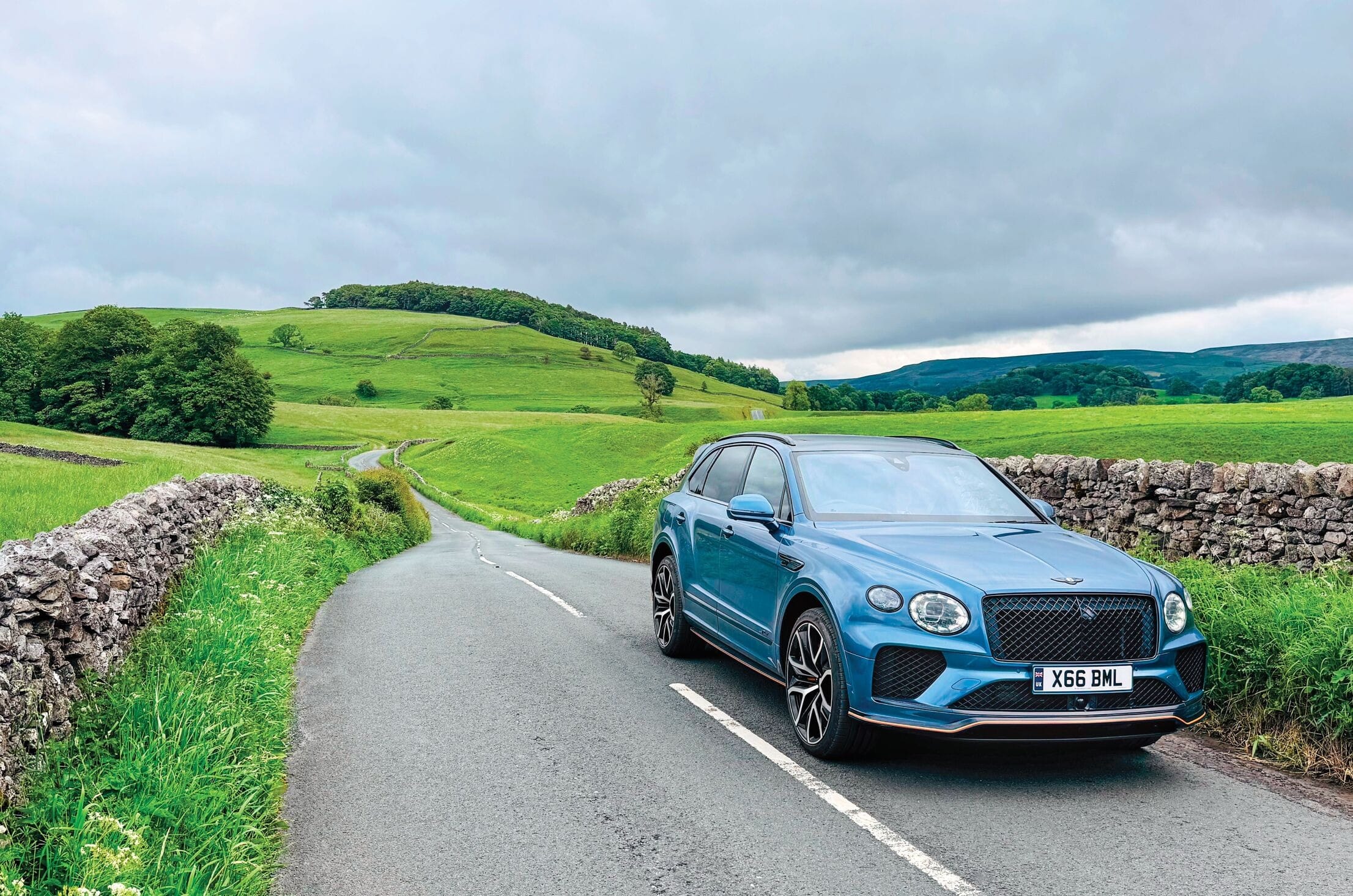
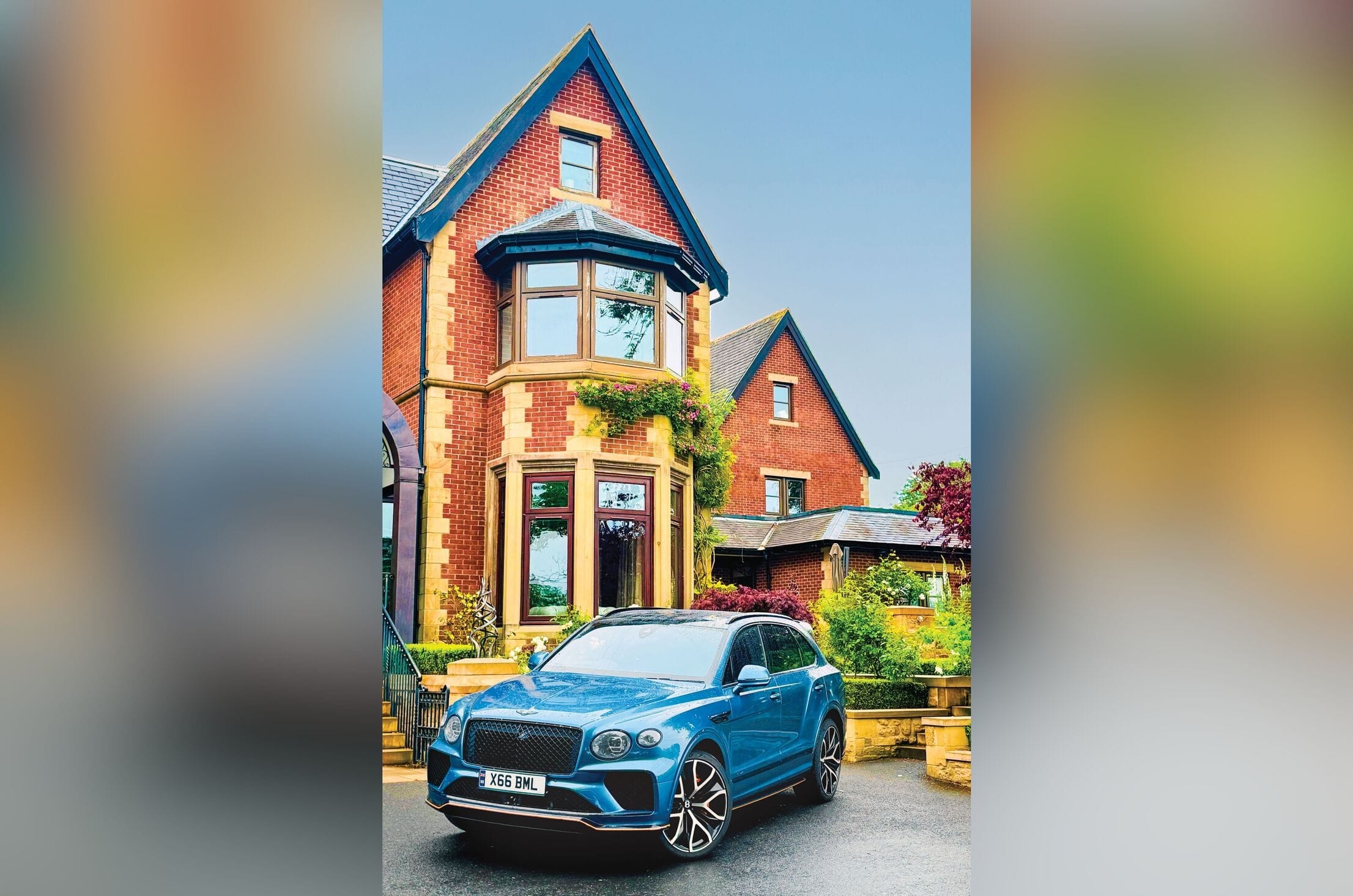
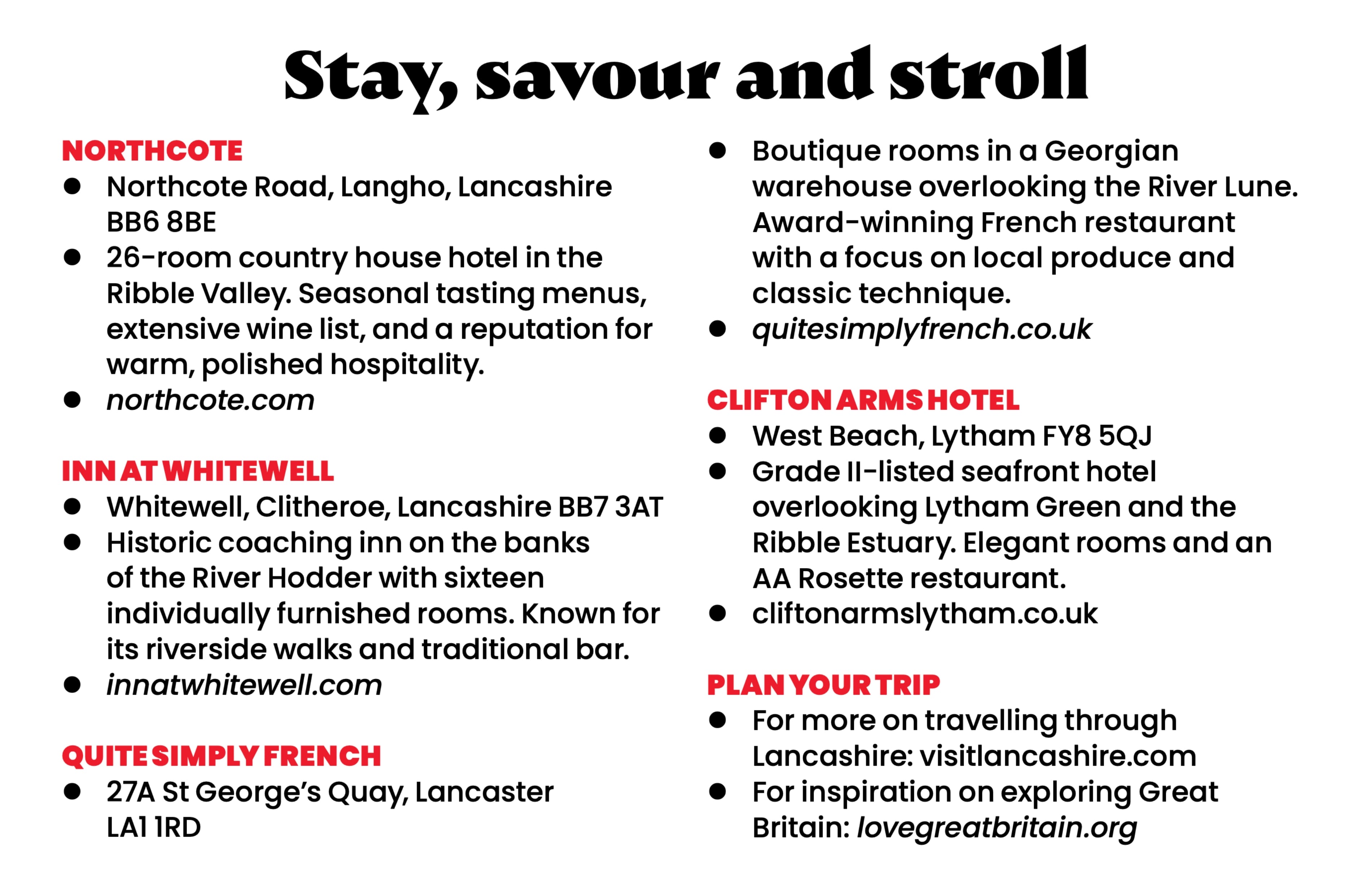
We continued north, crossing into Lancashire before finally turning off the motorway. Our destination was Northcote, nestled in the Ribble Valley near the village of Langho. As we made our approach, England changed its mind about what kind of country it wanted to be. The road narrowed and hedges closed in from both sides, threatening the Bentley’s two-metre width. The light was dropping into that long northern evening glow, and at the end of a gravel drive, Northcote appeared looking exactly like the opening shot of a film about an English country weekend. The Bentayga rolled up the approach, announcing its arrival with the polite crunch of low-profile Pirelli tyres on small stones – a suitably understated entrance for a 19th-century manor house that has seen a thing or two pull up outside.
We were here for dinner, bed and breakfast, and Northcote does none lightly. Chef Patron Lisa Goodwin-Allen has been translating this landscape into food since 1996 – three decades of a Michelin star, unbroken, which in the restaurant business is closer to a geological era than a career. Five courses arrived in unhurried succession, featuring asparagus, scallop, sole, local Lake District lamb, and a rich Valrhona chocolate to close – each dish a study in contrast and harmony, every course making the next feel inevitable. After dinner, we retired to one of the garden lodge deluxe suites: a fireplace casting a warm glow across the room, a private terrace looking out toward the dark valley, a deep tub in a bathroom that invited lingering. I went to bed deeply content, waking to a golden Ribble Valley morning that invited long, lazy walks. But the ribbon of tarmac through the Forest of Bowland was waiting, and the Bentayga was beckoning from the car park.
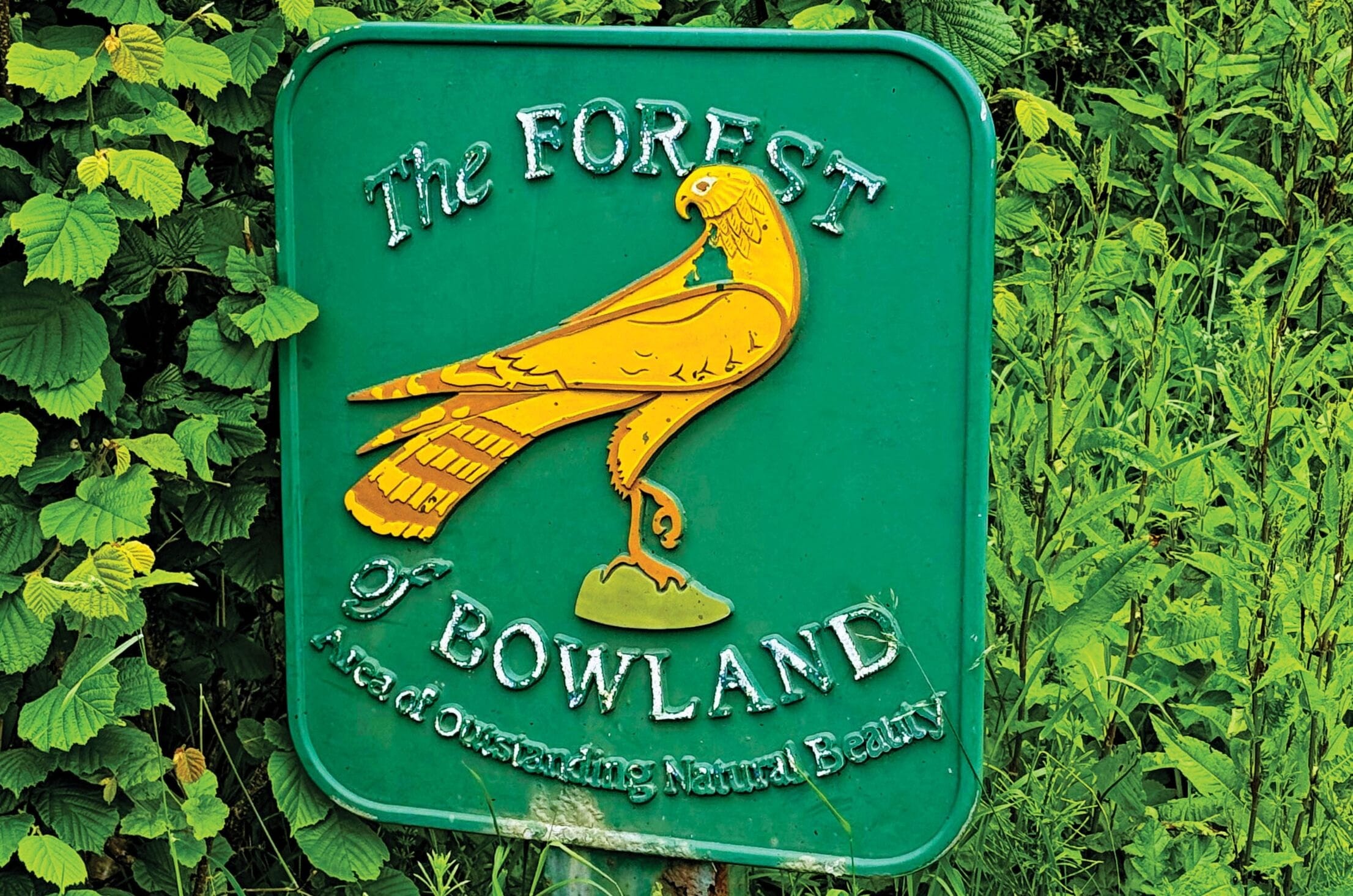
One of England’s best-kept secrets, this area of outstanding beauty is a delight for walkers and driving enthusiasts.
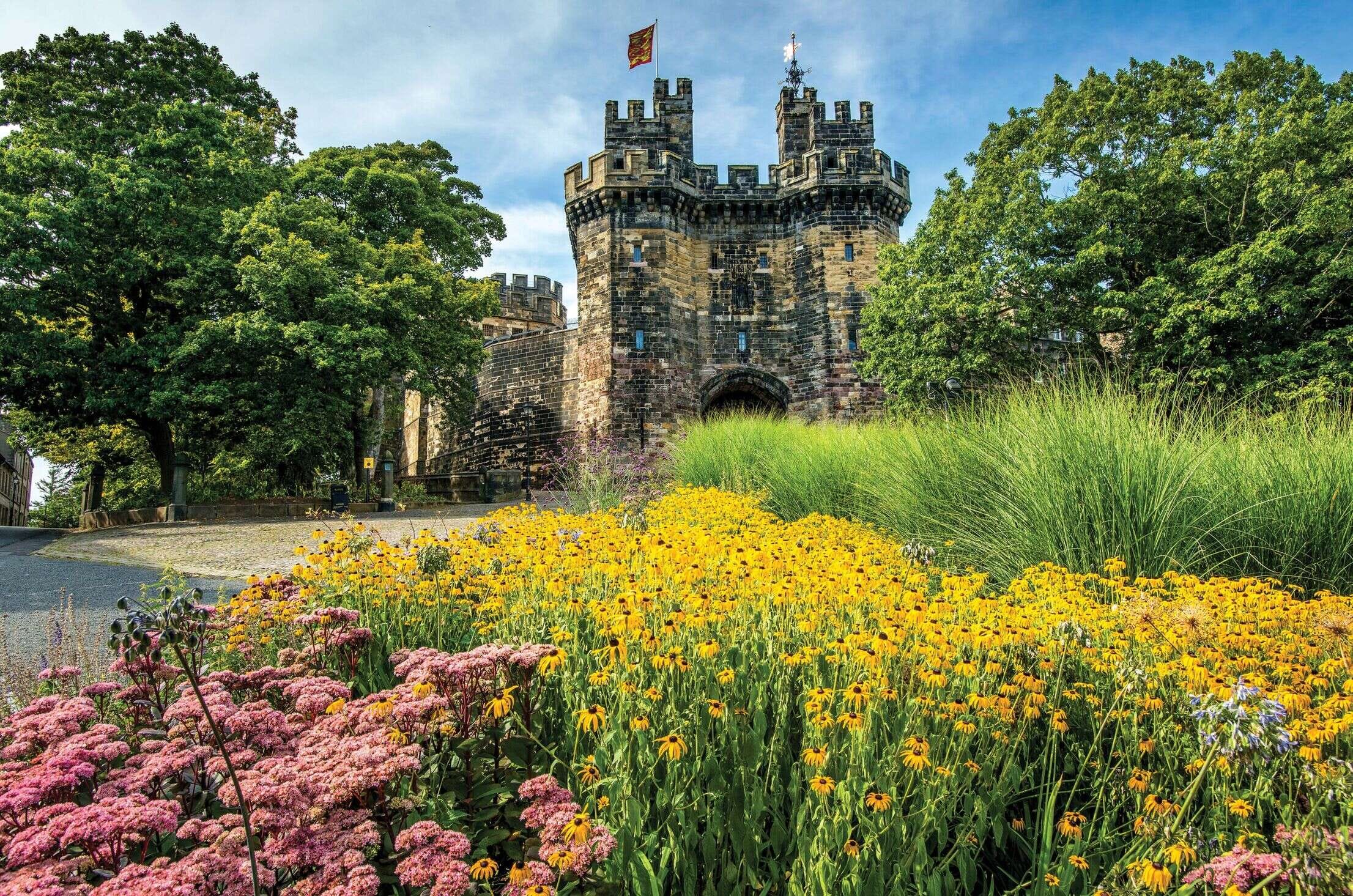
The road out runs through Clitheroe, where a Norman keep sits on a limestone mound with views stretching all the way to Pendle Hill, then climbs into the Forest of Bowland proper – 312 square miles of open moorland, fell, and river valley, largely left alone by the twenty-first century. I flicked the rotary drive selector into Sport early, curious to see what a two-and-a-half tonne SUV would make of roads that seemed written for something small and nimble. The transformation was immediate and theatrical – the car drew a long breath, settled onto its haunches, and changed its personality entirely. The steering weighted up with quiet authority, the throttle sharpened to a hair-trigger, and the Bentley Dynamic Ride system – it uses a 48-volt electrical architecture to split the anti-roll bars and sandwich an electric motor and planetary gear set between the halves, applying up to 1,300Nm of torque to each bar and reacting in as little as 0.06 seconds – kept the big SUV as flat through corners as a saloon car, entirely unbothered by its own considerable mass. The Bentayga had stopped being a grand tourer and become, without any fuss whatsoever, a driver’s car.
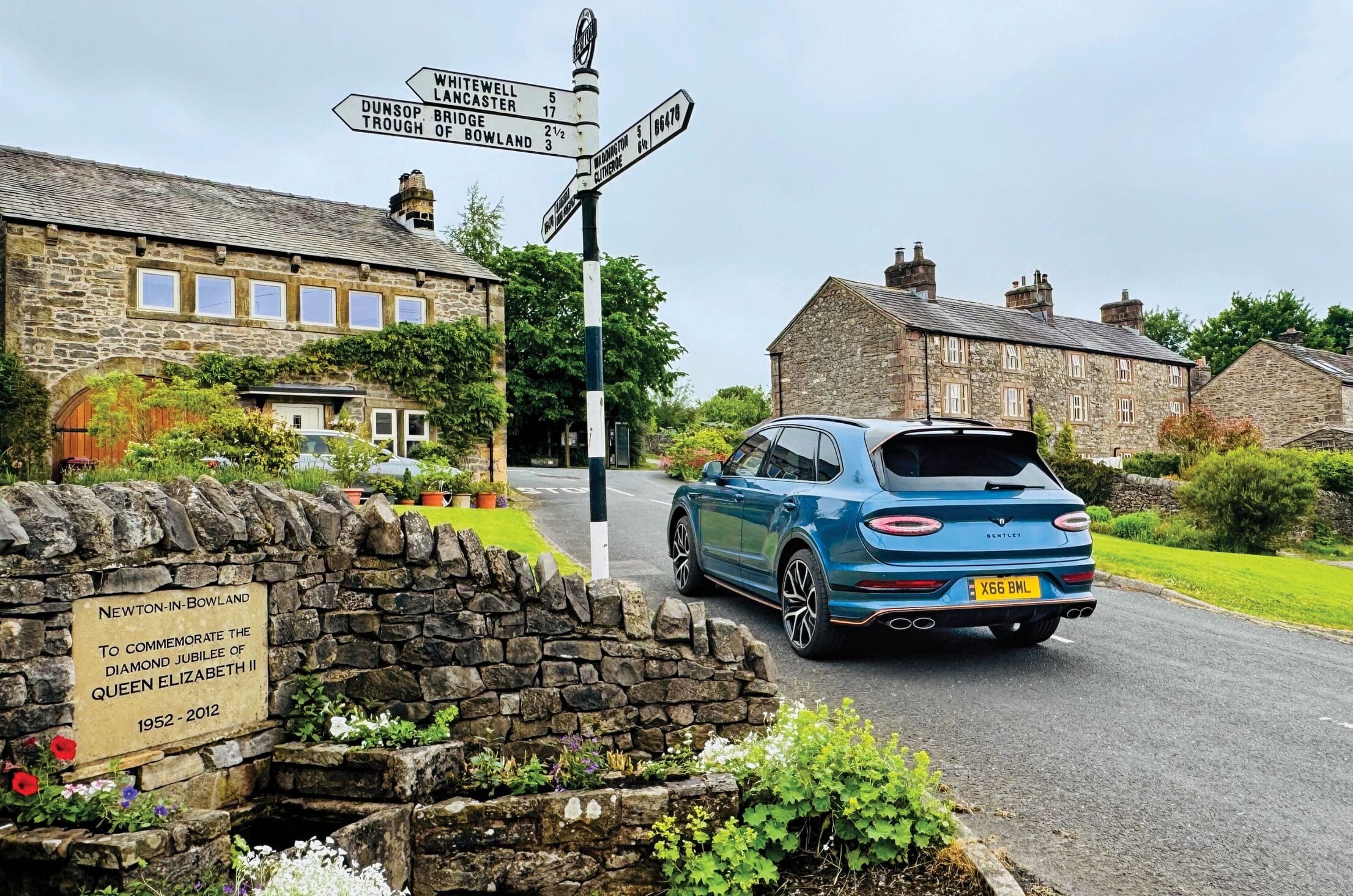
The signpost at Newton-in-Bowland offers four directions. For the traveller with time, there is no wrong turn here.
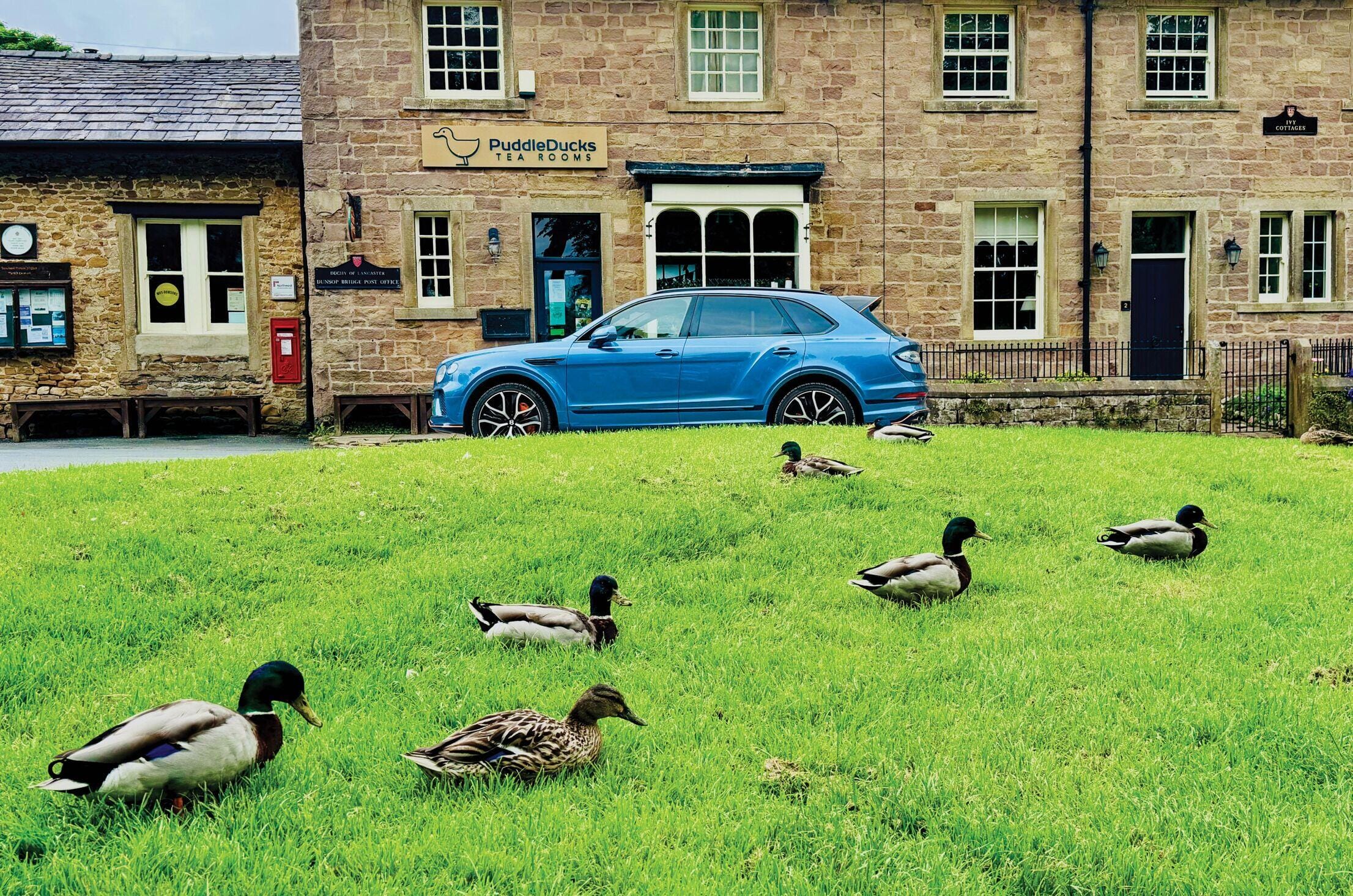
Dunsop Bridge slid past in a matter of seconds – a handful of stone houses, a red telephone box marking the geographic centre of Great Britain, and directly opposite, the Puddleducks Tearooms, where actual ducks were crossing the asphalt in front of us with the unhurried confidence of creatures who know they own the place.
And then came the Inn at Whitewell. It sits on a bend of the River Hodder, a low stone building with the fells rising behind it and the river running just below the terrace, dating to the 14th century when it housed the keeper of the King’s Forest. The manager told me that King Charles III had stayed the night here once, arriving by train to Lancaster and driving up through the valley. We parked the Bentayga in the gravel yard among vintage Land Rovers in active use by local farmers – the Bentley not looking remotely out of place, which says everything about both the car and the inn.
The ducks at Dunsop Bridge crossed the road with unhurried nonchalance. The Bentayga waited indulgently.
We had lunch at the exact spot where Steve Coogan and Rob Brydon filmed the opening episode of The Trip. Head chef Jamie Cadman has been running this kitchen for 29 years, and the scallops, the ribeye cooked medium-rare, and a crème brûlée of memorable creaminess proved that his tenure was very well spent. Afterwards we walked – an hour and a half across stepping stones and up into the moors, dappled afternoon light, the swish of boots in wet grass, sheep in fields arranged for maximum Englishness. We came back with deep-cleaned lungs, finding the Bentayga still flanked by a mud-caked Land Rover and a tractor. Even if it had feelings about its utilitarian neighbours, it kept them, with characteristic British restraint, entirely to itself.
Then came the Trough of Bowland – and the Bentayga’s finest hour. On these sweeping corners and squiggly bends that open into long glorious straights, the V8 deepened into a proper barrel-chested growl, the eight-speed ZF gearbox snapping through ratios with surgical precision. Burying my right foot out of a long right-hander, the 4.0-litre twin-turbo unleashed 850Nm of torque across a broad plateau between 2,250 and 4,500rpm – not a single violent hit but a sustained, relentless wave that simply didn’t stop. 2,440 kilograms of hand-built British engineering launched forward, brutally and joyfully hard, dispatching 0-100kph in 3.6 seconds. Yet at no point did it feel like it was getting away from me. The permanent all-wheel-drive system shuffles power between axles with imperceptible speed, while the all-wheel steering tightens the car into corners at low speed and plants it with absolute authority on high-speed straights. The confidence arrives quickly and stays.
Lancaster revealed itself in the late afternoon, featuring cobbled streets, a castle that hosted the Pendle Witch Trials of 1612, and a quayside built on 18th-century trading wealth. Our base was Quite Simply French on St George’s Quay, four boutique rooms in a 1750 warehouse with bare stone walls, timber beams, and the River Lune drifting past the windows. The 360-degree camera system made light work of threading the Bentley down the narrow quayside street. Dinner was a proper French feast including lobster, escargots, and a wine list worth lingering over.
Crème brûlée and ribeye at Whitewell, scallops at Northcote, scrambled eggs at Quite Simply French – Lancashire is a foodie’s delight.
Breakfast the next morning was the quiet revelation of the trip: scrambled eggs of extraordinary creaminess, sourdough toast, hand-churned butter, sea salt, genuinely good coffee – a little slice of France transplanted into the heart of Lancashire, courtesy of head chef Luke Johnson, fifteen years in this kitchen and showing no signs of slowing down.
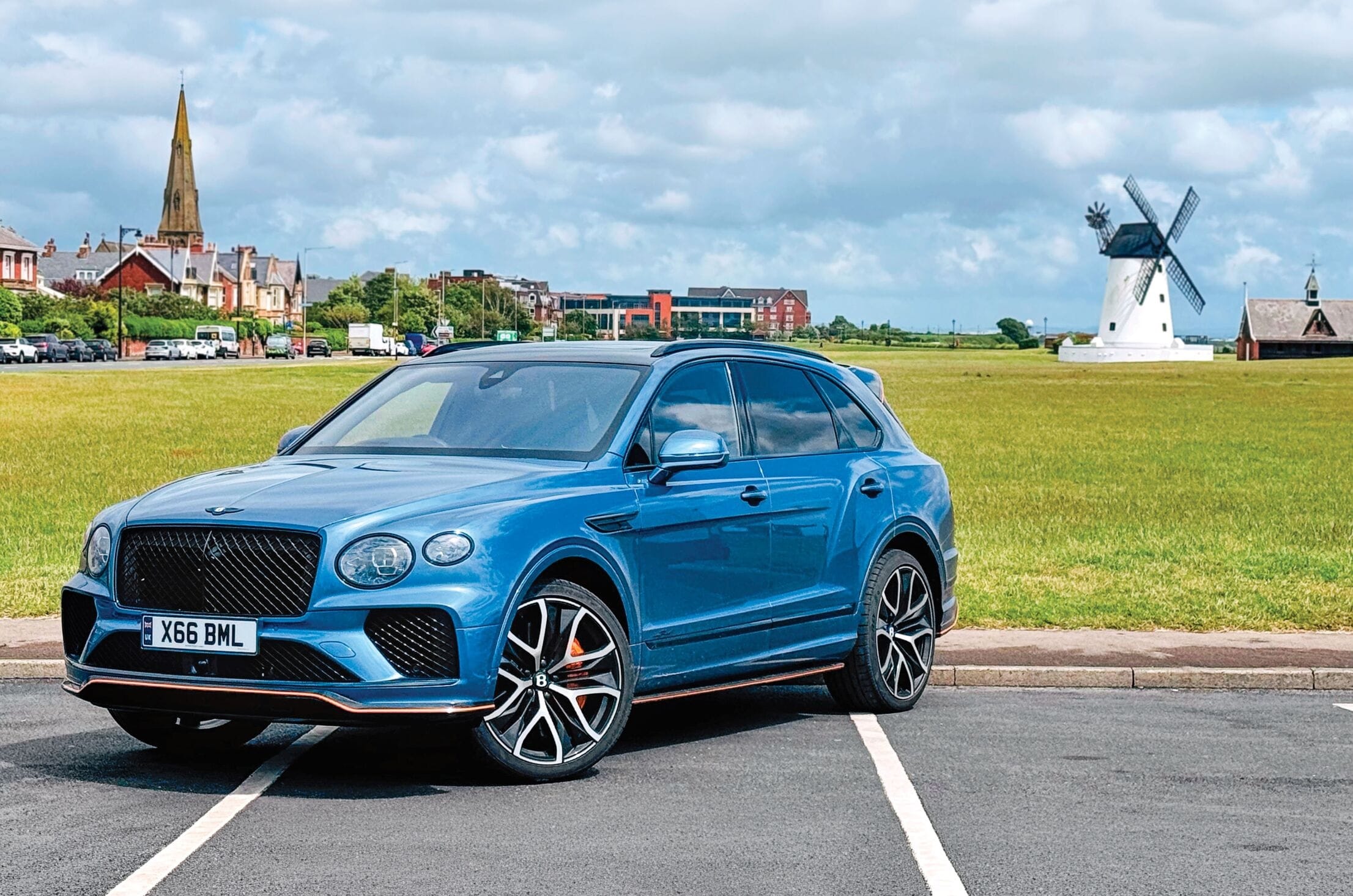
From Lancaster, we pointed toward the coast. Lytham is a handsome Edwardian seaside town of independent shops, a sprawling seafront green, and the wide Ribble Estuary beyond. At its centre stands a solid white 19th-century windmill, which we explored as the weather turned grey and blustery in the way English coastal mornings sometimes insist upon. We spent the night at the Clifton Arms on the seafront – Grade II-listed, dating to 1839, cast-iron balconies and classical columns looking out over the Green. The next morning’s photograph said everything: the Bentayga framed against the stark white of the windmill, hand-assembled British engineering against handmade British stone, both entirely unhurried and at home.
The Bentayga on Lytham seafront, with the town’s 19th-century windmill for company.
The drive back down the M6 was every bit as uneventful as the journey up. This is perhaps the highest compliment a grand tourer of this calibre can be paid. Over three days, the Bentayga had done everything asked of it by devouring a motorway slog in near-total silence, charging through the Trough of Bowland with a soundtrack fit for a film score, threading a medieval quayside without breaking a sweat, and reshaping its chassis, drivetrain, and suspension to whatever the road demanded, all while making every mile feel like it was exactly where it was meant to be.
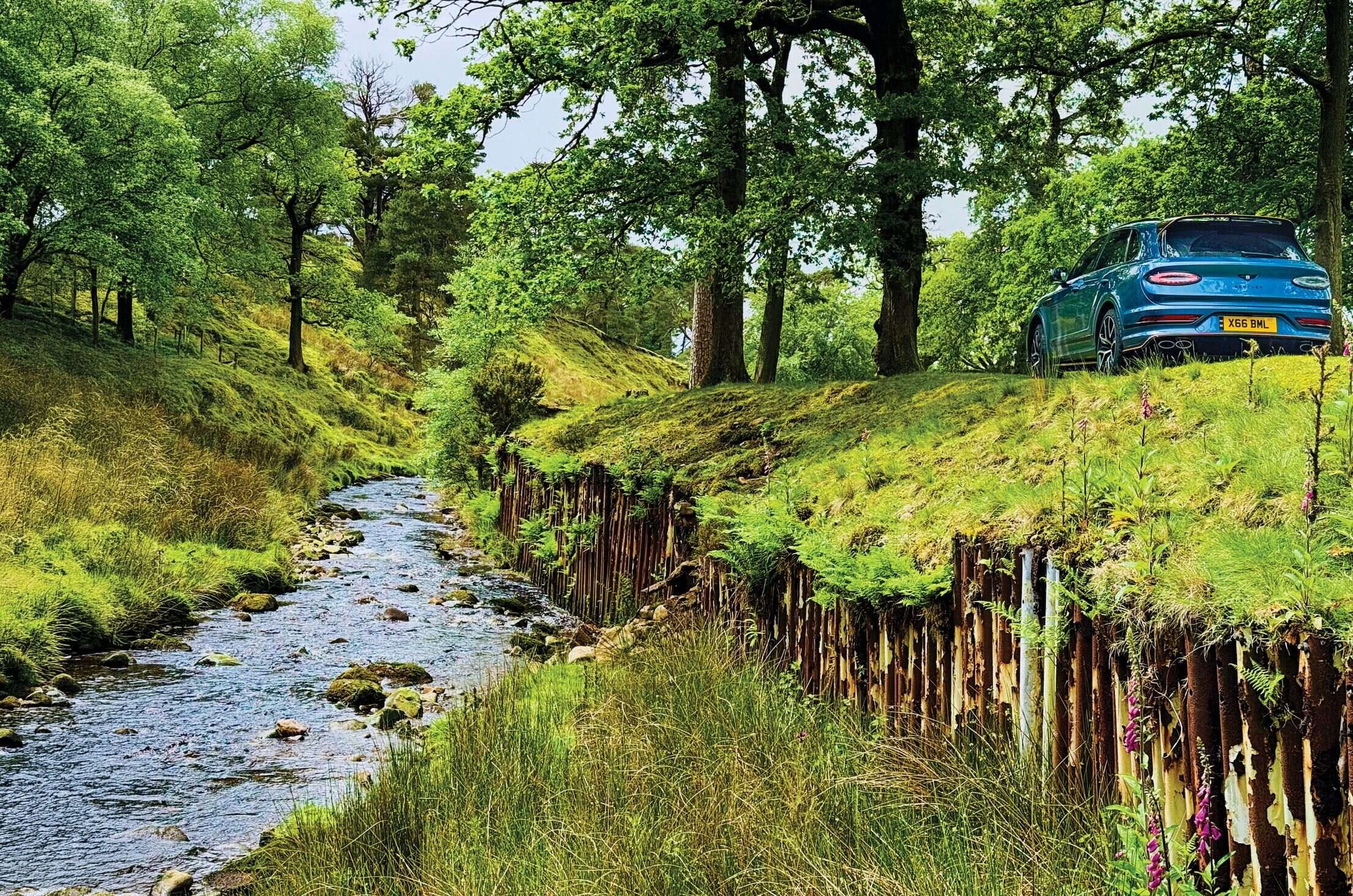
A burbling brook, a solid oak, and a hand-crafted car from Crewe — together in the Forest of Bowland. This picture quietly states “England”.
Lancashire is a county most tourists simply ignore, and that is precisely its saving grace. A few slow days spent looping through its corners delivered everything the quintessential English road trip ought to be – cosy country inns with roaring fires, smashing food that makes a detour entirely mandatory, and layers of medieval history etched into stone castles. There were long walks across the wet moors that left my boots soaked and my head clear, and scenic roads that begged to be driven. This is the good old English countryside exactly as it should be. It is a landscape that deserves to be savoured in a leisurely manner and preferably from the cockpit of something exactly this magnificent.
There are few cars with the sheer variety of powertrains as the Land Rover Defender. From a four-pot to a choice of V8s, there is seemingly something for everyone. One stands out, though – the D350 3.0-litre inline-six twin-turbocharged diesel. More power than the base petrol, more torque than the 5.0 V8, with the frugality of a diesel. It’s the only motor the Trophy Edition comes with, so is this engine the sweet spot in the range?
Land Rover Defender Trophy Edition exterior design and engineering – 9/10
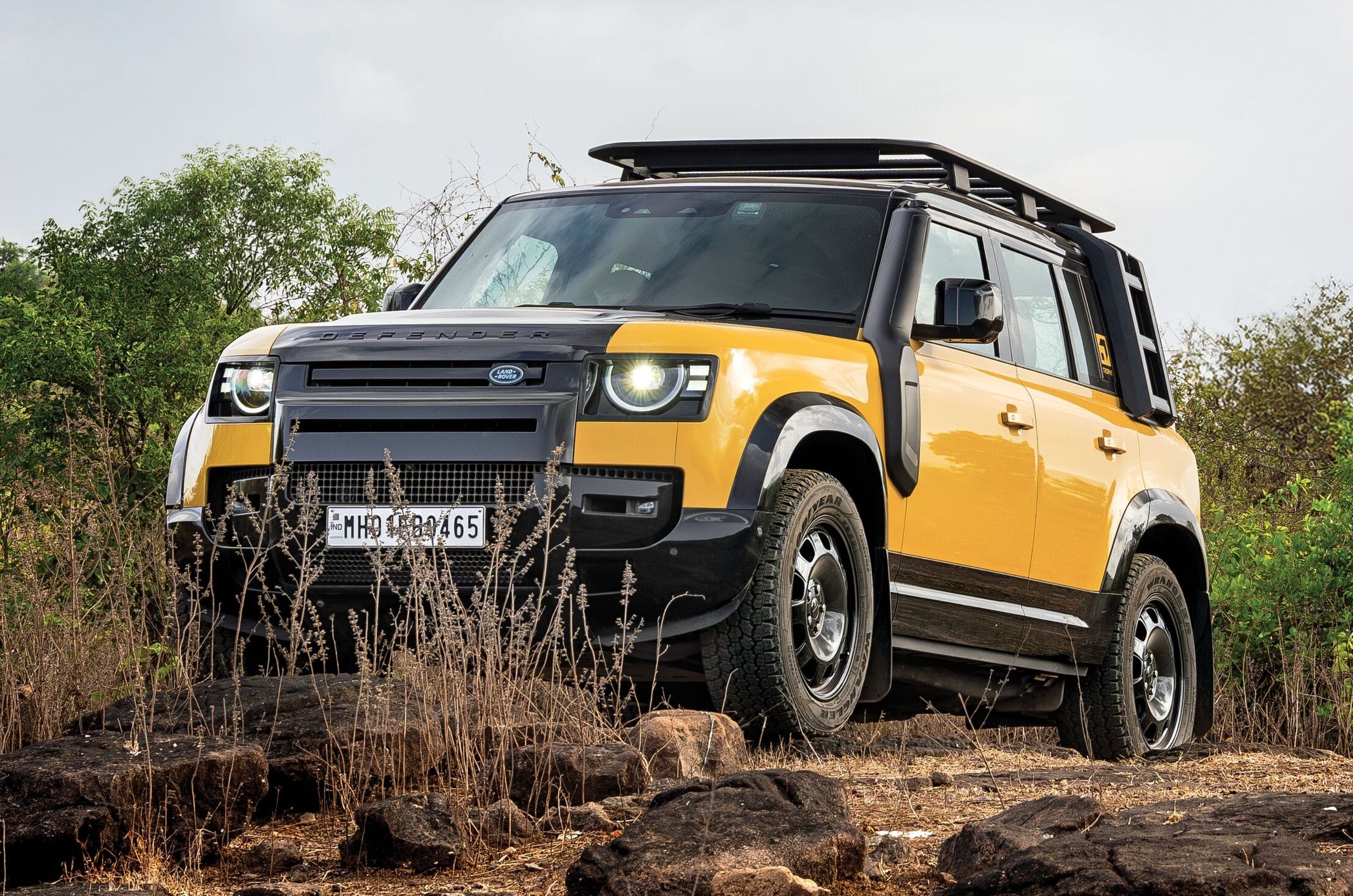
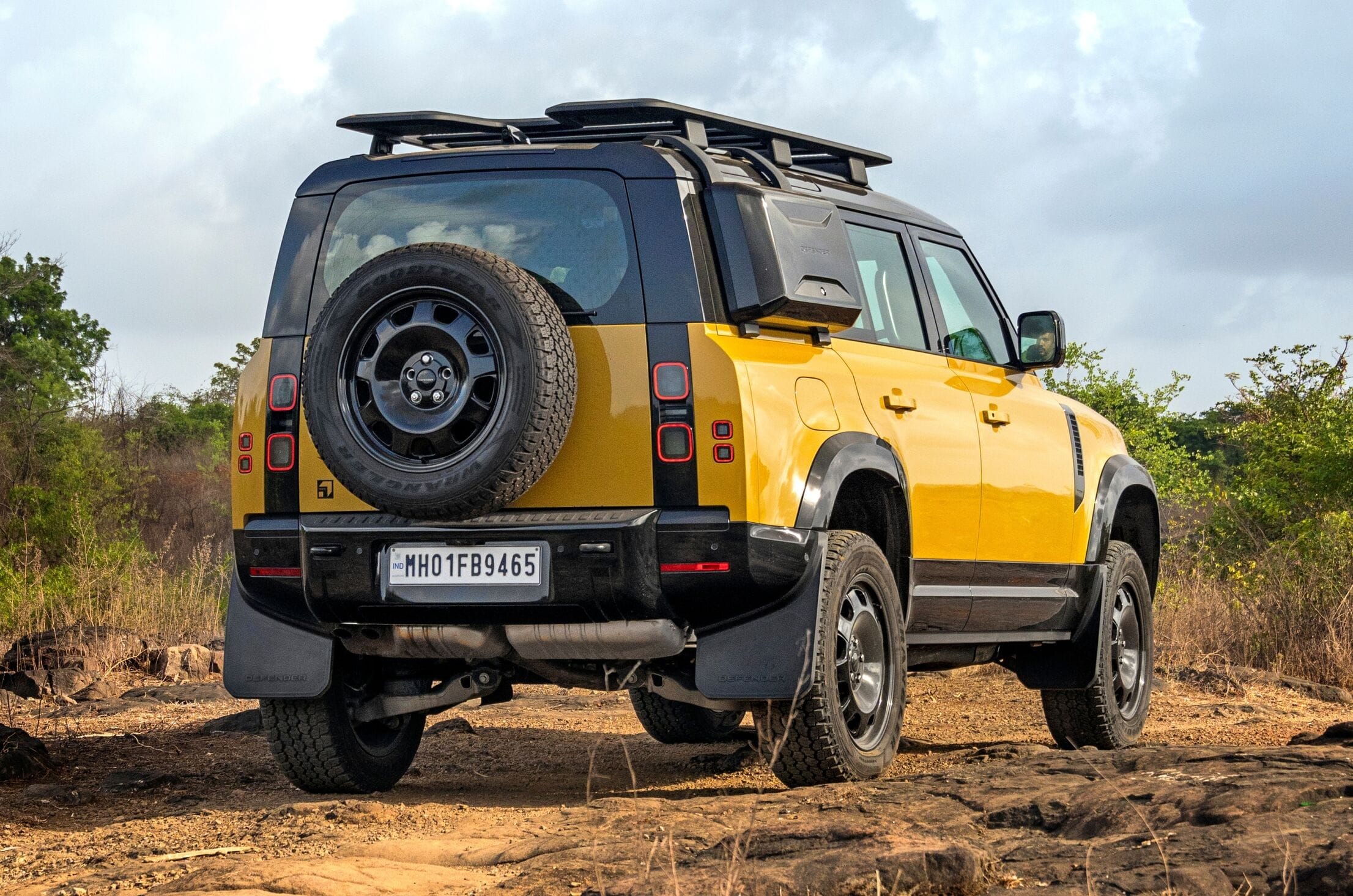
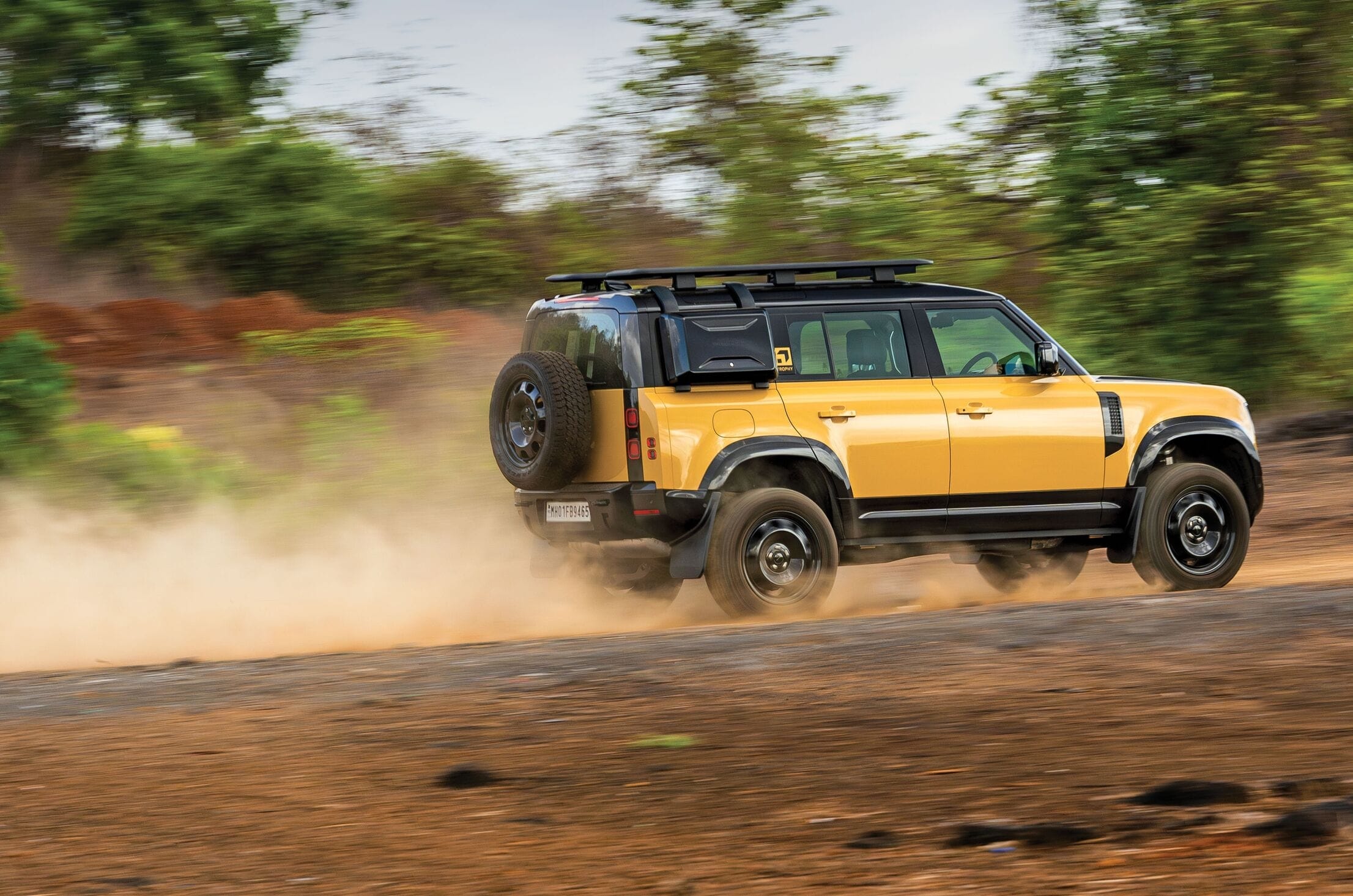
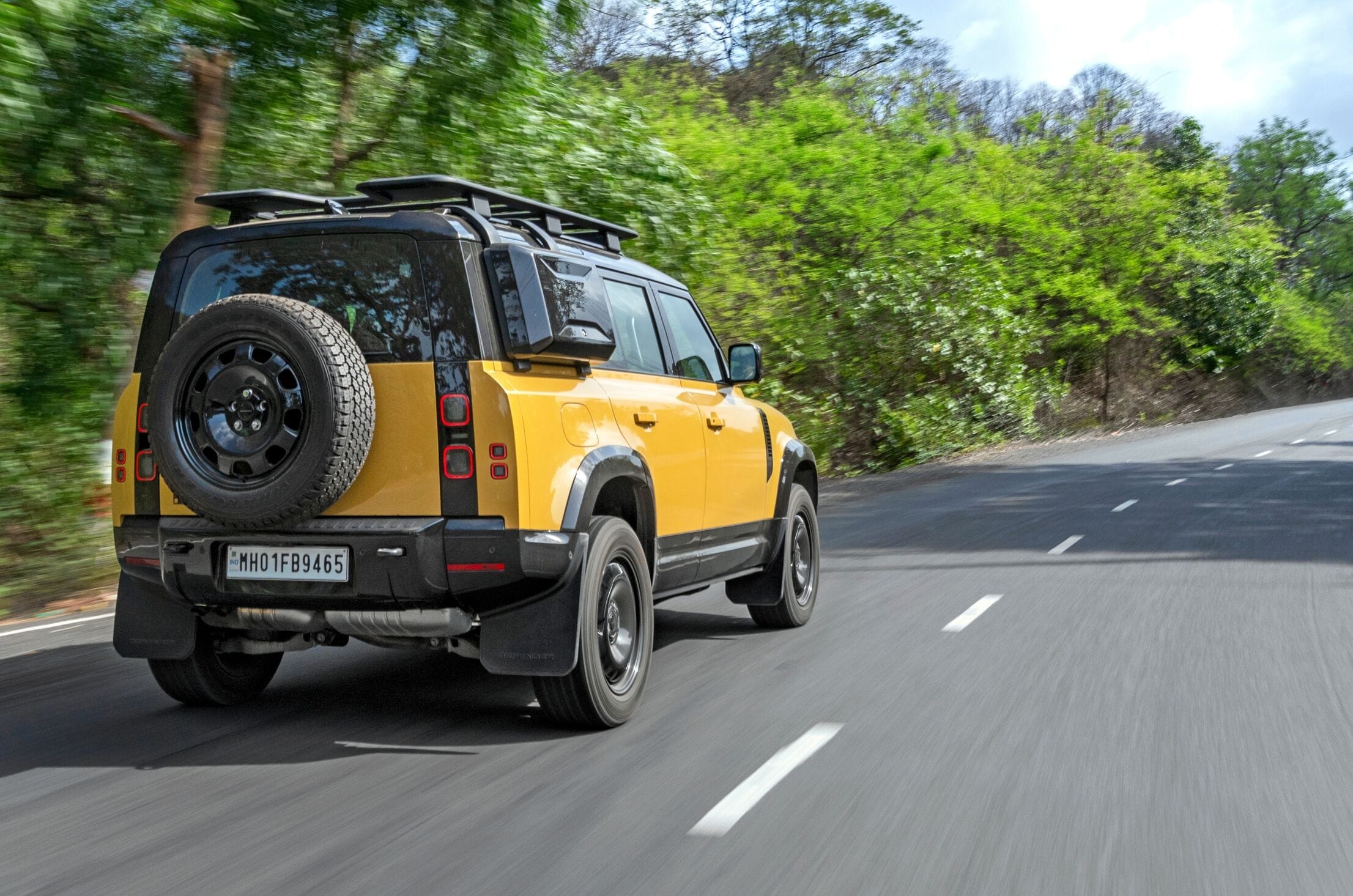
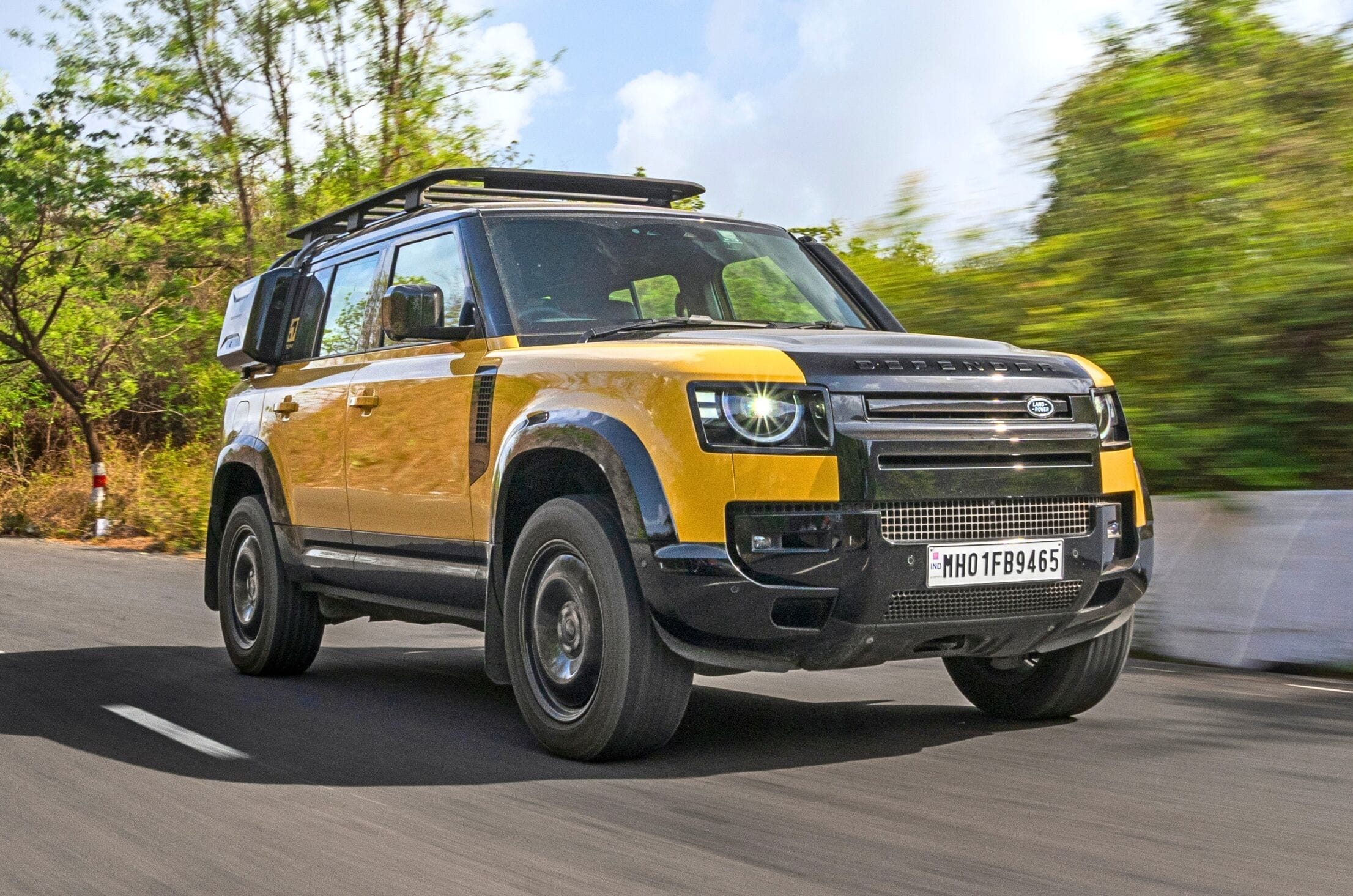
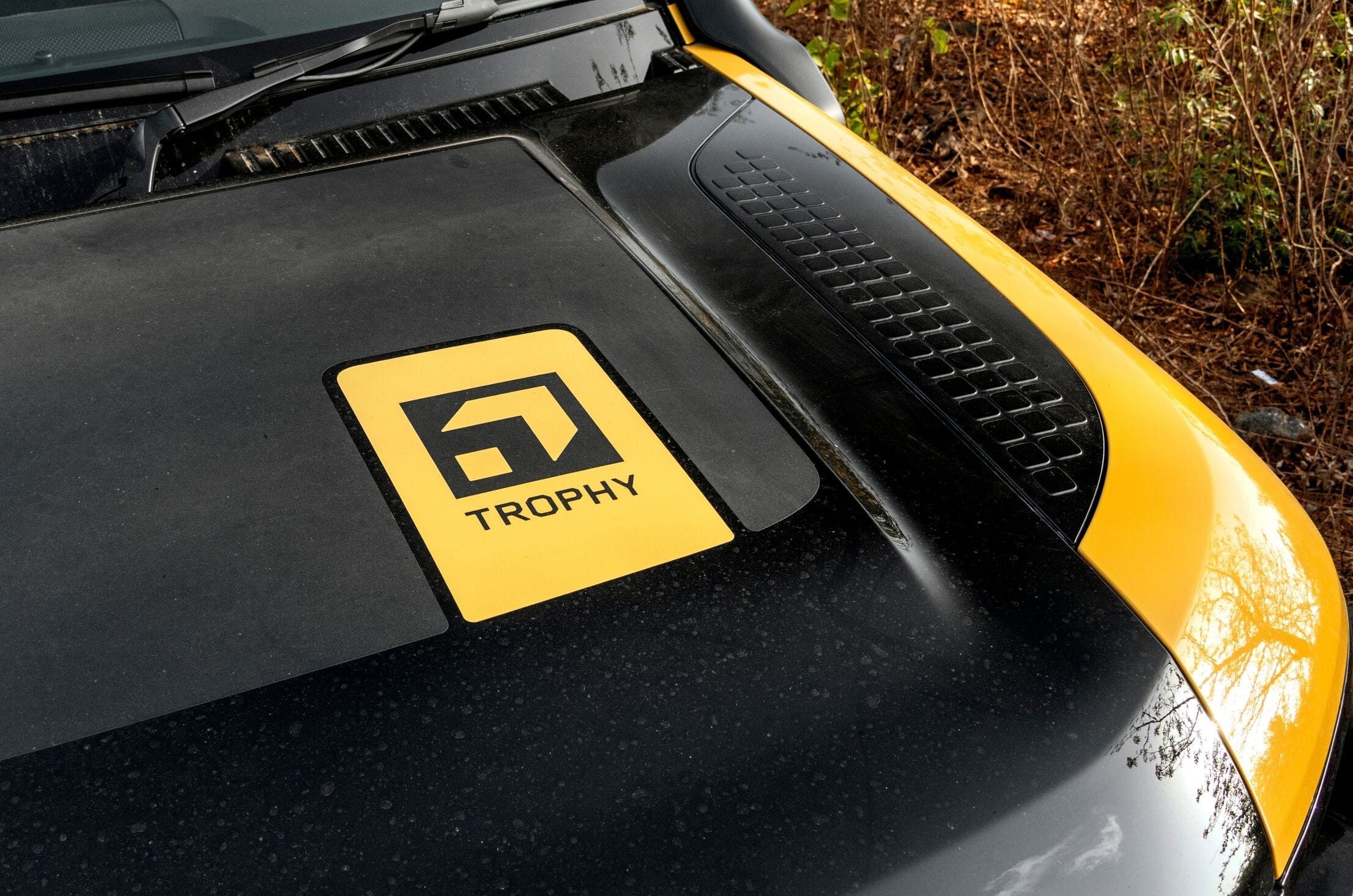
The Defender’s design hasn’t changed since it launched in 2020, but it certainly isn’t wanting for a facelift. It still looks fresh and modern with subtle nods to the original, without resorting to an overtly retro aesthetic. The Trophy Edition brings a choice of Deep Sandglow Yellow or Keswick Green – the former being the signature finish of the iconic Camel Trophy cars – with gloss black on the roof, bonnet, cladding and lower bumper for contrast. To go with the rugged look, it rides on all-terrain rubber shod 20-inch wheels that mimic steelies but are actually alloys. Additionally, there is Trophy branding on the bonnet, C-pillar and tailgate.
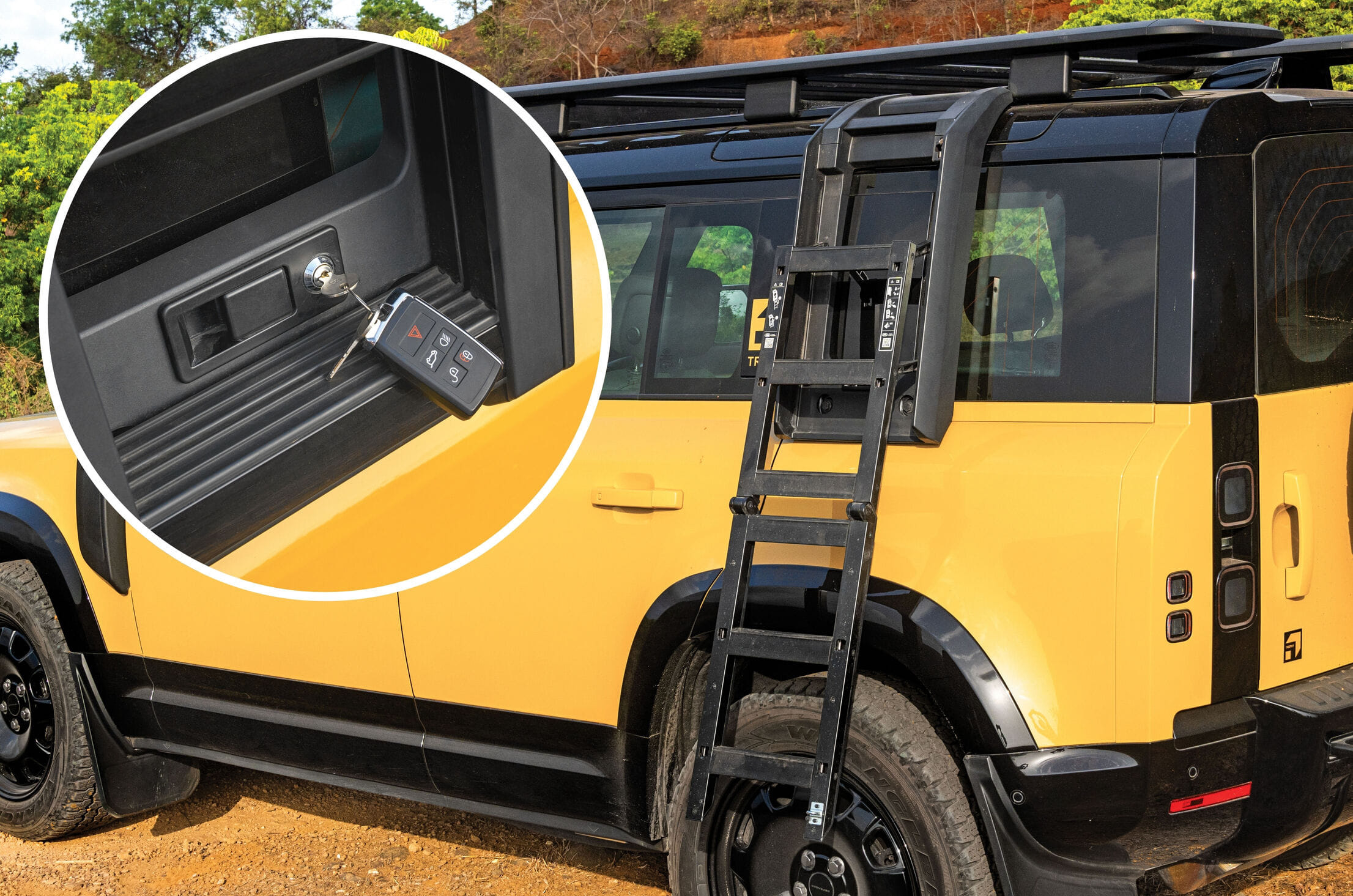
Sturdy ladder rated for 110kg; needs a seperate key to unlock.
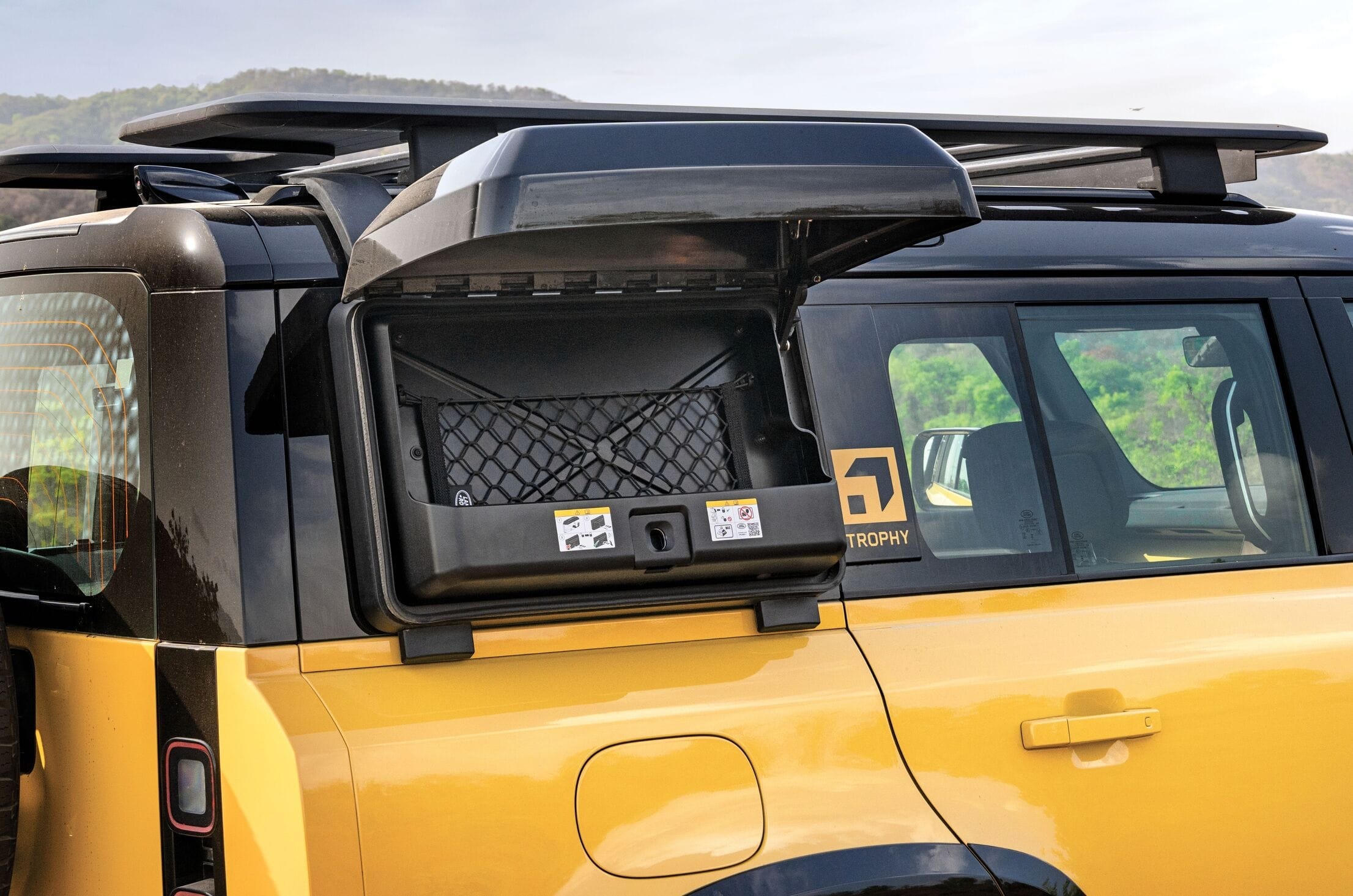
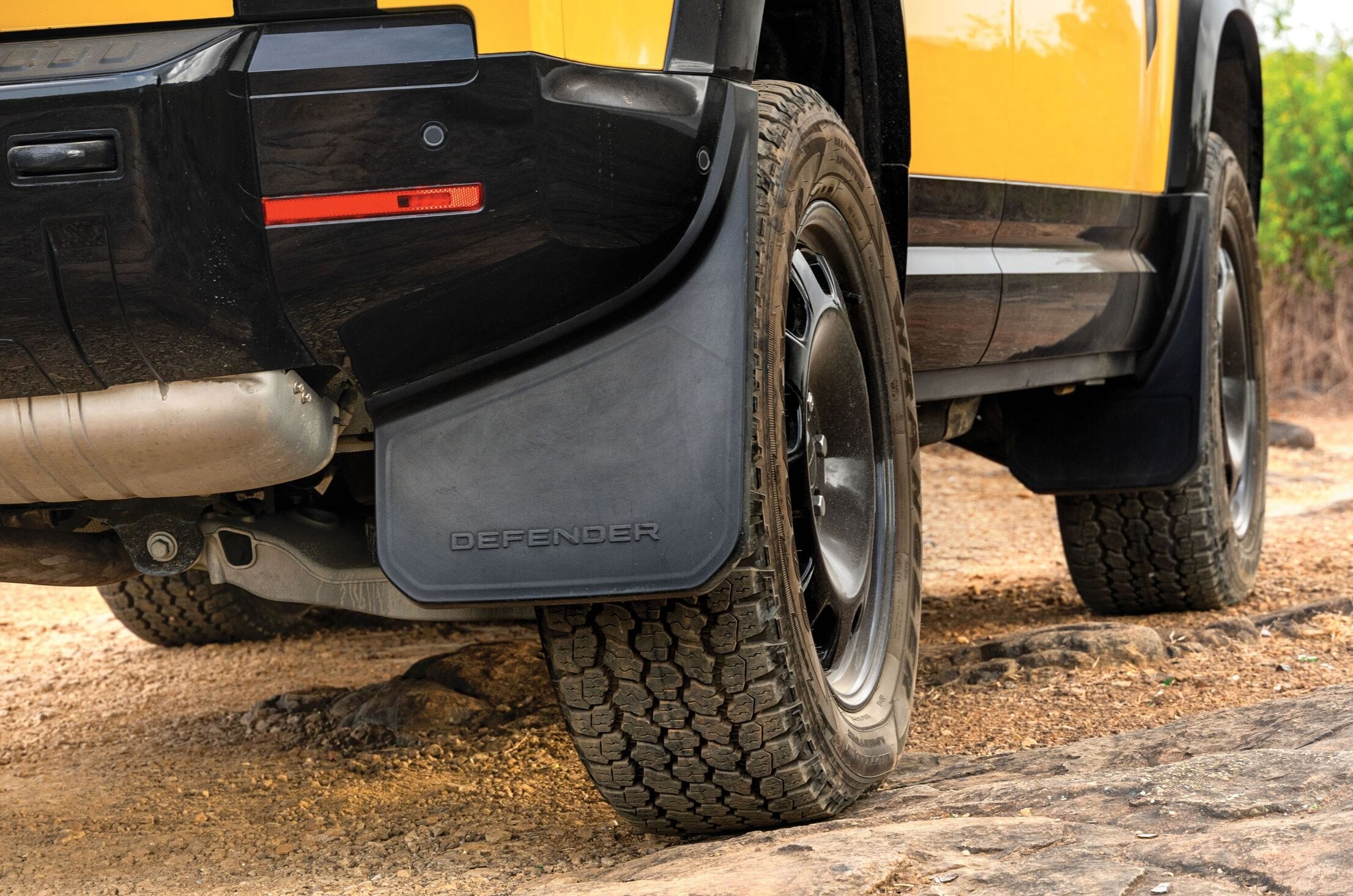
This particular example is also equipped with the optional Rs 5.35 Lakh Trophy Pack, which brings a roof rack, with a ladder to reach it on one side and an external storage box on the other. There’s big flexible mud flaps and a raised air intake – though it doesn’t raise the already lofty 900mm water wading ability, but helps with keeping sand out during dune bashing. All of this kit can be optioned on the regular Defender too, but here it ties in rather well with the whole Amazonian adventurer theme.
Land Rover Defender Trophy Edition interior space and comfort – 7/10
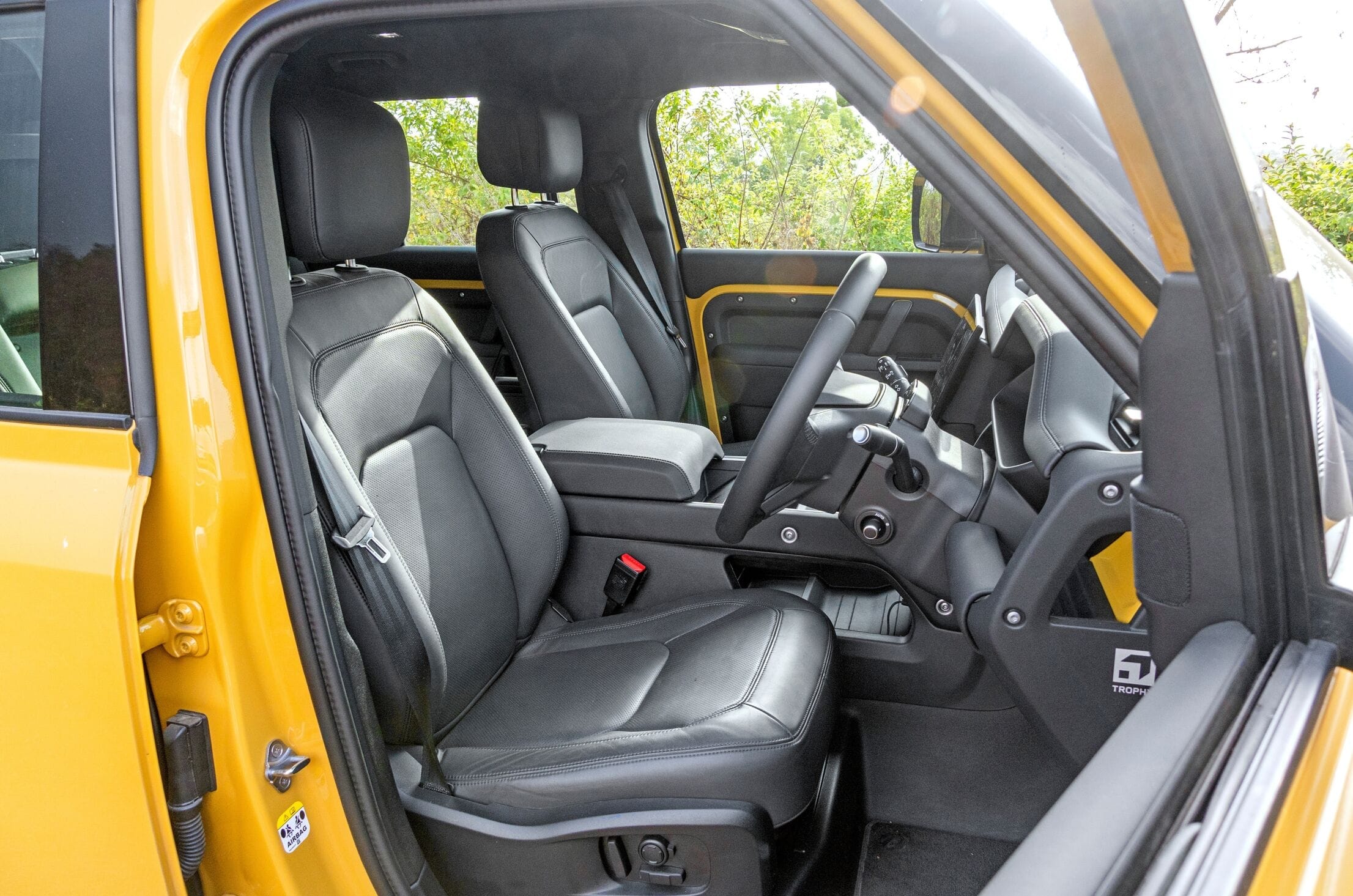
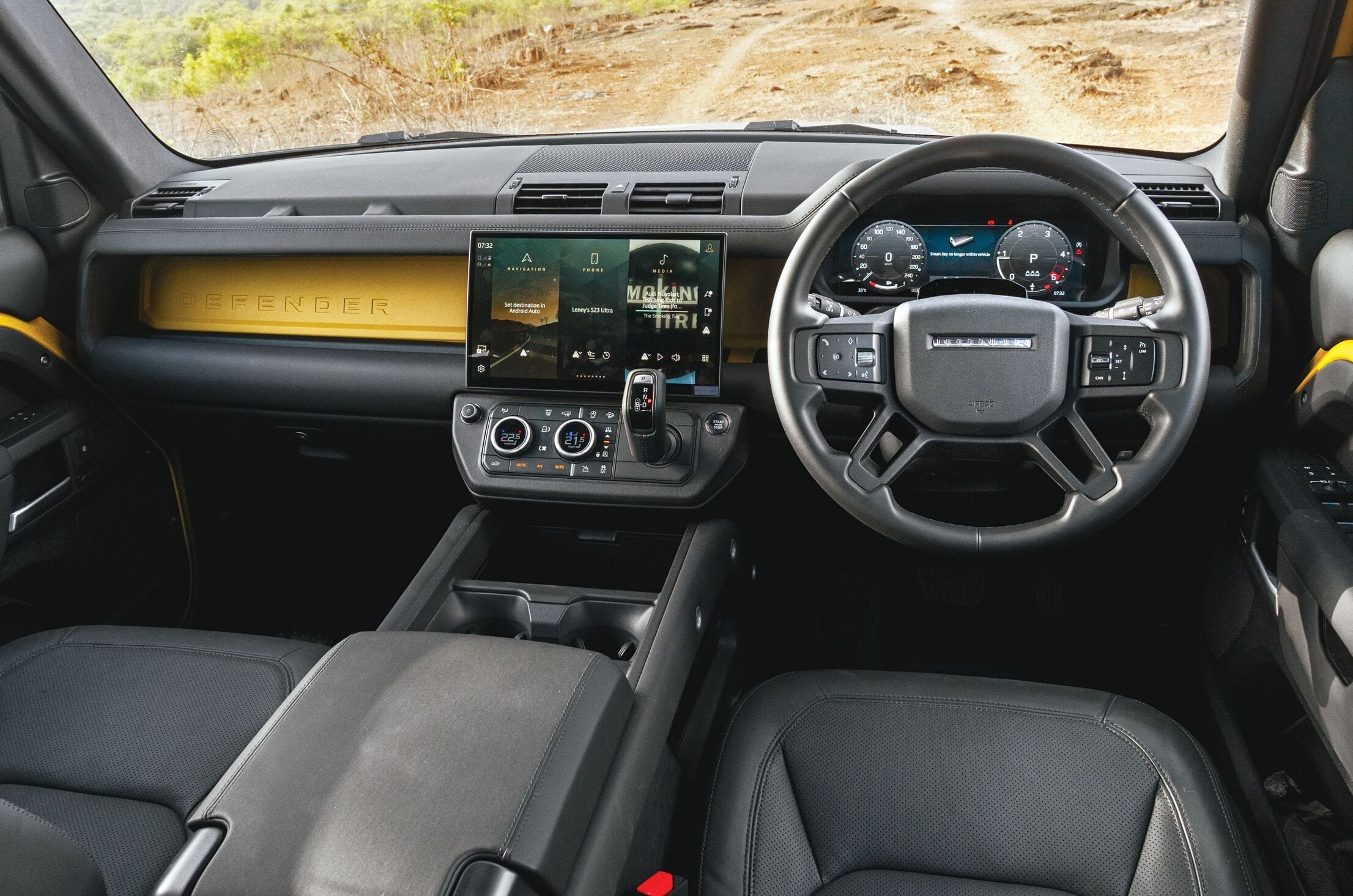
Electric front seats offer heating and ventilation.
Inside, it is standard Defender fare apart from some body-coloured trim on the dash, while the rest is finished in black. Comfort up front is excellent, with a lofty driving position that has you towering over conventionally large SUVs. The seat itself is wide and comfortable, with electrical adjustment as well as ventilation. The dashboard and centre console offer plenty of utility and storage spaces, while the quality of materials and finish elevates the premium quotient.
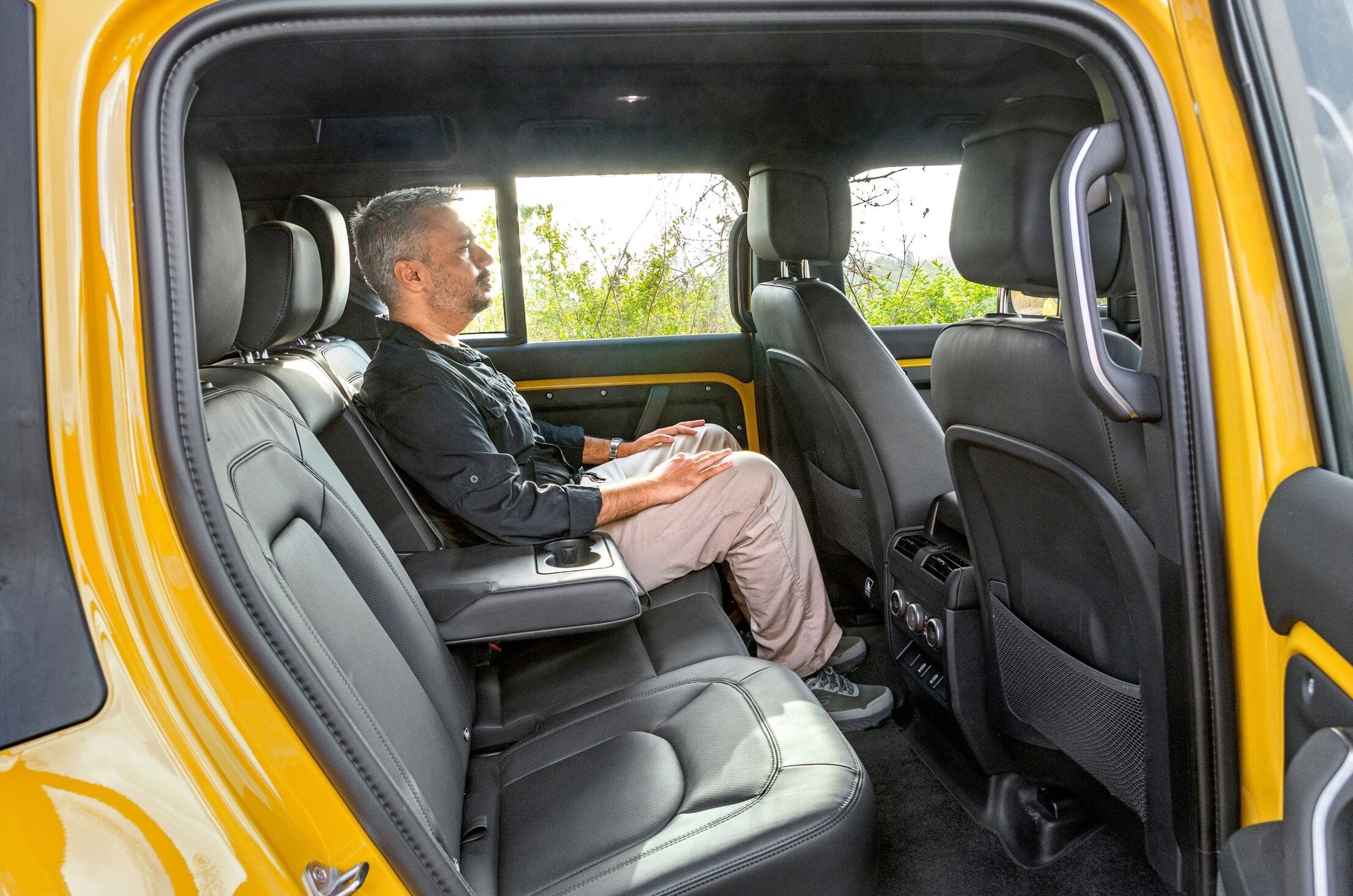
The rear is spacious and comfy, but climbing in takes effort.
For those who prefer to be chauffeured, the rear compartment is very comfortable and gets its own climate zone. There is plenty of room all around, and the bench is wide and supportive. It is, however, a task climbing into the Defender, even with the air suspension at its lowest position. Cargo room is also vast, with 786-litres of space with the second row up, expandable to 1875-litres with it stowed.
Land Rover Defender Trophy Edition features and safety – 8/10
Based on the X-Dynamic HSE, the Trophy Edition is also very well equipped, with highlights including a sharp 13.1-inch infotainment system, Meridian sound system and a panoramic sunroof. However, some of the serious off-road kit from the X trim, like air suspension, the Electronic Active Differential and Terrain Response 2, are optional extras.
Box for items you don’t want soiling the boot.
Safety is also well taken care of, with 6 airbags, Dynamic Stability Control, Roll Stability Control and Hill Descent Control. A sharp 360-degree parking camera helps when guiding this big SUV through tight spaces, and while adaptive cruise control is offered, other ADAS features like lane keep assist and autonomous emergency braking are not available in India.
Land Rover Defender Trophy Edition performance and refinement – 9/10
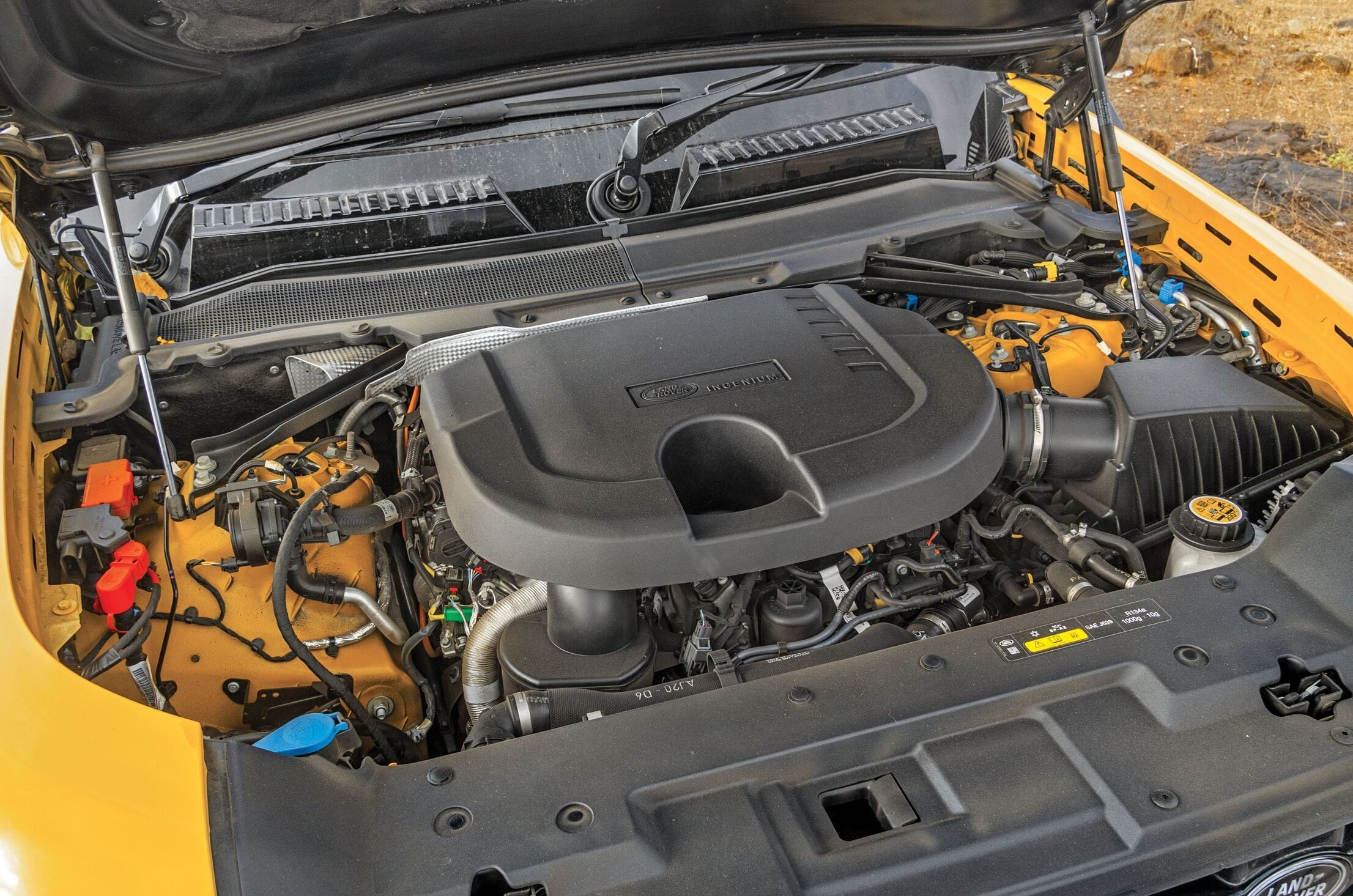
D350 diesel makes more torque than the P425 5.0L supercharged V8.
Under the hood is the 3.0-litre inline-six twin-turbo diesel from the Ingenium family, which makes 350hp and a whopping 700Nm – only the Octa beats it on torque, and that too by just 50Nm. Sending power to all four wheels is a slick 8-speed auto, which at times feels like too many cogs. At highway speeds, most overtakes are completed without the need for a downshift, and at city speeds merely tickling the throttle is enough to keep up with traffic. Push the right pedal harder, though, and it quickly drops a cog, the bonnet rises, and it accelerates as hard as you’d ever really need to in something this big.
Optional air springs iron out rough trails remarkably well.
A quick Vbox test confirmed a 0-100kph time of 6.79sec – slightly slower than the claimed time of 6.4sec. 20-80kph is dispatched in an equally rapid 4.19sec, while 40-100kph takes 4.98sec. Refinement is good too, and not just for a diesel. Outside the vehicle, the diesel clatter is very muted at idle, while inside, most passengers won’t be able to tell they’re in an oil burner. As revs rise, so do the decibels, but it sounds muscular and rather pleasant for a diesel. One gripe is at highway speeds, there is noticeable wind noise from the bolted-on accessories.
Land Rover Defender Trophy Edition range and efficiency – 7/10
While we didn’t get a chance to put it through our real-world fuel-efficiency run, the diesel is comfortably the most frugal of all the available Defender powertrains. On a steady highway run, it will regularly deliver double-digit fuel economy, which means the 89-litre tank will take you pretty far between fill-ups.
Land Rover Defender Trophy Edition ride comfort and handling – 8/10
The diesel feels like a natural fit for the Defender’s use case.
Our test car was equipped with air suspension, which is an option well worth ticking. Not only does it bring the ability to raise the car to clear obstacles or lower it to make getting in and out easier, but the ride is also superb. It feels very absorbent even on the roughest patches, and keeps the body quite flat and the cabin nicely isolated.
While it certainly has no sporting pretensions, it feels surprisingly fluid through corners too. There is no escaping the body roll, but it feels well controlled, surefooted and rather enjoyable to hustle. Also noteworthy is the steering; the large-diameter wheel feels great to hold and steer with, and the effort is perfectly weighted to boot.
Mudflaps suit the theme.
Off-road ability is a strength, but what’s impressive is the ease with which it conquers the rough stuff. Terrain Response offers presets for different surfaces, and advanced users can even configure individual settings, but generally leaving it in Auto works well enough for most scenarios. Low range will only ever need to be engaged to clear the sort of challenges that used to be thrown at Camel Trophy participants. Its size is intimidating off-road, but the array of cameras, including a transparent bonnet function, does help maneuverability.
Land Rover Defender Trophy Edition price and verdict – 8/10
At Rs 1.30 crore, the Trophy Edition is just over a lakh more than the X-Dynamic HSE. While that isn’t a lot of extra outlay in this context, what it buys you is essentially a unique paint scheme. If the history of the Camel Trophy, the exclusivity and the aesthetics appeal to you, this might seem like a bargain, but to others, that money would be better spent on the off-road packs.
But if getting muddy isn’t your thing, the standard Defender is still charming enough to seduce most. With the 6-cylinder petrol discontinued, this D350 diesel is now the default recommendation – much more performance than the 2.0-litre four-pot and way more frugal than the 5.0-litre V8. Sure the V8 has a greater sense of occasion, but the diesel feels like a more natural fit for the Defender’s use case – ergo, the sweet spot.
Skyroot Vikram-1 Update: भारत के अंतरिक्ष इतिहास में आज 18 जुलाई का दिन एक स्वर्णिम अक्षरों में दर्ज होने जा रहा है। देश की निजी स्पेस एजेंसी स्काईरूट एयरोस्पेस अपने पहले पूर्ण विकसित और स्वदेशी ऑर्बिटल-क्लास (कक्षीय श्रेणी) रॉकेट विक्रम-1 को लॉन्च करने के लिए पूरी तरह तैयार है। इस ऐतिहासिक मिशन को मिशन आगमन नाम दिया गया है। ये वैश्विक लॉन्चिंग कारोबार में भारत के प्राइवेट सेक्टर की धमाकेदार एंट्री का प्रतीक बनने जा रहा है। यह पहली बार होगा जब पूरी तरह से किसी निजी कंपनी द्वारा डिजाइन और विकसित किया गया ऑर्बिटल-श्रेणी का रॉकेट भारतीय धरती से अंतरिक्ष के लिए उड़ान भरेगा।
आइए जानते हैं इस ऐतिहासिक लॉन्चिंग से जुड़ी हर छोटी-बड़ी जानकारी और आप इसे घर बैठे लाइव कैसे देख सकते हैं।
कब और कहां से होगी लॉन्चिंग?
विक्रम-1 रॉकेट की यह पहली टेस्ट फ्लाइट आज यानी शनिवार को सुबह 11:30 बजे उड़ान भरेगी। यह 7 मंजिला ऊंचा रॉकेट आंध्र प्रदेश के श्रीहरिकोटा में स्थित भारतीय अंतरिक्ष अनुसंधान संगठन (ISRO) के सतीश धवन अंतरिक्ष केंद्र (SDSC-SHAR) के ऐतिहासिक ‘प्रथम लॉन्च पैड’ से गरजना भरते हुए अंतरिक्ष की ओर रवाना होगा।
घर बैठे कहां और कैसे देखें लाइव लॉन्चिंग?
यदि आप भारत के इस ऐतिहासिक पल का गवाह बनना चाहते हैं, तो स्काईरूट एयरोस्पेस इस पूरे इवेंट की लाइव स्ट्रीमिंग करने जा रहा है। कंपनी ने अपने आधिकारिक X हैंडल पर जानकारी दी है कि भारत के इस पहले प्राइवेट ऑर्बिटल लॉन्च को आज YouTube पर लाइव देखा जा सकता है। आप नीचे दिए गए आधिकारिक लिंक पर जाकर अपना रिमाइंडर सेट कर सकते हैं और सीधे लाइव लॉन्चिंग देख सकते हैं-
इस मिशन की सबसे खास और अनोखी बात यह है कि ‘विक्रम-1’ अपने साथ देश के प्रधानमंत्री नरेंद्र मोदी का एक बेहद खास संदेश लेकर अंतरिक्ष जा रहा है। स्काईरूट एयरोस्पेस के मुताबिक, इस टेस्ट फ्लाइट के विशेष पेलोड में प्रधानमंत्री नरेंद्र मोदी द्वारा अपने हाथों से लिखा गया एक पोस्टकार्ड शामिल है। इस पोस्टकार्ड पर वंदे मातरम लिखा हुआ है जिस पर पीएम मोदी के हस्ताक्षर भी मौजूद हैं। इस हस्तलिखित पोस्टकार्ड पर 26 जून 2026 की तारीख दर्ज है।
A historic new frontier for India’s space journey!
At 11:30 AM today, Skyroot Aerospace will undertake the maiden orbital launch of Vikram-1, India’s first privately developed launch vehicle.
This four-stage rocket is designed to provide rapid and on-demand launch services.… pic.twitter.com/1qFVTwNOuZ
कितना शक्तिशाली है ‘विक्रम-1’ और क्या है इसकी खासियत?
इस रॉकेट का नाम भारत के अंतरिक्ष कार्यक्रम के जनक माने जाने वाले महान वैज्ञानिक डॉ विक्रम साराभाई के नाम पर रखा गया है। नवंबर 2022 में स्काईरूट द्वारा लॉन्च किए गए विक्रम-एस सबऑर्बिटल रॉकेट की सफलता के बाद यह कंपनी का अगला सबसे बड़ा मील का पत्थर है। विक्रम-एस केवल सबऑर्बिटल फ्लाइट पर गया था (जो कुछ समय के लिए अंतरिक्ष में जाकर वापस आ गया था) लेकिन विक्रम-1 एक ऑर्बिटल लॉन्च व्हीकल है। इसका मतलब है कि यह सैटेलाइट्स को अंतरिक्ष की एक निश्चित और स्थिर कक्षा में स्थापित करने में सक्षम है।
इस मिशन के तहत रॉकेट का लक्ष्य 60° झुकाव पर 450 किलोमीटर की लो अर्थ ऑर्बिट (LEO) तक पहुंचना है। यह रॉकेट 350 किलोग्राम तक के छोटे सैटेलाइट्स को अंतरिक्ष की निचली कक्षा (LEO) में ले जाने के लिए खास तौर पर डिजाइन किया गया है। 7 मंजिला ऊंचे इस बहु-चरणीय रॉकेट का निर्माण पूरी तरह से कार्बन-मिश्रित संरचना से किया गया है। इसे ताकत देने के लिए कंपनी का खुद का प्रोपल्शन सिस्टम लगा है जिसमें 3D-प्रिंटेड इंजन और हाई-थ्रस्ट सॉलिड-फ्यूल रॉकेट बूस्टर शामिल हैं।
इस टेस्ट फ्लाइट का मुख्य उद्देश्य क्या है?
स्काईरूट एयरोस्पेस के अनुसार, 18 जुलाई की यह उड़ान मुख्य रूप से एक टेक्नोलॉजी डेमोंस्ट्रेशन (तकनीकी प्रदर्शन) फ्लाइट है। इसका मुख्य मकसद यह जांचना है कि स्काईरूट की बनाई गई तकनीक और उसके ऑनबोर्ड सिस्टम असल उड़ान की परिस्थितियों में कैसा प्रदर्शन करते हैं। इस मिशन के दौरान जो भी डेटा मिलेगा, उसका इस्तेमाल कंपनी अपनी तकनीक को गहराई से सीखने, उसमें सुधार करने, भविष्य के वर्शन्स को और बेहतर बनाने और नियमित लॉन्च ऑपरेशन्स स्थापित करने की अपनी योजनाओं को सहारा देने के लिए करेगी।
इस ऐतिहासिक मिशन में भारतीय और अंतर्राष्ट्रीय अंतरिक्ष कंपनियों जैसे ग्रेहा स्पेस, डीक्यूब्ड और कॉस्मोसर्व के कई तकनीकी प्रदर्शन पेलोड भी शामिल हैं, जो देश के स्पेस इकोसिस्टम में प्राइवेट प्लेयर्स की बढ़ती ताकत को दर्शाते हैं।
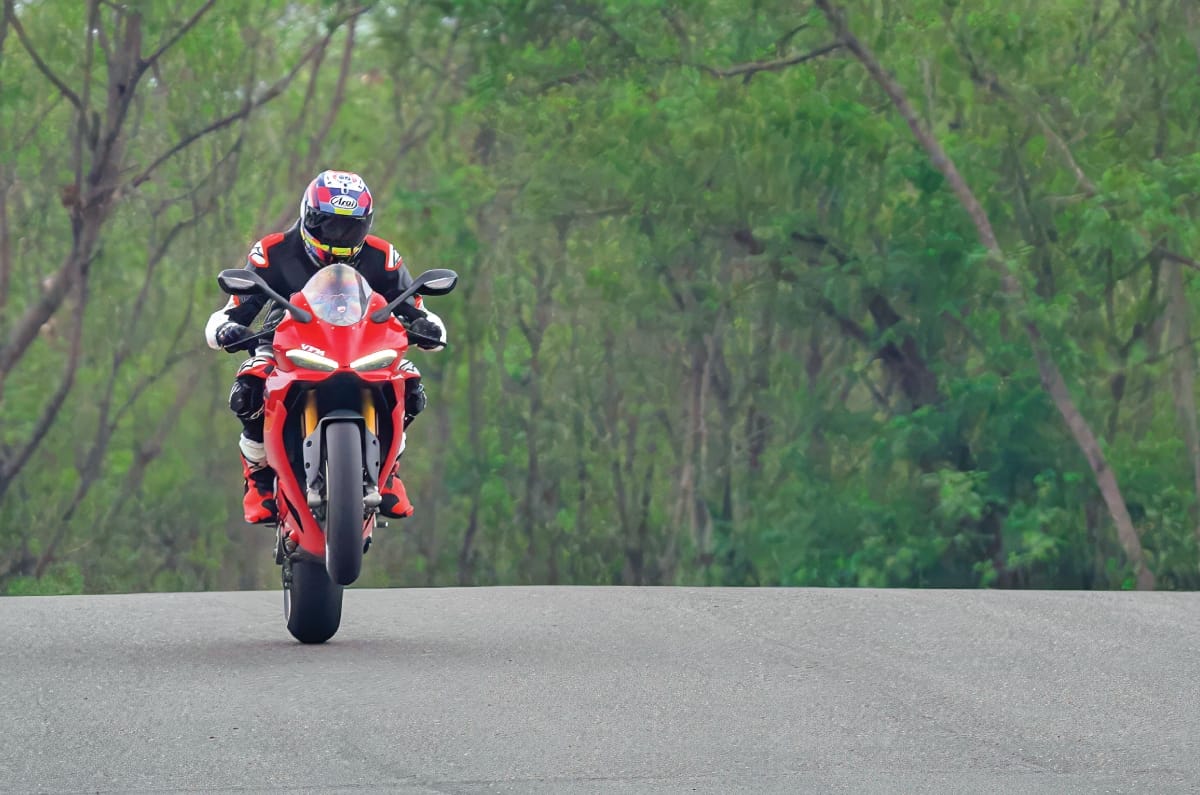
A sensible Panigale. Can such a thing even exist, and more importantly, should it? This was a consistent thought I grappled with in the approach to riding this bike. After all, on paper, it seems like a big step away from the previous-gen Pani V2. Yes, it lost a lot of weight, which is great, but it also dropped down from a solid 155hp to ‘just’ 120hp.
Not love at first sight
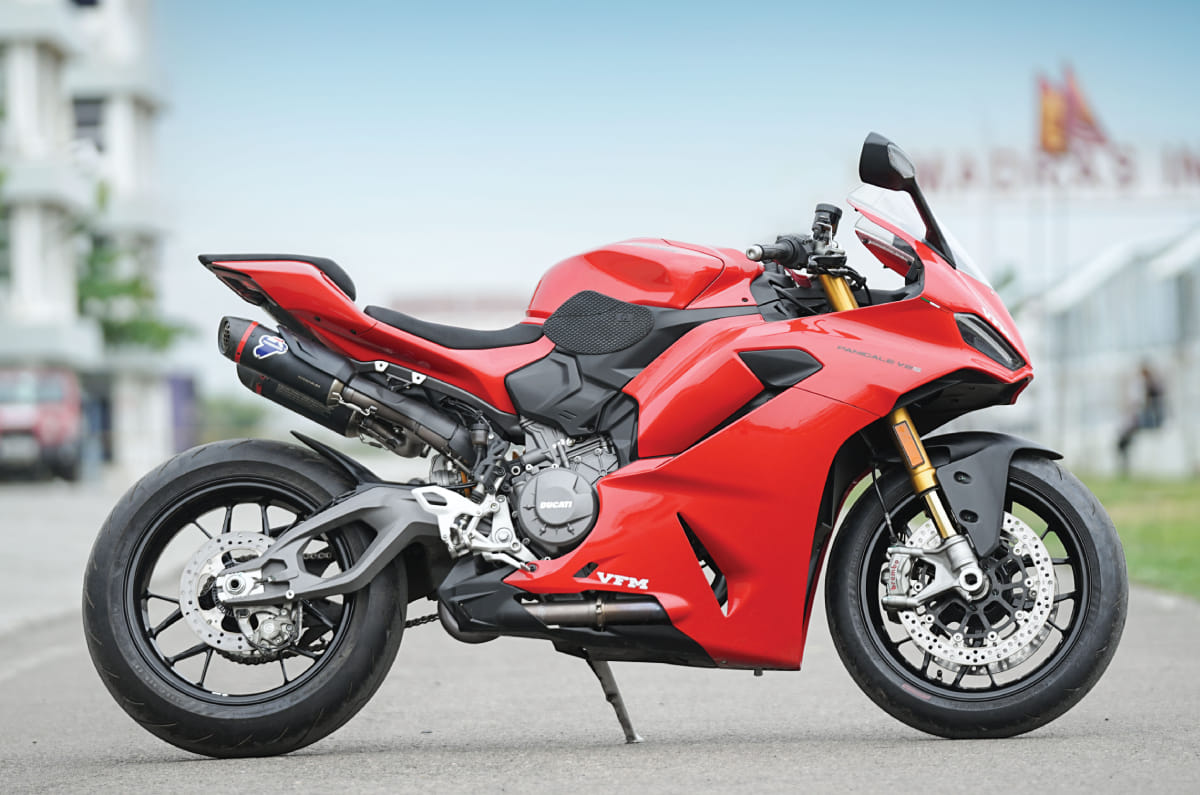
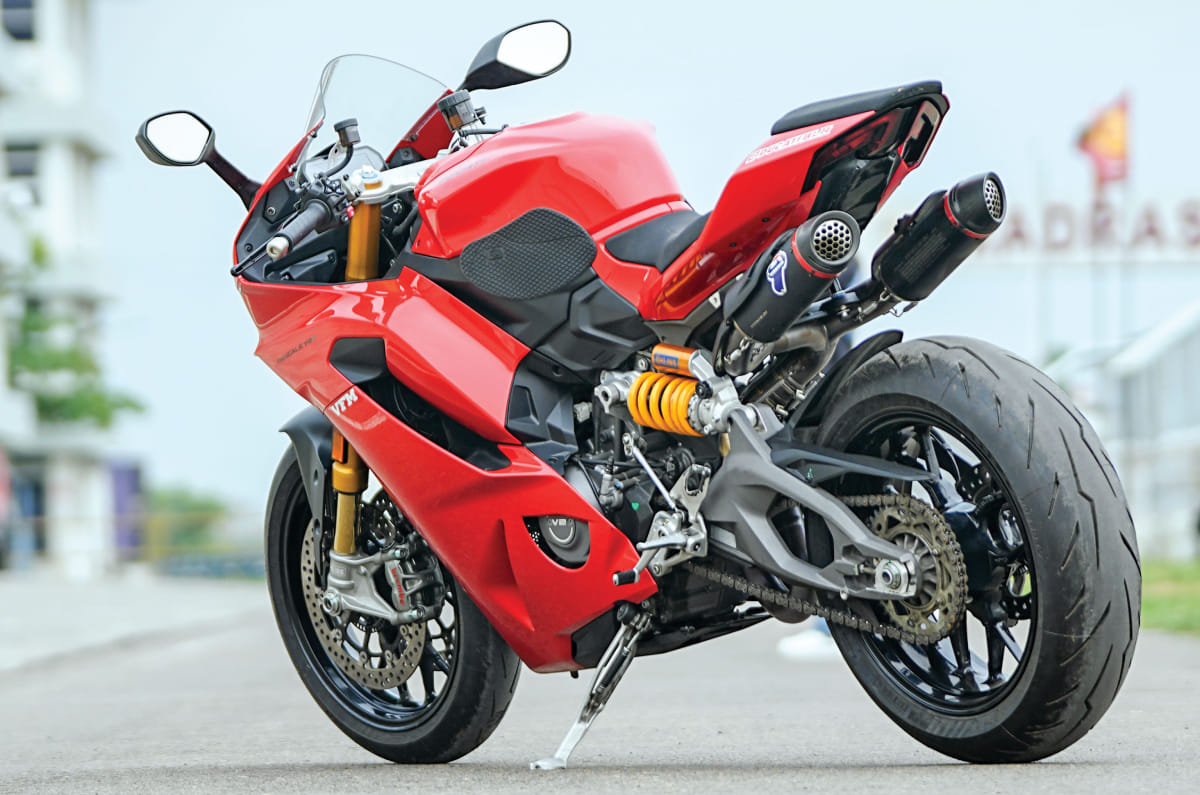
It’s not like these thoughts are lost when you first spot the bike in person. There are some beautiful details to take in at a close glance, including that crafted swingarm, the gorgeous monoshock mounts and that sculpted fairing. But step back, and it’s just missing something – the drop-dead gorgeous sex appeal that the Panigale name is supposed to carry simply isn’t there. The design is almost an amalgamation of a Panigale and a SuperSport 950; and given that the latter is no longer made, perhaps that explains it. Hmm.
The design is not as stunning as its predecessor.
Swing a leg over the tall 837mm seat, and you’ll be greeted by ergonomics that reflect the SuperSport design vibes, with surprisingly high and wide bars and footpegs lower than you’d expect. As a tall human with poor flexibility and shameful levels of fitness, this is something you won’t hear me complain about. But it does further drive home the point of just how different this new Panigale is.
Unexpected impressions
Anyhow, time has taught me that sometimes it’s best to stop thinking and let the bike do the talking. On the first lap out, my immediate impression was one that you will read in no review of this motorcycle anywhere in the world – it felt heavy! This is exactly the opposite of what anyone would normally think, because the new V2 has had a massive weight loss, and I knew that this problem was entirely in my own head. After all, I’d just spent the previous day riding a mind-bendingly light, 132kg, national championship-winning Pro Stock RACR race bike.
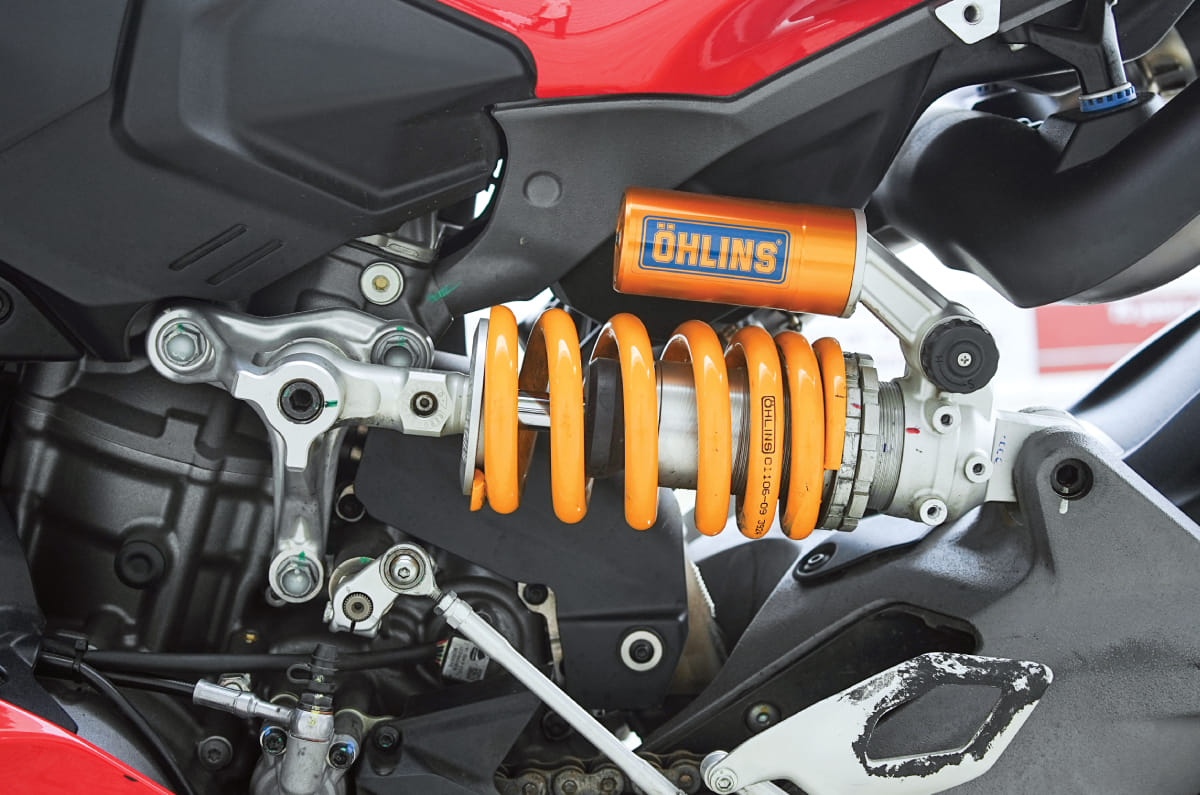
The S variant gets Öhlins suspension.
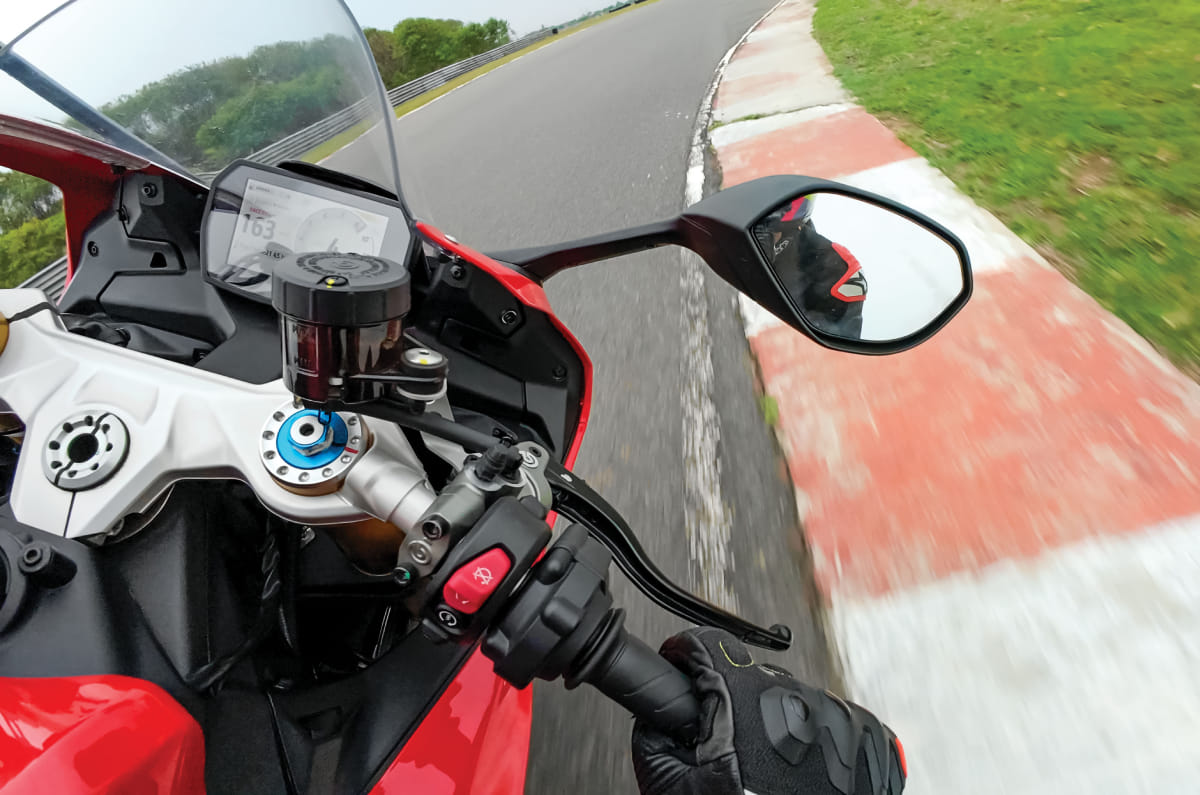
What was not just in my head was that something could improve with the suspension setup. It felt way too soft, and the bike wasn’t gelling with the Madras International Circuit’s many bumps. With some help from racing legend Rajini Krishnan and the super-helpful folks at Ducati Chennai, we dialed in the manually adjustable Öhlins (only on this S model), and I headed out for my second track session. This time, things felt much better, and the bike behaved more predictably over bumps. I got a real confidence boost after the session ended when I saw the lap times. In just the second session of the day, I’d gone faster than I managed all of the previous day on the race bike. That was unexpected!
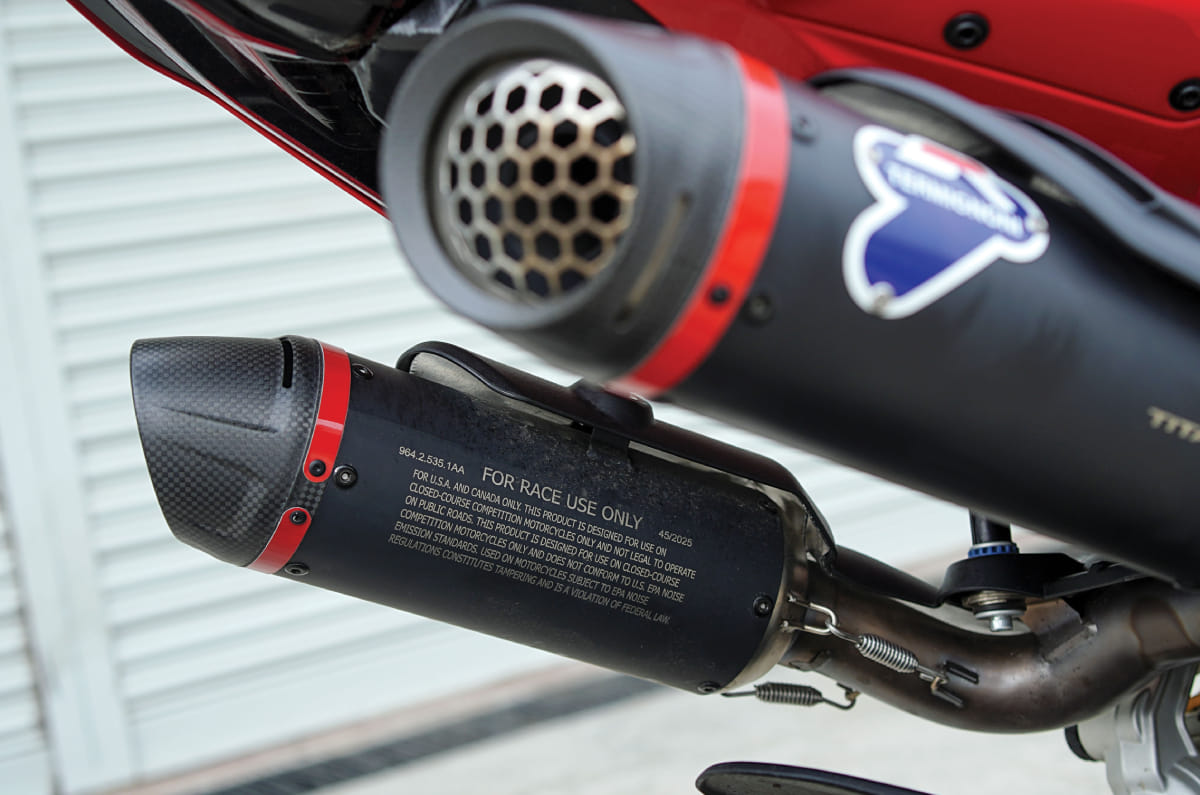
Termignoni exhaust sounds fab, but is for track use only and will set you back by Rs 3.64 lakh.
It all makes sense
To have broken just under the 2min barrier at the MIC so quickly was a revelation about how easy and encouraging this bike was to ride. This character was extra valuable in the brutally hot and humid weather one gets treated to in Chennai in May. But for all the comfort from the relatively kind ergos, I felt no limitations in pushing the bike to my limits. The only area that needed caution was in not putting unwanted leverage into the tall and wide handlebars, which was easy to do in certain situations.
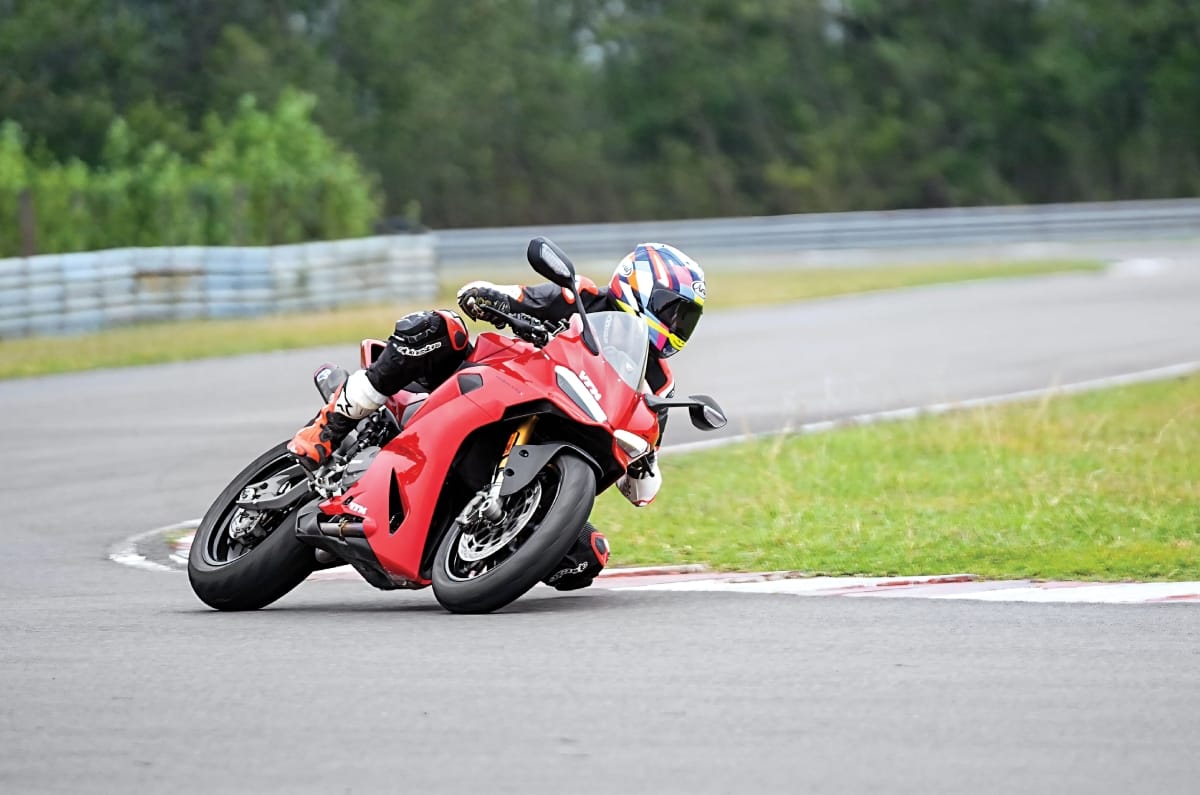
The best way to sum up the V2’s handling is friendly and forgiving. It turns when you ask and exactly how you expect, which is great for confidence. The light handling, as well as the bike’s ability to forgive poor or corrective inputs from the rider, is what I fell in love with, along with the fact that it’s not as exhausting to ride as a proper crotch rocket can be. The seating position is also quite spacious for taller riders, and it’s easy to hold onto the bike as well, thanks to more grippy footpegs than on the bigger V4.
I ended the day setting 1min:56s lap times, which is quite quick, but nowhere close to professional racer pace. Incredibly talented riders like that will probably want more committed riding positions and perhaps firmer suspension, but for the rest of us ‘normies’, this new V2 is a spicy treat on the track while remaining easy to digest.
Baby boomer
The new 890cc 90-degree V-twin engine plays a big role in this. The lower power is a downer on paper, but man does this engine impress in person. It feels light, quick revving and goes up surprisingly high, making peak power at 10,750rpm before the limiter kicks in at around 11,000rpm. But meeting that limiter was a rare occurrence because the 93.3Nm of torque was so rich and easy to access that the engine didn’t need to be constantly screaming at the limit. With the low 187kg kerb weight, the V2 was quick enough to just kiss 200kph on the display before some of the braking zones. That’s not bad considering the MIC has no massive straights, and you never see 6th gear here on a bike like this.
This particular dealer bike was also garnished with an official Ducati accessory exhaust. This carbon-fibre beauty from Italian specialist Termignoni produces a delicious bark on track that really elevates the riding experience, especially on rapid usage of the bi-directional quickshifter. The downsides are that it’s not road legal and it will set you back by a further Rs 3.63 lakh.
Braking is handled by twin front discs bitten down on by Brembo M50 calipers. These aren’t the latest or greatest in the world of production bike brakes, which is disappointing on such an expensive bike, but there is no doubt that they work very well. The Pirelli Diablo Rosso 4 tyres are just about okay for fast track work, and you’d undoubtedly find more confidence on more appropriate tyres. Nevertheless, like all Ducatis, the new V2 has comprehensive and excellent rider aids – keeping the traction control on at a lower level provided some valuable peace of mind when cracking open the gas at big lean angles.
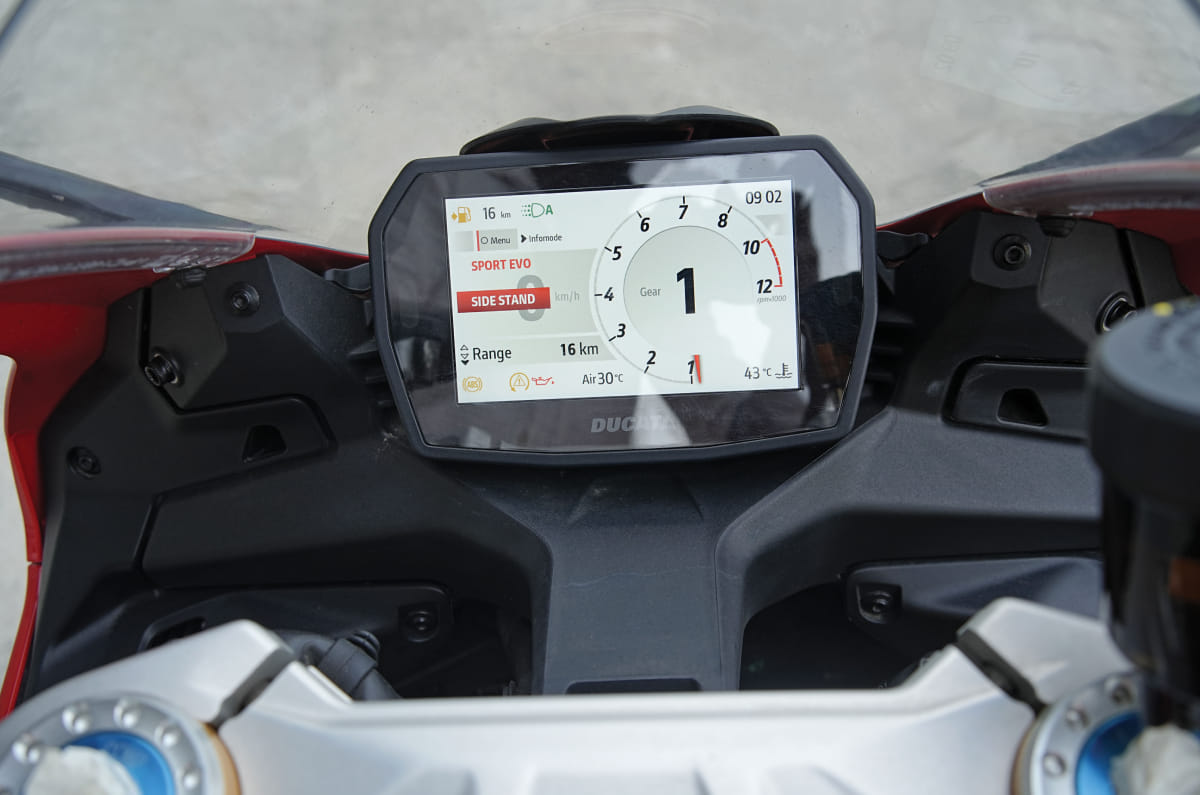
TFT dash is easy to read and use but a bit small.
If you can
At Rs 21.53 lakh for this S model (Rs 19.5 lakh for the standard V2), value is not a part of this conversation – as it has become with all Ducatis of late. A Rs 12.5 lakh Kawasaki ZX-6R will do a similar job for far less, although it lacks the Ducati’s advanced electronics and is a noticeable step down in the suspension and braking departments. In fact, the V2’s price is up there with proper 1000s like the ZX-10R and even the base BMW S 1000 RR.
Tempting as that may be, I have seen over the years that far too many folks jump onto 1000s at track days and then struggle. Those bikes are mind-blowingly capable and have the most spectacular spec sheets – but they also demand tremendous skill and fitness to satisfyingly exploit. Come to think of it, I myself have never jumped off a litre-class superbike on a racetrack feeling particularly good about myself as a rider…
But this smaller V2 bike is a revelation in that regard because it’s far easier to exploit, doesn’t completely overwhelm you physically and, most importantly, leaves you feeling good! So, if you can afford it, I’d go so far as recommending this over a Panigale V4 for most people, especially those just getting into the track-riding scene.
It’s a fantastic little thing, and it has carved out a space in my money-no-object imaginary garage. Not a lot of bikes do that.
Poco जल्द ही भारत में अपने स्मार्टफोन लाइनअप में दो नए डिवाइस शामिल कर सकता है। हाल ही में आई एक लीक के अनुसार, Xiaomi का यह सब-ब्रांड आने वाले हफ्तों में देश में Poco M8 Power और Poco X8 लॉन्च कर सकता है। कहा जा रहा है कि ये दोनों हैंडसेट हाल ही में लॉन्च हुए Redmi Note 17 और Redmi Note 17 Pro के रीब्रांडेड वर्जन होंगे, जिनमें Poco की ब्रांडिंग के साथ वही पुराने हार्डवेयर देखने को मिलेंगे। हालांकि, कंपनी ने अभी तक लॉन्च की जानकारी नहीं दी है, लेकिन ताजा लीक से यह अंदाजा लग सकता है कि क्या उम्मीद की जा सकती है। यहां उन Poco स्मार्टफोन के बारे में सब कुछ बताया गया है जिनकी चर्चा हो रही है।
Poco M8 Power और Poco X8 की लॉन्च टाइमलाइन लीक
टिप्सटर योगेश बरार के अनुसार, चीनी स्मार्टफोन कंपनी Poco इस साल की मौजूदा तिमाही में Poco M8 Power और Poco X8 को भारत में लॉन्च कर सकती है। हालांकि, लॉन्च की सही तारीख का खुलासा नहीं हुआ है, लेकिन टाइमलाइन से पता चलता है कि ये स्मार्टफोन अगले कुछ हफ्तों या महीनों में लॉन्च हो सकते हैं।
लीक में यह भी दावा किया गया है कि ये दोनों मॉडल असल में Redmi Note 17 और Redmi Note 17 Pro के ही रीब्रांडेड वर्जन होंगे, जिन्हें हाल ही में चीन में लॉन्च किया गया है। बता दें कि Poco के लिए यह कोई नई रणनीति नहीं है, क्योंकि यह चीनी टेक कंपनी अक्सर कई ग्लोबल मार्केट में Redmi स्मार्टफोन को अलग-अलग नामों से लॉन्च करती रही है।
हालांकि, टिपस्टर ने यह भी संकेत दिया कि कीमत का अनुमान “खराब” है, जिससे पता चलता है कि भारत में मिलने वाले मॉडल की कीमत चीन में मौजूद Redmi मॉडल की तुलना में काफी ज्यादा हो सकती है।
POCO is alive again
2 new launches this quarter in India (both rebranded Note 17 series models)
माना जा रहा है कि Poco M8 Power का ज्यादातर हार्डवेयर Redmi Note 17 जैसा ही होगा। बता दें कि Redmi का यह डिवाइस इस महीने की शुरुआत में चीन में लॉन्च किया गया था, जिसकी शुरुआती कीमत 6GB RAM + 128GB स्टोरेज वाले वेरिएंट के लिए CNY 1,299 (लगभग 18,000 रुपये) थी।
रिपोर्ट्स के मुताबिक, यह फोन Qualcomm Snapdragon 4 Gen 4 चिपसेट पर चल सकता है और इसमें बड़ी 8,000mAh की बैटरी मिलने की उम्मीद है। इसके अलावा, यह भी कहा जा रहा है कि मार्केट के हिसाब से Poco M8 Power और Poco X8 में अलग-अलग Snapdragon चिपसेट हो सकते हैं, हालांकि अभी चिपसेट के बारे में कोई पक्की जानकारी नहीं है।
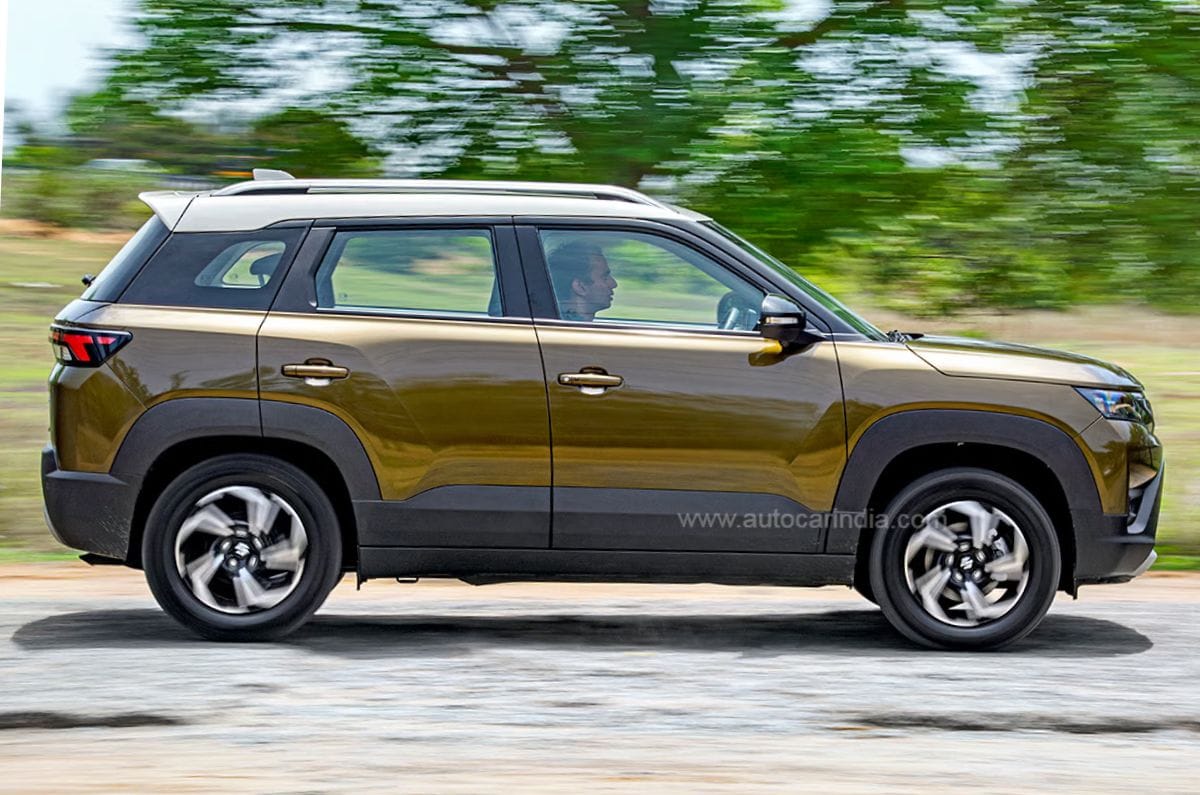
Ahead of its launch on July 24, 2026, specifications and features of the 2026 Maruti Brezza have been leaked on X (previously Twitter) via user @adityalala2000. The leak mentions a new turbo-petrol engine, along with new features and exterior paint options for the 2026 Maruti Brezza. Meanwhile, bookings of the Maruti compact SUV have already commenced.
2026 Maruti Brezza: What was leaked?
Uptuned Boosterjet engine, underbody CNG kit, and ventilated front seats to come on the 2026 Brezza
The updated Maruti Brezza is expected to get a 1.0-litre ‘Boosterjet’ turbo-petrol unit as the Fronx but in a higher state of tune. On the Brezza, it is likely to produce 110hp and 170Nm, which is 10hp and 26Nm more than the unit powering the Fronx. This engine would be paired to a manual transmission, likely a six-speed unit that was spied on a prototype model.
On the other hand, the 103hp, 139Nm 1.5-litre naturally aspirated petrol engine is expected to be retained along with its manual and automatic transmissions. A CNG kit paired to this engine could continue to be offered, but is expected to have the Victoris CNG-like underbody tank setup.
Additionally, the updated Brezza is likely to have new feature additions, including a larger 10.1-inch infotainment display with built-in apps and Alexa support, ventilated front seats, an air purifier, and 64-colour ambient lighting. New safety features are expected to include blind spot warning, rear cross traffic alert, front parking sensors, and a tyre pressure monitoring system. On the outside, the updated Brezza will likely arrive with an updated look for the bumpers. New monotone paint options, namely Vivacious Orange and Luster Beige, and new dual-tone options, with a black roof for the Arctic White and Luster Beige shades, are likely.