सोशल मीडिया पर एक वायरल पोस्ट ने एक बार फिर कॉर्पोरेट सेक्टर में नौकरी की सुरक्षा (Job Security) को लेकर बहस तेज कर दी है। पोस्ट में दावा किया गया कि एक कर्मचारी को अचानक ईमेल भेजकर नौकरी से हटा दिया गया, जिसके बाद इंटरनेट पर लोगों की प्रतिक्रियाओं की बाढ़ आ गई। इस घटना ने न केवल कंपनियों के कर्मचारियों के प्रति रवैये पर सवाल खड़े किए, बल्कि यह भी चर्चा शुरू कर दी कि क्या मौजूदा समय में बिना पूर्व सूचना या स्पष्ट संवाद के कर्मचारियों को नौकरी से निकालना एक सामान्य कॉर्पोरेट प्रथा बनती जा रही है। कई यूजर्स ने अपने अनुभव साझा करते हुए कहा कि आज के प्रतिस्पर्धी जॉब मार्केट में ऐसी घटनाएं पहले की तुलना में अधिक देखने को मिल रही हैं।
वहीं कुछ लोगों का मानना है कि कंपनियों और कर्मचारियों के बीच बेहतर संवाद और पारदर्शिता की जरूरत पहले से कहीं ज्यादा बढ़ गई है। इस वायरल पोस्ट ने रोजगार की स्थिरता और कॉर्पोरेट संस्कृति पर नई बहस को जन्म दे दिया है।
वायरल पोस्ट में क्या था?
X यूजर @coolcoder ने कथित तौर पर कर्मचारी हर्ष राणा को भेजे गए ईमेल का स्क्रीनशॉट साझा किया। पोस्ट के साथ उन्होंने लिखा, “बिना किसी चेतावनी या फीडबैक के नौकरी से निकाल दिया गया। क्या अब यह सामान्य बात हो गई है?” देखते ही देखते यह पोस्ट वायरल हो गई और हजारों यूजर्स ने अपनी राय रखनी शुरू कर दी।
ईमेल में क्या लिखा था?
स्क्रीनशॉट के अनुसार, कंपनी ने ईमेल में बताया कि प्रोसेस रैंप-डाउन होने के कारण कर्मचारी को मौजूदा भूमिका से हटाया जा रहा है। ईमेल में 7 अगस्त 2026 को अंतिम कार्य दिवस (Last Working Day) बताया गया और कंपनी की सभी एसेट्स जमा कराने के साथ फुल एंड फाइनल (F&F) प्रक्रिया पूरी करने का निर्देश दिया गया।
फीडबैक या चेतावनी का नहीं था जिक्र
ईमेल में कहीं भी कर्मचारी के प्रदर्शन, किसी गलती या पहले दी गई चेतावनी का उल्लेख नहीं था। यही वजह रही कि सोशल मीडिया पर कई लोगों ने सवाल उठाया कि क्या कर्मचारी को निर्णय से पहले अपनी बात रखने या सुधार का कोई अवसर दिया गया था।
सोशल मीडिया पर लोगों की मिली-जुली प्रतिक्रिया
पोस्ट पर प्रतिक्रिया देते हुए कई यूजर्स ने कॉर्पोरेट कंपनियों की कार्यशैली पर सवाल उठाए। कुछ लोगों का कहना था कि कंपनियां मुनाफे को कर्मचारियों से ज्यादा महत्व देती हैं। वहीं कुछ ने पूछा कि क्या कर्मचारी को अचानक नौकरी जाने के बदले तीन महीने का वेतन या कोई मुआवजा मिलेगा।
‘आज के जॉब मार्केट में यह आम बात है’
कई यूजर्स ने अनुमान लगाया कि मामला कर्मचारी के प्रदर्शन का नहीं, बल्कि प्रोजेक्ट या काम खत्म होने से जुड़ा हो सकता है। वहीं कुछ लोगों ने कहा कि मौजूदा रोजगार बाजार में बिना पूर्व सूचना के छंटनी अब असामान्य नहीं रही और ऐसे मामले लगातार देखने को मिल रहे हैं।
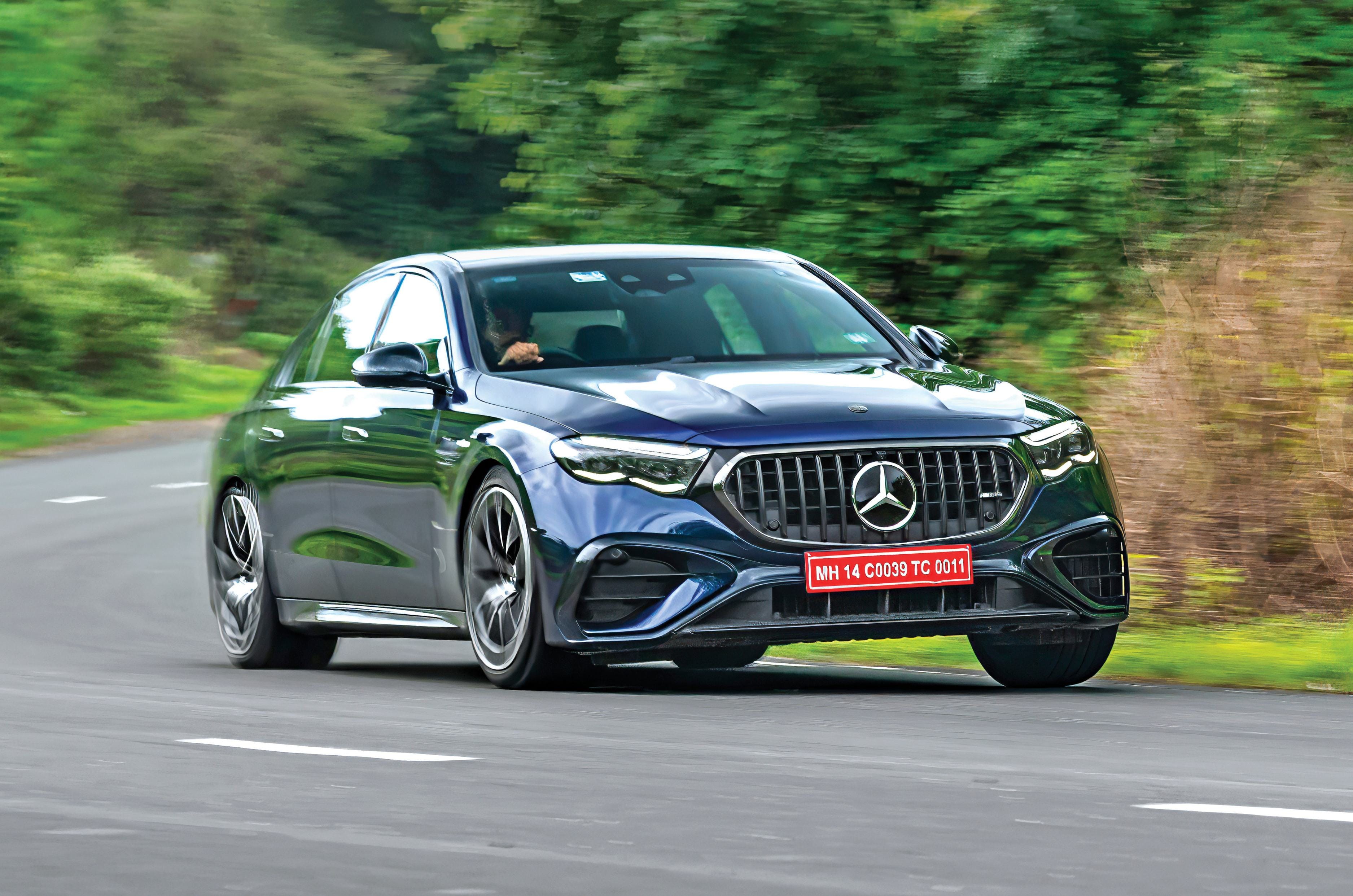
The Mercedes-AMG E53 Hybrid 4MATIC+ arrives at a time when performance cars are being asked to do more than simply go fast. It has to deliver the pace and character expected of an AMG while embracing electrification to meet increasingly stringent emissions norms and changing buyer expectations. The result is a plug-in hybrid performance sedan that combines a 3.0-litre turbo-petrol inline-six engine with an electric motor for a formidable system output of 585hp, while also offering enough electric-only range for mundane daily drives.
But this isn’t just an E-Class with a bigger battery and more power. The E53 gets AMG-specific chassis hardware, all-wheel drive, rear-wheel steering and a suite of performance-focused electronics designed to counter the added weight. Can this electrified AMG still deliver the thrills enthusiasts expect while remaining a genuinely usable luxury sedan every day?
Mercedes-AMG E53 Exterior Design and Engineering
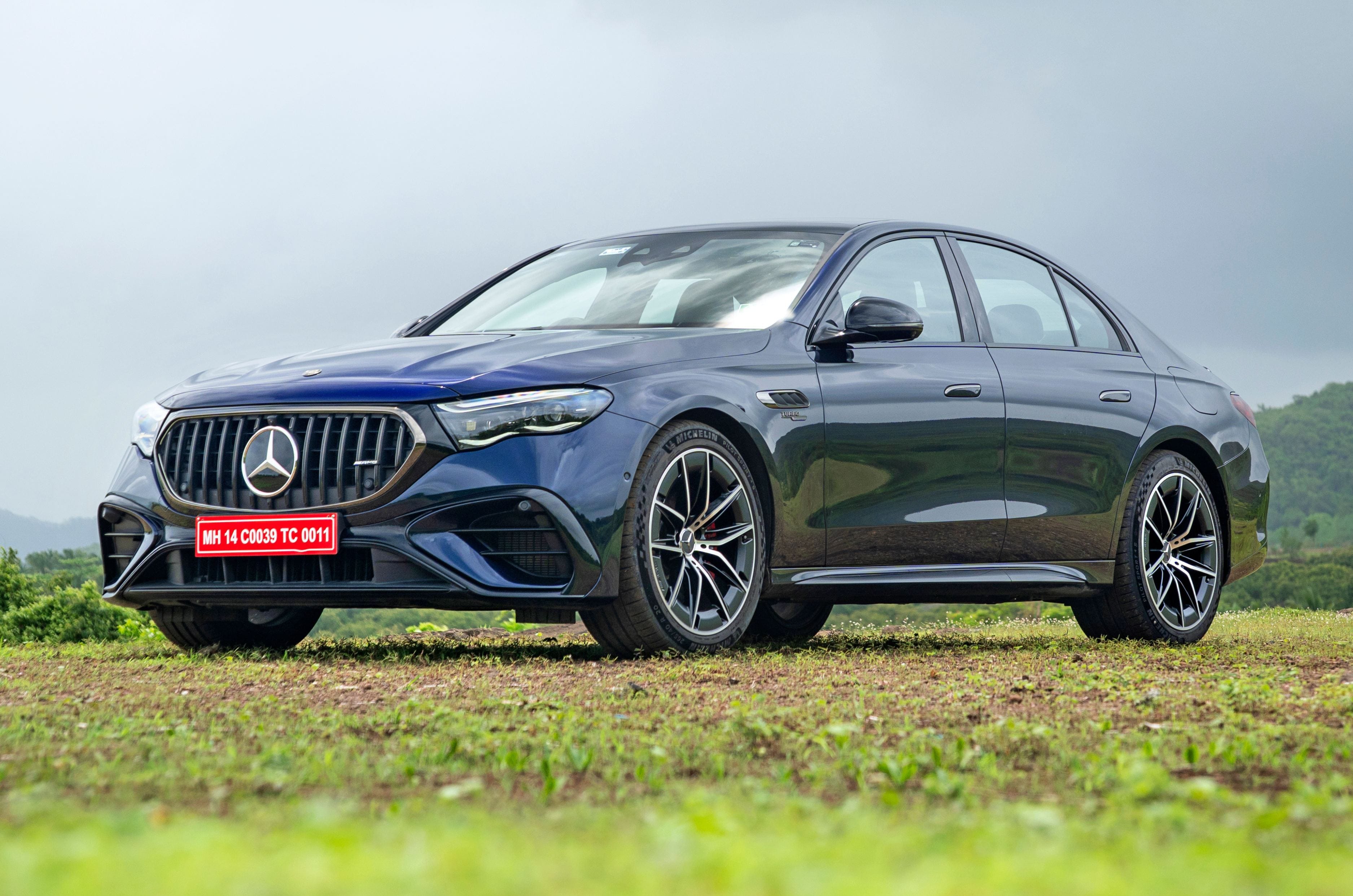
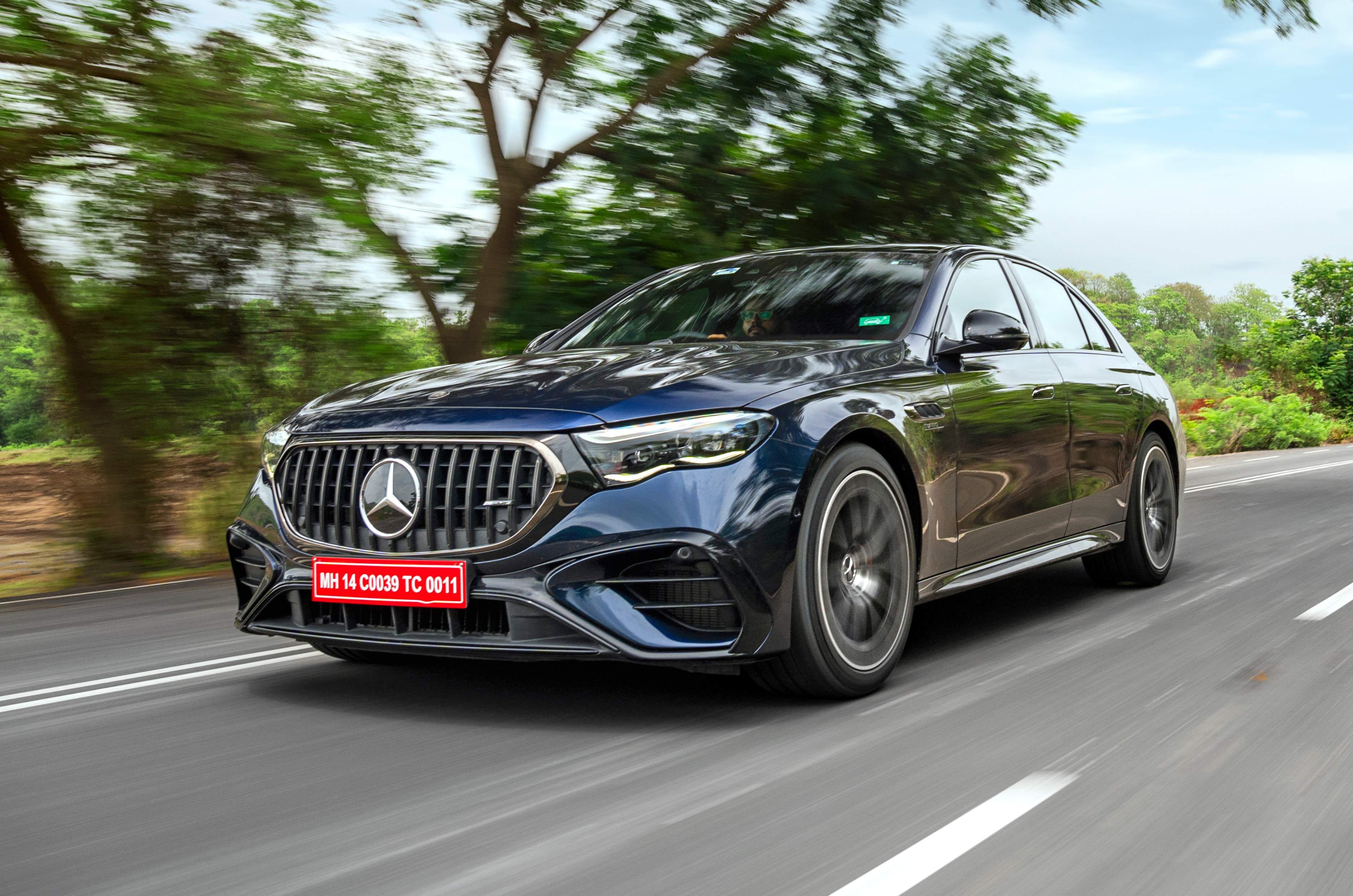
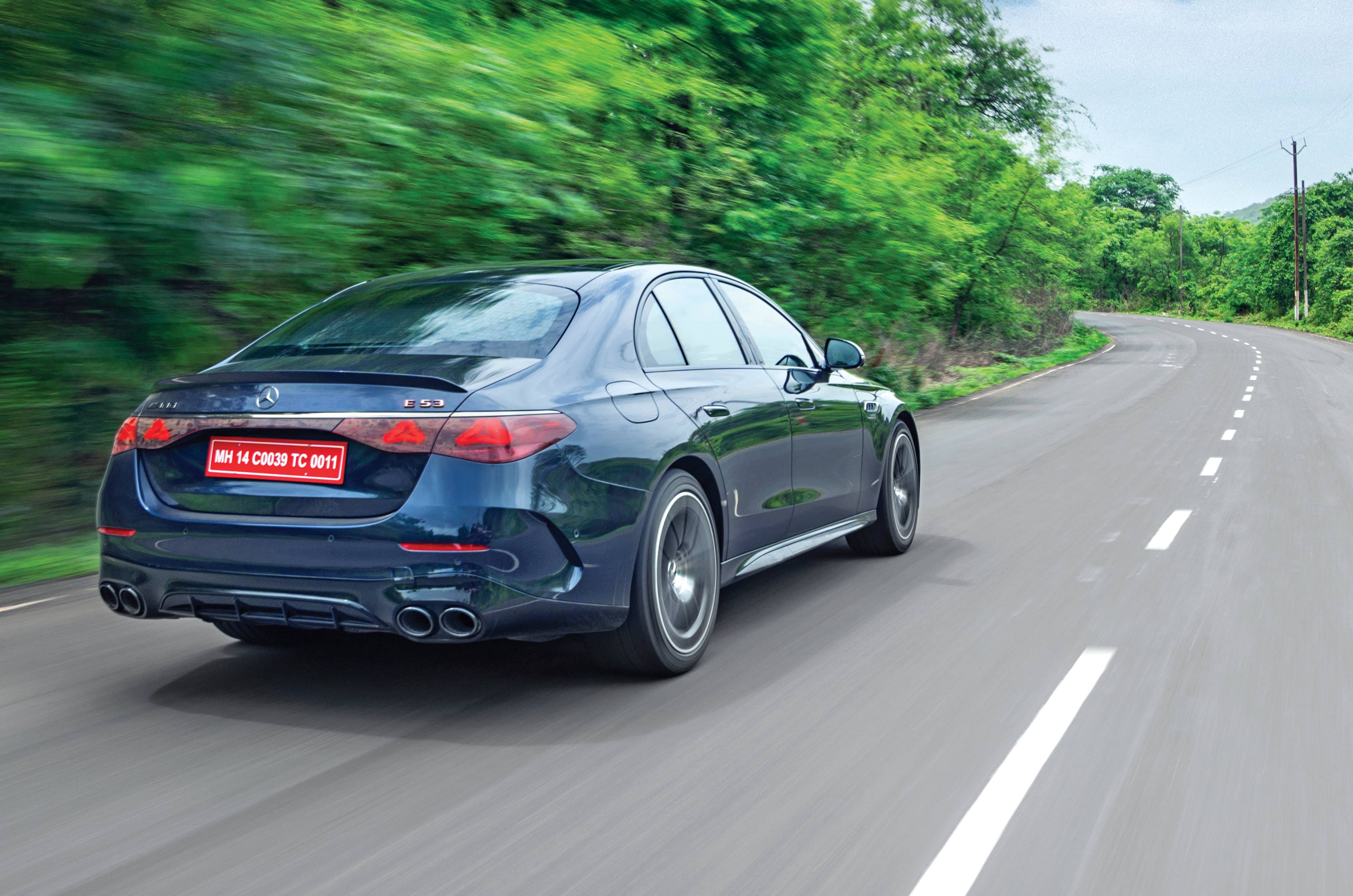
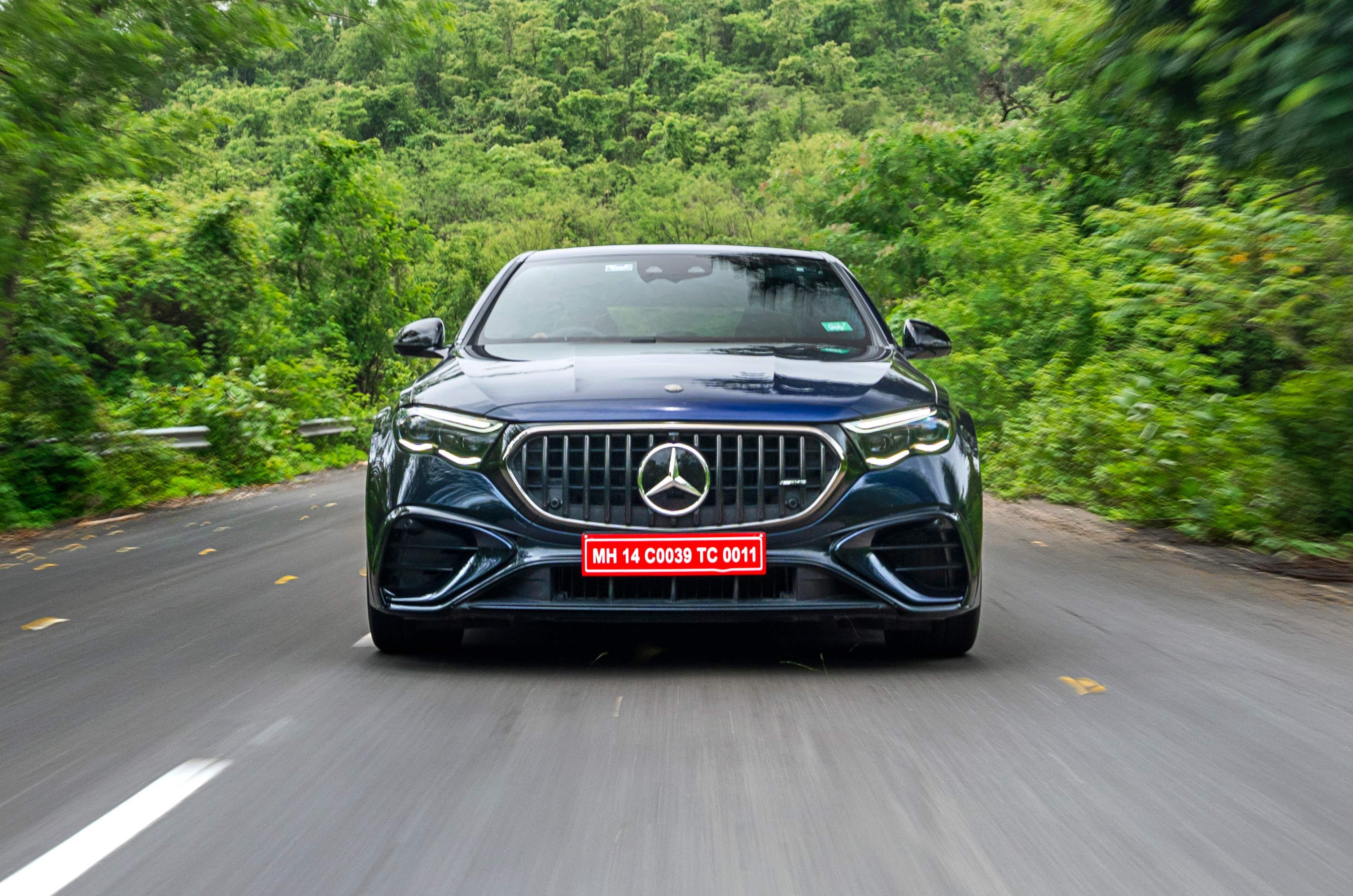
Expectedly, the E 53 has put on quite a bit of muscle. The front bumper is sportier, with large air dams. The Panamericana grille gets illuminated surrounds and is wide enough to gulp massive amounts of air to cool the engine, while the power lines on the bonnet add more intent to its character.
The E53 has good amount of muscle with aggressive bumpers, big grille and power lines
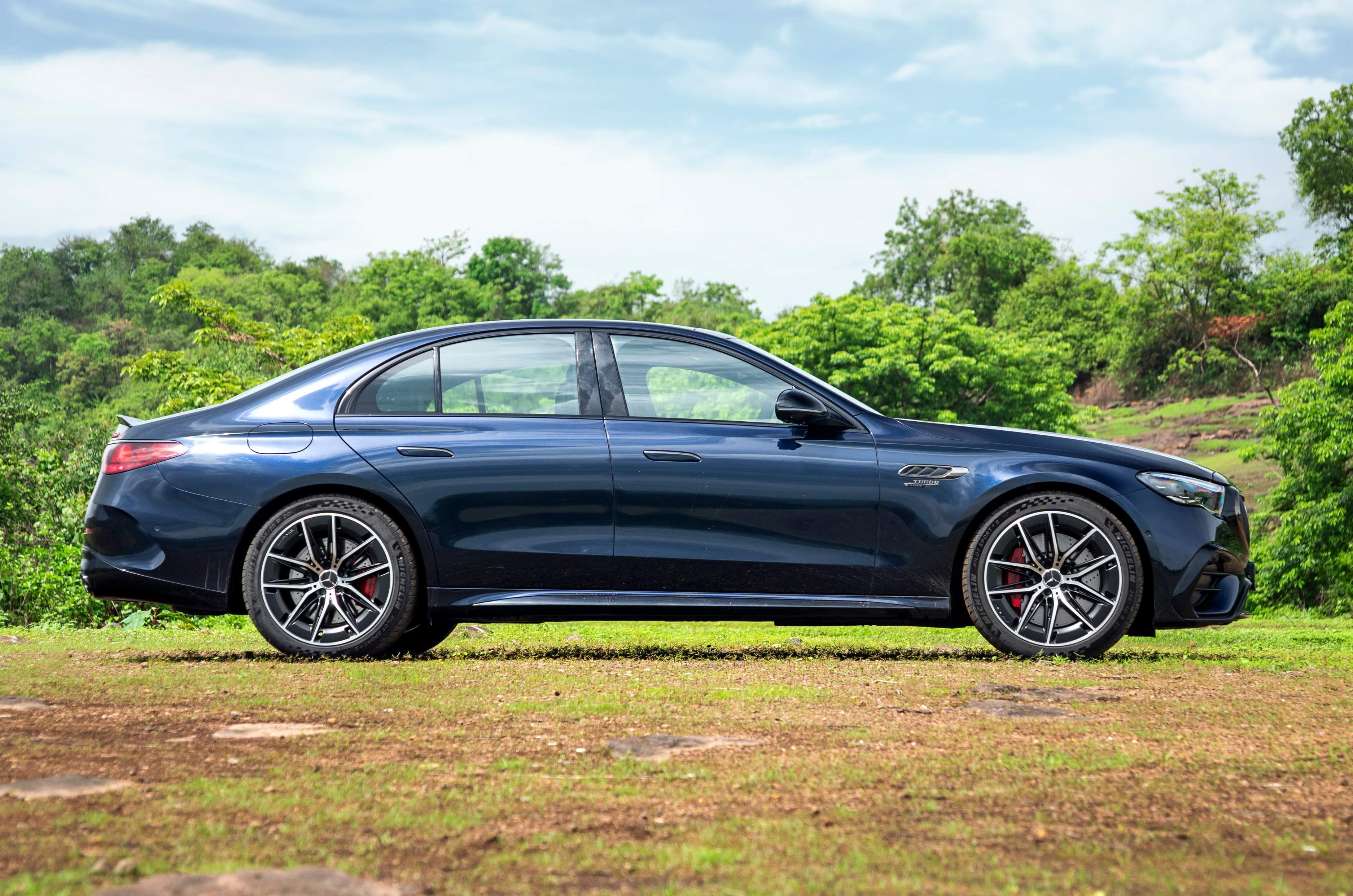
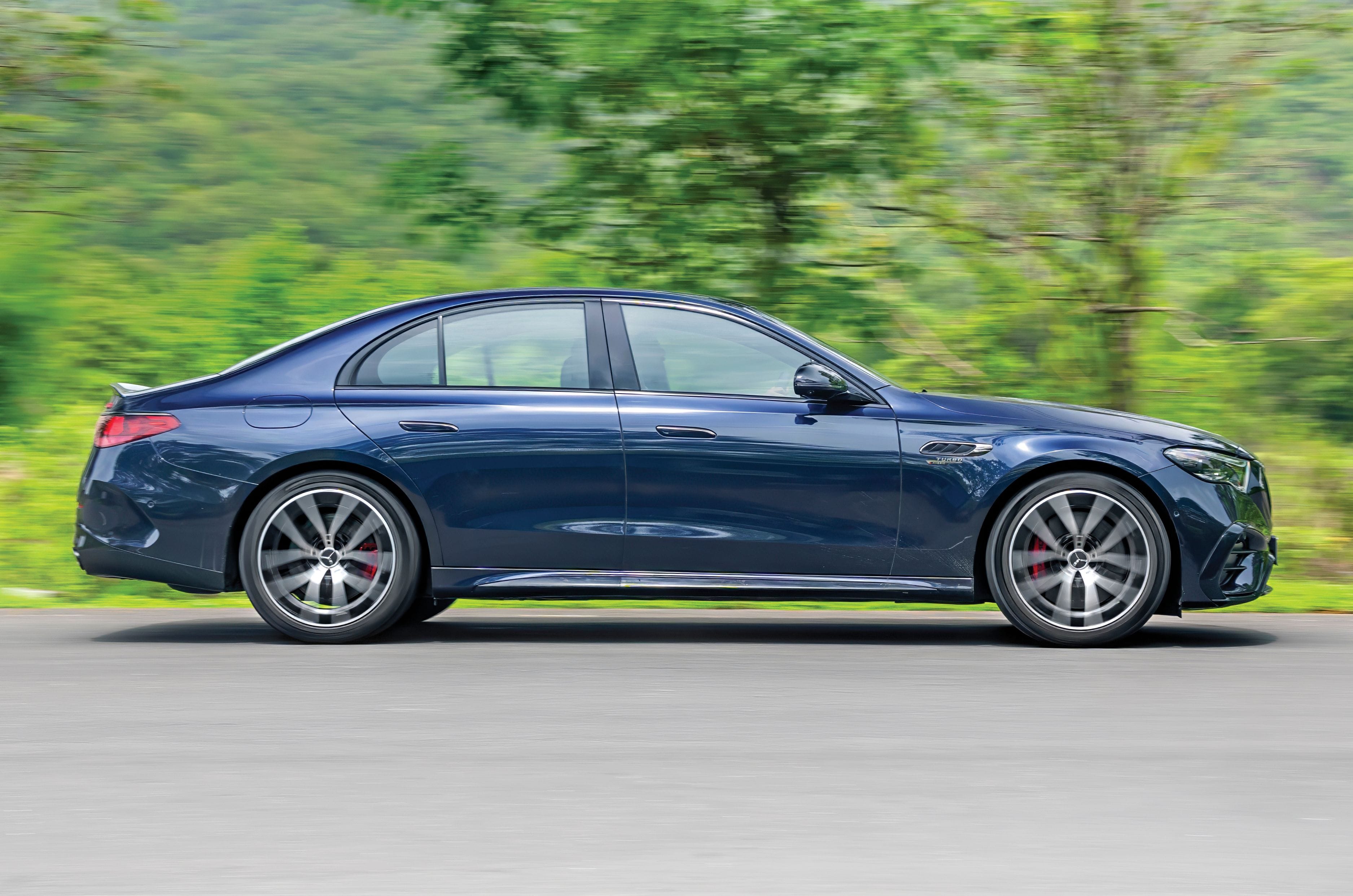
The profile flaunts flared wheel arches, larger 20-inch wheels (the last-gen E 53 featured 19-inchers) and, like before, a standard wheelbase, giving it sportier proportions than the long-wheelbase E-Class.
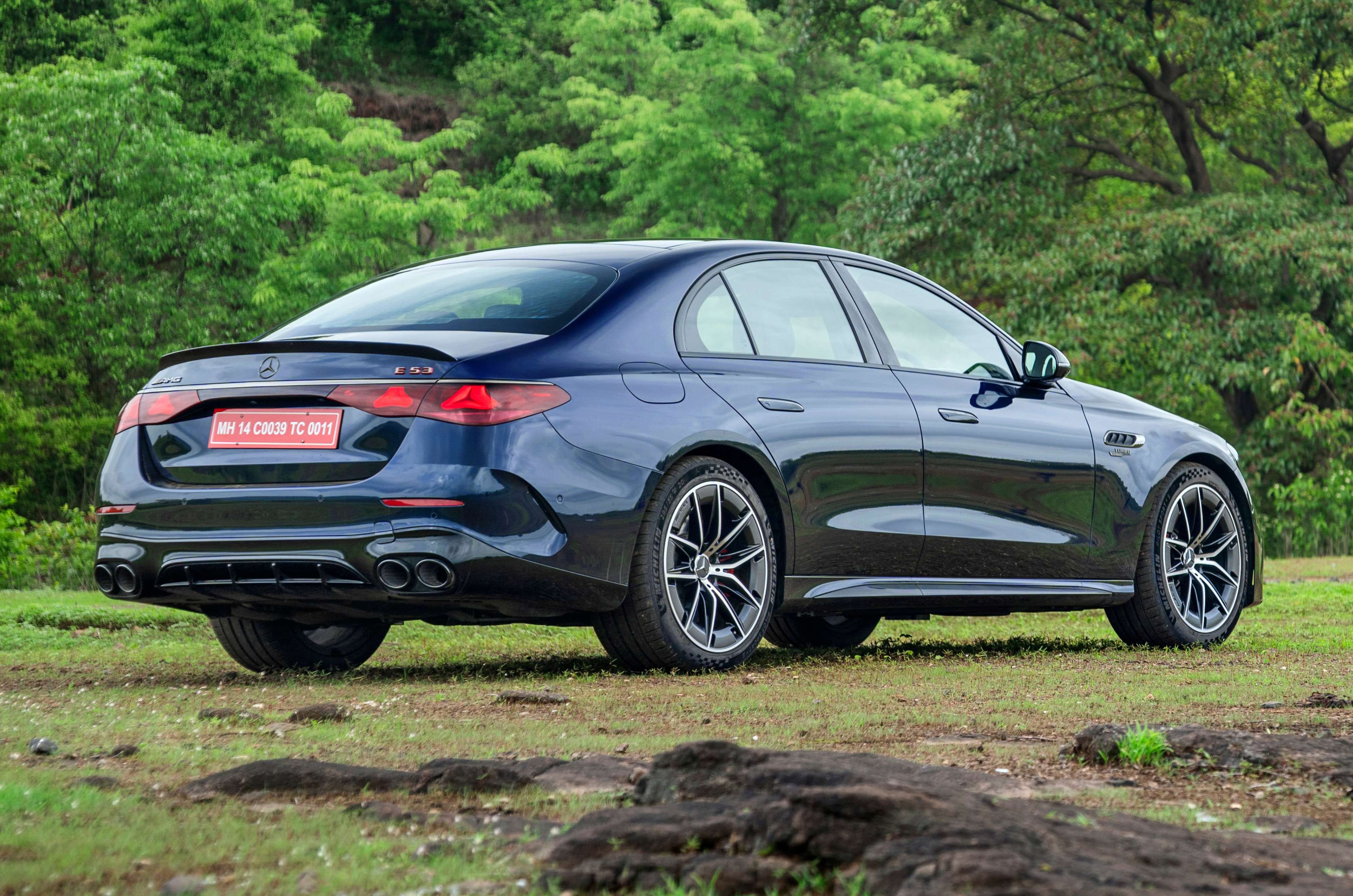
At the rear, there’s an E 53 badge with red highlights, a quad-exhaust setup that isn’t actually connected to the exhaust pipes, a diffuser and a ducktail spoiler that’s large enough to be noticed but won’t do much for downforce.
Not being a long wheelbase gives it perfect proportions
Overall, it’s a handsome-looking car with just the right amount of restraint. However, if you’re looking for a bit more visual drama, you’ll have to pay extra for the MANUFAKTUR paint finishes, as the standard colour palette is more E-Class than AMG.
Mercedes-AMG E53 Interior Space and Comfort
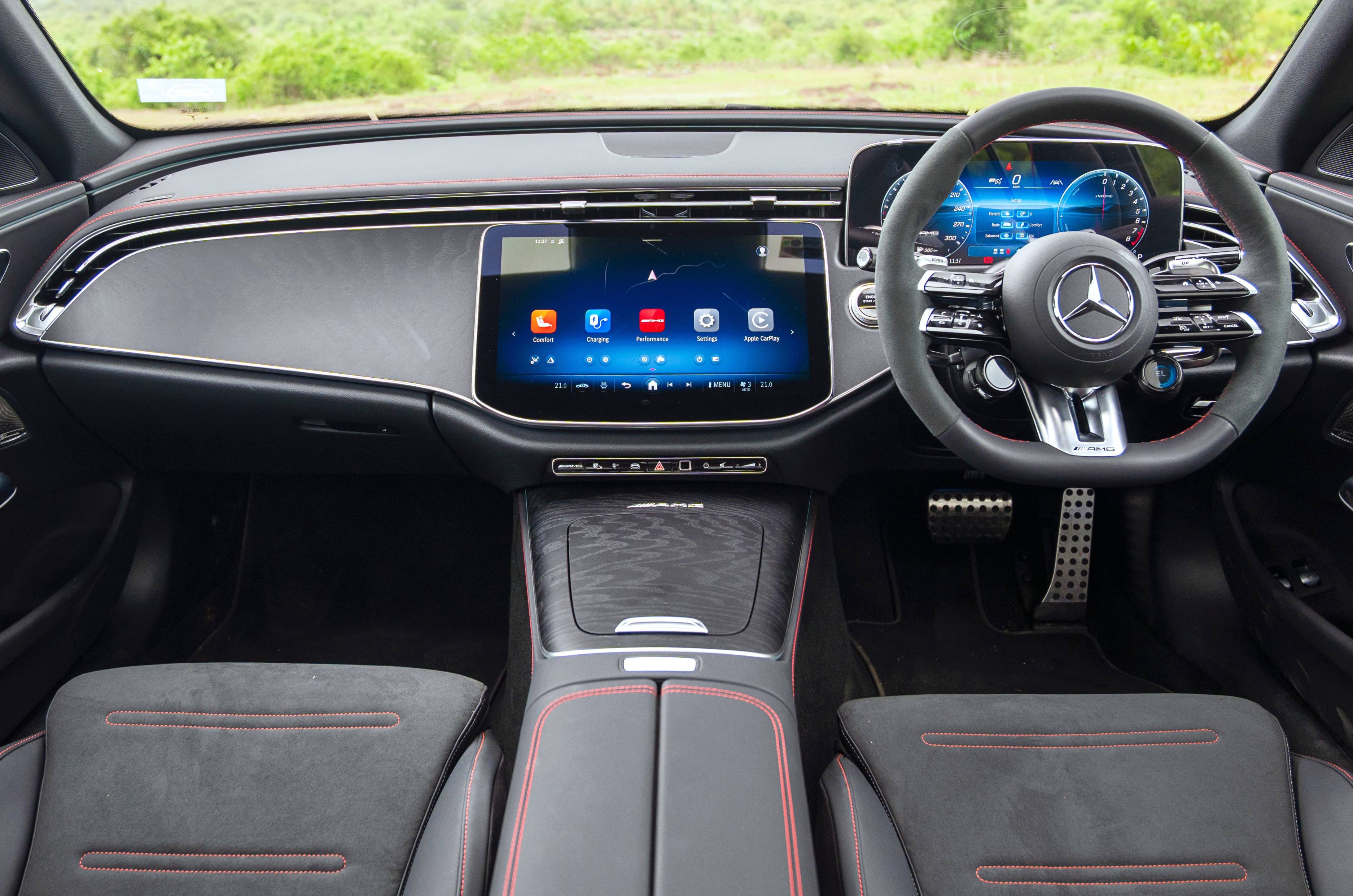
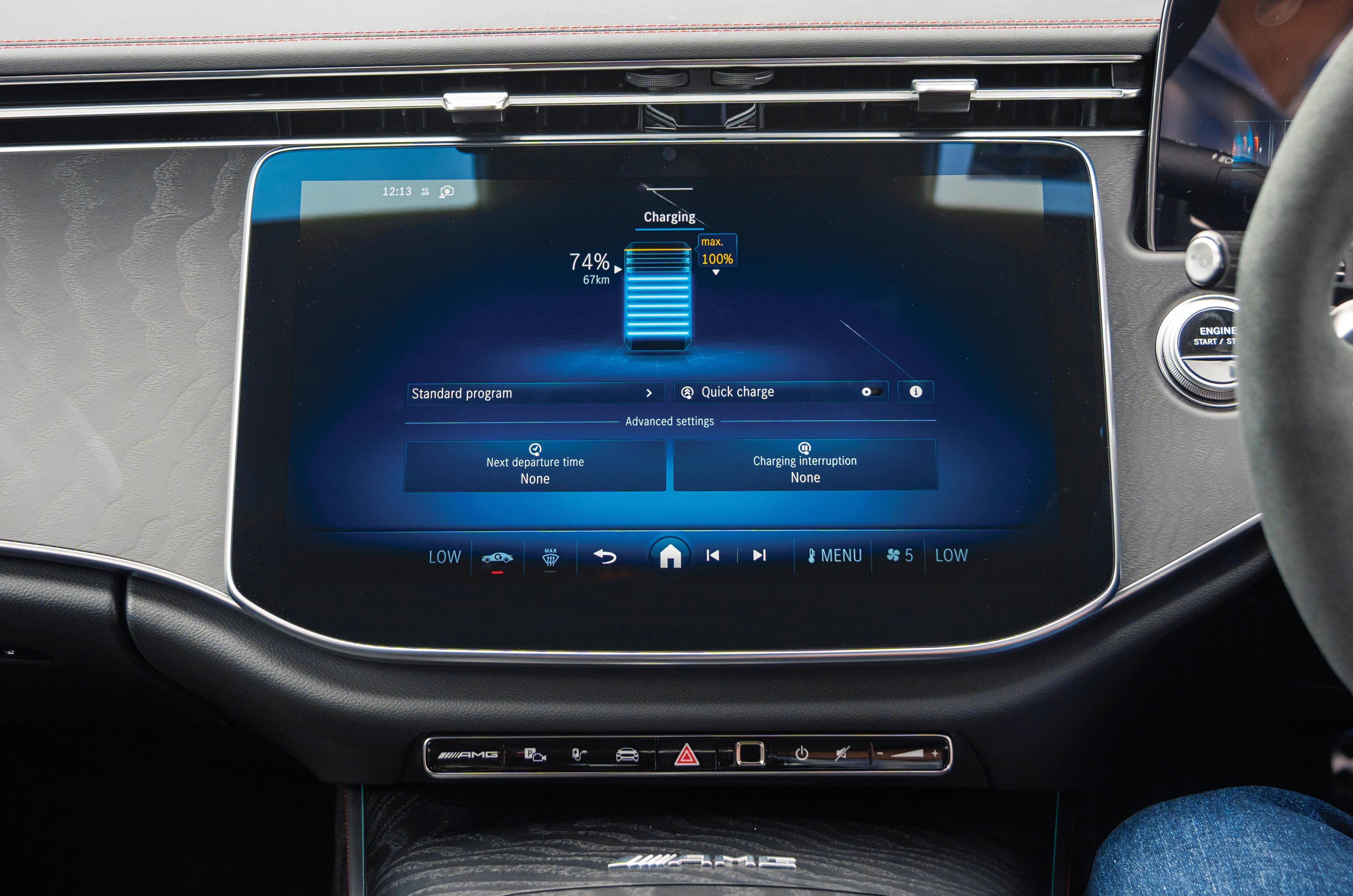
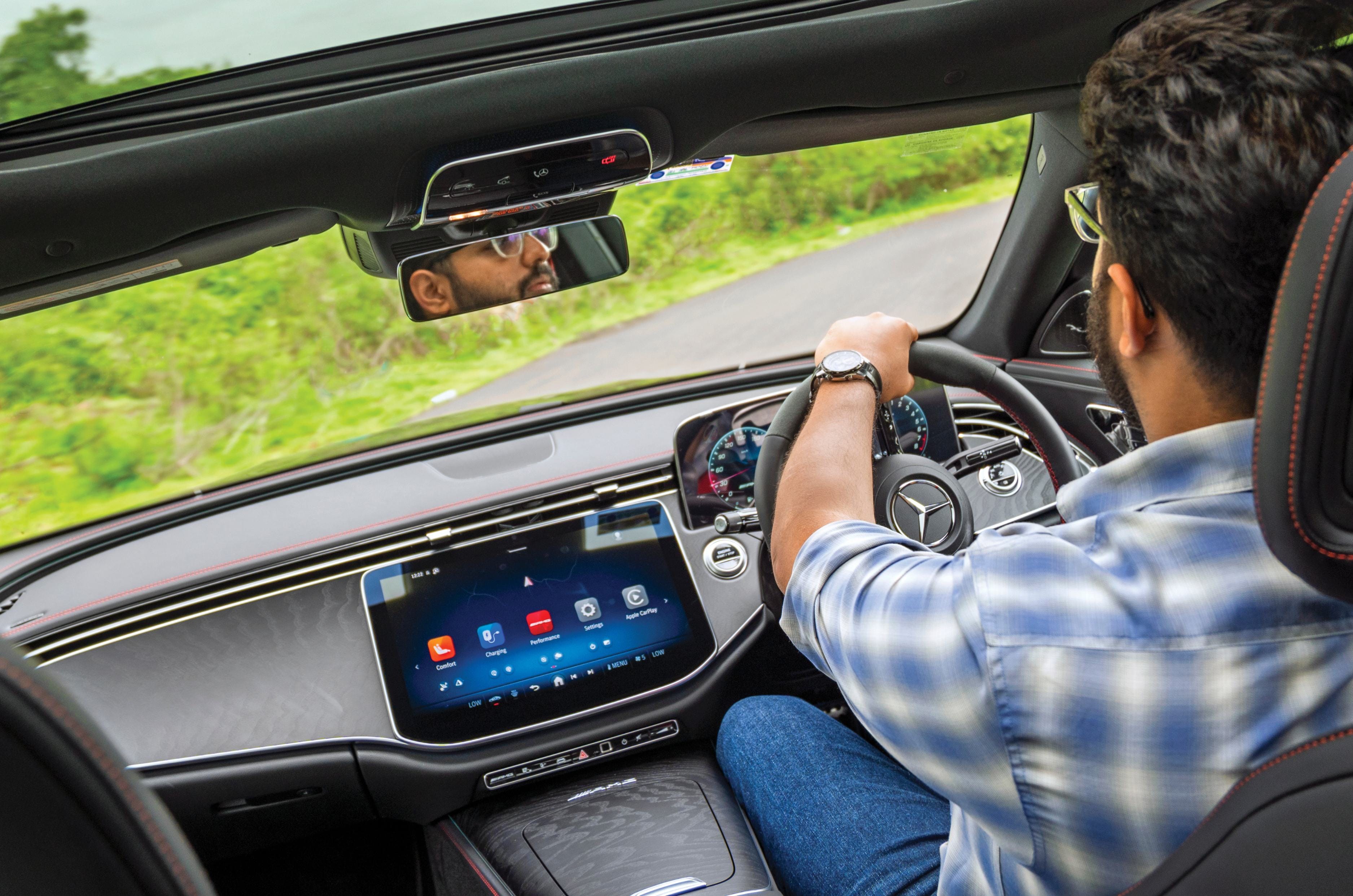
Inside, the E 53 strikes an appealing balance between luxury and sportiness. Instead of carbon-fibre or piano-black trim, Mercedes has used open-pore wood that feels rich and tactile. A large central MBUX touchscreen dominates the dashboard, while the passenger display found on the standard E is absent – not particularly bothersome given how good the main screen is.
Red and black upholstery looks racy while open pore wood adds luxe factor
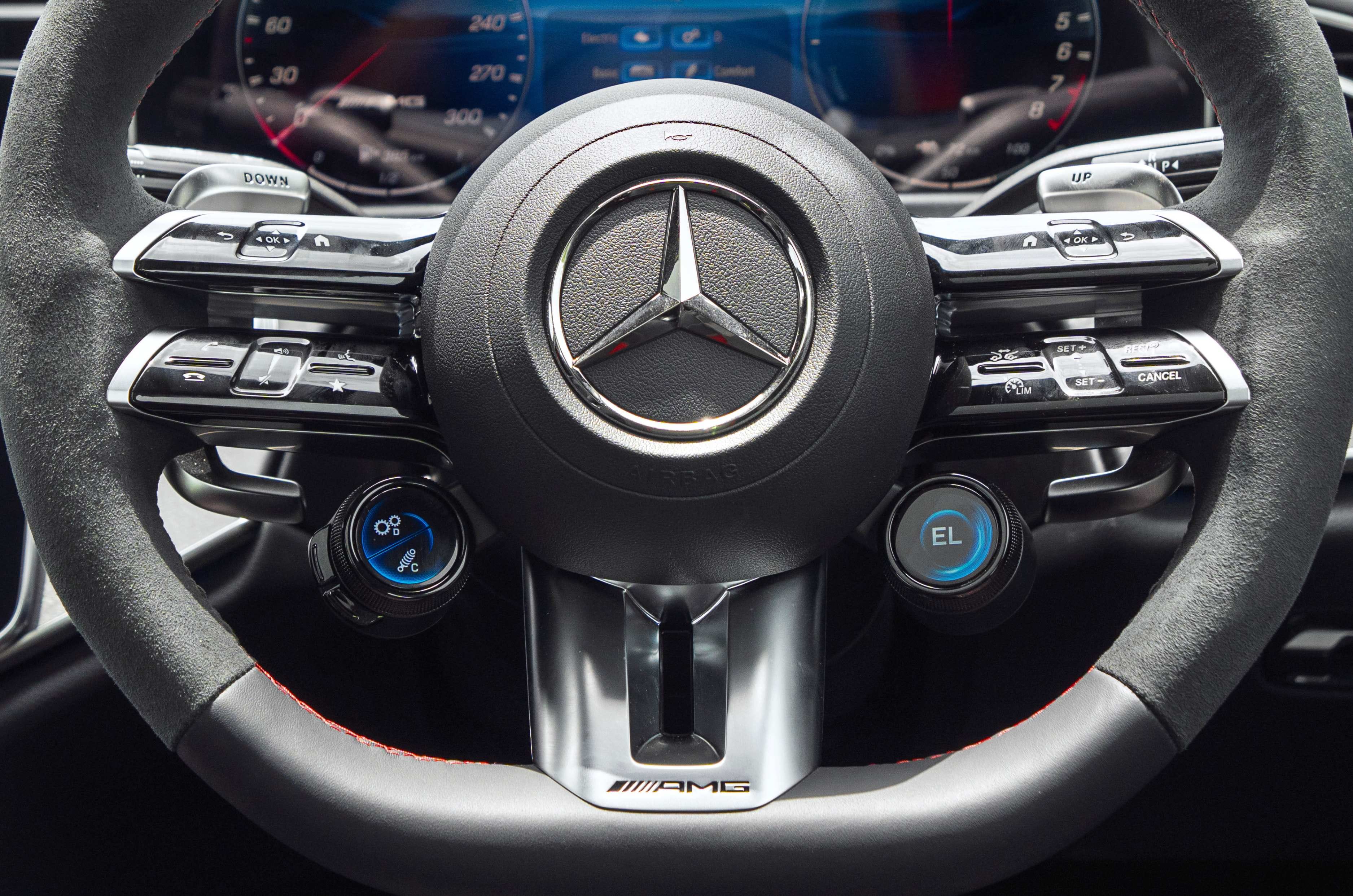
The AMG sports seats offer plenty of support and adjustment, although ventilated and massage functions are missing. Likewise, the chunky AMG steering wheel feels superb in hand but is cluttered with touch-sensitive controls that remain frustrating to use.
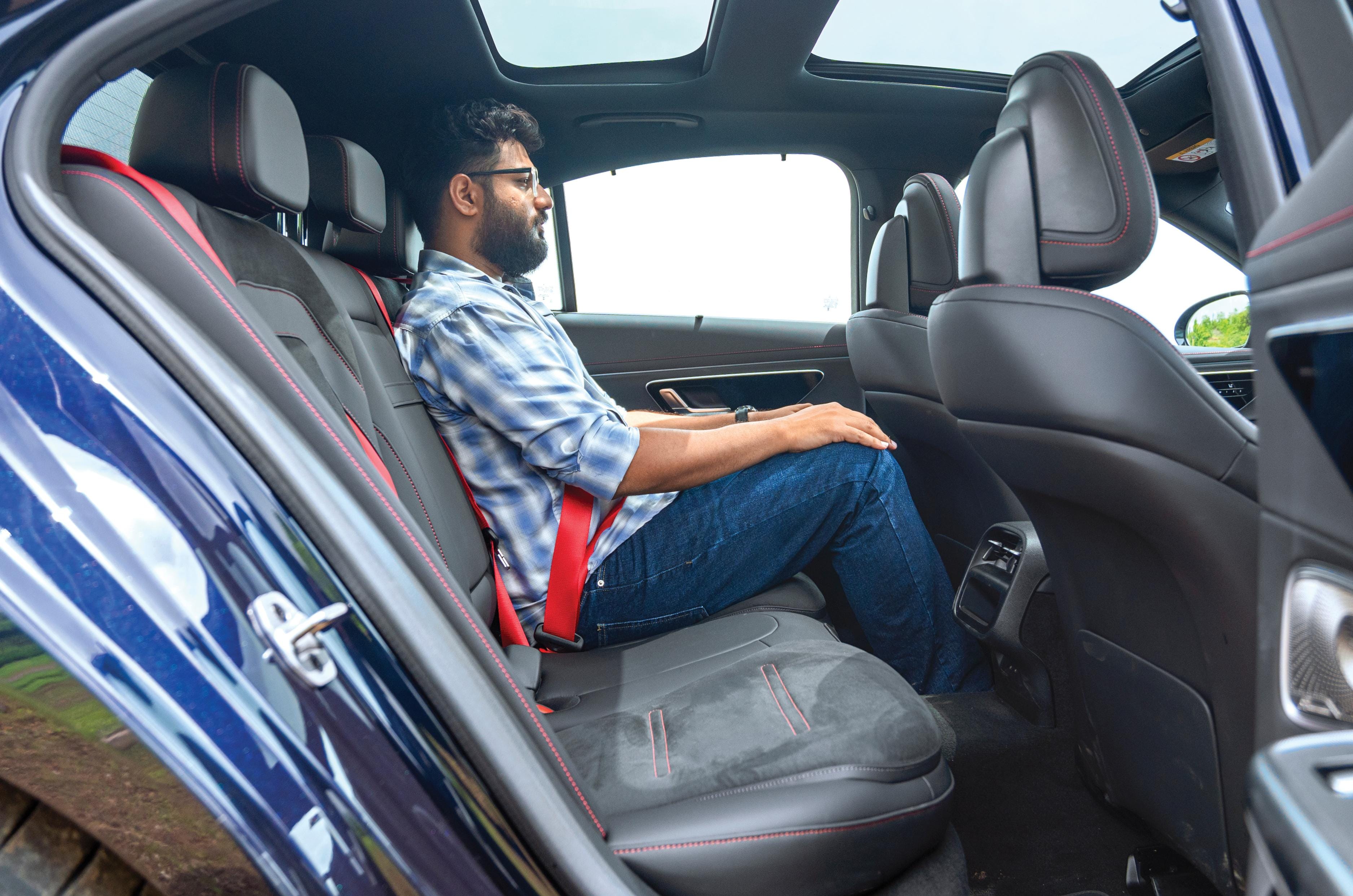
Rear-seat space is naturally tighter than the long-wheelbase E-Class, but there’s still enough room for two adults to travel comfortably. Manual sunblinds and a panoramic sunroof add to the ambience, although the large transmission tunnel makes this a strict four-seater.
There’s good space in the rear despite this not being a long wheelbase
The boot, however, sees the biggest compromise. At 370 litres, it’s 170 litres smaller than the standard E-Class because the battery sits beneath the floor. There’s no spare wheel either, with its space instead occupied by the charging cable and puncture repair kit.
Mercedes-AMG E53 Features and Safety
The E 53 is a well-equipped sedan despite missing features such as ventilated seats. The centre screen is the brains of the operation and, unfortunately, many of the controls are routed through it, making them difficult to operate on the move.
We’ve praised the MBUX infotainment system for its clear interface and high-resolution display, but usability isn’t its strongest suit. The large screen makes it difficult to accurately select the desired function while driving.
Too many controls on the steering is distracting
The E 53 gets a comprehensive suite of driver assistance systems, including Lane Keep Assist, Automatic Emergency Braking, Rear Cross Traffic Alert and Blind Spot Monitoring. Thankfully, these systems can also be switched off manually if required.
The 360-degree camera is crisp and high-resolution, while the 17-speaker Burmester 4D audio system delivers an exceptional listening experience. As impressive as the sound system is, however, it ultimately plays second fiddle to the performance on offer.
Mercedes-AMG E53 Performance and Refinement
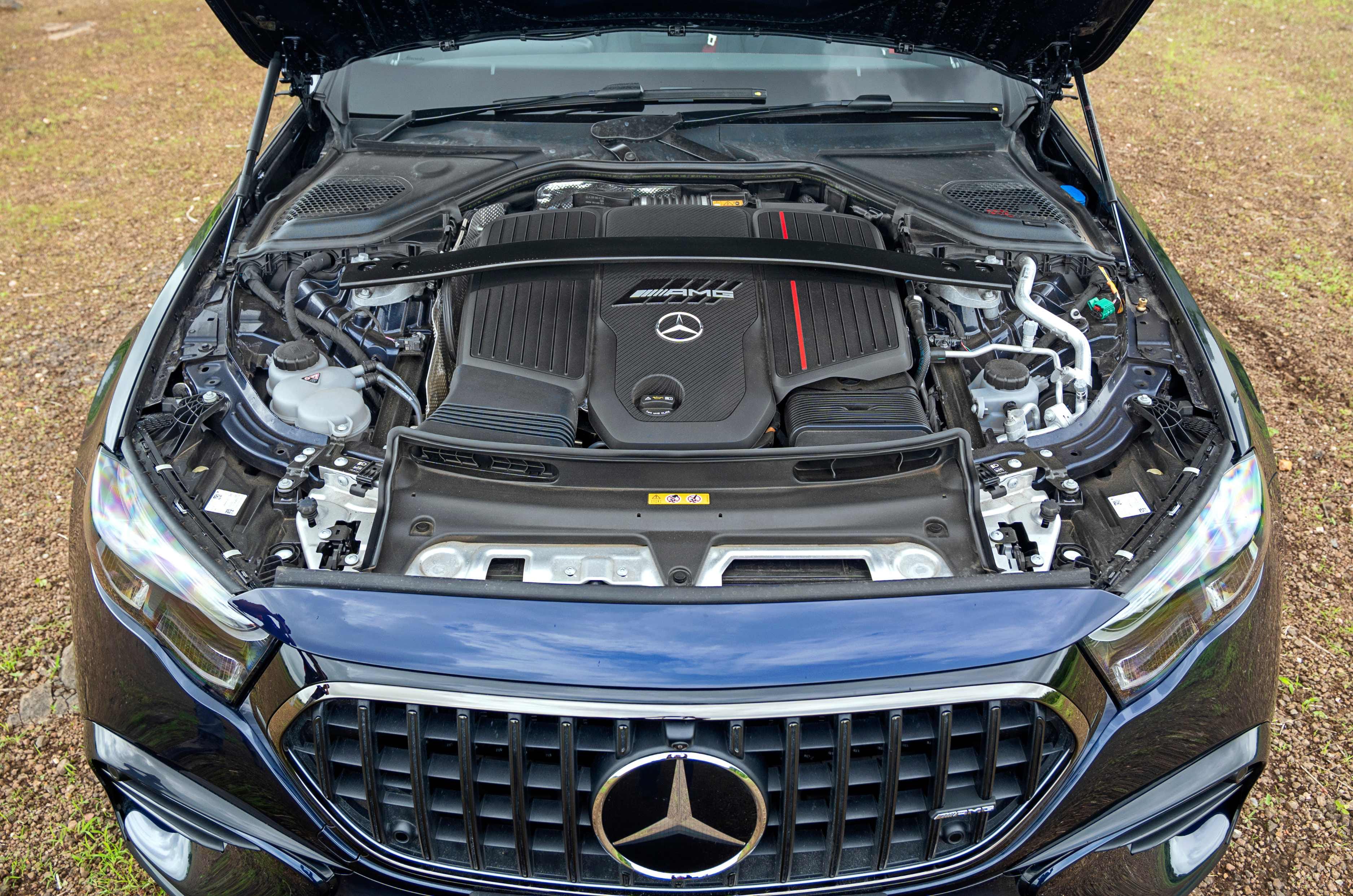
Like before, the new E 53 is powered by a 3.0-litre turbo-petrol straight-six engine. This time, however, it gets support from a 28.6kWh battery pack and an electric motor, taking the combined output to 585hp and 750Nm.
585hp six-cylinder engine makes 150hp more than before
Unlike the bigger PHEV AMGs, the E 53 isn’t an ‘E PERFORMANCE’ model, which means the electric motor is mounted within the gearbox housing rather than integrated into the rear axle. Power is sent to all four wheels via the familiar 9-speed automatic transmission, and the E 53 gets a host of drive modes that are noticeably different from one another.
‘Individual’ lets you tailor the engine, gearbox and suspension to your liking. ‘Battery Hold’ prevents the car from using the battery charge, saving it for when you truly need it. ‘EL’ is the full-electric mode, provided there’s sufficient charge in the battery. ‘Comfort’ offers a more relaxed setup, ‘Sport’ sharpens the responses, and ‘Sport+’ is the most aggressive setting.
Naturally, Sport+ is the mode you’ll spend most of your time in if you want the E 53 to feel like a proper AMG. The exhaust note, the urgency of the power delivery and the firmer suspension all come together beautifully. With the engine and electric motor working at full tilt, straight-line performance is genuinely rapid. Acceleration is smooth yet thrilling, as the engine piles on speed rapidly without the neck-snapping brutality of a powerful EV. Power delivery is strong and linear across the rev range, and the gearbox complements the aggressive character of Sport+ perfectly. 0-100kph takes just 4 secs with the ‘Race Start’ which is essentially launch control included in the AMG Dynamic Plus package as power jumps up to 612hp.
For greater driver involvement, you can also engage ‘M’ mode, which gives you full manual control of the gearbox. It will happily bounce off the limiter without automatically upshifting until you pull a paddle.
The exhaust note is a bit of a mixed bag. It’s genuine, but it’s also channelled into the cabin through the speakers and a subwoofer in the boot. It’s not the ideal solution because, outside the car, the engine and exhaust produce a genuinely enjoyable snarl. Still, in an era of synthesised, computer-generated soundtracks, a real exhaust note—even if it’s amplified through the speakers—is worth appreciation.
Switch to Comfort mode and the E 53 adopts an entirely different character. It’s calm, refined and smooth, with gentler power delivery that’s well suited to long-distance cruising.
Where the powertrain disappoints is in city traffic and slow stop-start driving. The gearbox is simply too eager and, even in Comfort mode, it feels a bit like walking an overexcited Rottweiler. It’s constantly trying to surge forward and grab the next gear before you’ve asked it to. The constant shuffling through the lower gears results in unnecessary jerks that spoil the experience.
The solution is to engage EL mode. It’s almost as if it was designed specifically for this scenario. In EL, the E 53 feels smooth and effortless. There’s very little noise apart from the drone generated by the Michelin Pilot Sport 4S tyres, which can be quite rumbly, especially on concrete surfaces.
Braking is less convincing, however. Despite massive 390mm front discs and regenerative braking, the pedal never delivers a natural or consistent feel. Stopping power is strong, but the spongy, inconsistent pedal detracts from an otherwise polished driving experience.
Mercedes-AMG E53 Mileage and Efficiency
One of the biggest talking points of the new E 53 isn’t its staggering performance, but the fact that it can deliver it without constantly visiting a fuel station. This plug-in hybrid marks a significant shift in AMG’s philosophy, combining electrification with a silky-smooth six-cylinder engine to create a performance sedan that’s as comfortable commuting as it is attacking a mountain road.
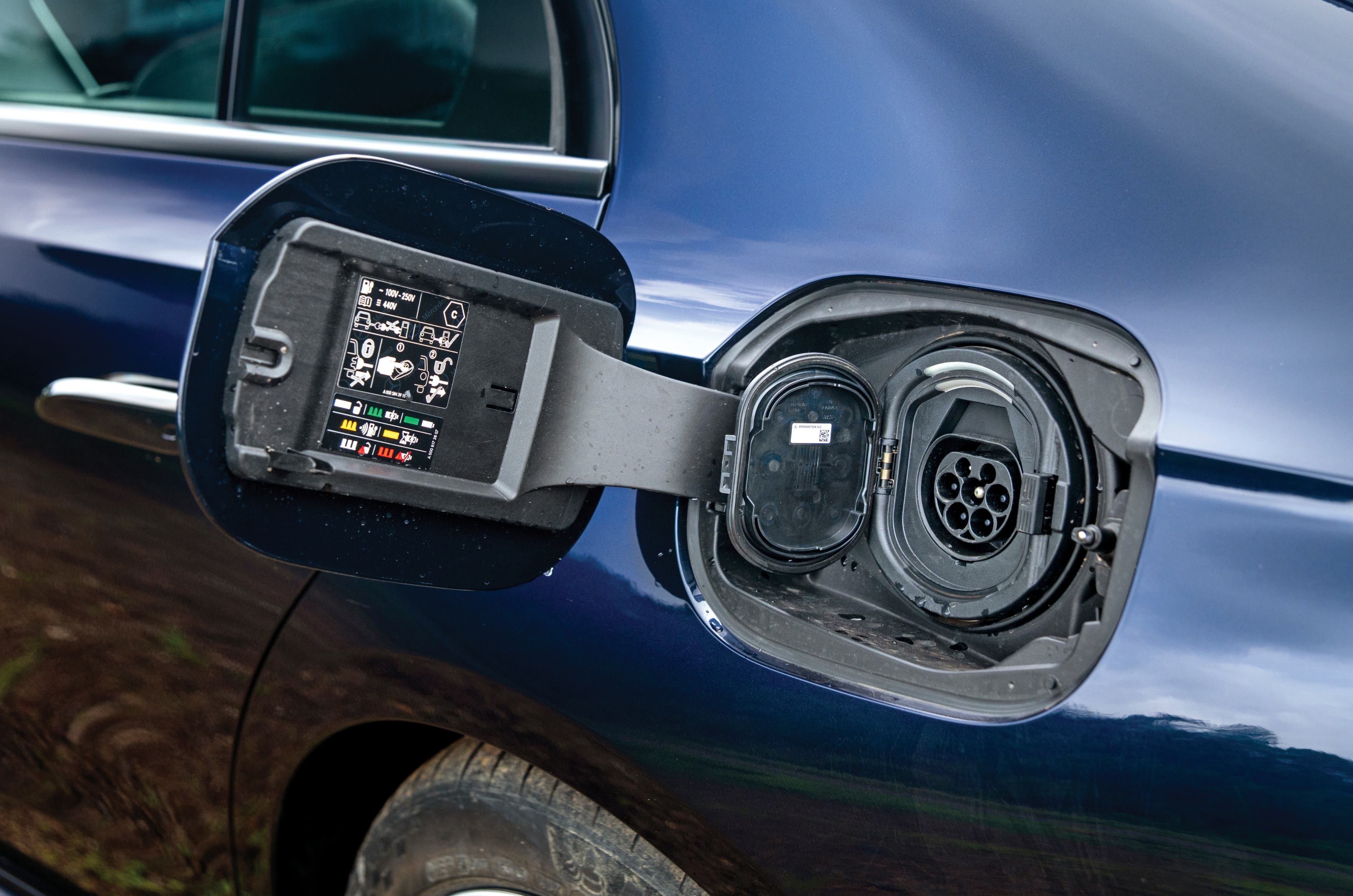
Charging via an 11kW AC charger will replenish the battery in 2.25 hrs; No DC charging option
The headline figure is a claimed electric-only range of up to 100km, courtesy a 28.6kWh battery pack. You can expect 75-90km on electric power alone making it entirely possible to complete daily urban commutes without firing up the engine.
Once the battery begins to deplete, the turbocharged 3.0-litre inline-six takes centre stage. Even then, the hybrid system continues to contribute through regenerative braking and electric assistance, ensuring the E 53 feels responsive while reducing fuel consumption compared to a conventional performance sedan. Mercedes has also equipped the car with four regenerative braking modes, allowing drivers to maximise energy recovery or opt for a more natural driving experience. For owners with access to home or workplace charging, fuel stops could become surprisingly infrequent. Charging is equally convenient, with the 11kW AC onboard charger replenishing the battery in around three hours.
28.6kWh battery allows for an electric-only range of 100km
Mercedes-AMG E53 Ride Comfort and Handling
For those who enjoy being behind the wheel, the E 53 delivers in abundance. Despite carrying the additional weight of a sizable battery pack, it feels remarkably composed. In Sport and Sport+, the car tightens up noticeably. Body roll is kept firmly in check, the dampers become more alert, and the steering gains welcome heft. What impresses most is how well the chassis disguises its mass. The battery may add considerable weight, but it’s mounted low in the car, lowering the centre of gravity and lending the E 53 impressive stability through fast corners.
The rear-biased 4MATIC+ all-wheel-drive system plays a major role here. The rear wheels can turn up to 2.5 degrees, which isn’t a huge amount, as you’ll still find yourself making the occasional three-point turn. Above 60kph, however, they turn in the same direction as the front wheels, adding another layer of stability through corners.
It is over 400kg heavier than the last-gen model but you just can’t feel it from behind the wheel
The Michelin Pilot Sport 4S tyres aren’t the quietest, but they allow the driver to deploy the combined output with confidence, even when exiting slower bends. Turn-in is crisp, and while the steering isn’t overflowing with feedback, it’s accurate enough to place the car confidently on a winding road.
At low speeds, the adaptive AMG Ride Control suspension does an admirable job of filtering out broken tarmac, expansion joints and sharp-edged potholes. It isn’t perfect, though. Compared with the last-generation E 53, which rode on smaller 19-inch wheels with taller-profile tyres, the new car’s 20-inch wheels have sacrificed a degree of ride compliance. As a result, the low-profile tyres transmit the occasional thud over particularly nasty potholes.
The adaptive dampers mated with the active engine mounts offer terrific stability
Ultimately, the Mercedes-AMG E 53 Hybrid 4MATIC+ isn’t as razor-sharp as a dedicated sports sedan, nor is it as pillowy as the standard E-Class. Instead, it strikes an impressive middle ground, blending everyday comfort with genuine driver engagement. It’s a car that feels just as at home soaking up kilometres on the expressway as it does carving through a series of fast, flowing corners.
Mercedes-AMG E53 Value for Money
Prices start at Rs 1.45 crore for the Performance Edition and Rs 1.48 crore for the Racing Edition. In this price range, there isn’t a direct rival to the E 53. The BMW M5 is both more powerful and considerably more expensive, while the BMW M4 is effectively rivalled by the Mercedes-AMG CLE 53 as a two-door coupe. The Audi RS5, meanwhile, hasn’t been launched in India yet.
The E 53 succeeds because it doesn’t try to be everything at once. It delivers the pace, handling and character expected of an AMG while introducing meaningful electric-only capability that genuinely enhances everyday usability. The brakes may lack the natural feel you’d expect from a performance sedan, and the gearbox can feel over-eager in slow-moving traffic, but these shortcomings do little to overshadow what is otherwise a remarkably accomplished package.
Fast, engaging and surprisingly efficient, the new E53 Hybrid is one of the most complete performance sedans on sale today. More importantly, it proves that electrification doesn’t have to dilute the AMG experience—it can make it even more usable.
Mercedes-Benz India has said every car it has sold in the country since January 2026 is compatible with E25 ethanol-blended petrol, making it one of the first luxury carmakers in India to prepare its portfolio ahead of any mandate for higher ethanol blends.
The announcement comes months after India completed the nationwide rollout of E20 petrol. More recently, the Bureau of Indian Standards (BIS) notified technical standards for higher ethanol blends, including E22, E25, E27 and E30, signalling the government’s efforts to prepare the regulatory framework for fuels beyond E20.
Mercedes cars in India have been E20-compatible since 2020
Announcement made at the launch of the AMG E 53 plug-in hybrid
Company to go ahead with a multi-powertrain strategy in India
Mercedes-Benz prepared line-up ahead of future ethanol norms
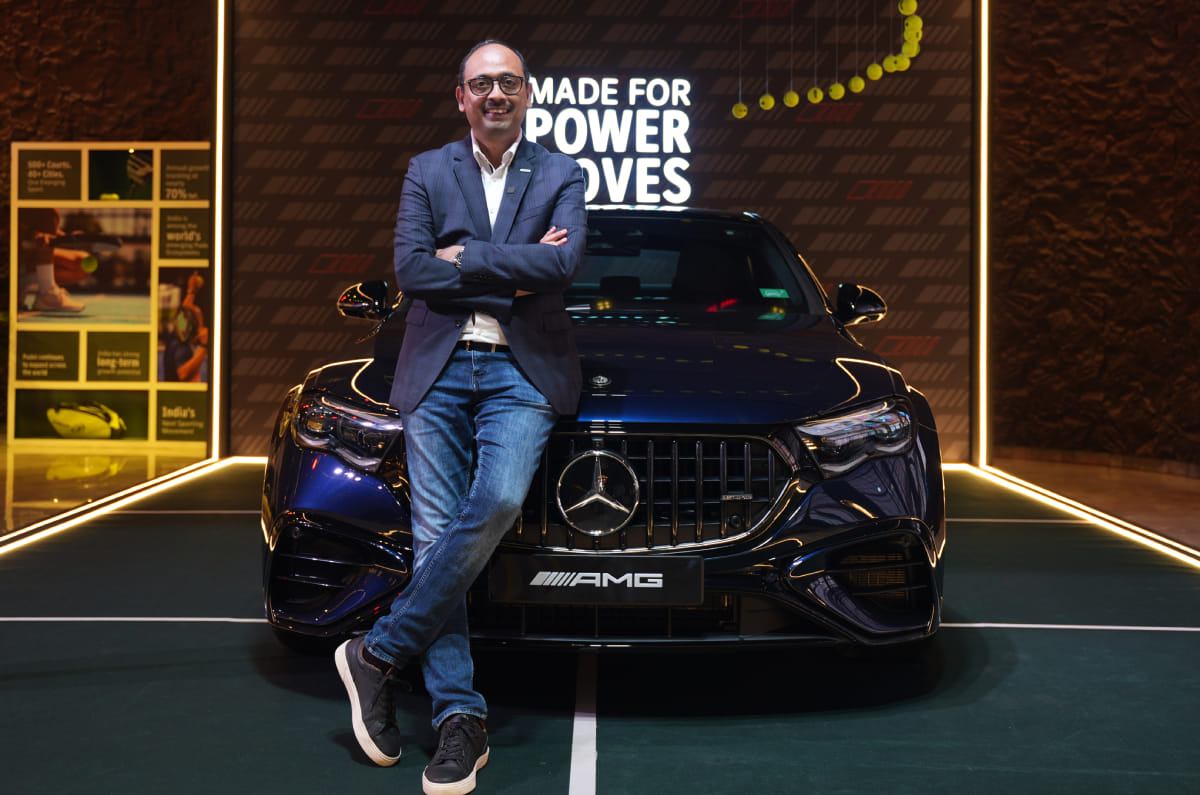
Speaking at the launch of the Mercedes-AMG E 53, Mercedes-Benz India Managing Director and CEO Santosh Iyer said the company upgraded its India portfolio in anticipation of future fuel regulations. Explaining the decision, Iyer said Mercedes-Benz wanted to prepare its products ahead of any future regulation. “The Mercedes customers expect that we will learn the legislation and upcoming trends. There are a lot of discussions on E25. It may not happen, but we want to offer cars which are compliant,” he said.
According to Iyer, Mercedes-Benz adopted E25 compatibility to future-proof its products as discussions continue around increasing ethanol blending beyond E20. He added that the company had similarly made its India line-up E20-compatible from 2020, around three years before the fuel became mandatory.
The announcement comes weeks after Mercedes-Benz highlighted concerns over fuel adulteration, rather than the E20 blend itself. The company had said inconsistent fuel quality could affect vehicle performance and called for stricter quality control as higher ethanol blends are introduced.
Mercedes-Benz to continue offering multiple powertrains
Mercedes-Benz said it will continue offering a mix of internal combustion engine, battery electric and plug-in hybrid models in India instead of focusing on a single powertrain technology. “Our job and responsibility is to offer good options across the spectrum, including gasoline with an E25,” he said.
The AMG E 53 launched alongside the announcement is the brand’s second plug-in hybrid model in India after the recently introduced S-Class Plug-in Hybrid, and the first electrified AMG E-Class in the country. Mercedes-Benz says customer demand in India continues to be spread across conventional ICE models and electrified vehicles, supporting its multi-powertrain strategy.
हरारे स्पोर्ट्स क्लब में खेले जा रहे पहले टी-20 अंतरराष्ट्रीय मैच में जिम्बाब्वे के खिलाफ भारतीय गेंदबाजों ने निर्धारित 20 ओवरों में मेजबान टीम के 7 विकेट गिरा कर 125 रनों पर पारी रोक दी। गौरतलब है कि इस मैच से पहले भारतीय पेस बैट्री का कुल अनुभव सिर्फ 9 विकेट था।
मयंक यादव ने पहली ही गेंद पर टी-20 विश्वकप में भारत के खिलाफ शतक मार चुके बेनेट को चलता कर दिया। इसके बाद प्रिंस यादव और मयंक यादव ने मायर्स और बेन करन को पॉवरप्ले में ही चलता कर जिम्बाब्वे की रन गति पर रोक लगा दी।
जिम्बाब्वे की ओर से सर्वाधिक रन वेसले मेधवेरे ने बनाए। उन्होंने 34 गेंदो में 39 रनों की पारी खेली। प्रिंस यादव और मयंक यादव ने किफायती गेंदबाजी के साथ साथ 2-2 विकेट निकाले।
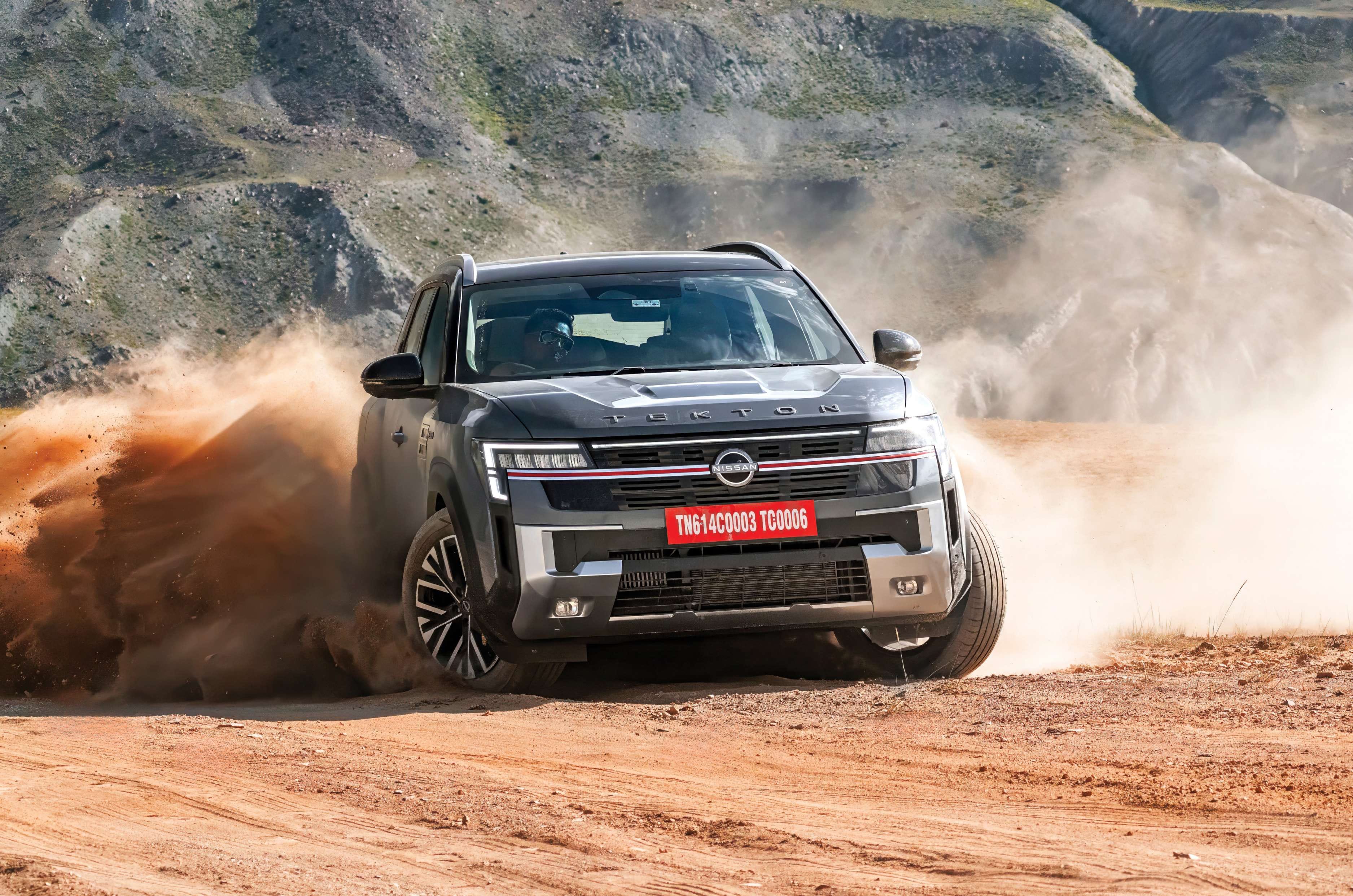
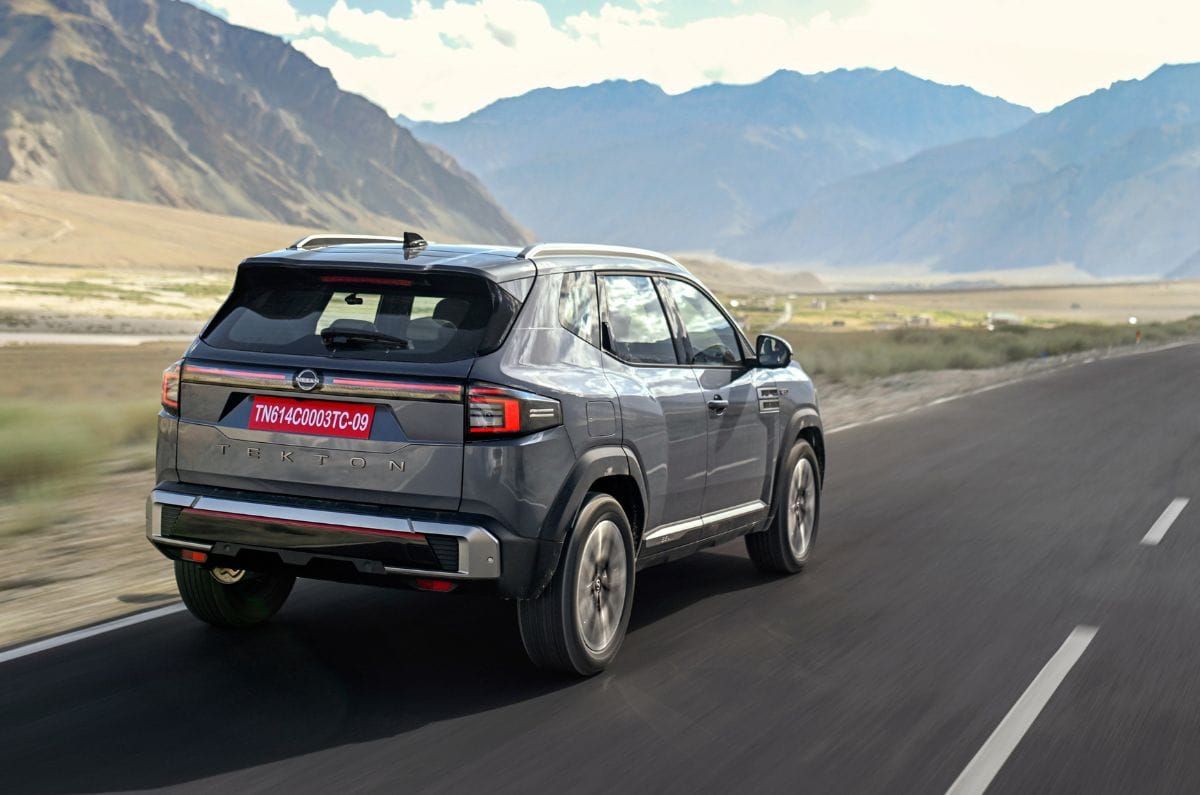
For our first drive of the all-new Tekton, Nissan organized an elaborate 700km plus test drive from Chandigarh to Leh, tackling everything from crowded city traffic and fast highways to mountain passes and broken roads. The aim was to find out whether Nissan’s new midsize SUV has what it takes to take on the Hyundai Creta, Kia Seltos and Maruti Victoris in the real world.
Nissan Tekton Exterior Design and Engineering – 9/10
The Tekton is, in essence, a badge-engineered Renault Duster. It is built at the same plant, on the same assembly line, and shares its platform, powertrains and several components with its French sibling. Nissan, however, has worked hard to give it a distinct identity, drawing inspiration from its flagship Patrol SUV.
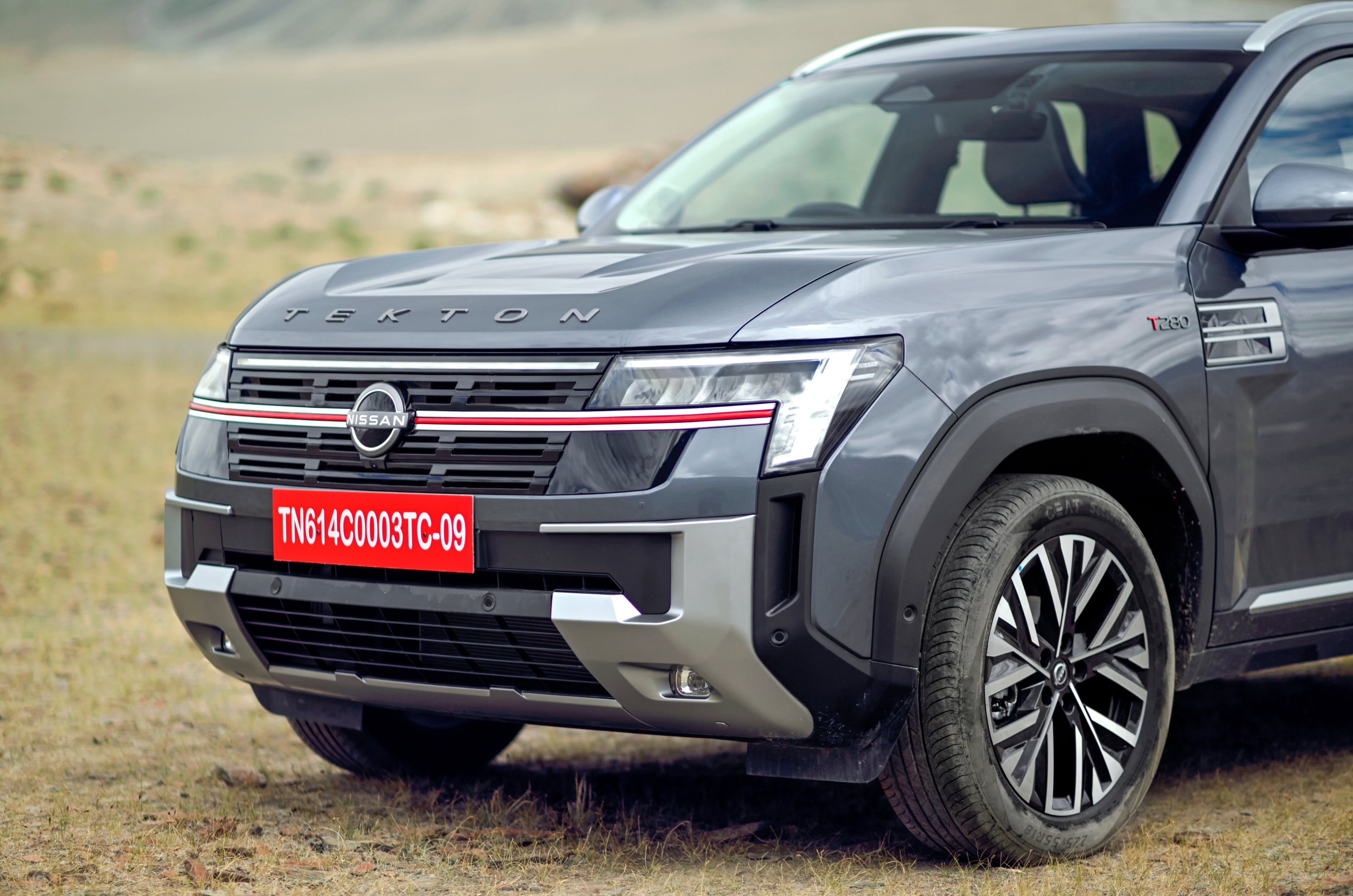
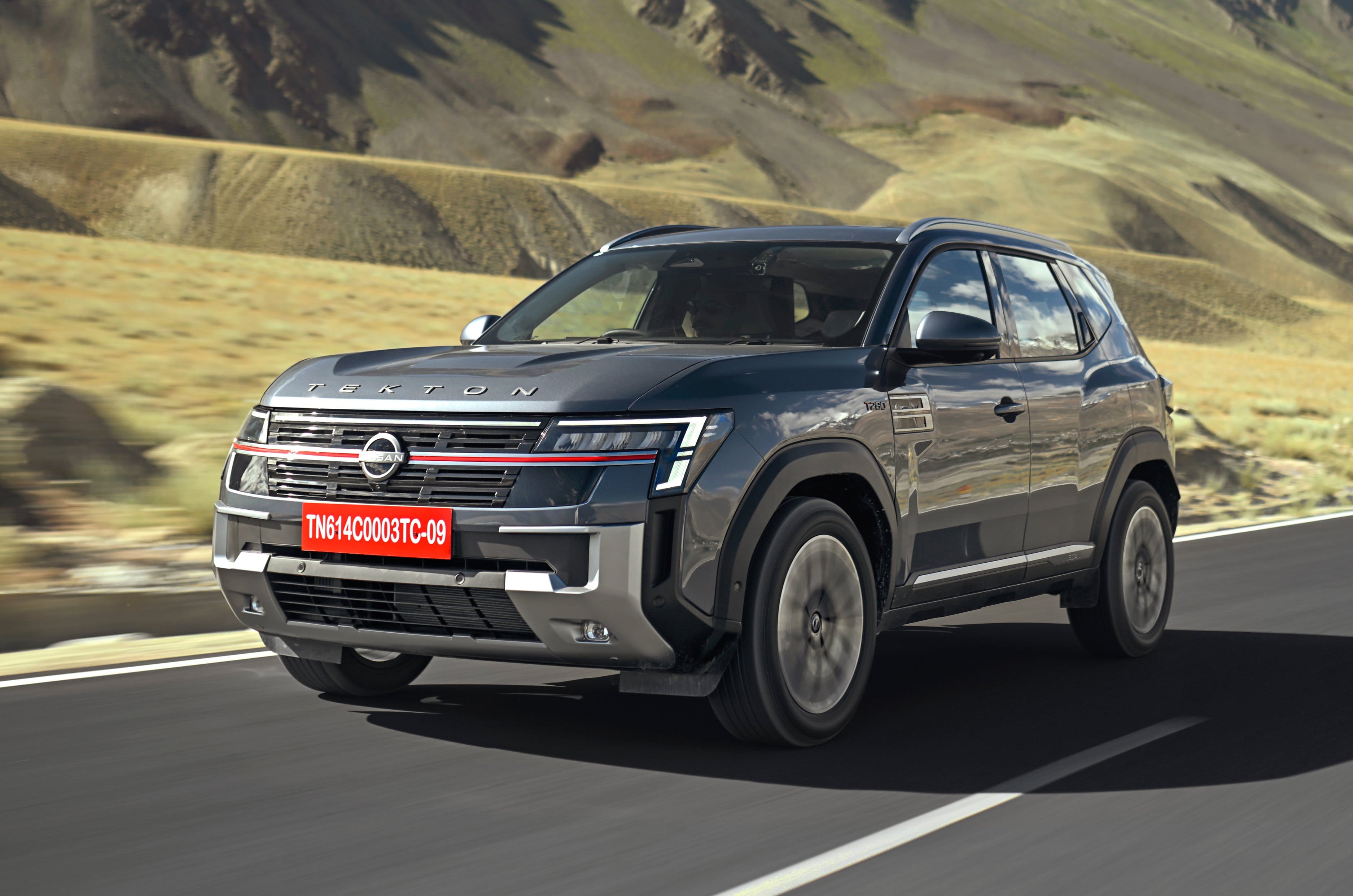
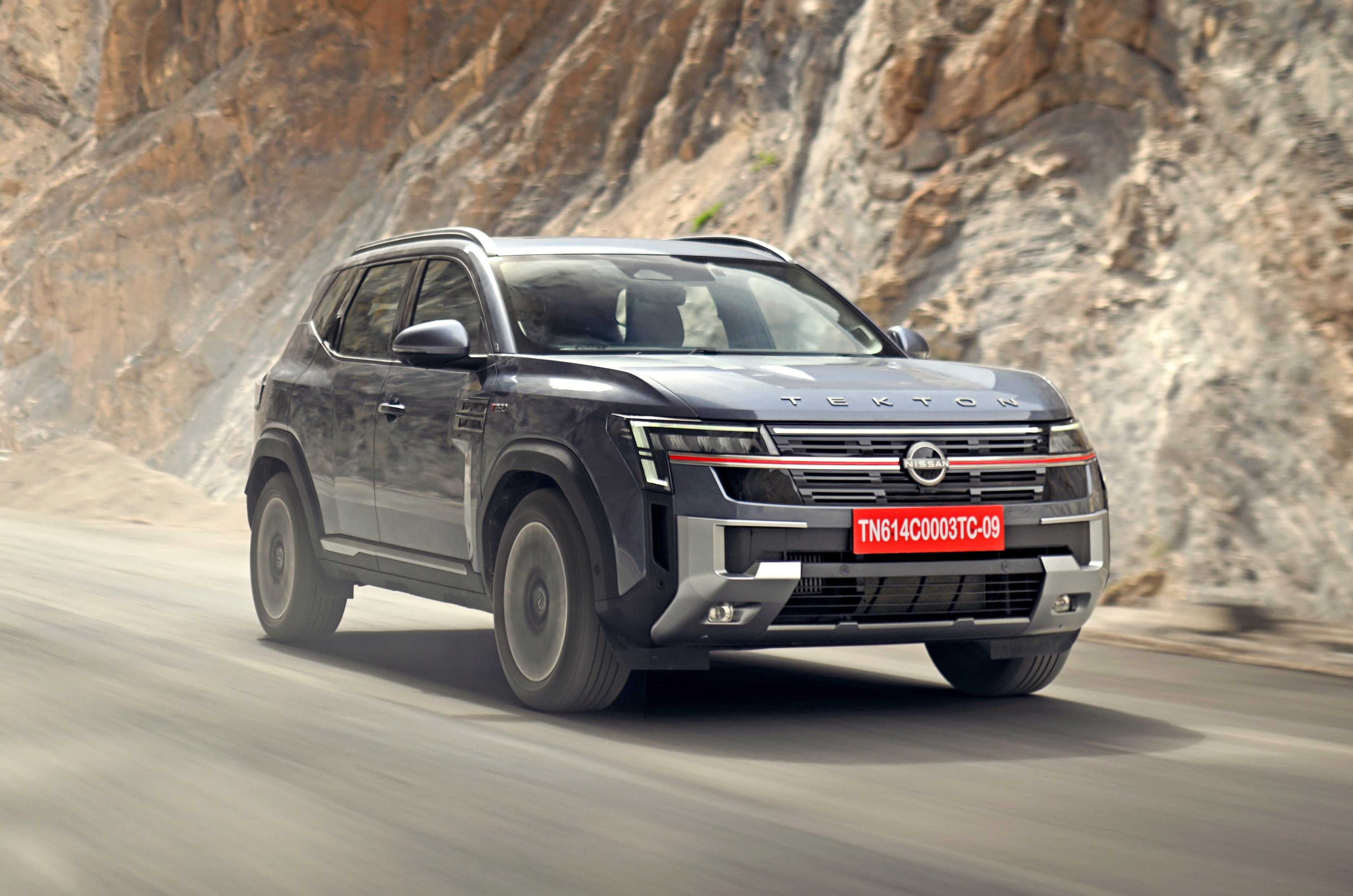
1.3 turbo variants can be identified by the red strip on the grille and T280 badge.
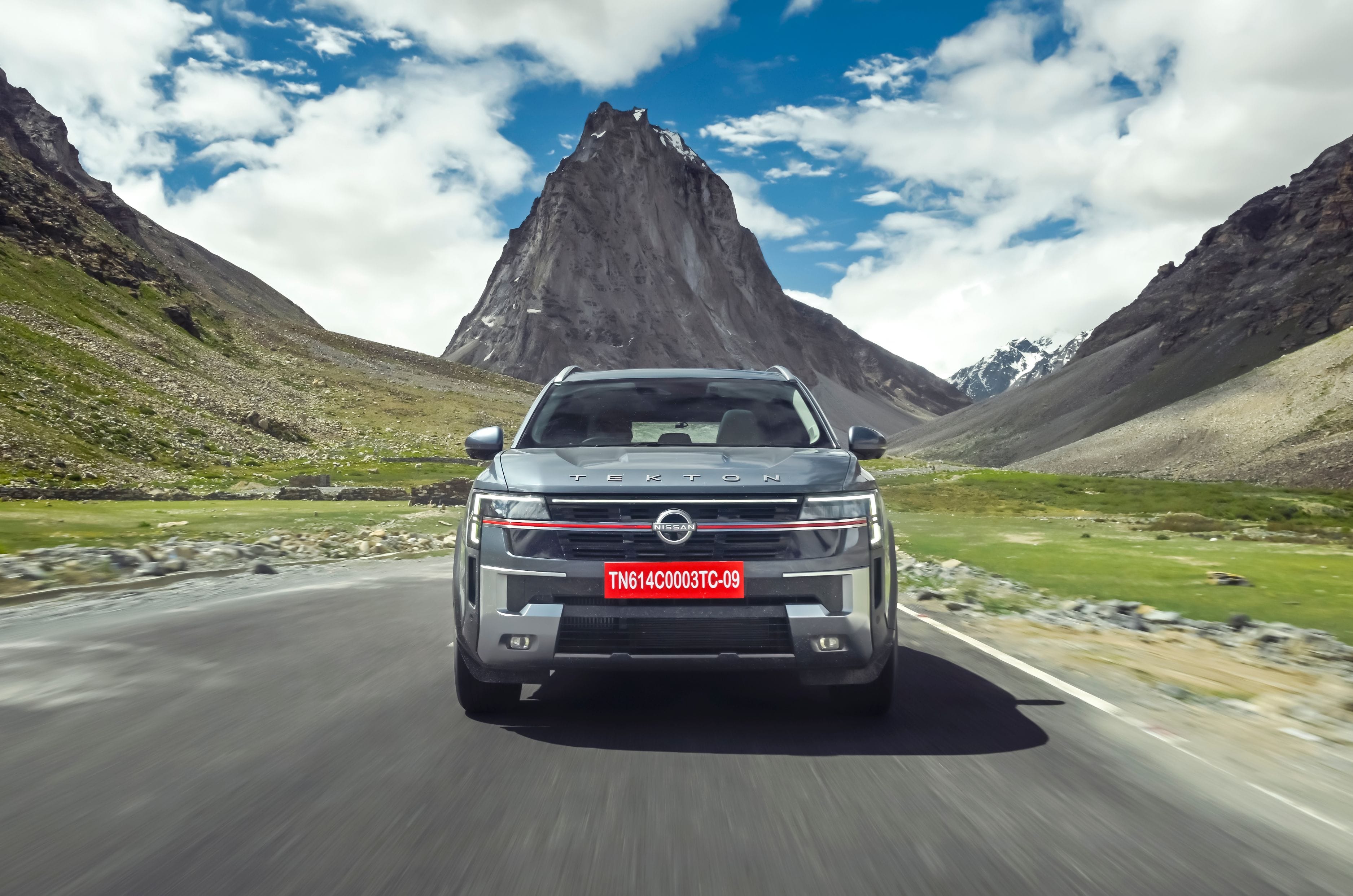
The front end is undoubtedly the highlight. The grille, connected light bar and red accents on the 1.3-litre turbo variants lend it a bold and distinctive look. It even gets functional bumper air scoops and fog lamps, the latter being an increasingly rare feature in this segment. The sculpted bonnet adds plenty of visual muscle, while the side profile is enhanced by attractive 18-inch alloy wheels wrapped in chunky, high-profile tyres.
Practicality extends beyond appearances. Ground clearance stands at an impressive 212mm, making the Tekton well suited to rough terrain. The T280 badge on the front fender denotes the 280Nm produced by the 1.3-litre turbo-petrol engine, while a unique applique depicting the Himalayas adds a touch of character. Its pillar-mounted rear door handles link ties to Nissan SUVs of yore like the Pathfinder and X-Terra.
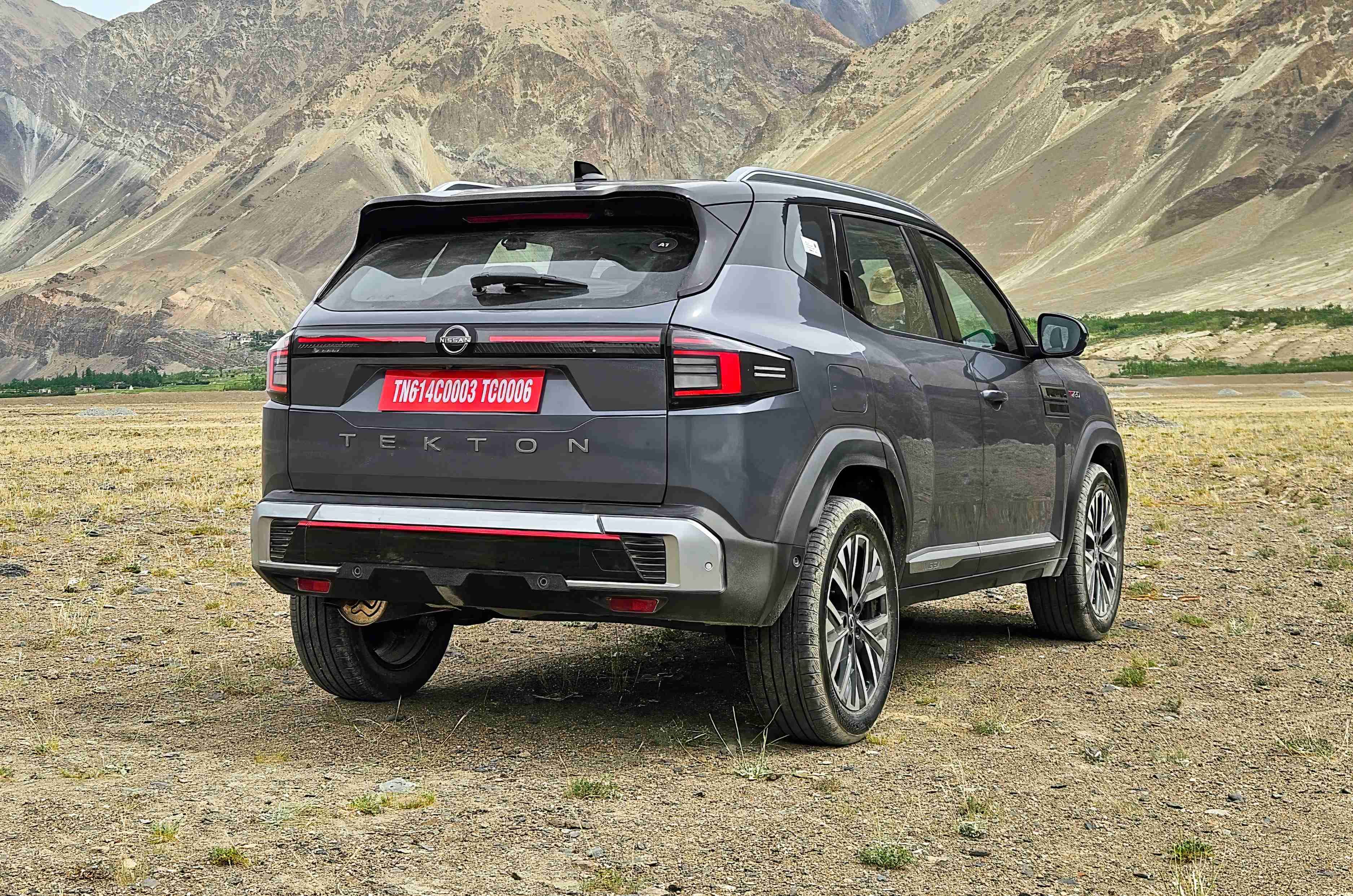
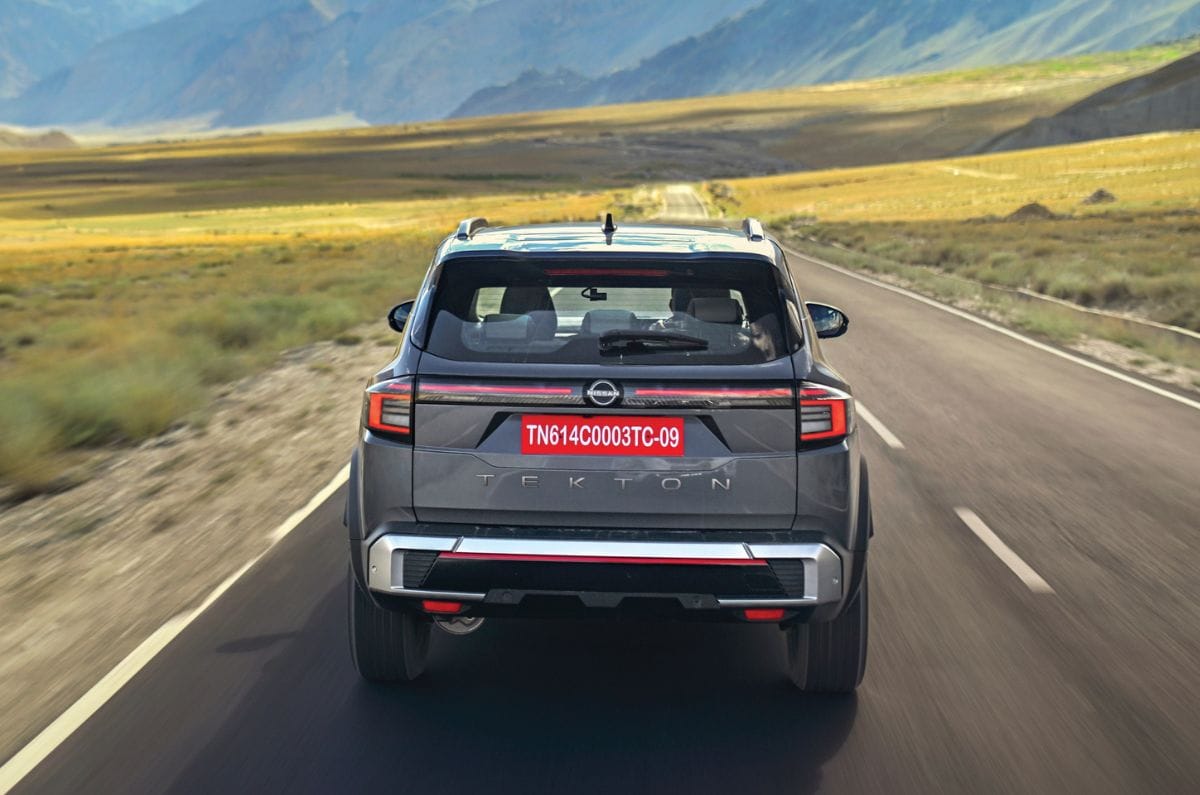
The execution of its tail-lamp design is spot on, looking most similar to the Patrol.
At the rear, the tail-lamp design bears the strongest resemblance to the Patrol and is executed rather well. While the Tekton isn’t the largest SUV in its class, it strikes a pleasing balance between road presence and urban friendliness. We suspect its styling is likely to be one of its biggest selling points.
Nissan Tekton Interior Space and Comfort – 8/10
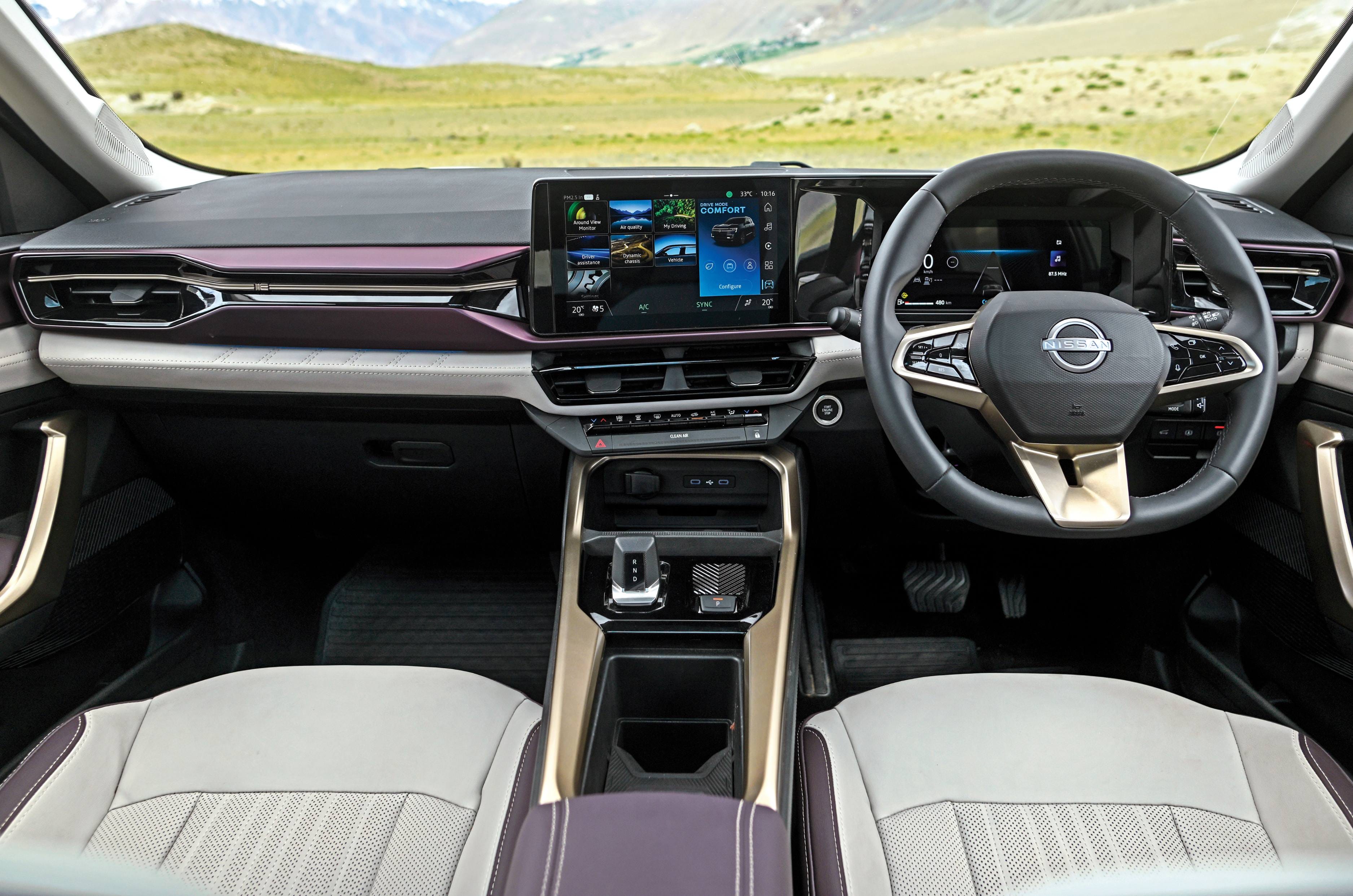
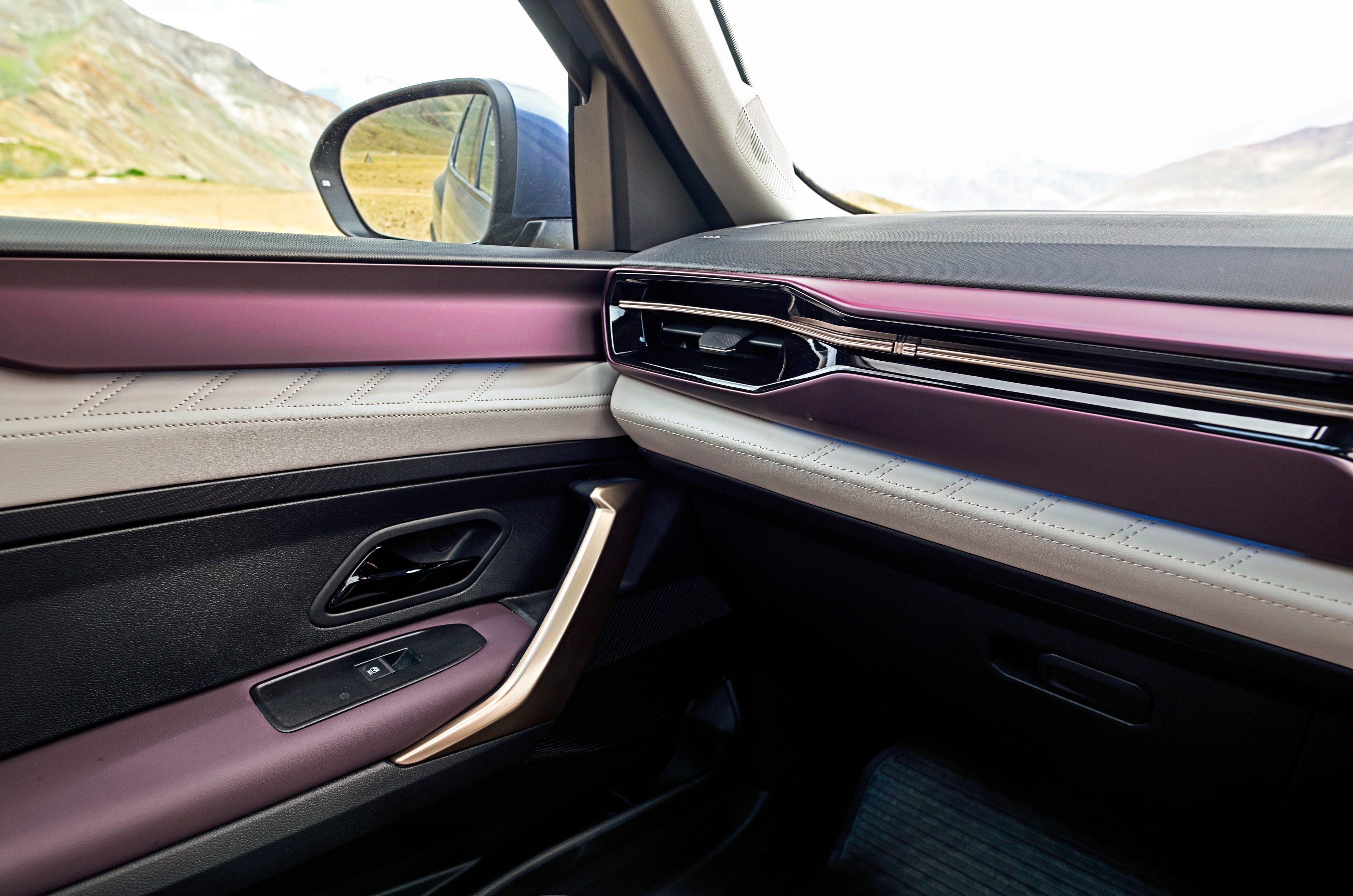
Inside, Nissan has done a commendable job differentiating the cabin from the Renault Duster. The layout remains familiar, but the padded leatherette on the dash and doorpads look classy and along with the burgundy, gold and light cream colour scheme lends the interior a more premium ambience. There are also subtle Nissan-specific touches on the dash fascia, including an Easter egg inspired by Japanese numerals represented by 2 vertical lines (Ni) and three horizontal lines (san).
Neatly dressed-up interior look and feel quite upmarket.
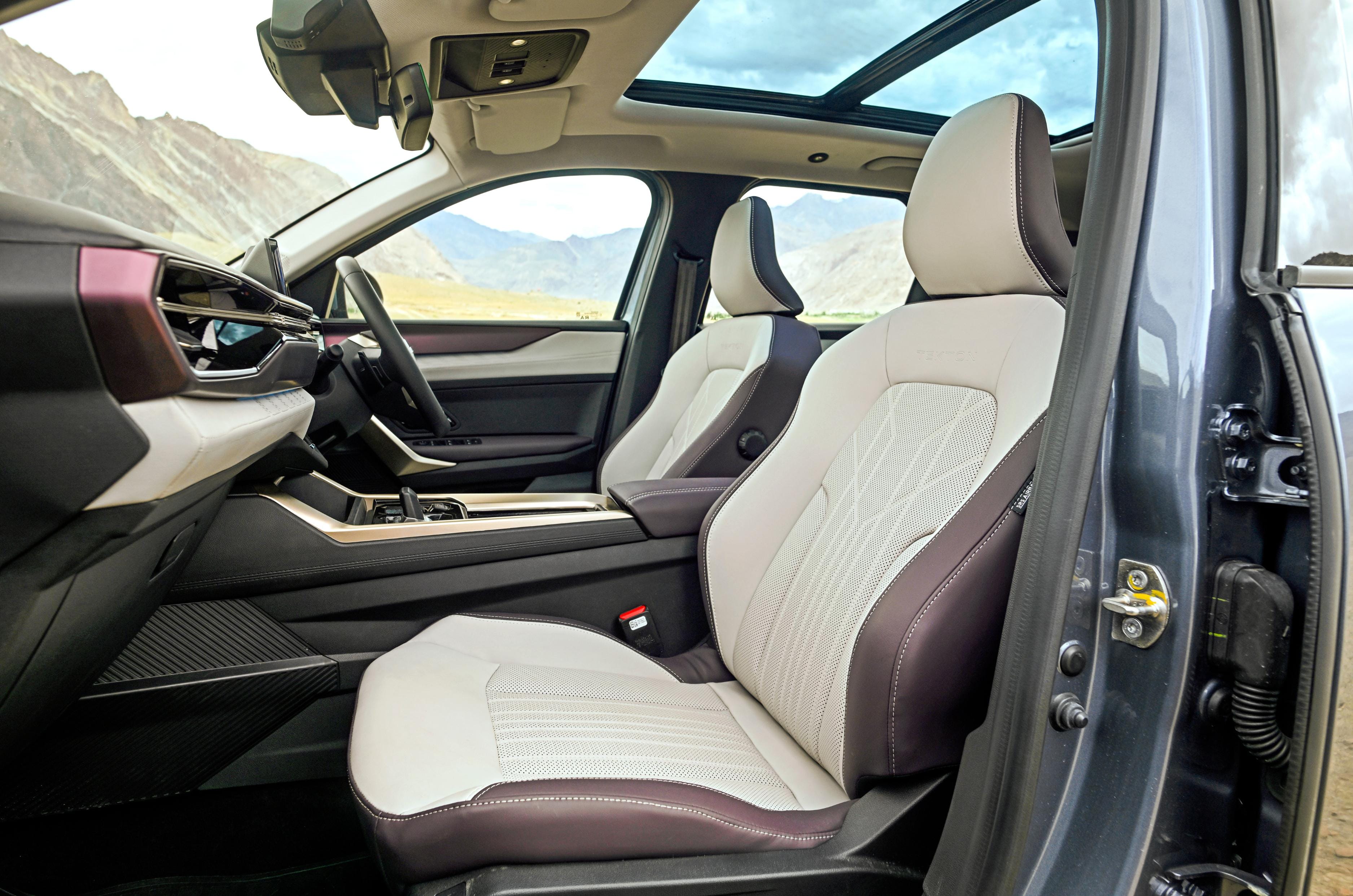
The driving position is excellent. Visibility is strong, the bonnet is clearly visible from the driver’s seat, and most controls fall easily to hand. Ergonomics are largely spot-on, though taller drivers who prefer a high seating position may find the large plastic panel near the A-pillar slightly intrusive.
Burgandy, gold and light cream colour scheme, along with the soft leatherette paddings enhance the cabin’s premium feel.
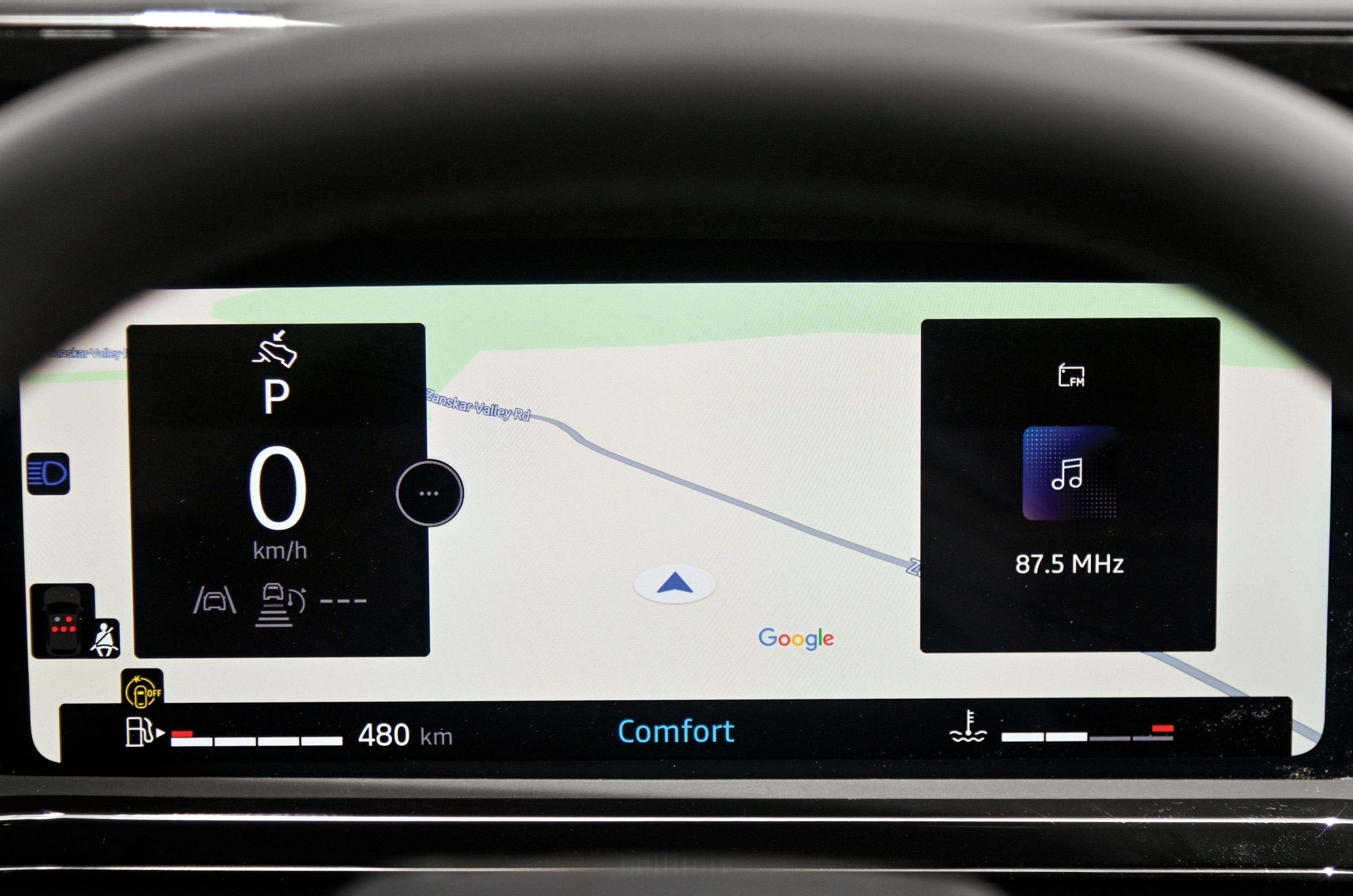
One area where the Tekton needs improvement is air conditioning performance. Even at the lowest temperature setting, the cabin takes time to cool down. Thankfully, the ventilated front seats are highly effective and help offset this weakness. The seats themselves deserve praise for their excellent support and long-distance comfort. The digital instrument cluster is clear and easy to read, offering multiple display layouts, including a full-map view. Unlike the Duster’s less intuitive tachometer display, the Nissan gets a more conventional and user-friendly setup. Physical controls for climate functions, audio settings and ADAS shortcuts are particularly welcome in an era increasingly dominated by fiddly touch panels.
Powered front seats are supportive and have a very effective ventilation function.
Storage solutions are generally well thought out. The cooled wireless charging pad prevents phones from overheating, while USB-C ports and a 12V socket are provided. However, 1-litre bottles cannot be stored vertically in the front door bins; although they can be placed vertically in the rear door bins. Useful storage spaces include deep cupholders and a large central armrest console. The glovebox is generous, though part of it is compromised by the fuse box, just as in the older-gen Duster.
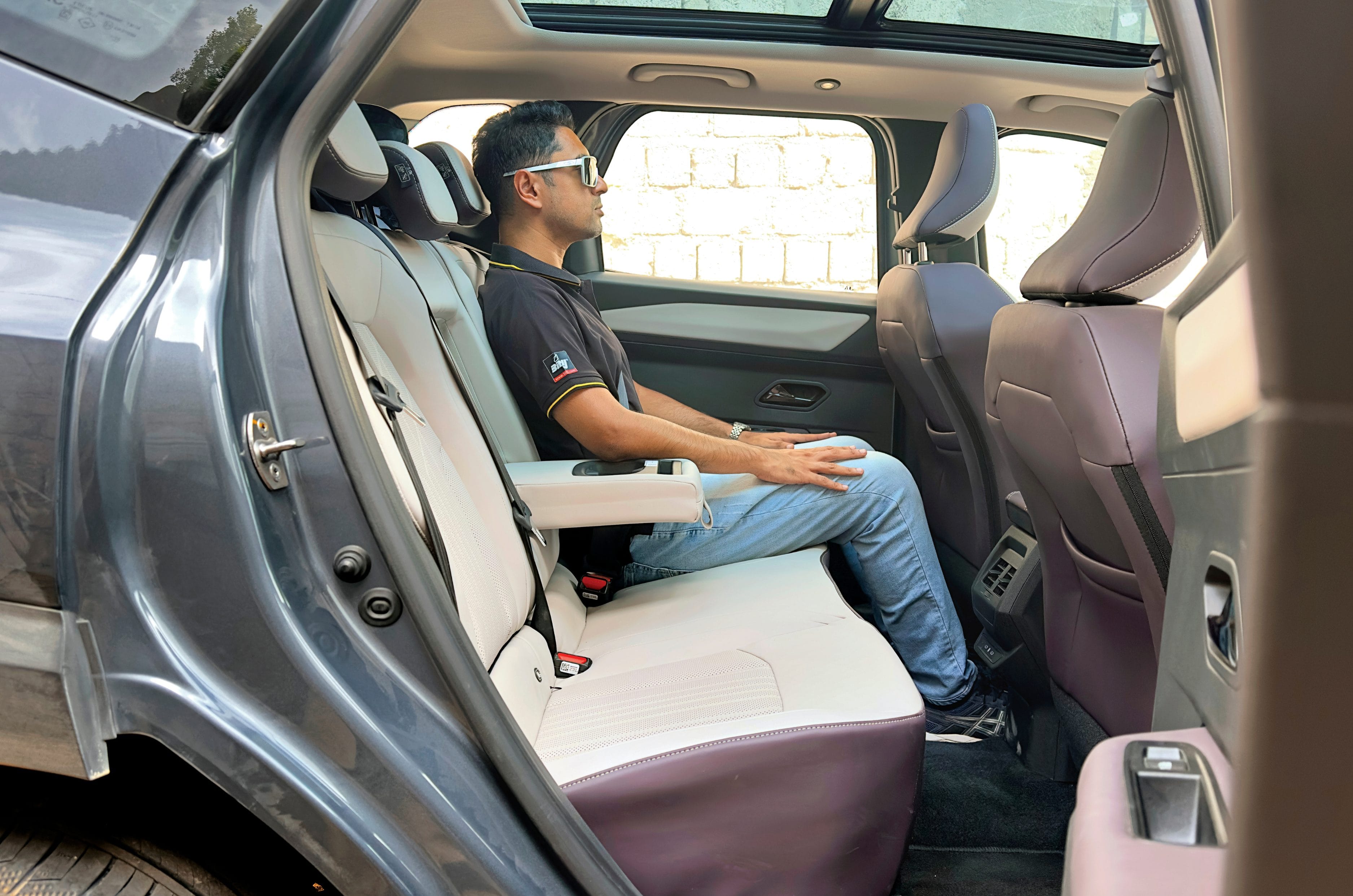
Cabin space is adequate for four adults; seats are very comfy.
Accessing the rear seat requires a bit of effort due to the high step-in and narrow opening, but once seated, comfort levels are impressive. The seat backrest is well angled, under-thigh support is good, and there’s plenty of room beneath the front seats to stretch out. The rear bench is best suited to two adults rather than three, although all occupants get individual headrests and three point seatbelts.
Rear-seat amenities include seatback pockets, rear AC vents, two USB charging ports, a centre armrest and a phone holder. The panoramic sunroof adds a real sense of occasion, especially on scenic drives through the mountains. That said a boss mode for the electrically adjustable front passenger seat and rear sunshades aren’t available.
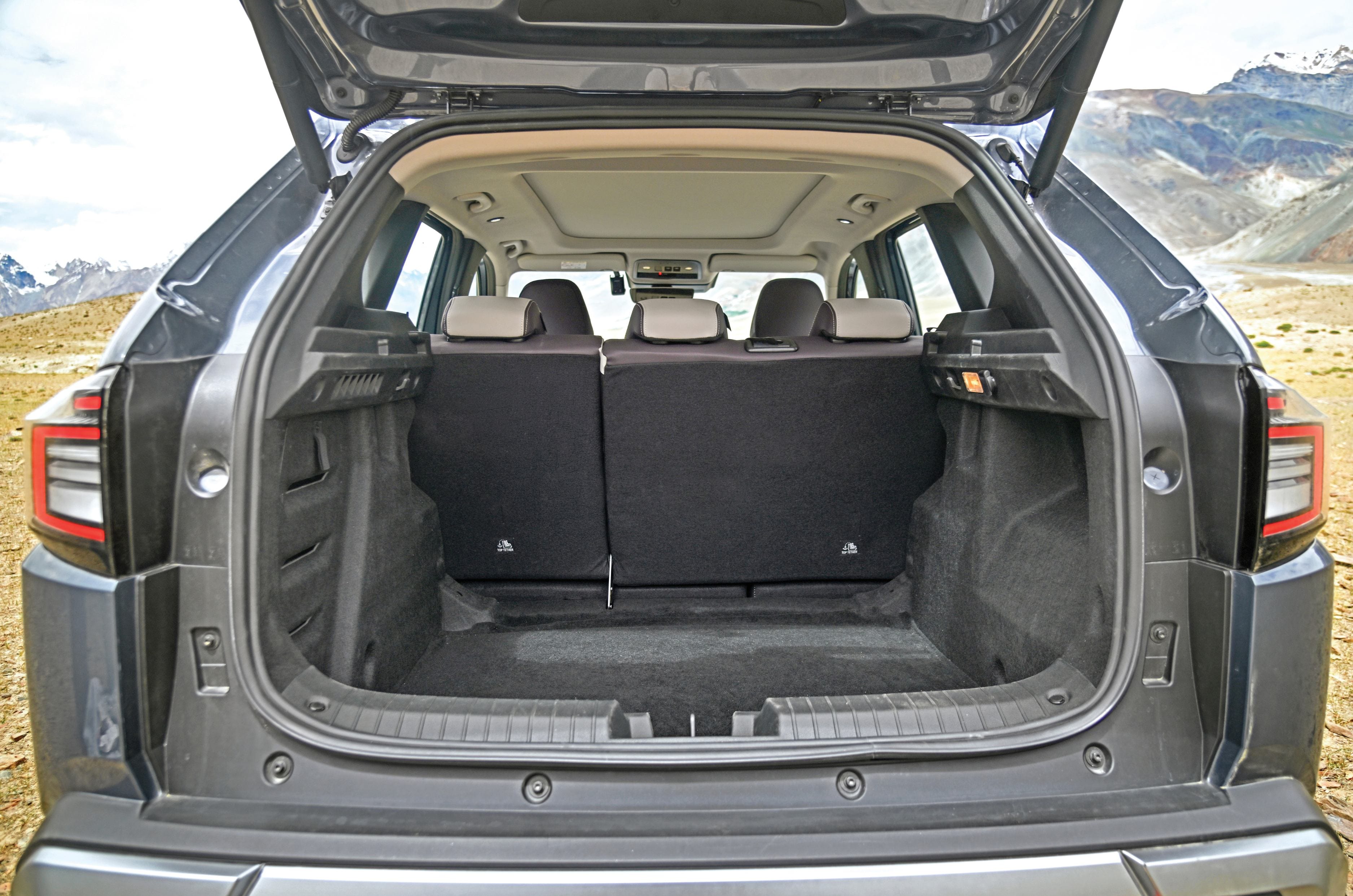
Cavernous 518-litre boot is ideal for road trips; gets a spare wheel too.
Open the electrically operated tailgate and you’re greeted by a massive 518-litre boot. It comfortably swallows luggage and is the largest in its class, making it ideal for long-distance touring. There’s a full-size spare tyre too.
Nissan Tekton Features and Safety – 9/10
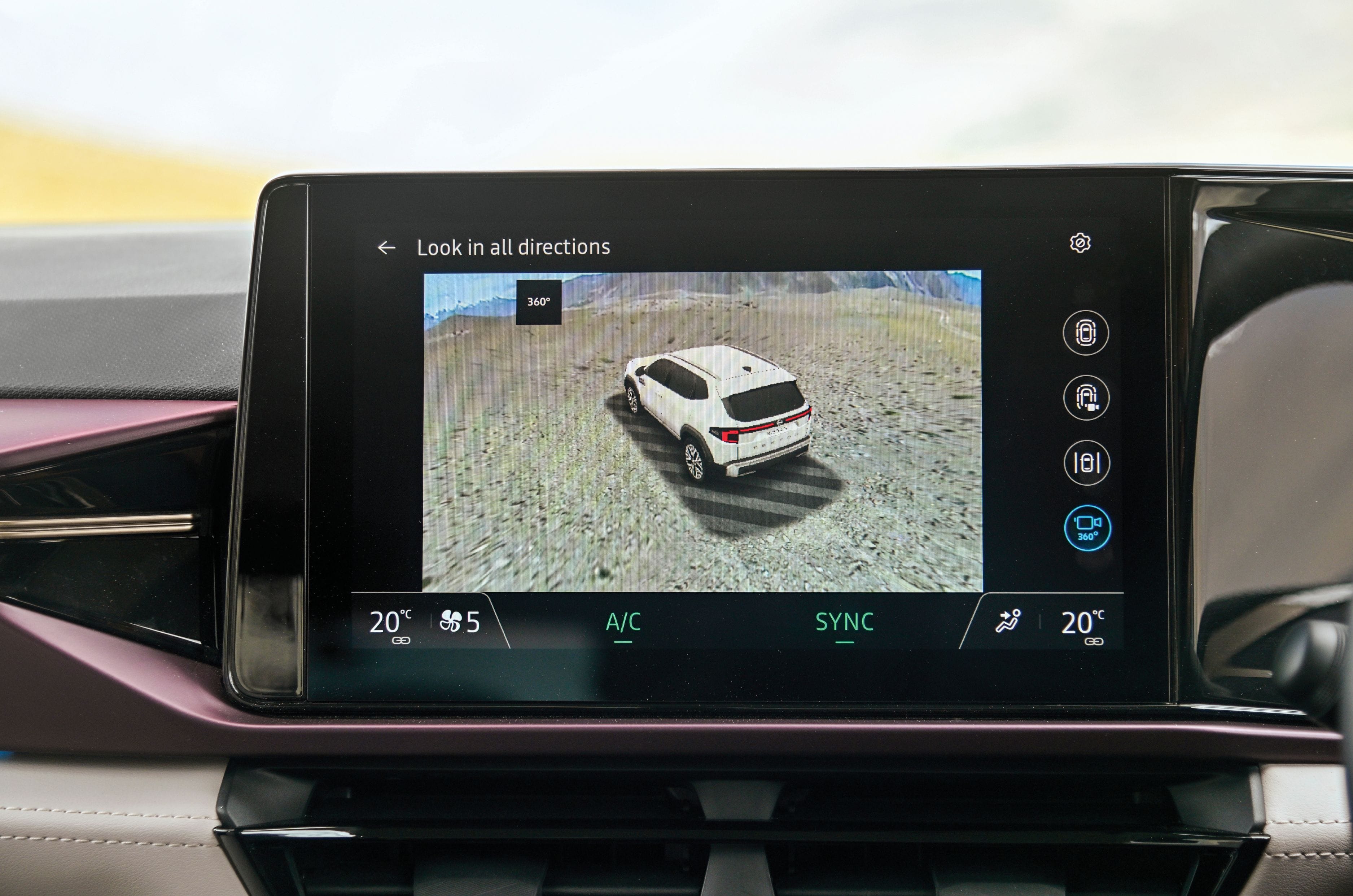
The Tekton is otherwise generously equipped with kit like panoramic sunroof, powered and ventilated front seats, 10.25-inch instrument cluster, 10.1-inch touchscreen which not only gets wireless Android Auto and Apple CarPlay, but it also gets native Google integration including Gemini voice assistant, among other notable features. The only real disappointment is the below par quality of the 360-degree camera system.
With in-built Google, screen works well; 360-degree camera quality is below par.
Safety credentials are strong. Along with a comprehensive ADAS suite, the Tekton has secured a five-star Bharat NCAP rating, just like its Renault sibling. The lane-keep assist didn’t seem to keep the vehicle properly centred within the lane, and it tended to weave between the lane markings.
The adaptive cruise control system also performed well, maintaining safe distances and slowing progressively with traffic. Its acceleration back to the set speed, however, feels somewhat slow regardless of drive mode.
10.25-inch instrument cluster is well executed; gets a full map view too.
Nissan Tekton Performance and Refinement – 7/10
The entry-level powertrain is a 1.0-litre turbo-petrol shared with the Magnite. With some updates though that has taken torque higher to 166Nm – up from 160Nm, while power remains the same at 100hp. It is paired exclusively with a six-speed manual gearbox.
To compensate for the Tekton’s weight and performance demands, Nissan has equipped this version with shorter gearing than the 1.3-litre variants. Around town, it feels perfectly adequate, but the small-capacity turbo engine suffers from noticeable turbo lag. Steep inclines often require clutch slip to get moving, and enthusiastic driving demands frequent gear changes to keep the engine in its power band. Peak boost arrives beyond 3,000rpm, while the gearbox itself lacks the slickness of some Korean and Japanese rivals.
If you love to drive, this is one of those cars that you’re surely going to like.
The 1.3-litre turbo-petrol is significantly more appealing. Refinement levels are better, performance is considerably stronger, and overtaking requires much less planning. Turbo lag is reduced compared to the 1.0-litre, though it hasn’t been eliminated entirely. On steep gradients and under stop-start conditions, the engine occasionally struggles to build revs quickly enough, exposing a weak bottom-end response.
Once past 2,500rpm, however, the turbo wakes up and the Tekton gathers speed with enthusiasm. The engine also produces an appealing turbo whoosh at higher revs, though some may find it intrusive.
Enthusiasts are likely to yearn for a bit more responsiveness from both the engines.
This engine comes with a manual as well as a six-speed wet-clutch dual-clutch automatic transmission, which is the one we drove. Shifts are impressively smooth and seamless, but responses are slower than expected. The gearbox’s tendency to upshift early can make the Tekton feel less responsive than it actually is, often prompting the use of the paddle shifters for quick overtakes.
There are two drive modes – Comfort and Eco – though enthusiasts will miss the absence of a Sport mode. Fortunately, manual mode allows greater control over the transmission and proved particularly enjoyable on mountain roads. In city traffic, however, the combination works well, with smooth low-speed behaviour and a well-calibrated creep function.
Even though we didn’t get a chance to test the Tekton for outright performance and fuel efficiency, we have extensively tested its Renault sibling, and the numbers aren’t particularly impressive. Expectedly, the Duster’s performance testing revealed that the 1.3-litre manual is the quickest variant to 100kph (10.32 sec), , while the 1.3 DCT’s reluctance to allow aggressive launches affects its outright acceleration times (11.33 sec). The 1.0-litre (13.26 sec) delivers acceleration comparable to the naturally aspirated 1.5-litre engines found in the Creta and Seltos.
Nissan Tekton Mileage and Efficiency – 6/10
Once again, taking the Duster’s figures for refence, average real-world fuel efficiency is quite weak too with the 1.0 version (10.98kpl) faring only slightly better than the 1.3 versions (10.47kpl for DCT, 10.64kpl for MT). Like the Duster, all variants of the Tekton get an Eco mode as well as an auto engine stop-start function to keep a check on fuel consumption.
Nissan Tekton Ride Comfort and Handling – 9/10
As with the Renault Duster, Nissan has absolutely nailed the ride-and-handling balance. Unlike many European cars, the Tekton does not feel overly firm at low speeds. Instead, it delivers a supple, absorbent ride that shrugs off poor road surfaces with ease. Even sharp potholes generate more noise than impact inside the cabin.
Unlike some rivals, its low speed ride doesn’t have the typical underlying firmness.
Handling is equally impressive. The Tekton changes direction eagerly and inspires confidence, making it genuinely enjoyable to drive. Its electronic power steering offers Light and Heavy modes, though the lighter setting strikes the better balance between ease and precision. The steering feel is among the best in the segment.
Braking performance is another strong point. Throughout our drive to Leh, the brakes consistently inspired confidence, delivering strong stopping power and natural pedal feel.
Nissan Tekton Value for Money – 8/10
Priced between Rs 10.50 lakh and Rs 18.5 lakh, the Tekton commands a premium of Rs 10,000-50,000 over an equivalent Renault Duster. The range consists of 12 variants: six powered by the 1.0-litre turbo petrol, two by the 1.3-litre manual and four by the 1.3-litre auto, indicating Nissan’s focus on the smaller engine.
The biggest drawbacks of the powertrains though are the lack of outright punch and responsiveness, as well as fuel efficiency that may not satisfy high-mileage users. Neither Renault nor Nissan offers a diesel option, and while the Duster is expected to receive a hybrid powertrain, Nissan has ruled out one for now.
However after 700km behind the wheel, the Nissan Tekton leaves an overall positive impression. It is handsome, well equipped and comfortable, with a premium-feeling cabin and class leading 518-litre boot. The rear seat may not be the most spacious in the segment, but it comfortably accommodates four adults, while its ride-and-handling balance ranks among the very best in class. The Tekton then is a thoroughly competent midsize SUV. And in a segment packed with strong contenders, this one too deserves serious consideration.
अच्छी सैलरी और बड़ी कंपनी में नौकरी हर किसी का सपना होती है। वहीं 31 वर्षीय सान्या देशमुख ने इससे बिल्कुल अलग रास्ता चुना। सान्या देशमुख ने कई साल तक बड़ी टेक कंपनियों में काम करते हुए अपना सफल करियर बनाया। 31 वर्षीय सान्या डिजिटल मार्केटिंग के क्षेत्र में बाइटडांस, इनमोबी और अमेजन जैसी नामी कंपनियों से जुड़ी रहीं। अमेजन में काम करते हुए उनकी सालाना सैलरी करीब 30 से 35 लाख रुपये थी। वहीं उनके पति की भी लगभग इतनी ही कमाई थी, जिससे दोनों की कुल सालाना आय 60 से 65 लाख रुपये के आसपास पहुंच गई थी।
लेकिन सान्या देशमुख के पास अच्छी नौकरी के बाद भी उन्हें धीरे-धीरे महसूस होने लगा कि मुंबई की भागदौड़ भरी जिंदगी उनके लिए सही नहीं है। इसके बाद उन्होंने कॉर्पोरेट नौकरी छोड़ने का फैसला किया। अब वह नासिक में रहकर अपने बिजनेस पार्टनर के साथ डिजिटल मार्केटिंग का काम करती हैं।
कई जगहों पर किया काम
पुणे से कंप्यूटर इंजीनियरिंग की डिग्री हासिल करने के बाद सान्या देशमुख ने पारंपरिक इंजीनियरिंग की नौकरी करने के बजाय डिजिटल मार्केटिंग को अपना करियर बनाया। शुरुआत में उन्होंने फूड से जुड़ा एक सोशल मीडिया प्रोजेक्ट शुरू किया, जिसकी लोकप्रियता ने उन्हें एक बड़ी डिजिटल मार्केटिंग एजेंसी में नौकरी दिलाने में मदद की। इसके बाद उन्होंने लगातार अपने करियर में तरक्की की और कई बड़ी कंपनियों में काम किया। सान्या पहले बाइटडांस से जुड़ीं, फिर भारत में बाइटडांस का कारोबार बंद होने के बाद उन्हें नौकरी छोड़नी पड़ी। इसके बाद वह इनमोबी पहुंचीं और बाद में अमेजन के विज्ञापन कारोबार से जुड़े विभाग में भी महत्वपूर्ण जिम्मेदारियां निभाईं।
करियर में आगे बढ़ते हुए सान्या ने शुरुआती पद से शुरुआत की और धीरे-धीरे टीम लीडर की जिम्मेदारी तक पहुंचीं। अमेजन में सान्या देशमुख को अपना काम पसंद था, लेकिन कॉर्पोरेट लाइफ की भागदौड़ धीरे-धीरे उनके लिए थकाऊ होती गई। उनके माता-पिता औरंगाबाद में और पति नासिक में रहते थे।
काफी त्योहार मिस किए
सान्या देशमुख ने मनीकंट्रोल से कहा, “अब मुझे सोमवार आने से पहले रविवार वाली घबराहट या तनाव महसूस नहीं होता।” सान्या देशमुख ने बताया, “शुरुआत में हमें हफ्ते में दो दिन ऑफिस आना होता था। बाद में यह तीन दिन और फिर पूरे पांच दिन हो गया। मैं हर रविवार शाम मुंबई के लिए निकलती थी, ऑफिस से काम करती थी और फिर वापस घर लौट आती थी।” उन्होंने बताया कि शादी के बाद लगातार शहरों के बीच सफर करना और परिवार की जिम्मेदारियों को निभाना उनके लिए धीरे-धीरे काफी मुश्किल और थकाने वाला हो गया था।
सान्या देशमुख ने कहा, “परिवार के कार्यक्रमों, त्योहारों और दूसरे खास मौकों पर शामिल होने के लिए हमें अक्सर छुट्टी लेनी पड़ती थी। ऐसे में कई बार हमें अपनों के साथ समय बिताने और भविष्य की यात्रा के लिए अपनी छुट्टियां बचाकर रखने के बीच चुनाव करना पड़ता था। हम परिवार के कई कार्यक्रम और त्योहार मिस कर रहे थे।”
किराए के लगते थे 65 हजार
सान्या देशमुख ने बताया कि उनकी आर्थिक स्थिति को लेकर भी पति-पत्नी के बीच गंभीर बातचीत होने लगी थी। ऑफिस आने-जाने का समय बचाने के लिए दोनों ने मुंबई में ऑफिस के पास एक बेडरूम का फ्लैट किराए पर लिया था, जिसका किराया करीब 65 हजार रुपये प्रति माह था। वे ये खर्च उठा सकते थे, लेकिन उन्हें लगने लगा कि लंबे समय तक ये व्यवस्था सही नहीं है। उन्होंने कहा, “हम अपनी कमाई, किराए, रोजमर्रा के खर्च और आखिर में कितनी बचत हो रही है, इन सभी बातों पर ध्यान देने लगे थे।”
मुंबई में बढ़ते खर्चों और बच्चों की परवरिश को लेकर सोचने के बाद सान्या और उनके पति ने नासिक में परिवार के साथ रहने का फैसला किया। यहां उन्हें किराया नहीं देना पड़ता, जिससे घर के खर्च में काफी कमी आई और उनकी बचत भी बढ़ गई।
पैसों को लेकर काफी कुछ सीखा
सान्या ने कहा कि, आय पहले से कम होने के बावजूद अब उनकी बचत पहले के मुकाबले ज्यादा हो रही है। सान्या देशमुख ने कहा, “जब हम मुंबई में रह रहे थे, तब मैं ठीक तरह से निवेश भी नहीं कर पा रही थी।” उन्होंने बताया कि उस समय उनकी ज्यादातर बचत PPF, कभी-कभी यात्रा और सोना खरीदने जैसे खर्चों में चली जाती थी। लेकिन अब उन्होंने SIP शुरू की, PPF में निवेश जारी रखा और पैसों के बेहतर प्रबंधन के लिए कई फाइनेंशियल लिटरेसी कोर्स भी किए। उन्होंने कहा, “मैंने निवेश और पैसों को मैनेज करने के बारे में काफी कुछ सीखा। इससे मेरा पूरा नजरिया बदल गया।”
नासिक आने के बाद सान्या की जिंदगी बदल गई। अब वह अपनी सेहत पर पूरा ध्यान देती हैं, नियमित जिम जाती हैं, खेलती हैं और पर्याप्त नींद व आराम भी करती हैं। सान्या देशमुख ने कहा, “अब काम का तनाव पहले के मुकाबले काफी कम हो गया है।”
किसी बड़े प्लान के लिए नहीं छोड़ी नौकरी
उन्होंने कहा, “ऐसे भी दिन आए जब बढ़ते दबाव की वजह से मैं ऑफिस के वॉशरूम में जाकर खुद को बंद कर लेती थी और रोने लगती थी।” सान्या ने पहले से तय किसी बड़े प्लान के तहत नौकरी नहीं छोड़ी। उन्होंने अपनी तय समय-सीमा से करीब एक साल पहले ही इस्तीफा देने का फैसला कर लिया। नौकरी छोड़ने के बाद उन्होंने कुछ समय का ब्रेक लिया और फिर एक प्रोफेशनल साथी के साथ मिलकर डिजिटल मार्केटिंग का अपना कारोबार शुरू किया। धीरे-धीरे उन्हें क्लाइंट मिलने लगे और अब उनका यह बिजनेस पिछले आठ महीनों से सफलतापूर्वक चल रहा है।
फैसले पर कोई अफसोस नहीं
सान्या ने कहा कि, नौकरी छोड़ने के बाद उन्हें सबसे बड़ी खुशी अपना समय वापस मिलने की है। अब वह परिवार के साथ ज्यादा समय बिताती हैं। सान्या देशमुख ने कहा, “कमाई भले ही पहले से कम हो गई हो, लेकिन मुझे लगता है कि यह फैसला सही था। मौके हमेशा मिलते रहते हैं। लोगों को सबसे ज्यादा डर हर महीने मिलने वाली सैलरी छोड़ने का होता है। लेकिन जब आपके आर्थिक लक्ष्य साफ होते हैं, तो आप अपनी जिंदगी के लिए अलग फैसले लेने की हिम्मत जुटा लेते हैं।”