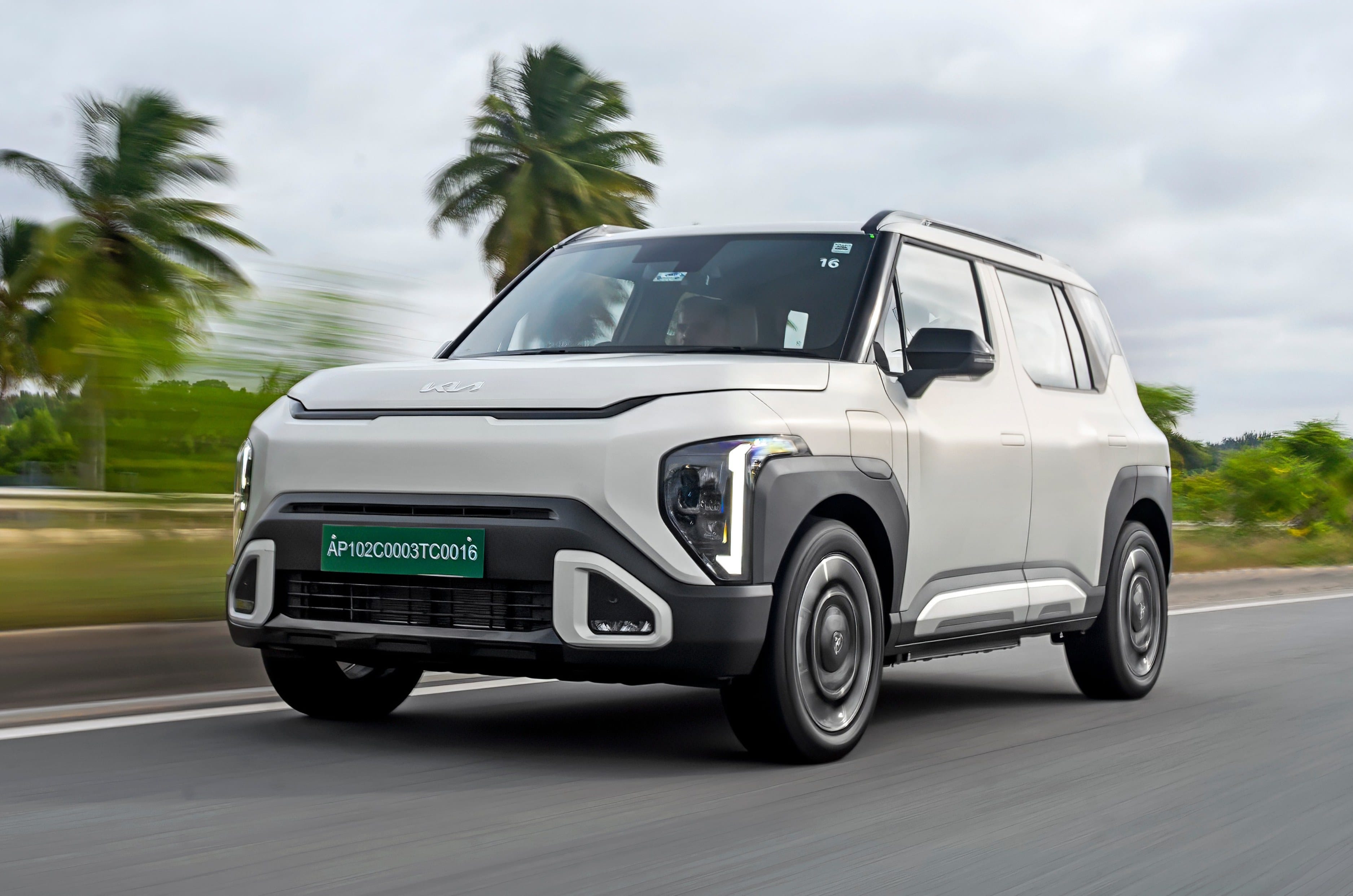
Kia Syros EV: Born to be electric

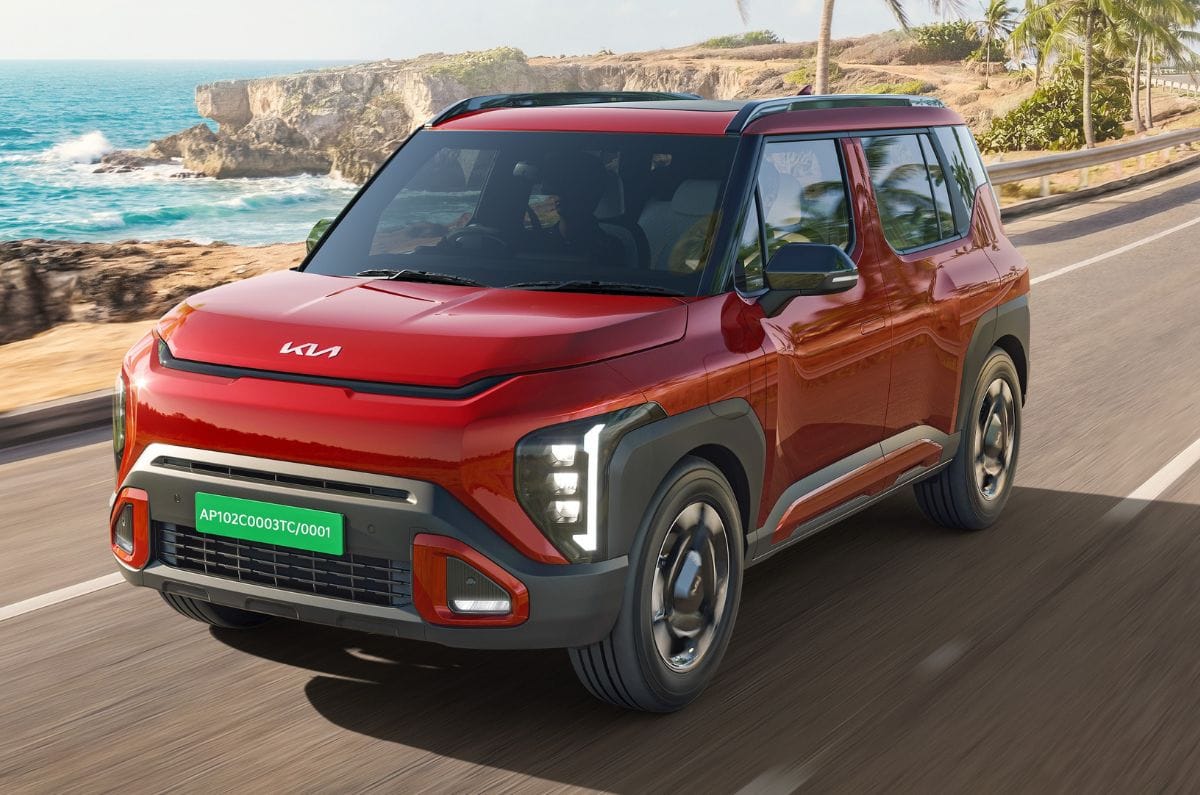
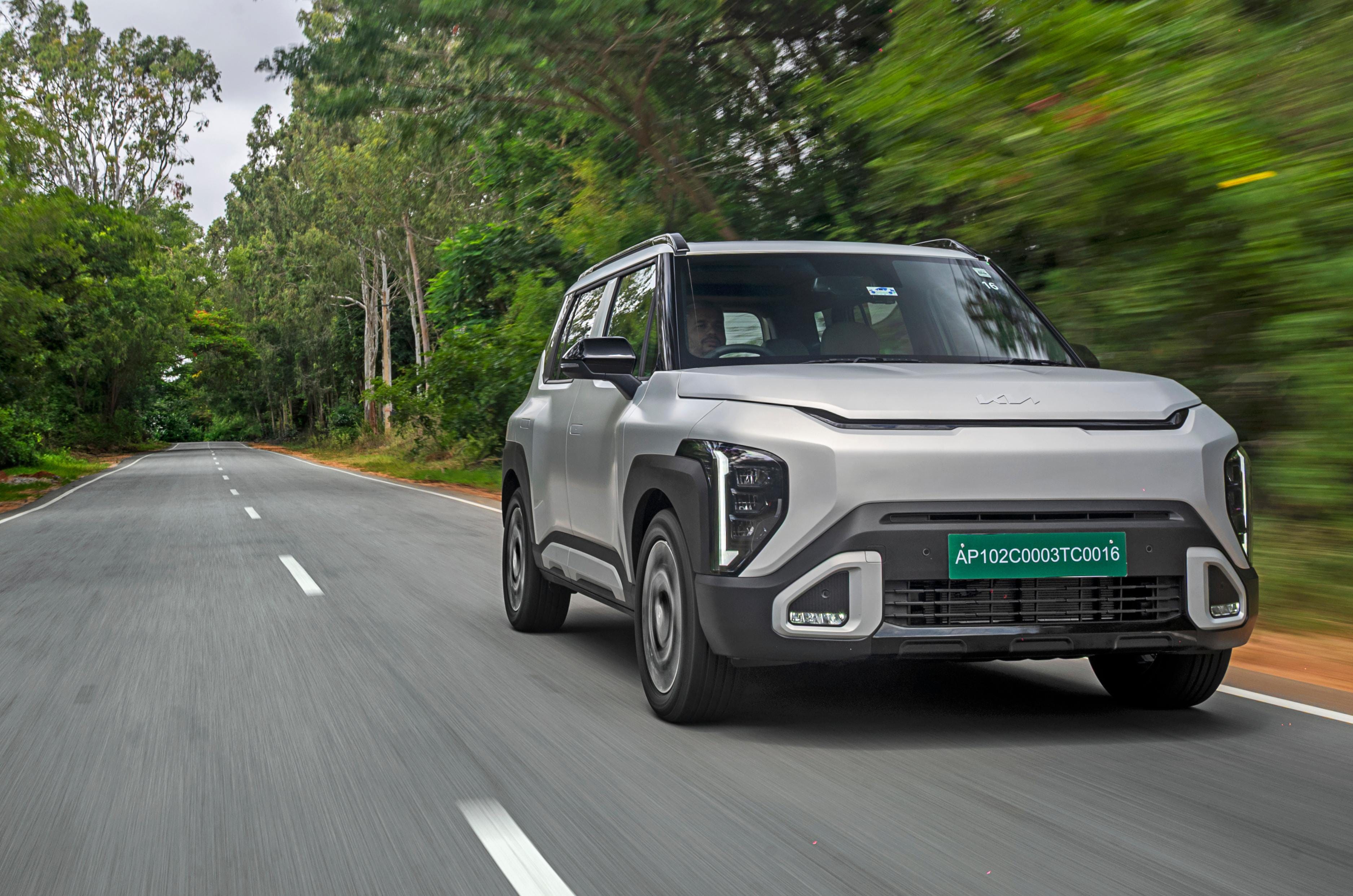
Kia Syros EV front quarter tracking

Kia has chosen the Syros to be its second mass market EV for the Indian market. Despite its superb packaging, oddball styling and high initial prices held back the original ICE version against traditional compact SUV rivals. However, EV customers are generally more accepting of avant-garde design, so can the Syros EV find success where the ICE version couldn’t? We drove it in Bengaluru to find out.

Kia Syros EV Exterior Design and Engineering – 7/10
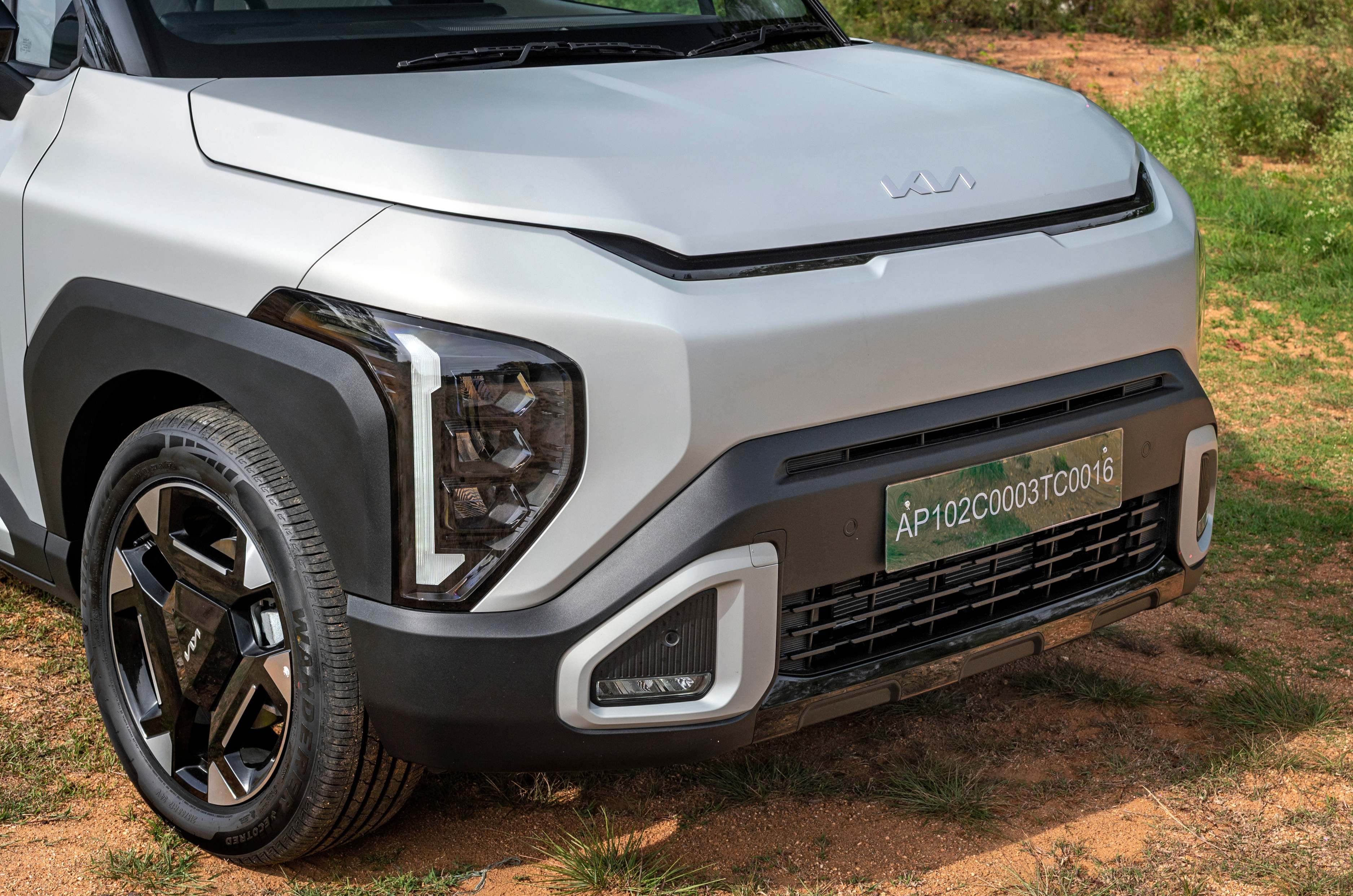
EV has a slimmer intake above the number plate and slightly different lower bumper

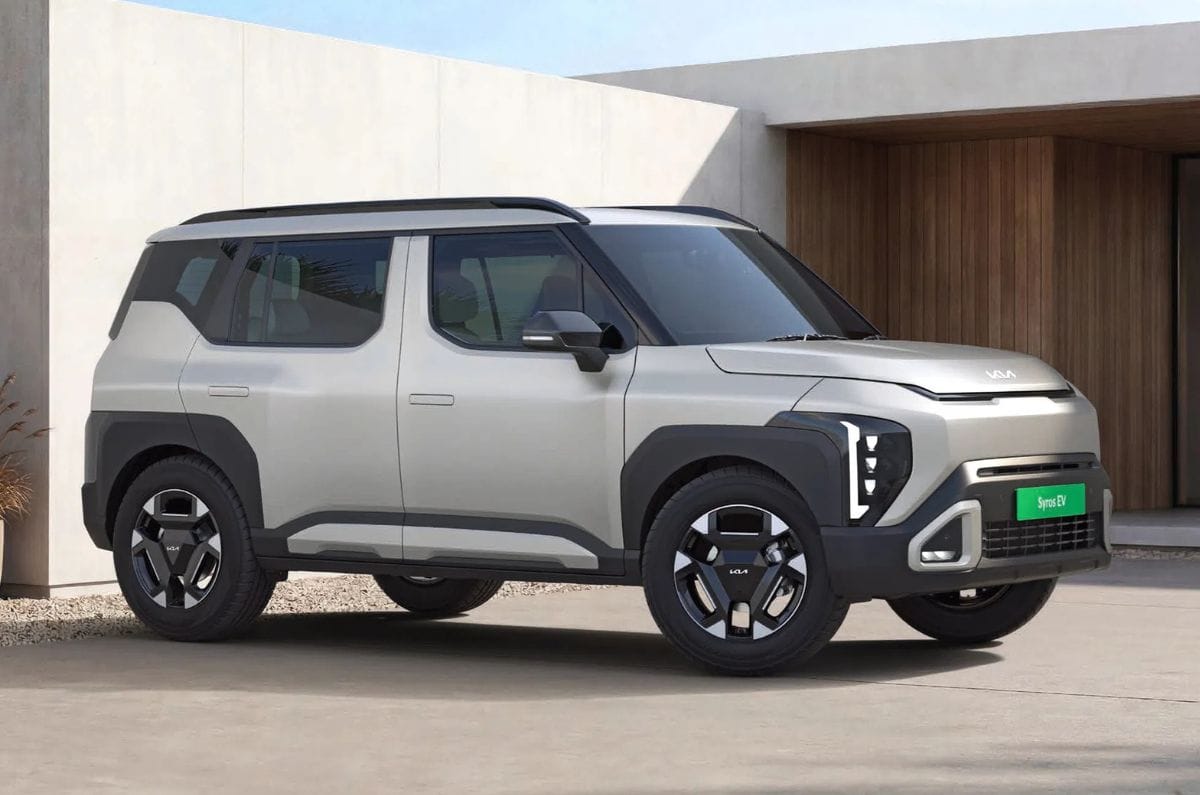
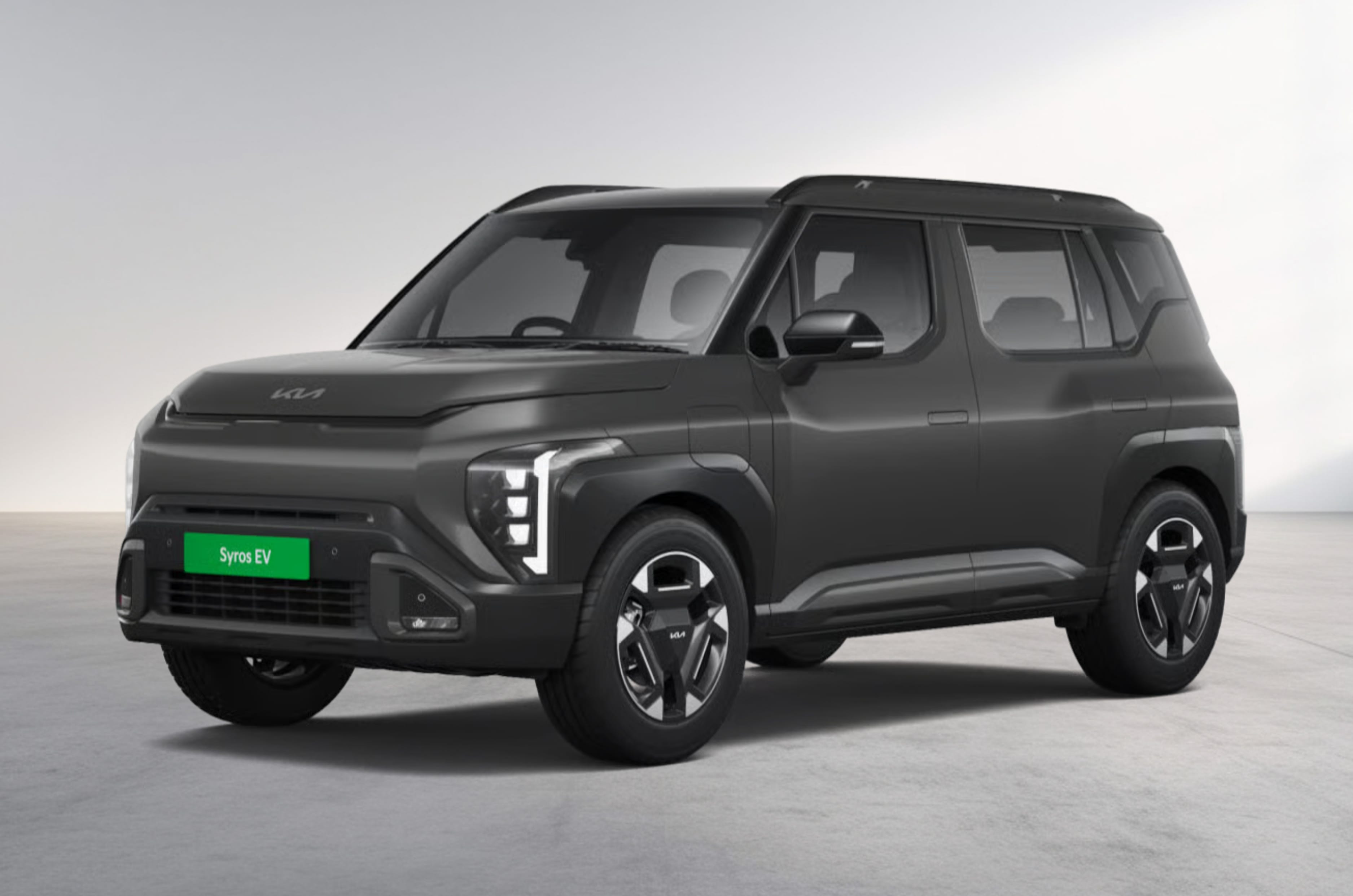
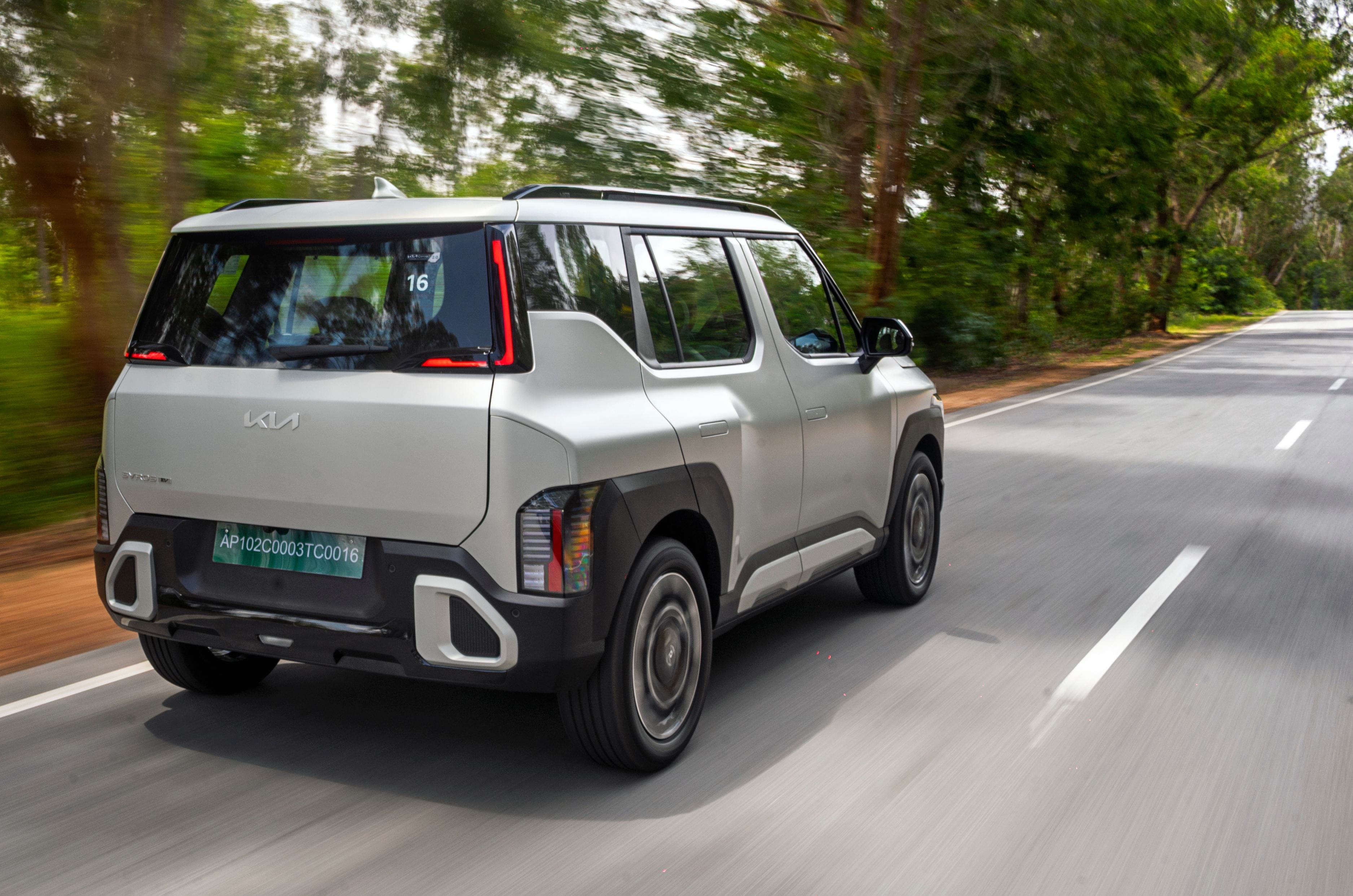
A game of spot the difference between the Syros EV and the ICE version would prove challenging for the casual observer, so here is the cheatsheet. Up front, the bumper is ever so slightly different, with a slimmer cooling slot above the number plate and minor tweaks to the body-coloured triangular pods that house the LED fog lamps. Apart from the charging port on the front left fender and the shorter roof rails, the profile is unchanged. Crouch down, though, and you’ll notice the battery pack is visible, like it is on the Hyundai Creta Electric. Kia claims ground clearance is 197mm which is 7mm more than the ICE version. The tri-spoke 17-inch alloys are the same ones that debuted on the ICE car but were discontinued with the facelift. No differences round the back either, save for an EV badge on the tailgate.
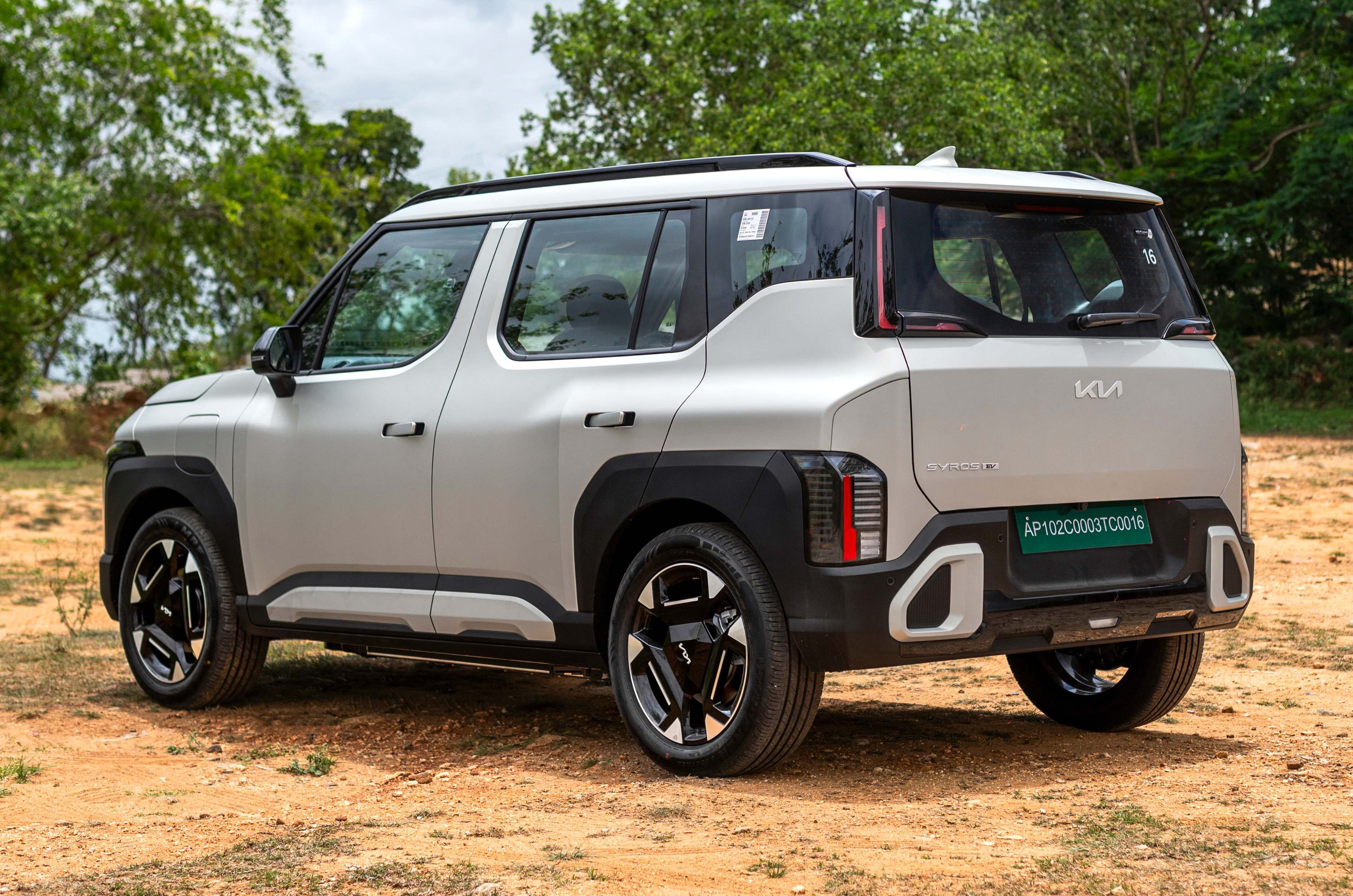
Split lighting lifts the otherwise bland rear

If you didn’t like the way the Syros looked, the EV isn’t going to change your mind. It is distinctive, though – like a Japanese kei car only larger, and Korean. Its blanked-off fascia looks appropriate on an EV, and the vertically oriented headlights give it a unique look. The cladding lower down on the bumper carries on to the wheel arches, doors and the rear, adding some muscle. Breaking up the large greenhouse are the pronounced B-pillar and the upward kink in the C-pillar, both of which are neatly done. And while the tailgate looks a bit blank, the split lighting – with L-shaped elements framing the rear windscreen and larger units at the edge of the bumper – looks great when lit up.

Syros EV Interior Space and Comfort – 10/10
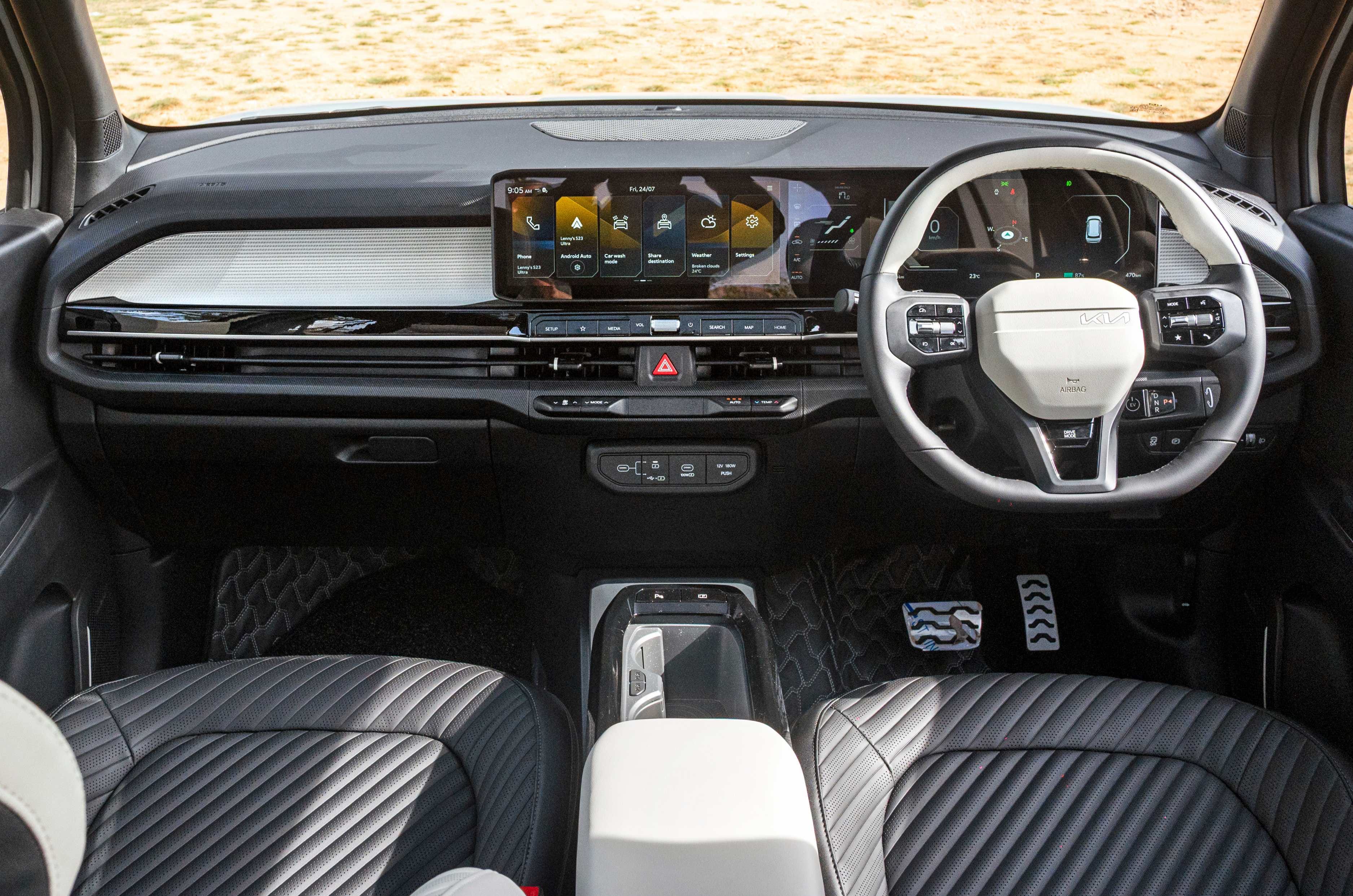
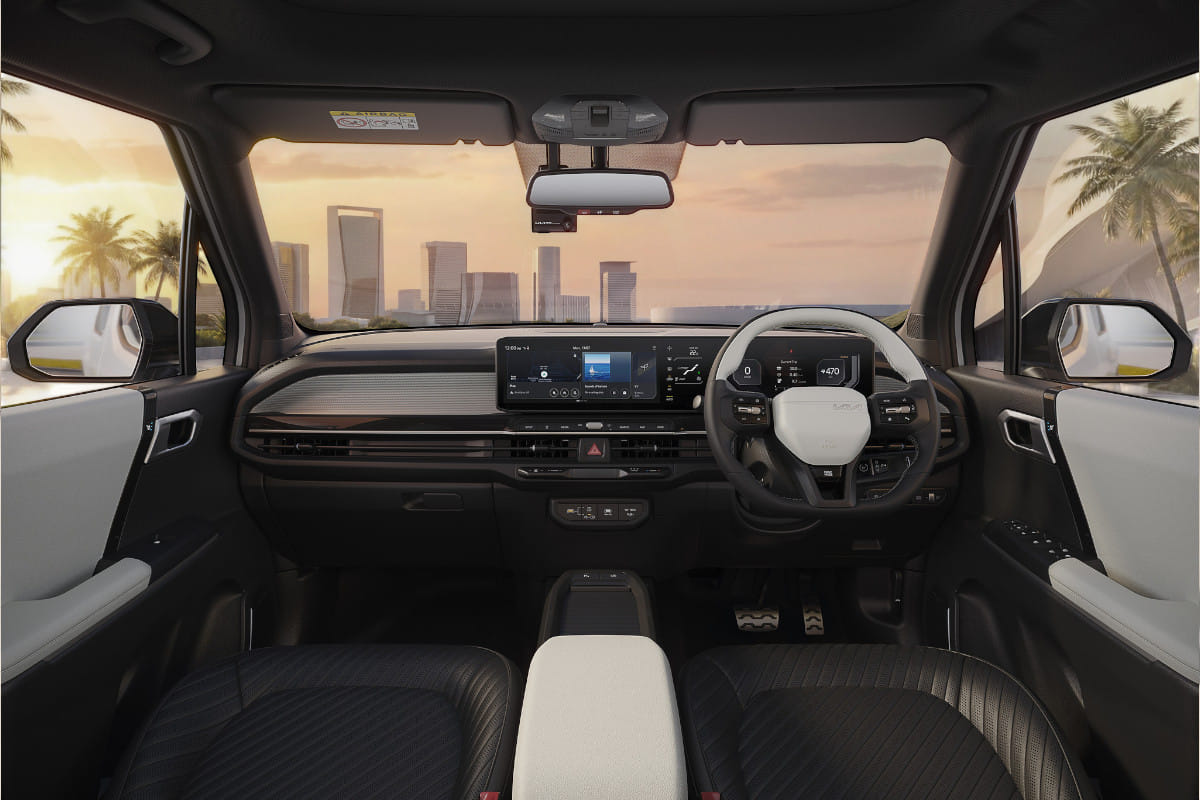
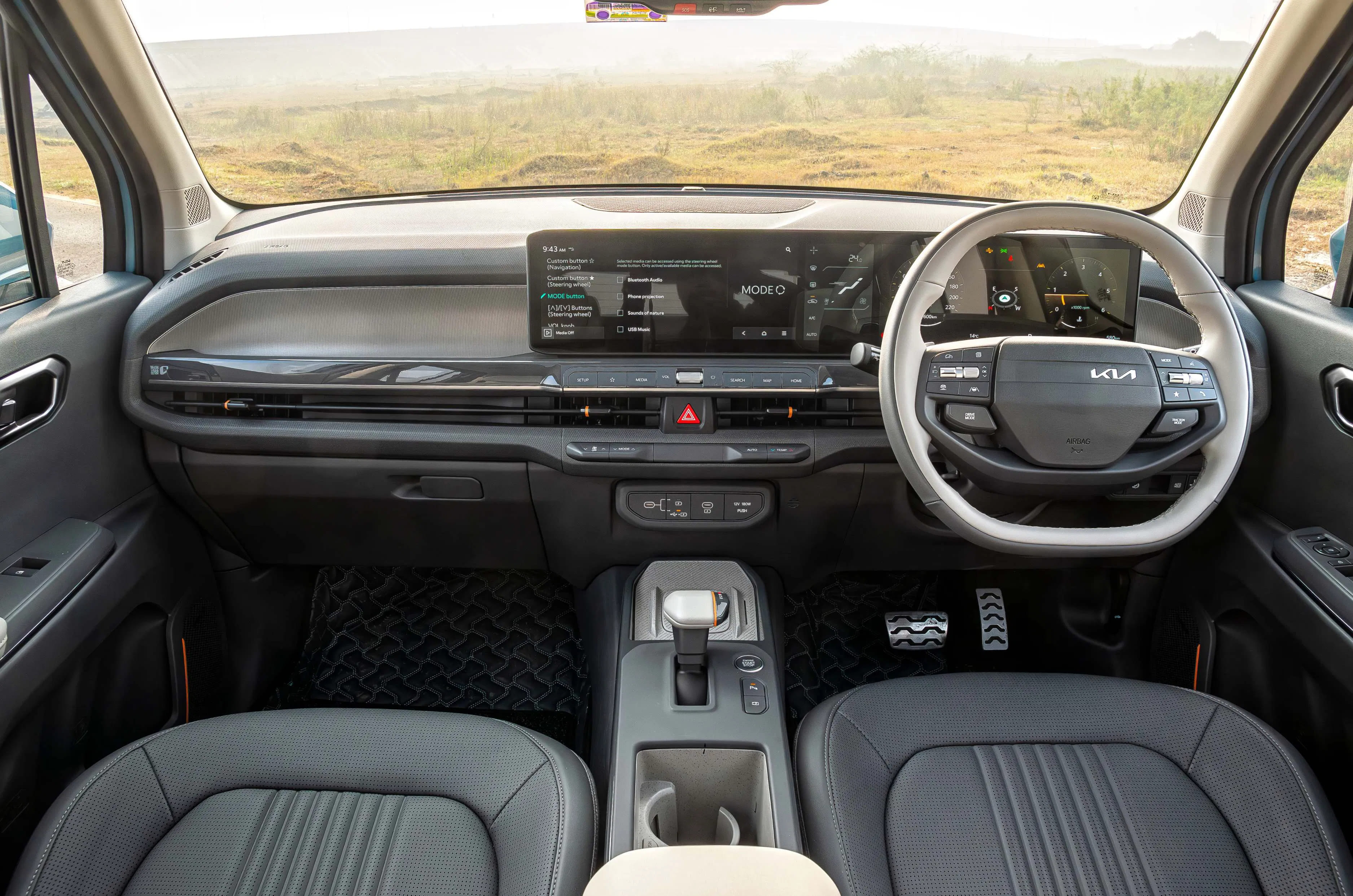
Dash layout is identical to the ICE version, but it gets the 3-spoke ‘wheel from the Seltos

Step inside and you start to understand why the Syros EV looks the way it does. Space for passengers, their knick-knacks and luggage is in abundance. With the EV’s drive selector positioned on the steering column, Kia has re-engineered the centre console to liberate a lot more storage. It now has two levels: the top floating portion has a small cubby under the armrest, along with two cupholders with their own sliding cover, while the lower level has a large storage area for a bag or such, another cupholder and a wireless charger. The front door pockets are just as accommodating, with room for a couple of bottles and an umbrella.
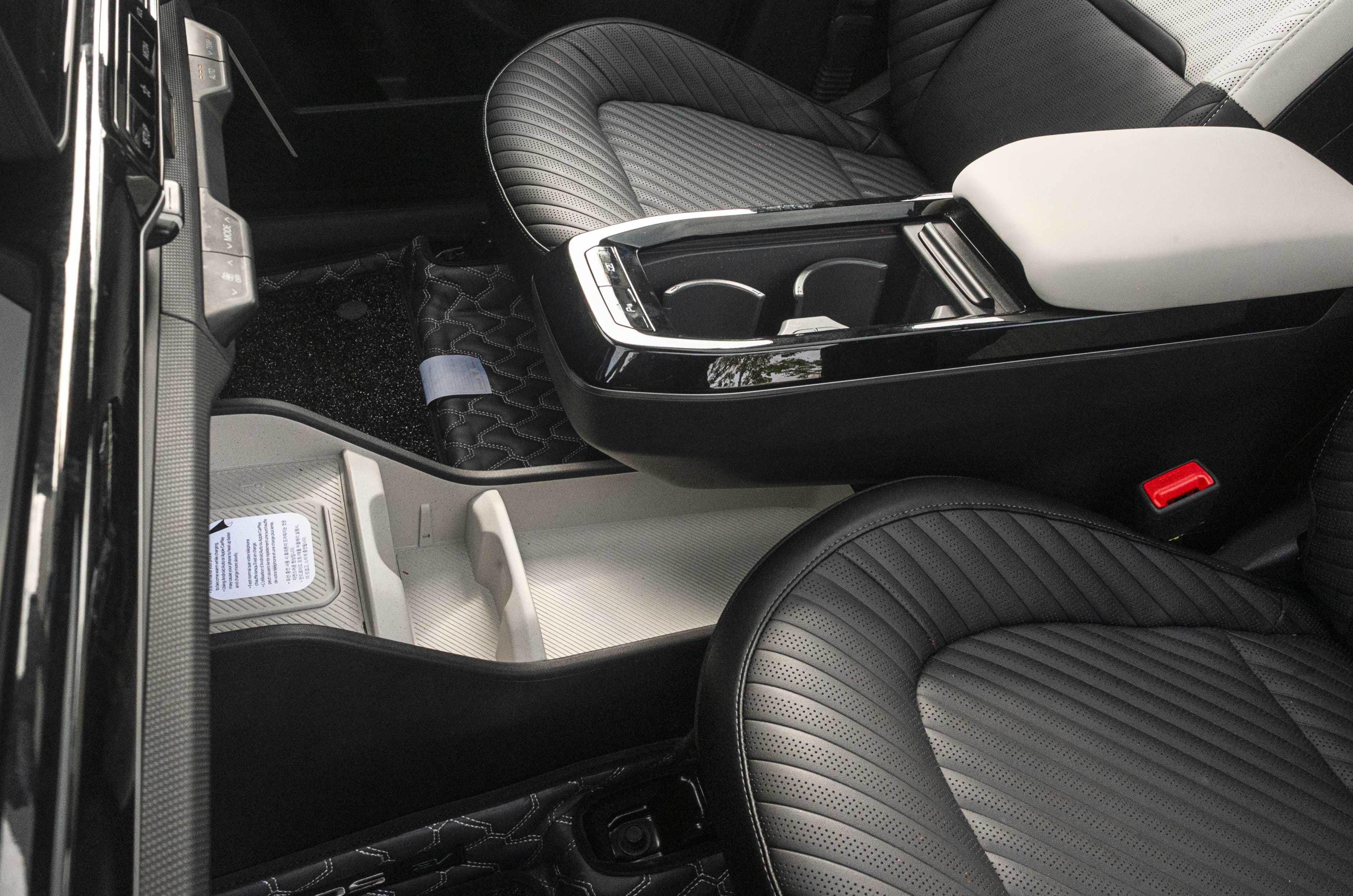
New center console has a lot of storage spaces

The front seats are supportive and comfortable, with heating and ventilation along with 4-way power adjustment for the driver. While the dash layout is unchanged, the EV gets the Seltos’ three-spoke steering wheel, but adjustment is still limited to rake and not reach. The EV uses a slightly different colour palette inside: our HTX+ test car gets a smart-looking black-and-off-white theme, the X-Line features a darker black-and-green ambience, while all other trims get an airy light grey and pastel blue theme. While most surfaces are hard plastic, the quality of the materials, fit and finish is top notch.
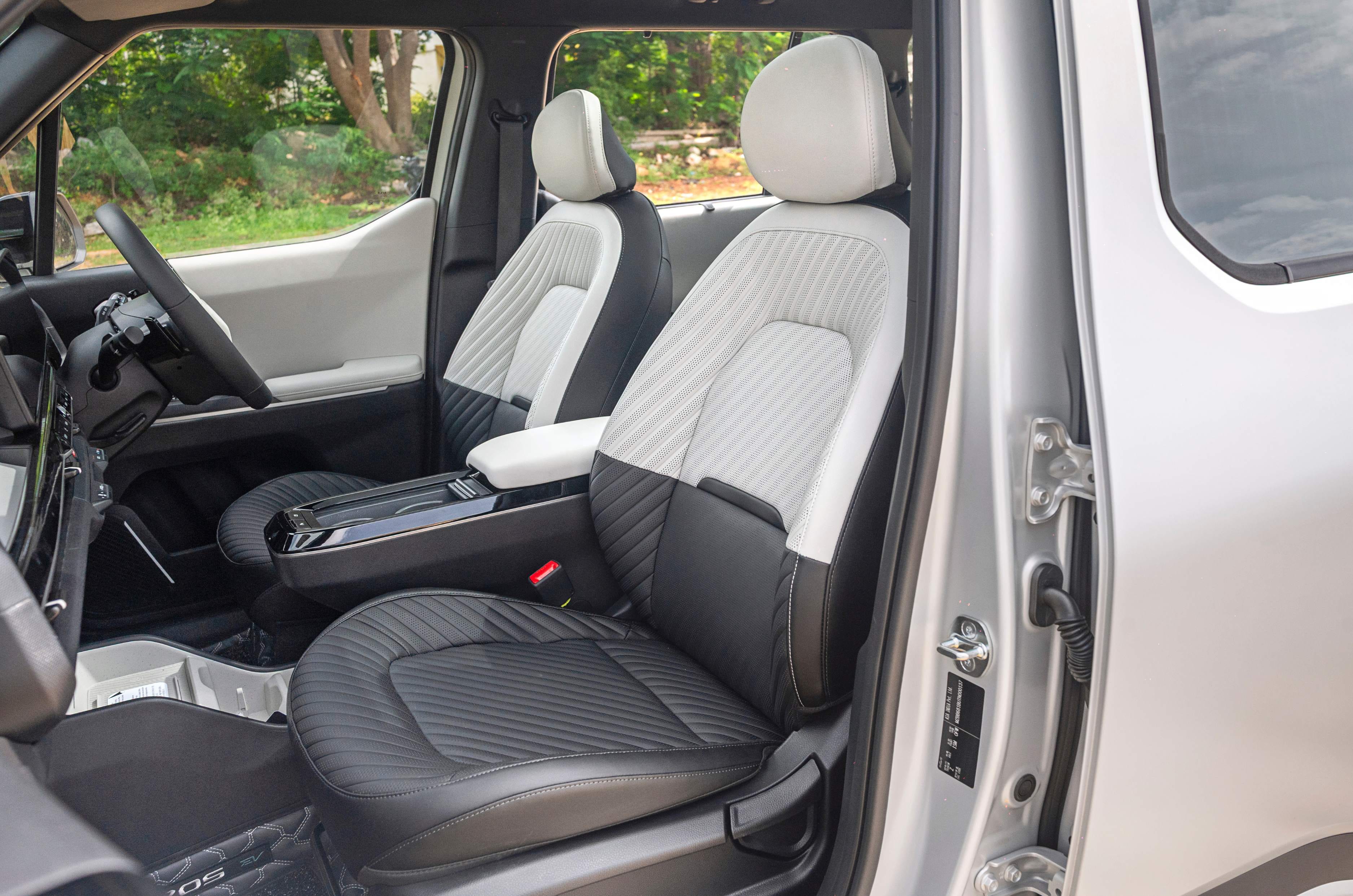
Front seats are comfy with heating, ventilation for both and power adjustment for the driver

The back seat remains a highlight, with plenty of room all around. The floor is slightly higher because of the battery pack, which means thigh support isn’t as good as in the ICE version. However, if you slide the bench back and stretch out, this isn’t much of an issue. A benefit of the raised floor is that it is now completely flat. Ventilation for the seat base carries over, but the backrest still misses out, as Kia says it would restrict its recline angle.
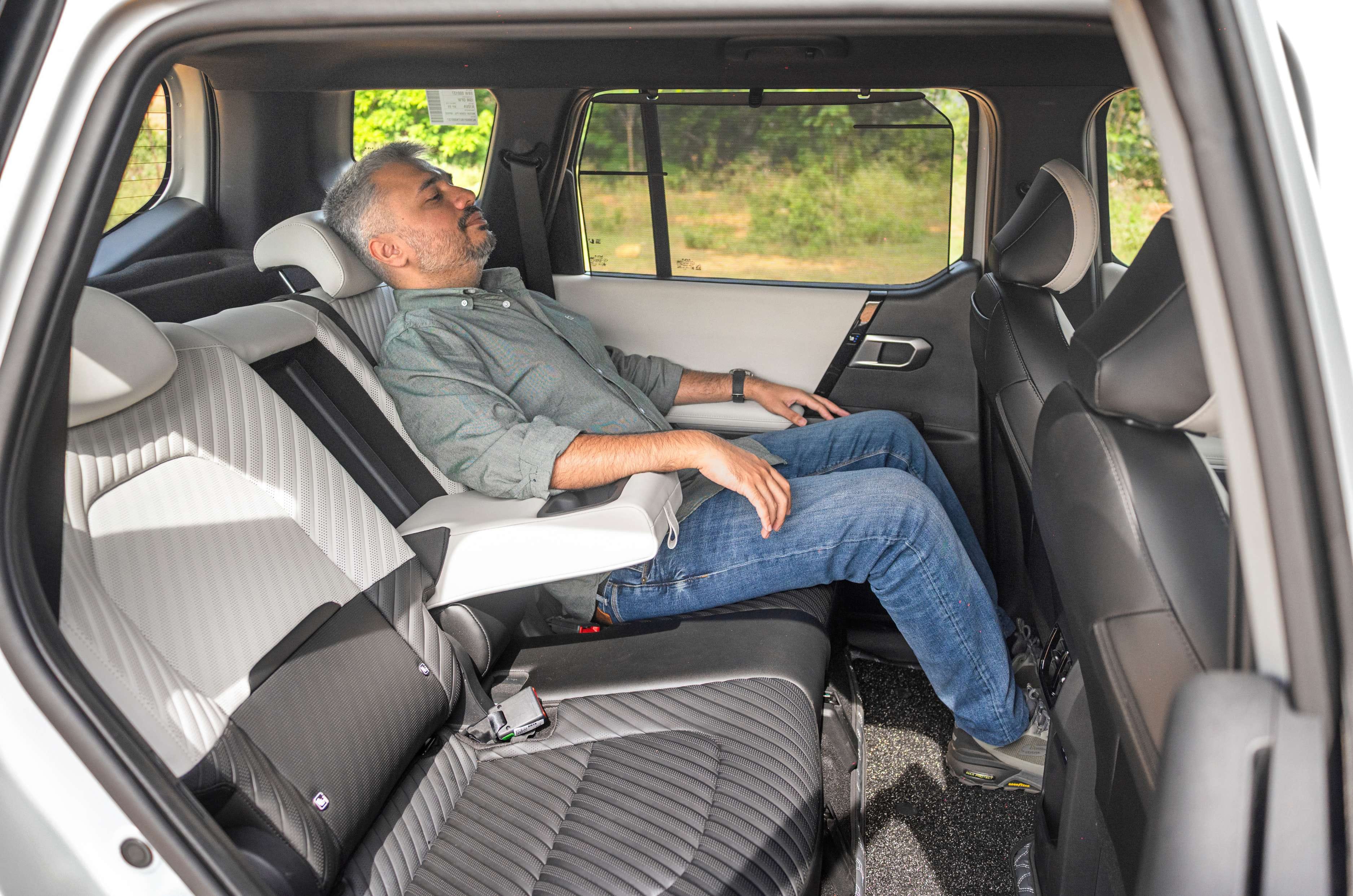
Higher floor slightly affects thigh support, but there’s ample room to stretch out

Boot space is identical to the ICE Syros at 390 litres with the seat all the way back, and 465 litres with it slid forward. The rear seats also split-fold – though not completely flat – to carry longer items. There is a 16-litre frunk too, though it is rather narrow.

Kia Syros EV Features and Safety – 9/10

Sitting proud on the dash is what Kia calls the Trinity Panoramic Display, comprising two 12.3-inch screens for the infotainment and driver’s display, with a 5-inch screen in between for the HVAC controls. The driver’s display is logically laid out, easy to read and offers some customisation, while the infotainment is sharp, snappy and has a clean UI. The EV gets a dedicated tab that shows several parameters related to the battery, range and energy consumption. It can also help find the nearest charger, condition the battery before charging, as well as set up charging schedules.
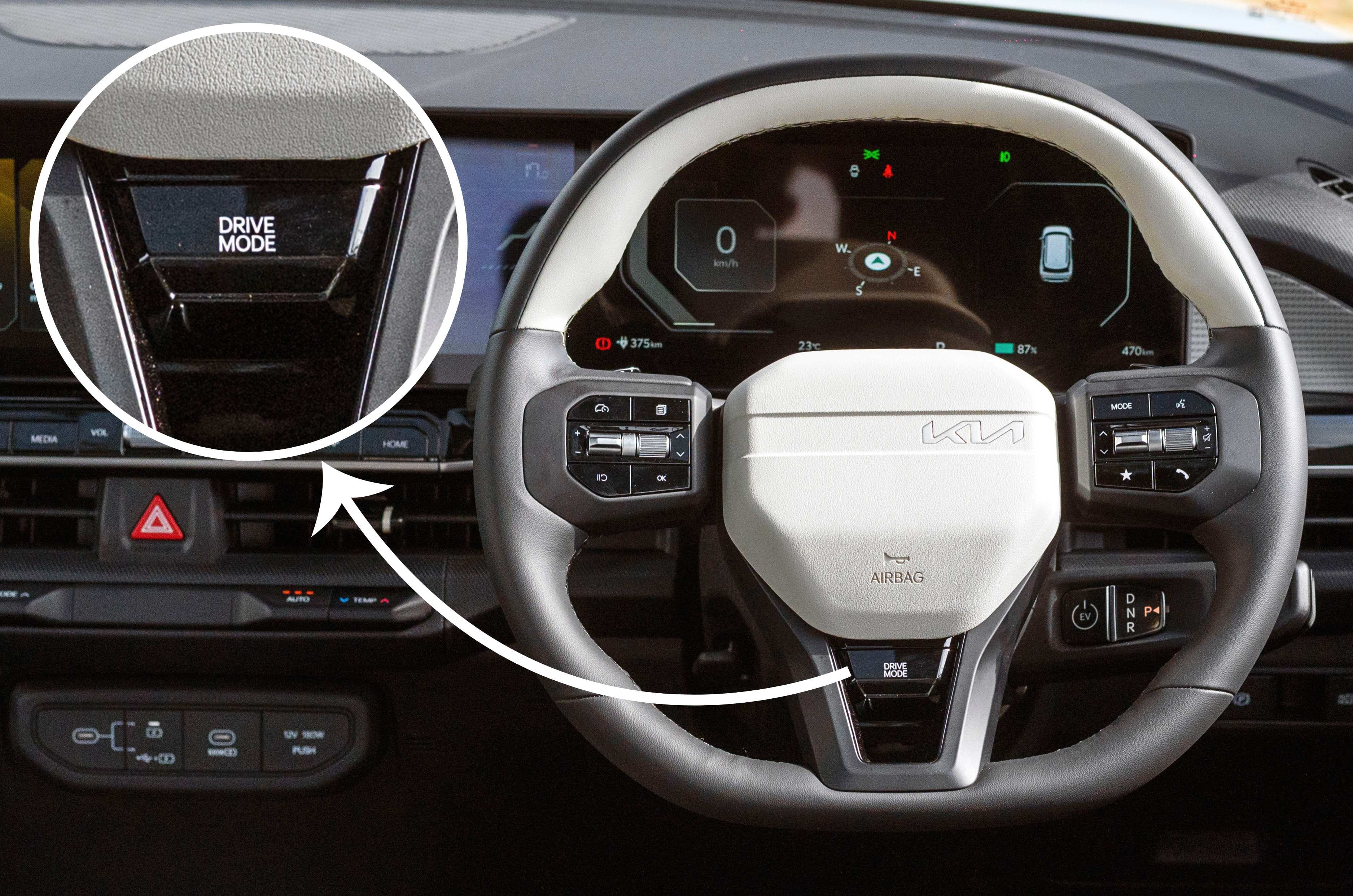
Handy drive mode button to cycle between Eco, Normal and Sport modes

The infotainment also offers wireless Android Auto and Apple CarPlay and, on the top trims, powers a superb Harman Kardon audio system with eight speakers, including one on the dash and a subwoofer in the boot. Sunblinds and rear AC vents are standard, while the massive panoramic sunroof features on all but the bottom two trims. Our second-from-top HTX+ also gets an integrated dashcam.
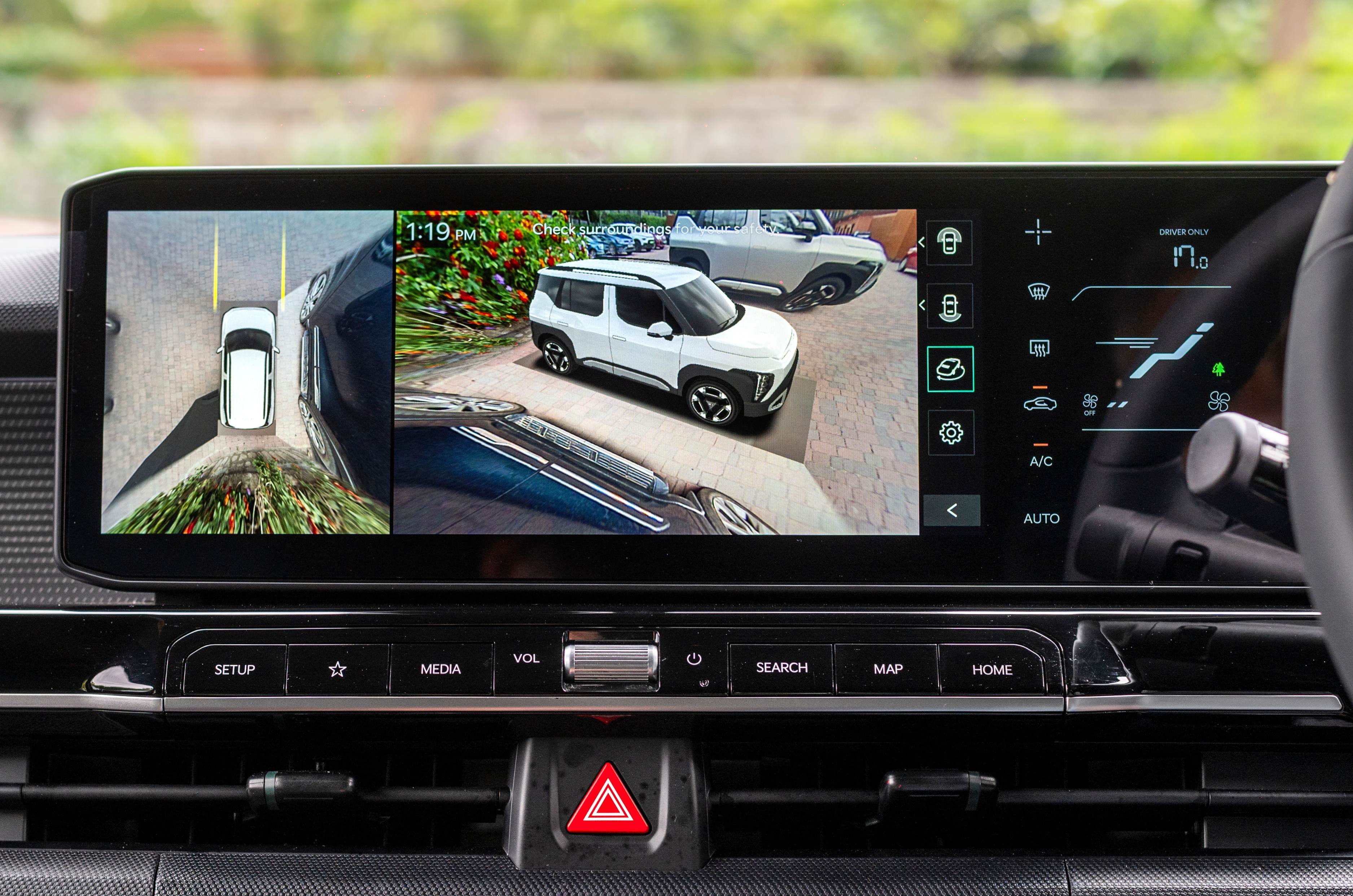
360-degree camera is sharp, but only available on top X-Line trim

Overall, the Syros EV is very well equipped, but some features are available only on the top X-Line variant, including Level 2 ADAS, ambient lighting, a 360-degree camera and a household-style three-pin socket in the back seat. Restricting features to the top trim isn’t unusual; however, the X-Line can only be had in Aurora Black Pearl or Matte Graphite, which might not be to all tastes.
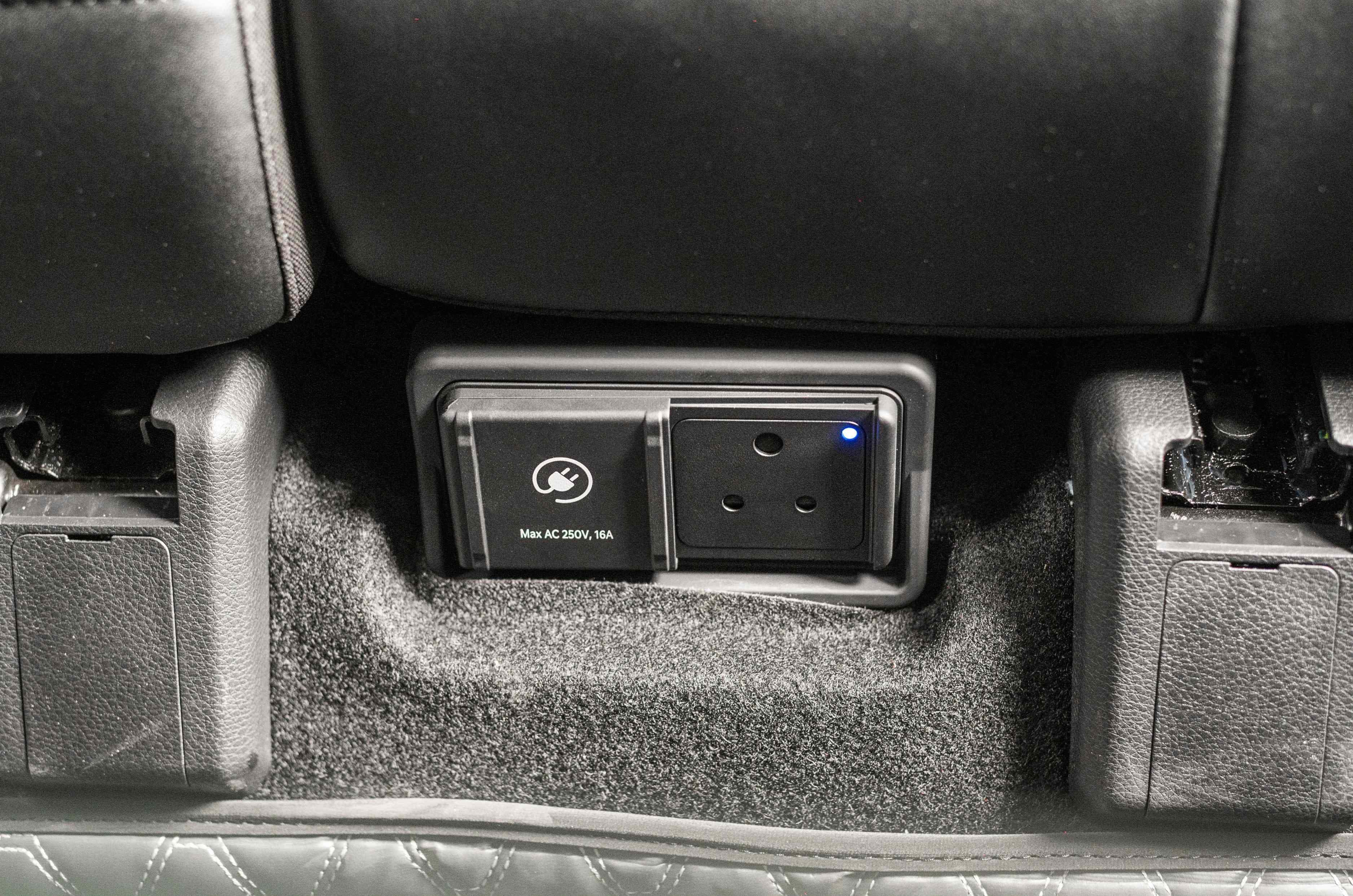
V2L power outlet under the rear seat

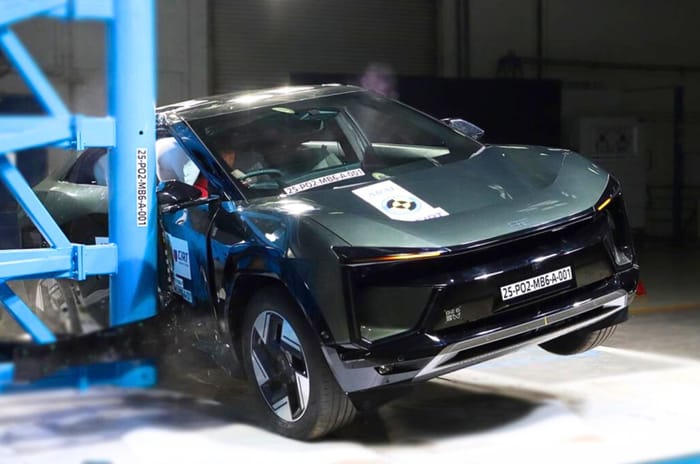
The standard safety suite is robust, including six airbags, all-wheel disc brakes, tyre pressure monitoring and ISOFIX mounts. The ADAS suite is also comprehensive, including adaptive cruise control with stop-and-go, lane keep assist, forward and rear collision avoidance, and a blind-spot camera. At the time of writing, the Syros EV does not yet have an official crash safety rating, but considering the ICE version has a five-star BNCAP rating, a similar result for the EV can be expected.

Kia Syros EV Performance and Refinement – 9/10

The Syros EV is available with the same 42kWh and 51.4kWh NMC battery packs as the Carens Clavis EV and the Hyundai Creta Electric. Here too, they power a single motor on the front axle producing 135hp with the smaller battery and 171hp with the extended-range version. Torque is identical on both at 255Nm.
Borrows the 42 and 51.4kWh battery packs from the Carens Clavis EV

Performance was brisk on our 51.4kWh test car, with the 0-100kph sprint claimed to take 8.1 seconds. There are three drive modes to choose from – Eco, Normal and Sport – with each sharpening throttle response a little more than the last. Initial response in all modes is linear so as not to overwhelm those who aren’t used to the instant torque, but there is a strong shove as you get further into the throttle. Overtaking, then, is quite effortless, even in Eco and Normal, almost never needing a switch to Sport for a quick pass.
Initial acceleration is linear, but there is plenty of shove for quick overtakes

The regen braking modes – selected via the paddle shifters – are also very well calibrated, with a noticeable increase in resistance in each mode and the ability to turn it off completely. Holding the left paddle engages one-pedal driving, which uses regen to bring the car to a full stop. It works quite seamlessly and can be very convenient once you get used to it.
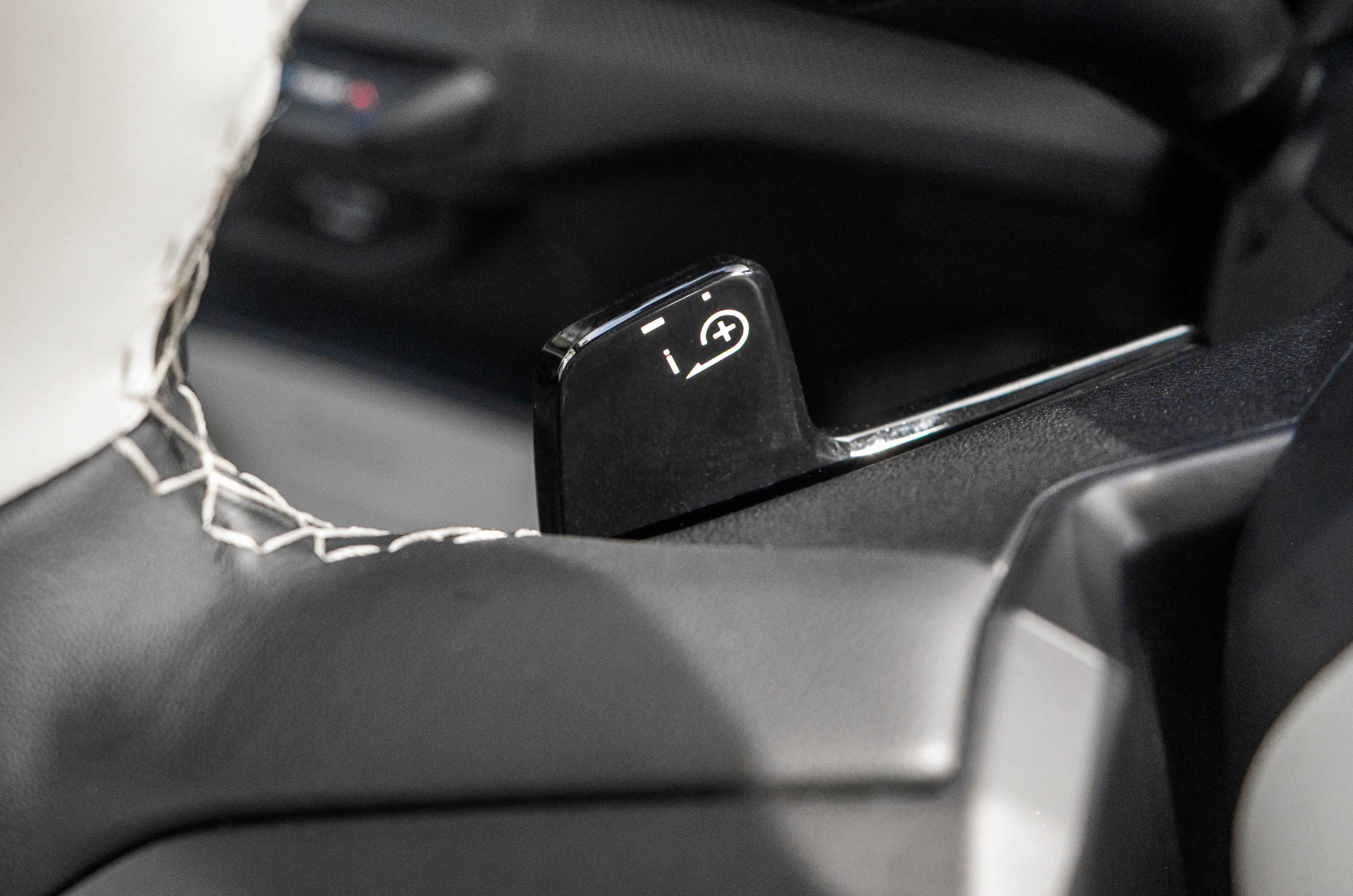
Regen modes are well calibrated and the i-Pedal function is handy in the city

Refinement is good too, with no noticeable motor whine making its way into the cabin. It’s so quiet, in fact, that Kia has added a virtual humming sound to warn pedestrians. Since there is no engine note inside the cabin, you do hear a bit more road noise, but at no point does it become intrusive.

Kia Syros EV Range and Efficiency – 8/10

Claimed MIDC range for the 51.4kWh battery is 526km, while the 42kWh unit claims 443km. Our short drive didn’t allow us to test these claims, but if the real-world range we achieved in the Clavis EV and Creta Electric is anything to go by, the Syros EV Extended Range should comfortably manage around 400km on a single charge. We will verify this when we have the car for longer.
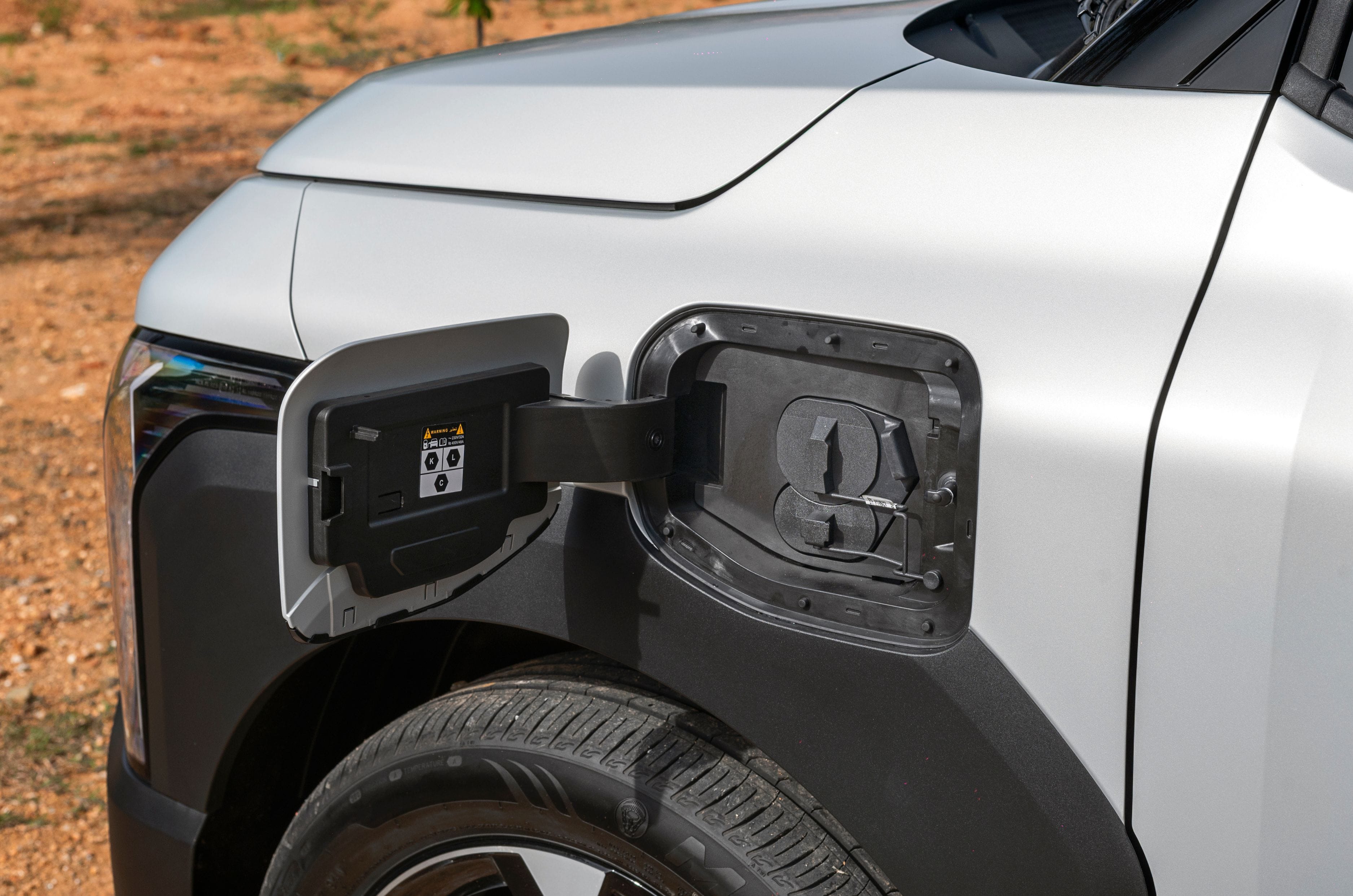
Capable of DC fast charging at up to 100kW

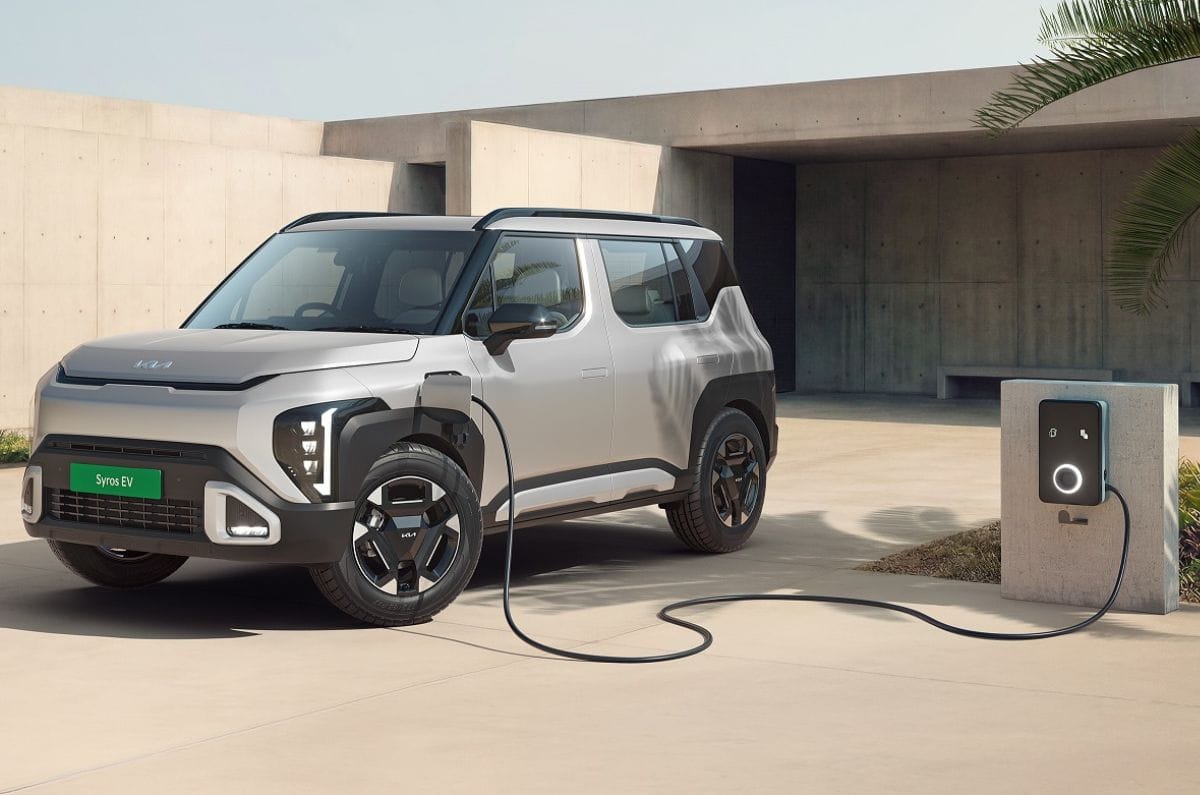
Topping up a depleted battery from 10 to 80 percent is said to take 39 minutes on a 100kW DC fast charger. The same charge using the optional 11kW wallbox charger, is said to take almost five hours for the Extended Range and four hours for the Standard Range.

Kia Syros EV Ride Comfort and Handling – 8/10

The ride on the Syros EV is a touch more absorbent than on its ICE counterpart. Sharp bumps don’t come through to the cabin as abruptly, but there is still an underlying firmness to it. This firmness is there to help body control, but being a tall, narrow car, there is still a fair bit of body roll through the corners. It does feel stable though, and overall grip is strong.
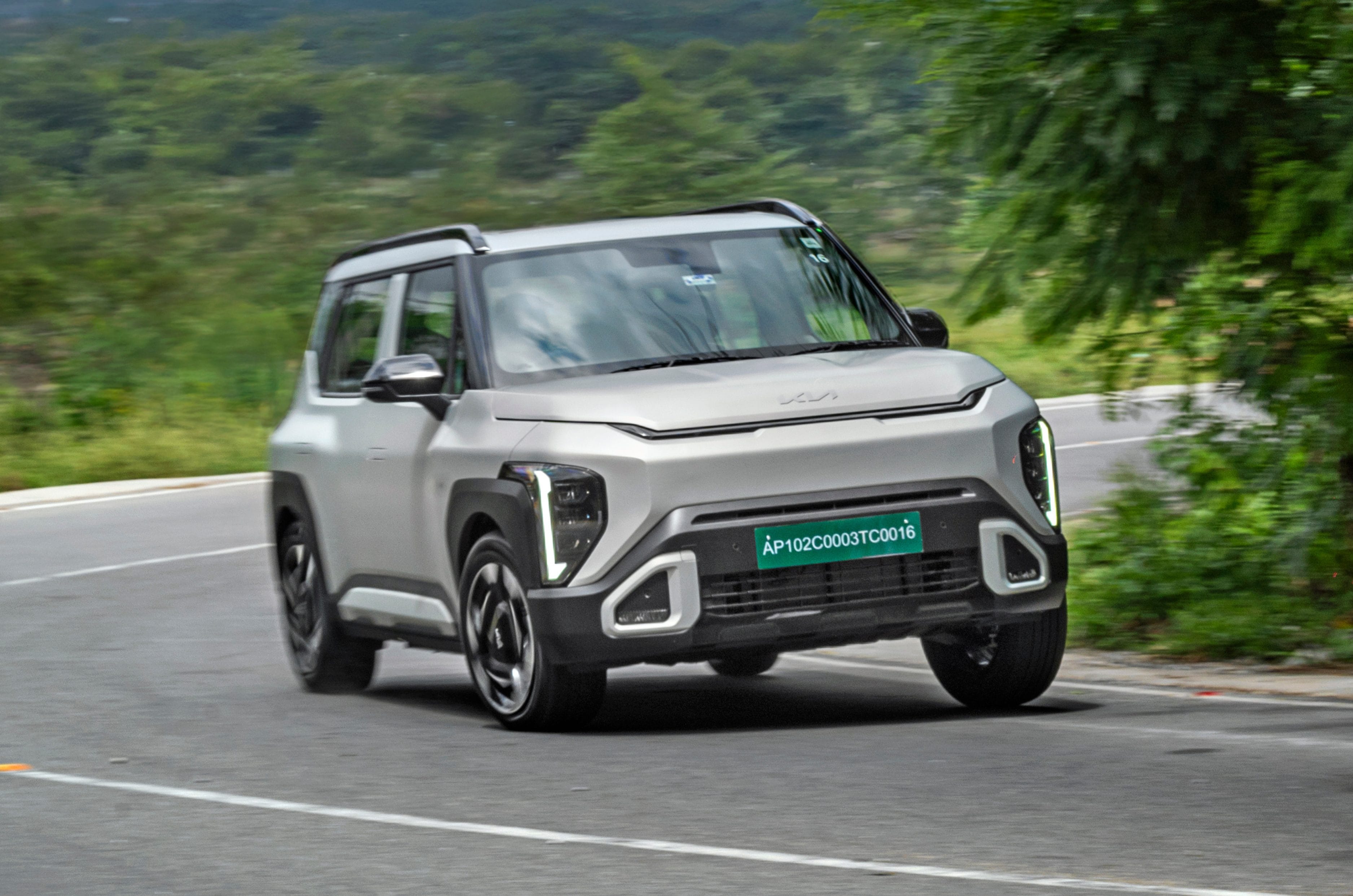
There’s plenty of body roll, but it remains stable through the bends

Steering feel is also good, and it weighs up as speeds rise, which helps with high-speed stability. The four-wheel disc brakes are strong too, bringing the Syros to a confident halt when you drop the anchors. Overall, it isn’t the most entertaining car to drive, but it feels stable and secure at speed while being easy to manoeuvre in tight spaces.

Kia Syros EV Value for Money – 7/10

Introductory prices for the Syros EV start at Rs 13.5 lakh for the 42kWh version and Rs 17 lakh for the 51.4kWh Extended Range. If you want the fully loaded X-Line, that’ll be a cool Rs 20 lakh. To reduce the upfront purchase cost, a BaaS scheme is available with prices starting at Rs 7.99 lakh, and battery rental costing Rs 3.3 per kilometre. To sweeten the deal, Kia is offering a 15-year/unlimited-kilometre HV battery warranty for the first owner, along with an assured buyback value of up to 80 percent after three years.
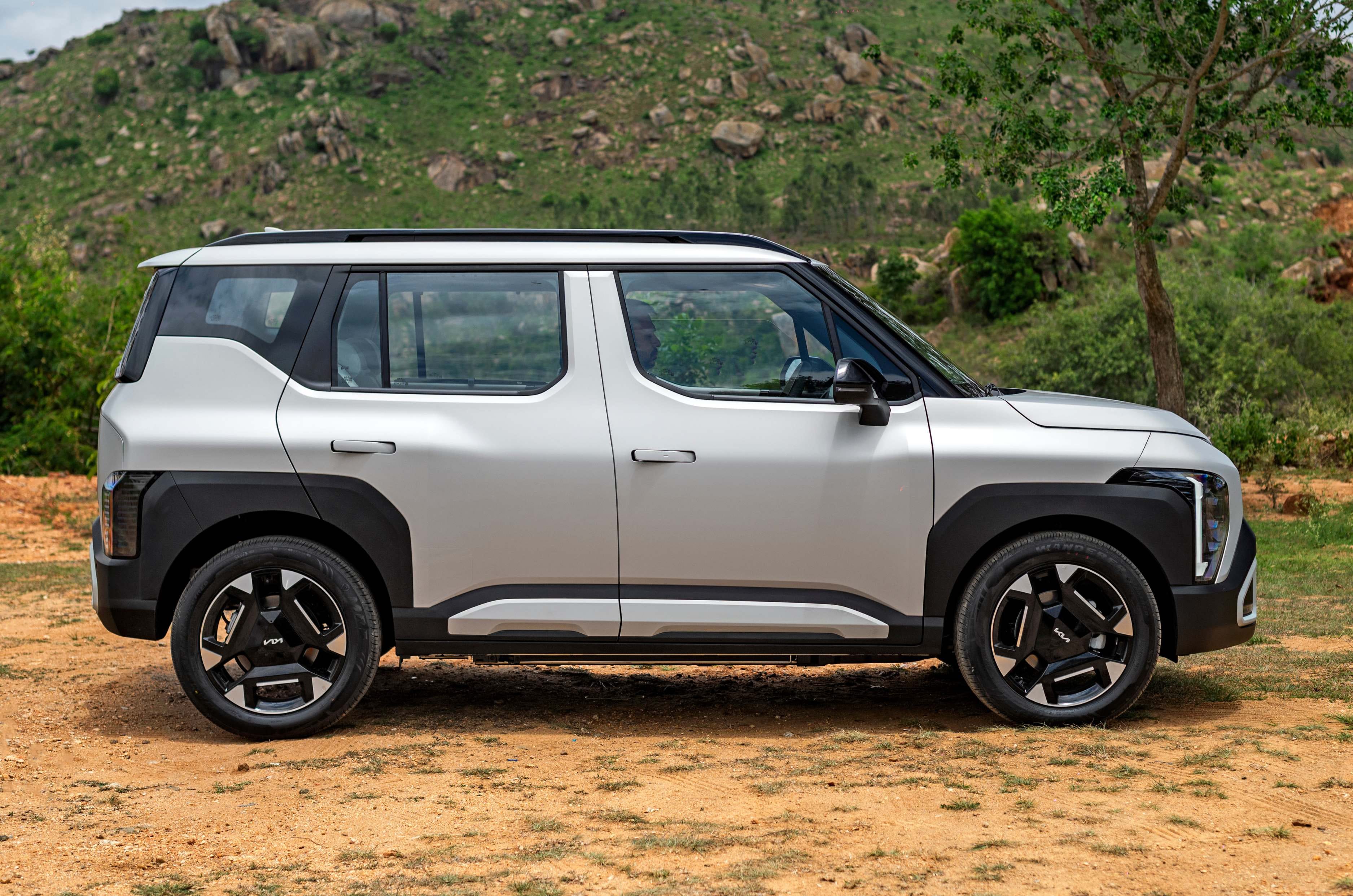
Its pricing means the Syros EV rivals the Tata Nexon EV and Mahindra XUV 3XO EV, as well as larger EVs like the MG Windsor and Maruti e Vitara. As such, the 42kWh Syros EV makes for a very compelling option, undercutting its rivals in the sub-four-metre EV space. It is easily the most spacious in this segment and is very well equipped even in the lower trims. However, its case weakens with the 51.4kWh Extended Range. It is significantly pricier than its immediate rivals, overlapping with the larger-battery versions of the Windsor and e Vitara. While the Syros EV has its merits and even outdoes them in some areas, buyers might find the allure of a bigger car for the same money too hard to resist.

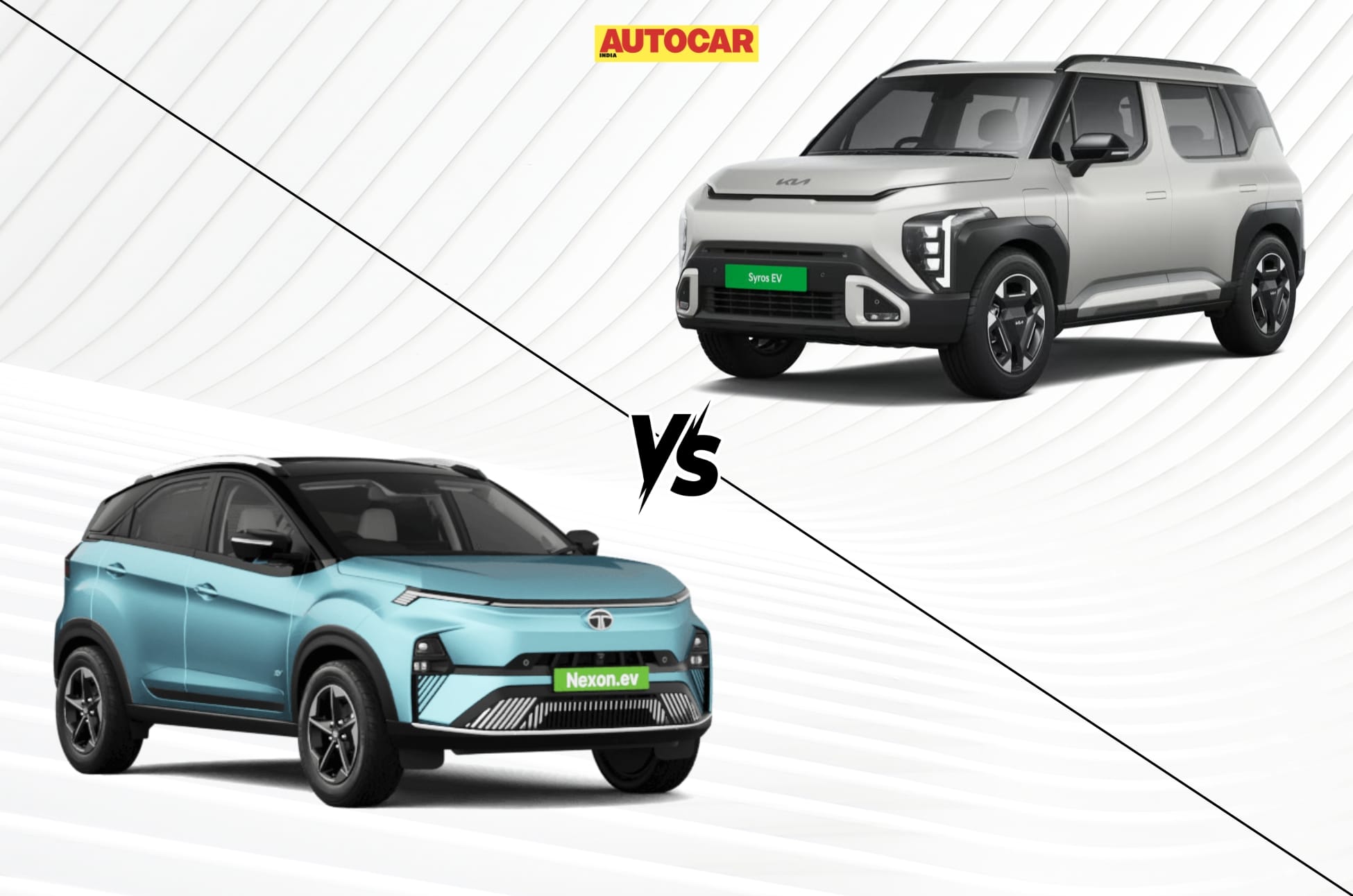
Kia Syros EV vs Tata Nexon EV: Whose top spec trim offers better value?

Kia Syros EV vs Tata Nexon EV

Kia has taken its first aim to crack the compact electric SUV space with the Syros EV. On the other hand, Tata has been dominating this very segment with the Nexon EV that’s been on the market for quite some time. But how do both SUVs fare when comparing specifications and features of their respective top-spec versions? For this comparison, we’ve chosen the Kia Syros EV’s X-Line variant and the Nexon EV’s Empowered+ A 45 variant.

Explore full specs, features, and a price breakdown in our Syros EV vs Nexon EV comparison.

Kia Syros EV vs Tata Nexon EV: Dimensions

Syros EV is comparatively the larger vehicle here

Kia Syros EV vs Tata Nexon EV: Dimensions


Kia Syros EV

Tata Nexon EV

Length (mm)

3,995

3,995

Width (mm)

1,805

1,802

Height (mm)

1,670

1,625

Wheelbase (mm)

2,550

2,498

Frunk (litres)

16

11.6

Boot space (litres)

390

350

Wheel size (inches)

17

16

While both SUVs have identical length, the Syros EV is 3mm wider, 45mm taller, and gets a 52mm longer wheelbase than the Nexon. Additionally, the former gets a 40-litre larger boot, a 4.4-litre larger frunk, and rides on wheels an inch bigger than the Nexon EV.

Kia Syros EV vs Tata Nexon EV: Powertrains 

Syros EV gets the larger battery pack, more powerful motor, and higher claimed range figure

Kia Syros EV vs Tata Nexon EV top-spec: Powertrains 


Kia Syros EV

Tata Nexon EV

Battery size (kWh)

51.4

45

Electric motor setup

Single motor

Single motor

Drive layout

FWD

FWD

Power (hp)

171

144

Torque (Nm)

255

215

Claimed 0-100kph time (seconds)

8.1

8.9

ARAI range (km)

526

489

The Syros EV features the largest battery pack in its segment with a 51.4kWh battery pack. Not only is its battery pack larger than the Nexon’s, but it also has a more powerful motor, leading to a quicker claimed 0-100kph time and a segment-best ARAI range that’s 37km higher than the Nexon’s.

Kia Syros EV vs Tata Nexon EV top-spec: Charging speeds and times 

Syros EV supports faster charging speeds

Kia Syros EV vs Tata Nexon EV top-spec: Charging speeds and times 


Kia Syros EV

Tata Nexon EV

Battery size (kWh)

51.4

45

7.2kW AC charging (10-100 percent)

6 hours 36 minutes

11kW AC charging (10-100 percent)

8.9 hrs


DC fast charging (10-80 percent)

39 minutes at 100kW

40 minutes at 60kW

The Syros EV supports higher charging output than the Nexon EV, be it at AC or DC speeds. But despite this, the Nexon EV’s smaller battery helps it juice up quicker at AC speeds, while DC fast charging times are almost similar to the Syros EV’s. 

Kia Syros EV vs Tata Nexon EV: Exterior features

Syros EV top-spec limited to one colour 

Kia Syros EV vs Tata Nexon EV top-spec: Exterior features


Kia Syros EV

Tata Nexon EV

LED headlamps

Automatic

Automatic

LED tail-lamps

Yes

Connected

DRLs

Yes

Connected

Front fog lamps

LED

LED

Puddle lamps w/ logo projection

Yes

No

Powered and foldable ORVMS

Yes

Yes

Flush door handles

Yes

No

Rear spoiler

Yes

Yes

Colour options

2, monotone and matte

5, dual tone 

On the outside, the Syros EV gets goodies such as flush door handles with motorised opening for the front handles, and puddle lamps with logo projection, which the Nexon EV skips. But with the Syros EV in top-spec guise, you’re limited to only black exterior paint in either matte or gloss finish. On the other hand, the Nexon offers five dual tone paint choices with a black roof as standard at the top-end.

Kia Syros EV vs Tata Nexon EV: Interior features 

Sliding and reclining rear seats with seat base ventilation found only on the Syros EV

Kia Syros EV vs Tata Nexon EV: Interior features 


Kia Syros EV

Tata Nexon EV

Infotainment screen

12.3-inch

12.3-inch

Digital driver’s display

12.3-inch

10.25-inch

HVAC display

5-inch

No

Apple CarPlay & Android Auto

Wireless

Wireless

Connected car tech

Yes

Yes

Sunroof

Panoramic

Panoramic

Sound system

8-speaker Harmon Kardon

9-speaker JBL

Automatic climate control

Yes

Yes

Wireless charger

Yes

Yes

Driver’s seat adjustment

4-way powered

No

Ventilated front seats

Yes

Yes

Rear seat base ventilation

Yes

No

Rear sunshades

Yes

Yes

Rear centre armrest

Yes

Yes

Sliding, reclining rear seats

Yes

No

OTA updates

Yes

Yes

Ambient lighting 

Yes

Yes

Air purifier

No

Yes

Rear AC vents

Yes

Yes

While Kia and Tata have packed a lot of features for their respective models, the former has the edge here. The Syros EV gets a larger digital driver’s display, powered driver seat, rear seat base ventilation, and sliding and reclining rear seats. But it misses out on an additional speaker and an air purifier, which the Nexon EV gets.

Kia Syros EV vs Tata Nexon EV: Driving features

Both models are on par with driving features

Kia Syros EV vs Tata Nexon EV: Driving features


Kia Syros EV

Tata Nexon EV

Drive modes

Eco, Normal, Sport

Eco, City, Sport

V2L function

Yes

Yes

Multi-level regen braking

Yes

Yes

Paddleshifters for regen

Yes

Yes

Cruise control

Adaptive

Adaptive

In the driving features department, the Syros EV and Nexon EV are equally equipped with drive modes, regen paddle shifters, adaptive cruise control, and V2L functionality.

Kia Syros EV vs Tata Nexon EV: Safety features

Syros EV yet to achieve BNCAP certification

Kia Syros EV vs Tata Nexon EV: Safety features


Kia Syros EV

Tata Nexon EV

Bharat NCAP rating

Yet to be tested

5 stars

Airbags

6

ABS with EBD

Yes

Yes

Electronic stability program

Yes

Yes

Follow-me-home headlamps

Yes

No

Hill hold control

Yes

Yes

Hill descent control

No

Yes

TPMS

Yes

Yes

360-degree camera

Yes

Yes

Parking sensors

Front, rear, side

Front and rear 

Electronic parking brake

Yes (w/ auto-hold)

Yes (w/ auto-hold)

Rain-sensing wipers

No

Yes

Auto-dimming IRVM

Yes

Yes

ISOFIX child seat anchors

Yes

Yes

Rear wiper, defogger

Yes

Yes

Disc brakes

All wheel

All wheel

Level 2 ADAS

Yes

Yes

While the Tata Nexon EV has already scored a 5-star rating in BNCAP tests, the Syros EV is yet to be tested. But for the latter, a similar rating can be expected considering its ICE version has already attained a 5-star rating. 

Both the Syros EV and Nexon EV come well equipped with basic and advanced safety features, including a Level 2 ADAS suite and a 360-degree camera. Here, the Kia gets follow-me-home headlamps and additional parking sensors on the side over the Tata. However, hill descent control and rain-sensing wipers are found only on the latter.

Kia Syros EV vs Tata Nexon EV: Prices and Verdict 

Syros EV X-Line pricier by Rs 3.5 lakh

Kia Syros EV vs Tata Nexon EV: Price 


Kia Syros EV

Tata Nexon EV

Price (Rs lakh)

20.00

17.49

In top-specification guise, the Syros EV is Rs 3.5 lakh pricier than the Nexon EV. Between the two, it’s the Nexon EV we find as the better value proposition. While the Syros EV is the larger vehicle dimensionally, has the larger battery pack, more powerful motor, and the higher claimed range, it doesn’t justify the extra premium that it commands over the Nexon EV. The Nexon EV may not have as much claimed range or features as the Syros EV, but it isn’t bad by segment standards. 

All prices are ex-showroom, India. 

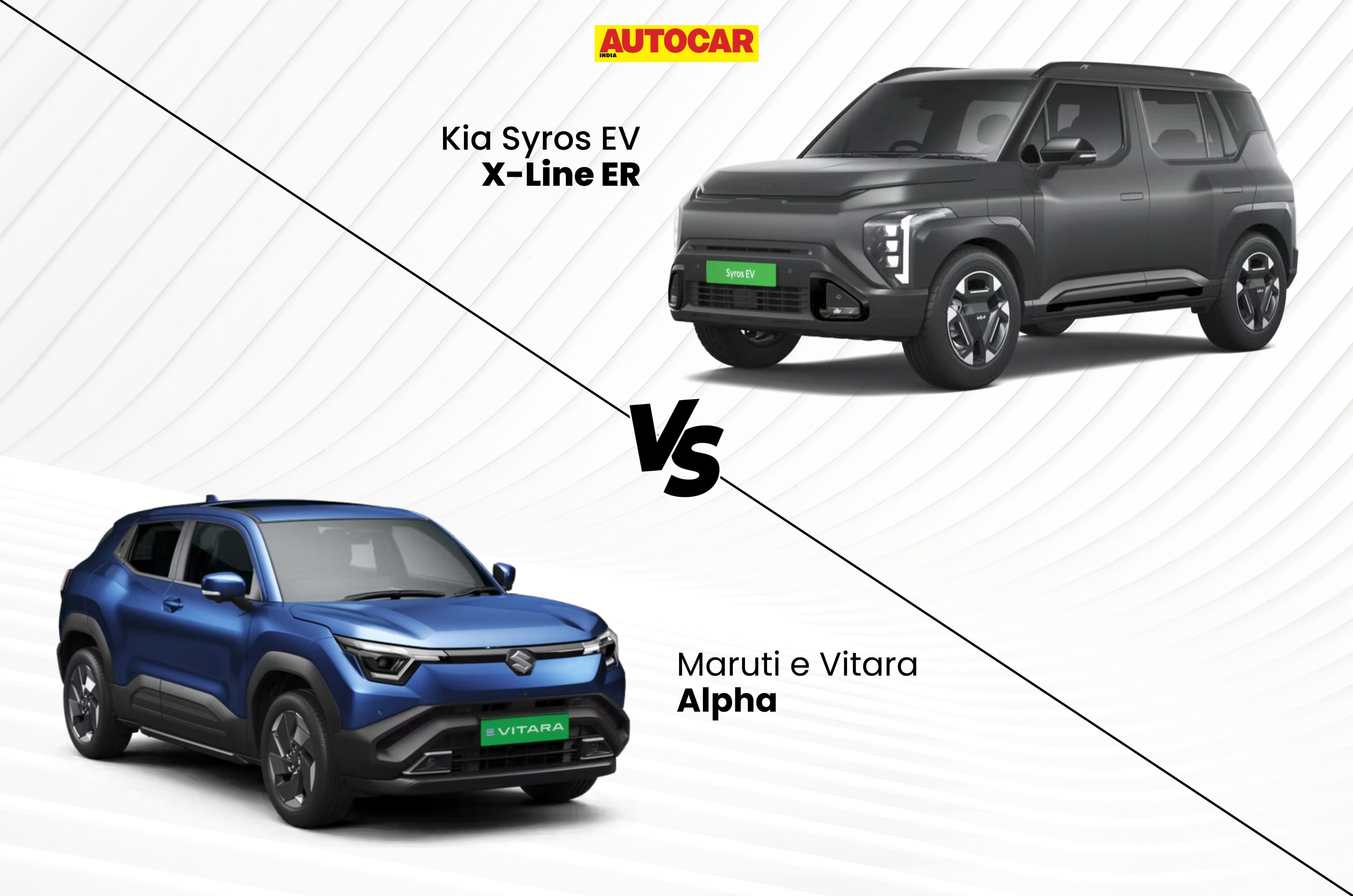
Kia Syros EV vs Maruti e Vitara: Whose top-spec trim offers more value?

Kia Syros EV vs Maruti e Vitara top trim

Kia India has officially launched its second mass-market electric car, the Syros EV. While the sub-4m Syros EV directly rivals the Tata Nexon EV and Mahindra XUV 3XO, the Kia’s pricing sees quite a bit of overlap with that of the Maruti Suzuki e Vitara, which is of a segment above. In fact, the top-spec trims of both electric SUVs are identically priced. Therefore, we compared the top-spec versions of the Syros EV and e Vitara on paper to determine which electric SUV offers more bang for your buck.

Kia Syros EV vs Maruti Suzuki e Vitara: Top trim dimensions

e Vitara is longer, but Syros EV is wider and taller

Kia Syros EV X-Line ER vs Maruti e Vitara Alpha dimensions


Syros EV

e Vitara

Length (mm)

3,995

4,275

Width (mm)

1,805

1,800

Height (mm)

1,670

1,640

Wheelbase (mm)

2,550

2,700

Frunk (litres)

16

Wheel size (inches)

17

18

Expectedly, the Syros EV is 280mm shorter overall (150mm shorter wheelbase) than the e Vitara, but interestingly, the Kia compact SUV is 5mm wider and 30mm taller. Neither Kia nor Maruti Suzuki quote precise boot space figures for their respective electric SUVs, but it’s worth noting that the Syros EV comes with a 16-litre frunk, while the e Vitara completely lacks storage space up front. However, the top-spec e Vitara does get larger alloy wheels than the equivalent Syros EV.

Kia Syros EV vs Maruti Suzuki e Vitara: Top trim powertrains

Syros EV is quicker, e Vitara claims higher range and has a bigger battery

Kia Syros EV X-Line ER vs Maruti e Vitara Alpha battery and range


Syros EV

e Vitara

Battery size (kWh)

51.4

61

Electric motor setup

Single motor, front

Single motor, front

Drive layout

FWD

FWD

Power (hp)

171

174

Torque (Nm)

255

193

Claimed 0-100kph time (seconds)

8.1

8.7

ARAI range (km)

526

543

The Syros EV’s battery pack is almost 10kWh smaller than that of the e Vitara, but the Kia is only 17km behind in terms of ARAI-claimed range. Both electric SUVs are front-wheel drive and make similar amounts of power, but the Syros EV edges ahead by a significant 62Nm in terms of torque output. This is partly why the Syros EV claims a 0.6sec quicker 0-100kph time than that of the e Vitara.

Kia Syros EV vs Maruti Suzuki e Vitara: Top trim charging speeds

Syros EV supports higher DC wattages

Kia Syros EV X-Line ER vs Maruti e Vitara Alpha charging times


Syros EV

e Vitara

Battery size (kWh)

51.4

61

7.4kW AC charging (10-100 percent)

9 hrs

11kW AC charging (10-100 percent)

8.9 hrs

DC fast charging (10-80 percent)

39 mins at 100kW

45 mins at 70kW

Kia and Maruti Suzuki quote AC charging speeds at different wattages, so the Syros EV and e Vitara can’t be directly compared on this front. However, it’s noteworthy that though the e Vitara has a larger battery than the Syros EV, the former takes roughly the same amount of time for a 10-100 percent charge at 7.4kW as the latter does at 11kW. Coming to DC charging, the Syros EV supports up to 100kW, while the e Vitara tops out at 70kW.

Kia Syros EV vs Maruti Suzuki e Vitara: Top trim exterior features

Syros EV gets puddle lamps, but e Vitara offers much greater choice in colours

Kia Syros EV X-Line ER vs Maruti e Vitara Alpha exterior features


Syros EV

e Vitara

LED projector headlamps

Yes (auto)

Yes (auto)

Front fog lamps

Yes

Yes

LED tail-lamps

Yes

Yes

Puddle lamps w/ logo projection

Yes

No

Roof rails

Yes

No

Powered ORVMs

Yes

Yes

Auto-folding ORVMs

Yes

Yes

Flush door handles

Yes

No

Body cladding

Yes

Yes

Rear spoiler

Yes

Yes

Colour options

2, monotone

10, monotone + dual-tone

Both electric SUVs are quite evenly matched in terms of exterior features, but the Syros EV takes the lead by way of roof rails and door-mounted puddle lamps that project the Kia logo. The Syros EV has flush door handles too, but some may appreciate the e Vitara’s conventional door handles more. Colours are a square win for the e Vitara, as it offers six monotone options and four dual-tone finishes. The Syros X-Line ER can be had in either Aurora Black Pearl or Matte Graphite, both of which are difficult to maintain. Buyers who want other colours have no option but to consider lower-spec Syros EV variants.

Kia Syros EV vs Maruti Suzuki e Vitara: Top trim interior features

Syros EV beats e Vitara with panoramic sunroof, cooled rear seat bases, and more

Kia Syros EV X-Line ER vs Maruti e Vitara Alpha interior features


Syros EV

e Vitara

Infotainment screen

12.3-inch

10.1-inch

Digital driver’s display

12.3-inch

10.25-inch

Climate control display

5-inch

Sunroof

Panoramic

Fixed single-pane

Wireless charger

Yes

Yes

Driver’s seat adjustment

4-way powered

10-way powered

Ventilated front seats

Yes

Yes

Rear seat base ventilation

Yes

No

Automatic climate control

Yes

Yes

Ambient lighting

Yes

Yes

Sound system

8-speaker Harmon Kardon

8-speaker Infinity

Apple CarPlay & Android Auto

Wireless

Wireless

Connected car tech

Yes

Yes

OTA updates

Yes

Yes

Rear sunshades

Yes

No

Rear centre armrest

Yes

Yes

Sliding, reclining rear seats

Yes

Yes

Even on the inside, the Syros EV’s feature set comes out on top. Over the e Vitara, the Syros EV packs larger infotainment and instrument displays, an additional screen for climate control settings, a panoramic sunroof, rear sunshades, and ventilation for the rear seat bases – this feature is not available even in electric SUVs a segment above the Syros EV. The e Vitara’s only advantage over the Syros EV is a greater gamut of electrical adjustment for the driver’s seat.

Kia Syros EV vs Maruti Suzuki e Vitara: Top trim driving features

Syros EV scores big on convenience by way of paddle shifters for regen modes

Kia Syros EV X-Line ER vs Maruti e Vitara Alpha driving features


Syros EV

e Vitara

Drive modes

Eco, Normal, Sport

Eco, Normal, Sport

Terrain modes

No

Snow

V2L function

Yes

No

Multi-level regen braking

Yes

Yes

Paddle shifters for regen

Yes

No

Cruise control

Adaptive

Adaptive

Both the Syros EV and e Vitara come with three drive modes and adaptive cruise control, but the Kia SUV inches forward thanks to vehicle-to-load (V2L) functionality, which lets you power external devices from the battery pack. The Syros EV also offers paddle shifters to cycle through the regenerative braking levels, while the e Vitara makes do with just a knob on the centre console. However, the e Vitara does offer a Snow terrain mode over the Syros EV.

Kia Syros EV vs Maruti Suzuki e Vitara: Top trim safety features

e Vitara wins thanks to an extra airbag, rain-sensing wipers, and 5-star BNCAP score

Kia Syros EV X-Line ER vs Maruti e Vitara Alpha safety features


Syros EV

e Vitara

Bharat NCAP rating

Yet to be tested

5 stars

Airbags

6

7

ABS with EBD

Yes

Yes

Electronic stability program

Yes

Yes

Follow-me-home headlamps

Yes

Yes

Hill hold control

Yes

Yes

TPMS

Yes

Yes

360-degree camera

Yes

Yes

Parking sensors

Front, rear, side

Front, rear

Electronic parking brake

Yes (w/ auto-hold)

Yes (w/ auto-hold)

Rain-sensing wipers

No

Yes

Auto-dimming IRVM

Yes

Yes

ISOFIX child seat anchors

Yes

Yes

Rear wiper, defogger

Yes

Yes

Disc brakes

Front, rear

Front, rear

Level 2 ADAS

Yes

Yes

Acoustic vehicle alert system

Yes

Yes

Coming to safety, the e Vitara finally scores a win. It’s the only one here to come with seven airbags and rain-sensing wipers, whereas the Syros EV sets itself apart with side parking sensors. The e Vitara also holds a 5-star crash safety rating from Bharat NCAP, while the Syros EV has not been tested yet. It’s worth noting, though, that the ICE-powered Syros was awarded 5 stars by Bharat NCAP, so a similar rating for the compact SUV’s electric derivative is very possible.

Kia Syros EV vs Maruti Suzuki e Vitara: Top trim prices

Syros EV for buyers seeking features, e Vitara for those who want a bigger car

Kia Syros EV X-Line ER vs Maruti e Vitara Alpha price comparison


Syros EV

e Vitara

Price (Rs, lakh)20.0019.99

As noted previously, there is next to no difference in the pricing of the Syros EV X-Line ER and e Vitara Alpha, which means the final decision comes down to your needs and preferences. If you want as many features as possible, are fine with a dark colour, and don’t mind smaller dimensions and funkier styling, the Syros EV X-Line ER is the one to go for. On the other hand, if you want the price you pay to be reflected in the size of the car, more choice in colours, more conventional looks, and are happy to forgo some features, you can consider the e Vitara.

It’s also worth noting that both the Syros EV and e Vitara can be purchased with battery-as-a-service (BaaS), which converts the cost of the battery into separate usage-based EMIs, thereby lowering the upfront cost. Kia has yet to reveal the BaaS price of the Syros EV X-Line ER, but the e Vitara Alpha costs Rs 14.49 lakh – Rs 5.5 lakh off the sticker price – with a Rs 4.39/km battery usage fee.

All prices are ex-showroom, India.

Kia Syros EV launched at Rs 13.49 lakh

Kia Syros EV launched

The Kia Syros EV has been launched in India with prices ranging between Rs 13.49 lakh and Rs 19.99 lakh (ex-showroom). It’s also available with BaaS, under which prices start at Rs 7.99 lakh, and Rs 3.3 is charged additionally for per kilometre of usage. This is Kia’s most affordable EV in India, and the brand’s second mass-market EV offering after the Carens Clavis. It is, however, more expensive than its direct rivals, the Tata Nexon EV and Mahindra XUV 3XO EV. 


All you need to know about the upcoming Kia Syros EV

Kia Syros EV front quarter static

Kia is aiming at the growing compact electric SUV segment with the upcoming Syros EV, set to be its second mass-market electric model for India. The Syros EV utilises the same K1 platform as its ICE-powered counterpart. Bookings for the Syros EV are already open ahead of its launch, scheduled for the end of July 2026. In this article, we answer everything that you need to know about the Syros EV.

1. What battery pack options does the Kia Syros EV offer, and how much power does its motor produce?

The Kia Syros EV offers the same 42kWh and 51.4kWh battery packs that do duty in the Kia Carens Clavis EV and the Hyundai Creta Electric. Both are mated to a front-mounted motor. In the 42kWh guise, the motor delivers 135hp and 255Nm, but in the 51.4kWh guise, power is bumped to 171hp, while torque remains the same. The 51.4kWh battery pack and its 171hp motor make it the model with the largest battery pack and the most powerful motor in the class. Kia claims a 0-100kph sprint in 8.1 seconds with the 51.4kWh version.

2. What is the claimed range of the Kia Syros EV?

The ARAI-rated range is 443km for the 42kWh battery pack and 543km for the larger 51.4kWh unit. Not only does the Syros EV have a higher claimed range than the Clavis EV and the Creta Electric, but its 543km figure is also the highest in the compact electric SUV segment.

3. What charging speeds does the Kia Syros EV support, and how long does it take to charge?

The Kia Syros EV supports up to 11kW AC charging speeds, while DC charging is capped at 100kW. A 10-100 percent top-up for the 42kWh version takes 6 hours with the 7.4kW charger and 4 hours with the 11kW unit. In the 51.4kWh guise, the same takes 7 hours and 15 minutes with a 7.4kW charger and 4 hours and 50 minutes with an 11kW charger. Kia also claims that with a 100kW DC fast charger, both batteries can charge from 10 to 80 percent in 39 minutes.

4. How different is the Kia Syros EV from the ICE Syros on the outside and inside?

The Kia Syros EV may look largely similar to the ICE Syros, but it comes with a charging flap on the front fender, EV badging at the rear and a different set of alloy wheels that give it some distinction. Apart from these differences, it retains the overall tall-boy silhouette, front and rear bumper designs and lighting elements found on its combustion-powered counterpart.

Inside, the dashboard layout remains the same as the ICE Syros, but there are some revisions to the centre console, which is high-set and features storage spaces and retractable cup holders. Also, the drive select lever has shifted to the steering wheel column.

5. What features does the Kia Syros EV come with?

For starters, the Kia Syros EV retains its ICE counterpart’s unique sliding and reclining rear seat with a ventilation function for the seat base. It also gets features such as dual 12.3-inch screens, a 5-inch HVAC control screen, wireless Apple CarPlay and Android Auto, a wireless charging pad, an 8-speaker Harman Kardon sound system, a panoramic sunroof, 64-colour ambient lighting and rear sunshades.

6. What does the Kia Syros EV offer over the ICE-powered Syros?

Apart from having EV-specific features such as a 16-litre frunk, regenerative braking, a virtual engine sound system and vehicle-to-load (V2L) functionality, it gets Level 2 ADAS, automatic flush door handles, a 360-degree camera setup, a dual-camera dashcam, a digital key, puddle lamps, multi-colour ambient lighting and metal pedals over the ICE-powered Syros.

7. What is the expected price of the Kia Syros EV?

The Kia Syros EV is expected to be priced from Rs 15 lakh to Rs 20 lakh, ex-showroom. It will take on the Mahindra XUV 3XO EV and the segment-reigning Tata Nexon EV, among others.

Kia Syros EV से उठा पर्दा और बुकिंग शुरू, 526KM की रेंज से Nexon EV और Mahindra XUV 3XO EV को देगी टक्कर! जानिए बाकी फीचर्स

Kia Syros EV: तेजी से बढ़ते इलेक्ट्रिक SUV सेगमेंट में Tata Nexon EV और Mahindra XUV 3XO EV जैसे कॉम्पिटिटर्स को टक्कर देने के लिए, Kia ने Carens Clavis EV के बाद अब भारत में अपना दूसरा मास-मार्केट इलेक्ट्रिक मॉडल, Syros EV पेश किया है। इस EV के लिए कंपनी ने ₹25,000 में प्री-बुकिंग भी शुरू कर दी है। यह मॉडल बेहतर ड्राइविंग रेंज, तेज चार्जिंग, एडवांस्ड टेक्नोलॉजी और एक कॉम्प्रिहेंसिव ओनरशिप पैकेज देने का वादा करता है।

Kia Syros EV की खासियत क्या है?

इसकी सबसे बड़ी खासियत है इसकी ARAI-सर्टिफाइड ड्राइविंग रेंज है, जो बड़े 51.4 kWh बैटरी पैक के साथ 526 km तक चल सकती है। Kia के अनुसार, यह अपने सेगमेंट की पहली SUV है जो 500 km का आंकड़ा पार करती है। खरीदार 42 kWh बैटरी का विकल्प भी चुन सकते हैं, जिसकी रेंज 443 km बताई गई है। इसके अलावा, Kia Syros EV में लगी इलेक्ट्रिक मोटर 171 PS की पावर जनरेट करती है। वहीं, बड़े बैटरी पैक वाले मॉडल में यह SUV 0 से 100 किलोमीटर प्रति घंटे की रफ्तार सिर्फ 8.1 सेकंड में पकड़ सकती है।

रोजाना इस्तेमाल के लिए यह कितनी प्रैक्टिकल है?

Kia का कहना है कि Syros EV को 100 kW DC फास्ट चार्जर से 39 मिनट में 10% से 80% तक चार्ज किया जा सकता है। इसमें चार्जिंग परफॉर्मेंस को बेहतर बनाने के लिए 10.8 kW का ऑनबोर्ड AC चार्जर और बैटरी कंडीशनिंग टेक्नोलॉजी भी दी गई है। MyKia ऐप के जरिए, मालिक एक ही वॉलेट का इस्तेमाल करके 23 चार्जिंग ऑपरेटर्स के 20,300 से ज्यादा चार्जिंग पॉइंट्स का इस्तेमाल कर सकते हैं, जबकि Kia के डीलरशिप नेटवर्क में 129 से ज्यादा DC फास्ट चार्जिंग लोकेशन्स और 275 से ज्यादा EV-रेडी वर्कशॉप्स शामिल हैं।

Kia Syros EV में कौन-कौन से फीचर्स हैं?

Syros EV में 30-इंच का ट्रिनिटी पैनोरमिक डिस्प्ले है, जिसमें डिजिटल इंस्ट्रूमेंट क्लस्टर, टचस्क्रीन इंफोटेनमेंट सिस्टम और क्लाइमेट कंट्रोल शामिल हैं। इसके अन्य फीचर्स में वायरलेस Android Auto और Apple CarPlay, Harman Kardon का 8-स्पीकर साउंड सिस्टम, ओवर-द-एयर सॉफ्टवेयर अपडेट, आगे और पीछे वेंटिलेटेड सीटें, पैनोरमिक सनरूफ, V2L (व्हीकल-टू-लोड) क्षमता, डिजिटल की (Key) और 16-लीटर का फ्रंट स्टोरेज कम्पार्टमेंट शामिल हैं।

नई इलेक्ट्रिक SUV कितनी सुरक्षित है?

सुरक्षा एक और ऐसा पहलू है जिस पर Kia ध्यान दे रही है। Syros EV में लेवल 2 ADAS के साथ 16 ऑटोनॉमस ड्राइविंग असिस्टेंस फंक्शन मिलते हैं। इसके अलावा, इसमें छह एयरबैग, 360-डिग्री कैमरा, इलेक्ट्रॉनिक स्टेबिलिटी कंट्रोल, सभी पहियों पर डिस्क ब्रेक, टायर प्रेशर मॉनिटरिंग सिस्टम और कुल 25 स्टैंडर्ड सुरक्षा फीचर दिए गए हैं।

Kia ओनरशिप के क्या फायदे दे रही है?

प्रोडक्ट के अलावा, Kia EV की ओनरशिप से जुड़ी आम चिंताओं को दूर करने की कोशिश कर रही है। इसके लिए वह लाइफटाइम हाई-वोल्टेज बैटरी वारंटी (शर्तों के साथ, 15 साल तक), एक ‘एश्योर्ड बायबैक’ प्रोग्राम और शुरुआती खरीद लागत को कम करने के मकसद से ‘बैटरी-एज-अ-सर्विस’ फाइनेंसिंग ऑप्शन दे रही है।

यह भी पढ़ें: Royal Enfield Shotgun 650 का लिमिटेड एडिशन लॉन्च, जानें कीमत और बुकिंग का तरीका

Kia Syros EV vs Nexon EV vs XUV 3XO EV: Specifications compared

Kia Syros EV vs rivals: Specifications compared

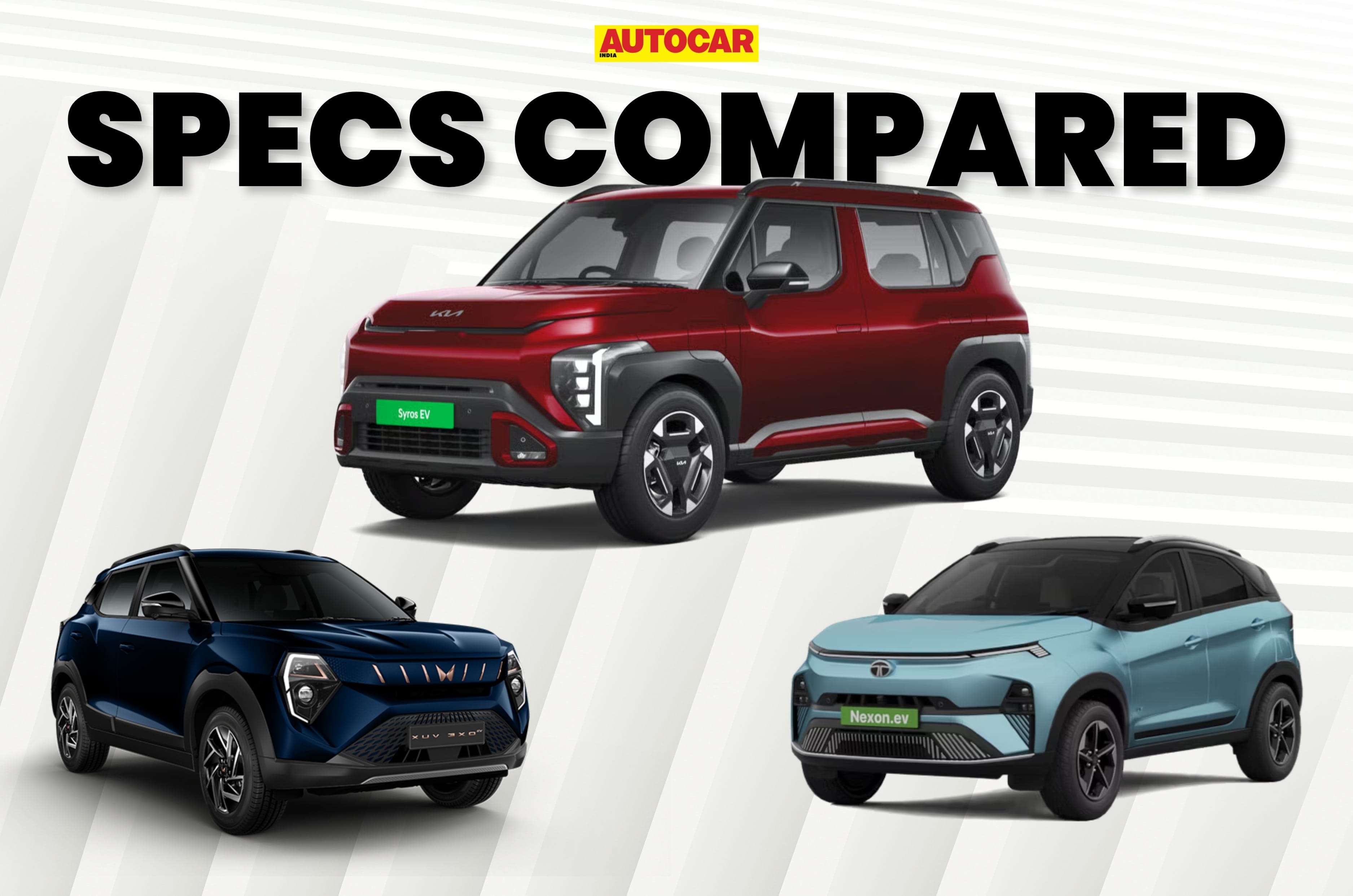
Kia recently unveiled the Syros EV as its smallest all-electric model in India. While prices are yet to be announced, Kia has revealed its variant-wise features, specifications, and powertrain options. The Syros EV will compete with the Tata Nexon EV and Mahindra XUV 3XO EV. Here’s how its specifications and powertrain options compare with its rivals. 

Kia Syros EV vs rivals: Dimensions

Kia is yet to reveal the ground clearance and boot space of the Kia Syros EV

Kia Syros EV vs rivals: Dimensions and other specifications


Kia Syros EV

Tata Nexon EV

Mahindra XUV 3XO EV

Length

3,995mm

3,995mm

3,990mm

Width

1,805mm

1,802mm

1,821mm

Height

1,670mm

1,625mm

1,653mm

Wheelbase

2,550mm

2,498mm

2,600mm

Ground clearance

190-205mm

190mm

Boot space 

350 litres

364 litres

The Kia Syros EV is similar in size to the Tata Nexon EV and Mahindra XUV 3XO EV, with a length of 3,995mm. The dimensional differences between the three SUVs are minimal, with variations limited to a few millimetres in most areas. The Syros EV is the tallest of the three at 1,670mm, while its 2,550mm wheelbase is longer than the Nexon EV’s but shorter than the XUV 3XO EV’s.

Kia Syros EV vs rivals: Powertrain options

The Syros EV and Nexon EV get two battery options, XUV 3XO EV gets just one

Kia Syros EV vs rivals: Powertrain options


Kia Syros EV

Tata Nexon EV

Mahindra XUV 3XO EV

Battery pack (kWh)

42 | 51.4

30 | 45

39.4

Drive configuration

FWDFWDFWD

Power (hp)

135 | 171

129 | 144

150

Torque (Nm)

255 | 255

215 | 215

310

ARAI range (km)

443 | 526

275 | 489

351

AC charging time*

4h 50m | 4h

4h 18m | 6h 36m

6h 50m

*AC charging times: Syros EV with an 11kW AC charger; Nexon EV and XUV 3XO EV with a 7.2kW AC charger.

The Kia Syros EV’s 51.4kWh is offered with the largest battery pack in the segment and delivers the highest claimed range. Its claimed range of 526km, is 37km more than the Tata Nexon EV’s 45kWh variant and 175km more than the Mahindra XUV 3XO EV. The 42kWh battery pack offers a claimed range that is 168km longer than the Tata Nexon EV’s 30kWh battery and 92km longer than the Mahindra XUV 3XO EV’s. While the Syros EV’s electric motor produces the highest power output at 171hp, the Mahindra XUV 3XO EV leads in torque with 310Nm.

For a 0-100 percent charge, the Kia Syros EV’s 42kWh battery takes 4 hours 50 minutes, while the 51.4kWh battery takes 4 hours using an 11kW AC charger. The Tata Nexon EV’s smaller and larger battery packs take 4 hours 18 minutes and 6 hours 36 minutes, respectively, with a 7.2kW AC charger. The Mahindra XUV 3XO EV takes 6.5 hours with the same 7.2kW AC charger. The Kia Syros EV supports up to 100kW DC fast charging, while the Tata Nexon EV and Mahindra XUV 3XO EV support up to 60kW and 50kW DC fast charging, respectively.

Kia Syros EV vs rivals: Prices

Kia is yet to reveal the prices of the Syros EV

Kia Syros EV vs rivals: Prices (in Rs, lakh)


Kia Syros EV

Tata Nexon EV

Mahindra XUV 3XO EV

Price

To be revealed

12.49 to 17.49

13.89 to 14.96

The Tata Nexon EV has a lower starting price than the Mahindra XUV 3XO EV by Rs 1.4 lakh, while its top-spec variant is Rs 2.53 lakh more expensive. The Kia Syros EV’s regular prices are expected to be in a similar range to those of its rivals; however, Kia’s Battery-as-a-Service (BaaS) option could reduce the initial purchase cost.

Prices are ex-showroom, India.

Kia Syros EV variants and features explained

Kia Syros EV variants explained

Kia has unveiled its second mass-market electric model for India in the form of the Syros EV. Though it shares its K1 platform with its ICE counterpart, it utilises the same battery packs found on the larger Carens Clavis EV. While prices are yet to be announced, they are expected to be in the Rs 15 lakh to 20 lakh range. At launch, it will take on the likes of the Tata Nexon EV, which currently dominates the segment, and the Mahindra XUV 3XO EV. In this article, we explain all the variants on offer, the colours, the standard safety kit, and the variant-wise features of the Syros EV.  

Kia Syros EV variant-wise battery pack options

Offered in seven variants across five trims 

Kia Syros EV variant-wise battery pack options 

Trim 

42kWh

51.4kWh (Extended range)

HTK

Yes

HTK+

Yes

Yes

HTX

Yes

Yes

HTX+

Yes

X-Line

Yes

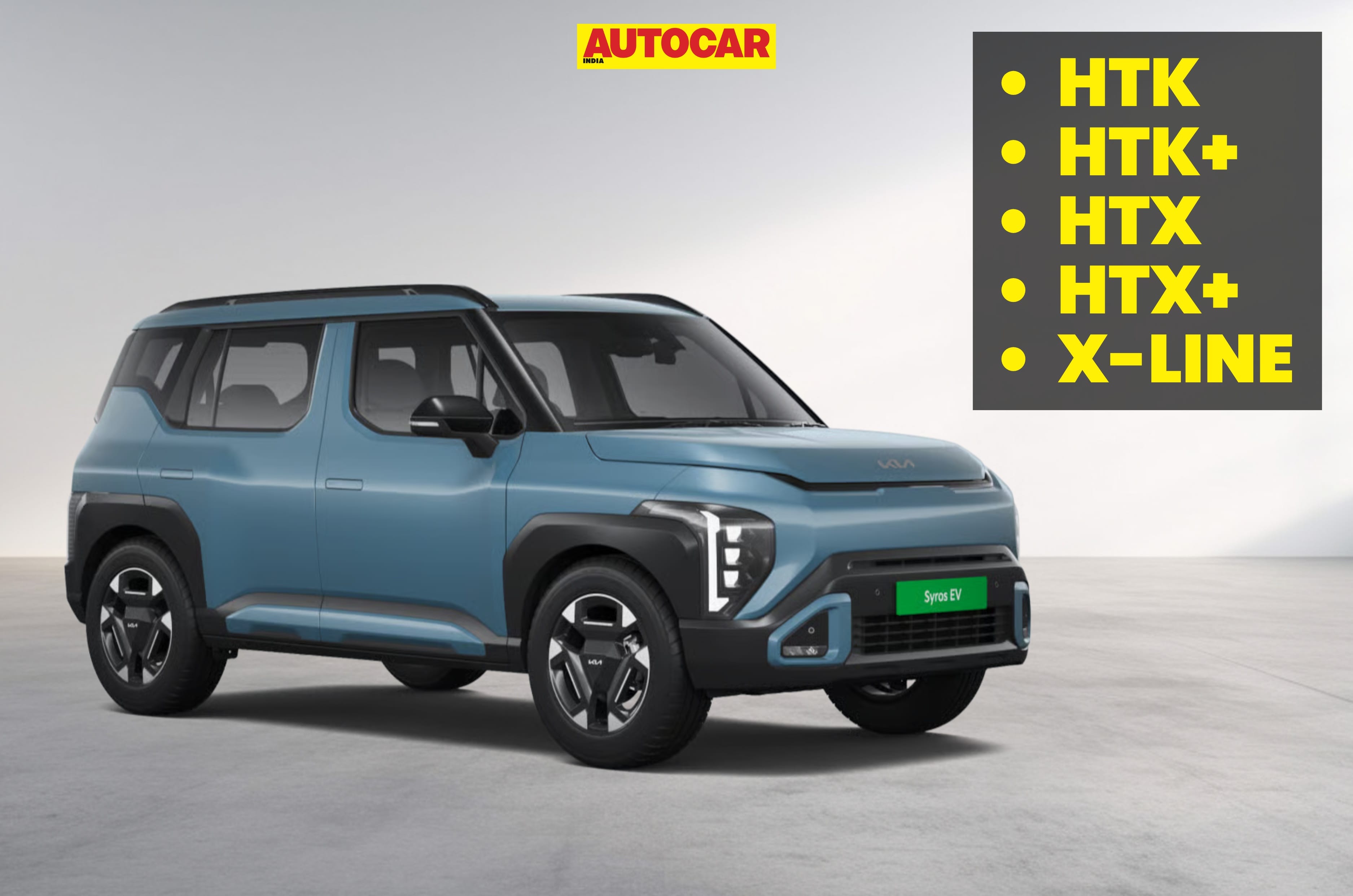
The Kia Syros EV offers a choice of 42kWh and 51.4kWh battery packs. While the base HTK trim solely offers a 42kWh option, the mid-level HTK+ and HTX trims additionally offer the larger 51.4kWh battery pack. Meanwhile, the higher-end HTX+ and X-Line trims are available only with the 51.4kWh battery pack.

Both battery packs are paired to a front-mounted motor, which develops 135hp and 171hp in 42kWh and 51.4kWh guises, respectively. In both versions, the motor produces an identical 255Nm of torque. Kia claims a 0-100kph time of 8.1 seconds in 51.4kWh guise. While the 42kWh battery pack gets an ARAI-claimed range of 443km, the 51.4kWh version’s claimed range is 526km.  Not only has Kia equipped the Syros EV with the largest battery pack in its segment (51.4kWh), but it also gets the most powerful motor and the highest claimed range figure in its class.

Both versions support up to 11 kW AC charging speeds, while DC charging support is up to 100kW. At 11kW AC speeds, a smaller 42kWh battery takes four hours to charge from 10-80 percent, while the 51.4kWh battery takes an additional 50 minutes. However, with a 100kW DC charger, both versions can charge from 10-80 percent in the same 39 minutes, claims Kia.

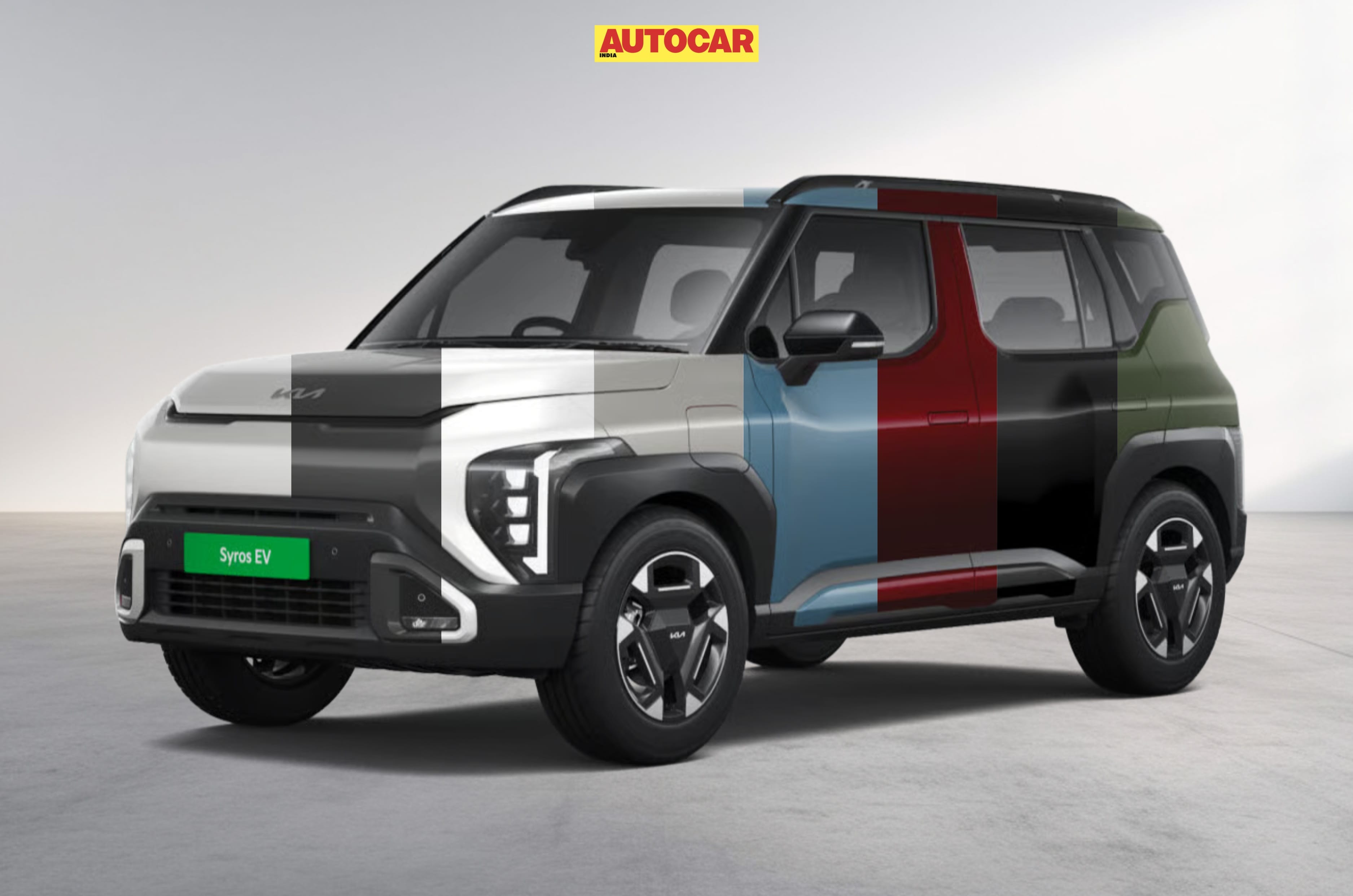
Kia Syros EV exterior and interior colours 

Nine options for the exterior, three for the interior

The Kia Syros EV is available only in nine monotone colour options. These include Ivory Silver Matte, Frost Blue, Gravity Grey, Pewter Olive, Magma Red, Ivory Silver Gloss, Aurora Black Pearl, Glacier White Pearl, and Xclusive Matte Graphite. Of these, the top X-Line trim is available solely in the Aurora Black Pearl and Xclusive Matte Graphite colours.

Inside, the Syros EV offers three interior and seat upholstery options depending on the chosen trim. HTK, HTK+ and HTX trims get blue and grey semi-leatherette seat upholstery and green accents throughout the interior, while the HTX+ trim gets black and white leatherette seat upholstery and white accents throughout the interior. The top X-Line trim comes with black and green leatherette seat upholstery with green accents across the interior.

Kia Syros EV standard safety kit 

Gets six airbags, electronic parking brake, hill start assist, TPMS, to name a few

As standard, the Kia Syros EV is equipped with six airbags, ABS, brake assist, ESC, stability control, hill-start assist, tyre pressure monitoring system (TPMS), all-wheel disc brakes, electronic parking brake with auto hold, follow-me-home headlamps, virtual engine sound system, child lock, rear parking sensors, speed sensing door locks, impact sensing auto door unlock, 3-point seatbelts for all seats, ISOFIX anchors, rear occupant alert, front passenger airbag on/off switch, and rear occupant alert.

Kia Syros EV variant-wise features list 

HTK

Battery pack options: 42kWh

  • LED headlamps, DRLs, foglamps, and tail-lamps
  • 16-inch aero-optimised alloy wheels 
  • Flush door handles 
  • Shark fin antenna 
  • Blue and grey fabric-leatherette seat upholstery 
  • 12.3-inch infotainment system 
  • 12.3-inch digital driver’s display 
  • Wireless Android Auto and Apple CarPlay 
  • 4 speakers and 2 tweeters 
  • Steering-mounted controls 
  • Tilt-adjustable steering 
  • Drive modes (Eco, Sport, Normal) 
  • 4x USB Type-C ports 
  • Portable charging cable 
  • Front centre console with retractable cup holders and storage 
  • Front centre armrest
  • Electronic parking brake with auto hold
  • Seatback pocket (front passenger seat)
  • Rear window sunshades 
  • Front adjustable headrests 
  • Rear AC vents 
  • Day/night IRVM 

HTK+ 

Battery pack options: 42kWh, 51.4kWh (Extended Range-ER)

Features over HTK

  • Rear view camera 
  • Cruise control
  • 100W Type-C charging port 
  • 17-inch aero-optimised alloy wheels (ER)

HTX 

Battery pack options: 42kWh, 51.4kWh (Extended Range-ER)

Features over HTK+

  • Panoramic sunroof
  • Rear wiper and washer
  • LED rear turn indicators 
  • All door windows up/down with key 
  • All door windows one-touch up/down with anti-pinch function
  • Sliding and reclining rear seats 
  • 60:40 split rear seat
  • Rear centre armrest with cupholder 
  • Rear adjustable headrests 
  • Rear defogger 
  • Rear parcel tray 
  • LED cabin lights, boot lamp
  • Seatback pocket (driver seat)
  • Connected-car tech (ER)
  • OTA software updates (ER)

HTX+ 

Battery pack options: 51.4kWh (Extended Range-ER)

Features over HTX

  • Automatic flush door handles
  • Black and white leatherette seat upholstery 
  • Leatherette-wrapped steering wheel 
  • Leatherette finish for armrest and door trims
  • Metal pedals 
  • 12.3-inch infotainment display with onboard navigation 
  • 5-inch HVAC control display
  • 8-speaker Harman Kardon sound system 
  • Dual dash cam 
  • Auto-dimming IRVM
  • Battery heating system 
  • Front seat ventilation 
  • Rear seat ventilation (seat base only) 
  • 4-way powered driver seat 
  • Wireless phone charger 
  • Front parking sensors

X-Line 

Battery pack options: 51.4kWh (Extended Range-ER)

Features over HTX+

  • 64-colour ambient lighting 
  • LED footwell lamps
  • Black and green leatherette seat upholstery 
  • Level 2 ADAS
  • Vehicle to Load (V2L) functionality 
  • Puddle lamps with logo projection 
  • Digital key 

Upcoming Kia Syros EV battery and range revealed

Kia Syros EV front quarter static

Kia has unofficially started bookings of the Syros EV for a token amount of Rs 25,000. It will be the second ICE-to-EV converted model in Kia India’s portfolio. Our dealer sources have hinted at a launch by the end of this month, along with its powertrain options. 

Kia Syros EV: What do we know so far?

Our dealer sources have stated that the Kia Syros EV will offer the same battery packs as found on the Carens Clavis EV. This includes a 42kWh battery pack for the standard-range version and a larger 51.4kWh battery pack for the long-range versions. Additionally, they mentioned that ARAI-claimed ranges for the 42kWh and 51.4kWh versions would be about 420km and 520 km, respectively. The battery packs are expected to be paired to a front-mounted motor; however, power figures remain under wraps.

Image credit: @RasacL on Reddit

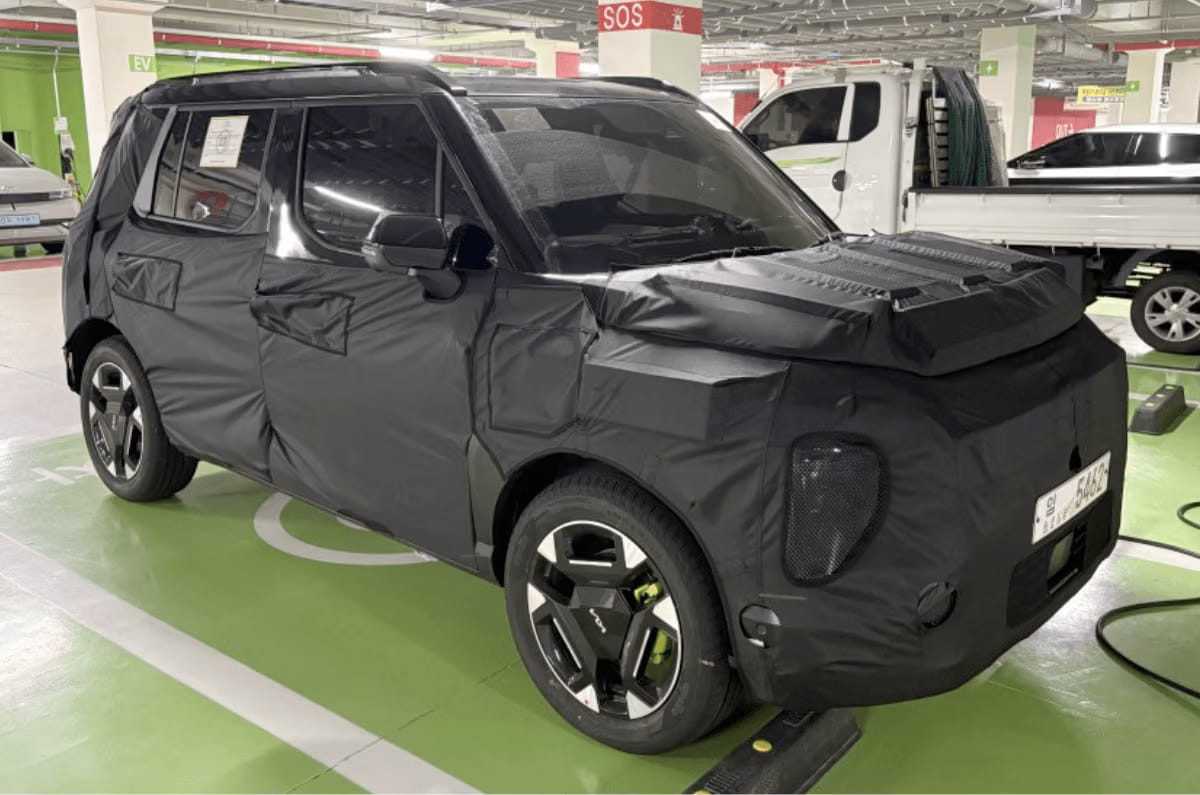
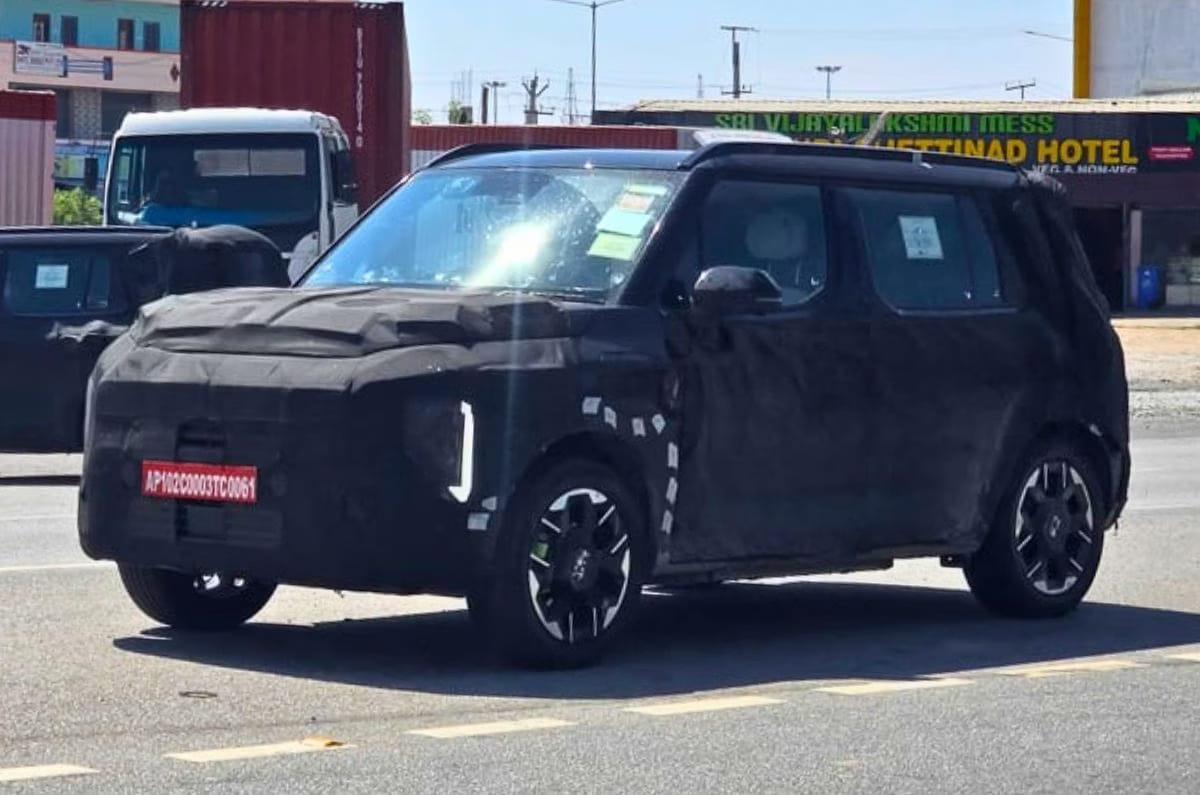
For its exterior, we were told that the Syros EV’s design would feature EV-specific design changes over its ICE counterpart, similar to how the Carens Clavis EV looks distinct from its ICE version. This could include a unique design for the alloy wheels, neon-green brake callipers, EV badging, and a slightly revised fascia. Heavily camouflaged test mules of the Syros EV have previously been spied on our roads. 

As far as the interior is concerned, it could likely retain the ICE versions’ overall layout, but with a different colour scheme. Its feature set could mirror that of the ICE Syros, which gets 12.3-inch displays for the infotainment and digital driver’s screens, a 5-inch HVAC control display, a panoramic sunroof, a powered driver seat, ventilated front seats, rear seat base ventilation and more. It remains to be seen whether the Syros EV will get an ADAS suite, given that it was discontinued in the MY26 update for the ICE Syros.

Dealer sources also told us that the Syros EV is likely to have a price range of Rs 15 lakh to Rs 20 lakh (ex-showroom). Once launched, it will take on the likes of the Tata Nexon EV and the MG Windsor. 

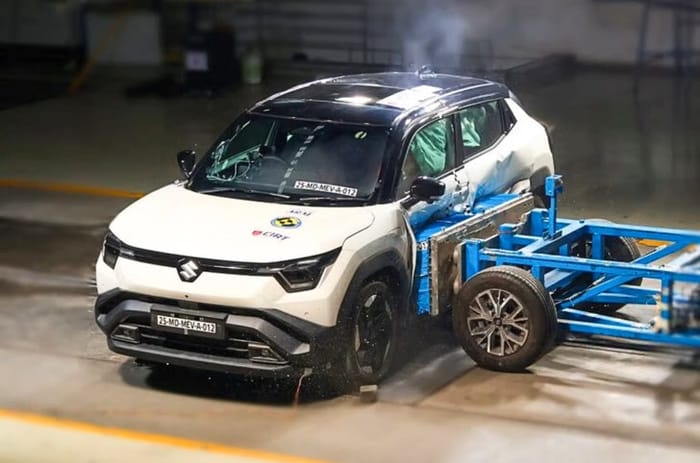
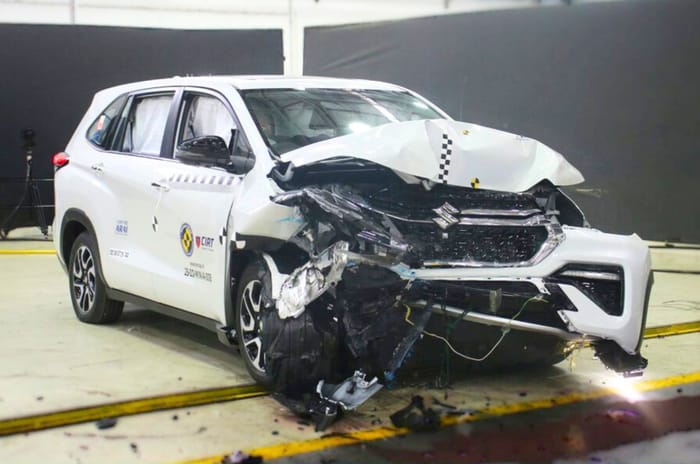
Every car crash tested by Bharat NCAP so far

Bharat NCAP tests

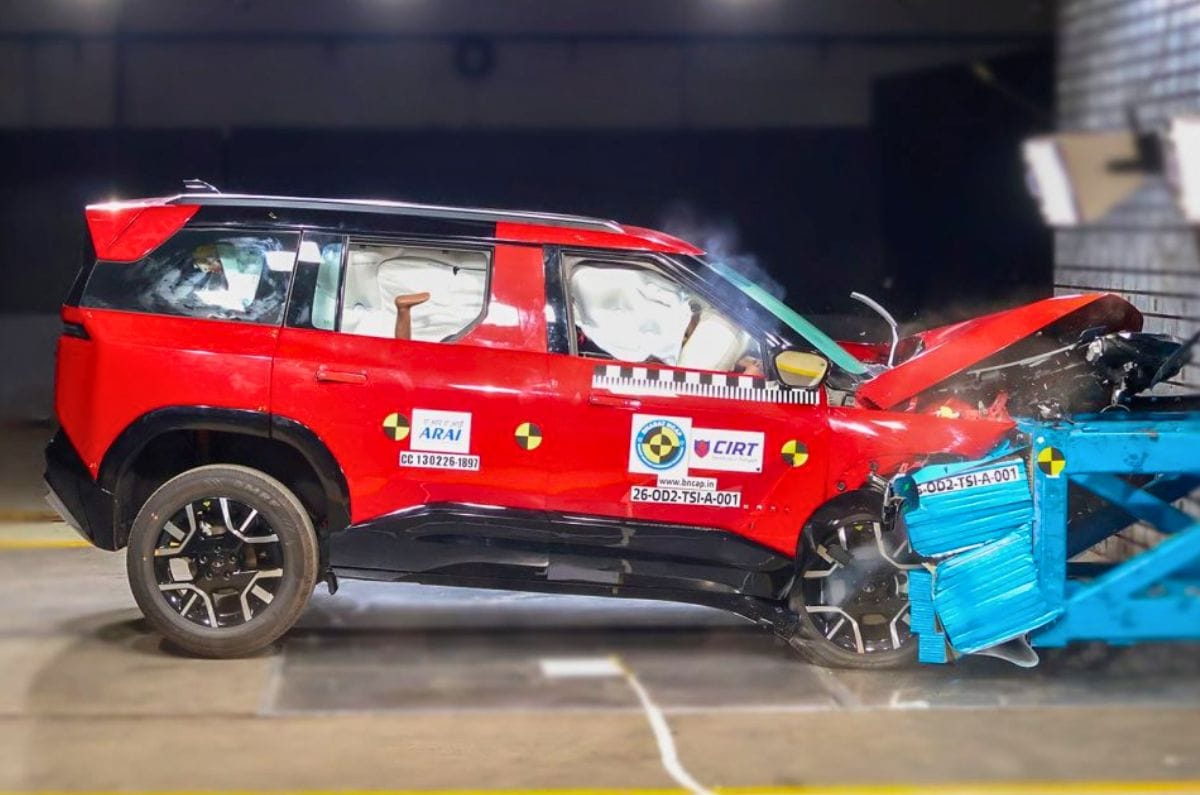
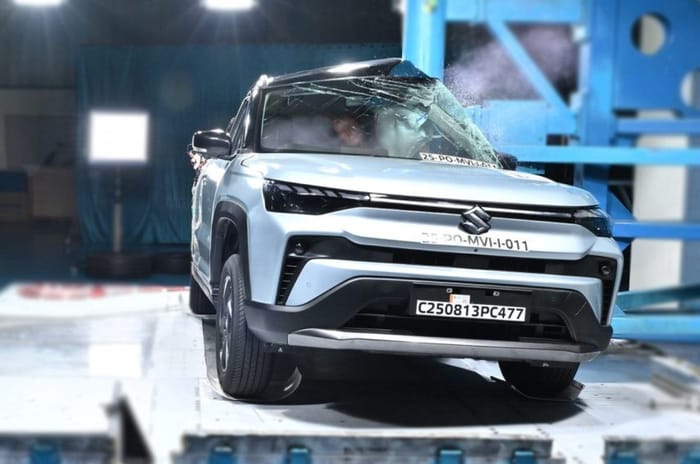
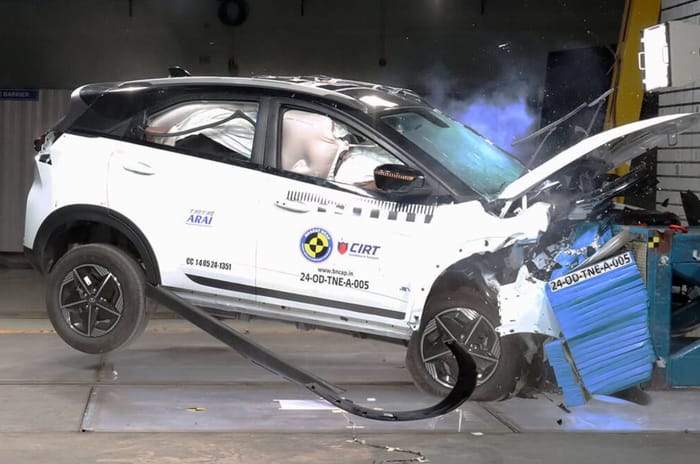
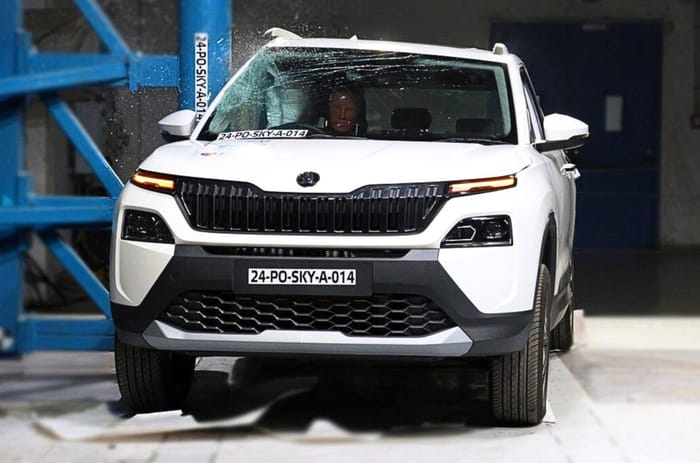
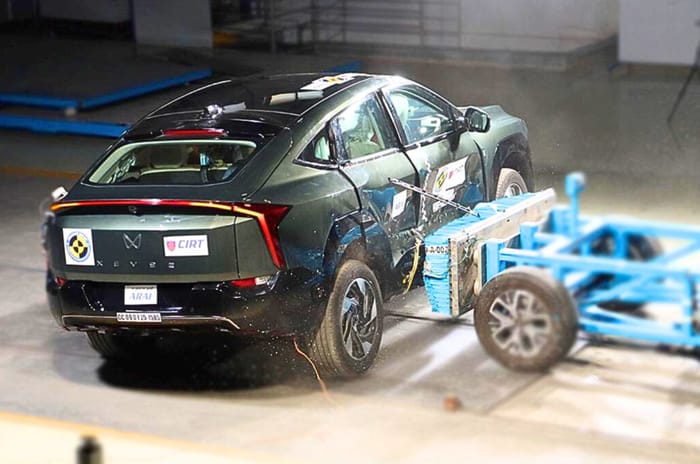
Introduced by the central government in 2023, the Bharat New Car Assessment Program (BNCAP) is responsible for conducting crash tests and awarding scores to cars sold in the country. The government hopes this will help buyers make more informed purchase decisions. Since its inception, Bharat NCAP has tested 31 vehicles, primarily SUVs. Below are the results detailing the crash safety performance of the models that are currently on sale.

1. Nissan Tekton

BNCAP rating: 5 stars

Nissan Tekton
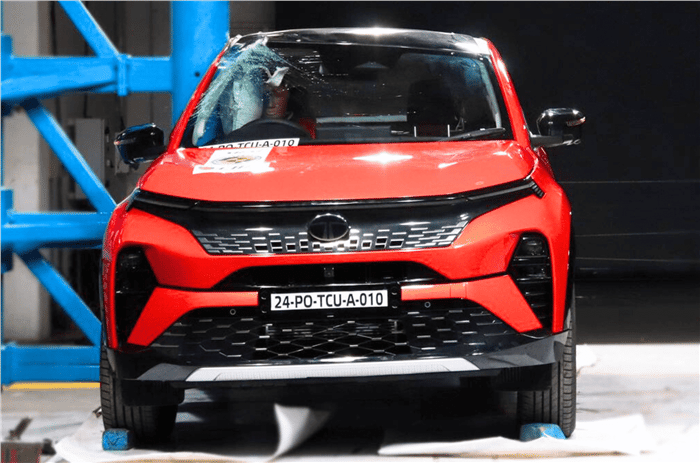
Crash-tested in June 2026 (representational image).

The Nissan Tekton is the latest model to be crash tested by Bharat NCAP, earning a full 5-star safety rating. The SUV scored 30.49 out of 32 points for adult occupant protection (AOP) and 45 out of 49 points for child occupant protection (COP). This 5-star rating applies to all variants of the Tekton. Standard safety features include six airbags, electronic stability control, hill start assist, a tyre pressure monitoring system, and three-point seatbelts for all occupants.

2. Renault Duster

BNCAP rating: 5 stars

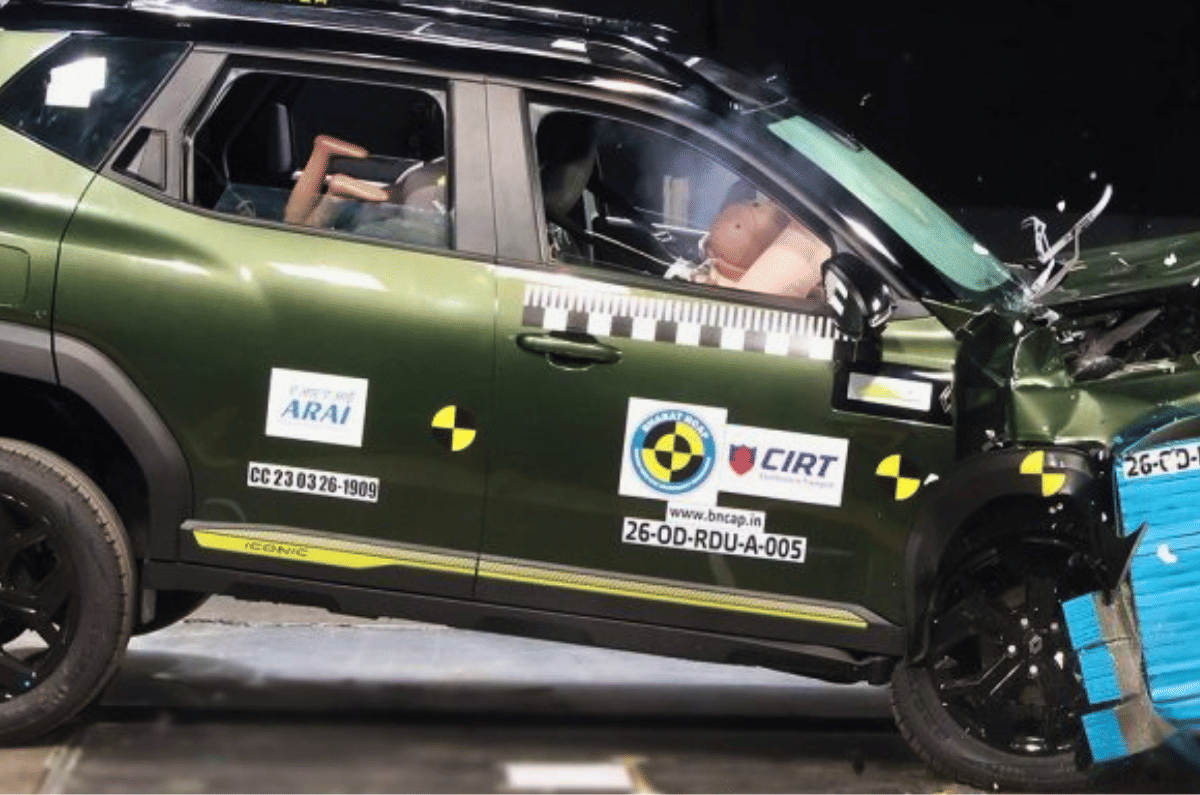
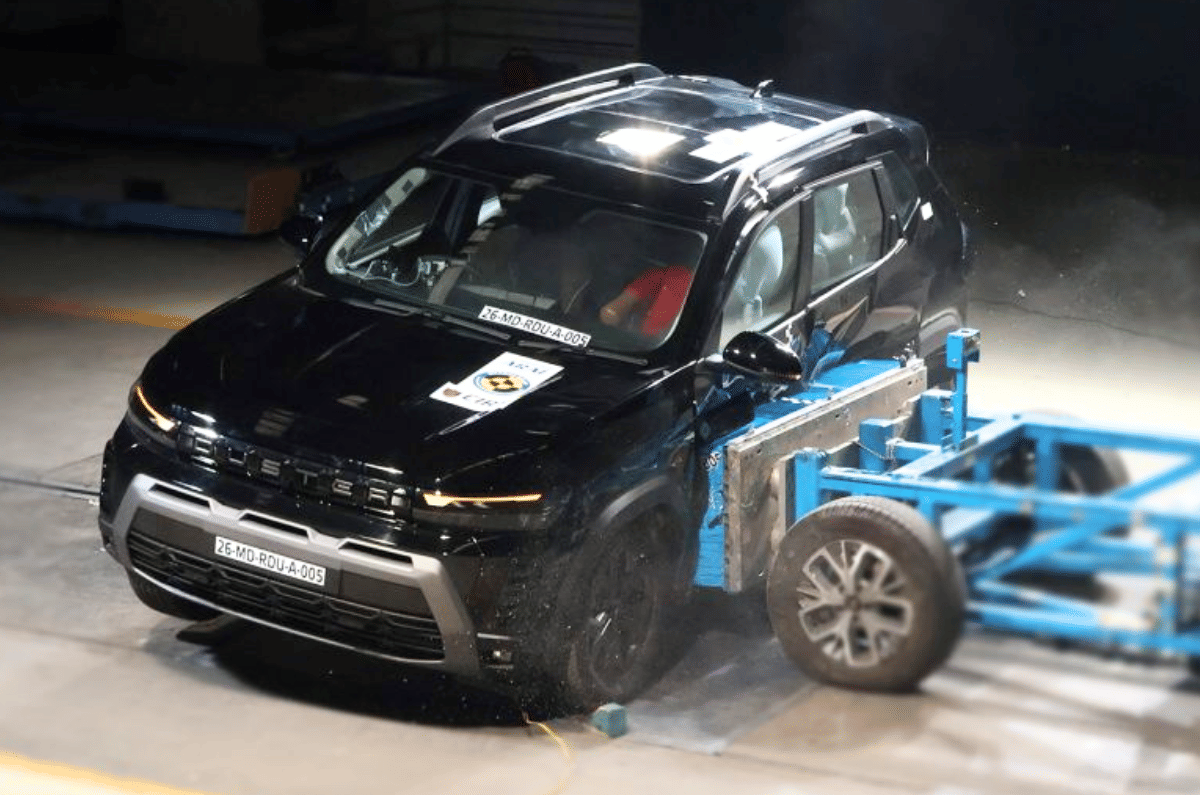
Renault Duster
Crash-tested in April 2026.

The Renault Duster was crash tested before its badge-engineered sibling, the Tekton, and both SUVs received identical BNCAP scores. All Duster variants feature 6 airbags, along with ABS, ESP, traction control and a tyre-pressure monitoring system.

3. Hyundai Venue

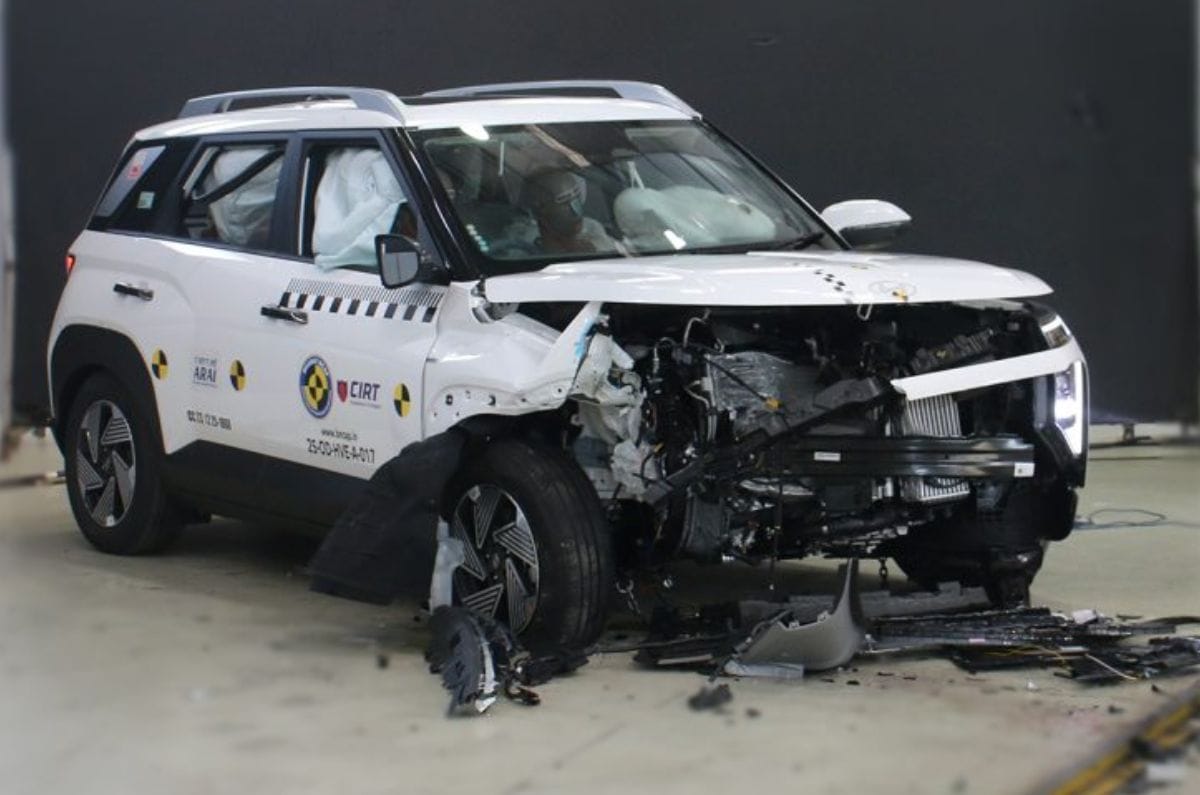
BNCAP rating: 5 stars

Crash-tested in March 2026.

The Hyundai Venue has received a 5-star safety rating from Bharat NCAP, which tested its HX2 diesel-manual and HX10 diesel-automatic variants, but the ratings apply to the entire line-up, including the N Line version. The Venue scored 31.15 out of 32 points in AOP and 44.46 out of 49 in COP. The Hyundai Venue is equipped with 6 airbags, hill-start assist, a tyre-pressure monitoring system (TPMS), 3-point seatbelts with reminders for all seats, rear parking sensors and ISOFIX child-seat anchorages as standard.

4. Kia Seltos

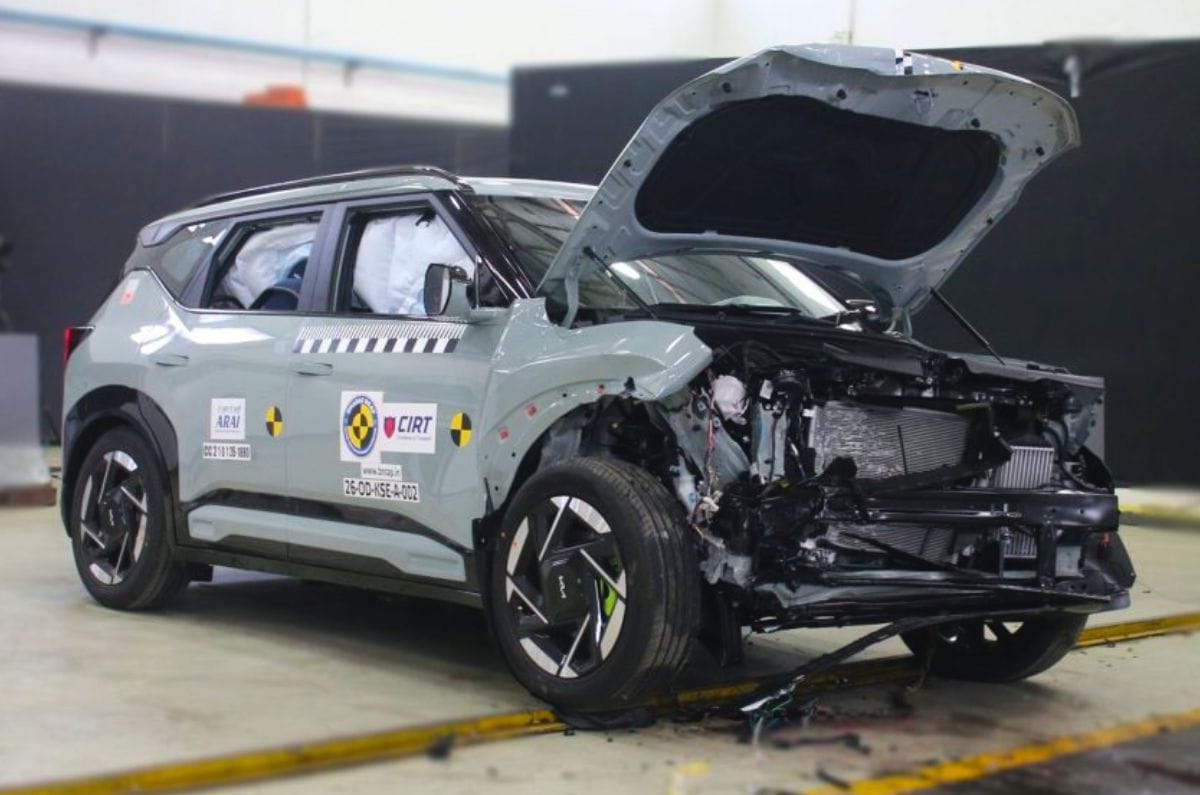
BNCAP rating: 5 stars

Crash-tested in March 2026.

The Kia Seltos is the second car from the brand after the Syros to receive a 5-star safety rating in the Bharat NCAP crash tests. It scored 31.70 points in AOP and 45 in COP. Only the diesel-powered HTE(O) and GTX variants were tested, but the results apply to all variants of the Seltos. The standard safety kit on the Kia Seltos includes 6 airbags, TPMS, a rear parking camera with sensors, disc brakes on all wheels, hill-start and hill-descent control and ISOFIX child-seat anchorages. 

5. Tata Sierra

BNCAP rating: 5 stars

Crash-tested in March 2026.

The Sierra is one of the latest Tata model on this list to receive a 5-star safety rating in both AOP and COP, securing 31.14 and 44.43 points, respectively. While BNCAP tested only the midsize SUV’s Adventure+ and Accomplished+ diesel variants, the ratings apply to its entire line-up. As standard, the Sierra gets 6 airbags, rear parking sensors, all-wheel disc brakes, ABS, EBD, ESC, traction control and more.

6. Vinfast VF7

BNCAP rating: 5 stars

Vinfast VF7
Crash-tested in January 2026.

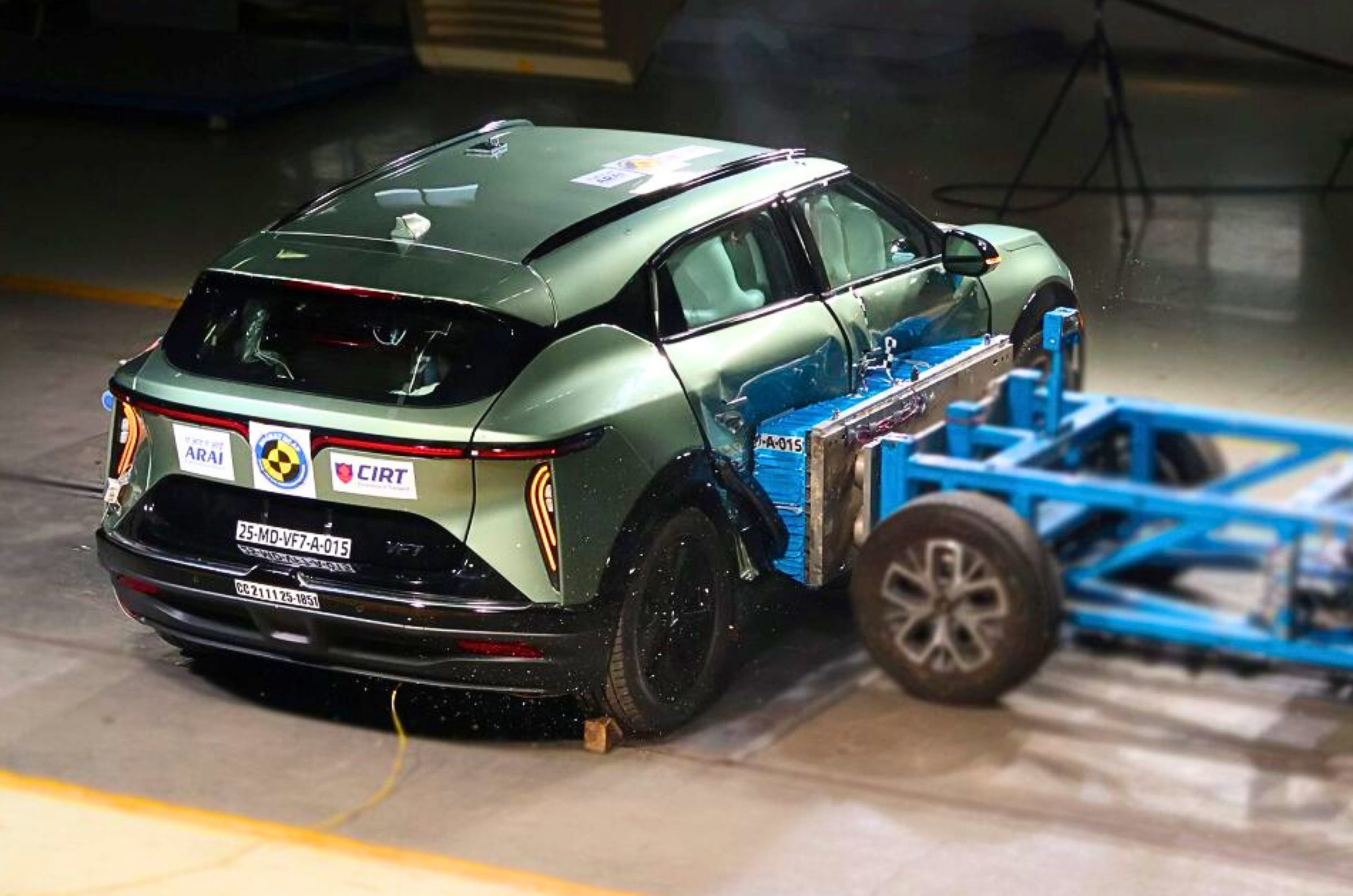
The Vinfast VF7, too, has secured a 5-star safety rating in both adult and child occupant protection, with 28.54 and 45.25 points, respectively. Though Bharat NCAP tested only the VF7 Wind and Sky variants, the rating applies to the entire range. The VF7 offers 7 airbags, ISOFIX anchors, ESC, and more as standard.

7. Vinfast VF6

BNCAP rating: 5 stars

Vinfast VF6
Crash-tested in January 2026.

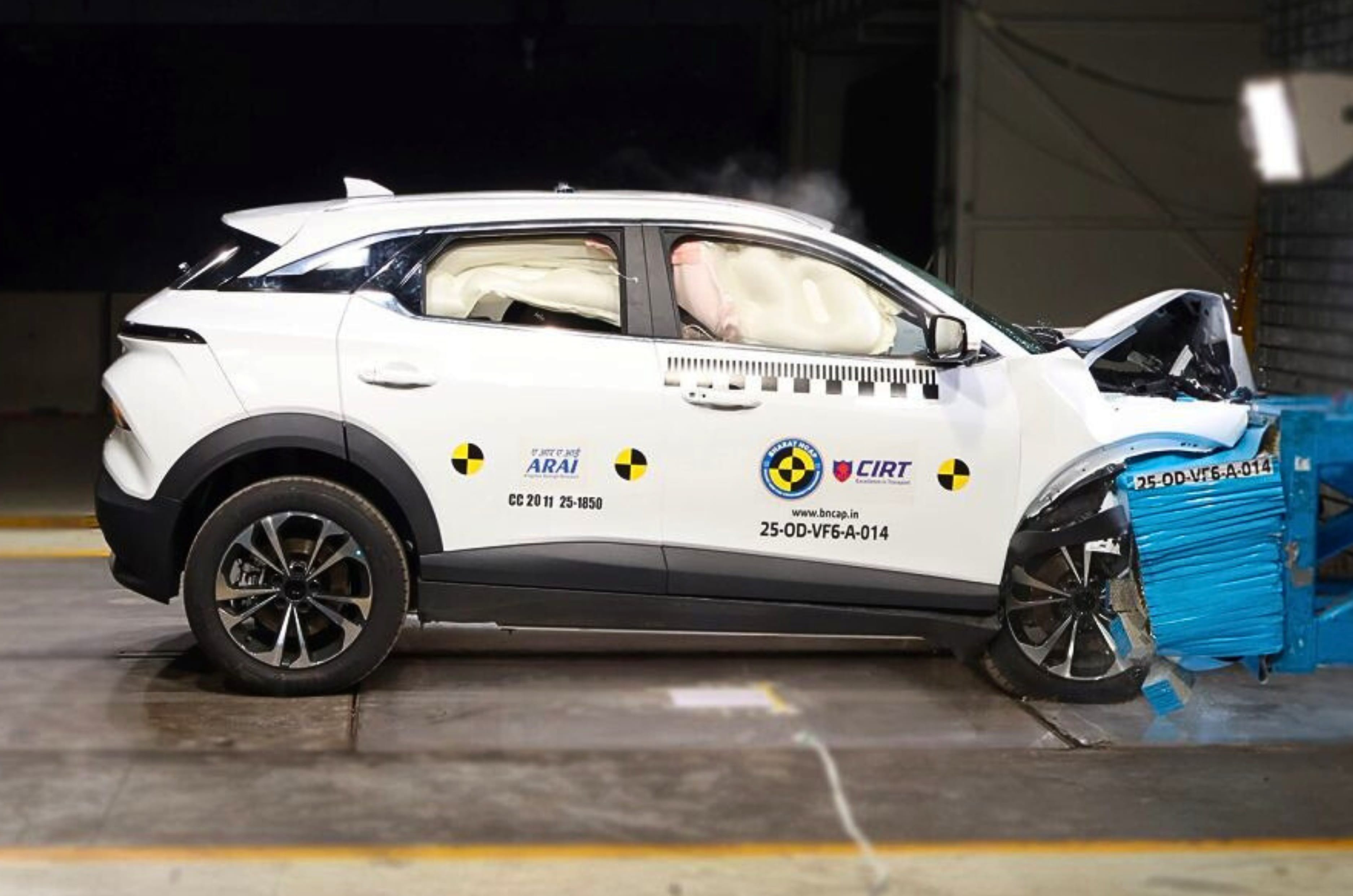
Also receiving a 5-star rating in both adult and child occupant protection, the Vinfast VF6 scored 27.13/32 in AOP and 44.41/49 in COP. Bharat NCAP tested all trims of the VF6 – Earth, Wind and Sky. As standard, the VF6 comes equipped with 7 airbags, including a driver knee airbag, and 3-point seat belts with reminders for all passengers, ESC and ISOFIX anchors for rear outboard seats.  

8. Tata Punch

BNCAP rating: 5 stars

Tata Punch
Crash-tested in January 2026.

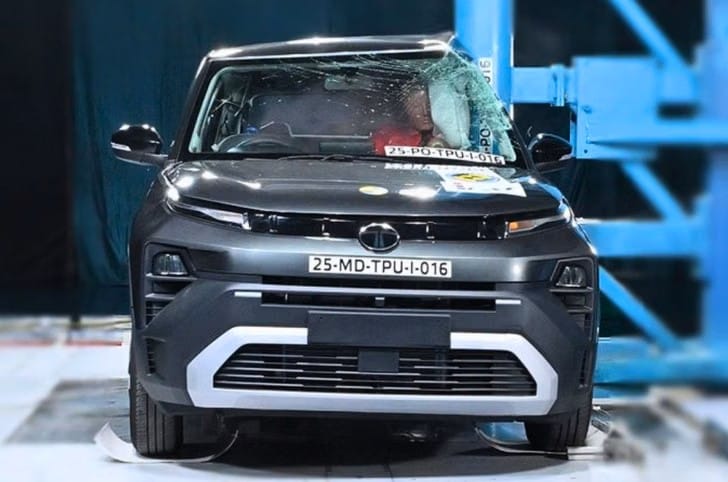
The Tata Punch, with 30.58 points in AOP and 45 points in COP, received a 5-star safety rating in both. The variants tested by Bharat NCAP were the Punch Pure+ CNG AMT and Accomplish CNG MT, but the rating applies to the entire line-up. The Punch’s safety suite features 6 airbags as standard, ESP, rear parking sensors, a tyre-pressure monitoring system, hill-hold and hill-descent control, ISOFIX child-seat anchorages, auto headlamps and rain-sensing wipers.  

9. Maruti Suzuki e Vitara

BNCAP rating: 5 stars

Maruti Suzuki e Vitara
Crash-tested in December 2025.

The Maruti Suzuki e Vitara has been awarded a 5-star rating in both AOP and COP, scoring 31.49/32 and 43/49, respectively. Bharat NCAP tested the top-spec Alpha variant with a 61kWh battery pack, and the rating applies to the entire range. Safety features of the e Vitara include 7 airbags, a tyre-pressure monitoring system (TPMS), a Level 2 ADAS suite with lane-keep assist, adaptive cruise control and AEB, rear disc brakes, ISOFIX mounts and a 360-degree camera. 

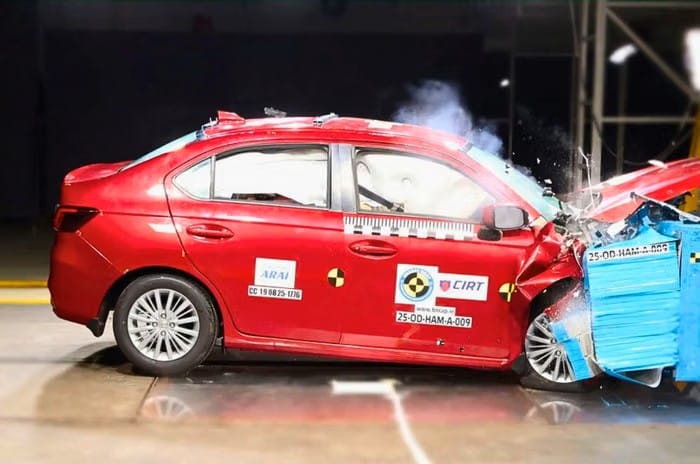
10. Honda Amaze

BNCAP rating: 5 stars

Honda Amaze
Crash-tested in November 2025.

The third-gen Honda Amaze has been awarded a 5-star safety rating by Bharat NCAP, becoming the second sedan to be tested by the road safety organisation. The Amaze has secured 5 stars in AOP (28.33 out of 32 points) and 4 stars in COP (40.81/49 points). In terms of safety kit, all six variants are equipped with 6 airbags, ISOFIX child-seat anchors, ESC, ABS, rear parking sensors and seat belt reminders as standard.

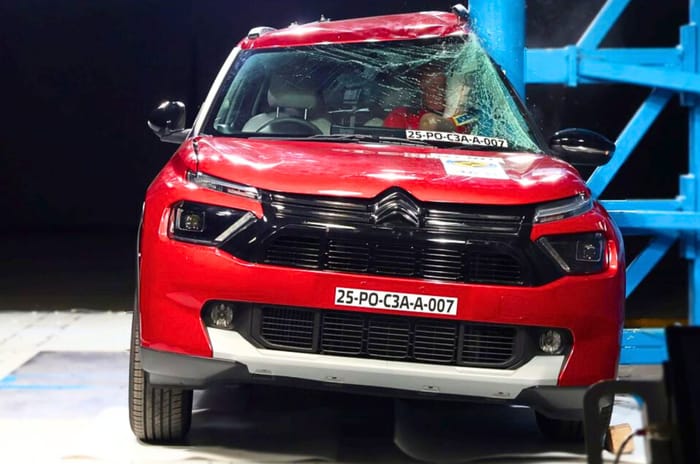
11. Citroen Aircross

BNCAP rating: 5 stars

Citroen Aircross
Crash-tested in September 2025.

The Citroen Aircross, sold in 5- and 7-seat configurations, was awarded 5 stars in AOP and 4 stars in COP. Notably, the AOP and COP crash-safety test ratings are valid for the Aircross 5-seat version’s 1.2-litre petrol and turbo-petrol variants. The Aircross received an AOP score of 27.05/32 and a COP score of 40/49. As standard, the Aircross comes with safety features like 6 airbags, ISOFIX child-seat mounts, electronic stability control, TPMS and hill-hold assist.
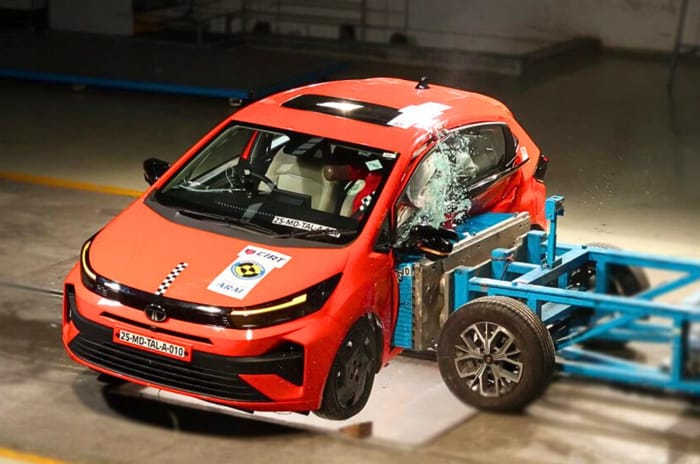
12. Maruti Suzuki Invicto

BNCAP rating: 5 stars

Maruti_Suzuki_Invicto_BNCAP
Crash-tested in September 2025.

Like most cars on this list, the Maruti Invicto MPV scored a 5-star rating for both adult and child occupant protection. Maruti’s flagship MPV was awarded 30.43 out of 32 in AOP and 44.90 out of 49 in COP. These safety ratings are applicable to all variants, which have 6 airbags, ABS with EBD, rear disc brakes, and 3-point seatbelts for all passengers as standard. The top-spec Invicto Alpha+ variant adds a 360-degree camera, TPMS, rear defogger and an anti-theft security system.

13. Tata Altroz

BNCAP rating: 5 stars

Tata Altroz safety rating
Crash-tested in September 2025.

The Tata Altroz has scored a 5-star rating for both adult and child occupant protection. The premium Tata hatchback was awarded 29.65 points out of 32 in AOP and 44.90 out of 49 in COP. These safety ratings are applicable to all variants of the Altroz. Starting from the base model, the Altroz hatchback comes equipped with 6 airbags, ABS, ESC and 3-point seat belts for all passengers. Higher Altroz variants add a 360-degree camera, a blind-spot monitor and TPMS.

14. Maruti Suzuki Victoris

BNCAP rating: 5 stars

Maruti Suzuki Victoris scores 5-star safety rating at Bharat NCAP
Crash-tested in September 2025.

The Maruti Victoris got a 5-star safety rating in both adult and child occupant protection. The Maruti SUV secured 31.66 points out of 32 in AOP and 43 points out of 49 in COP. While BNCAP tested hybrid and petrol-AT variants of Victoris, the safety rating is applicable to the entire line-up. As standard, the Victoris comes equipped with 6 airbags, 3-point seat belts with reminders for all passengers, ESC and ISOFIX anchors for rear outboard seats. Top-spec trims even get a Level 2 ADAS suite.

15. Toyota Innova Hycross 

BNCAP rating: 5 stars 

Crash-tested in June 2025.

The Toyota Innova Hycross has a 5-star safety rating for both adult and child occupant protection, with 30.47/32 and 45/49 points, respectively. Bharat NCAP tested both petrol and hybrid variants, and the rating applies to the entire Innova Hycross range. As standard, the Innova Hycross comes equipped with 6 airbags, 3-point seat belts with reminders for all passengers, ESC and ISOFIX anchors; top-spec trim also gets an ADAS suite.

16. Tata Harrier EV

BNCAP rating: 5 stars

Crash-tested in June 2025.

The Tata Harrier EV has been rated 5 stars in both adult and child occupant protection, scoring a full 32 points in AOP and 45 out of 49 points in COP. It is only the second vehicle tested by BNCAP to secure maximum points in AOP, the other being the Mahindra XEV 9e. The Harrier EV comes with 6 airbags (7 on Fearless and Empowered), 3-point seat belts with reminders for all passengers, ESC and ISOFIX anchors as standard. Notably, it has slightly better AOP and COP scores than the combustion-powered Harrier, which also has a 5-star BNCAP rating.

17. Maruti Suzuki Dzire

BNCAP rating: 5 stars

Crash-tested in June 2025.

As the first sedan to be tested by Bharat NCAP, the Maruti Suzuki Dzire took home an impressive 5-star safety rating. The compact sedan scored 29.46 out of 32 points for AOP and 41.57 out of 49 points for COP. BNCAP tested the Dzire’s base LXI trim, which comes with standard safety equipment like 6 airbags, ESC, reverse parking sensors, hill-hold assist, and overspeed alerts, among other features, thereby extending the 5-star rating to all variants.

18. Maruti Suzuki Baleno

BNCAP rating: 4 stars

Crash-tested in June 2025.

Maruti Baleno scored four stars in BNCAP’s crash tests; this rating applies to the respective MT and AMT models of Zeta and Alpha variants. Out of 32 points, the AOP score for the Zeta and Alpha variants scored 26.52 points. The COP score was 34.81 for all variants. Standard safety features for the Baleno include 6 airbags, ABS with EBD, brake assist, ESC, hill-hold assist and 3-point seat belts with reminders for all passengers.

19. Tata Nexon EV

BNCAP rating: 5 stars

Crash-tested in April 2025.

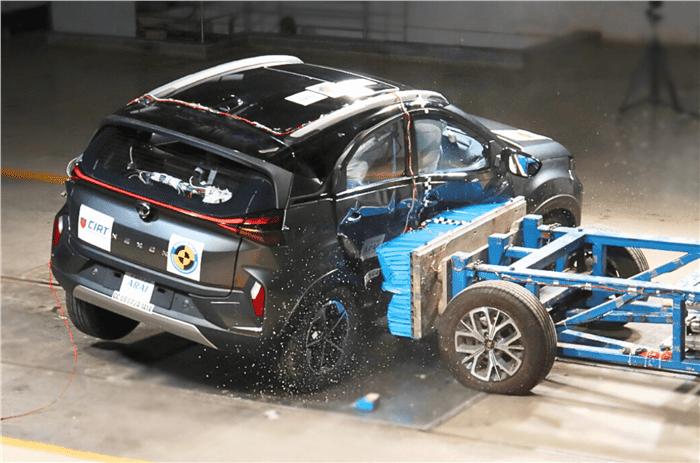
The 30kWh and now-discontinued 40.5kWh variants of the Tata Nexon EV achieved a 5-star Bharat NCAP rating for both adult and child protection in May 2024, scoring 29.86/32 and 44.95/49 points, respectively. In April 2025, BNCAP also tested the current range-topping 45kWh variants of the Nexon EV, which received identical AOP and COP scores and, therefore, a 5-star rating. The standard safety features for the Nexon EV include ABS with EBD, 6 airbags, ESP, hill-hold control, ISOFIX child-seat anchor points, rear parking sensors, a rear camera and TPMS.

20. Kia Syros

BNCAP rating: 5 stars

Crash-tested in April 2025.

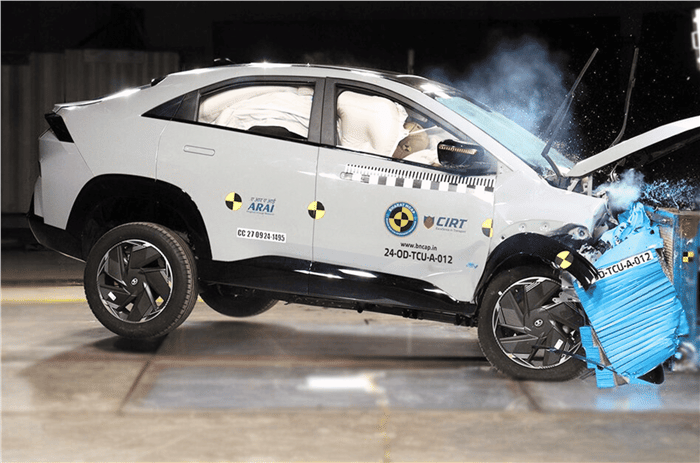
The Kia Syros compact SUV, with 30.21 out of 32 points in AOP and 44.42 out of 49 points in COP, secured 5-star ratings in both parameters. These ratings are applicable to the entire Syros petrol range. It should be noted that the Syros is Kia’s first SUV to get a 5-star safety rating in a crash test done by BNCAP or GNCAP. Although it uses the K1 platform as the Hyundai Grand i10 (which got 2 stars in the 2020 GNCAP), Kia achieved the top rating by using a reinforced K1 base and adding many hot-stamped parts to the body shell. The Syros offers ABS with EBD, TPMS and 6 airbags (with a passenger-side airbag cut-off switch) as standard safety features.

21. Skoda Kylaq

BNCAP rating: 5 stars

Crash-tested in January 2025.

The Skoda Kylaq compact SUV also got a 5-star rating in both adult and child occupant protection in the BNCAP crash test. Skoda’s compact SUV scored 30.88 out of 32 in AOP and 45 out of 49 in COP. ESC, 6 airbags, 3-point seat belts with reminders for all passengers and ISOFIX anchors for rear outboard seats are some safety features available across its variants.

22. Mahindra XEV 9e

BNCAP rating: 5 stars

Crash-tested in January 2025.

The Mahindra XEV 9e coupe-SUV was awarded a 5-star rating. The electric SUV scored a full 32 points in AOP and 45 out of 49 points in COP. The model tested by BNCAP was the top-spec XEV 9e Pack Three. Safety features like 6 airbags, ISOFIX anchors, rear disc brakes and tyre-pressure monitors are offered starting with the XEV 9e Pack One. 

23. Mahindra BE 6

BNCAP rating: 5 stars

Crash-tested in January 2025.

Another electric offering from the SUV specialist, the Mahindra BE 6, also scored a 5-star rating in both AOP and COP. In AOP, the EV received 31.97 points out of 32, and in COP, it got 45 points out of 49. Just like the XEV 9e, the BNCAP crash-tested the range-topping BE 6 Pack Three trim, but Mahindra claims that this rating applies to the base Pack One as well. In terms of standard safety equipment, the BE 6 comes with 6 airbags, a rear camera, parking sensors, TPMS and a driver drowsiness detection system.

24. Mahindra Thar Roxx

BNCAP rating: 5 stars

Crash-tested in November 2024.

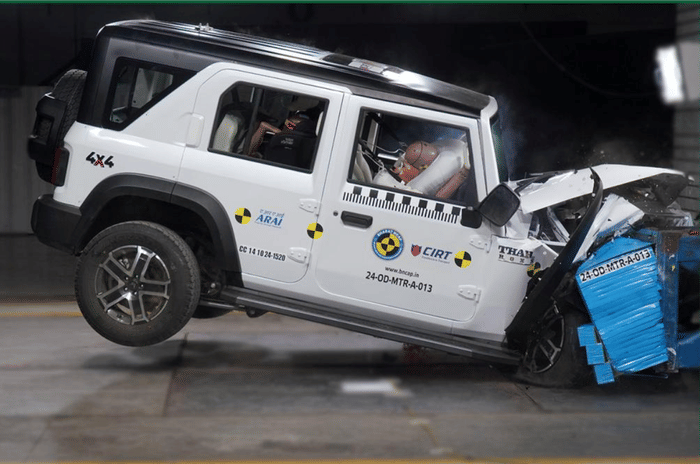
The 5-star rating for the Mahindra Thar Roxx consisted of AOP and COP scores of 31.09 and 45, respectively. This safety rating applies to all the variants of the 5-door SUV. The Thar Roxx complies with AIS-100 pedestrian protection norms for keeping the occupants as well as pedestrians safe when on the go. As standard, it features 6 airbags and a cut-off switch for the passenger-side airbag. Additionally, ISOFIX child-seat anchor points, all 3-point seatbelts with reminders and ESC are offered throughout the range. Like with the XUV 3XO, an ADAS suite is offered in the AX5L and AX7L variants.

25. Mahindra XUV 3XO

BNCAP rating: 5 stars

Crash-tested in November 2024.

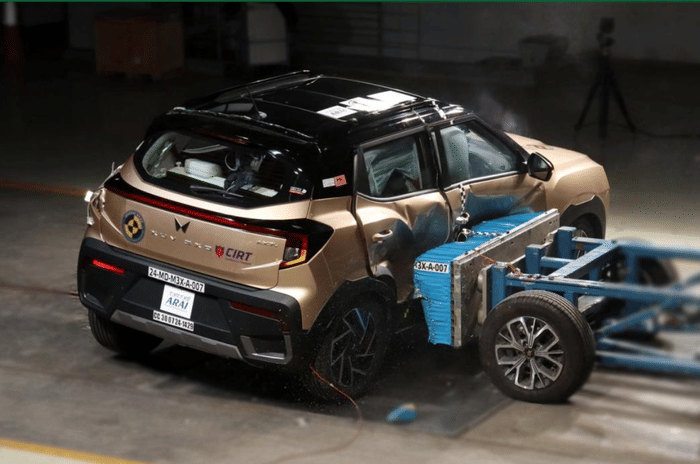
Next up, the Mahindra XUV 3XO continued the 5-star streak with scores of 29.36 in AOP and 43 in COP. BNCAP reported that the MX2 and AX7 L variants were sent by the homegrown brand for testing, but the results apply to the entire XUV 3XO line-up. Also, all trims of the subcompact SUV have 6 airbags, 3-point seatbelts with reminders, ESC, ISOFIX seats and a passenger-side airbag cut-off switch among the standard safety assist technologies. Level 2 ADAS suite, however, is reserved for the AX5 L and AX7 variants.

26. Tata Nexon

BNCAP rating: 5 stars

Crash-tested in October 2024.

The Tata Nexon secured a perfect 5-star rating for AOP and COP, scoring 29.41 and 43.83 points, respectively. Standard safety features include 6 airbags, ESC, ABS with EBD, ISOFIX child-seat anchor points, rear parking sensors and hill-hold control.

27. Tata Curvv

BNCAP rating: 5 stars

Crash-tested in October 2024.

The Tata Curvv’s crash-test result was revealed alongside the Nexon, and just like the compact SUV, the coupe-SUV scored 5 stars for both adult and child occupant protection. It secured 29.50 points for AOP and 43.66 points for COP. On the safety front, the Curvv gets ABS with EBD, ESC, 6 airbags, hill-hold control and ISOFIX child-seat anchor points as standard across the range.

28. Tata Curvv EV

BNCAP rating: 5 stars

Crash-tested in October 2024.

The Tata Curvv EV secured 5 stars for AOP and COP, scoring 30.81 and 44.83 points, respectively. It gets 6 airbags, ESP, all-wheel disc brakes, a rear camera and rear parking sensors as standard. Higher variants of the electric vehicle also get Level 2 ADAS, just like its ICE twin.

29. Citroen Basalt

BNCAP rating: 4 stars

Crash-tested in October 2024.

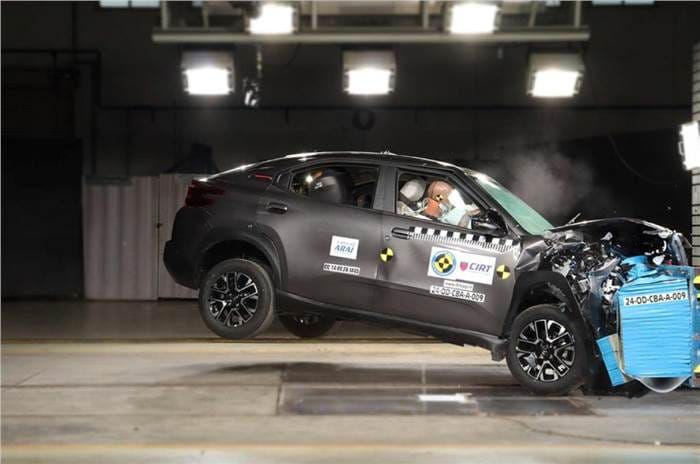
The Citroen Basalt was the first car from the brand to have been crash-tested by Bharat NCAP. The coupe-SUV managed to secure 4 stars for AOP (26.19/32) and 4 stars for COP (35.90/49). The Citroen offers the Basalt with 6 airbags, ESP, hill-hold, TPMS, a rearview camera, rear parking sensors and ISOFIX child-seat anchor points.

30. Tata Harrier

BNCAP rating: 5 stars

Harrier bncap
Crash-tested in December 2023 (representational image).

Tested in December 2023, the Tata Harrier SUV received a 5-star safety rating for both adult and child occupants’ safety, achieving an AOP score of 30.08 and a COP score of 44.54. Tata offers the Harrier with ABS and EBD, corner stability control, 6 airbags, ESP, hill-hold control, ISOFIX child-seat anchor points, traction control and rear parking sensors as standard.

31. Tata Safari

BNCAP rating: 5 stars

Crash-tested in December 2023.

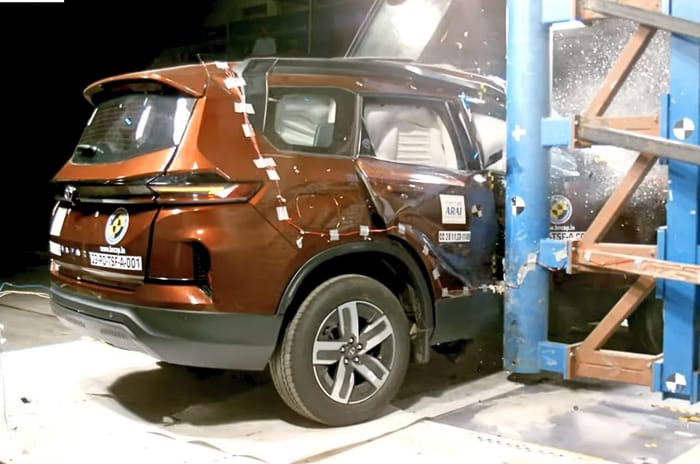
The Tata Safari was also crash-tested in December 2023, securing a 5-star safety rating, matching the Harrier with an AOP score of 30.08 and a COP score of 44.54. As standard, the Tata Safari gets all-wheel disc brakes, 6 airbags, ABS with EBD, corner stability control, ESP, hill-hold control, ISOFIX child-seat anchor points, rear parking sensors, roll-over mitigation and traction control.