Mercedes-Benz India has announced it achieved its best H1 (January to July) sales ever in 2026, with total sales of 9,768 units, marking a 9 percent increase over H1 2025. The manufacturer has also revealed it recorded its best-ever Q2 (April to June) sales of 4,238 units, a 10 percent growth over Q2 2025.
Mercedes-AMG sales grew by 50 percent in H1 2026
The top-end luxury portfolio grew by 20 percent
EVs contributed to 25 percent of Mercedes’ top-end car sales
Mercedes-Benz H1 2026 performance breakdown
‘Top-end Luxury’ segment saw a robust 20 percent growth
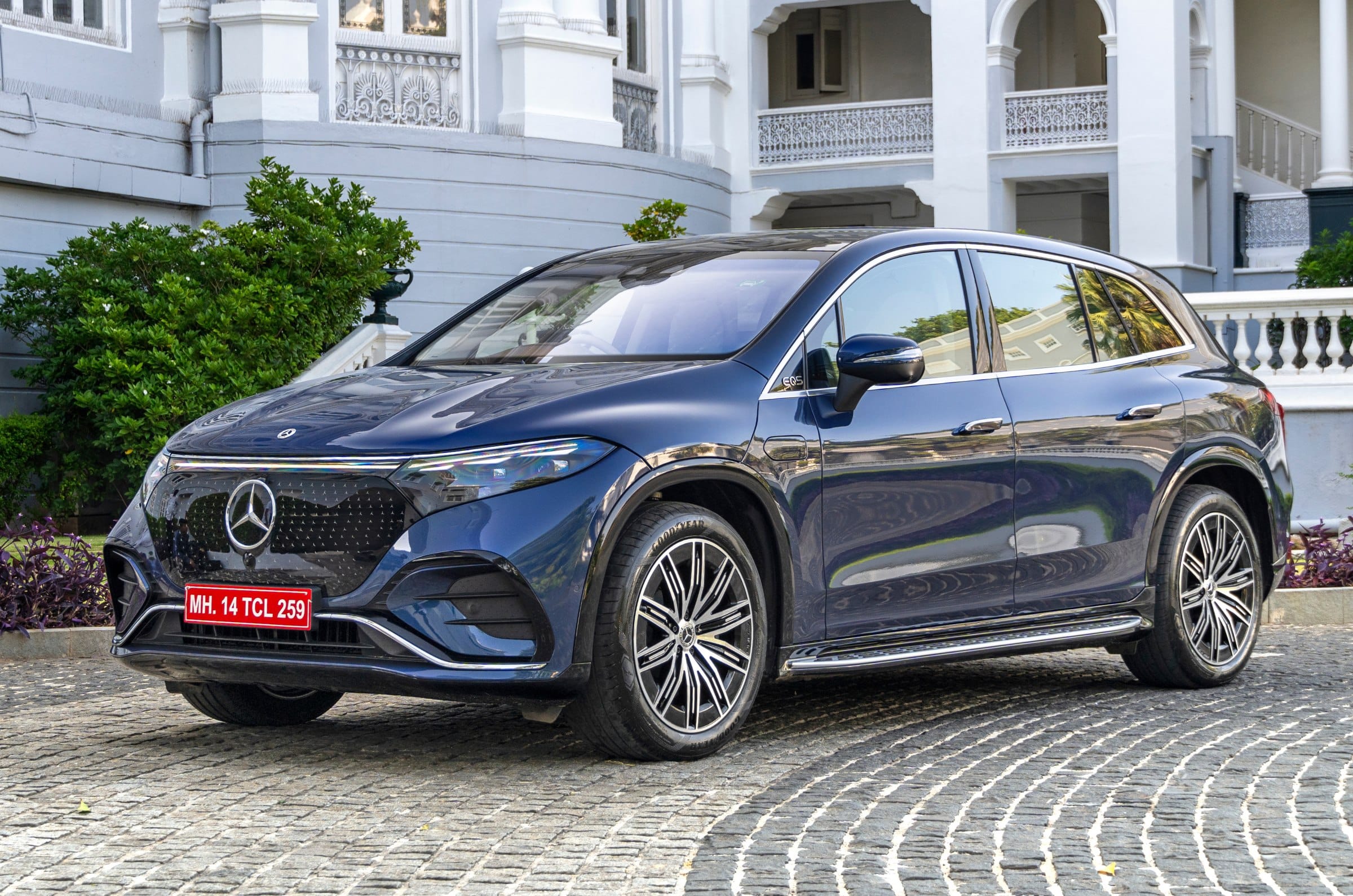
The EQS SUV was the best-selling Mercedes-Benz BEC in H1 2026.
Mercedes-Benz has stated that its ‘Top-end Luxury’ segment, comprising models like the V-Class, Mercedes-Maybach cars, EQS SUV and the AMG range, grew by over 20 percent. In fact, 28 percent of total Mercedes-Benz sales in H1 2026 were from this ‘Top-end Luxury’ segment. Among total sales in this segment in H1 2026, 25 percent were from EVs. These top-end BEV sales were driven by the EQS SUV, which was also the brand’s bestselling EV. In the more affordable ‘luxury entry segment’, however, the CLA Electric drove sales. Notably, the Mercedes-AMG sales surged by 50 percent in H1 2026.
Mercedes also revealed that the waiting period for cars in this segment ranges from 4 months to up to a year for models like the AMG G63 SUV.
Mercedes-Benz’s ‘Core’ segment saw steady demand
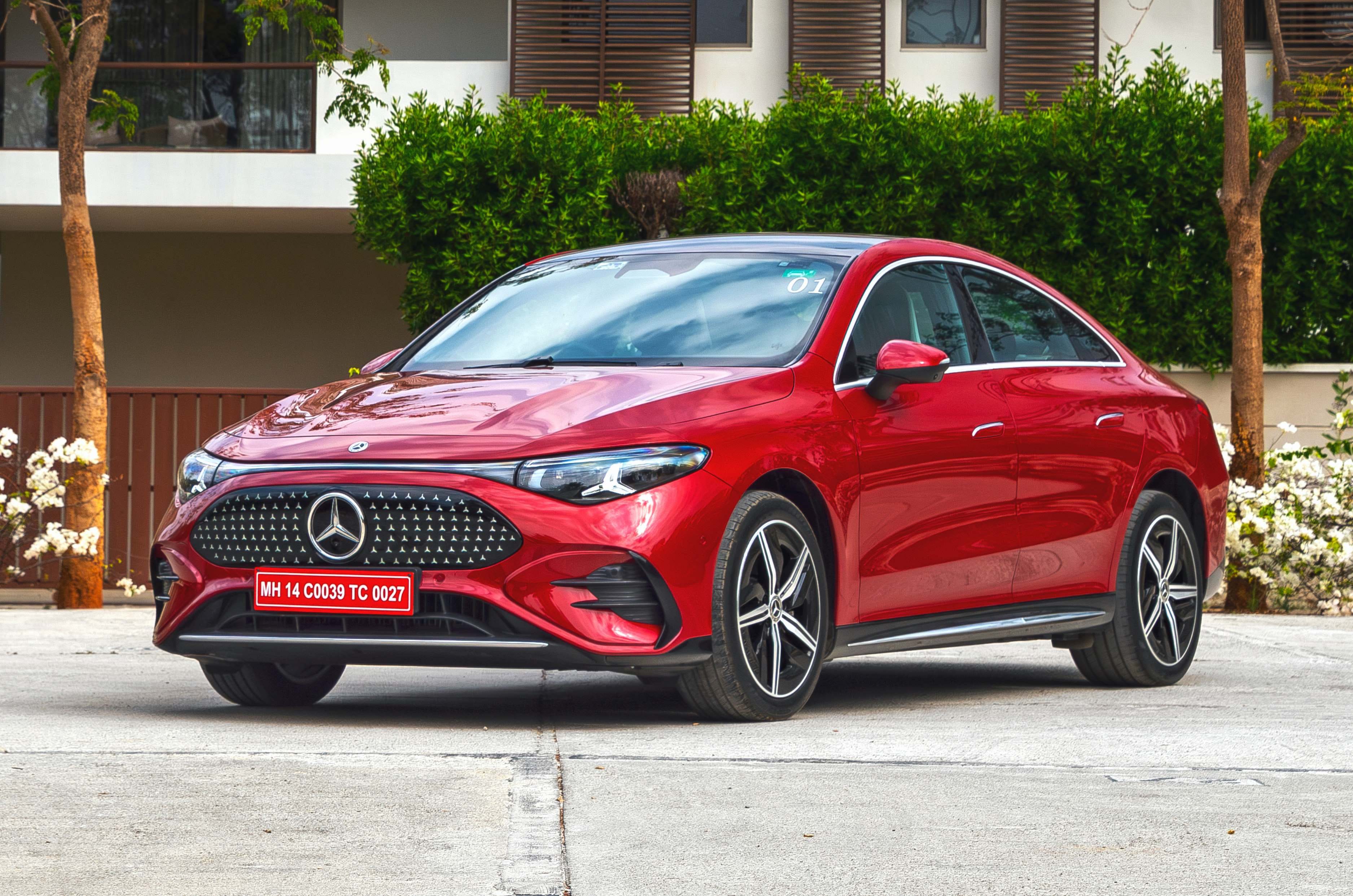
CLA Electric, launched in April 2026, drove entry-level luxury segment growth.
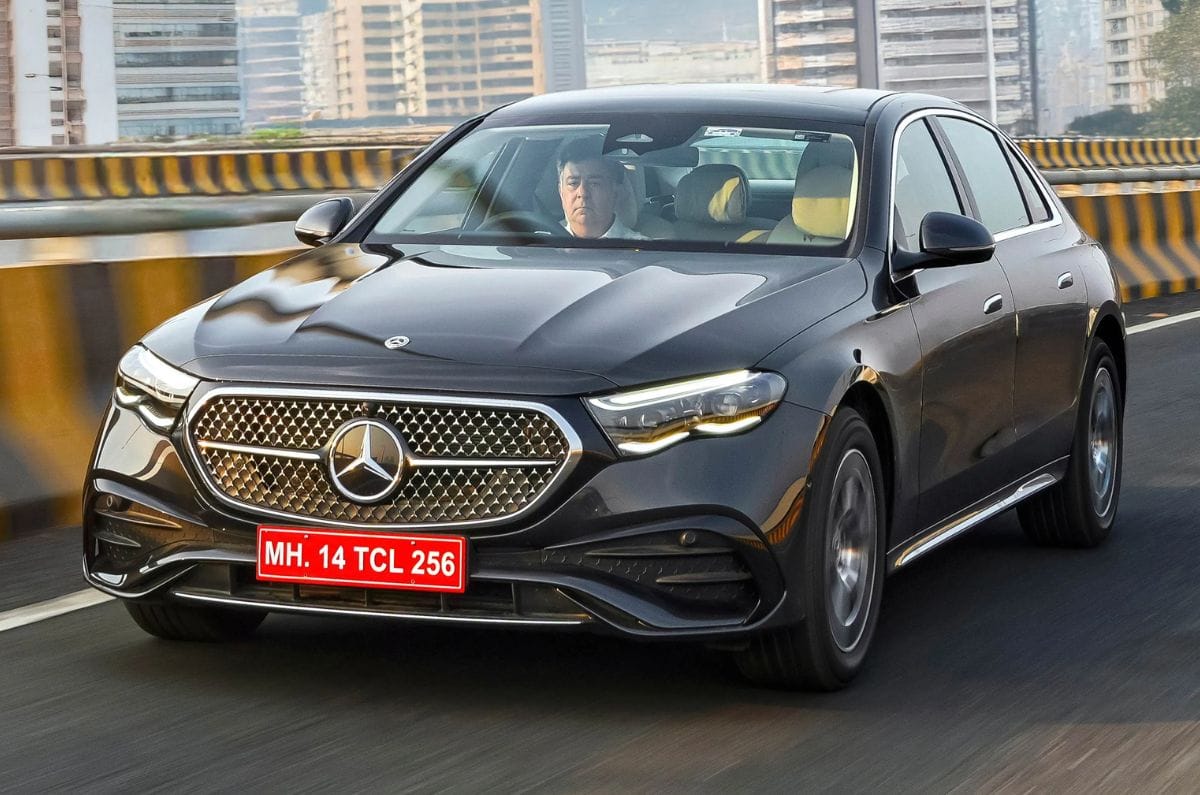
The ‘Core’ segment, comprising models like the C-Class, E-Class LWB, GLC and GLE, “significantly contributed to the sales performance in H1 2026 and in Q2 2026.” The manufacturer did not reveal sales numbers for this segment. Mercedes-Benz, however, claimed that “the Long Wheelbase E-Class continues to remain the highest-selling luxury car in India” and that they witnessed “a strong demand for the top-end E 450 variant.”
The ‘Entry Luxury’ segment witnessed 29 percent growth in Q2 2026, driven by the CLA Electric and the GLA.
A Rs 450 crore expansion plan over the next two years was underlined too
Mercedes-Benz has also underlined an investment of Rs 450 crores over the next two years as part of an expansion plan. Under this plan, the company plans to debut in new markets like Varanasi, while “strengthening its footprint in established markets of Mumbai, Pune, Delhi NCR, and Hyderabad during H2 2026.” Mercedes has added six new touchpoints in H1 2026 across Bengaluru, Bhopal, Raipur, Goa and Visakhapatnam.
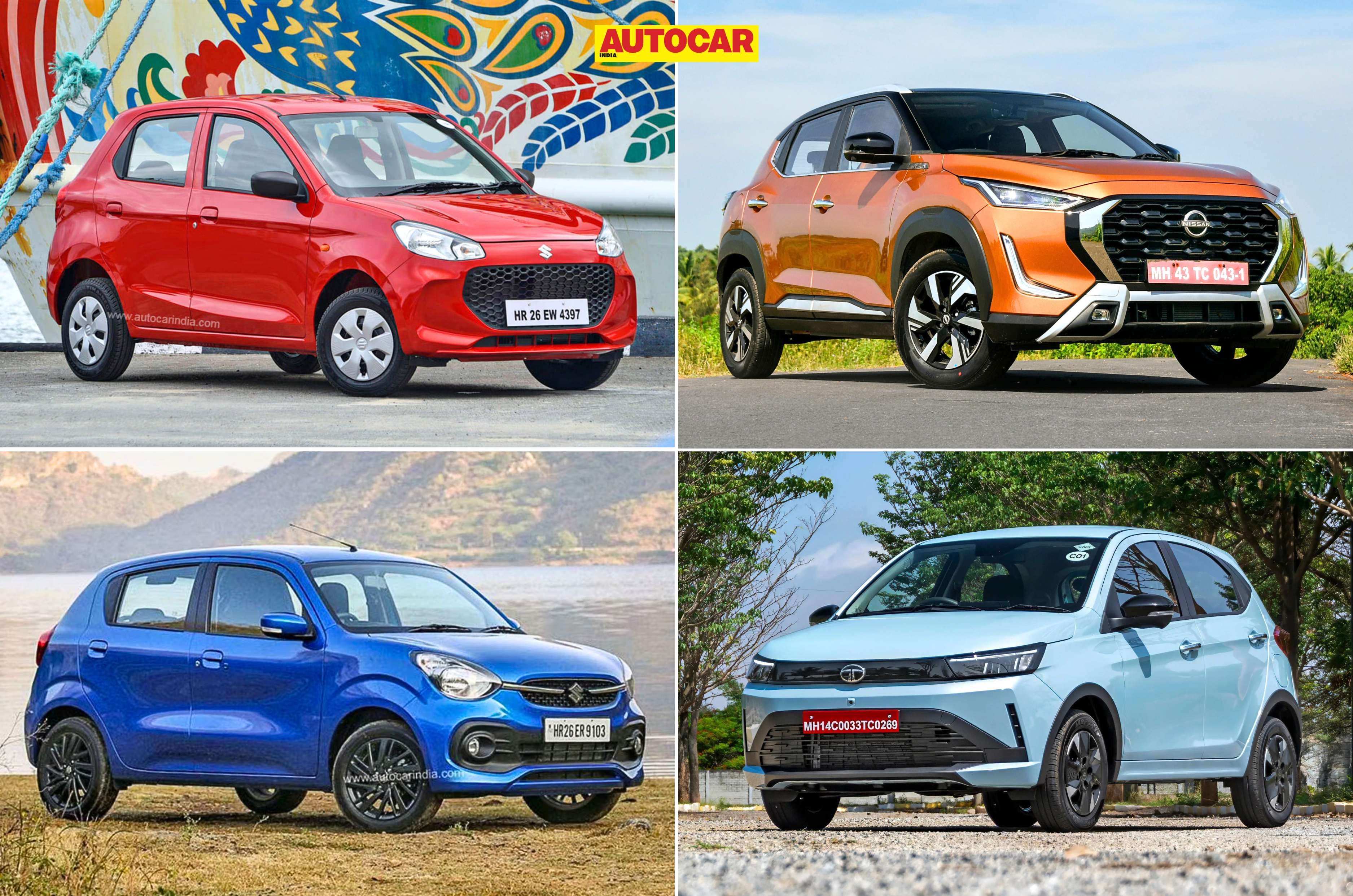
With traffic on our roads getting denser by the day, driving a manual car in the city can often feel like a chore. That is where automatic gearboxes help, and among the top 10 most affordable cars, AMT is the most popular, though some offer a CVT option too. Petrol is the dominant fuel type in this list, with some cars even pairing an automatic transmission with a CNG powertrain. Read on to find out which models made the cut.
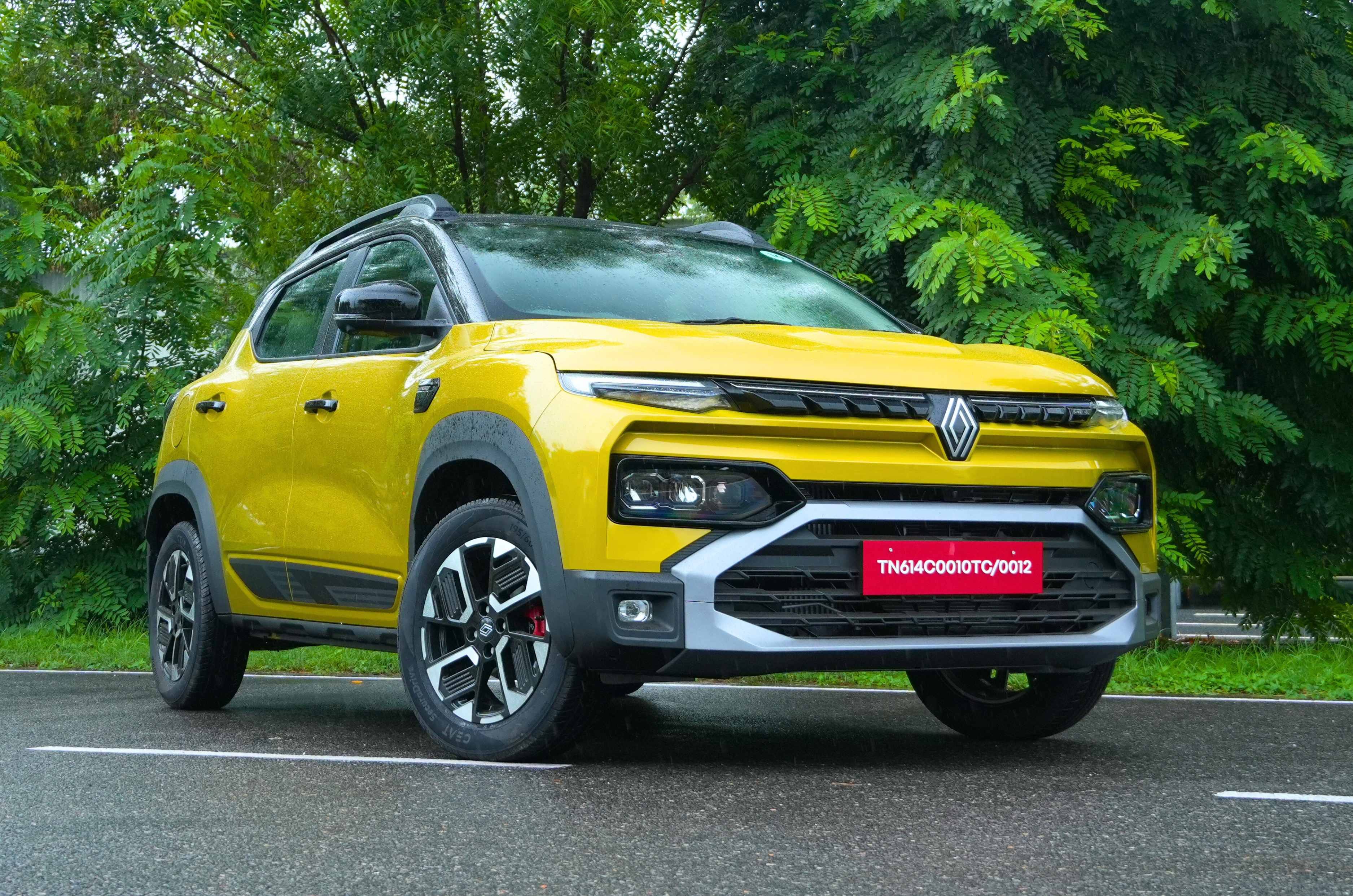
10. Renault Kiger
Rs 6.99 lakh-10.35 lakh
Starting this list is the Renault Kiger, which offers an AMT option with its 72hp, 96Nm 1-litre naturally aspirated petrol engine. A turbo-petrol mill with CVT is also on offer, an engine-and-gearbox combination no other vehicle here provides apart from the Nissan Magnite. Also, this powertrain’s peak output figures are 100hp and 152Nm are the highest here. The Renault Kiger’s NA petrol-AMT option is available in the Evolution, Evolution+ and Techno Energy trims, while the turbo-petrol CVT is offered in the Techno Turbo and Emotion Turbo trims.
During our time with the turbo-petrol CVT, we experienced very little of that ‘rubberband’ effect, and it’s virtually absent at city speeds. It even does a good job of staying in the power band.
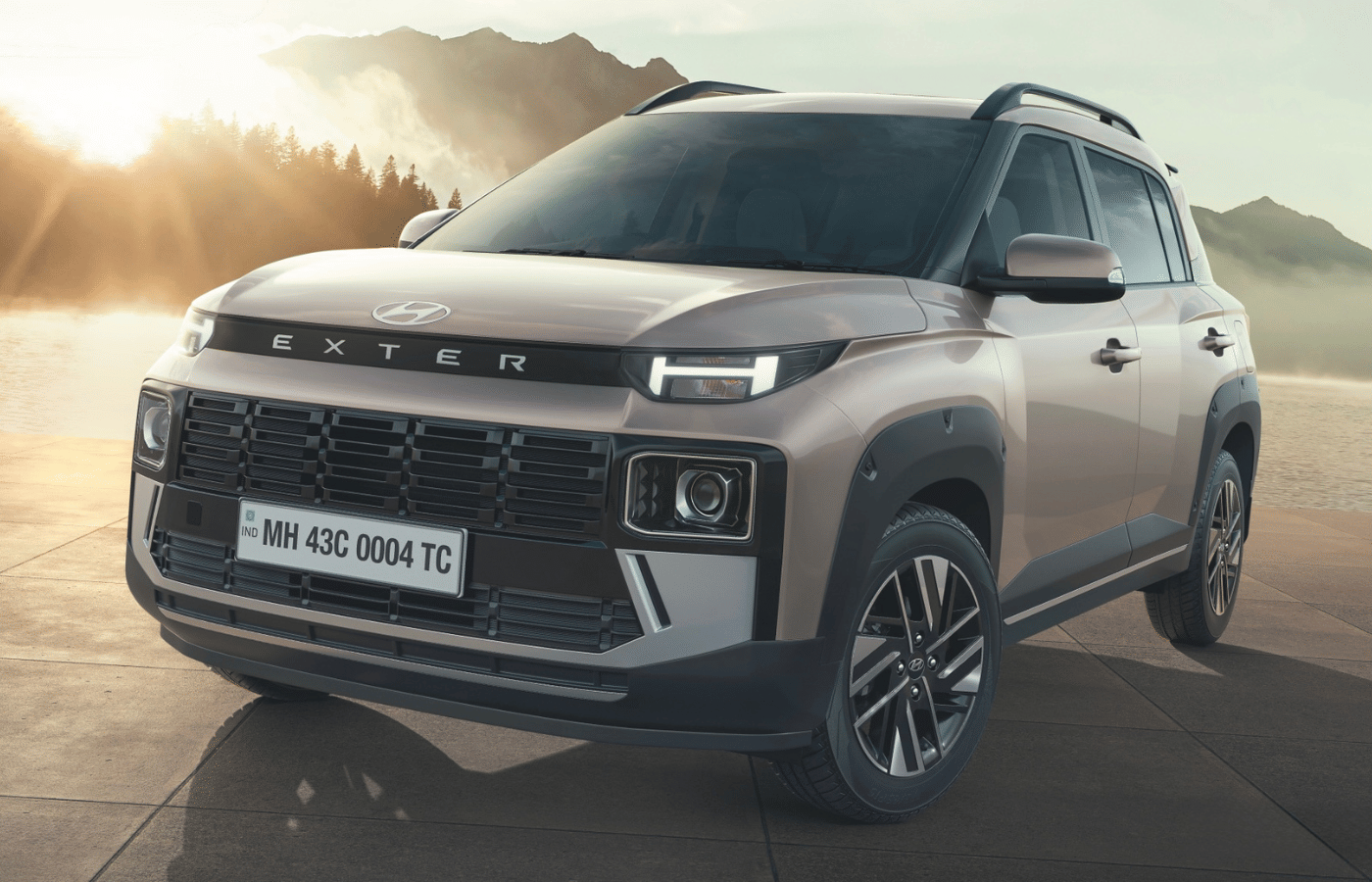
9. Hyundai Exter
Rs 6.95 lakh-9.61 lakh
Moving down the price ladder, we have the Hyundai Exter at the ninth place and its 1.2-litre NA petrol mill paired with an AMT makes 83hp and 114Nm. AMT is offered in the HX 3, HX 4+, HX 6, HX 8 and HX 10 trims. The sub-compact SUV received a facelift in March 2026, which brought cosmetic updates and a few feature upgrades but no mechanical changes. As a result, the Exter AMT should feel fairly smooth in regular driving. It also gets paddle shifters.
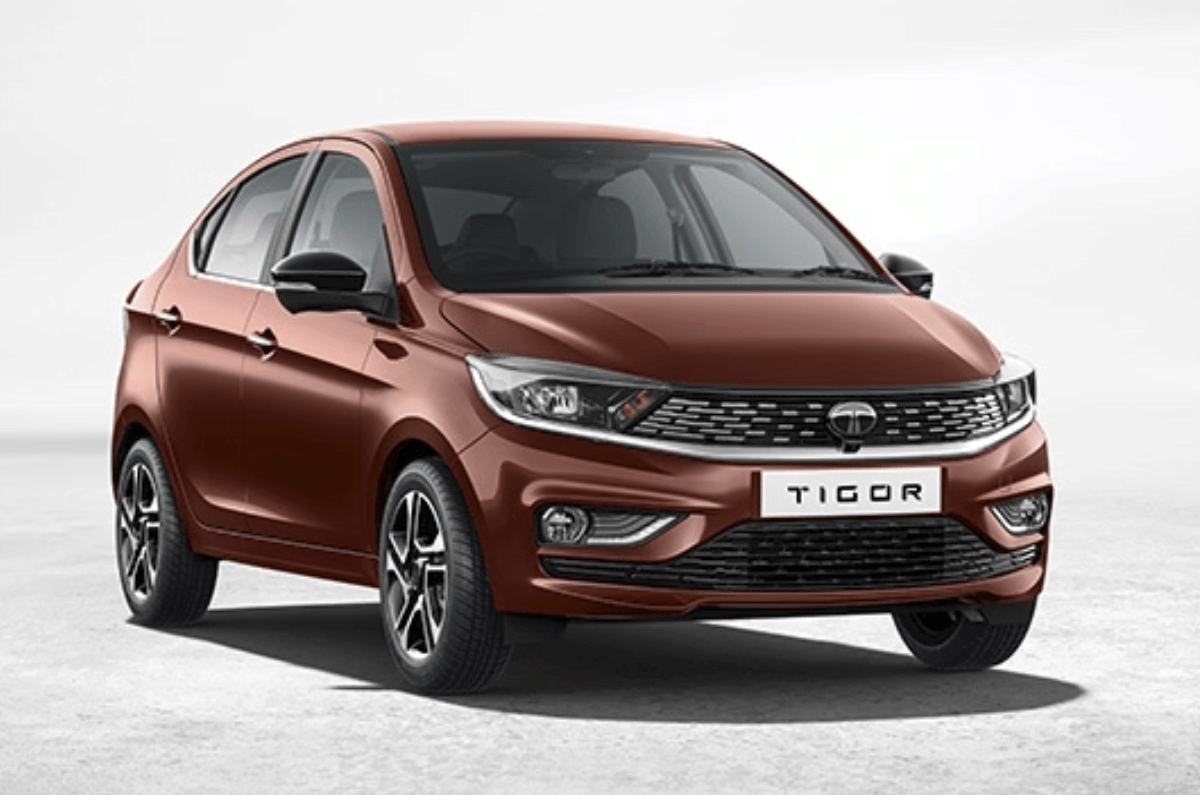
8. Tata Tigor
Rs 6.8 lakh-8.84 lakh
The Tata Tigor stands apart as the only sedan on this list. An AMT option with a CNG powertrain is also something only the Tigor and the Tiago offer. The Tigor petrol-AMT uses a 1.2-litre NA engine, generating 86hp and 113Nm, whereas in CNG mode, it makes 76hp and 97Nm. The AMT is offered in the XTA, XZA, XZA+ petrol trims and XZA CNG and XZA+ CNG trims.
Speaking of the engine, it feels adequate for everyday city driving and does a decent job of keeping up with the flow of traffic on the highway. It’s a capable commuter, although throttle responses could be sharper. Notably, in the Tigor CNG, the sedan starts in CNG mode by default, saving that extra bit of petrol, and the CNG-AMT version comes with the carmaker’s space-efficient dual-cylinder tank setup that limits the impact on boot space.
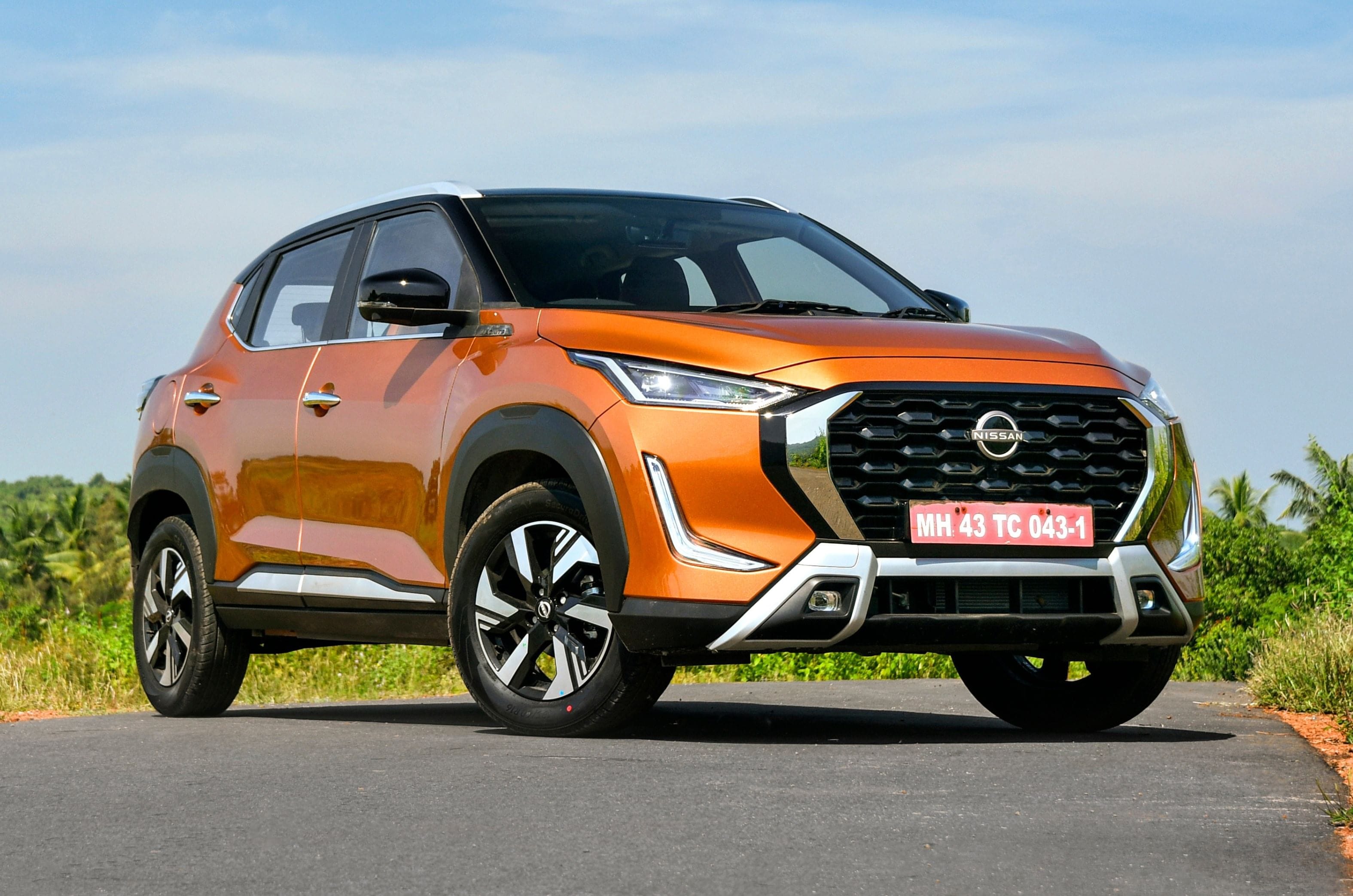
7. Nissan Magnite
Rs 6.24 lakh-10.96 lakh
The Nissan Magnite is a badge-engineered sibling of the Renault Kiger, offering the same 72hp 1-litre NA-AMT and 100hp turbo-petrol CVT powertrains. The AMT is available with the Visia, Acenta, N-Connecta, Tekna and Tekna+ trims, while the CVT is offered with turbo-petrol versions of these variants, save for Visia. We have sampled the turbo-petrol engine, which has a strong mid-range punch and works well with the smooth CVT to mask any lag at lower revs.
6. Tata Tiago
Rs 6 lakh-8.55 lakh
Like the Tigor, the Tata Tiago is available with 86hp petrol and 76hp petrol-CNG (dual-cylinder tank setup) options, both paired with an AMT. The AMT is offered with the Pure, Pure+, Pure+ A and Creative petrol and CNG trims. The Creative+ also offers an AMT choice, but only with the petrol engine. Tata gave the Tiago a major update in May 2026, although the changes were largely limited to styling revisions and feature additions. While reviewing the hatchback, we found that the engine is not particularly refined. For everyday commuting in heavy city traffic, performance is adequate.
5. Maruti Wagon R
Rs 5.97 lakh-6.84 lakh
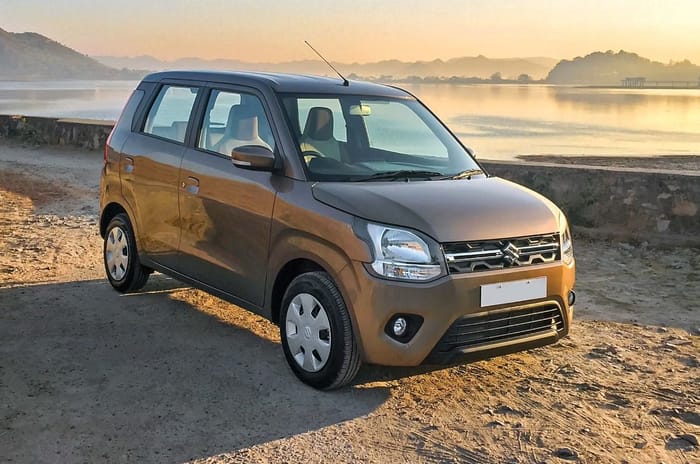
One of India’s bestselling cars, the Maruti Wagon R offers an AMT with two naturally aspirated petrol engines: a 69hp, 91Nm 1-litre unit and a 91hp, 114Nm 1.2-litre unit. The Wagon R offers an AMT with the 1.0 VXI, 1.2 ZXI and 1.2 ZXI+. Both engines have been around for years and have proven to be both reliable and efficient. On this list alone, the 69hp NA petrol-AMT combination is offered in three other Maruti cars, including the Celerio, Alto K10 and S-Presso. While real-world performance varies by engine, the Wagon R comes with Maruti Suzuki’s reputation for hassle-free ownership and low running costs.
4. Maruti Celerio
Rs 5.61 lakh-6.73 lakh
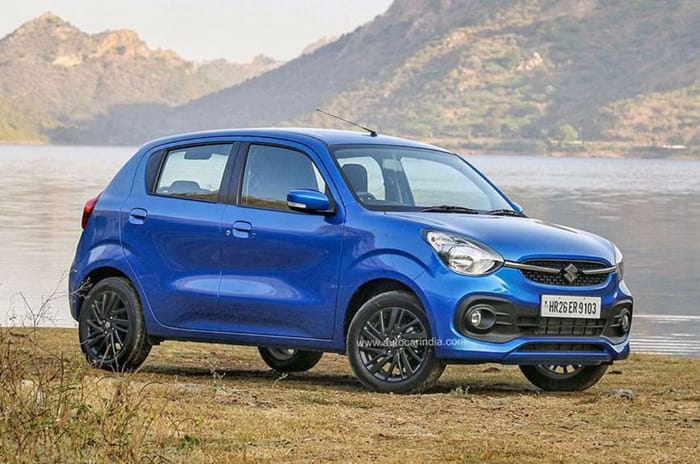
Compared to the Wagon R’s tall-boy hatchback design, the Maruti Celerio opts for a more traditional look. The AMT is available with the VXI, ZXI and ZXI+ trims. For those unaware, the first-generation Celerio debuted AMT in India in 2014. The Celerio AMT is a good option for buyers who want the convenience of an automatic without spending too much. Gearshifts are generally timely, and the typical AMT pause or head-nod between shifts is well controlled, making it easy to drive in everyday conditions.
3. Maruti Alto K10
Rs 4.95 lakh-5.45 lakh
Like the Wagon R, the Maruti Alto K10 is another long-running nameplate from the carmaker. The AMT is offered with the VXI (O) and VXI+ (O) trims. Compared with the manual, the AMT-equipped Alto K10 feels a bit slower. Even so, it is smooth for a single-clutch automated manual and shows how much Maruti has improved this technology over the years. It responds well to kickdown, but overtaking on the highway needs a bit more planning. In city traffic, though, the AMT works very well.
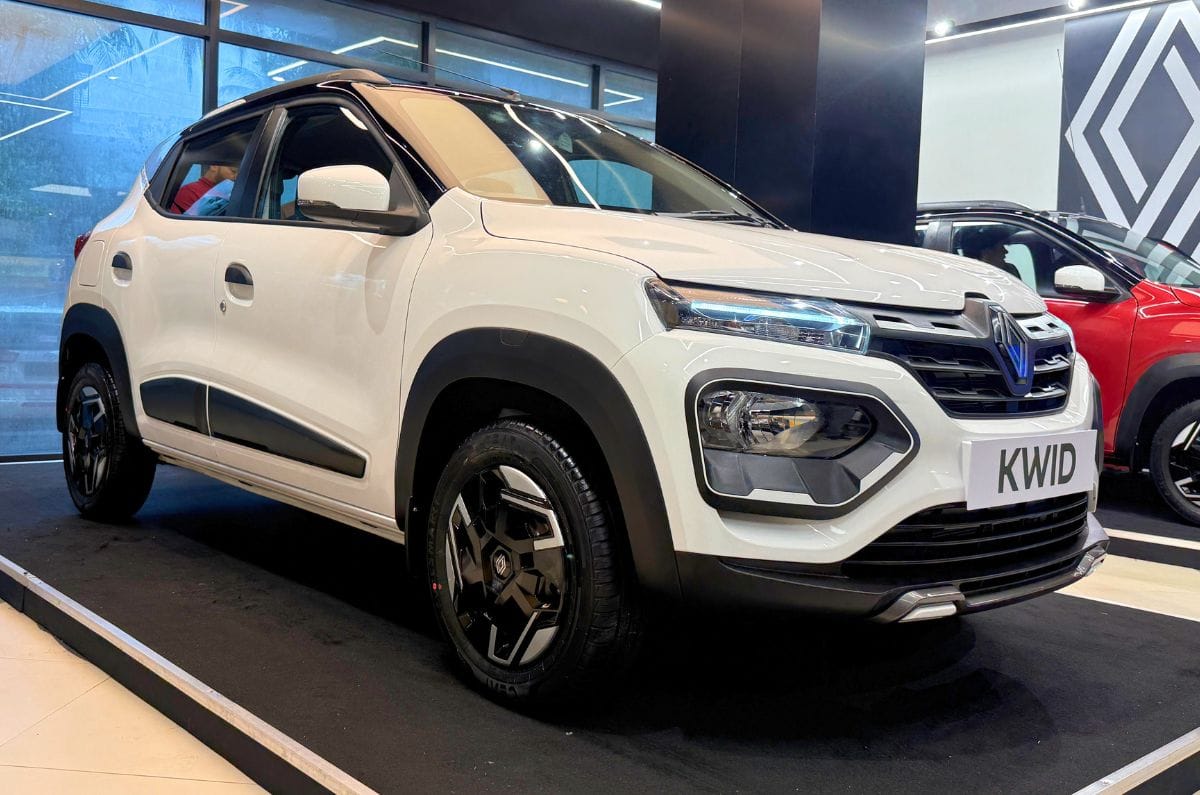
2. Renault Kwid
Rs 4.90 lakh-5.61 lakh
The Renault Kwid is the French carmaker’s second model to feature on this list. Under the hood, the Kwid gets a 1-litre NA petrol engine that makes 69hp and 93Nm. The AMT is available on both Evolution and Climber trims. The engine has been tuned to deliver good power delivery, and it ambles along smoothly with just a light tap on the accelerator. But it does get gruff as the revs rise.
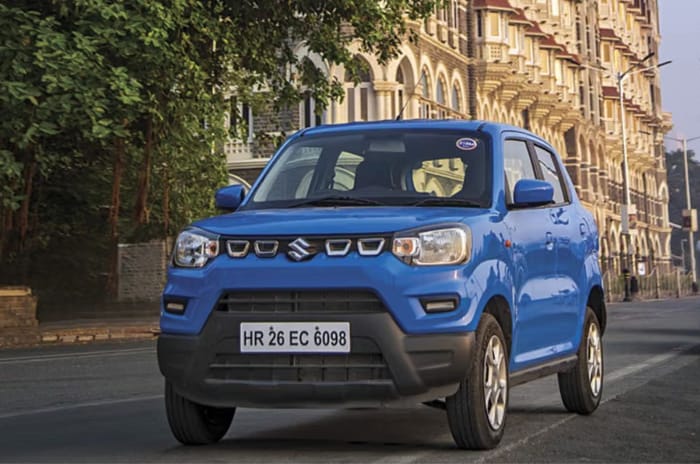
1. Maruti S-Presso
Rs 4.75 lakh-5.25 lakh
At number one is the Maruti S-Presso, currently the most affordable car in India to offer an automatic gearbox. The AMT is offered with the VXI (O) and VXI+ (O) trims. It is aimed at buyers looking for a budget-friendly automatic with low running and maintenance costs. However, even in its top-spec form, it misses out on several features, particularly on the safety front. Hence, spending a little more and getting the Alto K10 will be the more sensible and practical choice.
Ex-showroom prices mentioned above are as of July 7, 2026.
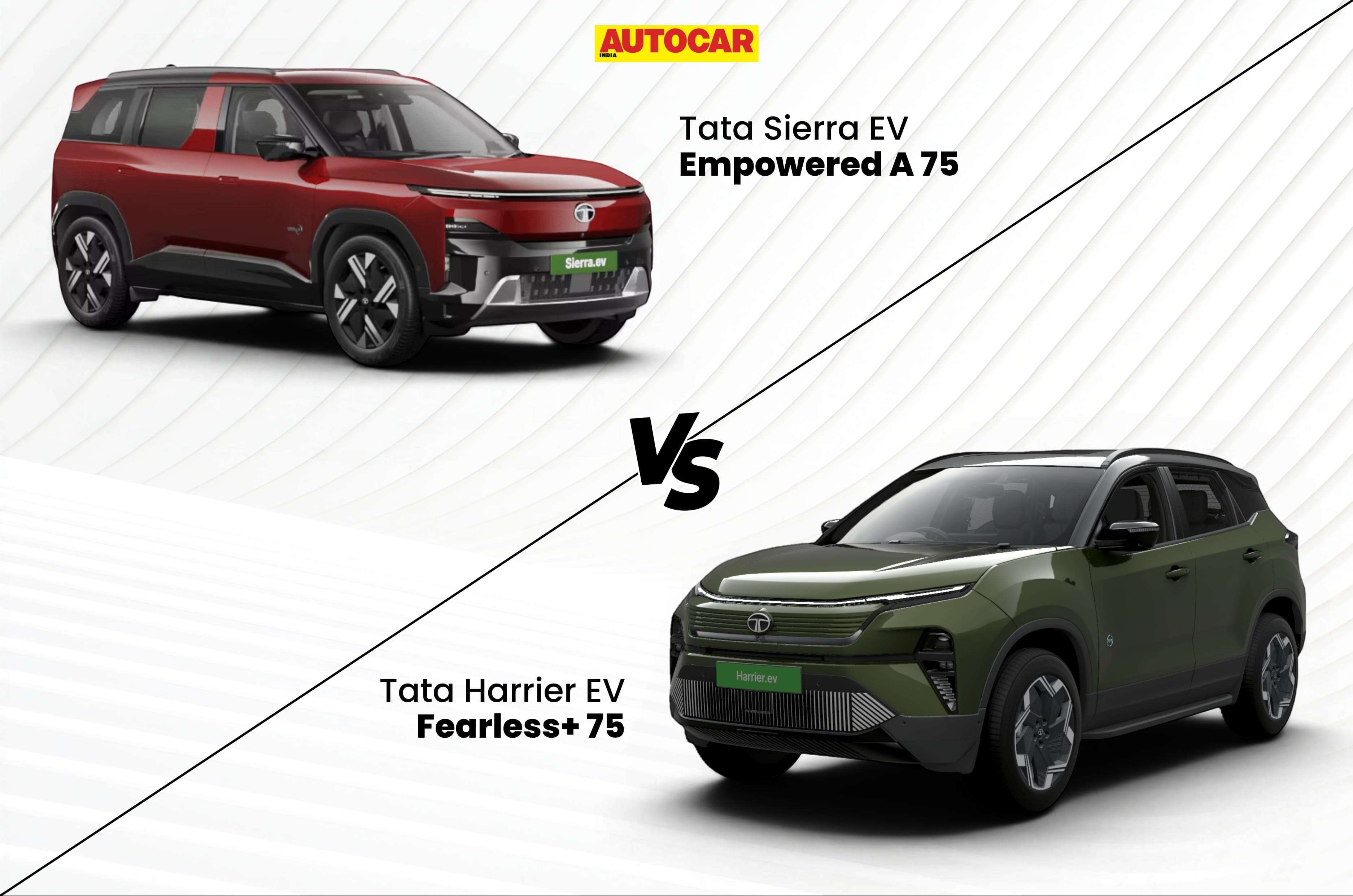
The recently launched Tata Sierra EV is positioned right below its larger sibling, the Harrier EV. However, there’s quite a lot of pricing overlap between the two Tata electric SUVs. To that end, we’ve compared the top-spec Sierra EV Empowered A 75 to the mid-spec Harrier EV Fearless+ 75 to find out which variant delivers better value on paper.
Tata Sierra EV top-spec vs Harrier EV mid-spec: Dimensions
Harrier EV is longer and wider, but Sierra EV is taller and offers greater boot space
Tata Sierra EV Empowered A 75 vs Harrier EV Fearless+ 75 dimensions
Sierra EV
Harrier EV
Length (mm)
4,340
4,607
Width (mm)
1,841
1,922
Height (mm)
1,750
1,740
Wheelbase (mm)
2,730
2,741
Boot space (litres)
622
502
Frunk space (litres)
55 (RWD) / 35 (AWD)
67 (RWD) / 35 (AWD)
Wheel size (inches)
19
19
Expectedly, the Harrier EV is 267mm longer than the Sierra EV, but there’s only an 11mm difference between their wheelbases, suggesting that the smaller SUV doesn’t lose out on much interior space. While the Harrier EV is 81mm wider than the Sierra EV, the latter is 10mm taller. Wheel sizes are matched at 19 inches for both electric SUVs.
Interestingly, the Sierra EV offers 120 litres of additional boot space over the Harrier EV – it’s worth nothing that both SUVs’ boot capacity is measured up until the roof, as opposed to the conventional method, which is up to the parcel tray. In terms of frunk capacity, the RWD Harrier EV offers the bigger one, while their AWD versions are matched in this regard.
Tata Sierra EV top-spec vs Harrier EV mid-spec: Battery and range
Harrier EV offers more power, Sierra EV is quicker and claims higher range figures
Tata Sierra EV Empowered A 75 vs Harrier EV Fearless+ 75 powertrains
Sierra EV
Harrier EV
Battery size (kWh)
75
75
Motor setup
Single, rear / Dual, front and rear
Single, rear / Dual, front and rear
Power (hp)
209 / 306
238 / 313
Torque (Nm)
315 / 504
315 / 504
Drive layout
RWD / AWD
RWD / AWD
Claimed 0-100kph time (seconds)
5.8 (AWD)
6.3 (AWD)
MIDC range (km)
665 / 624
627 / 622
Both the Sierra EV and Harrier EV get 75kWh battery packs, along with single-motor (RWD) and dual-motor (AWD) options. The Harrier EV edges ahead in terms of powertrain output, though the RWD versions of both SUVs feature identical torque figures. Despite the Sierra EV’s slightly lower output, its AWD variant is half a second quicker in the 0-100kph run compared to that of the Harrier EV – this is on account of the Sierra EV being smaller and lighter.
Similarly, MIDC-claimed range is a total victory for the Sierra EV as well. The Sierra EV AWD’s claimed range is 2km higher than that of the Harrier EV AWD, while the RWD version can travel 38km more on a single charge.
Tata Sierra EV top-spec vs Harrier EV mid-spec: Charging times
Both electric SUVs trade punches here
Tata Sierra EV Empowered A 75 vs Harrier EV Fearless+ 75 charging times and warranty details
Sierra EV
Harrier EV
AC charging time (10-100 percent)
10.5hrs (7.2kW)
10.7hrs (7.2kW)
DC charging time (20-80 percent)
26mins (120kW)
25mins (120kW)
Battery warranty
Lifetime warranty and unlimited kilometres
Lifetime warranty and unlimited kilometres
Motor warranty
8 years/1,60,000km (whichever is earlier)
8 years/1,60,000km (whichever is earlier)
Vehicle warranty
3 years/1,25,000km (whichever is earlier)
3 years/1,25,000km (whichever is earlier)
Despite battery capacities being identical for both electric SUVs, the Harrier EV takes slightly longer to charge from 10-100 percent via a 7.2kW AC outlet. On the other hand, the Harrier EV is marginally quicker in a 20-80 percent top-up from a 120kW DC fast charger. Tata offers the same battery, motor, and vehicle warranties for the Harrier EV and Sierra EV, so buyers can rest easy on this front.
Tata Sierra EV top-spec vs Harrier EV mid-spec: Exterior features
Harrier EV additionally offers side step and charging indicator function for the front light bar
Tata Sierra EV Empowered A 75 vs Harrier EV Fearless+ 75 exterior features
Sierra EV
Harrier EV
Headlamps
Automatic LED
Automatic LED
Front light bar
LED
LED
Welcome/goodbye sequence
Yes
Yes
Charging indicator in light bar
No
Yes
Front fog lamps
LED
LED
Cornering lamps
Yes
Yes
Tail-lamps
LED
LED
Rear fog lamps
Yes
Yes
Sequential indicators
Yes
Yes
Side step
No
Yes
Electrically adjustable ORVMs with auto-fold
Yes
Yes
Rear spoiler
Yes
Yes
Rear wiper and washer
Yes
Yes
Shark-fin antenna
Yes
Yes
Roof rails
Yes
Yes
Puddle lamps
Yes
Yes
Coming to exterior features, the Sierra EV and Harrier EV are near-identical. However, the Sierra EV does miss out on a charging indicator in the front light bar, with it instead being situated on the charging port. The Harrier EV additionally offers a side step too, which makes ingress and egress a tad easier.
Tata Sierra EV top-spec vs Harrier EV mid-spec: Interior features
Sierra EV is the only Tata electric car to offer a triple-screen setup
Tata Sierra EV Empowered A 75 vs Harrier EV Fearless+ 75 interior features
Sierra EV
Harrier EV
Touchscreen
12.3 inches
12.3 inches
Digital driver’s display
10.25 inches
10.25 inches
Passenger display
12.3 inches
No
Heads-up display
Yes
No
Automatic climate control
Dual-zone
Dual-zone
Steering-mounted controls
Yes
Yes
Ambient lights
Yes
Yes
Panoramic sunroof
Yes
Yes
Powered driver seat
6-way adjustment
6-way adjustment
Driver seat functions
Memory and welcome
Memory and welcome
Powered co-driver seat
4-way adjustment
4-way adjustment
Ventilated front seats
Yes
Yes
Boss mode
Yes
No
Sound system
12-speaker JBL Black
10-speaker JBL Black
Wireless charging pad
Yes
Yes
Cabin air purifier
Yes
Yes
Powered windows
Front and rear
Front and rear
Rear sunshade
Yes
Yes
Rear AC vents
Yes
Yes
Rear centre armrest
Yes
Yes
Connected car tech
Yes
Yes
V2L, V2V functionality
Yes
Yes
Despite its lower positioning, the Sierra EV pulls a clear lead over the Harrier EV in terms of cabin equipment. Features like a 12.3-inch passenger display, a 12-speaker JBL sound system, and a heads-up display are not offered even on the top-spec Harrier variant. In fact, the Sierra EV is the only electric Tata to come with a triple-screen setup at the moment.
Tata Sierra EV top-spec vs Harrier EV mid-spec: Driving features
Sierra EV comes with extra terrain mode and adaptive cruise control
Tata Sierra EV Empowered A 75 vs Harrier EV Fearless+ 75 driving features
Sierra EV
Harrier EV
Drive modes
Eco, City, Sport
Eco, City, Sport
Battery regen modes
Yes
Yes
Terrain modes
Normal, Wet, Rough, Custom
Normal, Wet, Rough
Cruise control
Adaptive with stop/go functions
Yes
Drift mode
Yes
Yes
Boost mode
AWD only
AWD only
Low-speed cruise control
AWD only
AWD only
Extra terrain modes (AWD only)
Yes
Yes
Both the top-spec Sierra EV and mid-spec Harrier EV are very similar on the driving features front. However, the Sierra EV gets an additional ‘Custom’ terrain mode in the RWD version, as well as adaptive cruise control with stop and go functionality. The latter is much more convenient than the Harrier EV’s standard cruise control, as it can automatically adjust the speed based on proximity to nearby vehicles, and even come to a standstill and set off by itself. AWD versions of both SUVs get additional terrain modes too, namely Snow/Grass, Mud-Ruts, Sand, Rock Crawl, and Custom.
Tata Sierra EV top-spec vs Harrier EV mid-spec: Safety features
Harrier EV has 7 airbags and 5-star BNCAP rating, Sierra EV gets Level 2 ADAS and better camera setup
Tata Sierra EV Empowered A 75 vs Harrier EV Fearless+ 75 safety features
Sierra EV
Harrier EV
Bharat NCAP rating
Yet to be tested
5 stars
Airbags
6
7
Level 2 ADAS
Yes
No
Camera setup
540-degree
Rear only
Parking sensors
Front and rear
Front and rear
Disc brakes
Front and rear
Front and rear
ABS with EBD
Yes
Yes
Electronic stability program (ESP)
Yes
Yes
TPMS
Yes
Yes
Electronic parking brake with auto-hold
Yes
Yes
Auto-dimming IRVM
Yes
Yes
Rain-sensing wipers
Yes
Yes
Rear defogger
Yes
Yes
Driver drowsiness detection
No
Yes
Acoustic vehicle alarm system (AVAS)
Yes
Yes
In the safety department, the Harrier EV holds some notable advantages, specifically a 5-star Bharat NCAP rating (the Sierra EV is yet to be tested, but will likely perform well too), 7 airbags, and driver drowsiness detection. The Sierra EV, though, trades punches with the Harrier EV thanks to safety features like Level 2 ADAS and a 540-degree camera (360-degree with underfloor view).
Tata Sierra EV top-spec vs Harrier EV mid-spec: Prices and verdict
Sierra EV is up to Rs 70,000 cheaper
Tata Sierra EV Empowered A 75 vs Harrier EV Fearless+ 75 price* (Rs, lakh)
Sierra EV
Harrier EV
Difference
RWD
Rs 24.79 lakh
Rs 25.19 lakh
Rs 40,000
AWD
Rs 25.99 lakh
Rs 26.69 lakh
Rs 70,000
*Exclusive of home charger and installation, which costs Rs 49,000 extra.
The Sierra EV Empowered A 75 clearly emerges as the better option over the Harrier EV Fearless+ 75, as the smaller SUV offers considerably more comfort and convenience features, a larger boot, higher claimed range figures, similar powertrain outputs and charging speeds, and greater performance – all while being Rs 40,000-70,000 more affordable.
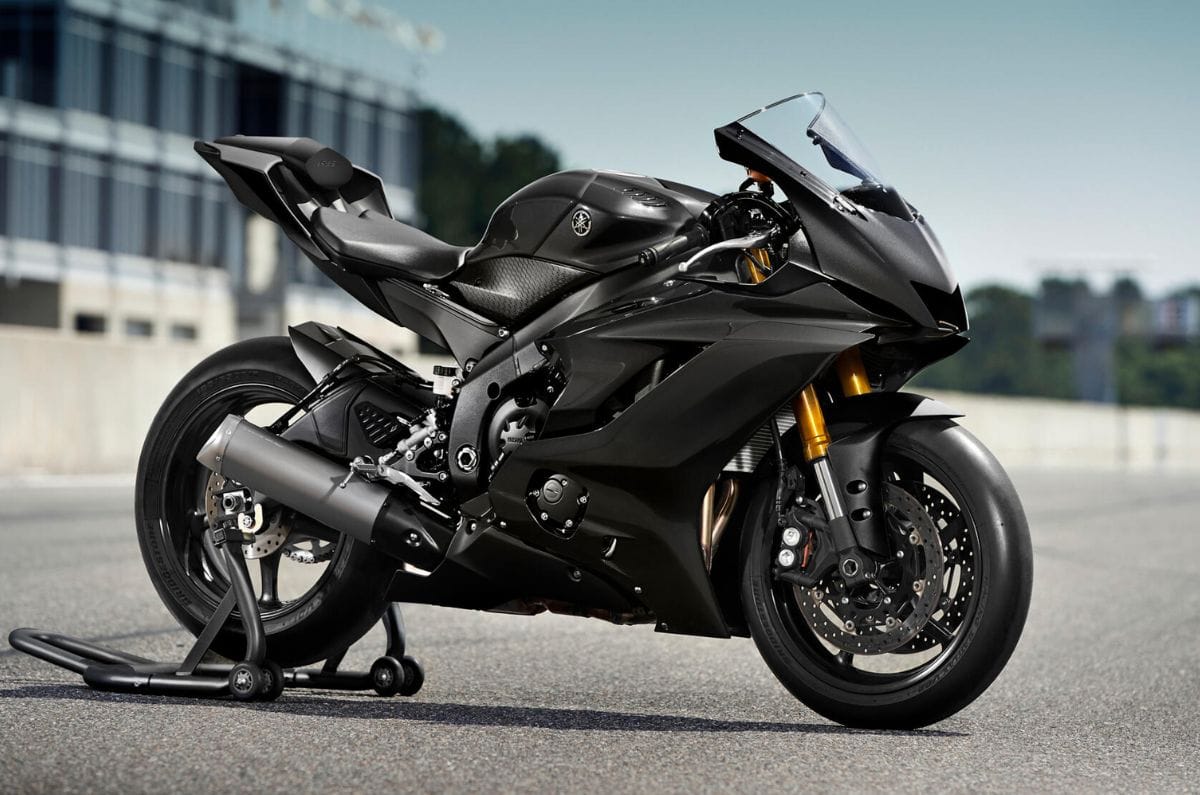
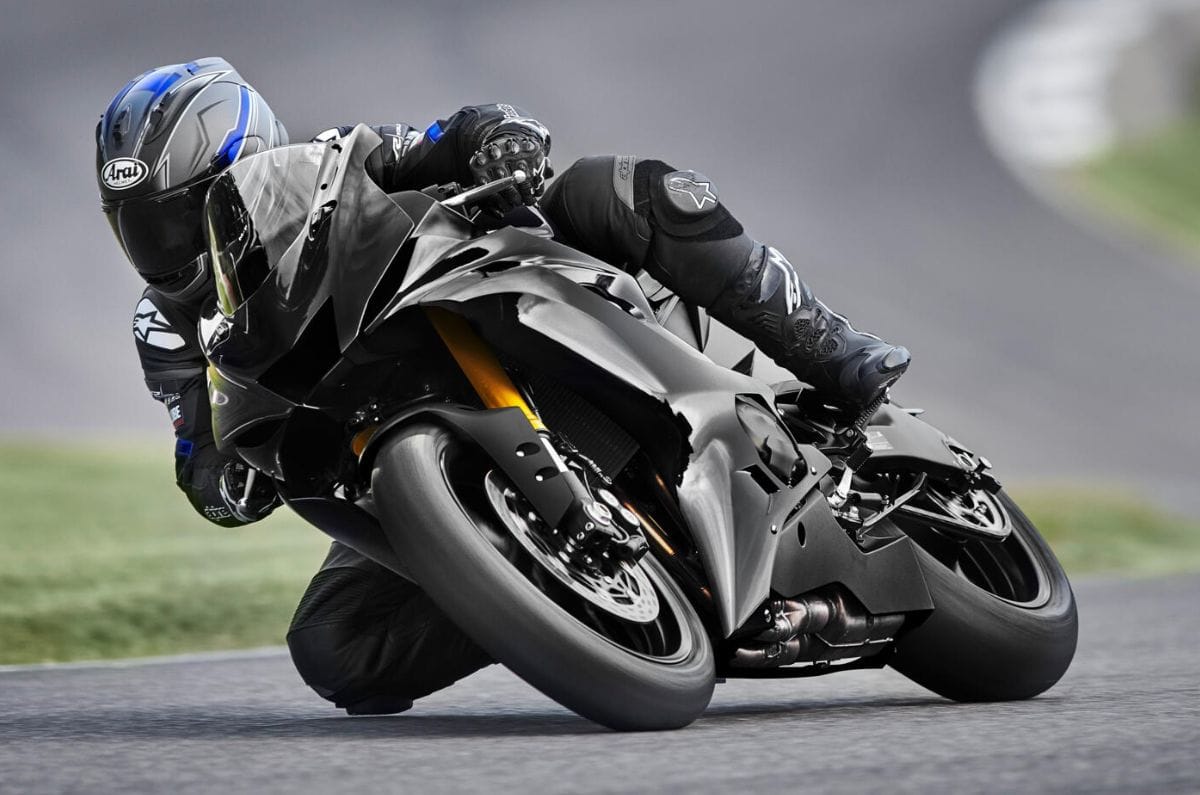
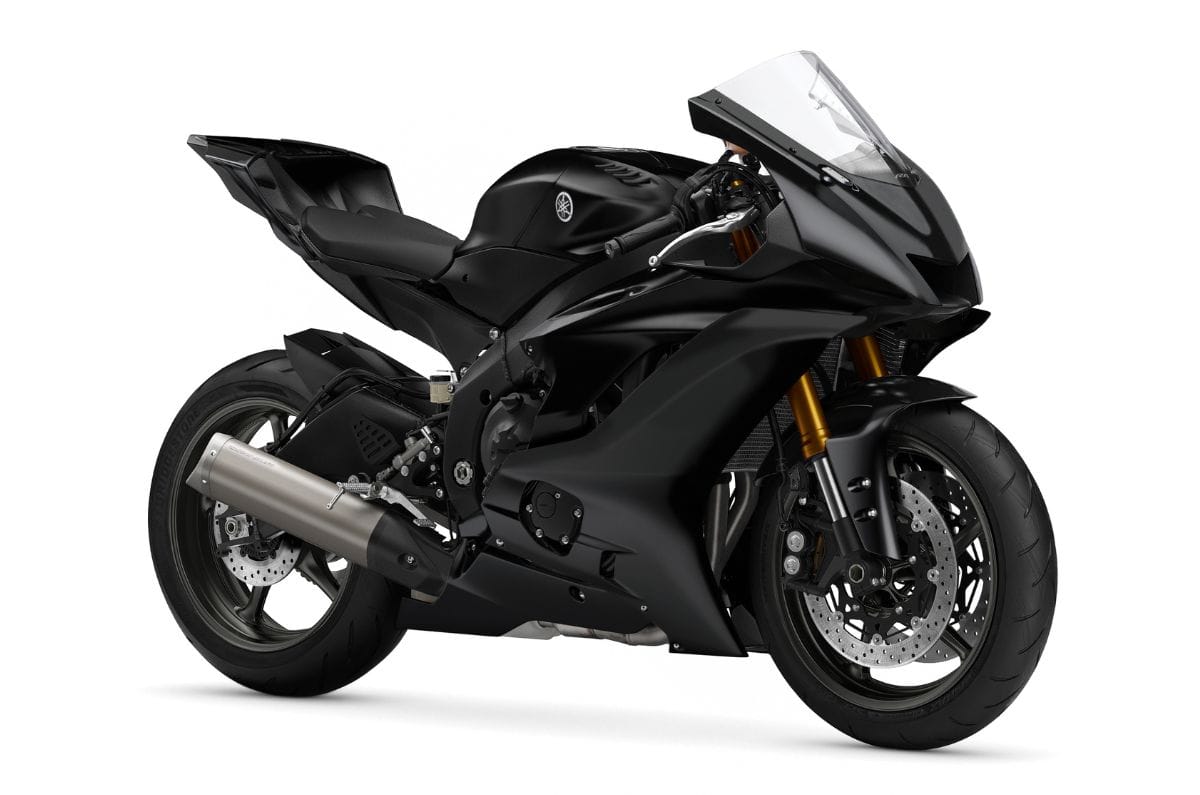
The Yamaha R6 has been around for 27 years, having debuted in 1999 and it has gone on to be one of the most iconic and recognizable sportbikes of all time. While it went off sale as a road bike in 2021 once the Euro 5 emission norms came in, it was still offered as a track only model for the last five years. However, Yamaha Japan has now announced that it will finally pull the plug on this middleweight icon.
The bike has been sold as a track-only version since 2021
The final units will be delivered in early 2027
According to a press release issued by Yamaha Japan, deliveries for a track only model called the “Yamaha R6 Race Base Model” will begin in February 2027. To secure one of these bikes, customers will have to reserve the bike in one of two purchase windows. The first opened on July 1 2026 and will close on 31 July 2026. A second reservation window will then open on 1 August 2026 before closing on the last day of the same month.
After these windows close, buyers in Japan will no longer be able to purchase the R6. As for customers in Europe and other select markets where the R6 Race is offered, the bike is likely to be available as long as stocks last.
The R6 Race Base Model has no road legal requirements like lights and number plates and it uses the same 599cc inline four cylinder engine as the road bike. The bike also features the same front suspension and braking set up from the bigger R1.
Sadly, Yamaha never launched the R6 in India, but enthusiasts have Kawasaki to thank for continuing to be the only Japanese manufacturer to sell a proper 600cc supersport in our market. The Kawasaki Ninja ZX-6R has survived the latest emissions regulations and continues to be available in India, currently priced at Rs 12.49 lakh (ex-showroom, India).
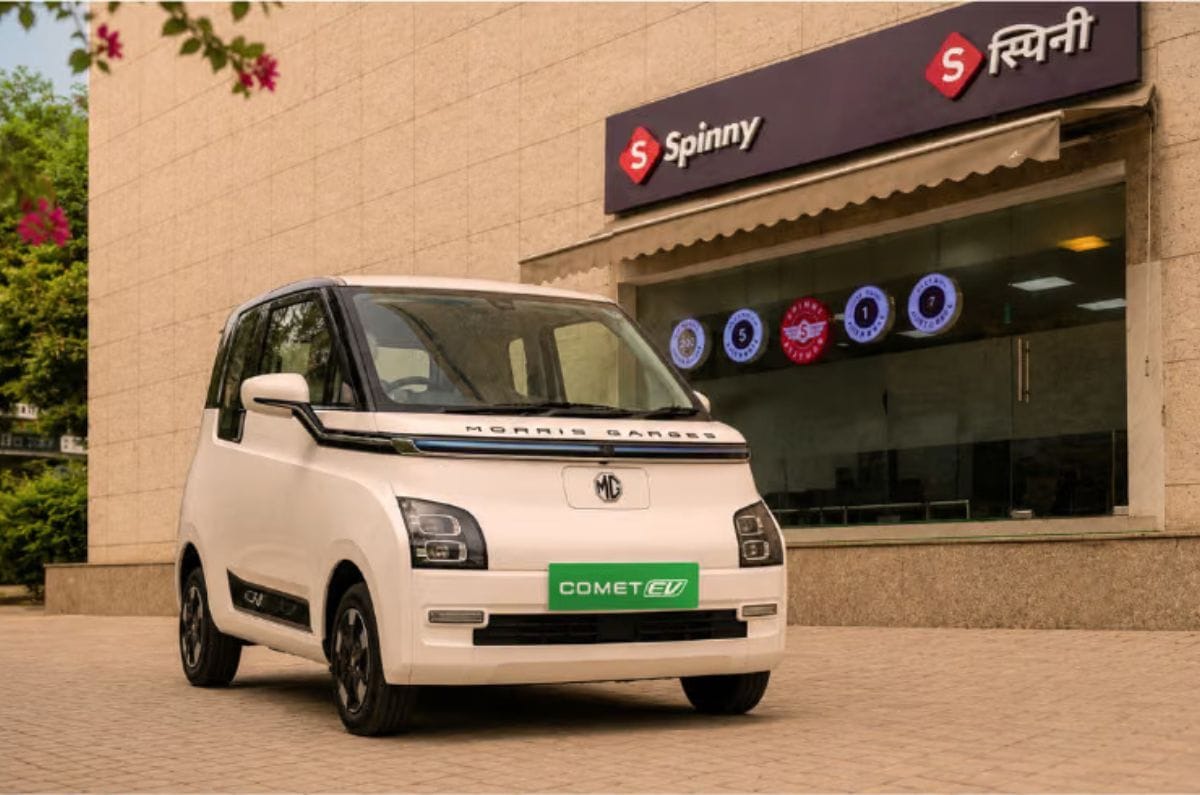
Used car platform Spinny has finalised a commercial partnership with JSW MG Motor India to establish a structured secondary market ecosystem for pre-owned electric vehicles (EVs). The collaboration is designed to counter common barriers in secondary EV transactions, particularly consumer uncertainty surrounding real-time battery degradation, residual valuation transparency, and long-term diagnostic verification.
What does the partnership entail?
Under the terms of the agreement, Spinny will introduce specialised EV evaluation protocols across its network, utilising technical inputs from JSW MG Motor India. The inspection framework focuses on standardised battery health assessment and certification processes intended to provide clearer valuation metrics for both buyers and sellers. The program will initially roll out across major urban centres, including Bengaluru, Chennai, Delhi NCR, Hyderabad, Kochi, Mumbai, Pune, Jaipur, Ahmedabad, Kolkata, Lucknow, Chandigarh, and Coimbatore.
The transaction pipeline allows consumers to list and purchase certified pre-owned MG electric models—such as the Comet EV, Windsor EV, and ZS EV—directly through Spinny’s digital platform and physical car hubs. Vehicles processed through this channel will feature a 200-point inspection check, OEM warranty continuity, fixed pricing assurance, and a five-day money-back window. The reconditioned units will undergo technical refurbishment at Spinny’s network of Integrated Restoration Centres, which are being upgraded with specialised EV diagnostic tooling and battery restoration workflows.
Vinay Raina, Chief Commercial Officer at JSW MG Motor India, stated that developing a reliable pre-owned framework is critical for the brand as it expands its new energy vehicle portfolio in the country. Niraj Singh, Founder and CEO of Spinny, noted that establishing structural transparency in battery diagnostics is essential to building secondary market transaction volume.
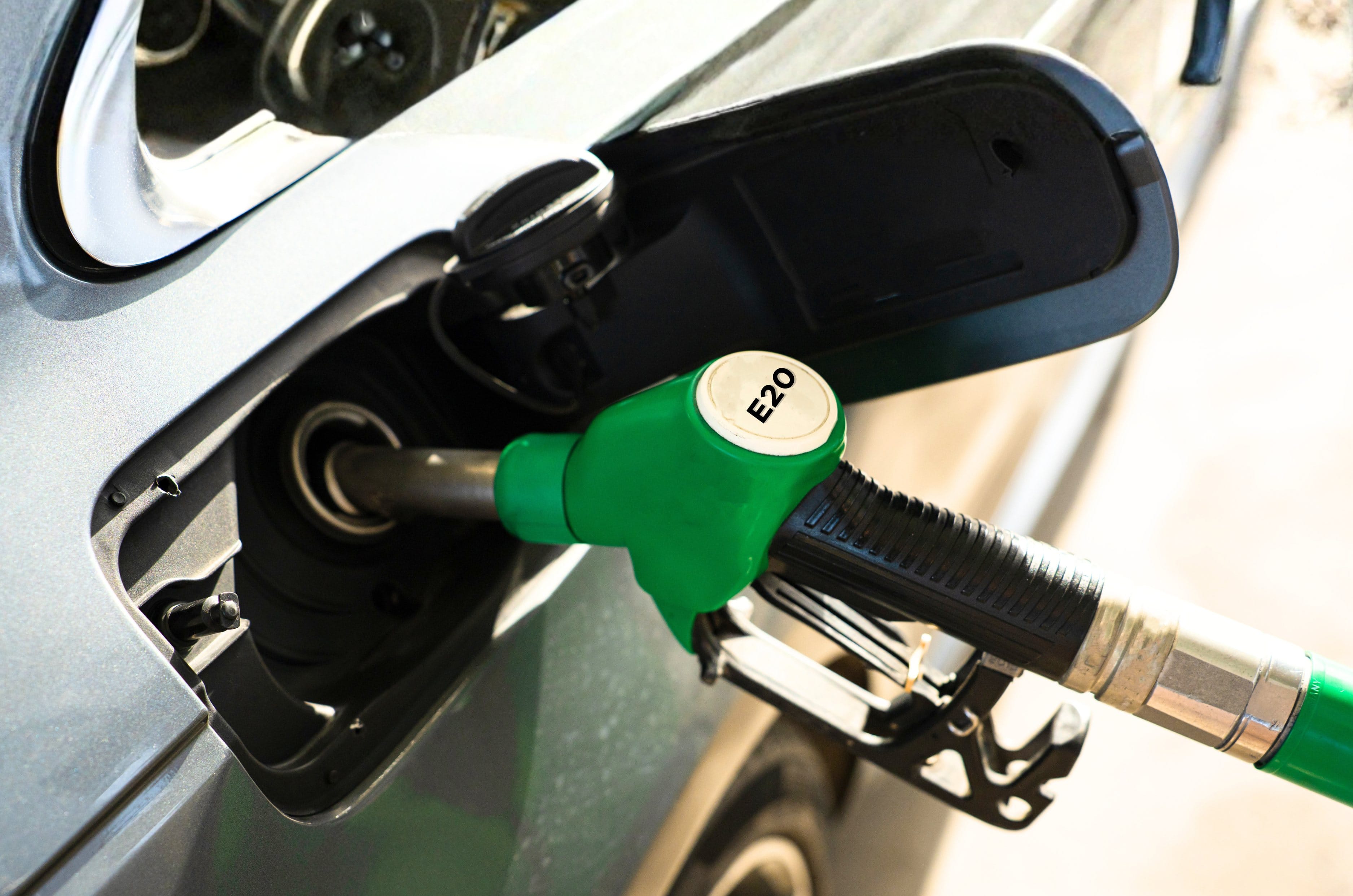
Amidst ongoing backlash and discontent surrounding E20 fuel, a resurfaced 2021 study conducted by ARAI highlights the impact of E20 on metals and non-metals used in fuel-system components. The study noted that while metals and metal coatings had no issue with E20, some plastic and rubber components did experience some deterioration over a prolonged period of time.
Citing the research study, a NITI Aayog report published in June 2026 stated, “Material compatibility tests revealed that the metals and metal coatings had no issue with E20. Elastomers (NBR/PVC blend and Epichlorohydrin) had inferior performance with E20 compared to neat gasoline. Plastic PA66 had a drop in tensile strength after use with E20. In the vehicle level studies, fuel economy decreased up to 6 percent (depending on the vehicle type) on an average basis.”
For the uninitiated, materials such as NBR/PVC blend, Epichlorohydrin and PA66 are used in fuel-system components such as gaskets, seals, O-rings, pipes and hoses.
The NITI Aayog report also noted, “The test vehicles passed startability and drivability tests at hot and cold conditions with E0 and E20 test fuels. In all the cases, there was no severe malfunction or stall observed at any stage of vehicle operation. No abnormal wear of engine components or deposits or deterioration of engine oils were observed after the on-road mileage accumulation trials.”
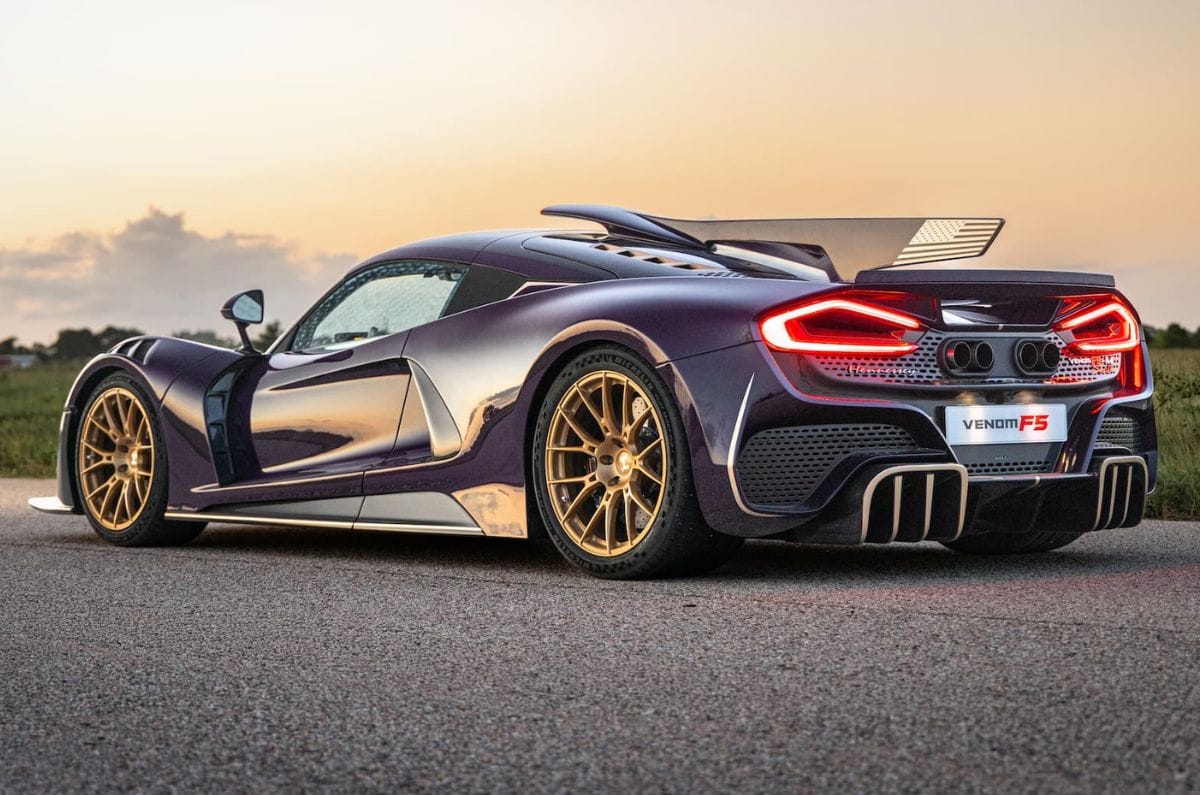
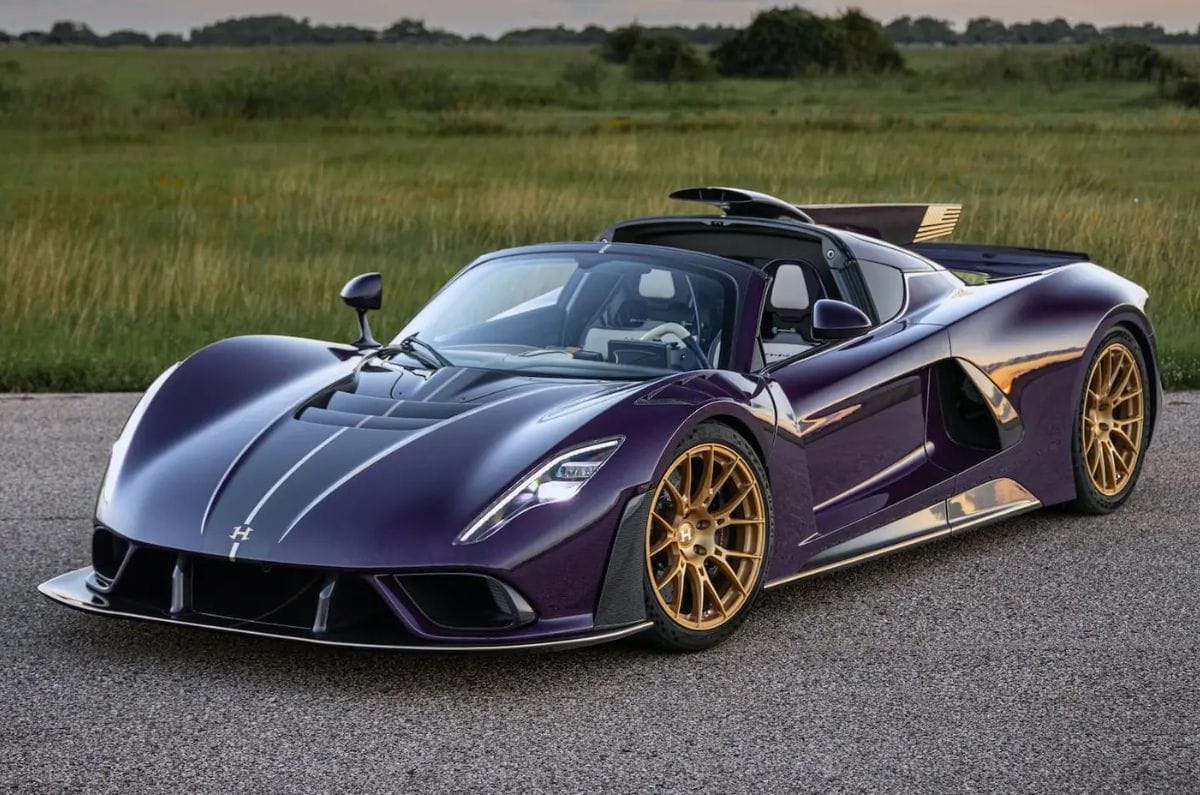
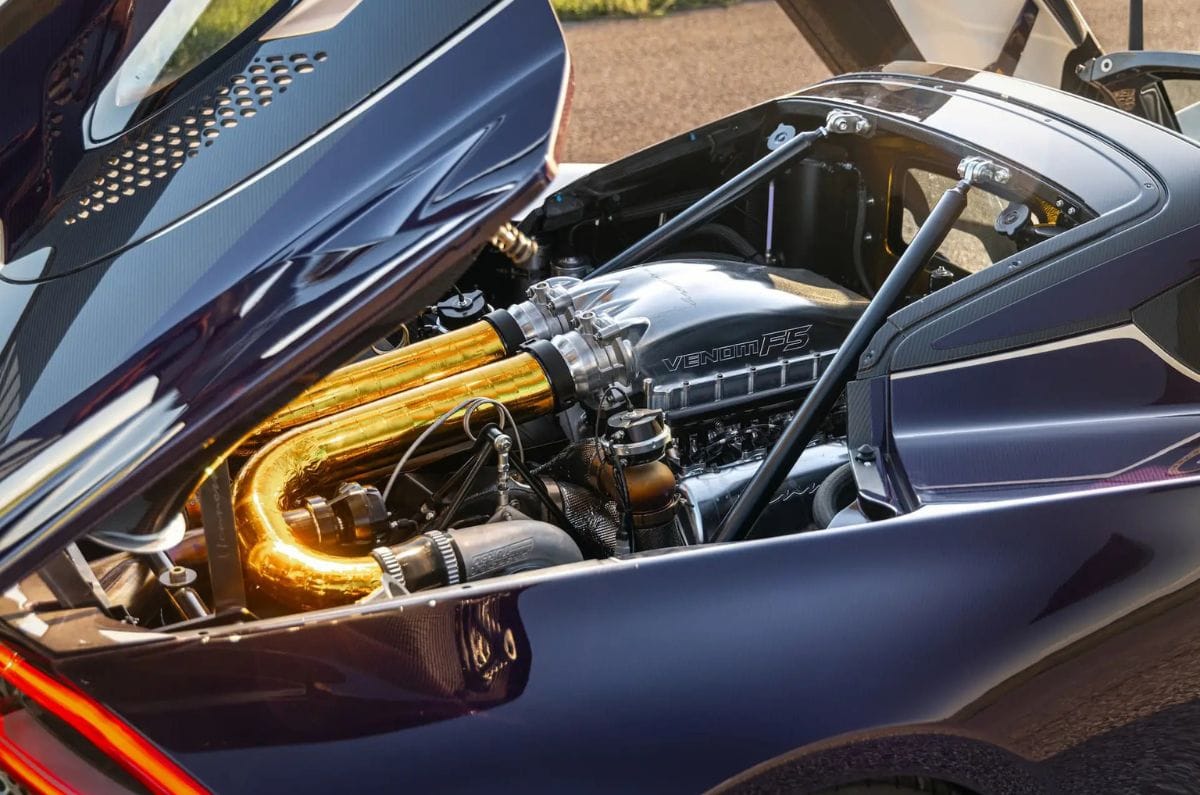
Hennessey will be debuting the Venom F5-M (manual) Roadster at the Goodwill Festival of Speed in the UK on July 9, 2026. During its four days at Goodwood, the Roadster will be driven by British Le Mans champion Alex Brundle. The open-top hypercar features a new 6-speed manual gearbox with a gated shifter, a new chassis, unique aerodynamics and a bespoke interior, according to the boutique Texas-based brand.
Bespoke bodywork sports a 55-inch dorsal fin and an integrated roof scoop
Uses an aluminum & carbon-fibre shifter, carbon bucket seats and a yoke-style steering
Power comes from a 6.6-litre twin-turbo V8
Hennessey Venom F5-M design and personalisation
The manual F5 features a couple of design features that are exclusive to it
While maintaining some of the general design cues from the Evolution series, the new Venom F5-M gets a few unique traits of its own. One of the most notable exterior features is a roof-mounted air intake scoop that sits right behind the removable roof. Then there’s the 55-inch (or 1.4-metre) long dorsal fin, which stretches from behind the scoop all the way to the aft-end of the F5. While the scoop serves cool air directly to the engine bay, the fin enhances aerodynamics at speeds beyond 320kph, as per Hennessey.
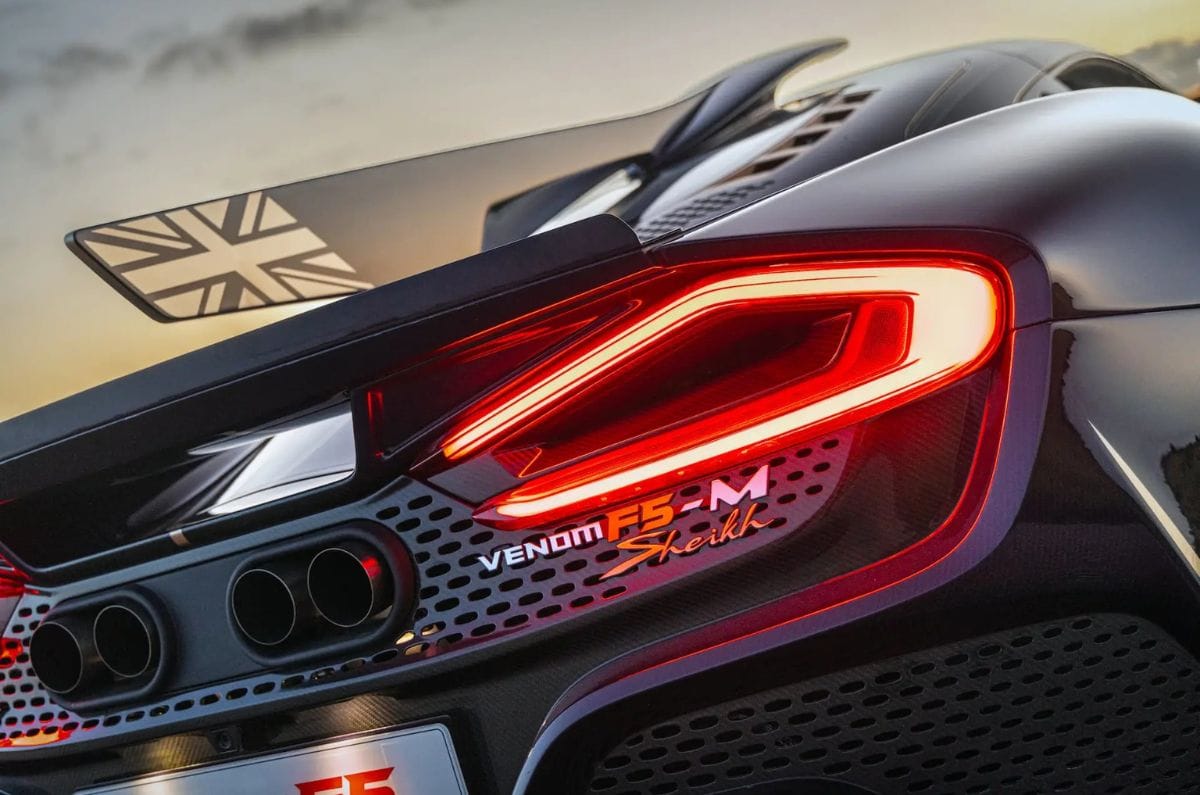
Customers of the manual Hennessey Venom F5 can provide inputs regarding personalisation options via the brand’s ‘Maverick’ division. The first customer commissioned their F5-M with hand-painted US and UK flags on either side of the fin finished in gold colour. The exterior of this UK car features exposed purple carbon fibre with anodised gold accents, a 24-karat gold ‘Hennessey’ badge on the nose, and ‘Sheikh’ lettering at the rear. This lettering is also found on the driver- and passenger-side knee pads. While the F5-M can be had with an aluminium & carbon-fibre shifter, this particular example has one made from billet aluminium.
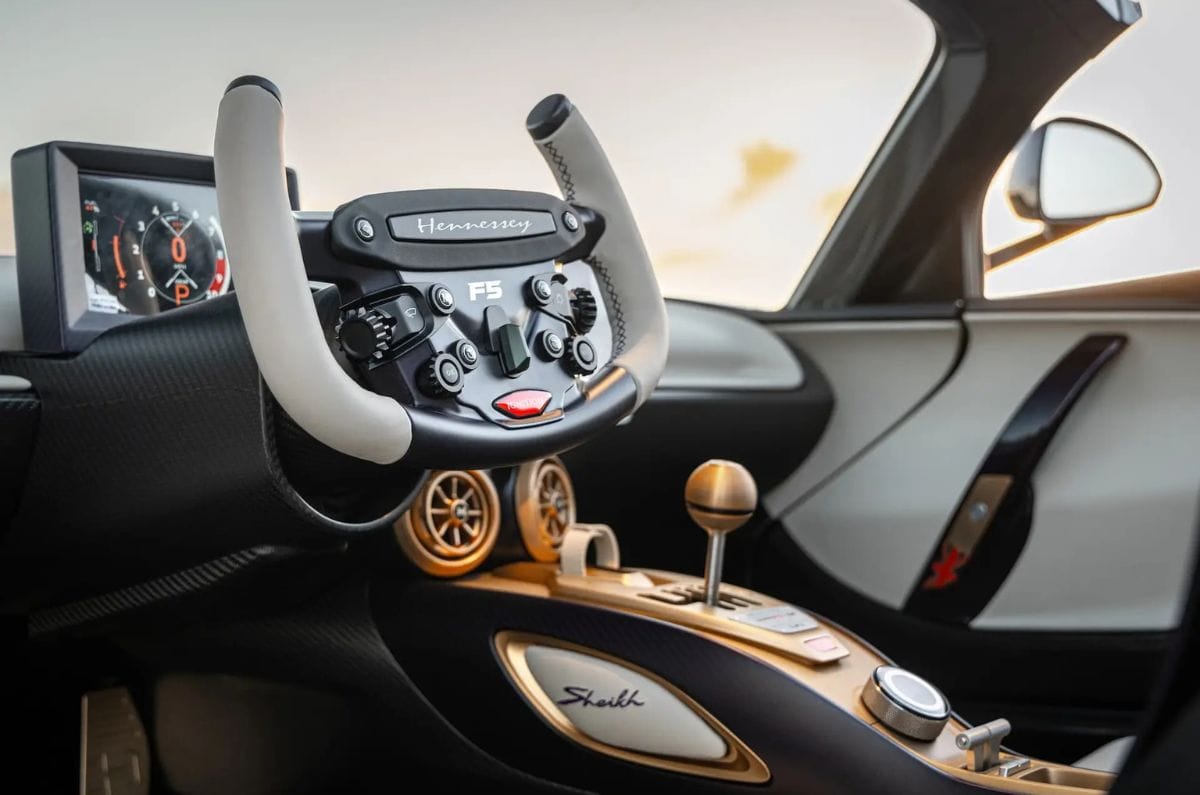
The interior also features a unique yoke-style steering with stitched leather and a whole set of physical buttons and dials. There’s exposed carbon fibre all across the Venon F5’M’s cabin, plus real metal and high-quality leather trim. The digital instrument panel is situated in the driver’s line of sight, while the short-throw gear lever offers a crisp and machined-metal clink, says Hennessey.
Hennessey Venom F5-M powertrain and chassis
The manual gearbox and updated chassis of the F5-M will make it to other F5 models
Powering the new Hennessey Venom F5-M is a 6.6-litre twin-turbocharged V8 that puts out 2,031hp. This so-called ‘Fury’ engine drives the rear wheels via a 6-speed manual transmission. While the American brand hasn’t disclosed the performance figures of the new Venom F5-M, it stated that the powertrain features a sophisticated traction control and engine management systems for precise and linear power delivery.
Even though it didn’t specify a timeline, Hennessey claimed that this car’s updated chassis and manual gearbox will make it to other Coupe and Roadster variants of the Venom F5, too. The hypercar also comes with active suspension, which can alter damping based on the drive mode selected by the driver. Hennessey said that it will only produce 12 units of the new Venom F5-M Roadster for the whole planet, and prices start from USD 2.65 million (roughly Rs 25.24 crore).
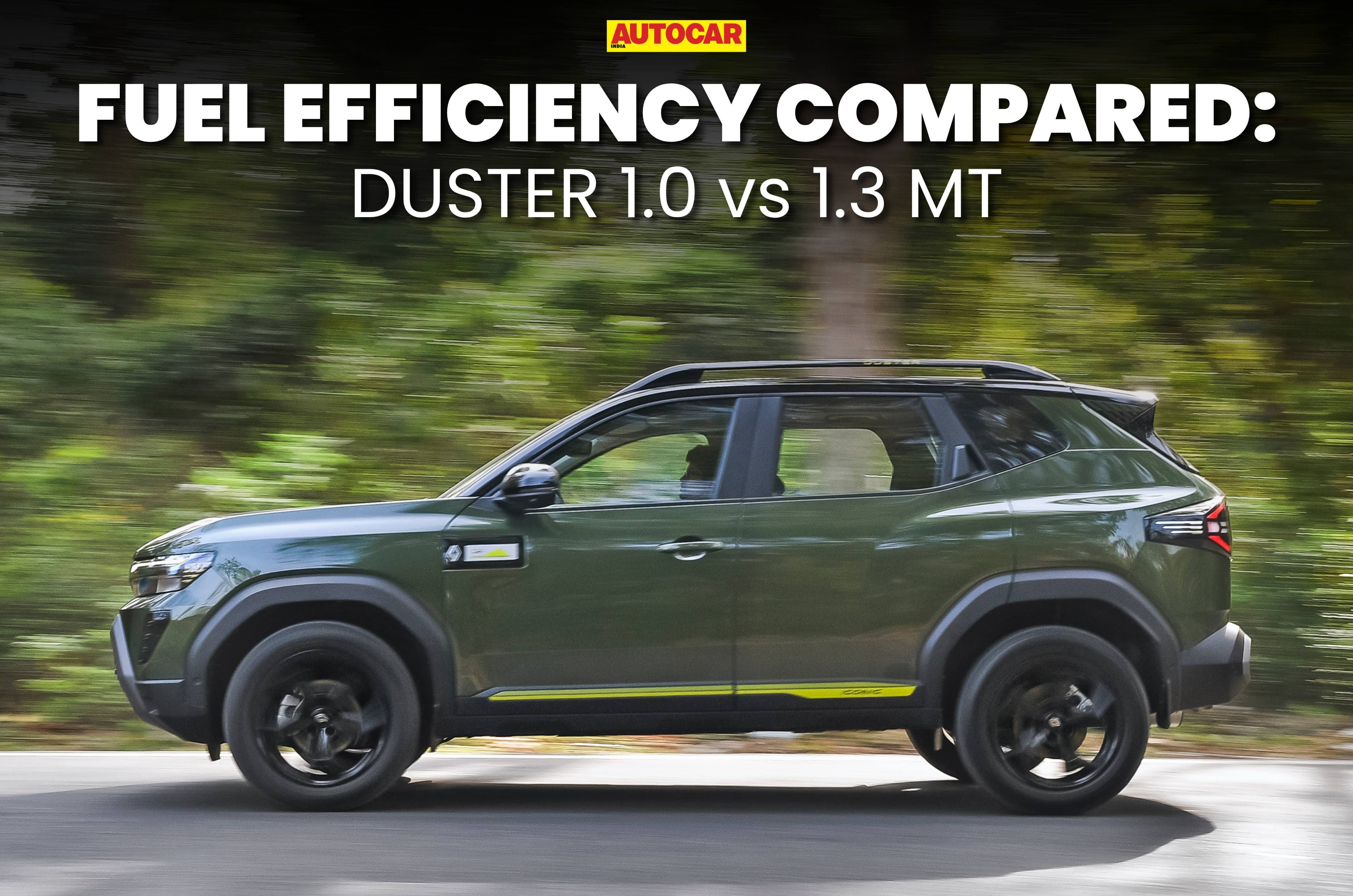
Earlier this year, Renault revived the Duster to mark its re-entry into the mid-size SUV space. Powering the SUV is a pair of turbo-petrol engines of either 1.0-litre or 1.3-litre in capacity. We’ve extensively tested and compared the real-world mileage figures of both turbo-petrol engines in manual transmission guise to determine how much of a gap there is in their efficiency.
Renault Duster 1.0 vs 1.3 MT: Specifications
Renault Duster 1.0 vs 1.3 MT: Specifications
Duster 1.0
Duster 1.3
Engine
3 cyls, turbo-petrol
4 cyls, turbo-petrol
Displacement (cc)
999
1333
Power (hp)
100
163
Torque (Nm)
166
280
Gearbox
6MT
6MT
Kerb weight (kg)
1316
1372
Fuel tank (litres)
50
50
The Duster’s 1.0-litre turbo-petrol engine is essentially the same unit that’s utilised in the Kiger. It develops an identical 100hp, but torque is slightly bumped to 166Nm (from 160Nm). This engine is the least powerful turbo-petrol unit in the segment. In contrast, the 163hp, 280Nm 1.3-litre turbo-petrol engine is the most powerful in the segment. A 6-speed manual gearbox is standard on both engines, while a 6-speed DCT is offered on the 1.3-litre mill as well. The smaller 1.0-litre engine translates into a 56kg lighter kerb weight. Both versions get an identical 50-litre fuel tank.
Renault Duster 1.0 vs 1.3 MT: Real-world fuel efficiency
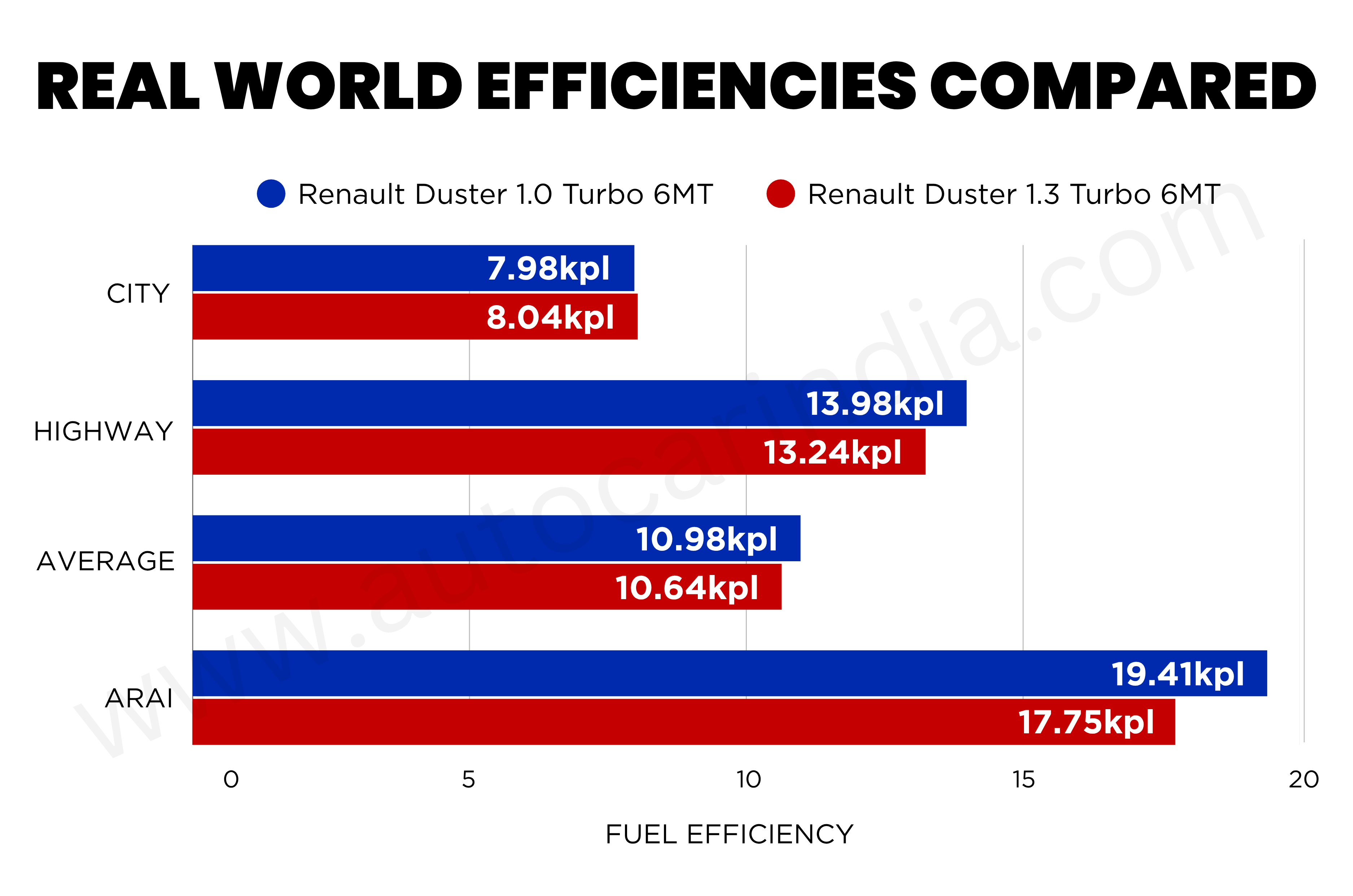
In the city, it was the 1.3-litre mill that was more frugal by a mere 0.48kpl. This is because of its ability to shift less frequently, due to its taller gearing. Both engines come with an Eco driving mode along with an auto start/stop function. But during the 1.0-litre units testing, high temperatures forced the AC to work harder, and auto start/stop only worked briefly, affecting city fuel efficiency. On the highway, however, the 1.0-litre unit was more efficient by 0.74kpl. Overall, the Duster 1.0’s average fuel efficiency was slightly higher at 10.98kpl in comparison to the 1.3’s 10.64kpl. The 0.34kpl gap in real-world average figures is much less in contrast to the 1.66kpl difference considering their respective ARAI-claimed figures
Renault Duster 1.0 vs 1.3 MT: Price
Renault Duster 1.0 vs 1.3 MT: Prices
Duster 1.0
Duster 1,3
Price (Rs lakh)
10.49 – 13.49
12.99 – 16.99
The Duster with the 1.0-litre engine has a more affordable price range as it’s offered from the base to the mid-level trims. Meanwhile, the 1.3-litre’s availability from the one above the base trim and exclusively on the top-end trim makes it comparatively pricier. Going for the 1.3 over the 1.0 within the same trim will set you back by up to Rs 1.3 lakh.
Autocar India’s fuel-efficiency testing
Before our real-world fuel-efficiency tests, we fill our test cars’ tanks to the brim and maintain tyre pressures based on the manufacturer’s recommendations. These cars are driven in fixed city and highway loops in and around Navi Mumbai, and we maintain certain average speeds. Throughout the tests, there is only one person in each car, operating the air conditioner and other electricals, such as the audio system, indicators and wipers, when required, just like a regular user would. Periodic driver swaps further neutralise variations in driver patterns. At the end of each cycle, we calculate efficiency by filling the tanks to full again.
Prices of select variants of the Victoris SUV have been reduced by Rs 39,000. This comes after the Maruti Victoris crossed the 1 lakh sales milestone in June, a feat the manufacturer said was achieved in just 8 months, faster than the Grand Vitara. In fact, the Victoris has been clocking over 10,000 sales per month in 2026, and a price reduction is expected to boost sales.
MT and AT variants of ZXi (O) and ZXi+ (O) trims witness price cuts
Prices of the Victoris’ CNG and strong hybrid variants are unchanged
Variant-wise features of the Victoris are unaffected by the price rejig
Maruti Suzuki Victoris: Old vs new prices
A panoramic sunroof on the Victoris has become more affordable now
Maruti Suzuki Victoris July 2026 prices for mild hybrid petrol variants (Rs, lakh)
Variant
New price
Old price
Price difference
LXi MT
10.50
10.50
None
VXi MT
11.80
11.80
None
VXi AT
13.36
13.36
None
ZXi MT
13.57
13.57
None
ZXi (O) MT
13.69
14.08
– Rs 39,000
ZXi AT
15.13
15.13
None
ZXi+ MT
15.24
15.24
None
ZXi (O) AT
15.25
15.64
– Rs 39,000
ZXi+ (O) MT
15.43
15.82
– Rs 39,000
ZXI+ AT
17.19
17.19
None
ZXi+ (O) AT
17.38
17.77
– Rs 39,000
ZXi+ AT AWD
18.64
18.64
None
ZXi+ (O) AT AWD
19.22
19.22
None
As the table suggests, prices of the ZXi (O) MT, ZXi (O) AT, ZXi+ (O) MT, and ZXi+ (O) AT have been reduced by Rs 39,000. Since these (O) variants add a panoramic sunroof over their standard counterparts, buyers can now get a Victoris with a panoramic sunroof at a more affordable price. The price range of Victoris variants with a naturally aspirated petrol engine, however, is unchanged.
CNG prices are the same and range from Rs 11.50 lakh to Rs 14.57 lakh
Maruti Suzuki Victoris July 2026 prices for CNG variants (Rs, lakh)
Variant
New price
Old price
Price difference
LXi CNG MT
11.50
11.50
None
VXi CNG MT
12.80
12.80
None
ZXi CNG MT
14.57
14.57
None
Unlike the naturally aspirated petrol variants, the CNG variants come at the same price as before. These range from Rs 11.50 lakh to Rs 14.57 lakh.
Strong hybrid prices are also unchanged
Maruti Suzuki Victoris July 2026 prices for strong hybrid petrol variants (Rs, lakh)
Variant
New price
Old price
Price difference
VXi eCVT
16.38
16.38
None
ZXi eCVT
17.80
17.80
None
ZXi (O) eCVT
18.39
18.39
None
ZXi+ eCVT
19.47
19.47
None
ZXi+ (O) eCVT
19.99
19.99
None
Like CNG, the strong hybrid petrol variants have seen no price rejig and continue to range from Rs 16.38 lakh to Rs 19.99 lakh.
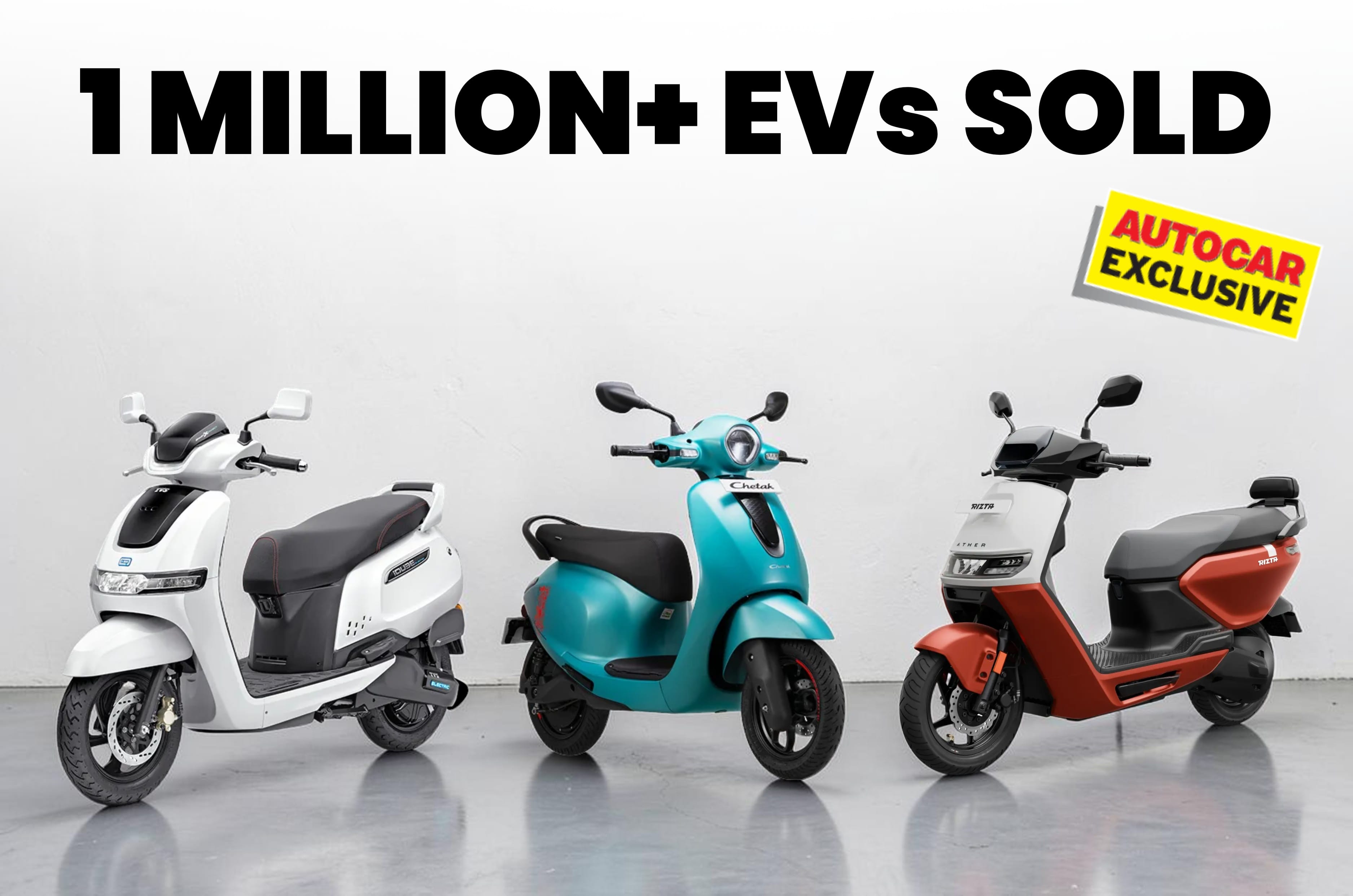
The Indian electric two-wheeler industry has surpassed 1 million unit sales as of July 6 this year. As per the latest data on the Vahan portal, a record 10,05,279 e-scooters, motorcycles and mopeds have been sold between January 1 and July 6 this year. This marks a handsome YoY increase of 54 percent (January 1-July 6, 2025: 6,54,592 units) and daily sales of 5,375 units.
Month
Units sold
January
1,29,265
February
1,18,408
March
1,99,393
April
1,57,619
May
1,72,530
June
1,94,186
July (till 6 July, 2026)
33,878
As the six-month retail sales data table above depicts, 2026 opened with 1,29,265 units in January, dropping 8 percent MoM in February (1,18,408 units). March saw retails jump 68 percent MoM to 1,99,393 units, which remains the highest monthly total yet for the industry. As a result, Q1 2026 (4,47,066 units) registered YoY growth of 39 percent (Q1 2025: 3,21,520 units). Sales rose higher in Q2 2026 (5,24,335 units) which was a 17 percent increase over Q1 and a 68 percent jump YoY (Q1 2025: 3,12,070 units) due to the sharp spike in sales in April (1,57,619 units, up 63 percent), May (194,196 units, up 64 percent) and June (1,94,186 units, up 75 percent).
Retail sales in May 2026, particularly from the second half, got a boost from the sharp increase in the price of petrol and a market dynamic that saw a fair number of two-wheeler buyers go electric to save money on costly petrol. Starting May 15, oil marketing companies implemented four hikes in petrol price in a span of 10 days. So far, fuel prices remain unchanged (as of July 7) and are enabling a higher level of transition to electric mobility across passenger and commercial vehicle segments.
Top brands on track to clock highest-ever annual sales
TVS, Bajaj Auto, Ather Energy and Vida have already achieved more than 80 percent of their record annual sales in 2025 already in 2026 so far.
The e-2W segment’s stellar growth this year is being driven by its Top 10 movers and shakers, with the bulk of them set to register their highest calendar year retail sales in CY2026. Combined sales of these 10 OEMs, at 9,39,894 units, gives them a 93 percent share of the 1-million retails to date, leaving the remaining 7 percent to be fought out by the other 16 players in the segment.
Rank
Company
Sales till date
% Market share
1
TVS
2,60,938
26
2
Bajaj
2,25,960
22
3
Ather
1,74,677
17
4
Vida (Hero)
1,09,306
11
5
Ola Electric
68,148
7
6
Greaves
45,240
5
7
River
22,490
2
8
BGauss
20,276
2
9
Simple
7,391
1
10
Revolt
5,468
1
Total
9,39,894
Market leader TVS Motor Co has sold 2,60,938 iQube and Orbiter scooters till July 6 and accounts for a 26 percent share of the 1 million sales. This total is already 83 percent of its 2025 sales of 3,15,085 units which means TVS is well set to surpass the 5 lakh units annual sales milestone for the first time in 2026.
Bajaj Auto, with 2,25,960 units and 22 percent share, is the closest challenger to TVS. The manufacturer of the Chetak has achieved 81 percent of its 2025 sales (2,79,687 units). It should cross the 3 lakh units annual sales mark by mid-August and then go on to surpass 4 lakh unit sales by the end of the year. It will be achieving both these milestones for the first time in a calendar year.
Ather Energy, the firm No. 3, is also on a roll this year. The company has delivered 1,74,677 units between January 1-July 6, which gives it a 17 percent share of the million units and constitute 81 percent of its 2025 sales (2,14,984 units). Given the strong growth momentum for its products, particularly the Rizta and the potential of its upcoming more affordable EL-platform based products, Ather should likely go on to surpass 3.50 lakh units this year.
Hero MotoCorp (Vida) will, for the first time, achieve the 2 lakh unit annual sales milestone for its EVs. The 1,09,306 e-scooters sold till date are 97 percent of its 2025 total (1,13,024 units) and give the company an 11 percent share of all e-2Ws sold in the year to date.
Ola Electric has delivered 68,148 e-scooters and e-motorcycles in the first 187 days of this year. This gives it a 7 percent share of the million units albeit this total is just 33 percent of its sales in 2025 (2,04,526 units). While annual sales will surely cross the 1.25 lakh units mark this year, only a massive resurgence in demand for products from the former market leader will see it hit 1.50 lakh units, far fewer than the top three OEMs – TVS, Bajaj and Ather.
IPO-bound Greaves Electric Mobility, the manufacturer of Ampere e-scooters, has clocked retail sales of 45,240 units in the year to date. This gives it a 5 percent share of the million-unit sales and is 78 percent of its 2025 sales (57,700 units). GEM’s highest annual sales were in 2022 (80,000-plus including Ampere Vehicles).
Bengaluru-based River Mobility, which is witnessing growing demand for its sole product – the River Indie – has already hit a new annual sales high of 22,490 units. This is 5,470 units more than in 2025 (17,020 units) and should see the startup close in on the 50,000 mark in 2026. The company also manufactures the Yamaha EC-06, which is based on the Indie platform.
Eighth-ranked BGauss Auto sold 20,276 units between January and July 6, which gives it a 2 percent share of all-India e-2W sales to date and 80 percent of its 2025 sales (25,131 units).
Scooter maker Simple Energy has sold 7,391 units in the year to date, 763 units more than the 6,628 e-scooters it sold in 2025. Electric motorcycle manufacturer Revolt Motors, with 5,468 units, has achieved 50 percent of its 2025 sales of 11,018 units.
Given that the surging demand for electric scooters and motorcycles continues in H2 this year, the industry is racing towards breaching the 2-million annual sales milestone for the first time. And, considering that e-2Ws constitute the largest volume, they will also help the domestic EV industry to achieve a record 3 million sales this year.