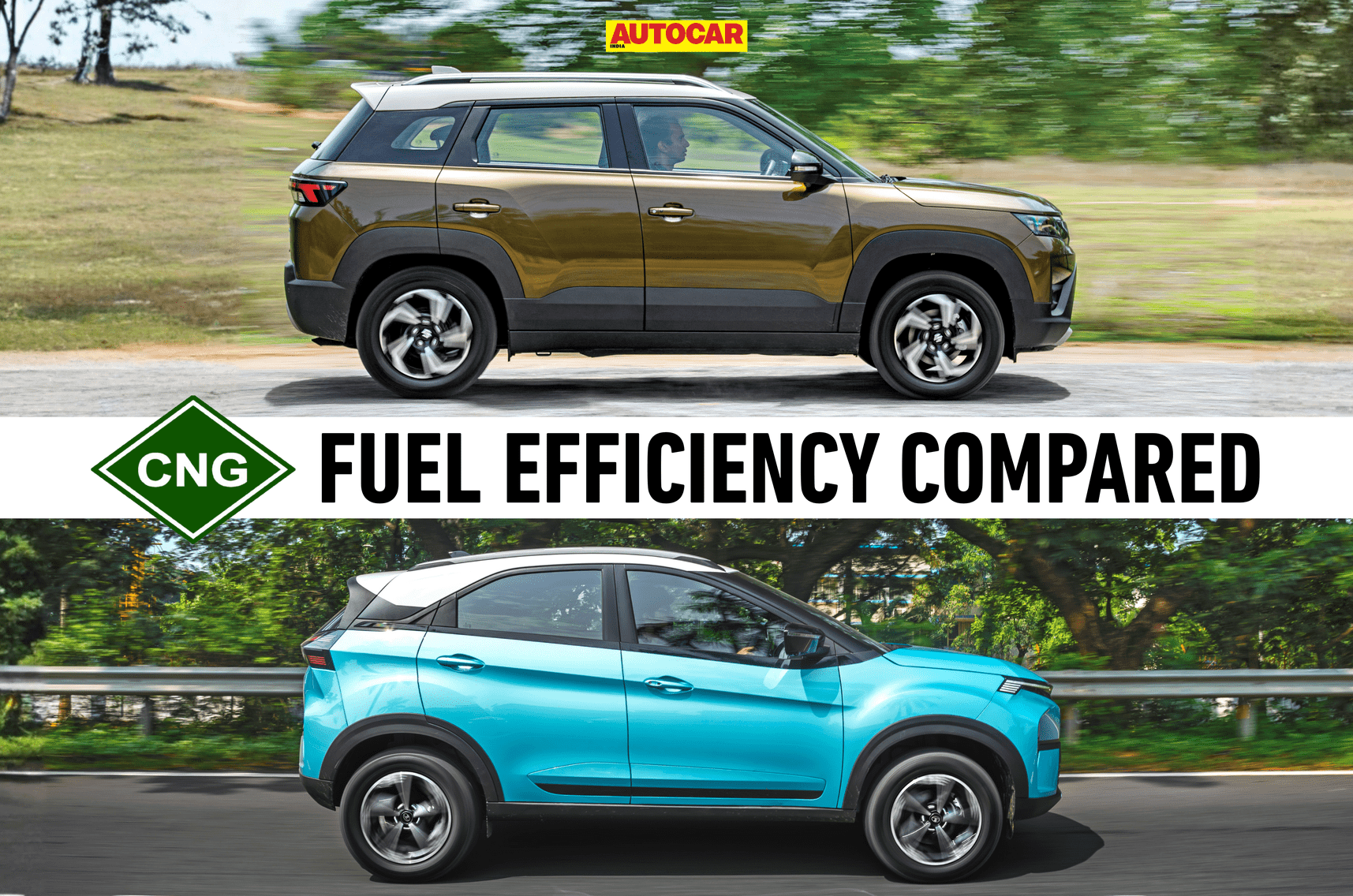
The Maruti Brezza and Tata Nexon are two of the few compact SUVs to offer a factory-fitted CNG kit. Both are also among the best-selling models for their respective brands, and since CNG cars are known to offer good mileage, it makes sense to compare these two and see which is more fuel-efficient in the real world. Keep reading to find out more.
Maruti Brezza CNG vs Tata Nexon CNG: Specs and price
Compact SUV
Brezza
Nexon
Engine
4 cyl, petrol-CNG
3 cyl, petrol-CNG
Turbocharged
No
Yes
Displacement (cc)
1,462
1,199
Power (hp)
101 (petrol), 88 (CNG)
120 (petrol), 100 (CNG)
Torque (Nm)
137 (petrol), 122 (CNG)
170
Transmission
5-speed manual
6-speed manual
Claimed CNG mileage (km/kg)
25.5
24
CNG tank (litres)
55
60
Petrol tank (litres)
48
44
Boot space (litres)
Not disclosed
321
Price range (Rs, lakh)
9.17-11.46
8.3-13.42
While the Brezza uses a four-cylinder naturally aspirated engine, the Nexon gets a three-cylinder turbocharged unit. Notably, no other compact SUV currently offers a CNG kit with a turbocharged engine. The Nexon has a clear performance advantage over the Brezza. In petrol guise, its 1.2-litre turbo-petrol engine produces 120hp and 170Nm, giving it a 19hp and 33Nm edge over the Brezza’s 1.5-litre naturally aspirated petrol engine, which develops 101hp and 137Nm.
In CNG mode too, the Nexon leads with 100hp and 170Nm, compared to the Brezza CNG’s 88hp and 122Nm. That gives the Nexon a 12hp and 48Nm advantage in CNG form. It also gets a 6-speed manual, compared with the Brezza’s 5-speed unit, and a larger 60-litre CNG tank (dual-cylinder setup). The Maruti, meanwhile, uses a more conventional cylinder arrangement.
The Brezza’s 1,462cc engine also crosses the 1,200cc threshold for the lower 18 percent GST slab, so it’s taxed at 40 percent. That shows up in pricing, too, with the Brezza’s entry price sitting Rs 95,000 above the Nexon’s. At the top end, though, the Tata is Rs 2.1 lakh pricier than the equivalent Brezza CNG variant.
Maruti Brezza CNG vs Tata Nexon CNG: Real-world mileage
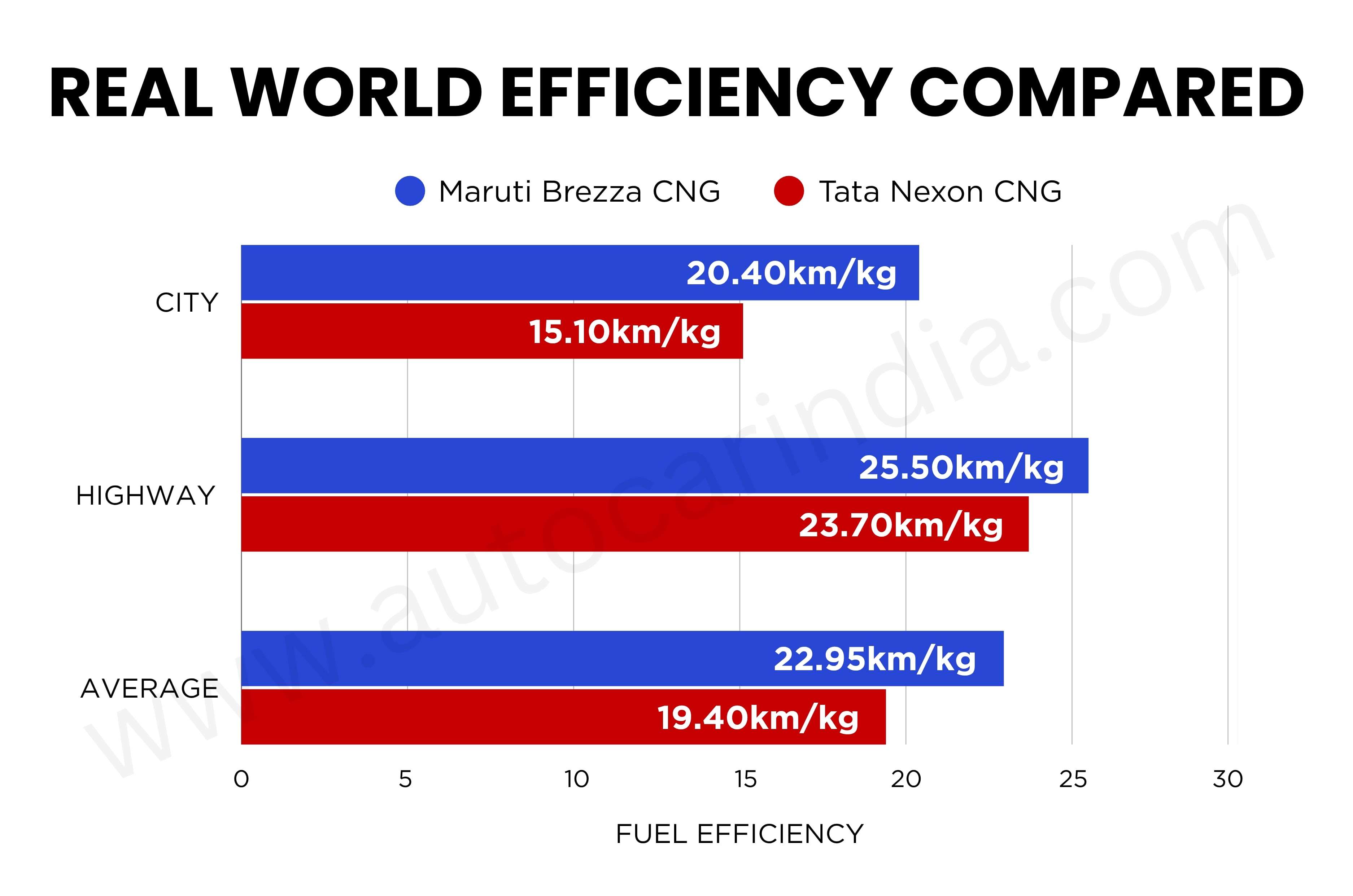
The Brezza CNG is clearly more efficient in real-world use than the Nexon CNG. In the city, it returns 5.3km/kg more than the Tata SUV. The Brezza maintains its lead on the highway as well, but the gap narrows to 1.8km/kg. As a result, the average figure also favours the Brezza, which is ahead by 3.55km/kg.
Part of the Brezza’s efficiency advantage comes from its much lighter kerb weight and a naturally aspirated setup. It should be noted that the Nexon’s CNG setup does not significantly affect drivability or performance in everyday use. It can also be started directly in CNG mode, and even the added weight of the kit – 120kg more than the petrol Nexon – does not make it feel breathless or strained.
Autocar India’s fuel efficiency testing
Before our real-world fuel efficiency tests, we fill our test cars’ tanks to the brim and maintain tyre pressures based on the manufacturer’s recommendations. These cars are driven in fixed city and highway loops in and around Navi Mumbai, and we maintain certain average speeds. Throughout the tests, there is only one person in each car, running the air conditioner and other electricals, such as the audio system, indicators and wipers, when required, just like a regular user would. Periodic driver swaps further neutralise variations in driver patterns. At the end of each cycle, we calculate efficiency by refilling the tanks to full.
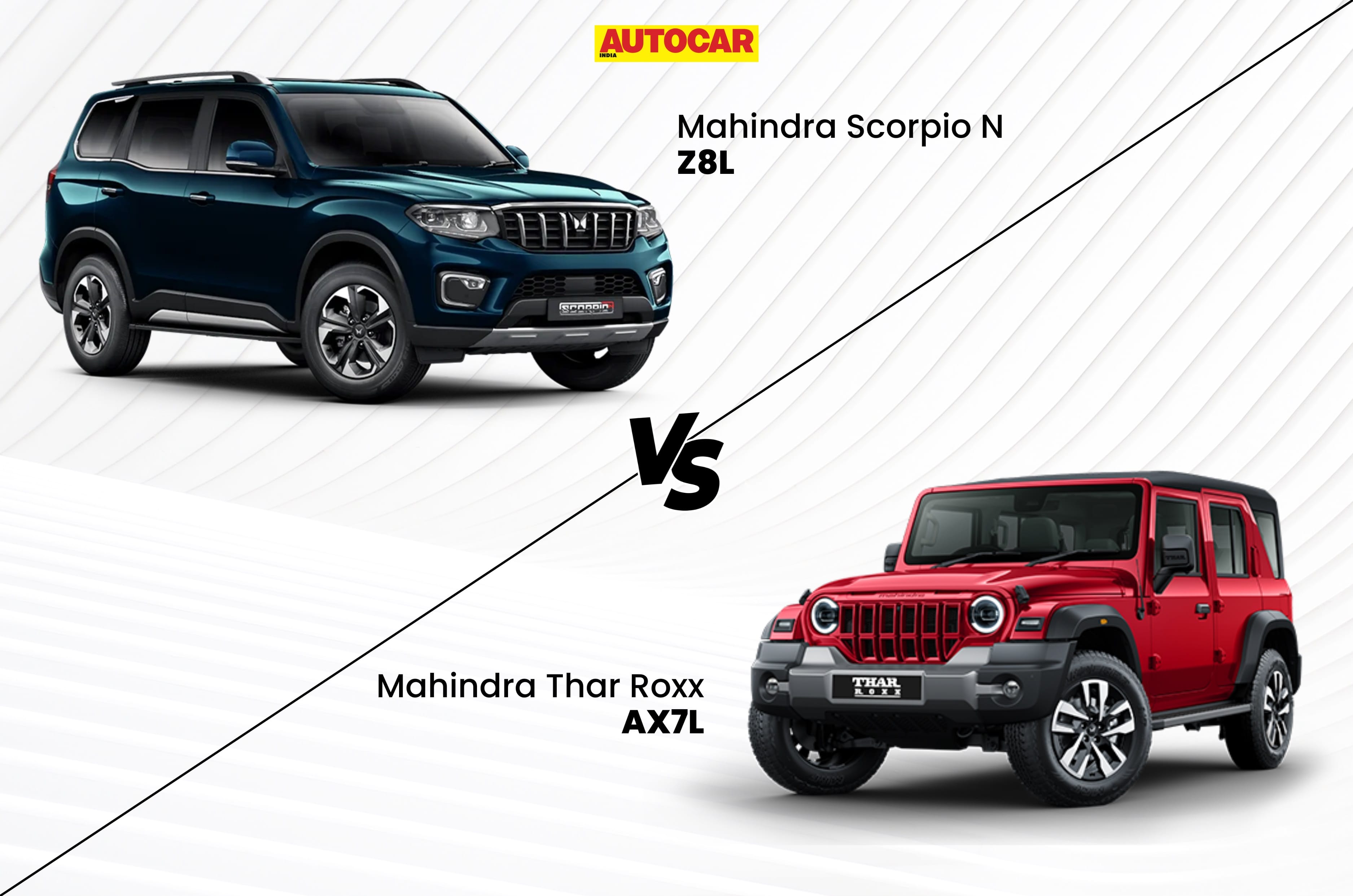
Mahindra recently launched the 2026 Scorpio N, introducing a handful of changes, including new rims, a larger touchscreen, a fresh driver’s display, and a 540-degree camera, while retaining the same powertrain and drivetrain options. It is priced from Rs 13.69 lakh to Rs 25.49 lakh (ex-showroom). Its prices are similar to those of the Thar Roxx’s, which also offers the same powertrain and drivetrain options. So, if you are looking for a Mahindra SUV at around Rs 25 lakh, should you choose the top-spec Mahindra Scorpio N Z8L or the Thar Roxx AX7L? We find out.
2026 Mahindra Scorpio N vs Thar Roxx: Dimensions
Scorpio N is larger and offers more boot space; Thar Roxx has better ground clearance
Mahindra Scorpio N vs Thar Roxx: Dimensions and other specifications
Scorpio N
Thar Roxx
Difference
Length (mm)
4,662
4,428
+234
Width (mm)
1,917
1,870
+47
Height (mm)
1,857
1,923
-66
Wheelbase (mm)
2,750
2,850
-100
Ground clearance (mm)
187
226
-39
Boot space (litres)
786*
447
+339
No. of seats (mm)
6 or 7
5
–
*786 litres of boot space is with the third row folded (with 5 seats up).
The Mahindra Scorpio N is significantly longer compared to the Thar Roxx, and it is also slightly wider. The Thar Roxx, on the other hand, has a larger wheelbase and is also taller than the Scorpio N.
The Scorpio N offers a larger boot with the third row folded. Notably, the Scorpio N is offered with either 6 or 7 seats, the former asking a premium over the latter, while the Thar Roxx is strictly a 5-seater.
2026 Mahindra Scorpio N Z8L vs Thar Roxx AX7L: Powertrain
Both Mahindra SUVs get the same powertrain options, but with slightly different tunes
Top-spec Mahindra Scorpio N vs Thar Roxx: Powertrain options
Scorpio N Z8L*
Thar Roxx AX7L^
Engine
2.0L TP | 2.2L D
2.0L TP | 2.2L D
Power (hp)
203 | 175
177 | 152-175
Torque (Nm)
370-380 | 370-400
380 | 330-400
Transmission
6MT, 6AT | 6MT, 6AT
6AT | 6MT, 6AT
Drivetrain
RWD | RWD, 4WD
RWD | RWD, 4WD
*Scorpio N’s direct-injection turbo-petrol produces 203hp, 370Nm with MT, and 203hp, 380Nm with AT; diesel engine produces 175hp, 370Nm with MT, 175hp, 400Nm with AT.
^Thar Roxx’s direct-injection turbo-petrol engine produces 152hp,300Nm with MT, and 175hp, 400Nm with AT.
Both top-spec Mahindra Scorpio N Z8L and Thar Roxx AX7 are offered with a choice between a 2.0-litre direct-injection turbo-petrol engine and a 2.2-litre diesel engine. However, these engines are offered in different states of tune, with varying power and torque outputs, and the Scorpio N’s select powertrains are slightly more powerful than the Thar Roxx’s.
The Scorpio N’s petrol-AT produces 28hp more than the Thar Roxx. Notably, the Thar Roxx AX7L is not offered with a petrol-manual option. The Scorpio N’s diesel-MT produces 23hp and 40Nm more than the Thar Roxx, while with the diesel-AT both SUVs offer 175hp and 400Nm.
The diesel engines on both SUVs are available with both rear-wheel-drive (RWD) and four-wheel-drive (4WD) setups with both manual and automatic variants, while the petrol engines are only offered with only a RWD setup.
2026 Mahindra Scorpio N Z8L vs Thar Roxx AX7L: Exterior
Thar Roxx AX7L has bigger rims, but Scorpio N Z8L offers roof rails
Mahindra Scorpio N Z8L vs Thar Roxx AX7L: Exterior
Scorpio N Z8L
Thar Roxx AX7L
Headlights
Auto LED
Auto LED
Taillights
Wraparound LED
Wraparound LED
DRLs
LED
LED
Front fog lamps
LED
LED
Wheels
18-inch
19-inch
Powered ORVMs
Yes
Yes
Roof rails
Yes
No
Sharkfin antenna
Yes
No
Colour
Mono-tone
Dual-tone
Top-spec trims of both SUVs are offered with all-LED lighting. The differences, however, are larger 19-inch alloy wheels on the Mahindra Thar Roxx AX7L, and roof rails on the Scorpio N Z8L. The Scorpio N has a sharkfin antenna, while the Thar Roxx’s antenna is placed on the front left fender.
The top-spec Scorpio N is offered with monotone hues only, while the Thar Roxx is available only in dual-tone shades.
2026 Mahindra Scorpio N Z8L vs Thar Roxx AX7L: Interior, features
Scorpio N Z8L offers larger infotainment, more speakers and dual-zone AC
Mahindra Scorpio N Z8L vs Thar Roxx AX7L: Interior and features
Scorpio N Z8L
Thar Roxx AX7L
Driver’s display
10.25-inch
10.25-inch
Infotainment screen
12.30-inch
10.25-inch
Android Auto, Apple CarPlay
Wireless
Wireless
Audio system
12-speaker Sony
8-speaker Harman Kardon
On-board navigation
Yes
Yes
Sunroof
Panoramic
Panoramic
Powered tailgate
No
No
Climate control
Dual-zone
Single-zone
Seat upholstery
Leatherette
Leatherette
Steering wheel adjustment
Tilt
Tilt
Wireless phone charger
Yes, with cooling
Yes
Driver seat adjustment
6-way
6-way
Co-driver’s seat adjustment
–
–
Front seat features
Ventilation
Ventilation
Rear window sunshade
No
No
The Scorpio N Z8L offers a larger 12.3-inch touchscreen infotainment system paired with a 12-speaker Sony sound system compared to the Thar Roxx AX7L’s 10.25-inch unit with an 8-speaker Harman Kardon sound system. The Scorpio N is also equipped with dual-zone climate control and a wireless phone charger with cooling, while the Thar Roxx gets basic single-zone automatic climate control and misses out on the cooling function for the wireless phone charger.
Everything else is identical on both SUVs, including a panoramic sunroof, a 10.25-inch driver’s display, a 6-way powered driver’s seat, front seat ventilation, and a tilt-adjustable steering wheel. Both SUVs also show adventure statistics including a compass, roll and pitch and an altimeter.
2026 Mahindra Scorpio N Z8L vs Thar Roxx AX7L: Driving tech
Scorpio N Z8L comes with more terrain modes than the Thar Roxx AX7L
Mahindra Scorpio N Z8L vs Thar Roxx AX7L: Driving technology
Scorpio N Z8L
Thar Roxx AX7L
Drive modes (RWD only)
Zip, Zap, Zoom
Zip, Zoom
Terrain modes (4WD only)
Normal, Snow, Mud & Ruts, Sand
Snow, Sand, Mud
Shift-on-fly 4WD
Yes
Yes
Electronic locking differential
4WD only
4WD only
Paddle shifters
AT only
AT only
Cruise control
Adaptive
Adaptive
Drive modes on the Scorpio N are offered only with the diesel-RWD variants, while even the petrol variants of the Thar Roxx get this suite. However, the Scorpio N gets an additional ‘Sand’ terrain mode missing on the Thar Roxx. Both SUVs, however, get a shift-on-fly 4WD system and an electronic locking differential, enhancing grip on slippery terrains.
2026 Mahindra Scorpio N Z8L vs Thar Roxx AX7L: Safety
Safety features are similar, save for a 540-degree camera on Scorpio N Z8L
Mahindra Scorpio N Z8L vs Thar Roxx AX7L: Safety features
Scorpio N Z8L
Thar Roxx AX7L
Airbags
6
6
ADAS
Level-2
Level-2
Camera setup
540-degree*
360-degree
Parking sensors
Front and rear
Front and rear
Electronic parking brake
Yes
Yes
All-wheel disc brakes
Yes
Yes
TPMS
Yes
Yes
IRVM
Auto-dimming
Auto-dimming
Rear wiper, washer
Yes
Yes
Hill start assist
Yes
Yes
Hill descent control
Yes
Yes
ESC
Yes
Yes
Traction control
Yes
Yes
*The 540-degree camera setup includes an under-bonnet display.
Except for a 540-degree camera setup on the Scorpio N Z8L, which shows the view under the SUV’s bonnet, all other safety features are identical to both SUVs. These include 6 airbags, Level-2 advanced driver assistance system (ADAS), front and rear parking sensors, a tyre pressure monitoring system (TPMS), and hill start and hold assists.
2026 Mahindra Scorpio N Z8L vs Thar Roxx AX7L: Prices
The Thar Roxx comes at a lower price compared to the top-spec Scorpio N
Mahindra Scorpio N Z8L vs Thar Roxx AX7L: Variant-wise ex-showroom price (Rs, lakh)
Scorpio N Z8L
Thar Roxx AX7L
Petrol MT
21.31-21.69
–
Petrol AT
22.87-23.05
20
Diesel MT
21.99-22.47
19.52
Diesel AT
23.49-23.80
20.78
Diesel MT 4WD
24.25
22.12
Diesel AT 4WD
25.49
22.53
The Mahindra Scorpio N Z8L is more expensive than the Thar Roxx AX7L in all powertrain configurations by over Rs 2 lakh. However, it is offered with an additional third row, which can accommodate more passengers. On the other hand, the Mahindra Thar Roxx is derived from a hardcore off-roader and is a good recreational vehicle while also serving urban buyers with its tech-loaded suite. However, the Scorpio N, despite being pricier, is a more practical option that packs in all the necessary off-roading tech and offers an additional third row, making it a good value-for-money SUV in its class.
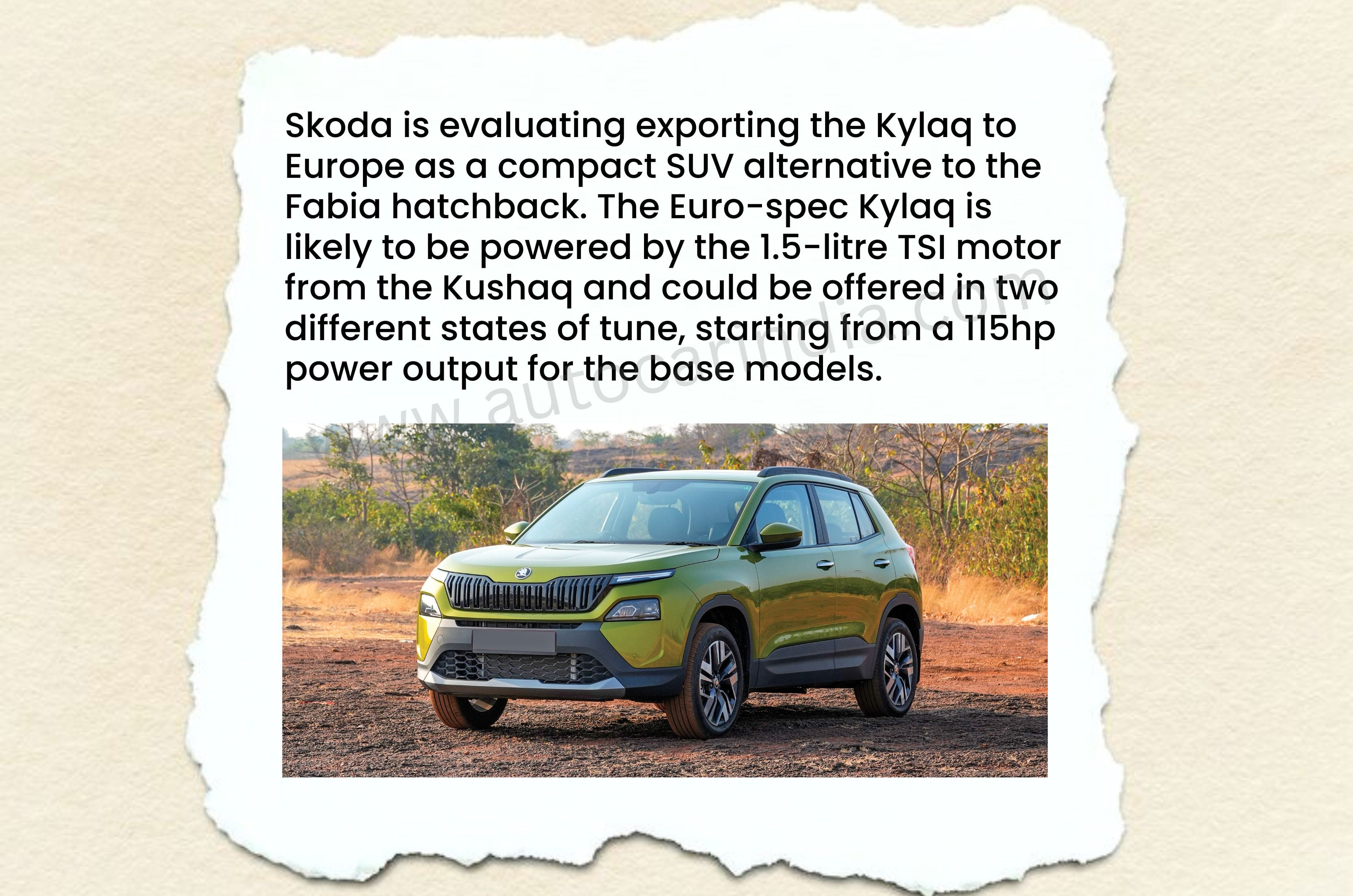
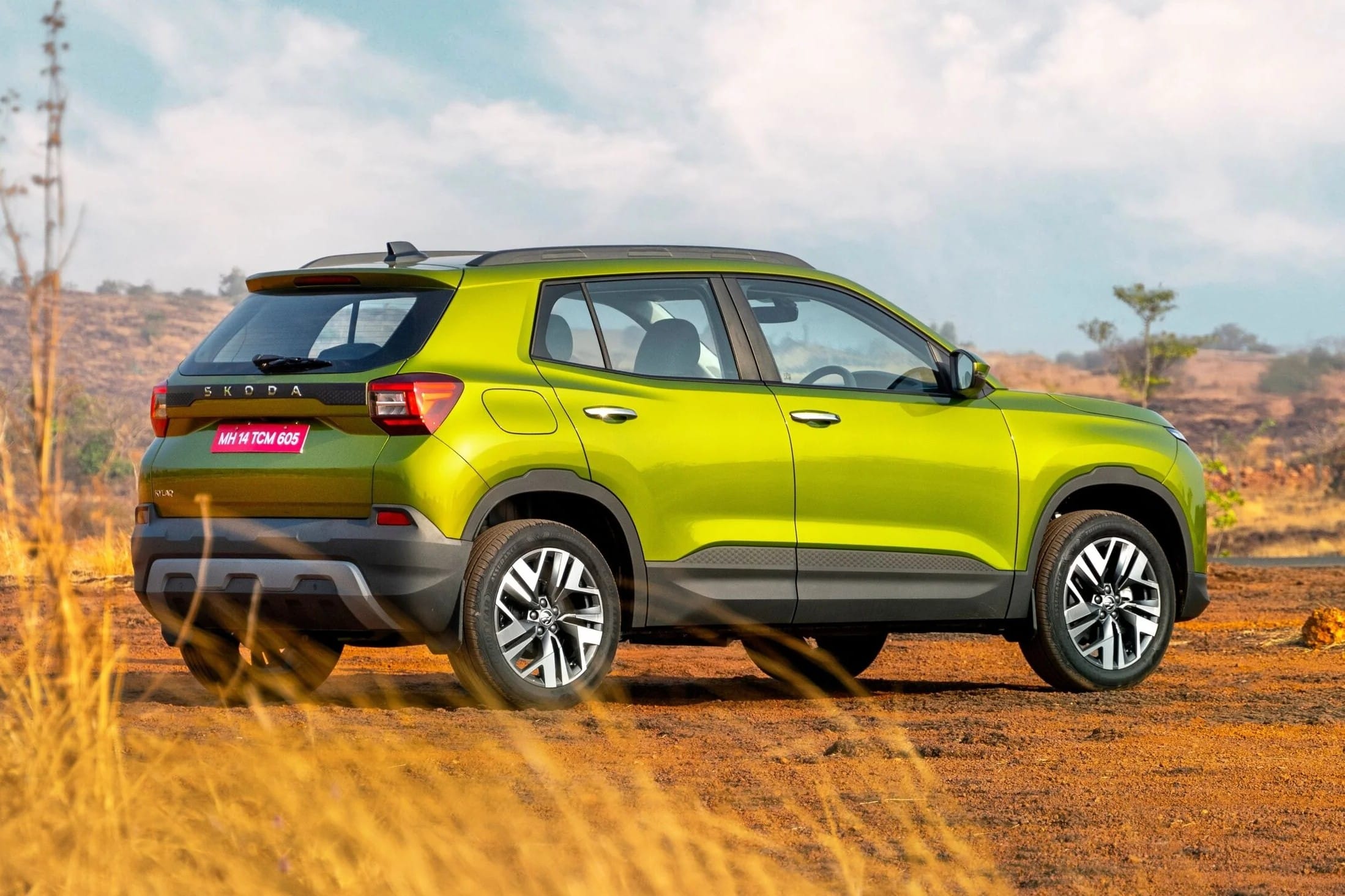
Skoda is considering exporting the made-in-India Kylaq to the European market as a crossover alternative to the Fabia hatchback. Launched here at the tail-end of 2024, the Kylaq is the third Skoda model to come out of Skoda-VW’s ‘India 2.0’ strategy and the Czech carmaker’s smallest SUV to date. While the Kylaq is designed specifically for the Indian market, Skoda feels the compact SUV carries enough pedigree and appeal for European customers.
Autocar India’s recent Pune to Prague drive, a 19,000km cross continent drive that covered several European countries, including the Czech Republic, the brand’s home country, established the Kylaq as a product that could blend in well in some of Skoda’s key markets. “We’re looking into a possibility or an opportunity to bring Kylaq to Europe, but there are a lot of barriers, a lot of homologation questions,” Skoda CEO Klaus Zellmer told us after the conclusion of the cross-continent Kylaq road trip.
1.0 TSI or 1.5 TSI for the Euro-spec Kylaq?
We reported about Kylaq’s export plans to Europe in June 2026 issue of the Autocar India magazine.
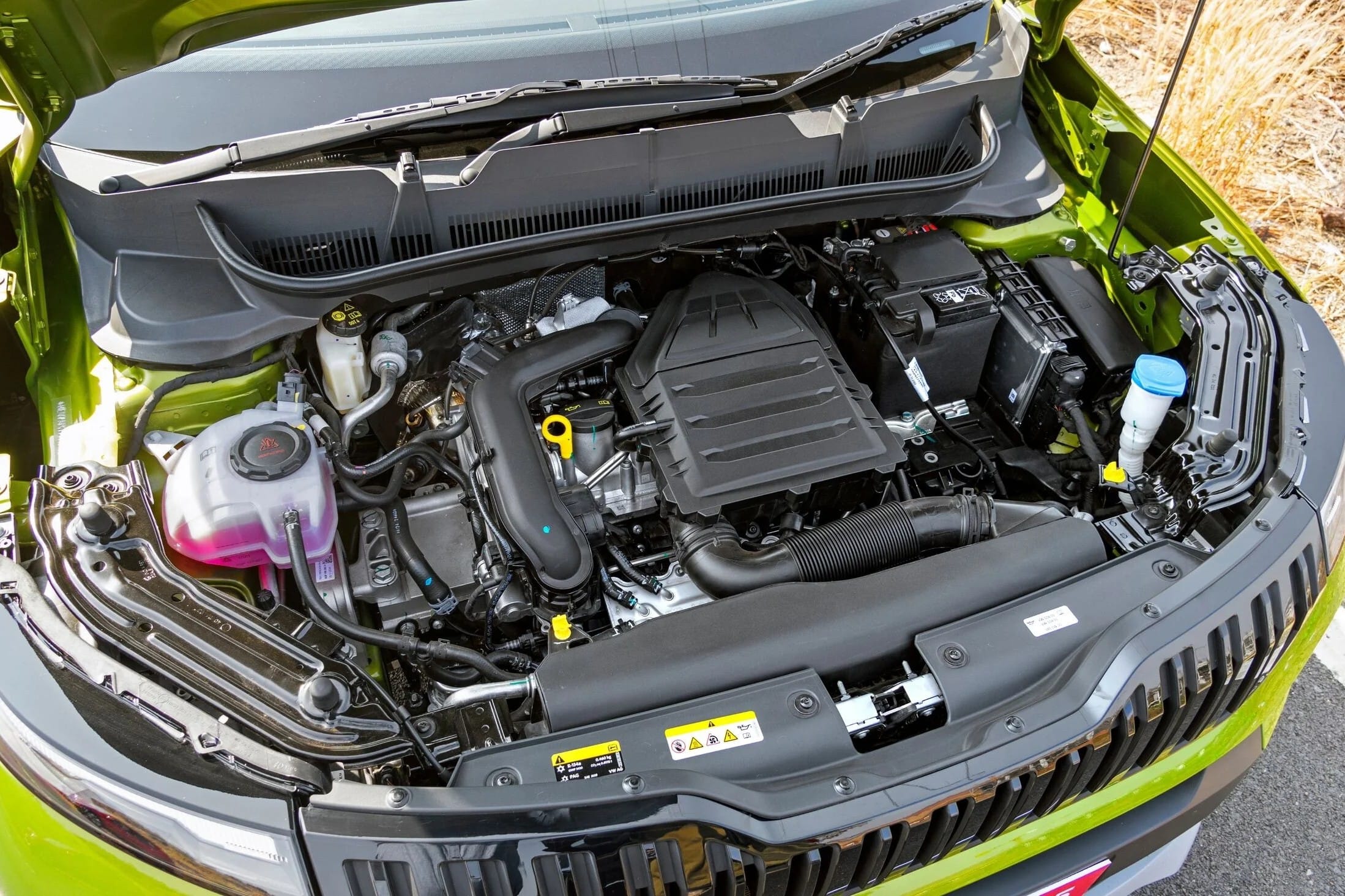
In India, the Kylaq is powered solely by the locally manufactured 115hp 1.0-litre 3-cyl direct-injection turbo-petrol engine (1.0 TSI), which can be had with either a 6-speed manual or 6-speed automatic. For Europe, however, Skoda might equip the Kylaq with the 1.5-litre 4-cyl direct-injection turbo-petrol mill (1.5 TSI) seen in the Slavia and Kushaq, paired to a 7-speed DCT.
The 1.5 TSI engine is used in Skoda’s other models and is already Euro 7 compliant making it the logical choice for export markets. However, from a cost perspective the 1.0 TSI is more attractive as it is a three-cylinder unit and is locally produced. However, the 1.0 TSI does not meet Euro 7 standards and upgrading it to the latest emission standards will call for significant upfront investment which will impact the overall cost of the Kylaq for exports.
If Skoda decides on the 1.5 TSI the export version of the Kylaq, it will likely be in a lower 115hp state of tune to help meet the Euro 7 targets. In fact, the Kylaq 1.5 TSI could be offered in two states of tune for the European market, but its not clear what the other power output of the engine would be.
Beyond emission regulations, the Kylaq would have to meet Europe’s safety, security and other homologation requirements that would again add to the cost of the vehicle.
India-EU FTA and weak rupee helps Kylaq’s export business case
The incoming India-EU FTA, in conjunction with the depreciating rupee against the euro, makes a strong case for exporting the Kylaq to Europe. Piyush Arora, the MD of Skoda Auto Volkswagen India Private Limited (SAVWIPL), said that the India-EU FTA will “open up opportunities” for SAVWIPL across all of its business verticals, including CBU imports, components, fully developing new models for India, and exporting cars to the European market.
A final decision has not been taken. However, a European programme would mark a significant step for Skoda Auto Volkswagen India by moving the country’s role beyond developing and manufacturing vehicles for India and other emerging markets to supplying a product to the carmaker’s home region.
River Mobility has closed a $120 million (Rs 1,141 crore approximately) Series C funding round comprising equity and venture debt, marking one of the largest private fundraises in India’s electric two-wheeler sector. The company plans to use the capital to expand its manufacturing footprint, develop new products in the utility lifestyle segment and improve profitability.
$120 million Series C round closed with equity and venture debt components
Round led by Elev8 Venture Partners and Claypond Capital; existing backers also participated
Capital to fund new greenfield plant, product launches and margin improvement
River Mobility funding
First significant round from Indian institutional investors for the company
The equity portion of the round was led by Elev8 Venture Partners and Claypond Capital, with participation from Singularity AMC, Anicut Capital, 360 ONE Asset, JIF Capital and HDFC AMC – marking the first time River Mobility has attracted significant backing from Indian institutional investors. Venture debt came from Alteria Capital, Innoven Capital and Stride Ventures. Existing global backers Yamaha Motor Corporation, Al Futtaim Group and Mitsui & Co. also participated in the round.
River’s monthly retail sales have since grown to around 5,000-6,000 units, and the company recently rolled out its 50,000th unit from its Hoskote plant. It currently has over 75 stores across India, with a target of over 350 stores by March 2028. The company also manufactures the Yamaha EC-06 at the same facility under a partnership with Yamaha Motor Co.
The company says these funds will be directed towards capacity expansion at the existing Hoskote facility, the construction of a new greenfield plant, new product development and improvements to gross margins and EBITDA profitability.
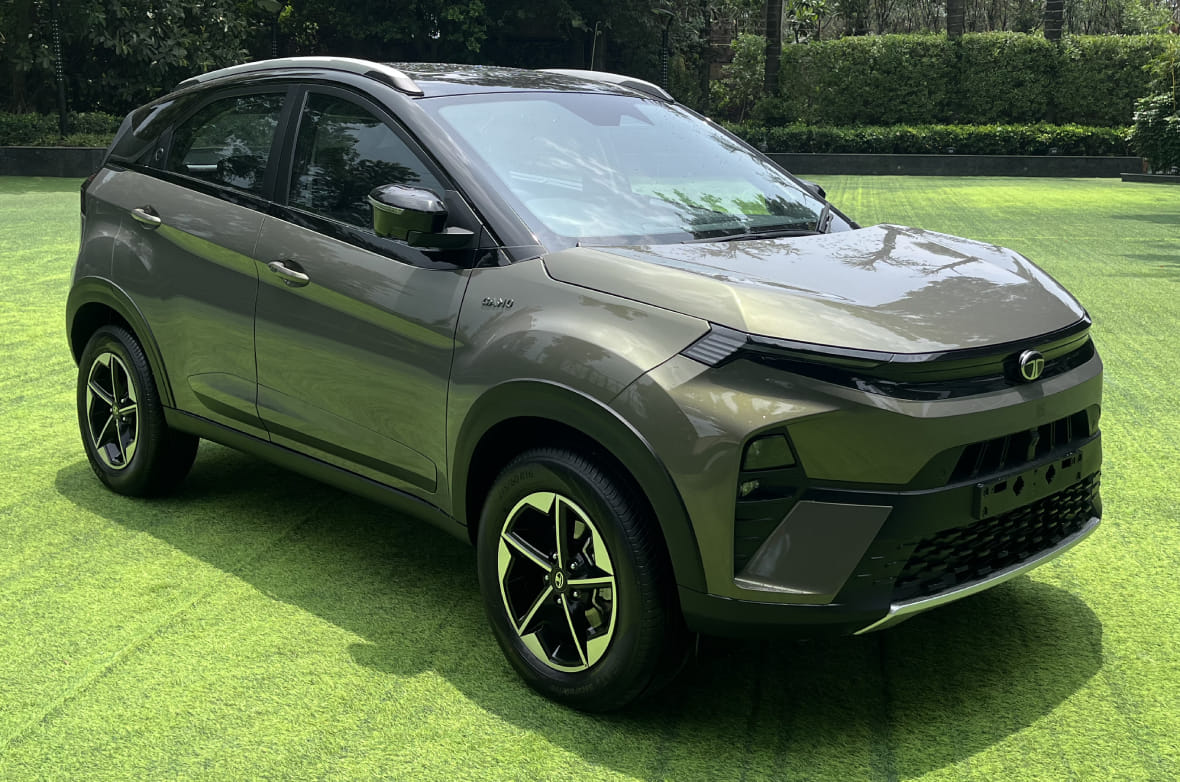
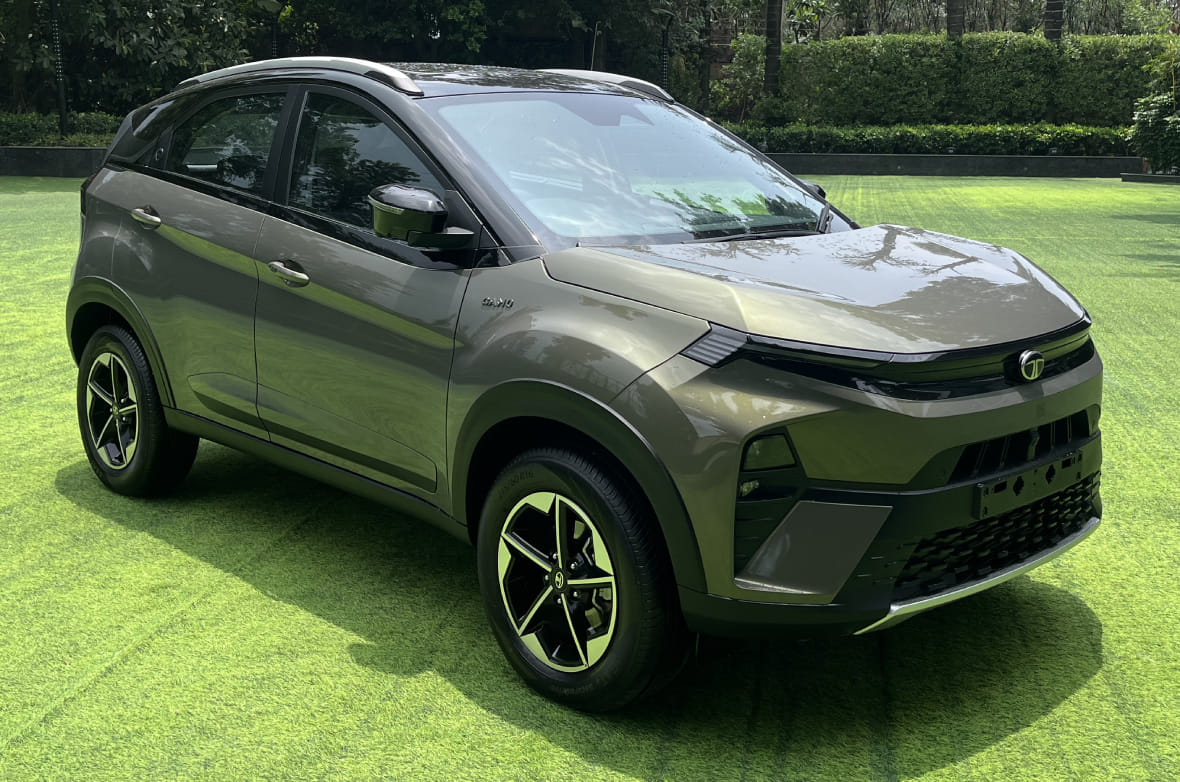
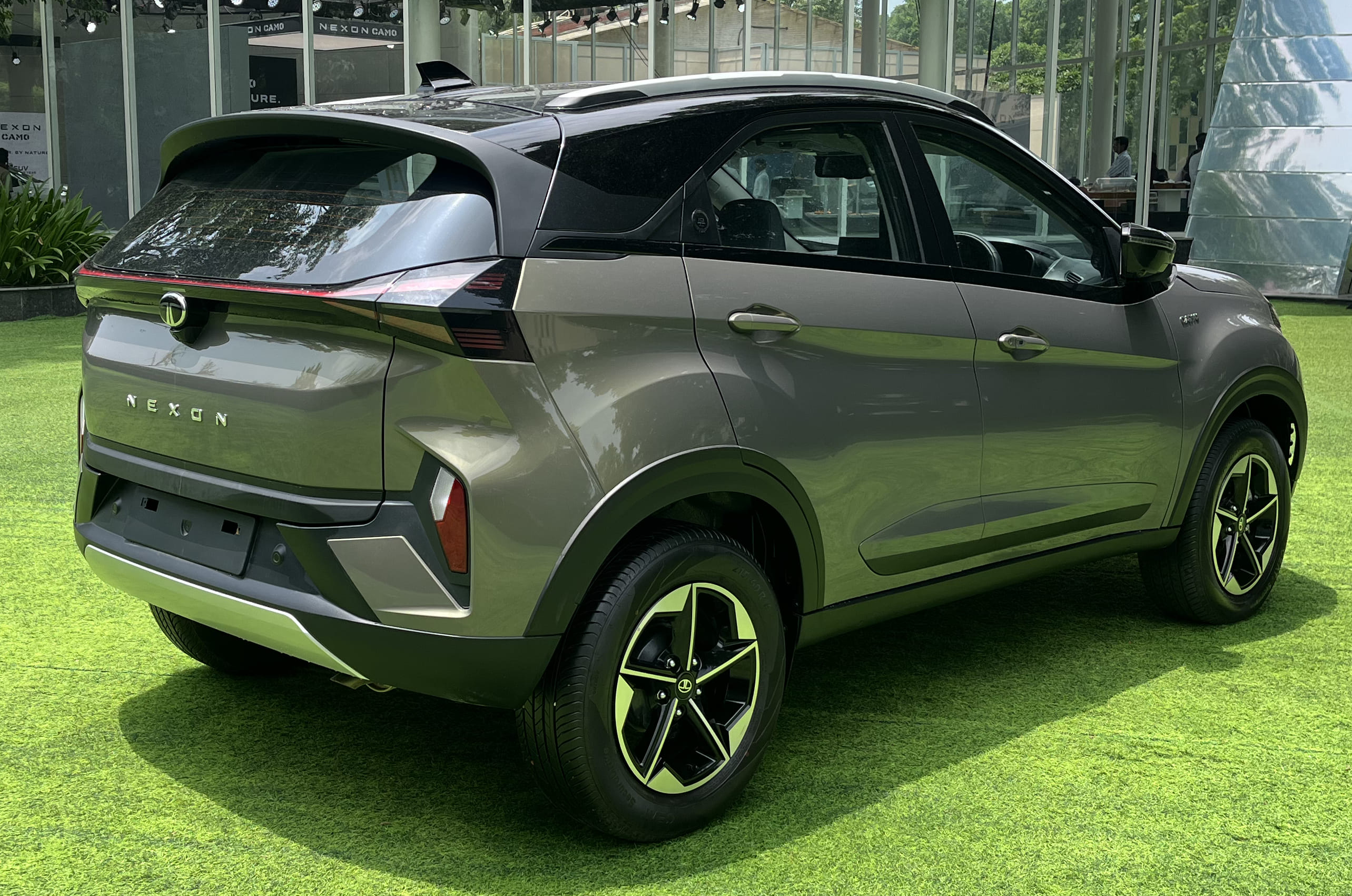
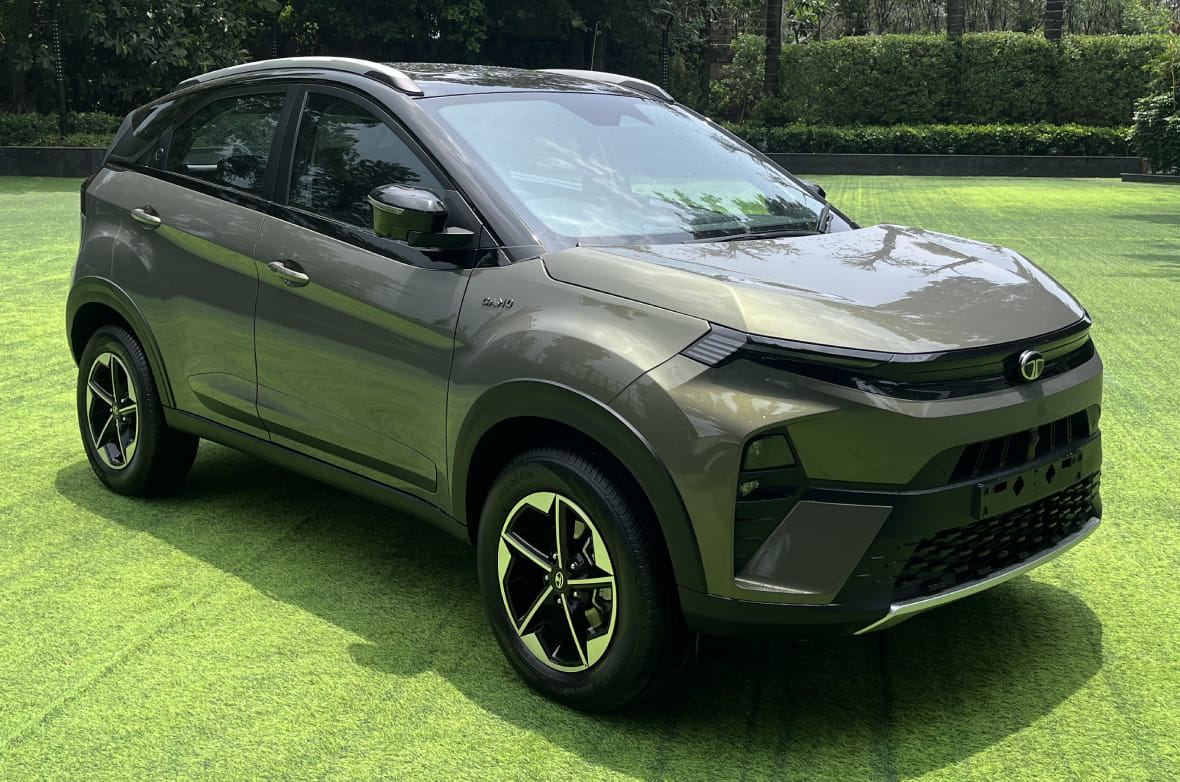
The Tata Nexon Camo Edition has been launched at a starting price of Rs 9.99 lakh (ex-showroom), bringing cosmetic changes and equipment upgrades to Tata’s compact SUV. Available for a limited period, it is based on the Creative and higher trims and introduces exclusive Munnar Mist and Coorg Cloud exterior colours, Camo-specific detailing and a larger 12.3-inch touchscreen infotainment system. Tata has also added an integrated dashcam that works with the SUV’s 360-degree camera system. Mechanically, the special edition remains unchanged and continues to be offered with petrol, diesel and CNG engine options across five trim levels.
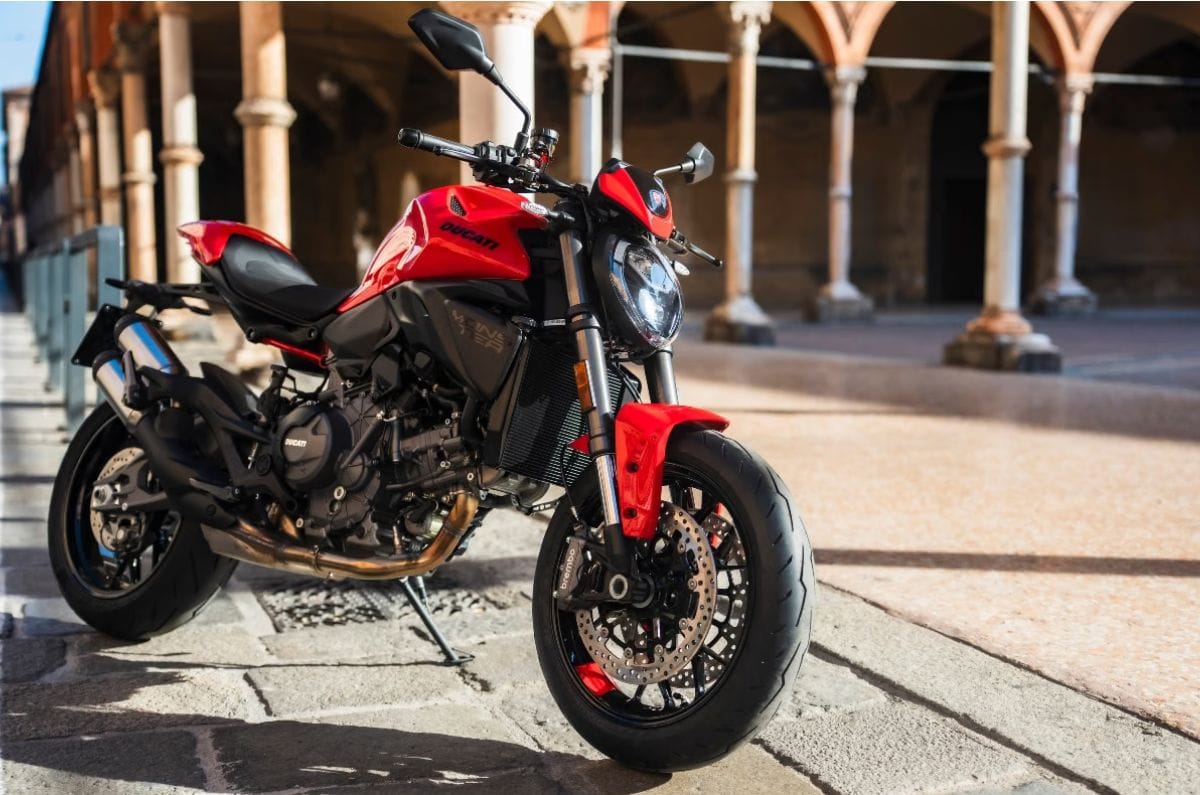
After patenting the design just a few weeks ago, Ducati is now all set to launch the Monster V2 in India. Compared to the outgoing model’s 937cc V-twin, the V2 is expected to have a smaller 890cc engine but with no change in power and ~2Nm less torque (91.1Nm vs 93Nm). The Monster V2 will also be 4kg lighter than the outgoing model. Other changes are to the chassis and a bigger tank design.
Gets a smaller 890cc V-twin shared with the Panigale V2 and other models
Features a new monocoque chassis
4kg lighter (wet weight, no fuel) than the outgoing model
Bringing the Monster’s hefty design back
Tank now looks bigger like Monsters of yesteryear, but capacity remains unchanged
The engine, although new to the Monster, is shared with other Ducatis like the Panigale V2, Streetfighter V2 and Multistrada V2. Even though the power figures are very similar to the outgoing Monster, peak power of 111hp is now available earlier in the rev range (9,000rpm vs 9,250rpm), however, peak torque now comes in later at 7,250rpm (vs 6,500rpm). Under the skin, there are further changes. The Monster V2 gets a monocoque chassis compared to the outgoing model’s aluminium frame. The tank also looks bigger now even though the capacity itself remains the same at 14-litres.
The other notable difference is the reduced weight. Coming in at 175kg (wet weight, no fuel), the Monster V2 will be 4kg lighter than the outgoing model. Currently, Ducati India has priced the Monster at Rs 13.84 lakh (ex-showroom), and we’ll have to wait for the prices for the Monster V2.
Tata Motors has launched the Nexon Camo Edition at a starting price of Rs 9.99 lakh (ex-showroom). Available for a limited period, the special edition is based on the Creative and higher trims and adds exclusive exterior colours, Camo-themed detailing, a larger infotainment display and an integrated dashcam while retaining the existing petrol, diesel and CNG engine options.
Available across 5 trims, depending on the powertrain
Exclusive Munnar Mist and Coorg Cloud paint finishes
The Nexon Camo Edition is priced from Rs 9.99 lakh to Rs 13.94 lakh (ex-showroom) and is available across Creative, Creative+ S, Creative+ PS, Fearless+ PS and Fearless+ A PS personas, depending on the powertrain. It continues to rival the Maruti Brezza, Hyundai Venue, Kia Sonet, Mahindra XUV 3XO, Skoda Kylaq and Kia Syros.
Tata Nexon Camo Edition: What’s new?
The CAMO Edition introduces two exclusive exterior colours: Munnar Mist and Coorg Cloud, along with Camo badging on the front fenders and ‘Camo’ perforation on the front-seat headrests.
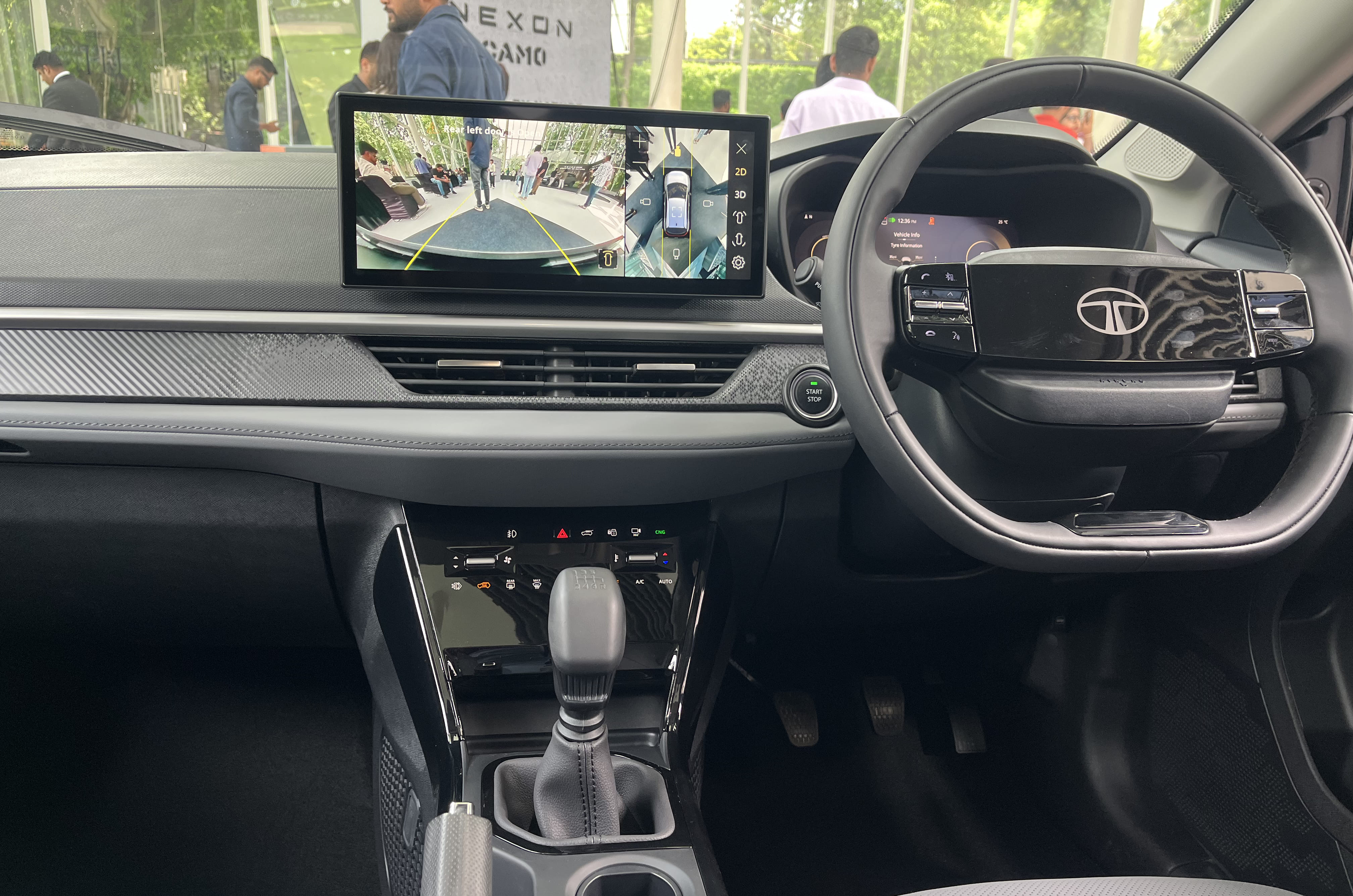
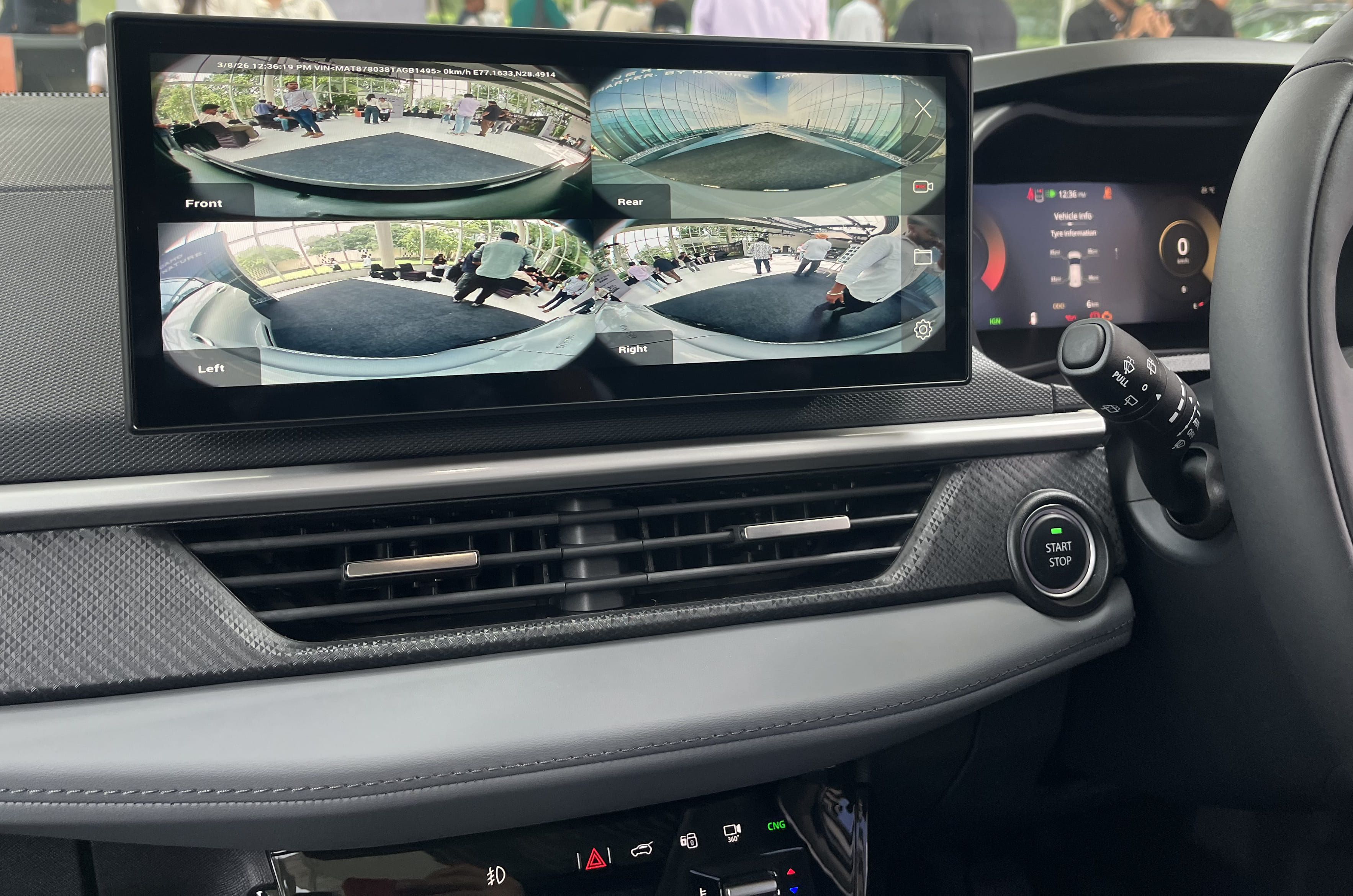
The biggest change inside is the addition of Tata’s 12.3-inch Harman touchscreen infotainment system, replacing the 10.25-inch unit offered on the corresponding variants of the standard Nexon. The 10.25-inch digital instrument cluster is carried over. An integrated dashcam that works with the 360-degree camera system has also been added.
Apart from the Camo-specific additions, the Nexon continues with features such as a panoramic sunroof, ventilated front seats, a JBL nine-speaker audio system, wireless Android Auto and Apple CarPlay, a wireless charger, connected car technology, a 360-degree camera with a blind-view monitor and advanced driver assistance systems (ADAS), depending on the variant.
The Camo Edition is available with the Nexon’s existing 1.2-litre turbo-petrol, 1.5-litre diesel and 1.2-litre turbo-petrol CNG engines. Outputs remain unchanged at 120hp and 170Nm for the petrol, 115hp and 260Nm for the diesel and 100hp and 170Nm in CNG mode. Transmission options include a 6-speed manual, an AMT and a 7-speed dual-clutch automatic, depending on the engine and variant.
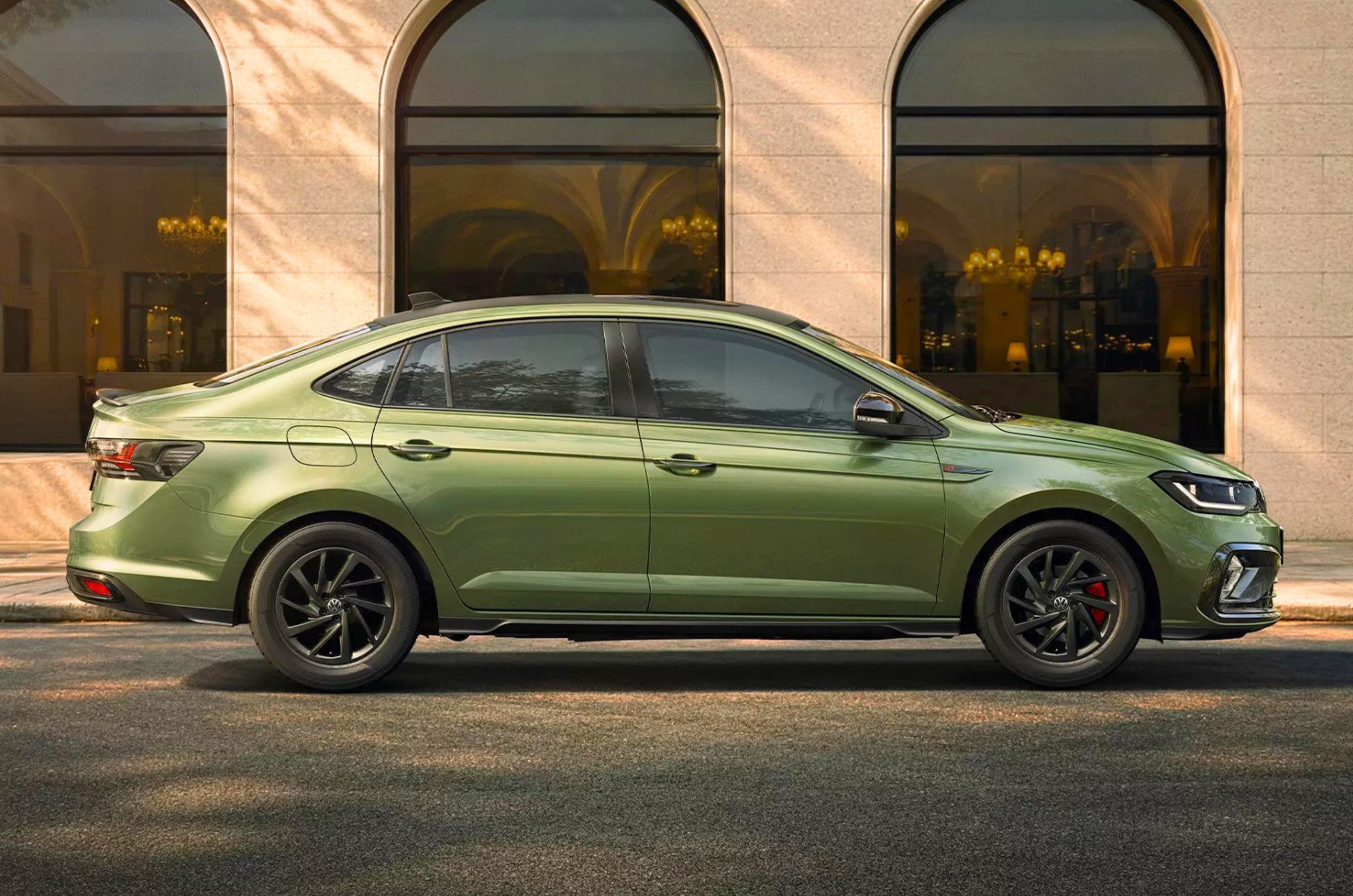
Volkswagen has launched the Anniversary Edition of the Virtus sedan at Rs 19.20 lakh (ex-showroom, India). It arrives about four years after the model was first introduced in the India market. The Virtus Anniversary Edition is based on the top-spec GT Plus Sport trim of the VW sedan, so it shares several of the latter’s visual aesthetics and feature set. The price of the Anniversary Edition identical to the trim that it’s based on, despite offering additional equipment.
Based on the top-spec GT Plus Sport trim
Finished in an exclusive Avocado Pearl colour
Features puddle lamps, 360-degree cameras, front parking sensors and more
Only available with the 1.5 TSI engine and DSG gearbox
Volkswagen Virtus Anniversary Edition: Exterior and interior features
The Anniversary Edition of the Volkswagen Virtus comes finished in an Avocado Pearl exterior colour, which Volkswagen says is exclusive to this edition. It also gets a contrasting black roof, black alloy wheels with red brake calipers and a black boot-lip spoiler – all of which are shared with the GT Plus Sport. Other shared design features include a gloss-black front bumper trim, darkened headlamps and tail-lamps housings, an all-black interior theme with gloss-black inserts on the dashboard.
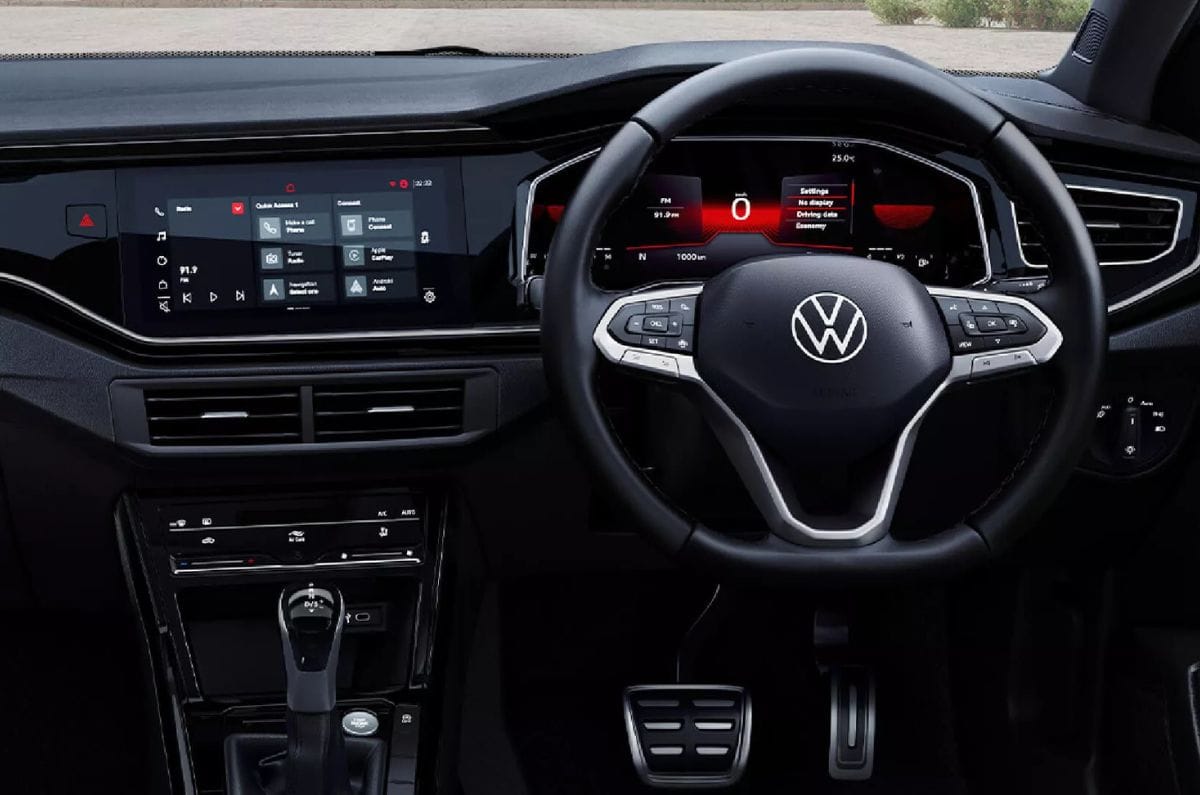
Volkswagen Virtus GT Plus Sport’s interior shown for representational purposes only.
On the equipment front, the Virtus Anniversary Edition is offered with official Volkswagen accessories like puddle lamps, a 360-degree camera system and front parking sensors. Since it’s based on the fully loaded GT Plus Sport trim, the Anniversary Edition shares all of its other feature set too. This includes the likes of leatherette upholstery, red ambient lighting, ventilated front seats, a powered sunroof, a 10-inch touch-infotainment screen, automatic climate control, an 8-speaker audio system and paddle shifters.
Safety features of the limited-run Virtus Anniversary Edition are also familiar. This means that it gets 6 airbags, electronic stability control, traction control, hill-start assist, and ABS with EBD, among others.
Volkswagen Virtus Anniversary Edition: Engine and gearbox
Under the bonnet of the Volkswagen Virtus Anniversary Edition is the same 1.5 TSI engine and 7-speed DSG (dual-clutch automatic) gearbox. This 1.5-litre four-cylinder turbo-petrol mill features direct injection, developing 150hp and 250Nm of torque. This engine and gearbox pairing has a claimed fuel economy of 19.62kpl. Meanwhile, the standard Virtus is also available with a 1.0-litre three-cylinder turbo-petrol engine with direct injection, which makes 115hp and 178Nm. This TSI unit can be mated with either a 6-speed manual or a 6-speed torque-converter automatic transmission.
Tata Motors has launched the Nexon Camo Edition at a starting price of Rs 9.99 lakh (ex-showroom). Available for a limited period, the special edition is based on the Creative and higher trims, and adds exclusive exterior colours, Camo-themed detailing, a larger infotainment display and an integrated dashcam, while retaining the existing petrol, diesel and CNG engine options.
Available across 5 trims, depending on the powertrain
Exclusive Munnar Mist and Coorg Cloud paint finishes
New 12.3-inch touchscreen and integrated dashcam
Tata Nexon Camo Edition: what’s new?
The CAMO Edition introduces two exclusive exterior colours: Munnar Mist and Coorg Cloud, along with Camo badging on the front fenders and ‘Camo’ perforation on the front seat headrests.
The biggest change inside is the addition of Tata’s 12.3-inch Harman touchscreen infotainment system, replacing the 10.25-inch unit offered on the corresponding variants of the standard Nexon. The 10.25-inch digital instrument cluster is carried over. An integrated dashcam, which works with the 360-degree camera system, has also been added.
Apart from the Camo-specific additions, the Nexon continues with features such as a panoramic sunroof, ventilated front seats, a JBL nine-speaker audio system, wireless Android Auto and Apple CarPlay, a wireless charger, connected car technology, a 360-degree camera with blind view monitor and ADAS, depending on the variant.
The Camo Edition is available with the Nexon’s existing 1.2-litre turbo-petrol, 1.5-litre diesel and 1.2-litre turbo-petrol CNG engines. Outputs remain unchanged at 120hp and 170Nm for the petrol, 115hp and 260Nm for the diesel and 100hp and 170Nm in CNG mode. Transmission options include a 6-speed manual, AMT and 7-speed dual-clutch automatic, depending on the engine and variant.
Tata Nexon Camo Edition: price and rivals
The Nexon Camo Edition is priced from Rs 9.99 lakh (ex-showroom) and is available across Creative, Creative+ S, Creative+ PS, Fearless+ PS and Fearless+ A PS personas, depending on the powertrain. It continues to rival the Maruti Brezza, Hyundai Venue, Kia Sonet, Mahindra XUV 3XO, Skoda Kylaq and Kia Syros.