UMS Technologies: India’s smallest carmaker

INDIA’S SMALLEST CARMAKER

The origin of the species. The very beginnings of the automobile. Where it all started. How it all started. What form the earliest cars took. What if you could experience all of this in one place, at the same time? Say hello to UMS Technologies, India’s smallest carmaker. Nestled in the heart of the bustling city of Coimbatore, where the manufacturing of machines is almost a religion, UMS tech not only recreates the past, it does so with exacting precision and a level of dedication that borders on obsession.

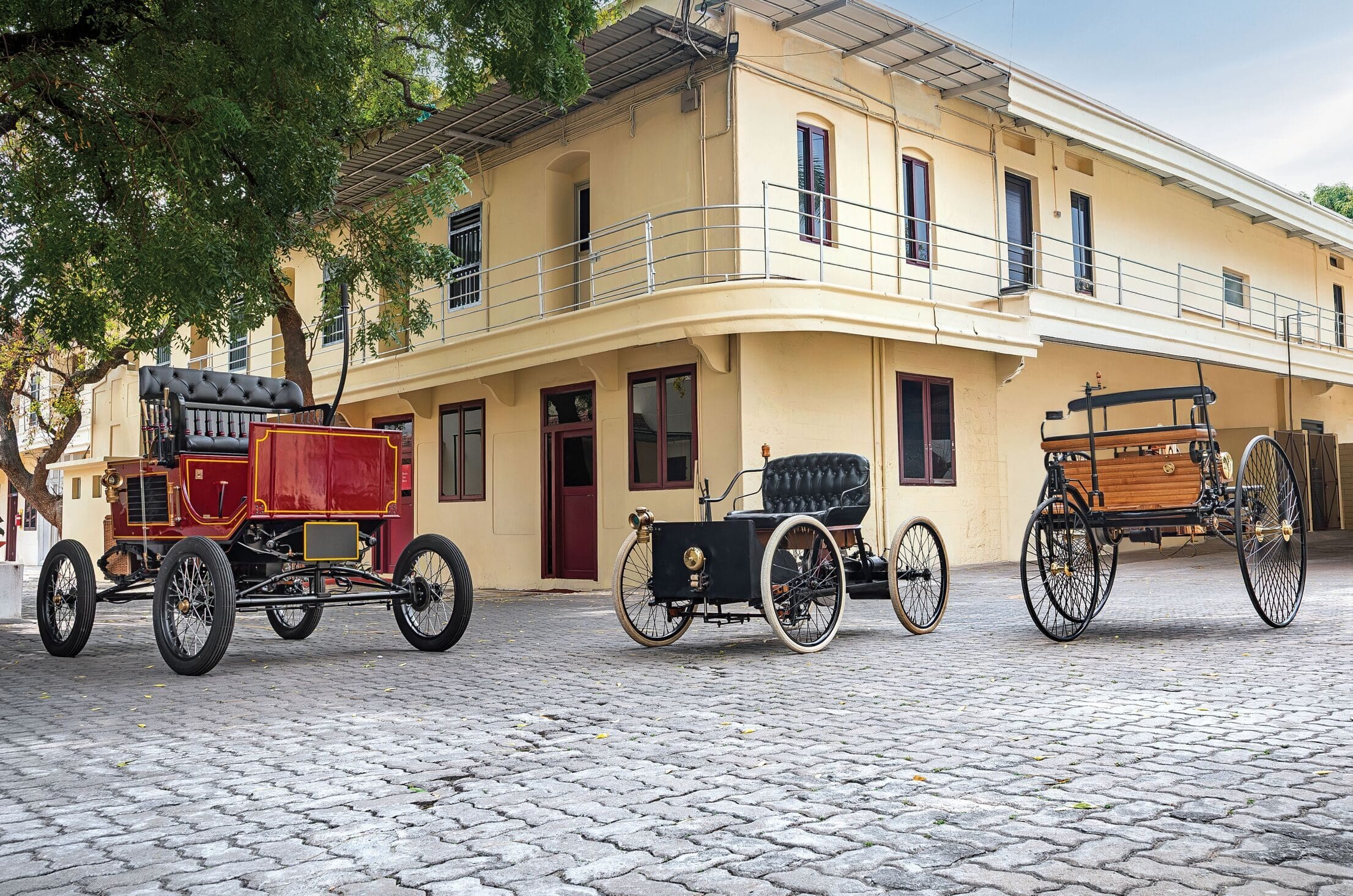
Walk onto the shop floor, just off main street Coimbatore, and you are greeted by finished versions of three icons – the 1899 Stanley Steamer, the 1896 Ford Quadricycle, and the 1886 Benz Patent-Motorwagen. Each is a faithful replica, crafted with painstaking detail, and together they tell the story of how the automobile was born. It feels like history is coming back to life. 

Give me steam 
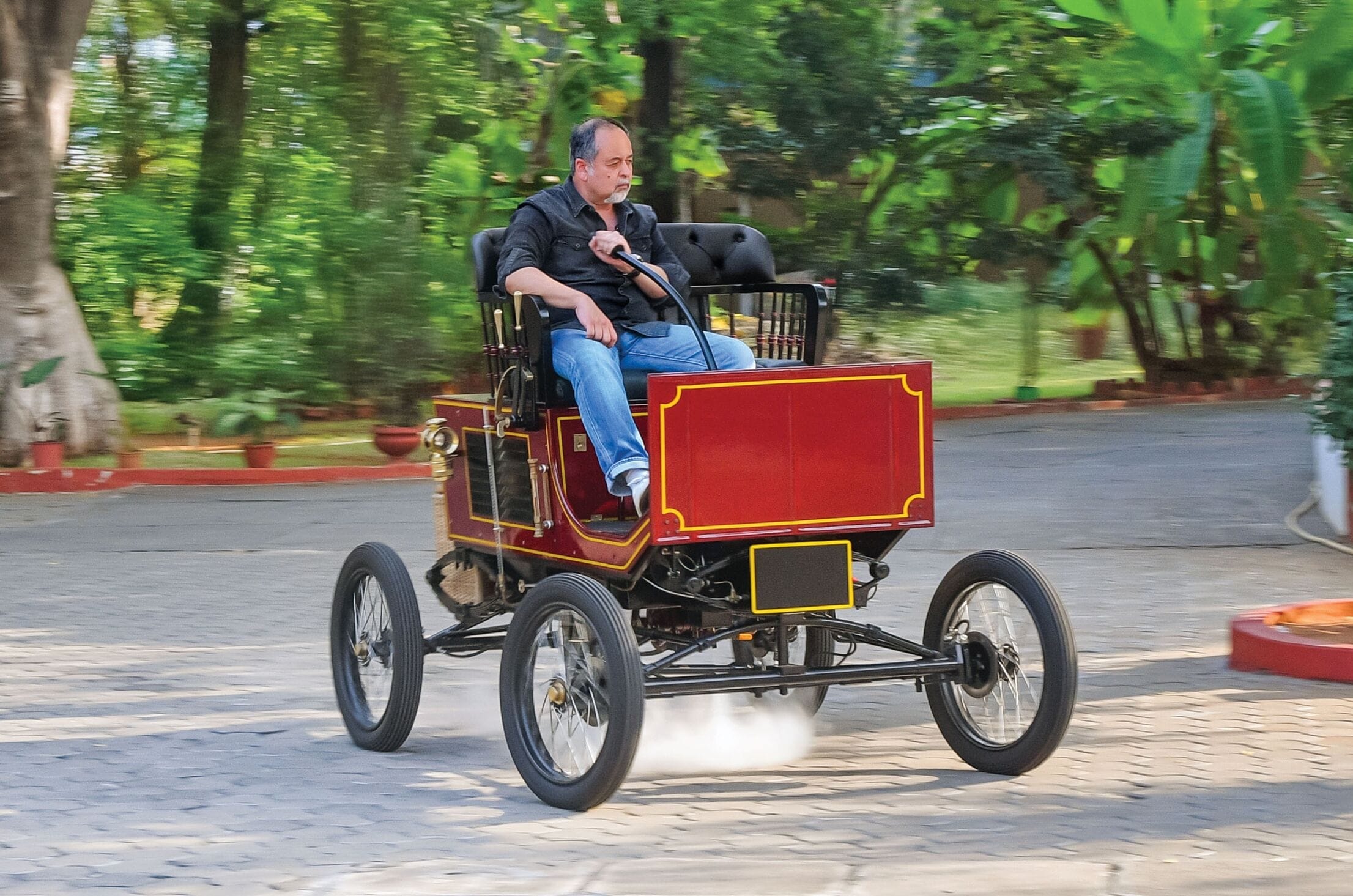
The steam car is the most difficult to steer and can accelerate quickly for a prehistoric car.

The Locomobile, or Stanley Steamer, is perhaps the most theatrical of the trio. Originally powered by naphtha and coal, it relied on steam pressure to drive its pistons. Did you know steam-powered cars predated petrol-powered cars by almost a century?  The replica here, however, has been updated with a diesel burner. Pressure in the ‘boiler’ goes up to around 150-200 PSI, and a gauge on the dashboard (origin of the term) tells you when the car is ready to move. This takes a bit.
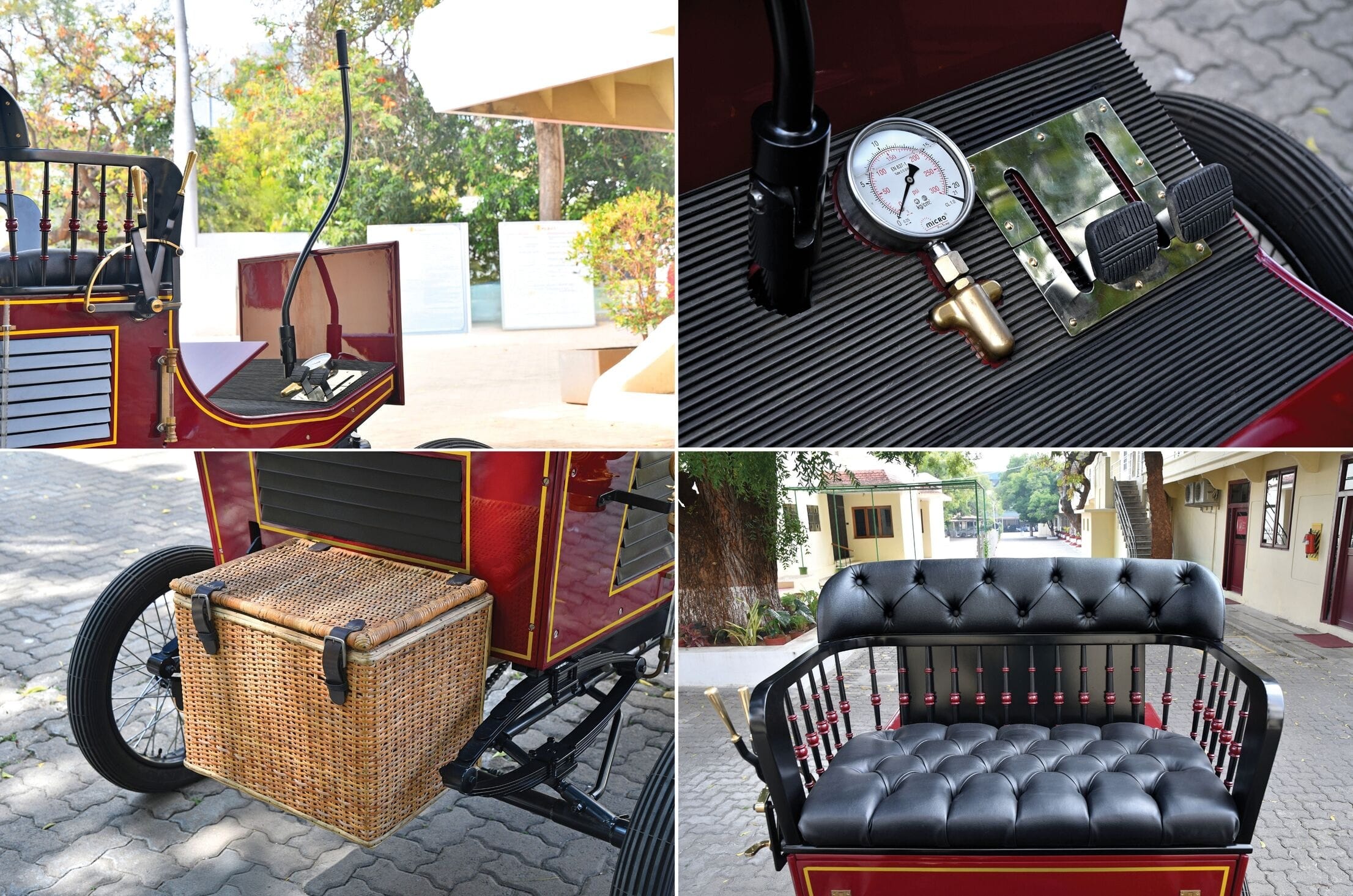
Clockwise from left: Levers select direction; Braking is via motorcycle discs; Seat feels like a comfy sofa; Diesel burner replaces coal.

Sidebar: steam-powered ships like aircraft carriers sometimes took 12-24 hours to build up a sufficient head of steam before they could start. In the car, once the needle climbs into range, a gentle push on the accelerator sends the vehicle chuffing forward with the rhythm of a steam train. The experience is surreal. Torque is abundant, acceleration is surprisingly brisk, and the soundtrack – a soft, mechanical chuffing – is delightfully addictive. Steering it, however, is a challenge. Without a wheel, only a rudimentary tiller guides the car, reminding me of why the steering rack was one of the most important innovations. Fun fact: none of the three cars here has a steering wheel. For safety, especially considering how quick it is when it builds up a head of steam, UMS Technologies has added motorcycle disc brakes. 

Before the Model T
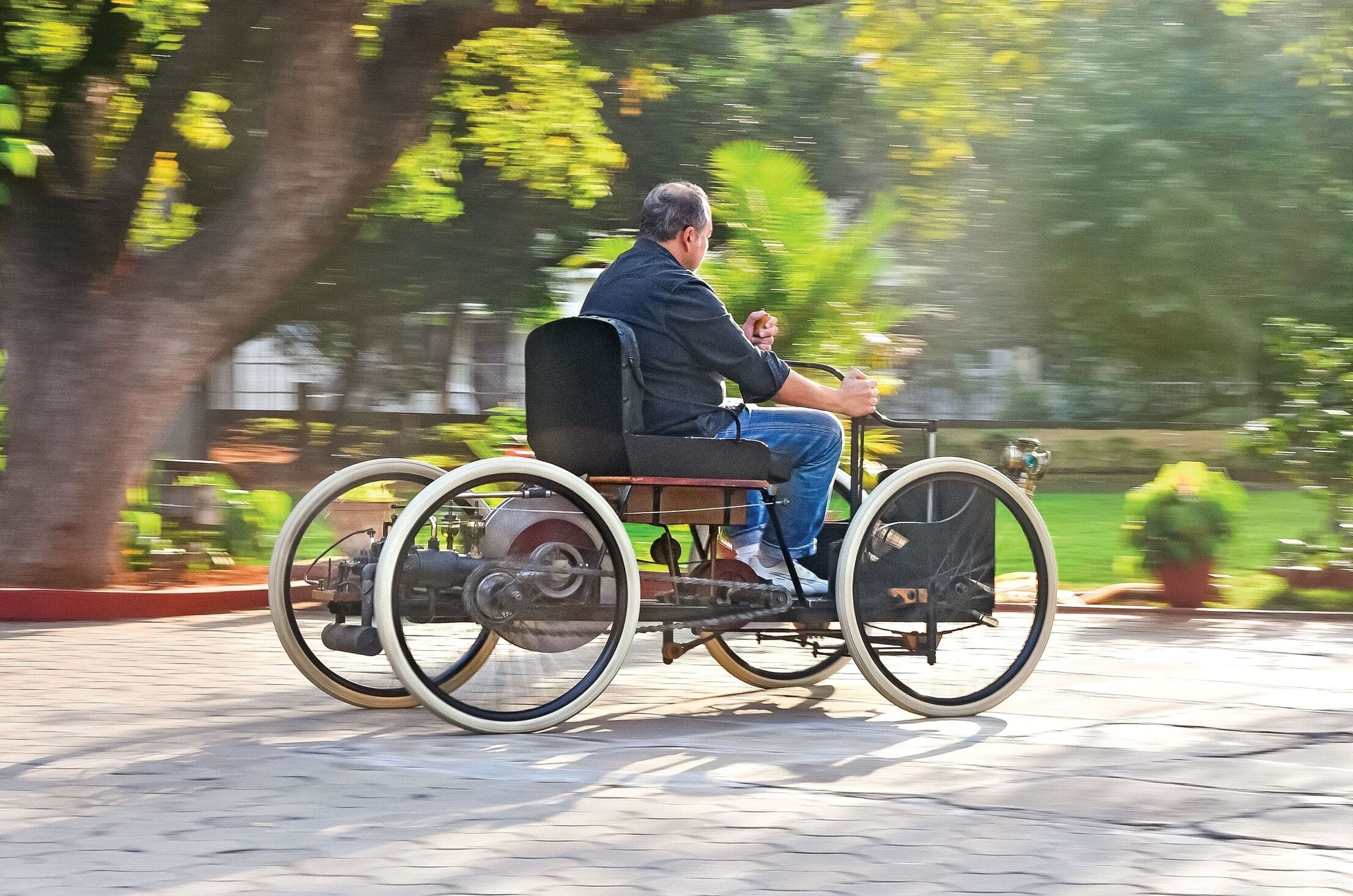
This was the car Henry Ford made before the Model T or even before the company’s formation in 1903.

If the Stanley Steamer is theatrical, the Ford Quadricycle is a burst of youthful energy. Built in 1896, ten years after Karl Benz unveiled his Patent-Motorwagen, it was Henry Ford’s first car, created before he even founded the Ford Motor Company in 1903. The replica is faithful to the original, complete with its mid-mounted twin-cylinder engine and bulb-type rudimentary carburettors that mix the fuel and air. The pistons are exposed, with no sump for oil, so lubrication is handled by drip-feed systems. A brass tube connects the pistons to water tanks for cooling, while spark plugs, carburettor, tappets, and valves are all visible, making the engine look like a mechanical marvel, all the running bits visible and exposed.
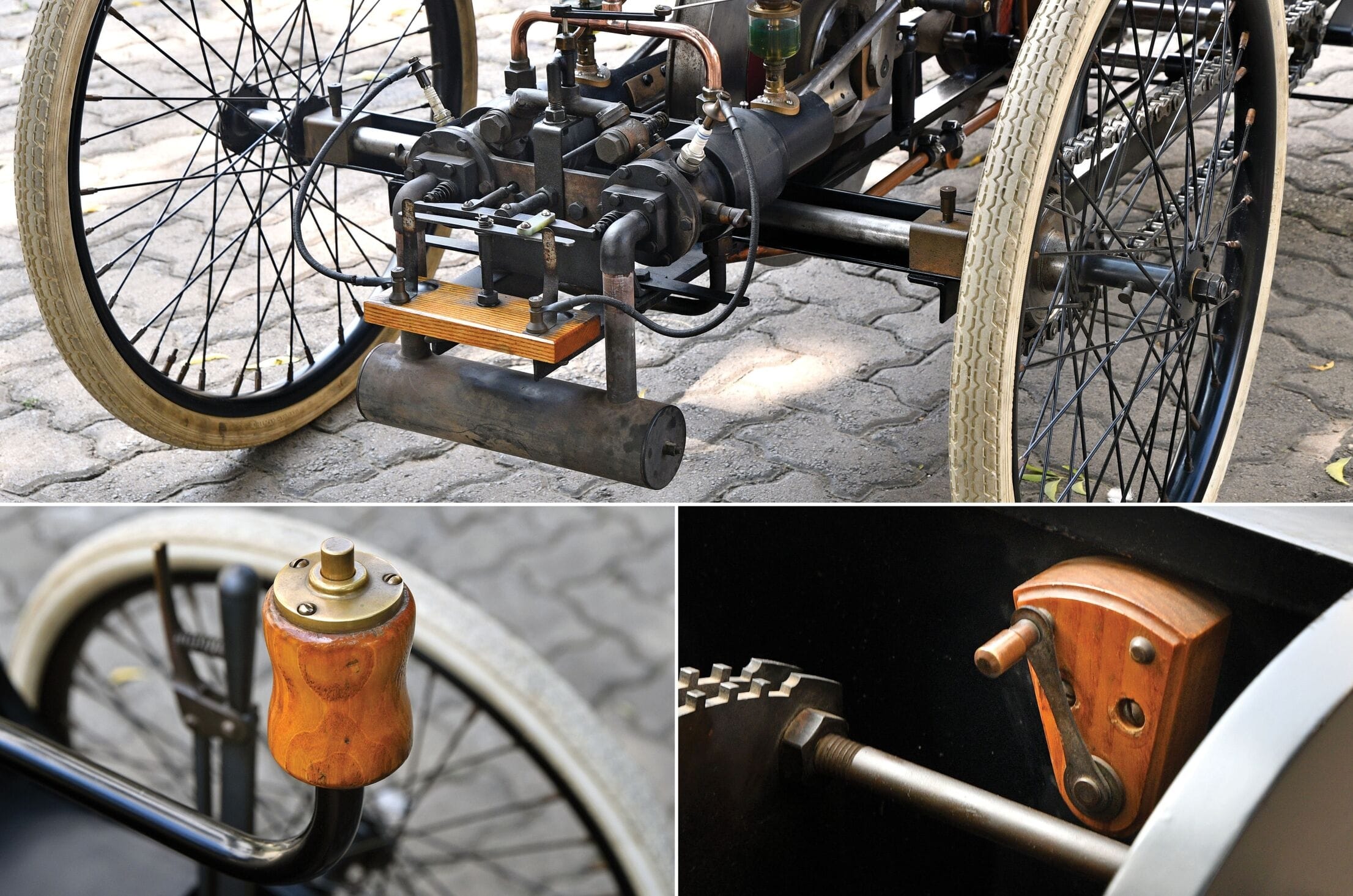
Clockwise from top: Twin cylinders placed horizontally; Contact box switch to start the car; Steering knob has button for the bell. 

Driving it is exhilarating. The twin cylinders give it a noticeable boost in speed. Steering is again by a tiller, while a lever operates the throttle, much like one on an aircraft; but in reverse. Pulling the lever back sends the car shooting forward, while pushing it forward slows it down! And yes, Ford even thought to add a horn, making this one of the first cars to have this safety feature. Something else that’s fascinating – this car runs on E100 or pure ethanol. However, there’s no blue roundel or Ford badge. This car came before the Ford Motor Company, remember. 

Prime petroleum  
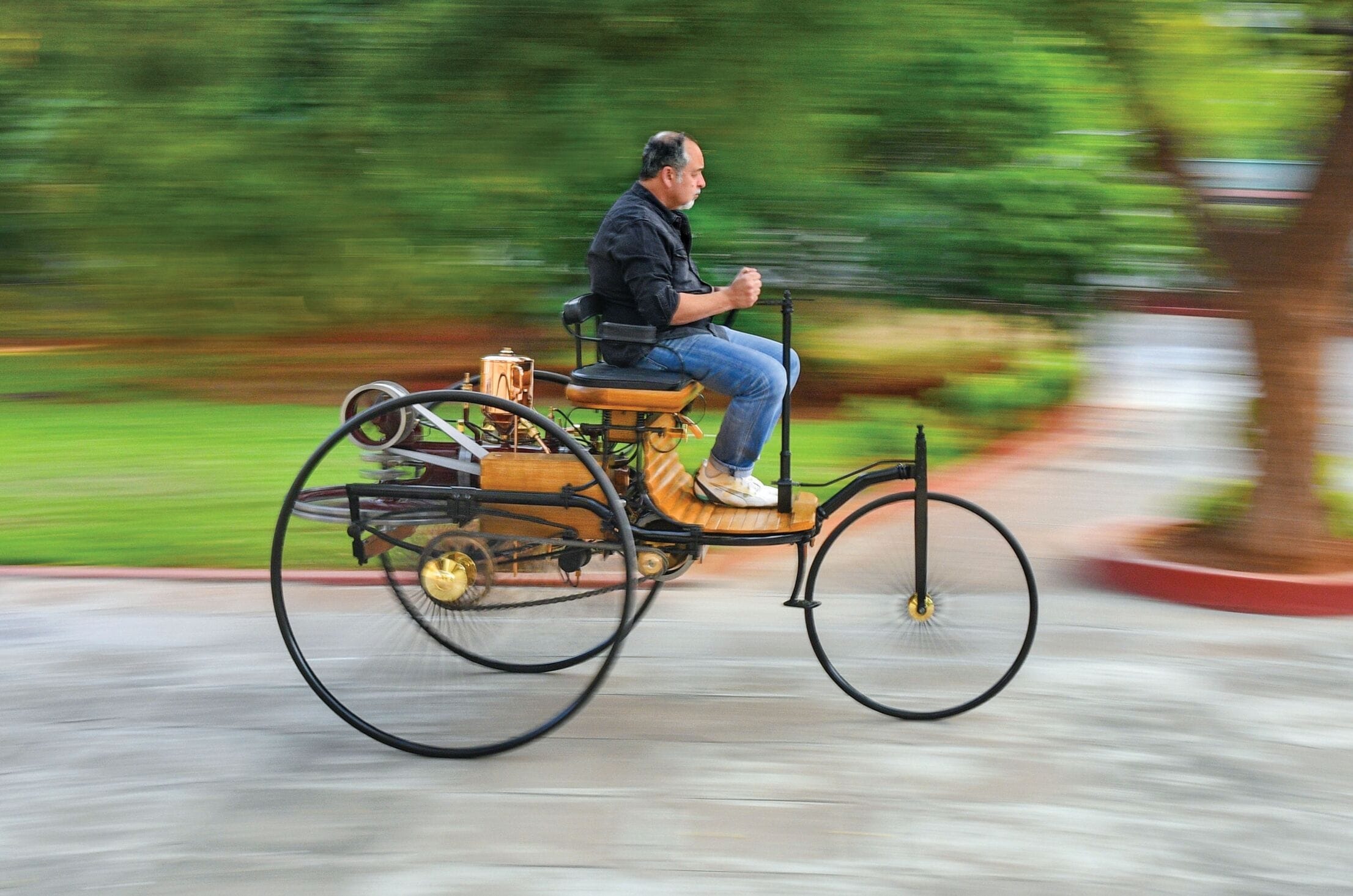
It moves forward gingerly with a put-putting sound from the weak single-cylinder ‘engine’.

The Benz Patent-Motorwagen, however, is the granddaddy of them all. Widely regarded as the first petrol-powered car, it was unveiled in 1886 and changed the course of history. While steam vehicles had existed since the 1760s, Benz’s creation was revolutionary: a single-cylinder, horizontal piston engine mounted on a tricycle frame. The replica here is almost indistinguishable from the original. Austrian white ash has been imported for the woodwork, just as Benz used in Germany. Brass fittings, carburettors, pistons and connecting rods are all crafted in-house, from the same materials that were used on the original. Even the massive wheels with hard-rubber tyres are made at the factory in Coimbatore, cast and assembled with meticulous care, as we stand and watch. 

Operating the Motorwagen is an exercise in patience. The wooden box houses the battery and electrics, while the crankshaft and piston lie horizontally. A pulley system drives the camshaft, with pushrods for intake and exhaust valves. The engine is started by spinning the horizontally placed ‘fly wheel’, and the car starts with a soft and faint put-put-put, white smoke softly escaping from the rear. 
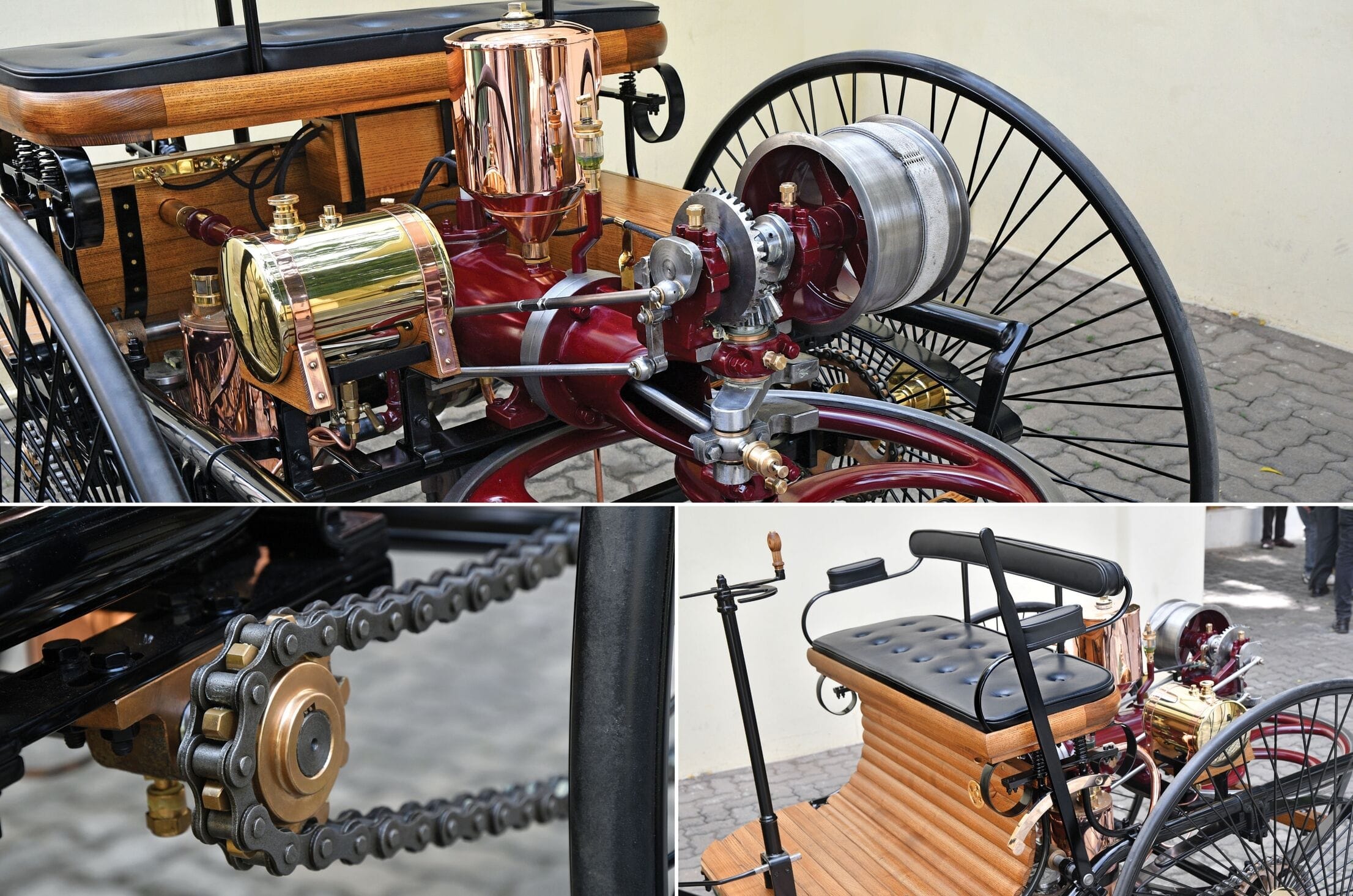
Clockwise from top: Brass canisters hold water, fuel; You steer with a tiller and use a long lever to accelerate, brake; Drive is via bicycle chain.

Sat high up, you control acceleration and braking with a single lever; push forward to accelerate or pull back to brake. On the road, it feels fragile and threatens to tip over at times. Unless you push the throttle open, even gentle slopes are a challenge. And then there’s some overrun, so you often need to pump the lever to give it a burst of power. In addition, the ride is harsh, the suspension rocks you and larger bumps simply toss you and threaten to flip the tricycle. But every chug of the piston, every few metres you cover remind you that this is where petrol motoring began. 

Recreating history

What makes these replicas remarkable is not just their historical accuracy, but the fact that they are built entirely in-house. UMS Technologies casts its own parts – cylinder heads, crankshafts, flywheels, carburettors – 20km away, then assembles them here. Brass, steel, gunmetal and Austrian ash are all shaped into components that mirror the originals. The workshop even uses a Carl Zeiss measuring machine to check tolerances on the Benz cylinder head – something Karl Benz himself could never have imagined in 1886. And the company doesn’t stop at cars. It also builds engines for drones and RC planes, ranging from single-cylinder 100cc units to seven-cylinder radial engines. Precision, craftsmanship and innovation coexist in this tiny factory, proving that scale is not a prerequisite for excellence. It even makes small turbine engines, complete with flames emitted from the rear and afterburners. 
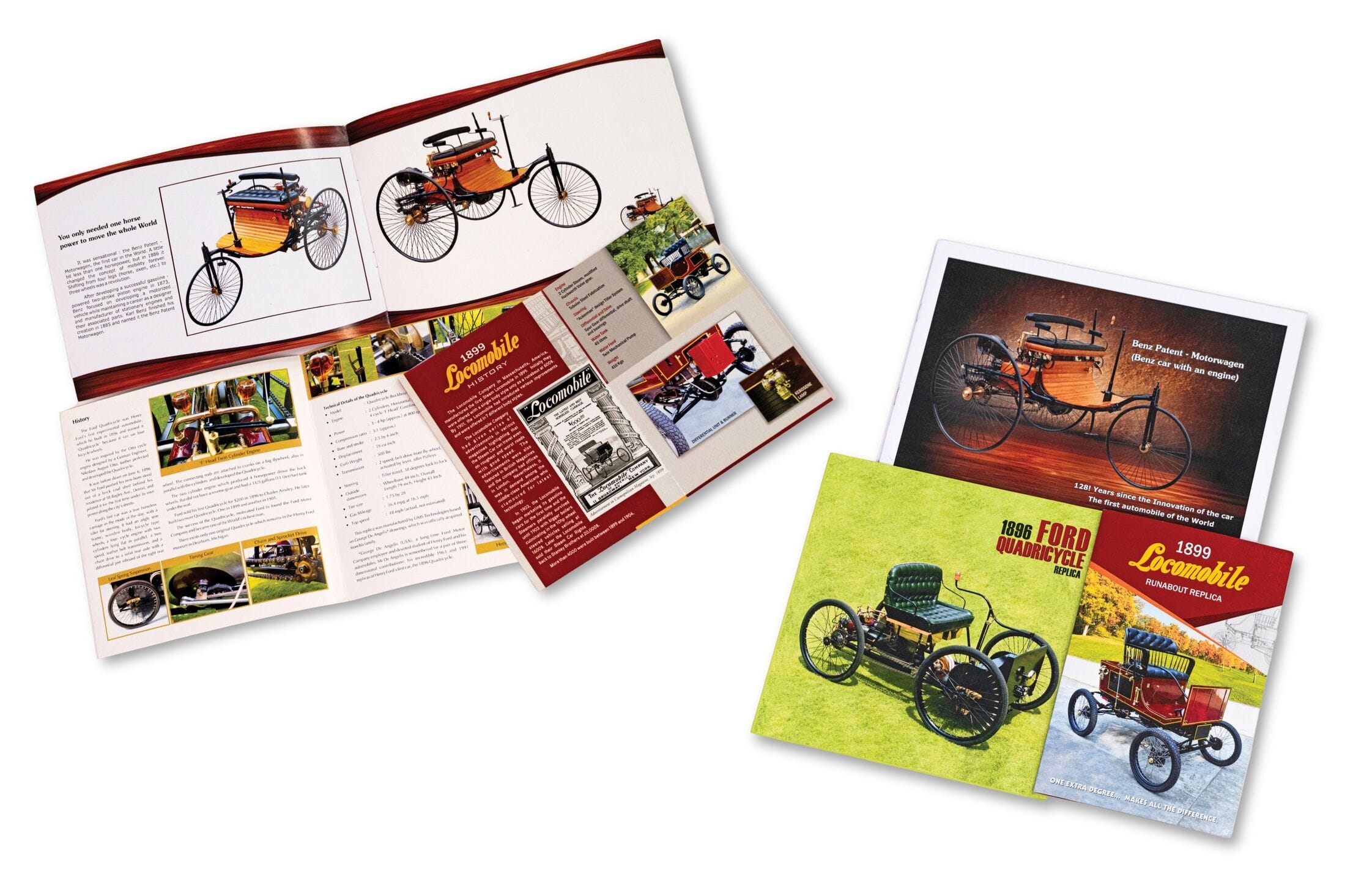
Each car gets its own brochure, as it should.

In an era dominated by SUVs, EVs and autonomous driving, why do these replicas matter? Because they remind us of where it all began. They show us the ingenuity of pioneers who built cars, they highlight the evolution of engineering, from steam to petrol, from tillers to steering wheels, from drip-feed lubrication to blade batteries. 

India’s smallest carmaker has achieved something extraordinary. By recreating the Stanley Steamer, the Ford Quadricycle and the Benz Patent-Motorwagen, it has preserved the earliest DNA of the automobile and shown us what it must have been like to drive and be transported by these machines. Even better, if you want to own one of these, each of them is on sale. 


Benz Motor Wagen

Stanley Steamer

Ford Quadricycle

Price*

Rs 22.10 lakh

Rs 19.50 lakh

Rs 15.60 lakh

Wheelbase

1,450mm

1,473mm

1,200mm

Power

0.68hp

3.5-5.5hp

3-4hp

Kerb weight

265kg

410kg

227kg

Top speed

16kph

40-48kph

28kph

*Domestic market discount 20-25 percent

No steering required 

Driving these three, you get a sense of what the pioneering days of motoring must have been like. You sit exposed, as on a carriage, and looking at this set here, that’s what they really are – horseless carriages. In the Patent-Motorwagen, you pump the accelerator and brake repeatedly, coaxing the car up inclines and slowing it down with a wooden lever. It feels awkward at first, but soon you get the hang of it. The ride is rough, but the sense of history is overwhelming. In the Stanley Steamer, you wait five minutes for pressure to build, then glide forward with effortless torque. The chuffing soundtrack is addictive, and the acceleration surprisingly rapid. Steering with a tiller is tricky, but the experience is joyous. In the Ford Quadricycle, performance takes centre stage. The twin cylinders deliver speed, the ethanol tank nods to sustainability, and the bell-like horn adds a touch of practicality. It feels like the first step toward the modern automobile. Together, they offer a time jump into motoring’s infancy.

How these cars are made in India
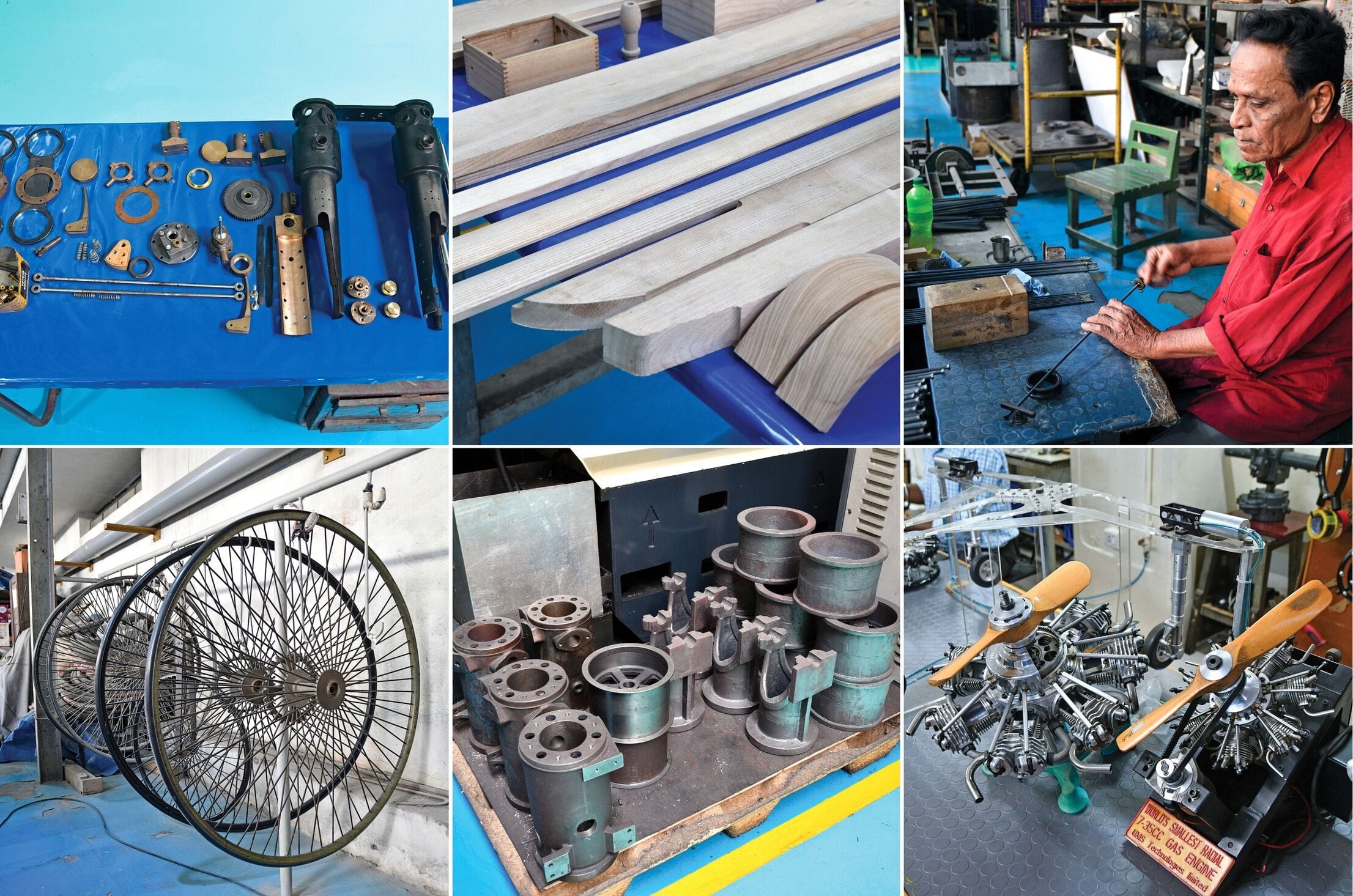
All basic parts for the engines are cast or machined either in-house or by a local supplier; for the Benz, the same imported ash wood as the original is used; the spokes and big wheels are made by hand; cylinder and sleeve made to the same spec as the originals; UMS also makes cylinder radial engines for drones and model planes – a nine-cylinder radial and a turbine, among the many.

Interview with GD Gopal, UMS Technologies
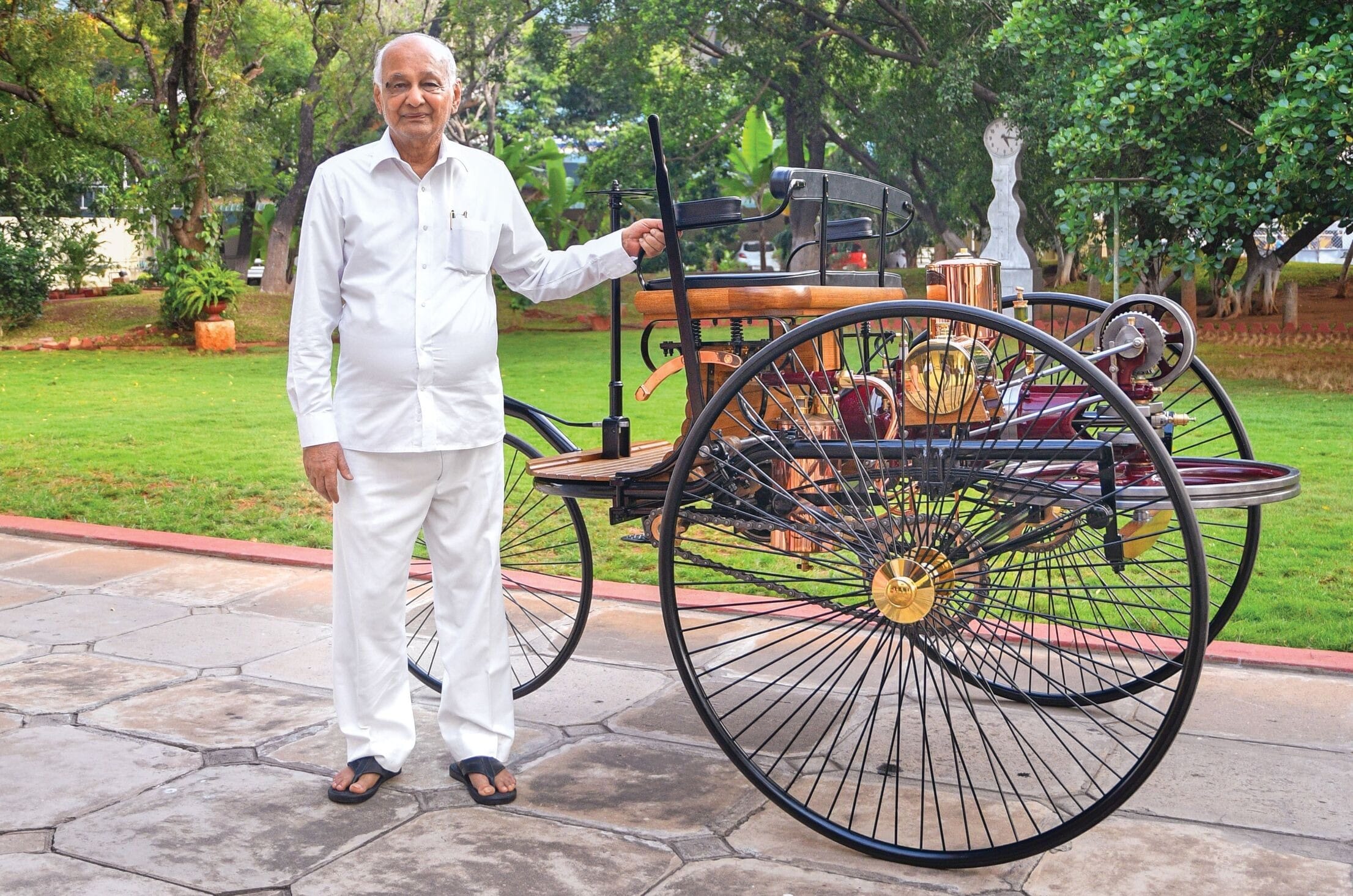
Why build replicas of cars that are more than a century old?

Because they are the roots of motoring. Everyone knows the latest SUVs or EVs, but very few have seen where it all began. By recreating the Stanley Steamer, the Ford Quadricycle and the Benz Patent-Motorwagen, we’re preserving history in a way people can touch, feel and drive.

How difficult is it to manufacture these cars from scratch?

Extremely difficult. We cast our own cylinder heads, crankshafts and carburettors. Even the woodwork is done here using Austrian ash, just like the originals. Every part is measured, machined and finished by hand. It’s not about mass production; it’s about precision and authenticity.

What’s next?

We’ll keep building history. And maybe inspire the future too.

MG GO!, Cyber electric concepts revealed at Goodwood Festival of Speed 2026

MG GO

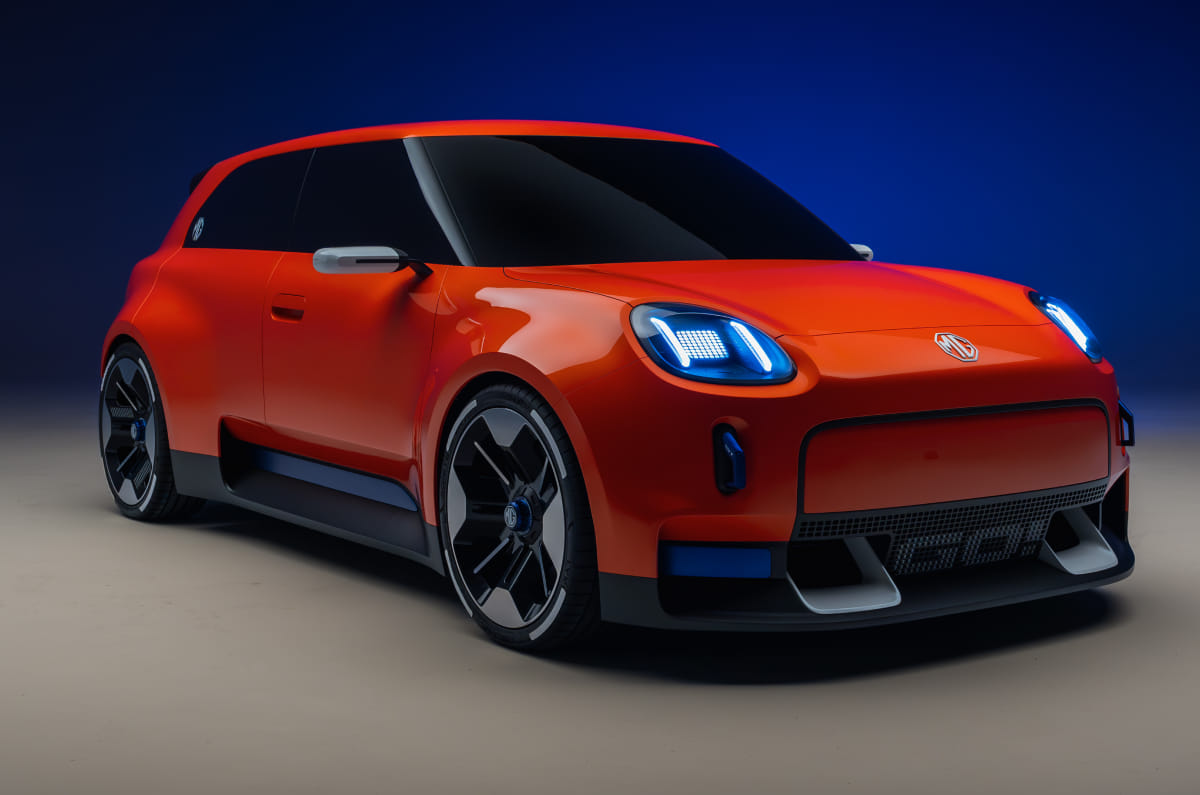
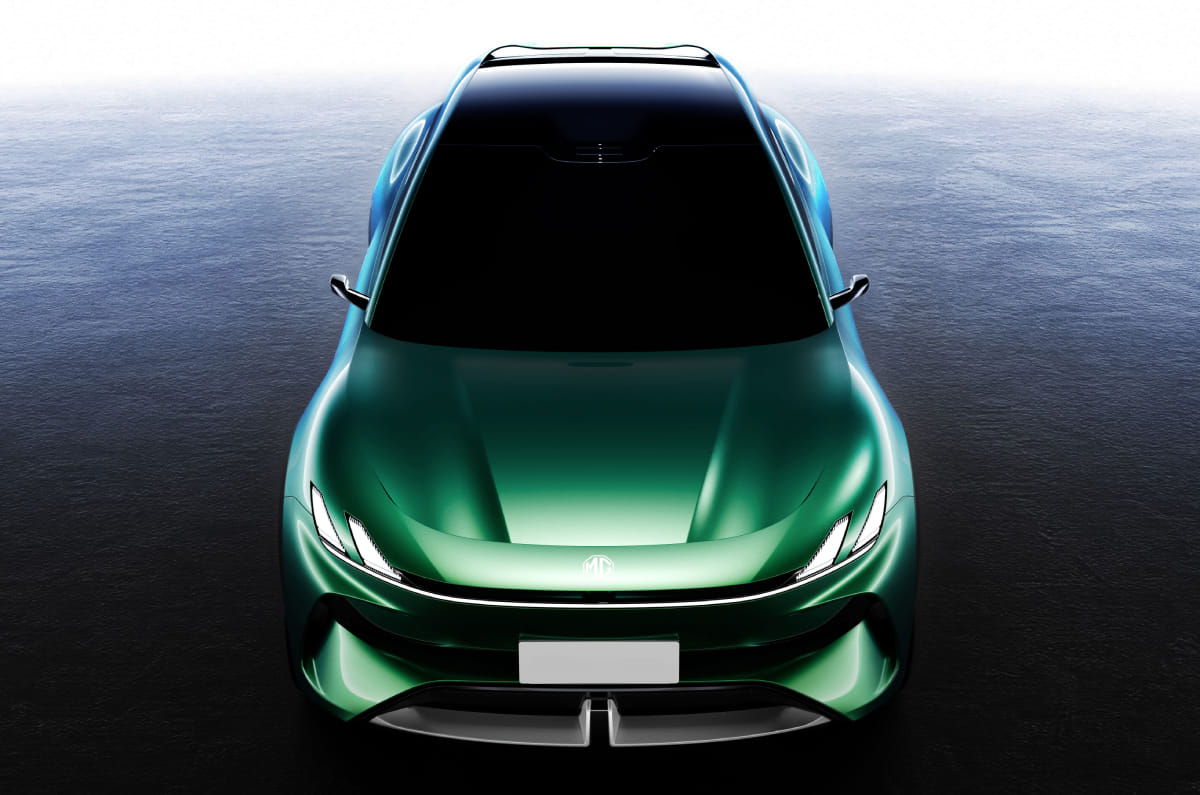
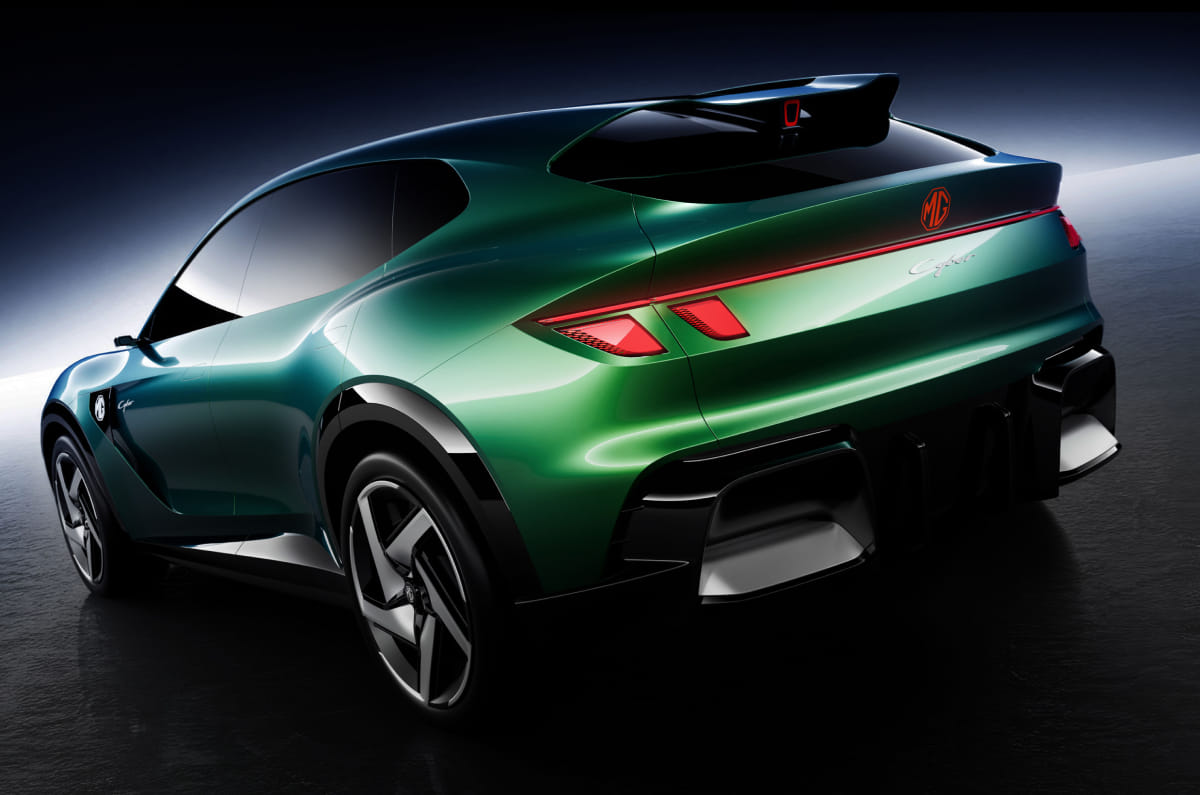
MG has unveiled two electric concepts at the 2026 Goodwood Festival of Speed. Called the MG GO! and Cyber Concept, the two models preview a B-segment electric hatchback and a large D-segment performance SUV, respectively. MG has confirmed that a production model previewed by the GO! will arrive in 2027, but has not announced a production timeline for the Cyber Concept.

MG GO! 

Production model confirmed for 2027

The MG GO! is a compact B-segment electric hatchback that previews a production model due in 2027. Both the concept and the upcoming road car have been designed at the MG Design Centre in London under design director Carl Gotham.

MG says the GO!’s design is influenced by its models from the mid-20th century, particularly the MGB GT. The company also cites the MG Metro Turbo, MG ZR and MG EX4 among the models referenced while developing the concept.

“With MG GO!, we wanted to create something compact and contemporary, but also warm, expressive and immediately likeable,” said Gotham. He added that the design aims to reinterpret the “clarity, charm and emotional appeal” associated with older MG models.

The five-door concept gets rounded headlights, a closed-off front grille, flared wheel arches, large alloy wheels and a roof spoiler. MG has not revealed battery, motor, range or charging details for the GO!.

MG Cyber Concept 

D-segment concept takes inspiration from the MG EX181

The Cyber Concept previews a future D-segment electric SUV and is positioned as a flagship design study for the brand. MG says the concept draws inspiration from the EX181 land-speed record car and explores how its performance focus could be applied to a large electric SUV.

The concept has a low, sloping roofline, wide stance and heavily sculpted bodywork. At the front, slim lighting elements sit above a full-width light strip, while the rear features a full-width light bar, an illuminated MG badge and a large roof-mounted spoiler.

MG says the Cyber Concept has been developed to combine the space and everyday usability of an SUV with a greater focus on performance and driving dynamics. However, the company has not announced battery, motor or performance details for the concept.

MG has also not disclosed a production timeline for the Cyber Concept.

Volkswagen Tayron R Line vs Tiguan R Line performance compared

Tayron R  Line vs Tiguan R Line

The Tayron R Line and Tiguan R Line sit at the top of Volkswagen’s portfolio in India. Both closely priced SUVs utilise the same platform and engine, but while the former is a 7-seater, the latter gets a 5-seat layout. We’ve tested the real-world performance of both models to find out how each performs with an identical engine and gearbox underneath.

Volkswagen Tayron R Line vs Tiguan R Line: Specifications

Volkswagen Tayron R Line vs Tiguan R Line: Specifications

Specifications

Tayron R Line

Tiguan R Line

Engine

4 cyls, turbo-petrol 

4 cyls, turbo-petrol

Displacement (cc)

1,984

1,984

Power (hp)

204

204

Torque (Nm)

320

320

Drive layout

AWD

AWD

Gearbox

7DCT

7DCT

Kerb Weight (kg) 

1,864

1,758

Power-to-weight (hp/tonne)

109.44

116.04

Torque-to-weight (Nm/tonne)

171.67

182.02

Powering both the Tayron and Tiguan is Volkswagen’s 2.0L TSI EVO engine, which is a direct-injection turbo-petrol unit. The mill churns out 204hp and 320Nm of torque, with power being sent to all four wheels via a 7-speed DCT gearbox. The only difference here is weight, where the Tiguan is lighter by 106kg leading it to have the better power/torque to weight figures in this comparison.

Volkswagen Tayron R Line vs Tiguan R Line: 0-100kph acceleration test

Volkswagen Tayron R Line vs Tiguan R Line: 0-100kph acceleration timings (seconds)

0-100kph acceleration

Tayron R Line

Tiguan R Line

0-20kph

1.15

1.12

0-40kph

2.16

2.03

0-60kph

3.56

3.26

0-80kph

5.50

5.01

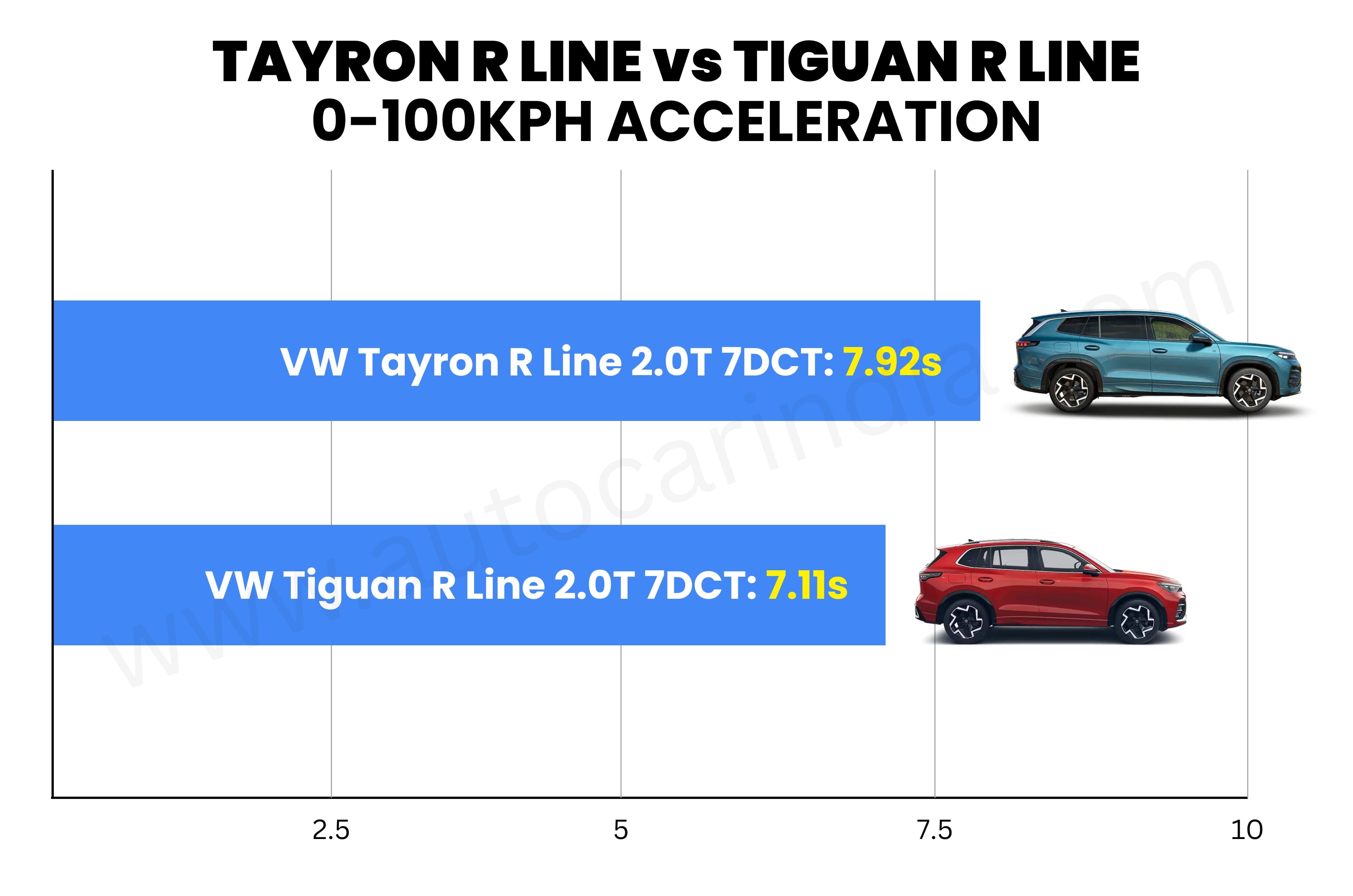
0-100kph

7.92

7.11

0-120kph

11.21

9.89

In our 0-100kph acceleration test, the Tiguan’s lighter weight came to its advantage, allowing it to accelerate 0.81 seconds quicker. At speeds of up to 20kph, both SUVs’ timings are closest, but as speeds increase, the Tiguan increases its gap further.  At 120kph, the Tiguan leads over the Tayron by 1.32 seconds. 

Volkswagen Tayron R Line vs Tiguan R Line: Rolling acceleration tests

Volkswagen Tayron R Line vs Tiguan R Line: Rolling acceleration tests (seconds) 


Tayron R Line

Tiguan R Line

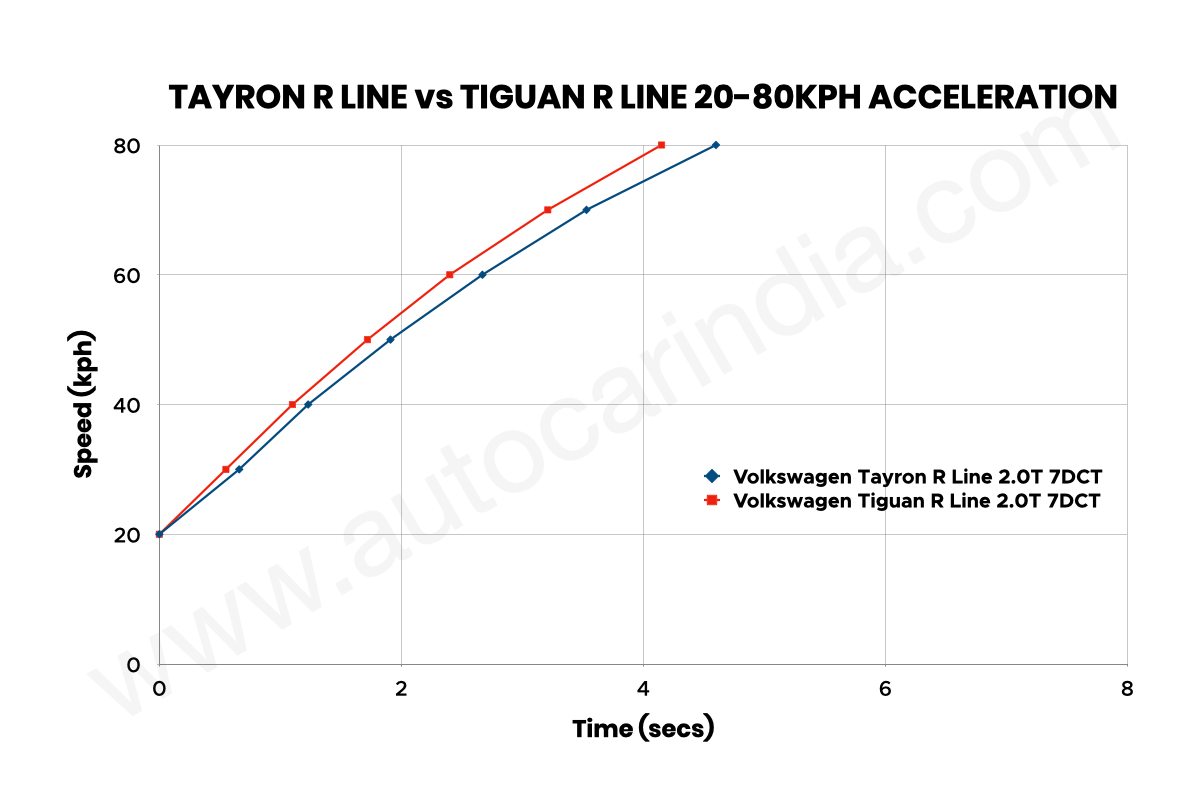
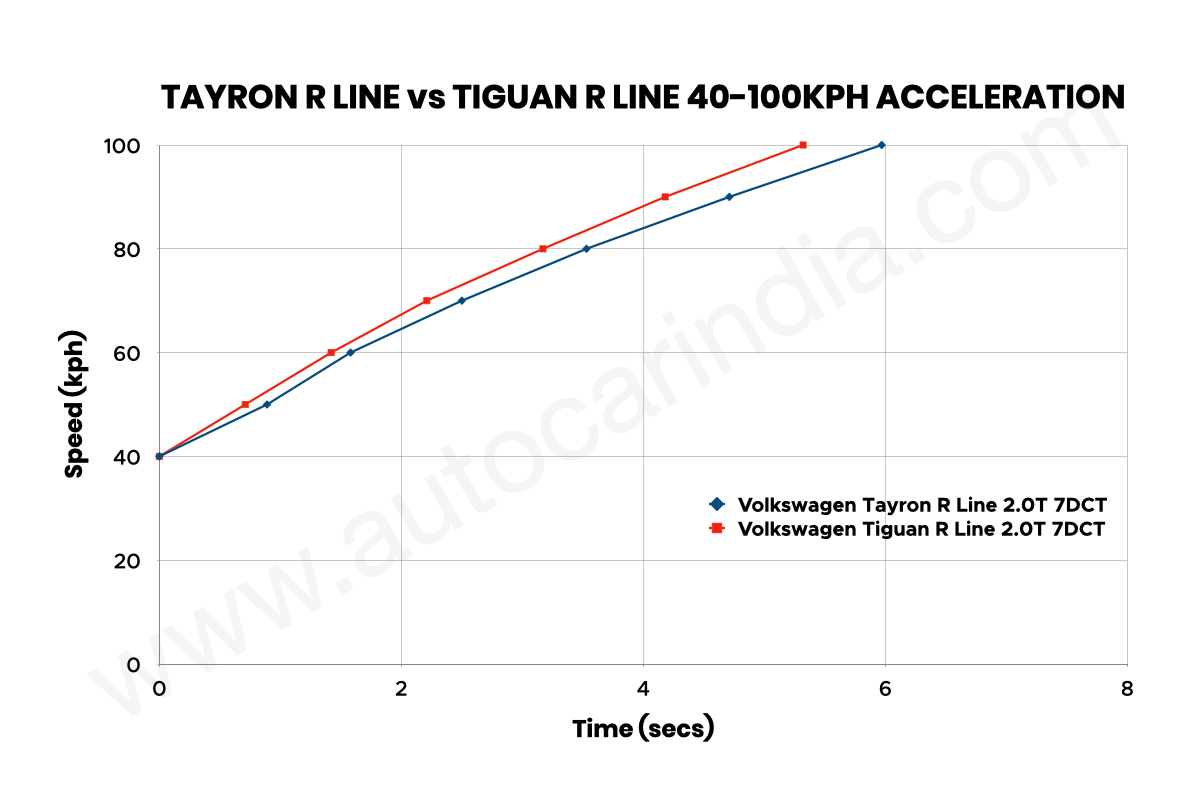
20-80kph (in kickdown)

4.6 

4.15

40-100kph (in kickdown)

5.97

5.32

Like their respective 0-100kph timings, the Tayron is outshined by the Tiguan in our rolling acceleration tests as well. It was faster in the 20-80kph and 40-100kph acceleration tests by 0.45 seconds and 0.65 seconds, respectively. 

Volkswagen Tayron R Line vs Tiguan R Line: Prices

Volkswagen Tayron R Line vs Tiguan R Line: Prices


Tayron R Line

Tiguan R Line

Price (Rs lakh)

46.99

47.11

Despite being the larger SUV with more seats on offer, the Tayron R Line is more affordable than the Tiguan R Line by Rs 12,000. This is because while the larger Tayron is locally assembled in India, the Tiguan, on the other hand, is a CBU model. 

Autocar India’s testing standards

Before we conduct our performance tests, we check and maintain tyre pressures based on the manufacturer’s recommendations and ensure the car has a full tank of fuel. The car is then tested in a controlled environment with two people on board, and the data is collected via highly accurate GPS-based timing equipment.

Volvo India confirms two new flagship EVs for 2026

Volvo

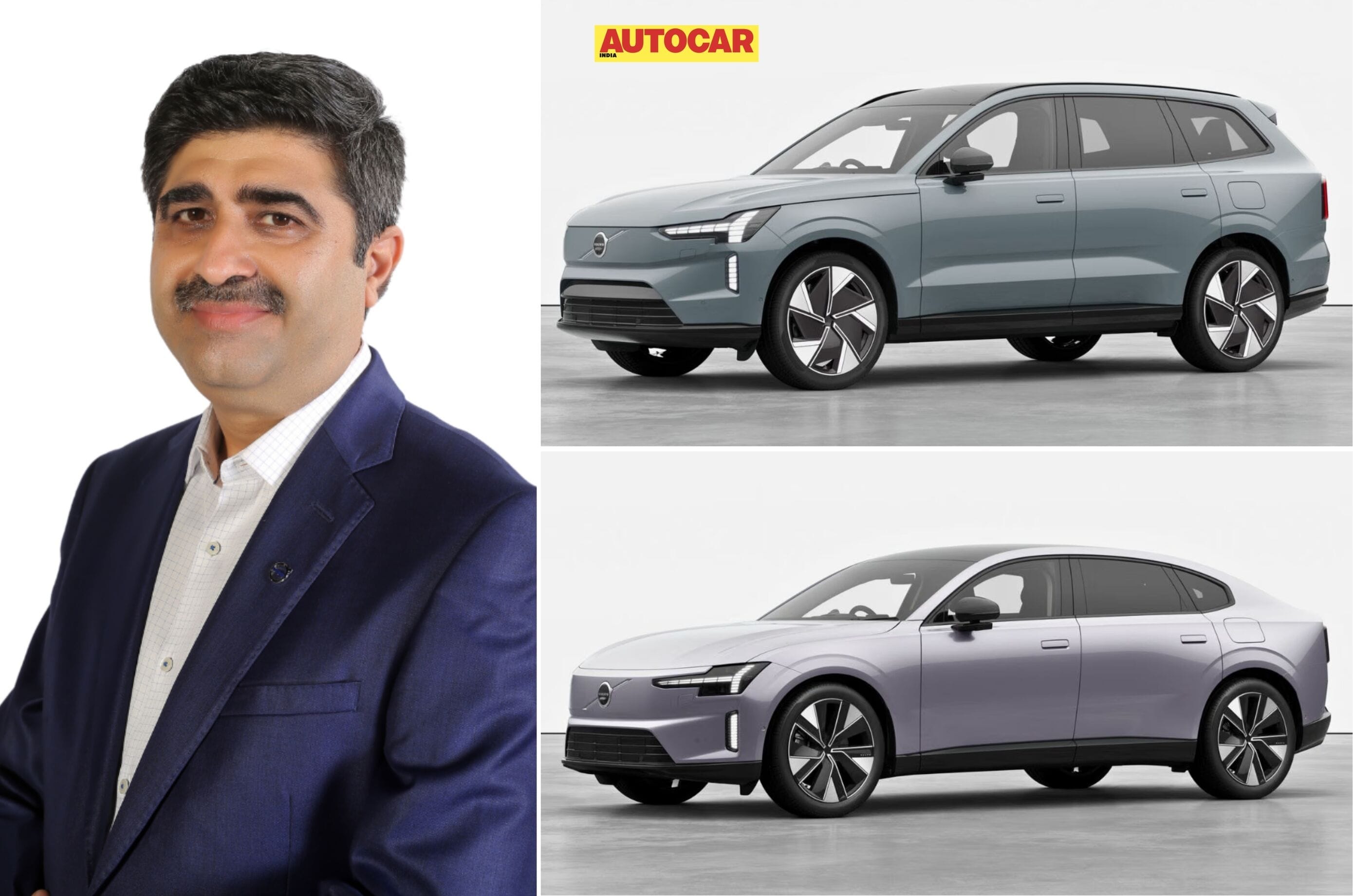
Volvo India has confirmed it will expand its electric vehicle portfolio with two new 90-series EVs over the coming months. While the company stopped short of naming the models, it said the line-up will comprise a flagship sedan and SUV, confirming our earlier report that the ES90 sedan and EX90 SUV were being lined up for India.

  1. One in every four Volvos sold in India is now electric
  2. Volvo says it will continue launching one EV every year

ES90 sedan and EX90 SUV expected to join the line-up

Volvo ES90

Speaking to our sister publication, Autocar Professional, Volvo Car India Managing Director Jyoti Malhotra said the company remains committed to introducing one new electric vehicle every year in India. “We have promised that we’ll bring one electric car every year. We brought in the EX30, and now we’ll be bringing two new electric cars in the 90 series later this year or in the next few months. They are from our 90 series – an SUV and a sedan,” Malhotra said.

Although Volvo has not officially confirmed the names, the company’s current global EV portfolio indicates the upcoming models are likely to be the ES90 electric sedan and the EX90 electric SUV. 

Volvo EX90

Both new flagship EVs are based on Volvo’s SPA2 architecture and use an 800V electrical system, supporting faster charging than the brand’s current EVs. The ES90 is expected to rival the BMW i5, while the EX90 will sit above the EC40 as Volvo’s flagship electric SUV. Both models are likely to be launched in India by Q3 2026.

EVs account for one in four Volvo sales

Volvo said electric vehicles now account for around one in every four cars it sells in India, with the remaining portfolio comprising mild-hybrid models such as the recently updated XC60 and XC90. The company also reported around 6 percent year-on-year growth in FY2026 and said it received an encouraging response to the EX30, which entered a new price point for the brand. Volvo also refreshed the XC60 and XC90 during the past year, with Malhotra saying both models have been well received by existing and new customers alike.

Malhotra reiterated that Volvo’s long-term goal remains to become an all-electric carmaker, although the company no longer has a fixed 2030 deadline because EV adoption varies across global markets. “Our end goal is still the same. We want to become an all-electric car company. But we are not saying that we want to do it by 2030,” he said.

He added that Volvo will continue offering both electric and mild-hybrid models in India as customer demand evolves.

चंपत राय समेत 3 दिग्गजों की डिजिटल ID ब्लॉक, आखिर क्यों लिया गया यह फैसला?

Champat Rai digital ID blocked

Champat Rai digital ID blocked: अयोध्या श्रीराम जन्मभूमि मंदिर में चढ़ावा और दान चोरी प्रकरण के बाद अब एक और बड़ा भूचाल आ गया है। राम मंदिर तीर्थ क्षेत्र ट्रस्ट ने एक बेहद कड़ा और अप्रत्याशित कदम उठाते हुए ट्रस्ट के पूर्व महासचिव चंपत राय, सदस्य डॉ. अनिल मिश्रा और गोपाल राव की डिजिटल ID को तुरंत प्रभाव से डीएक्टिवेट (ब्लॉक) कर दिया है। अब अयोध्या में इन दिग्गजों की सिफारिश पर VIP या VVIP एंट्री नहीं मिल पाएगी। आइए जानते हैं क्या है यह पूरा माजरा और क्यों लिया गया इतना बड़ा फैसला।

क्यों ब्लॉक हुई डिजिटल ID?

दरअसल, यह पूरा एक्शन राम मंदिर में हुए चढ़ावा और दान चोरी प्रकरण से जुड़ा हुआ है। इस मामले की जांच कर रही SIT (विशेष जांच दल) की तफ्तीश में एक चौंकाने वाला खुलासा हुआ। सूत्रों और SIT जांच के मुताबिक, ट्रस्ट के इन वरिष्ठ पदाधिकारियों की डिजिटल ID का दुरुपयोग करके भारी संख्या में VIP और VVIP दर्शन पास जारी किए गए थे। ALSO READ: अयोध्या आहत है… रामलला के घर 'लूट' ने आस्था को घायल किया, सरयू किनारे गूंज रहा एक ही सवाल— 'अब न्याय कब?'


डिजिटल ID का मुख्य काम मंदिर दर्शन के लिए विशेष पास बनाना था। पास जारी करने में किसी भी तरह की और अनियमितता या हेरफेर न हो, इसलिए ट्रस्ट ने यह 'डिजिटल स्ट्राइक' की है। दूसरी तरफ, चढ़ावा चोरी मामले में गिरफ्तार किए गए आरोपियों से SIT लगातार सघन पूछताछ कर रही है, जिससे कई और राज खुलने की उम्मीद है।

अब किसे मिली यह जिम्मेदारी?

ट्रस्ट में हुए इस बड़े फेरबदल के बाद अब जिम्मेदारी के समीकरण पूरी तरह बदल गए हैं। यह सख्त फैसला ट्रस्ट के कार्यवाहक महासचिव कृष्ण मोहन को नई जिम्मेदारी मिलने के ठीक बाद लिया गया है। अब चंपत राय और अनिल मिश्रा की जगह ट्रस्ट के सदस्य और निर्मोही अखाड़ा के महंत दिनेन्द्र दास को विशिष्ट (VIP) पास जारी करने का अधिकार सौंप दिया गया है। ALSO READ: राम मंदिर में चढ़ावा चोरी के बाद श्रद्धालुओं की संख्या घटी, अयोध्या की अर्थव्यवस्था पर गहरा असर

क्या है अयोध्या से जुड़ा यह पूरा मामला?

उल्लेखनीय है कि कुछ समय पहले अयोध्या के भव्य राम मंदिर में श्रद्धालुओं द्वारा चढ़ाए जाने वाले दान और चढ़ावे की रकम में हेराफेरी (चोरी) का मामला सामने आया था। करोड़ों लोगों की आस्था से जुड़े इस मंदिर में वित्तीय गड़बड़ी की बात सामने आते ही हड़कंप मच गया। मामले की गंभीरता को देखते हुए इसकी जांच SIT को सौंपी गई।


जांच जैसे-जैसे आगे बढ़ी, इसमें न सिर्फ पैसों की चोरी बल्कि VIP पास के काले खेल का भी पर्दाफाश हुआ। वीआईपी पास के जरिए अवैध रूप से लोगों को दर्शन कराने और उसमें इन डिजिटल आईडी के दुरुपयोग की आशंका सच साबित होती दिख रही है। इसी के बाद ट्रस्ट को अपनी साख बचाने और पारदर्शिता लाने के लिए अपने ही सबसे बड़े चेहरों (चंपत राय व अन्य) के खिलाफ इतना सख्त कदम उठाना पड़ा।
Edited by: Vrijendra Singh Jhala 


Ram Mandir Trust Wealth: राम मंदिर के पास कितना सोना, चांदी और कितने रुपये? FY26 की बैलेंस शीट से निकली ये जानकारी

राम मंदिर में चढ़ावे को लेकर उठे विवाद के बीच श्रीराम जन्मभूमि तीर्थ क्षेत्र ट्रस्ट ने पहली बार अपने आय-व्यय और फंड का लेखा-जोखा जारी किया है। सामने आए आंकड़ों के मुताबिक वित्त वर्ष 2025-26 में मंदिर को 250 करोड़ रुपये से ज्यादा का दान मिला। फाइनेंशियल ईयर 2025-26 में राम मंदिर ट्रस्ट की आय 250.04 करोड़ के करीब रही। वहीं श्री राम जन्मभूमि तीर्थ क्षेत्र ट्रस्ट की कमाई का सबसे बड़ा जरिया अब लोगों का दान नहीं, बल्कि निवेश पर मिलने वाला ब्याज बन गया है।

फाइनेंशियल ईयर 2025-26 के ट्रस्ट के बिना ऑडिट किए गए खातों के मुताबिक, निवेश पर ट्रस्ट को 151.80 करोड़ रुपये का ब्याज मिला। वहीं, श्रद्धालुओं से स्वैच्छिक दान के रूप में 149.36 करोड़ रुपये प्राप्त हुए। इन आंकड़ों से साफ है कि ट्रस्ट को अब अपने निवेश से मिलने वाली कमाई, नए दान से भी अधिक हो गई है।

ट्रस्ट के खातों के अनुसार, उसके पास कुल 1,876.30 करोड़ रुपये की राशि जमा है। इसमें से 1,771.22 करोड़ रुपये फिक्स्ड डिपॉजिट (एफडी) में निवेश किए गए हैं, जो कुल फंड का करीब 94 प्रतिशत है। इसके अलावा ट्रस्ट के पास 2.57 एकड़ जमीन, 323 किलोग्राम सोना, 751.98 किलोग्राम चांदी और वित्त वर्ष के अंत तक 7.74 लाख रुपये नकद भी मौजूद थे। यह जानकारी ऐसे समय सामने आई है, जब राम मंदिर में मिले दान में कथित गड़बड़ी की जांच विशेष जांच दल (एसआईटी) कर रहा है।

जांच कर रहे SIT के अधिकारियों ने पाया है कि अयोध्या के राम मंदिर में हर दिन मिलने वाले दान की रकम में काफी बढ़ोतरी हुई है। यह बढ़ोतरी मंदिर के चढ़ावे में कथित चोरी के मामले की जांच शुरू होने के बाद देखने को मिली है। इसी वजह से जांच एजेंसियां यह भी पता लगा रही हैं कि मामला सामने आने से पहले दान के रखरखाव और जमा करने की प्रक्रिया में कहीं कोई गड़बड़ी तो नहीं हुई थी।

सूत्रों के मुताबिक, कथित चोरी का मामला सामने आने से पहले श्री राम जन्मभूमि तीर्थ क्षेत्र ट्रस्ट के बैंक खातों में हर दिन औसतन 16 से 18 लाख रुपये का दान जमा होता था। लेकिन एसआईटी की जांच शुरू होने के बाद यह राशि बढ़कर रोजाना करीब 24 से 26 लाख रुपये तक पहुंच गई है।

रोजाना दान की रकम में 6 से 8 लाख रुपये की यह बढ़ोतरी अब जांच का सबसे अहम हिस्सा बन गई है। जांच अधिकारी यह पता लगाने में जुटे हैं कि क्या यह अंतर पहले दान में किसी तरह की गड़बड़ी या रकम के गलत इस्तेमाल का संकेत देता है। ट्रस्ट के खातों के अनुसार, वित्त वर्ष के दौरान उसे सभी स्रोतों से कुल 398.24 करोड़ रुपये की आय हुई। इसमें 149.36 करोड़ रुपये दान पेटियों, ऑनलाइन दान और श्रद्धालुओं के चढ़ावे से मिले। वहीं, निवेश पर मिले ब्याज से 151.80 करोड़ रुपये की कमाई हुई। इसके अलावा बाकी राशि अनुदान और अन्य स्रोतों से प्राप्त हुई।

ट्रस्ट ने अपनी बड़ी राशि अलग-अलग बैंकों में निवेश कर रखी है। इसके तहत पंजाब नेशनल बैंक में 562.88 करोड़ रुपये, बैंक ऑफ बड़ौदा में 327.30 करोड़ रुपये और भारतीय स्टेट बैंक में 791.04 करोड़ रुपये जमा हैं। इसके अलावा 90.10 करोड़ रुपये म्यूचुअल फंड में निवेश किए गए हैं, जबकि 24.77 करोड़ रुपये बचत खातों में रखे गए हैं। ट्रस्ट का सबसे बड़ा खर्च राम मंदिर का निर्माण है। वित्त वर्ष 2025-26 में निर्माण कार्य पर कुल 237.54 करोड़ रुपये खर्च किए गए। इसमें मुख्य मंदिर के निर्माण पर 42.42 करोड़ रुपये, जमीन खरीदने पर 38.81 करोड़ रुपये, परिक्रमा मार्ग और अस्थायी ढांचों पर 21.52 करोड़ रुपये तथा मंदिर परिसर के अन्य विकास कार्यों पर भी बड़ी राशि खर्च की गई।

मंदिर में श्रद्धालुओं की संख्या बढ़ने के साथ-साथ ट्रस्ट का खर्च भी बढ़ा है। वित्त वर्ष 2025-26 में मंदिर परिसर के रखरखाव पर कुल 91.76 करोड़ रुपये खर्च किए गए। इसमें सुरक्षा व्यवस्था पर 31.48 करोड़ रुपये, सफाई और स्वच्छता पर 17.49 करोड़ रुपये, बिजली पर 23.08 करोड़ रुपये और श्रद्धालुओं के लिए अन्न क्षेत्र चलाने पर 8.96 करोड़ रुपये खर्च हुए। ट्रस्ट ने मंदिर के आसपास अपनी जमीन भी बढ़ाई है। साल भर में 14 खरीद समझौतों और 8 दान पत्रों के माध्यम से आसपास की संपत्तियां खरीदी गईं। इन जमीनों की खरीद पर ट्रस्ट ने कुल 15.74 करोड़ रुपये खर्च किए।

इस्तीफे के बाद चंपत राय ने किसकी तरफ किया इशारा! राम मंदिर चढ़ावा विवाद पर तोड़ी चुप्पी

अयोध्या राम मंदिर चंदा चोरी मामले ने पूरे देश को हिला कर रख दिया है। चढ़ावा चोरी के मामले में हर दिन नए-नए खुलासे हो रहे हैं। इन खुलासों के बाद श्रीराम मंदिर ट्रस्ट के महासचिव चंपत राय ने इस्तीफा दे दिया था और उनके जगह कृष्ण मोहन को अंतरिम महासचिव की जिम्मेदारी दी गई थी। वहीं, अब इस विवाद और अपने इस्तीफे पर चंपत राय ने पहली बार बयान दिया है।

इस्तीफे के बाद पहली बार बोले चंपत राय

सोशल मीडिया प्लेटफॉर्म एक्स पर किए गए एक पोस्ट में चंपत राय ने एक इमोशनल चिट्ठी लिखी है। चंपत राय की ओर से जारी किए गए पत्र में कहा गया है कि SIT की अंतिम रिपोर्ट आएगी तब बोलूंगा। सोशल मीडिया पर हाथ से लिखा पत्र जारी कर अपना पक्ष रखा है। चंपत राय ने अपने ऊपर लगे आरोपों को अनर्गल बताते हुए कहा कि उन्होंने फिलहाल मौन धारण किया है। SIT की अंतिम रिपोर्ट आने के बाद वह सभी बिंदुओं पर जवाब देंगे। उन्होंने यह भी दावा किया कि SIT की प्रारंभिक रिपोर्ट में उनका नाम नहीं है।

कही ये बात

उन्होंने कहा कि मंदिर के दान-पात्रों में मिले पैसे की गिनती को लेकर कई तरह के आरोप और दावे किए गए। उनके ऊपर भी कई बेबुनियाद आरोप लगाए गए, लेकिन उन्होंने पिछले दो महीने तक इस मामले पर कोई प्रतिक्रिया नहीं दी। चंपत राय ने कहा कि इस मुद्दे पर इंटरनेट और सोशल मीडिया पर काफी चर्चा हुई। उन्होंने बताया कि विशेष जांच दल (एसआईटी) की शुरुआती जांच रिपोर्ट तैयार होकर सार्वजनिक की जा चुकी है। अब सभी लोगों को एसआईटी की अंतिम रिपोर्ट का इंतजार करना चाहिए। उनका कहना है कि जांच पूरी होने के बाद सच्चाई सबके सामने आ जाएगी। उन्होंने यह भी बताया कि वह वर्ष 1991 से अयोध्या में संगठन के कार्यकर्ता के रूप में काम कर रहे हैं और पिछले 45 वर्षों से सार्वजनिक जीवन में सक्रिय हैं।

बता दें कि, अयोध्या राम मंदिर चढ़ावा चोरी के बाद बीते सोमवार को श्री राम जन्मभूमि तीर्थ क्षेत्र ट्रस्ट ने महासचिव चंपत राय और ट्रस्टी अनिल मिश्रा का इस्तीफा स्वीकार कर लिया था। चंपत राय की जगह नए ट्रस्टी रिटायर्ड IFS कृष्ण मोहन को कार्यवाहक महासचिव बनाया गया है। कृष्ण मोहन दलित समाज से हैं। चढ़ावा चोरी के बाद सोमवार ट्रस्ट की पहली और अहम बैठक हुई थी।

Ram Temple Donation Theft: चंपत राय के इस्तीफे के अलावा राम मंदिर डोनेशन चोरी केस में ट्रस्ट की पहली बैठक से निकलीं ये 5 बड़ी बातें

Ram Mandir Trust Meeting: अयोध्या के श्रीराम मंदिर में चढ़ावा चोरी सामने आने के बाद श्रीराम जन्मभूमि तीर्थ क्षेत्र ट्रस्ट की अहम बैठक सोमवार को हुई। इस बैठक में उत्तर प्रदेश सरकार की ओर से बनाई गई विशेष जांच टीम (SIT) की रिपोर्ट ट्रस्ट के सामने रखी गई। बैठक में ट्रस्ट के सदस्यों ने माना कि इस मामले में ट्रस्ट के साथ विश्वासघात हुआ है और जिम्मेदार लोगों ने भरोसा तोड़ा है। बैठक में उत्तर प्रदेश के अपर मुख्य सचिव (गृह) संजय प्रसाद भी वीडियो कॉन्फ्रेंसिंग के जरिए शामिल हुए। ट्रस्ट ने साफ कहा कि उसे राज्य सरकार की SIT और उसकी जांच पर पूरा भरोसा है। बैठक में यह भी चर्चा हुई कि भविष्य में इस तरह की घटना दोबारा न हो, इसके लिए सुरक्षा और व्यवस्था को और मजबूत किया जाएगा।

बैठक से निकलीं 5 बड़ी बातें

  • 1. SIT की रिपोर्ट ट्रस्ट के सामने पेश की गई

बैठक में सबसे पहले उत्तर प्रदेश सरकार की SIT की जांच रिपोर्ट रखी गई। ट्रस्ट के सदस्यों ने रिपोर्ट पर विस्तार से चर्चा की और जांच पर भरोसा जताया।

  • 2. ट्रस्ट ने माना कि भरोसा तोड़ा गया

बैठक में ट्रस्ट के सदस्यों ने स्वीकार किया कि इस मामले में ट्रस्ट के विश्वास के साथ धोखा हुआ। आरोप है कि जिम्मेदार लोगों ने अधिकारियों को गुमराह किया और ट्रस्ट का भरोसा तोड़ा।

  • 3. दोबारा ऐसी घटना न हो, इसकी होगी समीक्षा

ट्रस्ट ने फैसला किया कि दान की राशि के संग्रह और निगरानी की पूरी व्यवस्था की समीक्षा की जाएगी, ताकि भविष्य में ऐसी किसी भी घटना की दोबारा गुंजाइश न रहे।

  • 4. चंपत राय और अनिल मिश्रा से मांगा जाएगा पक्ष

राम मंदिर ट्रस्ट की बैठक में कोषाध्यक्ष स्वामी गोविंद देव गिरी ने मीटिंग का एजेंडा रखा। स्वामी गोविंद देव गिरी ने चंपत राय और अनिल मिश्रा के इस्तीफे पर विचार का प्रस्ताव रखा। सूत्रों के मुताबिक, बैठक में ट्रस्ट के महासचिव चंपत राय और ट्रस्टी अनिल मिश्रा को भी बुलाने का फैसला किया गया। दोनों इस पूरे मामले पर अपना पक्ष रखेंगे।

  • 5. CEO का पद बनाने का प्रस्ताव खारिज

सूत्रों के अनुसार, बैठक में ट्रस्ट के लिए मुख्य कार्यकारी अधिकारी (CEO) का नया पद बनाने का प्रस्ताव भी रखा गया था, लेकिन ट्रस्ट ने इसे मंजूर नहीं किया।

फिलहाल ट्रस्ट की बैठक जारी है और आने वाले समय में इस मामले को लेकर कुछ और अहम फैसले सामने आ सकते हैं। वहीं, दान की कथित गड़बड़ी की जांच SIT लगातार कर रही है और उसकी रिपोर्ट के आधार पर आगे की कार्रवाई की जाएगी।

Ram Mandir Chanda Chori: चढ़ावे के सोने को बना दिया बिस्कुट और फिर… राम मंदिर चंदा चोरी मामले में सनसनीखेज खुलासा

Ram Mandir Chanda Chori Case: अयोध्या के राम मंदिर में श्रद्धालुओं द्वारा चढ़ाए गए दान में कथित गड़बड़ी की जांच अब नए चरण में पहुंच गई है। स्पेशल इन्वेस्टिगेशन टीम (SIT) इस बात की जांच कर रही है कि क्या मंदिर से कथित तौर पर चोरी किए गए सोने के आभूषणों को पहचान मिटाने के लिए उसे गलाकर सोने के बिस्किट (Gold Biscuits) में बदल दिया गया। फिलहाल, SIT इस पूरे मामले की कई पहलुओं से जांच कर रही है। यह अभी संदेह और जांच का विषय है कि कथित तौर पर चोरी किए गए सोने को वास्तव में गलाकर बिस्किट बनाया गया था या नहीं।

अधिकारियों का कहना है कि इस मामले में आधिकारिक रिपोर्ट आने के बाद ही स्पष्ट होगा। ‘इंडिया टुडे’ की एक रिपोर्ट के मुताबिक, जांचकर्ताओं को शक है कि आरोपियों ने चोरी किए गए सोने और चांदी के गहनों को पिघला दिया होगा ताकि उनकी पहचान मिटाई जा सके। कई बार छापेमारी और तलाशी के बाद भी सोने-चांदी के गायब गहने नहीं मिले, जिसके बाद जांच की दिशा में तेजी आई है।

मंदिर के इंचार्ज से पूछताछ तेज

जांच के सिलसिले में राम मंदिर गए SIT अधिकारियों ने मंदिर के इंचार्ज KD बाबू से गहनों और अन्य कीमती चढ़ावे के रखरखाव, उनकी इन्वेंट्री, स्टोरेज और देखभाल के बारे में पूछताछ की। रिपोर्ट में कहा गया है कि जांच टीम ने गहनों और अन्य कीमती दान का रिकॉर्ड मांगा है। साथ ही सरकारी कंपनी प्रिंटिंग एंड मिंटिंग कॉर्पोरेशन ऑफ इंडिया (Mint) के साथ हुए लेन-देन का रिकॉर्ड भी मांगा है।

जांचकर्ताओं ने अभी तक के जांच में पाया है कि ‘श्री राम जन्मभूमि तीर्थ क्षेत्र ट्रस्ट’ की तिमाही बैठकों में ज्यादातर ध्यान कैश दान और रेवेन्यू पर होता था। जबकि सोने, चांदी और अन्य कीमती चढ़ावे की डिटेल्स इन्वेंट्री बनाए रखने या उसकी समीक्षा करने पर बहुत कम ध्यान दिया जाता था। ‘इंडिया टुडे’ ने सूत्रों के हवाले से अपनी रिपोर्ट में यह दावा किया है।

आभूषण नहीं मिले, इसलिए SIT ने बदली जांच की दिशा

जांच एजेंसियों को लगातार छापेमारी और तलाशी के बावजूद कथित तौर पर गायब सोने-चांदी के आभूषण नहीं मिले। इसके बाद स्पेशल इन्वेस्टिगेशन टीम (SIT) को शक है कि आरोपियों ने आभूषणों को पिघलाकर उनकी पहचान खत्म कर दी, जिससे उन्हें बरामद करना मुश्किल हो जाए।

मंदिर प्रशासन से मांगे गए रिकॉर्ड

जांच के दौरान SIT ने राम मंदिर पहुंचकर मंदिर प्रभारी केडी बाबू से पूछताछ की। अधिकारियों ने आभूषणों के रखरखाव, स्टोरेज, इन्वेंट्री और श्रद्धालुओं द्वारा चढ़ाए गए कीमती दान से जुड़े सभी रिकॉर्ड मांगे। इसके साथ ही सरकारी प्रिंटिंग एंड मिंटिंग कॉर्पोरेशन ऑफ इंडिया (Mint) के साथ हुए लेन-देन का ब्यौरा भी जांच के दायरे में लिया गया है।

7 जून को सामने आया थआ मामला

राम मंदिर में कथित दान गबन का मामला 7 जून को सामने आया था। इसके बाद उत्तर प्रदेश सरकार ने SIT का गठन किया। प्रारंभिक जांच के आधार पर 25 जून को FIR दर्ज की गई। मंदिर में दान गिनने के काम से जुड़े 8 लोगों को गिरफ्तार किया गया है।

चंपत राय ने खुद को बताया व्हिसलब्लोअर

श्री राम जन्मभूमि तीर्थ क्षेत्र ट्रस्ट के पूर्व महासचिव चंपत राय ने अपने ऊपर लगे सभी आरोपों से इनकार किया है। उनका कहना है कि कथित गड़बड़ी का सबसे पहले पता उन्होंने ही लगाया था। उन्होंने दावा किया कि चोरी पकड़ने के लिए उन्होंने मंदिर परिसर में सीक्रेट CCTV कैमरे लगवाए थे। उन्हीं कैमरों की फुटेज से कथित चोरी का खुलासा हुआ।

‘मुझे मेरे ही लोगों ने धोखा दिया’

पुलिस पूछताछ के दौरान चंपत राय ने कहा कि उनका दान के कथित गबन से कोई लेना-देना नहीं है। उन्होंने कहा, “मुझे मेरे ही भरोसेमंद लोगों ने धोखा दिया। चोरी पकड़ने के लिए छिपे हुए कैमरे मैंने ही लगवाए थे।”

सुप्रीम कोर्ट की निगरानी में जांच की मांग

कांग्रेस ने मांग की है कि प्रधानमंत्री नरेंद्र मोदी अयोध्या में राम मंदिर में दान और चढ़ावे की कथित चोरी की सुप्रीम कोर्ट की निगरानी में जांच का आदेश दें। पणजी में आयोजित प्रेस वार्ता में कांग्रेस के महासचिव के.सी. वेणुगोपाल ने कहा कि उन्होंने प्रधानमंत्री को पत्र लिखकर मामले की स्वतंत्र जांच की मांग की है, क्योंकि मंदिर में दान के मैनेजमेंट को लेकर गंभीर सवाल उठाए गए हैं। उन्होंने BJP को भारत के मंदिरों पर आक्रमणकारियों द्वारा किए गए अतीत के कथित लूटपाट संबंधी उसके अक्सर दिए जाने वाले बयानों की भी याद दिलाई।

वेणुगोपाल ने पूर्व केंद्रीय गृह सचिव के उन दावों का भी जिक्र किया, जिनमें कहा गया था कि मंदिर में दान किए गए एक किलोग्राम सोने का सही हिसाब-किताब नहीं रखा गया था। इस मुद्दे को लेकर प्रधानमंत्री की चुप्पी पर सवाल उठाते हुए उन्होंने कहा, “यह किसी आम आदमी का आरोप नहीं है। यह आरोप केंद्र सरकार के एक सेवानिवृत्त गृह सचिव ने लगाया है। अयोध्या राम मंदिर में जो कुछ हो रहा है, वह हम सभी के लिए बहुत दुखद है। यह देश के सभी आस्था रखने वालों के लिए दुखद है।”

ये भी पढ़ें- चीन हो या पाकिस्तान… अब दुश्मन का गेम ओवर! भारत बना रहा ‘100 किमी की चक्रव्यूह’ दीवार

वेणुगोपाल ने कहा कि कांग्रेस के लोग आस्था के कारण ईश्वर में विश्वास करते हैं। लेकिन BJP के लोग ईश्वर में विश्वास नहीं करते और वे लोगों को बांटने और मंदिर को लूटने के मकसद से धर्म की बात करते हैं। उन्होंने आरोप लगाया कि अयोध्या मंदिर में हुई चोरी के लिए विश्व हिंदू परिषद (VHP) और राष्ट्रीय स्वयंसेवक संघ (RSS) पूरी तरह जिम्मेदार हैं। उन्होंने आरोप लगाया कि मंदिर को लूटने वालों को केंद्र और उत्तर प्रदेश की सरकारें बचा रही हैं।

Royal Enfield Lightwing multi rays modular helmet review

Royal Enfield Lightwing multi rays modular helmet review

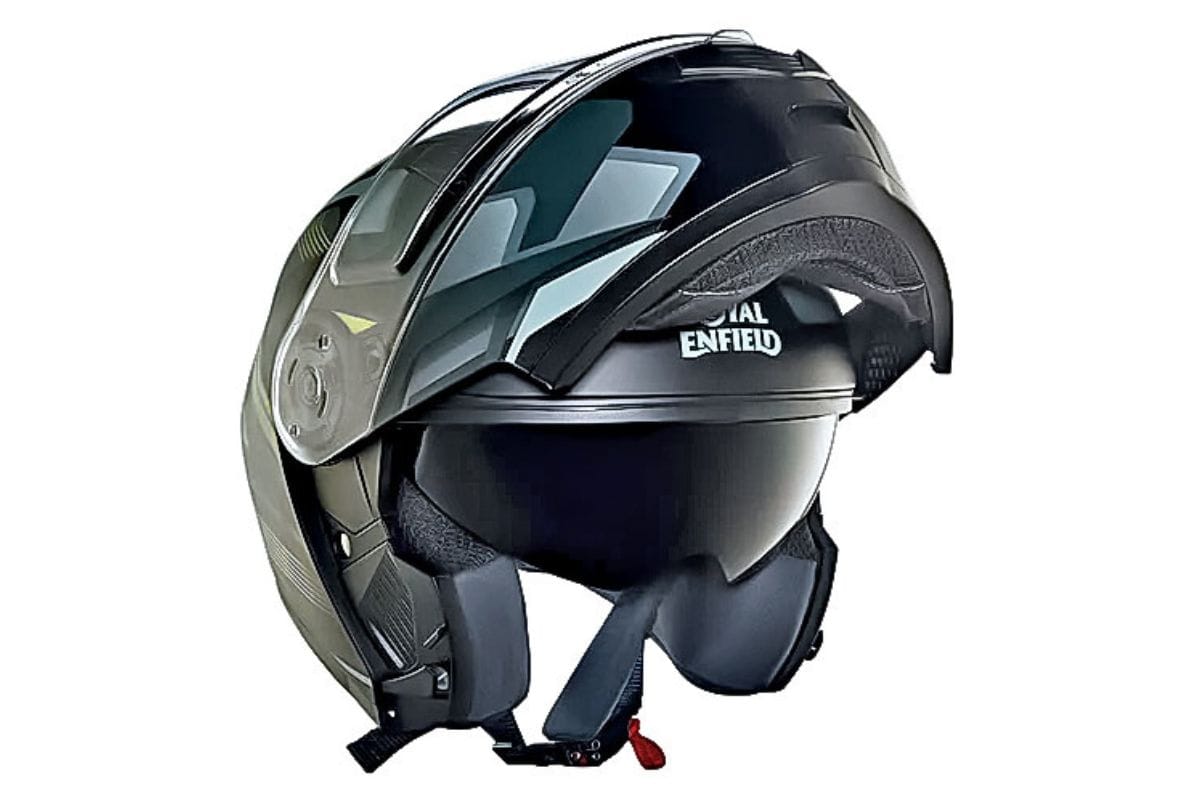
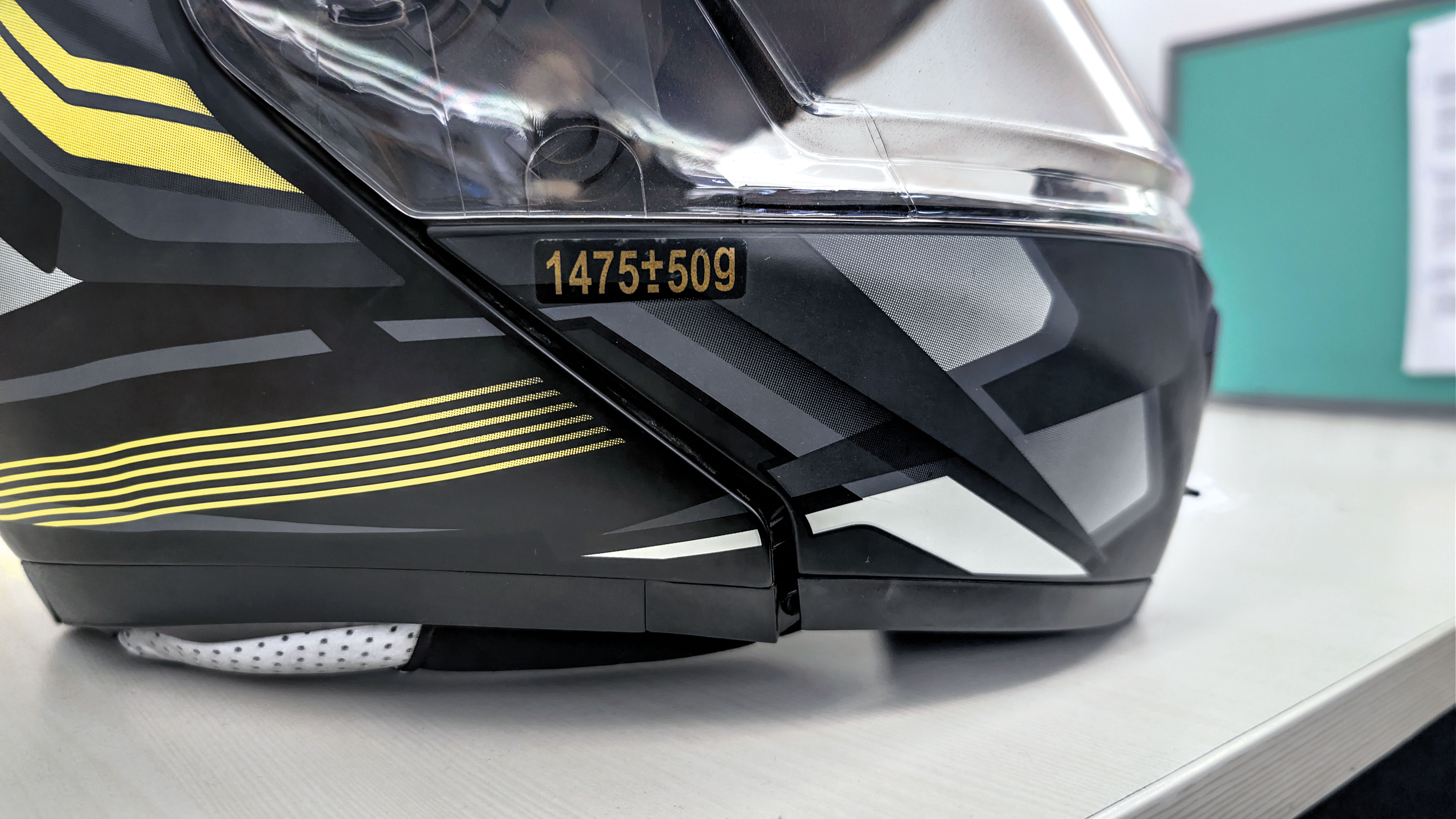
Switching from a half-face helmet to the Royal Enfield Lightwing modular lid was always going to be a step up, and the difference was immediately noticeable, especially in terms of weight. At approximately 1,475g, it’s significantly heavier. The first few rides made that clear, but a week into using it as my daily, the added weight faded into the background. In fact, it now feels like a fair trade-off for the added sense of security and build quality.

It also impresses with its solid construction. The shell feels sturdy, and the matte black and yellow finish has held up well despite being subjected to Mumbai’s harsh summer sun. There’s no fading or visible wear, which says a lot about its durability in real-world conditions. The inclusion of a ratchet strap instead of a double-d ring closure system might disappoint some, but it isn’t a deal-breaker in my books, although I’m primarily confined to the urban jungle.

Chin bar doesn’t sit flush upon closure; demands effort.

The integrated sun visor is genuinely useful in a city like Mumbai, where the sun is relentless. And the fact that it fits neatly over my spectacles makes it even more practical. For my usage – largely city commutes on my TVS Ntorq – I’ve often ridden with the helmet in its open-face configuration to cope with the heat.

That’s because using it as a full-face helmet in peak summer hasn’t been the most comfortable experience. While it does get adjustable vents, ventilation in Mumbai traffic compared to my previous half-face helmet is much lower, though that’s not entirely unexpected.

Comfort, however, is a strong suit. The inner padding is plush and sits well, even on longer rides. It’s easy to remove and clean, a big plus given the amount of sweat and dust helmets endure in daily use. There are a couple of niggles, though. The locking mechanism can be finicky, often requiring you to hold down the unlock button while shutting it, not ideal for something you use multiple times a day. Removing the visor is also easy, but getting it to lock back into place can test your patience. Wind noise is reasonably well contained up to about 70kph, but beyond that, I haven’t tested it enough to comment confidently on highway performance.

At Rs 4,500, this helmet is good value for what it offers. As a stylish, well-built modular helmet for primarily urban use, it largely delivers on expectations, with just a few compromises.

Written by SAGAR JUNEJA
Where: store.royalenfield.com
Price: Rs 4,500