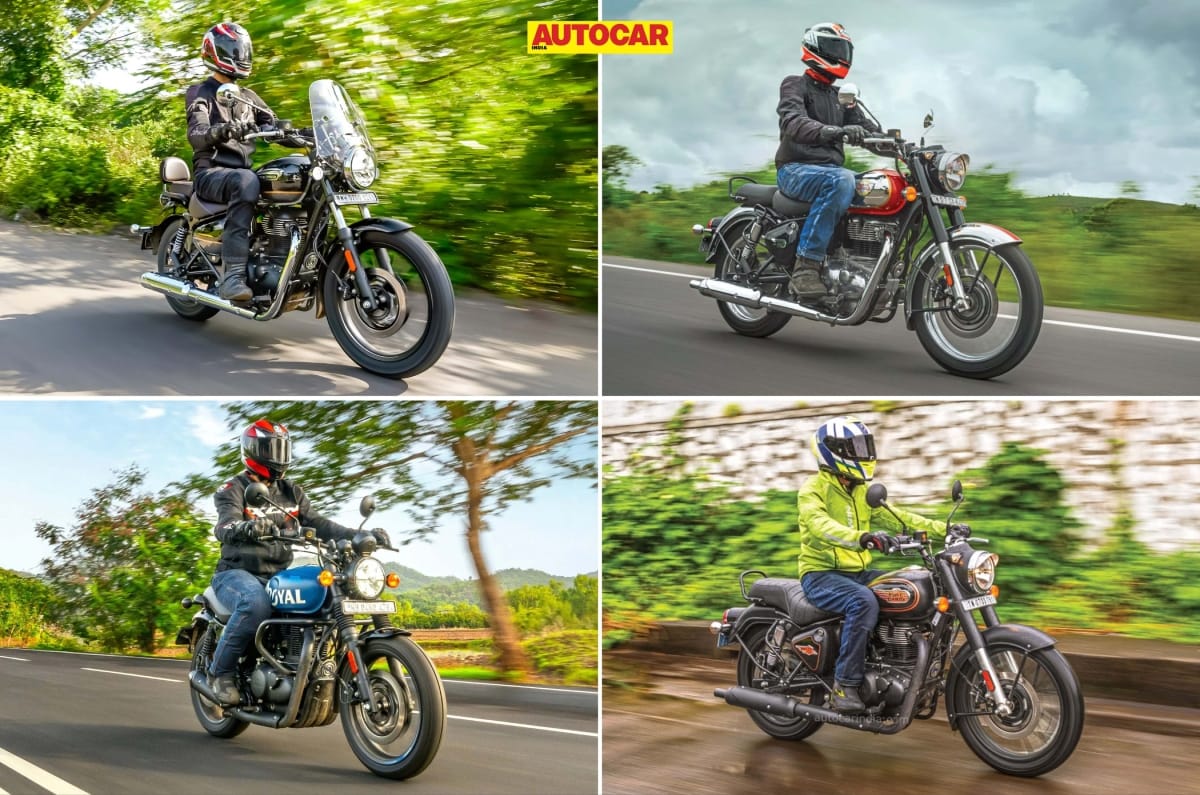
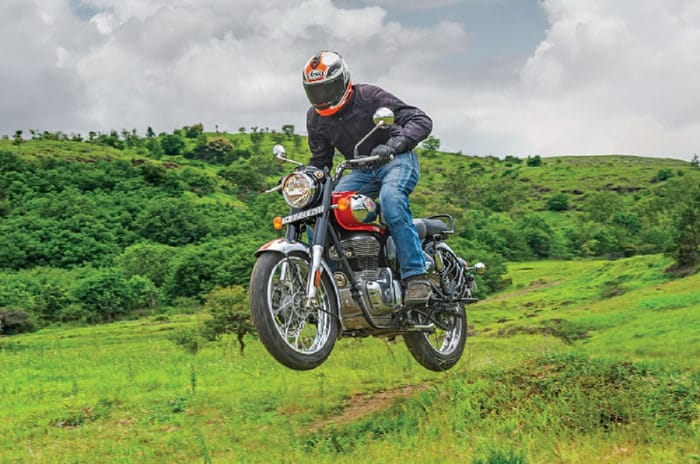
Royal Enfield’s 350cc J-platform is the thumping heart behind a significant part of the company’s sales. To put things into perspective, Royal Enfield sold over a million motorcycles between April 2025 and February 2026. Of those 10.07 lakh units, 9.31 lakh – or 92 percent – came from its 350cc range.
These bikes – the Classic 350, Hunter 350, Meteor 350, Bullet 350 and Goan Classic 350 – need no introduction. While they’re all based on the same platform, they differ in design, purpose and the riding experience they offer. If you’re in the market for one, this guide should help you figure out which suits you best.
Royal Enfield 350cc platform details
All five bikes share the same engine with identical output figures.
All five motorcycles are powered by the same 349cc, single-cylinder, air/oil-cooled engine producing 20.2hp at 6,100rpm and 27Nm at 4,000rpm, paired with a 5-speed gearbox. Over the past few months, Royal Enfield has rolled out a slip-and-assist clutch across most of the range. The Hunter 350, Meteor 350, Goan Classic 350 and Classic 350 have all received it, leaving the Bullet 350 as the only model yet to get the update.
The main chassis architecture is also shared across the lineup, comprising a twin-downtube frame suspended by conventional telescopic forks at the front and twin shock absorbers at the rear. However, each model features its own suspension tuning and ergonomics.
Royal Enfield Hunter 350
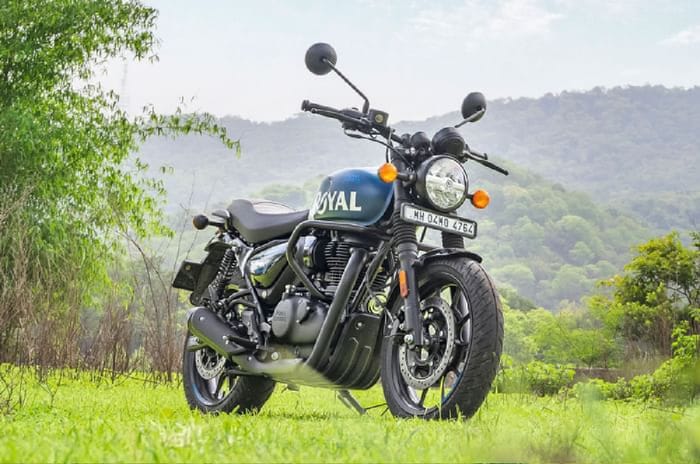
Royal Enfield Hunter 350 price starts at Rs 1.38 lakh.
The Hunter 350 is Royal Enfield’s most affordable and lightest 350, designed as a neo-retro roadster that feels most at home in the city. With a kerb weight of 181kg, it’s at least 10kg lighter than its siblings, making it easier to handle and more manageable in traffic. A slip-and-assist clutch, along with revised rear springs and seat foam introduced as part of a 2025 update, also make it more comfortable and easier to ride in urban conditions.
The Hunter range has since expanded with a new Base Premium variant at Rs 1.51 lakh, which slots between the entry-level Base at Rs 1.38 lakh and the higher variants. It adds alloy wheels with tubeless tyres and a more powerful headlight over the base model, while retaining single-channel ABS and a rear drum brake. Two new colour options – Moonshot White and Mumbai Yellow – have also been introduced on the top variant, which is now priced at Rs 1.71 lakh. If you’re looking for a lightweight, city-friendly Royal Enfield, the Hunter 350 is arguably your best pick.
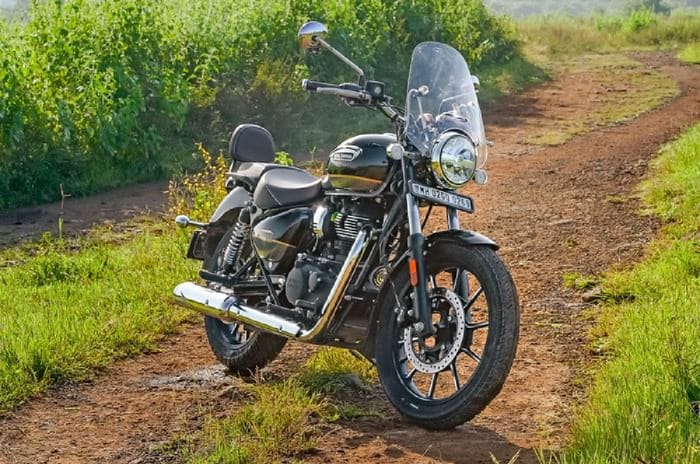
Royal Enfield Meteor 350 price starts at Rs 1.91 lakh.
The Meteor 350 is Royal Enfield’s cruiser in the 350cc range, featuring forward-set footpegs and an accessible 765mm seat height. It now comes with Tripper navigation, LED headlights, LED turn indicators and a slip-and-assist clutch as standard across all variants. At 191kg, it’s on the heavier side, but we’ve found that its weight is well managed and doesn’t make the bike difficult to ride or manoeuvre.
The Meteor 350 is available in multiple variants with either alloy or wire-spoke wheels, with prices ranging from Rs 2 lakh to Rs 2.21 lakh for the Supernova Black.
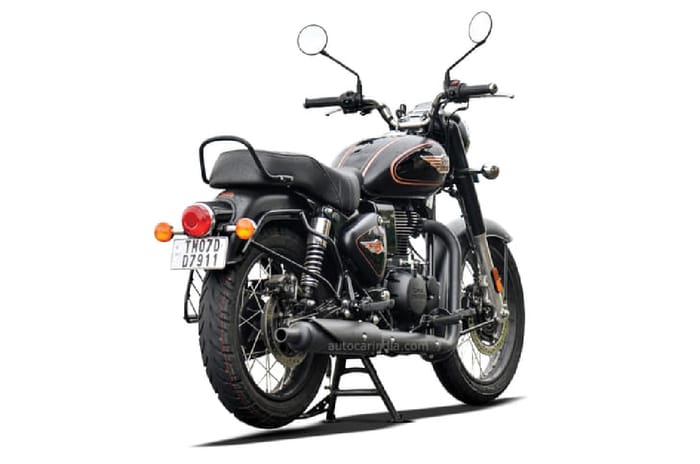
Royal Enfield Bullet 350 price starts at Rs 1.62 lakh.
The Bullet is arguably the quintessential Royal Enfield, most faithfully embodying the brand’s core identity. Decades on, it continues to carry distinctive design elements like the single seat and iconic silhouette, although the latest iteration has grown increasingly similar to the Classic 350. The Bullet 350 is also now the only model in Royal Enfield’s 350cc lineup yet to receive a slip-and-assist clutch.
In terms of the riding experience, the Bullet 350 feels very similar to the Classic. The key differences lie in its slightly taller handlebar, which offers a more upright riding position, and a seat with extra padding for improved comfort. The base variant features a single-tone paint scheme, single-channel ABS and generous chrome detailing, while the top-spec version gets dual-channel ABS along with a blacked-out engine and exhaust. It is priced at Rs 2.10 lakh.
Royal Enfield Classic 350 price starts at Rs 1.81 lakh.
The Classic remains Royal Enfield’s bestselling and most important motorcycle. It is also the latest model to receive a slip-and-assist clutch and a faster USB Type-C charging port, although both features are exclusive to the dual-channel ABS variants. The base single-channel Redditch Red continues unchanged at Rs 1.87 lakh. Two colour options – Halcyon Black and Jodhpur Blue – have also been discontinued.
It offers a neutral, upright riding position with handlebars within easy reach and footpegs positioned directly beneath the rider. Its 19-inch front and 18-inch rear wheel combination makes it slightly less nimble than the Hunter and Meteor, both of which use smaller wheels. Prices for the Classic 350 range go up to Rs 2.24 lakh.
Royal Enfield Goan Classic 350 price starts at Rs 2.18 lakh.
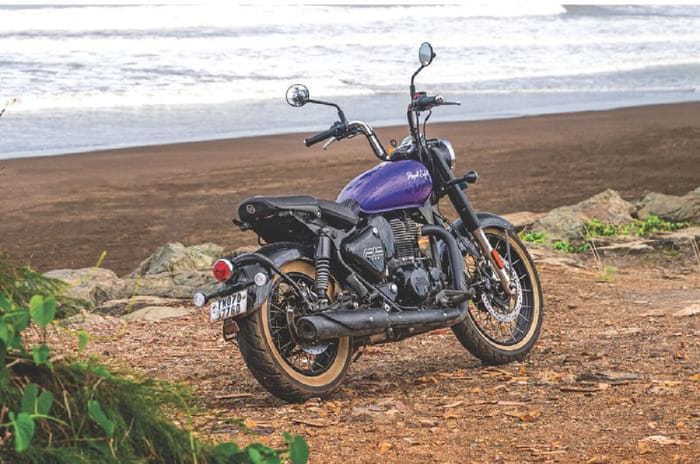
Simply put, the Goan Classic 350 is a custom-styled motorcycle you can buy straight from the showroom. With its ape-hanger handlebars and bobber-inspired design, it’s easily the most distinctive – and the most expensive – bike in the 350cc lineup.
Compared to the standard Classic 350, the Goan Classic sits lower with a 750mm seat height, features forward-set footpegs borrowed from the Meteor, and uses tall mini ape-hanger handlebars that completely transform the riding experience. Other standout styling elements include a 16-inch rear wheel and white-wall tyres mounted on tubeless wire-spoke rims. Fit and finish are also a step above the rest of the lineup, with details such as the premium metal switch cubes borrowed from Royal Enfield’s 650cc models. The Goan Classic is available in four colour schemes: Purple Haze and Shack Black are priced at Rs 2.25 lakh, while Trip Teal and Rave Red cost Rs 2.28 lakh.
The Renault Duster impressed us at the first drive event with its muscular design, modern interior and ride and handling balance. We’ve now subjected all versions of the new Duster to our in-depth performance and efficiency testing to tell you how it stacks up against its established competition in the midsize SUV segment.
Renault Duster Exterior Design and Engineering – 9/10
Butch, muscular SUV has good road presence; India model based on RGMP platform
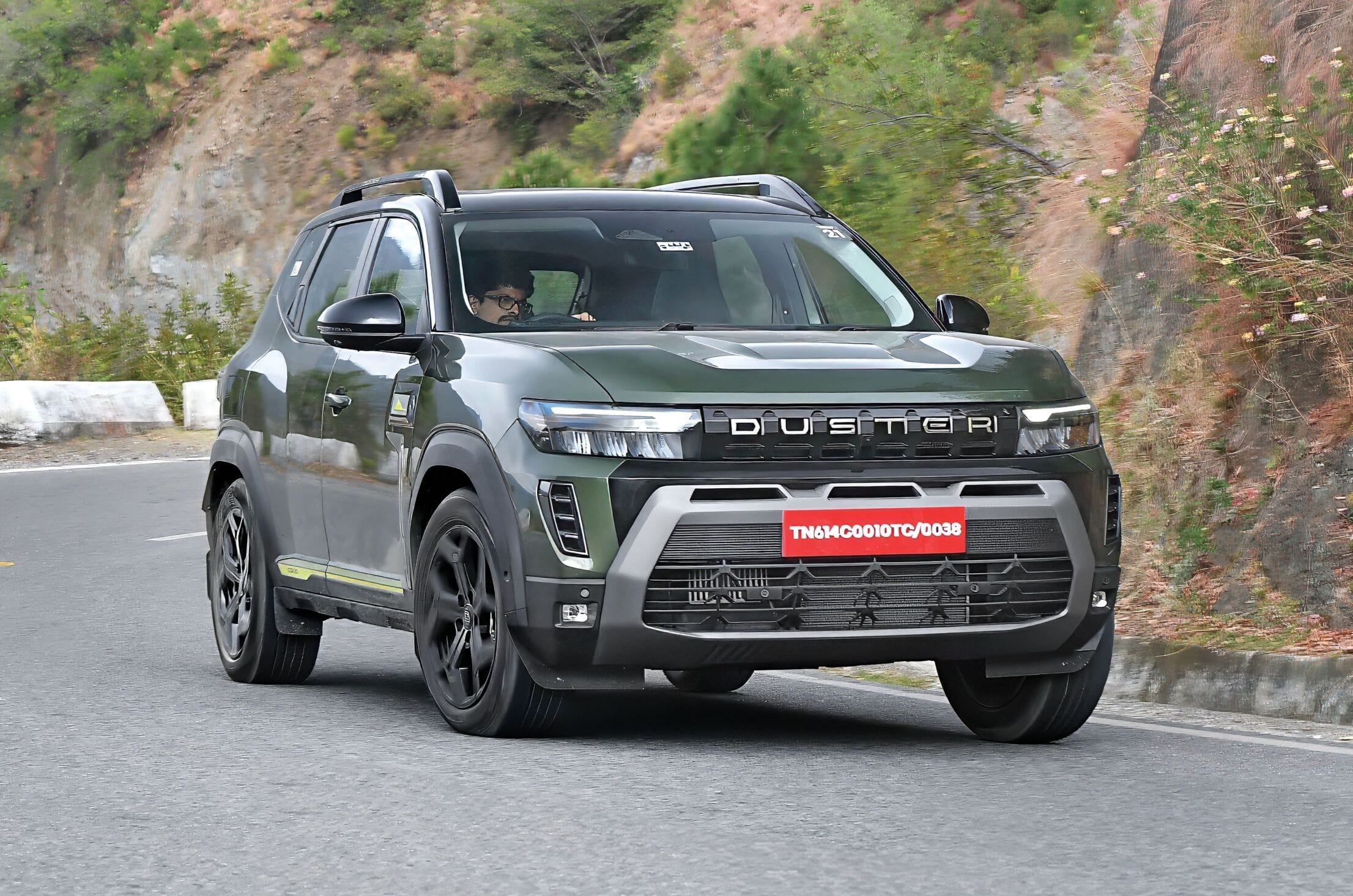
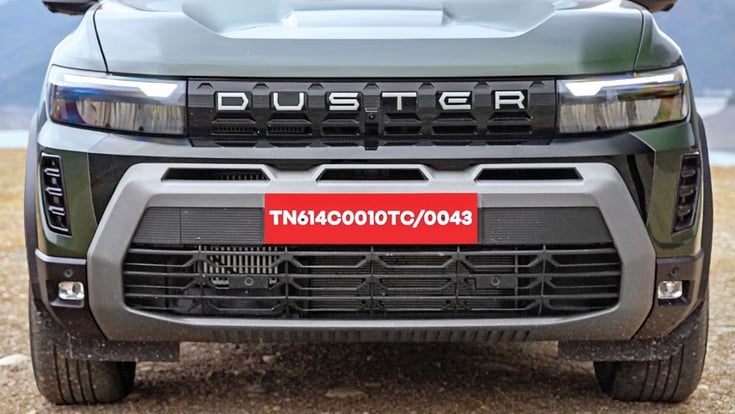
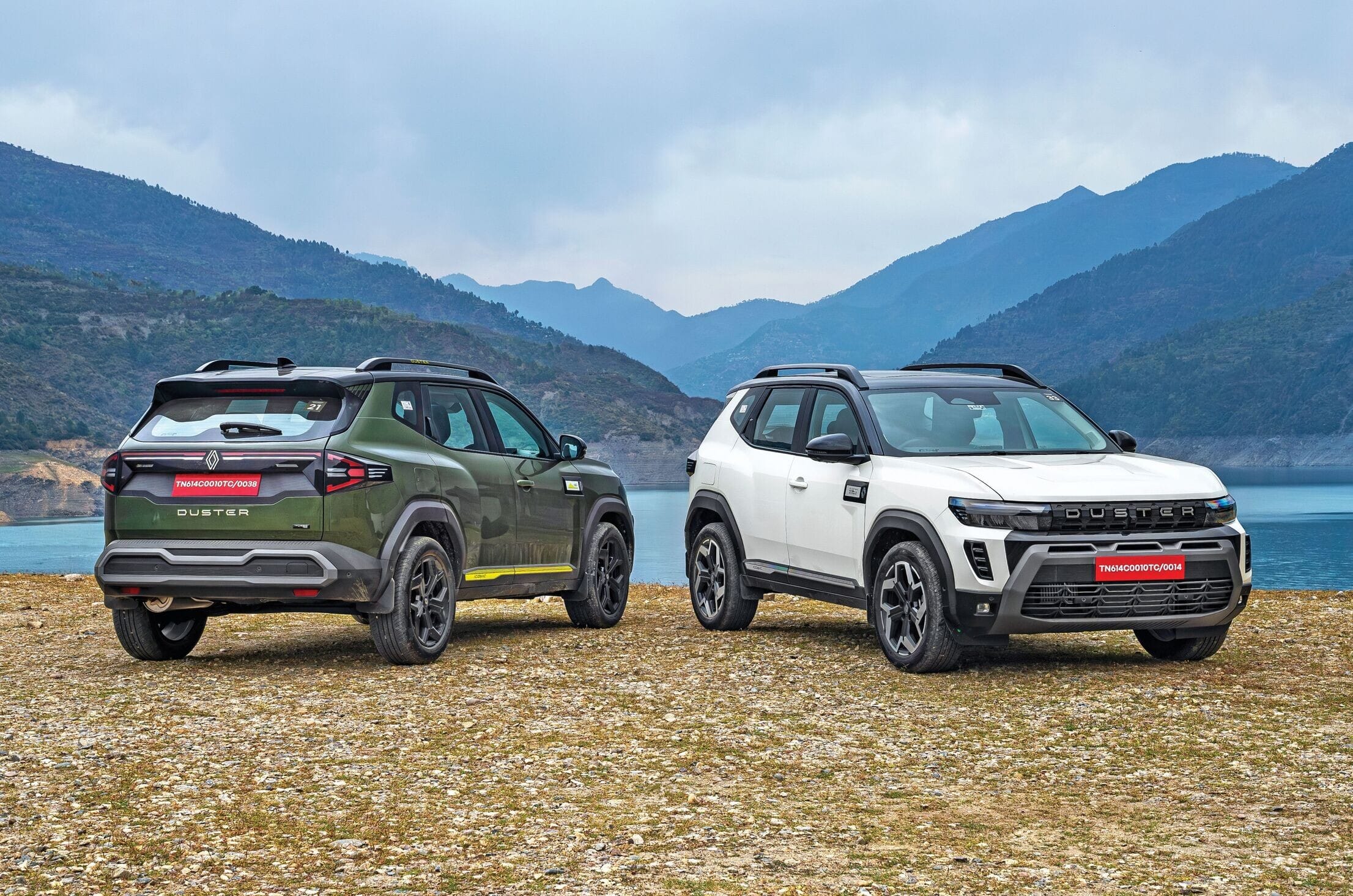
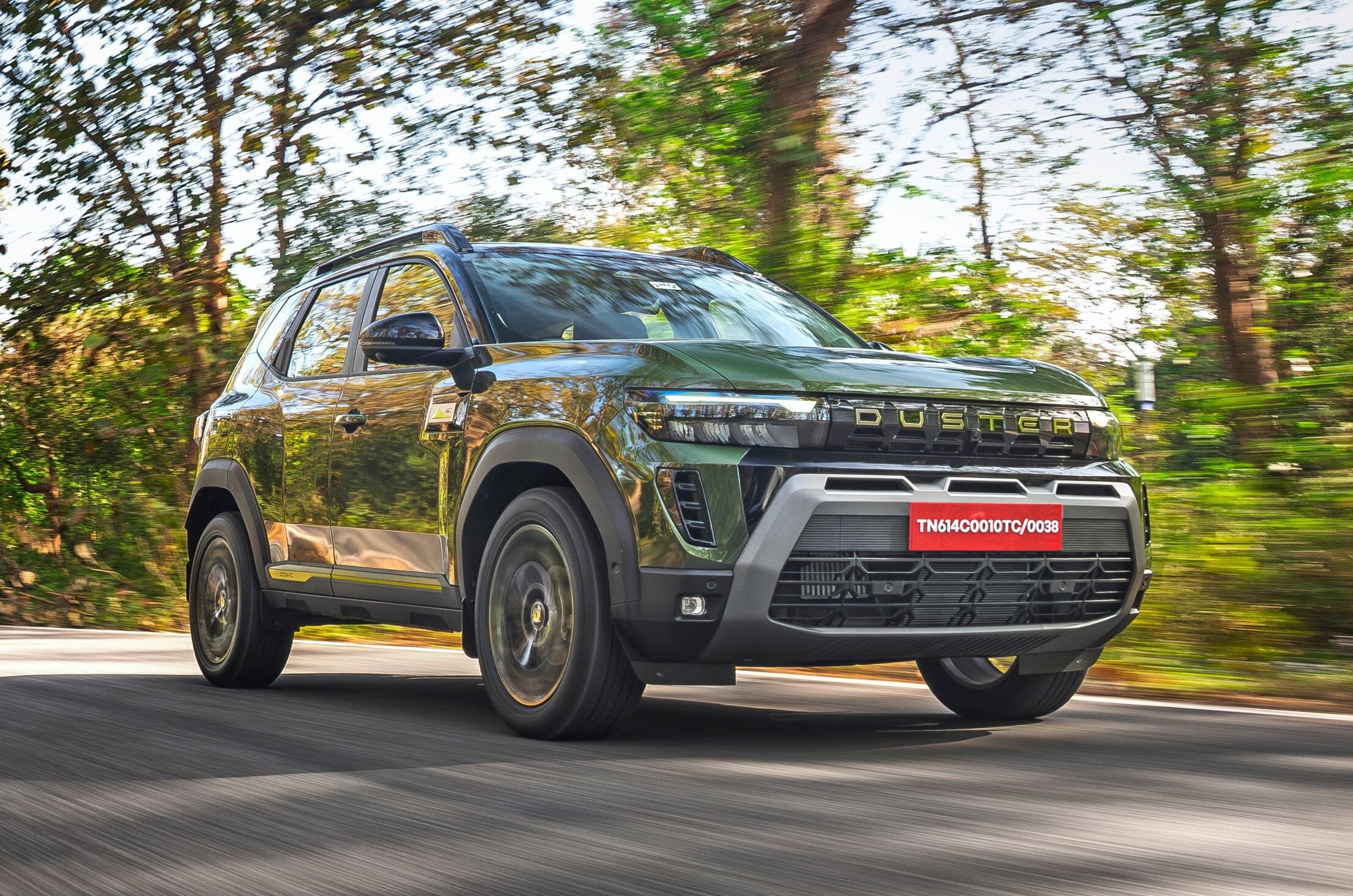
Renault has absolutely nailed the design of the new Duster. While it retains clear visual links to its predecessor, the styling feels thoroughly modern. Up front, large LED headlamps are paired with distinctive eyebrow-shaped DRLs that double as turn indicators, while the grille replaces the Renault logo with a prominent ‘Duster’ script, capitalising on the model’s strong brand recall. A protruding silver skid plate evokes memories of the original Duster, and pixel-style fog lamps, a sculpted bonnet and functional air curtains add further visual muscle.
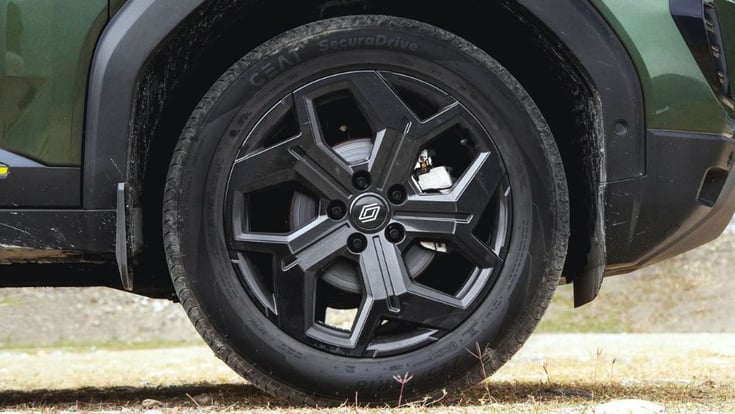
Left to right: Proudly wears the Duster badging on the nose; 18-inch alloys look proportionate.
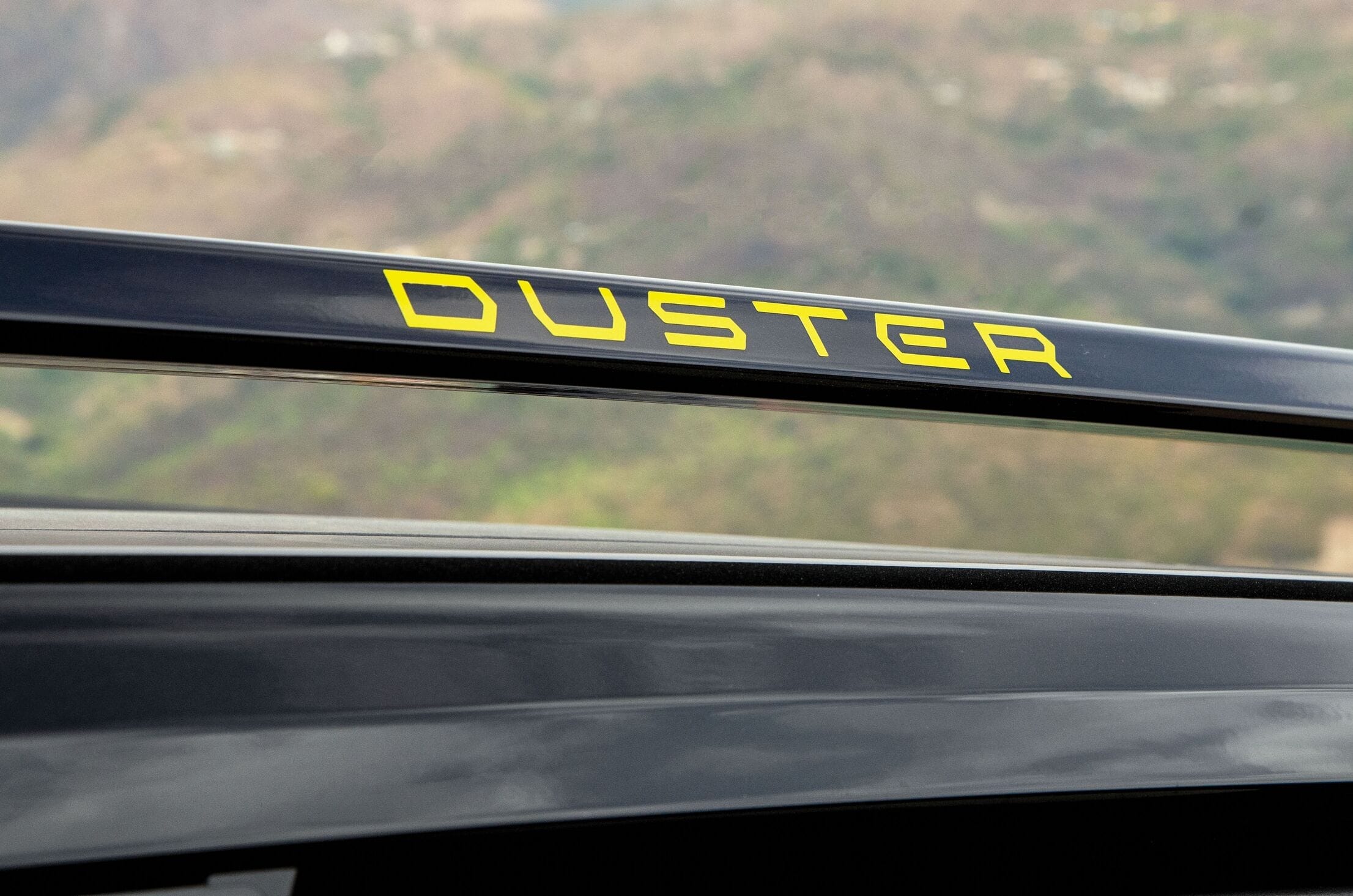
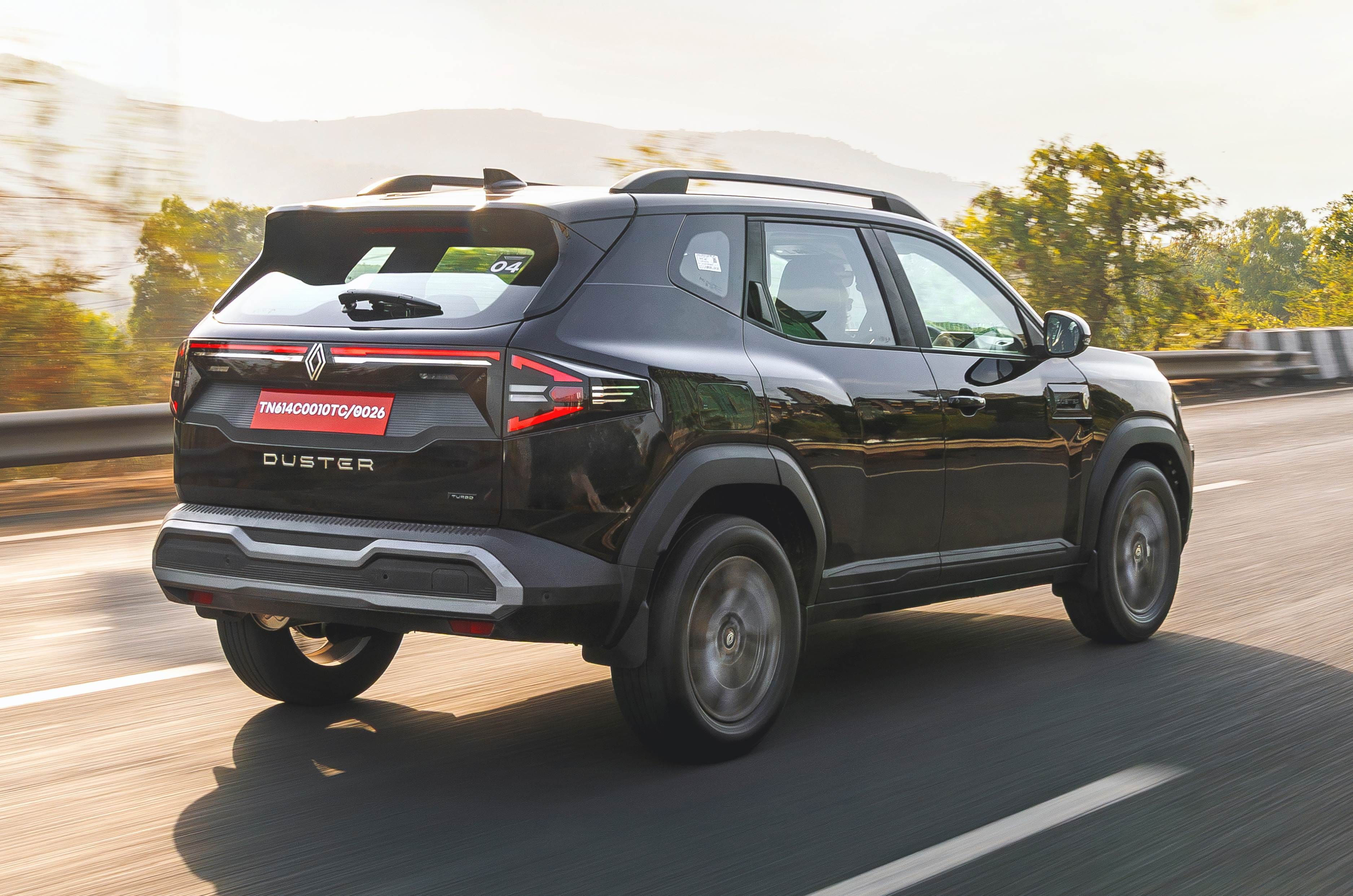
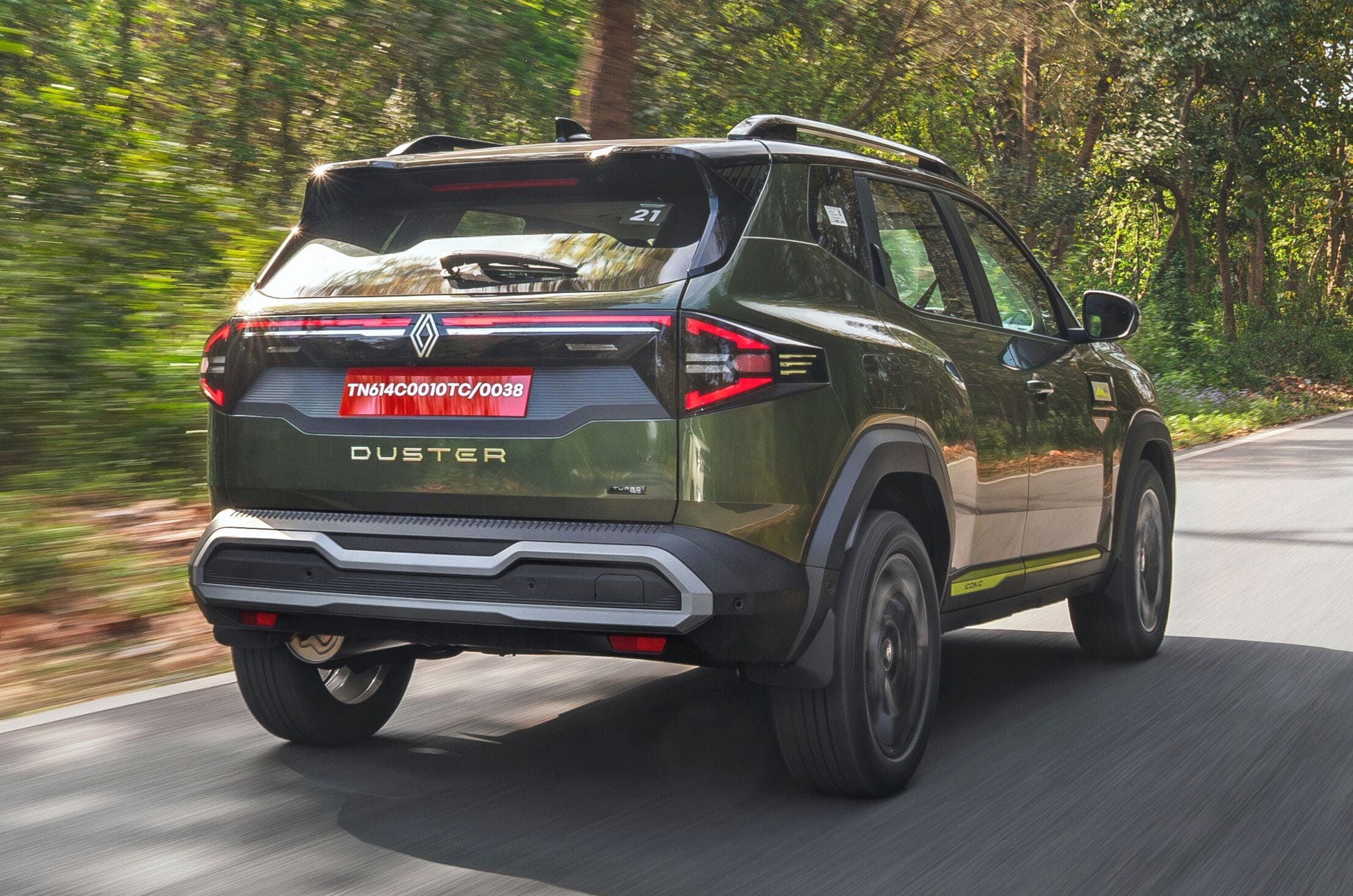
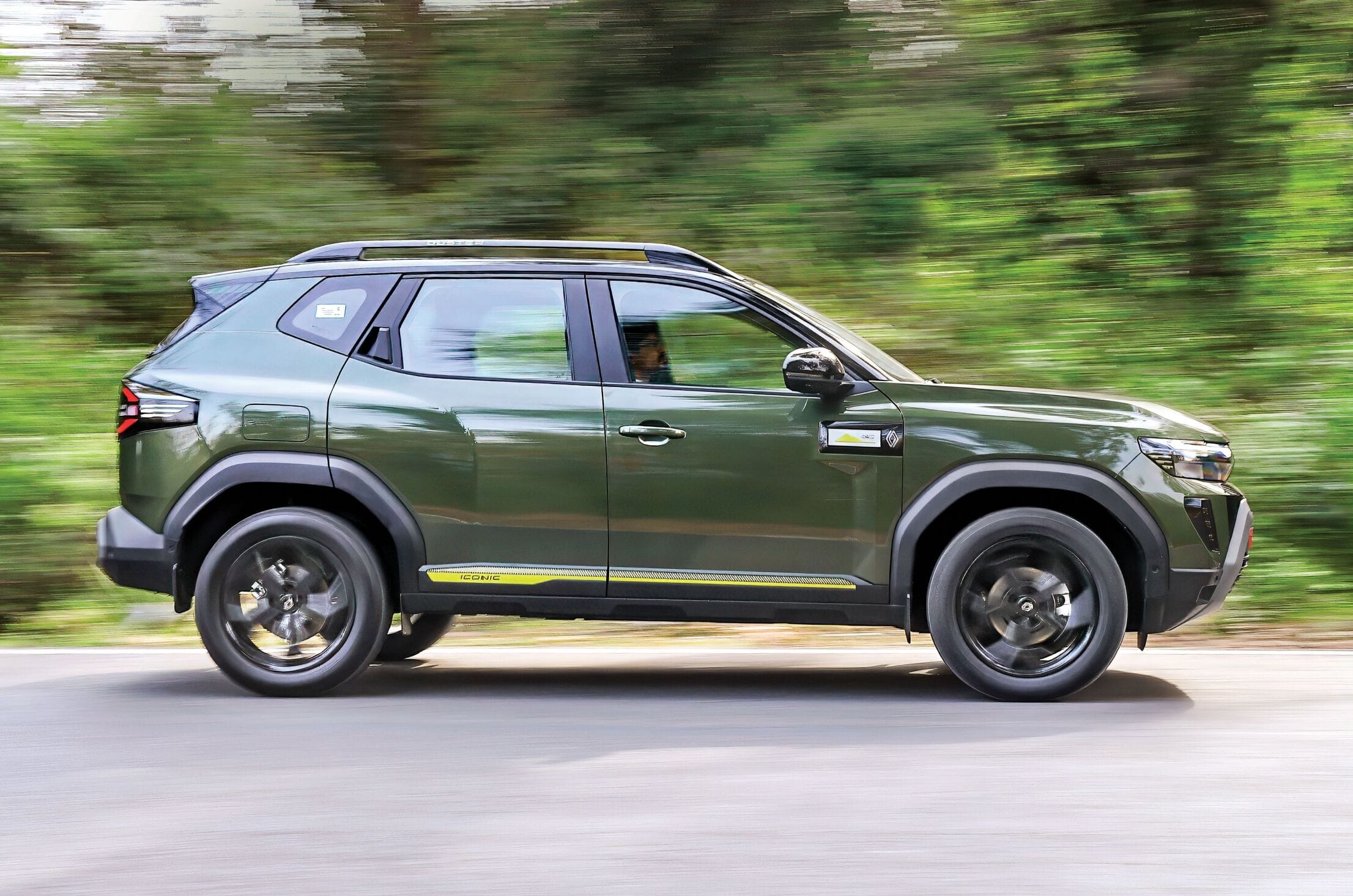
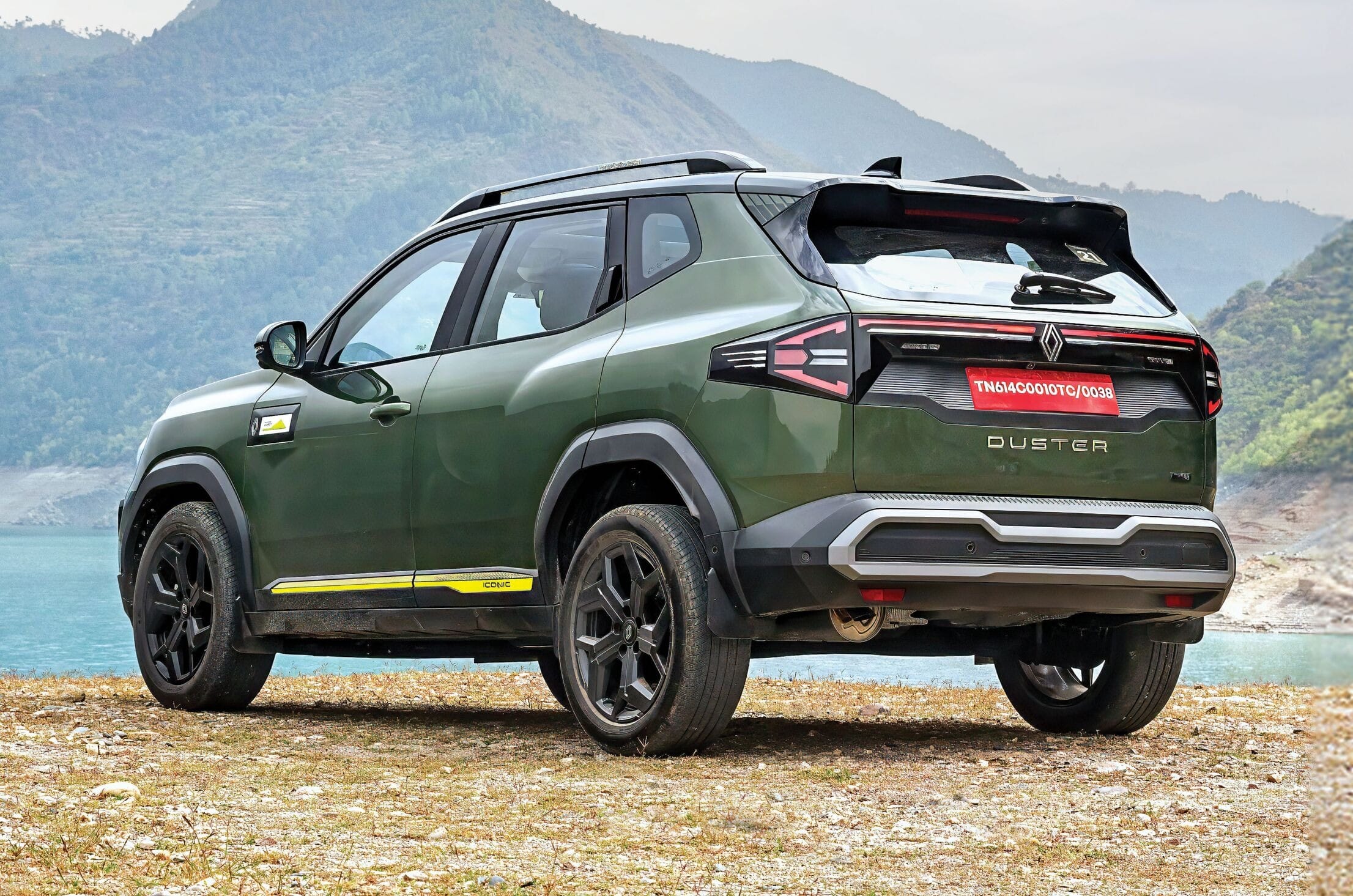
In profile, the Duster embraces a rugged SUV character with chunky black cladding, concealed rear door handles in the C-pillar and functional roof rails. It rides on striking 18-inch alloy wheels and offers 212mm of ground clearance. The rear design is relatively clean but features distinctive triangular tail-lamps connected by an LED light bar. A roof spoiler and contrasting silver insert in the bumper help enhance its stance. Overall, the Duster has considerable road presence. Colour options include Sunset Red, Pearl White, River Blue, Moonlight Silver, Stealth Black and Jade Mountain Green, while the Launch Edition adds neon-green accents and blacked-out alloys (pictured here).
The roof rails are functional and have a rated 50 kg load-carrying capacity.
Meanwhile, the 1.0 range tops out at the mid-spec Techno trim, but Renault has done a very good job of not making it look like so. You still get the same butch and muscular styling, LED lights, roof rails and body cladding. The only prominent difference from the top trims is the alloy wheels, which are a size smaller at 17 inches and feature a slightly different design.
Unlike the global CMF-B-based model, the India-spec Duster sits on an updated RGMP platform.
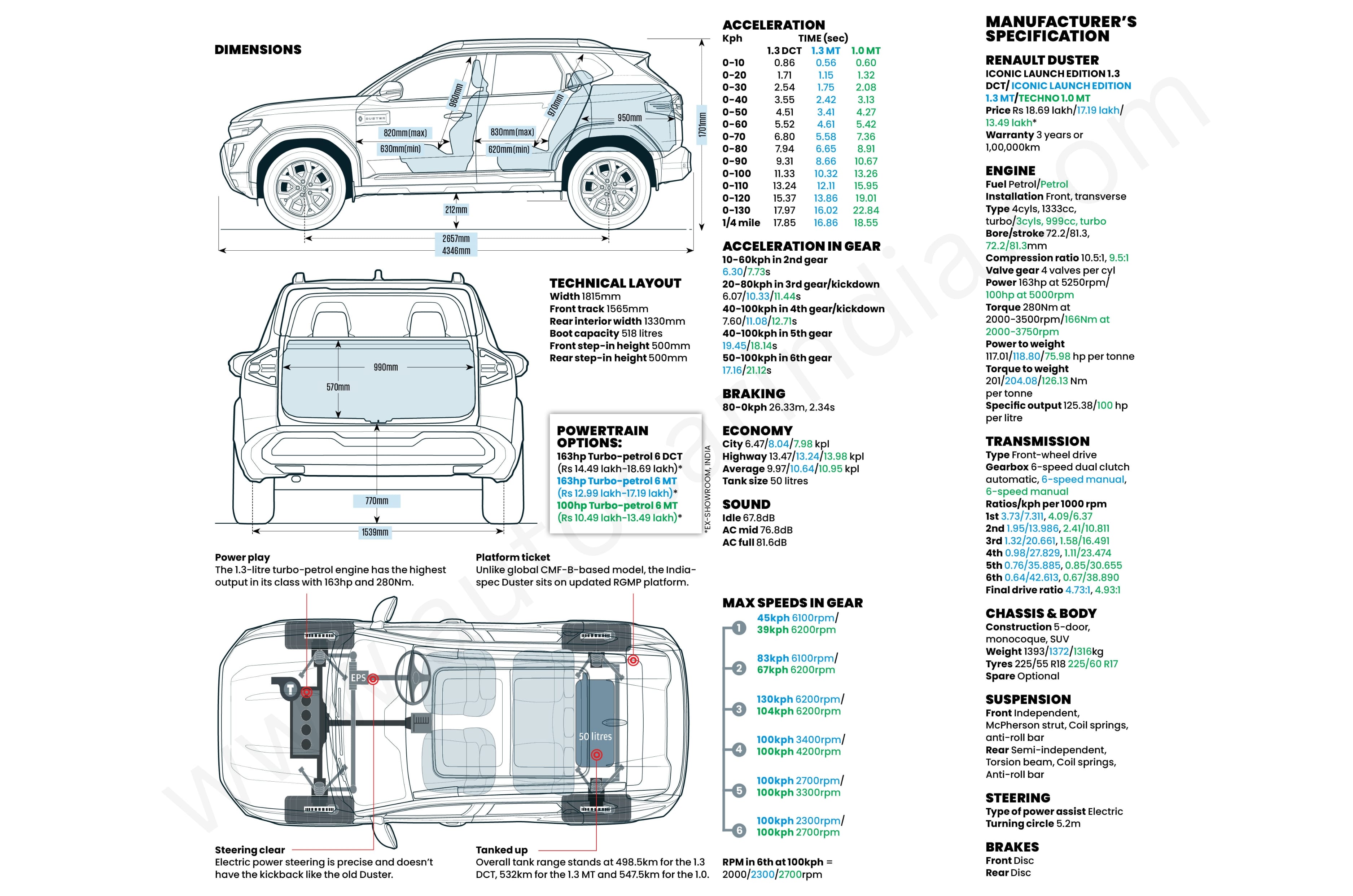
Unlike the European-spec Duster, which uses the CMF-B platform, the India model sits on an updated version of it, which Renault calls the Global Modular Platform (RGMP). It features a Google co-developed electronic architecture, and the platform is designed to accommodate a wide range of body styles and powertrains, including hybrids, CNG and full-electric derivatives. Interestingly, the cabin is around 40mm taller due to the addition of a panoramic sunroof, which necessitated a higher roofline to preserve cabin headroom. Ground clearance is slightly higher too, making the India car 50mm taller overall than the international model. Measuring 4,343mm long, 1,813mm wide and 1,659mm tall, with a 2,657mm wheelbase, the Duster sits squarely in the midsize SUV segment.
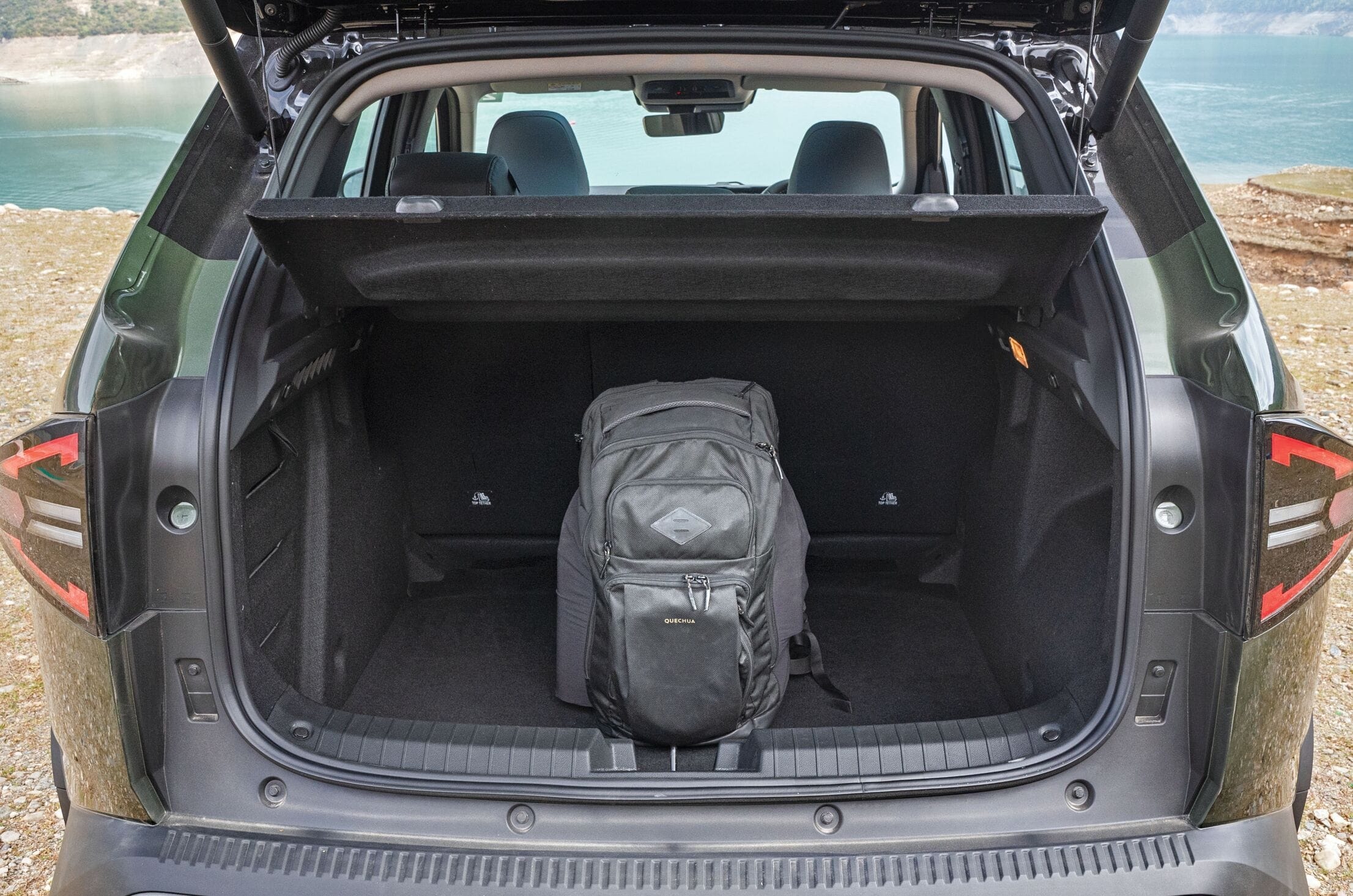
The Duster gets a segment-best 518-litre boot, though the loading lip is high.
The powered tailgate reveals a segment-leading 518-litre boot (700 litres up to the roof), although Renault only provides a puncture repair kit instead of a spare wheel as standard. Despite no AWD option, off-road credentials remain a key part of the Duster’s appeal, with 26.9-degree approach and 34.7-degree departure angles.
Renault Duster Interior Space, Comfort and Practicality – 8/10
Modern interior impresses with its design, but it isn’t as spacious as some rivals in the segment
Fit and finish of materials inside the cabin are good.
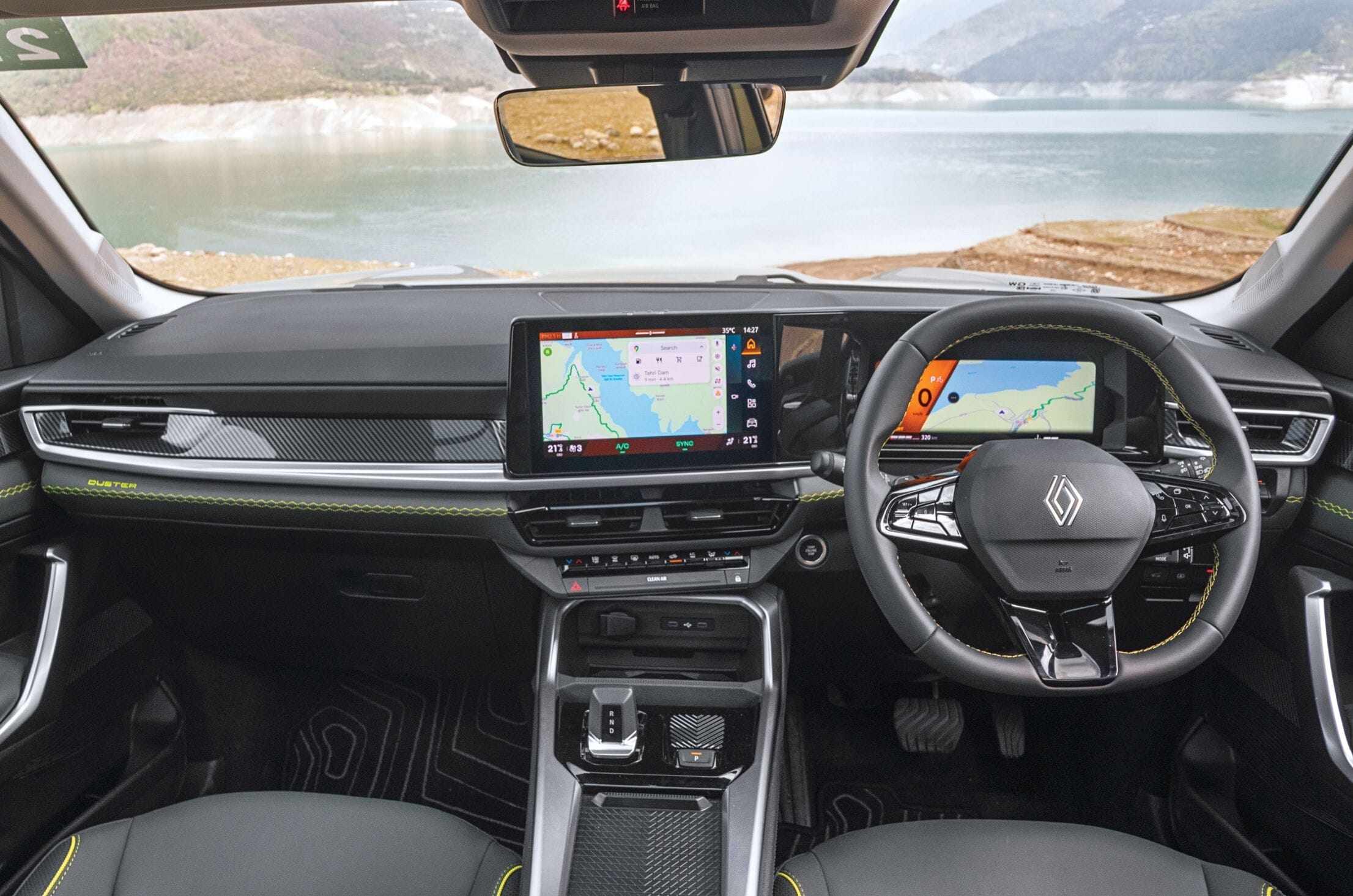
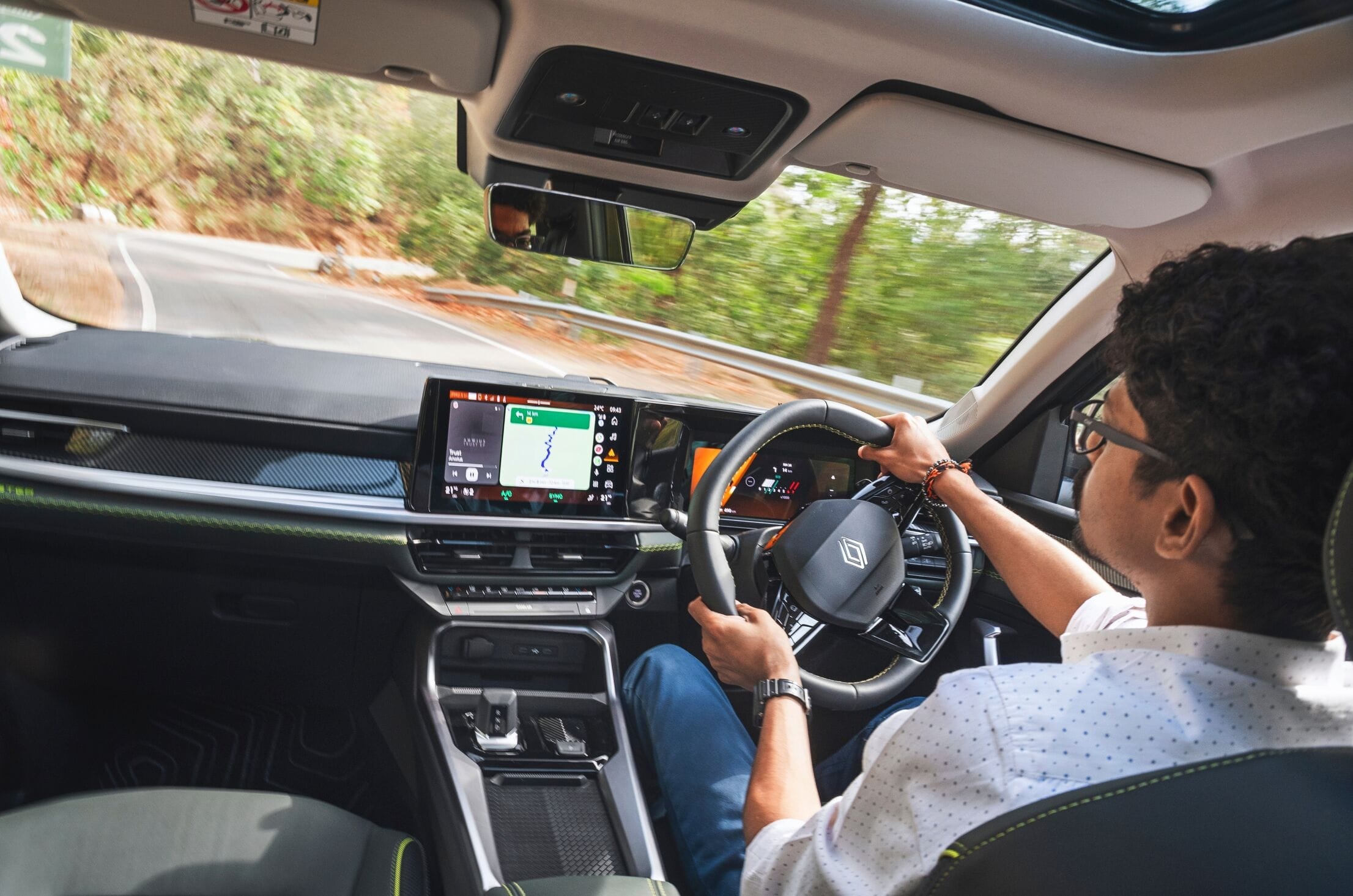
Inside, the dashboard features a twin-screen layout, with a mix of textured and soft-touch materials that lend the interior a premium feel. Silver accents, faux carbon-fibre trim and contrast green stitching add visual drama without making the cabin feel overly busy.
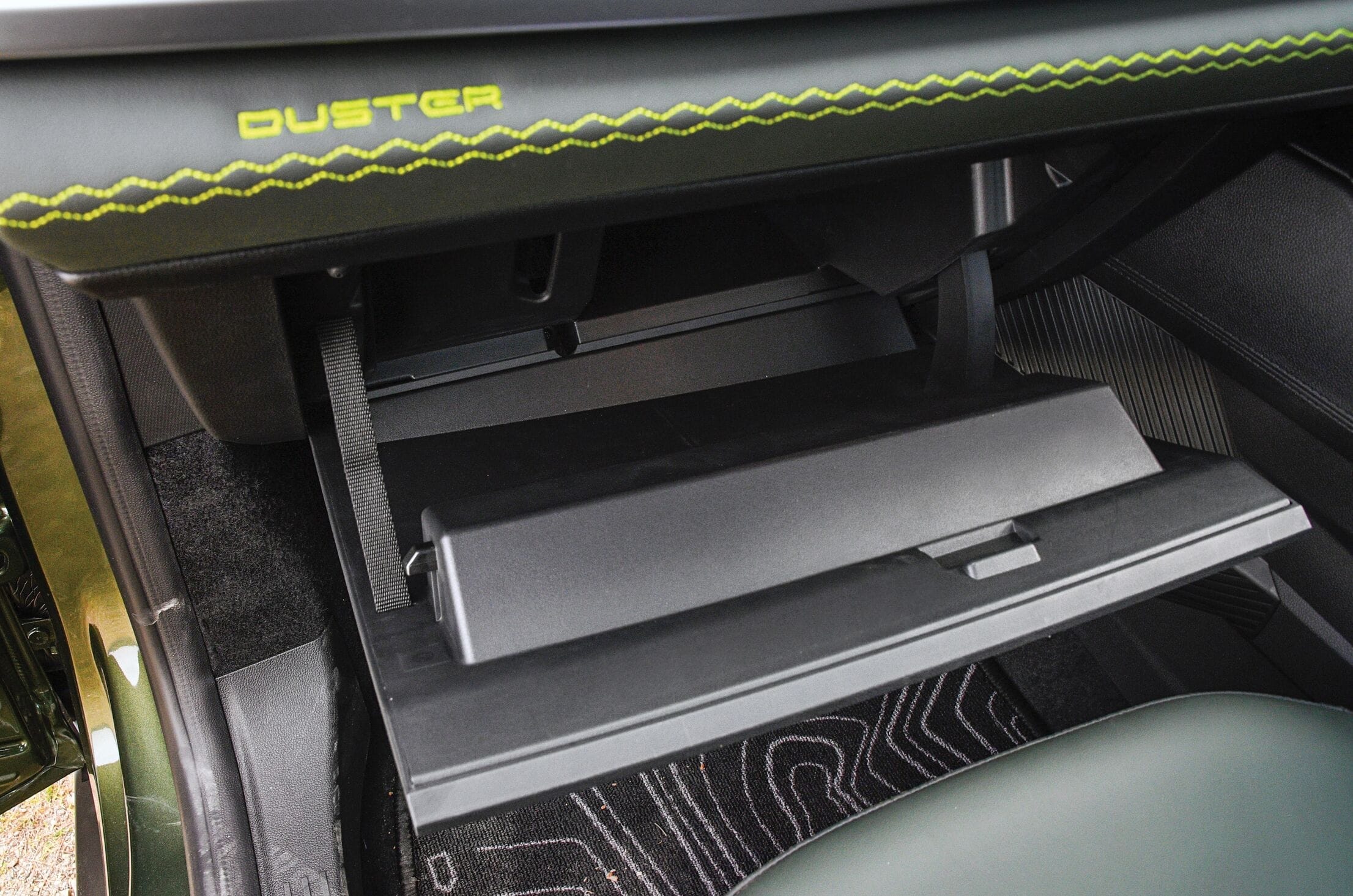
Glovebox is quite shallow and small on the whole.
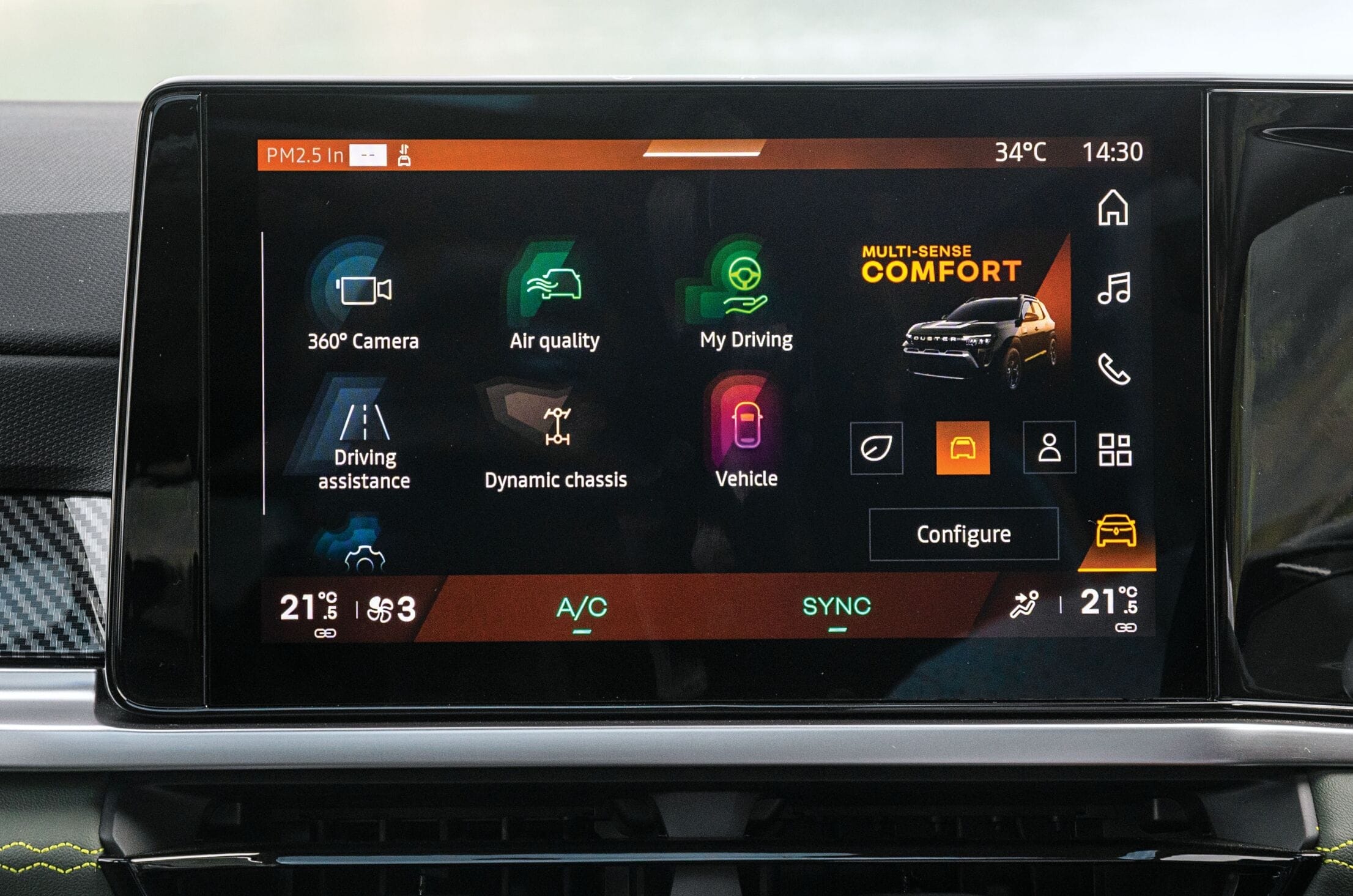
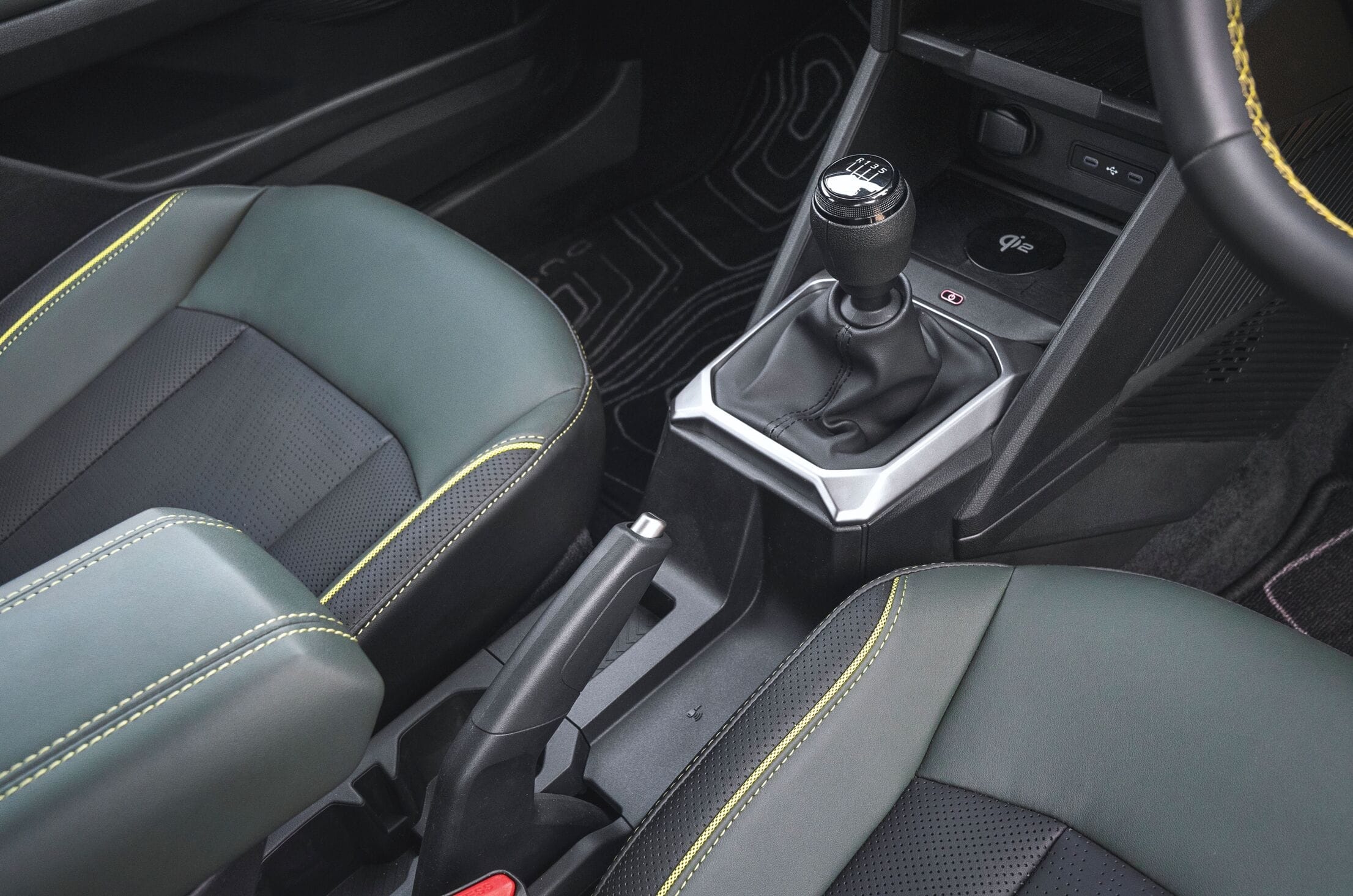
Crucially, Renault has resisted the temptation to digitise everything. The Duster strikes a sensible balance between touchscreen functions and physical controls, with a row of buttons and knobs for key functions, including the climate control system. Interestingly, the manual and automatic versions feature different centre console layouts. The automatic gets a raised console with a deep, cooled storage compartment, cup holders, a wireless charger and a stubby gear selector, while the manual features a lower-set console with a conventional handbrake and an additional storage shelf beneath the dashboard controls. The manual gear lever feels pleasingly tactile and well-engineered.
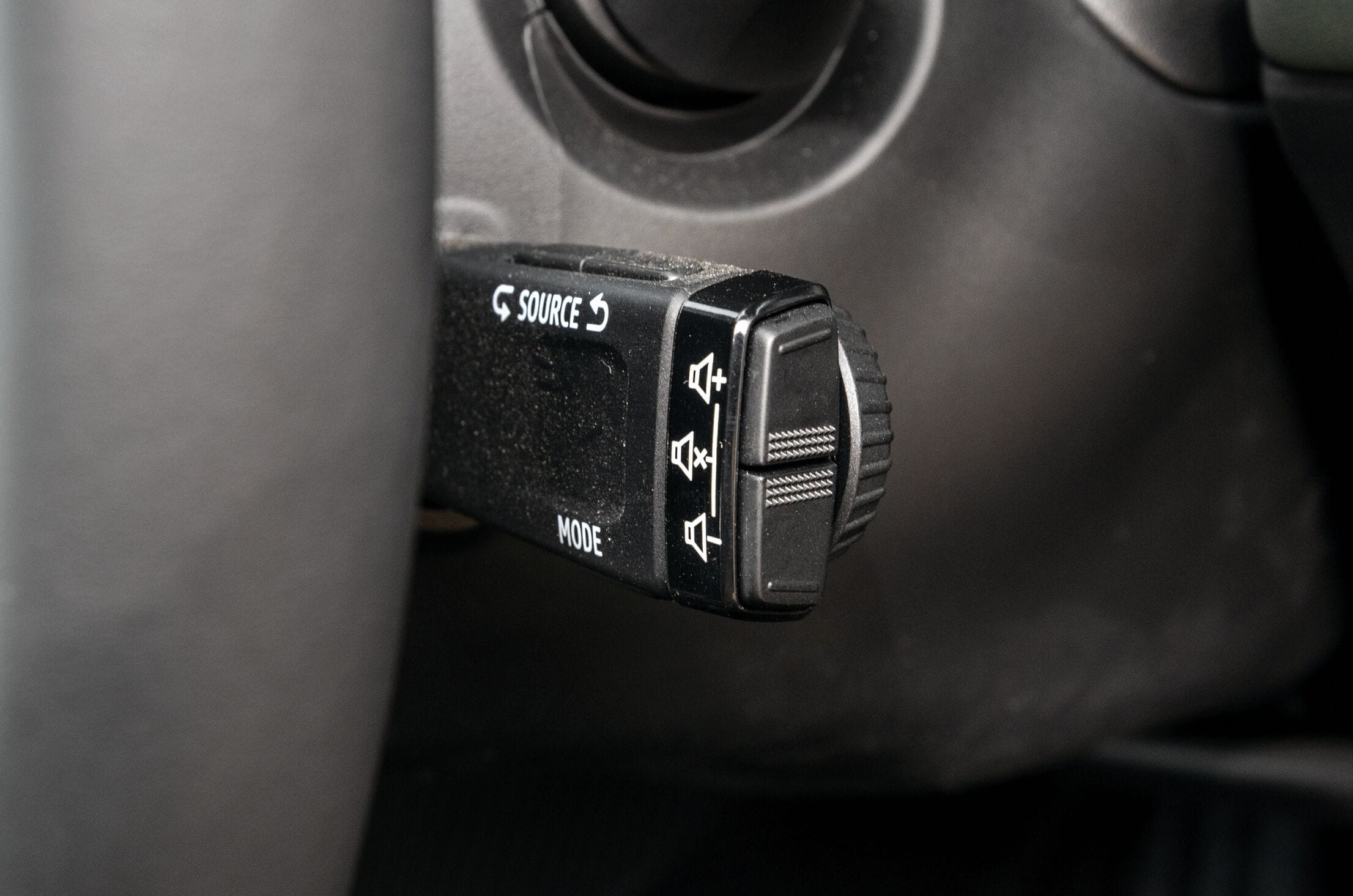
Audio controls are on a separate stalk behind the steering wheel; it takes some time getting used to.
Practicality is par for the course. The sliding front armrest incorporates a storage compartment, but the glovebox is on the smaller side, and the door pockets struggle to accommodate 1-litre bottles. The flat-bottom, flat-top steering wheel feels good to hold and houses controls for the instrument cluster and cruise control, while audio controls continue to sit on a separate stalk behind the wheel, a familiar Renault trait. What’s nice is that it features auto up/down for all windows from the base trim.
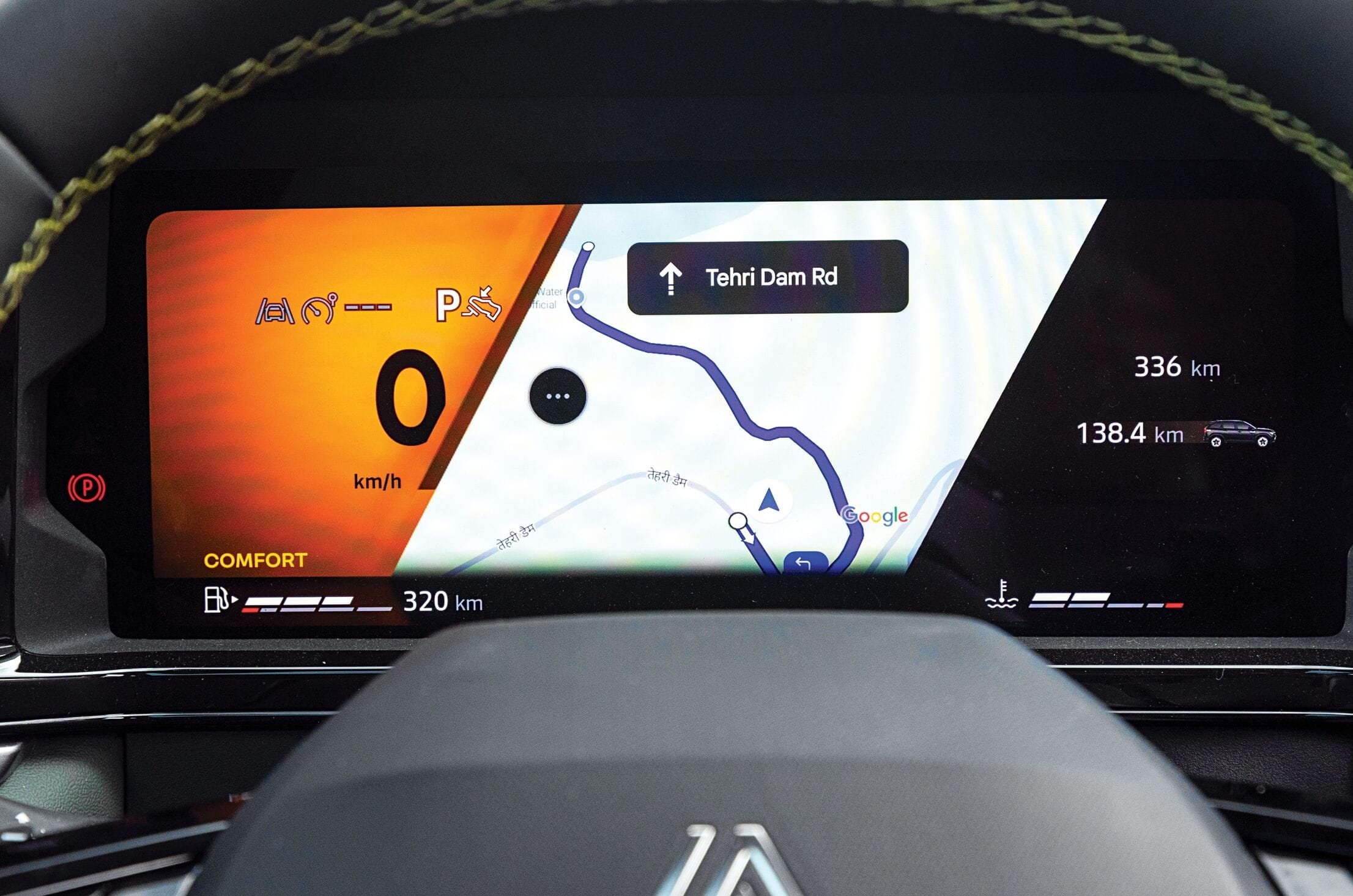
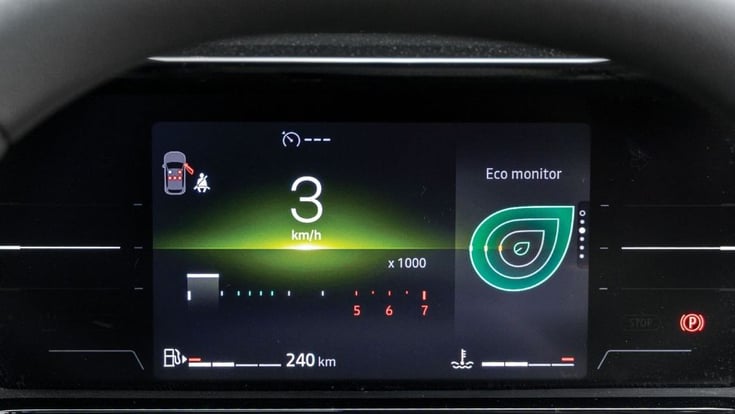
10.25-inch digital cluster has a split-screen function; some will miss classic round dials, though.
The digital instrument cluster is crisp, colourful and configurable, although some buyers will miss straightforward analogue dials. Less impressive is the key fob, shared with the Triber and Kiger, which feels very budget-oriented.
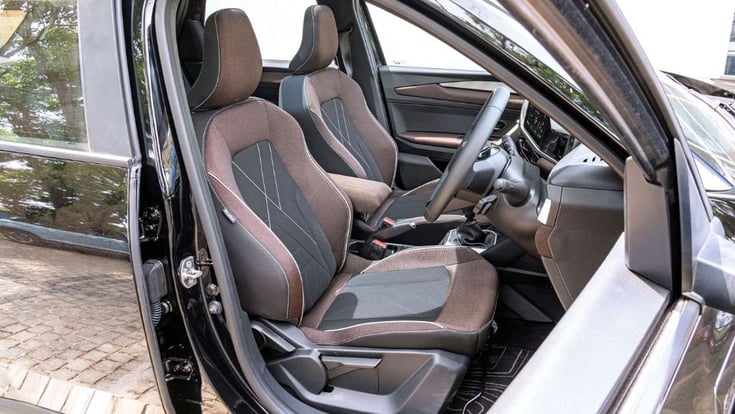
1.0 range gets a smaller 7-inch driver’s display and brown- black fabric seat upholstery.
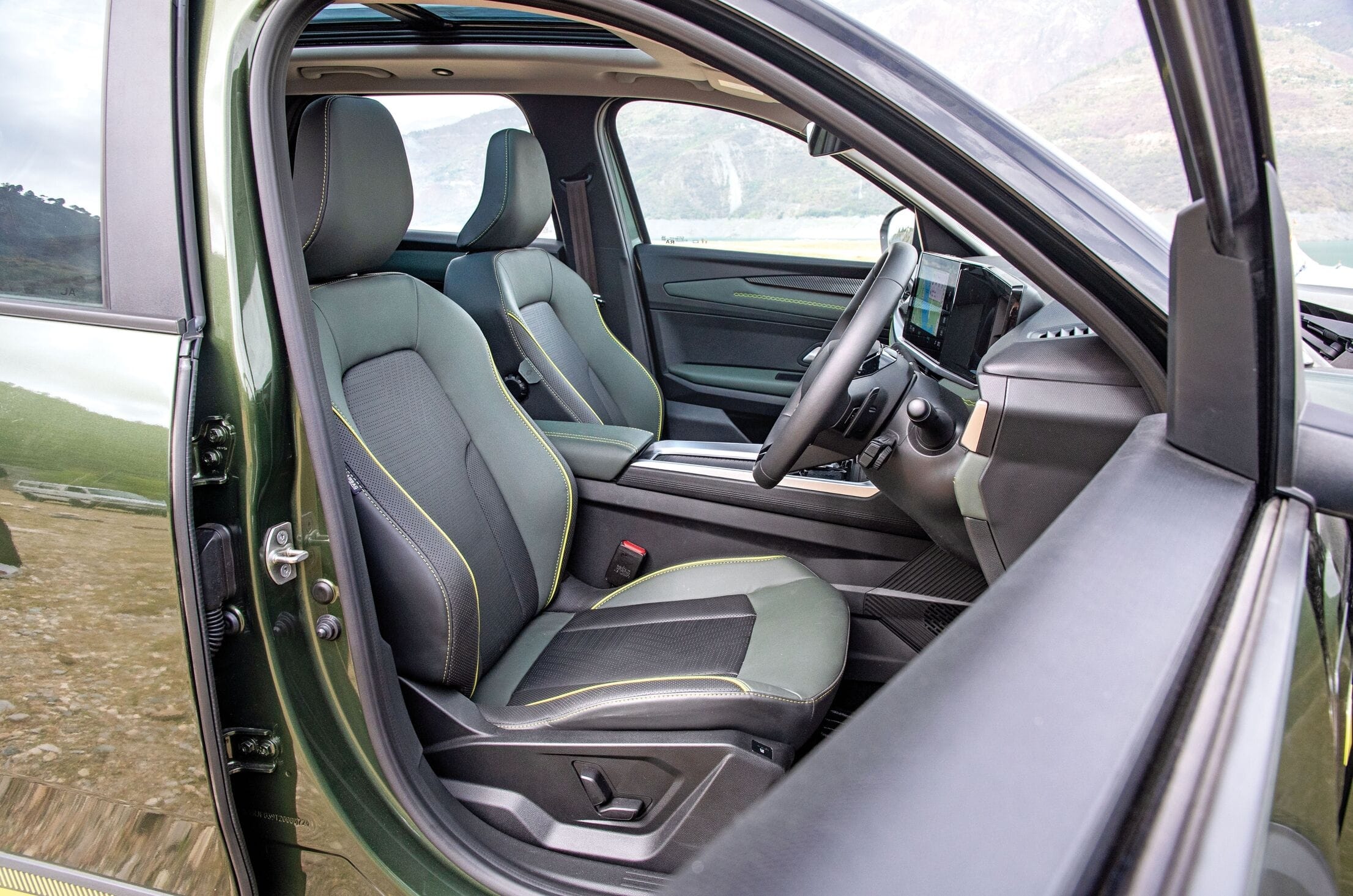
The dual-tone black-and-dark-green upholstery with neon-green stitching in the top-spec Iconic Launch Edition adds some character to the cabin. The Techno trim, meanwhile, which is where the 1.0 tops out, features brown-and-black seat upholstery with some different trim elements.
Front seats are well-padded, accommodating and ideal for long drives.
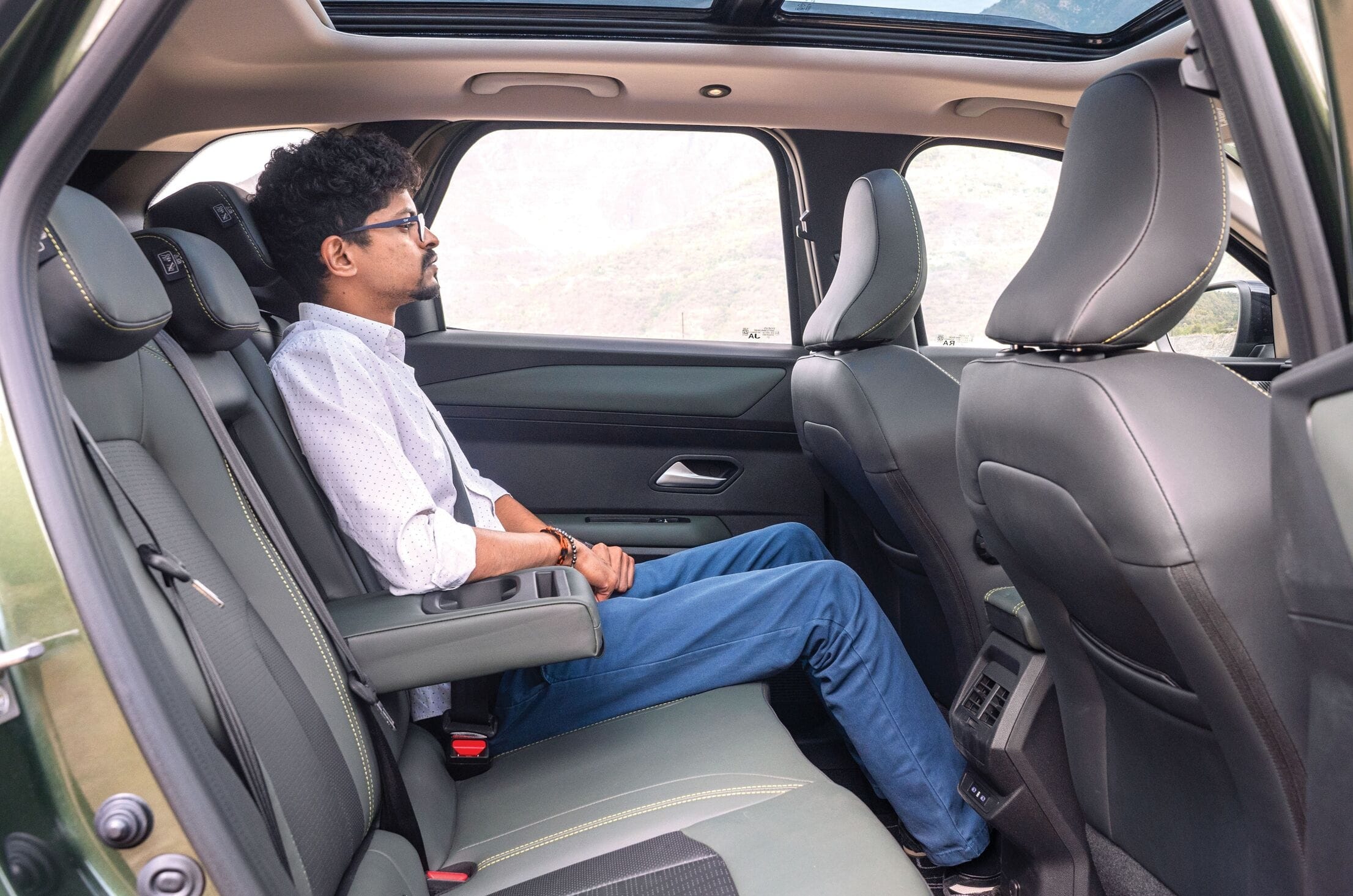
Up front, the seats are supportive and comfortable over long distances, and they feature electric adjustment and an effective ventilation function. Rear-seat comfort is good for two adults, with adequate knee room and good headroom. While a third passenger can be accommodated, limited shoulder room and the transmission tunnel make it a squeeze.
There’s good knee room and headroom on offer, but overall space is less than some rivals.
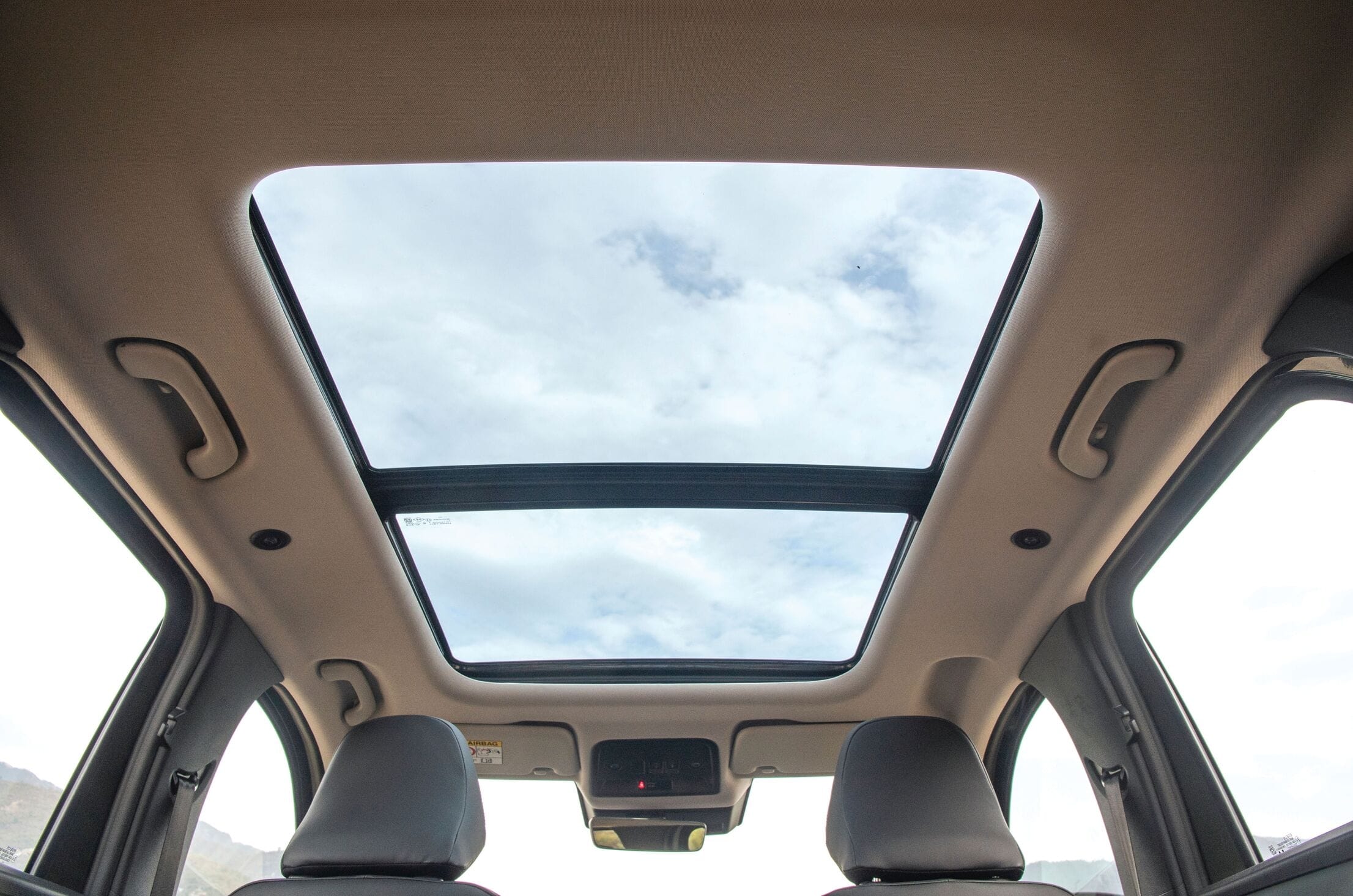
Rear occupants also get AC vents, charging ports and a centre armrest with cup holders. The large panoramic sunroof and expansive glass area help create an airy feel, although rear sun blinds are notably absent. One drawback is that the window line is considerably higher than before, meaning outward visibility isn’t quite as good as in the original Duster, which was renowned for its excellent all-round view out.
Renault Duster Features and Safety – 8/10
Top-spec comes very well-equipped, though features could’ve been better spread out
10.1-inch touchscreen is slick and high- resolution, but the UI isn’t as logical or straightforward as some rivals.
The Duster comes loaded with all the features expected of a midsize SUV. Its infotainment system supports wireless smartphone connectivity and impresses with crisp graphics and vibrant colours, matching the digital instrument cluster. However, the 10.1-inch touchscreen’s ratio makes it feel relatively slim.
The standout feature is the integration of Google services – Google Maps, Google Assistant and the Google Play Store, which are built into the system, and work seamlessly. The interface is slick and responsive, though it isn’t very intuitive to use, lacking the straightforward layout and menu structure seen in some rivals.
The large panoramic sunroof livens up the cabin without hampering headroom.
Equipment highlights include ventilated and powered front seats, a panoramic sunroof, wireless phone charging, a powered tailgate, dual-zone climate control, connected car technology, auto headlamps and wipers, and a 360-degree camera, although image quality could be sharper.
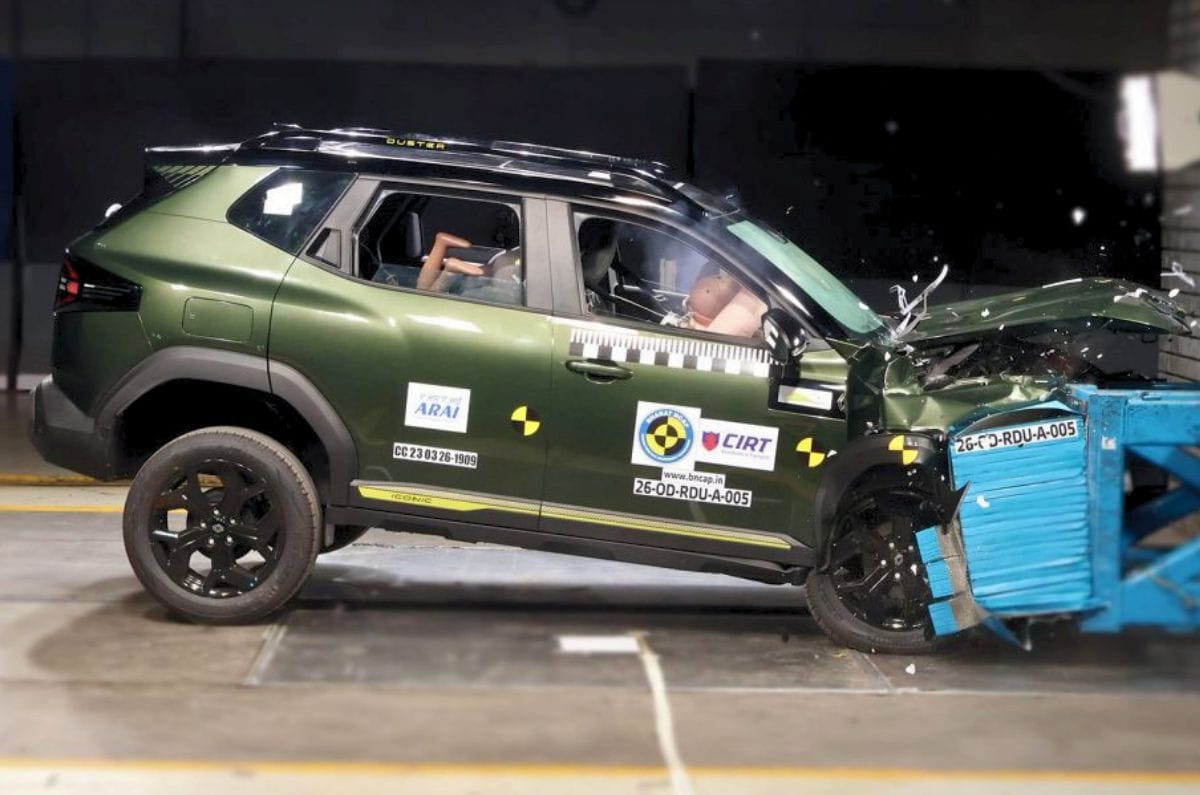
Safety equipment is comprehensive, with six airbags as standard, front and rear parking sensors, TPMS, an electronic parking brake on DCT variants, disc brakes all around, adjustable headrests and three-point seatbelts for all occupants. The Duster is also Renault India’s first model to feature Level 2 ADAS. During our drive, the system felt well calibrated and largely unobtrusive, though lane-keep assist was slightly overzealous. A dedicated button allows drivers to disable all ADAS functions without diving into touchscreen menus, which is a welcome touch. Commendably, Renault has also secured a full 5-star crash safety rating from Bharat NCAP for the SUV.
It scored 30.49/32 points for adult occupant protection and 45/49 points for child occupant protection.
Overall, the Duster is well equipped to compete with its rivals, though Renault could have distributed some premium features like ventilated seats more effectively across the range, particularly on mid-spec variants. As for the 1.0 range, the top-spec Techno is well specified with features like the same touchscreen, panoramic sunroof, powered tailgate and more.
Renault Duster equipment checklist
Auto LED headlamps
Yes
Alloy wheels
18-inch
Powered front seats
Yes
Ventilated seats
Yes
Panoramic sunroof
Yes
Ambient lighting
Yes
Touchscreen
10.1-inch
Android Auto/Apple CarPlay
Yes
Arkamys Kardon audio
Yes
ADAS
Level 2
Renault Duster Engine Refinement and Performance – 8/10
Both turbo-petrols are refined and have a strong midrange punch; DCT is the pick of the lot
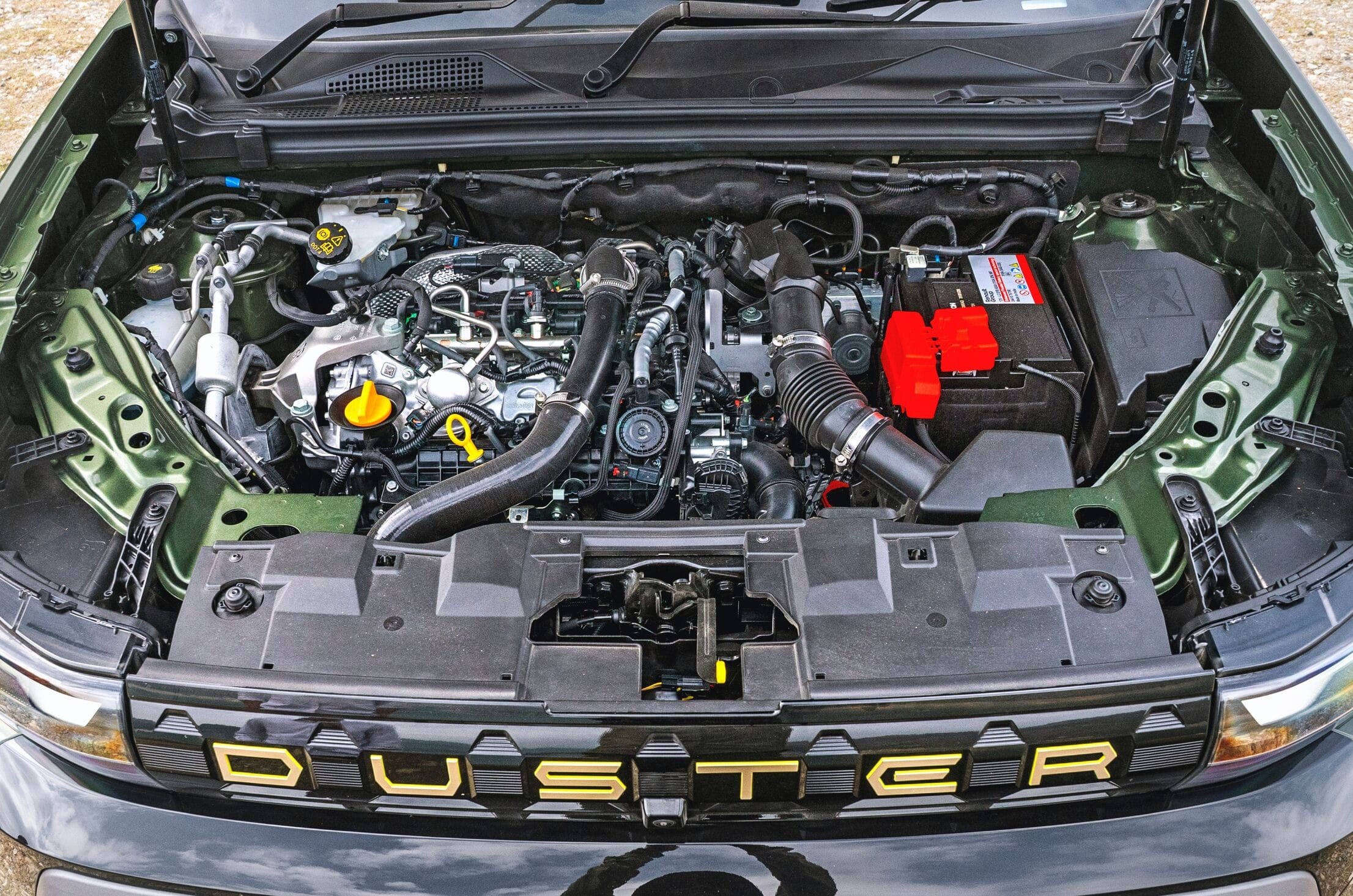
The Duster range starts with a 1.0-litre three-cylinder turbo-petrol producing 100hp and 166Nm, paired exclusively with a 6-speed manual gearbox. Then there’s a 1.3-litre four-cylinder turbo-petrol with a segment-leading 163hp and 280Nm, available with either a 6-speed manual or a 6-speed DCT automatic. We’ve tested all three versions of the Duster on sale currently.
Renault Duster powertrain specs
1.0TP MT
1.3 TP MT
1.3TP DCT
Installation
Front, transverse
Front, transverse
Front, transverse
Type
3 cyls, 999cc, turbo-petrol
4 cyls, 1333cc, turbo-petrol
4 cyls, 1333cc, turbo-petrol
Bore/ stroke (mm)
72.2/81.3
72.2/81.3
72.2/81.3
Compression ratio
9.5:1
10.5:1
10.5:1
Valve gear
4 valves per cyl
4 valves per cyl
4 valves per cyl
Power (hp)
100 at 5000rpm
163 at 5250rpm
163 at 5250rpm
Torque (Nm)
166 at 2000-3750rpm
280 at 2000-3500rpm
280 at 2000-3500rpm
Power to weight (hp per tonne)
75.98
118.80
117.01
Torque to weight (Nm per tonne)
126.13
244.17
244.17
Specific output (hp per ltr)
100
125.38
125.38
Drive layout
Front-wheel drive
Front-wheel drive
Front-wheel drive
Gearbox
6-speed manual
6-speed manual
6-speed dual-clutch automatic
A strong-hybrid powertrain will join the line-up later this year. It combines a 109hp 1.8-litre petrol engine with a 49hp electric motor and a 20hp hybrid starter generator, drawing power from a 1.4kWh battery. Total system output stands at 160hp and 172Nm. Notably, unlike the original, the new Duster isn’t available with a diesel engine or an AWD option.
Both engines are refined and have a strong midrange, but aren’t very fuel-efficient.
The 1.3-litre engine is impressively refined, with virtually no vibrations at idle and excellent smoothness throughout the rev range. Cabin insulation is equally impressive, keeping engine noise largely out of the cabin unless you’re extending it towards the redline. You do hear quite a bit of the turbo’s blow-off sound though. There is some turbo lag, followed by a noticeable surge in performance at around 2,500rpm, after which the engine delivers a strong and eager mid range.
The 1.3-litre turbo-petrol engine has the highest output in its class with 163hp and 280Nm.
Thanks to its wet clutch, the DCT allows for some slip, given that the lubrication manages wear as well as heat build-up. Thus, shifts prioritise smoothness over outright speed, feeling more like a conventional torque-converter automatic in city driving. This makes it exceptionally easy to live with in traffic, while responsive paddle shifters add an extra layer of engagement on a spirited drive. We recorded a 0-100kph time of 11.3 seconds, which is decent for the segment. However, the tall gearing does blunt low-speed responses somewhat.
Enthusiasts will naturally gravitate towards the manual. Driven on winding and open roads, it feels engaging and rewarding, with a light clutch and a precise shift action. However, turbo lag is more noticeable here than in the DCT, particularly when accelerating from slow speeds. This does make city drives somewhat cumbersome. Combined with the tall gearing, it often requires an extra downshift to keep the engine in its sweet spot.
Manual versions get a lower-set centre console with a manual handbrake.
The manual posted a 0-100kph time of 10.3sec, making it a whole second quicker than the DCT. Both versions feature Comfort and Eco drive modes, although the addition of a Sport mode would have better suited the Duster’s otherwise enthusiastic character.
The 1.0 entry-level engine is a familiar unit that also powers the Kiger. However, Renault has made tweaks, with torque increasing to 166Nm, up by 6Nm over the Kiger, while a 6-speed manual gearbox replaces the compact SUV’s 5-speed unit. There’s no automatic option, though, which does limit its appeal.
The Duster shares its 1.0-litre engine with the smaller Kiger.
Like most three-cylinder engines, there’s a noticeable thrum and some vibrations at idle, but things smoothen out considerably once on the move. Being a small-capacity turbocharged motor, there is some lag low down in the rev range. However, once past 2,000rpm – where peak torque arrives – the engine feels responsive and pulls cleanly towards the redline. Performance is more adequate than exciting. Around town, it keeps pace with traffic comfortably, and part-throttle responses are respectable. On highways and steep inclines, however, you’ll need to work the gearbox to extract the best from the engine, particularly when overtaking.
The clutch is light, making it easy to use in traffic, while the 6-speed gearbox offers a precise shift action. It isn’t the slickest unit around, though, and enthusiastic drivers will notice that shifts require a bit more effort than expected.
Renault Duster acceleration times
Speed (kph)
1.0TP MT time (sec)
1.3TP MT time (sec)
1.3TP DCT time (sec
0-10
0.60
0.56
0.86
0-20
1.32
1.15
1.71
0-30
2.08
1.75
2.54
0-40
3.13
2.42
3.55
0-50
4.27
3.41
4.51
0-60
5.42
4.61
5.52
0-70
7.36
5.58
6.80
0-80
8.91
6.65
7.94
0-90
10.67
8.66
9.31
0-100
13.26
10.32
11.33
0-110
15.95
12.11
13.24
0-120
19.01
13.86
15.37
0-130
22.84
16.02
17.97
1/4 mile
18.55
16.86
17.85
20-80 (rolling)
11.44
10.33
6.07
40-100 (rolling)
12.71
11.08
7.60
Renault Duster Fuel Efficiency – 6/10
Small-capacity turbo engines mean efficiency isn’t great
Renault Duster tested fuel efficiency (kpl)
1.0TP MT
1.3TP MT
1.3TP DCT
City
7.98
8.04
6.47
Highway
13.98
13.24
13.47
Average
10.95
10.64
9.97
Tank size (ltr)
50
50
50
The Duster 1.0 has a claimed ARAI fuel efficiency of 19.41kpl. In our real-world tests, it returned 7.92kpl in the city and 13.98kpl out on the highway, for an average of 10.95kpl. It packs in an Eco drive mode and auto start/stop tech, which help boost its efficiency. However, the ambient temperature during our test reached a soaring 40degC, which meant the AC was working hard to keep the cabin at our preset 22degC and the auto start/stop would only shut off the car for a brief time at traffic lights, which affected the efficiency.
Overall tank range stands at 498.5km for the 1.3 DCT, 532km for the 1.3 MT and 547.5km for the 1.0.
The 1.3 MT is the second most fuel-efficient version from the Duster range, returning 8.04kpl in the city and 13.24kpl on the highway for an average of 10.64kpl. The 1.3 has better efficiency than the 1.0 in the city owing to its taller gearing, which requires less frequent shifts. Meanwhile, as you’d expect, it’s the 1.3 DCT that’s the least fuel-efficient. It managed 6.47kpl in the city and 13.47kpl on the highway, for an average of 9.97kpl. Like with the 1.0, high ambient temperatures played a role in affecting its efficiency as well. Still, compared to its rivals, the Duster’s real-world efficiency is on the lower side.
Renault Duster Ride Comfort and Handling – 9/10
Feels solid and composed over all surfaces and is engaging to drive
Renault Duster suspension, steering, and brakes
Front suspension
Independent, McPherson strut, Coil springs, anti-roll bar
Rear suspension
Semi-independent, Torsion beam, Coil springs, Anti-roll bar
Steering type
Rack and pinion
Type of power assist
Electric
Turning circle
5.2m
Front brakes
Disc
Rear brakes
Disc
Ride comfort was one of the original Duster’s defining strengths, and thankfully, that trait has carried over to the new model. There’s a distinctly European firmness to the suspension setup, particularly at lower speeds, but comfort isn’t compromised. The Duster absorbs rough patches, sharp edges and large potholes with impressive composure, preventing harsh impacts from filtering into the cabin. Unlike the older model, there’s also very little steering kickback over rough surfaces.
Electric power steering is precise and doesn’t have the kickback like the old Duster.
Contributing to this pliant ride are the relatively tall sidewalls of the 225/55 R18 tyres, which add an extra layer of cushioning. In fact, the 1.0 variants may even feel a touch plusher owing to their smaller 17-inch wheel size, though the difference is barely perceptible. At highway speeds, the Duster feels equally accomplished, remaining stable and reassuringly planted.
If you stall the manual, it will automatically restart when you press the clutch pedal.
Anti-roll bars are present at the front, and uncharacteristically, Renault has utilised one at the rear too, integrating it within the twist-beam axle. Handling is enjoyable through corners, and body control is commendable. However, there is some roll when pushed hard, and it doesn’t feel quite as agile or as tightly tied down as some other European rivals. The steering is light but accurate, with enough feedback to inspire confidence on a twisty road. Steering modes are available on the 1.3 that add useful weight for more enthusiastic driving.
Renault Duster braking performance
80-0kph
26.33mtr, 2.34s
Renault Duster Price and Verdict – 8/10
Builds on its legacy of rugged styling and engaging drive with a very modern and well-equipped cabin
Renault Duster price (Rs lakh)
Techno 1.0 MT
13.49
Iconic Launch Edition 1.3 MT AT
17.19
Iconic Launch Edition 1.3DCT
18.69
The new Renault Duster is a well-rounded package that is well equipped to take on the congested midsize SUV space. It’s not without its shortcomings, though, as it would have benefitted from a bit more rear-seat space, better real-world efficiency, and the option of a diesel would have widened its appeal.
Offered in five trims: Authentic, Evolution, Techno, Techno+, and Iconic.
That aside, it stays true to its predecessor by offering a tough and solid feel, outstanding ride comfort and an engaging drive experience, while moving the game forward. The cabin feels properly modern, with all the new-age features; it’s got punchy turbo-petrol engine options, and it’s got the rugged styling to match. There’s even a strong hybrid on the way. Bottom line is, the Duster feels fresh, desirable and a proper match for the heavy hitters in its segment.
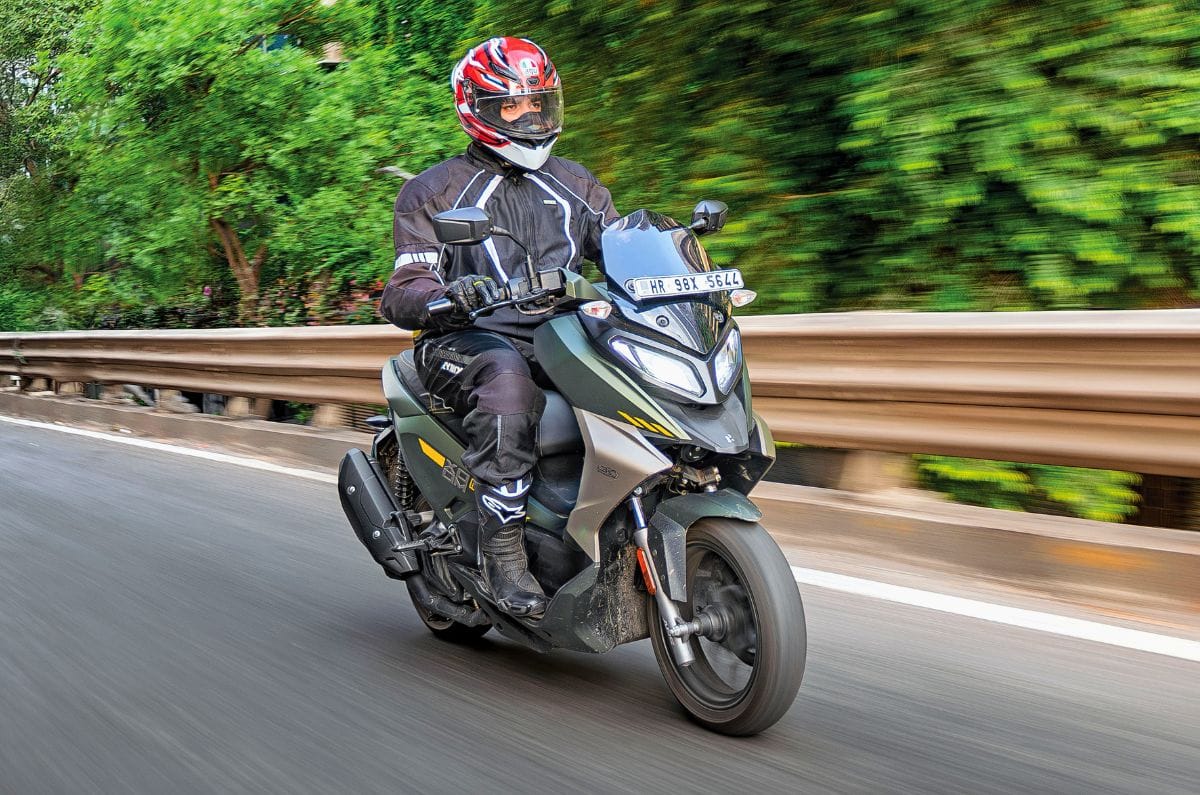
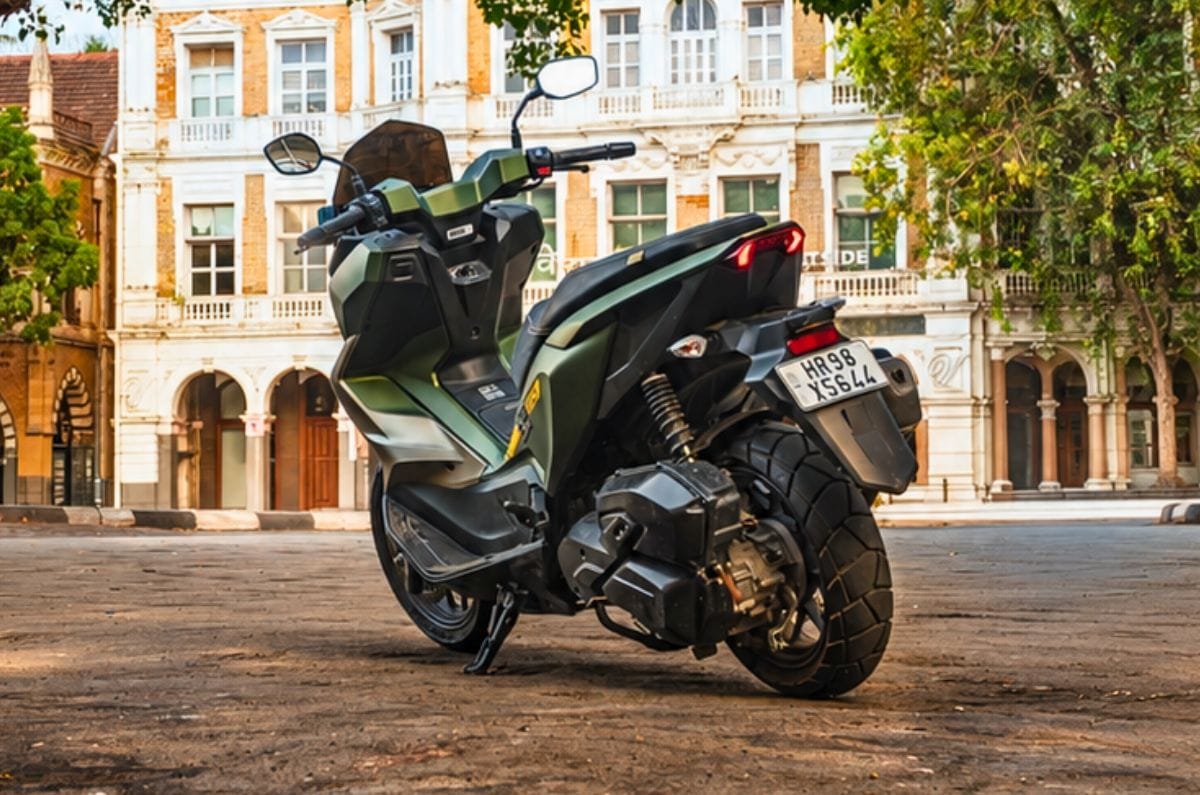
The Hero Xoom 160 is unlike anything else currently sold in India. Styled like an adventure scooter and borrowing elements from European maxi-scooters, it aims to offer more space, comfort and touring ability than a conventional scooter. After spending extended time with it in Mumbai, it’s clear that Hero has got some aspects very right, but a few key areas stop it from being as convincing as its styling suggests.
Xoom 160 Design and Practicality – 8/10
The Xoom 160 stands out with its ADV-styling
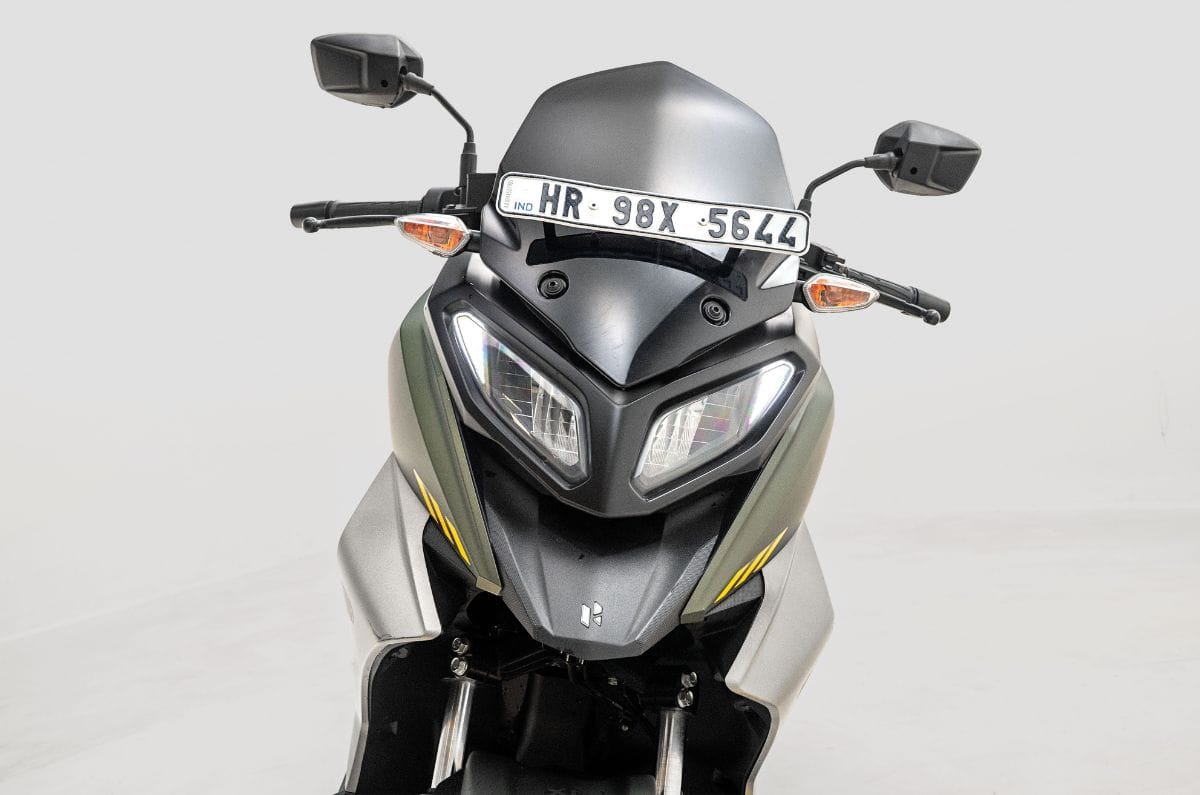
The Xoom 160 makes a strong first impression. From its prominent front beak and block-pattern tyres to the sharp twin-LED headlamp, everything about the scooter projects an adventure-inspired image. It also has genuine road presence and feels noticeably larger than a conventional scooter, one that makes passersby give it a second glance.
The front beak with twin headlights look striking
Hero has made good use of that size. There is a practical front storage cubby for everyday items, while the underseat compartment offers 22 litres of storage and can accommodate certain full-face helmets. Taller riders will also appreciate the generous knee room, which makes the riding position feel much less restrictive than the Aerox 155.
Xoom 160 Features and Quality – 6/10
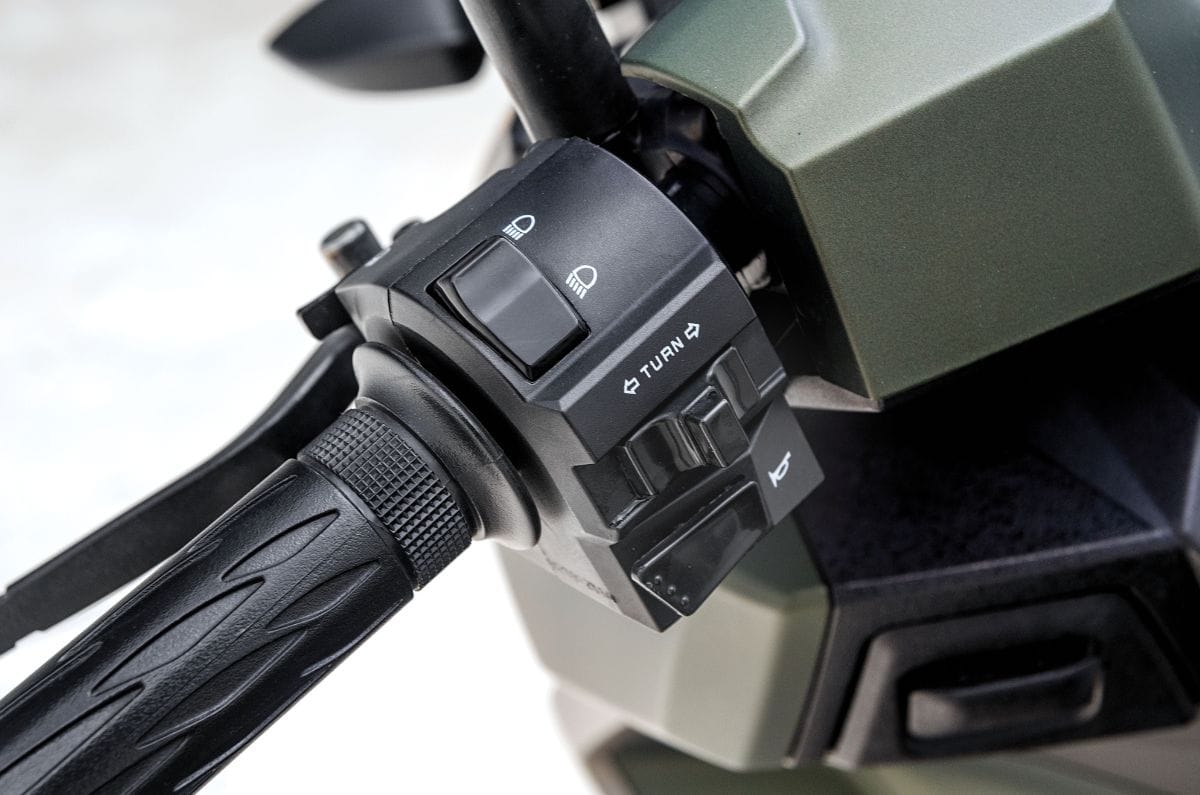
The instrumentation and switchgear are big letdowns in an overall strong package.
One area where the Xoom 160 already feels dated is its instrumentation and switchgear. Despite being Hero’s flagship scooter, the switchgear lacks the premium feel and even other newer Hero products such as the Xoom 125 have nicer switchgear.
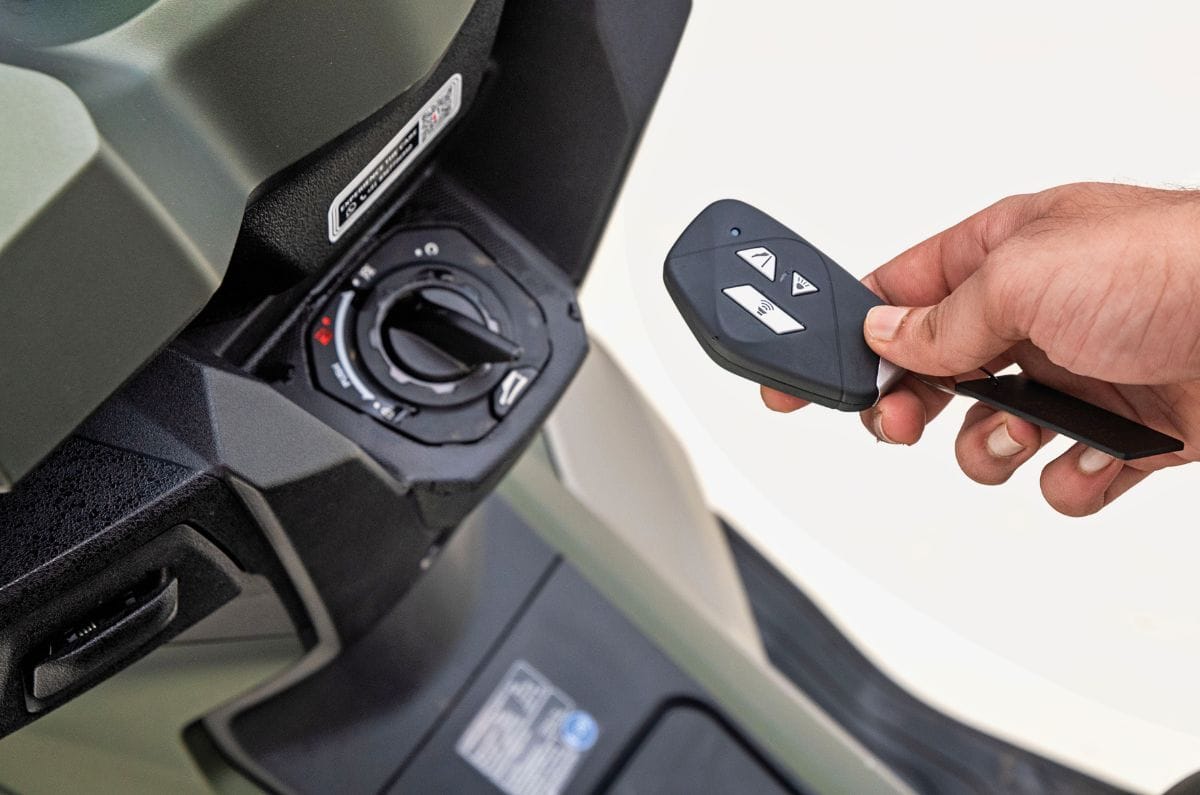
The LCD display offers Bluetooth connectivity and all the expected information, but it is small and not particularly easy to read on the move. The scooter does get keyless operation and a remote seat-release function, both of which add a degree of convenience and premium feel.
The overall feature distribution is somewhat puzzling as it has been with most Hero’s. Another example of this is how the smaller Xoom 125 receives segment-first, sequential LED indicators, while the more expensive Xoom 160 makes do with conventional bulb indicators.
Xoom 160 Performance and Refinement – 8/10
The performance isn’t as exciting as its chief rival but the engine is superbly refined.
The key fob looks and feels premium, unlike the switch cubes.
The 156cc liquid-cooled, four-valve engine is one of this scooter’s highlights. It is smooth, refined and delivers its performance in a very linear manner.
Unlike the Yamaha Aerox 155, the Xoom 160 doesn’t feel particularly sporty or aggressive. Instead, it focuses on refinement and ease of use. In our performance tests, the Aerox reaches 80kph quicker, but the gap disappears by the time both scooters reach 100kph. Considering the Xoom’s substantial weight disadvantage, that is an impressive result. An excessively long accelerator twist action does impact the engine’s effortlessness, though.
The engine also remains smooth at higher speeds and feels well suited to long-distance riding. Talking about long-distance riding, Hero will also sell you a top-box.
Xoom 160 Ride and Handling – 7/10
Once leaned in, the Xoom holds its line well through the corners.
At 142kg, the Xoom 160 is around 16kg heavier than the Aerox 155, and that weight is impossible to ignore in the city. Filtering through traffic, changing direction and negotiating corners all require more effort than on a conventional scooter.
Switchgear looks a generation older
Although, the weight does bring in some benefits. The scooter feels planted and stable at speed, and once leaned into a corner, it holds its line confidently. However, it never feels particularly eager or agile and is more comfortable cruising than being ridden aggressively. The block-pattern tyres offer adequate dry-weather grip, although wet-weather confidence could be better.
Xoom 160 Comfort and suspension setup – 6/10
The seat height is low enough to not intimidate shorter riders.
The riding position is comfortable and accommodating. The 787mm seat height is approachable, while the floorboard on either side of the underspine allows riders to either sit conventionally or stretch their legs forward in typical maxi-scooter fashion.
However, the suspension does not live up to the promise of the styling. Ride quality is noticeably firmer than expected, particularly on broken roads and this was something the lighter riders in our office felt more acutely. While the seat cushioning is excellent and helps improve long-distance comfort, it cannot completely mask the stiff suspension setup. A more absorbent suspension tune and rear preload adjustability would have significantly improved the overall experience.
Xoom 160 Fuel efficiency and braking – 7/10
The Xoom returned an average fuel economy of 38.7kpl
The Xoom’s 7-litre fuel tank – the largest on any Indian-made scooter – enhances its touring credentials. Highway comfort is also good, with the engine feeling relaxed and vibrations remaining well controlled at cruising speeds.
In our instrumented fuel-efficiency tests, the Xoom 160 returned 38.7kpl overall, with figures of 39.6kpl on the highway and 37.9kpl in the city. These are respectable numbers, although not class-leading.
Interestingly, the scooter’s fuel-efficiency display consistently showed figures that were nearly 10kpl lower than what we achieved during testing.
Braking performance is reassuring and despite its weight, the Xoom sheds speed well. The 240mm front disc provides decent stopping power without feeling overly aggressive, while the ABS calibration remains unobtrusive.
Xoom 160 Price and Verdict – 7/10
At Rs 1.40 lakh, it costs Rs 3,000 less than the Base Aerox 155.
The Hero Xoom 160 is an interesting scooter because it attempts something genuinely different. It combines maxi-scooter proportions with adventure-inspired styling and delivers practicality and refinement
However, the execution does not fully match the promise suggested by the design. The firm suspension, dated switchgear and missing features prevent it from becoming the complete package it could have been.
Even so, there is a lot to like here. The Xoom 160 is refined, spacious and priced at Rs 1.40 lakh, it is unlike anything else in the segment. Hero may not have extracted the full potential from the concept, but it has shown that there is room in India for a more convincing maxi-scooter in the future.
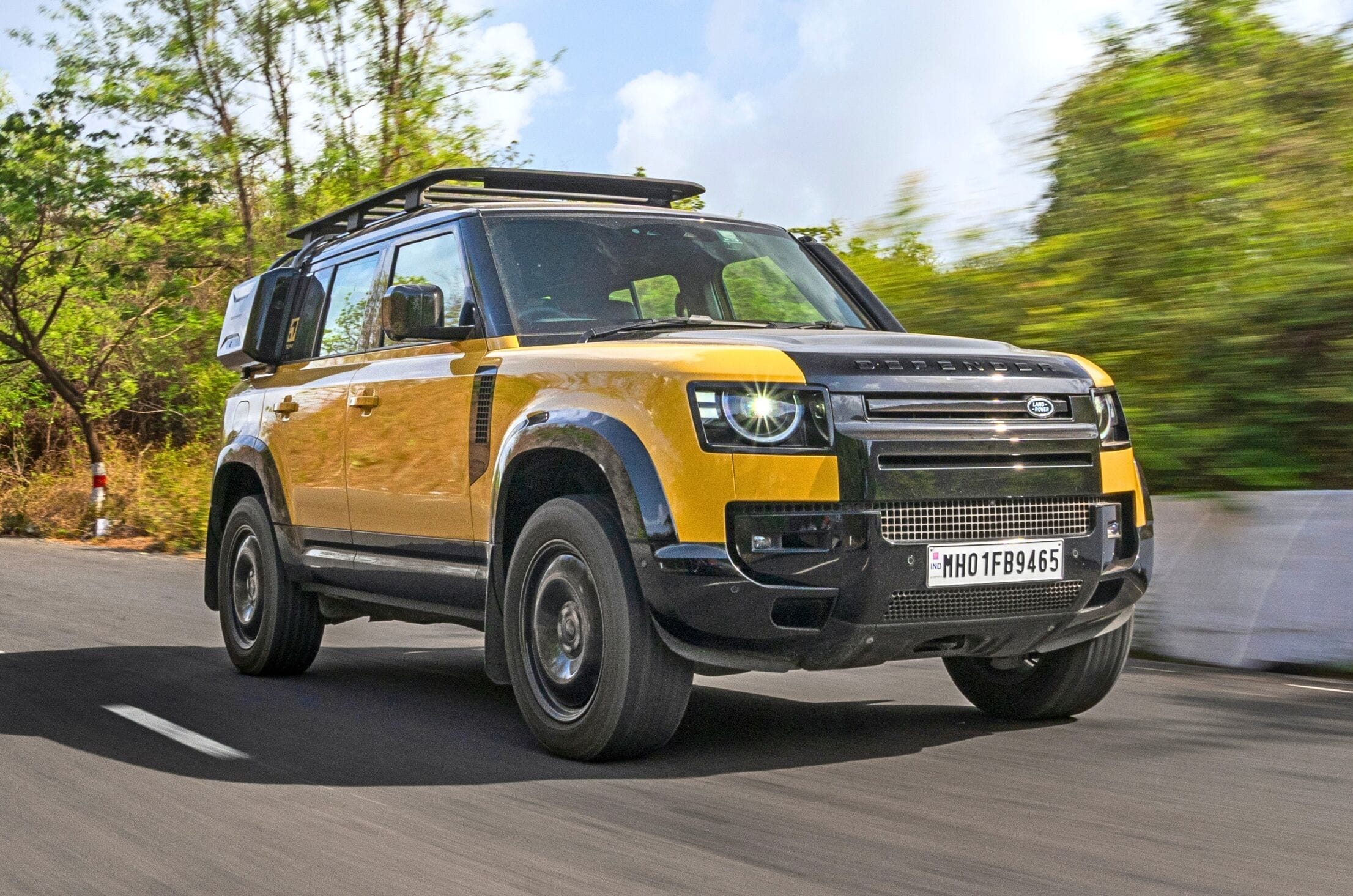
There are few cars with the sheer variety of powertrains as the Land Rover Defender. From a four-pot to a choice of V8s, there is seemingly something for everyone. One stands out, though – the D350 3.0-litre inline-six twin-turbocharged diesel. More power than the base petrol, more torque than the 5.0 V8, with the frugality of a diesel. It’s the only motor the Trophy Edition comes with, so is this engine the sweet spot in the range?
Land Rover Defender Trophy Edition exterior design and engineering – 9/10
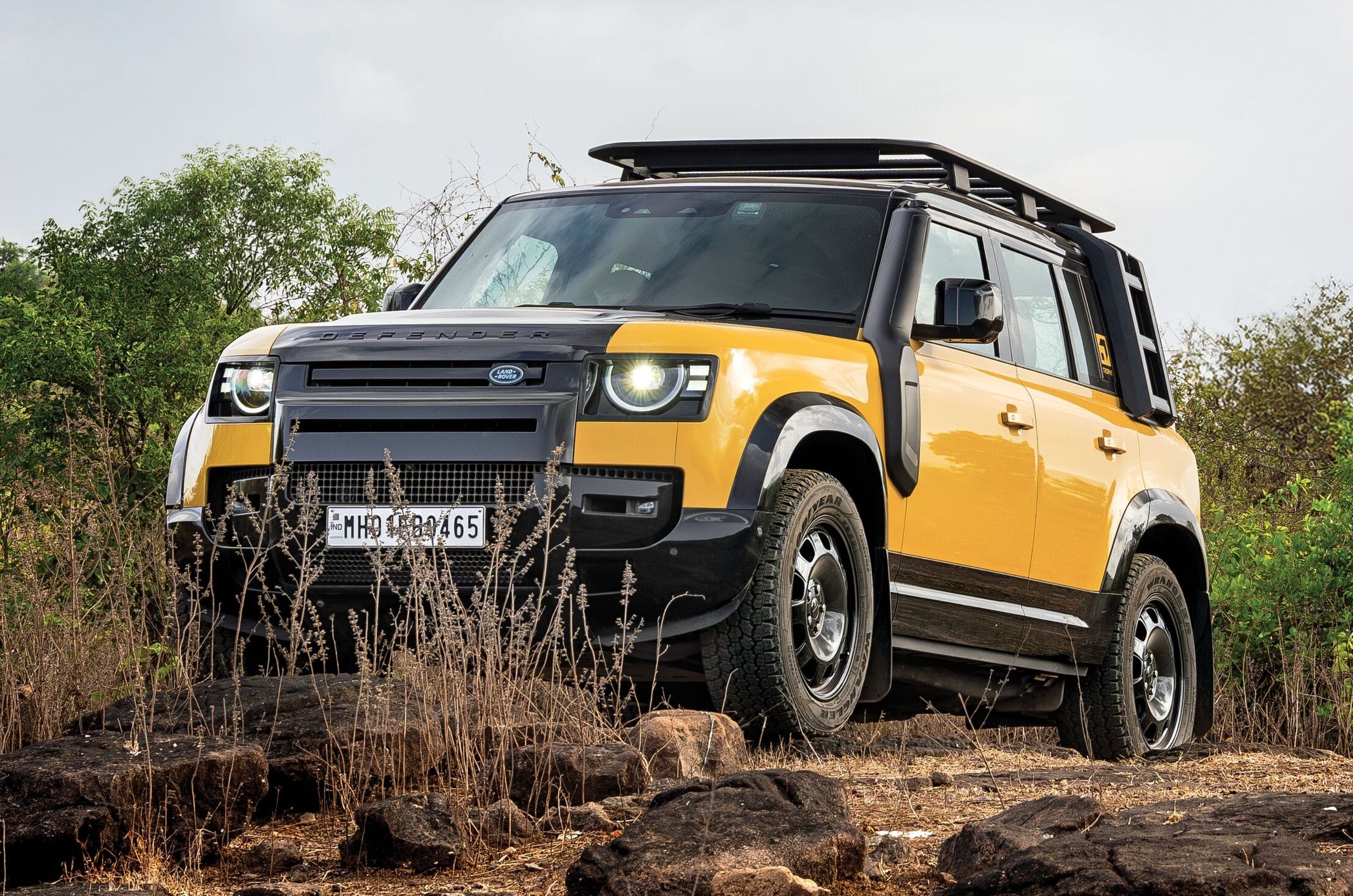
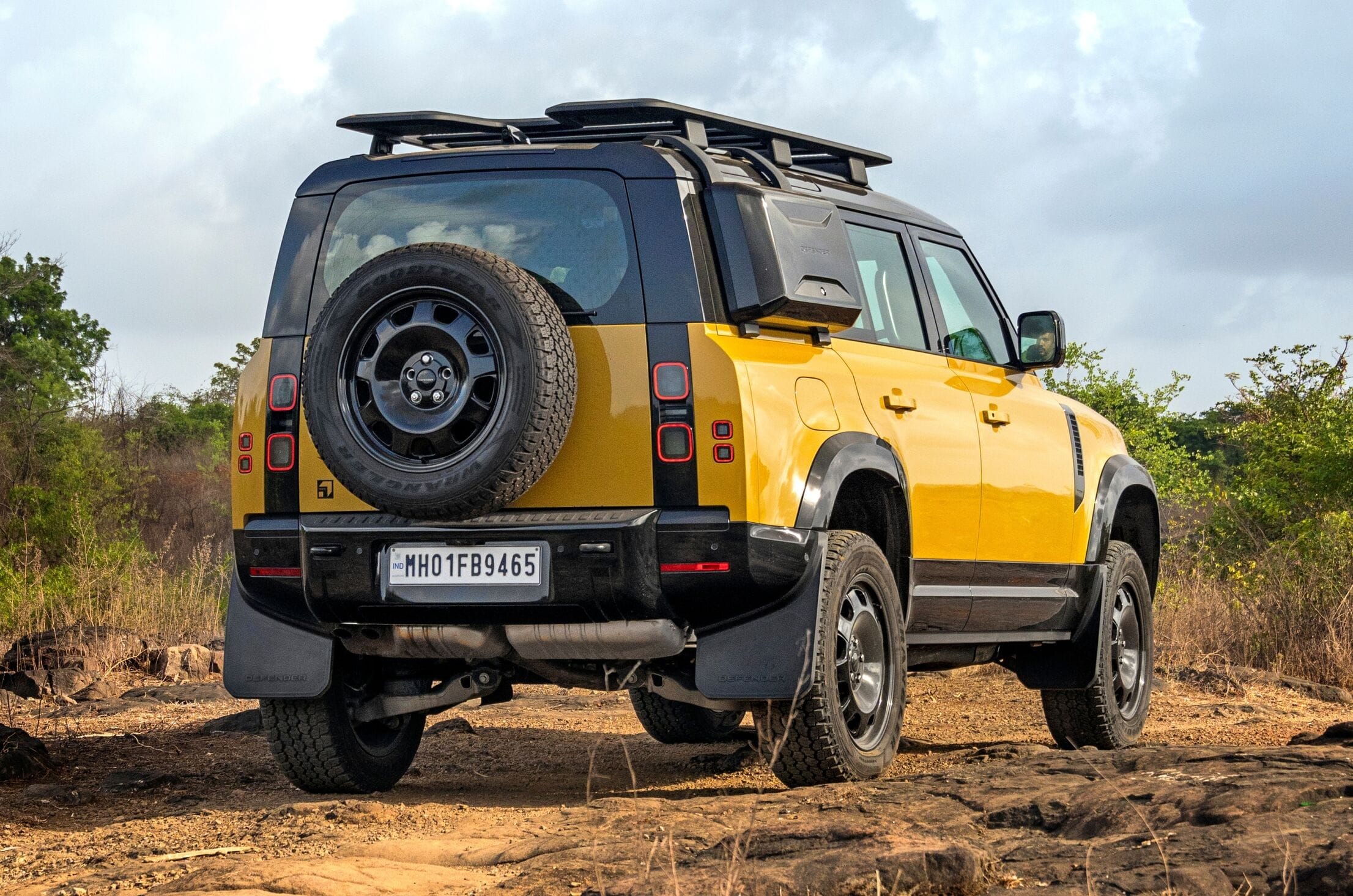
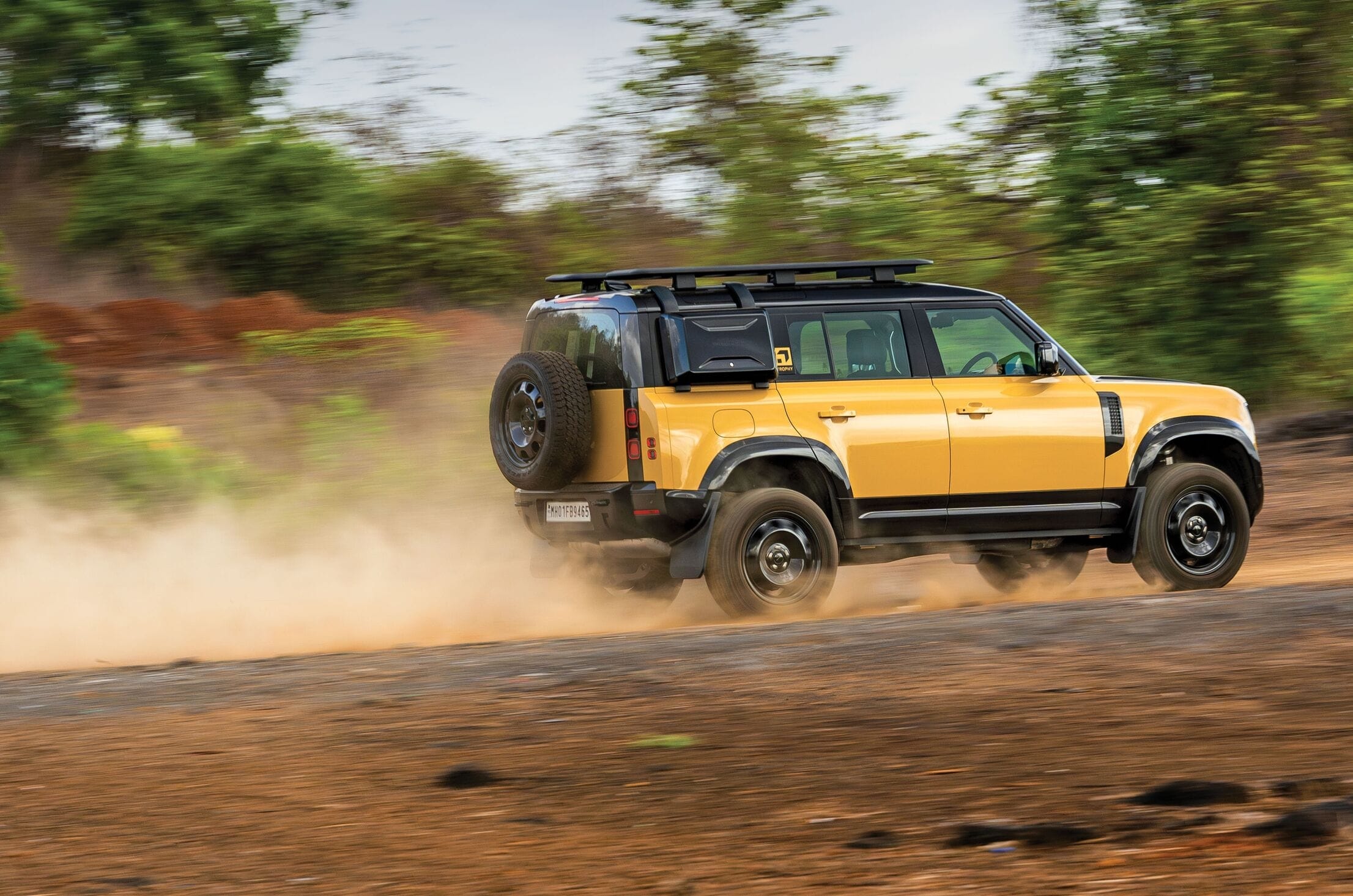
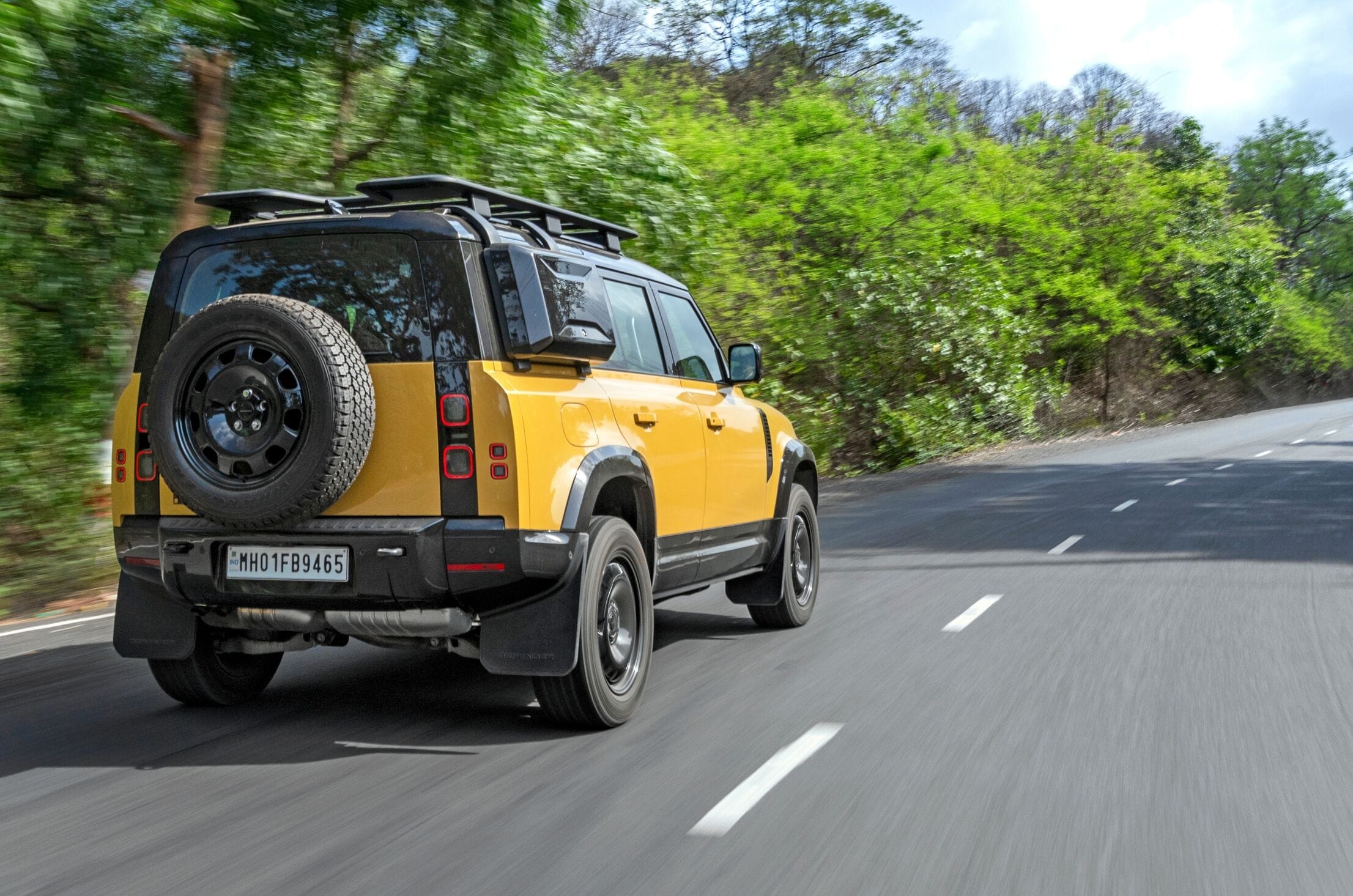
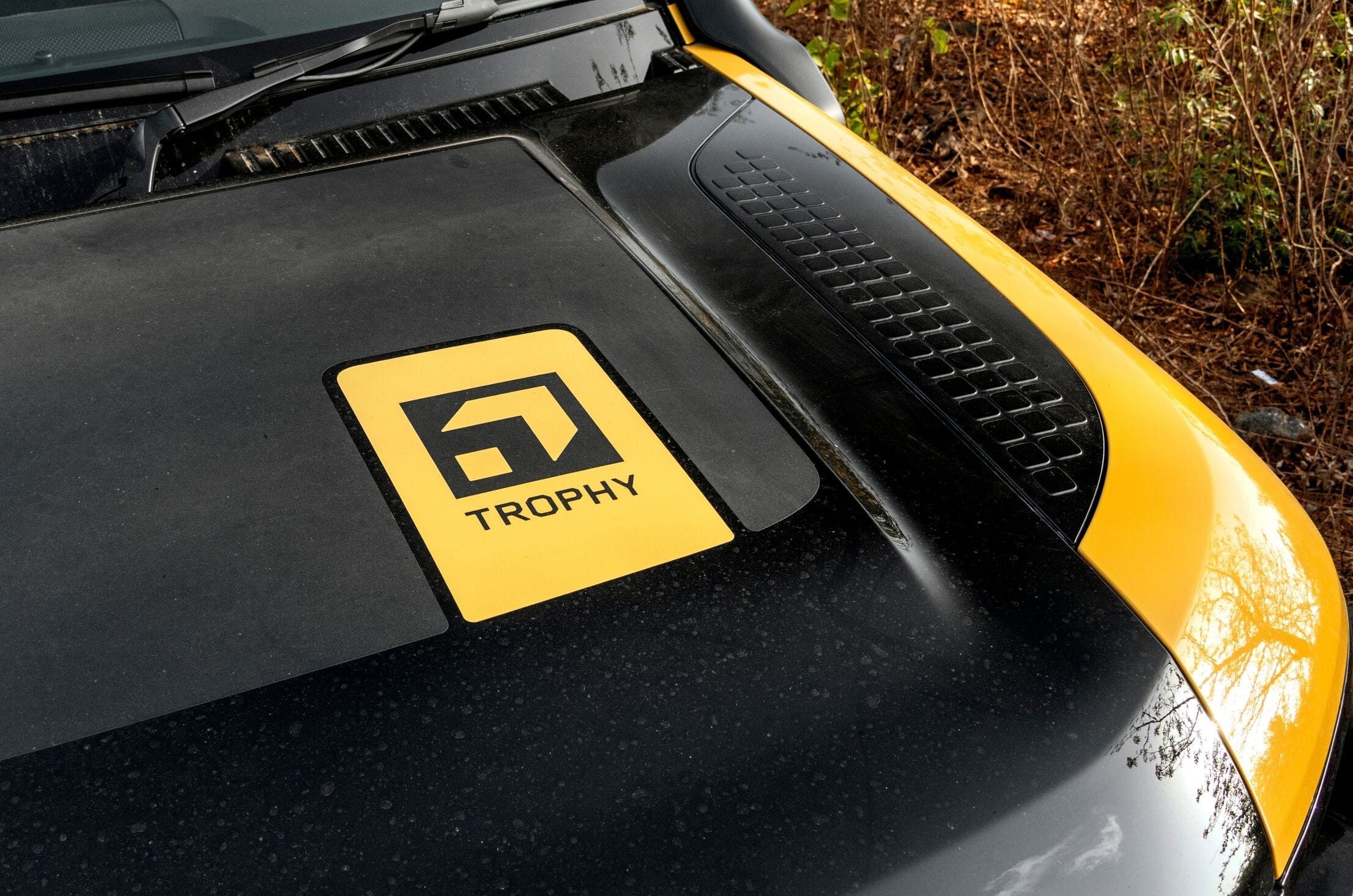
The Defender’s design hasn’t changed since it launched in 2020, but it certainly isn’t wanting for a facelift. It still looks fresh and modern with subtle nods to the original, without resorting to an overtly retro aesthetic. The Trophy Edition brings a choice of Deep Sandglow Yellow or Keswick Green – the former being the signature finish of the iconic Camel Trophy cars – with gloss black on the roof, bonnet, cladding and lower bumper for contrast. To go with the rugged look, it rides on all-terrain rubber shod 20-inch wheels that mimic steelies but are actually alloys. Additionally, there is Trophy branding on the bonnet, C-pillar and tailgate.
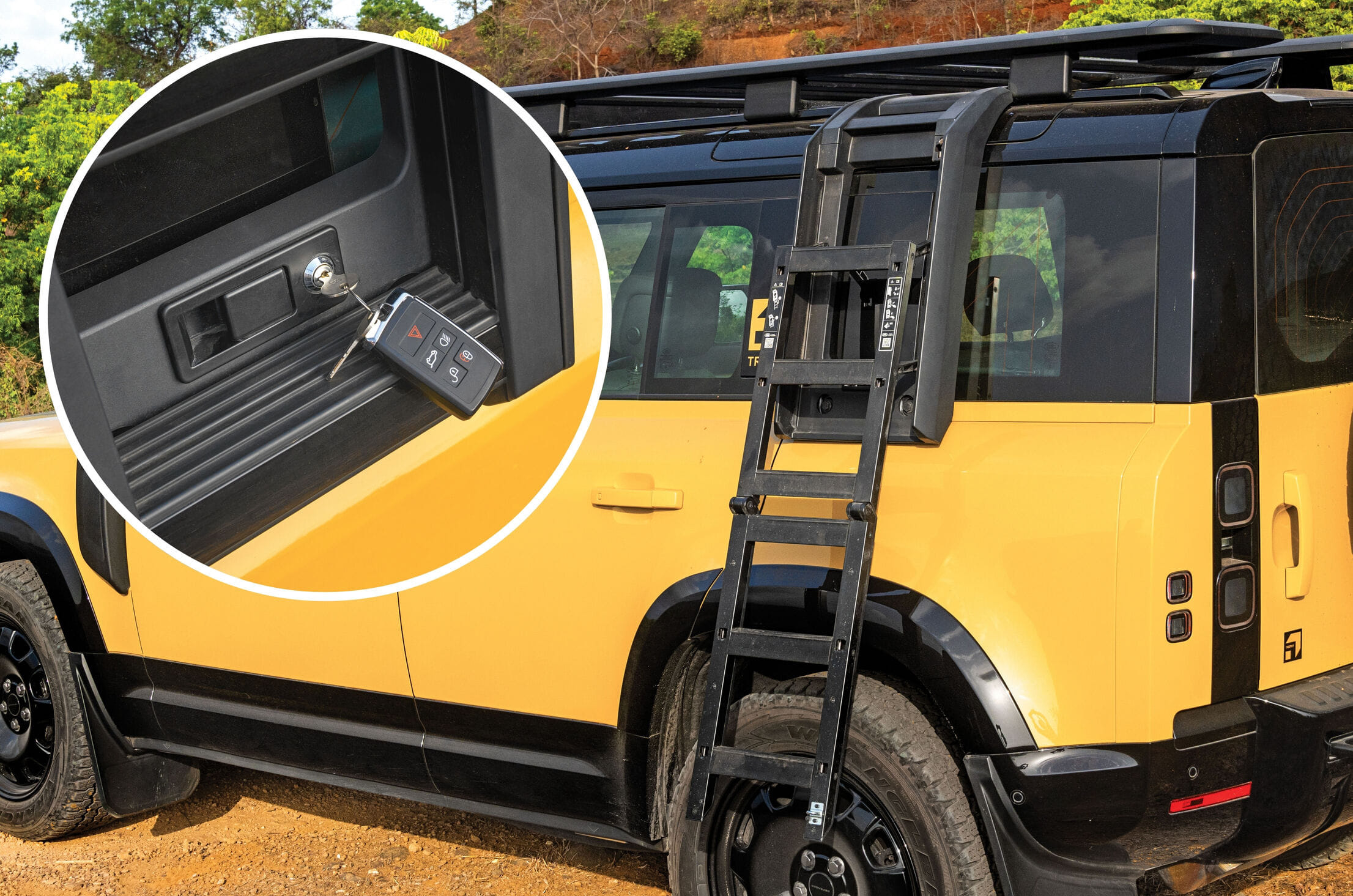
Sturdy ladder rated for 110kg; needs a seperate key to unlock.
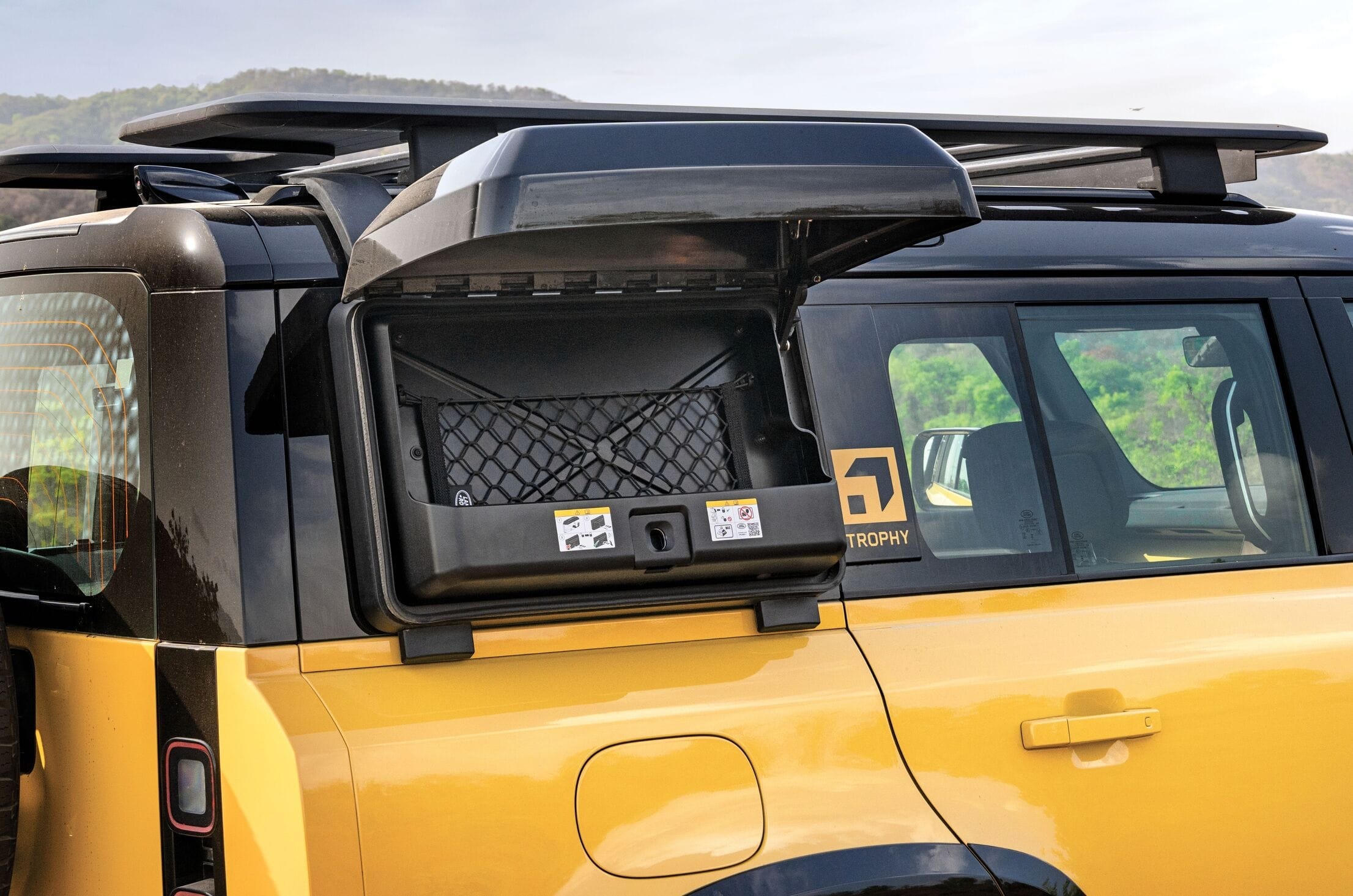
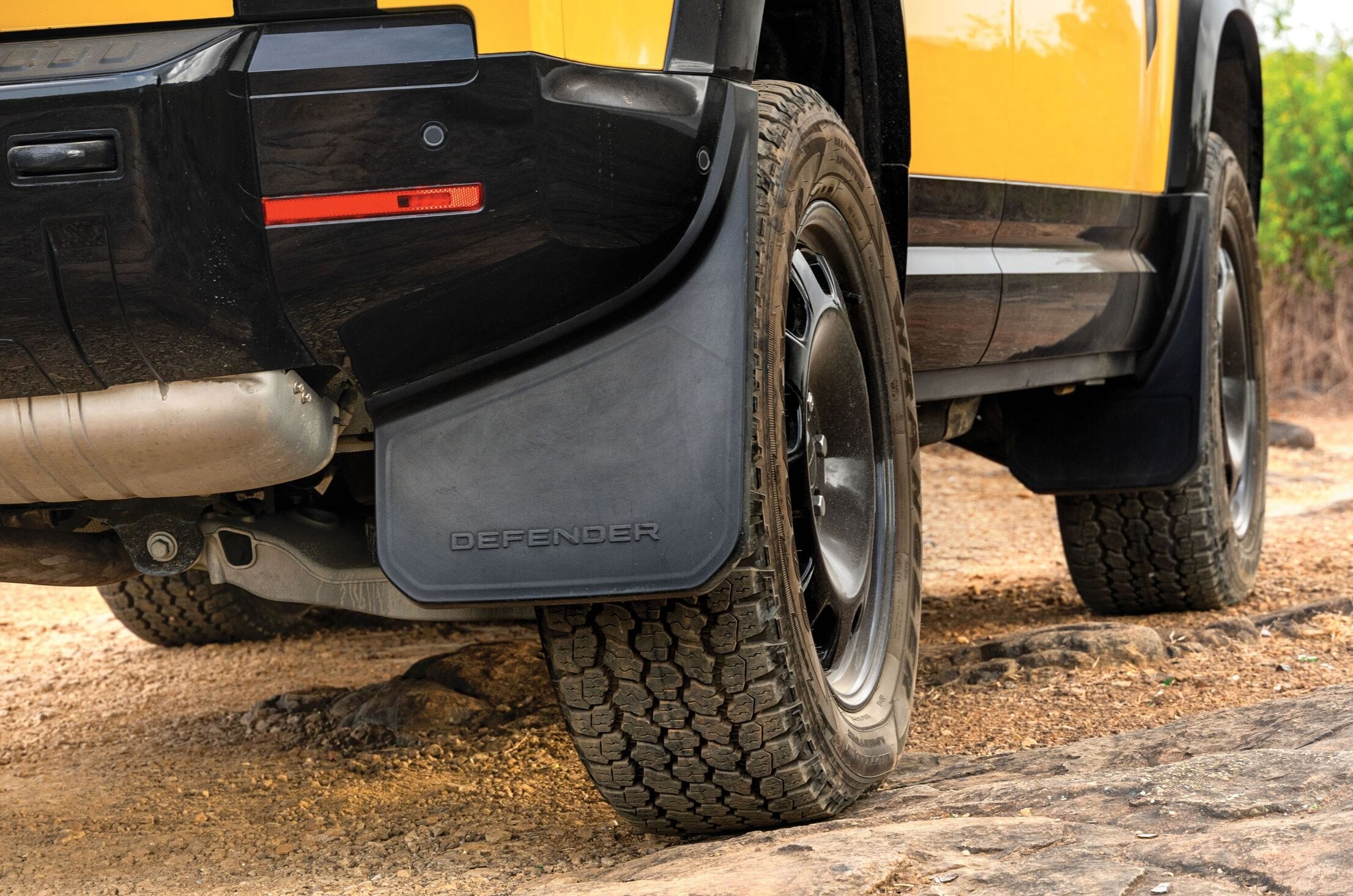
This particular example is also equipped with the optional Rs 5.35 Lakh Trophy Pack, which brings a roof rack, with a ladder to reach it on one side and an external storage box on the other. There’s big flexible mud flaps and a raised air intake – though it doesn’t raise the already lofty 900mm water wading ability, but helps with keeping sand out during dune bashing. All of this kit can be optioned on the regular Defender too, but here it ties in rather well with the whole Amazonian adventurer theme.
Land Rover Defender Trophy Edition interior space and comfort – 7/10
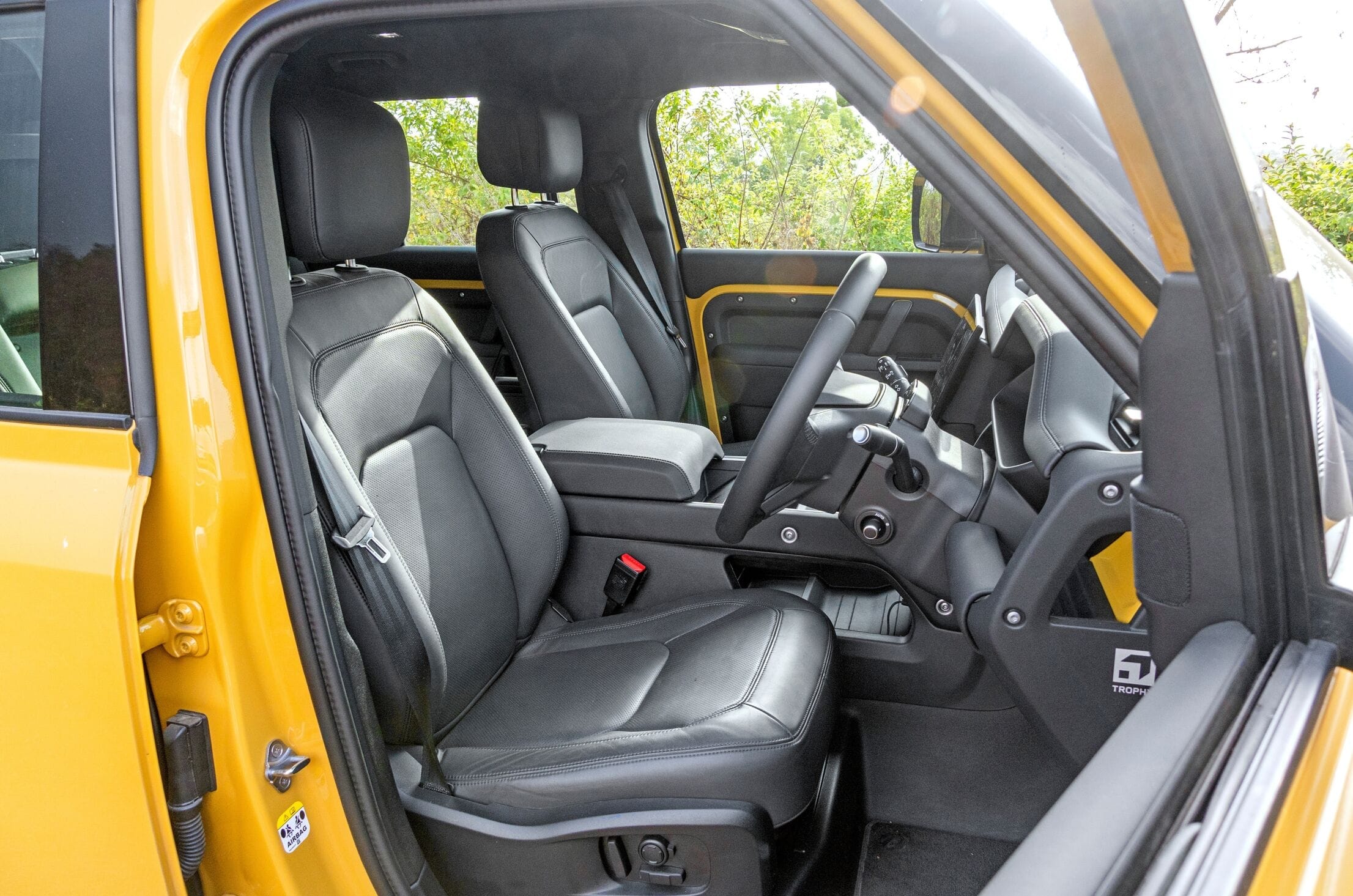
Electric front seats offer heating and ventilation.
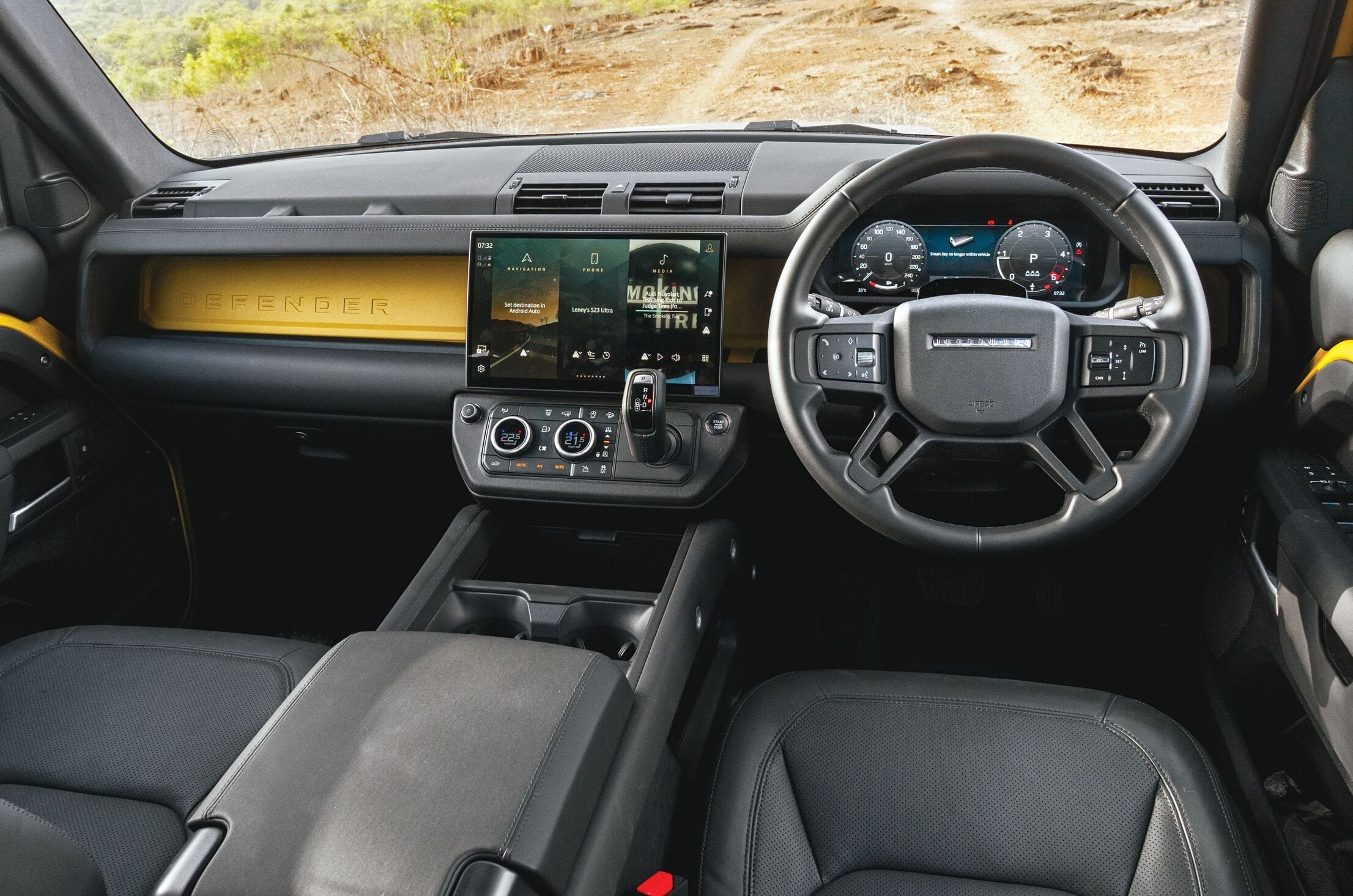
Inside, it is standard Defender fare apart from some body-coloured trim on the dash, while the rest is finished in black. Comfort up front is excellent, with a lofty driving position that has you towering over conventionally large SUVs. The seat itself is wide and comfortable, with electrical adjustment as well as ventilation. The dashboard and centre console offer plenty of utility and storage spaces, while the quality of materials and finish elevates the premium quotient.
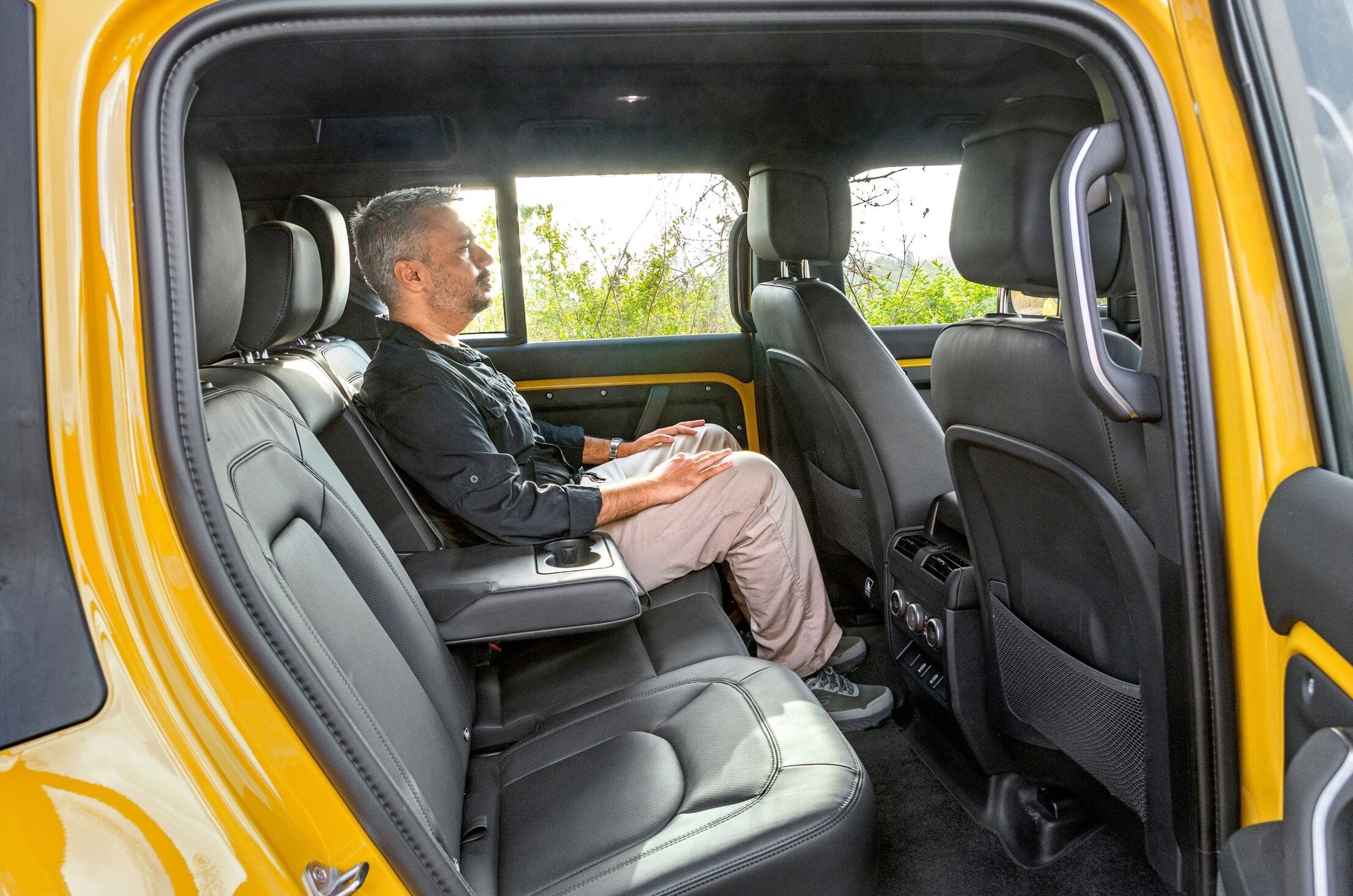
The rear is spacious and comfy, but climbing in takes effort.
For those who prefer to be chauffeured, the rear compartment is very comfortable and gets its own climate zone. There is plenty of room all around, and the bench is wide and supportive. It is, however, a task climbing into the Defender, even with the air suspension at its lowest position. Cargo room is also vast, with 786-litres of space with the second row up, expandable to 1875-litres with it stowed.
Land Rover Defender Trophy Edition features and safety – 8/10
Based on the X-Dynamic HSE, the Trophy Edition is also very well equipped, with highlights including a sharp 13.1-inch infotainment system, Meridian sound system and a panoramic sunroof. However, some of the serious off-road kit from the X trim, like air suspension, the Electronic Active Differential and Terrain Response 2, are optional extras.
Box for items you don’t want soiling the boot.
Safety is also well taken care of, with 6 airbags, Dynamic Stability Control, Roll Stability Control and Hill Descent Control. A sharp 360-degree parking camera helps when guiding this big SUV through tight spaces, and while adaptive cruise control is offered, other ADAS features like lane keep assist and autonomous emergency braking are not available in India.
Land Rover Defender Trophy Edition performance and refinement – 9/10
D350 diesel makes more torque than the P425 5.0L supercharged V8.
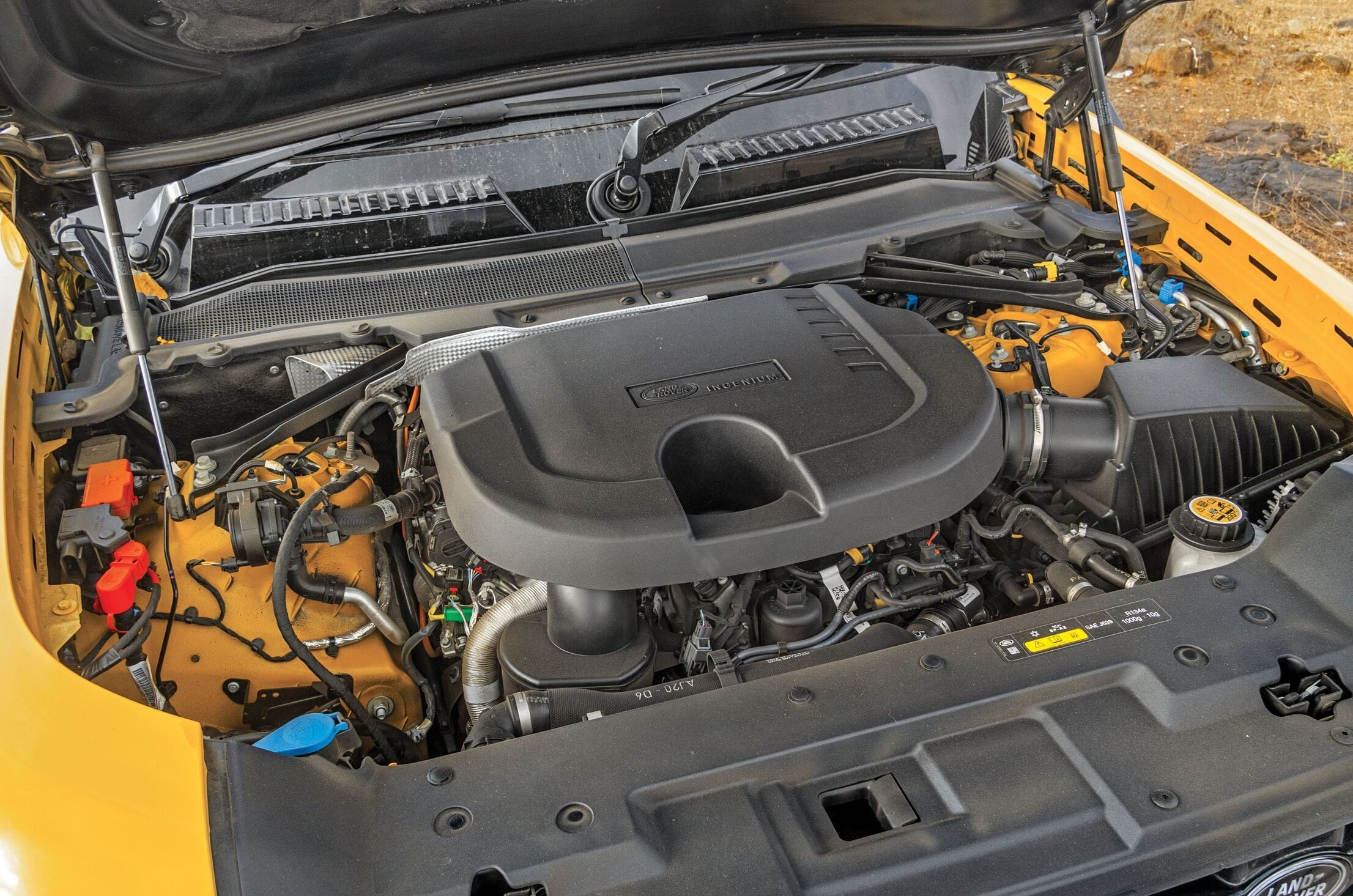
Under the hood is the 3.0-litre inline-six twin-turbo diesel from the Ingenium family, which makes 350hp and a whopping 700Nm – only the Octa beats it on torque, and that too by just 50Nm. Sending power to all four wheels is a slick 8-speed auto, which at times feels like too many cogs. At highway speeds, most overtakes are completed without the need for a downshift, and at city speeds merely tickling the throttle is enough to keep up with traffic. Push the right pedal harder, though, and it quickly drops a cog, the bonnet rises, and it accelerates as hard as you’d ever really need to in something this big.
Optional air springs iron out rough trails remarkably well.
A quick Vbox test confirmed a 0-100kph time of 6.79sec – slightly slower than the claimed time of 6.4sec. 20-80kph is dispatched in an equally rapid 4.19sec, while 40-100kph takes 4.98sec. Refinement is good too, and not just for a diesel. Outside the vehicle, the diesel clatter is very muted at idle, while inside, most passengers won’t be able to tell they’re in an oil burner. As revs rise, so do the decibels, but it sounds muscular and rather pleasant for a diesel. One gripe is at highway speeds, there is noticeable wind noise from the bolted-on accessories.
Land Rover Defender Trophy Edition range and efficiency – 7/10
While we didn’t get a chance to put it through our real-world fuel-efficiency run, the diesel is comfortably the most frugal of all the available Defender powertrains. On a steady highway run, it will regularly deliver double-digit fuel economy, which means the 89-litre tank will take you pretty far between fill-ups.
Land Rover Defender Trophy Edition ride comfort and handling – 8/10
The diesel feels like a natural fit for the Defender’s use case.
Our test car was equipped with air suspension, which is an option well worth ticking. Not only does it bring the ability to raise the car to clear obstacles or lower it to make getting in and out easier, but the ride is also superb. It feels very absorbent even on the roughest patches, and keeps the body quite flat and the cabin nicely isolated.
While it certainly has no sporting pretensions, it feels surprisingly fluid through corners too. There is no escaping the body roll, but it feels well controlled, surefooted and rather enjoyable to hustle. Also noteworthy is the steering; the large-diameter wheel feels great to hold and steer with, and the effort is perfectly weighted to boot.
Mudflaps suit the theme.
Off-road ability is a strength, but what’s impressive is the ease with which it conquers the rough stuff. Terrain Response offers presets for different surfaces, and advanced users can even configure individual settings, but generally leaving it in Auto works well enough for most scenarios. Low range will only ever need to be engaged to clear the sort of challenges that used to be thrown at Camel Trophy participants. Its size is intimidating off-road, but the array of cameras, including a transparent bonnet function, does help maneuverability.
Land Rover Defender Trophy Edition price and verdict – 8/10
At Rs 1.30 crore, the Trophy Edition is just over a lakh more than the X-Dynamic HSE. While that isn’t a lot of extra outlay in this context, what it buys you is essentially a unique paint scheme. If the history of the Camel Trophy, the exclusivity and the aesthetics appeal to you, this might seem like a bargain, but to others, that money would be better spent on the off-road packs.
But if getting muddy isn’t your thing, the standard Defender is still charming enough to seduce most. With the 6-cylinder petrol discontinued, this D350 diesel is now the default recommendation – much more performance than the 2.0-litre four-pot and way more frugal than the 5.0-litre V8. Sure the V8 has a greater sense of occasion, but the diesel feels like a more natural fit for the Defender’s use case – ergo, the sweet spot.
गुरुग्राम को देश के सबसे आधुनिक और तेजी से विकसित होते शहरों में गिना जाता है। ऊंची-ऊंची इमारतें, कॉर्पोरेट ऑफिस, लग्जरी सोसायटी और शानदार लाइफस्टाइल इसे लाखों लोगों के लिए आकर्षण का केंद्र बनाते हैं। हर साल बड़ी संख्या में लोग नौकरी और बेहतर अवसरों की तलाश में यहां पहुंचते हैं। लेकिन शहर की चमक-दमक के पीछे कुछ ऐसी चुनौतियां भी हैं, जिनका सामना यहां रहने वाले लोग रोजाना करते हैं। ट्रैफिक जाम, खराब सड़कें, बारिश के दौरान जलभराव और बुनियादी सुविधाओं को लेकर अक्सर चर्चा होती रहती है।
यही वजह है कि समय-समय पर सोशल मीडिया पर भी गुरुग्राम को लेकर अलग-अलग राय देखने को मिलती है। हाल ही में एक कंटेंट क्रिएटर ने शहर को लेकर ऐसा मजेदार और अनोखा उदाहरण दिया कि उसका वीडियो देखते ही देखते वायरल हो गया। उनकी तुलना ने न सिर्फ लोगों का ध्यान खींचा, बल्कि कमेंट सेक्शन में भी शहर को लेकर दिलचस्प बहस शुरू हो गई।
‘अदरक की तरह हर दिशा में फैल गया शहर’
वीडियो में साक्षी कहती हैं कि गुरुग्राम का नक्शा और विकास ऐसा लगता है, मानो शहर बिना किसी योजना के हर दिशा में फैल गया हो। उनके मुताबिक, बारिश होते ही हालात और बिगड़ जाते हैं। सड़कें पानी से भर जाती हैं, गड्ढों के कारण निकलना मुश्किल हो जाता है और लोगों को रोजाना परेशानियों का सामना करना पड़ता है।
‘अमीर पिता के बिगड़े बेटे का प्रोजेक्ट लगता है’
साक्षी ने शहर के विकास पर तंज कसते हुए कहा कि गुरुग्राम ऐसा महसूस होता है जैसे किसी बेहद अमीर व्यक्ति के बिगड़े बेटे ने अपनी पसंद से शहर बसाया हो। उन्होंने मजाकिया अंदाज में कहा कि बिना सही प्लानिंग के सब कुछ इधर-उधर जोड़कर शहर खड़ा कर दिया गया।
रोज का सफर बना सबसे बड़ी परेशानी
उन्होंने बताया कि गुरुग्राम में रोजाना यात्रा करना बेहद थकाने वाला अनुभव है। खराब सड़कें, लंबा ट्रैफिक और लगातार चल रहे निर्माण कार्य लोगों की दिनचर्या को मुश्किल बना देते हैं। वीडियो के कैप्शन में उन्होंने लिखा, “अच्छी बात बस इतनी है कि यहां रहकर आपकी टॉलरेंस काफी बढ़ जाती है।”
वीडियो पर हजारों लोगों ने प्रतिक्रिया दी। कई यूजर्स ने कहा कि “गुरुग्राम अदरक की तरह हर जगह उग आया है” वाली तुलना शहर की सबसे सटीक तस्वीर पेश करती है। कुछ लोगों ने खराब सड़कों, धूल और स्ट्रीट लाइट की कमी का जिक्र किया, जबकि एक यूजर ने लिखा कि वह इस शहर में हमेशा के लिए फंस गया है। वहीं, बेंगलुरु के एक यूजर ने मजाक में कहा कि “एक बार बेंगलुरु आ जाओ, फिर गुरुग्राम अच्छा लगने लगेगा।”