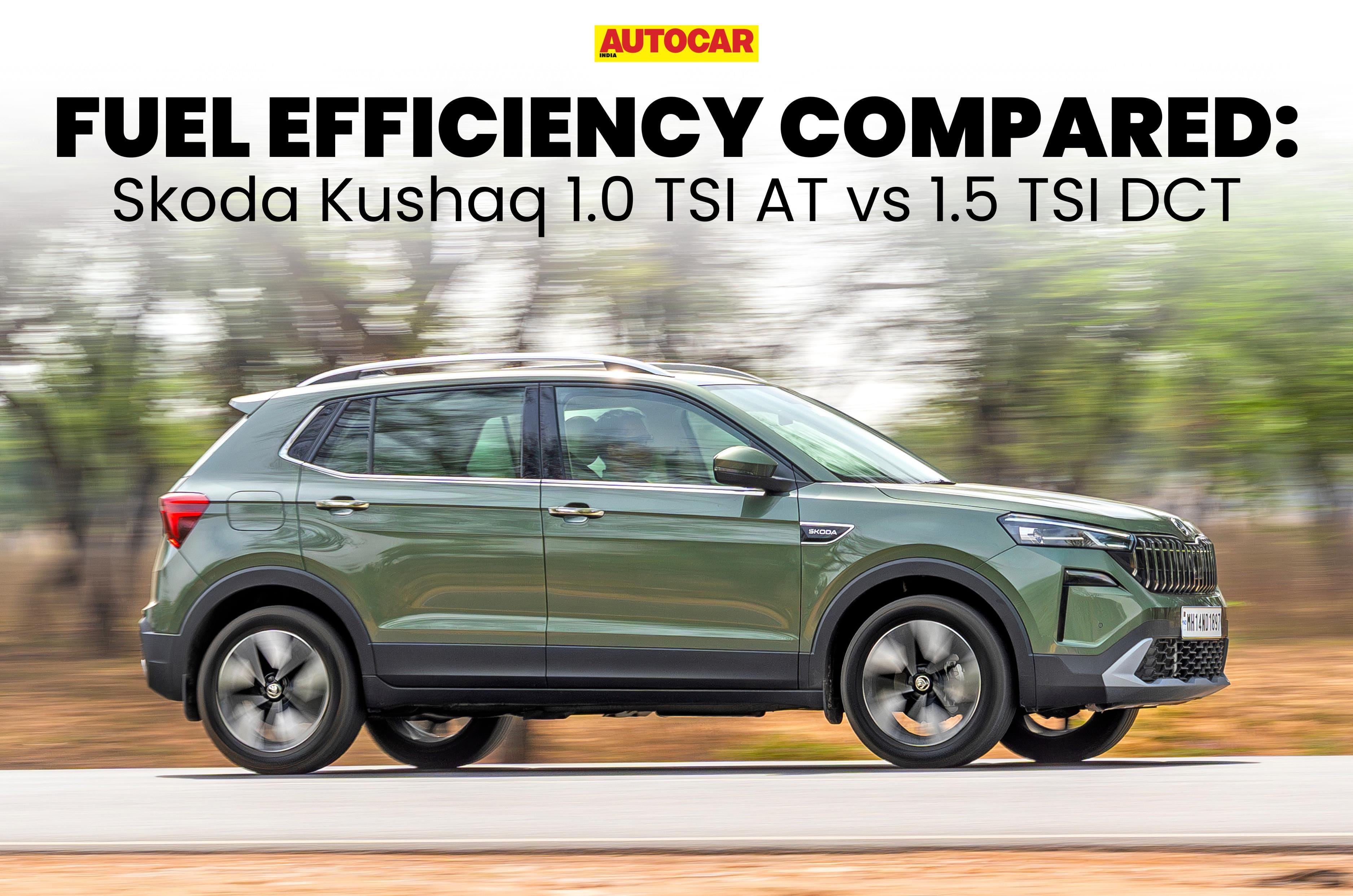
Skoda Kushaq 1.0 AT vs 1.5 DCT: Real-world efficiency compared

Skoda Kushaq 1.0 AT vs 1.5 DCT: Real-world efficiency compared
Skoda Kushaq side tracking

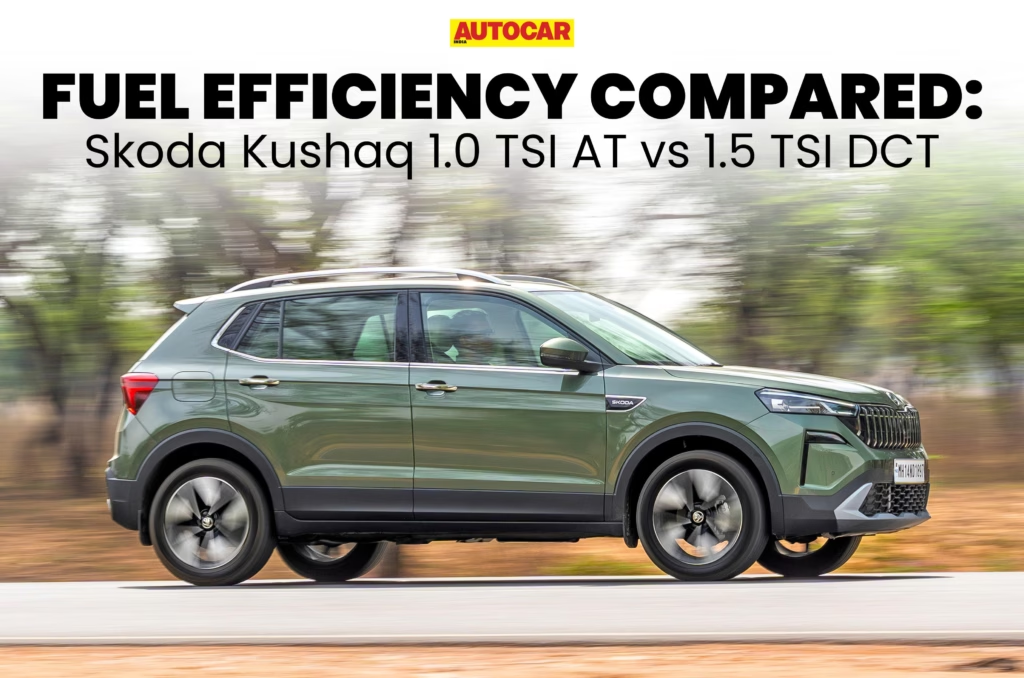
The Skoda Kushaq was updated earlier this year with much-needed improvements, and continues to offer 1.0-litre and 1.5-litre direct-injection turbo-petrol engines. In the interest of better fuel efficiency, the carmaker introduced a new automatic gearbox for the former engine option, replacing the older 6-speed unit. We’ve tested the updated Kushaq’s fuel efficiency with this new gearbox and compared it with the real-world fuel efficiency figures with the larger, more powerful 1.5 TSI engine.

Skoda Kushaq 1.0 AT vs 1.5 DCT: Specifications 

1.5 unit develops more power, while the 1.0 has a much lighter kerb weight

Skoda Kushaq 1.0 AT vs 1.5 DCT:


Kushaq 1.0

Kushaq 1.5

Engine

3 cyls, turbo-petrol 

4 cyls, turbo-petrol

Displacement (cc)

999

1,498

Power (hp)

115

150

Torque (Nm)

178

250

Gearbox

8AT

7DCT

Fuel tank capacity (litres)

50

50

Kerb weight (kg)

1,270 – 1,300 

1,321 – 1,322

While the smaller 1.0 TSI develops 115hp and 178Nm, the 1.5 TSI mill outputs 150hp and 250Nm. In automatic guise, the former is paired to an 8-speed torque converter gearbox while the latter is paired to a 7-speed DCT. Additionally, both come with an auto engine start/stop system, but only the 1.5 TSI comes with cylinder deactivation technology, a feature that shuts off operation of two of the four cylinders depending on throttle input and engine load to curb fuel consumption. Both come with identical 50-litre fuel tanks, but the smaller 1.0 TSI helps it have a lighter kerb weight than the 1.5 TSI.

Skoda Kushaq 1.0 AT vs 1.5 DCT: Real-world fuel efficiency 

1.0 AT delivers better efficiency, but the gap isn’t huge 
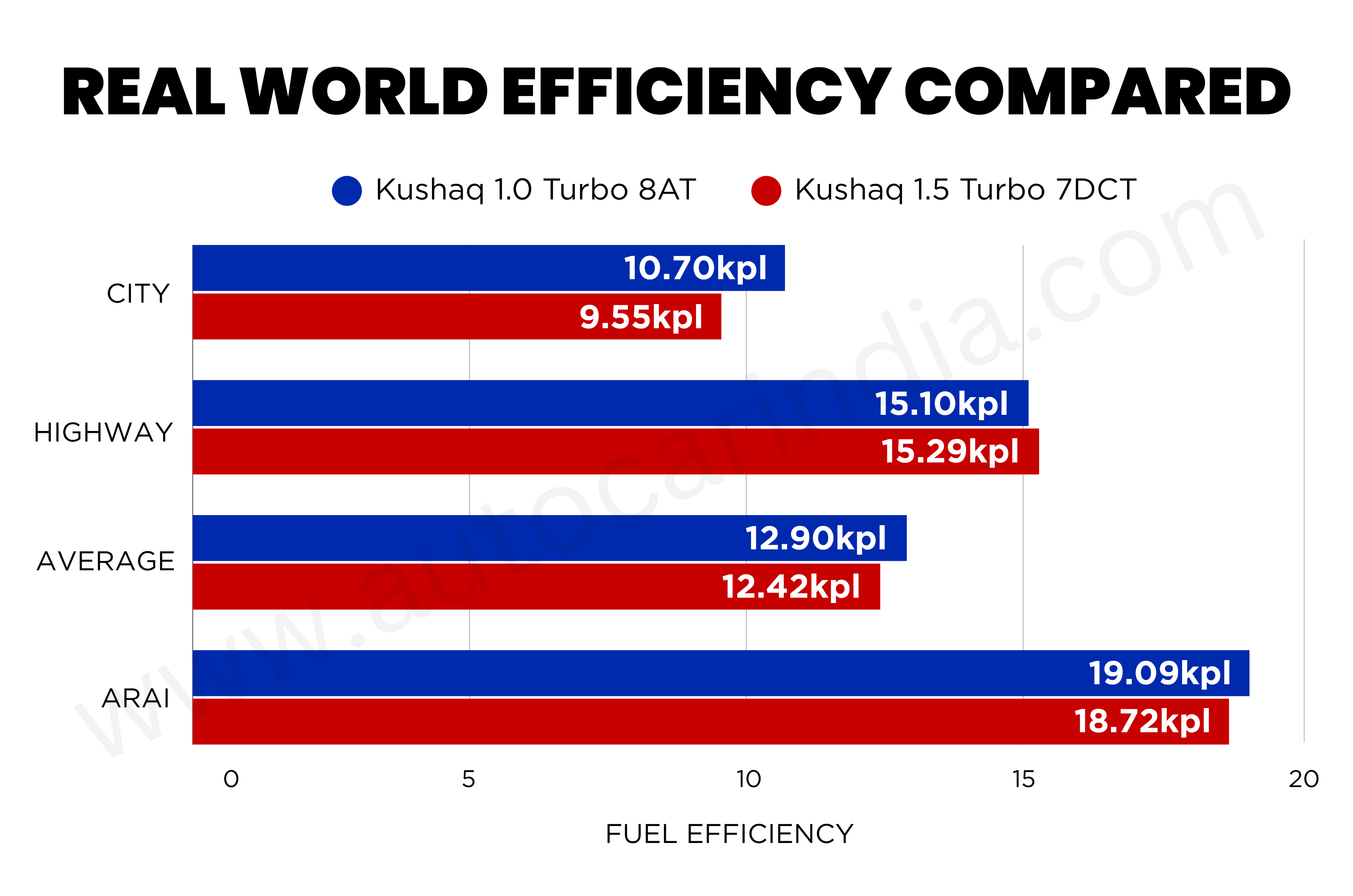
In our real-world fuel efficiency tests, the Kushaq 1.0 TSI AT averaged better than the 1.5 TSI DCT by 0.48kpl. In the city, the 1.0 TSI was more efficient than the 1.5 TSI by 1.15kpl. This is because of the 1.0’s lighter kerb weight and aggressive start/stop system. In contrast, the 1.5’s twin-cylinder deactivation tech helped it be more efficient on the highway than the 1.0 by 0.19kpl. Overall, the gap in real-world efficiency is slightly higher than their ARAI-claimed figures (0.48kpl vs 0.37kpl).   

Skoda Kushaq 1.0 AT vs 1.5 DCT: Price

Availability from lower trims makes the 1.0 AT much more affordable than the 1.5 DCT 

Skoda Kushaq 1.0 AT vs 1.5 DCT: Price


Kushaq 1.0 TSI

Kushaq 1.5 TSI

Petrol automatic price range (Rs lakh)

12.89 – 17.89

18.79 – 18.99

As the Kushaq’s 1.5 TSI automatic is limited to top-spec variants, it is Rs 5.9 lakh pricier than the 1.0 TSI automatic. In fact, even in top-spec guise, the latter powertrain combo is Rs 1 lakh cheaper than the former.

Autocar India’s fuel-efficiency testing

Before our real-world fuel-efficiency tests, we fill our test cars’ tanks to the brim and maintain tyre pressures based on the manufacturer’s recommendations. These cars are driven in fixed city and highway loops in and around Navi Mumbai, and we maintain certain average speeds. Throughout the tests, there is only one person in each car, operating the air conditioner and other electricals, such as the audio system, indicators and wipers, when required, just like a regular user would. Periodic driver swaps further neutralise variations in driver patterns. At the end of each cycle, we calculate efficiency by filling the tanks to full again.

All prices are ex-showroom, India.
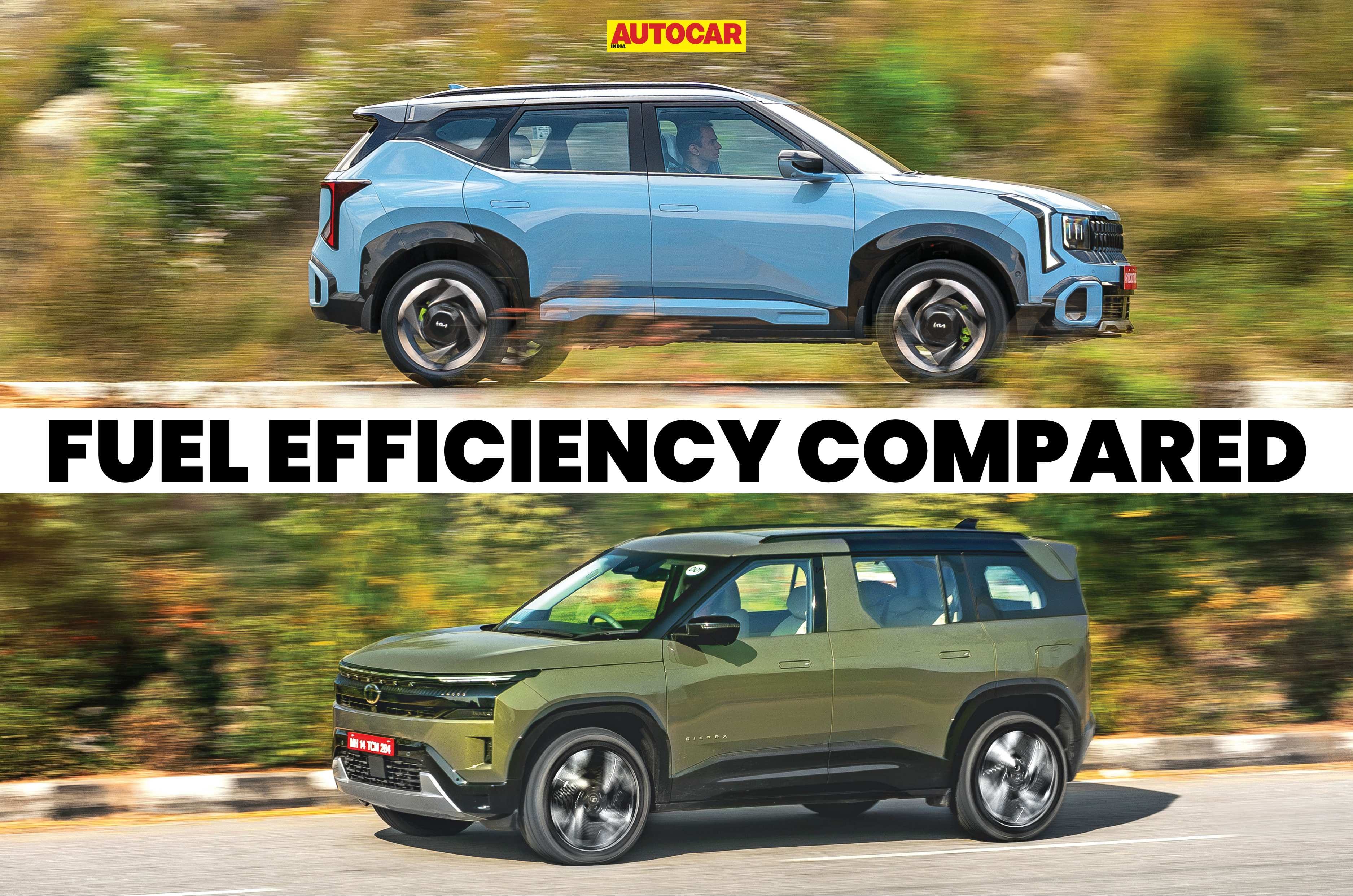
Kia Seltos vs Tata Sierra diesel automatic: Real world mileage compared

Kia Seltos vs Tata Sierra diesel automatic real world mileage comparison

Alongside the Hyundai Creta, the only SUVs in this segment offering a diesel engine mated to a torque-converter automatic transmission (AT) are the Kia Seltos and the Tata Sierra. Where the all-new Sierra was introduced in November 2025, the second-gen Seltos entered the fray in January 2026. The Sierra diesel-AT version is limited to five trim options, but its Seltos counterpart is available in eleven. So, which one of these 5-seater midsize SUVs offers higher fuel economy?

Explore full specs, features and a price breakdown in our Seltos vs Sierra comparison.

Kia Seltos vs Tata Sierra diesel automatic: Specifications

The Sierra offers more power, but it is also heavier than the Seltos

Kia Seltos vs Tata Sierra diesel automatic: Specifications


Kia Seltos

Tata Sierra

Engine

4 cyl, diesel

4 cyl, diesel

Displacement (cc)

1493

1497

Power (hp)

116 (4,000rpm)

118 (4,000rpm)

Torque (Nm)

250 (1,500-2,750rpm)

280 (1,500-2,750rpm)

Gearbox

6-speed AT

6-speed AT

Fuel tank (litres)

47

50

Even though their turbocharged engines are of similar sizes, it’s the Tata Sierra’s unit that produces 2hp and 30Nm more. Moreover, the power and torque figures of these cars are achieved over the same engine RPM range. Compared to the Seltos, the Sierra diesel comes with a slightly larger fuel tank (by 3 litres), whilst the gearboxes on both are 6-speed torque-converter automatic units. Both cars are equipped with a variable-geometry turbocharger, thus improving power delivery and reducing turbo lag.

Kia Seltos vs Tata Sierra diesel automatic: Real-world fuel efficiency

Despite featuring an ‘Eco’ mode and weighing less, the Seltos fared slightly worse than the Sierra

Kia Seltos vs Tata Sierra diesel automatic real world mileage comparison chart

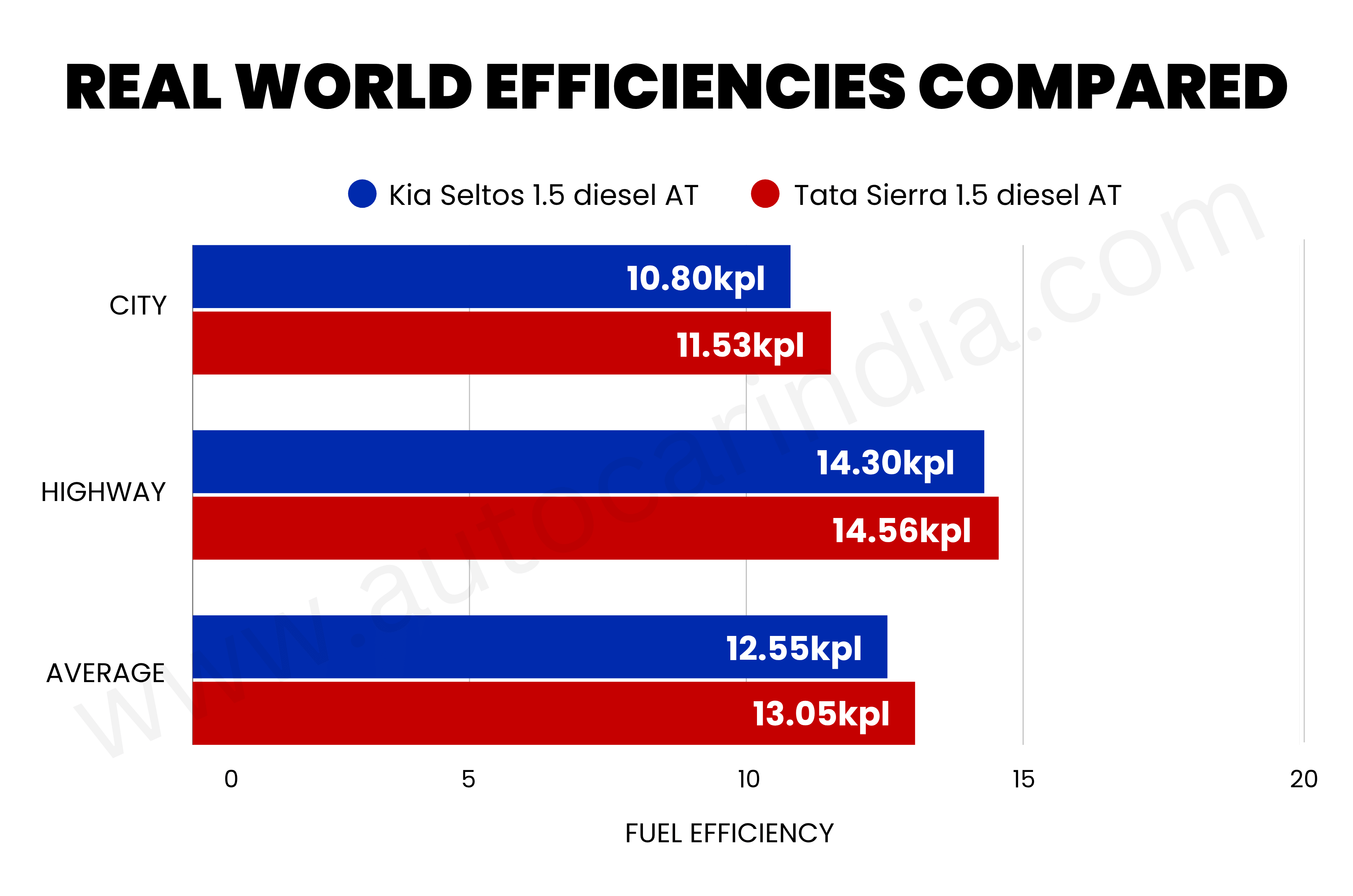
During our real-world fuel economy test, the Seltos diesel managed an average that was 0.5kpl worse than the Sierra. It was also 0.73kpl thirstier in the city, whilst consuming 0.26kpl more fuel than its Tata rival out on the highway. Despite being heavier than a comparable diesel-automatic trim of the Seltos, the relatively lower engine RPM of the Sierra when cruising at 100kph helps its efficiency. For reference, the Seltos’ diesel engine was spinning much faster at 100kph, at 2,100 RPM. Neither SUV gets an automatic engine stop-start system to reduce fuel burn further, but the Seltos does come with an Eco drive mode.

Kia Seltos vs Tata Sierra diesel automatic: Prices

Kia Seltos vs Tata Sierra diesel automatic prices


Kia Seltos

Tata Sierra

Price range (in Rs, lakh)

15.32-21.82

15.99-21.29

The most affordable trim of the Kia Seltos diesel with the torque-converter automatic gearbox costs Rs 67,000 less than its equivalent Tata Sierra. At the top-end of the spectrum, the latter has a price advantage of Rs 53,000.

Autocar India’s fuel efficiency testing

Before our real-world fuel efficiency tests, we fill our test cars’ tanks to the brim and maintain tyre pressures based on the manufacturer’s recommendations. These cars are driven in fixed city and highway loops in and around Navi Mumbai, and we maintain certain average speeds. Throughout the tests, there is only one person in each car, running the air conditioner and other electricals, such as the audio system, indicators and wipers, when required, just like a regular user would. Periodic driver swaps further neutralise variations in driver patterns. At the end of each cycle, we calculate efficiency by filling the tanks to full again.

Prices are ex-showroom, India.

Also read

Nissan Gravite CNG real world fuel economy tested, explained

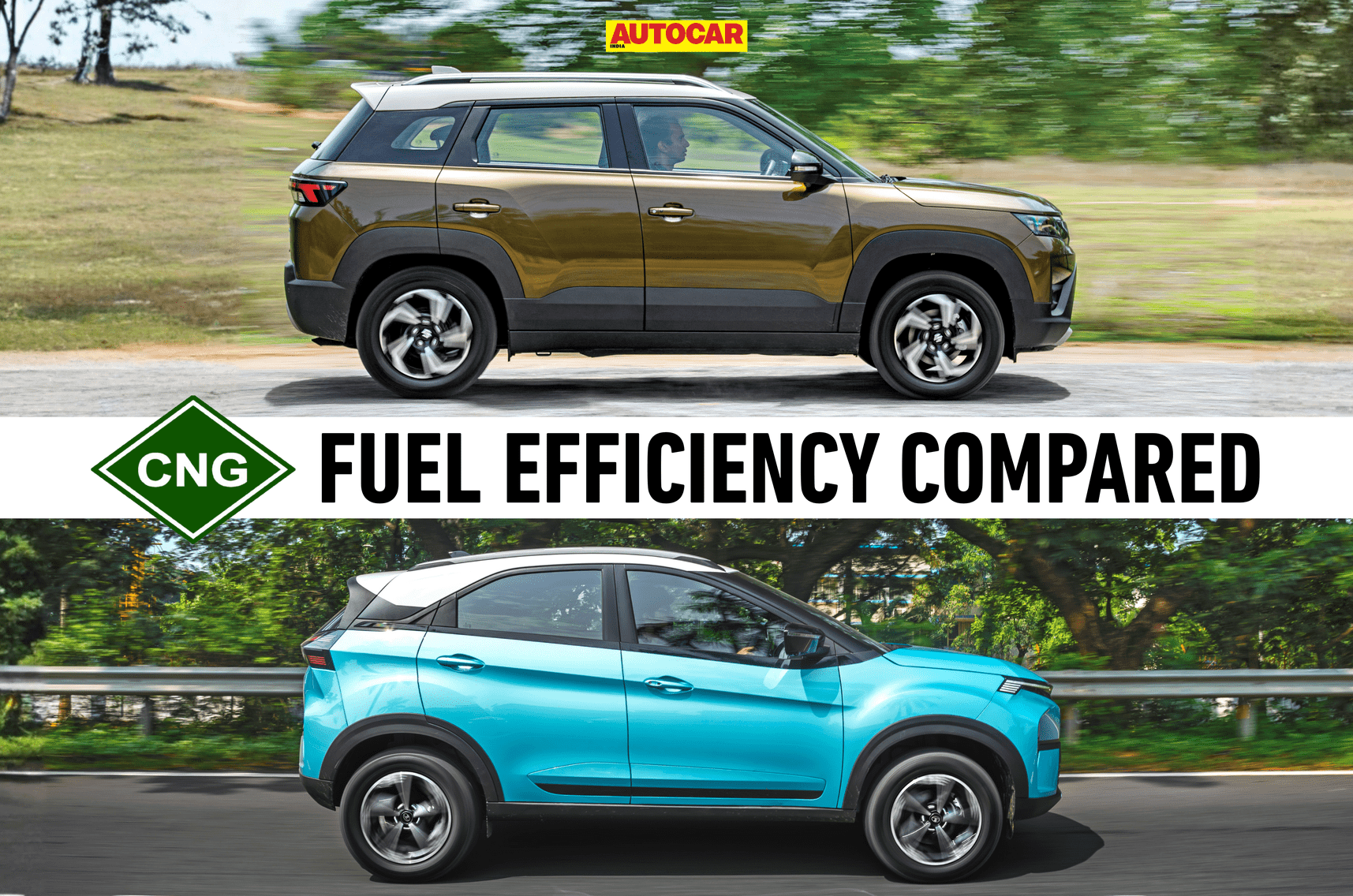
Maruti Brezza vs Tata Nexon real world CNG mileage comparison

Maruti Brezza vs Tata Nexon real world CNG mileage comparison

Brezza CNG and Nexon CNG

The Maruti Brezza and Tata Nexon are two of the few compact SUVs to offer a factory-fitted CNG kit. Both are also among the best-selling models for their respective brands, and since CNG cars are known to offer good mileage, it makes sense to compare these two and see which is more fuel-efficient in the real world. Keep reading to find out more.

Maruti Brezza CNG vs Tata Nexon CNG: Specs and price

Compact SUVBrezzaNexon

Engine

4 cyl, petrol-CNG3 cyl, petrol-CNG
TurbochargedNoYes

Displacement (cc)

1,4621,199

Power (hp)

101 (petrol), 88 (CNG)120 (petrol), 100 (CNG)

Torque (Nm)

137 (petrol), 122 (CNG)170

Transmission

5-speed manual6-speed manual
Claimed CNG mileage (km/kg)25.524

CNG tank (litres)

5560
Petrol tank (litres)4844
Boot space (litres)Not disclosed321

Price range (Rs, lakh)

9.17-11.468.3-13.42

While the Brezza uses a four-cylinder naturally aspirated engine, the Nexon gets a three-cylinder turbocharged unit. Notably, no other compact SUV currently offers a CNG kit with a turbocharged engine. The Nexon has a clear performance advantage over the Brezza. In petrol guise, its 1.2-litre turbo-petrol engine produces 120hp and 170Nm, giving it a 19hp and 33Nm edge over the Brezza’s 1.5-litre naturally aspirated petrol engine, which develops 101hp and 137Nm. 

In CNG mode too, the Nexon leads with 100hp and 170Nm, compared to the Brezza CNG’s 88hp and 122Nm. That gives the Nexon a 12hp and 48Nm advantage in CNG form. It also gets a 6-speed manual, compared with the Brezza’s 5-speed unit, and a larger 60-litre CNG tank (dual-cylinder setup). The Maruti, meanwhile, uses a more conventional cylinder arrangement.

The Brezza’s 1,462cc engine also crosses the 1,200cc threshold for the lower 18 percent GST slab, so it’s taxed at 40 percent. That shows up in pricing, too, with the Brezza’s entry price sitting Rs 95,000 above the Nexon’s. At the top end, though, the Tata is Rs 2.1 lakh pricier than the equivalent Brezza CNG variant.

Maruti Brezza CNG vs Tata Nexon CNG: Real-world mileage

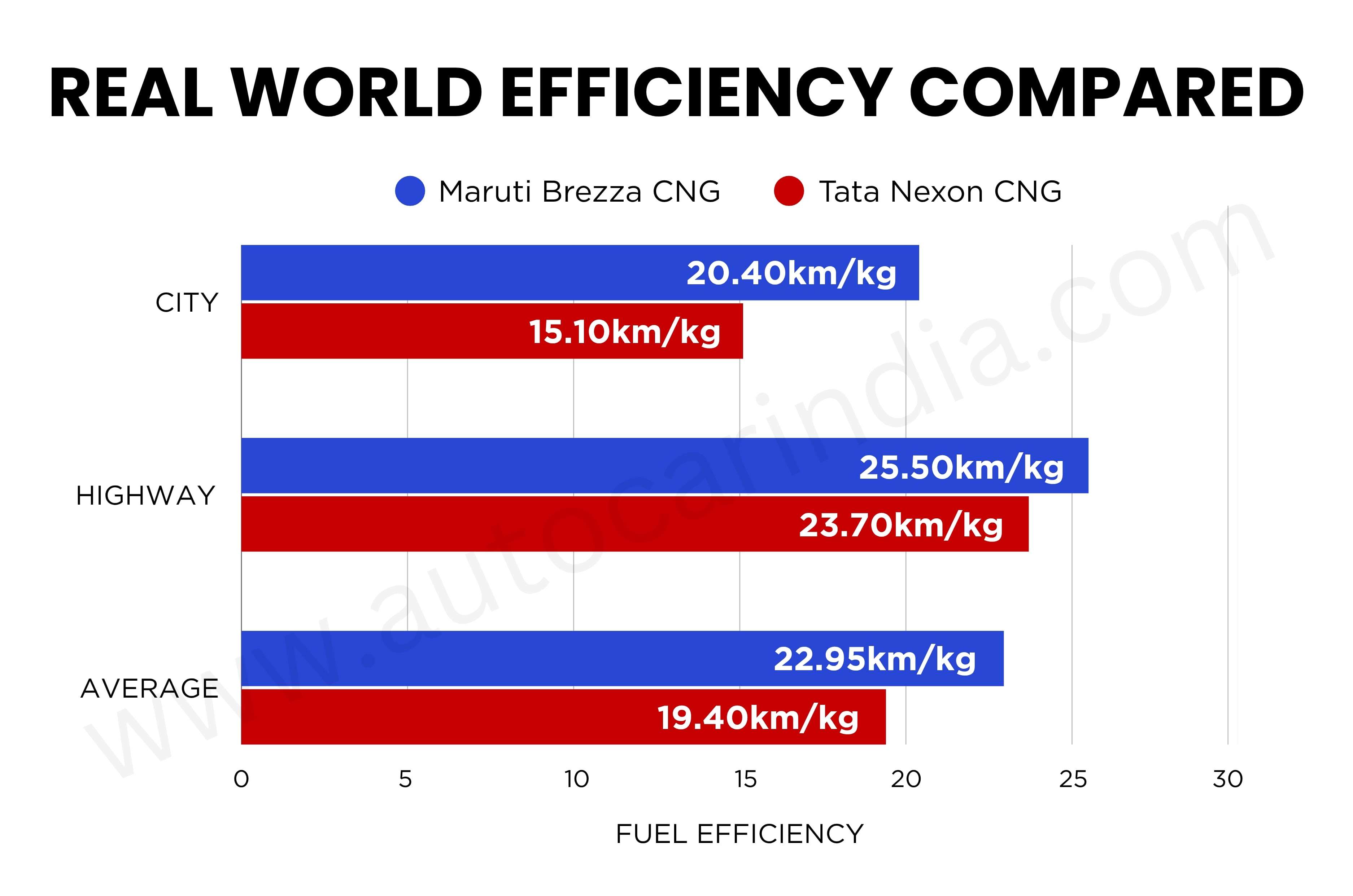
The Brezza CNG is clearly more efficient in real-world use than the Nexon CNG. In the city, it returns 5.3km/kg more than the Tata SUV. The Brezza maintains its lead on the highway as well, but the gap narrows to 1.8km/kg. As a result, the average figure also favours the Brezza, which is ahead by 3.55km/kg.

Part of the Brezza’s efficiency advantage comes from its much lighter kerb weight and a naturally aspirated setup. It should be noted that the Nexon’s CNG setup does not significantly affect drivability or performance in everyday use. It can also be started directly in CNG mode, and even the added weight of the kit – 120kg more than the petrol Nexon – does not make it feel breathless or strained.

Autocar India’s fuel efficiency testing

Before our real-world fuel efficiency tests, we fill our test cars’ tanks to the brim and maintain tyre pressures based on the manufacturer’s recommendations. These cars are driven in fixed city and highway loops in and around Navi Mumbai, and we maintain certain average speeds. Throughout the tests, there is only one person in each car, running the air conditioner and other electricals, such as the audio system, indicators and wipers, when required, just like a regular user would. Periodic driver swaps further neutralise variations in driver patterns. At the end of each cycle, we calculate efficiency by refilling the tanks to full.

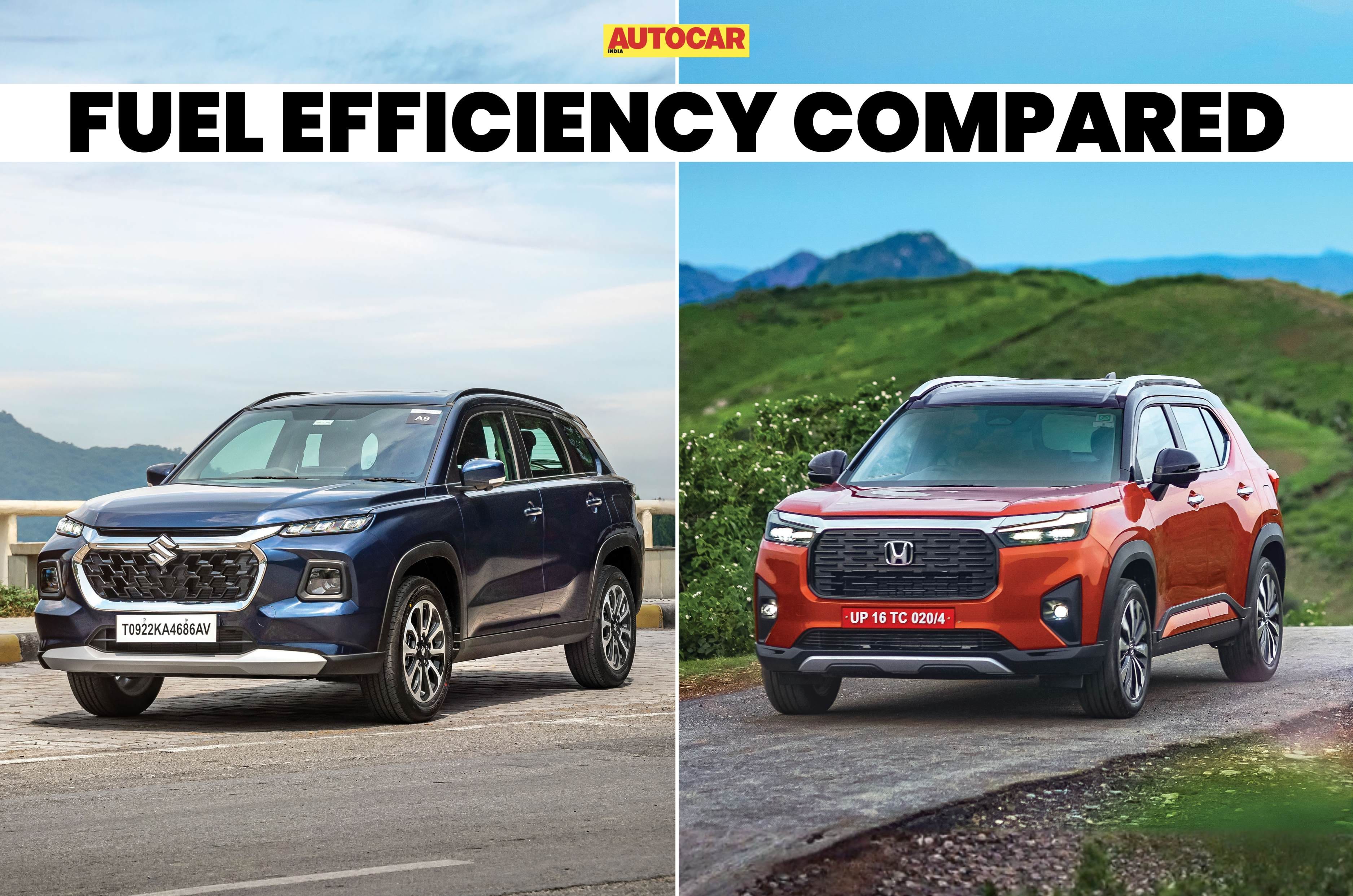
Maruti Grand Vitara AT vs Honda Elevate CVT real world mileage comparison

Maruti Grand Vitara AT vs Honda Elevate CVT real world mileage comparison

The Maruti Grand Vitara was launched in September 2022, while the Honda Elevate arrived a year later. Both compete in the mid-size SUV segment and offer naturally aspirated petrol engines with automatic gearbox options – a torque converter in the Grand Vitara and a continuously variable transmission (CVT) in the Elevate. But how do the two SUVs compare in terms of real-world fuel efficiency? Let’s find out.

Maruti Grand Vitara AT vs Honda Elevate CVT: Specs

 Maruti Grand Vitara

Honda Elevate

Engine

4 cyl, naturally aspirated petrol

4 cyl, naturally aspirated petrol

Displacement (cc)

1462

1498

Power (hp)

103

121

Torque (Nm)

139

145

Transmission

6AT

CVT

Drive layoutFront wheelFront wheel

Fuel tank (L)

45

40

Both SUVs use naturally aspirated four-cylinder petrol engines, but the Honda Elevate makes more power and torque outputs. Its 1,498cc engine produces 121hp and 145Nm, giving it an advantage of 18hp and 6Nm over the Grand Vitara’s 1,462cc block, which makes 103hp and 139Nm. The Elevate is paired with a CVT automatic, while the Grand Vitara uses a 6-speed torque converter automatic. Notably, the Grand Vitara also gets a 12V integrated starter generator (assists the engine during acceleration and recharges the 6Ah Li-ion battery) and offers the choice of all-wheel drive layout with this engine-and-gearbox combination, whereas, the Elevate is front-wheel drive only. Maruti claws back some ground with a larger 45-litre fuel tank, which is 5 litres bigger than the Elevate’s 40-litre tank.

Maruti Grand Vitara AT vs Honda Elevate CVT: Real-world fuel efficiency

 Maruti Grand Vitara

Honda Elevate

Tested city mileage (kpl)

11.60

8.60

Tested highway mileage (kpl)

15.30

13.10

Tested average mileage (kpl)

13.45

10.85

Tested range (km)

605

434

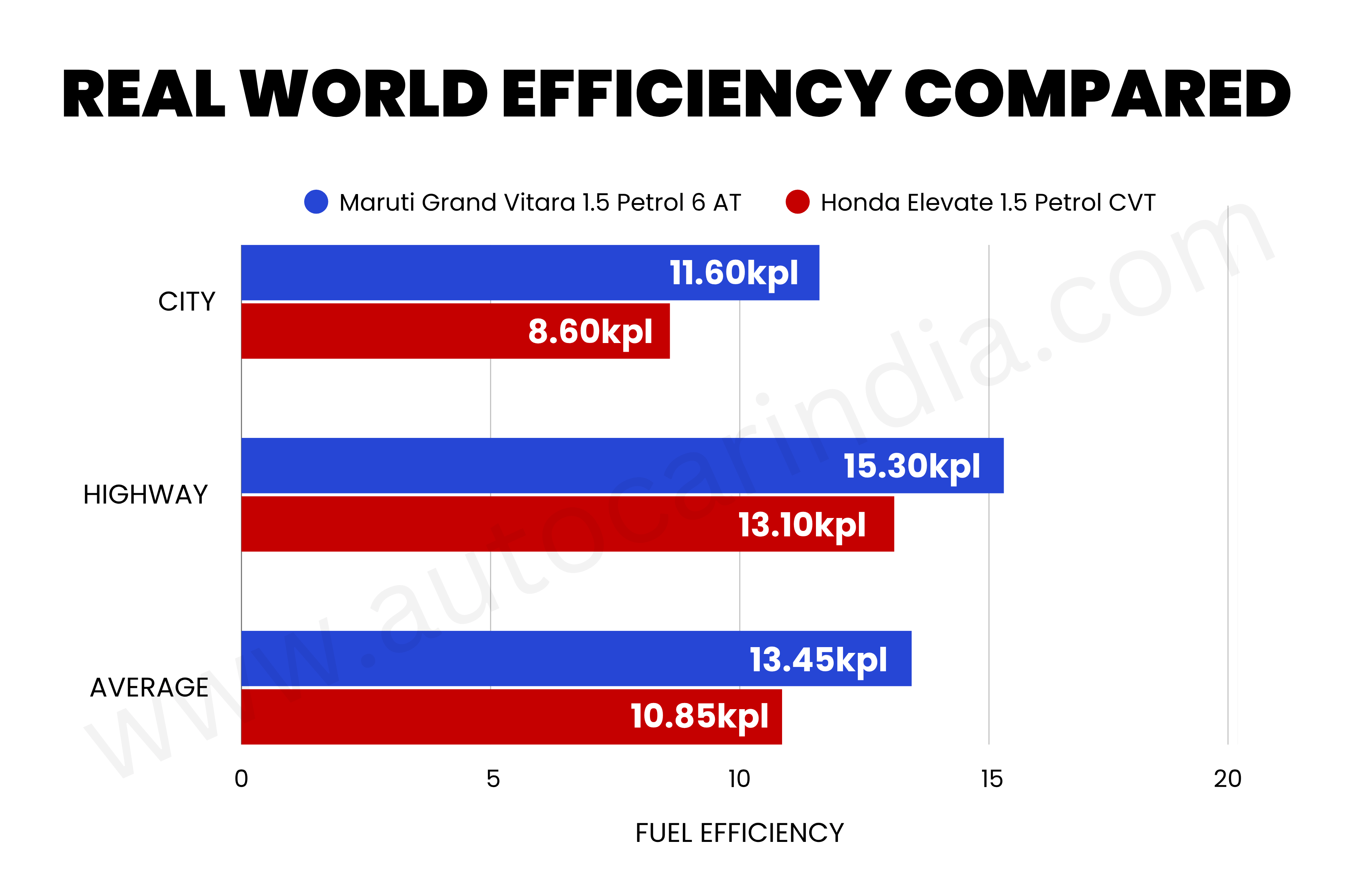
The Maruti Grand Vitara AT is more fuel efficient than the Honda Elevate CVT in both city and highway driving. In our tests, the Grand Vitara returned 11.60kpl in the city, which is 3kpl higher than the Elevate’s 8.60kpl. On the highway, the gap is smaller at 2.2kpl, with the Grand Vitara delivering 15.30kpl, compared to the Elevate’s 13.10kpl.

Maruti Grand Vitara AT vs Honda Elevate CVT Real-world fuel efficiency

As a result, the Grand Vitara posted a tested average of 13.45kpl, while the Elevate managed 10.85kpl. Combined with its larger 45-litre fuel tank, the Grand Vitara also achieved a range of 605km, which is 171km more than the Elevate’s 434km.

Maruti Grand Vitara AT vs Honda Elevate CVT: Price

 Maruti Grand Vitara

Honda Elevate

Price (Rs lakh)13.45-18.5813.43-16.78

The base automatic variants of both petrol SUVs are priced very close to each other. However, the price gap increases to Rs 1.8 lakh when you compare the top variants. One reason behind this is that the top-spec Alpha and Alpha (O) variants of the Grand Vitara come with an AWD system. Whereas, the front-wheel-drive Alpha and Alpha (O) AT variants are priced at Rs 16.55 lakh and Rs 16.74 lakh, respectively.

In conclusion, the Maruti Grand Vitara is the clear winner here, outperforming the Honda Elevate by a good margin. Buyers with a higher budget can also consider the Grand Vitara strong hybrid, which is even more frugal. In our real-world tests, it returned 22.08kpl.

Autocar India’s fuel efficiency testing

Before our real-world fuel efficiency tests, we fill our test cars’ tanks to the brim and maintain tyre pressures based on the manufacturer’s recommendations. These cars are driven in fixed city and highway loops in and around Navi Mumbai, and we maintain certain average speeds. Throughout the tests, there is only one person in each car, running the air conditioner and other electricals, such as the audio system, indicators and wipers, when required, just like a regular user would. Periodic driver swaps further neutralise variations in driver patterns. At the end of each cycle, we calculate efficiency by filling the tanks to full again.

Ex-showroom prices mentioned above are as of August 3, 2026.

Tata Nexon vs Mahindra XUV 3XO petrol automatic: Real world mileage compared

Tata Nexon vs Mahindra XUV 3XO turbo-petrol automatic comparison

The Tata Nexon and Mahindra XUV 3XO offer buyers two types of turbo-petrol engines. All turbo-petrol versions of the Nexon use multi-point fuel injection (MPFI), with lower trims being mated to an AMT (automated manual transmission) gearbox, while higher trims use a dual-clutch automatic (DCT) gearbox. Meanwhile, all turbo-petrol versions of the XUV 3XO feature a 6-speed torque converter automatic transmission (AT), with gasoline direct injection (GDI) only reserved for the top-spec version. So, if you want the convenience of a proper automatic gearbox plus the performance associated with a turbo-petrol engine without sacrificing fuel economy, which of these two cars should you consider?

Explore full specs, features and a price breakdown in our Nexon vs XUV 3XO comparison.

Tata Nexon vs Mahindra XUV 3XO turbo-petrol automatic: Specifications

While torque spread is comparable in both, the XUV 3XO has a distinct power advantage

Tata Nexon vs Mahindra XUV 3XO automatic: Specifications


Tata Nexon

Mahindra XUV 3XO

Engine

3 cyl, petrol

3 cyl, petrol

Displacement (cc)

1199

1197

Power (hp)

120 (5,500rpm)

131 (5,000rpm)

Torque (Nm)

170 (1,750-4,000rpm)

230 (1,500-3750rpm)

Gearbox

7-speed DCT

6-speed AT

Fuel tank (litres)

44

42

At first glance, the turbo-petrol engines powering the Nexon and XUV 3XO look identical, as both are three-cylinder units with a displacement of 1.2 litres. Since the GDI system typically allows a more complete combustion of fuel, it benefits include more power and better fuel economy over a similar-sized MPFI system.

The XUV 3XO’s direct injection turbo-petrol setup offers 11hp and 60Nm more than its equivalent Nexon version. However, peak torque of these engines is spread out over an identical range of 2,250rpm. The Tata SUV features a 7-speed dual-clutch automatic transmission (DCT), while the top-spec XUV 3XO petrol comes mated to a 6-speed torque converter automatic transmission (AT). Also, the fuel tank of the Tata SUV has a slightly higher capacity, by two litres. 

Tata Nexon vs Mahindra XUV 3XO turbo-petrol automatic: Real-world fuel efficiency

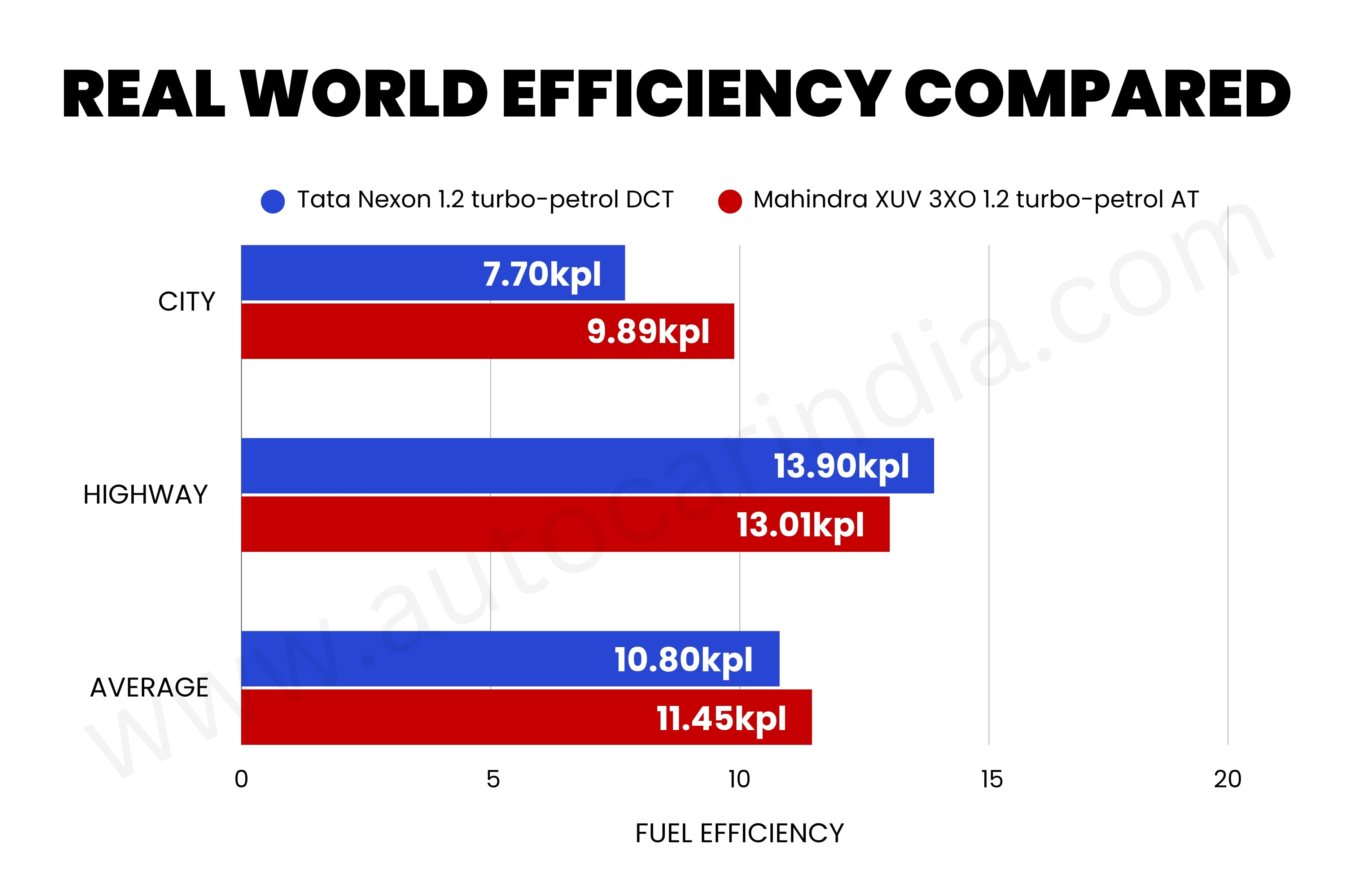
Despite having the punchier engine, the XUV 3XO’s fuel economy is better than the Nexon

Tata Nexon vs Mahindra XUV 3XO automatic: Real-world mileage


Tata Nexon

Mahindra XUV 3XO

Tested city mileage (kpl)

7.70

9.89

Tested highway mileage (kpl)

13.90

13.01

Tested average mileage (kpl)

10.80

11.45

The Tata Nexon returned an average that was 0.65kpl poorer than the Mahindra XUV 3XO. Its low mileage of 7.70kpl in city conditions meant that, even with a higher fuel economy of 13.90kpl on the highway, the Nexon’s overall efficiency still lagged behind the XUV 3XO. The efficiency gains of the Nexon on the highway was helped by the extra ratio in its DCT. Compared to the XUV 3XO’s torque convert AT with six ratios, the Nexon’s 7-speed gearbox allows its engine to spin at a more leisurely speed as you pick up pace.

Tata Nexon vs Mahindra XUV 3XO turbo-petrol automatic comparison chart

In the city, the XUV 3XO had a clear lead over the Nexon, achieving a real-world fuel economy that was higher by 2.19kpl. The Mahindra XUV 3XO’s direct fuel-injection technology allows petrol to be introduced into the engine in a highly measured and precise manner. This reduces fuel consumption and improves combustion when compared to a similarly sized but MPFI-equipped turbo-petrol engine, like in the Nexon.

Tata Nexon vs Mahindra XUV 3XO turbo-petrol automatic: Prices

Tata Nexon vs Mahindra XUV 3XO turbo-petrol automatic prices


Tata Nexon

Mahindra XUV 3XO

Price range (in Rs, lakh)

11.35-13.70

13.28-15.04

The turbo-petrol-automatic variants of both the Tata Nexon and Mahindra XUV 3XO are available in three trim levels. For cost-conscious buyers, the most affordable Nexon with this powertrain setup comes in Rs 1.93 lakh cheaper than a comparable XUV 3XO. This price delta continues to the mid-spec trim as well, where the Mahindra is pricier by Rs 79,000. At the top-end, the XUV 3XO’s turbo-petrol automatic variant costs Rs 1.34 lakh more than the equivalent Nexon. One of the reasons for the XUV 3XO’s higher price is is its direct-injection fuel system, which costs more than a comparable MPFI unit. 

Autocar India’s fuel efficiency testing

Before our real-world fuel efficiency tests, we fill our test cars’ tanks to the brim and maintain tyre pressures based on the manufacturer’s recommendations. These cars are driven in fixed city and highway loops in and around Navi Mumbai, and we maintain certain average speeds. Throughout the tests, there is only one person in each car, running the air conditioner and other electricals, such as the audio system, indicators and wipers, when required, just like a regular user would. Periodic driver swaps further neutralise variations in driver patterns. At the end of each cycle, we calculate efficiency by filling the tanks to full again.

Prices are ex-showroom, India.

Also read

Tata Harrier vs MG Hector petrol automatic: Real world mileage compared

Tata Nexon vs Mahindra XUV 3XO: Real world diesel efficiency compared

Honda City vs Skoda Slavia petrol automatic: Real-world mileage compared

Honda City vs Skoda Slavia petrol automatic real-world mileage compared

The fifth-gen Honda City is fresh off its second facelift, which aims to make the midsize sedan more compelling against rivals like the Skoda Slavia. Where the Slavia is available with turbo-petrol engines only, the City gets a sole naturally aspirated motor in its petrol variants. We put the petrol automatic versions of the City and Slavia through our real-world test

Honda City vs Skoda Slavia petrol automatic: Price and specs

 CitySlavia
Engine1.5 NA1.0 turbo / 1.5 turbo
Cylinder count43 / 4
Power (hp)121116 / 150
Torque (Nm)145178 / 250
GearboxCVT6AT / 7DCT
Fuel tank capacity (litres)4045
ARAI mileage (kpl)17.9718.73 / 19.36
Price range (Rs, lakh)14.30-17.1514.34-16.69 / 18.04-18.19

As noted previously, the City gets a 1.5-litre 4-cyl naturally aspirated petrol engine, whereas the Slavia can be had with either a 1.0-litre 3-cyl or 1.5-litre 4-cyl turbo-petrol mill – both are direct-injection engines. The City’s i-VTEC engine makes slightly more power than the Slavia’s 1.0 TSI, but falls much short of the 1.5 TSI. Torque output, fuel tank capacity, and ARAI-claimed mileage figures are clear victories for the Skoda sedan too.

Slavia 1.5 TSI offers cylinder deactivation feature

The City also comes with a CVT transmission, which is more cost-effective, but not as smooth or responsive as the Slavia 1.0 TSI’s 6-speed torque converter and the 1.5 TSI’s 7-speed dual-clutch automatic. It’s also worth noting that the Slavia 1.5 TSI gets cylinder deactivation tech, which can shut off two cylinders at cruising speeds to save fuel.

In terms of pricing, the City CVT slightly undercuts the Slavia 1.0 TSI AT at the base level, though the latter’s top-spec version is more affordable than the Honda sedan’s fully-loaded variant. Compared to the Slavia 1.5 TSI, the City CVT is cheaper by up to Rs 1.04 lakh.

Honda City vs Skoda Slavia petrol automatic: Real-world mileage

City vs Slavia 1.0 TSI AT

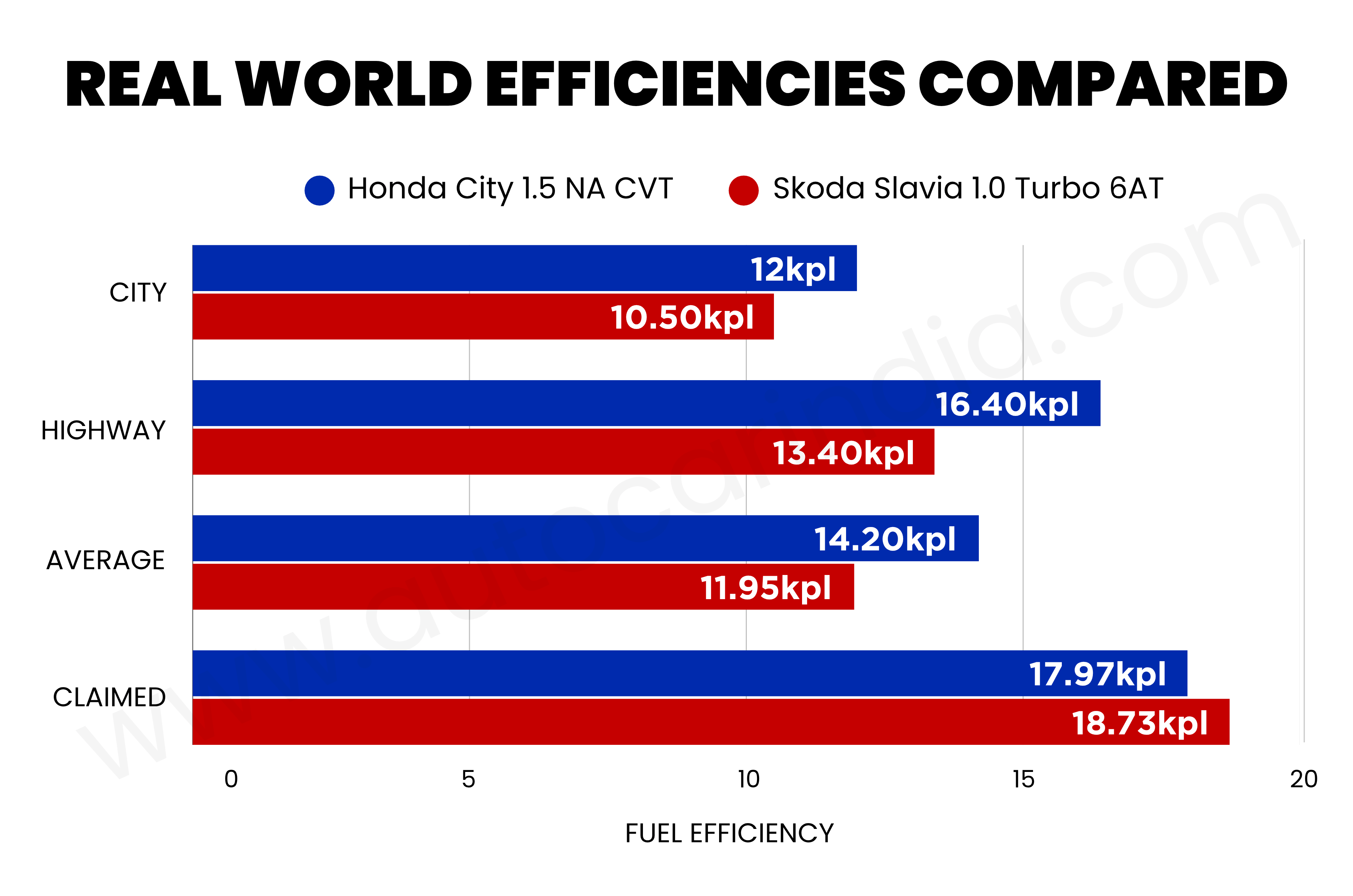
Despite being a cylinder down compared to the City, the Slavia 1.0 TSI yielded lower mileage figures in our real-world testing. In urban conditions, the City eked out a 1.5kpl victory over the Slavia 1.0 TSI, while on the highway, the Honda sedan’s lead widened to a full 3kpl. Looking at their average fuel efficiency figures, the City was 2.25kpl ahead of the Slavia 1.0 TSI.

City vs Slavia 1.5 TSI DCT

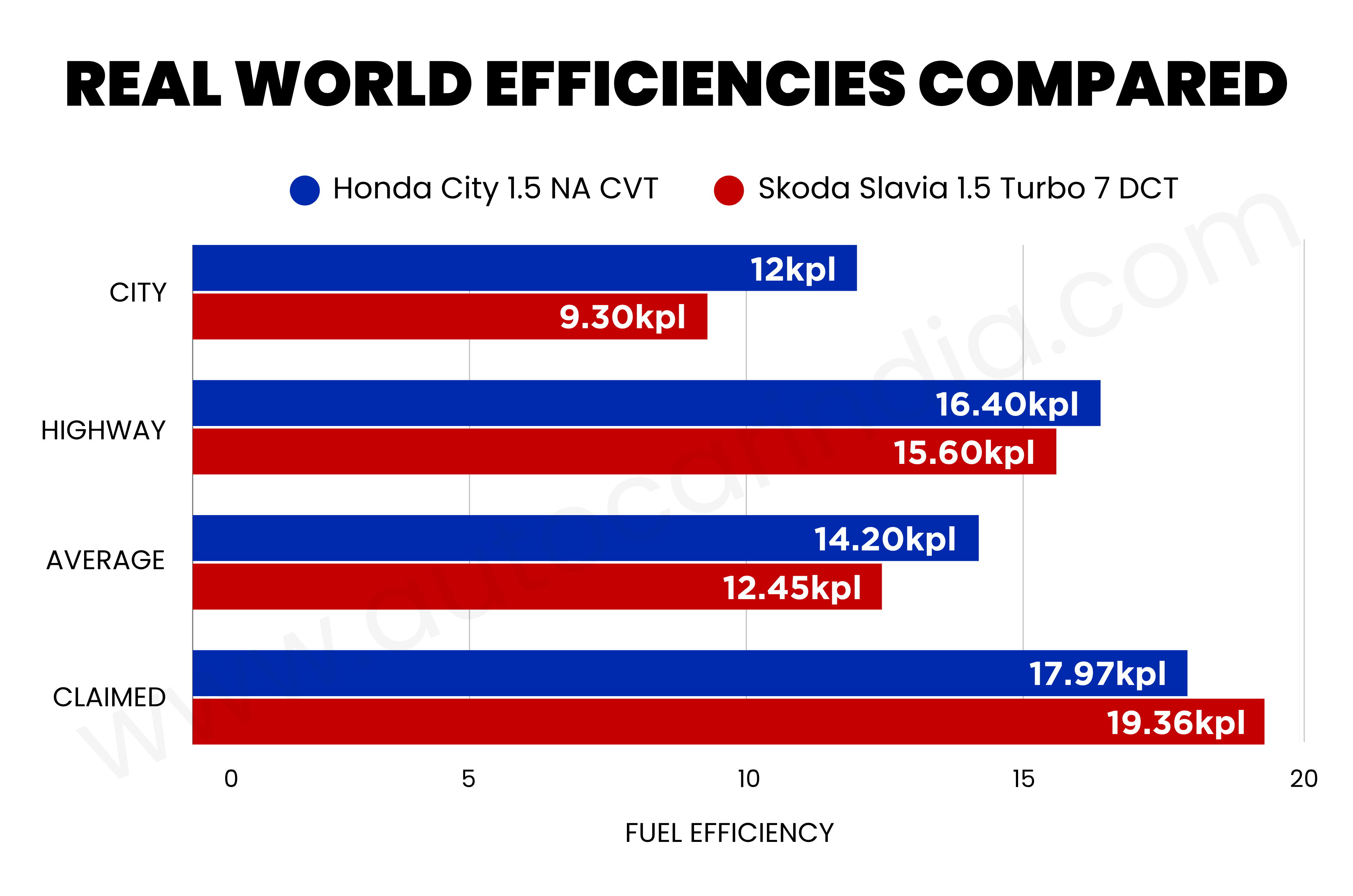
Unsurprisingly, the Slavia 1.5 TSI sipped more fuel than the 1.0 TSI in urban conditions, resulting in a 2.7kpl delta between the City. Thanks to its cylinder deactivation function, though, the Slavia 1.5 TSI majorly closed the mileage gap on the highway, but still fell short of the City by 0.8kpl. All told, the Slavia 1.5 TSI’s average fuel efficiency worked out to 0.5kpl higher than the 1.0 TSI, and 1.75kpl lower than that of the City.

City’s smaller fuel tank lets it down a bit

While the City undeniably offers better real-world mileage, its smaller fuel tank somewhat detracts from the victory. Per the average fuel efficiency numbers, the Honda sedan can travel 568km on a full tank of petrol, while the Slavia 1.0 TSI AT and 1.5 TSI DCT manage real-world range figures of 538km and 560km, respectively. That’s a difference of 8-30km in the City’s favour, which isn’t all that substantial, especially when comparing the 4-cyl versions of each sedan.

Autocar India’s fuel efficiency testing

Before our real-world fuel efficiency tests, we fill our test cars’ tanks to the brim and maintain tyre pressures based on the manufacturer’s recommendations. These cars are driven in fixed city and highway loops in and around Navi Mumbai, and we maintain certain average speeds. Throughout the tests, there is only one person in each car, running the air conditioner and other electricals, such as the audio system, indicators and wipers, when required, just like a regular user would. Periodic driver swaps further neutralise variations in driver patterns. At the end of each cycle, we calculate efficiency by filling the tanks to full again.

All prices are ex-showroom, India.
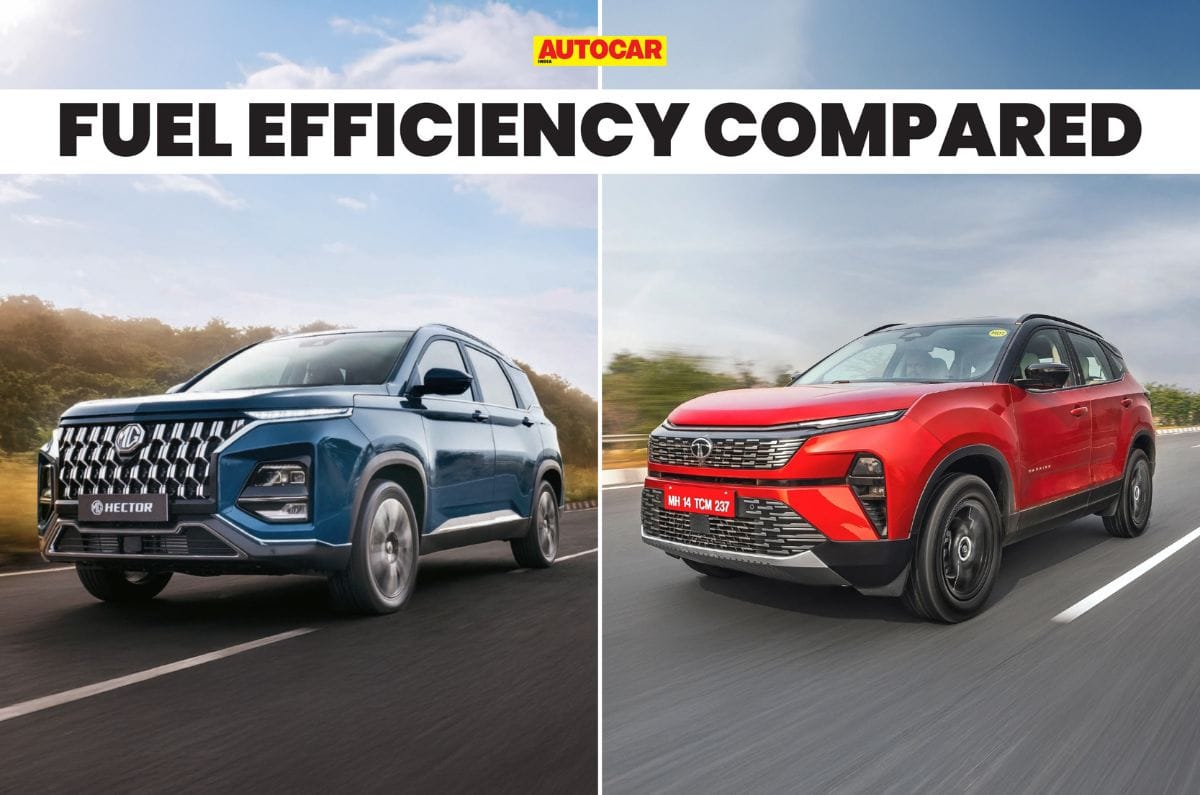
Tata Harrier vs MG Hector petrol automatic: Real world mileage compared

Tata Harrier vs MG Hector turbo-petrol automatic mileage comparison

Since its introduction in 2019, the MG Hector has been available with a turbo-petrol engine with manual and CVT automatic transmissions. However, it wasn’t until January 2026 that Tata Motors equipped the Harrier with a turbo-petrol engine. Where MG offers the Hector in 7-seater configurations, the Tata Harrier petrol only offers seating for 5 occupants. That said, let’s find out which SUV delivers better fuel economy.

Explore full specs, features and a price breakdown in our Harrier vs Hector comparison.

Tata Harrier vs MG Hector turbo-petrol automatic: Specifications

The Harrier petrol has the clear power advantage over the equivalent Hector

Tata Harrier vs MG Hector turbo-petrol automatic: Specifications


Tata Harrier

MG Hector

Engine

4 cyl, petrol

4 cyl, petrol

Displacement (cc)

1498

1451

Power (hp)

170 (5,000rpm)

143 (5,200rpm)

Torque (Nm)

280 (1,750-3,500rpm)

250 (3,000rpm)

Gearbox

6-speed automatic

Continuously variable transmission

Fuel tank (litres)

50

60

While both SUVs are powered by 1.5-litre direct-injection turbo-petrol engines, the Harrier’s unit is ever so slightly bigger (by 47cc). It backs up this size advantage by developing 27hp and 30Nm more than the engine under the MG Hector’s bonnet. The Tata Harrier’s higher torque output is also available across a wide RPM band, with peak power coming in at 200rpm lower in the engine’s rev range when compared to the Hector.

A key differentiator here is that the Tata Harrier petrol is paired with a 6-speed torque converter automatic gearbox, while the MG Hector makes use of a CVT (continuously variable transmission). The latter also features a bigger fuel tank, holding 10 litres more petrol.

Tata Harrier vs MG Hector turbo-petrol automatic: Real-world fuel efficiency

The Hector’s more efficient in the city, but the Harrier manages a higher average economy

Tata Harrier vs MG Hector turbo-petrol automatic: Real-world mileage


Tata Harrier

MG Hector

Tested city mileage (kpl)

6.17

8.30

Tested highway mileage (kpl)

12.49

9.60

Tested average mileage (kpl)

9.33

8.95

During our time testing it in the real world, the MG Hector’s mileage figures remained in the single digits. In the city, the Hector turbo-petrol turned out to be 2.13kpl more frugal than the Tata Harrier. Out on the open highway, it was the Tata Harrier turbo-petrol that fared better by achieving a fuel economy in the double digits – it was 2.89kpl higher than the Hector.

A wider peak torque spread of the Tata SUV means that its engine is less stressed at higher speeds, one of the factors explaining its better mileage on the highway. On the other hand, if a majority of your drives are in a city environment, The Hector’s CVT gearbox helps it sip less fuel in the city, given this design’s inherent efficiency advantages at lower speeds. Unfortunately, the MG SUV’s average mileage is lower than the Harrier’s despite its lower kerb weight and the CVT. Both cars get an Eco drive mode, but neither features an automatic engine stop-start system.

Tata Harrier vs MG Hector turbo-petrol automatic: Prices

Tata Harrier vs MG Hector turbo-petrol automatic: Prices


Tata Harrier

MG Hector

Price range (in Rs, lakh)

17.70-24.25

17.00-20.00

There are six trim levels of the Tata Harrier petrol with the automatic gearbox, and all of them are priced higher than their MG Hector counterparts. At the bottom end, the Hector CVT is Rs 70,000 cheaper than the entry-level Harrier petrol automatic. For those wishing to get all the bells & whistles that are only available in the range-topping trims of each SUV, the top-end Hector CVT is Rs 4.25 lakh less expensive than its equivalent Tata Harrier petrol variant.

Autocar India’s fuel efficiency testing

Before our real-world fuel efficiency tests, we fill our test cars’ tanks to the brim and maintain tyre pressures based on the manufacturer’s recommendations. These cars are driven in fixed city and highway loops in and around Navi Mumbai, and we maintain certain average speeds. Throughout the tests, there is only one person in each car, running the air conditioner and other electricals, such as the audio system, indicators and wipers, when required, just like a regular user would. Periodic driver swaps further neutralise variations in driver patterns. At the end of each cycle, we calculate efficiency by filling the tanks to full again.

Prices are ex-showroom, India.
Also read

Renault Duster 1.3L turbo MT vs DCT: Performance compared

Mahindra XUV 7XO vs Tata Harrier petrol AT: Real world mileage compared

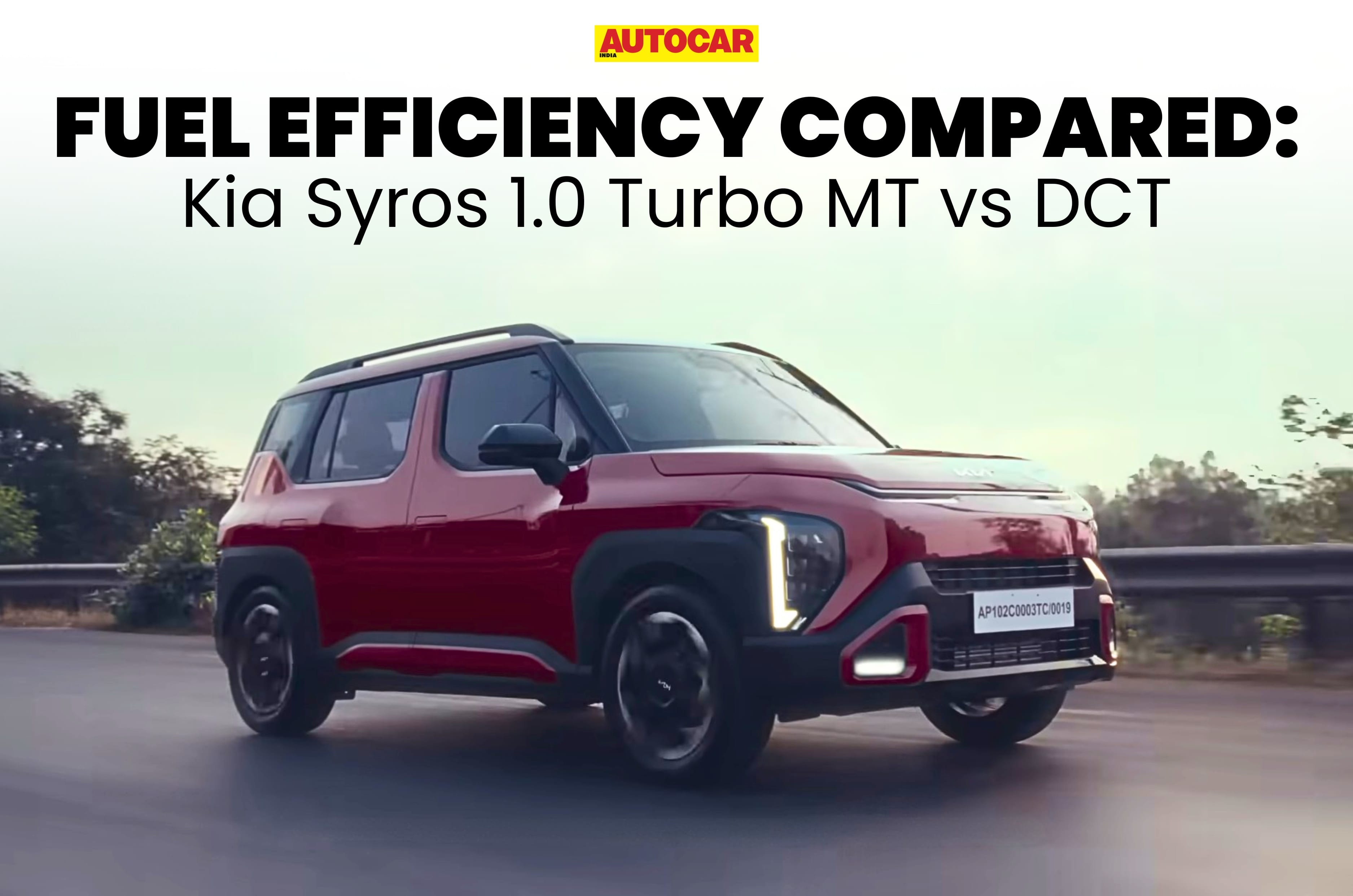
Kia Syros 1.0 turbo MT vs DCT: Real world mileage compared

Kia Syros 1.0 turbo MT vs DCT: Real world mileage compared

The Kia Syros is a compact SUV that is positioned between the Sonet compact SUV and the Seltos midsize SUV. It is offered with a 1.0-litre turbo-petrol and 1.5-litre diesel engine options. Among these, the turbo-petrol engine comes with manual and DCT options, with claimed fuel efficiency of up to 18.2kpl. But which of these two powertrain options offers more real-world mileage? Let’s find out.

Kia Syros 1.0L turbo-petrol MT vs DCT: Specifications and price

The Syros turbo MT’s top-end price is similar to the DCT’s starting price

Kia Syros 1.0L turbo-petrol MT vs DCT: Specifications and price


Syros 1.0TP MT

Syros 1.0TP DCT

Engine

3-cyl, turbo-petrol

3-cyl, turbo-petrol

Displacement (cc)

998

998

Power (hp)

120

120

Torque (Nm)

172

172

Gearbox

6-speed MT

7-speed DCT

Fuel tank capacity (litres)

45

45

Claimed mileage (kpl)

18.2

17.68

Price range (Rs, lakh)

8.42-12.02

11.96-15

With a total output of 120hp and 172Nm, the Syros has one of the most potent turbo-petrol engines in the segment. It is available with either a 6-speed manual or a 7-speed DCT, with the former claiming to be the more frugal option. The manual version is more affordable than the DCT, and interestingly, the top-end manual’s price is just Rs 6,000 more than the entry-spec DCT variant.

Kia Syros 1.0L turbo-petrol MT vs DCT: Real-world fuel efficiency

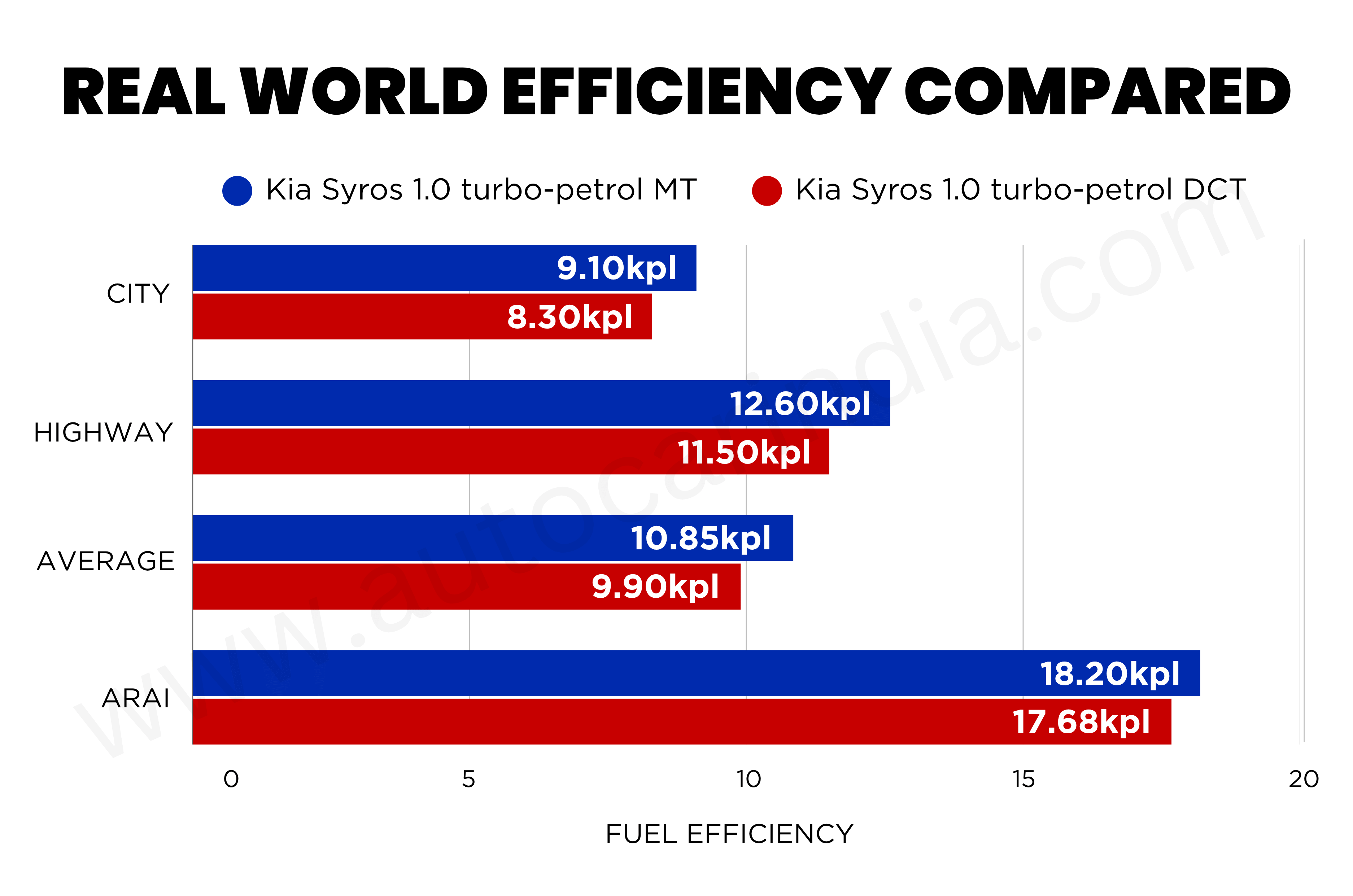
The manual is almost 1kpl more frugal than the DCT

Kia Syros 1.0L turbo-petrol MT vs DCT: Acceleration from rest (in seconds)


Syros 1.0TP MT

Syros 1.0TP DCT

Tested city mileage (kpl)

9.10

8.30

Tested highway mileage (kpl)

12.60

11.50

Tested average mileage (kpl)

10.85 

9.90

In our real-world tests, we found that the manual version was more frugal than the DCT version in both city and highway conditions by 0.81kpl and 1.1kpl, respectively. This results in the Syros turbo-petrol manual being overall 0.95kpl more fuel efficient than the DCT version. 

Autocar India’s fuel efficiency testing

Before our real-world fuel efficiency tests, we fill our test cars’ tanks to the brim and maintain tyre pressures based on the manufacturer’s recommendations. These cars are driven in fixed city and highway loops in and around Navi Mumbai, and we maintain certain average speeds. Throughout the tests, there is only one person in each car, running the air conditioner and other electricals, such as the audio system, indicators and wipers, when required, just like a regular user would. Periodic driver swaps further neutralise variations in driver patterns. At the end of each cycle, we calculate efficiency by filling the tanks to full again.

Prices are ex-showroom, India.

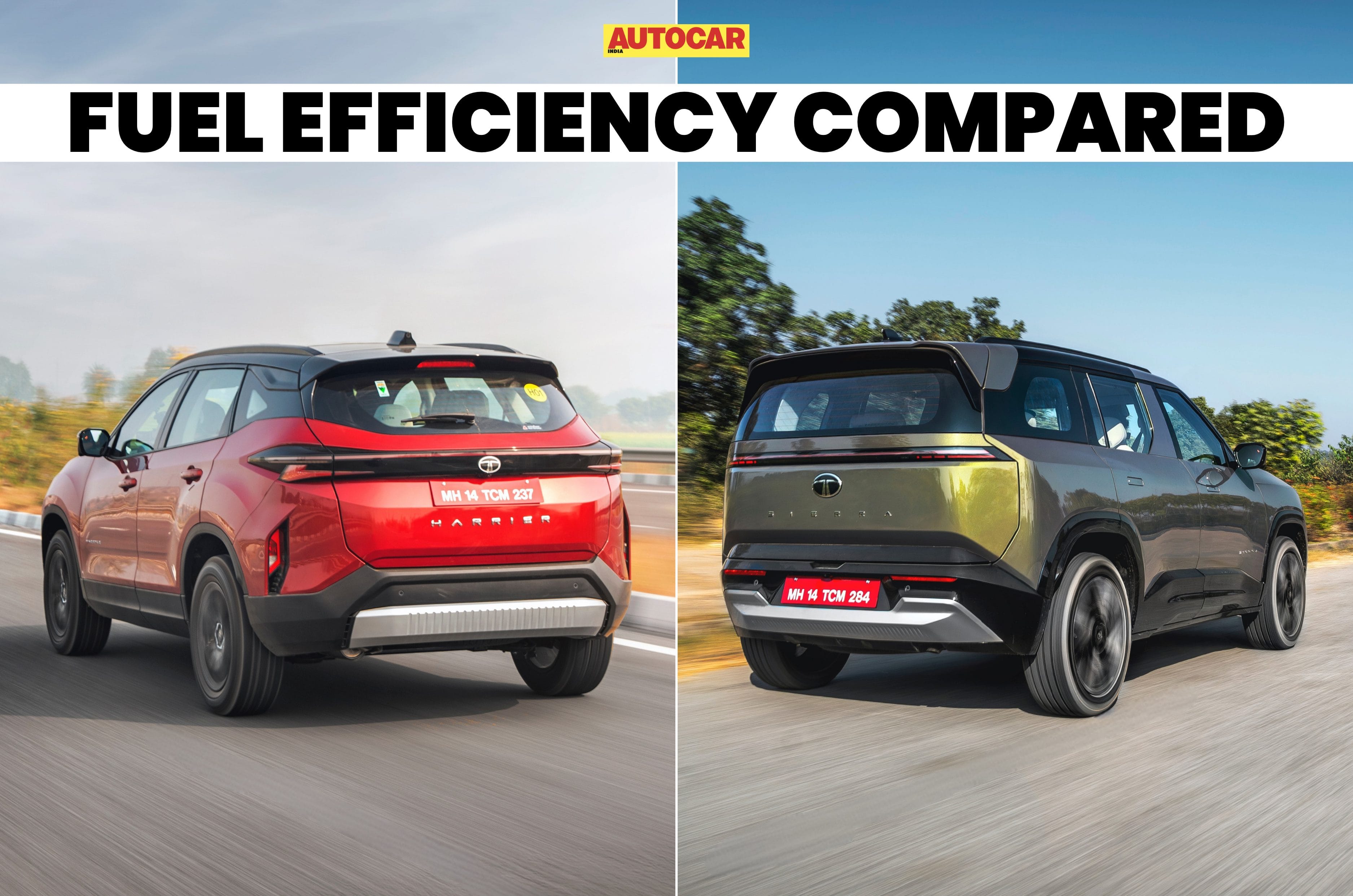
Tata Harrier vs Tata Sierra turbo petrol AT real-world mileage compared

Tata Harrier vs Tata Sierra

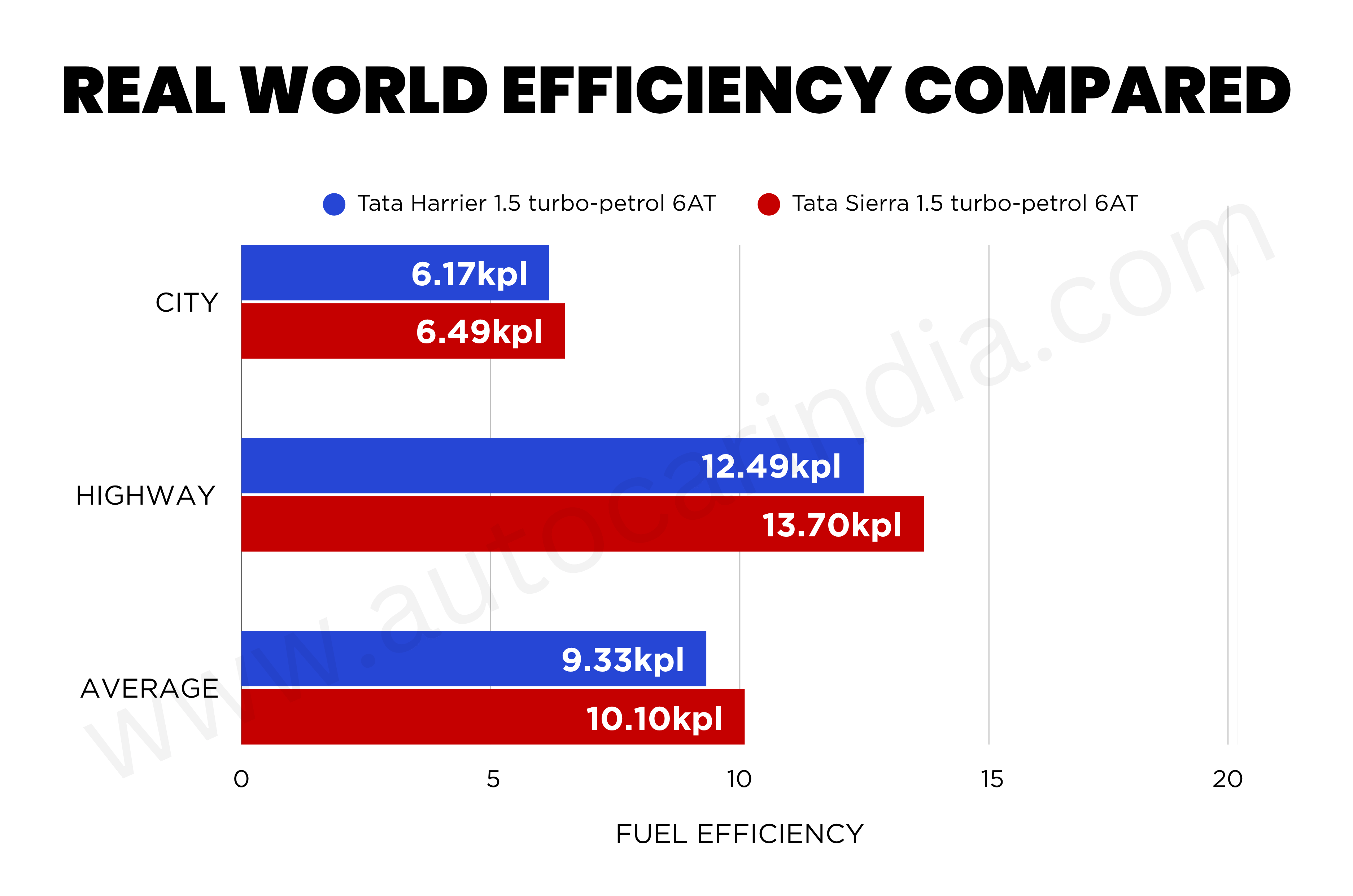
The new 1.5-litre ‘Hyperion’ turbo-petrol engine was developed in-house by Tata and first debuted on the Sierra in 2025. In January 2026, the carmaker introduced this engine into its larger stablemate, the Harrier. Since its inception in 2019, the Harrier has been offered only with a diesel engine. We’ve put the turbo-petrol automatic versions of both SUVs through our real-world mileage tests and compared their efficiency figures to find out which is more frugal. 

Tata Harrier vs Tata Sierra turbo petrol AT: Specifications

Tata Harrier vs Hyundai Alcazar turbo-petrol: Specification and price 


Tata Harrier

Tata Sierra

Engine

4 cyls, turbo-petrol

4 cyls, turbo-petrol

Displacement (cc)

1,498

1,498

Power (hp)

170

160

Torque (Nm)

280

255

Gearbox

6AT

6AT

Fuel tank (litres)

50

50

Kerb weight (kg)

1,738

1,552

Though powered by the same 1.5-litre turbo-petrol engine, both SUVs are tuned differently. While the Sierra’s mill develops 160hp and 255Nm, the Harrier’s unit develops more power and torque at 170hp and 280Nm, respectively. However, the larger Harrier is 186 kg heavier than the Sierra. Common to both SUVs are 6-speed torque-converter automatics and 50-litre fuel tanks. 

Tata Harrier vs Tata Sierra turbo petrol AT:  Real-world fuel efficiency

In our real-world fuel efficiency tests, the Sierra’s lighter weight helped it deliver 0.77kpl better fuel efficiency than the Harrier overall. Despite the Harrier getting an ‘Eco’ driving mode over the Sierra to improve fuel efficiency, the latter outperformed it by 0.32kpl in the city. On the highway, the efficiency gap increased to 1.21kpl because at 100kph, the Harrier’s engine runs at 1,900rpm in top gear, whereas the Sierra cruises at 1,750rpm in sixth gear at the same speed.

Tata Harrier vs Tata Sierra turbo petrol AT: Price

Tata Harrier vs Tata Sierra turbo petrol AT: Price


Tata Harrier

Tata Sierra

Petrol automatic price range (Rs lakh)

17.68 – 24.85

17.99 – 20.99

Considering turbo-petrol automatic price ranges, the Harrier turbo petrol automatic is Rs 31,000 cheaper than the Sierra. This is because the engine-gearbox combo is offered on the former’s one above the base trim, while the latter gets it on a mid-level trim onward. At the top end, however, the Harrier is pricier than the Sierra by Rs 3.86 lakh. 

Autocar India’s fuel-efficiency testing

Before our real-world fuel-efficiency tests, we fill our test cars’ tanks to the brim and maintain tyre pressures based on the manufacturer’s recommendations. These cars are driven in fixed city and highway loops in and around Navi Mumbai, and we maintain certain average speeds. Throughout the tests, there is only one person in each car, operating the air conditioner and other electricals, such as the audio system, indicators and wipers, when required, just like a regular user would. Periodic driver swaps further neutralise variations in driver patterns. At the end of each cycle, we calculate efficiency by filling the tanks to full again.

Renault Duster 1.0 vs 1.3 MT real-world fuel efficiency compared 

Renault Duster side tracking

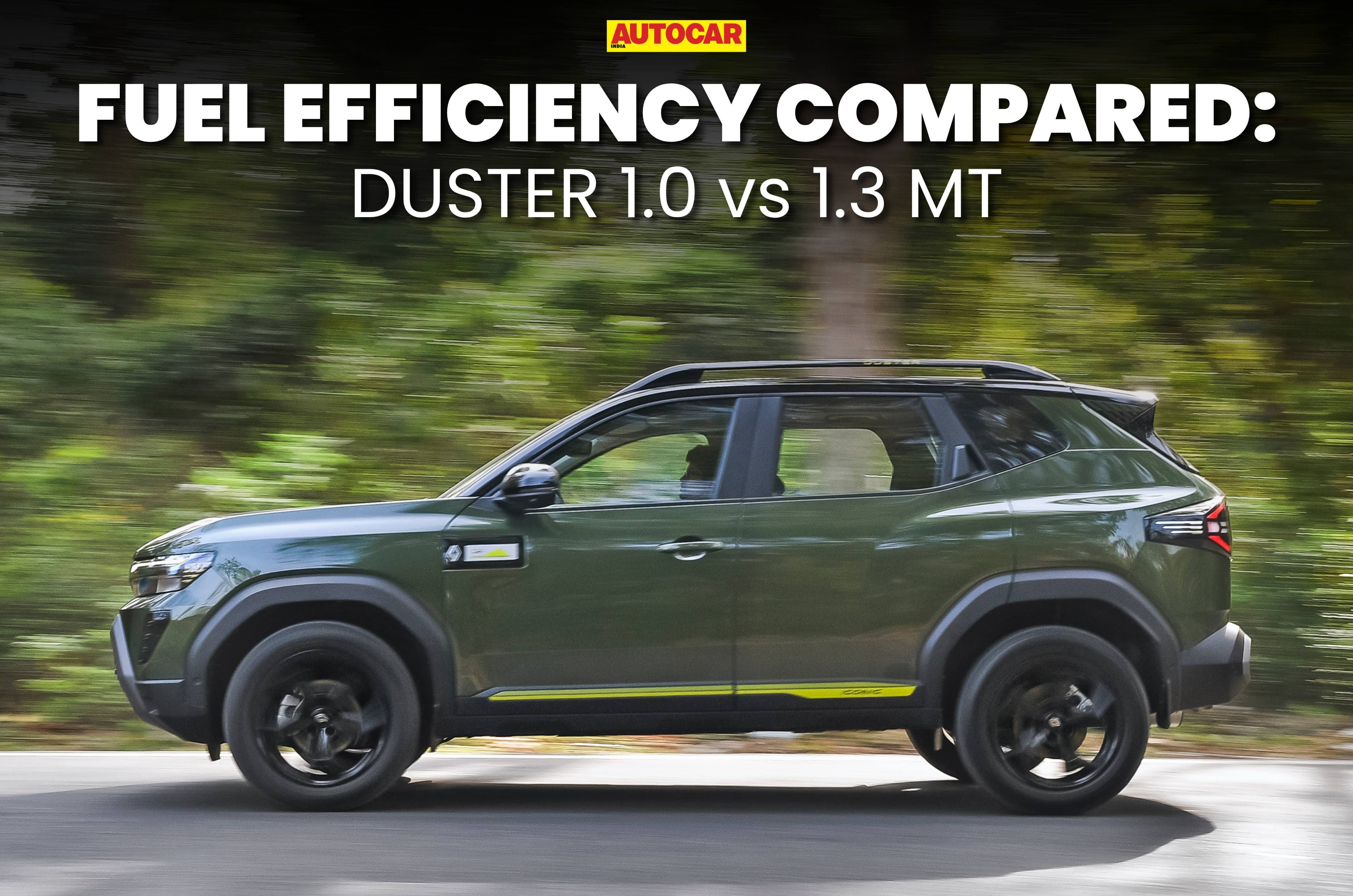
Earlier this year, Renault revived the Duster to mark its re-entry into the mid-size SUV space. Powering the SUV is a pair of turbo-petrol engines of either 1.0-litre or 1.3-litre in capacity. We’ve extensively tested and compared the real-world mileage figures of both turbo-petrol engines in manual transmission guise to determine how much of a gap there is in their efficiency.

Renault Duster 1.0 vs 1.3 MT: Specifications

Renault Duster 1.0 vs 1.3 MT: Specifications


Duster 1.0

Duster 1.3

Engine

3 cyls, turbo-petrol

4 cyls, turbo-petrol 

Displacement (cc)

999

1333

Power (hp)

100

163

Torque (Nm)

166

280

Gearbox

6MT

6MT

Kerb weight (kg)

1316

1372

Fuel tank (litres)

50

50

The Duster’s 1.0-litre turbo-petrol engine is essentially the same unit that’s utilised in the Kiger. It develops an identical 100hp, but torque is slightly bumped to 166Nm (from 160Nm). This engine is the least powerful turbo-petrol unit in the segment. In contrast, the 163hp, 280Nm 1.3-litre turbo-petrol engine is the most powerful in the segment. A 6-speed manual gearbox is standard on both engines, while a 6-speed DCT is offered on the 1.3-litre mill as well. The smaller 1.0-litre engine translates into a 56kg lighter kerb weight. Both versions get an identical 50-litre fuel tank. 

Renault Duster 1.0 vs 1.3 MT: Real-world fuel efficiency

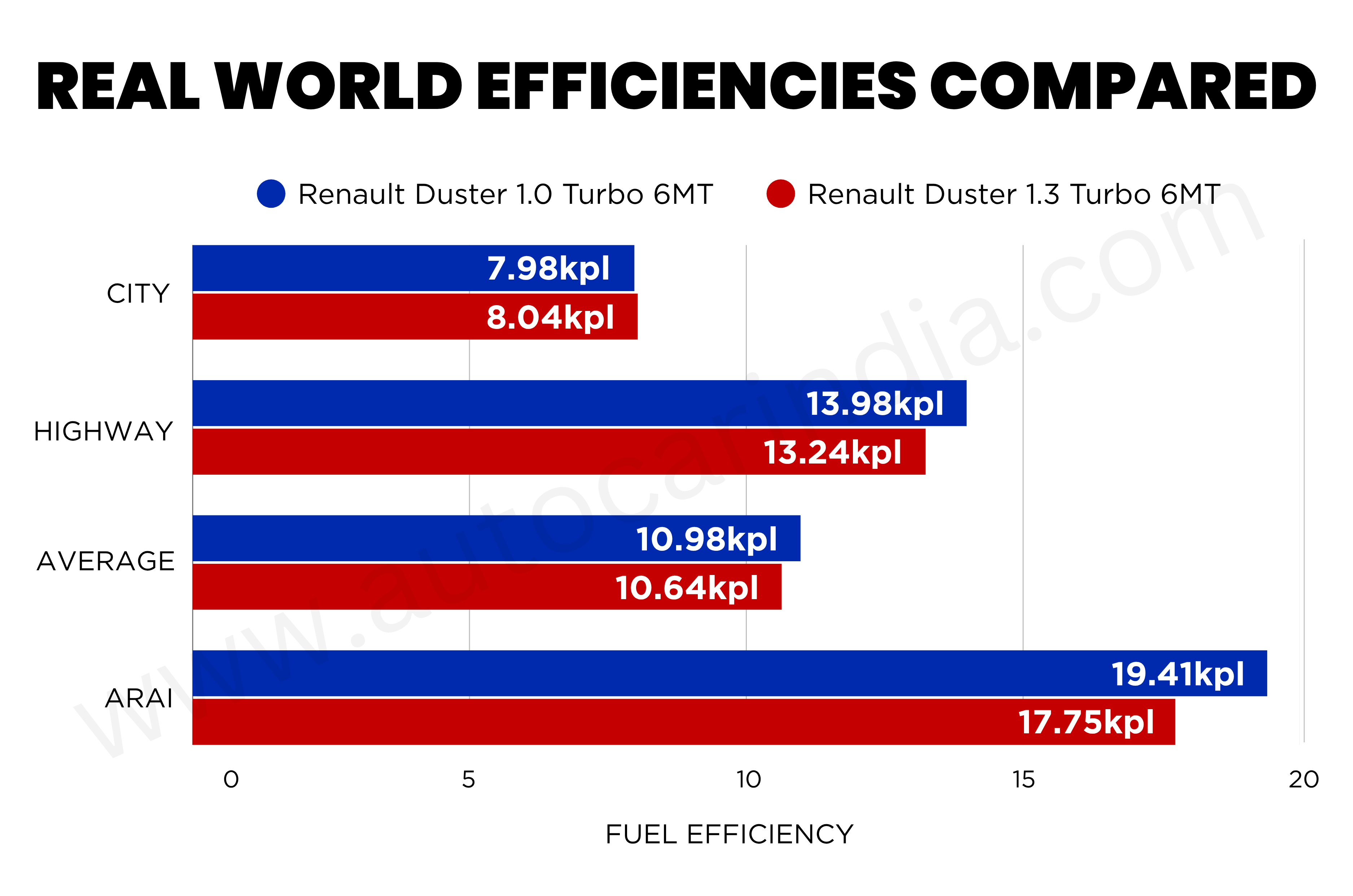
In the city, it was the 1.3-litre mill that was more frugal by a mere 0.48kpl. This is because of its ability to shift less frequently, due to its taller gearing. Both engines come with an Eco driving mode along with an auto start/stop function. But during the 1.0-litre units testing, high temperatures forced the AC to work harder, and auto start/stop only worked briefly, affecting city fuel efficiency. On the highway, however, the 1.0-litre unit was more efficient by 0.74kpl. Overall, the Duster 1.0’s average fuel efficiency was slightly higher at 10.98kpl in comparison to the 1.3’s 10.64kpl. The 0.34kpl gap in real-world average figures is much less in contrast to the 1.66kpl difference considering their respective ARAI-claimed figures 

Renault Duster 1.0 vs 1.3 MT: Price

Renault Duster 1.0 vs 1.3 MT: Prices


Duster 1.0

Duster 1,3

Price (Rs lakh) 

10.49 – 13.49

12.99 – 16.99

The Duster with the 1.0-litre engine has a more affordable price range as it’s offered from the base to the mid-level trims. Meanwhile, the 1.3-litre’s availability from the one above the base trim and exclusively on the top-end trim makes it comparatively pricier. Going for the 1.3 over the 1.0 within the same trim will set you back by up to Rs 1.3 lakh. 

Autocar India’s fuel-efficiency testing

Before our real-world fuel-efficiency tests, we fill our test cars’ tanks to the brim and maintain tyre pressures based on the manufacturer’s recommendations. These cars are driven in fixed city and highway loops in and around Navi Mumbai, and we maintain certain average speeds. Throughout the tests, there is only one person in each car, operating the air conditioner and other electricals, such as the audio system, indicators and wipers, when required, just like a regular user would. Periodic driver swaps further neutralise variations in driver patterns. At the end of each cycle, we calculate efficiency by filling the tanks to full again.

All prices are ex-showroom, India.