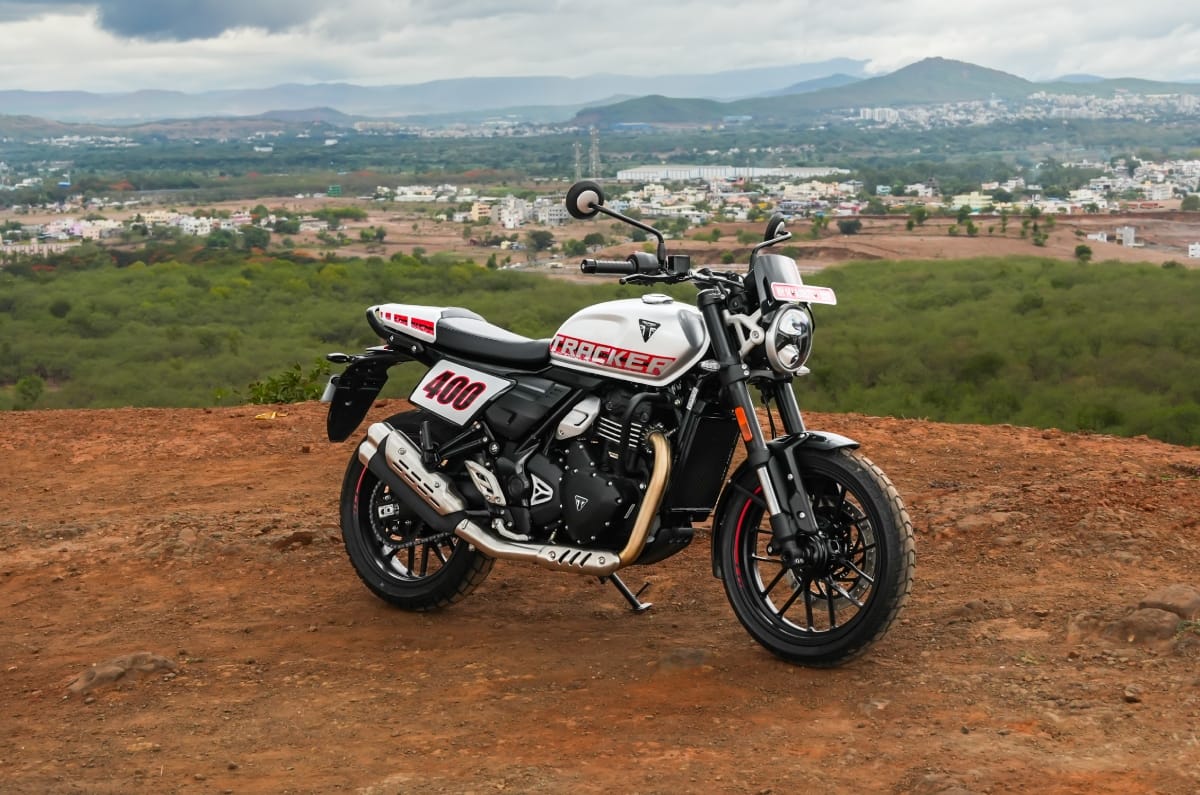
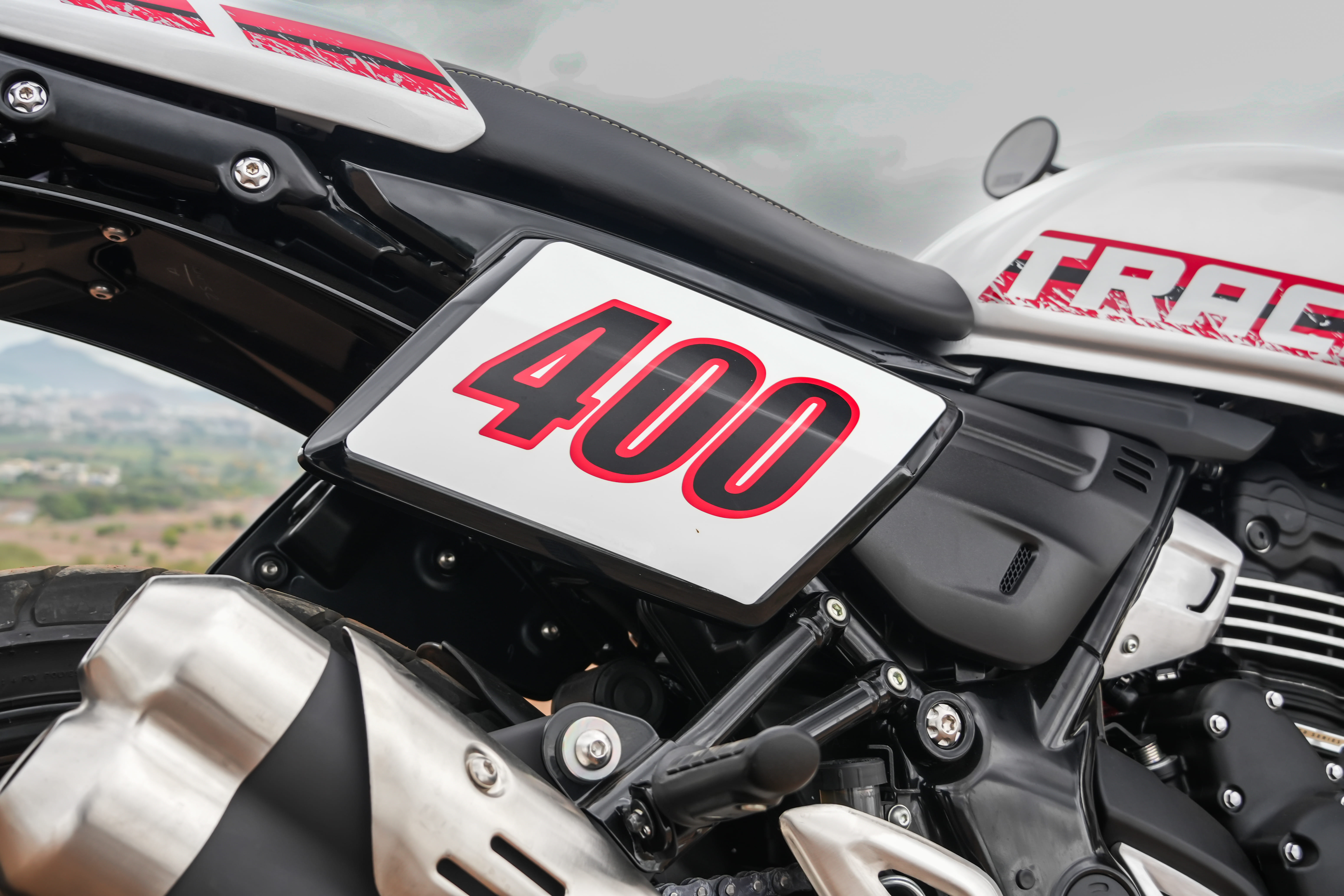
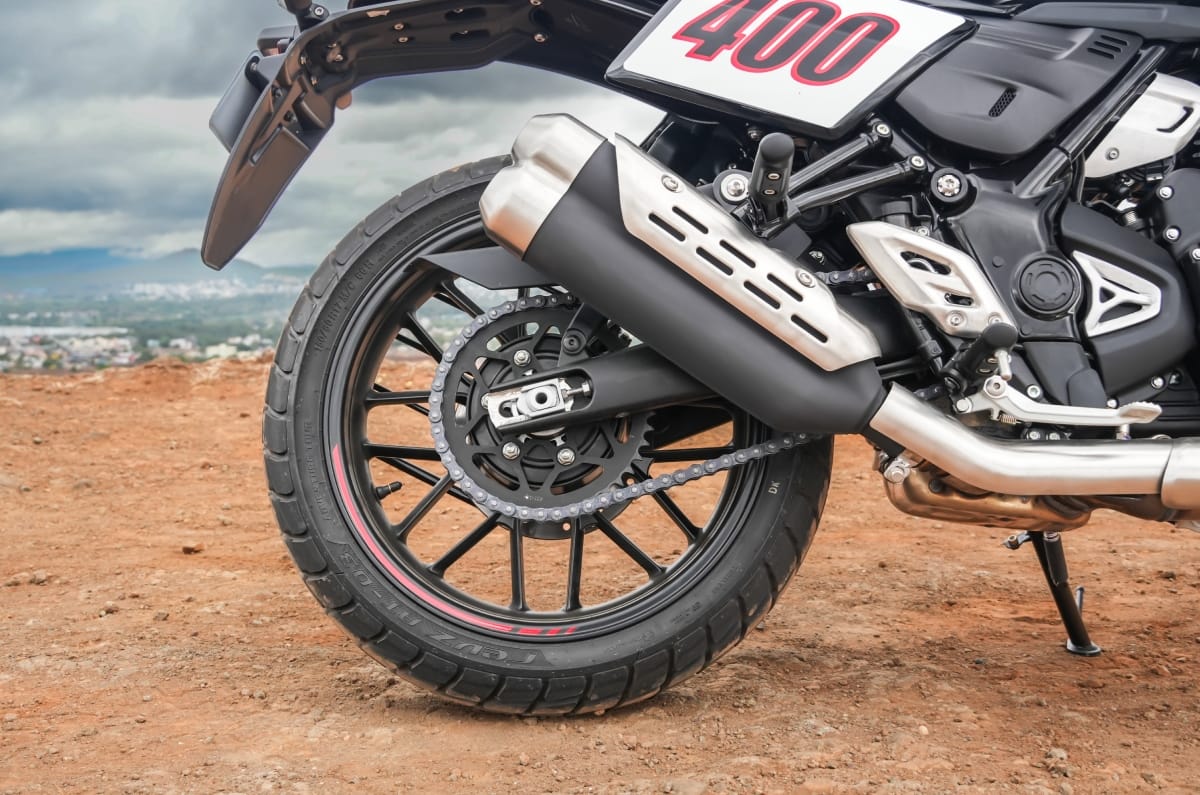
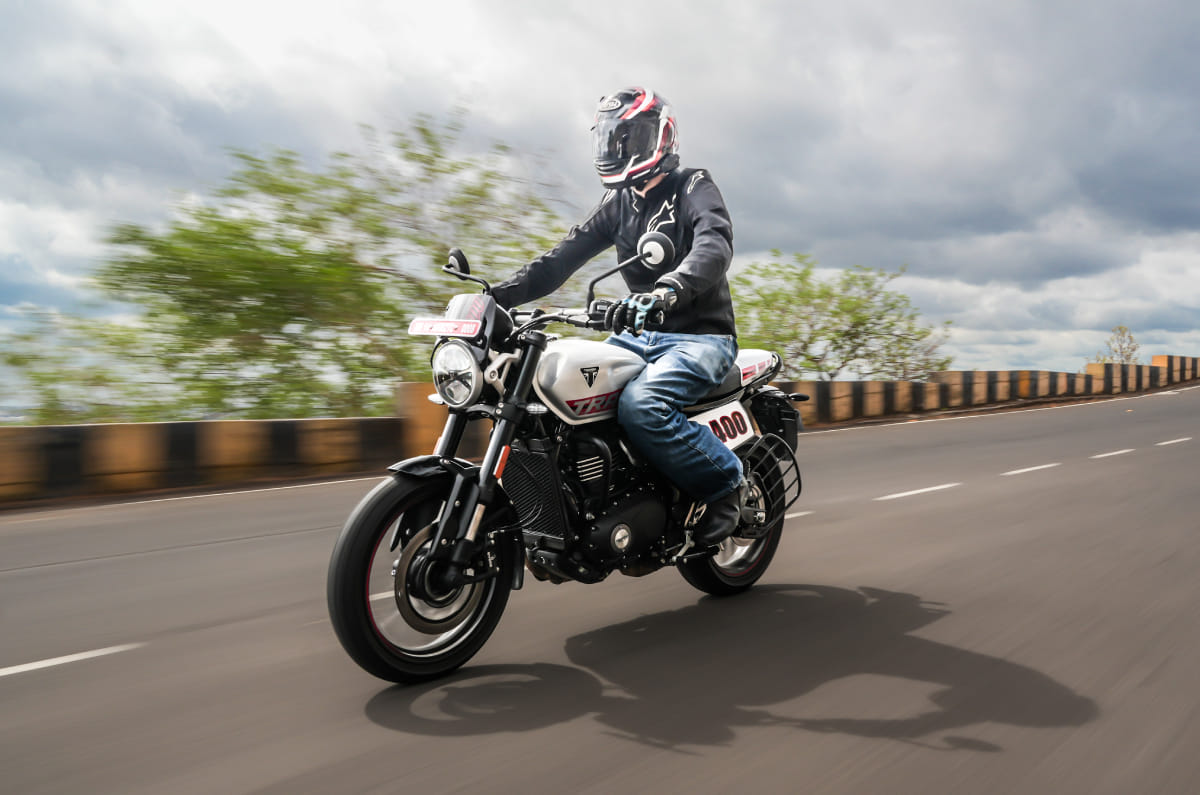
The Triumph Tracker 400 is the newest addition to the Indian-made Triumph lineup and, on paper at least, the most distinctive of the lot. It draws its design inspiration from flat-track racing, with a wider fuel tank, chunky dual-purpose tyres, number board-style panels and a flyscreen. Here’s what works in its favour and a couple of reasons it might not be for you.
Reasons to buy the Triumph Tracker 400
Eye-catching, distinctive design
The Tracker 400 is the most visually striking motorcycle in the Indian Triumph range. The wider tank, cast aluminium headlamp mount, flyscreen and number board panels give it a strong, individual character that you won’t find anywhere else at this price. During our time with the bike, it attracted more attention than any of the other single-cylinder Triumphs – and for riders who want something that stands apart from the crowd of retro-styled commuters in this segment, that matters. The tail section, shared with the Thruxton, is the one visual weak point, but it doesn’t significantly detract from the overall look.
Handling and comfort
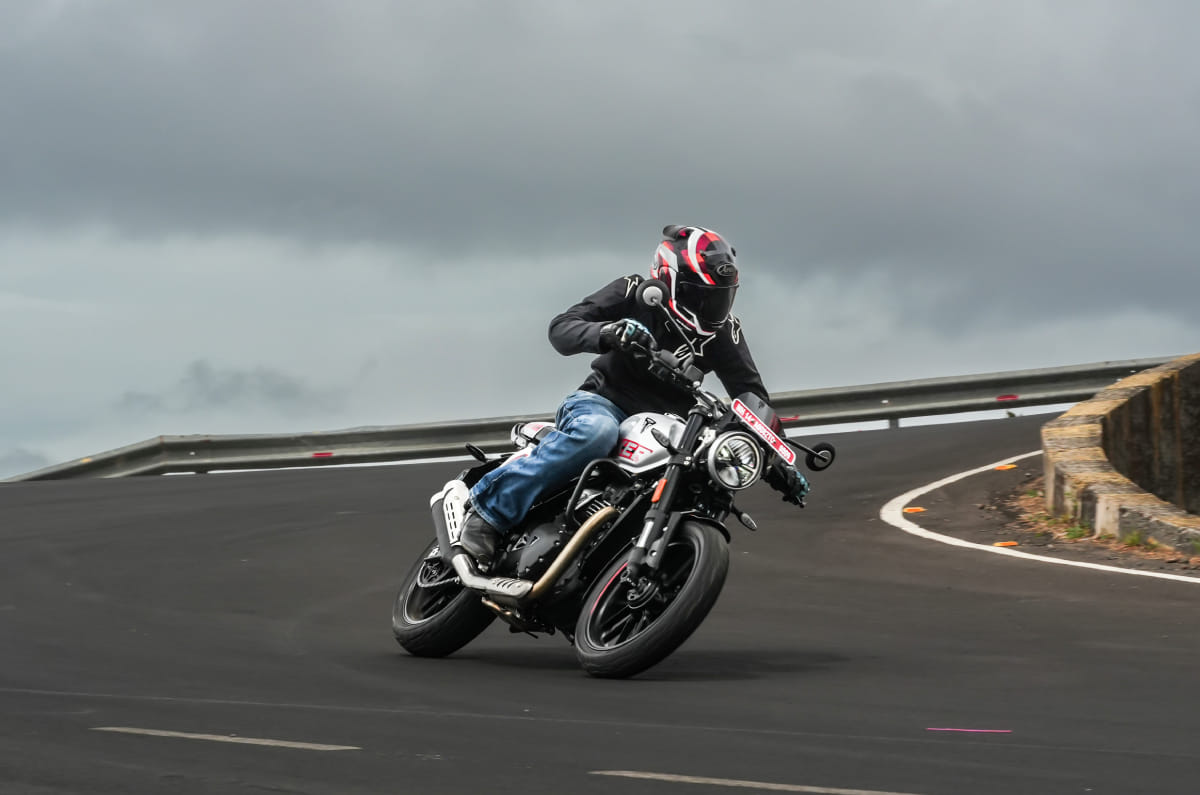
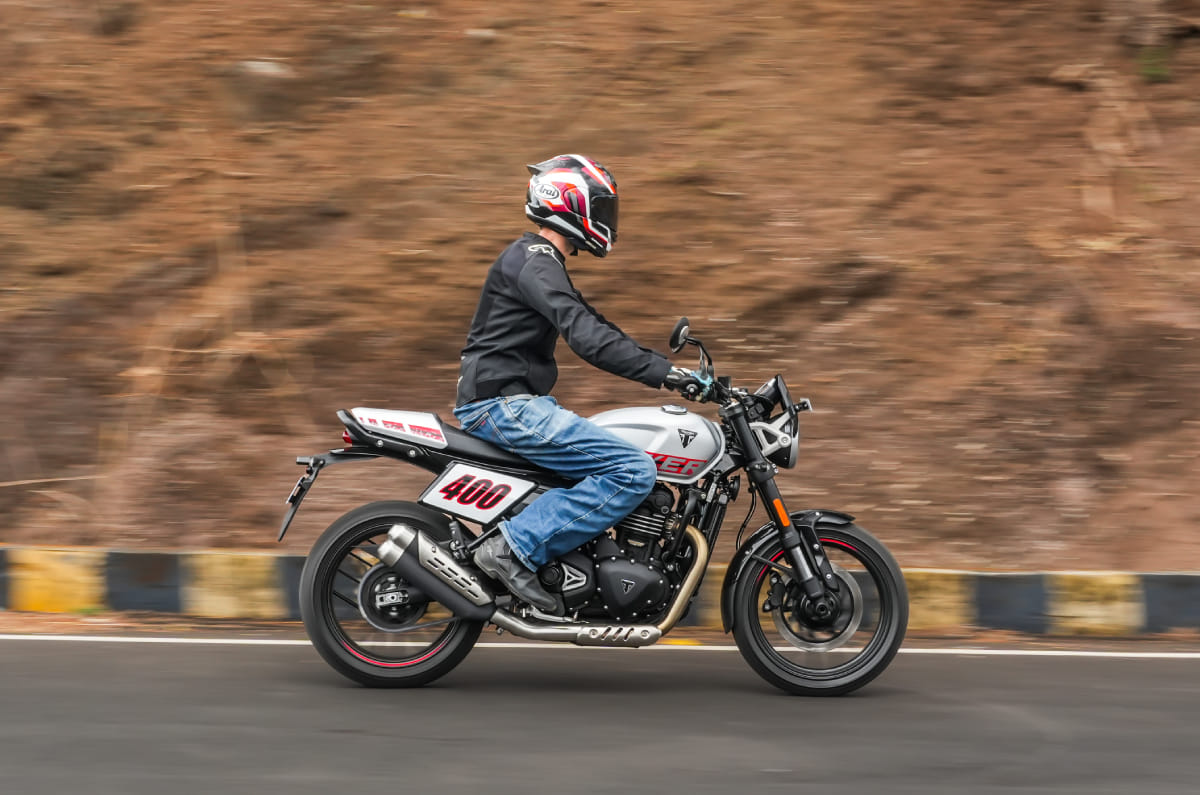
Despite the off-road-styled MRF Revz AT-03 tyres, the Tracker 400 is a genuinely capable and entertaining handler. The sharper 24.5-degree steering rake angle that it shares with the Thruxton 400 makes itself felt in the corners, and there is good lean-angle clearance available. More impressive is how well the suspension balances firmness with compliance – it inspires confidence at higher speeds while still absorbing rough roads without fuss. The sporty, leaned-forward riding position created by the lower and wider handlebar and repositioned footpegs adds to the sense of connection without crossing into discomfort over longer rides.
Price
At Rs 2.46 lakh (ex-showroom, Delhi), the Tracker 400 is priced Rs 14,000 more than the Speed 400 and Rs 24,000 less than the Thruxton 400 – a sensible position in the range given it shares the latter’s engine tune and suspension character. It comes with the same full feature set as the rest of the Indian Triumph lineup, including switchable traction control, a semi-digital display and a bi-directional quickshifter, making it good value for what you get.
Reasons to skip the Triumph Tracker 400
It’s a tracker only in name
The Tracker 400’s flat-track styling is exactly that – styling. Look beneath the chunky tyres and number boards, and you’re riding a bike based on the Thruxton 400 with a sporty steering geometry and a more aggressive riding position. There is no off-road capability to speak of, and the dual-purpose tyres, while they look the part, would have been better replaced with road-biased rubber that lets the chassis show what it can actually do. If you’re buying this expecting anything beyond a road-focused sporty roadster, you’ll be disappointed.
High-rpm vibrations
The Tracker shares the Thruxton 400’s higher state of tune – 40hp versus 37hp on the Speed 400 – but that extra performance comes with a noticeable increase in vibration above 8,000rpm. During our time with the bike, the buzz through the handlebars, footpegs and tank became more intrusive than on the Speed 400 once the revs climbed, and sustained highway cruising above 110kph required more mental effort to manage. For a bike that is otherwise well-suited to longer rides, this is a genuine drawback.
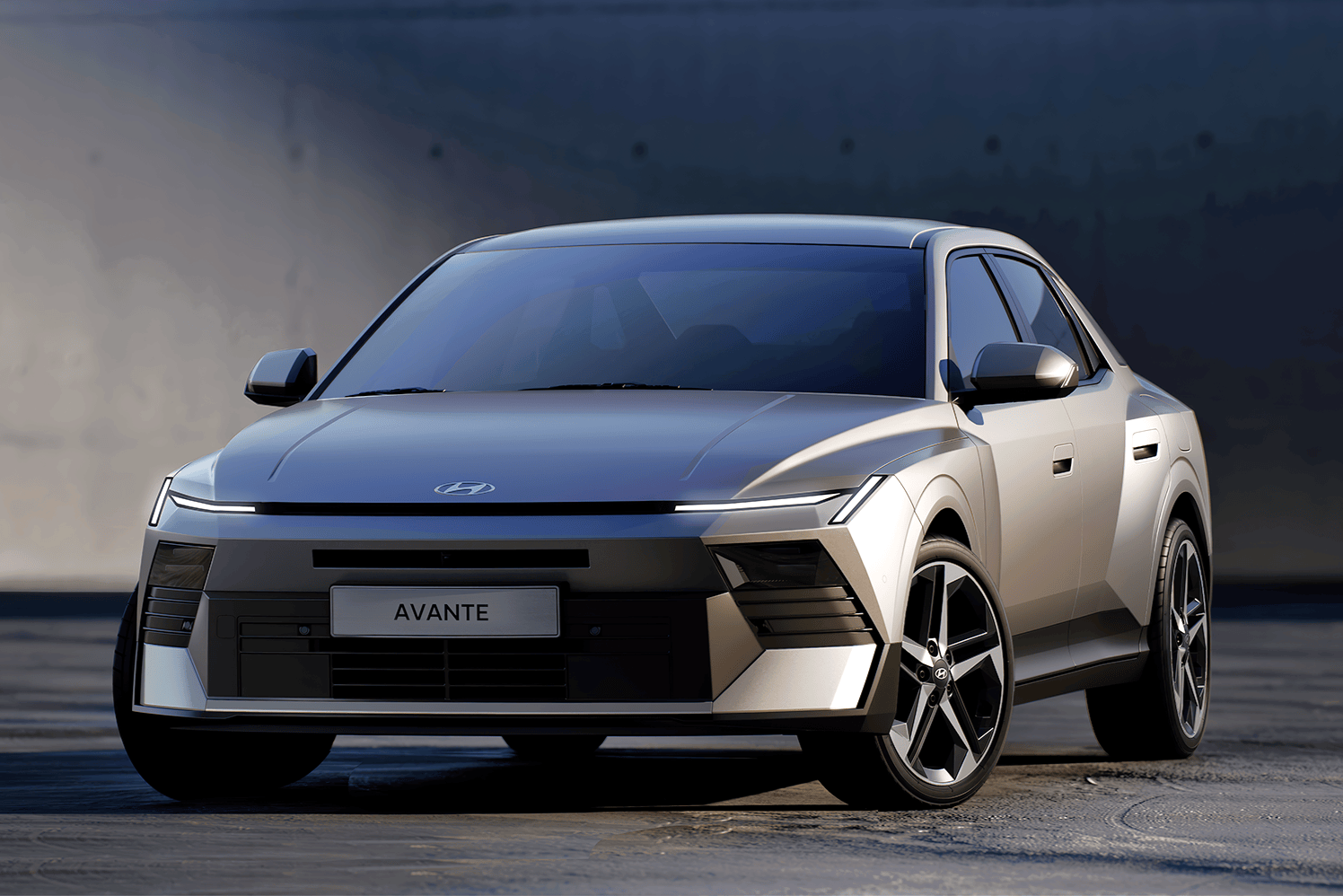
Hyundai has unveiled the eighth-gen Elantra sedan, which packs major styling changes, more tech, and mechanical upgrades. The eighth-gen Elantra adopts Hyundai’s Art of Steel styling approach, which looks like an evolved form of the design language used for the Sonata and Verna. Measuring 4,765mm in length, 1,855mm in width, 1,425mm in height, and 2,750mm in wheelbase, the new Elantra is also 55mm longer and 30mm wider than its predecessor. Inside, the new Elantra gets a massive 14.6-inch infotainment touchscreen running Hyundai’s new Pleos Connect infotainment interface, as well as a slim digital driver’s display, new three-spoke steering wheel, lots of physical controls, ambient lighting, and more. Under the hood, it carries forward the same 2.0-litre naturally aspirated petrol and 1.6-litre hybrid powertrains, but the latter sees changes like a 13hp bump and optimisations for the gearbox, drive motor, and battery.
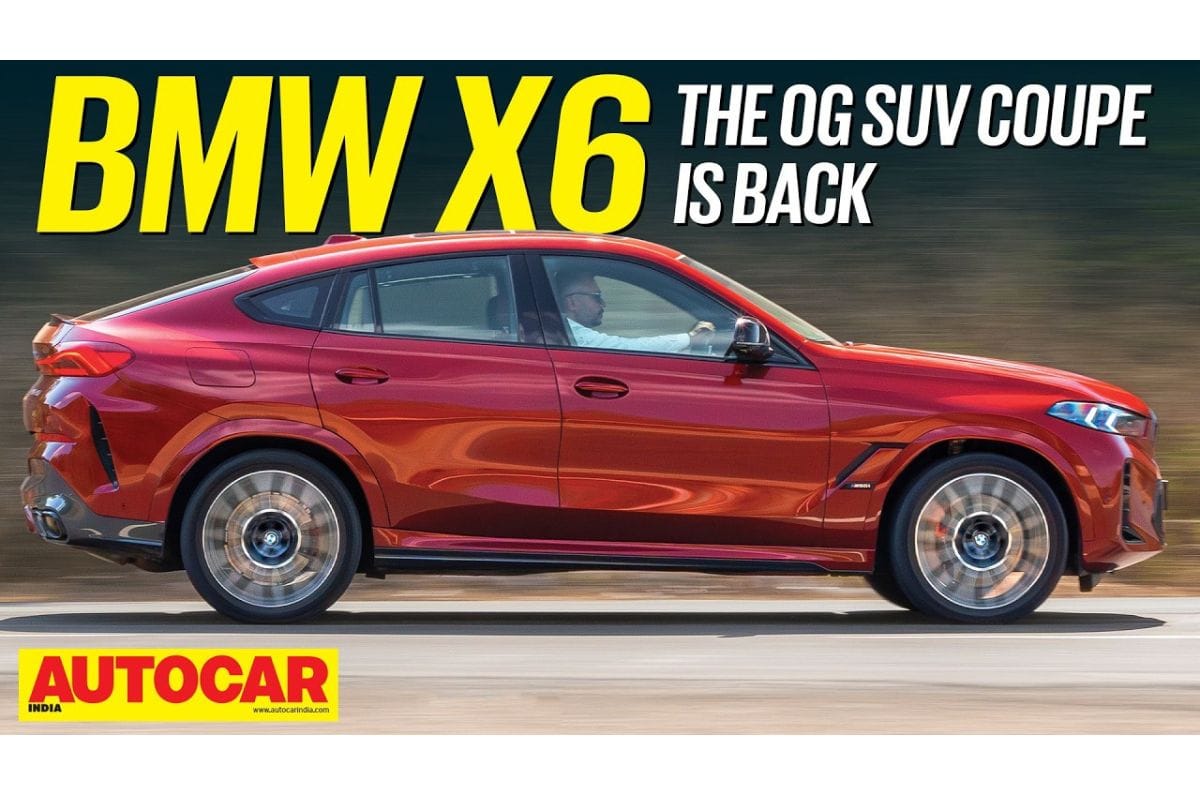
After a brief hiatus, the BMW X6 is back on sale in India, but this time with a stonking great V8. The pioneer of the coupe-SUV format takes on the Mercedes-AMG GLE 53 Coupe, the newly launched Audi SQ8 and the Porsche Cayenne GTS Coupe. Where does it fit in this elite company? We find out.
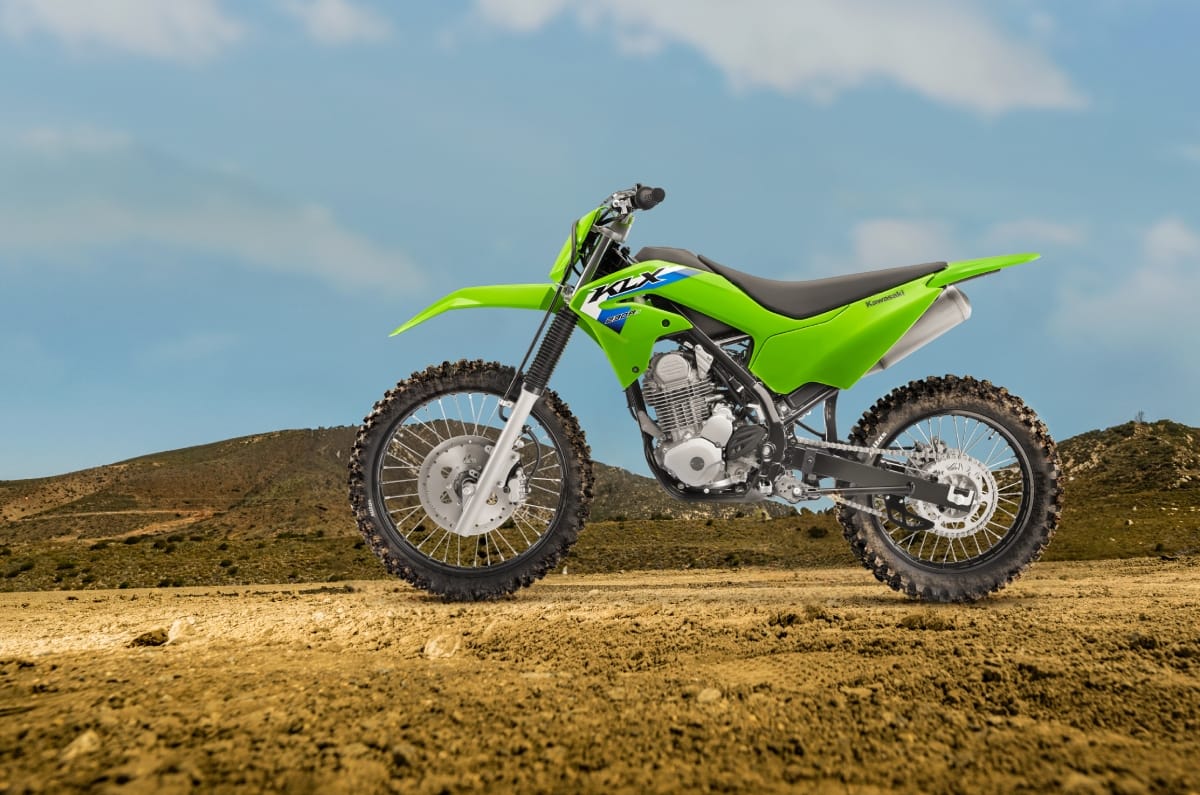
The Kawasaki KLX230R S is a dedicated off-road motorcycle (not road-legal) built around the same 233cc air-cooled, fuel-injected single-cylinder engine shared across the KLX230 range, producing 19hp at 7,800rpm and 19.1Nm at 6,200rpm, paired with a 6-speed gearbox. At 129kg, it is the lightest of the three KLX230 models and gets the most committed off-road setup – a 37mm telescopic front fork with 220mm of wheel travel and a rear monoshock with adjustable preload and 223mm of travel. Seat height is 900mm, and the bike runs on 21-inch front and 18-inch rear knobby tyres suited to trail use.
Design cues are drawn from Kawasaki’s championship-winning KX motocross series, with a flat seat profile for unrestricted rider movement, a race-style number plate, minimalist bodywork with flush seams between panels, and an electric starter as standard. Unlike the road-legal KLX230 and KLX230 S, the R S does not get a headlamp, road-going instrumentation or ABS – it is built purely for off-road use on private trails, motocross tracks and riding schools.
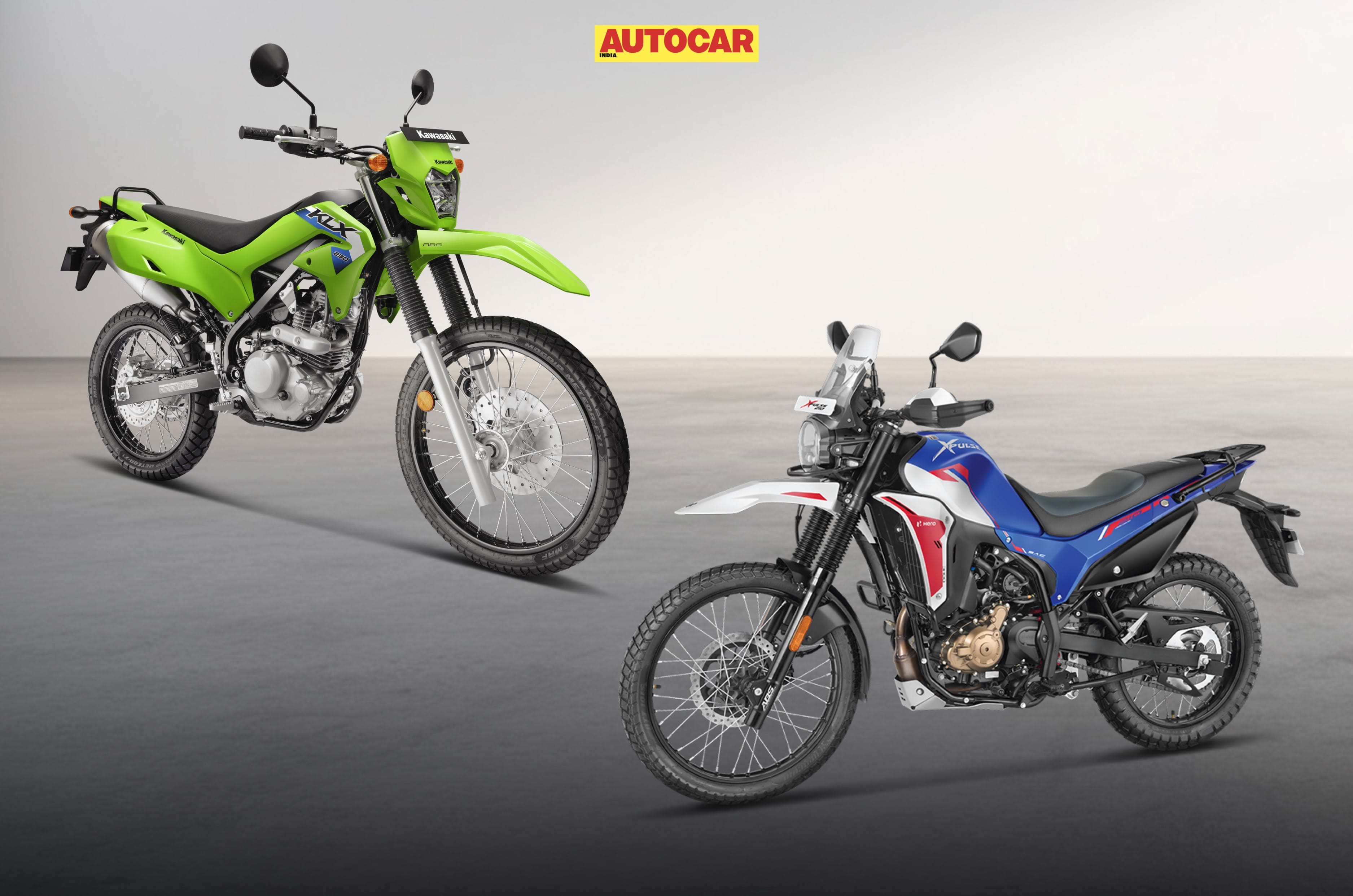
Kawasaki has launched a more road-focused model of its KLX230 with an ‘S’ suffix. The KLX230 S comes with a lower seat height and reduced suspension travel, making it ideal for riders that are intimidated by the tall seat-height of the regular KLX230. Here we pit it against the HeroXpulse 210, to see how it fairs on paper.
Kawasaki KLX230 S vs Hero Xpulse 210: Engine and output
Kawasaki KLX230 S
Hero Xpulse 210
Engine
233cc, single-cylinder, air-cooled
210cc, single-cylinder, liquid-cooled
Power
19hp at 7,800rpm
24.6hp at 9,250rpm
Torque
19Nm at 6,200rpm
20.7Nm at 7,250rpm
Gearbox
6-speed
6-speed
Power-to-weight ratio
136.6hp/tonne
144.7hp/tonne (Top) / 146.4hp/tonne (Base)
The Xpulse 210 boasts a better power-to-weight ratio
Despite its larger 233cc displacement, the KLX230 S trails the Xpulse 210 in outright performance. The Hero produces 5.6hp and 1.7Nm more while also boasting a better power-to-weight ratio. The Kawasaki, however, develops its peak power and torque lower down the rev range, suggesting it should feel more relaxed at lower engine speeds.
Kawasaki KLX230 S vs Hero Xpulse 210: Weight and dimensions
Kawasaki KLX230 S
Hero Xpulse 210
Kerb weight
139kg
170kg (168kg Base variant)
Seat height
830mm
830mm
Ground clearance
220mm
220mm
Fuel tank capacity
7.5 litres
13-litres
Wheelbase
1350mm
1446mm
The KLX230 S is 31kg lighter than the Xpulse 210
The KLX230 S’ biggest advantage is its kerb weight. At 139kg, it’s a substantial 31kg lighter than the Xpulse 210, which should make it easier to handle on technical trails and at lower speeds. Both motorcycles have the same 830mm seat height and 220mm ground clearance, but the Hero counters with a much larger 13-litre fuel tank and a longer wheelbase that could lend it greater stability. As opposed to the standard KLX230’s 890mm seat height and 255mm ground-clearance, the KLX230 S gets a more accessible seat height.
Kawasaki KLX230 S vs Hero Xpulse 210: Tyres, brakes and suspension
Kawasaki KLX230 S
Hero Xpulse 210
Tyres
2.75-21 45P /
4.10-18 59P
90/90 – 21 / 120/80 – 18
Suspension
Telescopic fork / monoshock
Telescopic fork / monoshock
Brakes
290mm disc / 230mm disc
276mm disc / 220mm disc
Both motorcycles come with the same off-road biased 21/18-inch setup
On paper, both motorcycles employ a conventional telescopic fork and monoshock setup and ride on a 21-/18-inch wheel combination. The Kawasaki uses slightly larger brake discs at both ends, while the Hero features wider tyres, particularly at the front, although the two use different tyre sizing conventions.
Kawasaki KLX230 S vs Hero Xpulse 210: Features
The Xpulse gets a TFT dash on its top-variant
Here the KLX230 S falls short of offering creature comforts like a TFT dash and Bluetooth connectivity that the Xpulse 210 gets. However, both motorcycles cover the essentials such as LED headlights and dual-channel ABS. Sticking to their off-road intent, both motorcycles get a tubed tyre setup with a 21-inch/18-inch (F/R).
Kawasaki KLX230 S vs Hero Xpulse 210: Price
Kawasaki KLX230 S
Hero Xpulse 210
Price
Rs 2.19 lakh (ex-showroom, India)
Rs 1.67 lakh – Rs 1.76 lakh (ex-showroom, Delhi)
At Rs 2.19 lakh (ex-showroom), the KLX230 S costs around Rs 43,000 more than the top-spec Xpulse 210. That premium buys you a significantly lighter motorcycle, but on paper the Hero offers stronger performance and a much larger fuel tank for considerably less money. It is also worth bearing in mind that the Kawasaki is a more premium brand whose after sales service ought to cost more
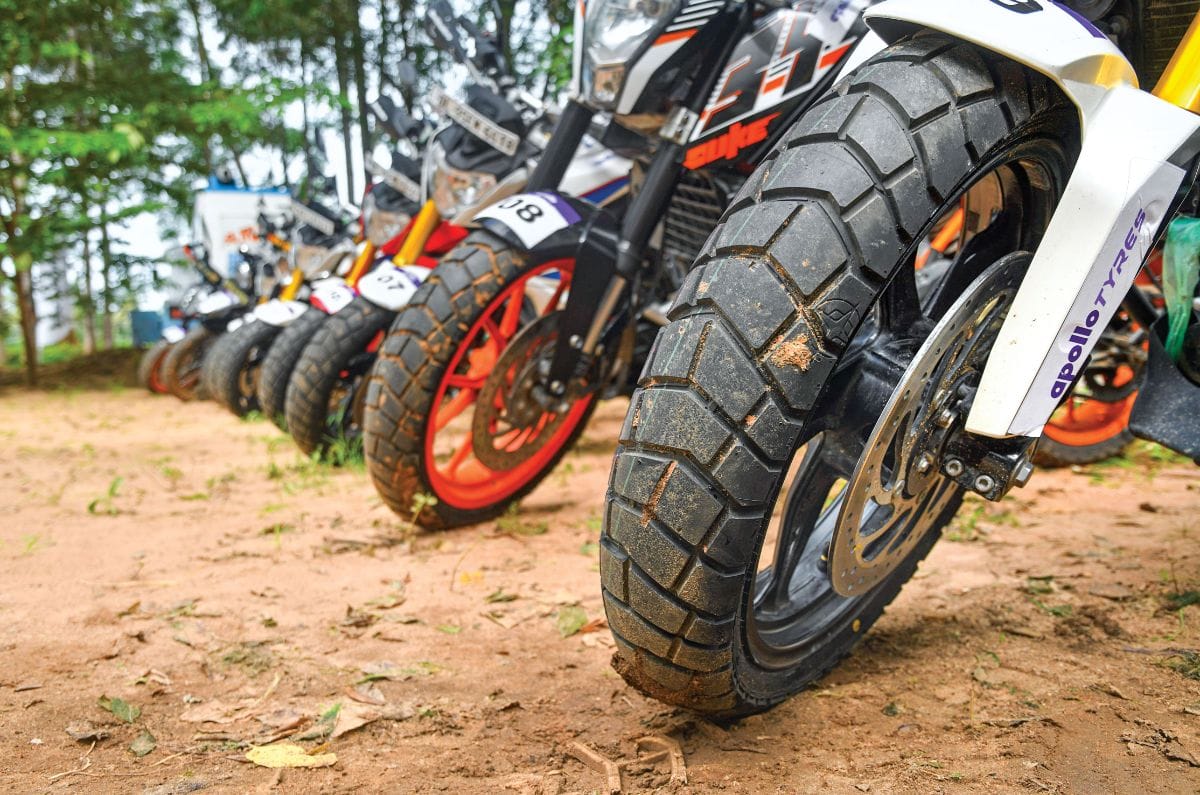
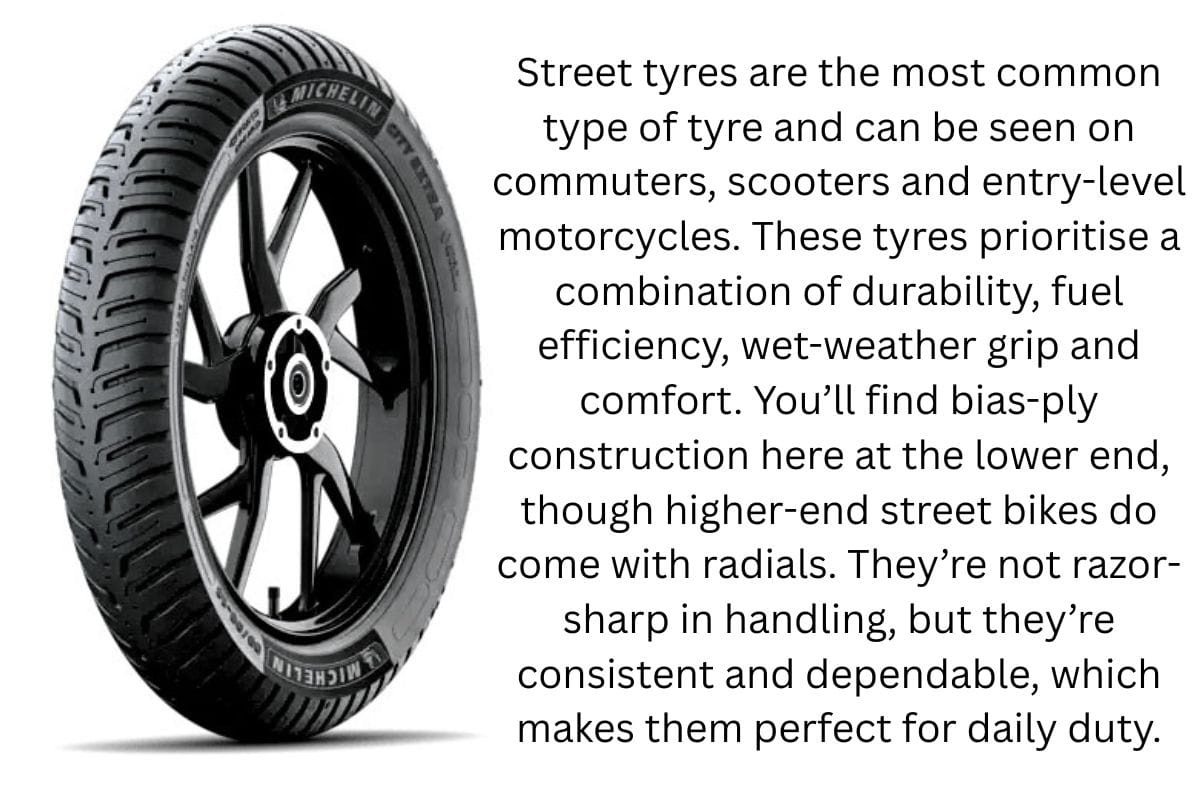
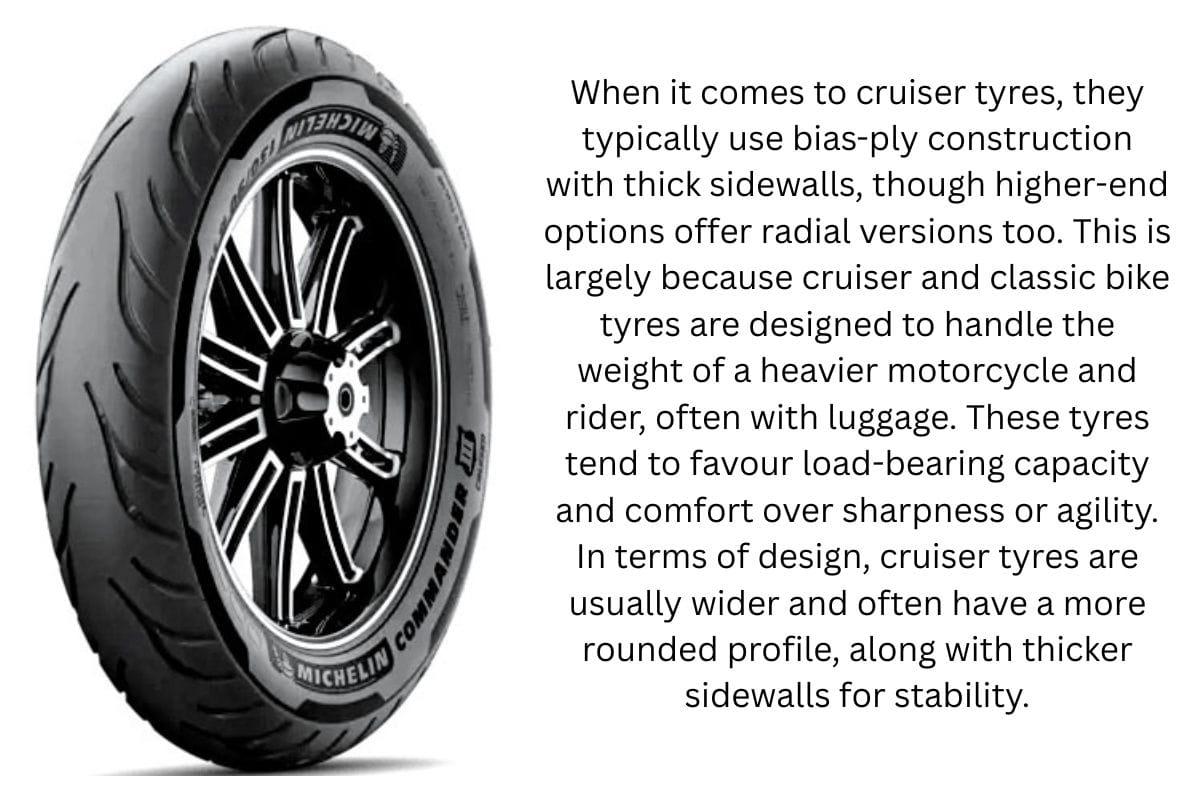
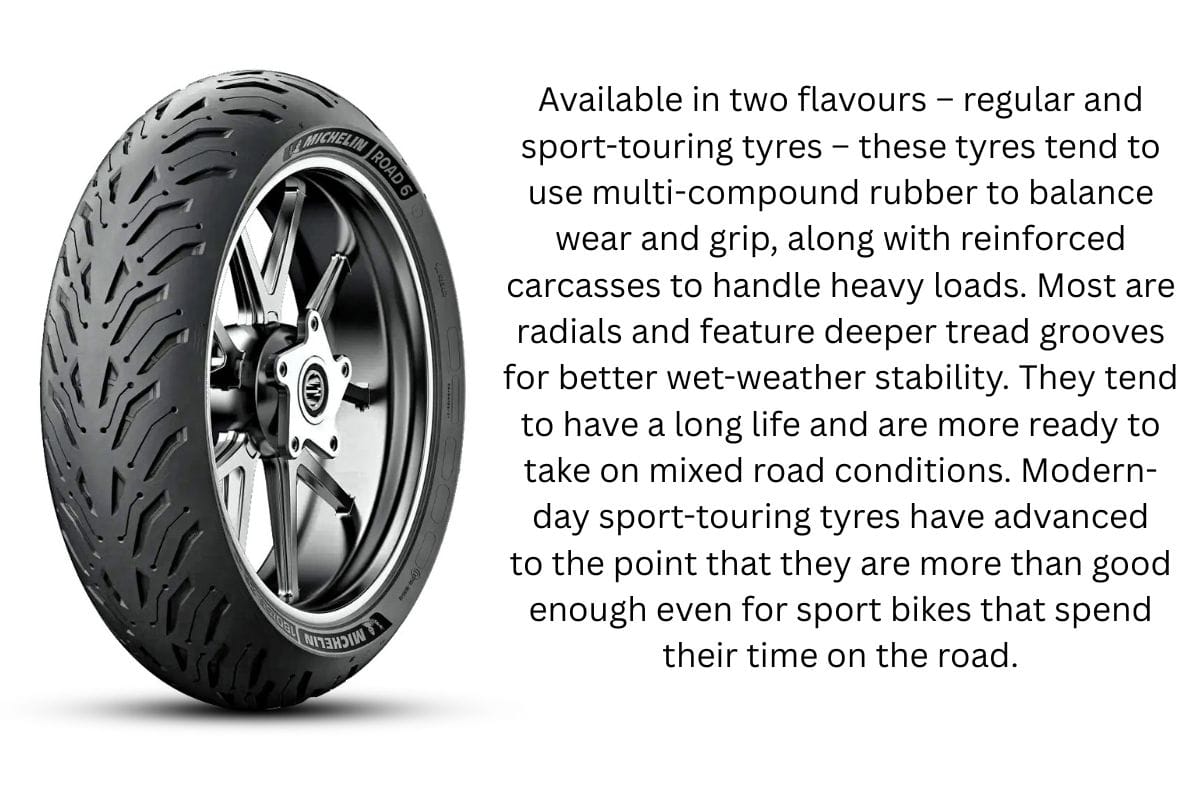
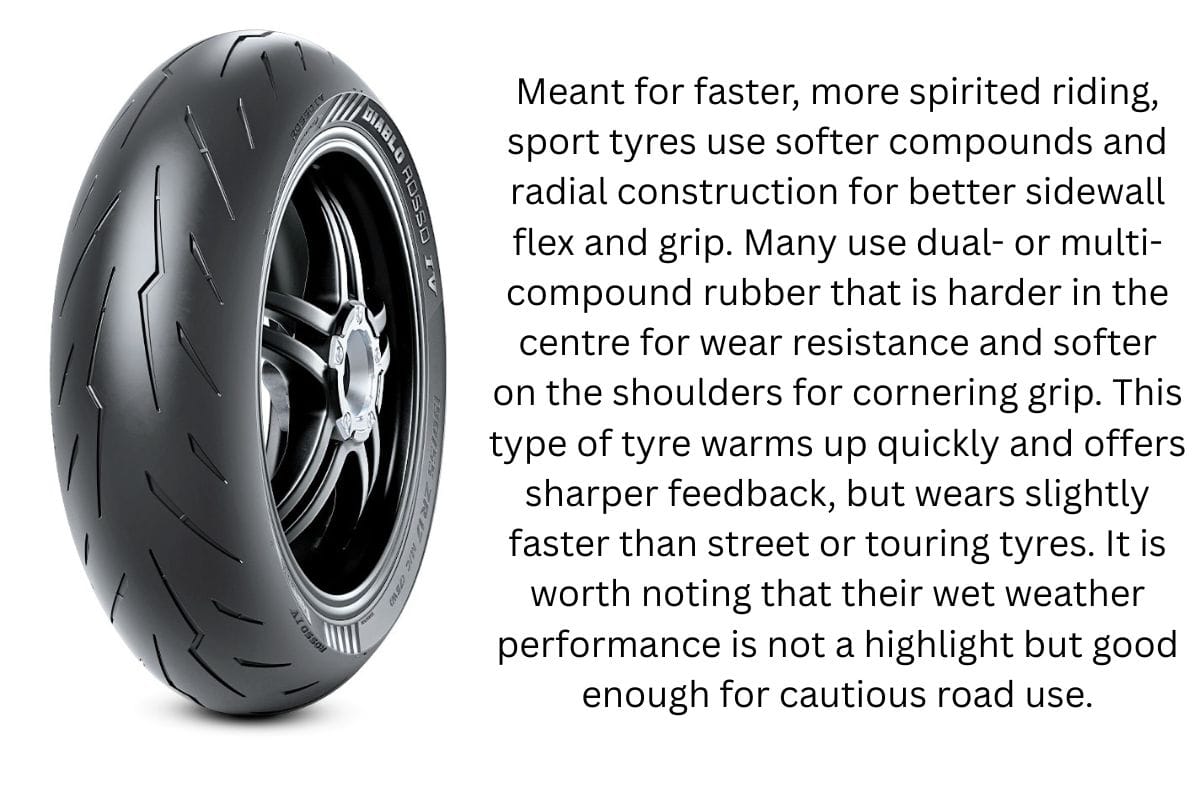
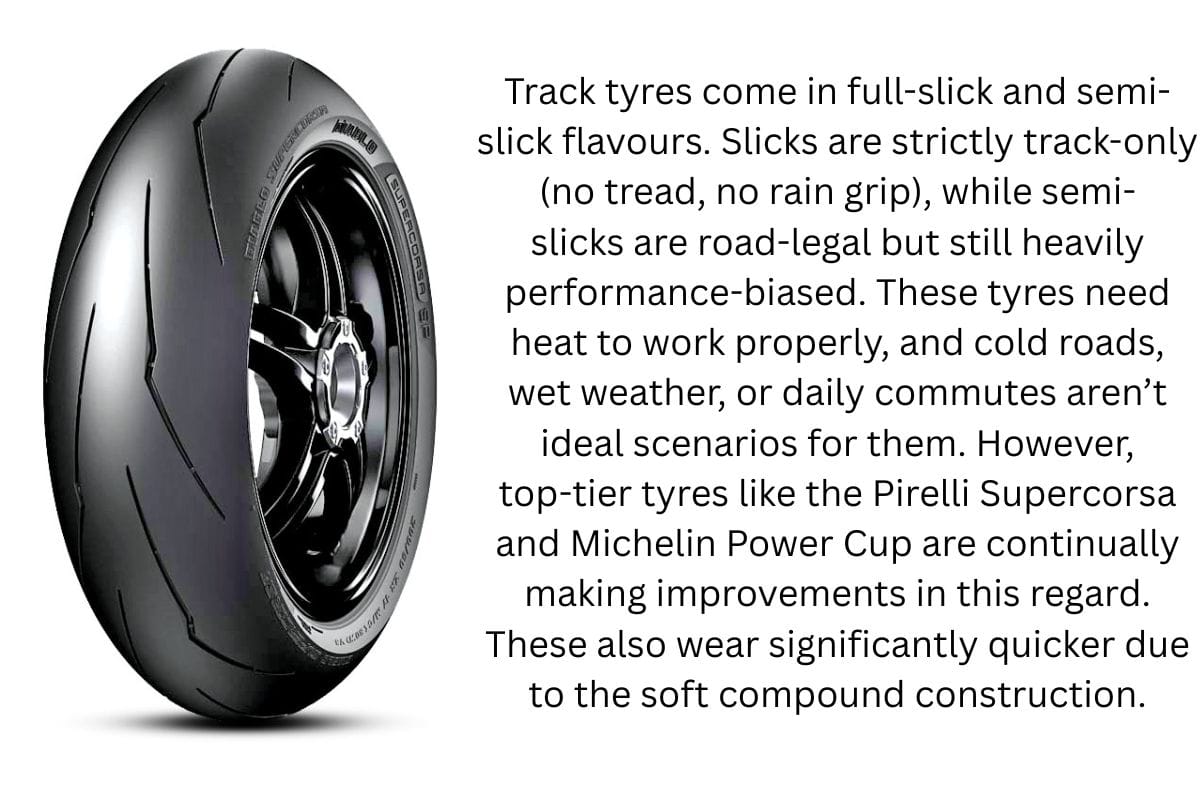
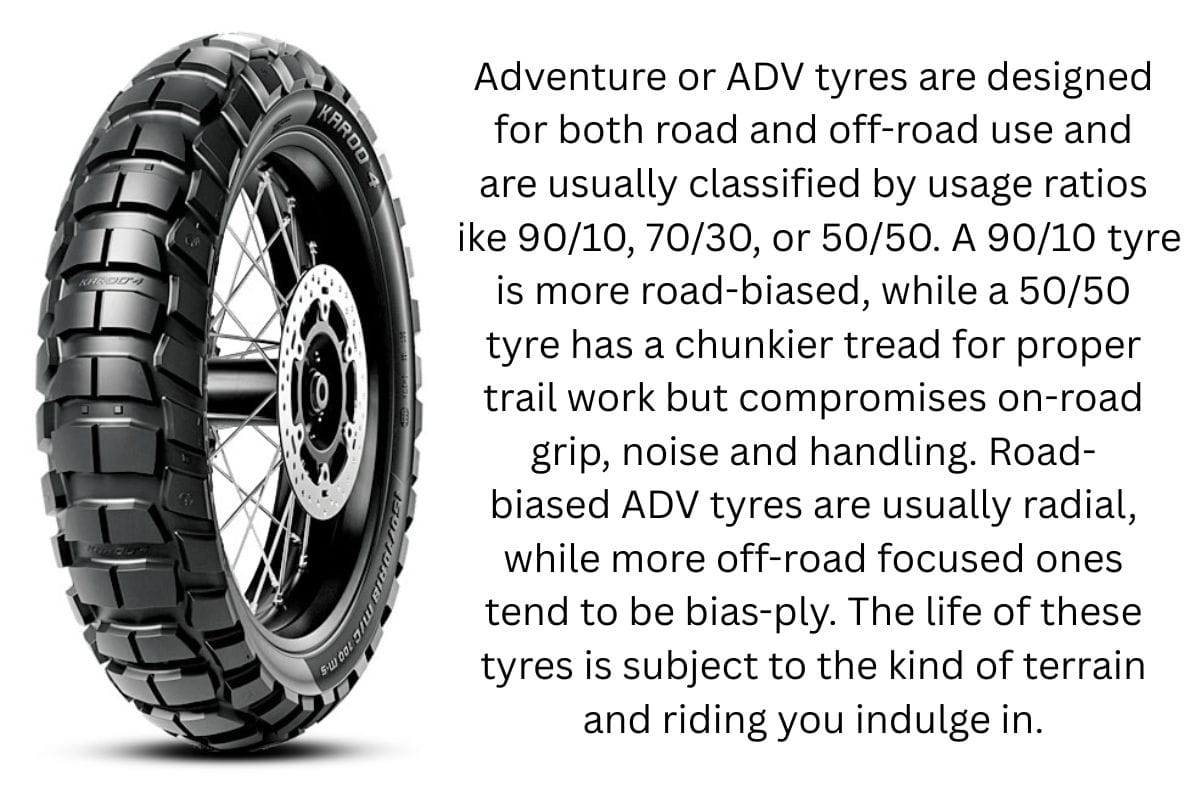
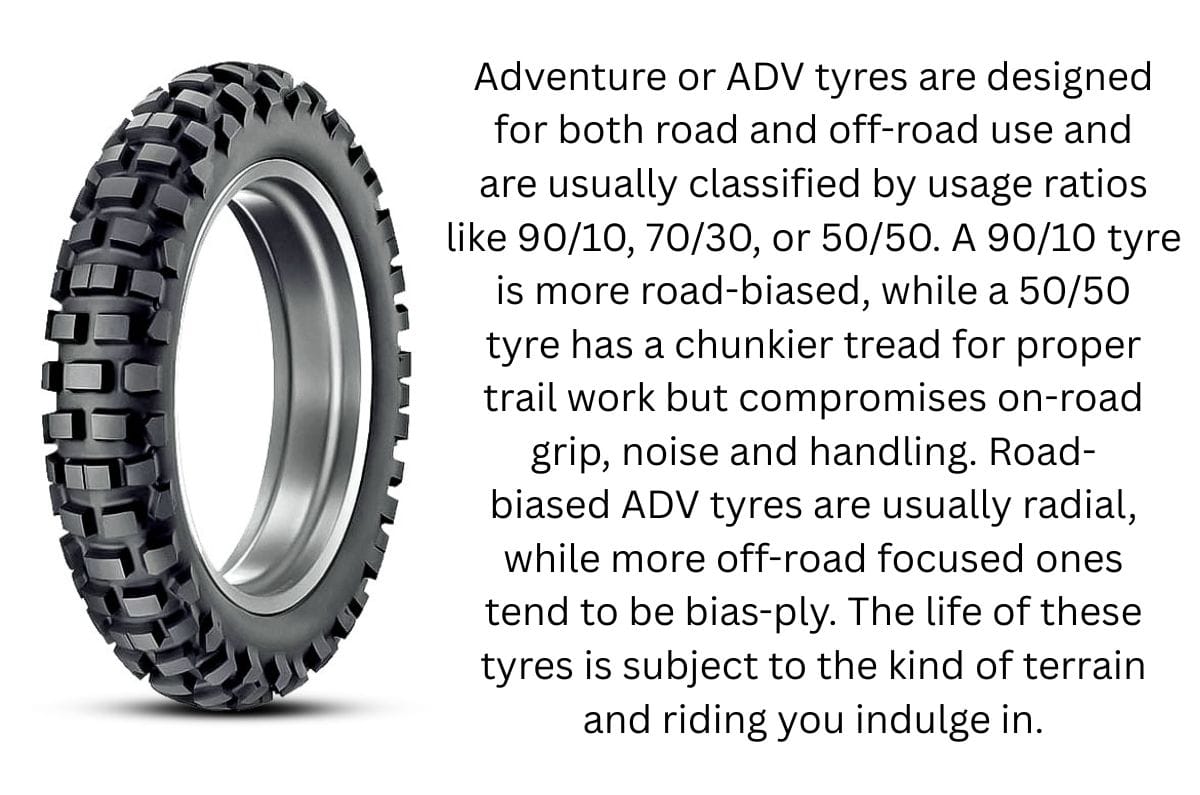
Tyres are often treated like a wear-and-forget item, but they can play a big role in how your motorcycle behaves. Get it right for the kind of motorcycle and riding style you have, and the bike feels planted, predictable and confident. Get it wrong, and you’re either feeling uncomfortable and insecure, or watching them square off in a few thousand kilometres. Here’s a simple breakdown of the different types of motorcycle tyres, how they’re built, and where each one makes the most sense.
Construction
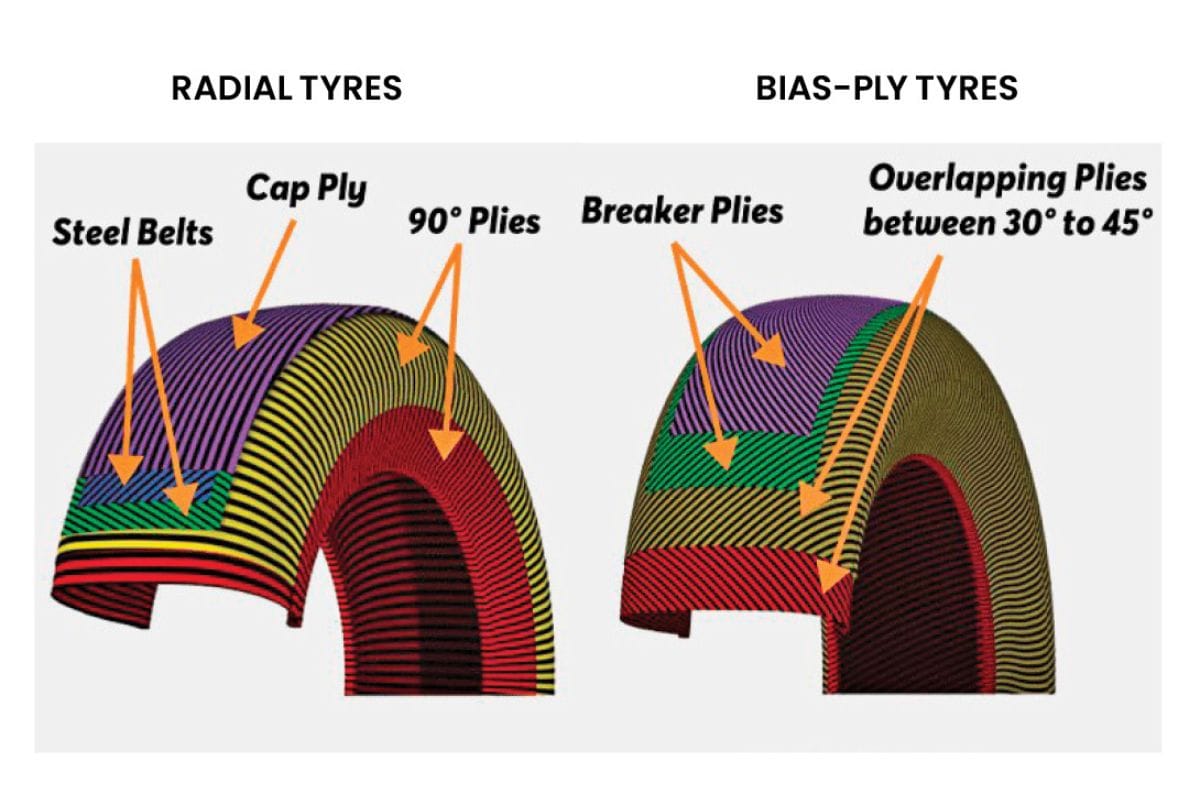
Before getting into tyre types, it helps to understand how they’re made. Tyres can be generally put into two categories – radial and bias-ply. The difference comes down to how the layers (called plies) are arranged inside the carcass. Bias-ply tyres use criss-crossing layers laid at angles, which gives the sidewall extra stiffness, and is good for load-bearing and rough roads. However, they’re not ideal for high-speed grip or flexibility.
Radial tyres have plies arranged at 90 degrees to the direction of travel, with added belts across the tread area. This allows the sidewall to flex independently of the tread, improving comfort, heat dissipation, and high-speed handling. Generally, you will find bias-ply tyres on commuters, cruisers and old motorcycles. Radials are standard on performance-oriented motorcycles, sport bikes, tourers and some ADVs. Now that you understand the two foundational differences in construction, let us dive into the different types of tyres. Remember, picking the right tyre is more about how and where you ride than what your bike originally came with. A tyre that excels at a 100km commute won’t feel right on a racetrack, and something that grips brilliantly in dirt might be borderline terrifying on the tarmac, especially in the rain. There’s no single “best tyre” out there to do it all, but if you know what you’re asking of your motorcycle, the right one becomes pretty easy to spot. Just don’t treat tyres like an afterthought, because they’re doing more than you think.
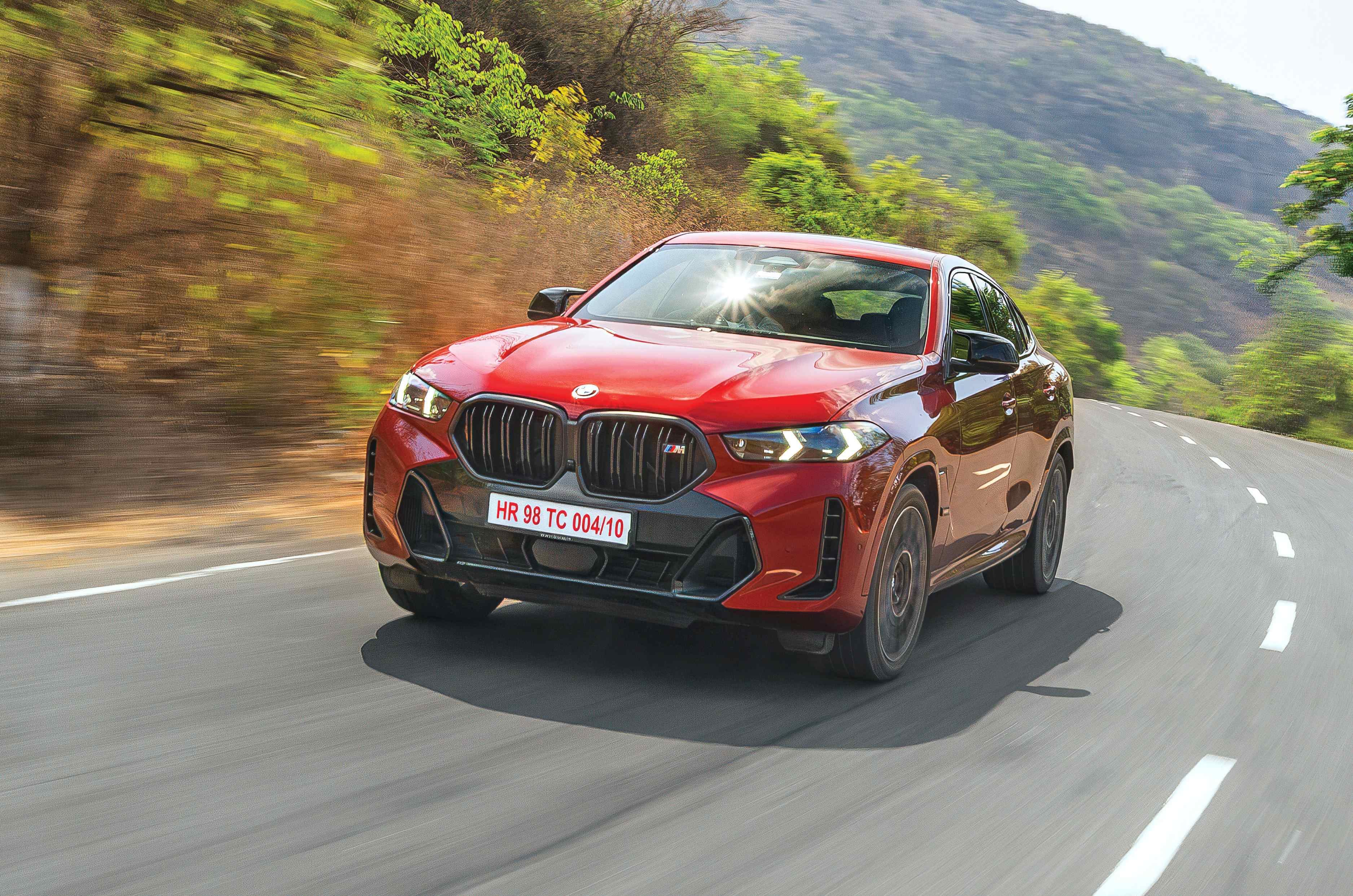
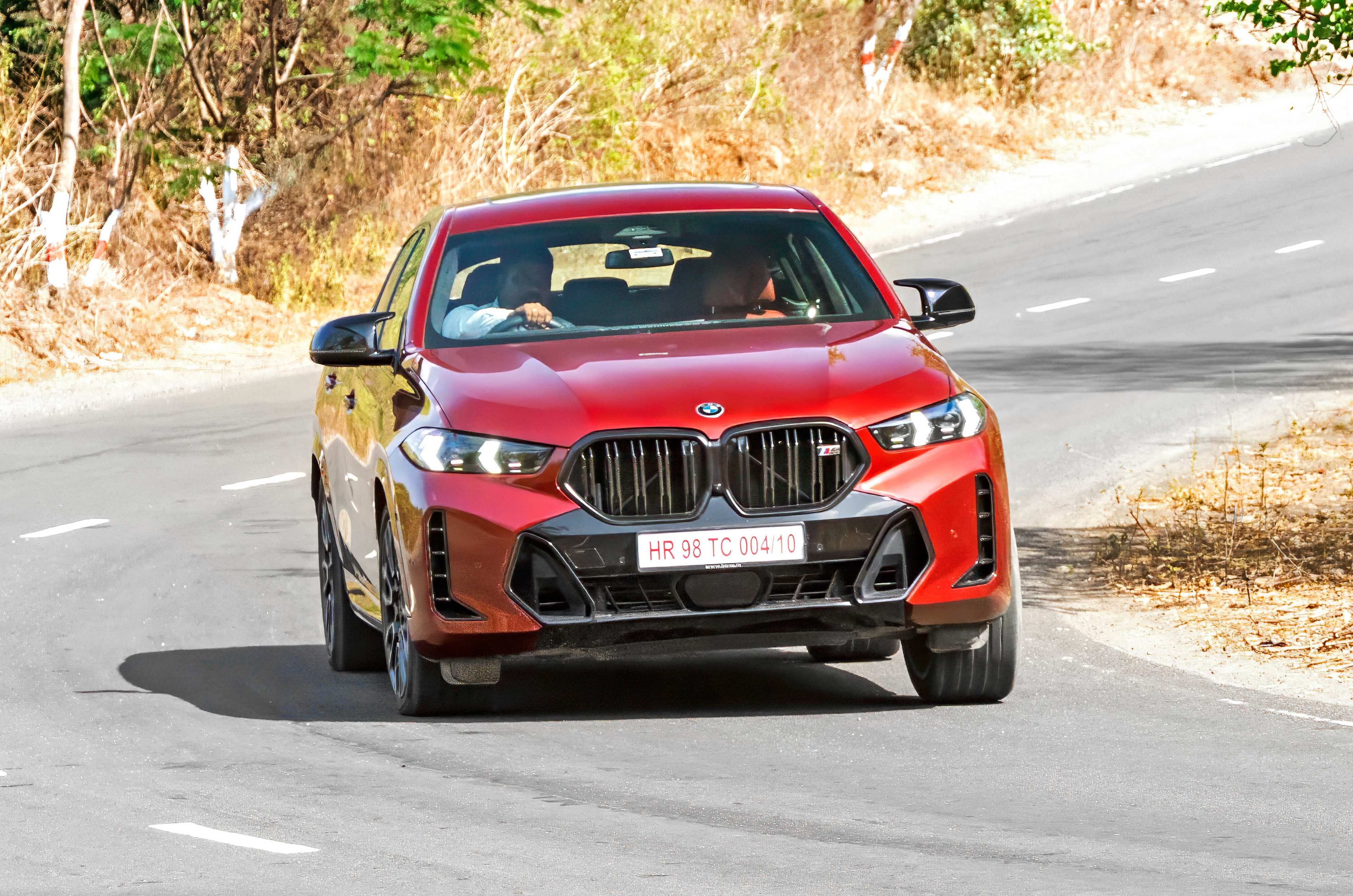
After a brief hiatus, the BMW X6 is back on our shores, but this time it’s packing a lot more firepower. You see, when it was last on sale in 2023, the X6 carried the B58 twin-turbo inline-six engine – a fabulous motor in its own right and one we adore in the M340i.
But in something the size and weight of the X6, you’d want something more potent, and that’s what we have here – the V8-powered, twin-turbocharged, 4.4-litre X6 M60i. A perfect match for the brutish exterior?
BMW X6 M60i xDrive Exterior Design and Engineering – 8/10
M60i gets a more aggressive front end with larger air dams.
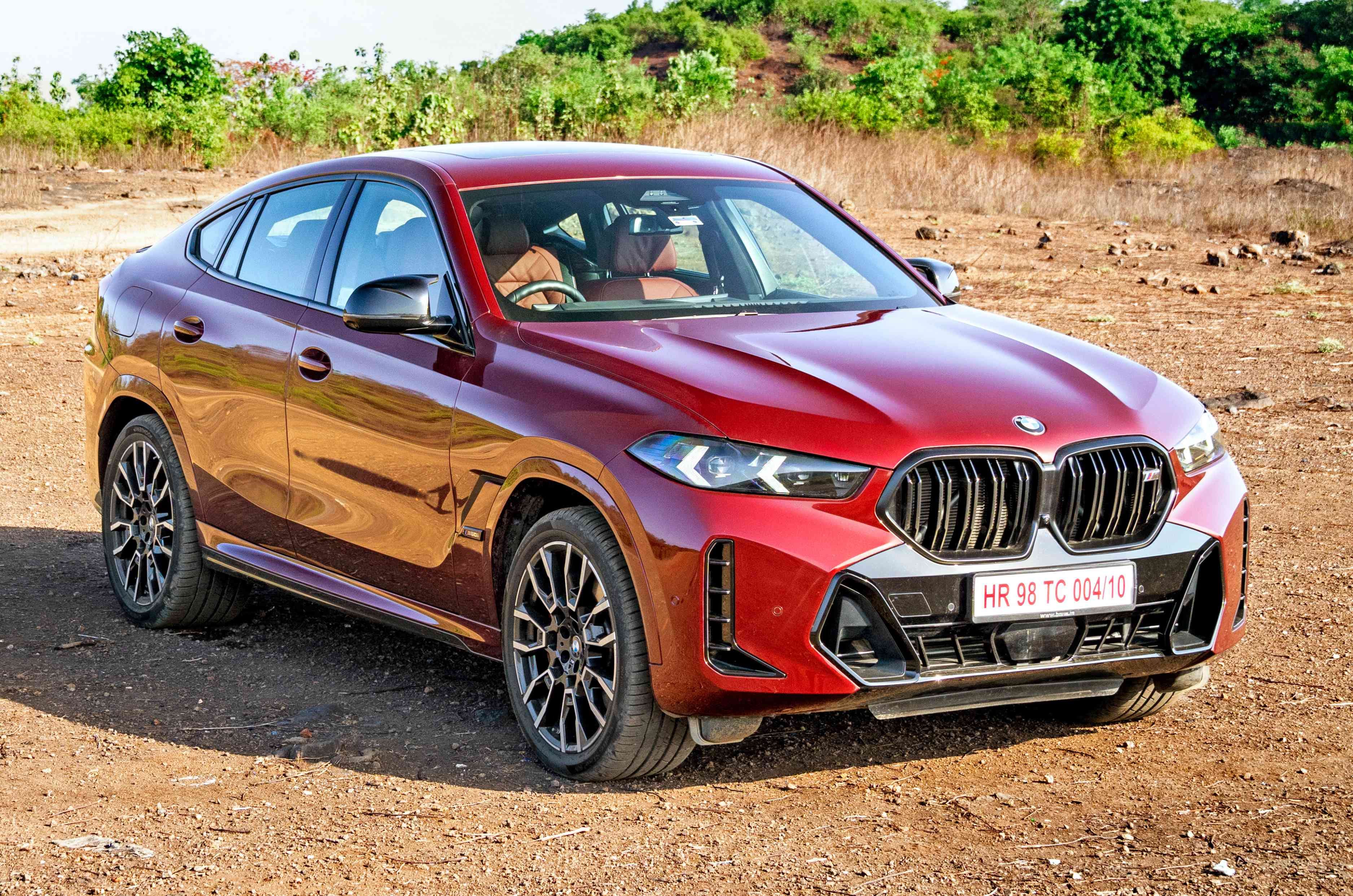
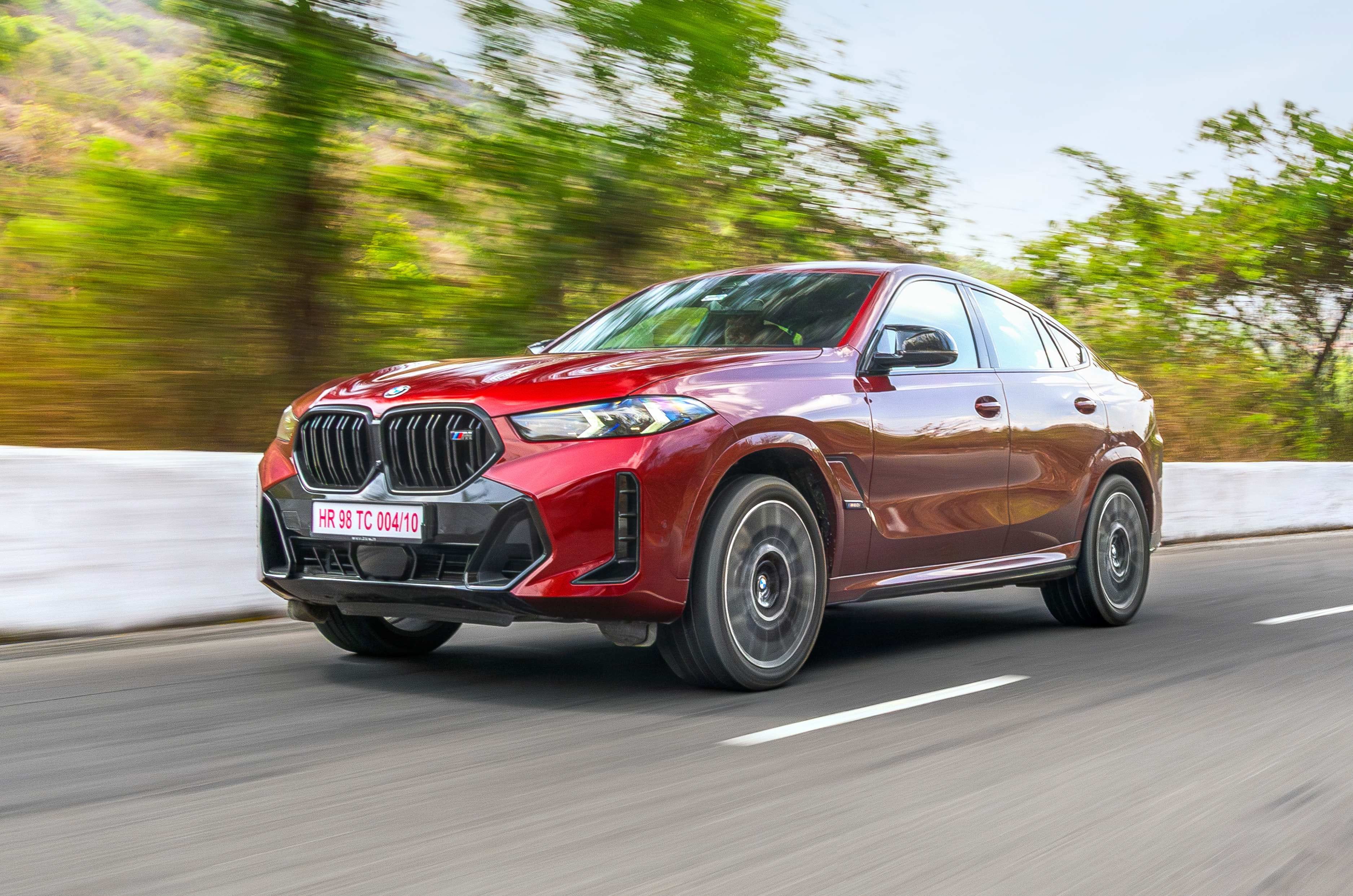
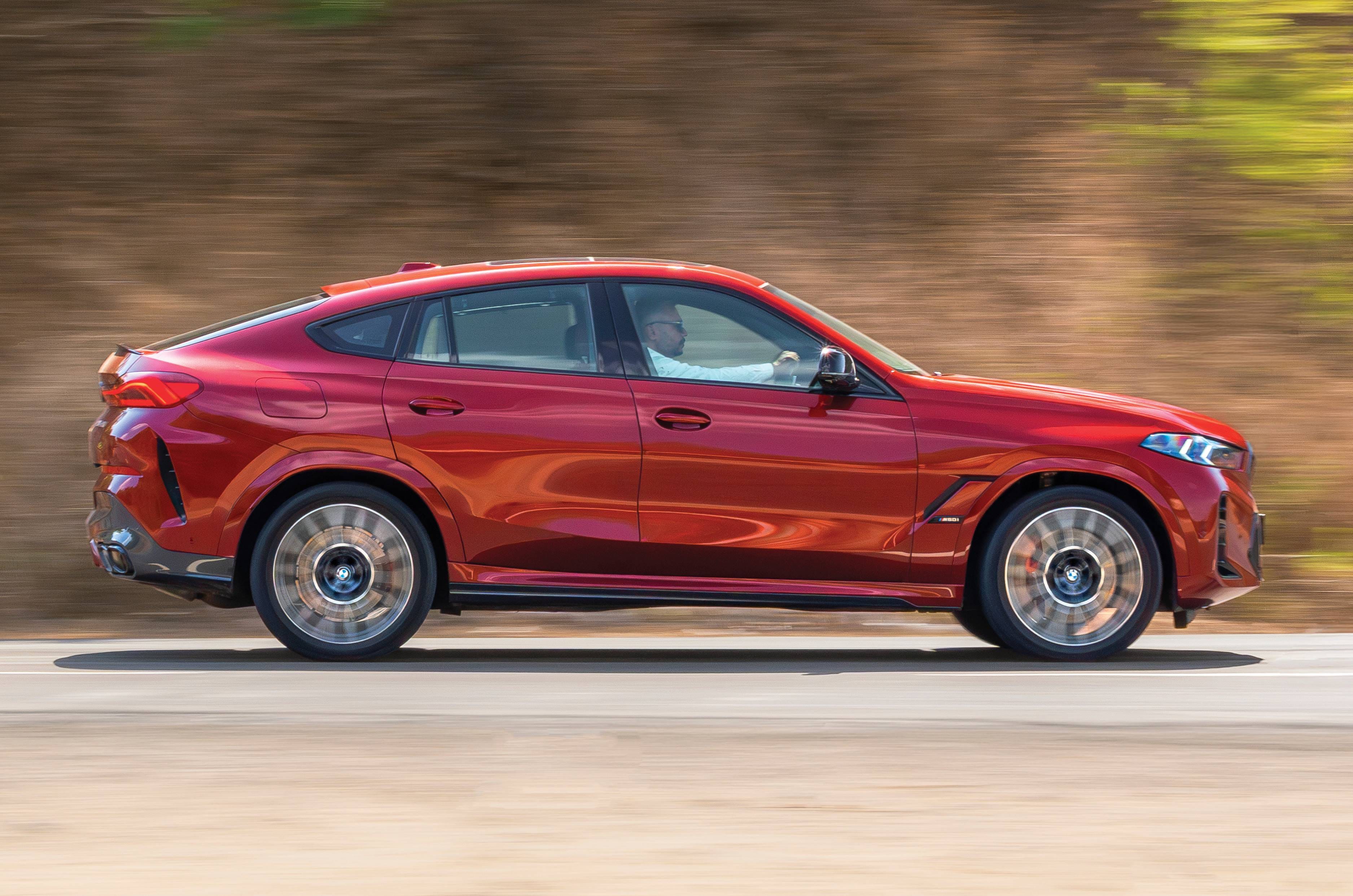
When the first-gen X6 broke cover back in 2007, BMW received a lot of flak for its awkward styling. With time, though, BMW has honed the coupé-SUV formula, and this third-gen looks rather fetching. The sloping roofline catches your attention, but it’s the muscular flanks and the sculpted bonnet that hold onto it.
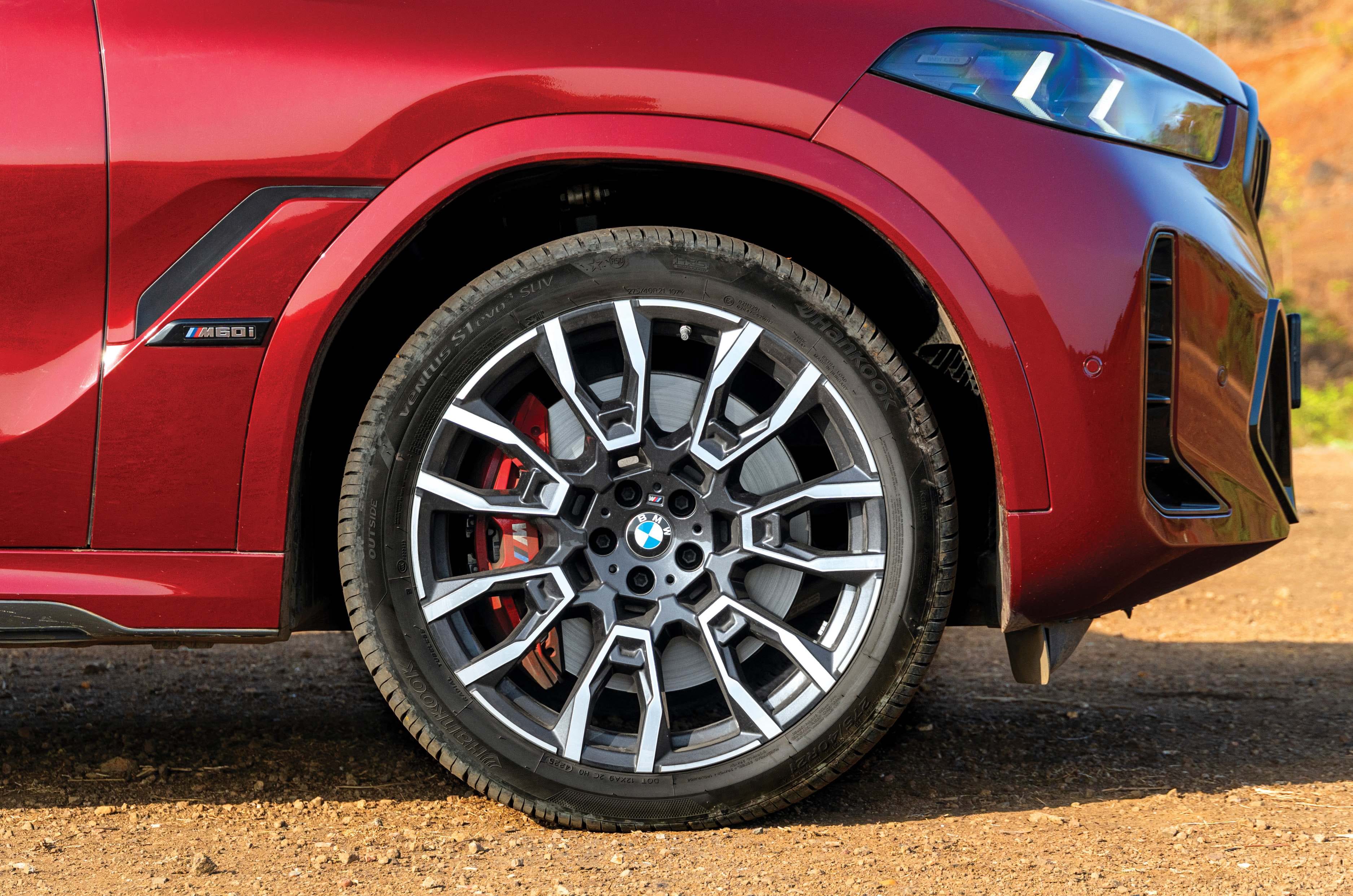
21-inch wheels hide big 4-pot M Sport brake callipers.
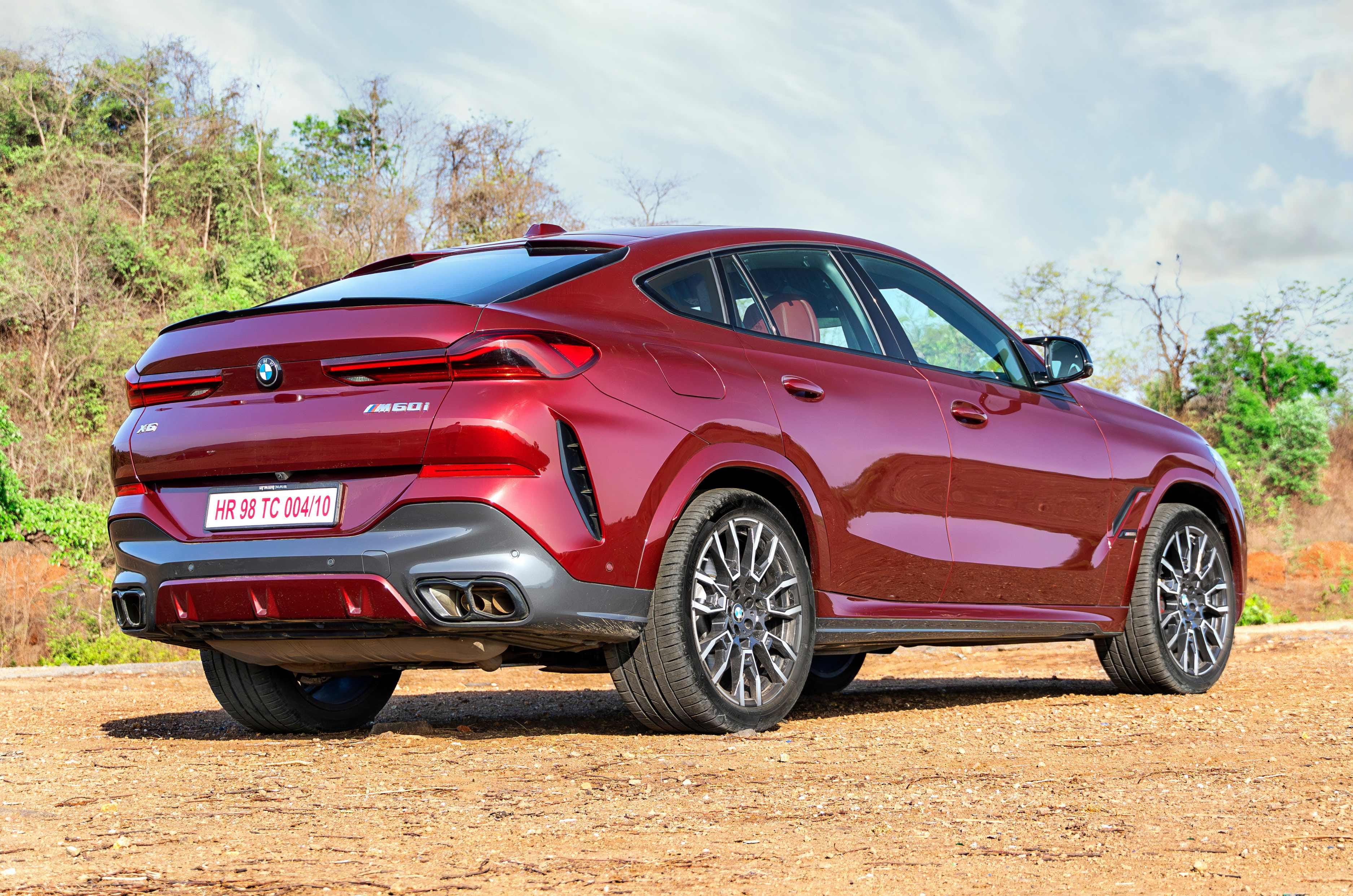
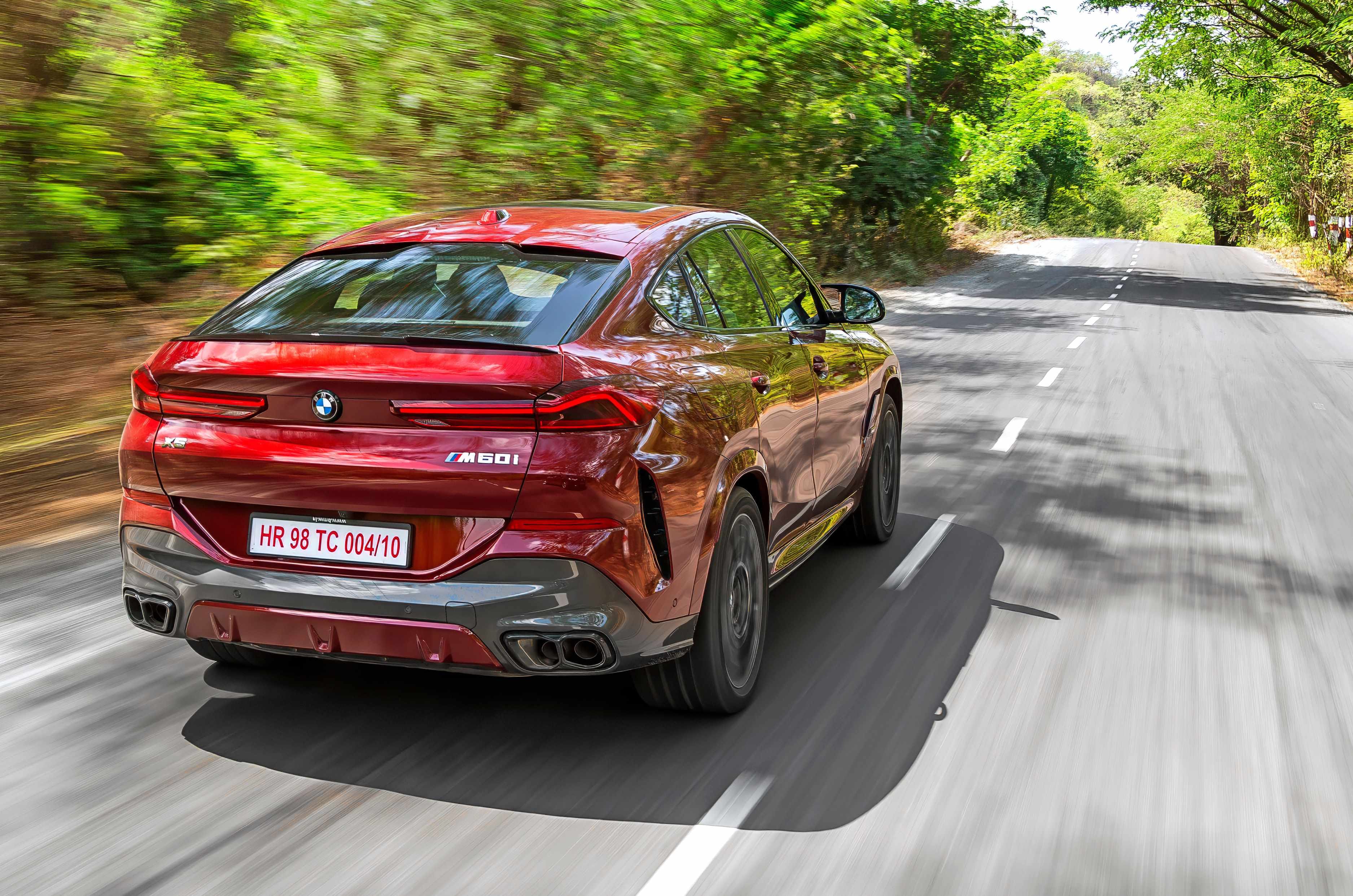
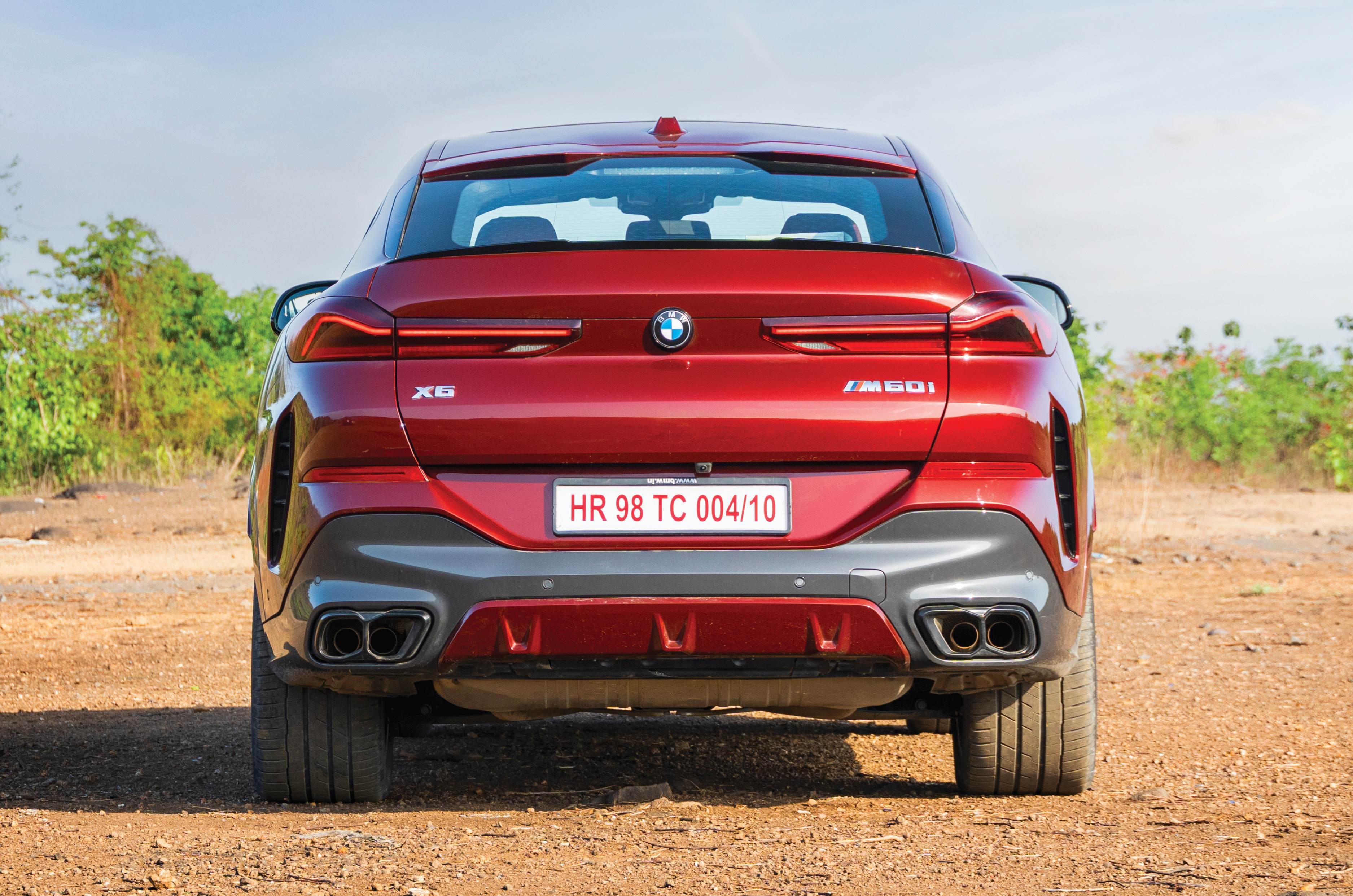
While it was away, the X6 received a minor facelift, giving it a more aggressive front end that the M60i trim builds on with larger air inlets and a gloss-black treatment for the bumper’s centre section. The M-badged kidney grilles are large but not disproportionately so, and are flanked by slimmer LED headlights with cool arrow-shaped turn indicators. Wider side skirts are part of the package, along with gloss black M wing mirrors and massive 21-inch alloy wheels. The rear sports new, more three-dimensional tail-lamps, but the real highlight is those massive exhaust finishers lower down on the bumper. They aren’t just trim pieces either – look closely, and you’ll spot quad exits hiding within.
The sloping coupe-SUV roofline sets the X6 apart from the X5 it’s based on.
What it doesn’t have is subtlety. Despite not being a full-blown M car, it has enough visual drama to satisfy ardent extroverts – particularly in one of the brighter shades, like our test car’s Aventurine Red or the Isle of Man Green. If that isn’t enough, BMW’s expansive Individual catalogue will help you find the spec of your liking.
BMW X6 M60i xDrive Interior Space and Comfort – 8/10
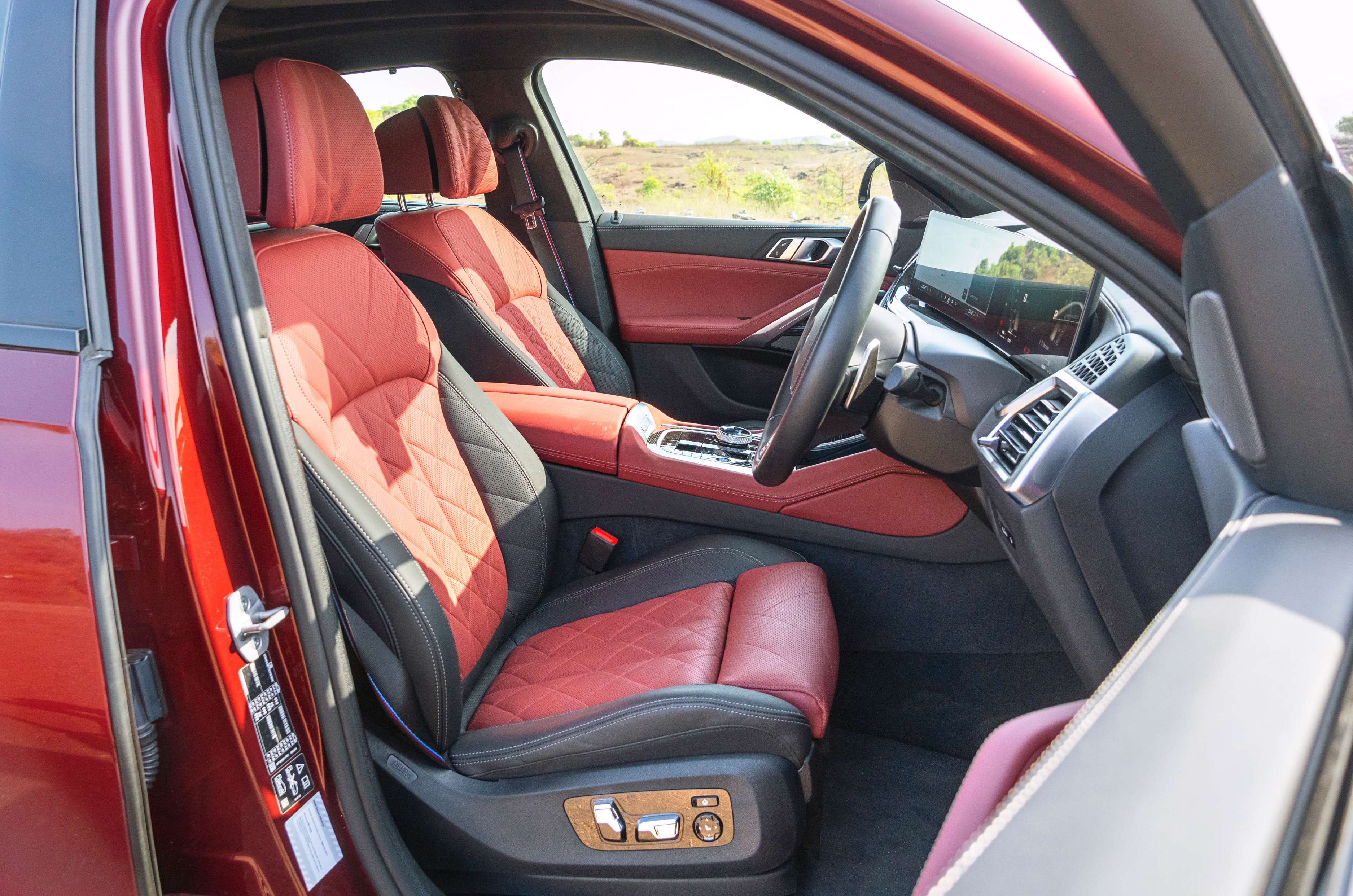
Supremely comfy front seats offer ventilation and massage functions.
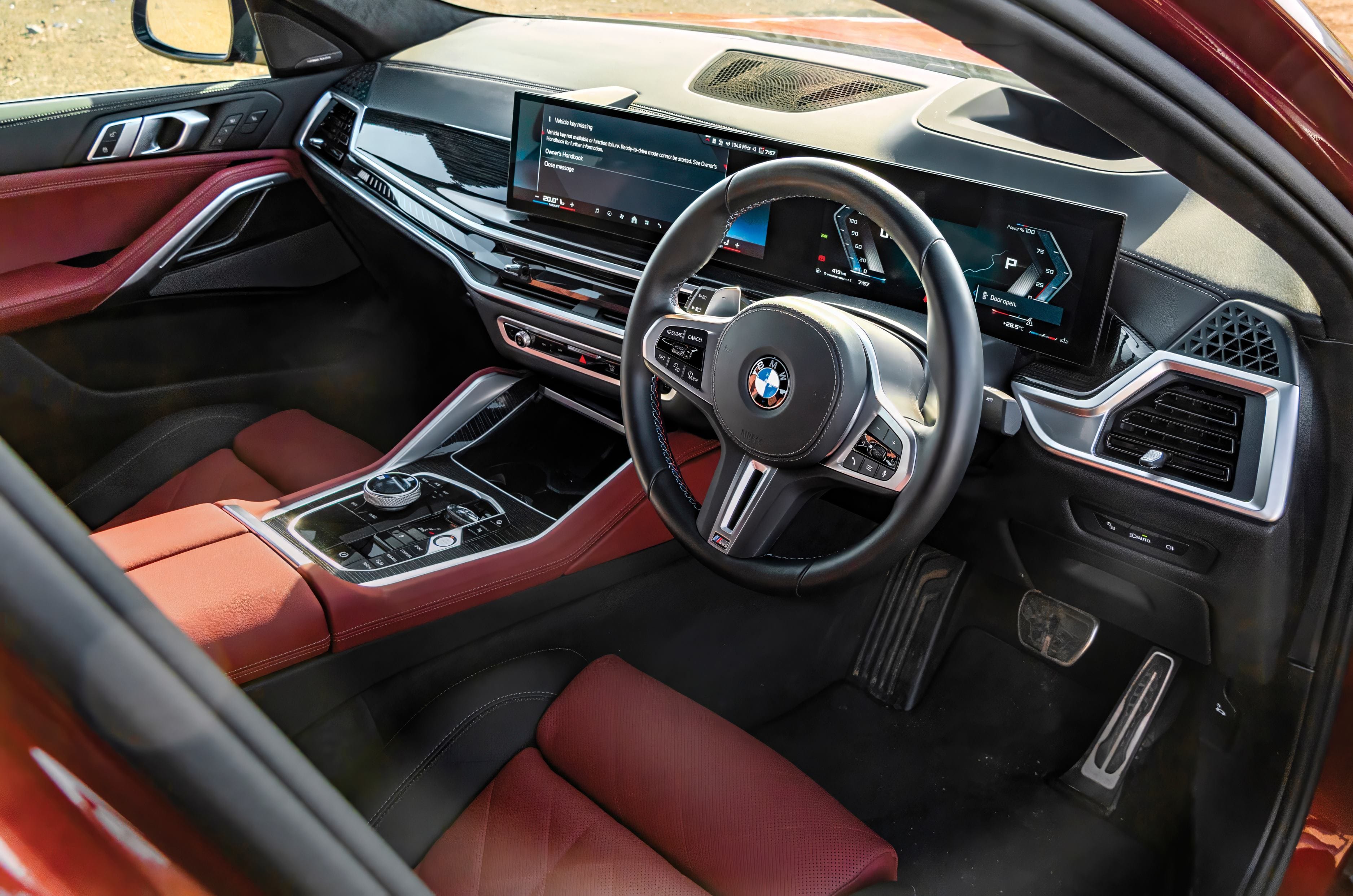
Inside, it’s the quality of the materials that really impresses. There are none of the hard plastics we complain about on some of the newer BMWs, like the 5 Series or X3. Nearly everything you see or interact with is either soft-touch plastic, flawlessly stitched leather, cool aluminium or high-gloss wood. You sit low, unlike a typical SUV, and the black, suede-like roof lining adds to that snug feeling.
The cabin is exquisitely trimmed and superbly put together.
The front seats are armchair-comfortable and yet hold you well during hard cornering. Heating and ventilation are a given, but there are also multiple massage modes that work rather well. There is also a high degree of adjustability; the top third of the seatback adjusts independently from the bottom, so shoulder support is superb, and those with long limbs will appreciate the extendable thigh support and telescopic steering column – all done electrically, of course.
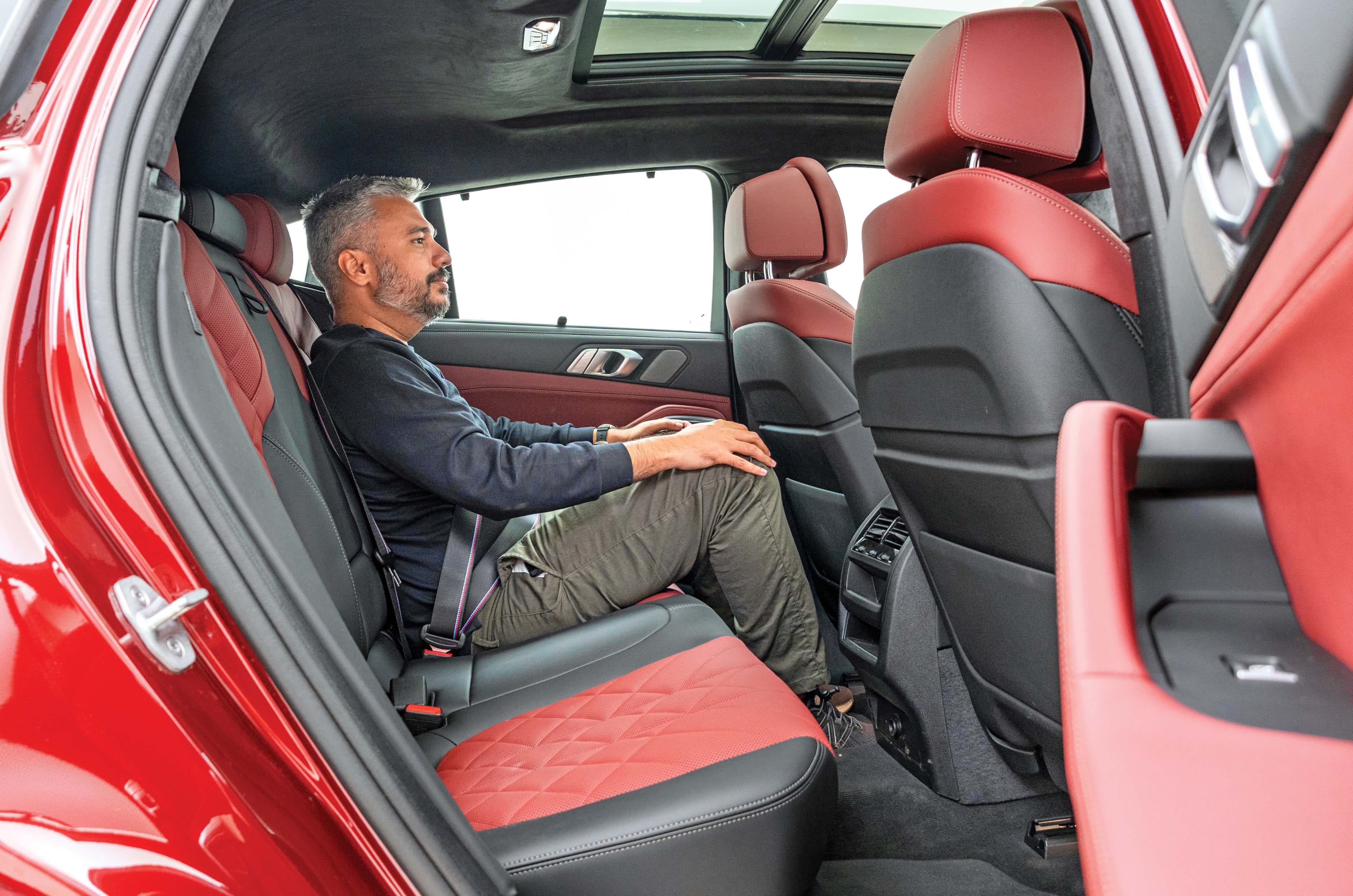
High floor means you sit knees-up, but headroom is decent.
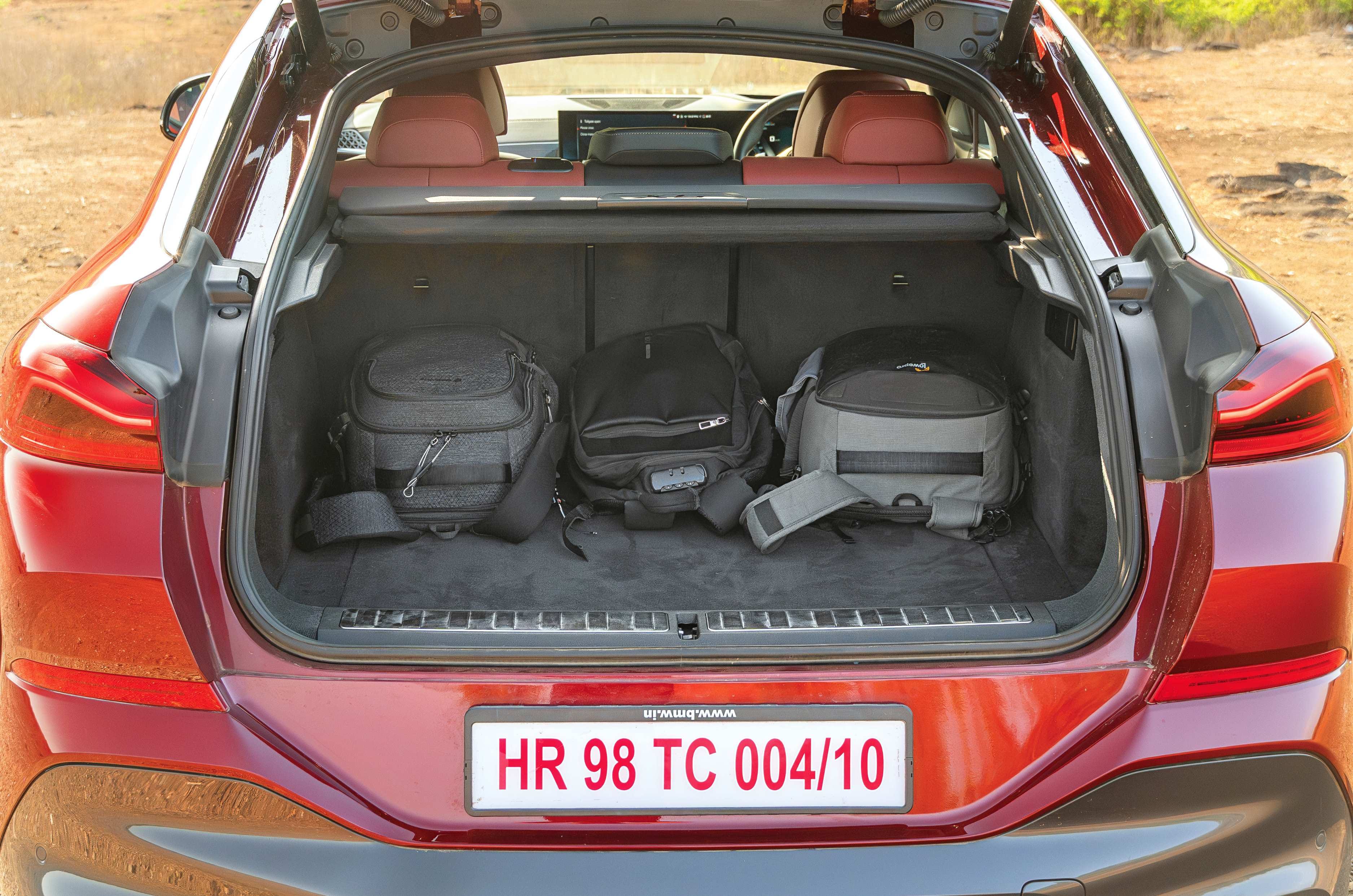
Naturally, you don’t buy an X6 for the back seat, but when you do put someone there, they may find the low seat lacks thigh support. Headroom, however, is not an issue, but the sloping roofline means you won’t be carrying any tall plants in the 580-litre boot.
The 580-litre boot is deep, but the coupe roofline restricts height.
BMW X6 M60i xDrive Features and Safety – 8/10
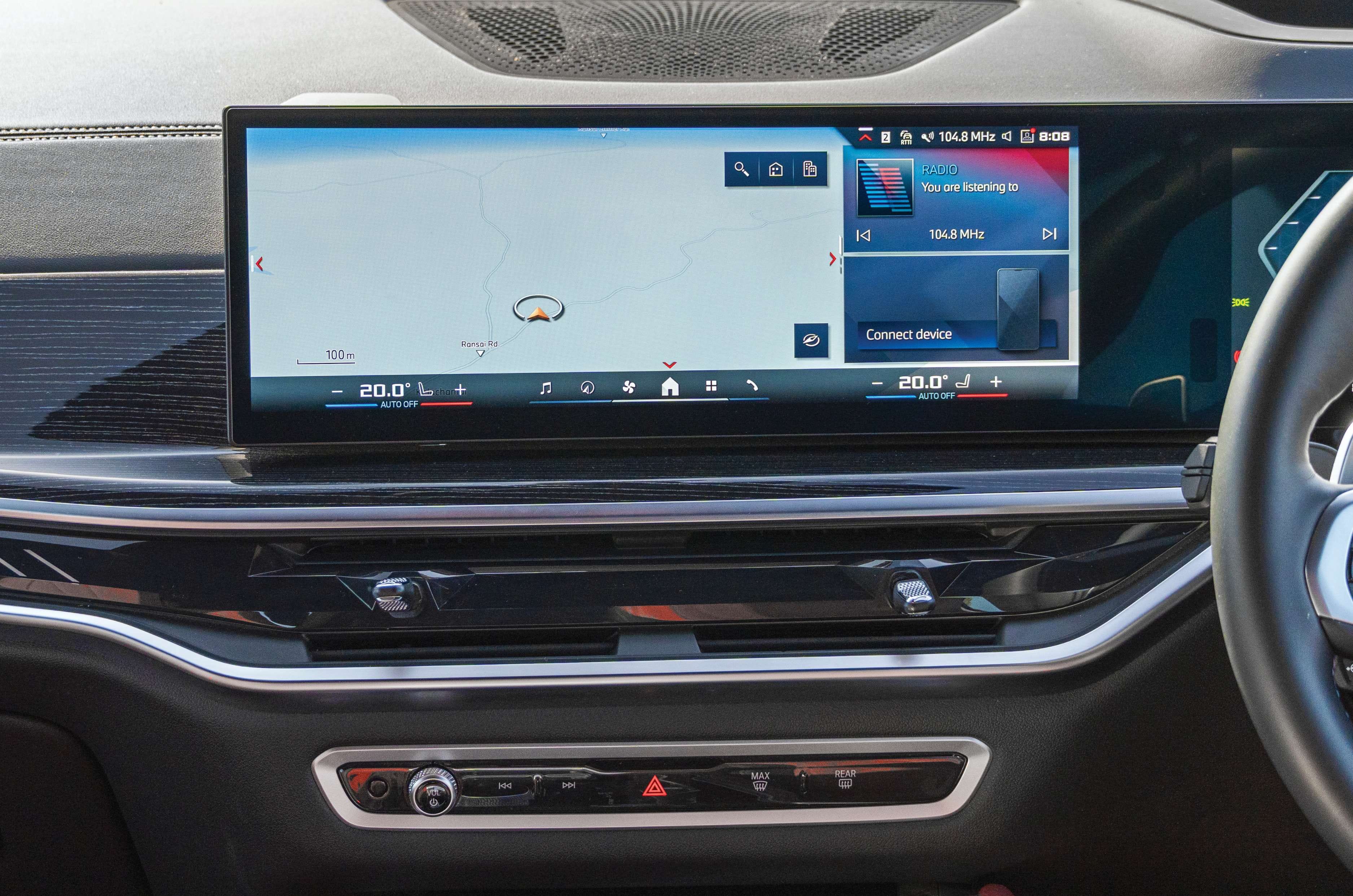
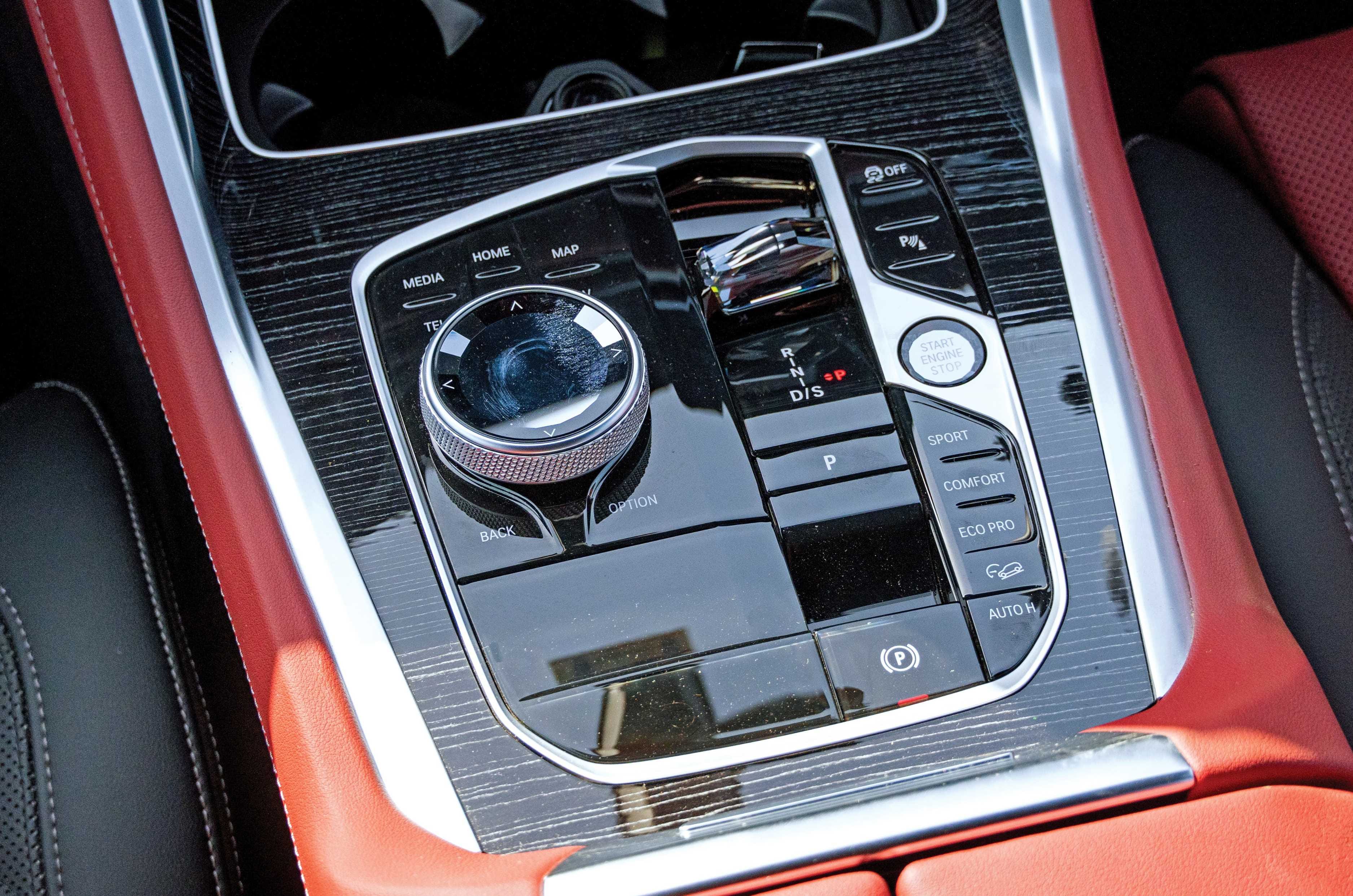
Occupying prime real estate on the updated dashboard is BMW’s curved display comprising a 14.9-inch infotainment screen and a 12.3-inch digital instrument cluster. This also means it forgoes some physical controls in favour of the screens. There are shortcut buttons strewn about the cabin, but these merely take you to the right menu in the infotainment. Thankfully, the infotainment is logically laid out, quick to respond and, using a combination of the iDrive controller and shortcuts, easy to get used to.
14.9-inch infotainment houses the HVAC controls.
There are other niceties, like a thumping 16-speaker Harman Kardon sound system, a wireless charger, a heads-up display and ambient lighting. Safety kit includes 6 airbags, a suite of electronic aids and ADAS features, including an auto-park function – sample the V8, though, and you are unlikely to relinquish control.
The latest iDrive is intuitive to use with some practice.
BMW X6 M60i xDrive Performance and Refinement – 9/10
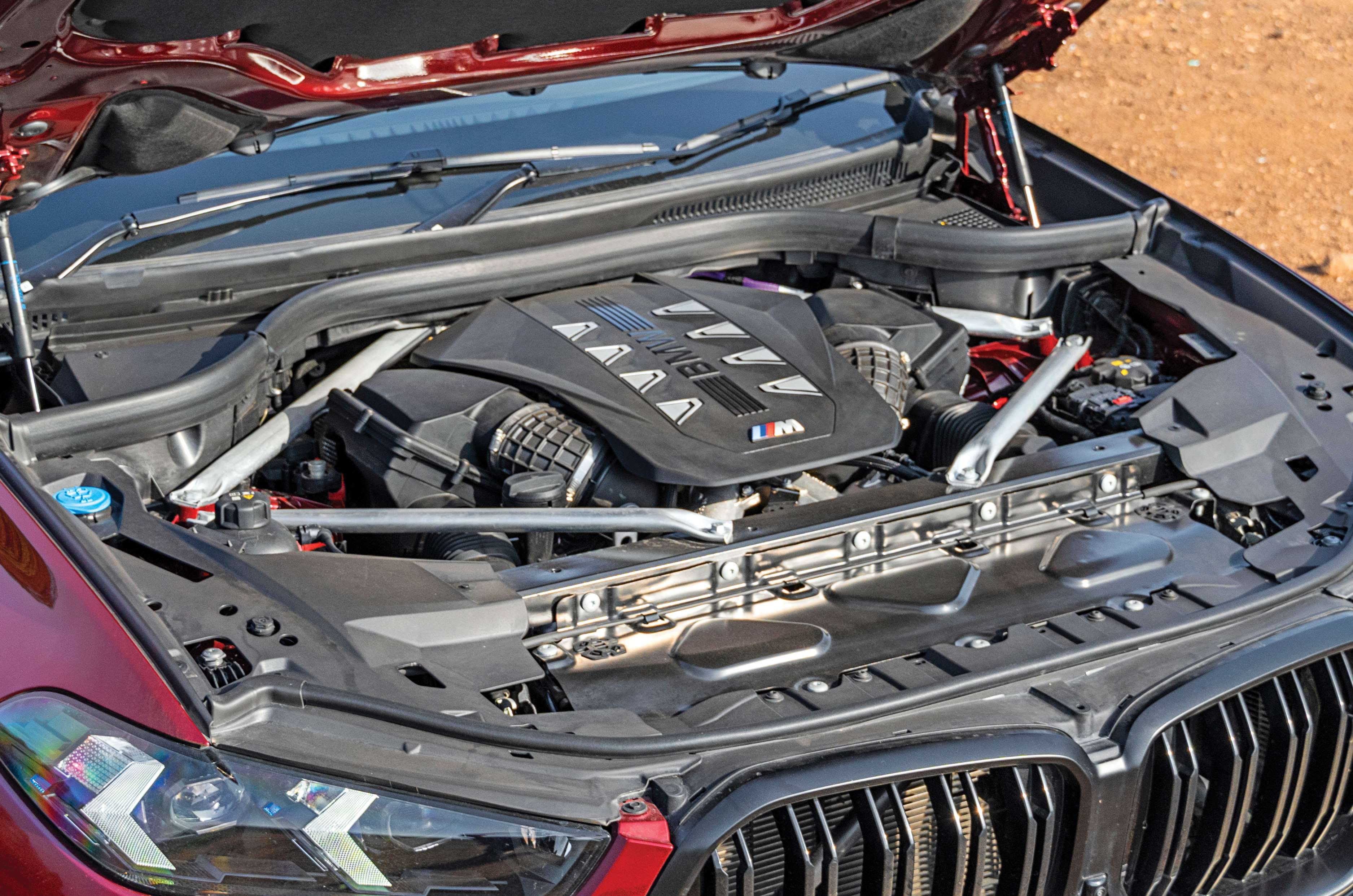
Boilerplate items first: under the bonnet is the S68 – a 4.4-litre V8 with twin turbos and a 48V mild-hybrid system. It’s a rather special motor and, in different configurations, can be found in everything from the X6 M Competition to even the Defender Octa. In the M60i, it makes 530hp and 750Nm, but it is reassuring to know it’s stout enough to handle more.
A tweaked version of this S68 also does duty in the full-blown X6 M and Defender Octa.
Fire it up, and you are greeted by a bass-heavy rumble. Sport Plus mode opens up the taps in the standard M Sport exhaust for a louder, angrier tone that builds to a deep growl as the revs rise. Granted, some of this is pumped in through the speakers, but it is very enjoyable nonetheless. It isn’t obnoxiously loud even at full chat, but it certainly isn’t lacking in character.
Despite not being a full-blown M car, the M60i offers plenty of visual drama.
As expected, performance is explosive. It fires off the line with real violence, spinning the tyres if the surface isn’t perfect. BMW claims 4.3 seconds to 100kph, and we clocked a VBOX-verified time of 4.11 seconds. Even into triple digits, it feels relentless, with the 8-speed torque-converter doing its best dual-clutch impression – I imagine hitting its 250kph limiter must feel like an anchor dropping.
BMW X6 M60i xDrive Range and Efficiency – 6/10
Despite the cornering ability, the ride is more pliant than you would expect.
The X6 gets an Eco Pro mode that dulls the V8’s responses, and the mild-hybrid system with its auto stop-start function helps efficiency, but the age-old adage of “if you must ask” applies here. A large 83-litre tank should at least ensure you aren’t stopping too frequently.
BMW X6 M60i xDrive Ride Comfort and Handling – 8/10
For something this big and heavy, it has a shocking amount of poise through the bends.
Despite the ballistic performance, there is a wonderful duality to the M60i. Dial it back into Comfort mode, and the growl is replaced by a distant rumble, the suspension unclenches, the transmission slurs its shifts, and it transforms from brute to relaxed GT. But the M-specific springs and adaptive dampers have a definite firm edge, amplified by the stiff sidewalls of the run-flats. Some harshness will come through while crawling over the worst of our city streets, but for the most part, there is more pliancy than you would expect. As speeds rise, this improves further and, while it never feels cosseting, it isn’t uncomfortable.
Quad exhaust ports demand attention even before the V8 fires up.
It’s a fair trade-off considering the cornering ability it has. For something that weighs 2.4 tonnes, the X6 has a shocking amount of poise through the twisties. Body control is superb, with roll only apparent in the tightest bends. The M Sport differential gives it incredible drive out of corners, and it does feel distinctly rear-biased, but to get it unstuck, you’d have to be travelling at ludicrous speeds. There is a welcome heft to the steering, but also a good feel and feedback coming through the meaty rim. It doesn’t drive like the blunt instrument its size and brawn might suggest, but rather like something a lot more sophisticated.
BMW X6 M60i xDrive Price and Verdict – 8/10
Updated rear gets new 3D tail lamps and a revised bumper.
Priced at Rs 1.78 crore, the X6 M60i enters a segment with some stellar rivals. At one end is the Mercedes-AMG GLE 53 Coupé priced at Rs 1.5 crore – similar to the X6 in terms of bodystyle, but outgunned in cylinder count and performance. At the other end is the Porsche Cayenne GTS Coupé starting at Rs 1.97 crore, with an emphasis on “starting” – spend time on the configurator, and you’ll see how quickly the number climbs as you tick option boxes. The most direct rival, then, is the Rs 1.77 crore Audi SQ8. In terms of ability too, it sits between the Audi and Porsche – more characterful than the former, not quite as sharp as the latter. Picking between them, then, is a matter of where your preferences and loyalties lie.
Conducted in association with Spinny, India’s leading pre-owned car platform, the fourth edition of our Used Car Study analyses real-world resale values across a broad spectrum of vehicles sold in the Indian market in order to assess depreciation trends over a five-year ownership period. The study is based on actual transactional data shared by Spinny for vehicles sold between January 1 and August 31, 2025.
In this series of the resale value study, we are first taking a look at the budget hatchback segment:
Midsize HatchbacksResale Value
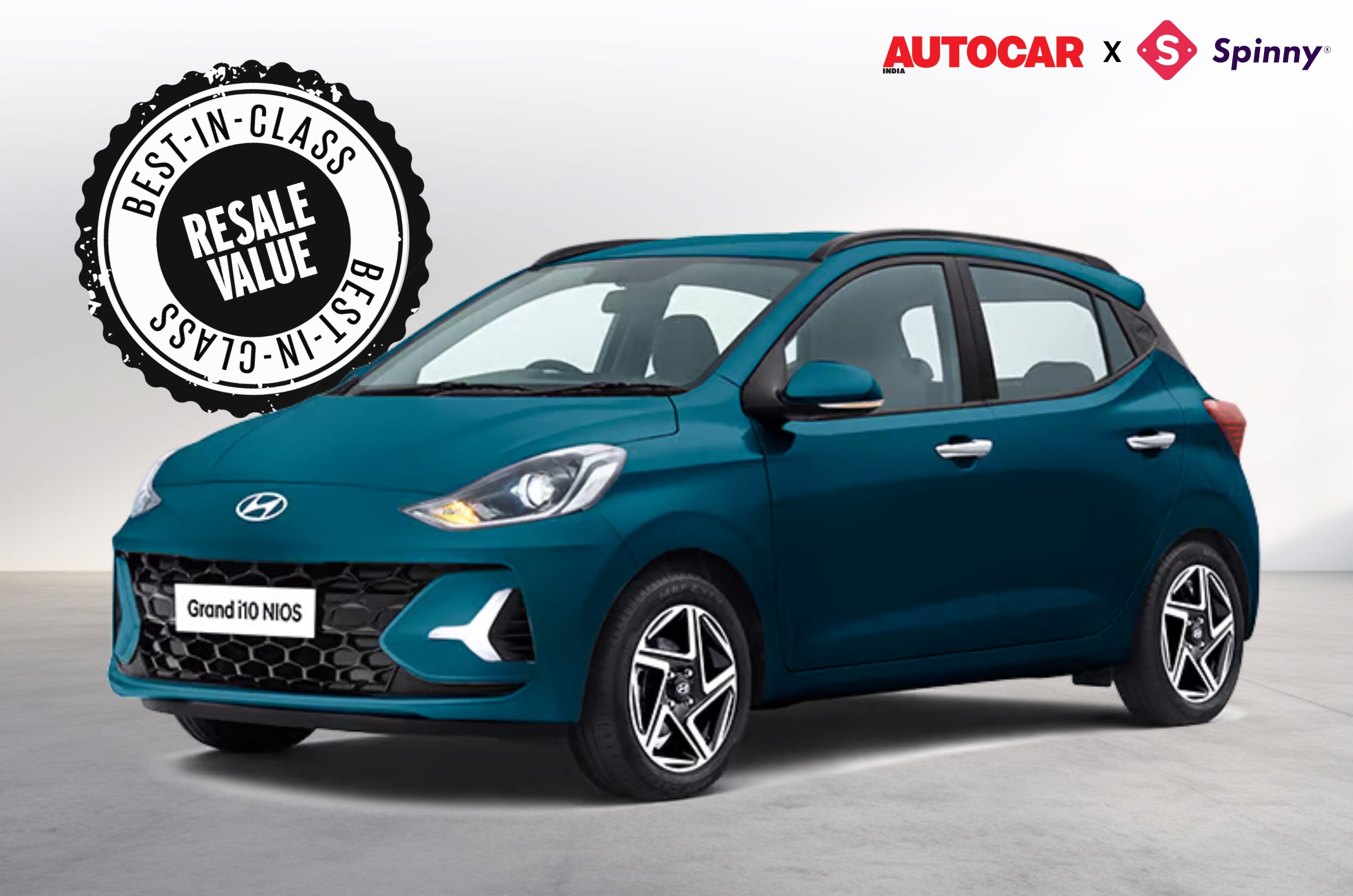
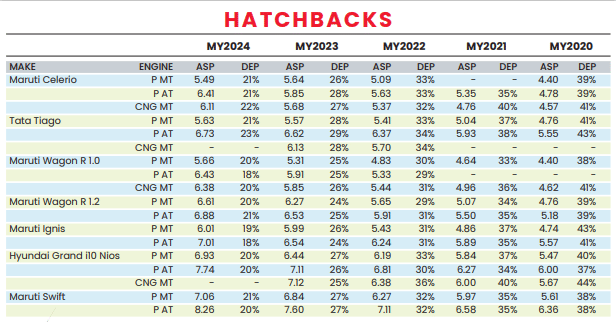
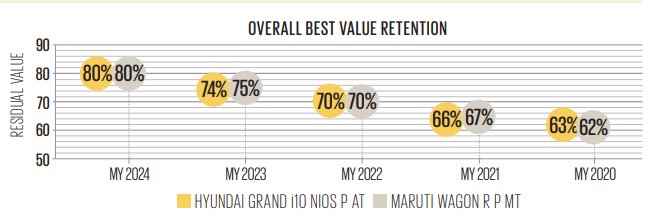
The Hyundai Grand i10 Nios petrol-AMT emerged as the strongest performer in terms of residual value, registering the flattest depreciation curve in the segment. Matching it closely are both the 1.0-litre and 1.2-litre petrol-manual variants of the Maruti Wagon R, whose consistently strong demand in the new and used car markets has helped preserve resale values.
At the other end of the spectrum, the Grand i10 Nios CNG sees the steepest depreciation among its siblings, while the Tata Tiago petrol-AMT also records relatively greater value loss over time. The Maruti Ignis is also among the ones to lose the most value over the five-year period. The Maruti Swift stands out in this company for having the most consistent rate of depreciation across both its manual and automatic variants.
As per the study, the average selling price of a five-year-old midsize hatchback retailed through Spinny stood at Rs 5.47 lakh. Comparable figures for three-year-old and one-year-old the midsize hatchbacks were Rs 5.84 lakh and Rs 6.58 lakh, respectively. Average depreciation over the same periods worked out to 40 percent, 31.9 percent and 20.3 percent, respectively.
Autocar-Spinny Resale Value Study methodology
The analysis covers the average selling prices (ASPs) of vehicles retailed through Spinny’s network across nine cities – Delhi-NCR, Bengaluru, Hyderabad, Pune, Chennai, Mumbai, Lucknow, Ahmedabad and Kolkata.
For the purposes of this study, depreciation has been defined as the percentage difference between a vehicle’s original on-road price in its year of manufacture and its resale value in 2025. In instances where a model was offered with multiple engine options using the same fuel type, the data has been consolidated and averaged. Variant-wise differences have similarly been averaged out.
Discontinued models and powertrain options have been excluded. Additionally, premium vehicles priced above Rs 30 lakh, electric vehicles and certain low-volume models have not been included due to limited transaction data and insufficient sample sizes.
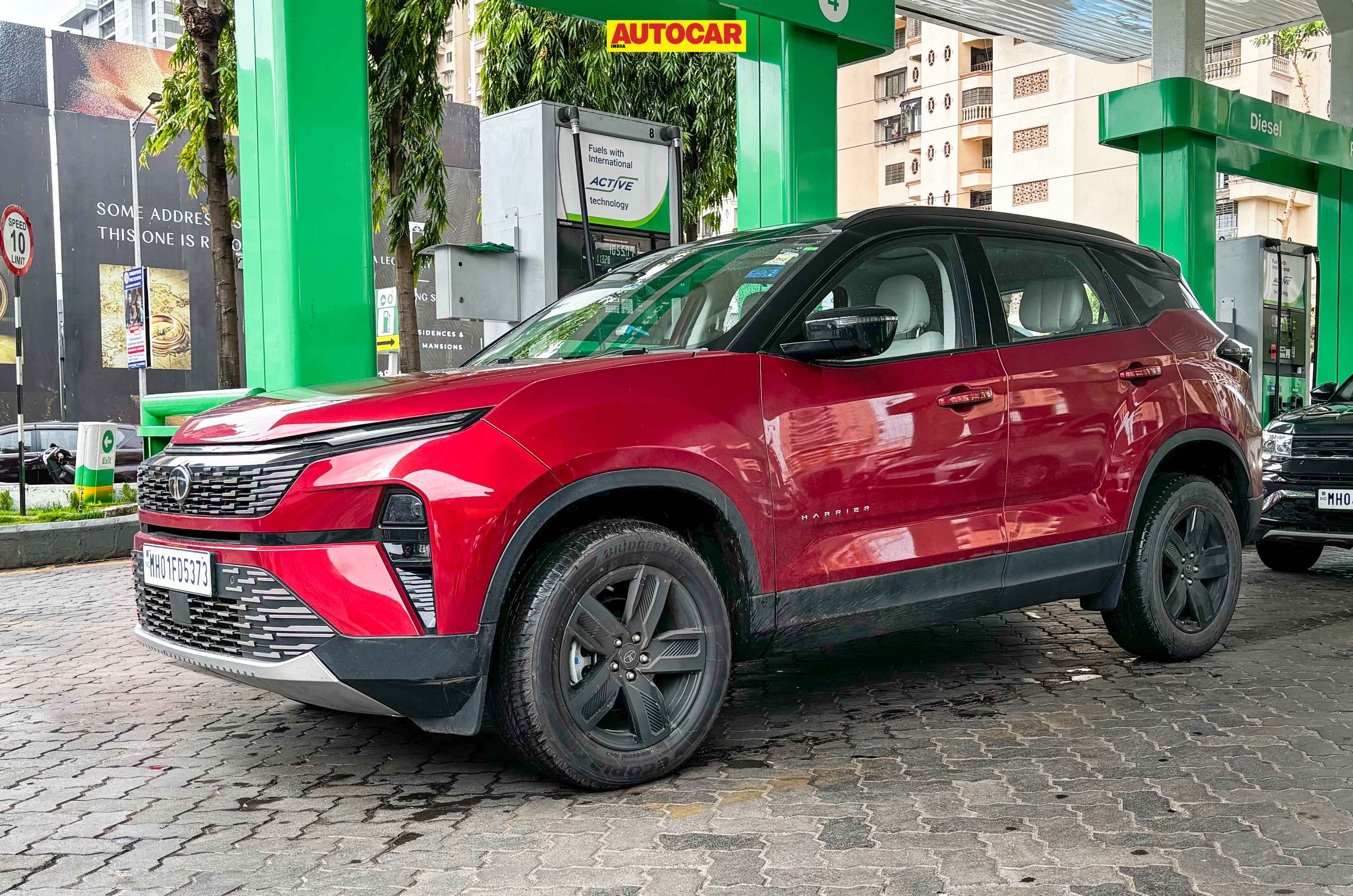
Launched with a diesel engine in 2019, the Tata Harrier finally gained a turbo-petrol option in January 2026. Under the hood is the same 1.5-litre Hyperion turbo-petrol engine that debuted in the Sierra. In the Harrier, however, it produces 170hp and 280Nm, 10hp and 25Nm more than in the Sierra. Unlike its sibling, the turbo-petrol Harrier is available with both 6-speed manual and automatic transmission options. We tested the latter to evaluate its real-world fuel efficiency.
Misses out on an auto engine stop-start system.
Gets an Eco driving mode.
Weighs 1,738kg.
Tata Harrier petrol mileage explained
The Harrier’s higher state of tune (than the Sierra), sharp throttle responses and revised gearing improve drivability, and despite its 1,738kg kerb weight, performance feels more than adequate. Unlike the Sierra, the turbo-petrol Harrier also gets an Eco driving mode to help curb fuel consumption. However, an automatic engine stop-start system is still absent.
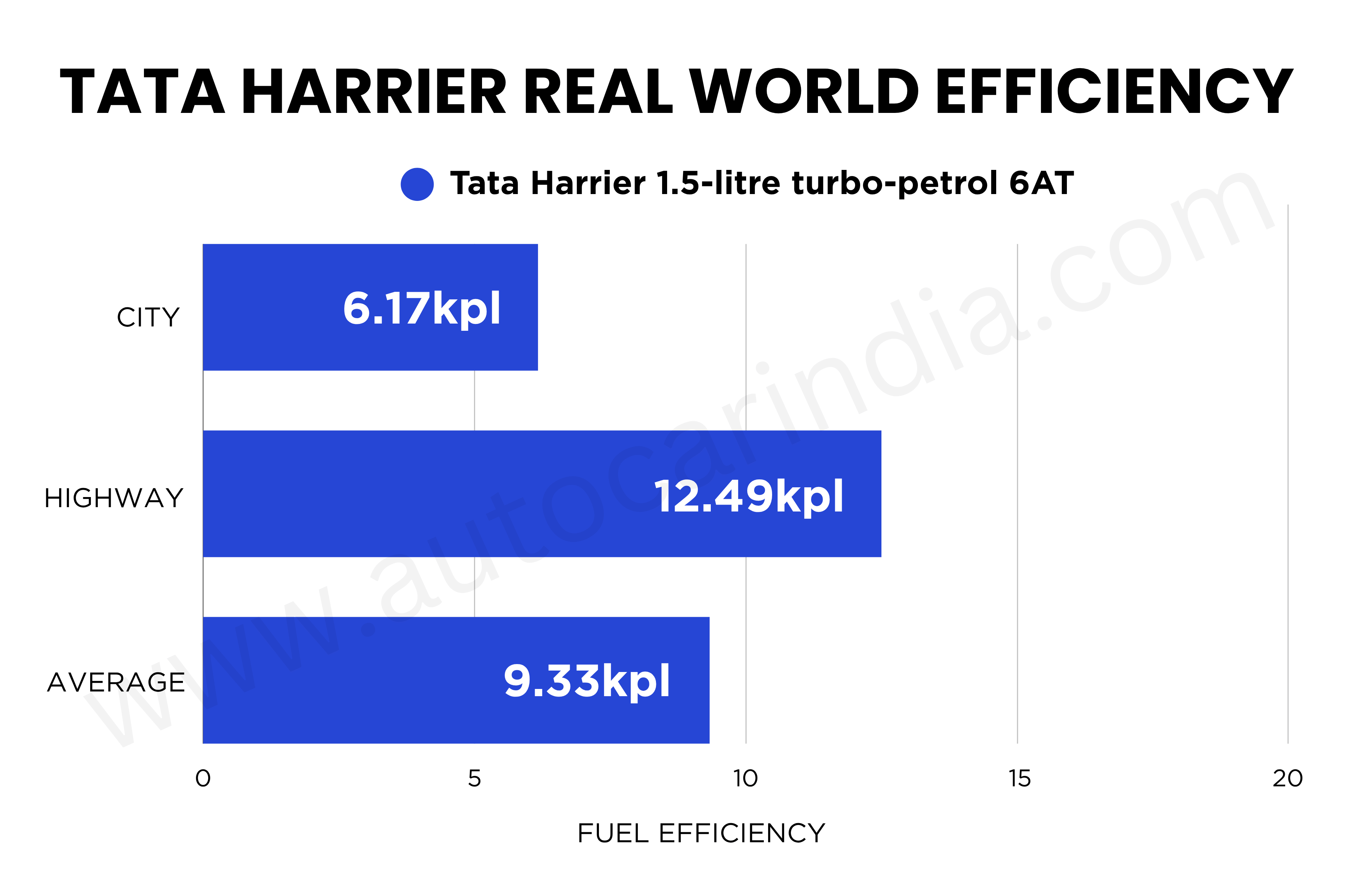
In our tests, the Harrier turbo-petrol automatic, equipped with a 6-speed torque-converter gearbox, delivered 6.17kpl in the city and 12.49kpl on the highway, resulting in an overall average fuel efficiency of 9.33kpl.
Notably, the top-spec Harrier weighs over 180kg more than the Sierra and is, as expected, less efficient. In our tests, the Sierra was 0.32kpl more efficient in the city and 1.21kpl more efficient on the highway. The larger gap in highway efficiency can also be attributed to the Harrier’s higher cruising engine speeds. At 100kph, the Harrier’s engine turns at 1,900rpm in top gear, whereas the Sierra cruises at 1,750rpm in sixth gear at the same speed.
For fuel-conscious buyers, the Harrier diesel remains the more sensible choice. For reference, the 2021 Harrier diesel automatic returned 9.6kpl in the city and 14.4kpl on the highway in our efficiency tests.
Autocar India’s fuel-efficiency testing
Before conducting our real-world fuel-efficiency tests, we fill our test cars’ tanks to the brim and maintain tyre pressures based on the manufacturer’s recommendation. These cars are then driven on fixed city and highway loops in and around Navi Mumbai, and we maintain certain average speeds. Throughout the tests, we run the aircon at 22 degrees in full-auto mode and other electricals, such as the audio system, indicators and wipers, when required – just as a regular user would. Periodic driver swaps further neutralise variations in driver patterns. At the end of each cycle, we calculate efficiency by filling the tanks to full again.
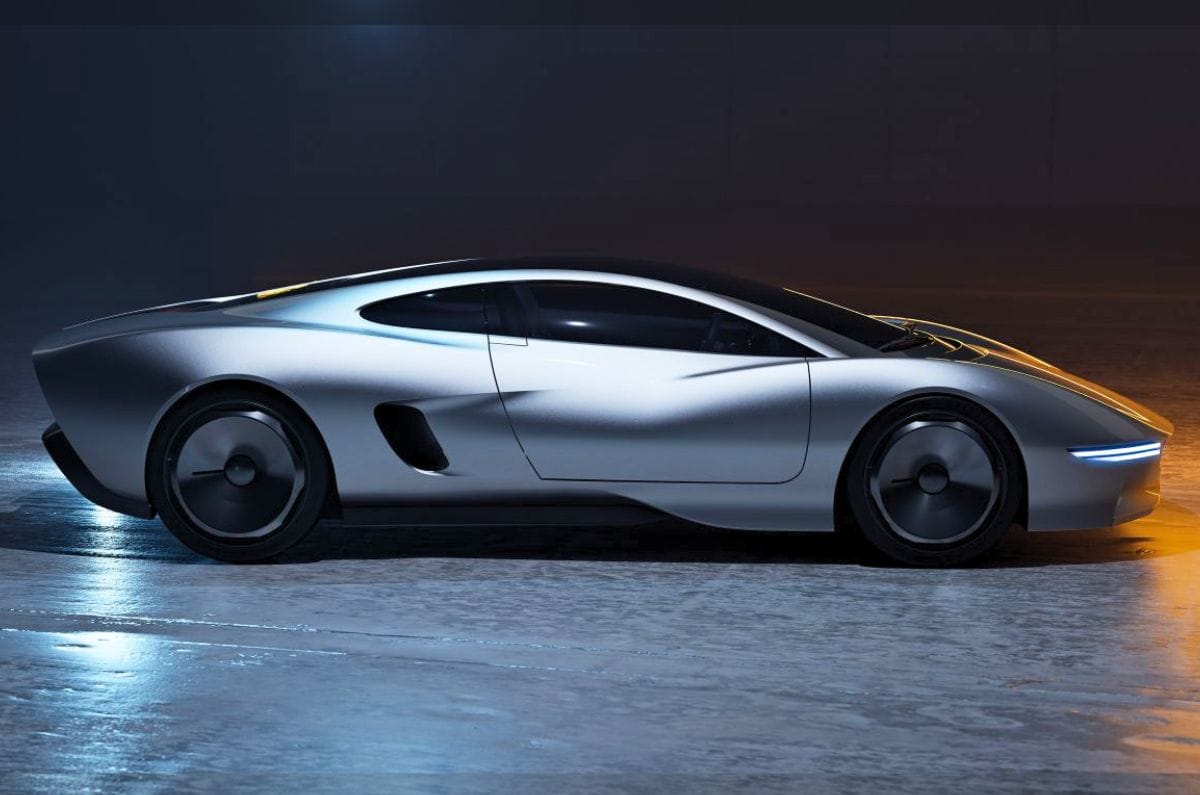
Callum Designs, a UK-based design and engineering consultancy, has partially showcased a reimagined version of the famed Jaguar XJ220 supercar. “Introducing the latest Callum portfolio project: XJ220,” the company stated on social media. It’s best known for making limited-edition versions of Mini and Aston Martin models alongside reimagined Jaguar E-Types and even bespoke marine commissions. Callum Designs is headed by Ian Callum, former Design Director for Jaguar.
Callum Designs specialises in bespoke commissions
The concept borrows design cues from the Jaguar XJ220
XJ220 by Callum Designs
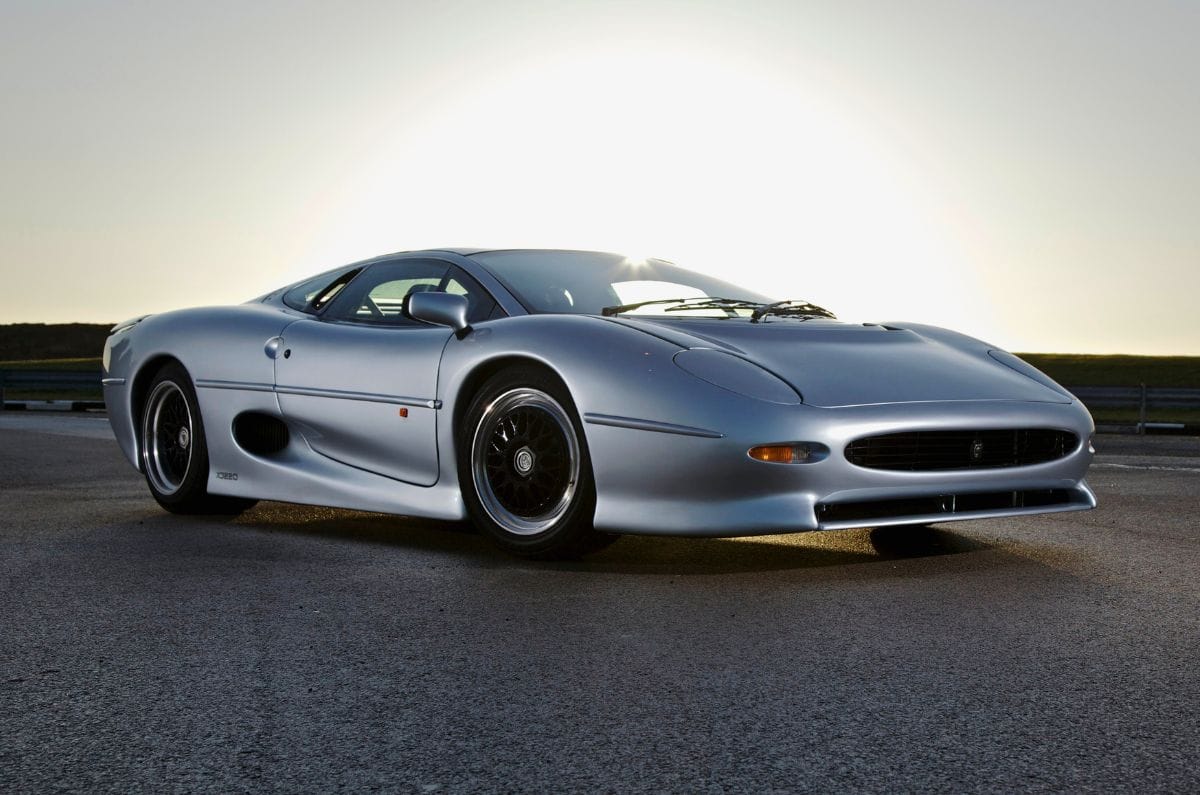
While the concept is yet to be revealed thoroughly, the lone image by Callum Designs still showcases a few details. “This is a contemporary interpretation of one of the most iconic supercars ever made,” the company stated. Some of the visual similarities with the original Jaguar XJ220 include bits such as the oval-shaped side windows, a similar location for the side ducts, and a steeply raked windscreen. Other design nods to the XJ220 are the concentric arcs integrated into the bonnet area (at the base of the windscreen) and even the silver exterior colour. Finally, the flared haunches on either side of the bonnet are also design cues originally found on the Jaguar XJ220.
The intent with this project is expected to be more than just to expand the Callum Designs product portfolio. “This concept preserves the unmistakable silhouette of the original while redefining every surface, detail and proportion through a modern lens,” says Callum Designs. The company behind this concept is currently calling it a “design study that showcases what is possible.” Callum Designs concluded by saying, “Keep an eye out for more on this project.”
The original Jaguar XJ220
Jaguar XJ220
The original Jaguar XJ220 was launched in 1992 at a price of GBP 470,000. It featured a lightweight aluminium honeycomb structure and was powered by a 3.5‑litre twin turbocharged V6 engine producing 550hp and 644Nm of torque. This allowed for a claimed top speed of 343kph, while 96kph from a standstill took less than 4 seconds. However, an XJ220 driven by Jaguar Le Mans winner and Formula One driver Martin Brundle set a Guinness World Record for the fastest production road car in 1992 by hitting a maximum speed of 349kph.