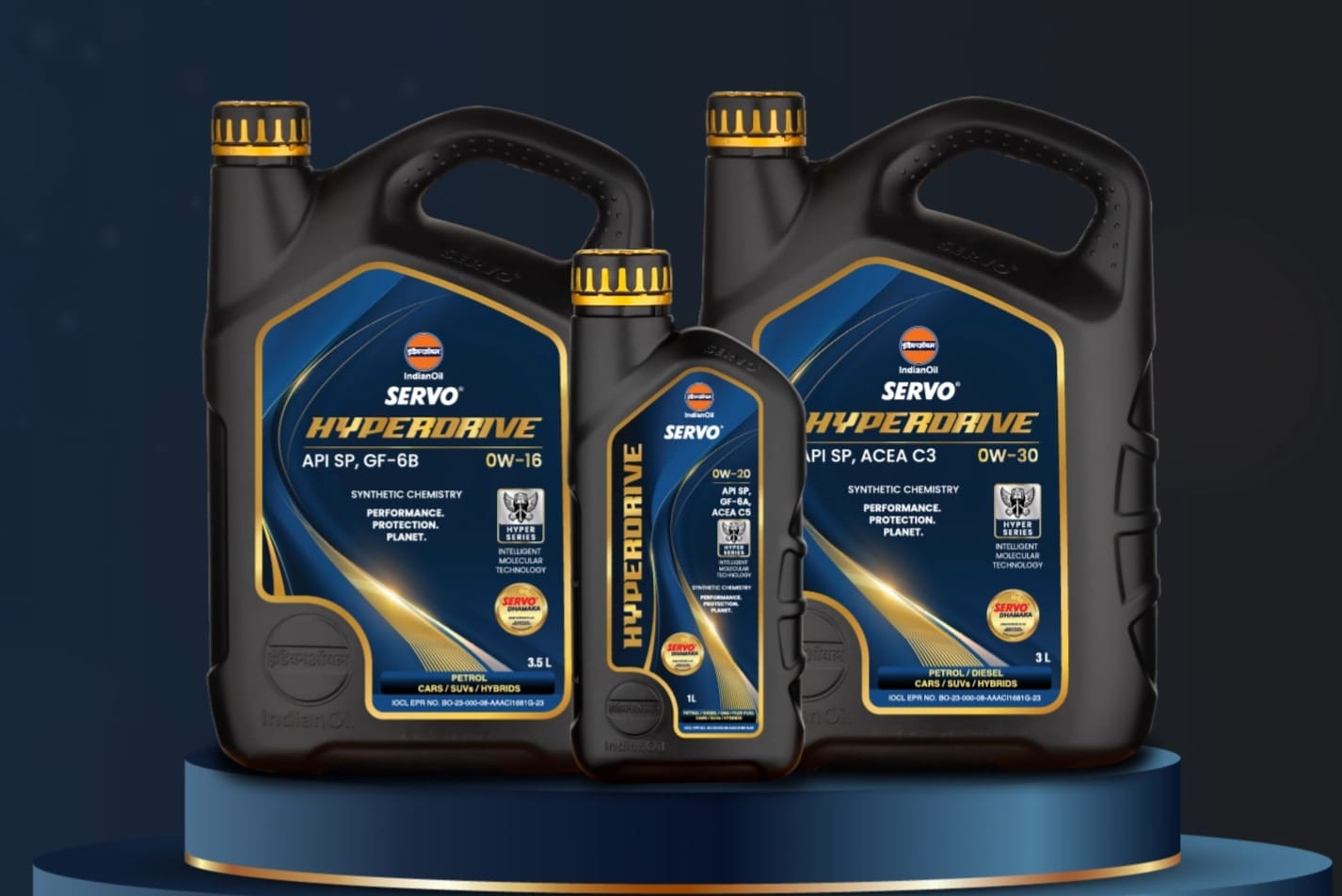
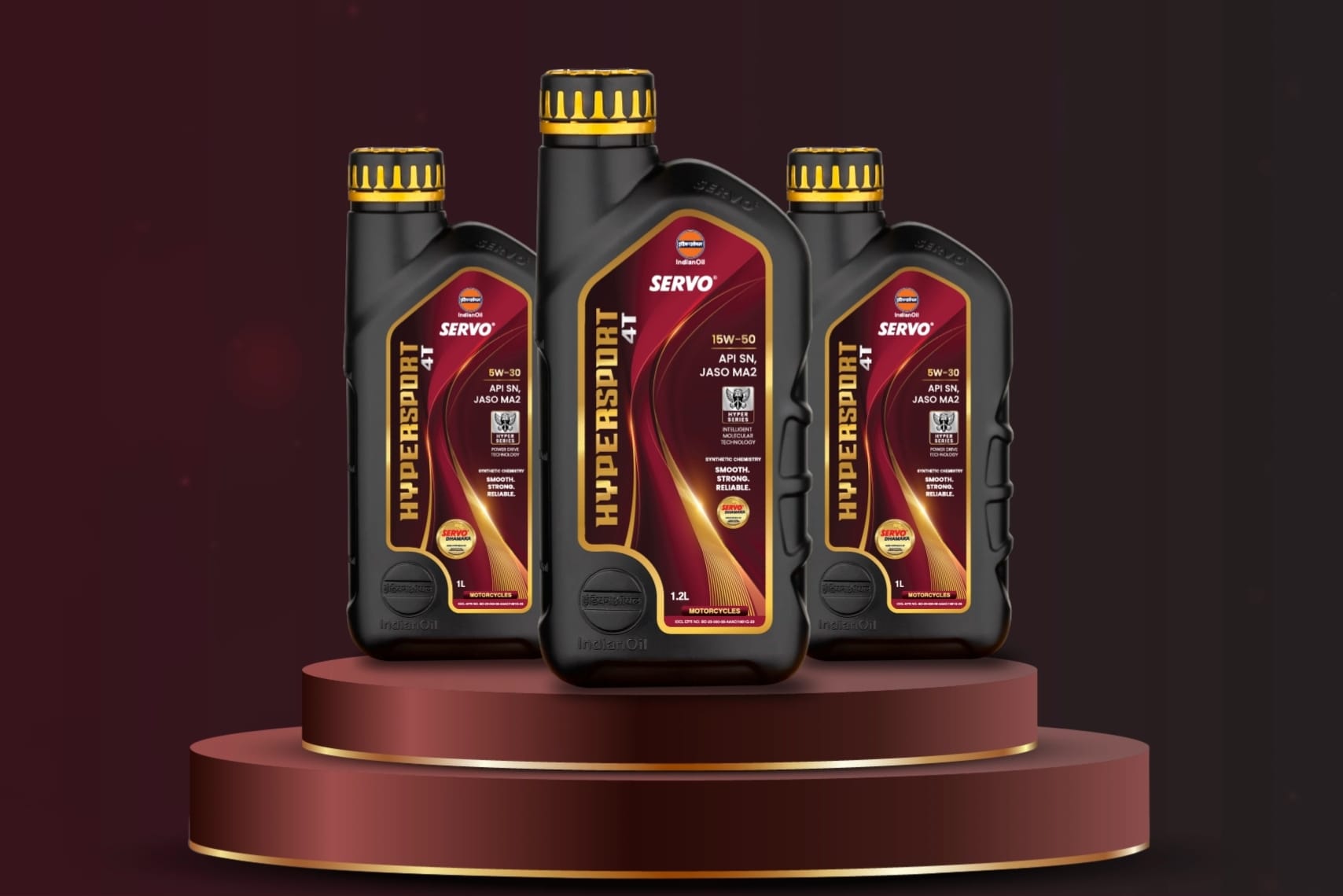
Indian Oil has introduced a new premium lubricant to its Servo range. Called the Servo Hyper Series, the brand says its the ‘most advanced premium lubricant portfolio, designed to meet the evolving requirements of modern engines and high- performance industrial equipment.”
Servo Hyper Series Lubricants: What is it?
Indian Oil states that the Servo Hyper Series Lubricants deliver superior engine performance, improved fuel efficiency and extended drain intervals under demanding operating conditions by using “advanced synthetic base oils and next-generation additive technologies.” It comprises three versions for different vehicle applications, namely Hyper Sport for motorcycles, Hyper Drive for passenger cars, and Hyper Torq for commercial vehicles.
The Hyper Drive lubricants for cars consist of two products. The regular Hyper Drive applies to BS6 petrol and diesel-powered cars and is recommended for vehicles from manufacturers such as Honda, GM (Chevrolet), Ford, Toyota, Nissan, Maruti-Suzuki, MG, Renault, Hyundai, Citroën, Volkswagen Group, BMW, Mercedes-Benz and others. The Hyperdrive NXT is for high-performance cars and is compatible with petrol, diesel, CNG, flex-fuel and hybrid vehicles. Indian Oil says that the NXT is ‘optimised for hybrid cold starts and E85 petrol.’
Under its Hyper Sport series of lubricants for bikes, the Hyper Sport F5 is recommended for superbikes and racing motorcycles from BMW Motorrad, Ducati, Suzuki, Kawasaki, Yamaha, KTM and Honda. It has a drain interval of up to 10000km. The Hyper Sport 4T is recommended for most four-stroke 2-wheeler engines and is specifically recommended for Royal Enfield, Hero MotoCorp, Bajaj, TVS, Honda, Yamaha and other leading motorcycle brands. The Hyper Sport scooter is specifically recommended for 4-stroke gearless scooters. Both the Hyper Sport 4T and Scooter have a drain interval of up to 8000km.
For commercial vehicles, Indian Oil’s Servo Hyper Torq consists of three versions. The standard Hyper Torq is applicable for heavy-duty diesel-powered commercial vehicles operating under BS4 emissions and earlier. It has a drain interval of up to 80,000 km. The Hyper Torq NXT is recommended for BS6-compliant commercial vehicles and has a drain interval up to 1,20,000 km. The Hyper Torq XP is a fully synthetic commercial vehicle engine oil for truck engines operating with low sulphur content. This oil has a drain interval of up to 10,000km.
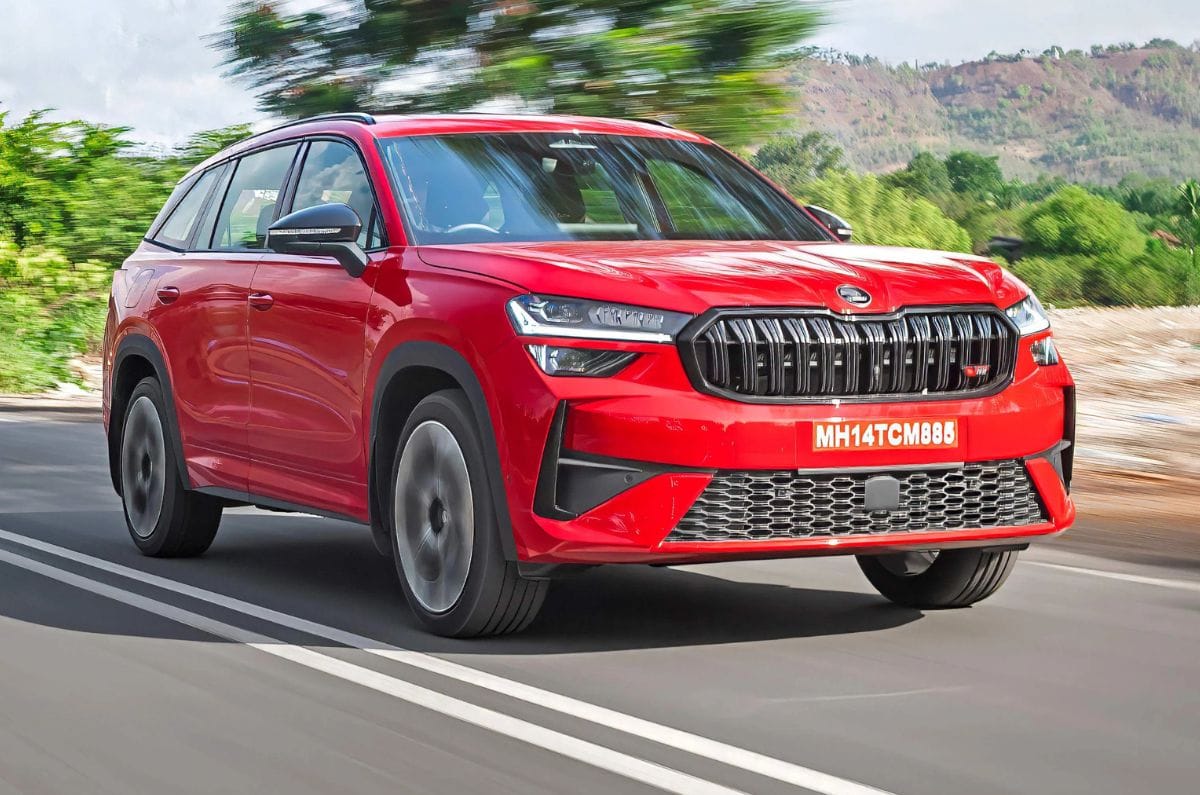
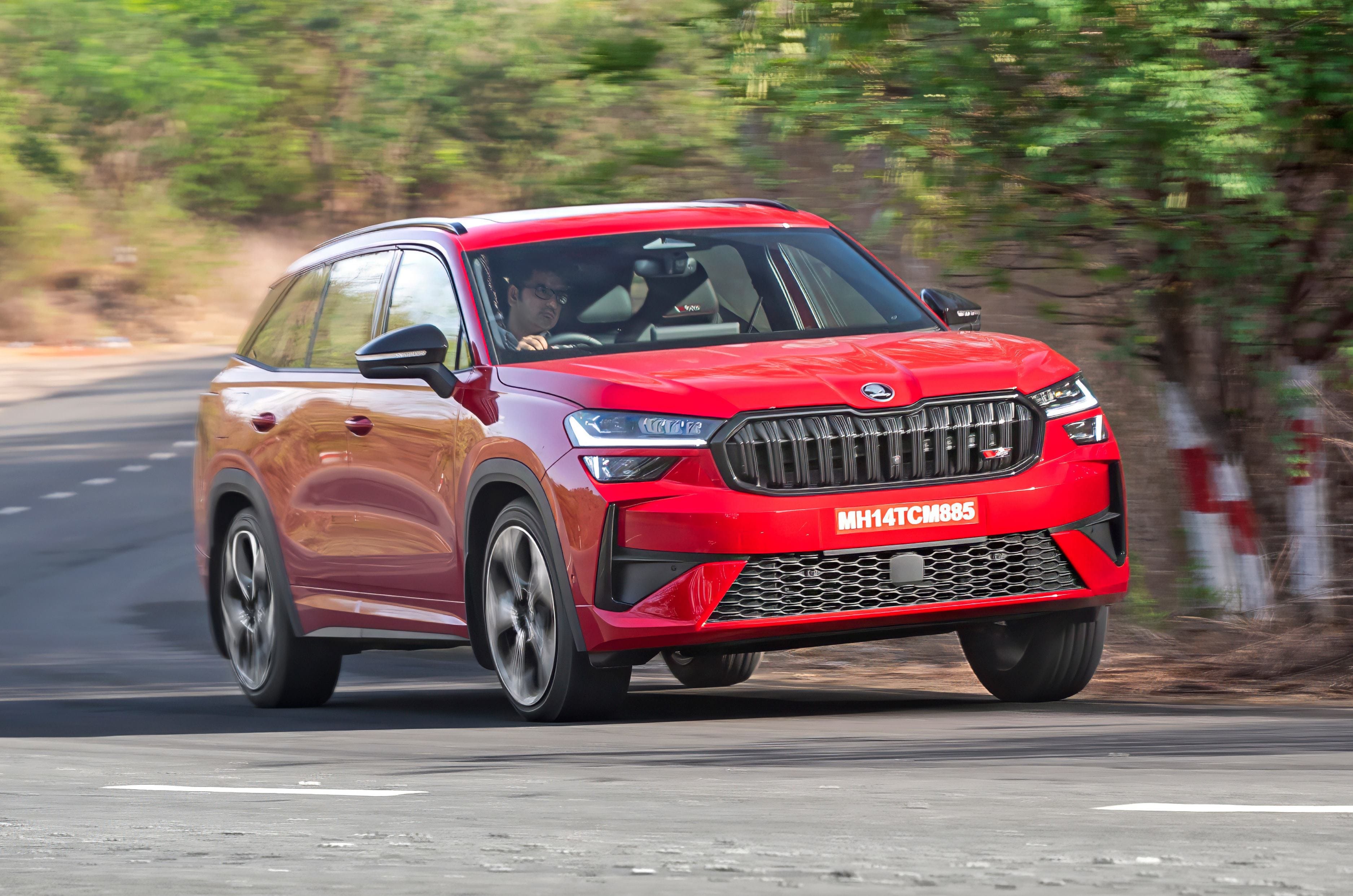
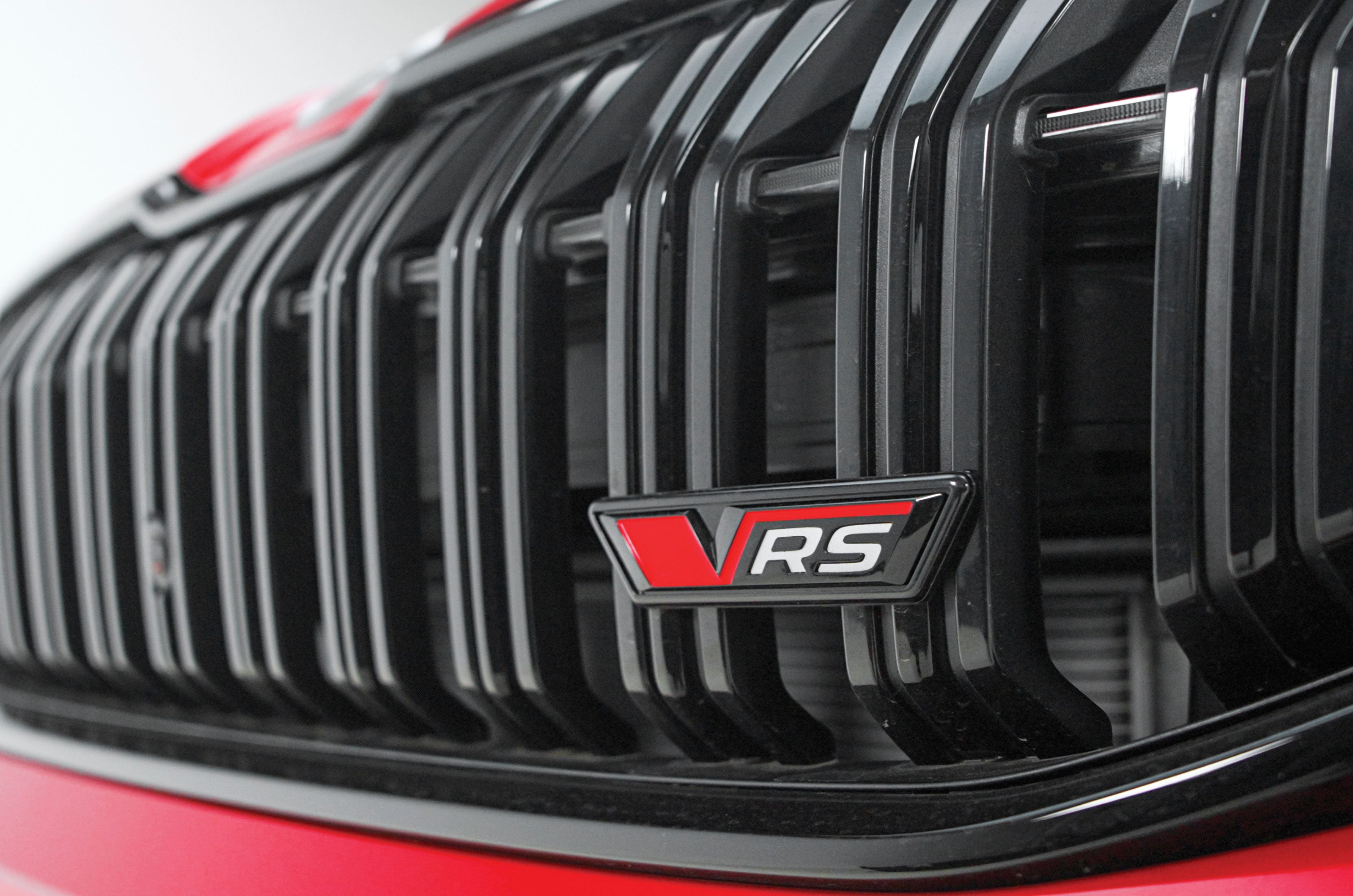
The Skoda Kodiaq RS is built on the Volkswagen Group’s MQB Evo platform and finds competition in the Volkswagen Tayron R-Line. Within a claimed six minutes of Skoda opening bookings for the Kodiaq RS in India, all 50 units were already spoken for. That said, the brand could allocate a second batch for our market if there’s enough demand. If you’re a prospective buyer of this 7-seater performance SUV, here are its pros and cons.
Lively engine and gearbox
Rev-happy engine snarls when pushed, adding to the engagement
Skoda has tweaked the 2.0-litre four-cylinder turbo-petrol direct injection engine for the Kodiaq RS. It now produces 265hp and 400Nm of torque – that’s 61hp and 80Nm more than the standard model. Not only does this engine pull hard all the way to 6,500rpm, but the power it produces remains usable throughout the rev-range. The 7-speed dual-clutch automatic transmission is also quick to shift and feels responsive when using the paddle shifters. Moreover, the sporty notes played through the speakers have been well-executed and do not sound fake.
A capable ride and handling package
The Kodiaq RS handles corners just as well as it does straight roads
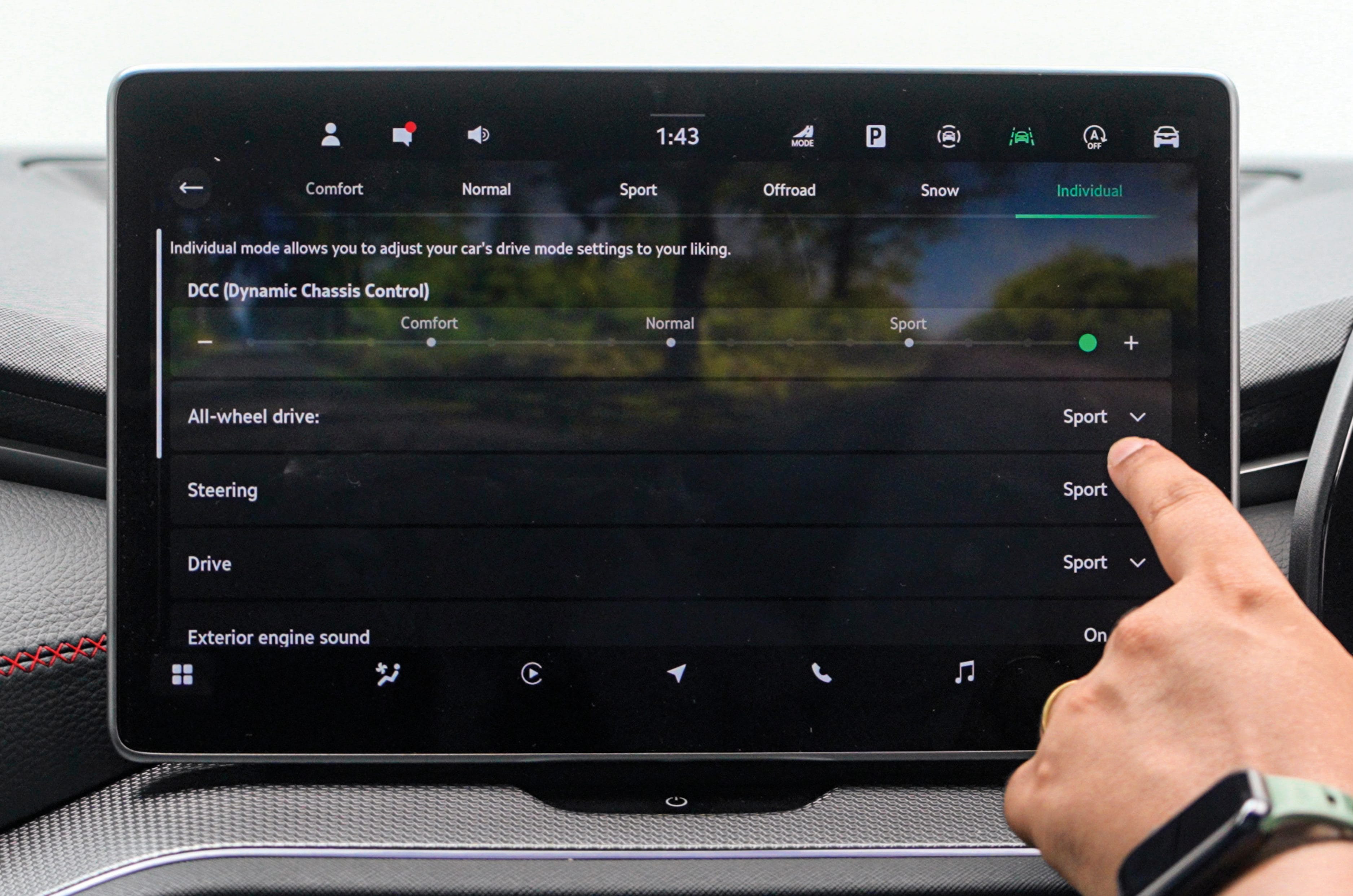
Despite being tall and heavy, the 7-seater Kodiaq RS is engaging to drive – whether that be around corners or in a straight line. One of the features that allows this are the adaptive dampers, or Dynamic Chassis Control (DCC), as VW-Skoda call it. Depending on your preference, the system can be set to one of 15 damping modes – ranging from various levels of soft and firm. In its sportiest setting, the suspension allows the RS to change directions quickly without upsetting body control even when tackling high-speed corners.
The Kodiaq RS also gets an all-wheel drive system that can send all of the engine’s torque to the rear axle, plus an electronic differential lock system. Known as the ‘XDS+’, this allows the car to brake the inner wheel to counter any understeering tendencies, leading to better agility around fast corners. Finally, the steering wheel feels responsive and is well-weighted, adding to the overall fun factor.
A sporty-looking interior
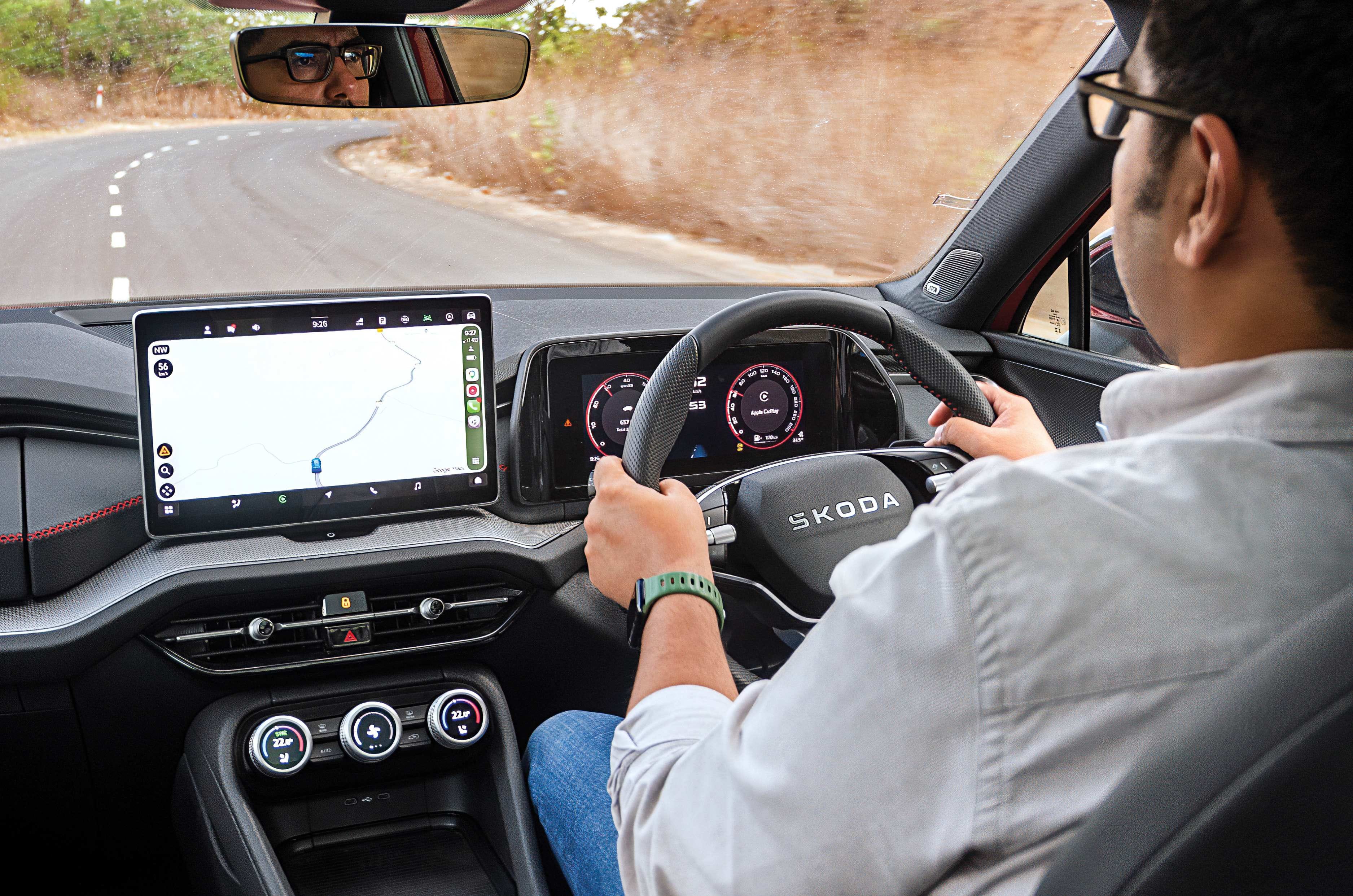
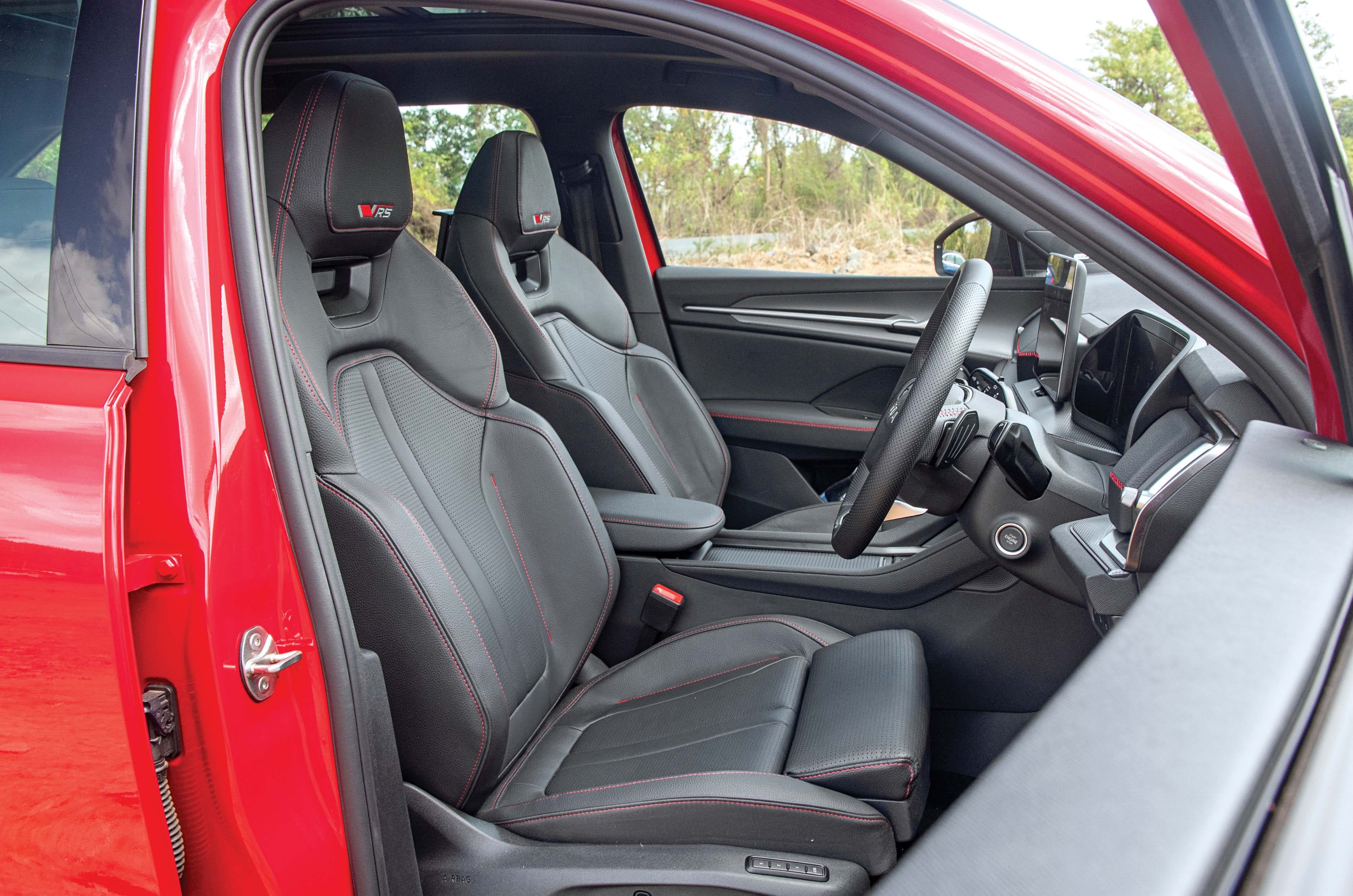
The all-black interior features RS-specific touches
The all-black interior theme and sports seats at the front are similar to those of the Kodiaq Sportline. However, the seat headrests here get ‘RS’ branding, along with contrast red stitching and a textured metal finish on various surfaces and trim. Such detailing adds to the overall sporty nature of the Kodiaq RS.
Let’s now look at what’s not so good about the Skoda Kodiaq RS.
The ‘RS’ tax
The price premium could be difficult for most to jusity
Even though the first batch of 50 units have already been spoken for, Skoda is yet to disclose the official price of the Kodiaq RS in India. However, since it’s fully imported, the price difference is expected to be around Rs 15-20 lakh more than the locally assembled Kodiaq L&K. It feels more premium and sporty than the standard model, but a price tag of about Rs 65 lakh can be hard to justify for some.
While modern cars are more reliable than ever, mechanical and electrical failures can still occur, which is where a warranty is useful. Simply put, it is the carmaker’s assurance that the vehicle is free from manufacturing defects. If a part fails because of such a defect within the specified time or kilometre limit, the company bears the cost of repairing or replacing it. Here’s a closer look at some of the most important questions surrounding car warranties.
Disclaimer: Warranty terms and conditions vary from one manufacturer to another. It is always recommended to check with your carmaker for the exact coverage and exclusions.
What does a car warranty actually cover?
A factory warranty mainly covers key components that are expected to last the life of the vehicle under normal use. These include the powertrain, engine, fuel pumps and transmission. It also covers components such as the steering system, suspension linkages and braking system. Factory-fitted electrical components are covered as well. In short, if there is a manufacturing or assembly defect, the company either repairs or replaces the affected part free of cost.
What isn’t covered under a car warranty?
A warranty does not cover parts that naturally wear out over time. Brake pads, clutch plates, wiper blades, bulbs and tyres are among the common exclusions. Consumables such as engine oil, filters and coolant are covered only if they need to be replaced as part of an approved warranty repair.
Damage caused by certain external factors is also excluded. This includes paint damage caused by bird droppings, tree sap, industrial fallout or acidic rain. Bird droppings, in particular, are highly acidic and can damage the paint if not cleaned off quickly.
What can void your car’s warranty?
Warranty protection depends heavily on following manufacturer-prescribed maintenance schedules using approved procedures and genuine parts. Even a comprehensive warranty can become invalid if the vehicle is modified or misused. Odometer tampering is one such example, as disconnecting or altering the odometer immediately voids the warranty.
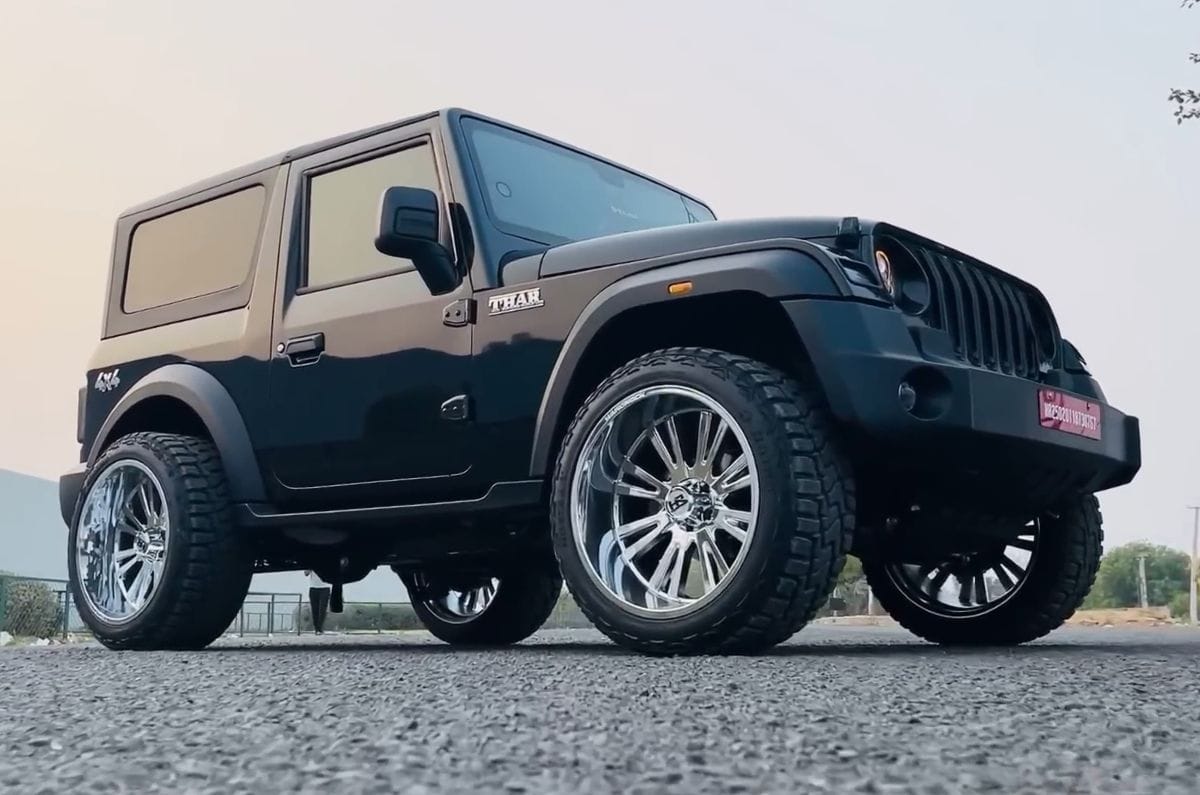
ECU remaps are another common reason. Manufacturers, particularly Volkswagen Group brands such as Skoda and Volkswagen, use OBD scans to detect unauthorised tuning, and a detected remap can result in the loss of powertrain warranty. Aftermarket electrical modifications, such as cutting into the wiring harness to install audio systems, can also create warranty issues. Also, upsizing, using wider tyres or placing wheel spacers could cause issues and therefore void the warranty.
Image credit: tarunvlogs3445 via YouTube.
BYD excludes rodent damage, while MG warns against charging its EVs from non-earthed power sources, which can affect the battery management system. Driving through deep water and causing a hydrostatic lock is also considered misuse, so owners should always stay within the manufacturer’s recommended water-wading limit.
How are EV warranties different?
Unlike petrol and diesel cars, where the warranty is generally offered as a single package, EV warranties are split across different components. Manufacturers typically provide separate warranties for the electric motor(s) and battery. Speaking of the latter, the industry standard for high-voltage batteries is 8 years or 1,60,000km, but coverage varies across manufacturers.
For example, Tata Motors offers the Harrier EV with an unlimited-kilometre battery warranty for the vehicle’s lifetime, defining it as 15 years from the date of first registration. Toyota offers an 8-year or 1,60,000km battery warranty for its hybrid vehicles and 8 years or 2,00,000km for its battery electric vehicles.
Should you buy an extended warranty?
As standard, carmakers usually offer a 3-year or 1,00,000km warranty, whichever is earlier. In some cases, manufacturers offer even more. The new Renault Duster, for example, comes with a 7-year or 1,50,000km standard warranty. BYD also offers a 6-year or 1,50,000km warranty across its entire range.
Beyond this, customers can also opt for extended warranty packages, typically ranging from 2 to 7 years or a set number of kilometres. Some manufacturers go further still. For instance, BMW provides warranty extensions of up to 10 years or 2,00,000km. Toyota’s True Warranty can be extended up to 2,20,000km. Nissan offers comprehensive coverage for up to 7 years or 1,70,000km, along with separate engine and transmission-only extensions of up to 10 years.
Some manufacturers take a different approach. Hyundai’s Shield of Trust package covers 14 wear-and-tear parts for up to 5 years or 60,000km. Honda’s Anytime Warranty, meanwhile, can be purchased for cars that are up to 10 years old, even after the original factory warranty has expired.
Whether an extended warranty is worth buying largely depends on how long you plan to keep your car. If you intend to sell it before the standard warranty expires, you may not need one, although it may improve the car’s resale value. However, if you plan to keep the vehicle beyond the factory warranty period, an extended warranty may prove useful.
How do warranties work on used cars?
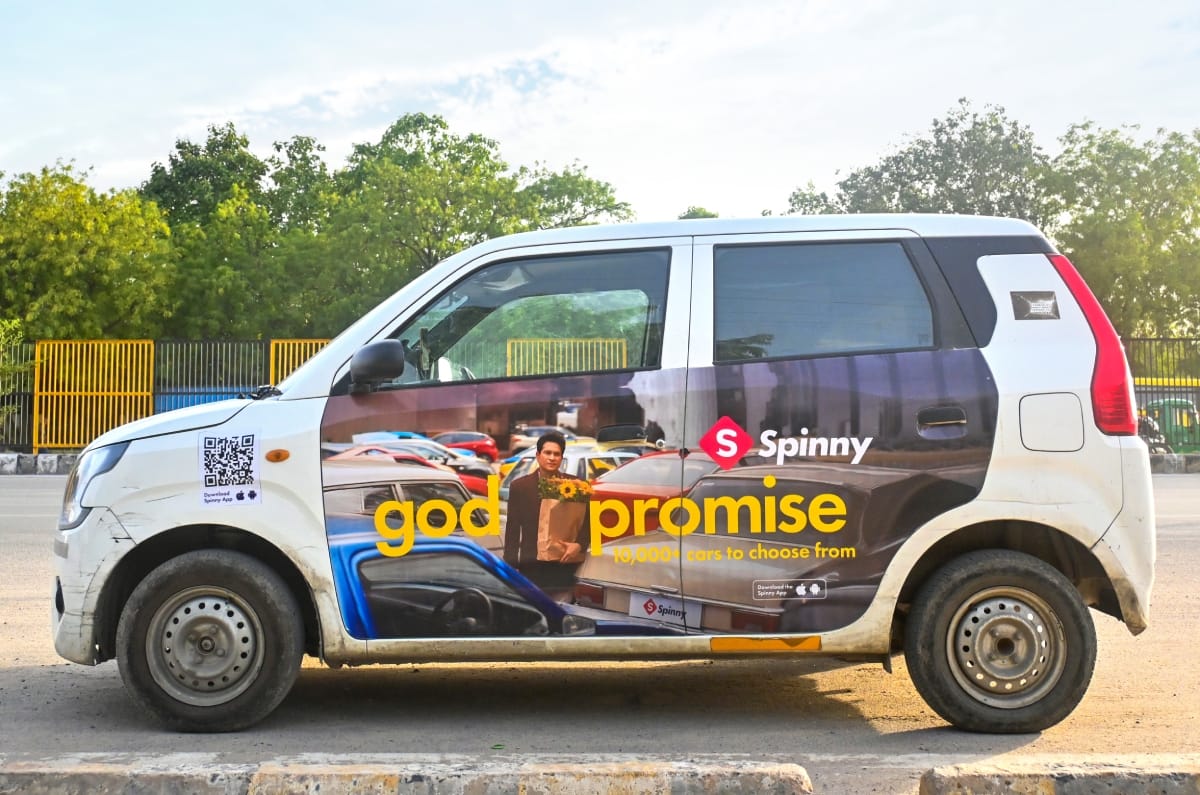
Beyond vehicle manufacturers, some small-scale dealers and used-car platforms also offer warranty packages. Spinny, for instance, offers different warranties based on the category of the used car: Budget, Assured and Assured+. The Budget category gets a 6-month/6,000km powertrain warranty and a 2-month/2,000km warranty, while the Assured models offer a 1-year/12,000km powertrain warranty and a 3-month/3,000km warranty.
The Assured+ cars come with a 3-year/36,000km powertrain warranty and a 6-month/6,000km comprehensive warranty, whichever comes first. Notably, Spinny became the first used-car retailer in India to introduce a 3-year warranty on its Assured+ cars in June 2025.
Spinny’s extended warranty, valid only for Assured and Budget cars, provides additional peace of mind and is available as an additional purchase for your car.
In conclusion, a car warranty protects you against manufacturing and assembly defects, not routine servicing or normal wear and tear. Understanding what is covered, excluded and can void the warranty will help avoid expensive surprises later. Also, an extended warranty may not be necessary for every owner, but if you plan to keep your car for several years beyond the standard warranty period, it can be a worthwhile investment.
आईटी कंपनी HCLTech ने जर्मनी की ऑटोमोटिव सॉफ्टवेयर कंपनी e.solutions के साथ कई साल की रणनीतिक साझेदारी की है। e.solutions, फॉक्सवैगन ग्रुप (Volkswagen Group) का हिस्सा है। इस साझेदारी के तहत दोनों कंपनियां कारों में इस्तेमाल होने वाले एंटरटेनमेंट, नेविगेशन, इंटरनेट और दूसरे डिजिटल फीचर्स के लिए नई सॉफ्टवेयर टेक्नोलॉजी डेवलप करेंगी।
AI बेस्ड कार टेक्नोलॉजी पर फोकस
इस समझौते के तहत HCLTech, Android Automotive प्लेटफॉर्म पर आधारित AI-इनेबल्ड सिस्टम डेवलप करने में मदद करेगी।
इन तकनीकों का मकसद कारों में बेहतर डिजिटल अनुभव देना है। ऑटोमोबाइल इंडस्ट्री में तेजी से ऐसी गाड़ियों की मांग बढ़ रही है, जिनमें स्मार्ट कनेक्टिविटी, इंटरनेट आधारित सेवाएं, डिजिटल कंट्रोल और बेहतर एंटरटेनमेंट सिस्टम मौजूद हों।
HCLTech क्या काम करेगी?
HCLTech इस साझेदारी में कारों के डिजिटल स्क्रीन से जुड़े सॉफ्टवेयर डेवलप करेगी। कंपनी इन सॉफ्टवेयर को अलग-अलग सिस्टम के साथ जोड़ने का काम भी करेगी। इसके अलावा उनकी टेस्टिंग और वैलिडेशन की जिम्मेदारी भी HCLTech संभालेगी।
यह तकनीक कई तरह के व्हीकल मॉडल में इस्तेमाल की जाएगी। इसका मकसद अलग-अलग हार्डवेयर प्लेटफॉर्म और वैश्विक बाजारों में एक जैसा डिजिटल अनुभव देना है।
e.solutions क्या करती है?
e.solutions कारों में इस्तेमाल होने वाले एंटरटेनमेंट, नेविगेशन और कनेक्टिविटी सॉफ्टवेयर बनाती है। कंपनी ऐसे सॉफ्टवेयर और एप्लिकेशन तैयार करती है, जिनकी मदद से कारों में म्यूजिक, मैप्स, कॉलिंग, इंटरनेट और दूसरे डिजिटल फीचर्स काम करते हैं।
इसके अलावा कंपनी अपने वैश्विक पार्टनर नेटवर्क की तकनीकों को भी इन सिस्टम्स के साथ जोड़ती है, ताकि ग्राहकों को आधुनिक और बेहतर डिजिटल सुविधाएं मिल सकें।
HCLTech ने क्या कहा?
HCLTech के मुताबिक, AI आधारित इंजीनियरिंग और ऑटोमोबाइल सेक्टर में उसके अनुभव की मदद से e.solutions नई पीढ़ी के डिजिटल कार प्लेटफॉर्म तेजी से डेवलप कर सकेगी।
कंपनी ने कहा कि यह साझेदारी वैश्विक ऑटोमोबाइल इंडस्ट्री में उसकी मजबूत मौजूदगी को और बढ़ाएगी। साथ ही यह भी दिखाती है कि HCLTech अंतरराष्ट्रीय स्तर पर बड़े और जटिल इंजीनियरिंग प्रोजेक्ट्स को संभालने की क्षमता रखती है।
HCL Technologies के शेयर
HCL Technologies का शेयर BSE पर 7.10 रुपये यानी 0.61% की बढ़त के साथ 1,166.45 रुपये पर बंद हुआ।
Disclaimer: मनीकंट्रोल.कॉम पर दिए गए सलाह या विचार एक्सपर्ट/ब्रोकरेज फर्म के अपने निजी विचार होते हैं। वेबसाइट या मैनेजमेंट इसके लिए उत्तरदायी नहीं है। यूजर्स को मनीकंट्रोल की सलाह है कि कोई भी निवेश निर्णय लेने से पहले हमेशा सर्टिफाइड एक्सपर्ट की सलाह लें।